
Ever wondered what makes up everything around you? This topic...
 Science7 views·Updated Jun 7, 2026·6 pages
Understanding Elements, Compounds, and Mixtures: Simple Science Guide
1 / 6
1
of 6
Introduction to Substances and Key Definitions
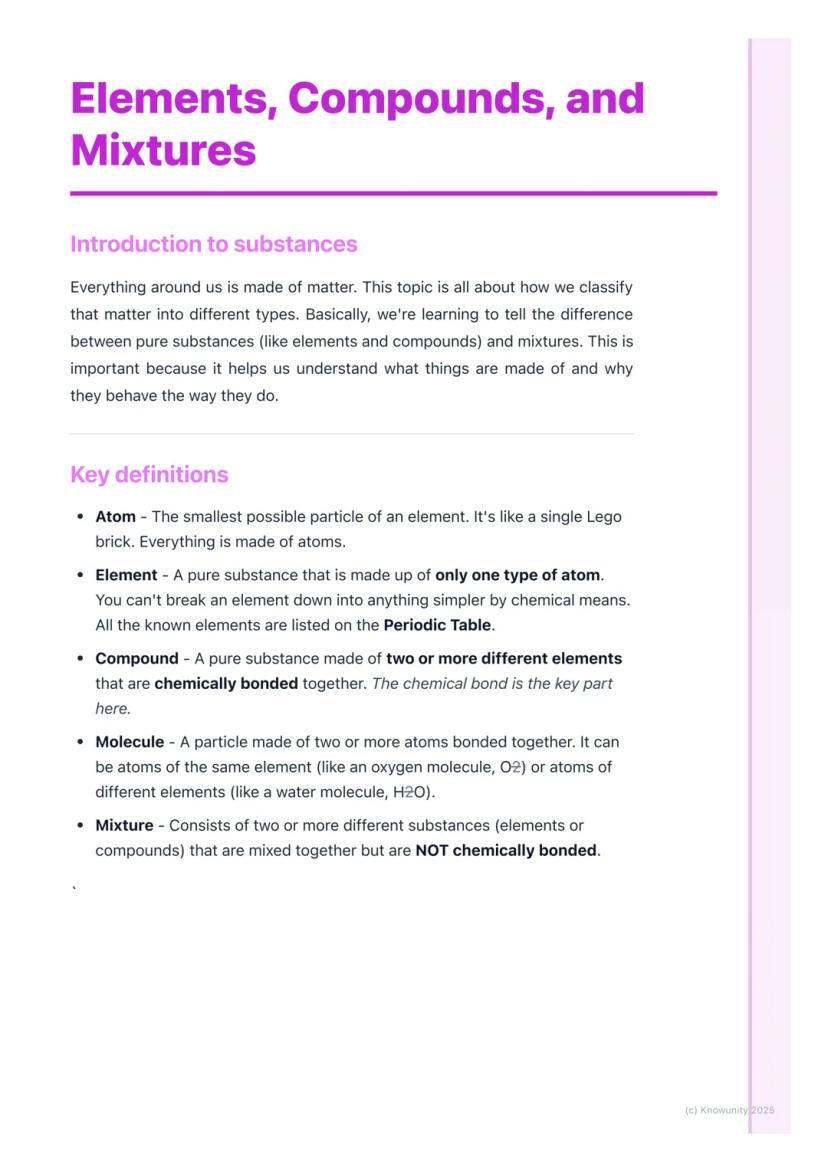
Everything you touch, see, or breathe is made of matter, and scientists have clever ways to classify it all. Think of it like sorting your wardrobe - we need categories to make sense of things!
The smallest building blocks are atoms - imagine them as tiny Lego bricks that make up everything. An element is like having a box of identical Lego bricks (only one type of atom), whilst a compound is when different coloured bricks stick together permanently.
Molecules are simply groups of atoms bonded together - they could be identical atoms (like oxygen gas O₂) or different ones (like water H₂O). Finally, mixtures are when different substances hang out together but aren't actually stuck to each other - like having loose Lego bricks of different colours in the same box.
Quick Check: If you can physically separate something (like picking out smarties from a bag of mixed sweets), it's probably a mixture!
2
of 6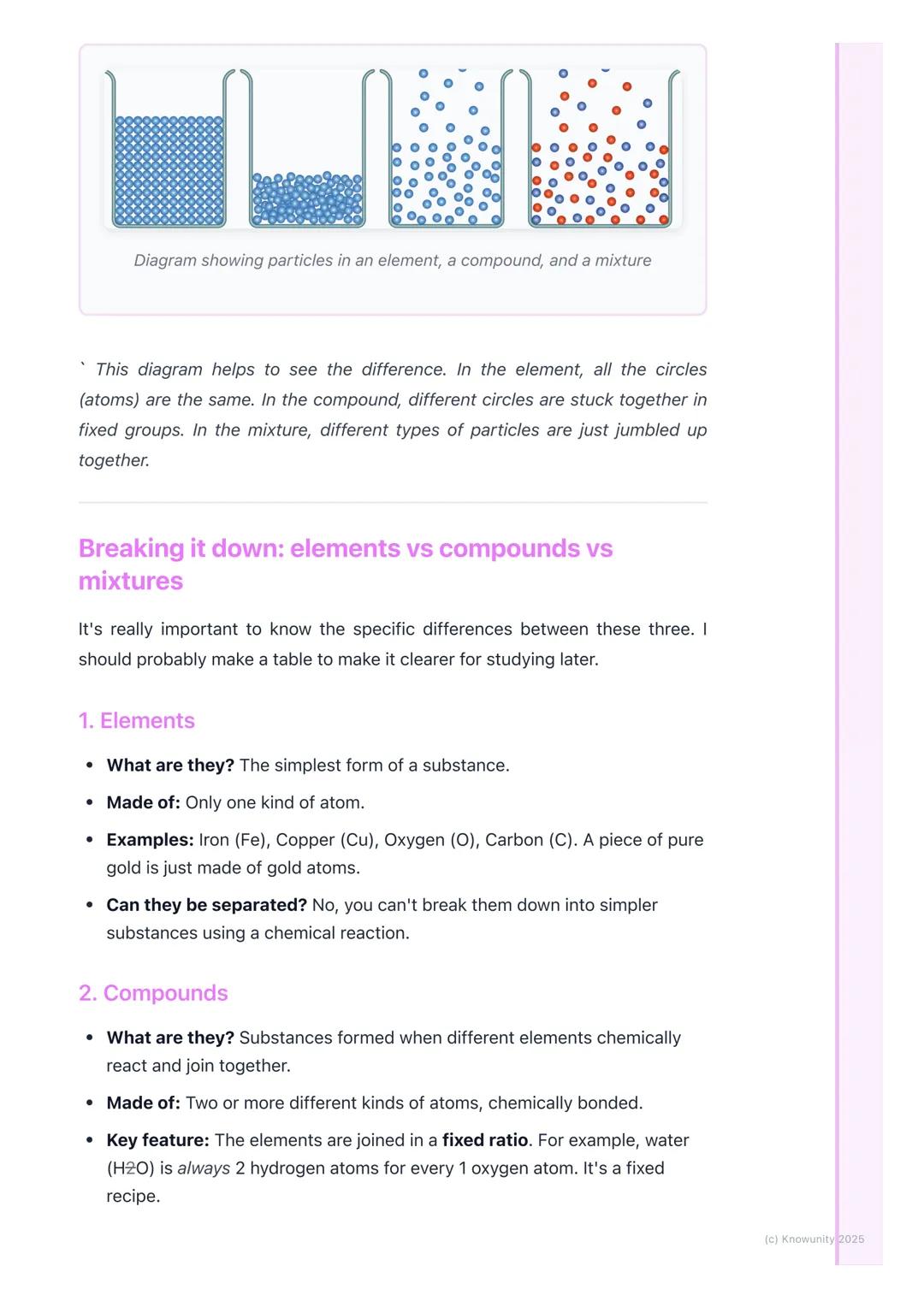
Breaking Down: Elements vs Compounds vs Mixtures
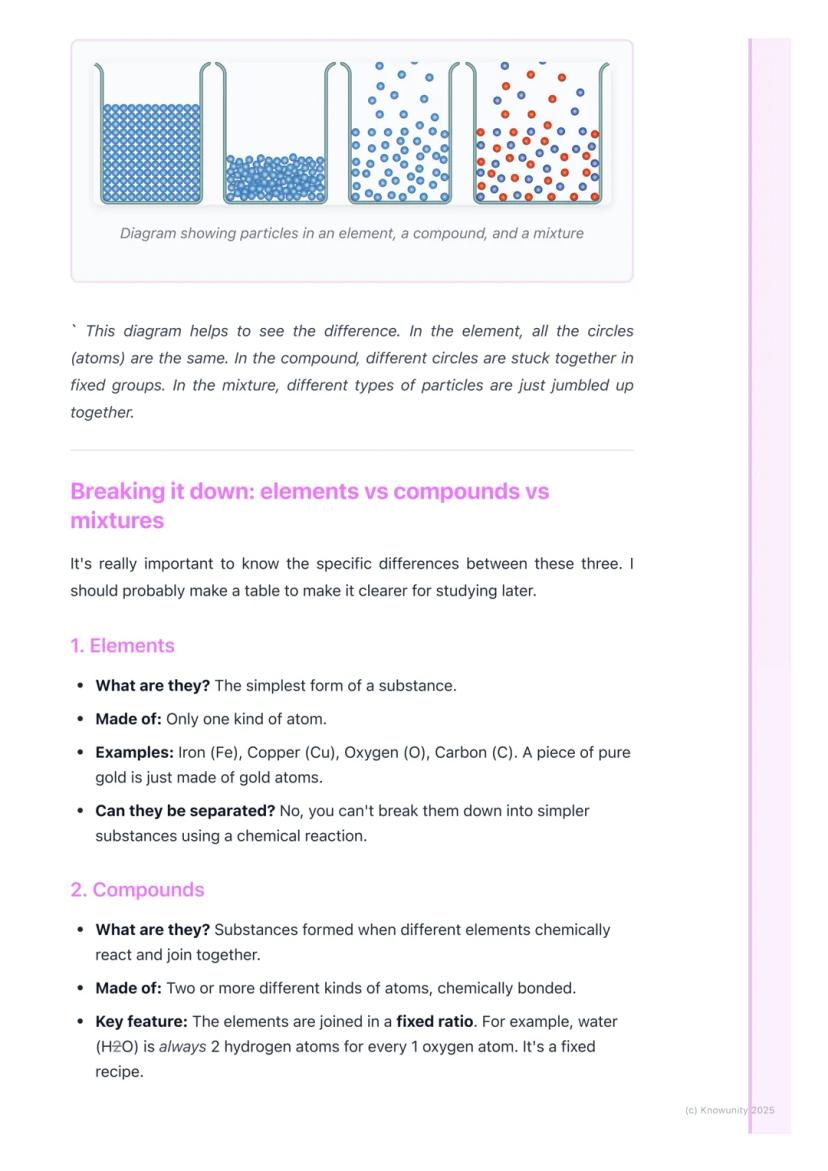
Elements are the simplest substances you can find - they're made of just one type of atom. Think gold jewellery (pure gold atoms) or the helium in balloons. You literally cannot break them down any further using chemical reactions.
Compounds form when different elements chemically react and bond together in fixed ratios. Water is always H₂O (never H₃O or HO), and table salt is always NaCl. Here's the mad bit - sodium explodes in water and chlorine is poisonous, but together they make the salt on your chips!
Mixtures are much more relaxed - different substances just mixed together without chemical bonds. Your cup of tea is a mixture, and you can make it strong or weak because there's no fixed recipe. Each substance keeps its original properties, so the sugar stays sweet and the tea stays... well, tea-flavoured.
Memory Trick: Compounds have fixed recipes like baking (exact measurements needed), mixtures are like making a sandwich (add as much or as little as you want)!
3
of 6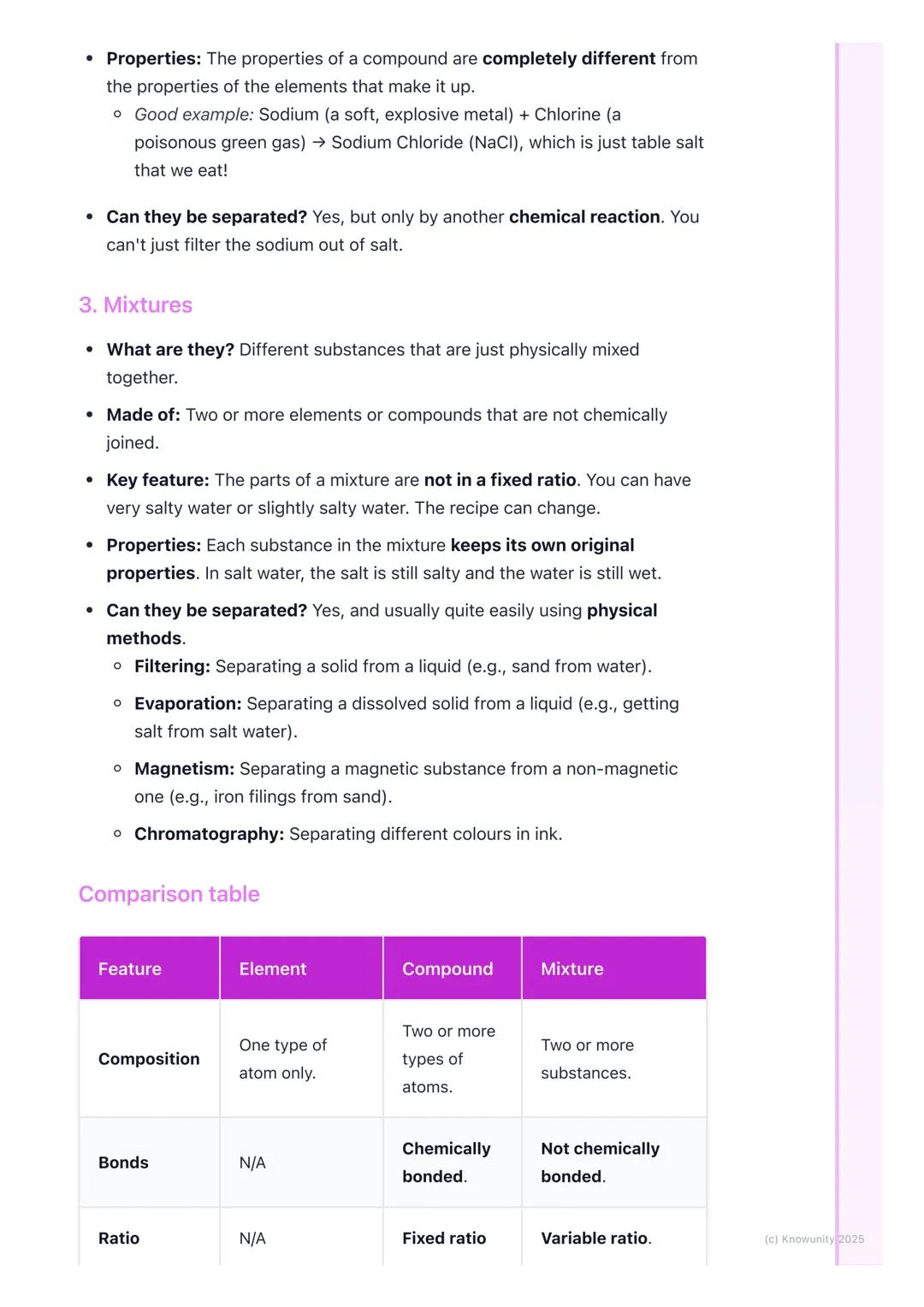
Separating Substances - The Big Difference
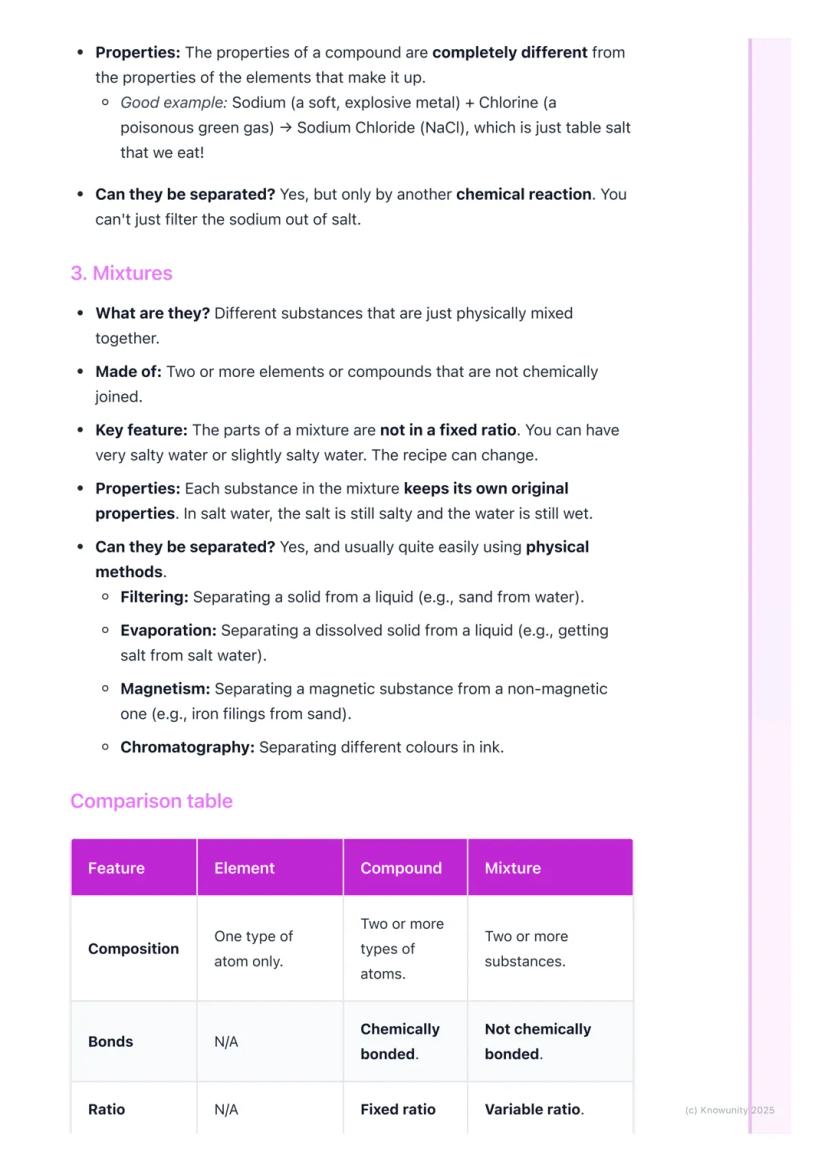
The easiest way to tell these apart is by thinking about separation. Elements cannot be broken down chemically - end of story. Compounds need another chemical reaction to split them up, which usually requires heat, electricity, or other chemicals.
Mixtures, however, are dead easy to separate using physical methods. You can use filtering to separate sand from water, evaporation to get salt from seawater, or magnetism to pull iron filings from sand. Chromatography is brilliant for separating different colours in ink.
The key difference comes down to chemical bonds. If different types of atoms are chemically bonded together, you've got a compound. If they're just hanging out together without bonds, it's a mixture.
Test Tip: If a question mentions separating things with filters, magnets, or evaporation, you're definitely dealing with a mixture!
4
of 6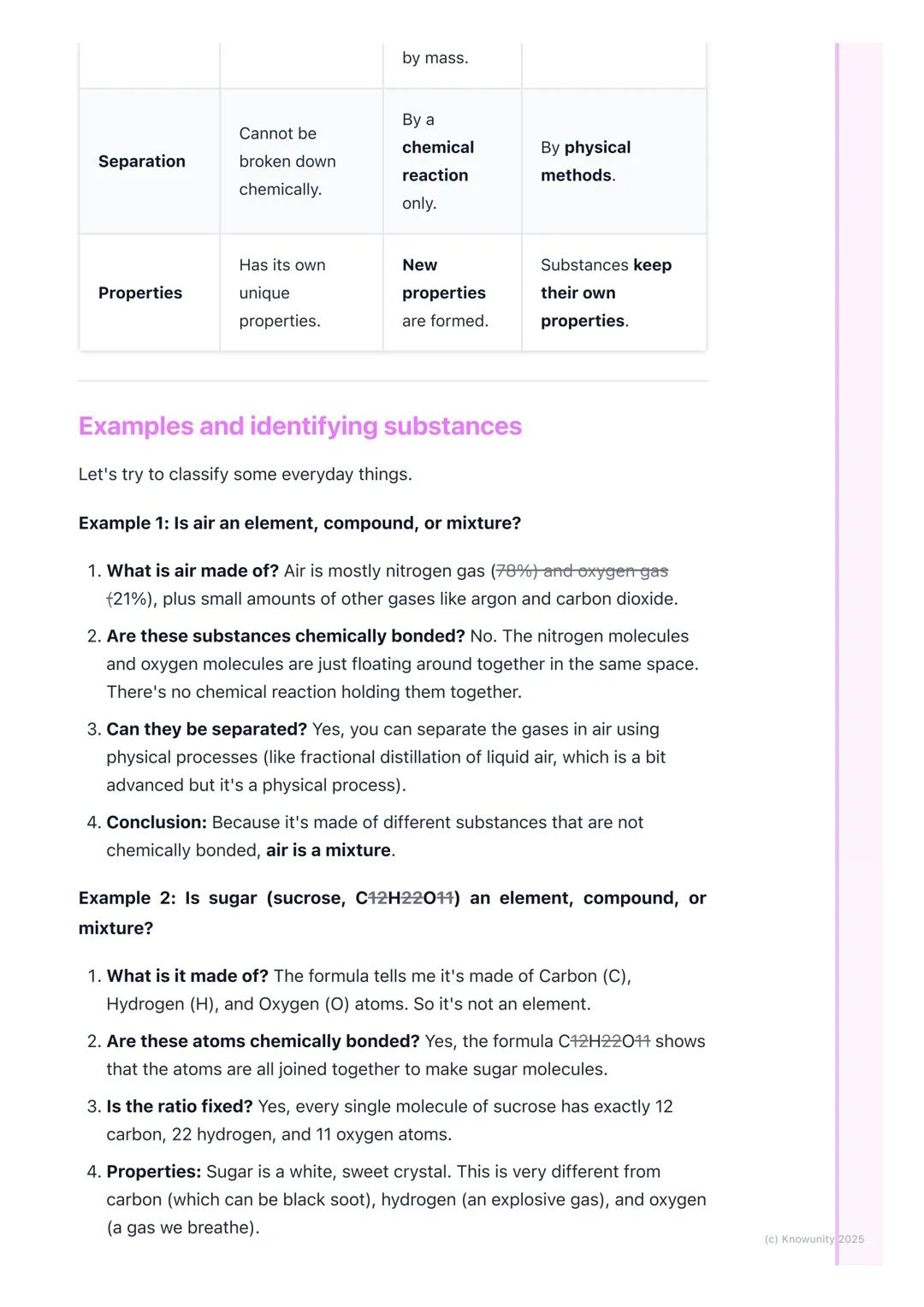
Examples and How to Identify Substances
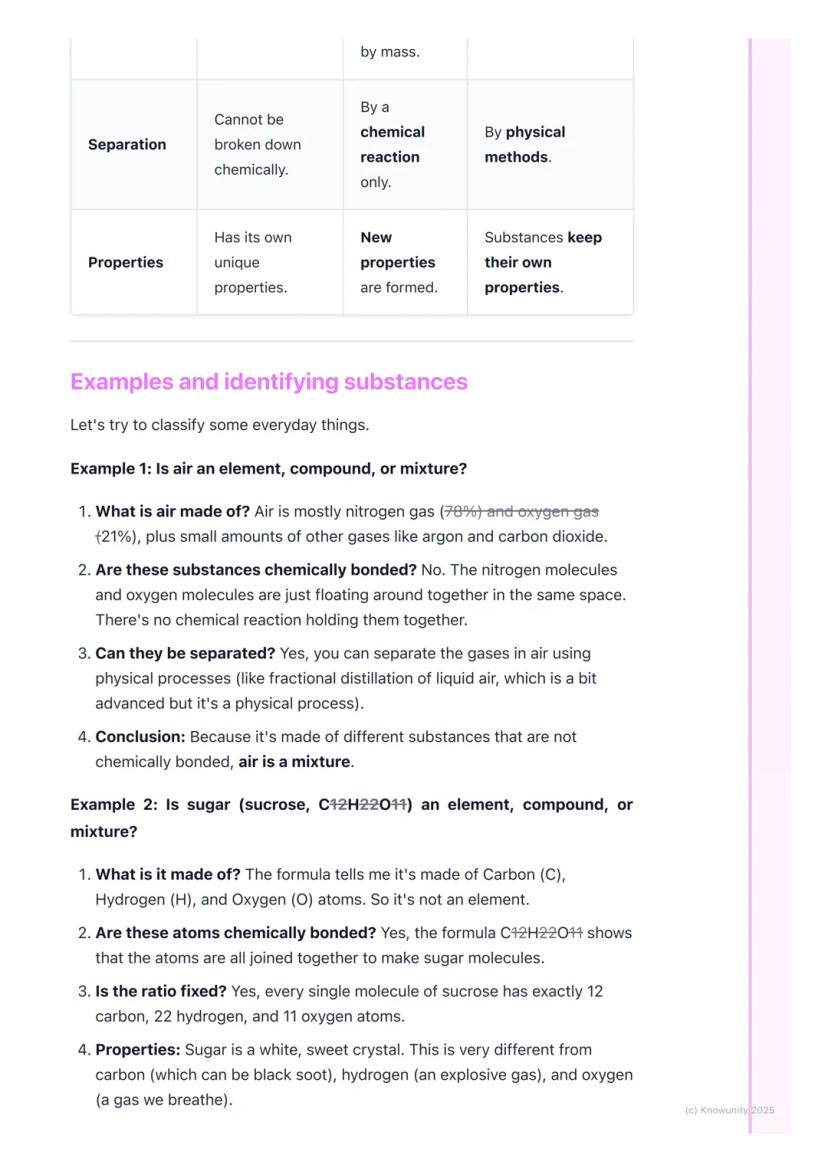
Let's practice with air - is it an element, compound, or mixture? Air contains nitrogen (78%), oxygen (21%), and other gases just floating around together. Since these gases aren't chemically bonded and can be separated physically, air is a mixture.
Now consider sugar (C₁₂H₂₂O₁₁) - the formula tells us it contains carbon, hydrogen, and oxygen atoms. These are chemically bonded in a fixed ratio, and sugar behaves completely differently from its individual elements. Sugar is definitely a compound.
When tackling these problems, ask yourself three questions: What's it made of? Are the parts chemically bonded? Can it be separated easily? These questions will guide you to the right answer every time.
Common Mistake: Don't confuse O₂ (oxygen gas) with a compound - it's still an element because it only contains one type of atom!
5
of 6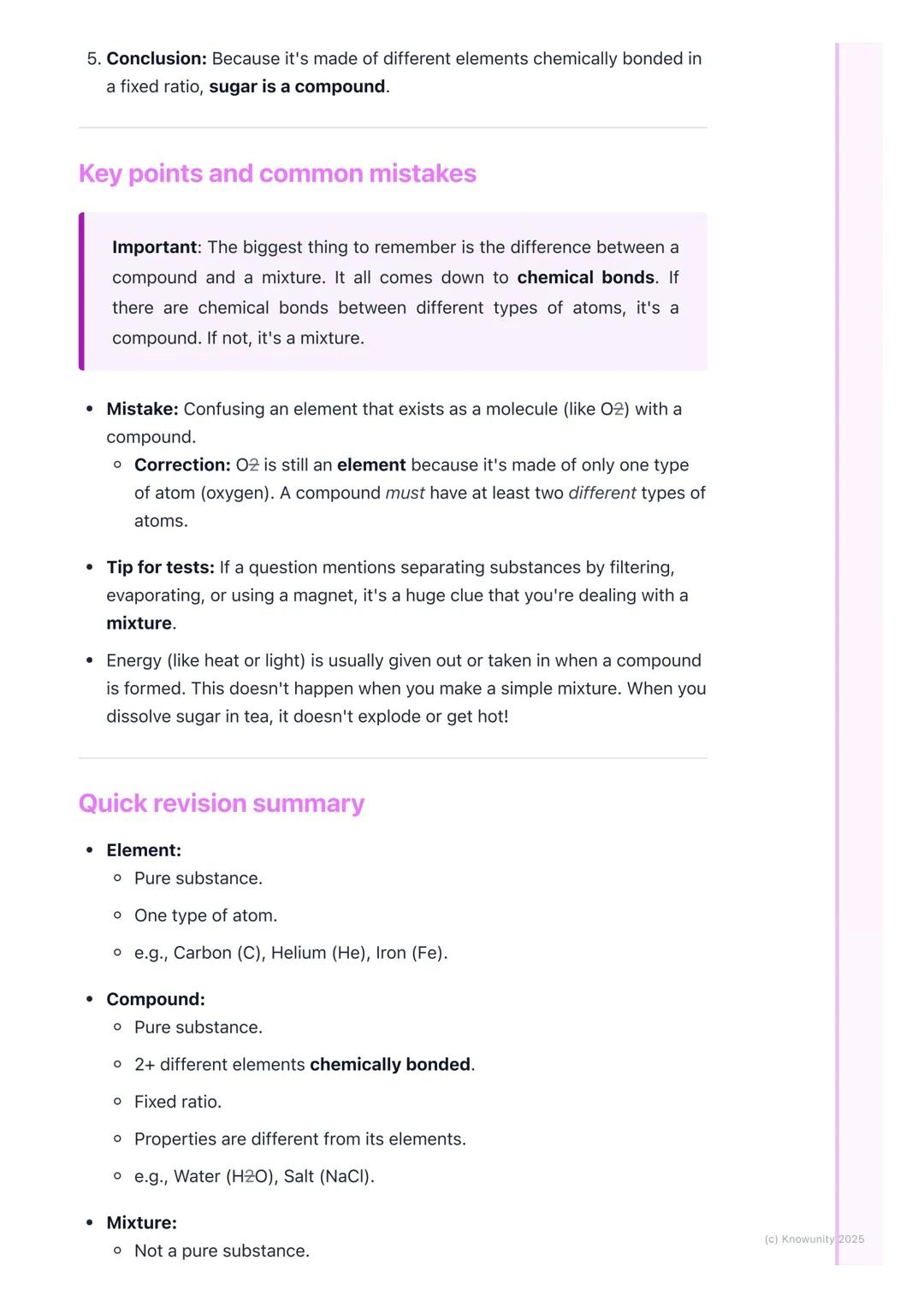
Quick Revision Summary
Elements are pure substances made of one type of atom only. Examples include carbon, helium, and iron. You cannot break them down chemically, and they're all listed on the periodic table.
Compounds are pure substances where two or more different elements are chemically bonded in fixed ratios. They have completely new properties compared to their original elements. Think water (H₂O) or salt (NaCl).
Mixtures contain two or more substances that aren't chemically bonded, can have variable ratios, and each substance keeps its original properties. Examples include saltwater, air, and that bag of mixed nuts you're probably snacking on right now.
Remember: it's all about those chemical bonds. No bonds between different substances = mixture. Chemical bonds between different elements = compound. Only one type of atom = element.
Success Strategy: Master the separation techniques for mixtures - they're exam favourites and really help you identify what type of substance you're dealing with!
6
of 6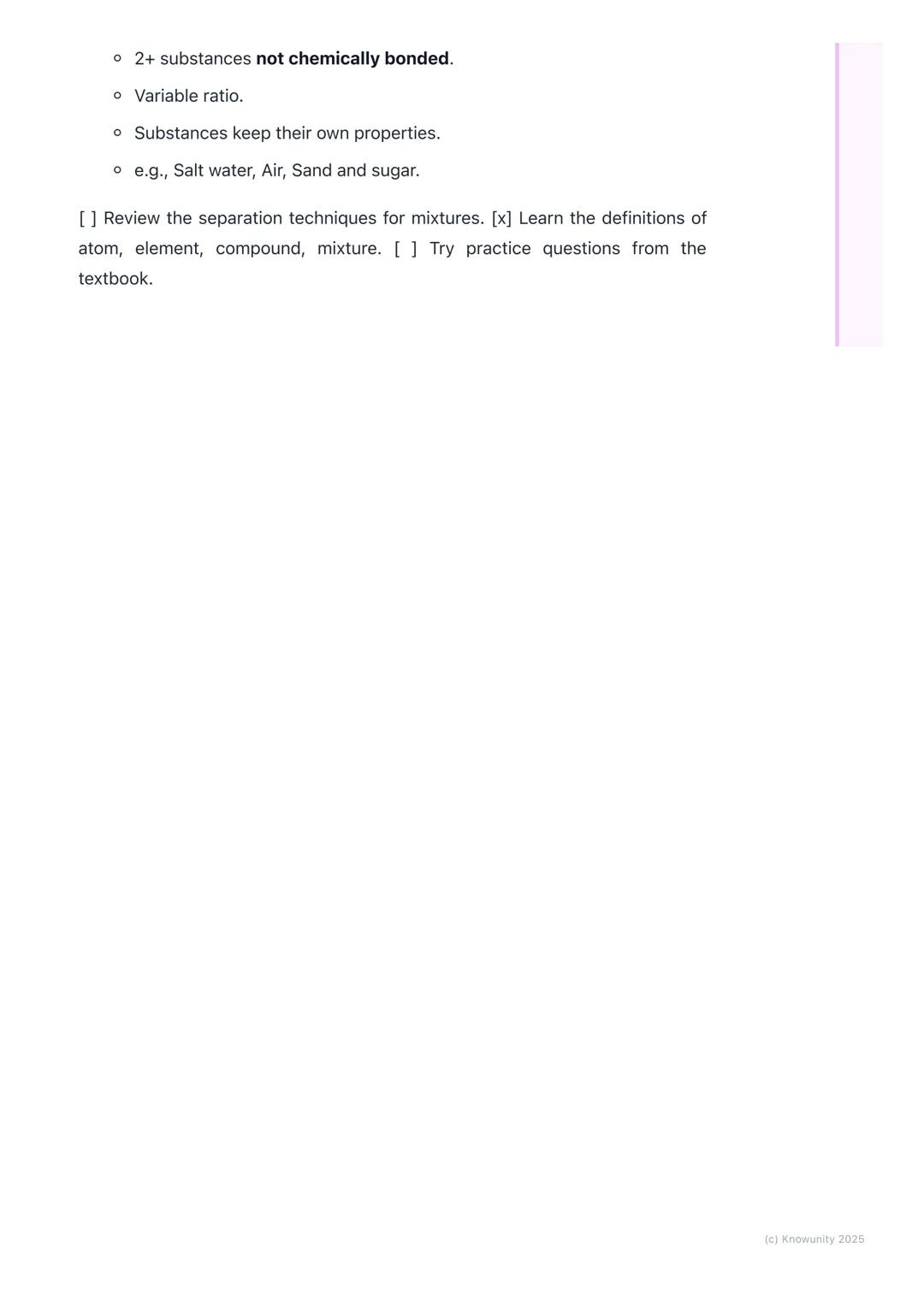
We thought you’d never ask...
What is the Knowunity AI companion?
Our AI companion is specifically built for the needs of students. Based on the millions of content pieces we have on the platform we can provide truly meaningful and relevant answers to students. But its not only about answers, the companion is even more about guiding students through their daily learning challenges, with personalised study plans, quizzes or content pieces in the chat and 100% personalisation based on the students skills and developments.
Where can I download the Knowunity app?
You can download the app in the Google Play Store and in the Apple App Store.
Is Knowunity really free of charge?
That's right! Enjoy free access to study content, connect with fellow students, and get instant help – all at your fingertips.
Most popular content in Science
7ScienceScience/Physics notes - Speed, density, work
Speed density work formulas
3rd Year81
ScienceAtomic Structure and the Periodic Table
Students will learn about the structure of atoms, including protons, neutrons, and electrons, and how elements are organised and classified in the Periodic Table based on their electronic configuration and chemical properties.
5th Year41
ScienceHuman Body Systems
An introduction to major human body systems such as the digestive, circulatory, respiratory, and nervous systems, understanding their basic functions.
2nd Year131
ScienceJunior Cert Science Notes: The Cell
Notes on the Cell
3rd Year261
ScienceCells
Junior cert science cells summary
1st Year611
ScienceHuman Reproductive System
A basic overview of the male and female reproductive systems, including their main structures and functions.
TY191
ScienceLight and Optics
Exploring the properties of light, including how it travels, reflects, and refracts, and how we perceive colours.
2nd Year50
Most popular content
9 Irish
IrishIrish oral questions and answers
Questions and answers for the leaving cert oral
5th Year4264
 English
Key Quotes : Sive
Key Quotes and explanations: Sive
6th Year2842
IrishIrish oral questions
Outline of oral questions
5th Year2055
IrishIníon- le hÁine Durkin
Aine Durkin’s poem, Iníon: Themes & summary
5th Year890
IrishIrish poetry 2027
Iníon + Dínit an Bhróin
5th Year1153
IrishLC HL notes- Iníon (poem)
Includes poem in English and Irish, theme, key words & phrases
5th Year2304
EnglishCultural Context : Shawshank Redemption : Sive : Small Things Like These
Comparative Study : Cultural Context : Shawshank Redemption, Sive and Small Things Like These
6th Year1430
IrishMo Ghrá-sa (Idir Lúibíní)
Notes on mo ghrá-sa
5th Year380
IrishAn Gaeilge Aiste
Irish Language essay
6th Year1320
Can't find what you're looking for? Explore other subjects.
Students love us — and so will you.
4.6/5App Store
4.7/5Google Play
The app is very easy to use and well designed. I have found everything I was looking for so far and have been able to learn a lot from the presentations! I will definitely use the app for a class assignment! And of course it also helps a lot as an inspiration.
Stefan SiOS user
This app is really great. There are so many study notes and help [...]. My problem subject is French, for example, and the app has so many options for help. Thanks to this app, I have improved my French. I would recommend it to anyone.
Samantha KlichAndroid user
Wow, I am really amazed. I just tried the app because I've seen it advertised many times and was absolutely stunned. This app is THE HELP you want for school and above all, it offers so many things, such as workouts and fact sheets, which have been VERY helpful to me personally.
AnnaiOS user
Science7 views·Updated Jun 7, 2026·6 pagesUnderstanding Elements, Compounds, and Mixtures: Simple Science Guide
Ever wondered what makes up everything around you? This topic breaks down how scientists classify all matter into three main categories: elements, compounds, and mixtures. Understanding these differences is crucial for chemistry and helps explain why things behave the way...
1
of 6
Sign up to see the content. It's free!
- Access to all documents
- Improve your grades
- Join milions of students
Introduction to Substances and Key Definitions
Everything you touch, see, or breathe is made of matter, and scientists have clever ways to classify it all. Think of it like sorting your wardrobe - we need categories to make sense of things!
The smallest building blocks are atoms - imagine them as tiny Lego bricks that make up everything. An element is like having a box of identical Lego bricks (only one type of atom), whilst a compound is when different coloured bricks stick together permanently.
Molecules are simply groups of atoms bonded together - they could be identical atoms (like oxygen gas O₂) or different ones (like water H₂O). Finally, mixtures are when different substances hang out together but aren't actually stuck to each other - like having loose Lego bricks of different colours in the same box.
Quick Check: If you can physically separate something (like picking out smarties from a bag of mixed sweets), it's probably a mixture!
2
of 6Sign up to see the content. It's free!
- Access to all documents
- Improve your grades
- Join milions of students
Breaking Down: Elements vs Compounds vs Mixtures
Elements are the simplest substances you can find - they're made of just one type of atom. Think gold jewellery (pure gold atoms) or the helium in balloons. You literally cannot break them down any further using chemical reactions.
Compounds form when different elements chemically react and bond together in fixed ratios. Water is always H₂O (never H₃O or HO), and table salt is always NaCl. Here's the mad bit - sodium explodes in water and chlorine is poisonous, but together they make the salt on your chips!
Mixtures are much more relaxed - different substances just mixed together without chemical bonds. Your cup of tea is a mixture, and you can make it strong or weak because there's no fixed recipe. Each substance keeps its original properties, so the sugar stays sweet and the tea stays... well, tea-flavoured.
Memory Trick: Compounds have fixed recipes like baking (exact measurements needed), mixtures are like making a sandwich (add as much or as little as you want)!
3
of 6Sign up to see the content. It's free!
- Access to all documents
- Improve your grades
- Join milions of students
Separating Substances - The Big Difference
The easiest way to tell these apart is by thinking about separation. Elements cannot be broken down chemically - end of story. Compounds need another chemical reaction to split them up, which usually requires heat, electricity, or other chemicals.
Mixtures, however, are dead easy to separate using physical methods. You can use filtering to separate sand from water, evaporation to get salt from seawater, or magnetism to pull iron filings from sand. Chromatography is brilliant for separating different colours in ink.
The key difference comes down to chemical bonds. If different types of atoms are chemically bonded together, you've got a compound. If they're just hanging out together without bonds, it's a mixture.
Test Tip: If a question mentions separating things with filters, magnets, or evaporation, you're definitely dealing with a mixture!
4
of 6Sign up to see the content. It's free!
- Access to all documents
- Improve your grades
- Join milions of students
Examples and How to Identify Substances
Let's practice with air - is it an element, compound, or mixture? Air contains nitrogen (78%), oxygen (21%), and other gases just floating around together. Since these gases aren't chemically bonded and can be separated physically, air is a mixture.
Now consider sugar (C₁₂H₂₂O₁₁) - the formula tells us it contains carbon, hydrogen, and oxygen atoms. These are chemically bonded in a fixed ratio, and sugar behaves completely differently from its individual elements. Sugar is definitely a compound.
When tackling these problems, ask yourself three questions: What's it made of? Are the parts chemically bonded? Can it be separated easily? These questions will guide you to the right answer every time.
Common Mistake: Don't confuse O₂ (oxygen gas) with a compound - it's still an element because it only contains one type of atom!
5
of 6Sign up to see the content. It's free!
- Access to all documents
- Improve your grades
- Join milions of students
Quick Revision Summary
Elements are pure substances made of one type of atom only. Examples include carbon, helium, and iron. You cannot break them down chemically, and they're all listed on the periodic table.
Compounds are pure substances where two or more different elements are chemically bonded in fixed ratios. They have completely new properties compared to their original elements. Think water (H₂O) or salt (NaCl).
Mixtures contain two or more substances that aren't chemically bonded, can have variable ratios, and each substance keeps its original properties. Examples include saltwater, air, and that bag of mixed nuts you're probably snacking on right now.
Remember: it's all about those chemical bonds. No bonds between different substances = mixture. Chemical bonds between different elements = compound. Only one type of atom = element.
Success Strategy: Master the separation techniques for mixtures - they're exam favourites and really help you identify what type of substance you're dealing with!
6
of 6Sign up to see the content. It's free!
- Access to all documents
- Improve your grades
- Join milions of students
We thought you’d never ask...
What is the Knowunity AI companion?
Our AI companion is specifically built for the needs of students. Based on the millions of content pieces we have on the platform we can provide truly meaningful and relevant answers to students. But its not only about answers, the companion is even more about guiding students through their daily learning challenges, with personalised study plans, quizzes or content pieces in the chat and 100% personalisation based on the students skills and developments.
Where can I download the Knowunity app?
You can download the app in the Google Play Store and in the Apple App Store.
Is Knowunity really free of charge?
That's right! Enjoy free access to study content, connect with fellow students, and get instant help – all at your fingertips.
Most popular content in Science
7ScienceScience/Physics notes - Speed, density, work
Speed density work formulas
3rd Year81
ScienceAtomic Structure and the Periodic Table
Students will learn about the structure of atoms, including protons, neutrons, and electrons, and how elements are organised and classified in the Periodic Table based on their electronic configuration and chemical properties.
5th Year41
ScienceHuman Body Systems
An introduction to major human body systems such as the digestive, circulatory, respiratory, and nervous systems, understanding their basic functions.
2nd Year131
ScienceJunior Cert Science Notes: The Cell
Notes on the Cell
3rd Year261
ScienceCells
Junior cert science cells summary
1st Year611
ScienceHuman Reproductive System
A basic overview of the male and female reproductive systems, including their main structures and functions.
TY191
ScienceLight and Optics
Exploring the properties of light, including how it travels, reflects, and refracts, and how we perceive colours.
2nd Year50
Most popular content
9IrishIrish oral questions and answers
Questions and answers for the leaving cert oral
5th Year4264
EnglishKey Quotes : Sive
Key Quotes and explanations: Sive
6th Year2842
IrishIrish oral questions
Outline of oral questions
5th Year2055
IrishIníon- le hÁine Durkin
Aine Durkin’s poem, Iníon: Themes & summary
5th Year890
IrishIrish poetry 2027
Iníon + Dínit an Bhróin
5th Year1153
IrishLC HL notes- Iníon (poem)
Includes poem in English and Irish, theme, key words & phrases
5th Year2304
EnglishCultural Context : Shawshank Redemption : Sive : Small Things Like These
Comparative Study : Cultural Context : Shawshank Redemption, Sive and Small Things Like These
6th Year1430
IrishMo Ghrá-sa (Idir Lúibíní)
Notes on mo ghrá-sa
5th Year380
IrishAn Gaeilge Aiste
Irish Language essay
6th Year1320
Can't find what you're looking for? Explore other subjects.
Students love us — and so will you.
4.6/5App Store
4.7/5Google Play
The app is very easy to use and well designed. I have found everything I was looking for so far and have been able to learn a lot from the presentations! I will definitely use the app for a class assignment! And of course it also helps a lot as an inspiration.
Stefan SiOS user
This app is really great. There are so many study notes and help [...]. My problem subject is French, for example, and the app has so many options for help. Thanks to this app, I have improved my French. I would recommend it to anyone.
Samantha KlichAndroid user
Wow, I am really amazed. I just tried the app because I've seen it advertised many times and was absolutely stunned. This app is THE HELP you want for school and above all, it offers so many things, such as workouts and fact sheets, which have been VERY helpful to me personally.
AnnaiOS user