
Ever wondered who the Irish people were before Christianity arrived?...
 History1 views·Updated Jun 14, 2026·7 pages
The Celts and Their Iron Age Legacy in Ireland

1 / 7
1
of 7
The Iron Age Arrives in Ireland
Picture Ireland around 600 BC - everything's about to change! The Celts arrived from central Europe (think Austria and Switzerland) bringing something revolutionary: the ability to make tools and weapons from iron ore. This was massive because iron was way stronger than bronze and much easier to find.
The Iron Age wasn't just about better metal - the Celts brought the Irish language, incredible art, and a whole new way of organizing society. They divided Ireland into about 150 small kingdoms called tuatha , each ruled by a warrior king called a Rí.
The Aos Dána were the celebrities of Celtic society - these "skilled people" included powerful druids (priests who memorized everything because they couldn't write), poets called filí, doctors, and judges. They were so respected that even kings had to listen to them!
Did you know? Druids had to memorize 20 years' worth of laws, stories, and religious knowledge because writing was forbidden in their training!
2
of 7
Celtic Society: All About the Pyramid
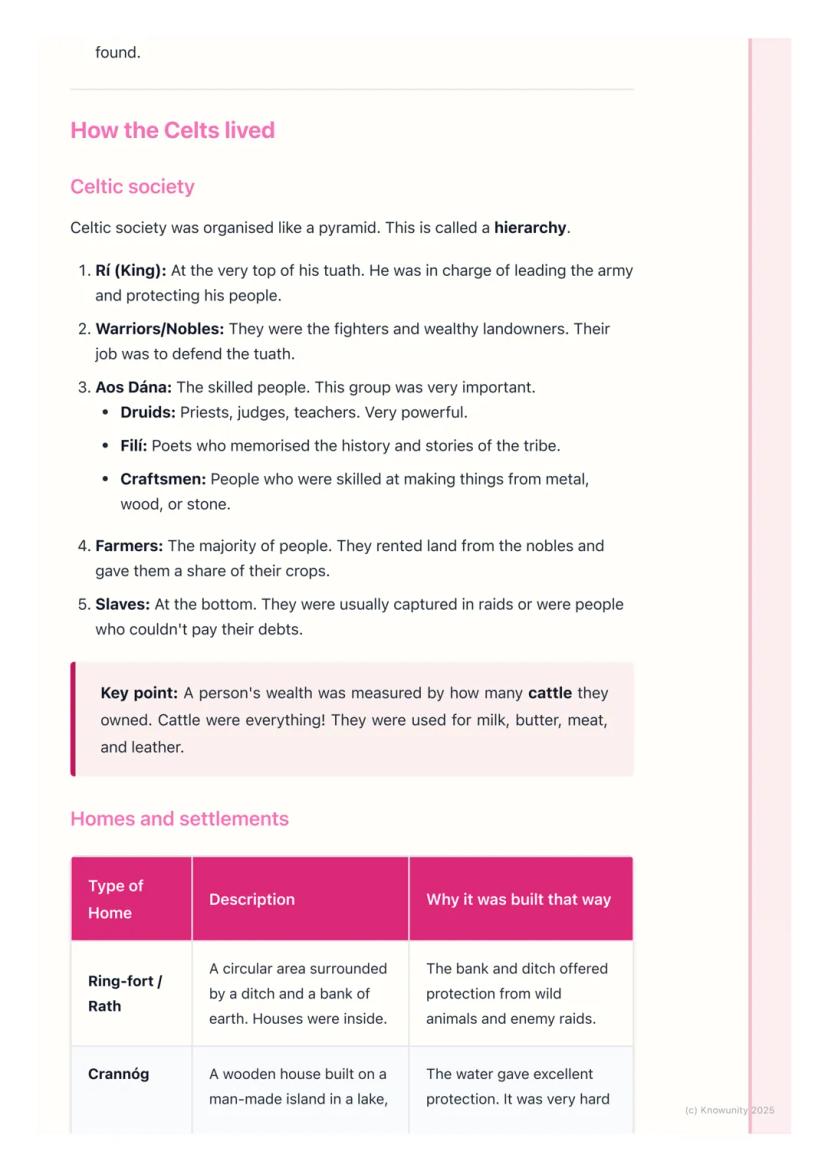
Think of Celtic society like a pyramid with the Rí (king) at the top of each tuath. Below him were warriors and nobles who owned land and fought battles. The Aos Dána came next - these skilled people were incredibly important even though they weren't necessarily warriors.
Most people were farmers who rented land from nobles and paid them with crops. At the bottom were slaves - usually people captured in raids or those who couldn't pay their debts. Here's the key thing: wealth was measured in cattle. No joke - cows were literally money! They provided milk, butter, meat, and leather.
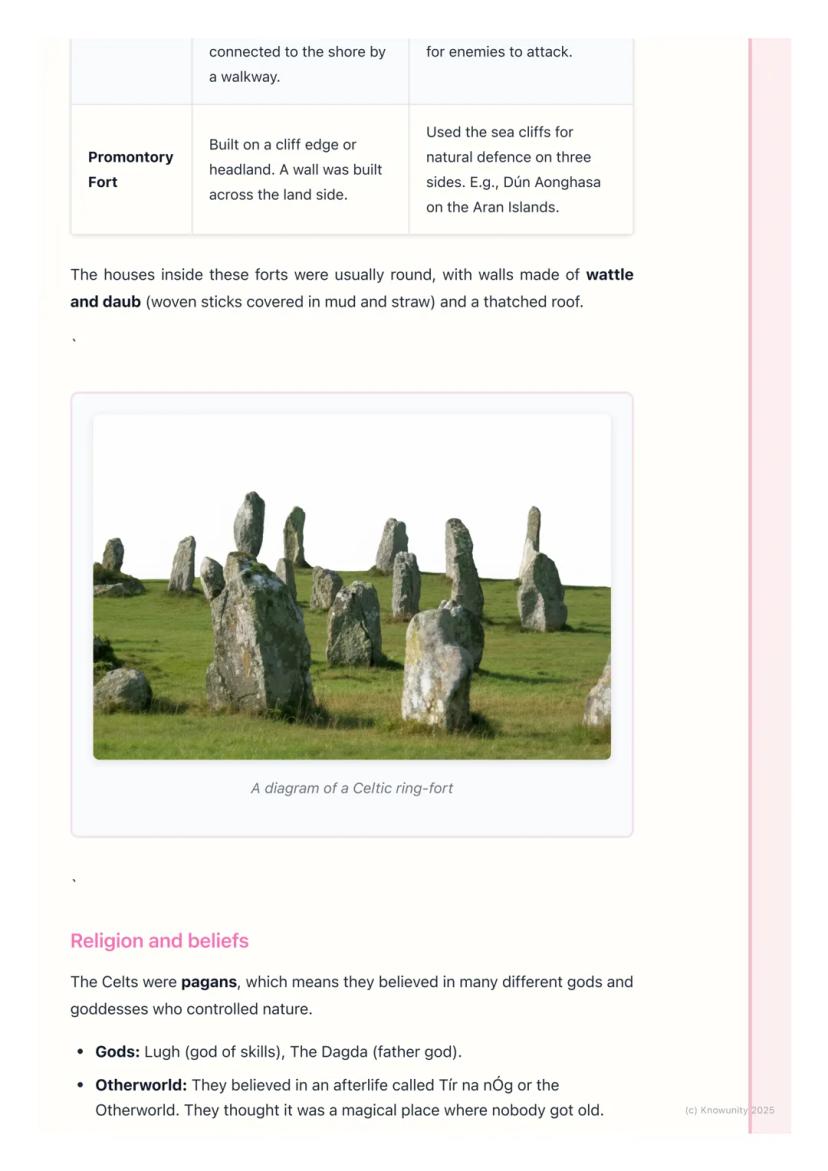
Celtic homes were built for protection. Ring-forts (or raths) were circular farmsteads surrounded by earth banks and ditches to keep out wild animals and raiders. For extra security, some families built crannógs - houses on artificial islands in lakes connected to shore by hidden walkways.
Remember this: In any exam answer about Celtic society, always mention that cattle = wealth. It's the golden rule!
3
of 7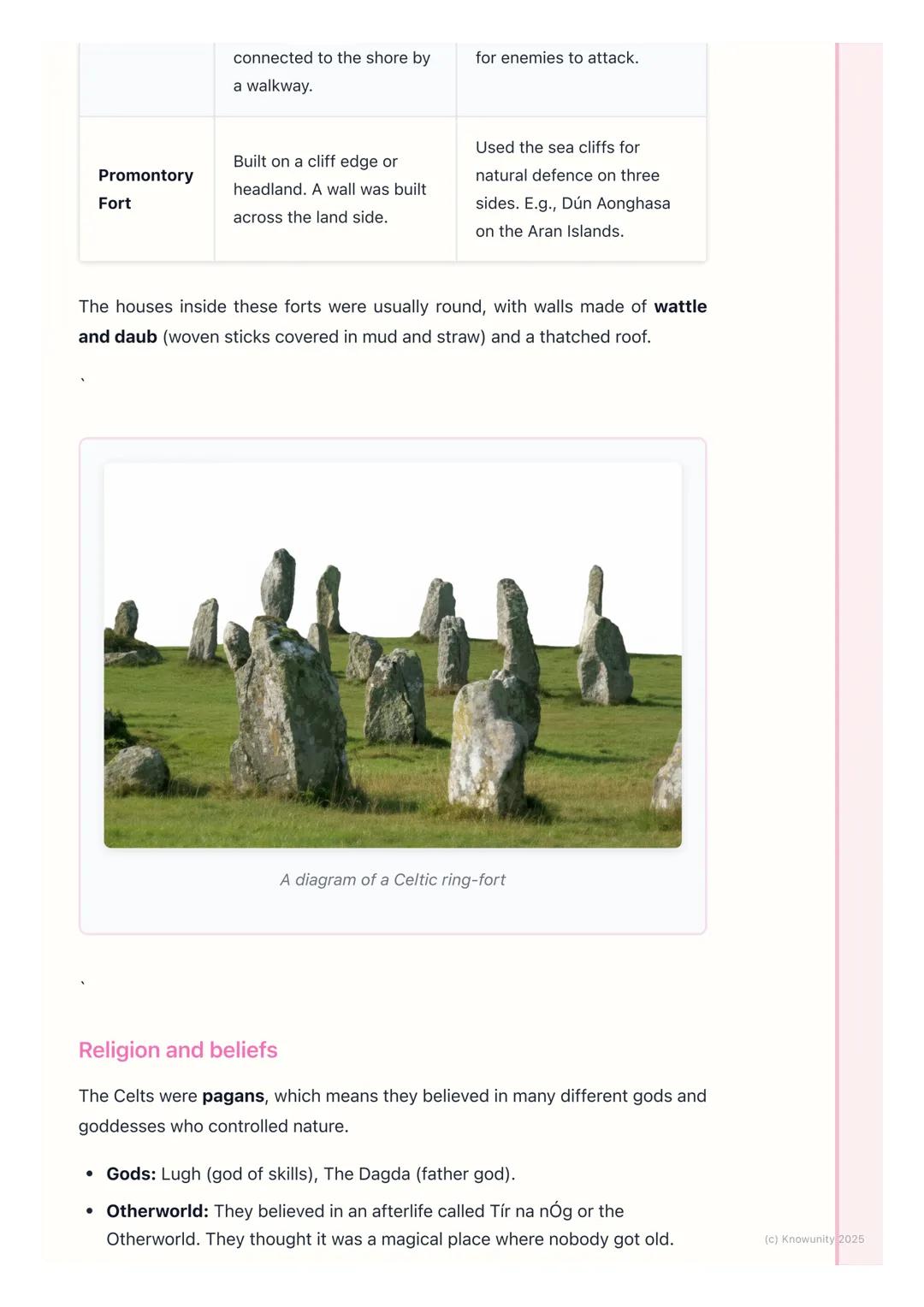
Daily Life and Beliefs
The Celts loved a good party! They celebrated four major festivals that matched the seasons: Samhain (Halloween's ancestor), Imbolc (spring's start), Bealtaine (summer begins), and Lughnasa (harvest time). These weren't just parties - they were serious religious events.
Celtic religion was all about nature gods and the Otherworld - their version of the afterlife. When important people died, they were buried with grave goods like swords, shields, and jewelry because they'd need them in the next life. The druids ran religious ceremonies and acted as judges using Brehon Law - ancient Irish laws they memorized word for word.
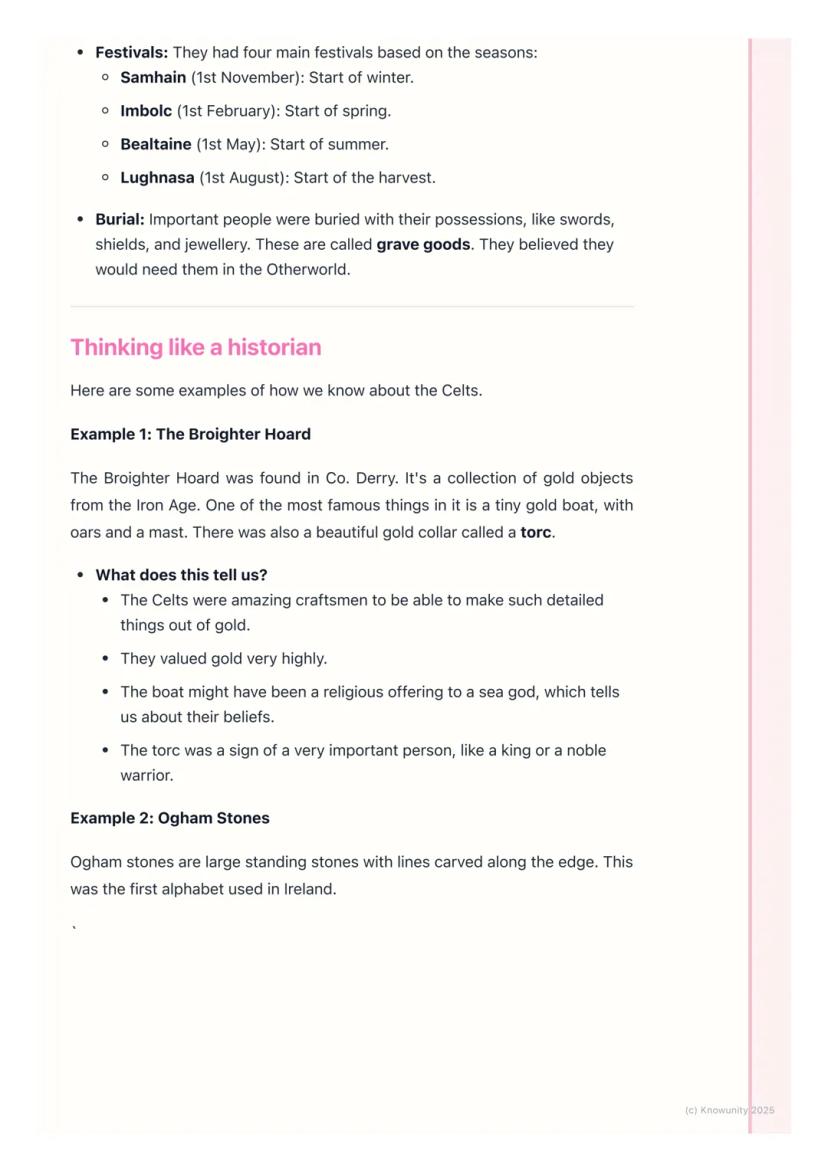
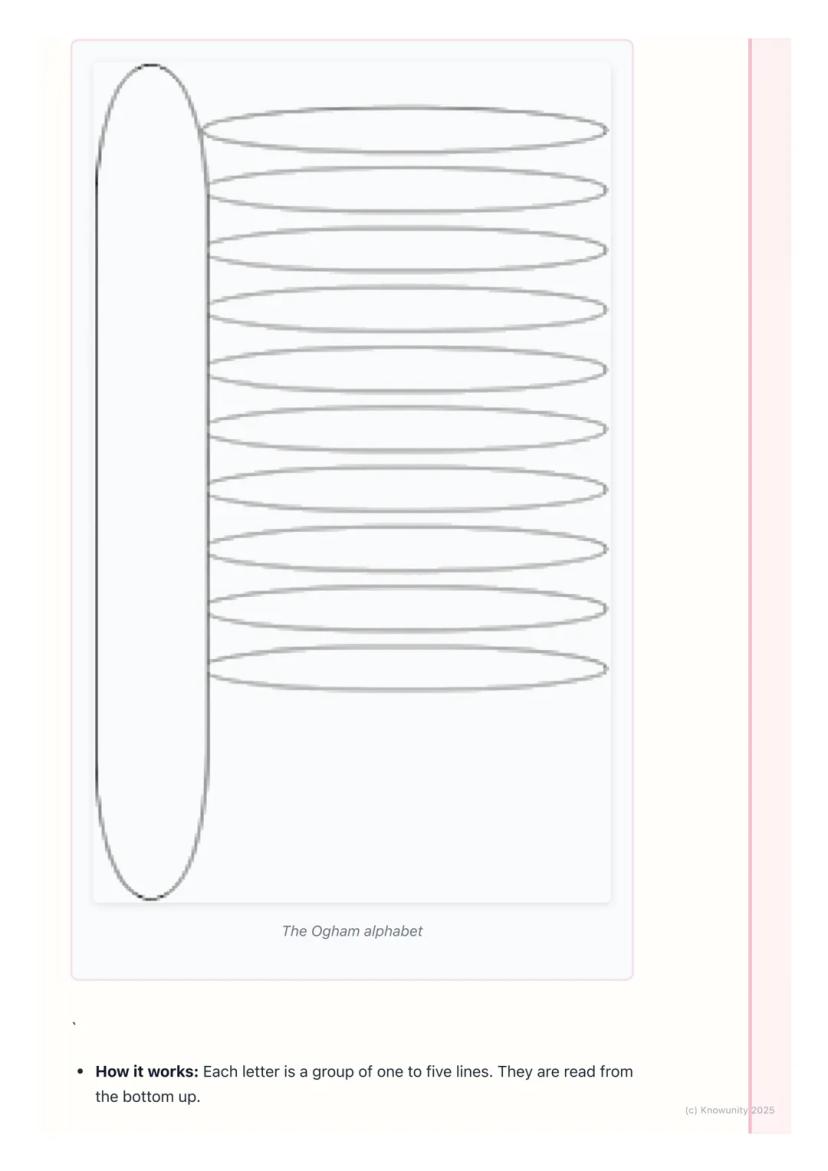
The Celts created the first writing system in Ireland called Ogham. These were lines and notches carved into stone edges, read from bottom to top. Most Ogham stones just marked graves or boundaries with simple messages like "this belonged to so-and-so."
Cool fact: The tiny gold boat in the Broighter Hoard might have been thrown into water as an offering to sea gods - showing how seriously Celts took their religion!
4
of 7
Evidence and Legacy
How do we know all this stuff about people from over 2,000 years ago? Archaeologists are like detectives! The Broighter Hoard found in County Derry shows us incredible Celtic craftsmanship - especially a tiny gold boat with working oars and mast, plus a gorgeous gold collar called a torc that screamed "I'm important!"
La Tène art was the Celtic style - think swirls, spirals, and animal patterns that flow together beautifully. You can see this on artifacts like the Turoe Stone. This art style proves the Celts weren't just tough warriors - they were seriously talented artists too.
The Ogham stones scattered around Ireland are like ancient text messages. Each letter was made of one to five lines carved along the stone's edge. Though most just say someone's name, they mark the beginning of written history in Ireland - pretty amazing for people whose priests weren't allowed to write!
Exam tip: Don't mix up Bronze Age and Iron Age! The big difference is the metal used - iron was much stronger and more available than bronze.
5
of 7
6
of 7
7
of 7
We thought you’d never ask...
What is the Knowunity AI companion?
Our AI companion is specifically built for the needs of students. Based on the millions of content pieces we have on the platform we can provide truly meaningful and relevant answers to students. But its not only about answers, the companion is even more about guiding students through their daily learning challenges, with personalised study plans, quizzes or content pieces in the chat and 100% personalisation based on the students skills and developments.
Where can I download the Knowunity app?
You can download the app in the Google Play Store and in the Apple App Store.
Is Knowunity really free of charge?
That's right! Enjoy free access to study content, connect with fellow students, and get instant help – all at your fingertips.
Most popular content in History
9HistoryThe Great Famine (An Gorta Mór)
Students will learn about the causes, devastating impact, and long-term consequences of the potato famine on Irish population and society.
2nd Year282
HistoryThe renaissance
junior cert renaissance summary
1st Year361
HistoryCauses and Consequences of World War II
This subtopic covers the origins of the Second World War, its global scale, and its devastating human and political consequences, including the atomic bomb.
3rd Year152
HistoryThe 1798 Rebellion in Ireland
Learning about the causes, events, and aftermath of the United Irishmen's rebellion against British rule, inspired by revolutionary ideals.
3rd Year211
HistoryAmerican revolution
junior cert american revolution summary
1st Year442
HistoryThe Great Famine (An Gorta Mór)
This critical subtopic examines the causes, devastating impact, and long-term consequences of the potato famine on Irish society, population, and emigration.
3rd Year140
HistoryThe Renaissance
Students will learn about a time of 'rebirth' in Europe, where new ideas in art, science, and literature flourished.
1st Year140
History1916 Rising Revison Sheet
revision sheet
3rd Year211
HistoryThe Reformation in Europe
Students will learn about the causes and key figures of the Protestant Reformation and its impact on European society and politics.
3rd Year110
Most popular content
9 Irish
IrishIrish oral questions and answers
Questions and answers for the leaving cert oral
5th Year4264
 English
Key Quotes : Sive
Key Quotes and explanations: Sive
6th Year2842
IrishIrish oral questions
Outline of oral questions
5th Year2055
IrishIníon- le hÁine Durkin
Aine Durkin’s poem, Iníon: Themes & summary
5th Year850
IrishIrish poetry 2027
Iníon + Dínit an Bhróin
5th Year1133
IrishLC HL notes- Iníon (poem)
Includes poem in English and Irish, theme, key words & phrases
5th Year2284
EnglishCultural Context : Shawshank Redemption : Sive : Small Things Like These
Comparative Study : Cultural Context : Shawshank Redemption, Sive and Small Things Like These
6th Year1430
IrishMo Ghrá-sa (Idir Lúibíní)
Notes on mo ghrá-sa
5th Year380
IrishAn Gaeilge Aiste
Irish Language essay
6th Year1320
Can't find what you're looking for? Explore other subjects.
Students love us — and so will you.
4.6/5App Store
4.7/5Google Play
The app is very easy to use and well designed. I have found everything I was looking for so far and have been able to learn a lot from the presentations! I will definitely use the app for a class assignment! And of course it also helps a lot as an inspiration.
Stefan SiOS user
This app is really great. There are so many study notes and help [...]. My problem subject is French, for example, and the app has so many options for help. Thanks to this app, I have improved my French. I would recommend it to anyone.
Samantha KlichAndroid user
Wow, I am really amazed. I just tried the app because I've seen it advertised many times and was absolutely stunned. This app is THE HELP you want for school and above all, it offers so many things, such as workouts and fact sheets, which have been VERY helpful to me personally.
AnnaiOS user
History1 views·Updated Jun 14, 2026·7 pagesThe Celts and Their Iron Age Legacy in Ireland
Ever wondered who the Irish people were before Christianity arrived? Meet the Celts- the warriors, craftspeople, and storytellers who shaped Ireland from around 600 BC. They brought iron tools, the Irish language, and amazing art that you can still...
1
of 7
Sign up to see the content. It's free!
- Access to all documents
- Improve your grades
- Join milions of students
The Iron Age Arrives in Ireland
Picture Ireland around 600 BC - everything's about to change! The Celts arrived from central Europe (think Austria and Switzerland) bringing something revolutionary: the ability to make tools and weapons from iron ore. This was massive because iron was way stronger than bronze and much easier to find.
The Iron Age wasn't just about better metal - the Celts brought the Irish language, incredible art, and a whole new way of organizing society. They divided Ireland into about 150 small kingdoms called tuatha , each ruled by a warrior king called a Rí.
The Aos Dána were the celebrities of Celtic society - these "skilled people" included powerful druids (priests who memorized everything because they couldn't write), poets called filí, doctors, and judges. They were so respected that even kings had to listen to them!
Did you know? Druids had to memorize 20 years' worth of laws, stories, and religious knowledge because writing was forbidden in their training!
2
of 7Sign up to see the content. It's free!
- Access to all documents
- Improve your grades
- Join milions of students
Celtic Society: All About the Pyramid
Think of Celtic society like a pyramid with the Rí (king) at the top of each tuath. Below him were warriors and nobles who owned land and fought battles. The Aos Dána came next - these skilled people were incredibly important even though they weren't necessarily warriors.
Most people were farmers who rented land from nobles and paid them with crops. At the bottom were slaves - usually people captured in raids or those who couldn't pay their debts. Here's the key thing: wealth was measured in cattle. No joke - cows were literally money! They provided milk, butter, meat, and leather.
Celtic homes were built for protection. Ring-forts (or raths) were circular farmsteads surrounded by earth banks and ditches to keep out wild animals and raiders. For extra security, some families built crannógs - houses on artificial islands in lakes connected to shore by hidden walkways.
Remember this: In any exam answer about Celtic society, always mention that cattle = wealth. It's the golden rule!
3
of 7Sign up to see the content. It's free!
- Access to all documents
- Improve your grades
- Join milions of students
Daily Life and Beliefs
The Celts loved a good party! They celebrated four major festivals that matched the seasons: Samhain (Halloween's ancestor), Imbolc (spring's start), Bealtaine (summer begins), and Lughnasa (harvest time). These weren't just parties - they were serious religious events.
Celtic religion was all about nature gods and the Otherworld - their version of the afterlife. When important people died, they were buried with grave goods like swords, shields, and jewelry because they'd need them in the next life. The druids ran religious ceremonies and acted as judges using Brehon Law - ancient Irish laws they memorized word for word.
The Celts created the first writing system in Ireland called Ogham. These were lines and notches carved into stone edges, read from bottom to top. Most Ogham stones just marked graves or boundaries with simple messages like "this belonged to so-and-so."
Cool fact: The tiny gold boat in the Broighter Hoard might have been thrown into water as an offering to sea gods - showing how seriously Celts took their religion!
4
of 7Sign up to see the content. It's free!
- Access to all documents
- Improve your grades
- Join milions of students
Evidence and Legacy
How do we know all this stuff about people from over 2,000 years ago? Archaeologists are like detectives! The Broighter Hoard found in County Derry shows us incredible Celtic craftsmanship - especially a tiny gold boat with working oars and mast, plus a gorgeous gold collar called a torc that screamed "I'm important!"
La Tène art was the Celtic style - think swirls, spirals, and animal patterns that flow together beautifully. You can see this on artifacts like the Turoe Stone. This art style proves the Celts weren't just tough warriors - they were seriously talented artists too.
The Ogham stones scattered around Ireland are like ancient text messages. Each letter was made of one to five lines carved along the stone's edge. Though most just say someone's name, they mark the beginning of written history in Ireland - pretty amazing for people whose priests weren't allowed to write!
Exam tip: Don't mix up Bronze Age and Iron Age! The big difference is the metal used - iron was much stronger and more available than bronze.
5
of 7Sign up to see the content. It's free!
- Access to all documents
- Improve your grades
- Join milions of students
6
of 7Sign up to see the content. It's free!
- Access to all documents
- Improve your grades
- Join milions of students
7
of 7Sign up to see the content. It's free!
- Access to all documents
- Improve your grades
- Join milions of students
We thought you’d never ask...
What is the Knowunity AI companion?
Our AI companion is specifically built for the needs of students. Based on the millions of content pieces we have on the platform we can provide truly meaningful and relevant answers to students. But its not only about answers, the companion is even more about guiding students through their daily learning challenges, with personalised study plans, quizzes or content pieces in the chat and 100% personalisation based on the students skills and developments.
Where can I download the Knowunity app?
You can download the app in the Google Play Store and in the Apple App Store.
Is Knowunity really free of charge?
That's right! Enjoy free access to study content, connect with fellow students, and get instant help – all at your fingertips.
Most popular content in History
9HistoryThe Great Famine (An Gorta Mór)
Students will learn about the causes, devastating impact, and long-term consequences of the potato famine on Irish population and society.
2nd Year282
HistoryThe renaissance
junior cert renaissance summary
1st Year361
HistoryCauses and Consequences of World War II
This subtopic covers the origins of the Second World War, its global scale, and its devastating human and political consequences, including the atomic bomb.
3rd Year152
HistoryThe 1798 Rebellion in Ireland
Learning about the causes, events, and aftermath of the United Irishmen's rebellion against British rule, inspired by revolutionary ideals.
3rd Year211
HistoryAmerican revolution
junior cert american revolution summary
1st Year442
HistoryThe Great Famine (An Gorta Mór)
This critical subtopic examines the causes, devastating impact, and long-term consequences of the potato famine on Irish society, population, and emigration.
3rd Year140
HistoryThe Renaissance
Students will learn about a time of 'rebirth' in Europe, where new ideas in art, science, and literature flourished.
1st Year140
History1916 Rising Revison Sheet
revision sheet
3rd Year211
HistoryThe Reformation in Europe
Students will learn about the causes and key figures of the Protestant Reformation and its impact on European society and politics.
3rd Year110
Most popular content
9IrishIrish oral questions and answers
Questions and answers for the leaving cert oral
5th Year4264
EnglishKey Quotes : Sive
Key Quotes and explanations: Sive
6th Year2842
IrishIrish oral questions
Outline of oral questions
5th Year2055
IrishIníon- le hÁine Durkin
Aine Durkin’s poem, Iníon: Themes & summary
5th Year850
IrishIrish poetry 2027
Iníon + Dínit an Bhróin
5th Year1133
IrishLC HL notes- Iníon (poem)
Includes poem in English and Irish, theme, key words & phrases
5th Year2284
EnglishCultural Context : Shawshank Redemption : Sive : Small Things Like These
Comparative Study : Cultural Context : Shawshank Redemption, Sive and Small Things Like These
6th Year1430
IrishMo Ghrá-sa (Idir Lúibíní)
Notes on mo ghrá-sa
5th Year380
IrishAn Gaeilge Aiste
Irish Language essay
6th Year1320
Can't find what you're looking for? Explore other subjects.
Students love us — and so will you.
4.6/5App Store
4.7/5Google Play
The app is very easy to use and well designed. I have found everything I was looking for so far and have been able to learn a lot from the presentations! I will definitely use the app for a class assignment! And of course it also helps a lot as an inspiration.
Stefan SiOS user
This app is really great. There are so many study notes and help [...]. My problem subject is French, for example, and the app has so many options for help. Thanks to this app, I have improved my French. I would recommend it to anyone.
Samantha KlichAndroid user
Wow, I am really amazed. I just tried the app because I've seen it advertised many times and was absolutely stunned. This app is THE HELP you want for school and above all, it offers so many things, such as workouts and fact sheets, which have been VERY helpful to me personally.
AnnaiOS user