
The Home Rule movement was Ireland's major political campaign from...
 History19 views·Updated Jun 4, 2026·6 pages
The Fight for Irish Independence: The Home Rule Movement
1 / 6
1
of 6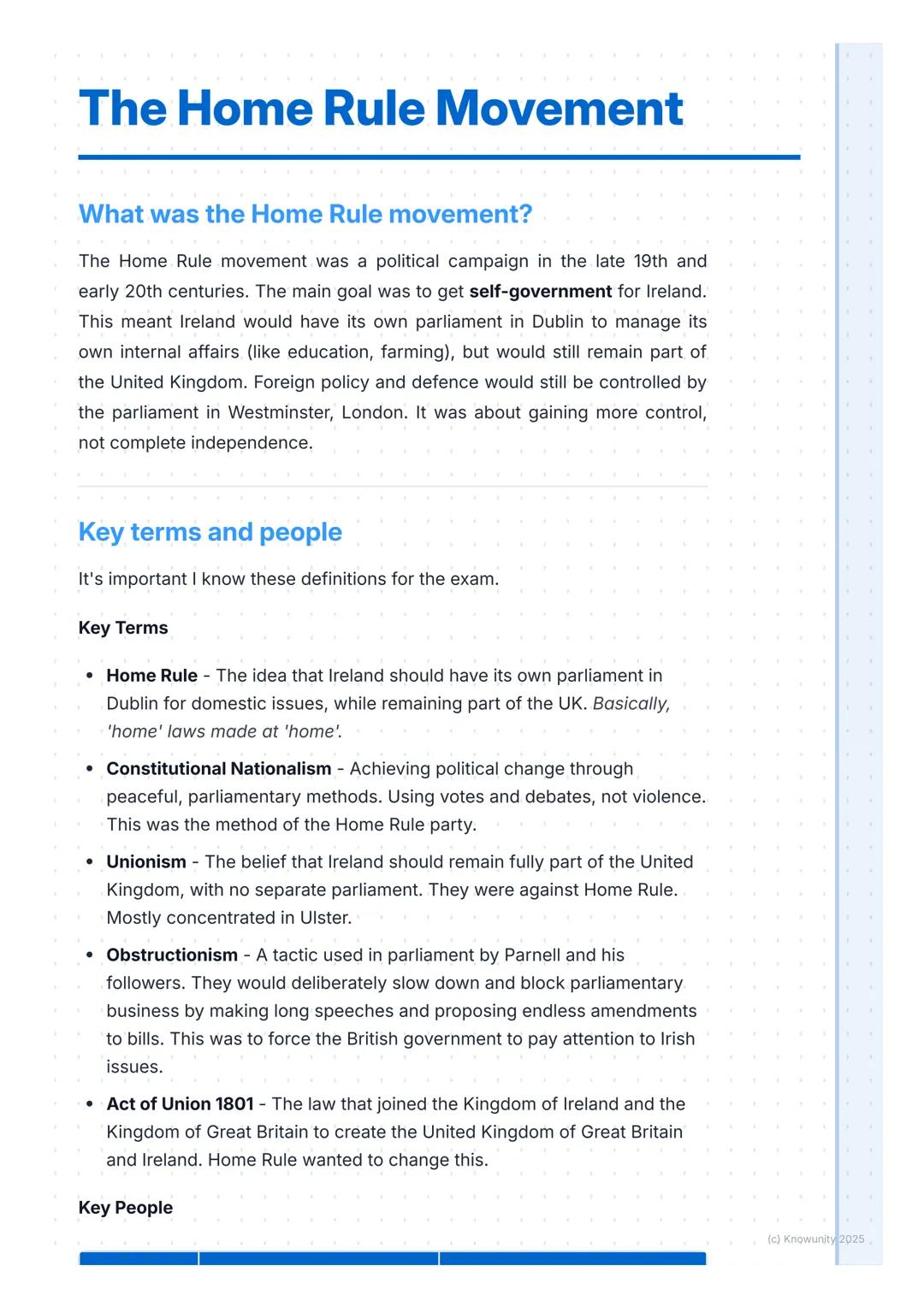
Understanding Home Rule and Key Players
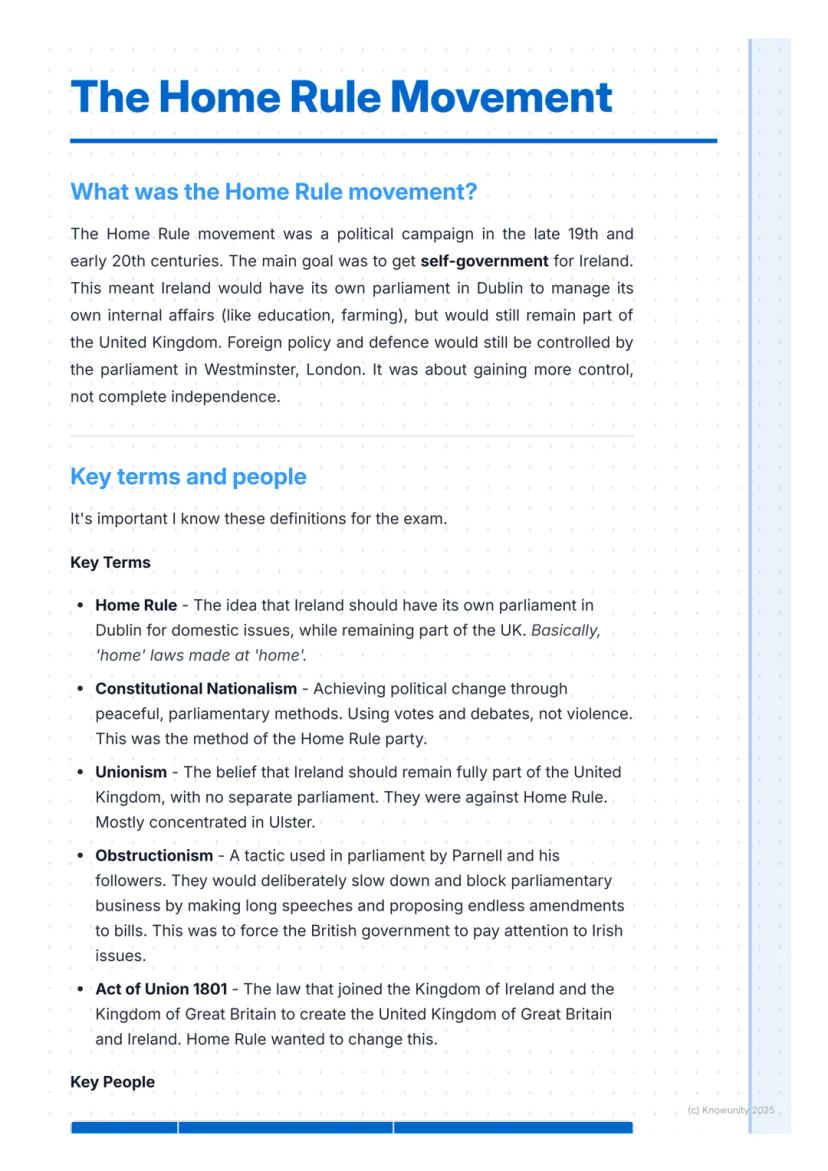
Home Rule wasn't about complete independence - it was about Ireland having its own parliament in Dublin for domestic affairs whilst remaining part of the United Kingdom. This approach was called constitutional nationalism, which meant achieving change through peaceful parliamentary methods rather than violence.
The movement had some brilliant tactics. Obstructionism was when Irish MPs deliberately slowed down British parliament by making endless speeches and proposing loads of amendments to bills - basically being as annoying as possible until Britain paid attention to Irish issues!
Isaac Butt started it all in 1870 with his Home Government Association, but his polite approach didn't work well. The real game-changer was Charles Stewart Parnell, who became leader in 1880 and was known as the "Uncrowned King of Ireland" - he was much more aggressive and effective.
Key Point: Remember that Unionists (mainly in Ulster) completely opposed Home Rule because they wanted Ireland to stay fully part of the UK with no separate parliament.
2
of 6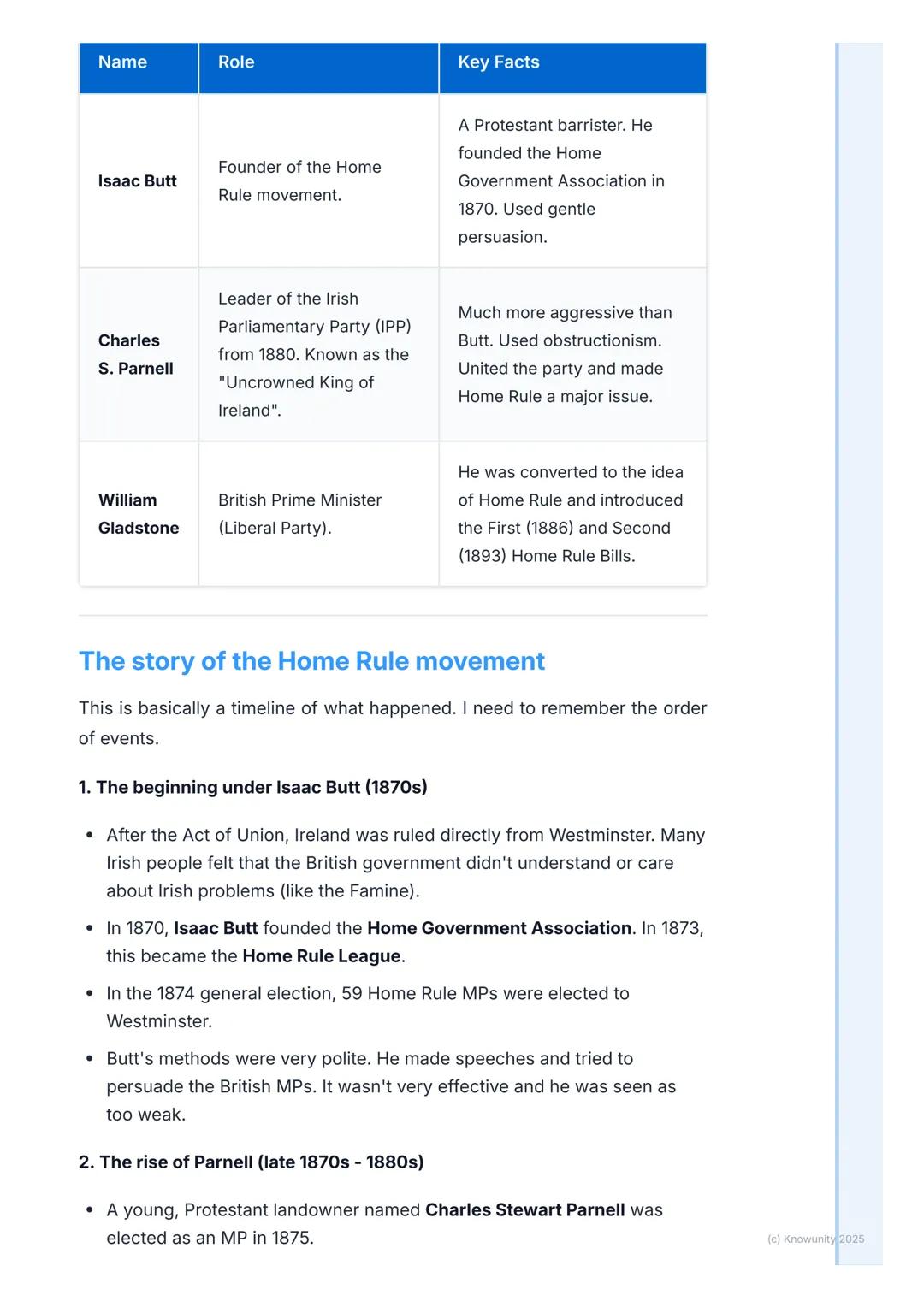
The Early Years and Parnell's Rise
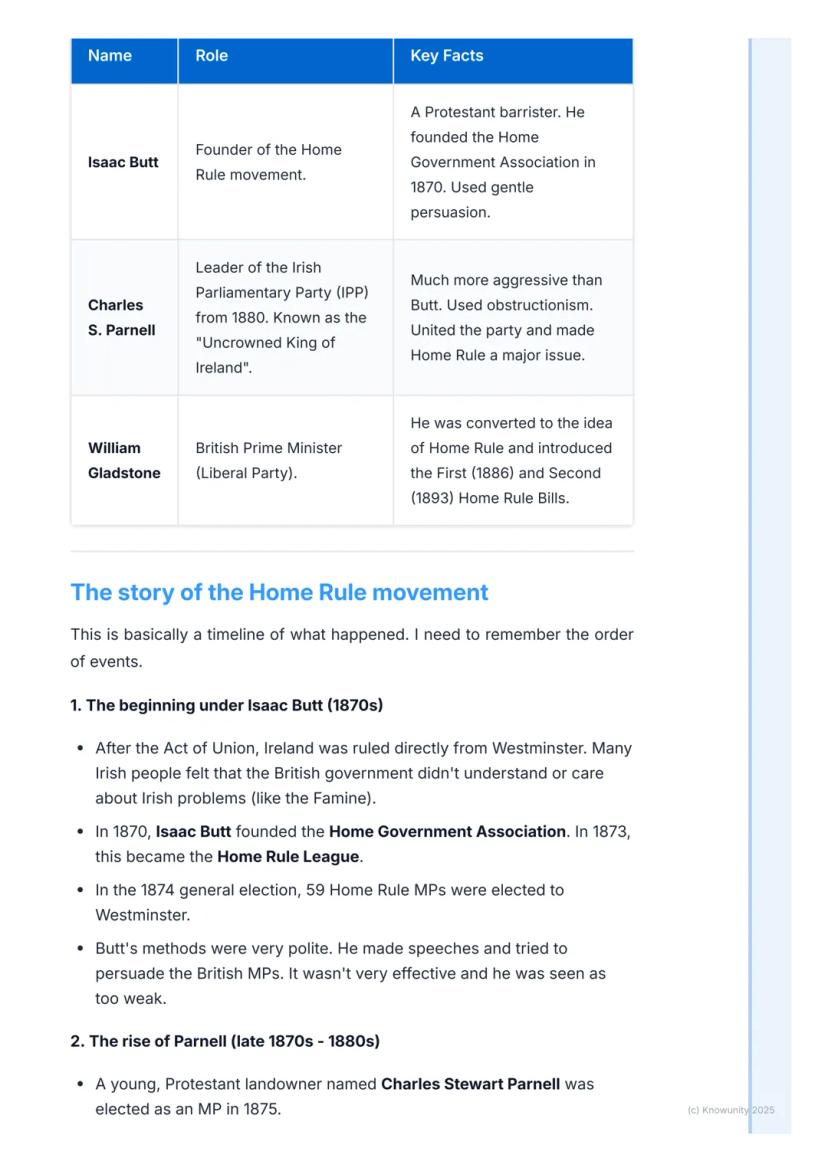
After the 1801 Act of Union, Ireland was ruled directly from Westminster, and many Irish people felt the British government didn't understand or care about Irish problems (hello, the Famine!). Butt's gentle persuasion methods in the 1870s were seen as too weak, even though 59 Home Rule MPs got elected in 1874.
Everything changed when young Protestant landowner Charles Stewart Parnell entered politics in 1875. He thought Butt's approach was failing, so he started using obstructionism with a small group of MPs, making them famous in Ireland and incredibly annoying to the British government.
Parnell's masterstroke was linking the political campaign for Home Rule with the social campaign for land reform (the Land War) - this was called the New Departure. Suddenly, he had support from poor tenant farmers as well as middle-class nationalists.
Remember: By 1880, Parnell had taken over the Irish Parliamentary Party (IPP) and was a brilliant organiser who united different groups under one cause.
3
of 6
The Home Rule Bills and Gladstone's Support
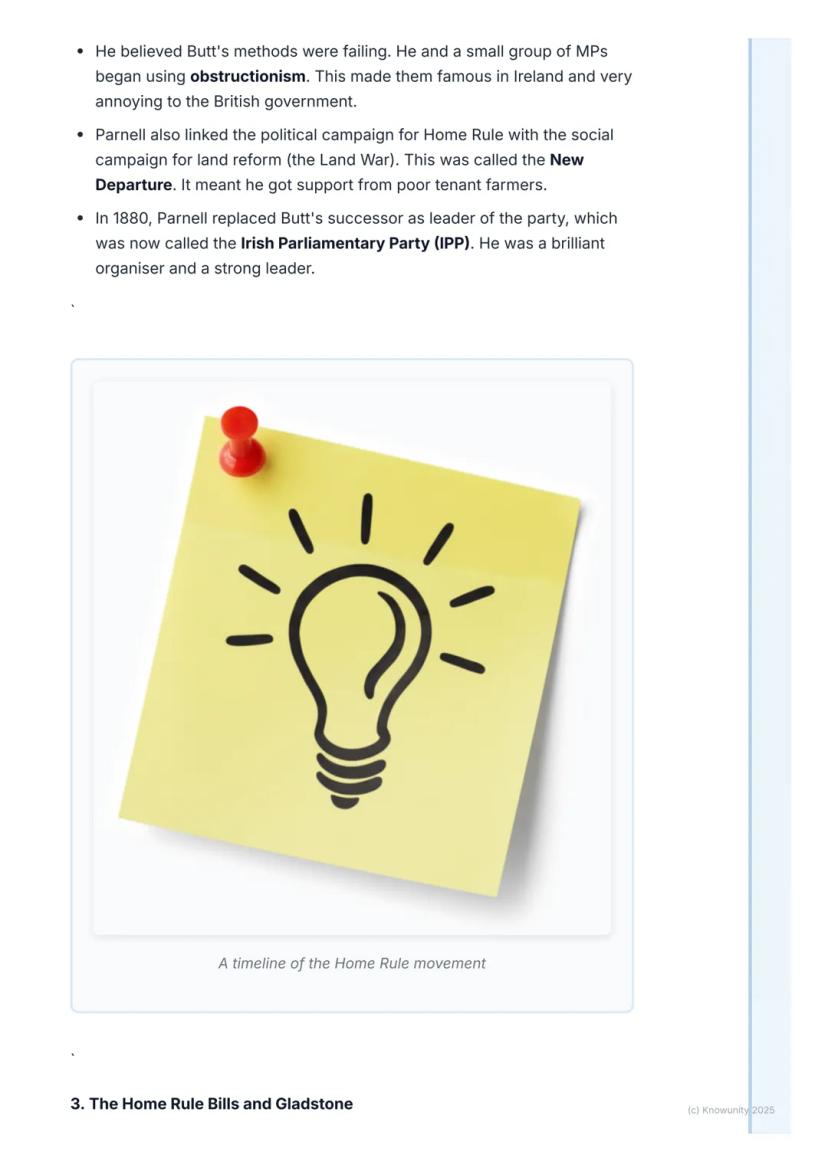
By 1885, Parnell's IPP was incredibly powerful, winning 86 seats and holding the balance of power - neither the Conservative nor Liberal parties could form a government without Irish support. This gave Ireland massive influence at Westminster.
William Gladstone, the Liberal Prime Minister, promised to introduce a Home Rule Bill in return for Parnell's support. The First Home Rule Bill (1886) proposed a Dublin parliament for Irish affairs, but it was defeated in the House of Commons when some of Gladstone's own Liberal MPs voted against it (they became Liberal Unionists).
The Second Home Rule Bill (1893) actually passed the House of Commons this time, but the House of Lords - full of Conservatives and Unionists - just blocked it completely. The House of Lords could veto any law they didn't like, making them a major obstacle to Home Rule.
Exam Tip: Don't confuse the reasons the bills failed - Bill 1 failed in the Commons due to Liberal Party splits, Bill 2 failed because the Lords vetoed it.
4
of 6
Parnell's Downfall and What Home Rule Actually Meant
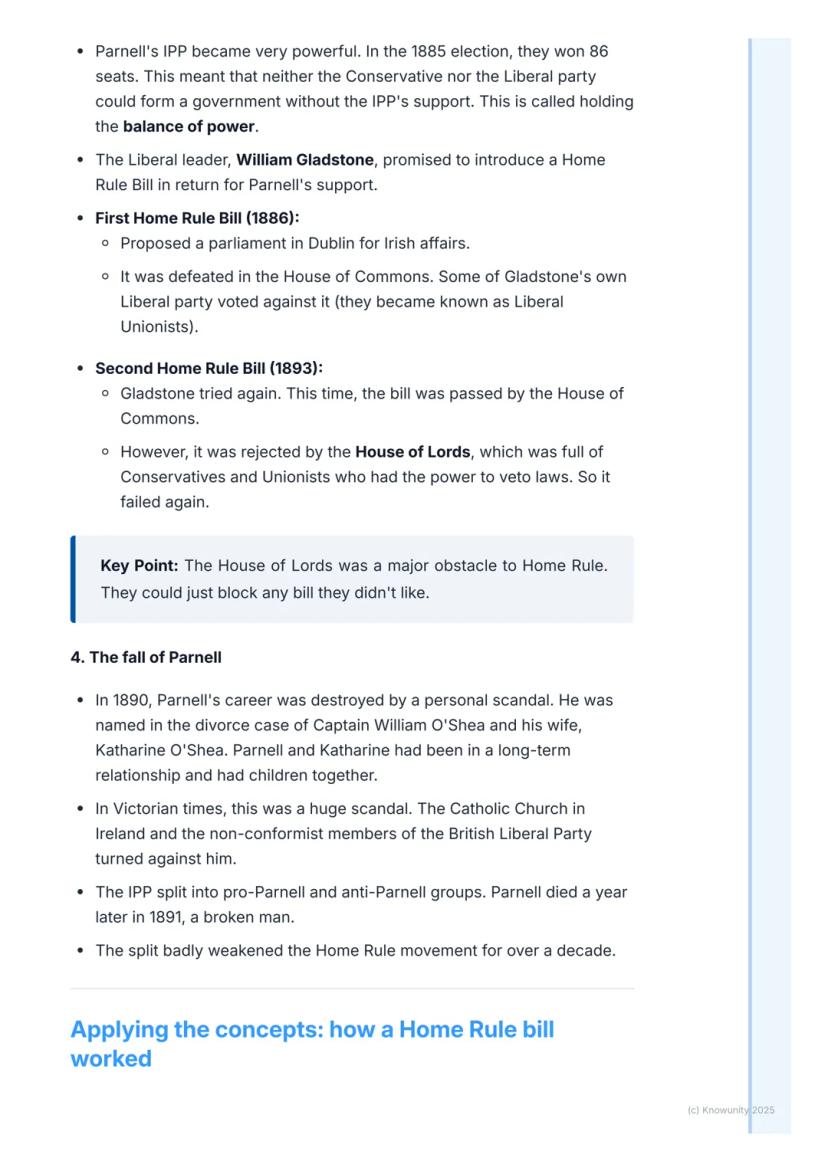
In 1890, Parnell's career was destroyed by a scandal when he was named in Captain William O'Shea's divorce case - Parnell had been in a long-term relationship with Katharine O'Shea. In Victorian times, this was absolutely shocking, and the Catholic Church and British non-conformists turned against him.
The IPP split into pro-Parnell and anti-Parnell groups, badly weakening the movement for over a decade. Parnell died in 1891, a broken man, showing how personal scandals could destroy political careers.
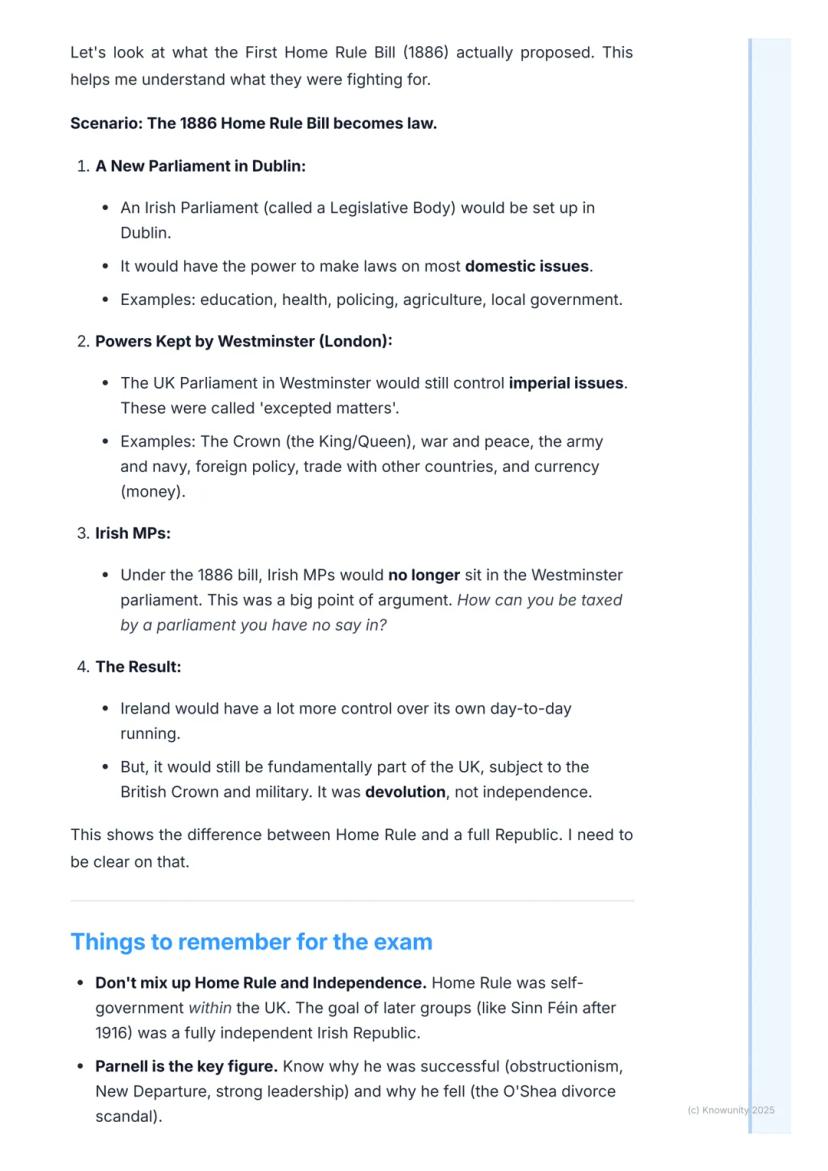
So what would Home Rule actually look like? The 1886 bill proposed an Irish parliament in Dublin controlling domestic issues like education, health, and policing, whilst Westminster kept control of "excepted matters" like foreign policy, defence, and currency.
Crucial Distinction: Home Rule meant devolution within the UK, not independence - Ireland would still be subject to the British Crown and military, very different from the full republic that later groups like Sinn Féin wanted.
5
of 6
Quick Revision Summary
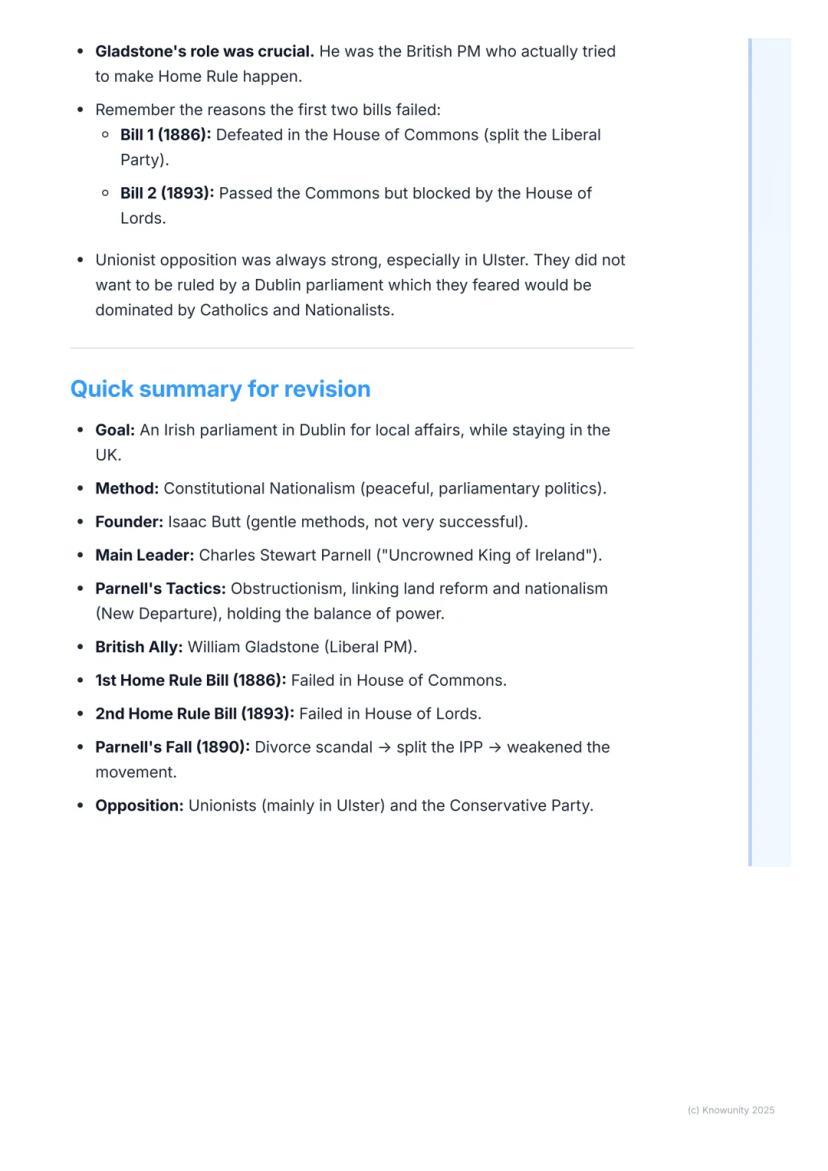
Here's what you absolutely need to remember for your exam: Home Rule was about self-government within the UK, not complete independence. The method was constitutional nationalism (peaceful politics), and the main tactics included obstructionism and Parnell's clever New Departure linking land reform with nationalism.
Key timeline: Isaac Butt founded the movement (1870s) but was too gentle, Parnell took over and made it powerful (1880s), Gladstone introduced two failed bills (1886 and 1893), then Parnell fell due to scandal (1890).
The opposition was fierce - Unionists (especially in Ulster) feared being ruled by a Catholic-dominated Dublin parliament, whilst the Conservative Party and House of Lords blocked progress. Remember, the movement was weakened for years after Parnell's fall.
Exam Success: Focus on why Parnell was successful (strong leadership, clever tactics, holding balance of power) and why the movement ultimately struggled (personal scandals, institutional opposition, split party).
6
of 6
We thought you’d never ask...
What is the Knowunity AI companion?
Our AI companion is specifically built for the needs of students. Based on the millions of content pieces we have on the platform we can provide truly meaningful and relevant answers to students. But its not only about answers, the companion is even more about guiding students through their daily learning challenges, with personalised study plans, quizzes or content pieces in the chat and 100% personalisation based on the students skills and developments.
Where can I download the Knowunity app?
You can download the app in the Google Play Store and in the Apple App Store.
Is Knowunity really free of charge?
That's right! Enjoy free access to study content, connect with fellow students, and get instant help – all at your fingertips.
Most popular content in History
9HistoryThe Great Famine (An Gorta Mór)
Students will learn about the causes, devastating impact, and long-term consequences of the potato famine on Irish population and society.
2nd Year282
HistoryThe renaissance
junior cert renaissance summary
1st Year361
HistoryCauses and Consequences of World War II
This subtopic covers the origins of the Second World War, its global scale, and its devastating human and political consequences, including the atomic bomb.
3rd Year152
HistoryThe 1798 Rebellion in Ireland
Learning about the causes, events, and aftermath of the United Irishmen's rebellion against British rule, inspired by revolutionary ideals.
3rd Year211
HistoryAmerican revolution
junior cert american revolution summary
1st Year442
HistoryThe Great Famine (An Gorta Mór)
This critical subtopic examines the causes, devastating impact, and long-term consequences of the potato famine on Irish society, population, and emigration.
3rd Year140
HistoryThe Renaissance
Students will learn about a time of 'rebirth' in Europe, where new ideas in art, science, and literature flourished.
1st Year140
History1916 Rising Revison Sheet
revision sheet
3rd Year211
HistoryThe Reformation in Europe
Students will learn about the causes and key figures of the Protestant Reformation and its impact on European society and politics.
3rd Year110
Most popular content
9 Irish
IrishIrish oral questions and answers
Questions and answers for the leaving cert oral
5th Year4264
 English
Key Quotes : Sive
Key Quotes and explanations: Sive
6th Year2842
IrishIrish oral questions
Outline of oral questions
5th Year2055
IrishIníon- le hÁine Durkin
Aine Durkin’s poem, Iníon: Themes & summary
5th Year850
IrishIrish poetry 2027
Iníon + Dínit an Bhróin
5th Year1133
IrishLC HL notes- Iníon (poem)
Includes poem in English and Irish, theme, key words & phrases
5th Year2284
EnglishCultural Context : Shawshank Redemption : Sive : Small Things Like These
Comparative Study : Cultural Context : Shawshank Redemption, Sive and Small Things Like These
6th Year1430
IrishMo Ghrá-sa (Idir Lúibíní)
Notes on mo ghrá-sa
5th Year380
IrishAn Gaeilge Aiste
Irish Language essay
6th Year1320
Can't find what you're looking for? Explore other subjects.
Students love us — and so will you.
4.6/5App Store
4.7/5Google Play
The app is very easy to use and well designed. I have found everything I was looking for so far and have been able to learn a lot from the presentations! I will definitely use the app for a class assignment! And of course it also helps a lot as an inspiration.
Stefan SiOS user
This app is really great. There are so many study notes and help [...]. My problem subject is French, for example, and the app has so many options for help. Thanks to this app, I have improved my French. I would recommend it to anyone.
Samantha KlichAndroid user
Wow, I am really amazed. I just tried the app because I've seen it advertised many times and was absolutely stunned. This app is THE HELP you want for school and above all, it offers so many things, such as workouts and fact sheets, which have been VERY helpful to me personally.
AnnaiOS user
History19 views·Updated Jun 4, 2026·6 pagesThe Fight for Irish Independence: The Home Rule Movement
The Home Rule movement was Ireland's major political campaign from the 1870s to the 1890s, aiming to get self-government whilst staying part of the UK. Think of it as Ireland wanting its own parliament in Dublin to handle local issues...
1
of 6
Sign up to see the content. It's free!
- Access to all documents
- Improve your grades
- Join milions of students
Understanding Home Rule and Key Players
Home Rule wasn't about complete independence - it was about Ireland having its own parliament in Dublin for domestic affairs whilst remaining part of the United Kingdom. This approach was called constitutional nationalism, which meant achieving change through peaceful parliamentary methods rather than violence.
The movement had some brilliant tactics. Obstructionism was when Irish MPs deliberately slowed down British parliament by making endless speeches and proposing loads of amendments to bills - basically being as annoying as possible until Britain paid attention to Irish issues!
Isaac Butt started it all in 1870 with his Home Government Association, but his polite approach didn't work well. The real game-changer was Charles Stewart Parnell, who became leader in 1880 and was known as the "Uncrowned King of Ireland" - he was much more aggressive and effective.
Key Point: Remember that Unionists (mainly in Ulster) completely opposed Home Rule because they wanted Ireland to stay fully part of the UK with no separate parliament.
2
of 6Sign up to see the content. It's free!
- Access to all documents
- Improve your grades
- Join milions of students
The Early Years and Parnell's Rise
After the 1801 Act of Union, Ireland was ruled directly from Westminster, and many Irish people felt the British government didn't understand or care about Irish problems (hello, the Famine!). Butt's gentle persuasion methods in the 1870s were seen as too weak, even though 59 Home Rule MPs got elected in 1874.
Everything changed when young Protestant landowner Charles Stewart Parnell entered politics in 1875. He thought Butt's approach was failing, so he started using obstructionism with a small group of MPs, making them famous in Ireland and incredibly annoying to the British government.
Parnell's masterstroke was linking the political campaign for Home Rule with the social campaign for land reform (the Land War) - this was called the New Departure. Suddenly, he had support from poor tenant farmers as well as middle-class nationalists.
Remember: By 1880, Parnell had taken over the Irish Parliamentary Party (IPP) and was a brilliant organiser who united different groups under one cause.
3
of 6Sign up to see the content. It's free!
- Access to all documents
- Improve your grades
- Join milions of students
The Home Rule Bills and Gladstone's Support
By 1885, Parnell's IPP was incredibly powerful, winning 86 seats and holding the balance of power - neither the Conservative nor Liberal parties could form a government without Irish support. This gave Ireland massive influence at Westminster.
William Gladstone, the Liberal Prime Minister, promised to introduce a Home Rule Bill in return for Parnell's support. The First Home Rule Bill (1886) proposed a Dublin parliament for Irish affairs, but it was defeated in the House of Commons when some of Gladstone's own Liberal MPs voted against it (they became Liberal Unionists).
The Second Home Rule Bill (1893) actually passed the House of Commons this time, but the House of Lords - full of Conservatives and Unionists - just blocked it completely. The House of Lords could veto any law they didn't like, making them a major obstacle to Home Rule.
Exam Tip: Don't confuse the reasons the bills failed - Bill 1 failed in the Commons due to Liberal Party splits, Bill 2 failed because the Lords vetoed it.
4
of 6Sign up to see the content. It's free!
- Access to all documents
- Improve your grades
- Join milions of students
Parnell's Downfall and What Home Rule Actually Meant
In 1890, Parnell's career was destroyed by a scandal when he was named in Captain William O'Shea's divorce case - Parnell had been in a long-term relationship with Katharine O'Shea. In Victorian times, this was absolutely shocking, and the Catholic Church and British non-conformists turned against him.
The IPP split into pro-Parnell and anti-Parnell groups, badly weakening the movement for over a decade. Parnell died in 1891, a broken man, showing how personal scandals could destroy political careers.
So what would Home Rule actually look like? The 1886 bill proposed an Irish parliament in Dublin controlling domestic issues like education, health, and policing, whilst Westminster kept control of "excepted matters" like foreign policy, defence, and currency.
Crucial Distinction: Home Rule meant devolution within the UK, not independence - Ireland would still be subject to the British Crown and military, very different from the full republic that later groups like Sinn Féin wanted.
5
of 6Sign up to see the content. It's free!
- Access to all documents
- Improve your grades
- Join milions of students
Quick Revision Summary
Here's what you absolutely need to remember for your exam: Home Rule was about self-government within the UK, not complete independence. The method was constitutional nationalism (peaceful politics), and the main tactics included obstructionism and Parnell's clever New Departure linking land reform with nationalism.
Key timeline: Isaac Butt founded the movement (1870s) but was too gentle, Parnell took over and made it powerful (1880s), Gladstone introduced two failed bills (1886 and 1893), then Parnell fell due to scandal (1890).
The opposition was fierce - Unionists (especially in Ulster) feared being ruled by a Catholic-dominated Dublin parliament, whilst the Conservative Party and House of Lords blocked progress. Remember, the movement was weakened for years after Parnell's fall.
Exam Success: Focus on why Parnell was successful (strong leadership, clever tactics, holding balance of power) and why the movement ultimately struggled (personal scandals, institutional opposition, split party).
6
of 6Sign up to see the content. It's free!
- Access to all documents
- Improve your grades
- Join milions of students
We thought you’d never ask...
What is the Knowunity AI companion?
Our AI companion is specifically built for the needs of students. Based on the millions of content pieces we have on the platform we can provide truly meaningful and relevant answers to students. But its not only about answers, the companion is even more about guiding students through their daily learning challenges, with personalised study plans, quizzes or content pieces in the chat and 100% personalisation based on the students skills and developments.
Where can I download the Knowunity app?
You can download the app in the Google Play Store and in the Apple App Store.
Is Knowunity really free of charge?
That's right! Enjoy free access to study content, connect with fellow students, and get instant help – all at your fingertips.
Most popular content in History
9HistoryThe Great Famine (An Gorta Mór)
Students will learn about the causes, devastating impact, and long-term consequences of the potato famine on Irish population and society.
2nd Year282
HistoryThe renaissance
junior cert renaissance summary
1st Year361
HistoryCauses and Consequences of World War II
This subtopic covers the origins of the Second World War, its global scale, and its devastating human and political consequences, including the atomic bomb.
3rd Year152
HistoryThe 1798 Rebellion in Ireland
Learning about the causes, events, and aftermath of the United Irishmen's rebellion against British rule, inspired by revolutionary ideals.
3rd Year211
HistoryAmerican revolution
junior cert american revolution summary
1st Year442
HistoryThe Great Famine (An Gorta Mór)
This critical subtopic examines the causes, devastating impact, and long-term consequences of the potato famine on Irish society, population, and emigration.
3rd Year140
HistoryThe Renaissance
Students will learn about a time of 'rebirth' in Europe, where new ideas in art, science, and literature flourished.
1st Year140
History1916 Rising Revison Sheet
revision sheet
3rd Year211
HistoryThe Reformation in Europe
Students will learn about the causes and key figures of the Protestant Reformation and its impact on European society and politics.
3rd Year110
Most popular content
9IrishIrish oral questions and answers
Questions and answers for the leaving cert oral
5th Year4264
EnglishKey Quotes : Sive
Key Quotes and explanations: Sive
6th Year2842
IrishIrish oral questions
Outline of oral questions
5th Year2055
IrishIníon- le hÁine Durkin
Aine Durkin’s poem, Iníon: Themes & summary
5th Year850
IrishIrish poetry 2027
Iníon + Dínit an Bhróin
5th Year1133
IrishLC HL notes- Iníon (poem)
Includes poem in English and Irish, theme, key words & phrases
5th Year2284
EnglishCultural Context : Shawshank Redemption : Sive : Small Things Like These
Comparative Study : Cultural Context : Shawshank Redemption, Sive and Small Things Like These
6th Year1430
IrishMo Ghrá-sa (Idir Lúibíní)
Notes on mo ghrá-sa
5th Year380
IrishAn Gaeilge Aiste
Irish Language essay
6th Year1320
Can't find what you're looking for? Explore other subjects.
Students love us — and so will you.
4.6/5App Store
4.7/5Google Play
The app is very easy to use and well designed. I have found everything I was looking for so far and have been able to learn a lot from the presentations! I will definitely use the app for a class assignment! And of course it also helps a lot as an inspiration.
Stefan SiOS user
This app is really great. There are so many study notes and help [...]. My problem subject is French, for example, and the app has so many options for help. Thanks to this app, I have improved my French. I would recommend it to anyone.
Samantha KlichAndroid user
Wow, I am really amazed. I just tried the app because I've seen it advertised many times and was absolutely stunned. This app is THE HELP you want for school and above all, it offers so many things, such as workouts and fact sheets, which have been VERY helpful to me personally.
AnnaiOS user