
Persuasive writing is a powerful skill that helps you convince... Show more
 English
 Irish
IrishSign up to see the contentIt's free!
Access to all documents
Improve your grades
Join milions of students
Knowunity AI
Subjects
Triangle Congruence and Similarity Theorems
Triangle Properties and Classification
Linear Equations and Graphs
Geometric Angle Relationships
Trigonometric Functions and Identities
Equation Solving Techniques
Circle Geometry Fundamentals
Division Operations and Methods
Basic Differentiation Rules
Exponent and Logarithm Properties
Show all topics
Human Organ Systems
Reproductive Cell Cycles
Biological Sciences Subdisciplines
Cellular Energy Metabolism
Autotrophic Energy Processes
Inheritance Patterns and Principles
Biomolecular Structure and Organization
Cell Cycle and Division Mechanics
Cellular Organization and Development
Biological Structural Organization
Show all topics
Chemical Sciences and Applications
Atomic Structure and Composition
Molecular Electron Structure Representation
Atomic Electron Behavior
Matter Properties and Water
Mole Concept and Calculations
Gas Laws and Behavior
Periodic Table Organization
Chemical Thermodynamics Fundamentals
Chemical Bond Types and Properties
Show all topics
European Renaissance and Enlightenment
European Cultural Movements 800-1920
American Revolution Era 1763-1797
American Civil War 1861-1865
Global Imperial Systems
Mongol and Chinese Dynasties
U.S. Presidents and World Leaders
Historical Sources and Documentation
World Wars Era and Impact
World Religious Systems
Show all topics
Classic and Contemporary Novels
Literary Character Analysis
Rhetorical Theory and Practice
Classic Literary Narratives
Reading Analysis and Interpretation
Narrative Structure and Techniques
English Language Components
Influential English-Language Authors
Basic Sentence Structure
Narrative Voice and Perspective
Show all topics
1
•
Updated May 3, 2026
•
Persuasive writing is a powerful skill that helps you convince... Show more
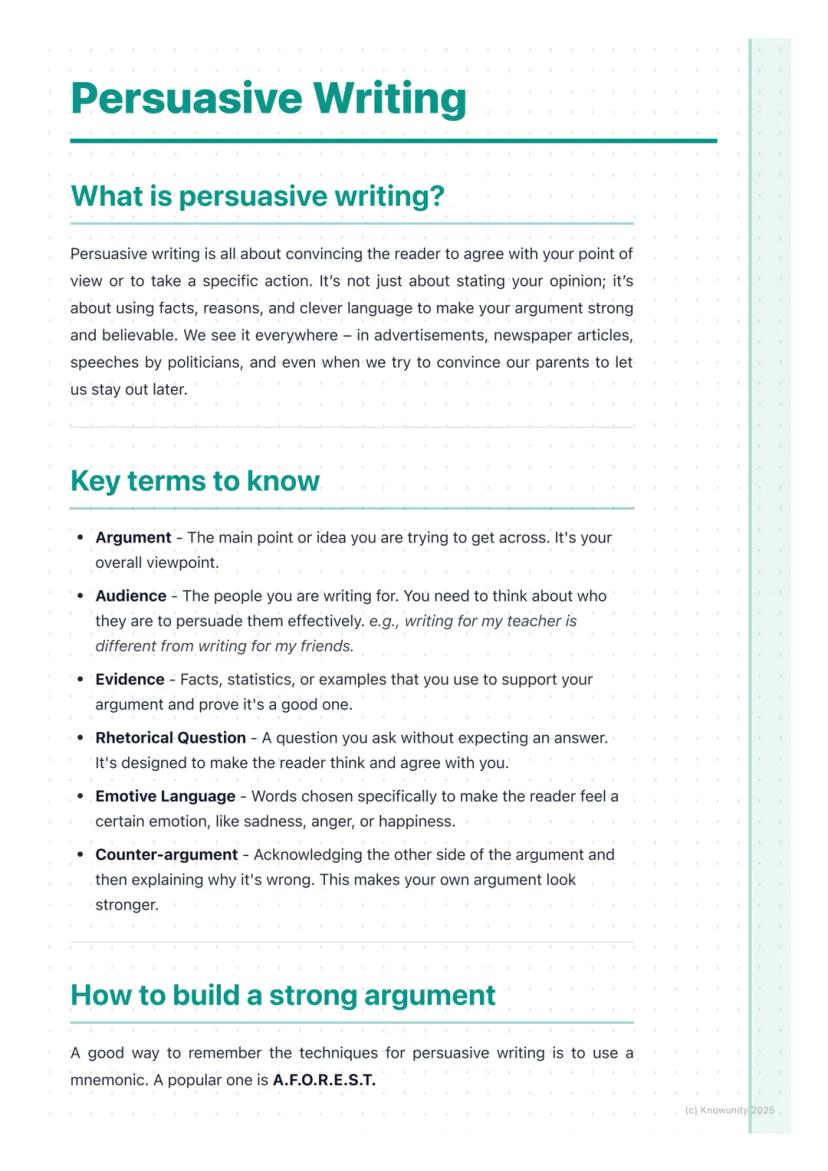
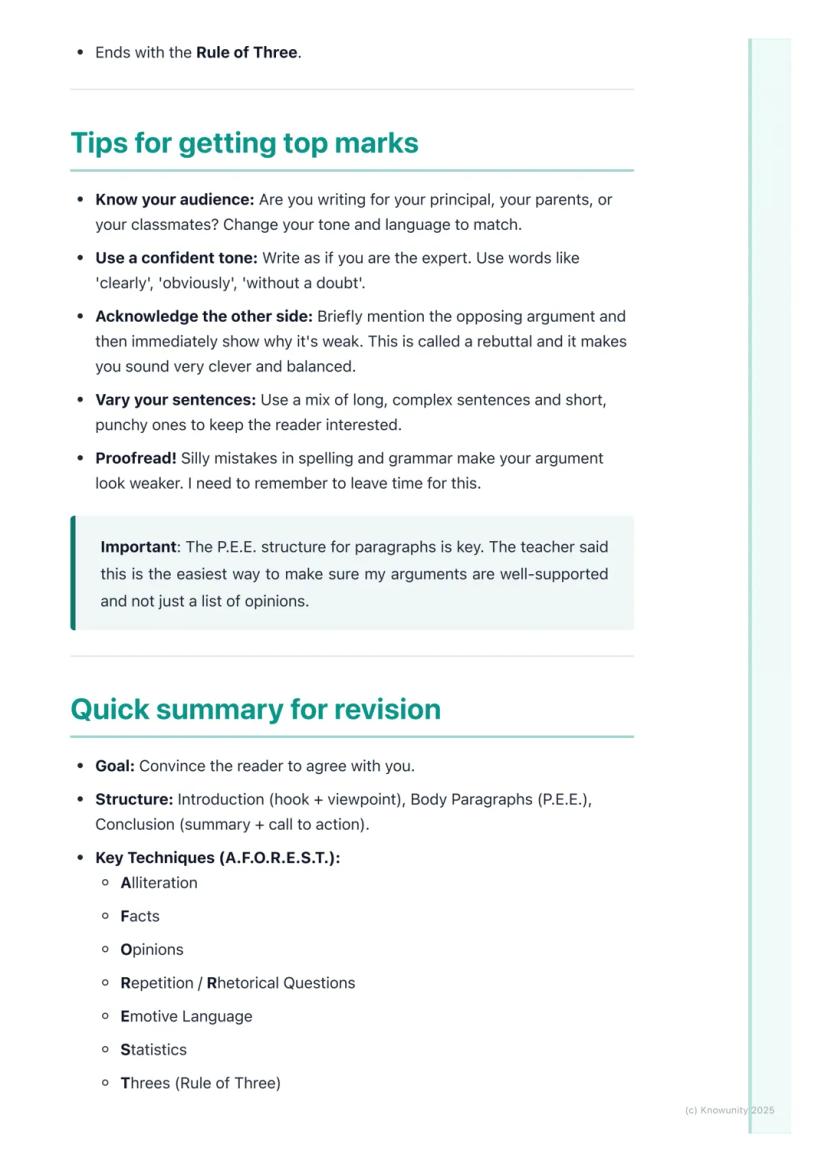

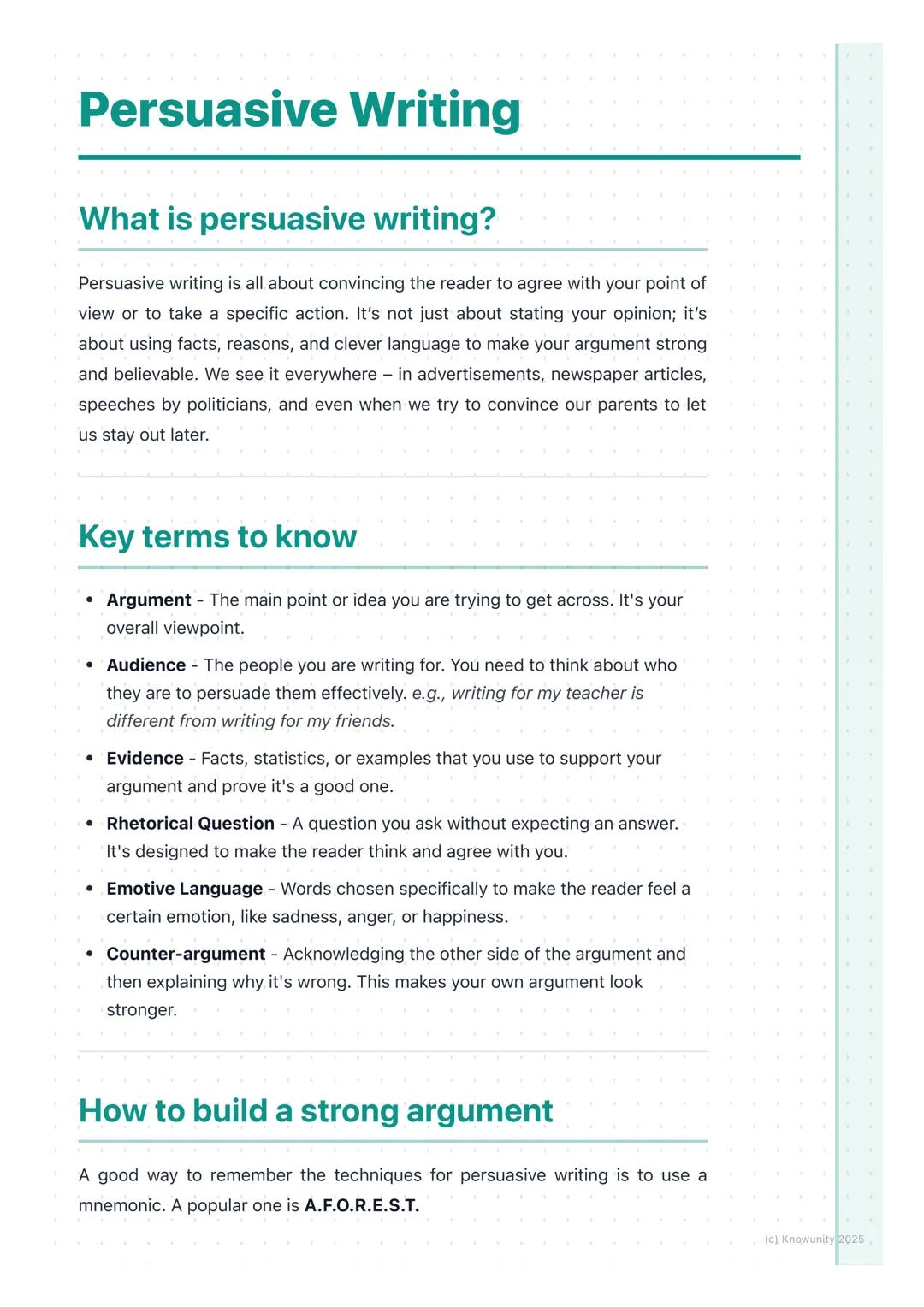
Persuasive writing isn't just about stating your opinion. It's about using facts, clever language and solid reasoning to make your argument believable and convincing. When you're writing persuasively, you need to understand some key terms that will help structure your arguments.
Key terms include your argument (the main point you're making), your audience (who you're writing for), and evidence (facts that support your point). You'll also use techniques like rhetorical questions to make readers think, emotive language to trigger feelings, and addressing counter-arguments to strengthen your position.
A strong persuasive piece requires careful planning and structure. One helpful way to remember persuasive techniques is the mnemonic A.F.O.R.E.S.T., which we'll explore next.
Remember this! Always think about who your audience is before you start writing. The way you'd persuade your teacher is completely different from how you'd persuade your friends!
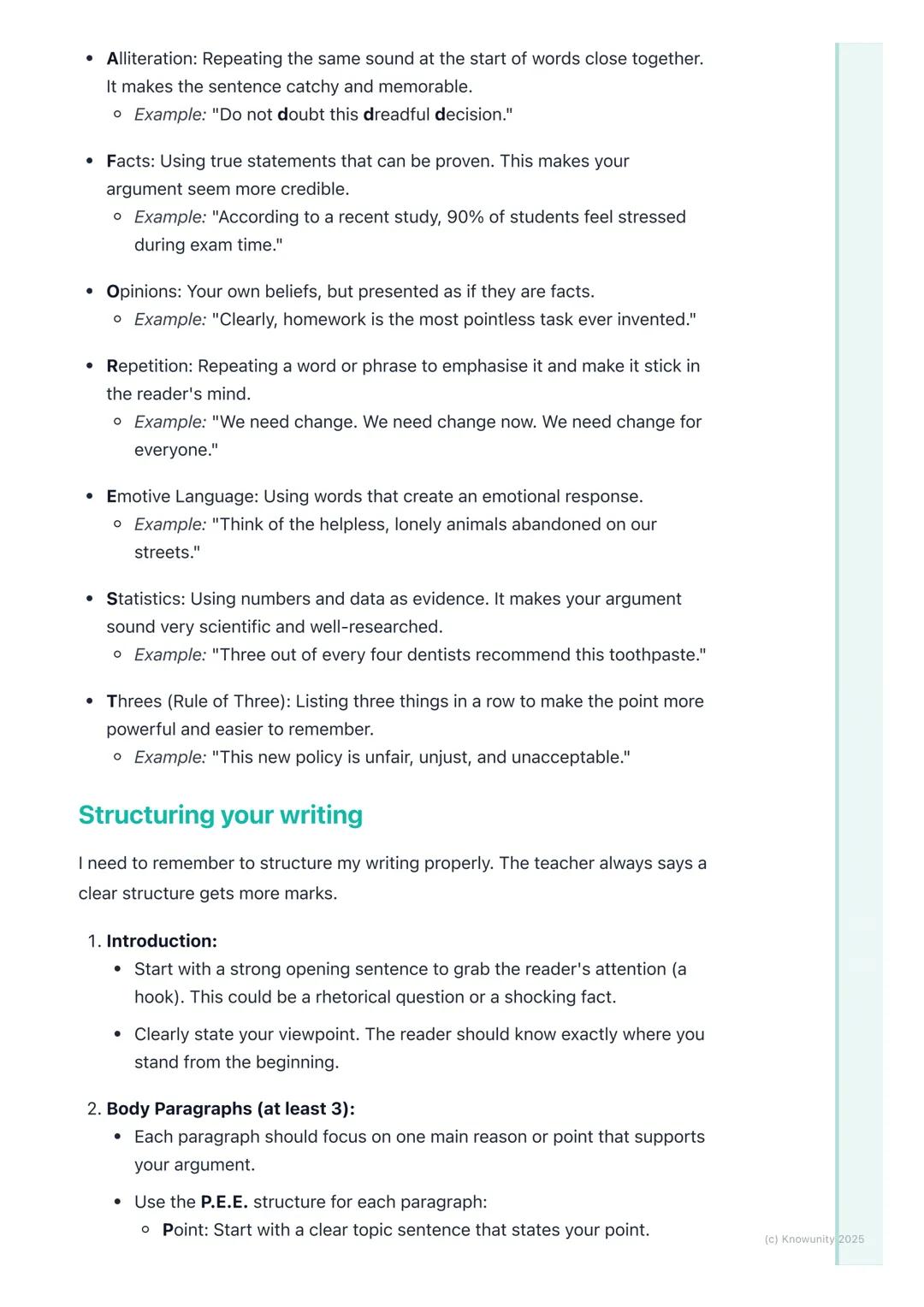
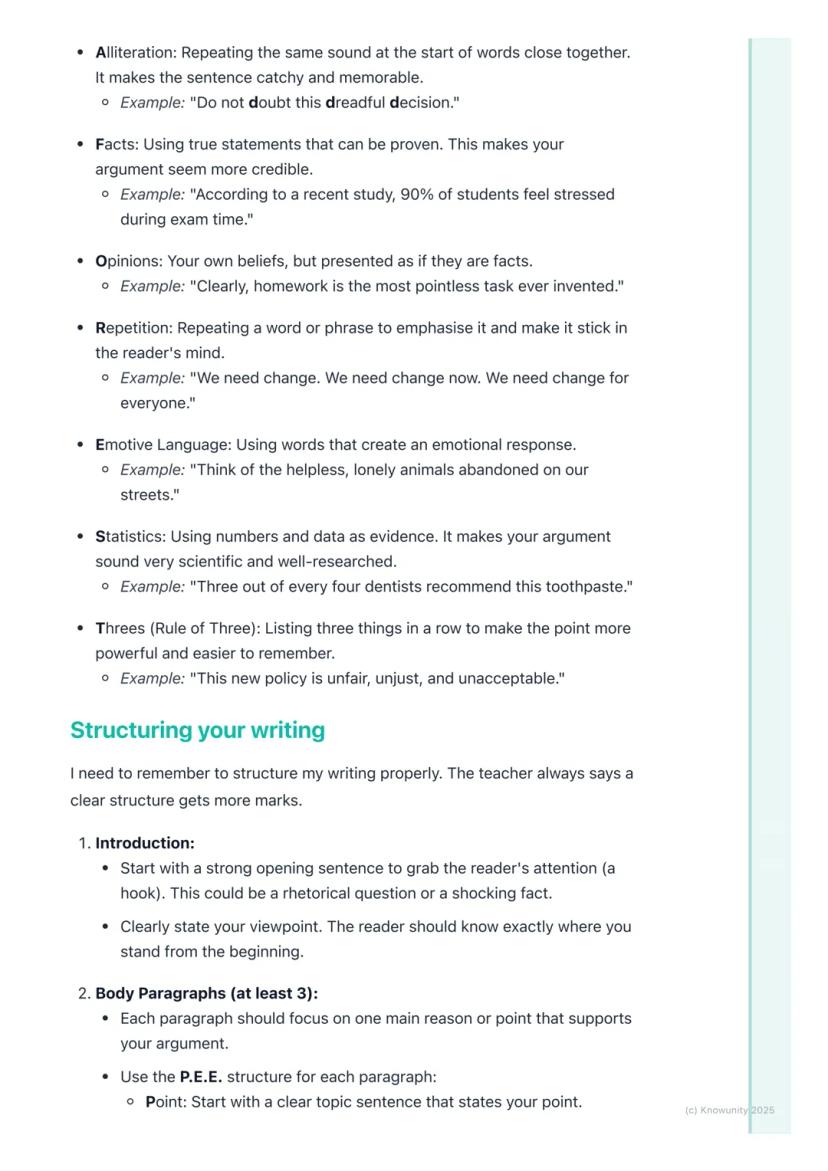
A.F.O.R.E.S.T. helps you remember seven powerful persuasive techniques that will make your writing more effective:
Alliteration makes your writing catchy and memorable by repeating the same sound in nearby words, like "Do not doubt this dreadful decision." Facts add credibility to your argument, while stating your opinions confidently makes them seem more authoritative.
Repetition of key phrases helps them stick in readers' minds, and emotive language creates feelings like sympathy or outrage. Statistics make your argument sound well-researched and scientific, while the Rule of Three (listing three things together) makes points more memorable and impactful.
Try combining these techniques in your writing. For example, you might use statistics alongside emotive language, or reinforce a fact with repetition to really drive your point home.
Top tip! Using the Rule of Three is incredibly powerful—it's simple, effective, and memorable (see what I did there?).
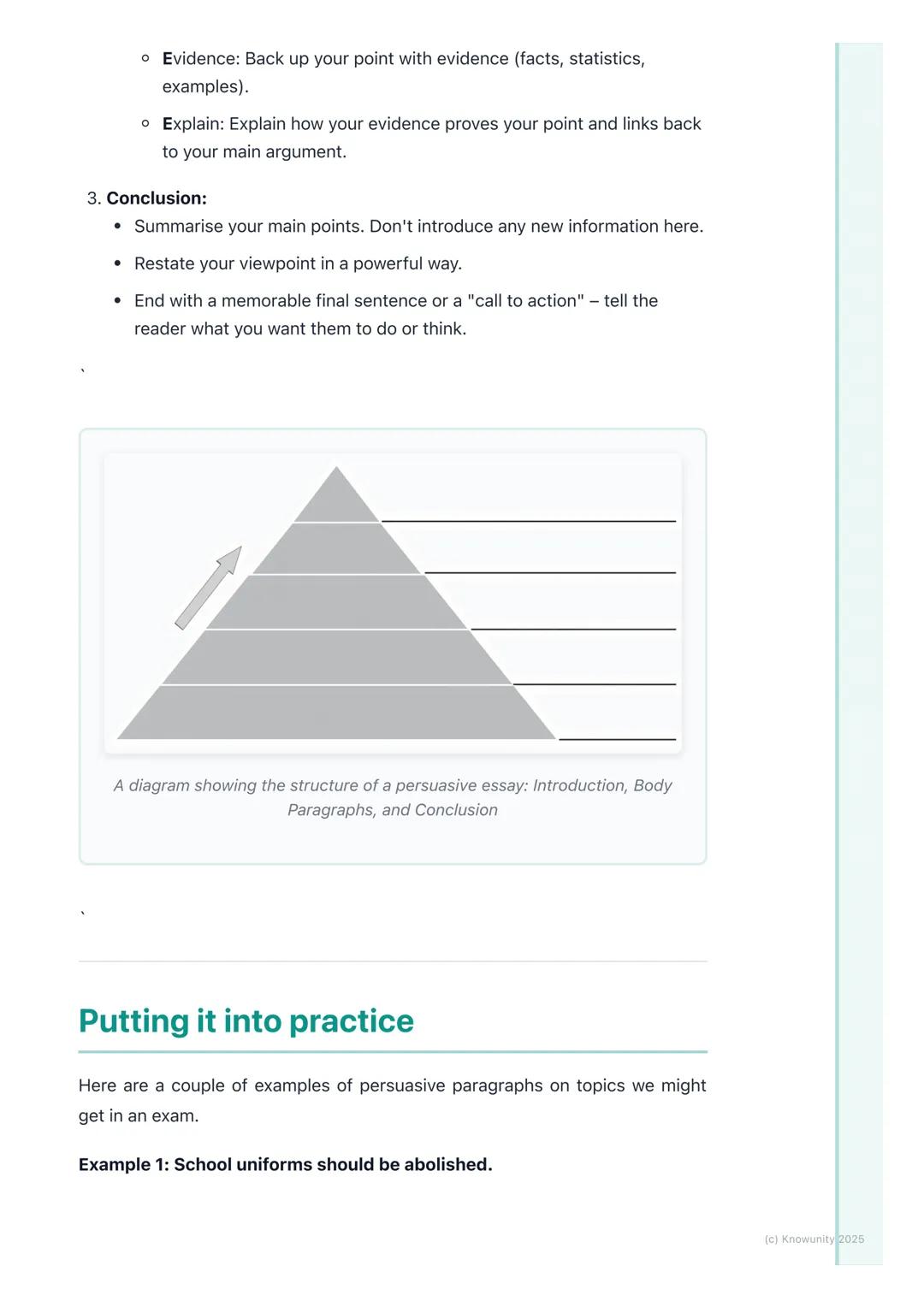
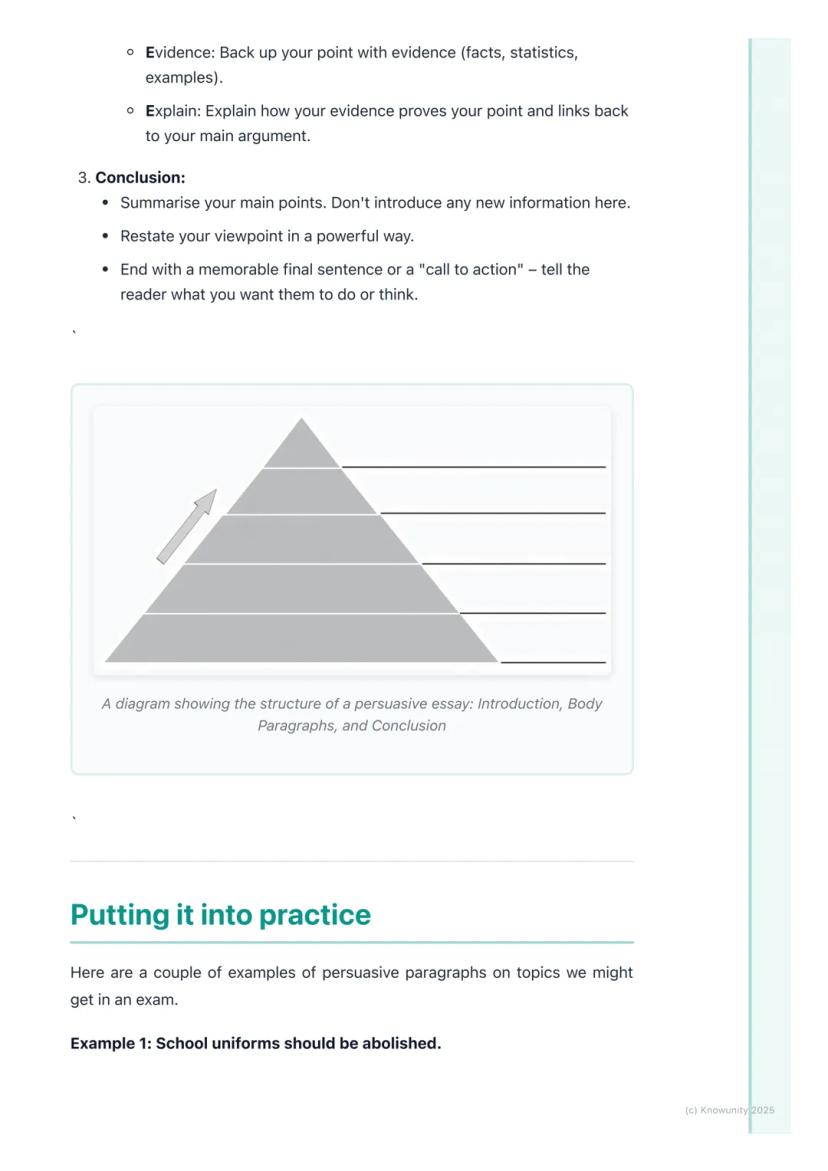
A clear structure is essential for persuasive writing and will help you earn higher marks. Your writing should have three main sections that flow logically from start to finish.
Begin with an introduction that grabs attention with a hook (like a shocking fact or rhetorical question) and clearly states your viewpoint. The reader should immediately understand your position on the issue.
Your body paragraphs (aim for at least three) should each focus on one main reason supporting your argument. Use the P.E.E. structure for each paragraph: make your Point, provide Evidence to support it, then Explain how this evidence proves your point and connects to your overall argument.
Finish with a strong conclusion that summarises your main points without introducing any new information. Restate your viewpoint powerfully and end with a memorable final sentence or call to action.
Examiner's favourite! Using P.E.E. (Point, Evidence, Explain) in each paragraph shows you can build and support arguments logically—a skill examiners love to see!
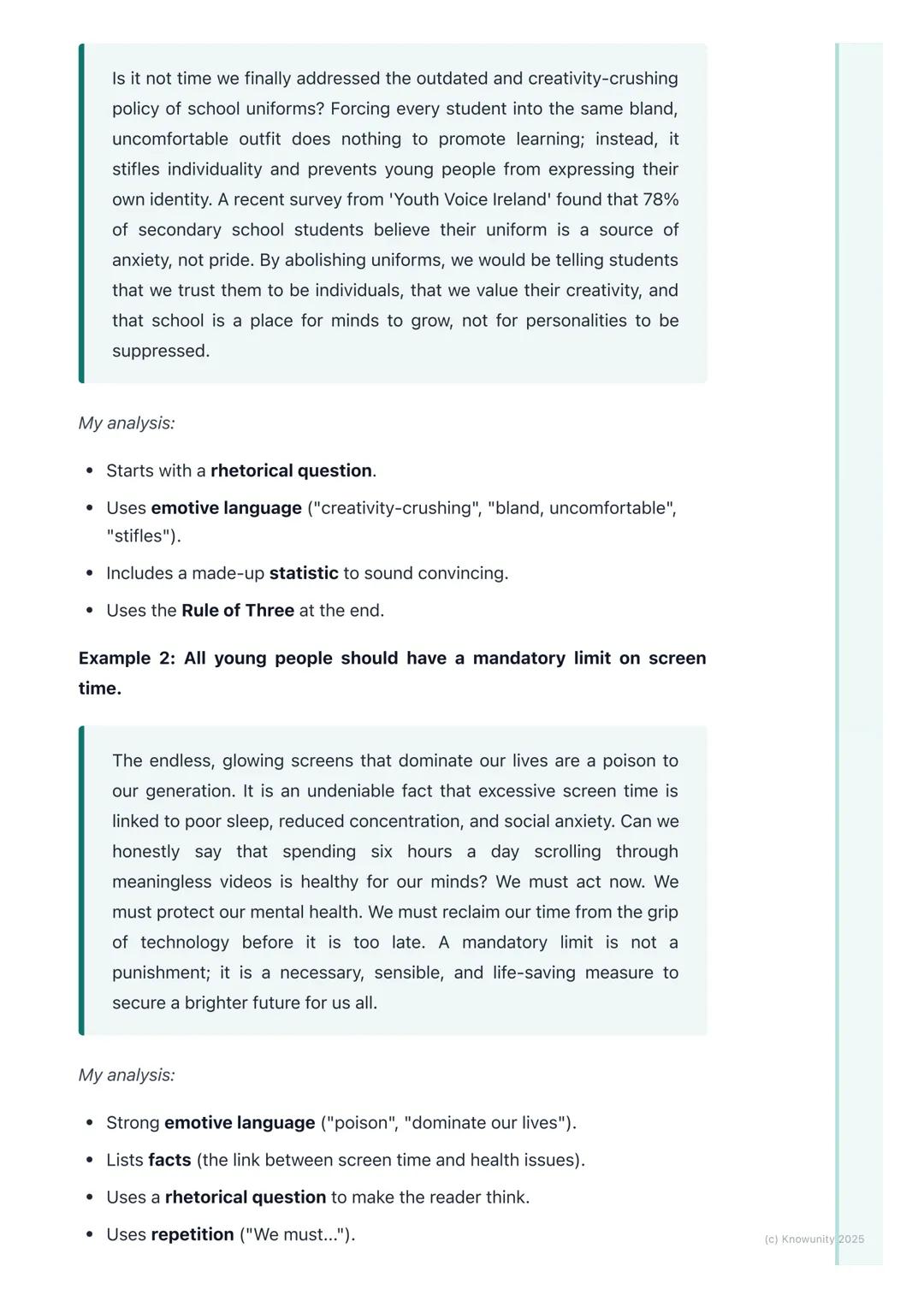
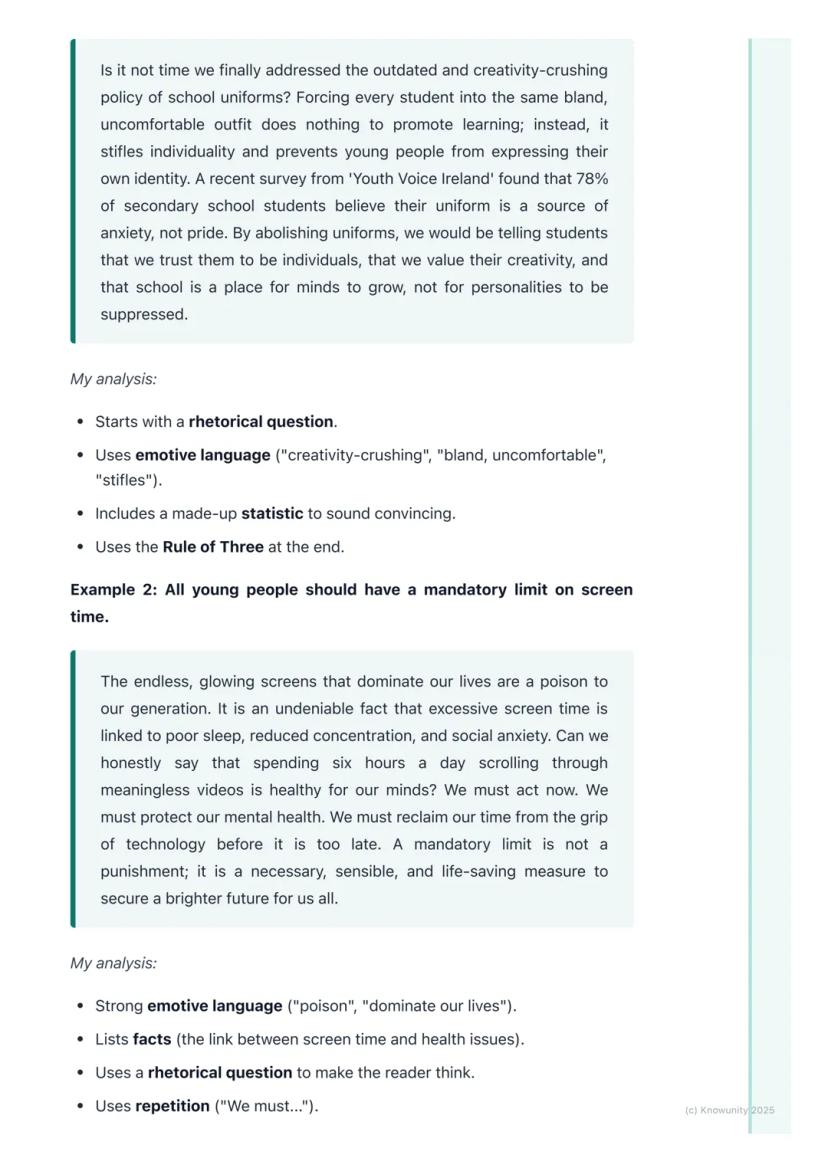
Looking at strong examples helps you understand what makes persuasive writing effective. Let's analyze two sample paragraphs that demonstrate different techniques.
The first example argues that school uniforms should be abolished. It starts with a rhetorical question and uses emotive language like "creativity-crushing" and "stifles individuality." Notice how it includes a statistic (78% of students) to sound more convincing and ends with the Rule of Three to emphasize the benefits of abolishing uniforms.
The second example argues for limiting screen time. It uses powerful emotive language by calling screens "poison" and lists health facts about screen time. The writer builds urgency through repetition ("We must...") and finishes with the Rule of Three, describing the limit as "necessary, sensible, and life-saving."
Both examples demonstrate how combining different persuasive techniques creates a powerful argument. They don't just state opinions—they use evidence and emotional appeals to convince the reader.
Build your skills! Try identifying the persuasive techniques used in advertisements you see every day—you'll be surprised how many use these same strategies!
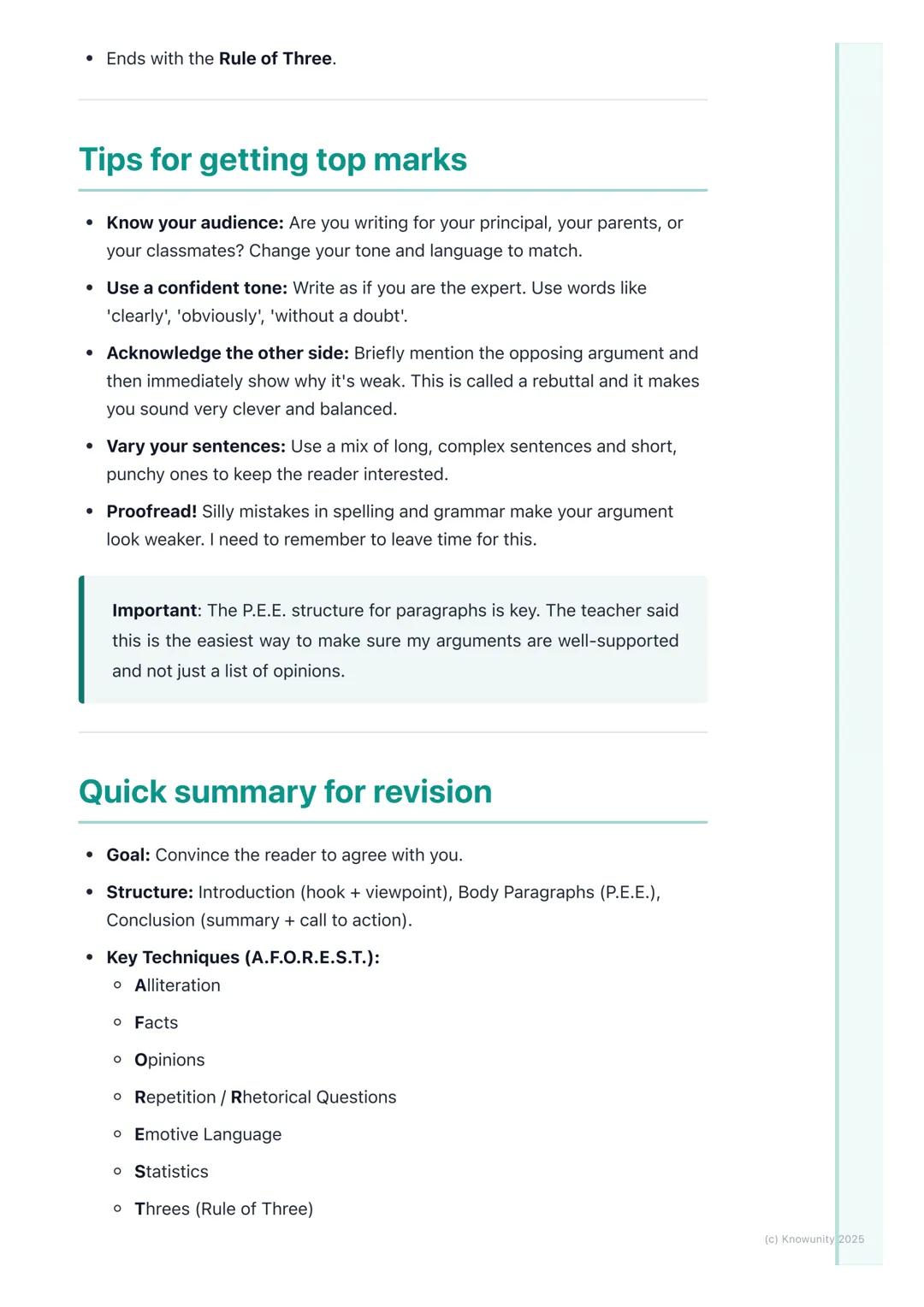
To excel at persuasive writing, always know your audience and adjust your language accordingly—you'd write differently for your principal than for your classmates. Use a confident tone with phrases like "clearly" and "obviously" to sound authoritative.
A clever strategy is to briefly acknowledge the opposing view before showing why it's weak. This makes you sound balanced and thoughtful. Remember to vary your sentences between long, complex ones and short, punchy statements for better rhythm and impact.
Always leave time to proofread your work! Spelling and grammar errors make your arguments look weaker, no matter how good your points are. The P.E.E. structure (Point, Evidence, Explain) is essential for well-supported arguments that don't just list opinions.
When revising, remember your goal is to convince the reader to agree with you. Use the A.F.O.R.E.S.T. techniques throughout your writing.
Exam success strategy! In timed exams, quickly jot down your main points and supporting evidence before you start writing—this ensures your argument stays focused and well-structured.

As you prepare to write persuasively, keep these final tips in mind to make your writing stand out. Always back up your arguments with solid evidence—opinions alone won't convince your reader!
Write with confidence and authority, even if you're not 100% sure about your position. Confident language is more persuasive than hesitant statements. Consider your audience carefully and adapt your tone and examples to appeal to them specifically.
Never skip proofreading! Take a few minutes to check for errors and unclear sentences that could weaken your argument. Remember that a well-structured, error-free piece of writing instantly appears more credible.
With practice, you'll become more skilled at crafting arguments that not only express your opinion but also genuinely persuade others to see things your way—a valuable skill for school and life beyond!
You've got this! Persuasive writing is like learning to ride a bike—it might seem tricky at first, but once you master the techniques, you'll be zooming along confidently in no time!
Our AI companion is specifically built for the needs of students. Based on the millions of content pieces we have on the platform we can provide truly meaningful and relevant answers to students. But its not only about answers, the companion is even more about guiding students through their daily learning challenges, with personalised study plans, quizzes or content pieces in the chat and 100% personalisation based on the students skills and developments.
You can download the app in the Google Play Store and in the Apple App Store.
That's right! Enjoy free access to study content, connect with fellow students, and get instant help – all at your fingertips.
App Store
Google Play
The app is very easy to use and well designed. I have found everything I was looking for so far and have been able to learn a lot from the presentations! I will definitely use the app for a class assignment! And of course it also helps a lot as an inspiration.
Stefan S
iOS user
This app is really great. There are so many study notes and help [...]. My problem subject is French, for example, and the app has so many options for help. Thanks to this app, I have improved my French. I would recommend it to anyone.
Samantha Klich
Android user
Wow, I am really amazed. I just tried the app because I've seen it advertised many times and was absolutely stunned. This app is THE HELP you want for school and above all, it offers so many things, such as workouts and fact sheets, which have been VERY helpful to me personally.
Anna
iOS user
I think it’s very much worth it and you’ll end up using it a lot once you get the hang of it and even after looking at others notes you can still ask your Artificial intelligence buddy the question and ask to simplify it if you still don’t get it!!! In the end I think it’s worth it 😊👍 ⚠️Also DID I MENTION ITS FREEE YOU DON’T HAVE TO PAY FOR ANYTHING AND STILL GET YOUR GRADES IN PERFECTLY❗️❗️⚠️
Thomas R
iOS user
Knowunity is the BEST app I’ve used in a minute. This is not an ai review or anything this is genuinely coming from a 7th grade student (I know 2011 im young) but dude this app is a 10/10 i have maintained a 3.8 gpa and have plenty of time for gaming. I love it and my mom is just happy I got good grades
Brad T
Android user
Not only did it help me find the answer but it also showed me alternative ways to solve it. I was horrible in math and science but now I have an a in both subjects. Thanks for the help🤍🤍
David K
iOS user
The app's just great! All I have to do is enter the topic in the search bar and I get the response real fast. I don't have to watch 10 YouTube videos to understand something, so I'm saving my time. Highly recommended!
Sudenaz Ocak
Android user
In school I was really bad at maths but thanks to the app, I am doing better now. I am so grateful that you made the app.
Greenlight Bonnie
Android user
I found this app a couple years ago and it has only gotten better since then. I really love it because it can help with written questions and photo questions. Also, it can find study guides that other people have made as well as flashcard sets and practice tests. The free version is also amazing for students who might not be able to afford it. Would 100% recommend
Aubrey
iOS user
Best app if you're in Highschool or Junior high. I have been using this app for 2 school years and it's the best, it's good if you don't have anyone to help you with school work.😋🩷🎀
Marco B
iOS user
THE QUIZES AND FLASHCARDS ARE SO USEFUL AND I LOVE Knowunity AI. IT ALSO IS LITREALLY LIKE CHATGPT BUT SMARTER!! HELPED ME WITH MY MASCARA PROBLEMS TOO!! AS WELL AS MY REAL SUBJECTS ! DUHHH 😍😁😲🤑💗✨🎀😮
Elisha
iOS user
This app is phenomenal down to the correct info and the various topics you can study! I greatly recommend it for people who struggle with procrastination and those who need homework help. It has been perfectly accurate for world 1 history as far as I’ve seen! Geometry too!
Paul T
iOS user
The app is very easy to use and well designed. I have found everything I was looking for so far and have been able to learn a lot from the presentations! I will definitely use the app for a class assignment! And of course it also helps a lot as an inspiration.
Stefan S
iOS user
This app is really great. There are so many study notes and help [...]. My problem subject is French, for example, and the app has so many options for help. Thanks to this app, I have improved my French. I would recommend it to anyone.
Samantha Klich
Android user
Wow, I am really amazed. I just tried the app because I've seen it advertised many times and was absolutely stunned. This app is THE HELP you want for school and above all, it offers so many things, such as workouts and fact sheets, which have been VERY helpful to me personally.
Anna
iOS user
I think it’s very much worth it and you’ll end up using it a lot once you get the hang of it and even after looking at others notes you can still ask your Artificial intelligence buddy the question and ask to simplify it if you still don’t get it!!! In the end I think it’s worth it 😊👍 ⚠️Also DID I MENTION ITS FREEE YOU DON’T HAVE TO PAY FOR ANYTHING AND STILL GET YOUR GRADES IN PERFECTLY❗️❗️⚠️
Thomas R
iOS user
Knowunity is the BEST app I’ve used in a minute. This is not an ai review or anything this is genuinely coming from a 7th grade student (I know 2011 im young) but dude this app is a 10/10 i have maintained a 3.8 gpa and have plenty of time for gaming. I love it and my mom is just happy I got good grades
Brad T
Android user
Not only did it help me find the answer but it also showed me alternative ways to solve it. I was horrible in math and science but now I have an a in both subjects. Thanks for the help🤍🤍
David K
iOS user
The app's just great! All I have to do is enter the topic in the search bar and I get the response real fast. I don't have to watch 10 YouTube videos to understand something, so I'm saving my time. Highly recommended!
Sudenaz Ocak
Android user
In school I was really bad at maths but thanks to the app, I am doing better now. I am so grateful that you made the app.
Greenlight Bonnie
Android user
I found this app a couple years ago and it has only gotten better since then. I really love it because it can help with written questions and photo questions. Also, it can find study guides that other people have made as well as flashcard sets and practice tests. The free version is also amazing for students who might not be able to afford it. Would 100% recommend
Aubrey
iOS user
Best app if you're in Highschool or Junior high. I have been using this app for 2 school years and it's the best, it's good if you don't have anyone to help you with school work.😋🩷🎀
Marco B
iOS user
THE QUIZES AND FLASHCARDS ARE SO USEFUL AND I LOVE Knowunity AI. IT ALSO IS LITREALLY LIKE CHATGPT BUT SMARTER!! HELPED ME WITH MY MASCARA PROBLEMS TOO!! AS WELL AS MY REAL SUBJECTS ! DUHHH 😍😁😲🤑💗✨🎀😮
Elisha
iOS user
This app is phenomenal down to the correct info and the various topics you can study! I greatly recommend it for people who struggle with procrastination and those who need homework help. It has been perfectly accurate for world 1 history as far as I’ve seen! Geometry too!
Paul T
iOS user
Persuasive writing is a powerful skill that helps you convince others to agree with your viewpoint or take a specific action. You'll find persuasive techniques everywhere—from advertisements to political speeches to convincing your parents to extend your curfew. Mastering this... Show more
Access to all documents
Improve your grades
Join milions of students
Persuasive writing isn't just about stating your opinion. It's about using facts, clever language and solid reasoning to make your argument believable and convincing. When you're writing persuasively, you need to understand some key terms that will help structure your arguments.
Key terms include your argument (the main point you're making), your audience (who you're writing for), and evidence (facts that support your point). You'll also use techniques like rhetorical questions to make readers think, emotive language to trigger feelings, and addressing counter-arguments to strengthen your position.
A strong persuasive piece requires careful planning and structure. One helpful way to remember persuasive techniques is the mnemonic A.F.O.R.E.S.T., which we'll explore next.
Remember this! Always think about who your audience is before you start writing. The way you'd persuade your teacher is completely different from how you'd persuade your friends!
Access to all documents
Improve your grades
Join milions of students
A.F.O.R.E.S.T. helps you remember seven powerful persuasive techniques that will make your writing more effective:
Alliteration makes your writing catchy and memorable by repeating the same sound in nearby words, like "Do not doubt this dreadful decision." Facts add credibility to your argument, while stating your opinions confidently makes them seem more authoritative.
Repetition of key phrases helps them stick in readers' minds, and emotive language creates feelings like sympathy or outrage. Statistics make your argument sound well-researched and scientific, while the Rule of Three (listing three things together) makes points more memorable and impactful.
Try combining these techniques in your writing. For example, you might use statistics alongside emotive language, or reinforce a fact with repetition to really drive your point home.
Top tip! Using the Rule of Three is incredibly powerful—it's simple, effective, and memorable (see what I did there?).
Access to all documents
Improve your grades
Join milions of students
A clear structure is essential for persuasive writing and will help you earn higher marks. Your writing should have three main sections that flow logically from start to finish.
Begin with an introduction that grabs attention with a hook (like a shocking fact or rhetorical question) and clearly states your viewpoint. The reader should immediately understand your position on the issue.
Your body paragraphs (aim for at least three) should each focus on one main reason supporting your argument. Use the P.E.E. structure for each paragraph: make your Point, provide Evidence to support it, then Explain how this evidence proves your point and connects to your overall argument.
Finish with a strong conclusion that summarises your main points without introducing any new information. Restate your viewpoint powerfully and end with a memorable final sentence or call to action.
Examiner's favourite! Using P.E.E. (Point, Evidence, Explain) in each paragraph shows you can build and support arguments logically—a skill examiners love to see!
Access to all documents
Improve your grades
Join milions of students
Looking at strong examples helps you understand what makes persuasive writing effective. Let's analyze two sample paragraphs that demonstrate different techniques.
The first example argues that school uniforms should be abolished. It starts with a rhetorical question and uses emotive language like "creativity-crushing" and "stifles individuality." Notice how it includes a statistic (78% of students) to sound more convincing and ends with the Rule of Three to emphasize the benefits of abolishing uniforms.
The second example argues for limiting screen time. It uses powerful emotive language by calling screens "poison" and lists health facts about screen time. The writer builds urgency through repetition ("We must...") and finishes with the Rule of Three, describing the limit as "necessary, sensible, and life-saving."
Both examples demonstrate how combining different persuasive techniques creates a powerful argument. They don't just state opinions—they use evidence and emotional appeals to convince the reader.
Build your skills! Try identifying the persuasive techniques used in advertisements you see every day—you'll be surprised how many use these same strategies!
Access to all documents
Improve your grades
Join milions of students
To excel at persuasive writing, always know your audience and adjust your language accordingly—you'd write differently for your principal than for your classmates. Use a confident tone with phrases like "clearly" and "obviously" to sound authoritative.
A clever strategy is to briefly acknowledge the opposing view before showing why it's weak. This makes you sound balanced and thoughtful. Remember to vary your sentences between long, complex ones and short, punchy statements for better rhythm and impact.
Always leave time to proofread your work! Spelling and grammar errors make your arguments look weaker, no matter how good your points are. The P.E.E. structure (Point, Evidence, Explain) is essential for well-supported arguments that don't just list opinions.
When revising, remember your goal is to convince the reader to agree with you. Use the A.F.O.R.E.S.T. techniques throughout your writing.
Exam success strategy! In timed exams, quickly jot down your main points and supporting evidence before you start writing—this ensures your argument stays focused and well-structured.
Access to all documents
Improve your grades
Join milions of students
As you prepare to write persuasively, keep these final tips in mind to make your writing stand out. Always back up your arguments with solid evidence—opinions alone won't convince your reader!
Write with confidence and authority, even if you're not 100% sure about your position. Confident language is more persuasive than hesitant statements. Consider your audience carefully and adapt your tone and examples to appeal to them specifically.
Never skip proofreading! Take a few minutes to check for errors and unclear sentences that could weaken your argument. Remember that a well-structured, error-free piece of writing instantly appears more credible.
With practice, you'll become more skilled at crafting arguments that not only express your opinion but also genuinely persuade others to see things your way—a valuable skill for school and life beyond!
You've got this! Persuasive writing is like learning to ride a bike—it might seem tricky at first, but once you master the techniques, you'll be zooming along confidently in no time!
Our AI companion is specifically built for the needs of students. Based on the millions of content pieces we have on the platform we can provide truly meaningful and relevant answers to students. But its not only about answers, the companion is even more about guiding students through their daily learning challenges, with personalised study plans, quizzes or content pieces in the chat and 100% personalisation based on the students skills and developments.
You can download the app in the Google Play Store and in the Apple App Store.
That's right! Enjoy free access to study content, connect with fellow students, and get instant help – all at your fingertips.
0
Smart Tools NEW
Transform this note into: ✓ 50+ Practice Questions ✓ Interactive Flashcards ✓ Full Practice Test ✓ Essay Outlines
App Store
Google Play
The app is very easy to use and well designed. I have found everything I was looking for so far and have been able to learn a lot from the presentations! I will definitely use the app for a class assignment! And of course it also helps a lot as an inspiration.
Stefan S
iOS user
This app is really great. There are so many study notes and help [...]. My problem subject is French, for example, and the app has so many options for help. Thanks to this app, I have improved my French. I would recommend it to anyone.
Samantha Klich
Android user
Wow, I am really amazed. I just tried the app because I've seen it advertised many times and was absolutely stunned. This app is THE HELP you want for school and above all, it offers so many things, such as workouts and fact sheets, which have been VERY helpful to me personally.
Anna
iOS user
I think it’s very much worth it and you’ll end up using it a lot once you get the hang of it and even after looking at others notes you can still ask your Artificial intelligence buddy the question and ask to simplify it if you still don’t get it!!! In the end I think it’s worth it 😊👍 ⚠️Also DID I MENTION ITS FREEE YOU DON’T HAVE TO PAY FOR ANYTHING AND STILL GET YOUR GRADES IN PERFECTLY❗️❗️⚠️
Thomas R
iOS user
Knowunity is the BEST app I’ve used in a minute. This is not an ai review or anything this is genuinely coming from a 7th grade student (I know 2011 im young) but dude this app is a 10/10 i have maintained a 3.8 gpa and have plenty of time for gaming. I love it and my mom is just happy I got good grades
Brad T
Android user
Not only did it help me find the answer but it also showed me alternative ways to solve it. I was horrible in math and science but now I have an a in both subjects. Thanks for the help🤍🤍
David K
iOS user
The app's just great! All I have to do is enter the topic in the search bar and I get the response real fast. I don't have to watch 10 YouTube videos to understand something, so I'm saving my time. Highly recommended!
Sudenaz Ocak
Android user
In school I was really bad at maths but thanks to the app, I am doing better now. I am so grateful that you made the app.
Greenlight Bonnie
Android user
I found this app a couple years ago and it has only gotten better since then. I really love it because it can help with written questions and photo questions. Also, it can find study guides that other people have made as well as flashcard sets and practice tests. The free version is also amazing for students who might not be able to afford it. Would 100% recommend
Aubrey
iOS user
Best app if you're in Highschool or Junior high. I have been using this app for 2 school years and it's the best, it's good if you don't have anyone to help you with school work.😋🩷🎀
Marco B
iOS user
THE QUIZES AND FLASHCARDS ARE SO USEFUL AND I LOVE Knowunity AI. IT ALSO IS LITREALLY LIKE CHATGPT BUT SMARTER!! HELPED ME WITH MY MASCARA PROBLEMS TOO!! AS WELL AS MY REAL SUBJECTS ! DUHHH 😍😁😲🤑💗✨🎀😮
Elisha
iOS user
This app is phenomenal down to the correct info and the various topics you can study! I greatly recommend it for people who struggle with procrastination and those who need homework help. It has been perfectly accurate for world 1 history as far as I’ve seen! Geometry too!
Paul T
iOS user
The app is very easy to use and well designed. I have found everything I was looking for so far and have been able to learn a lot from the presentations! I will definitely use the app for a class assignment! And of course it also helps a lot as an inspiration.
Stefan S
iOS user
This app is really great. There are so many study notes and help [...]. My problem subject is French, for example, and the app has so many options for help. Thanks to this app, I have improved my French. I would recommend it to anyone.
Samantha Klich
Android user
Wow, I am really amazed. I just tried the app because I've seen it advertised many times and was absolutely stunned. This app is THE HELP you want for school and above all, it offers so many things, such as workouts and fact sheets, which have been VERY helpful to me personally.
Anna
iOS user
I think it’s very much worth it and you’ll end up using it a lot once you get the hang of it and even after looking at others notes you can still ask your Artificial intelligence buddy the question and ask to simplify it if you still don’t get it!!! In the end I think it’s worth it 😊👍 ⚠️Also DID I MENTION ITS FREEE YOU DON’T HAVE TO PAY FOR ANYTHING AND STILL GET YOUR GRADES IN PERFECTLY❗️❗️⚠️
Thomas R
iOS user
Knowunity is the BEST app I’ve used in a minute. This is not an ai review or anything this is genuinely coming from a 7th grade student (I know 2011 im young) but dude this app is a 10/10 i have maintained a 3.8 gpa and have plenty of time for gaming. I love it and my mom is just happy I got good grades
Brad T
Android user
Not only did it help me find the answer but it also showed me alternative ways to solve it. I was horrible in math and science but now I have an a in both subjects. Thanks for the help🤍🤍
David K
iOS user
The app's just great! All I have to do is enter the topic in the search bar and I get the response real fast. I don't have to watch 10 YouTube videos to understand something, so I'm saving my time. Highly recommended!
Sudenaz Ocak
Android user
In school I was really bad at maths but thanks to the app, I am doing better now. I am so grateful that you made the app.
Greenlight Bonnie
Android user
I found this app a couple years ago and it has only gotten better since then. I really love it because it can help with written questions and photo questions. Also, it can find study guides that other people have made as well as flashcard sets and practice tests. The free version is also amazing for students who might not be able to afford it. Would 100% recommend
Aubrey
iOS user
Best app if you're in Highschool or Junior high. I have been using this app for 2 school years and it's the best, it's good if you don't have anyone to help you with school work.😋🩷🎀
Marco B
iOS user
THE QUIZES AND FLASHCARDS ARE SO USEFUL AND I LOVE Knowunity AI. IT ALSO IS LITREALLY LIKE CHATGPT BUT SMARTER!! HELPED ME WITH MY MASCARA PROBLEMS TOO!! AS WELL AS MY REAL SUBJECTS ! DUHHH 😍😁😲🤑💗✨🎀😮
Elisha
iOS user
This app is phenomenal down to the correct info and the various topics you can study! I greatly recommend it for people who struggle with procrastination and those who need homework help. It has been perfectly accurate for world 1 history as far as I’ve seen! Geometry too!
Paul T
iOS user