
Time to dive into W.B. Yeats and Elizabeth Bishop -...
 English29 views·Updated 11 Jul 2026·24 pages
Comprehensive Notes on Macbeth, Poetry, and Comparison
L
LUCY DOYLE@lucydoyle_0fm44
1 / 10
1
of 10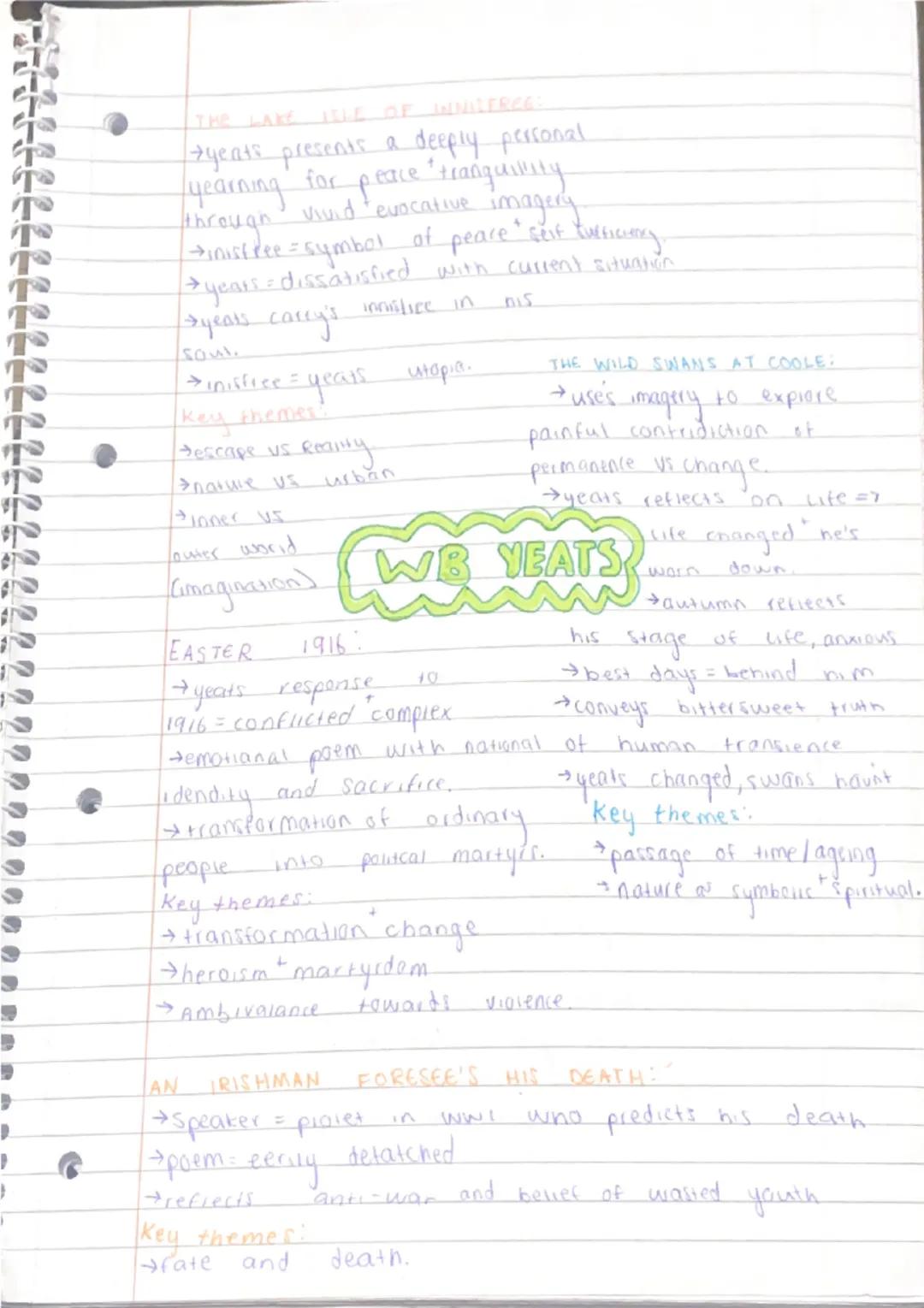
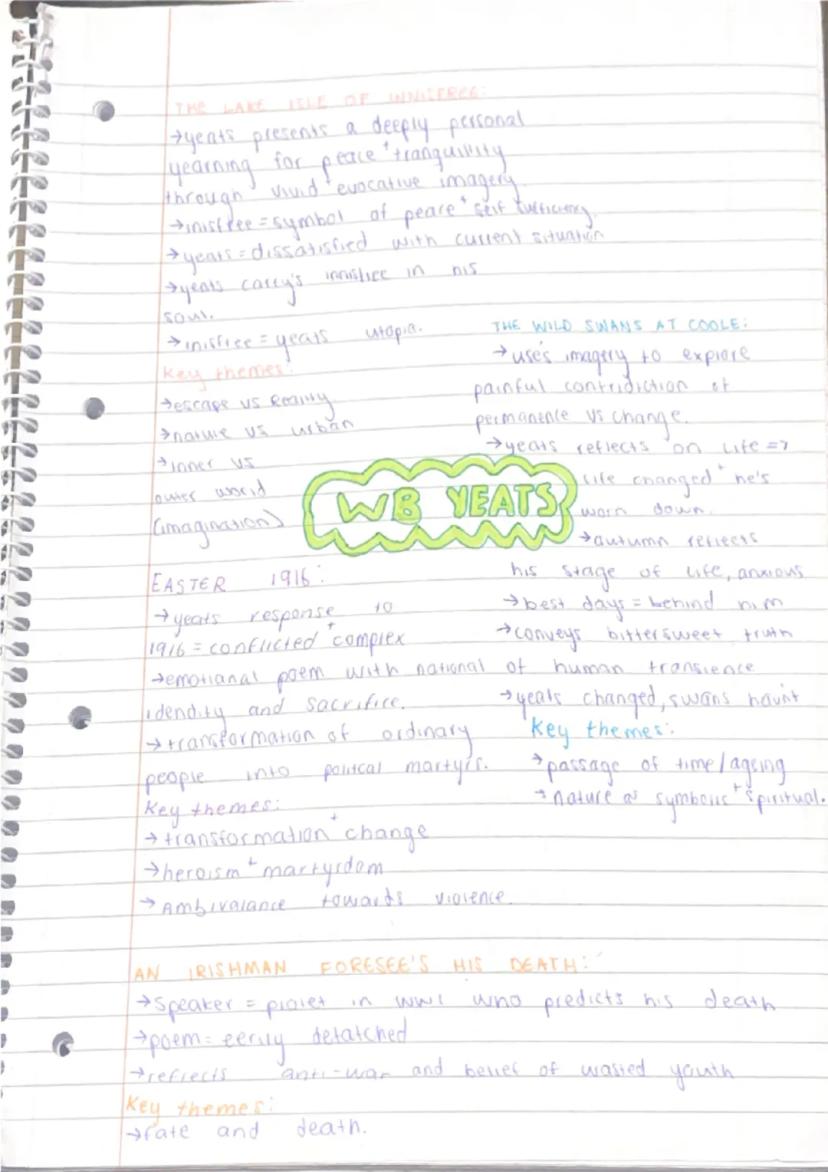
W.B. Yeats Overview
W.B. Yeats captures the complexity of Irish life through deeply personal yet politically charged poetry. His work spans from romantic escapism to gritty political reality, making him perfect for understanding how personal feelings connect to bigger historical moments.
"The Lake Isle of Innisfree" shows Yeats dreaming of escape from modern life's pressures. Innisfree becomes his symbol of peace and tranquillity - basically his ideal Instagram location before social media existed! The poem reflects his dissatisfaction with urban living and his longing for spiritual renewal.
"The Wild Swans at Coole" uses nature imagery to explore how everything changes except the things we wish would stay the same. Yeats feels worn down by life whilst the swans remain eternally beautiful - it's his midlife crisis poem, essentially.
"Easter 1916" tackles the Irish independence struggle with conflicted emotions. Yeats transforms ordinary people into political martyrs, showing how historical events can completely change how we see people we once knew casually.
Quick Tip: Remember that Yeats often contrasts inner emotions with outer political events - this tension appears in most of his major works.
2
of 10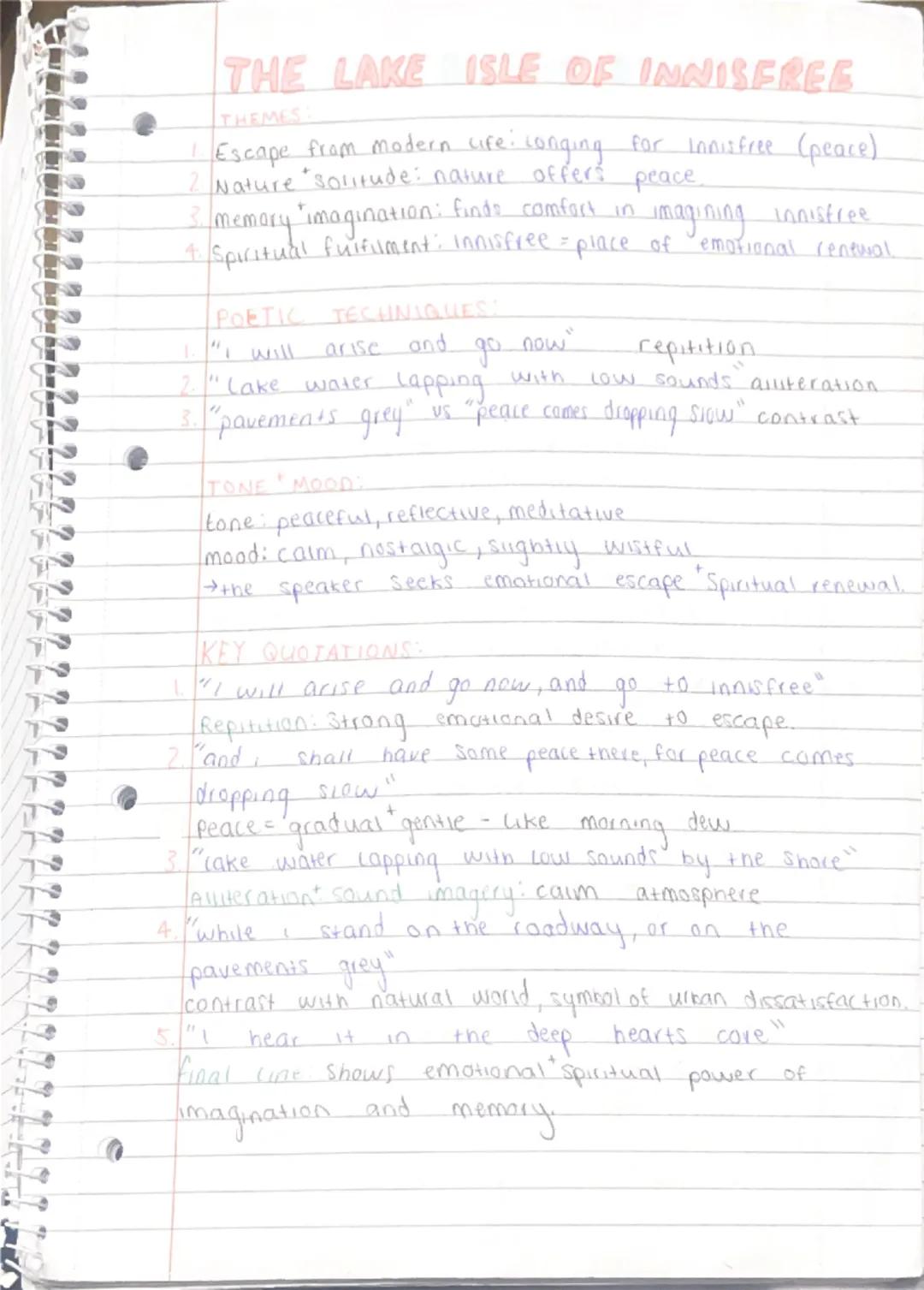
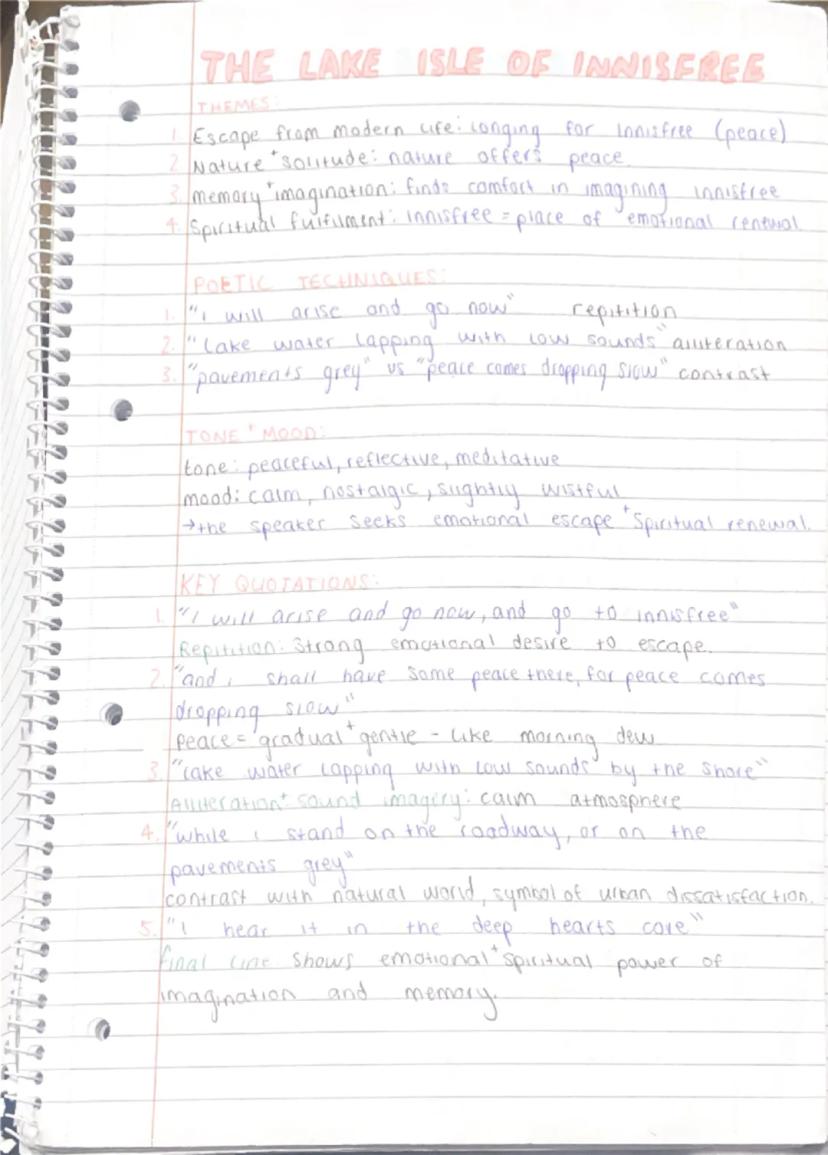
The Lake Isle of Innisfree - Analysis
This poem basically screams "I need a holiday!" but in the most beautiful way possible. Yeats presents his yearning for peace through imagery so vivid you can practically hear the lake water lapping.
The key themes revolve around escape versus reality and nature versus urban life. Notice how "pavements grey" contrasts sharply with "peace comes dropping slow" - Yeats uses this contrast technique throughout to highlight his dissatisfaction with city living.
Repetition drives the poem's emotional power. "I will arise and go now" appears like a mantra, showing his desperate desire to escape. The alliteration in "lake water lapping with low sounds" creates that calm, hypnotic atmosphere he's craving.
The tone shifts from dreamy to determined, whilst the mood remains consistently peaceful yet wistful. That final line about hearing Innisfree "in the deep heart's core" proves that sometimes imagination and memory provide the escape we need when physical escape isn't possible.
Exam Focus: Learn those quotations about contrast - especially the grey pavements versus natural imagery. Examiners love when you can explain how Yeats uses sound devices to create atmosphere.
3
of 10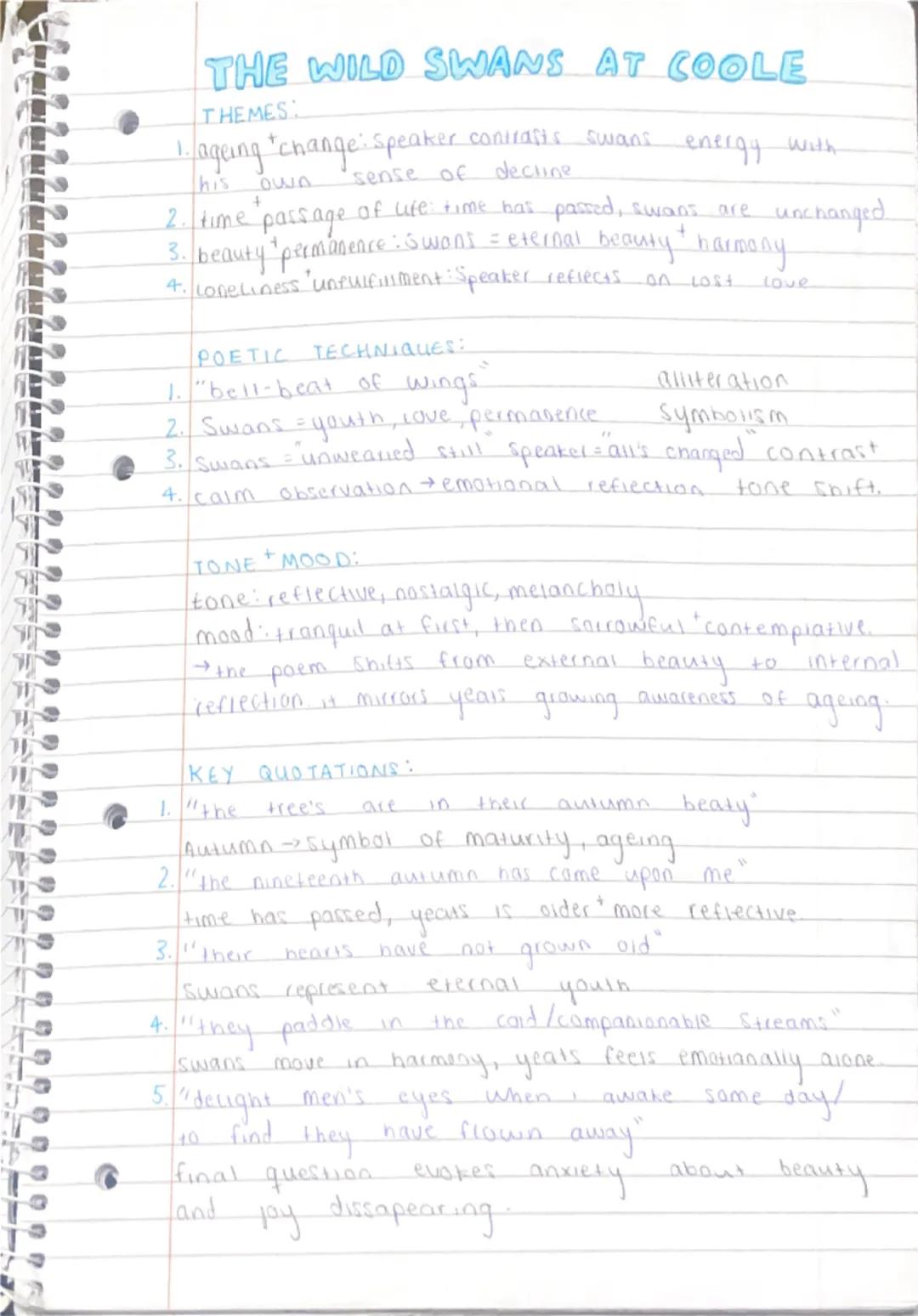
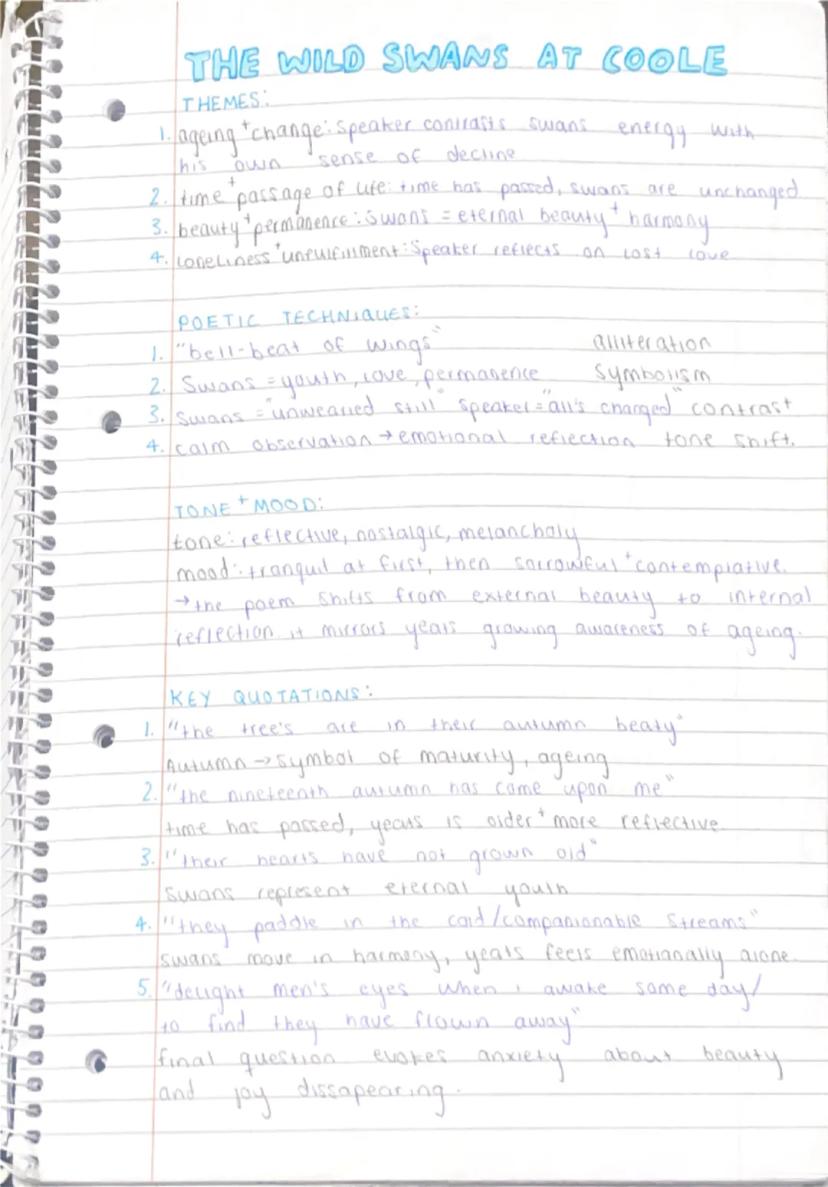
The Wild Swans at Coole - Analysis
Ever noticed how some things never seem to change whilst you feel like you're ageing rapidly? That's exactly what Yeats explores through his swan symbolism - they represent eternal youth whilst he feels increasingly worn down by life.
The autumn setting immediately signals themes of ageing and change. "The nineteenth autumn has come upon me" shows Yeats counting the years, making time feel heavy and significant. Meanwhile, the swans remain "unwearied still" - their permanence contrasts sharply with his sense of decline.
Poetic techniques include brilliant alliteration like "bell-beat of wings" and symbolism where swans represent everything Yeats feels he's lost - youth, love, energy. The tone shifts from calm observation to deeper emotional reflection as the poem progresses.
That final image about waking to find "they have flown away" captures anxiety about beauty disappearing. It's not just about swans - it's about youth, opportunities, and love potentially vanishing whilst we're not paying attention.
Remember: The swans symbolise permanence in nature whilst Yeats represents human transience - this contrast drives the entire poem's emotional impact.
4
of 10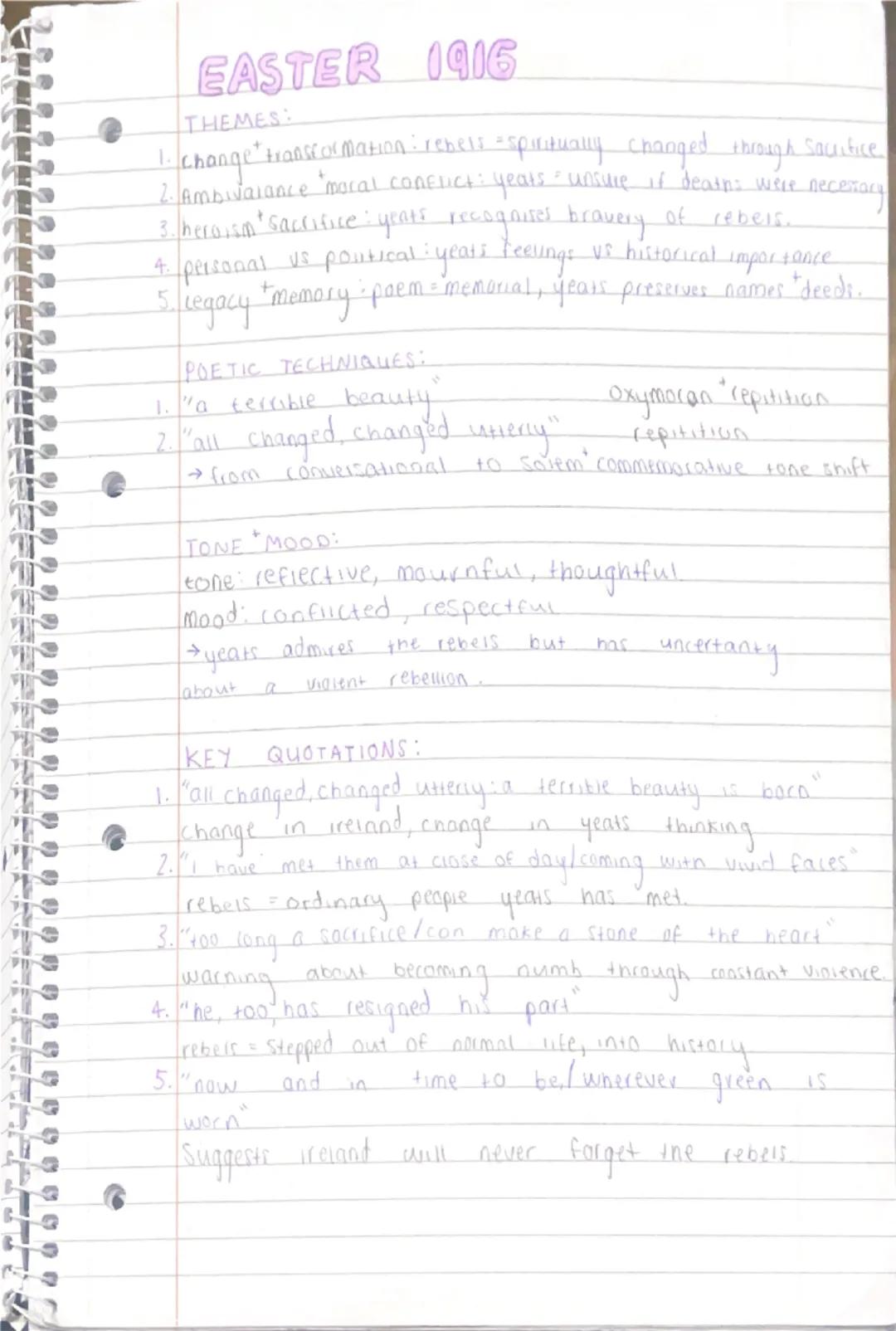
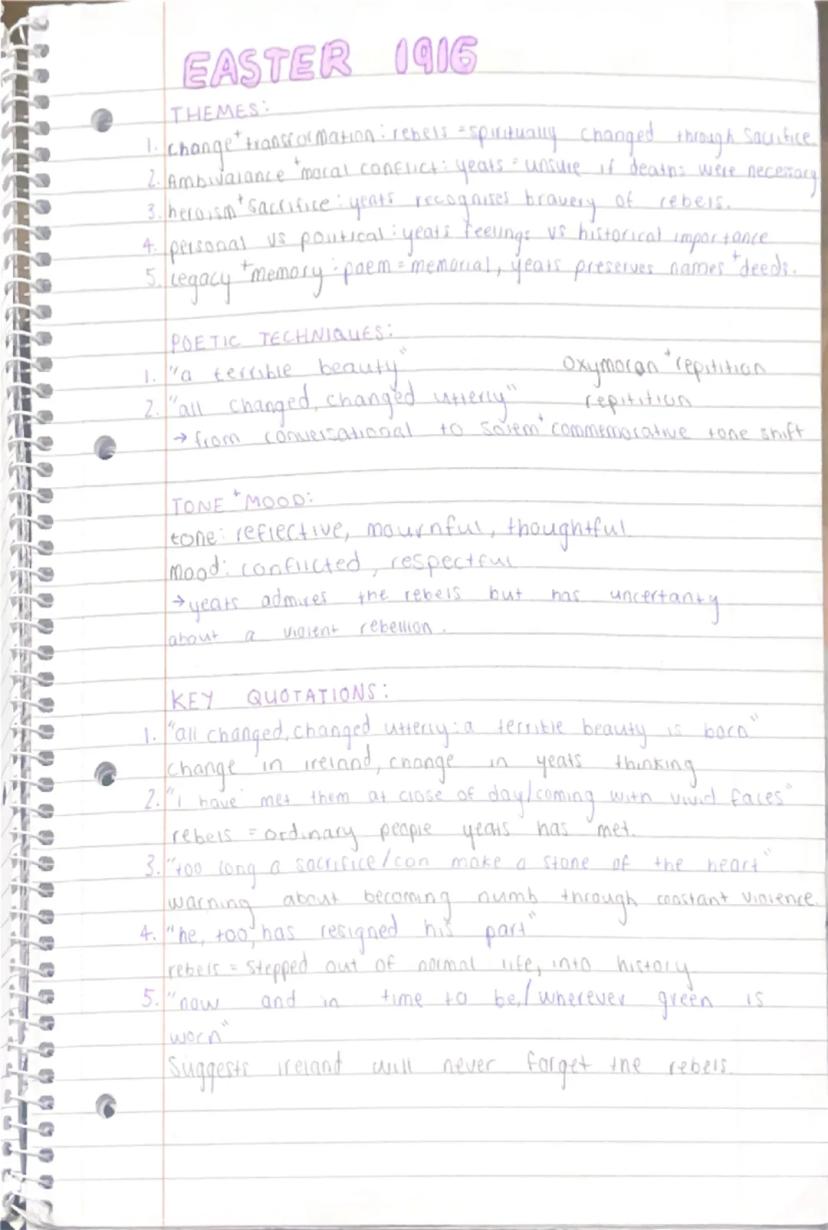
Easter 1916 - Analysis
Yeats' response to the Easter Rising shows how ordinary people can become extraordinary through sacrifice - but he's not entirely sure if their deaths were worth it. This ambivalence makes the poem complex and honest rather than simple propaganda.
"All changed, changed utterly" becomes the poem's heartbeat through repetition, whilst "a terrible beauty is born" creates an oxymoron that captures Yeats' conflicted feelings. Something beautiful emerged from violence, but at what cost?
The transformation theme runs throughout - rebels "resigned his part" in normal life to enter history. Yeats knew these people casually ("coming with vivid faces") but now sees them as political martyrs who've achieved immortality through sacrifice.
Tone shifts dramatically from conversational to solemn and commemorative. Yeats moves between admiring their bravery and questioning whether "too long a sacrifice can make a stone of the heart" - warning against becoming numb to violence.
That final promise that "wherever green is worn" Ireland will remember shows how poetry preserves memory. Yeats transforms personal grief into national commemoration.
Key Insight: Yeats balances personal feelings with historical importance - he's writing both as someone who knew these people and as Ireland's unofficial national poet.
5
of 10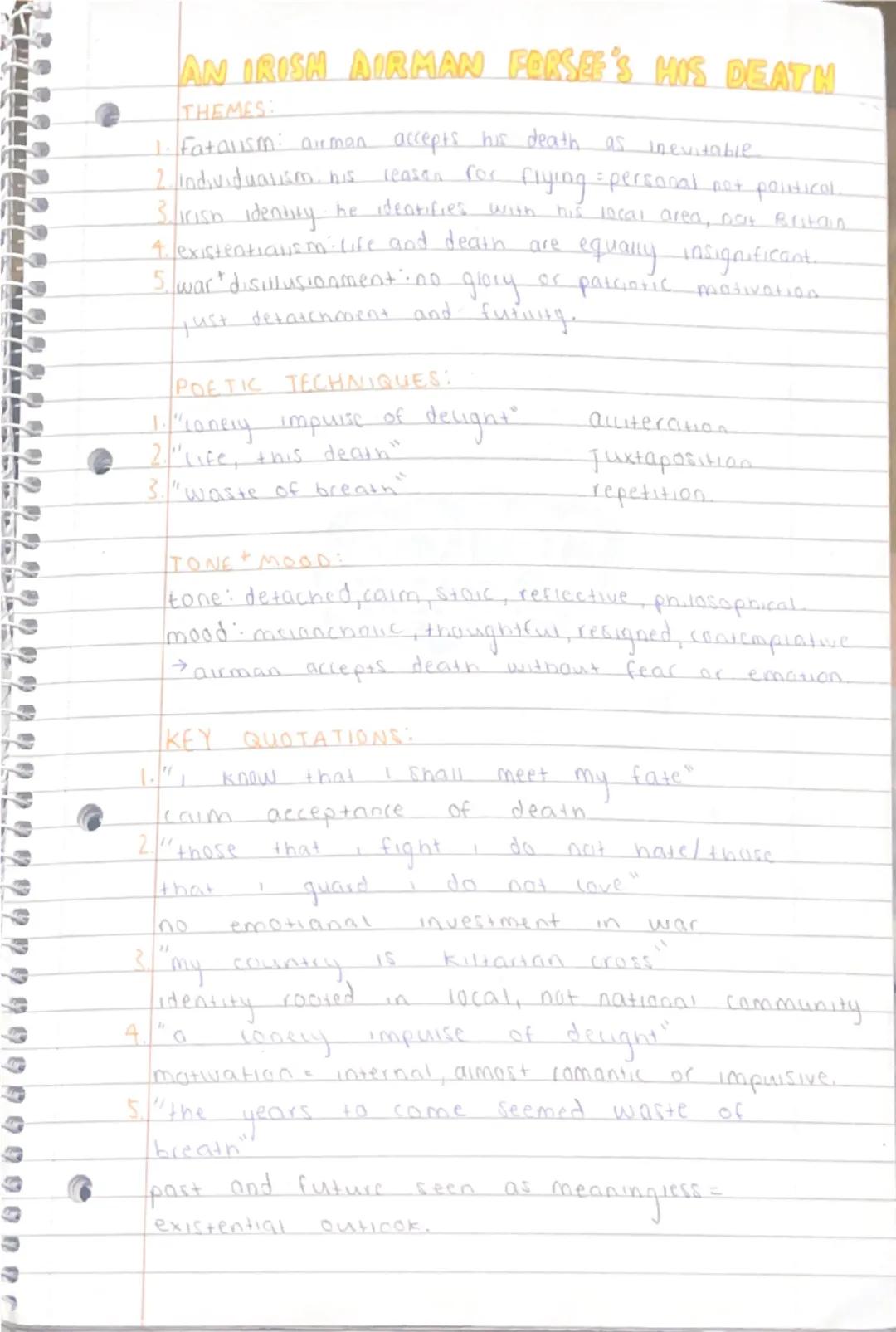
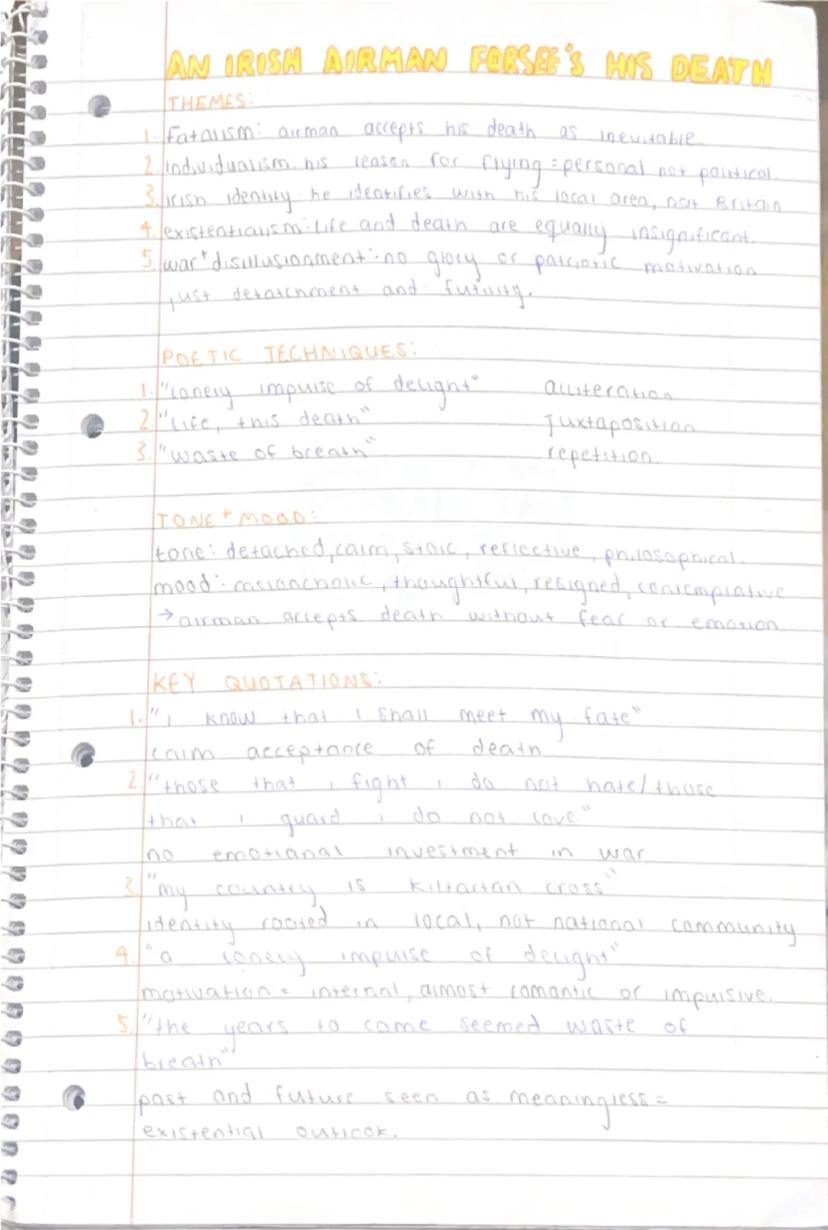
An Irishman Foresees His Death - Analysis
This poem strips war of all romantic nonsense. The Irish airman speaks with eerie detachment about his coming death, making this anti-war poetry at its most effective because it avoids dramatic emotion.
Fatalism dominates - "I know that I shall meet my fate" shows calm acceptance rather than fear. His motivation isn't patriotic but personal: "a lonely impulse of delight" drives him to fly, making this about individual choice rather than political duty.
Identity remains local - "my country is Kiltartan Cross" shows he fights for his immediate community, not Britain or even Ireland as a whole. This Irish identity grounds the poem in specific place rather than abstract nationalism.
The juxtaposition "those that I fight I do not hate/Those that I guard I do not love" emphasises his emotional detachment. Past and future seem "waste of breath" - pure existential philosophy where life and death become equally meaningless.
Tone stays remarkably calm and philosophical throughout, creating a melancholic but resigned mood. No heroics here - just honest reflection on war's pointlessness.
War Poetry Connection: Compare this detached approach to other war poems you've studied - Bishop's airman represents disillusioned individualism rather than patriotic sacrifice.
6
of 10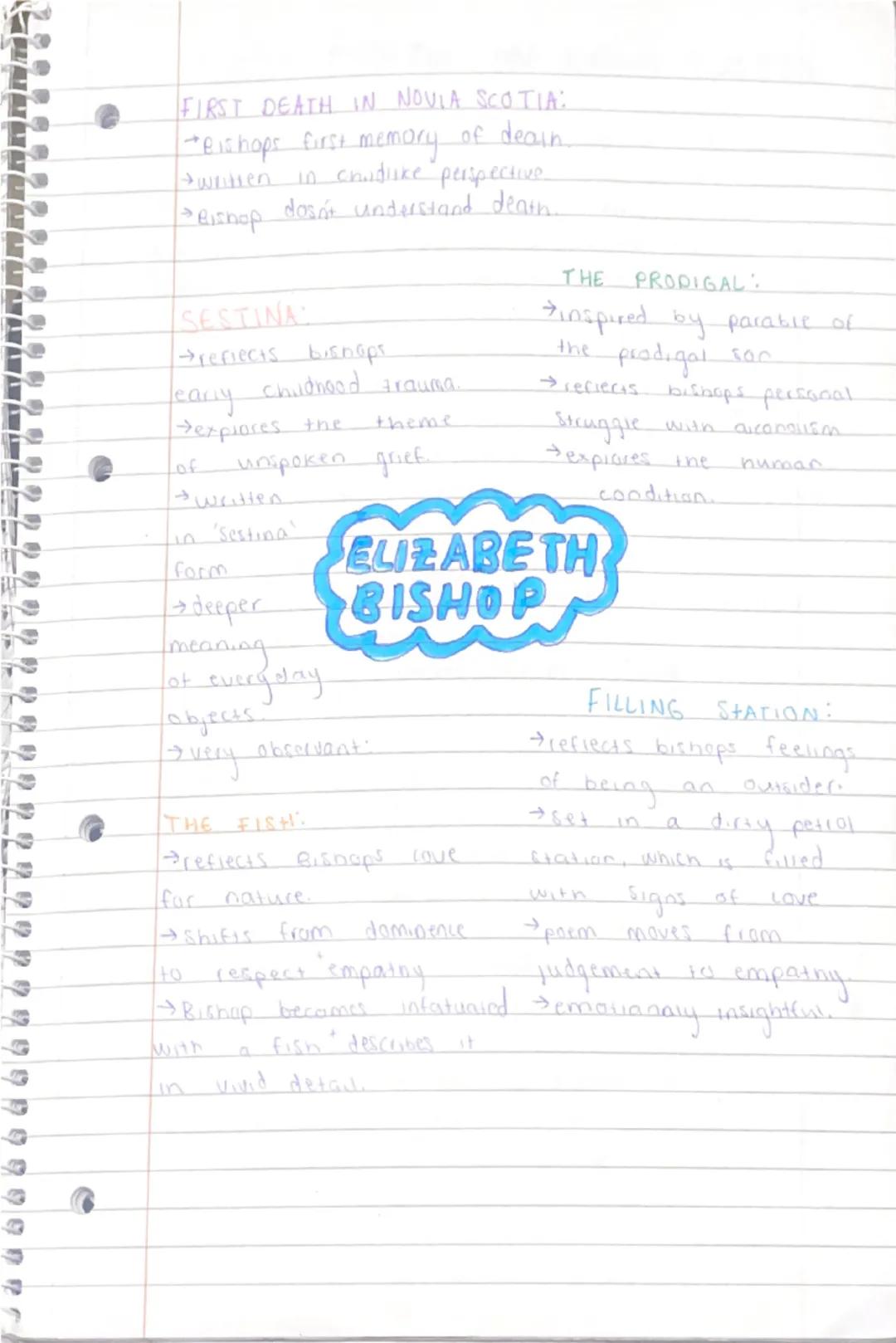
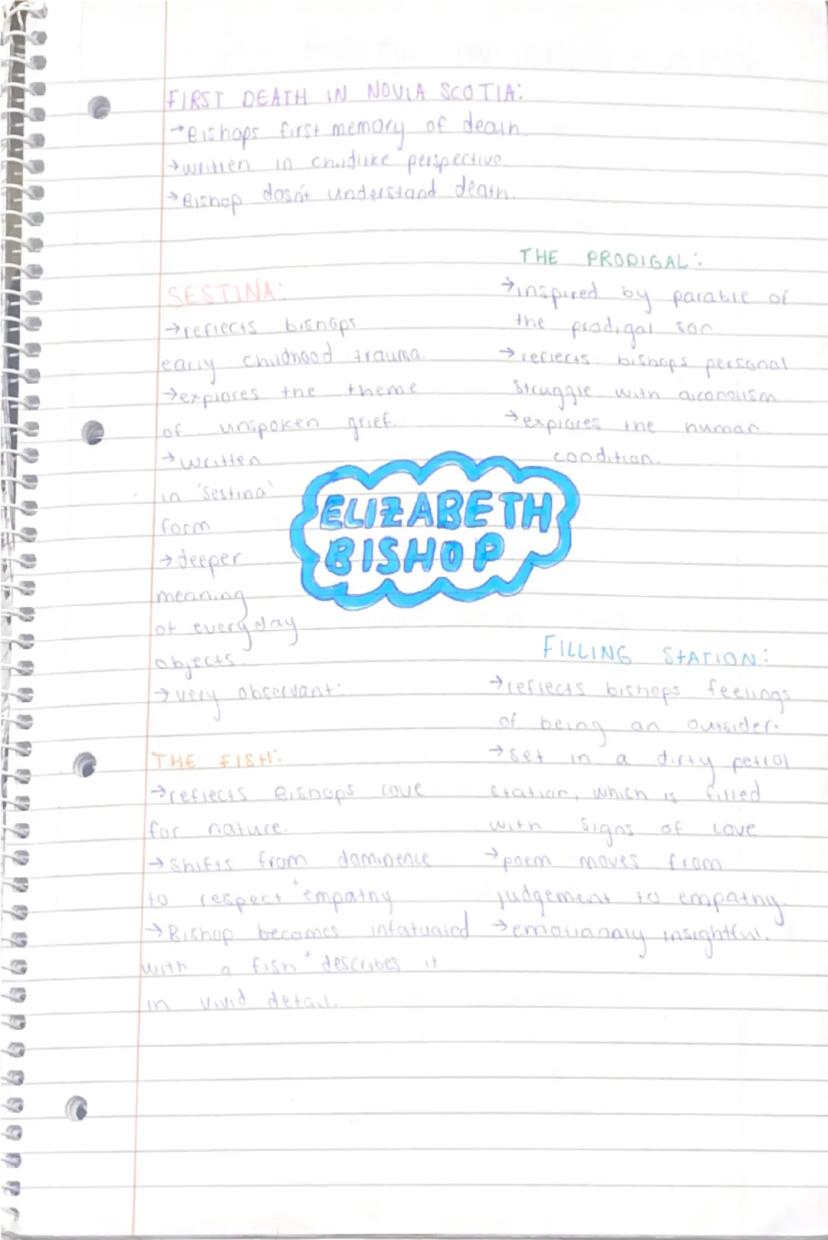
Elizabeth Bishop Overview
Elizabeth Bishop transforms ordinary moments into profound poetry through incredible observational skills and emotional restraint. Her childhood experiences of loss and displacement shape poems that find beauty in unexpected places whilst exploring themes of belonging and understanding.
"First Death in Nova Scotia" captures a child's confusion when confronting death for the first time. Bishop writes from a childlike perspective, showing how imagination helps process incomprehensible experiences like mortality.
"Sestina" uses its complex poetic form to mirror how unspoken grief cycles through daily life. Everyday objects become emotionally charged symbols in this exploration of childhood trauma and family dysfunction.
"The Fish" demonstrates Bishop's love for nature whilst showing personal growth. The speaker's attitude shifts from dominance to respect as detailed observation leads to empathy and moral development.
"The Prodigal" reflects Bishop's personal struggles through the biblical parable, exploring addiction, exile, and the difficulty of change with unflinching honesty.
Bishop's Style: Notice how she finds deeper meaning in everyday objects and situations - this observational approach makes her poetry both accessible and profound.
7
of 10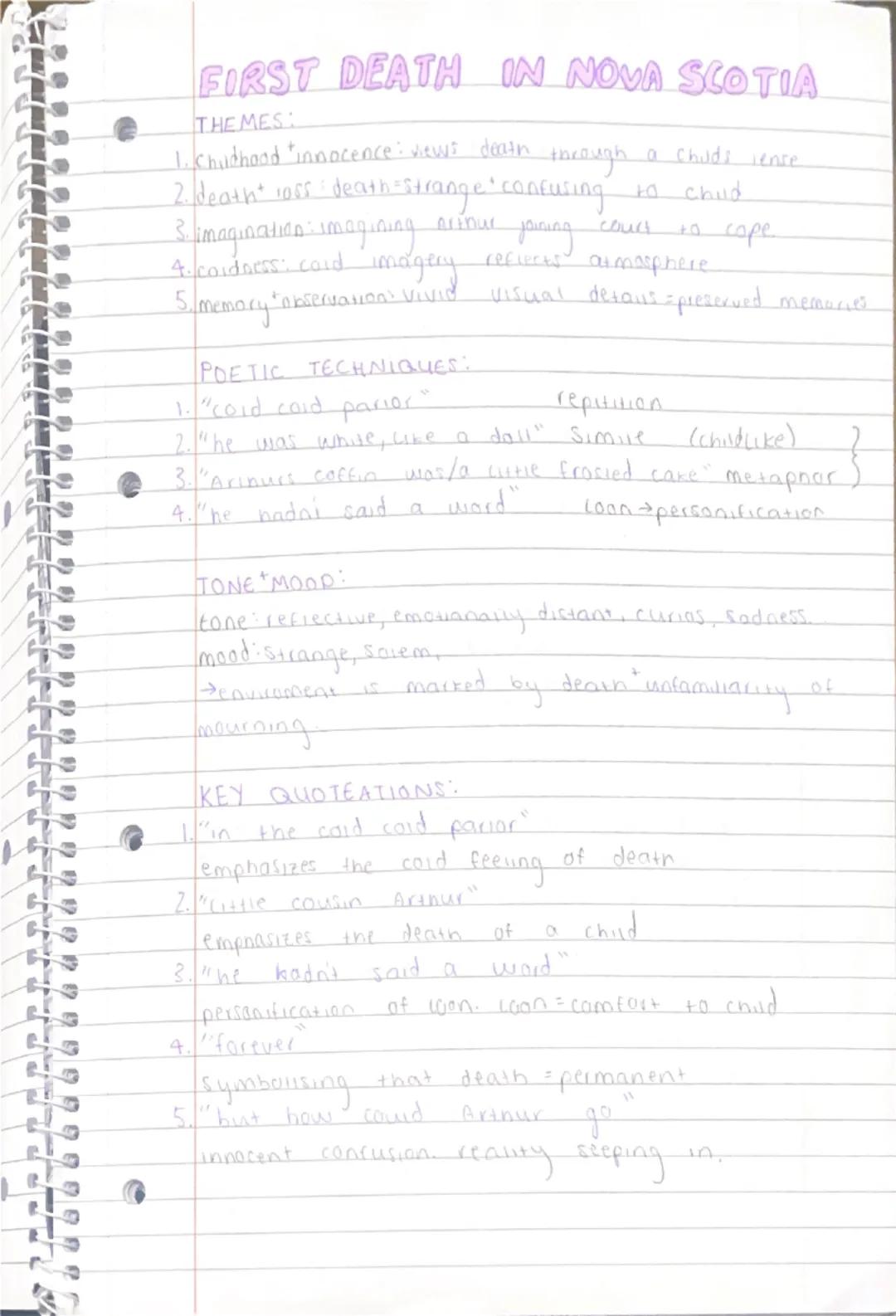
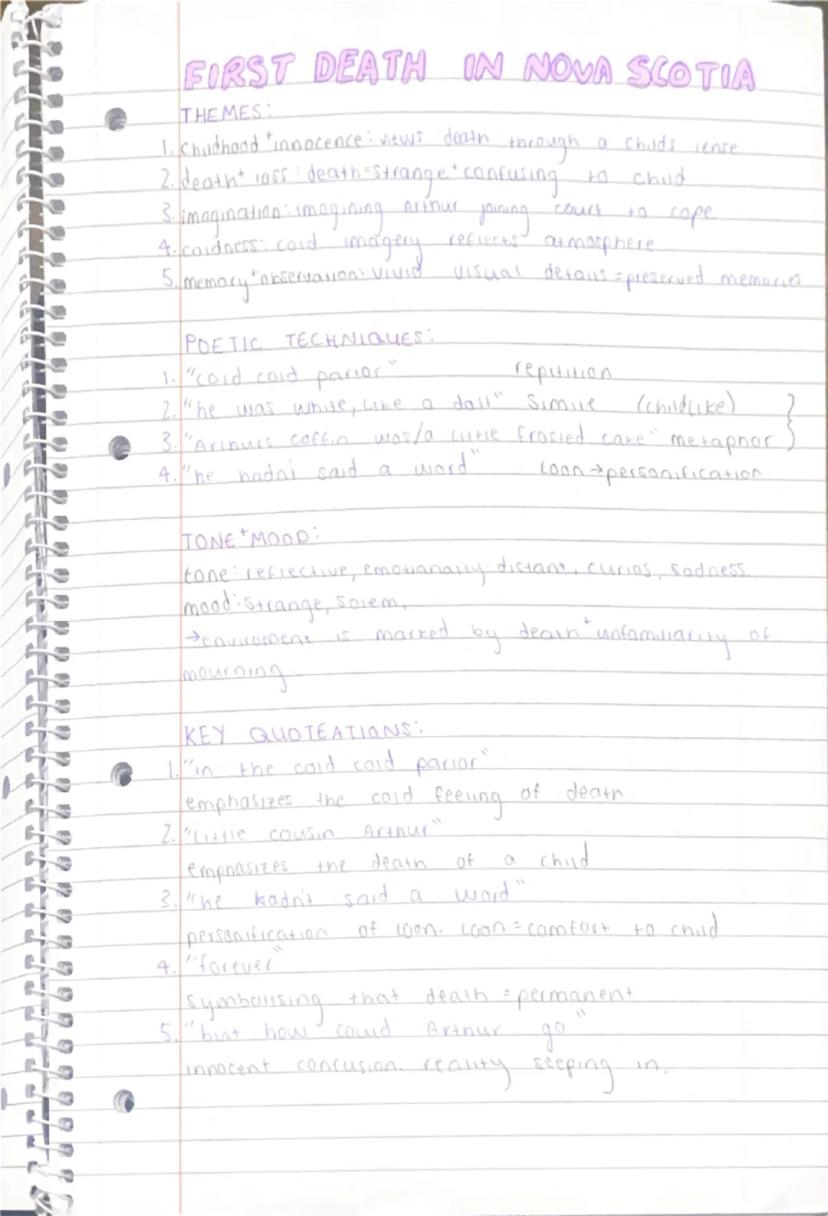
First Death in Nova Scotia - Analysis
Childhood innocence meets death's reality in this beautifully confused poem. Bishop recreates a child's perspective so convincingly that we experience death's strangeness through young eyes rather than adult understanding.
The cold imagery dominates - "cold cold parlour" uses repetition to emphasise both physical temperature and death's emotional chill. Similes like "white, like a doll" and metaphors comparing the coffin to "a little frosted cake" show how children process incomprehensible experiences through familiar comparisons.
Red imagery appears throughout - from the stuffed loon to references to royalty - creating an atmosphere that's both festive and unsettling. The child imagines "Arthur's" court as a coping mechanism, blending reality with fairy-tale fantasy.
That final question "But how could Arthur go" shows innocent confusion as reality begins penetrating the child's protective imagination. Personification of the loon who "hadn't said a word" suggests even familiar objects become strange in death's presence.
Tone remains emotionally distant yet curious, creating a solemn, strange mood where mourning rituals feel foreign and bewildering to young observers.
Memory Technique: Bishop preserves childhood's emotional truth rather than adult interpretation - this authenticity makes her childhood poems particularly powerful.
8
of 10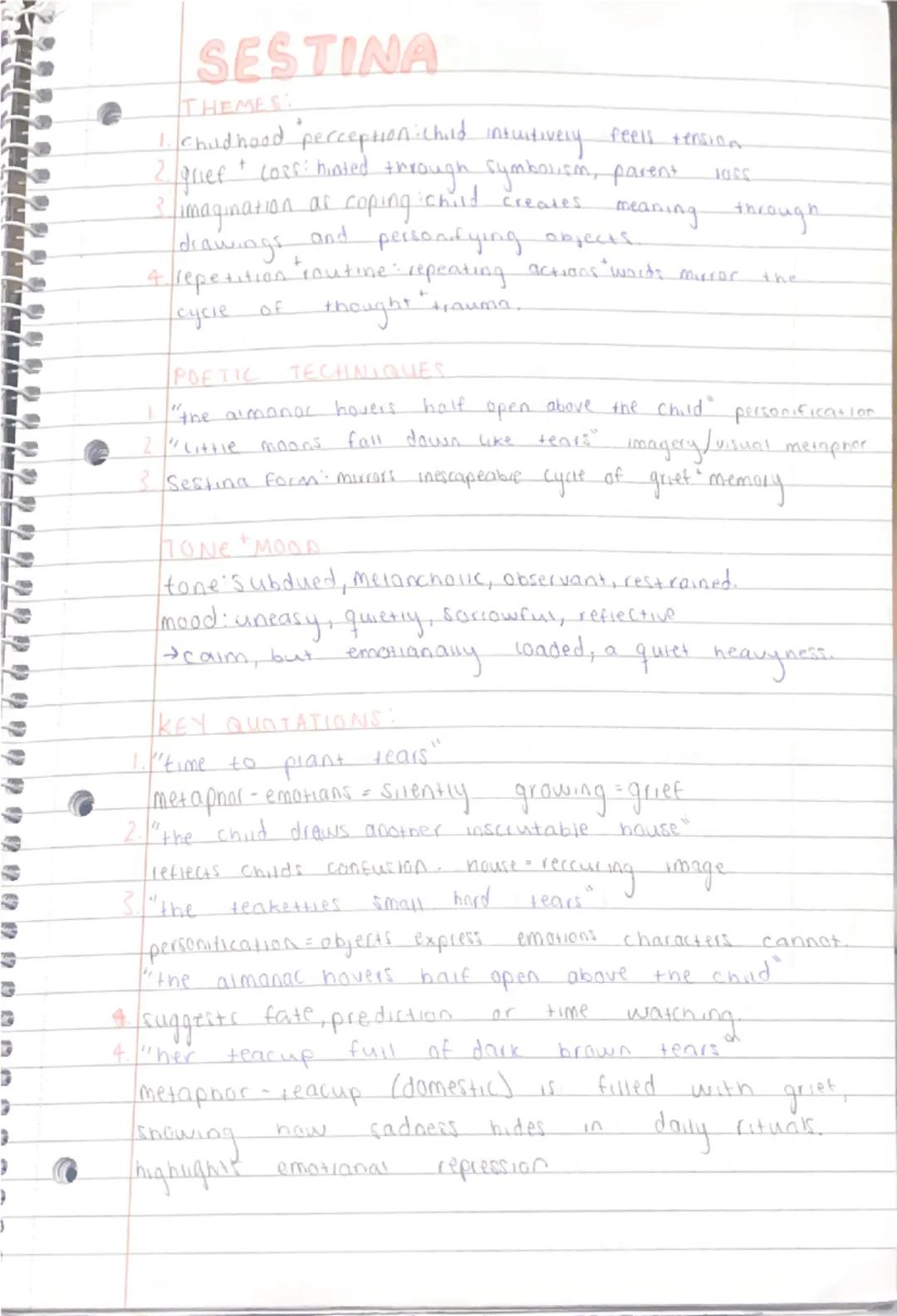
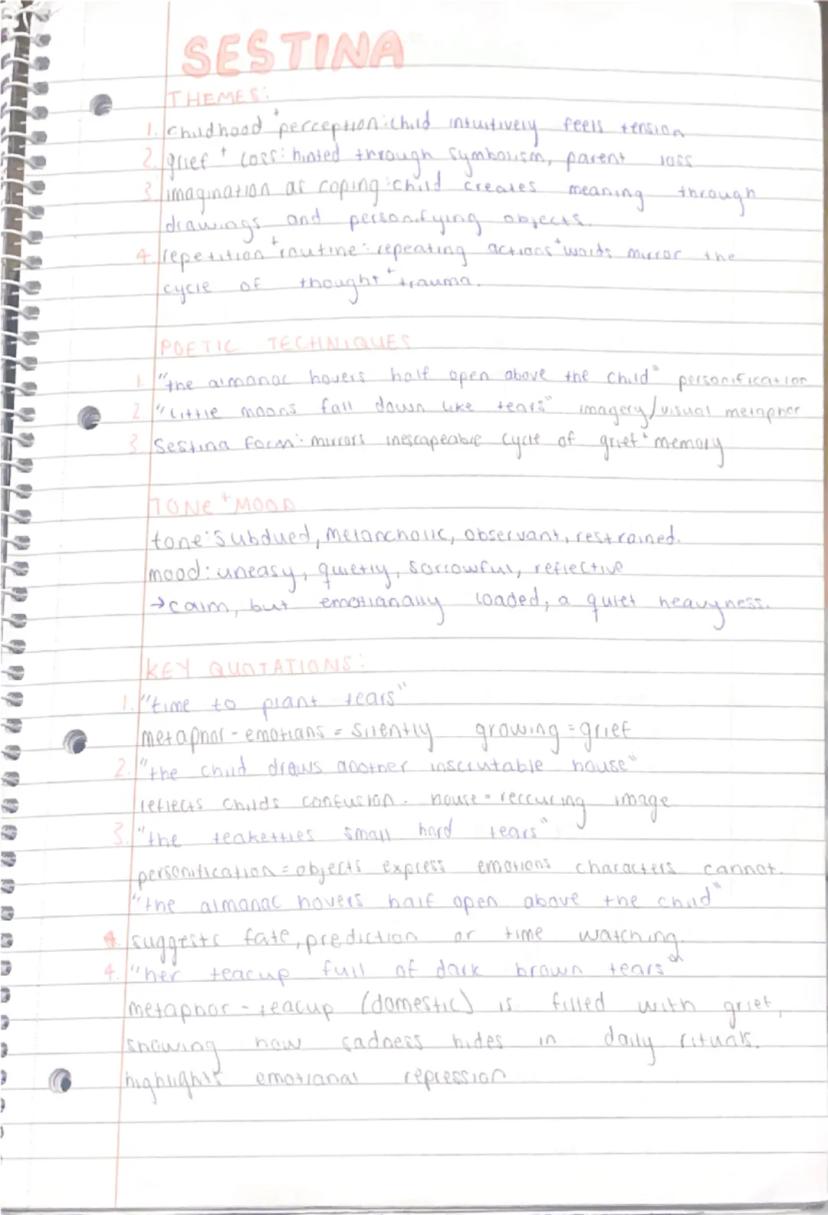
Sestina - Analysis
The sestina form itself becomes part of the meaning here - its repetitive structure mirrors how grief and trauma cycle through everyday life without ever being directly addressed. Bishop shows rather than tells emotional dysfunction.
Unspoken grief fills this poem's domestic scene. The child intuitively feels tension whilst adults maintain emotional restraint. Objects become emotionally charged: the almanac hovers, the teakettle cries, and even tears become something to plant rather than expressions of sadness.
Personification runs throughout - "the almanac hovers half open above the child" suggests fate or time watching, whilst "teakettle's small hard tears" shows how objects express emotions that characters cannot. This emotional repression creates the poem's underlying tension.
The child's repeated drawings of "another inscrutable house" reflect confusion about family and belonging. "Time to plant tears" uses metaphor to suggest emotions growing silently underground like seeds.
Tone stays subdued and observant whilst the mood feels uneasy yet quietly sorrowful. There's emotional weight without dramatic expression - typical Bishop restraint that makes the pain more powerful.
Form Analysis: The sestina's circular structure perfectly captures how trauma repeats in memory and daily life without resolution.
9
of 10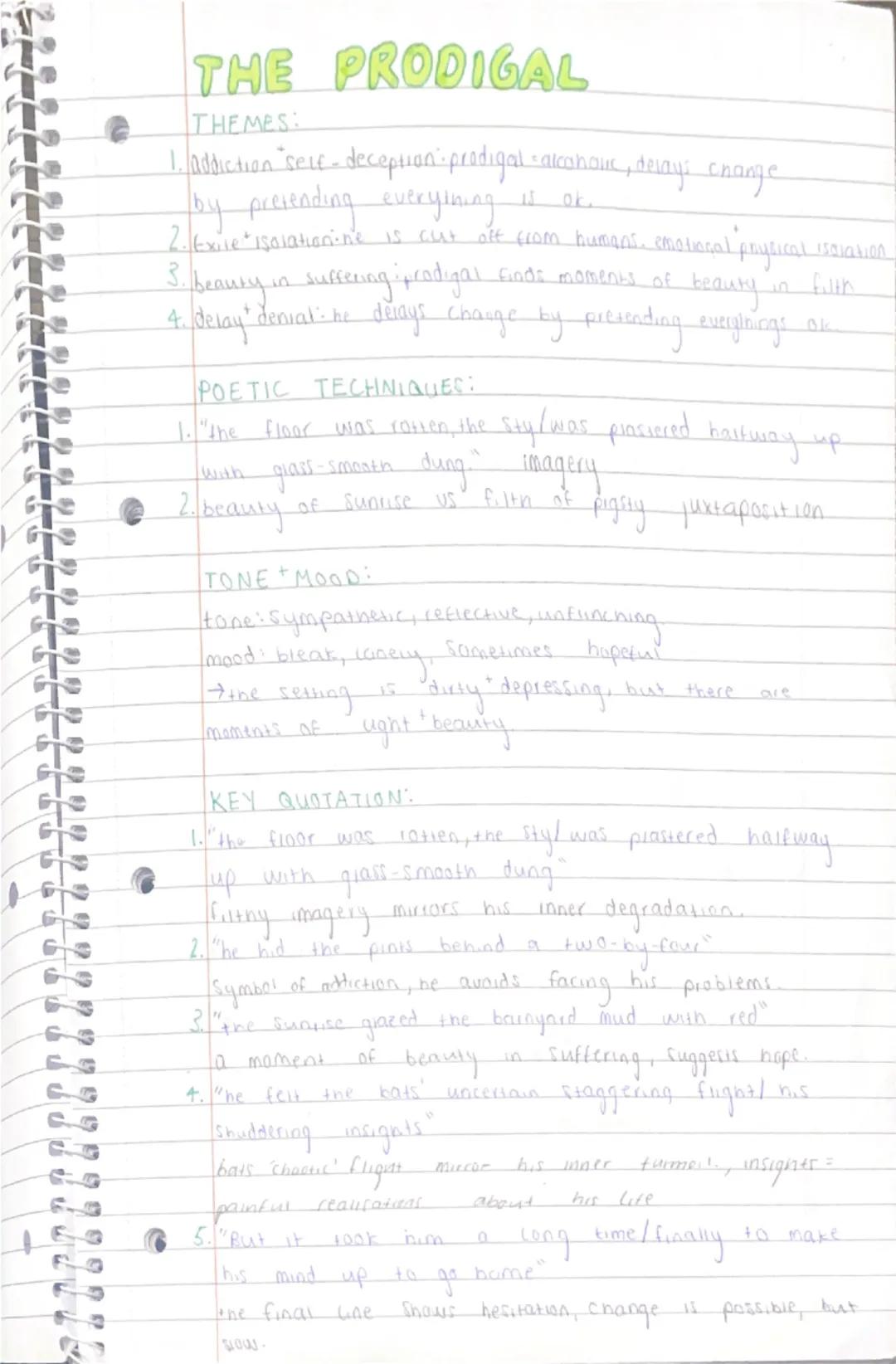
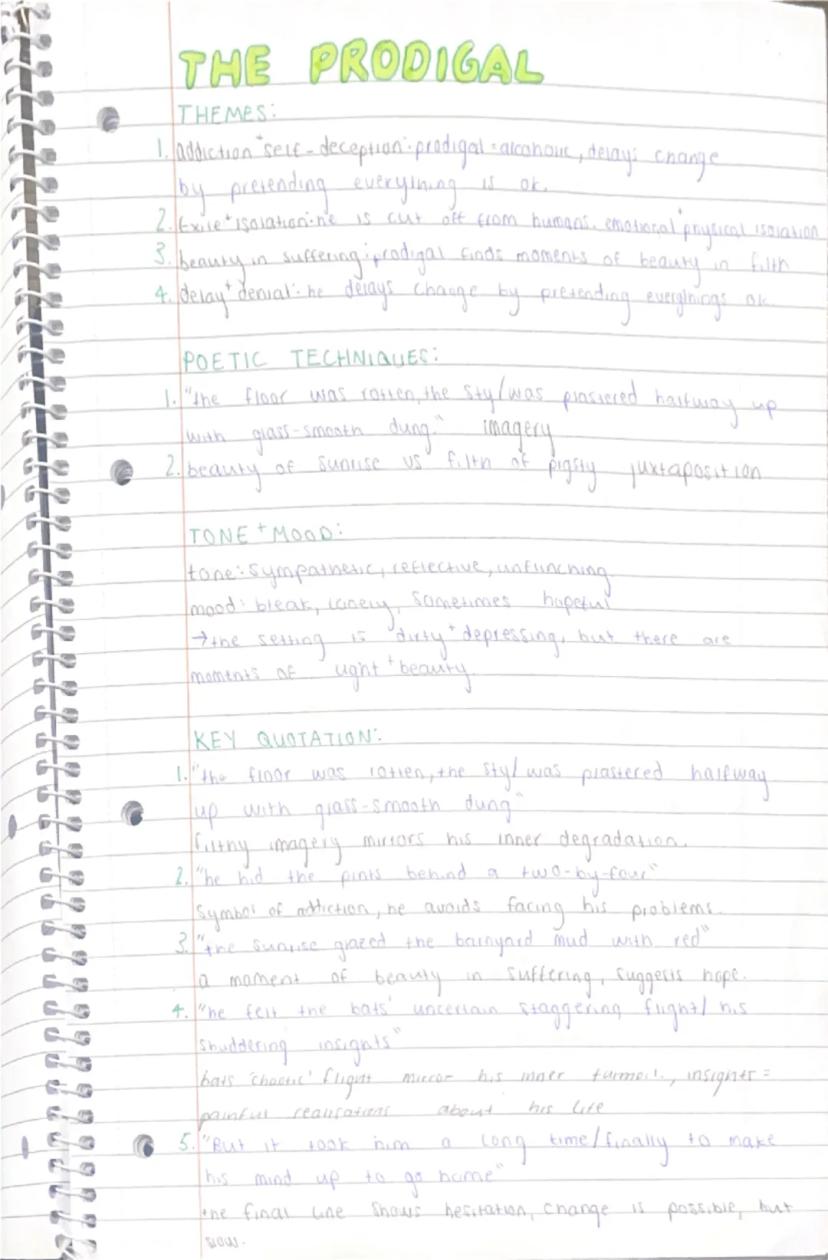
The Prodigal - Analysis
Addiction and self-deception dominate this unflinching look at hitting rock bottom. Bishop's prodigal delays change through denial, finding himself isolated amongst pigs - both literally and metaphorically living in filth.
The setting imagery is deliberately harsh: "the floor was rotten, the sty was plastered halfway up with glass-smooth dung." This vivid, unpleasant imagery mirrors the character's inner degradation without sentimentality or romanticism.
Juxtaposition appears in moments where beauty breaks through suffering - "the sunrise glazed the barnyard mud with red" suggests hope persisting even in degraded circumstances. These brief moments of beauty keep the poem from becoming completely despairing.
"He hid the pints behind a two-by-four" symbolises how addiction involves constant hiding and avoidance. The bats' "uncertain staggering flight" mirrors his own instability whilst representing "shuddering insights" - painful self-realisations he'd rather avoid.
That final hesitation - "it took him a long time/finally to make his mind up to go home" - shows change is possible but difficult. No easy redemption here, just honest acknowledgment of how hard transformation becomes.
Biblical Connection: Bishop modernises the parable whilst keeping its essential message about redemption requiring genuine change rather than simple return.
10
of 10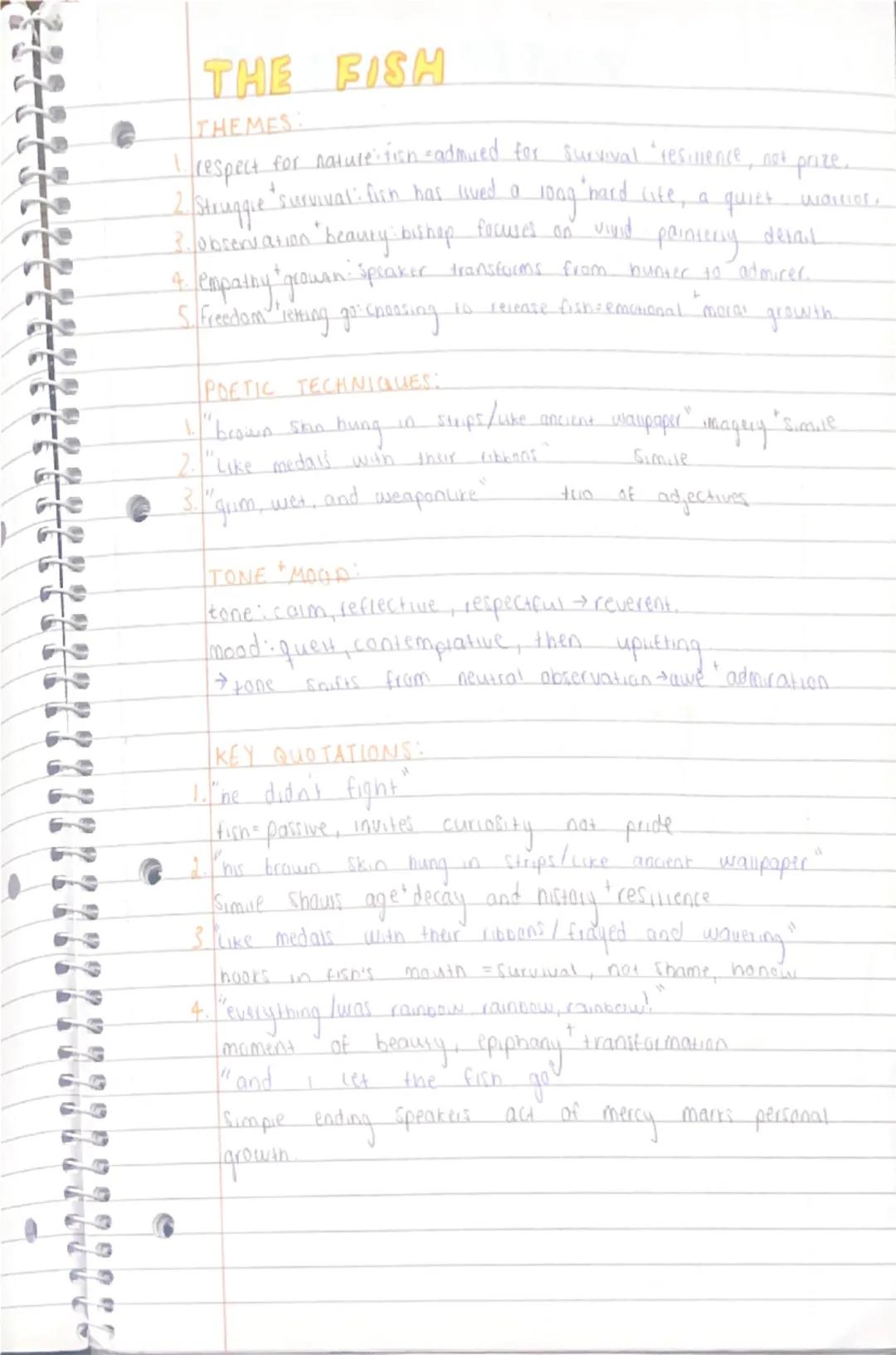
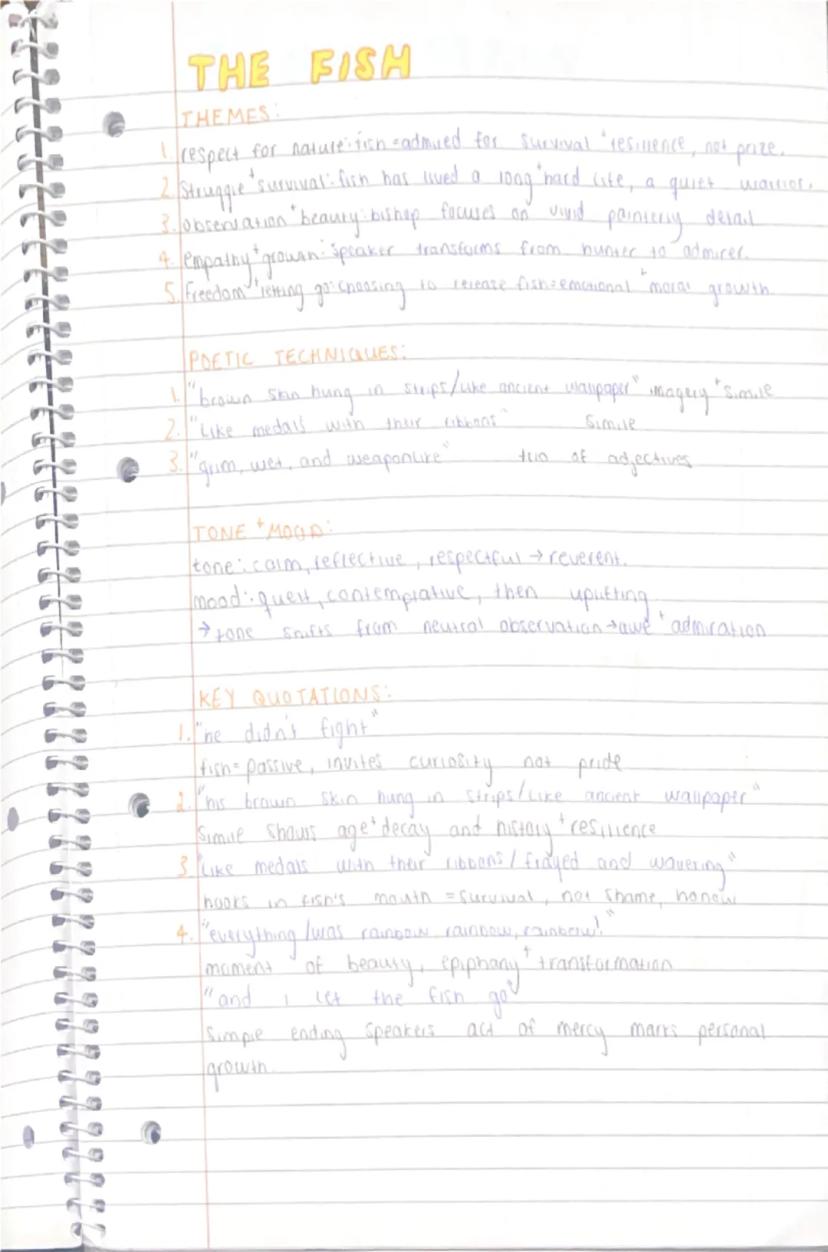
The Fish - Analysis
Respect for nature emerges through detailed observation in this poem about personal moral growth. Bishop transforms from predator to admirer as she really sees what she's caught rather than just claiming her prize.
The fish becomes a quiet warrior through Bishop's incredible descriptive imagery: "brown skin hung in strips/like ancient wallpaper" uses simile to show age and resilience. Those old hooks in its mouth become "like medals with their ribbons" - symbols of survival rather than defeat.
Empathy grows through observation. The fish "didn't fight" - its passive dignity invites curiosity rather than pride. Bishop's tone shifts from neutral description to awe and admiration as she recognises the fish's long struggle for survival.
That climactic moment - "everything was rainbow, rainbow, rainbow!" - represents epiphany through beauty. The ordinary world transforms when we truly see rather than simply look, leading to her simple but powerful decision: "and I let the fish go."
Freedom and release complete the poem's emotional and moral journey. This isn't just about fishing - it's about learning respect for other forms of life through genuine attention and empathy.
Nature Writing: Bishop shows how close observation leads to respect - the more accurately she describes the fish, the less she can justify keeping it.
We thought you’d never ask...
Our AI companion is specifically built for the needs of students. Based on the millions of content pieces we have on the platform we can provide truly meaningful and relevant answers to students. But its not only about answers, the companion is even more about guiding students through their daily learning challenges, with personalised study plans, quizzes or content pieces in the chat and 100% personalisation based on the students skills and developments.
You can download the app in the Google Play Store and in the Apple App Store.
That's right! Enjoy free access to study content, connect with fellow students, and get instant help – all at your fingertips.
Most popular content in English
9EnglishKey Quotes : Sive
Key Quotes and explanations: Sive
6th Year2852
EnglishCultural Context : Shawshank Redemption : Sive : Small Things Like These
Comparative Study : Cultural Context : Shawshank Redemption, Sive and Small Things Like These
6th Year1430
EnglishElizabeth Bishop notes
Elizabeth Bishop notes
6th Year1271
EnglishPoetry
Paula Meehan - the statue of the virgin at granard speaks, the exact moment i became a poet, prayer for the children of longing, the pattern notes. Seamus Heaney, the forge notes.
6th Year300
EnglishKey Moments of Macbeth
This is a one page summary for key moments of Macbeth including quotes and act numbers
6th Year320
EnglishMud term break
Jc poem english
1st Year141
EnglishBanquo Study Notes
Macbeth
6th Year280
EnglishThe fish-Elizabeth bishop
Overview of Elizabeth bishops poem the fish written in 1940 ,include a summary,tone and mood,key quotes,imagery examples and theme examples
6th Year370
EnglishThe merchant of Venice notes.
Scene summaries of the merchant of Venice.
3rd Year360
Most popular content
9EnglishKey Quotes : Sive
Key Quotes and explanations: Sive
6th Year2852
 Physics
Balanced and Unbalanced Forces
Students will explore how balanced forces result in no change in motion, while unbalanced forces cause an object to accelerate or change direction.
2nd Year592
 Irish
IrishIníon- le hÁine Durkin
Aine Durkin’s poem, Iníon: Themes & summary
5th Year890
IrishIrish oral questions and answers
Questions and answers for the leaving cert oral
5th Year4274
EnglishCultural Context : Shawshank Redemption : Sive : Small Things Like These
Comparative Study : Cultural Context : Shawshank Redemption, Sive and Small Things Like These
6th Year1430
IrishMo Ghrá-sa (Idir Lúibíní)
Notes on mo ghrá-sa
5th Year380
EnglishElizabeth Bishop notes
Elizabeth Bishop notes
6th Year1271
PhysicsTypes of Forces
Students will identify common forces such as gravity (pulling objects down), friction (opposing motion), and air resistance (slowing objects in the air).
2nd Year580
IrishAn Gaeilge Aiste
Irish Language essay
6th Year1320
Students love us — and so will you.
4.6/5App Store
4.7/5Google Play
The app is very easy to use and well designed. I have found everything I was looking for so far and have been able to learn a lot from the presentations! I will definitely use the app for a class assignment! And of course it also helps a lot as an inspiration.
Stefan SiOS user
This app is really great. There are so many study notes and help [...]. My problem subject is French, for example, and the app has so many options for help. Thanks to this app, I have improved my French. I would recommend it to anyone.
Samantha KlichAndroid user
Wow, I am really amazed. I just tried the app because I've seen it advertised many times and was absolutely stunned. This app is THE HELP you want for school and above all, it offers so many things, such as workouts and fact sheets, which have been VERY helpful to me personally.
AnnaiOS user
English29 views·Updated 11 Jul 2026·24 pagesComprehensive Notes on Macbeth, Poetry, and Comparison
L
LUCY DOYLE@lucydoyle_0fm44
Time to dive into W.B. Yeats and Elizabeth Bishop - two poets who'll actually make sense once you break them down! Yeats explores Irish identity, ageing, and political change, whilst Bishop focuses on childhood memories, nature, and finding beauty in...
1
of 10
Sign up to see the content. It's free!
- Access to all documents
- Improve your grades
- Join milions of students
By signing up you accept Terms of Service and Privacy Policy
W.B. Yeats Overview
W.B. Yeats captures the complexity of Irish life through deeply personal yet politically charged poetry. His work spans from romantic escapism to gritty political reality, making him perfect for understanding how personal feelings connect to bigger historical moments.
"The Lake Isle of Innisfree" shows Yeats dreaming of escape from modern life's pressures. Innisfree becomes his symbol of peace and tranquillity - basically his ideal Instagram location before social media existed! The poem reflects his dissatisfaction with urban living and his longing for spiritual renewal.
"The Wild Swans at Coole" uses nature imagery to explore how everything changes except the things we wish would stay the same. Yeats feels worn down by life whilst the swans remain eternally beautiful - it's his midlife crisis poem, essentially.
"Easter 1916" tackles the Irish independence struggle with conflicted emotions. Yeats transforms ordinary people into political martyrs, showing how historical events can completely change how we see people we once knew casually.
Quick Tip: Remember that Yeats often contrasts inner emotions with outer political events - this tension appears in most of his major works.
2
of 10Sign up to see the content. It's free!
- Access to all documents
- Improve your grades
- Join milions of students
By signing up you accept Terms of Service and Privacy Policy
The Lake Isle of Innisfree - Analysis
This poem basically screams "I need a holiday!" but in the most beautiful way possible. Yeats presents his yearning for peace through imagery so vivid you can practically hear the lake water lapping.
The key themes revolve around escape versus reality and nature versus urban life. Notice how "pavements grey" contrasts sharply with "peace comes dropping slow" - Yeats uses this contrast technique throughout to highlight his dissatisfaction with city living.
Repetition drives the poem's emotional power. "I will arise and go now" appears like a mantra, showing his desperate desire to escape. The alliteration in "lake water lapping with low sounds" creates that calm, hypnotic atmosphere he's craving.
The tone shifts from dreamy to determined, whilst the mood remains consistently peaceful yet wistful. That final line about hearing Innisfree "in the deep heart's core" proves that sometimes imagination and memory provide the escape we need when physical escape isn't possible.
Exam Focus: Learn those quotations about contrast - especially the grey pavements versus natural imagery. Examiners love when you can explain how Yeats uses sound devices to create atmosphere.
3
of 10Sign up to see the content. It's free!
- Access to all documents
- Improve your grades
- Join milions of students
By signing up you accept Terms of Service and Privacy Policy
The Wild Swans at Coole - Analysis
Ever noticed how some things never seem to change whilst you feel like you're ageing rapidly? That's exactly what Yeats explores through his swan symbolism - they represent eternal youth whilst he feels increasingly worn down by life.
The autumn setting immediately signals themes of ageing and change. "The nineteenth autumn has come upon me" shows Yeats counting the years, making time feel heavy and significant. Meanwhile, the swans remain "unwearied still" - their permanence contrasts sharply with his sense of decline.
Poetic techniques include brilliant alliteration like "bell-beat of wings" and symbolism where swans represent everything Yeats feels he's lost - youth, love, energy. The tone shifts from calm observation to deeper emotional reflection as the poem progresses.
That final image about waking to find "they have flown away" captures anxiety about beauty disappearing. It's not just about swans - it's about youth, opportunities, and love potentially vanishing whilst we're not paying attention.
Remember: The swans symbolise permanence in nature whilst Yeats represents human transience - this contrast drives the entire poem's emotional impact.
4
of 10Sign up to see the content. It's free!
- Access to all documents
- Improve your grades
- Join milions of students
By signing up you accept Terms of Service and Privacy Policy
Easter 1916 - Analysis
Yeats' response to the Easter Rising shows how ordinary people can become extraordinary through sacrifice - but he's not entirely sure if their deaths were worth it. This ambivalence makes the poem complex and honest rather than simple propaganda.
"All changed, changed utterly" becomes the poem's heartbeat through repetition, whilst "a terrible beauty is born" creates an oxymoron that captures Yeats' conflicted feelings. Something beautiful emerged from violence, but at what cost?
The transformation theme runs throughout - rebels "resigned his part" in normal life to enter history. Yeats knew these people casually ("coming with vivid faces") but now sees them as political martyrs who've achieved immortality through sacrifice.
Tone shifts dramatically from conversational to solemn and commemorative. Yeats moves between admiring their bravery and questioning whether "too long a sacrifice can make a stone of the heart" - warning against becoming numb to violence.
That final promise that "wherever green is worn" Ireland will remember shows how poetry preserves memory. Yeats transforms personal grief into national commemoration.
Key Insight: Yeats balances personal feelings with historical importance - he's writing both as someone who knew these people and as Ireland's unofficial national poet.
5
of 10Sign up to see the content. It's free!
- Access to all documents
- Improve your grades
- Join milions of students
By signing up you accept Terms of Service and Privacy Policy
An Irishman Foresees His Death - Analysis
This poem strips war of all romantic nonsense. The Irish airman speaks with eerie detachment about his coming death, making this anti-war poetry at its most effective because it avoids dramatic emotion.
Fatalism dominates - "I know that I shall meet my fate" shows calm acceptance rather than fear. His motivation isn't patriotic but personal: "a lonely impulse of delight" drives him to fly, making this about individual choice rather than political duty.
Identity remains local - "my country is Kiltartan Cross" shows he fights for his immediate community, not Britain or even Ireland as a whole. This Irish identity grounds the poem in specific place rather than abstract nationalism.
The juxtaposition "those that I fight I do not hate/Those that I guard I do not love" emphasises his emotional detachment. Past and future seem "waste of breath" - pure existential philosophy where life and death become equally meaningless.
Tone stays remarkably calm and philosophical throughout, creating a melancholic but resigned mood. No heroics here - just honest reflection on war's pointlessness.
War Poetry Connection: Compare this detached approach to other war poems you've studied - Bishop's airman represents disillusioned individualism rather than patriotic sacrifice.
6
of 10Sign up to see the content. It's free!
- Access to all documents
- Improve your grades
- Join milions of students
By signing up you accept Terms of Service and Privacy Policy
Elizabeth Bishop Overview
Elizabeth Bishop transforms ordinary moments into profound poetry through incredible observational skills and emotional restraint. Her childhood experiences of loss and displacement shape poems that find beauty in unexpected places whilst exploring themes of belonging and understanding.
"First Death in Nova Scotia" captures a child's confusion when confronting death for the first time. Bishop writes from a childlike perspective, showing how imagination helps process incomprehensible experiences like mortality.
"Sestina" uses its complex poetic form to mirror how unspoken grief cycles through daily life. Everyday objects become emotionally charged symbols in this exploration of childhood trauma and family dysfunction.
"The Fish" demonstrates Bishop's love for nature whilst showing personal growth. The speaker's attitude shifts from dominance to respect as detailed observation leads to empathy and moral development.
"The Prodigal" reflects Bishop's personal struggles through the biblical parable, exploring addiction, exile, and the difficulty of change with unflinching honesty.
Bishop's Style: Notice how she finds deeper meaning in everyday objects and situations - this observational approach makes her poetry both accessible and profound.
7
of 10Sign up to see the content. It's free!
- Access to all documents
- Improve your grades
- Join milions of students
By signing up you accept Terms of Service and Privacy Policy
First Death in Nova Scotia - Analysis
Childhood innocence meets death's reality in this beautifully confused poem. Bishop recreates a child's perspective so convincingly that we experience death's strangeness through young eyes rather than adult understanding.
The cold imagery dominates - "cold cold parlour" uses repetition to emphasise both physical temperature and death's emotional chill. Similes like "white, like a doll" and metaphors comparing the coffin to "a little frosted cake" show how children process incomprehensible experiences through familiar comparisons.
Red imagery appears throughout - from the stuffed loon to references to royalty - creating an atmosphere that's both festive and unsettling. The child imagines "Arthur's" court as a coping mechanism, blending reality with fairy-tale fantasy.
That final question "But how could Arthur go" shows innocent confusion as reality begins penetrating the child's protective imagination. Personification of the loon who "hadn't said a word" suggests even familiar objects become strange in death's presence.
Tone remains emotionally distant yet curious, creating a solemn, strange mood where mourning rituals feel foreign and bewildering to young observers.
Memory Technique: Bishop preserves childhood's emotional truth rather than adult interpretation - this authenticity makes her childhood poems particularly powerful.
8
of 10Sign up to see the content. It's free!
- Access to all documents
- Improve your grades
- Join milions of students
By signing up you accept Terms of Service and Privacy Policy
Sestina - Analysis
The sestina form itself becomes part of the meaning here - its repetitive structure mirrors how grief and trauma cycle through everyday life without ever being directly addressed. Bishop shows rather than tells emotional dysfunction.
Unspoken grief fills this poem's domestic scene. The child intuitively feels tension whilst adults maintain emotional restraint. Objects become emotionally charged: the almanac hovers, the teakettle cries, and even tears become something to plant rather than expressions of sadness.
Personification runs throughout - "the almanac hovers half open above the child" suggests fate or time watching, whilst "teakettle's small hard tears" shows how objects express emotions that characters cannot. This emotional repression creates the poem's underlying tension.
The child's repeated drawings of "another inscrutable house" reflect confusion about family and belonging. "Time to plant tears" uses metaphor to suggest emotions growing silently underground like seeds.
Tone stays subdued and observant whilst the mood feels uneasy yet quietly sorrowful. There's emotional weight without dramatic expression - typical Bishop restraint that makes the pain more powerful.
Form Analysis: The sestina's circular structure perfectly captures how trauma repeats in memory and daily life without resolution.
9
of 10Sign up to see the content. It's free!
- Access to all documents
- Improve your grades
- Join milions of students
By signing up you accept Terms of Service and Privacy Policy
The Prodigal - Analysis
Addiction and self-deception dominate this unflinching look at hitting rock bottom. Bishop's prodigal delays change through denial, finding himself isolated amongst pigs - both literally and metaphorically living in filth.
The setting imagery is deliberately harsh: "the floor was rotten, the sty was plastered halfway up with glass-smooth dung." This vivid, unpleasant imagery mirrors the character's inner degradation without sentimentality or romanticism.
Juxtaposition appears in moments where beauty breaks through suffering - "the sunrise glazed the barnyard mud with red" suggests hope persisting even in degraded circumstances. These brief moments of beauty keep the poem from becoming completely despairing.
"He hid the pints behind a two-by-four" symbolises how addiction involves constant hiding and avoidance. The bats' "uncertain staggering flight" mirrors his own instability whilst representing "shuddering insights" - painful self-realisations he'd rather avoid.
That final hesitation - "it took him a long time/finally to make his mind up to go home" - shows change is possible but difficult. No easy redemption here, just honest acknowledgment of how hard transformation becomes.
Biblical Connection: Bishop modernises the parable whilst keeping its essential message about redemption requiring genuine change rather than simple return.
10
of 10Sign up to see the content. It's free!
- Access to all documents
- Improve your grades
- Join milions of students
By signing up you accept Terms of Service and Privacy Policy
The Fish - Analysis
Respect for nature emerges through detailed observation in this poem about personal moral growth. Bishop transforms from predator to admirer as she really sees what she's caught rather than just claiming her prize.
The fish becomes a quiet warrior through Bishop's incredible descriptive imagery: "brown skin hung in strips/like ancient wallpaper" uses simile to show age and resilience. Those old hooks in its mouth become "like medals with their ribbons" - symbols of survival rather than defeat.
Empathy grows through observation. The fish "didn't fight" - its passive dignity invites curiosity rather than pride. Bishop's tone shifts from neutral description to awe and admiration as she recognises the fish's long struggle for survival.
That climactic moment - "everything was rainbow, rainbow, rainbow!" - represents epiphany through beauty. The ordinary world transforms when we truly see rather than simply look, leading to her simple but powerful decision: "and I let the fish go."
Freedom and release complete the poem's emotional and moral journey. This isn't just about fishing - it's about learning respect for other forms of life through genuine attention and empathy.
Nature Writing: Bishop shows how close observation leads to respect - the more accurately she describes the fish, the less she can justify keeping it.
We thought you’d never ask...
Our AI companion is specifically built for the needs of students. Based on the millions of content pieces we have on the platform we can provide truly meaningful and relevant answers to students. But its not only about answers, the companion is even more about guiding students through their daily learning challenges, with personalised study plans, quizzes or content pieces in the chat and 100% personalisation based on the students skills and developments.
You can download the app in the Google Play Store and in the Apple App Store.
That's right! Enjoy free access to study content, connect with fellow students, and get instant help – all at your fingertips.
Most popular content in English
9EnglishKey Quotes : Sive
Key Quotes and explanations: Sive
6th Year2852
EnglishCultural Context : Shawshank Redemption : Sive : Small Things Like These
Comparative Study : Cultural Context : Shawshank Redemption, Sive and Small Things Like These
6th Year1430
EnglishElizabeth Bishop notes
Elizabeth Bishop notes
6th Year1271
EnglishPoetry
Paula Meehan - the statue of the virgin at granard speaks, the exact moment i became a poet, prayer for the children of longing, the pattern notes. Seamus Heaney, the forge notes.
6th Year300
EnglishKey Moments of Macbeth
This is a one page summary for key moments of Macbeth including quotes and act numbers
6th Year320
EnglishMud term break
Jc poem english
1st Year141
EnglishBanquo Study Notes
Macbeth
6th Year280
EnglishThe fish-Elizabeth bishop
Overview of Elizabeth bishops poem the fish written in 1940 ,include a summary,tone and mood,key quotes,imagery examples and theme examples
6th Year370
EnglishThe merchant of Venice notes.
Scene summaries of the merchant of Venice.
3rd Year360
Most popular content
9EnglishKey Quotes : Sive
Key Quotes and explanations: Sive
6th Year2852
PhysicsBalanced and Unbalanced Forces
Students will explore how balanced forces result in no change in motion, while unbalanced forces cause an object to accelerate or change direction.
2nd Year592
IrishIníon- le hÁine Durkin
Aine Durkin’s poem, Iníon: Themes & summary
5th Year890
IrishIrish oral questions and answers
Questions and answers for the leaving cert oral
5th Year4274
EnglishCultural Context : Shawshank Redemption : Sive : Small Things Like These
Comparative Study : Cultural Context : Shawshank Redemption, Sive and Small Things Like These
6th Year1430
IrishMo Ghrá-sa (Idir Lúibíní)
Notes on mo ghrá-sa
5th Year380
EnglishElizabeth Bishop notes
Elizabeth Bishop notes
6th Year1271
PhysicsTypes of Forces
Students will identify common forces such as gravity (pulling objects down), friction (opposing motion), and air resistance (slowing objects in the air).
2nd Year580
IrishAn Gaeilge Aiste
Irish Language essay
6th Year1320
Students love us — and so will you.
4.6/5App Store
4.7/5Google Play
The app is very easy to use and well designed. I have found everything I was looking for so far and have been able to learn a lot from the presentations! I will definitely use the app for a class assignment! And of course it also helps a lot as an inspiration.
Stefan SiOS user
This app is really great. There are so many study notes and help [...]. My problem subject is French, for example, and the app has so many options for help. Thanks to this app, I have improved my French. I would recommend it to anyone.
Samantha KlichAndroid user
Wow, I am really amazed. I just tried the app because I've seen it advertised many times and was absolutely stunned. This app is THE HELP you want for school and above all, it offers so many things, such as workouts and fact sheets, which have been VERY helpful to me personally.
AnnaiOS user