
Ever wondered why plays hit differently than novels? It's all... Show more
 English
 Irish
IrishSign up to see the contentIt's free!
Access to all documents
Improve your grades
Join milions of students
Knowunity AI
Subjects
Triangle Congruence and Similarity Theorems
Triangle Properties and Classification
Linear Equations and Graphs
Geometric Angle Relationships
Trigonometric Functions and Identities
Equation Solving Techniques
Circle Geometry Fundamentals
Division Operations and Methods
Basic Differentiation Rules
Exponent and Logarithm Properties
Show all topics
Human Organ Systems
Reproductive Cell Cycles
Biological Sciences Subdisciplines
Cellular Energy Metabolism
Autotrophic Energy Processes
Inheritance Patterns and Principles
Biomolecular Structure and Organization
Cell Cycle and Division Mechanics
Cellular Organization and Development
Biological Structural Organization
Show all topics
Chemical Sciences and Applications
Atomic Structure and Composition
Molecular Electron Structure Representation
Atomic Electron Behavior
Matter Properties and Water
Mole Concept and Calculations
Gas Laws and Behavior
Periodic Table Organization
Chemical Thermodynamics Fundamentals
Chemical Bond Types and Properties
Show all topics
European Renaissance and Enlightenment
European Cultural Movements 800-1920
American Revolution Era 1763-1797
American Civil War 1861-1865
Global Imperial Systems
Mongol and Chinese Dynasties
U.S. Presidents and World Leaders
Historical Sources and Documentation
World Wars Era and Impact
World Religious Systems
Show all topics
Classic and Contemporary Novels
Literary Character Analysis
Rhetorical Theory and Practice
Classic Literary Narratives
Reading Analysis and Interpretation
Narrative Structure and Techniques
English Language Components
Influential English-Language Authors
Basic Sentence Structure
Narrative Voice and Perspective
Show all topics
1
•
Updated May 13, 2026
•
Ever wondered why plays hit differently than novels? It's all... Show more
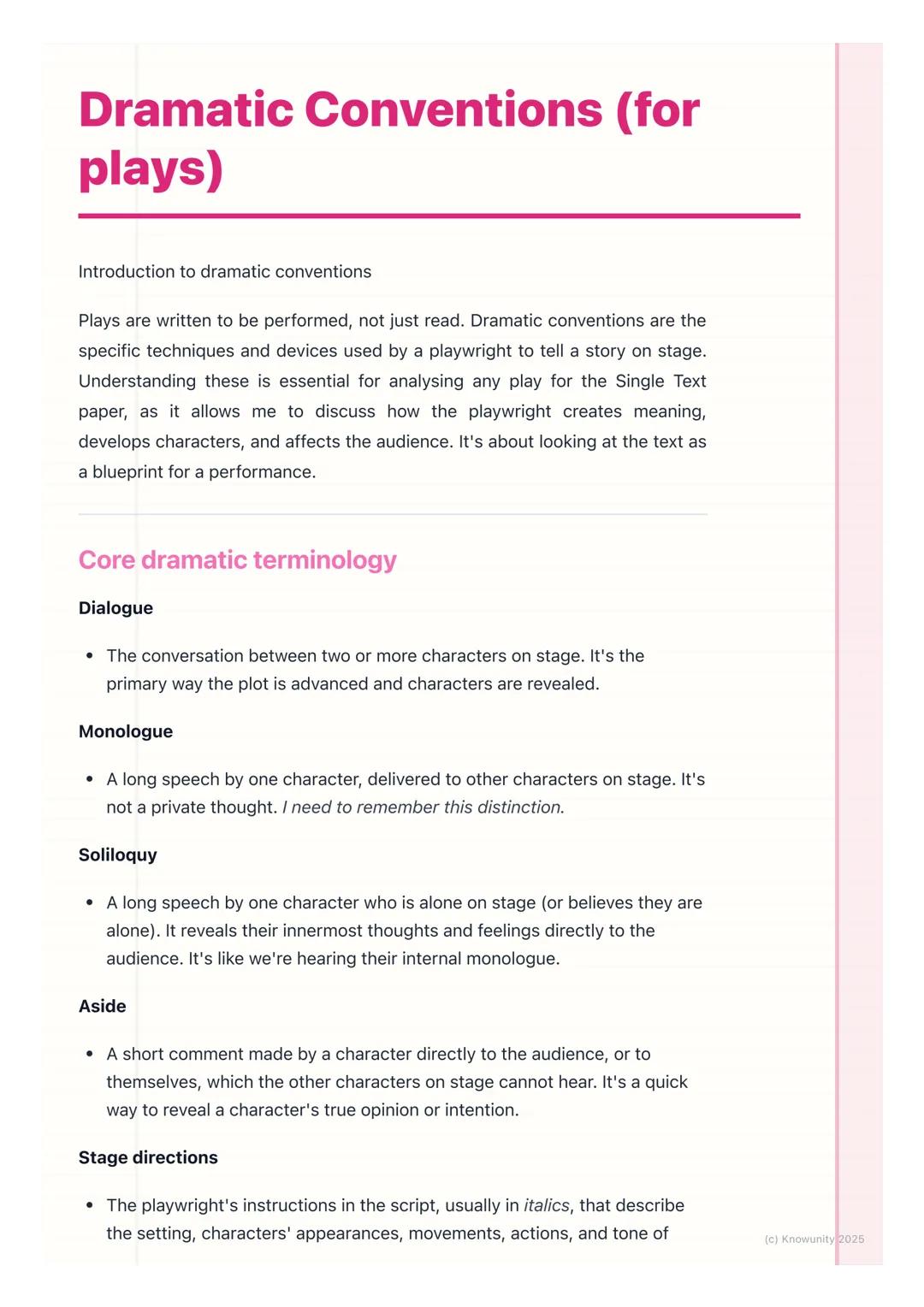
Think of dramatic conventions as the playwright's toolkit for creating magic on stage. Unlike novels, plays are blueprints for live performance, so every word and stage direction has a specific purpose.
Dialogue is your bread and butter - it's how characters talk to each other and move the story forward. But here's where it gets interesting: monologues are long speeches delivered to other characters (think of a courtroom speech), while soliloquies are private thoughts spoken aloud when a character believes they're alone.
Asides are those sneaky moments when a character whispers directly to the audience - like breaking the fourth wall for a quick comment. Meanwhile, stage directions (usually in italics) are the playwright's secret instructions about everything from lighting to how a character should move.
Remember: Stage directions aren't just suggestions - they're crucial clues about character motivation and mood that you need to analyse!
Don't forget dramatic irony - this is when you know something the characters don't, creating that delicious tension that keeps audiences on the edge of their seats.
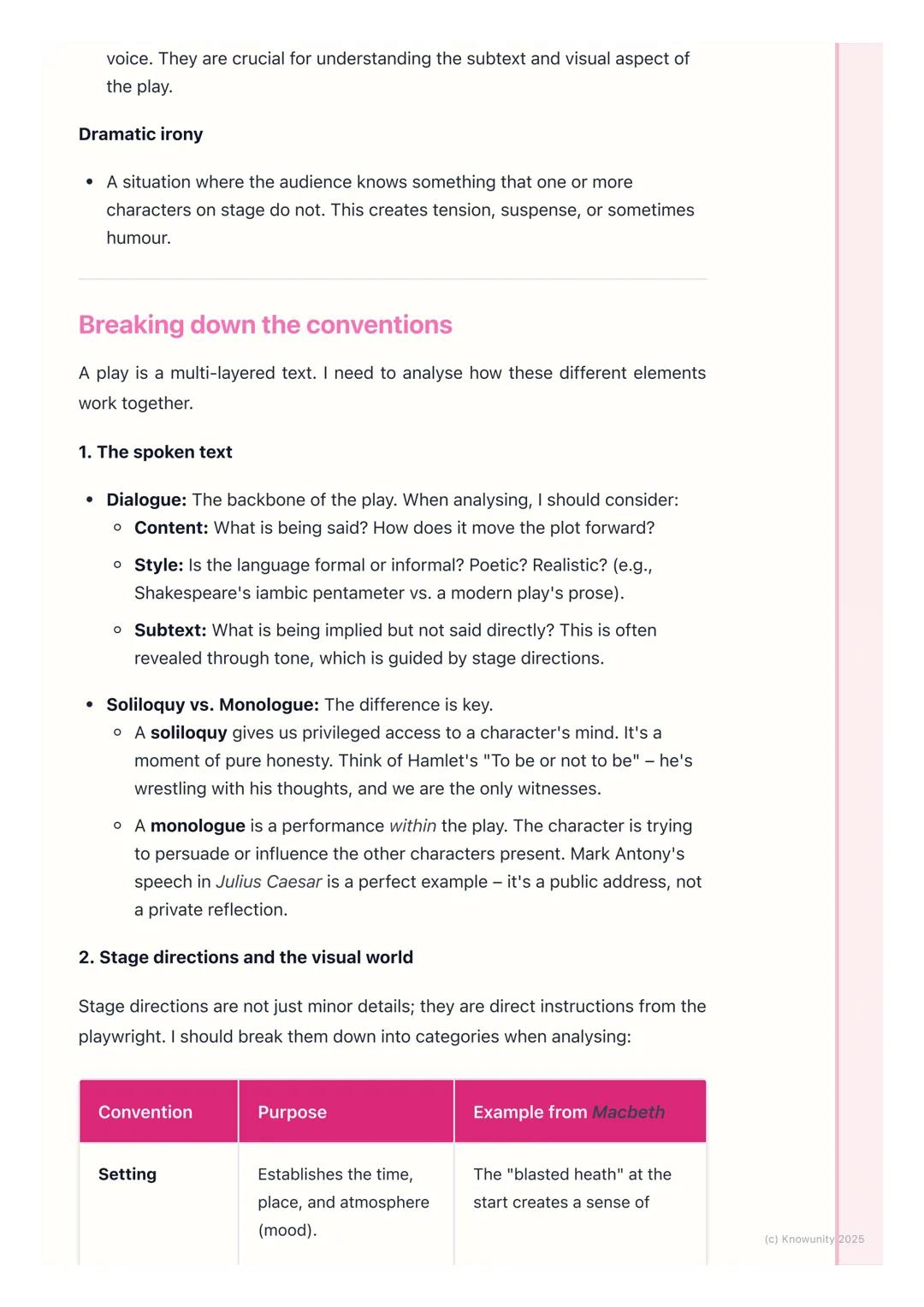
Dialogue analysis is where you'll score serious marks in essays. Look at three layers: what's being said (content), how it's being said (style), and what's not being said directly (subtext). Shakespeare's poetic language creates a completely different effect than modern realistic dialogue.
The soliloquy versus monologue distinction is exam gold. Hamlet's "To be or not to be" is pure soliloquy - we're eavesdropping on his private mental battle. Mark Antony's speech in Julius Caesar? That's a monologue designed to manipulate the crowd.
Stage directions create the visual world of the play. They're not just describing scenery - they're establishing mood, revealing character states, and guiding the audience's emotional response.
Top Tip: When analysing stage directions, always connect them to their effect on the audience. Don't just describe what you see - explain why it matters!
Props, costumes, lighting, and character actions all work together to create meaning. Lady Macbeth's nightgown in her sleepwalking scene isn't just clothing - it symbolises her vulnerability and mental breakdown.
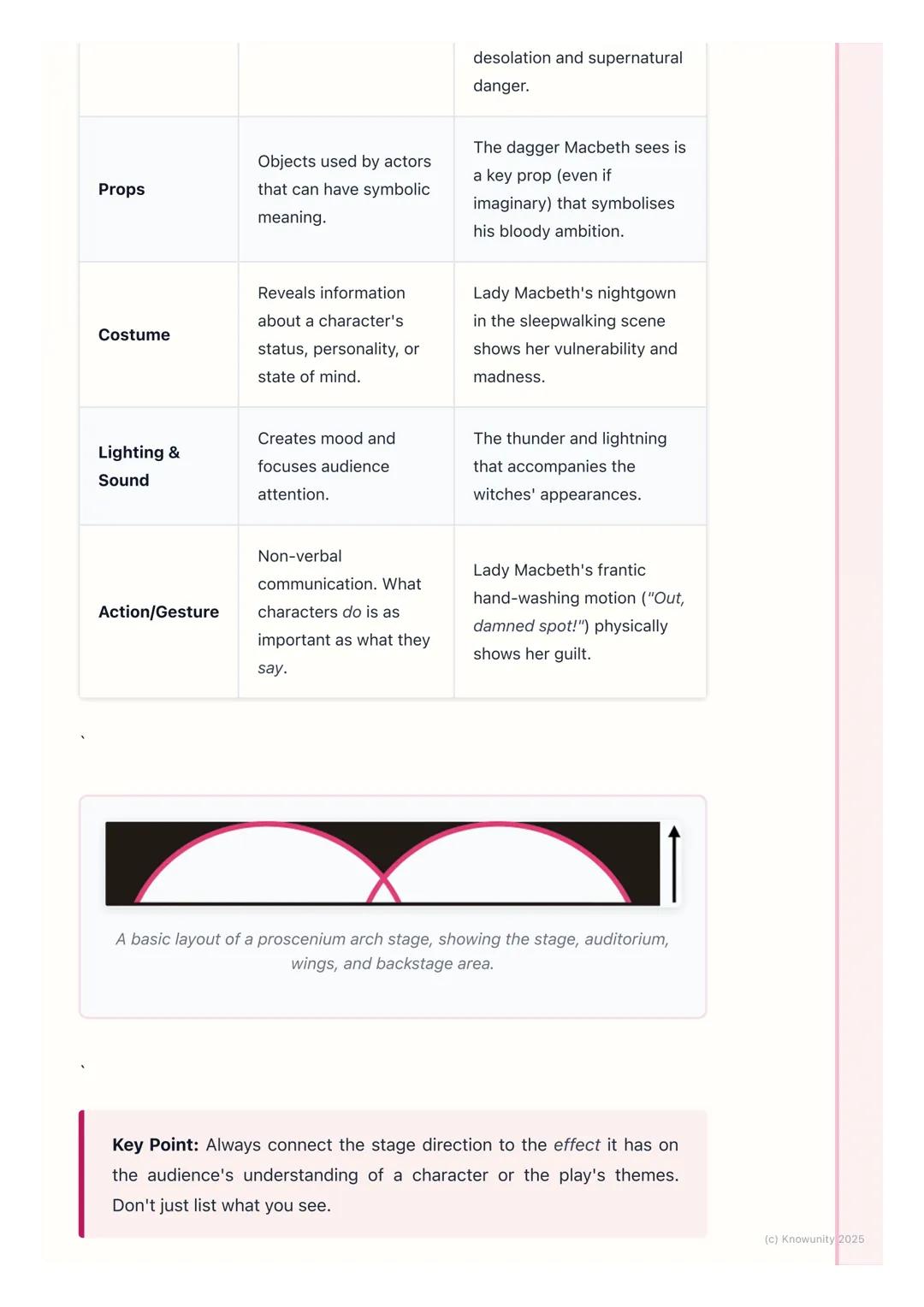
Stage directions work like a film director's notes, controlling every visual aspect of the performance. The "blasted heath" in Macbeth isn't just a location - it creates an atmosphere of supernatural danger before the witches even speak.
Props can carry massive symbolic weight. Macbeth's imaginary dagger isn't just a hallucination - it physically represents his bloody ambition taking shape. Costumes reveal character status and psychological states instantly.
Lighting and sound effects aren't just technical elements - they're emotional manipulators. Thunder accompanying the witches tells the audience we're dealing with dark, unnatural forces. Character actions often speak louder than words - Lady Macbeth's frantic hand-washing shows her guilt more powerfully than any dialogue could.
Key Point: Always connect visual elements to themes and character development. Don't just list what you observe - analyse why the playwright chose these specific details.
Think of the stage as a complete communication system where every element - from costume colour to where characters stand - is deliberately chosen to affect how the audience interprets the story.
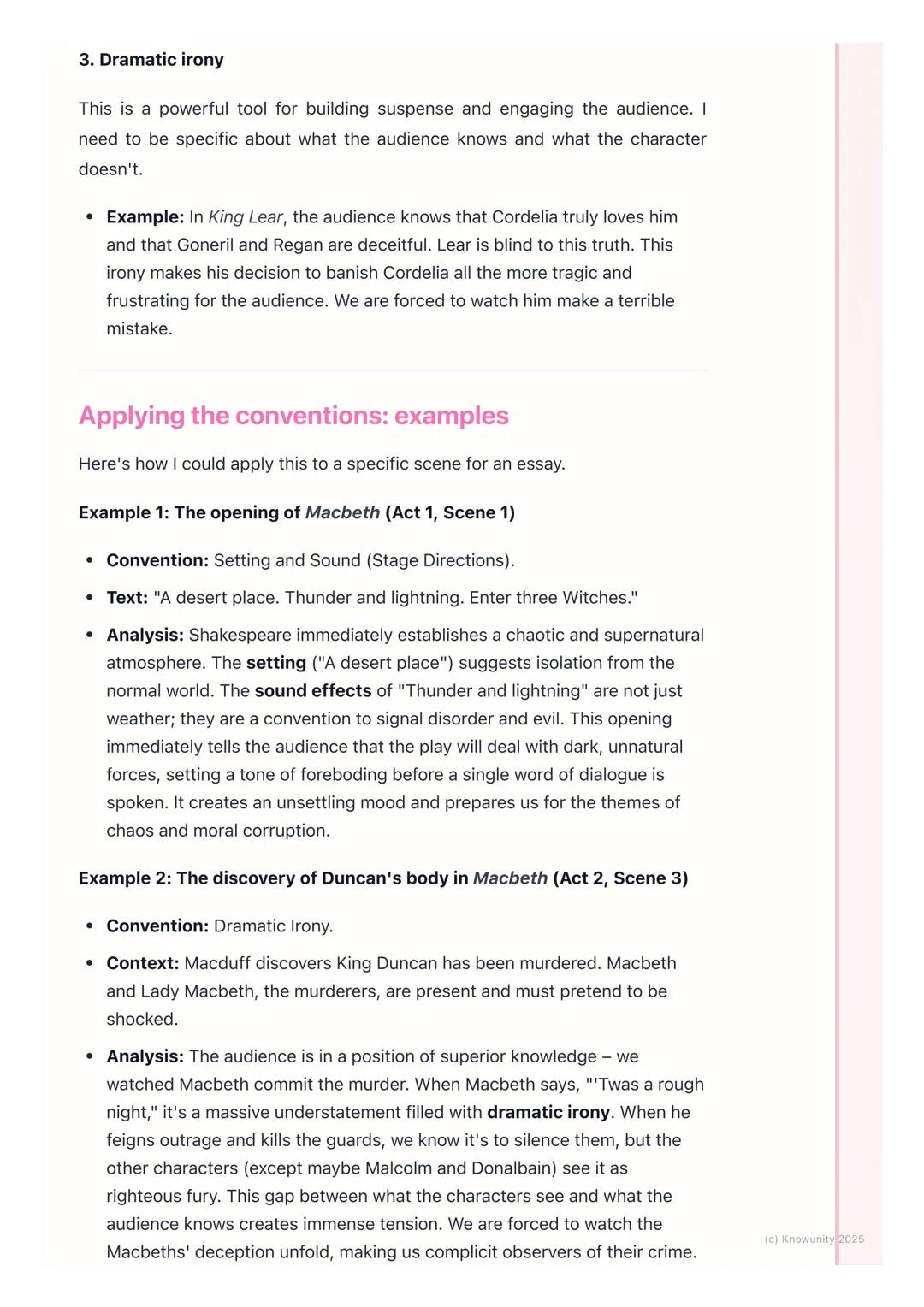
Dramatic irony creates some of the most powerful moments in theatre. In King Lear, we know Cordelia truly loves her father while her sisters are manipulating him, making his decision to banish her absolutely heartbreaking to watch.
When analysing Macbeth's opening scene, don't just note the thunder and lightning - explain how Shakespeare uses these sound effects to signal chaos and evil before any character speaks. The "desert place" setting isolates us from the normal world, preparing us for supernatural horror.
The discovery of Duncan's body showcases dramatic irony brilliantly. We watched Macbeth commit murder, so when he feigns shock and kills the guards "in righteous fury," we know he's really silencing witnesses. This gap between audience knowledge and character understanding creates unbearable tension.
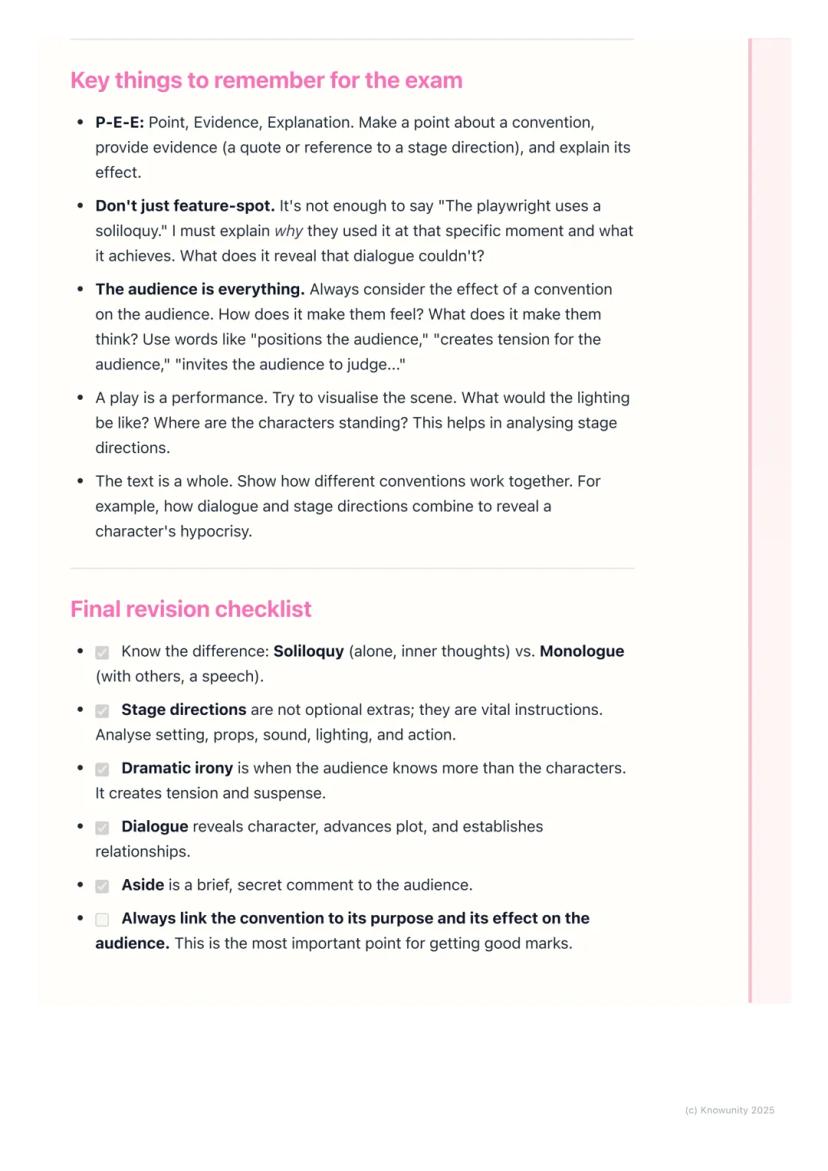
Exam Strategy: Use the P-E-E structure - make your Point about a convention, provide Evidence from the text, then Explain its effect on the audience.
Remember that different conventions work together. Macbeth's understated "Twas a rough night" combines dialogue and dramatic irony to create dark humour - we know exactly how "rough" his night really was.
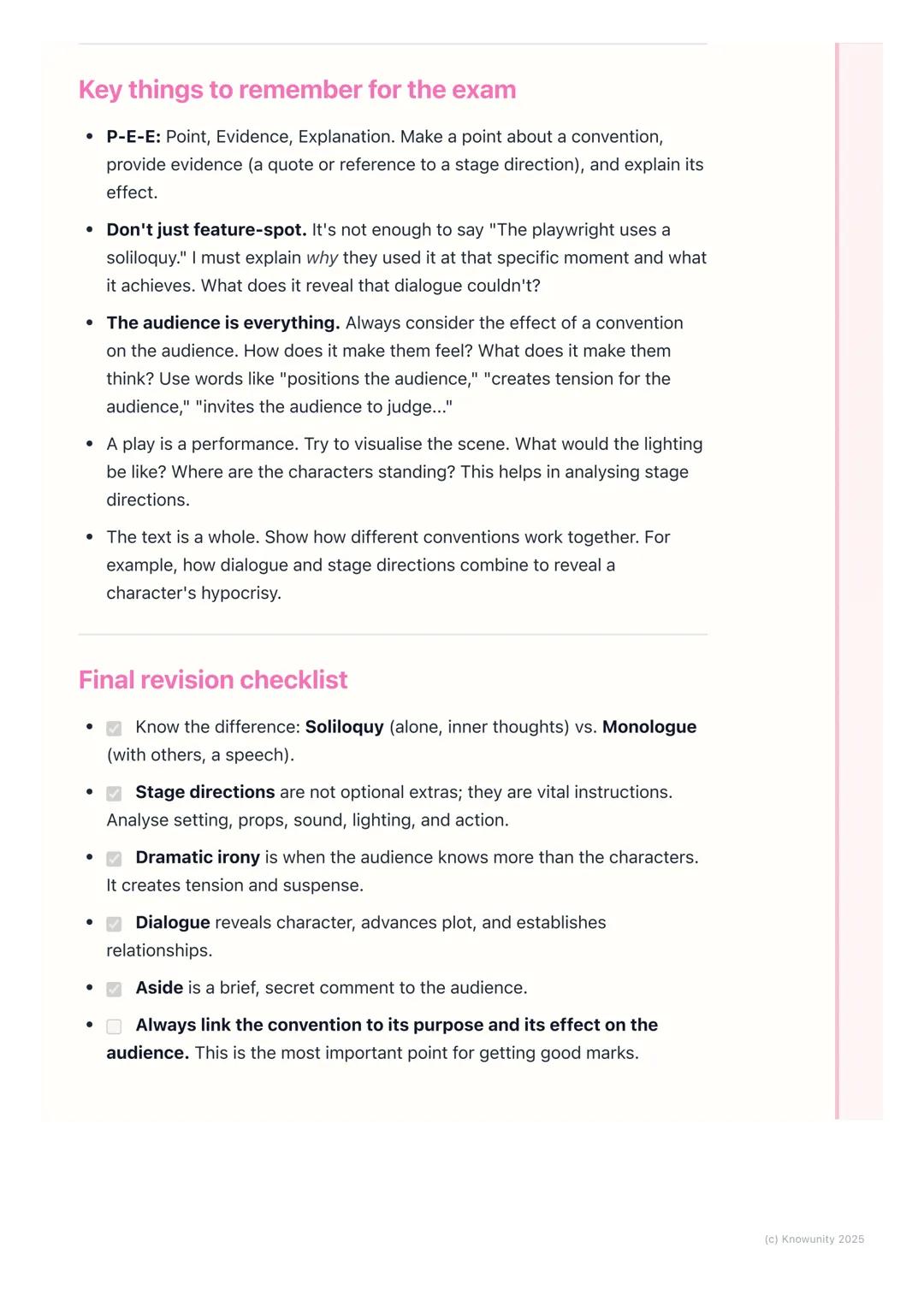
Feature-spotting won't get you top marks - anyone can identify a soliloquy, but you need to explain why the playwright used it at that specific moment and what it achieves that regular dialogue couldn't.
Always think about audience positioning. How does each convention make viewers feel? What does it make them think? Use phrases like "positions the audience to judge" or "creates tension for viewers" to show you understand the performance aspect.
Visualise the scene as you analyse. Where are characters standing? What would the lighting look like? This helps you write more sophisticated analysis of stage directions and their effects.
Golden Rule: The text is a complete system - show how different conventions work together, like how dialogue and stage directions combine to reveal character hypocrisy.
Your revision checklist should include: knowing soliloquy vs monologue differences, understanding that stage directions are vital instructions (not optional extras), recognising that dramatic irony creates audience tension, and always linking conventions to their purpose and audience effect. Master these, and you'll smash your Single Text analysis!
Our AI companion is specifically built for the needs of students. Based on the millions of content pieces we have on the platform we can provide truly meaningful and relevant answers to students. But its not only about answers, the companion is even more about guiding students through their daily learning challenges, with personalised study plans, quizzes or content pieces in the chat and 100% personalisation based on the students skills and developments.
You can download the app in the Google Play Store and in the Apple App Store.
That's right! Enjoy free access to study content, connect with fellow students, and get instant help – all at your fingertips.
App Store
Google Play
The app is very easy to use and well designed. I have found everything I was looking for so far and have been able to learn a lot from the presentations! I will definitely use the app for a class assignment! And of course it also helps a lot as an inspiration.
Stefan S
iOS user
This app is really great. There are so many study notes and help [...]. My problem subject is French, for example, and the app has so many options for help. Thanks to this app, I have improved my French. I would recommend it to anyone.
Samantha Klich
Android user
Wow, I am really amazed. I just tried the app because I've seen it advertised many times and was absolutely stunned. This app is THE HELP you want for school and above all, it offers so many things, such as workouts and fact sheets, which have been VERY helpful to me personally.
Anna
iOS user
I think it’s very much worth it and you’ll end up using it a lot once you get the hang of it and even after looking at others notes you can still ask your Artificial intelligence buddy the question and ask to simplify it if you still don’t get it!!! In the end I think it’s worth it 😊👍 ⚠️Also DID I MENTION ITS FREEE YOU DON’T HAVE TO PAY FOR ANYTHING AND STILL GET YOUR GRADES IN PERFECTLY❗️❗️⚠️
Thomas R
iOS user
Knowunity is the BEST app I’ve used in a minute. This is not an ai review or anything this is genuinely coming from a 7th grade student (I know 2011 im young) but dude this app is a 10/10 i have maintained a 3.8 gpa and have plenty of time for gaming. I love it and my mom is just happy I got good grades
Brad T
Android user
Not only did it help me find the answer but it also showed me alternative ways to solve it. I was horrible in math and science but now I have an a in both subjects. Thanks for the help🤍🤍
David K
iOS user
The app's just great! All I have to do is enter the topic in the search bar and I get the response real fast. I don't have to watch 10 YouTube videos to understand something, so I'm saving my time. Highly recommended!
Sudenaz Ocak
Android user
In school I was really bad at maths but thanks to the app, I am doing better now. I am so grateful that you made the app.
Greenlight Bonnie
Android user
I found this app a couple years ago and it has only gotten better since then. I really love it because it can help with written questions and photo questions. Also, it can find study guides that other people have made as well as flashcard sets and practice tests. The free version is also amazing for students who might not be able to afford it. Would 100% recommend
Aubrey
iOS user
Best app if you're in Highschool or Junior high. I have been using this app for 2 school years and it's the best, it's good if you don't have anyone to help you with school work.😋🩷🎀
Marco B
iOS user
THE QUIZES AND FLASHCARDS ARE SO USEFUL AND I LOVE Knowunity AI. IT ALSO IS LITREALLY LIKE CHATGPT BUT SMARTER!! HELPED ME WITH MY MASCARA PROBLEMS TOO!! AS WELL AS MY REAL SUBJECTS ! DUHHH 😍😁😲🤑💗✨🎀😮
Elisha
iOS user
This app is phenomenal down to the correct info and the various topics you can study! I greatly recommend it for people who struggle with procrastination and those who need homework help. It has been perfectly accurate for world 1 history as far as I’ve seen! Geometry too!
Paul T
iOS user
The app is very easy to use and well designed. I have found everything I was looking for so far and have been able to learn a lot from the presentations! I will definitely use the app for a class assignment! And of course it also helps a lot as an inspiration.
Stefan S
iOS user
This app is really great. There are so many study notes and help [...]. My problem subject is French, for example, and the app has so many options for help. Thanks to this app, I have improved my French. I would recommend it to anyone.
Samantha Klich
Android user
Wow, I am really amazed. I just tried the app because I've seen it advertised many times and was absolutely stunned. This app is THE HELP you want for school and above all, it offers so many things, such as workouts and fact sheets, which have been VERY helpful to me personally.
Anna
iOS user
I think it’s very much worth it and you’ll end up using it a lot once you get the hang of it and even after looking at others notes you can still ask your Artificial intelligence buddy the question and ask to simplify it if you still don’t get it!!! In the end I think it’s worth it 😊👍 ⚠️Also DID I MENTION ITS FREEE YOU DON’T HAVE TO PAY FOR ANYTHING AND STILL GET YOUR GRADES IN PERFECTLY❗️❗️⚠️
Thomas R
iOS user
Knowunity is the BEST app I’ve used in a minute. This is not an ai review or anything this is genuinely coming from a 7th grade student (I know 2011 im young) but dude this app is a 10/10 i have maintained a 3.8 gpa and have plenty of time for gaming. I love it and my mom is just happy I got good grades
Brad T
Android user
Not only did it help me find the answer but it also showed me alternative ways to solve it. I was horrible in math and science but now I have an a in both subjects. Thanks for the help🤍🤍
David K
iOS user
The app's just great! All I have to do is enter the topic in the search bar and I get the response real fast. I don't have to watch 10 YouTube videos to understand something, so I'm saving my time. Highly recommended!
Sudenaz Ocak
Android user
In school I was really bad at maths but thanks to the app, I am doing better now. I am so grateful that you made the app.
Greenlight Bonnie
Android user
I found this app a couple years ago and it has only gotten better since then. I really love it because it can help with written questions and photo questions. Also, it can find study guides that other people have made as well as flashcard sets and practice tests. The free version is also amazing for students who might not be able to afford it. Would 100% recommend
Aubrey
iOS user
Best app if you're in Highschool or Junior high. I have been using this app for 2 school years and it's the best, it's good if you don't have anyone to help you with school work.😋🩷🎀
Marco B
iOS user
THE QUIZES AND FLASHCARDS ARE SO USEFUL AND I LOVE Knowunity AI. IT ALSO IS LITREALLY LIKE CHATGPT BUT SMARTER!! HELPED ME WITH MY MASCARA PROBLEMS TOO!! AS WELL AS MY REAL SUBJECTS ! DUHHH 😍😁😲🤑💗✨🎀😮
Elisha
iOS user
This app is phenomenal down to the correct info and the various topics you can study! I greatly recommend it for people who struggle with procrastination and those who need homework help. It has been perfectly accurate for world 1 history as far as I’ve seen! Geometry too!
Paul T
iOS user
Ever wondered why plays hit differently than novels? It's all about dramatic conventions - the special techniques playwrights use to bring stories to life on stage. Mastering these will transform how you analyse any play for your Single Text exam.
Access to all documents
Improve your grades
Join milions of students
Think of dramatic conventions as the playwright's toolkit for creating magic on stage. Unlike novels, plays are blueprints for live performance, so every word and stage direction has a specific purpose.
Dialogue is your bread and butter - it's how characters talk to each other and move the story forward. But here's where it gets interesting: monologues are long speeches delivered to other characters (think of a courtroom speech), while soliloquies are private thoughts spoken aloud when a character believes they're alone.
Asides are those sneaky moments when a character whispers directly to the audience - like breaking the fourth wall for a quick comment. Meanwhile, stage directions (usually in italics) are the playwright's secret instructions about everything from lighting to how a character should move.
Remember: Stage directions aren't just suggestions - they're crucial clues about character motivation and mood that you need to analyse!
Don't forget dramatic irony - this is when you know something the characters don't, creating that delicious tension that keeps audiences on the edge of their seats.
Access to all documents
Improve your grades
Join milions of students
Dialogue analysis is where you'll score serious marks in essays. Look at three layers: what's being said (content), how it's being said (style), and what's not being said directly (subtext). Shakespeare's poetic language creates a completely different effect than modern realistic dialogue.
The soliloquy versus monologue distinction is exam gold. Hamlet's "To be or not to be" is pure soliloquy - we're eavesdropping on his private mental battle. Mark Antony's speech in Julius Caesar? That's a monologue designed to manipulate the crowd.
Stage directions create the visual world of the play. They're not just describing scenery - they're establishing mood, revealing character states, and guiding the audience's emotional response.
Top Tip: When analysing stage directions, always connect them to their effect on the audience. Don't just describe what you see - explain why it matters!
Props, costumes, lighting, and character actions all work together to create meaning. Lady Macbeth's nightgown in her sleepwalking scene isn't just clothing - it symbolises her vulnerability and mental breakdown.
Access to all documents
Improve your grades
Join milions of students
Stage directions work like a film director's notes, controlling every visual aspect of the performance. The "blasted heath" in Macbeth isn't just a location - it creates an atmosphere of supernatural danger before the witches even speak.
Props can carry massive symbolic weight. Macbeth's imaginary dagger isn't just a hallucination - it physically represents his bloody ambition taking shape. Costumes reveal character status and psychological states instantly.
Lighting and sound effects aren't just technical elements - they're emotional manipulators. Thunder accompanying the witches tells the audience we're dealing with dark, unnatural forces. Character actions often speak louder than words - Lady Macbeth's frantic hand-washing shows her guilt more powerfully than any dialogue could.
Key Point: Always connect visual elements to themes and character development. Don't just list what you observe - analyse why the playwright chose these specific details.
Think of the stage as a complete communication system where every element - from costume colour to where characters stand - is deliberately chosen to affect how the audience interprets the story.
Access to all documents
Improve your grades
Join milions of students
Dramatic irony creates some of the most powerful moments in theatre. In King Lear, we know Cordelia truly loves her father while her sisters are manipulating him, making his decision to banish her absolutely heartbreaking to watch.
When analysing Macbeth's opening scene, don't just note the thunder and lightning - explain how Shakespeare uses these sound effects to signal chaos and evil before any character speaks. The "desert place" setting isolates us from the normal world, preparing us for supernatural horror.
The discovery of Duncan's body showcases dramatic irony brilliantly. We watched Macbeth commit murder, so when he feigns shock and kills the guards "in righteous fury," we know he's really silencing witnesses. This gap between audience knowledge and character understanding creates unbearable tension.
Exam Strategy: Use the P-E-E structure - make your Point about a convention, provide Evidence from the text, then Explain its effect on the audience.
Remember that different conventions work together. Macbeth's understated "Twas a rough night" combines dialogue and dramatic irony to create dark humour - we know exactly how "rough" his night really was.
Access to all documents
Improve your grades
Join milions of students
Feature-spotting won't get you top marks - anyone can identify a soliloquy, but you need to explain why the playwright used it at that specific moment and what it achieves that regular dialogue couldn't.
Always think about audience positioning. How does each convention make viewers feel? What does it make them think? Use phrases like "positions the audience to judge" or "creates tension for viewers" to show you understand the performance aspect.
Visualise the scene as you analyse. Where are characters standing? What would the lighting look like? This helps you write more sophisticated analysis of stage directions and their effects.
Golden Rule: The text is a complete system - show how different conventions work together, like how dialogue and stage directions combine to reveal character hypocrisy.
Your revision checklist should include: knowing soliloquy vs monologue differences, understanding that stage directions are vital instructions (not optional extras), recognising that dramatic irony creates audience tension, and always linking conventions to their purpose and audience effect. Master these, and you'll smash your Single Text analysis!
Our AI companion is specifically built for the needs of students. Based on the millions of content pieces we have on the platform we can provide truly meaningful and relevant answers to students. But its not only about answers, the companion is even more about guiding students through their daily learning challenges, with personalised study plans, quizzes or content pieces in the chat and 100% personalisation based on the students skills and developments.
You can download the app in the Google Play Store and in the Apple App Store.
That's right! Enjoy free access to study content, connect with fellow students, and get instant help – all at your fingertips.
0
Smart Tools NEW
Transform this note into: ✓ 50+ Practice Questions ✓ Interactive Flashcards ✓ Full Practice Test ✓ Essay Outlines
App Store
Google Play
The app is very easy to use and well designed. I have found everything I was looking for so far and have been able to learn a lot from the presentations! I will definitely use the app for a class assignment! And of course it also helps a lot as an inspiration.
Stefan S
iOS user
This app is really great. There are so many study notes and help [...]. My problem subject is French, for example, and the app has so many options for help. Thanks to this app, I have improved my French. I would recommend it to anyone.
Samantha Klich
Android user
Wow, I am really amazed. I just tried the app because I've seen it advertised many times and was absolutely stunned. This app is THE HELP you want for school and above all, it offers so many things, such as workouts and fact sheets, which have been VERY helpful to me personally.
Anna
iOS user
I think it’s very much worth it and you’ll end up using it a lot once you get the hang of it and even after looking at others notes you can still ask your Artificial intelligence buddy the question and ask to simplify it if you still don’t get it!!! In the end I think it’s worth it 😊👍 ⚠️Also DID I MENTION ITS FREEE YOU DON’T HAVE TO PAY FOR ANYTHING AND STILL GET YOUR GRADES IN PERFECTLY❗️❗️⚠️
Thomas R
iOS user
Knowunity is the BEST app I’ve used in a minute. This is not an ai review or anything this is genuinely coming from a 7th grade student (I know 2011 im young) but dude this app is a 10/10 i have maintained a 3.8 gpa and have plenty of time for gaming. I love it and my mom is just happy I got good grades
Brad T
Android user
Not only did it help me find the answer but it also showed me alternative ways to solve it. I was horrible in math and science but now I have an a in both subjects. Thanks for the help🤍🤍
David K
iOS user
The app's just great! All I have to do is enter the topic in the search bar and I get the response real fast. I don't have to watch 10 YouTube videos to understand something, so I'm saving my time. Highly recommended!
Sudenaz Ocak
Android user
In school I was really bad at maths but thanks to the app, I am doing better now. I am so grateful that you made the app.
Greenlight Bonnie
Android user
I found this app a couple years ago and it has only gotten better since then. I really love it because it can help with written questions and photo questions. Also, it can find study guides that other people have made as well as flashcard sets and practice tests. The free version is also amazing for students who might not be able to afford it. Would 100% recommend
Aubrey
iOS user
Best app if you're in Highschool or Junior high. I have been using this app for 2 school years and it's the best, it's good if you don't have anyone to help you with school work.😋🩷🎀
Marco B
iOS user
THE QUIZES AND FLASHCARDS ARE SO USEFUL AND I LOVE Knowunity AI. IT ALSO IS LITREALLY LIKE CHATGPT BUT SMARTER!! HELPED ME WITH MY MASCARA PROBLEMS TOO!! AS WELL AS MY REAL SUBJECTS ! DUHHH 😍😁😲🤑💗✨🎀😮
Elisha
iOS user
This app is phenomenal down to the correct info and the various topics you can study! I greatly recommend it for people who struggle with procrastination and those who need homework help. It has been perfectly accurate for world 1 history as far as I’ve seen! Geometry too!
Paul T
iOS user
The app is very easy to use and well designed. I have found everything I was looking for so far and have been able to learn a lot from the presentations! I will definitely use the app for a class assignment! And of course it also helps a lot as an inspiration.
Stefan S
iOS user
This app is really great. There are so many study notes and help [...]. My problem subject is French, for example, and the app has so many options for help. Thanks to this app, I have improved my French. I would recommend it to anyone.
Samantha Klich
Android user
Wow, I am really amazed. I just tried the app because I've seen it advertised many times and was absolutely stunned. This app is THE HELP you want for school and above all, it offers so many things, such as workouts and fact sheets, which have been VERY helpful to me personally.
Anna
iOS user
I think it’s very much worth it and you’ll end up using it a lot once you get the hang of it and even after looking at others notes you can still ask your Artificial intelligence buddy the question and ask to simplify it if you still don’t get it!!! In the end I think it’s worth it 😊👍 ⚠️Also DID I MENTION ITS FREEE YOU DON’T HAVE TO PAY FOR ANYTHING AND STILL GET YOUR GRADES IN PERFECTLY❗️❗️⚠️
Thomas R
iOS user
Knowunity is the BEST app I’ve used in a minute. This is not an ai review or anything this is genuinely coming from a 7th grade student (I know 2011 im young) but dude this app is a 10/10 i have maintained a 3.8 gpa and have plenty of time for gaming. I love it and my mom is just happy I got good grades
Brad T
Android user
Not only did it help me find the answer but it also showed me alternative ways to solve it. I was horrible in math and science but now I have an a in both subjects. Thanks for the help🤍🤍
David K
iOS user
The app's just great! All I have to do is enter the topic in the search bar and I get the response real fast. I don't have to watch 10 YouTube videos to understand something, so I'm saving my time. Highly recommended!
Sudenaz Ocak
Android user
In school I was really bad at maths but thanks to the app, I am doing better now. I am so grateful that you made the app.
Greenlight Bonnie
Android user
I found this app a couple years ago and it has only gotten better since then. I really love it because it can help with written questions and photo questions. Also, it can find study guides that other people have made as well as flashcard sets and practice tests. The free version is also amazing for students who might not be able to afford it. Would 100% recommend
Aubrey
iOS user
Best app if you're in Highschool or Junior high. I have been using this app for 2 school years and it's the best, it's good if you don't have anyone to help you with school work.😋🩷🎀
Marco B
iOS user
THE QUIZES AND FLASHCARDS ARE SO USEFUL AND I LOVE Knowunity AI. IT ALSO IS LITREALLY LIKE CHATGPT BUT SMARTER!! HELPED ME WITH MY MASCARA PROBLEMS TOO!! AS WELL AS MY REAL SUBJECTS ! DUHHH 😍😁😲🤑💗✨🎀😮
Elisha
iOS user
This app is phenomenal down to the correct info and the various topics you can study! I greatly recommend it for people who struggle with procrastination and those who need homework help. It has been perfectly accurate for world 1 history as far as I’ve seen! Geometry too!
Paul T
iOS user