
Poetic devices are the secret weapons poets use to make... Show more
 English
 Irish
IrishSign up to see the contentIt's free!
Access to all documents
Improve your grades
Join milions of students
Knowunity AI
Subjects
Triangle Congruence and Similarity Theorems
Triangle Properties and Classification
Linear Equations and Graphs
Geometric Angle Relationships
Trigonometric Functions and Identities
Equation Solving Techniques
Circle Geometry Fundamentals
Division Operations and Methods
Basic Differentiation Rules
Exponent and Logarithm Properties
Show all topics
Human Organ Systems
Reproductive Cell Cycles
Biological Sciences Subdisciplines
Cellular Energy Metabolism
Autotrophic Energy Processes
Inheritance Patterns and Principles
Biomolecular Structure and Organization
Cell Cycle and Division Mechanics
Cellular Organization and Development
Biological Structural Organization
Show all topics
Chemical Sciences and Applications
Atomic Structure and Composition
Molecular Electron Structure Representation
Atomic Electron Behavior
Matter Properties and Water
Mole Concept and Calculations
Gas Laws and Behavior
Periodic Table Organization
Chemical Thermodynamics Fundamentals
Chemical Bond Types and Properties
Show all topics
European Renaissance and Enlightenment
European Cultural Movements 800-1920
American Revolution Era 1763-1797
American Civil War 1861-1865
Global Imperial Systems
Mongol and Chinese Dynasties
U.S. Presidents and World Leaders
Historical Sources and Documentation
World Wars Era and Impact
World Religious Systems
Show all topics
Classic and Contemporary Novels
Literary Character Analysis
Rhetorical Theory and Practice
Classic Literary Narratives
Reading Analysis and Interpretation
Narrative Structure and Techniques
English Language Components
Influential English-Language Authors
Basic Sentence Structure
Narrative Voice and Perspective
Show all topics
6
•
Updated May 1, 2026
•
Poetic devices are the secret weapons poets use to make... Show more
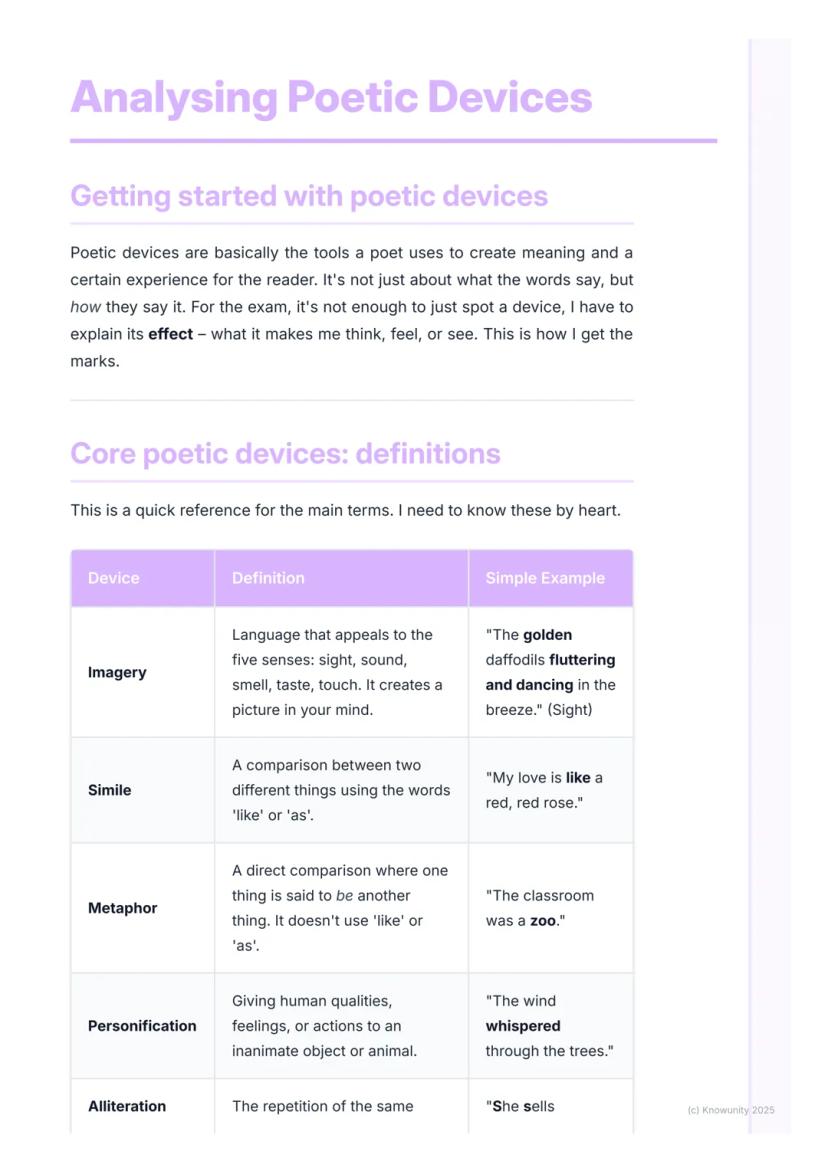
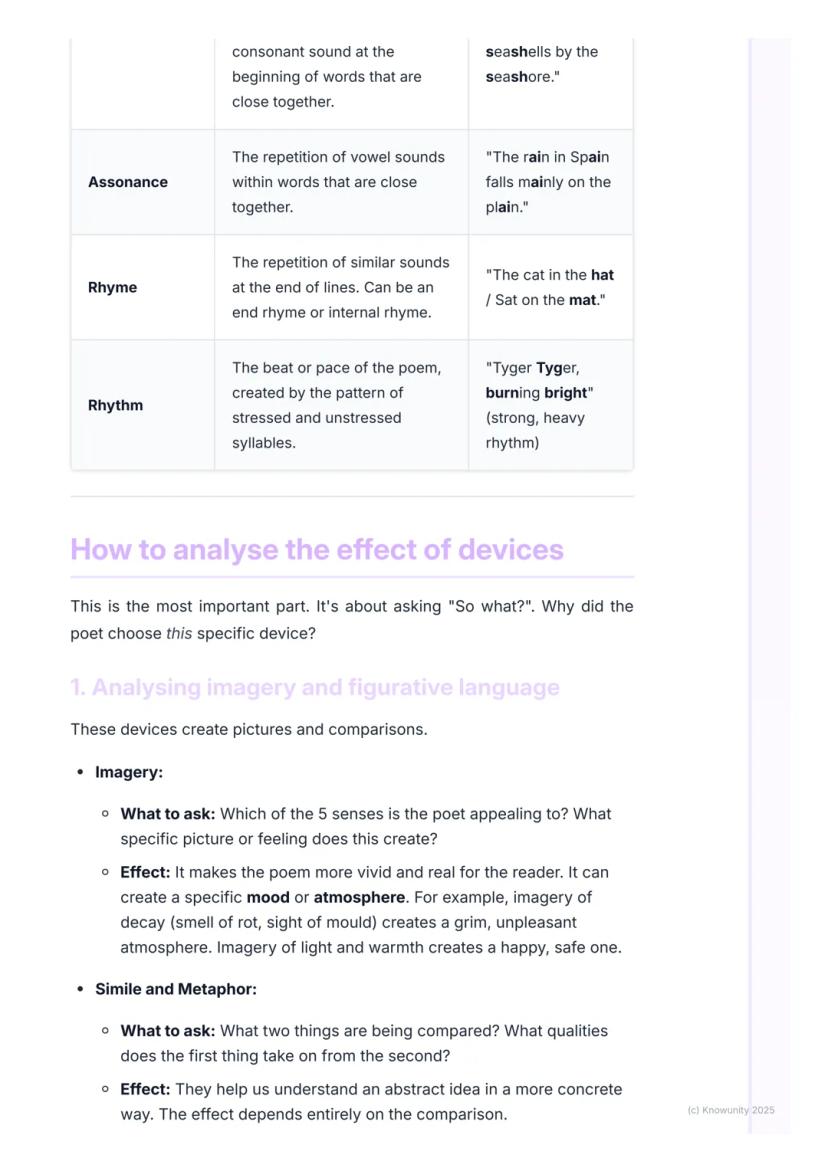
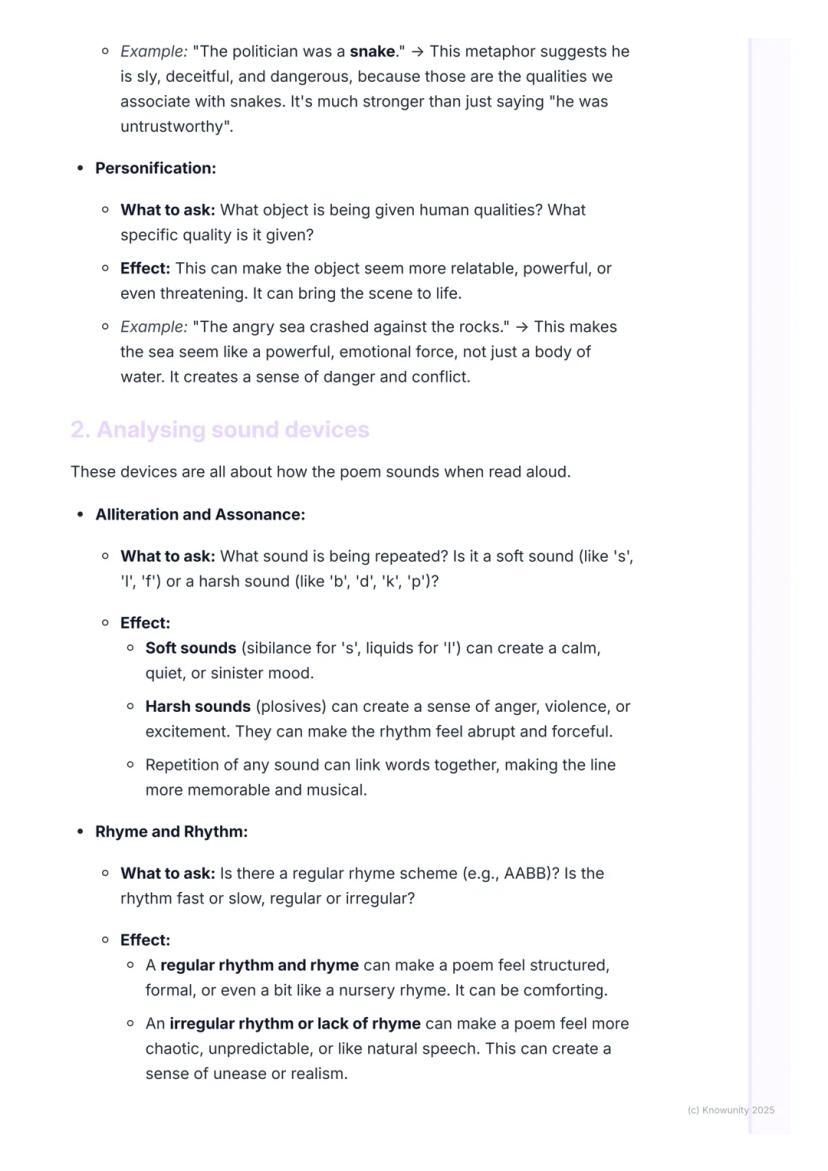
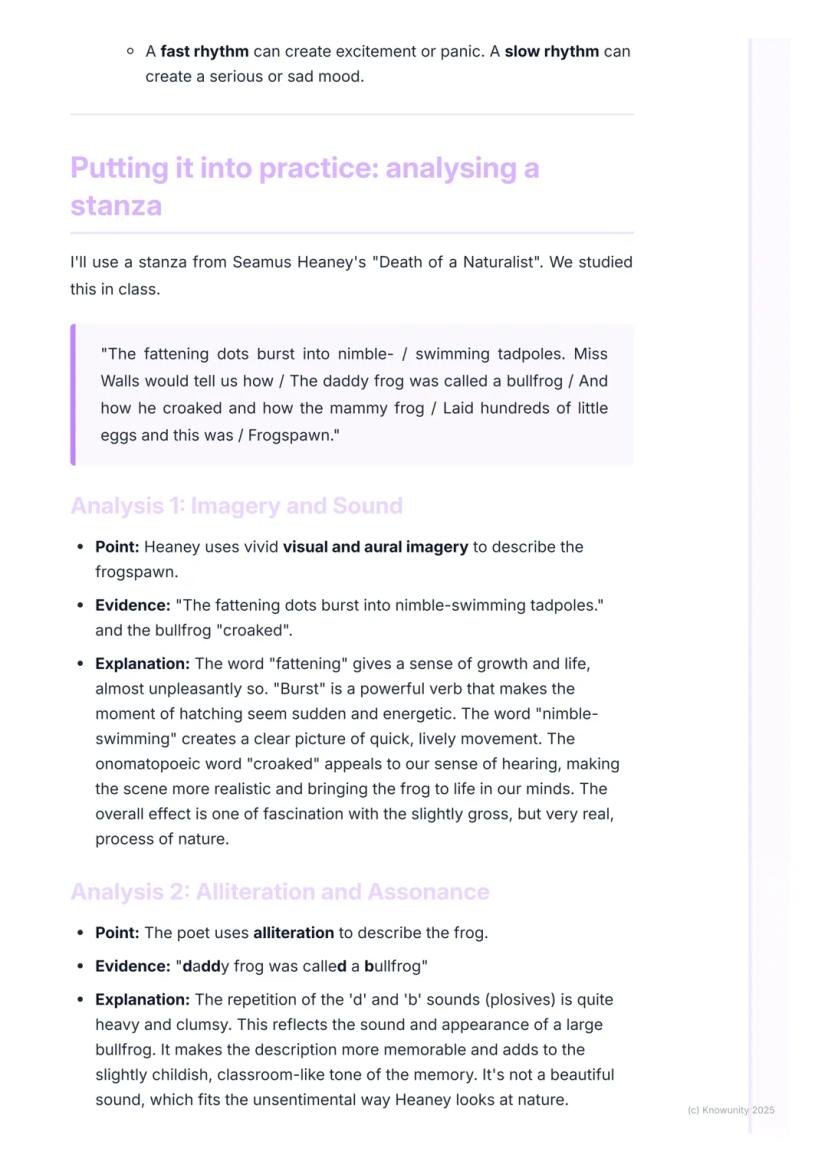
Think of poetic devices as a poet's toolkit for creating meaning and atmosphere. They're not just fancy words - they're deliberate choices that shape how you experience a poem. The key to exam success isn't just identifying these devices, but explaining their effect on you as the reader.
When analysing poetry, always ask yourself: what does this make me think, feel, or see? This approach will earn you the marks because you're showing understanding, not just recognition.
Quick Tip: Learn these core definitions by heart - they're your foundation for all poetry analysis.
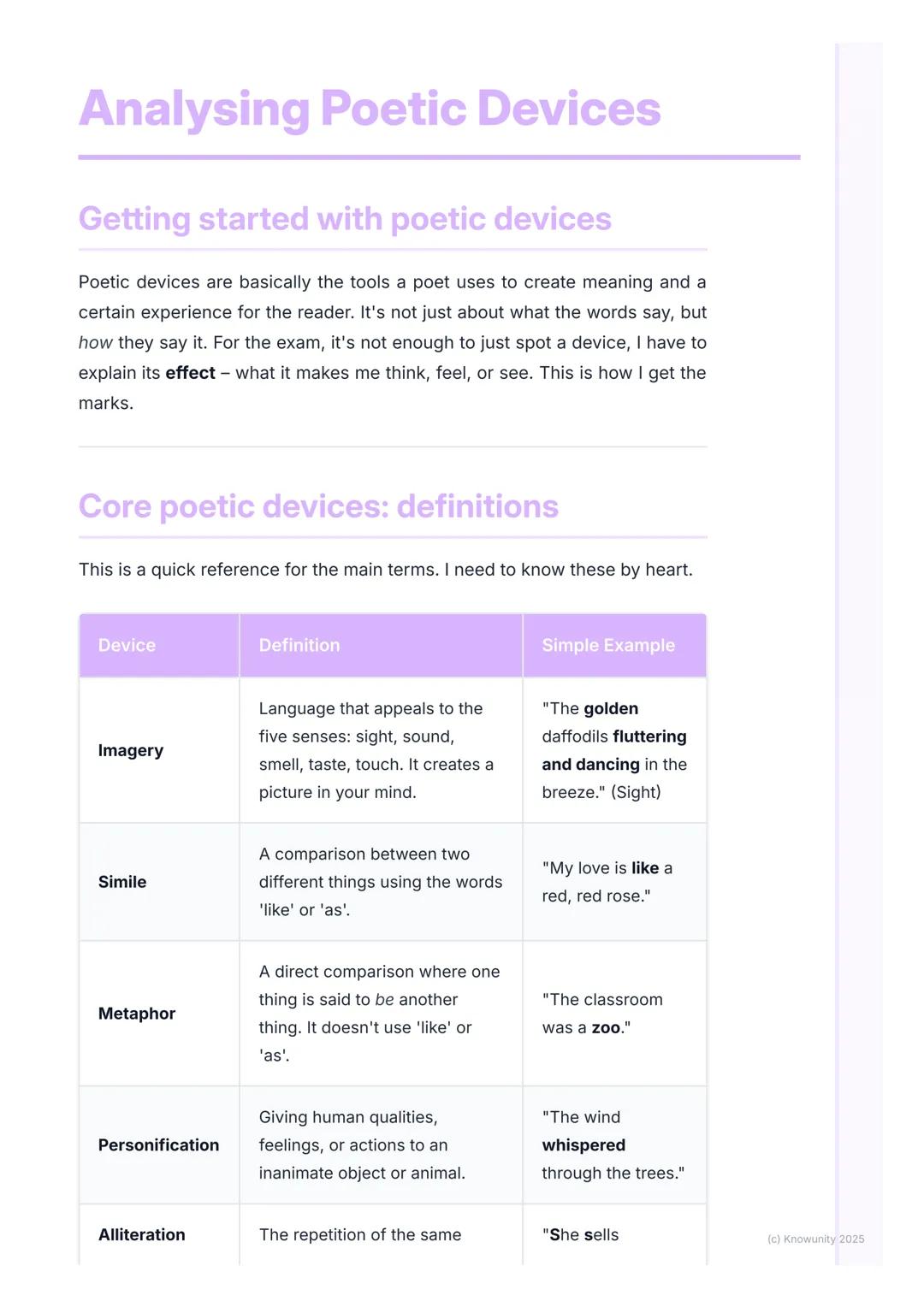
Alliteration repeats consonant sounds at the start of nearby words (like "seashells by the seashore"). Assonance repeats vowel sounds within words close together. Rhyme creates similar sounds at line endings, whilst rhythm establishes the beat through stressed and unstressed syllables.
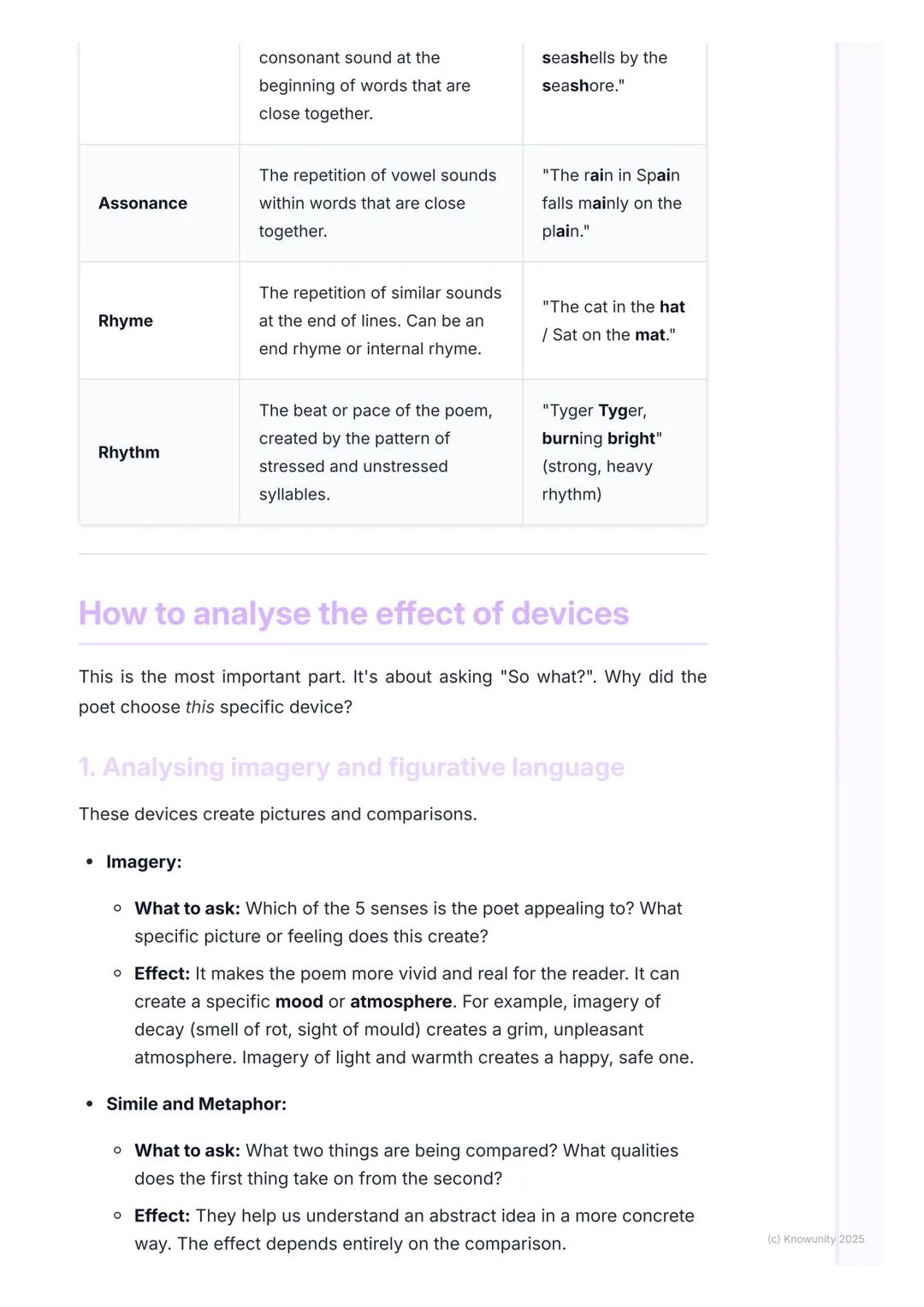
These devices paint pictures in your mind and make abstract ideas concrete. Imagery appeals to your five senses, creating vivid scenes that establish mood and atmosphere. Dark, decaying imagery creates grimness, whilst light and warmth suggest safety and happiness.
Similes and metaphors work through comparison. A simile uses 'like' or 'as' to compare, whilst a metaphor makes a direct comparison. The magic happens when qualities transfer between the compared things - calling a politician "a snake" suggests they're sly, deceitful, and dangerous.
Personification gives human qualities to objects, making them relatable or threatening. "The angry sea crashed against the rocks" transforms water into an emotional, dangerous force rather than just H2O.
Remember: Always ask what specific qualities are being transferred through these comparisons - that's where the meaning lies.
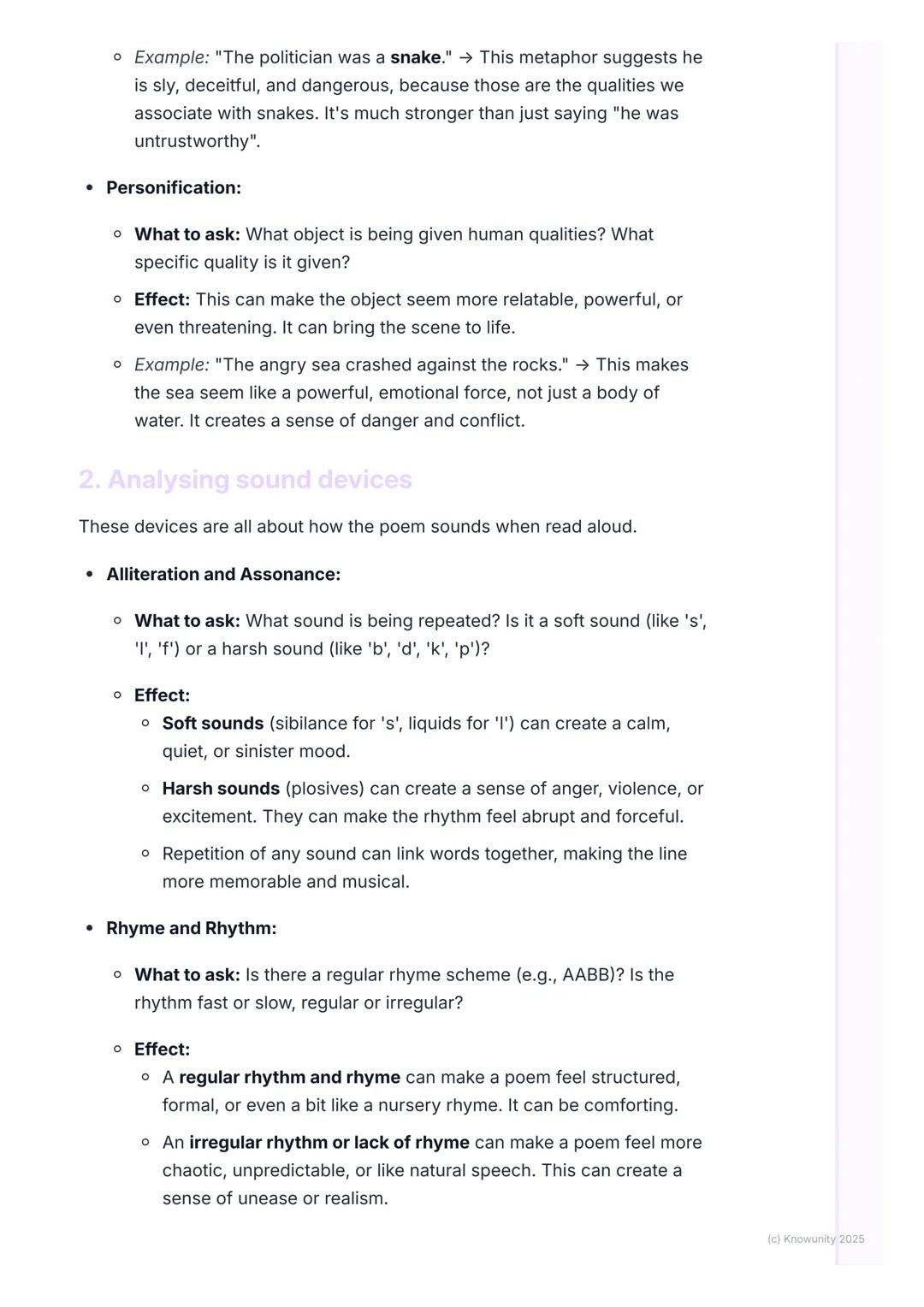
Sound devices control how poems feel when read aloud, affecting pace and mood dramatically. Alliteration and assonance work through the type of sounds repeated - soft sounds like 's' and 'l' create calm or sinister moods, whilst harsh sounds like 'b' and 'k' suggest violence or excitement.
The repetition of sounds links words together, making lines more memorable and musical. This isn't accidental - poets choose sounds that match their message.
Rhyme and rhythm create the poem's musical structure. Regular patterns feel formal and comforting, like nursery rhymes. Irregular patterns feel chaotic or realistic, like natural speech. Fast rhythms build excitement or panic, whilst slow rhythms create seriousness or sadness.
Pro Tip: Read poems aloud to really hear how these sound devices work - your ear will pick up effects your eyes might miss.
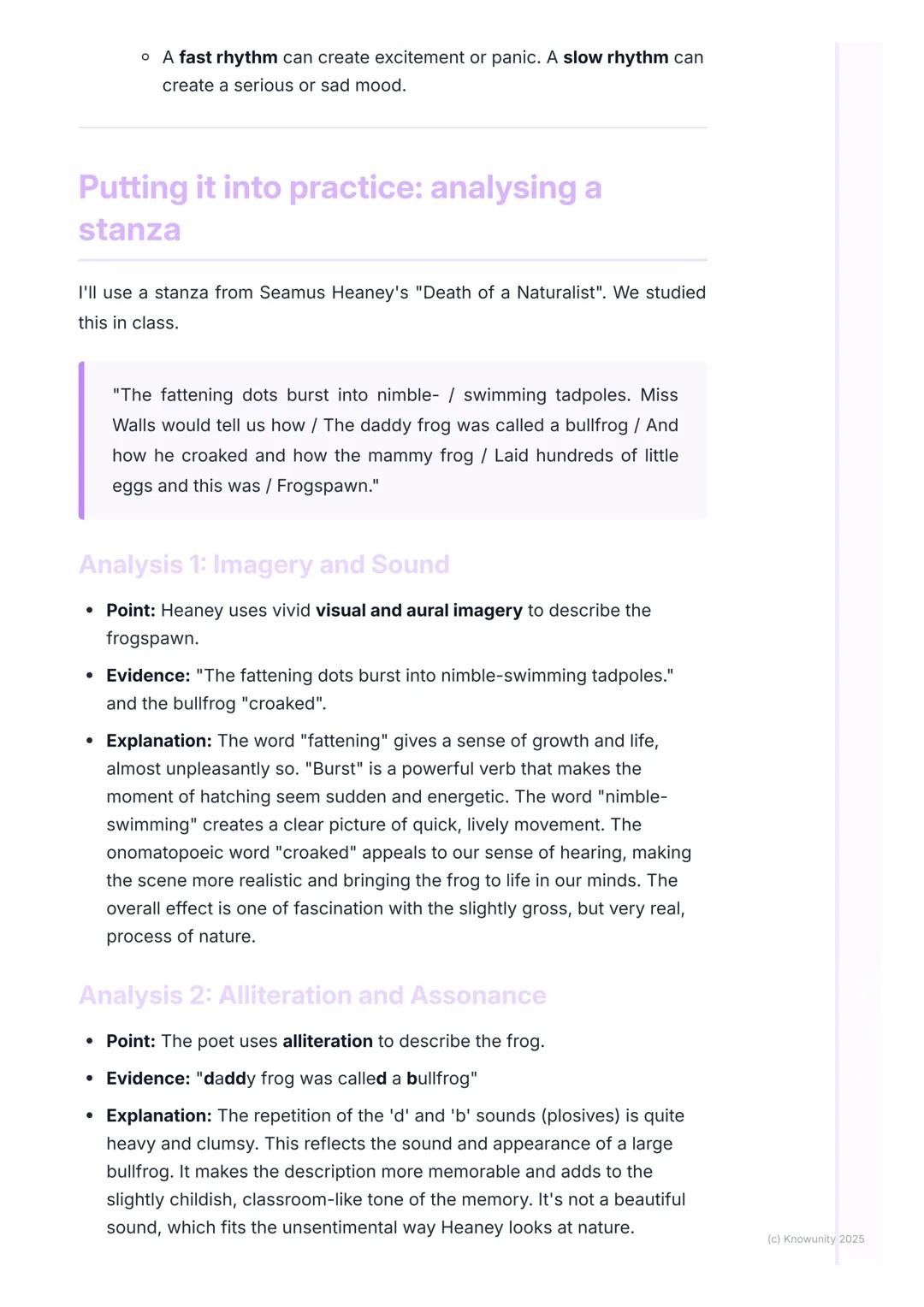
Let's analyse Seamus Heaney's line: "The fattening dots burst into nimble-swimming tadpoles." The vivid visual imagery uses "fattening" to suggest uncomfortable growth, whilst "burst" makes hatching seem explosive and energetic.
The alliteration in "daddy frog" and "bullfrog" uses heavy 'd' and 'b' sounds that mirror a bullfrog's clumsy appearance and croaking sound. This creates a childish, classroom-like tone that fits the poem's memory theme.
Notice how each device serves the poem's overall meaning - Heaney isn't just showing off his vocabulary, he's creating a specific atmosphere and emotional response.
Essential Skill: Always connect your analysis back to the poem's main themes and overall effect - isolated observations won't impress examiners.
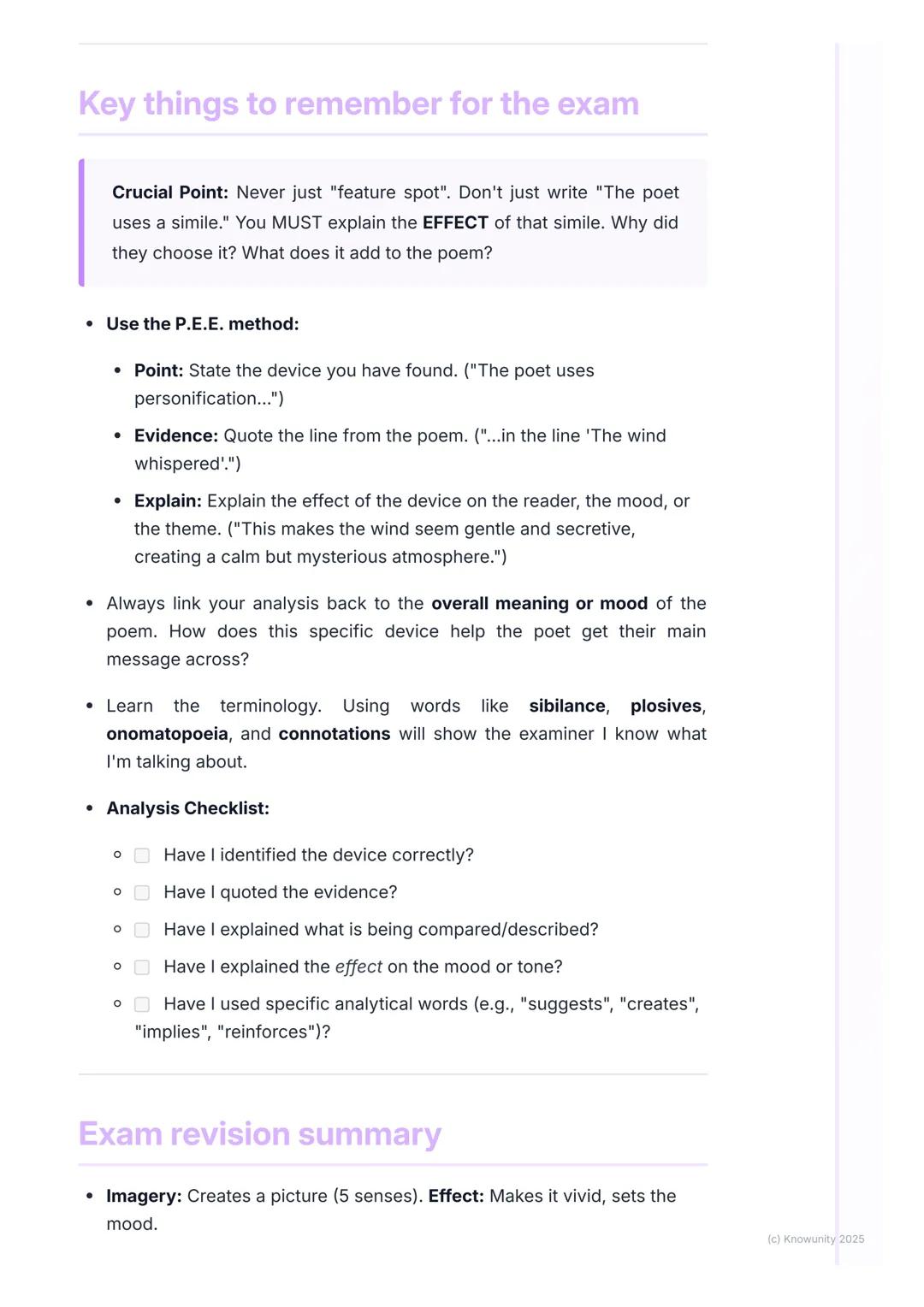
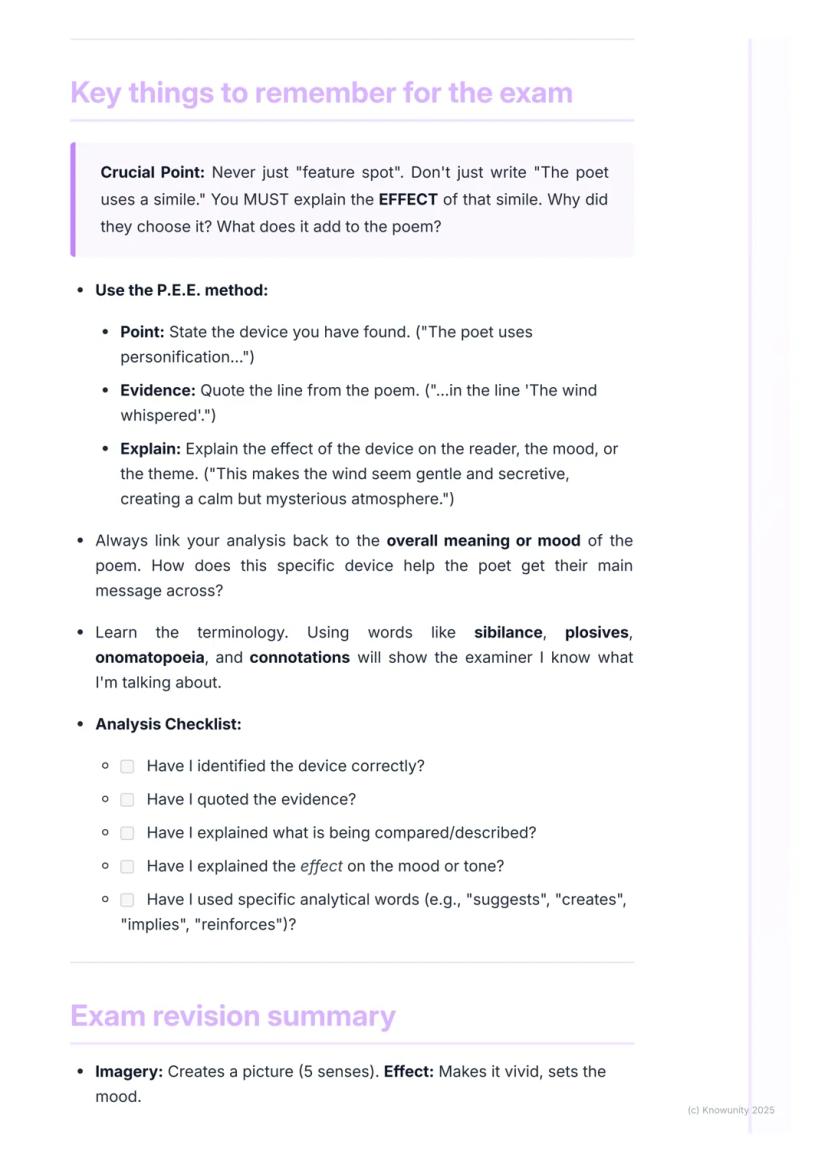
Never just "feature spot" - identifying a simile without explaining its effect scores you nothing. Always use the P.E.E. method: make your Point, provide Evidence through quotation, then Explain the effect on mood, tone, or meaning.
Your explanations should focus on what the device adds to the reader's experience. How does it help the poet communicate their message? What atmosphere does it create? These connections between technique and meaning are what examiners want to see.
Learn the terminology - words like 'sibilance', 'plosives', and 'connotations' show sophisticated understanding. Use analytical phrases like "suggests", "creates", "implies", and "reinforces" to sound professional.
Exam Success: Always link individual devices back to the poem's overall meaning - show how each technique contributes to the bigger picture.
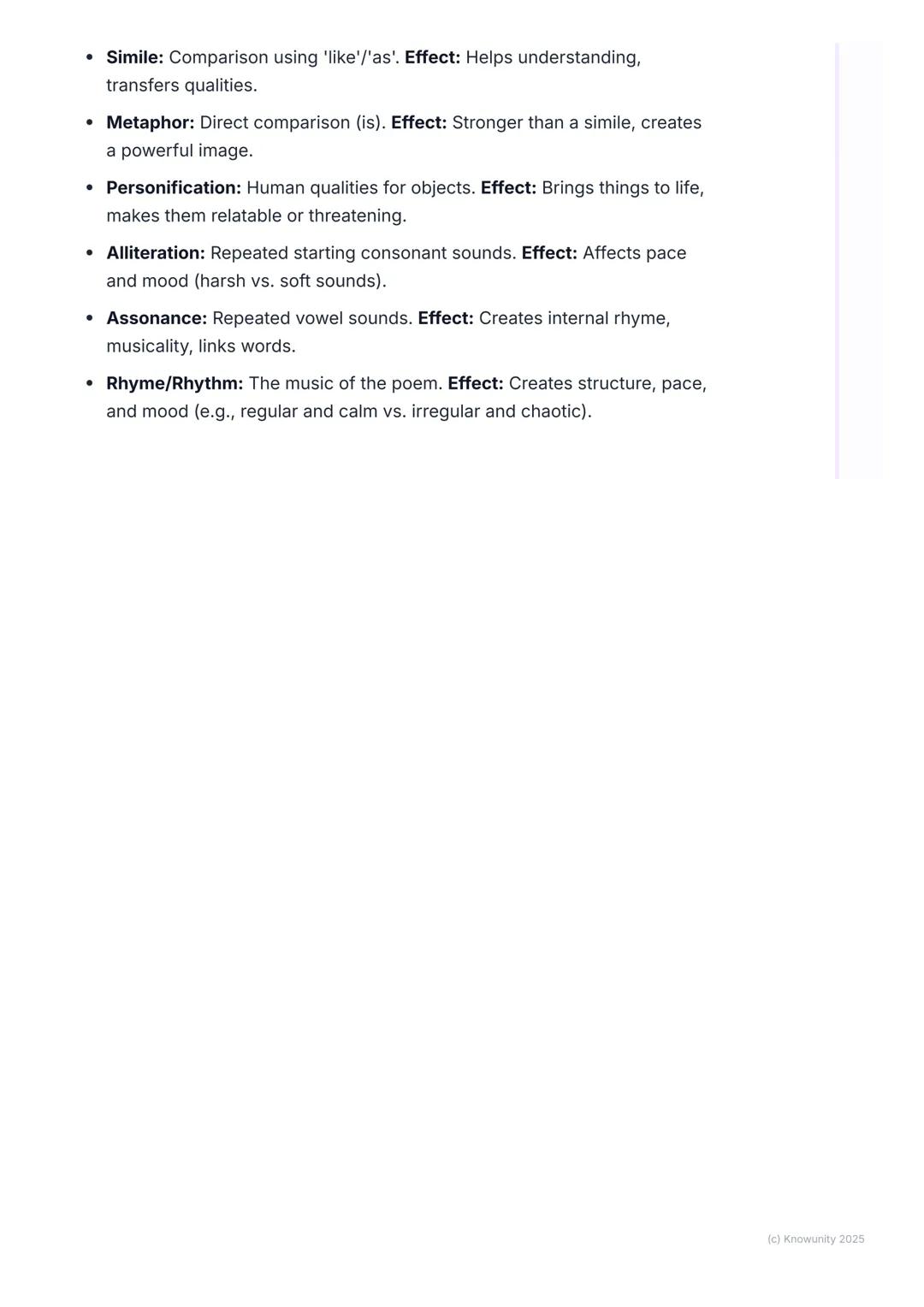
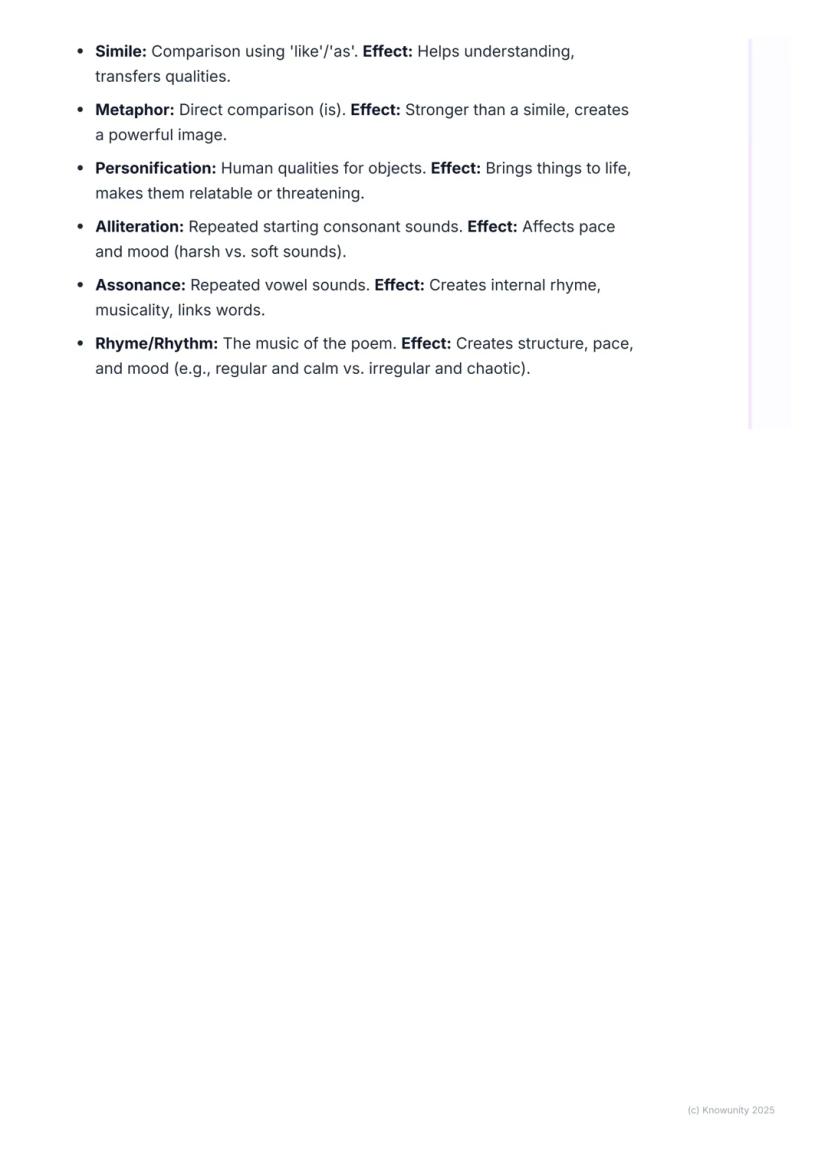
Here's your essential toolkit: Imagery creates vivid pictures using the five senses and sets mood. Similes compare using 'like' or 'as' to aid understanding, whilst metaphors make direct comparisons for stronger impact.
Personification brings objects to life, making them relatable or threatening. Alliteration uses repeated consonant sounds to affect pace and mood - harsh sounds create aggression, soft sounds suggest calm.
Assonance repeats vowel sounds for musicality and internal connections. Rhyme and rhythm provide structure and control pace - regular patterns feel ordered and calm, irregular ones suggest chaos or natural speech.
Final Reminder: Understanding these devices is just the beginning - explaining their effects and linking them to meaning is where the real marks lie.
Our AI companion is specifically built for the needs of students. Based on the millions of content pieces we have on the platform we can provide truly meaningful and relevant answers to students. But its not only about answers, the companion is even more about guiding students through their daily learning challenges, with personalised study plans, quizzes or content pieces in the chat and 100% personalisation based on the students skills and developments.
You can download the app in the Google Play Store and in the Apple App Store.
That's right! Enjoy free access to study content, connect with fellow students, and get instant help – all at your fingertips.
App Store
Google Play
The app is very easy to use and well designed. I have found everything I was looking for so far and have been able to learn a lot from the presentations! I will definitely use the app for a class assignment! And of course it also helps a lot as an inspiration.
Stefan S
iOS user
This app is really great. There are so many study notes and help [...]. My problem subject is French, for example, and the app has so many options for help. Thanks to this app, I have improved my French. I would recommend it to anyone.
Samantha Klich
Android user
Wow, I am really amazed. I just tried the app because I've seen it advertised many times and was absolutely stunned. This app is THE HELP you want for school and above all, it offers so many things, such as workouts and fact sheets, which have been VERY helpful to me personally.
Anna
iOS user
I think it’s very much worth it and you’ll end up using it a lot once you get the hang of it and even after looking at others notes you can still ask your Artificial intelligence buddy the question and ask to simplify it if you still don’t get it!!! In the end I think it’s worth it 😊👍 ⚠️Also DID I MENTION ITS FREEE YOU DON’T HAVE TO PAY FOR ANYTHING AND STILL GET YOUR GRADES IN PERFECTLY❗️❗️⚠️
Thomas R
iOS user
Knowunity is the BEST app I’ve used in a minute. This is not an ai review or anything this is genuinely coming from a 7th grade student (I know 2011 im young) but dude this app is a 10/10 i have maintained a 3.8 gpa and have plenty of time for gaming. I love it and my mom is just happy I got good grades
Brad T
Android user
Not only did it help me find the answer but it also showed me alternative ways to solve it. I was horrible in math and science but now I have an a in both subjects. Thanks for the help🤍🤍
David K
iOS user
The app's just great! All I have to do is enter the topic in the search bar and I get the response real fast. I don't have to watch 10 YouTube videos to understand something, so I'm saving my time. Highly recommended!
Sudenaz Ocak
Android user
In school I was really bad at maths but thanks to the app, I am doing better now. I am so grateful that you made the app.
Greenlight Bonnie
Android user
I found this app a couple years ago and it has only gotten better since then. I really love it because it can help with written questions and photo questions. Also, it can find study guides that other people have made as well as flashcard sets and practice tests. The free version is also amazing for students who might not be able to afford it. Would 100% recommend
Aubrey
iOS user
Best app if you're in Highschool or Junior high. I have been using this app for 2 school years and it's the best, it's good if you don't have anyone to help you with school work.😋🩷🎀
Marco B
iOS user
THE QUIZES AND FLASHCARDS ARE SO USEFUL AND I LOVE Knowunity AI. IT ALSO IS LITREALLY LIKE CHATGPT BUT SMARTER!! HELPED ME WITH MY MASCARA PROBLEMS TOO!! AS WELL AS MY REAL SUBJECTS ! DUHHH 😍😁😲🤑💗✨🎀😮
Elisha
iOS user
This app is phenomenal down to the correct info and the various topics you can study! I greatly recommend it for people who struggle with procrastination and those who need homework help. It has been perfectly accurate for world 1 history as far as I’ve seen! Geometry too!
Paul T
iOS user
The app is very easy to use and well designed. I have found everything I was looking for so far and have been able to learn a lot from the presentations! I will definitely use the app for a class assignment! And of course it also helps a lot as an inspiration.
Stefan S
iOS user
This app is really great. There are so many study notes and help [...]. My problem subject is French, for example, and the app has so many options for help. Thanks to this app, I have improved my French. I would recommend it to anyone.
Samantha Klich
Android user
Wow, I am really amazed. I just tried the app because I've seen it advertised many times and was absolutely stunned. This app is THE HELP you want for school and above all, it offers so many things, such as workouts and fact sheets, which have been VERY helpful to me personally.
Anna
iOS user
I think it’s very much worth it and you’ll end up using it a lot once you get the hang of it and even after looking at others notes you can still ask your Artificial intelligence buddy the question and ask to simplify it if you still don’t get it!!! In the end I think it’s worth it 😊👍 ⚠️Also DID I MENTION ITS FREEE YOU DON’T HAVE TO PAY FOR ANYTHING AND STILL GET YOUR GRADES IN PERFECTLY❗️❗️⚠️
Thomas R
iOS user
Knowunity is the BEST app I’ve used in a minute. This is not an ai review or anything this is genuinely coming from a 7th grade student (I know 2011 im young) but dude this app is a 10/10 i have maintained a 3.8 gpa and have plenty of time for gaming. I love it and my mom is just happy I got good grades
Brad T
Android user
Not only did it help me find the answer but it also showed me alternative ways to solve it. I was horrible in math and science but now I have an a in both subjects. Thanks for the help🤍🤍
David K
iOS user
The app's just great! All I have to do is enter the topic in the search bar and I get the response real fast. I don't have to watch 10 YouTube videos to understand something, so I'm saving my time. Highly recommended!
Sudenaz Ocak
Android user
In school I was really bad at maths but thanks to the app, I am doing better now. I am so grateful that you made the app.
Greenlight Bonnie
Android user
I found this app a couple years ago and it has only gotten better since then. I really love it because it can help with written questions and photo questions. Also, it can find study guides that other people have made as well as flashcard sets and practice tests. The free version is also amazing for students who might not be able to afford it. Would 100% recommend
Aubrey
iOS user
Best app if you're in Highschool or Junior high. I have been using this app for 2 school years and it's the best, it's good if you don't have anyone to help you with school work.😋🩷🎀
Marco B
iOS user
THE QUIZES AND FLASHCARDS ARE SO USEFUL AND I LOVE Knowunity AI. IT ALSO IS LITREALLY LIKE CHATGPT BUT SMARTER!! HELPED ME WITH MY MASCARA PROBLEMS TOO!! AS WELL AS MY REAL SUBJECTS ! DUHHH 😍😁😲🤑💗✨🎀😮
Elisha
iOS user
This app is phenomenal down to the correct info and the various topics you can study! I greatly recommend it for people who struggle with procrastination and those who need homework help. It has been perfectly accurate for world 1 history as far as I’ve seen! Geometry too!
Paul T
iOS user
Poetic devices are the secret weapons poets use to make their words come alive and hit you right in the feels. It's not just about spotting these techniques - you need to explain why they work and what they do... Show more
Access to all documents
Improve your grades
Join milions of students
Think of poetic devices as a poet's toolkit for creating meaning and atmosphere. They're not just fancy words - they're deliberate choices that shape how you experience a poem. The key to exam success isn't just identifying these devices, but explaining their effect on you as the reader.
When analysing poetry, always ask yourself: what does this make me think, feel, or see? This approach will earn you the marks because you're showing understanding, not just recognition.
Quick Tip: Learn these core definitions by heart - they're your foundation for all poetry analysis.
Alliteration repeats consonant sounds at the start of nearby words (like "seashells by the seashore"). Assonance repeats vowel sounds within words close together. Rhyme creates similar sounds at line endings, whilst rhythm establishes the beat through stressed and unstressed syllables.
Access to all documents
Improve your grades
Join milions of students
These devices paint pictures in your mind and make abstract ideas concrete. Imagery appeals to your five senses, creating vivid scenes that establish mood and atmosphere. Dark, decaying imagery creates grimness, whilst light and warmth suggest safety and happiness.
Similes and metaphors work through comparison. A simile uses 'like' or 'as' to compare, whilst a metaphor makes a direct comparison. The magic happens when qualities transfer between the compared things - calling a politician "a snake" suggests they're sly, deceitful, and dangerous.
Personification gives human qualities to objects, making them relatable or threatening. "The angry sea crashed against the rocks" transforms water into an emotional, dangerous force rather than just H2O.
Remember: Always ask what specific qualities are being transferred through these comparisons - that's where the meaning lies.
Access to all documents
Improve your grades
Join milions of students
Sound devices control how poems feel when read aloud, affecting pace and mood dramatically. Alliteration and assonance work through the type of sounds repeated - soft sounds like 's' and 'l' create calm or sinister moods, whilst harsh sounds like 'b' and 'k' suggest violence or excitement.
The repetition of sounds links words together, making lines more memorable and musical. This isn't accidental - poets choose sounds that match their message.
Rhyme and rhythm create the poem's musical structure. Regular patterns feel formal and comforting, like nursery rhymes. Irregular patterns feel chaotic or realistic, like natural speech. Fast rhythms build excitement or panic, whilst slow rhythms create seriousness or sadness.
Pro Tip: Read poems aloud to really hear how these sound devices work - your ear will pick up effects your eyes might miss.
Access to all documents
Improve your grades
Join milions of students
Let's analyse Seamus Heaney's line: "The fattening dots burst into nimble-swimming tadpoles." The vivid visual imagery uses "fattening" to suggest uncomfortable growth, whilst "burst" makes hatching seem explosive and energetic.
The alliteration in "daddy frog" and "bullfrog" uses heavy 'd' and 'b' sounds that mirror a bullfrog's clumsy appearance and croaking sound. This creates a childish, classroom-like tone that fits the poem's memory theme.
Notice how each device serves the poem's overall meaning - Heaney isn't just showing off his vocabulary, he's creating a specific atmosphere and emotional response.
Essential Skill: Always connect your analysis back to the poem's main themes and overall effect - isolated observations won't impress examiners.
Access to all documents
Improve your grades
Join milions of students
Never just "feature spot" - identifying a simile without explaining its effect scores you nothing. Always use the P.E.E. method: make your Point, provide Evidence through quotation, then Explain the effect on mood, tone, or meaning.
Your explanations should focus on what the device adds to the reader's experience. How does it help the poet communicate their message? What atmosphere does it create? These connections between technique and meaning are what examiners want to see.
Learn the terminology - words like 'sibilance', 'plosives', and 'connotations' show sophisticated understanding. Use analytical phrases like "suggests", "creates", "implies", and "reinforces" to sound professional.
Exam Success: Always link individual devices back to the poem's overall meaning - show how each technique contributes to the bigger picture.
Access to all documents
Improve your grades
Join milions of students
Here's your essential toolkit: Imagery creates vivid pictures using the five senses and sets mood. Similes compare using 'like' or 'as' to aid understanding, whilst metaphors make direct comparisons for stronger impact.
Personification brings objects to life, making them relatable or threatening. Alliteration uses repeated consonant sounds to affect pace and mood - harsh sounds create aggression, soft sounds suggest calm.
Assonance repeats vowel sounds for musicality and internal connections. Rhyme and rhythm provide structure and control pace - regular patterns feel ordered and calm, irregular ones suggest chaos or natural speech.
Final Reminder: Understanding these devices is just the beginning - explaining their effects and linking them to meaning is where the real marks lie.
Our AI companion is specifically built for the needs of students. Based on the millions of content pieces we have on the platform we can provide truly meaningful and relevant answers to students. But its not only about answers, the companion is even more about guiding students through their daily learning challenges, with personalised study plans, quizzes or content pieces in the chat and 100% personalisation based on the students skills and developments.
You can download the app in the Google Play Store and in the Apple App Store.
That's right! Enjoy free access to study content, connect with fellow students, and get instant help – all at your fingertips.
1
Smart Tools NEW
Transform this note into: ✓ 50+ Practice Questions ✓ Interactive Flashcards ✓ Full Practice Test ✓ Essay Outlines
App Store
Google Play
The app is very easy to use and well designed. I have found everything I was looking for so far and have been able to learn a lot from the presentations! I will definitely use the app for a class assignment! And of course it also helps a lot as an inspiration.
Stefan S
iOS user
This app is really great. There are so many study notes and help [...]. My problem subject is French, for example, and the app has so many options for help. Thanks to this app, I have improved my French. I would recommend it to anyone.
Samantha Klich
Android user
Wow, I am really amazed. I just tried the app because I've seen it advertised many times and was absolutely stunned. This app is THE HELP you want for school and above all, it offers so many things, such as workouts and fact sheets, which have been VERY helpful to me personally.
Anna
iOS user
I think it’s very much worth it and you’ll end up using it a lot once you get the hang of it and even after looking at others notes you can still ask your Artificial intelligence buddy the question and ask to simplify it if you still don’t get it!!! In the end I think it’s worth it 😊👍 ⚠️Also DID I MENTION ITS FREEE YOU DON’T HAVE TO PAY FOR ANYTHING AND STILL GET YOUR GRADES IN PERFECTLY❗️❗️⚠️
Thomas R
iOS user
Knowunity is the BEST app I’ve used in a minute. This is not an ai review or anything this is genuinely coming from a 7th grade student (I know 2011 im young) but dude this app is a 10/10 i have maintained a 3.8 gpa and have plenty of time for gaming. I love it and my mom is just happy I got good grades
Brad T
Android user
Not only did it help me find the answer but it also showed me alternative ways to solve it. I was horrible in math and science but now I have an a in both subjects. Thanks for the help🤍🤍
David K
iOS user
The app's just great! All I have to do is enter the topic in the search bar and I get the response real fast. I don't have to watch 10 YouTube videos to understand something, so I'm saving my time. Highly recommended!
Sudenaz Ocak
Android user
In school I was really bad at maths but thanks to the app, I am doing better now. I am so grateful that you made the app.
Greenlight Bonnie
Android user
I found this app a couple years ago and it has only gotten better since then. I really love it because it can help with written questions and photo questions. Also, it can find study guides that other people have made as well as flashcard sets and practice tests. The free version is also amazing for students who might not be able to afford it. Would 100% recommend
Aubrey
iOS user
Best app if you're in Highschool or Junior high. I have been using this app for 2 school years and it's the best, it's good if you don't have anyone to help you with school work.😋🩷🎀
Marco B
iOS user
THE QUIZES AND FLASHCARDS ARE SO USEFUL AND I LOVE Knowunity AI. IT ALSO IS LITREALLY LIKE CHATGPT BUT SMARTER!! HELPED ME WITH MY MASCARA PROBLEMS TOO!! AS WELL AS MY REAL SUBJECTS ! DUHHH 😍😁😲🤑💗✨🎀😮
Elisha
iOS user
This app is phenomenal down to the correct info and the various topics you can study! I greatly recommend it for people who struggle with procrastination and those who need homework help. It has been perfectly accurate for world 1 history as far as I’ve seen! Geometry too!
Paul T
iOS user
The app is very easy to use and well designed. I have found everything I was looking for so far and have been able to learn a lot from the presentations! I will definitely use the app for a class assignment! And of course it also helps a lot as an inspiration.
Stefan S
iOS user
This app is really great. There are so many study notes and help [...]. My problem subject is French, for example, and the app has so many options for help. Thanks to this app, I have improved my French. I would recommend it to anyone.
Samantha Klich
Android user
Wow, I am really amazed. I just tried the app because I've seen it advertised many times and was absolutely stunned. This app is THE HELP you want for school and above all, it offers so many things, such as workouts and fact sheets, which have been VERY helpful to me personally.
Anna
iOS user
I think it’s very much worth it and you’ll end up using it a lot once you get the hang of it and even after looking at others notes you can still ask your Artificial intelligence buddy the question and ask to simplify it if you still don’t get it!!! In the end I think it’s worth it 😊👍 ⚠️Also DID I MENTION ITS FREEE YOU DON’T HAVE TO PAY FOR ANYTHING AND STILL GET YOUR GRADES IN PERFECTLY❗️❗️⚠️
Thomas R
iOS user
Knowunity is the BEST app I’ve used in a minute. This is not an ai review or anything this is genuinely coming from a 7th grade student (I know 2011 im young) but dude this app is a 10/10 i have maintained a 3.8 gpa and have plenty of time for gaming. I love it and my mom is just happy I got good grades
Brad T
Android user
Not only did it help me find the answer but it also showed me alternative ways to solve it. I was horrible in math and science but now I have an a in both subjects. Thanks for the help🤍🤍
David K
iOS user
The app's just great! All I have to do is enter the topic in the search bar and I get the response real fast. I don't have to watch 10 YouTube videos to understand something, so I'm saving my time. Highly recommended!
Sudenaz Ocak
Android user
In school I was really bad at maths but thanks to the app, I am doing better now. I am so grateful that you made the app.
Greenlight Bonnie
Android user
I found this app a couple years ago and it has only gotten better since then. I really love it because it can help with written questions and photo questions. Also, it can find study guides that other people have made as well as flashcard sets and practice tests. The free version is also amazing for students who might not be able to afford it. Would 100% recommend
Aubrey
iOS user
Best app if you're in Highschool or Junior high. I have been using this app for 2 school years and it's the best, it's good if you don't have anyone to help you with school work.😋🩷🎀
Marco B
iOS user
THE QUIZES AND FLASHCARDS ARE SO USEFUL AND I LOVE Knowunity AI. IT ALSO IS LITREALLY LIKE CHATGPT BUT SMARTER!! HELPED ME WITH MY MASCARA PROBLEMS TOO!! AS WELL AS MY REAL SUBJECTS ! DUHHH 😍😁😲🤑💗✨🎀😮
Elisha
iOS user
This app is phenomenal down to the correct info and the various topics you can study! I greatly recommend it for people who struggle with procrastination and those who need homework help. It has been perfectly accurate for world 1 history as far as I’ve seen! Geometry too!
Paul T
iOS user