
Ever wondered how flowering plants are built and how they...
 Biology3 views·Updated Jun 18, 2026·7 pages
Understanding the Structure of Flowering Plants
C
Cayla Martin@caylamartin
1 / 7
1
of 7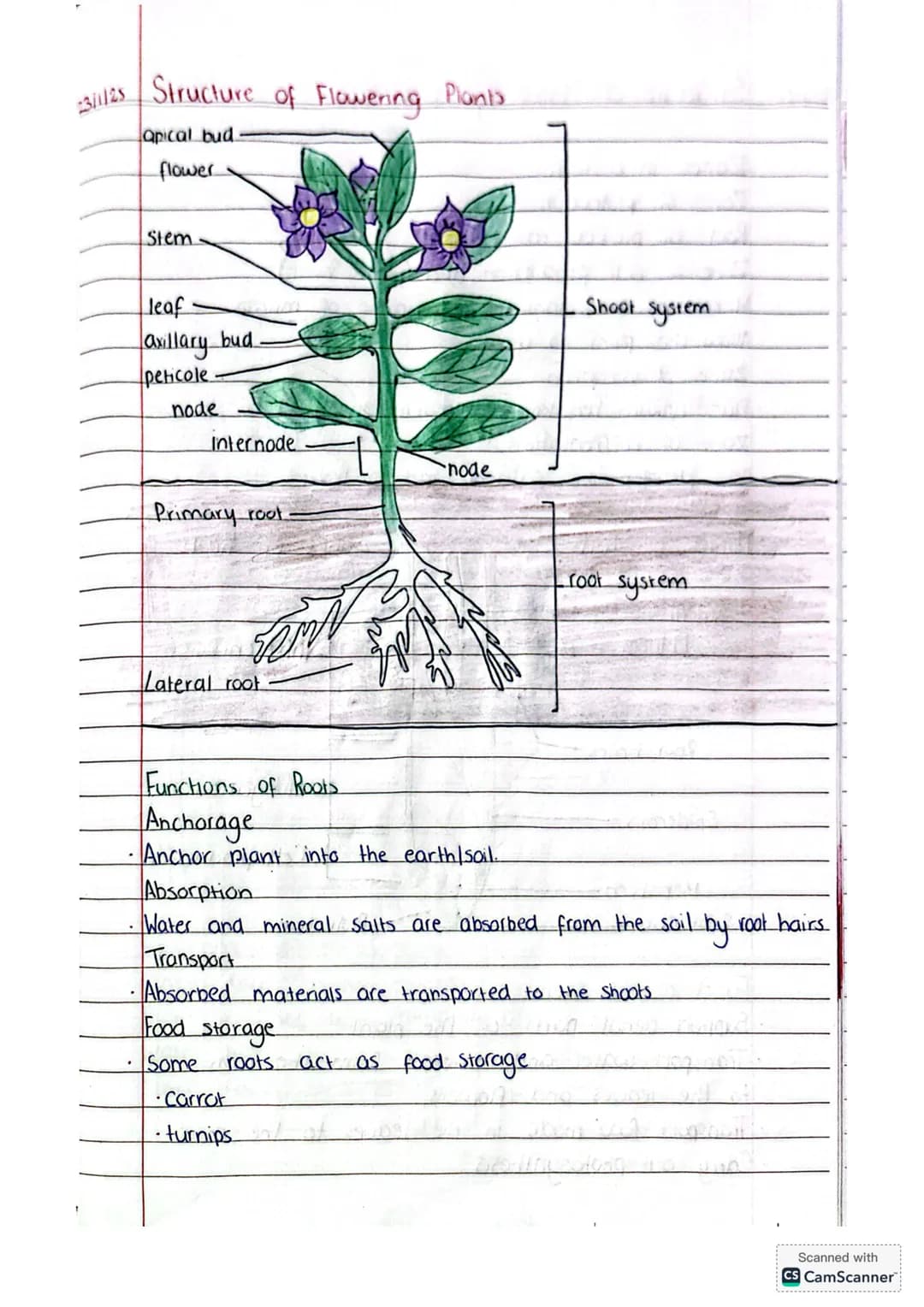
Basic Plant Structure and Root Functions
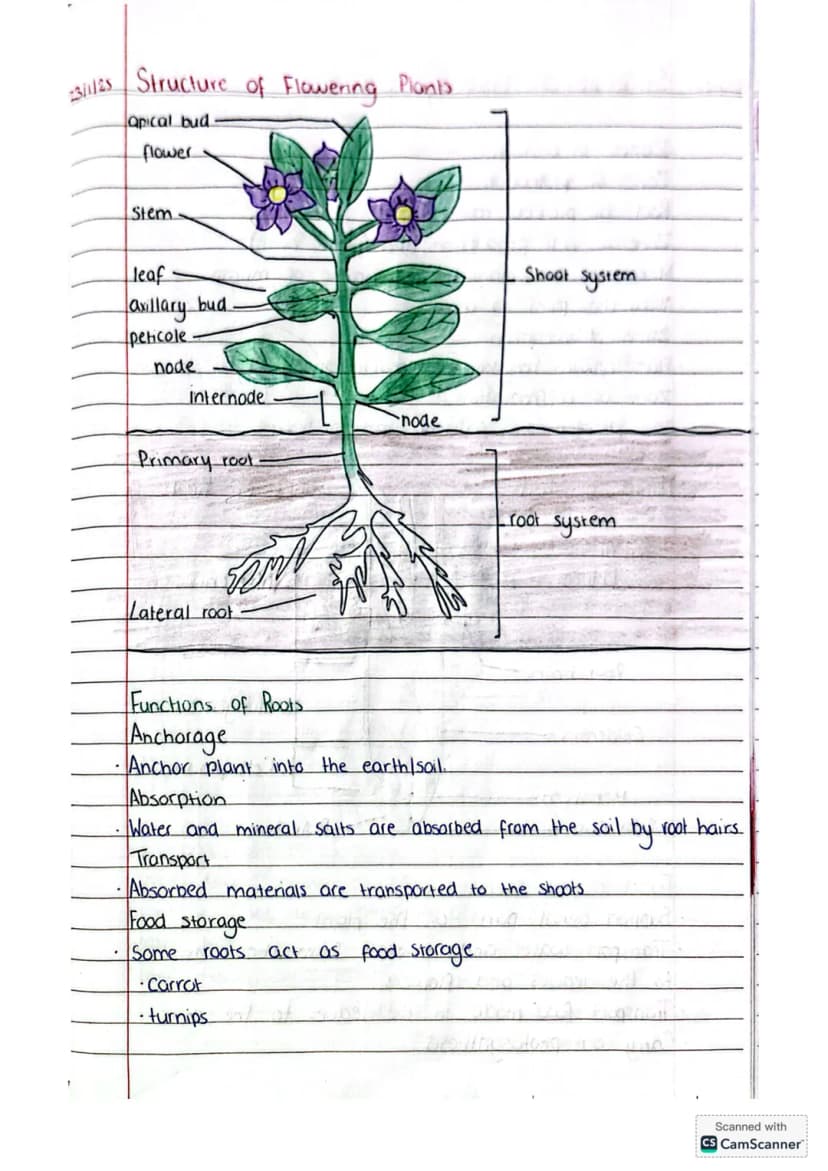
Your typical flowering plant is basically split into two main systems that work together perfectly. The shoot system includes everything above ground - stems, leaves, flowers, and buds - while the root system handles all the underground business.
Roots are proper workhorses that do way more than just sit there in the dirt. They anchor the plant so it doesn't topple over, absorb water and minerals through tiny root hairs, and transport all these materials up to the shoots above ground.
Some roots even act as storage units for food - think carrots and turnips. These clever plants pack away carbohydrates in their roots for later use, which is why we find them so tasty!
Quick Tip: Root hairs massively increase the surface area for absorption - it's like having millions of tiny straws sucking up nutrients!
2
of 7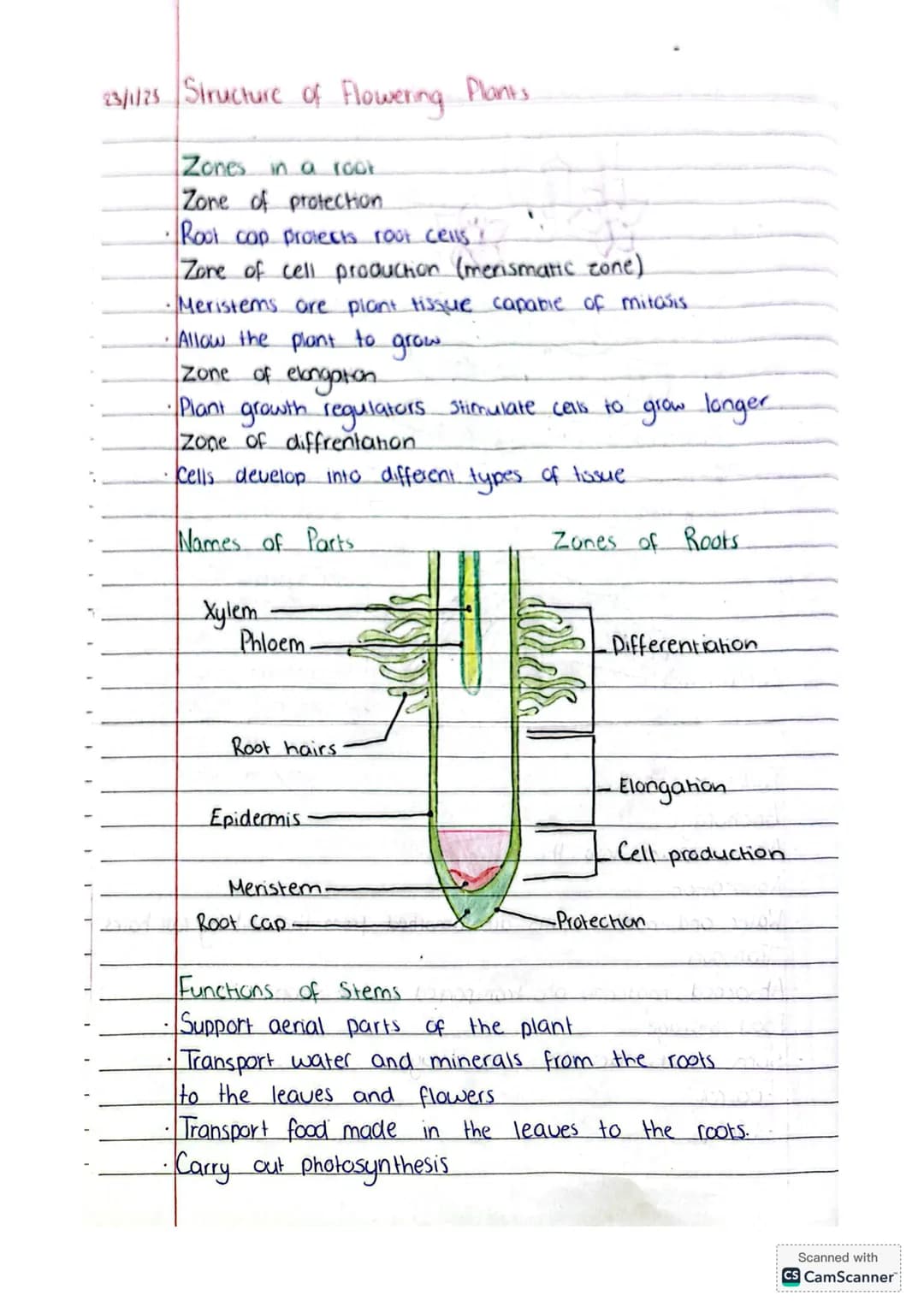
Root Zones and Stem Functions
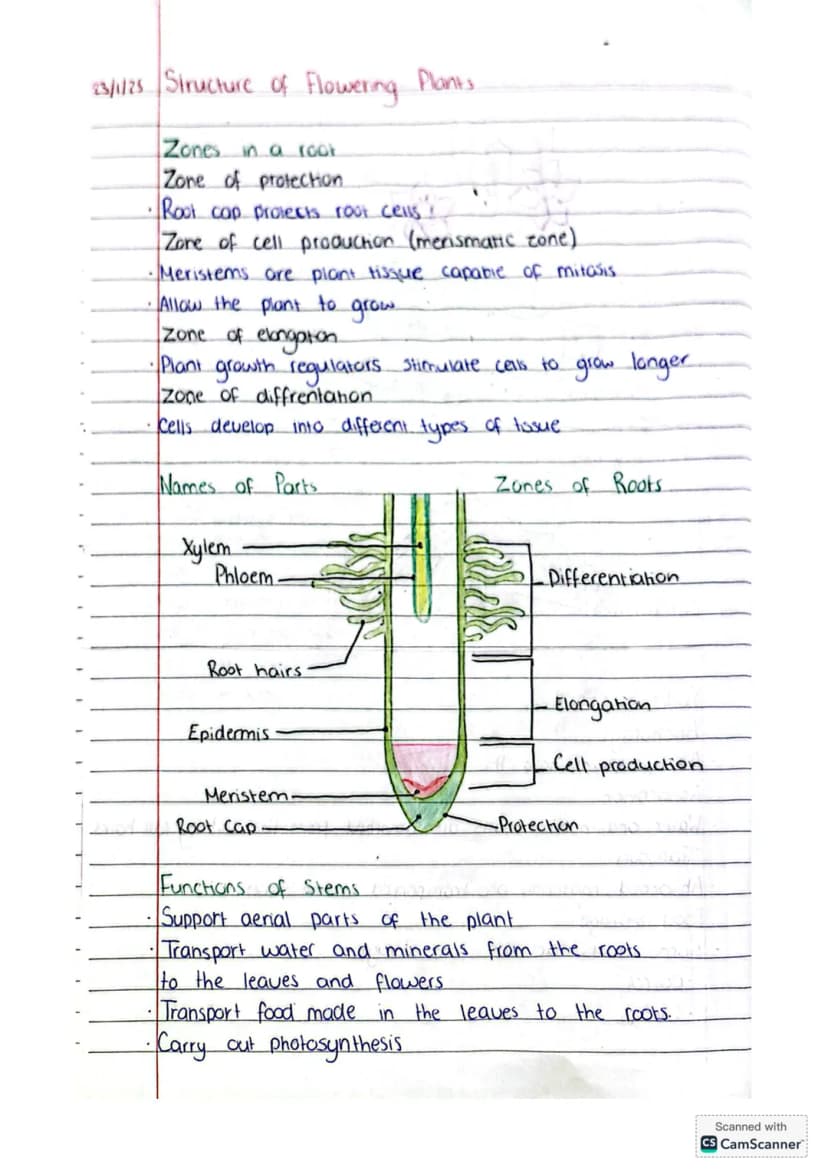
Roots are organised into four distinct zones, each with its own job. At the tip, the zone of protection (root cap) shields delicate cells as they push through soil. Just behind that, the zone of cell production contains meristems - special tissues that can divide through mitosis to help plants grow.
The zone of elongation is where plant growth regulators make cells stretch longer, while the zone of differentiation is where cells specialise into different tissue types like xylem and phloem.
Stems are the plant's highway system, supporting all the aerial parts whilst transporting water and minerals upward from roots and food downward from leaves. Many stems can even carry out photosynthesis and store food - they're more versatile than you might think!
Remember: Meristems are the only plant tissues that can keep dividing - they're like the plant's growth centres!
3
of 7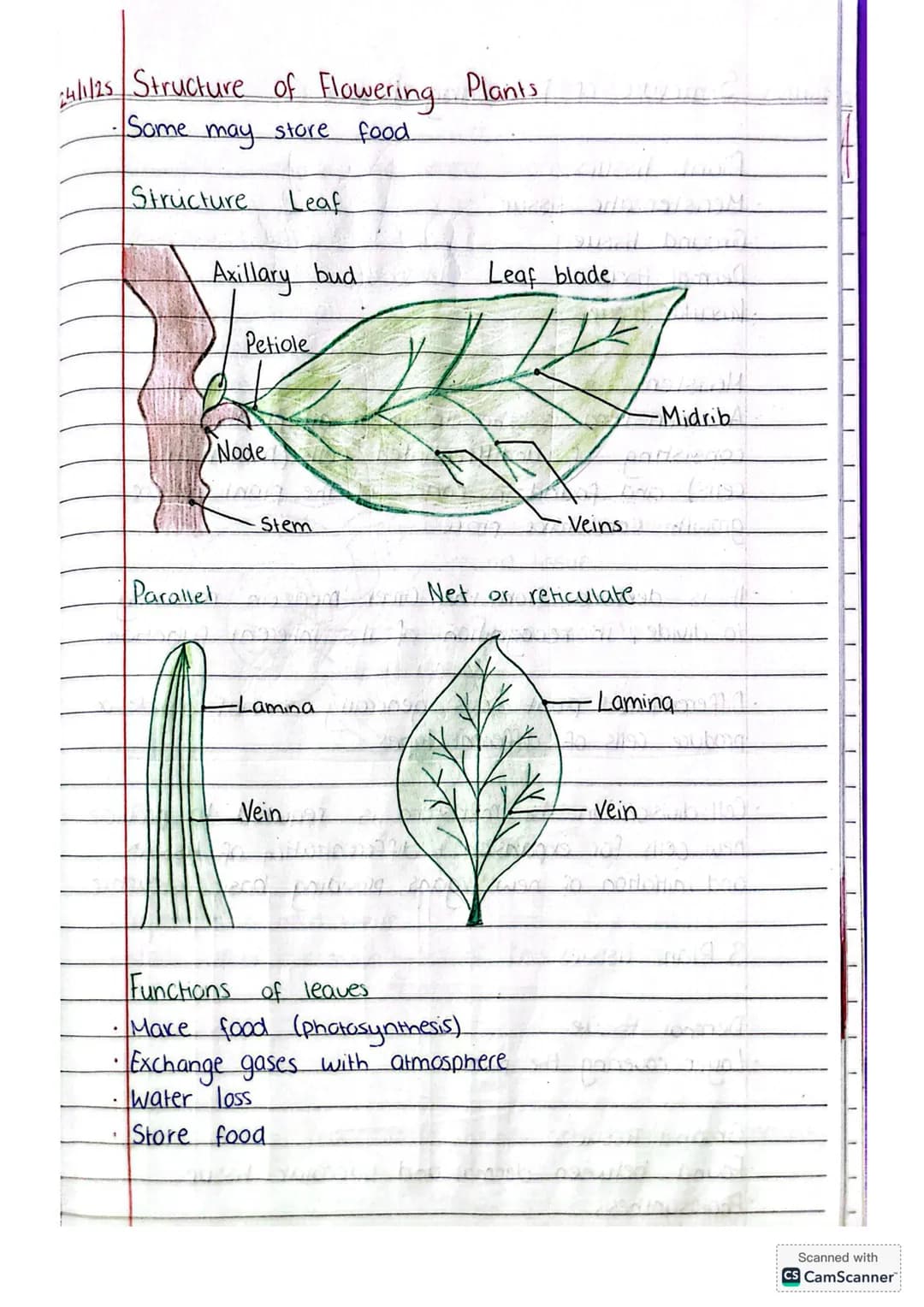
Leaf Structure and Functions
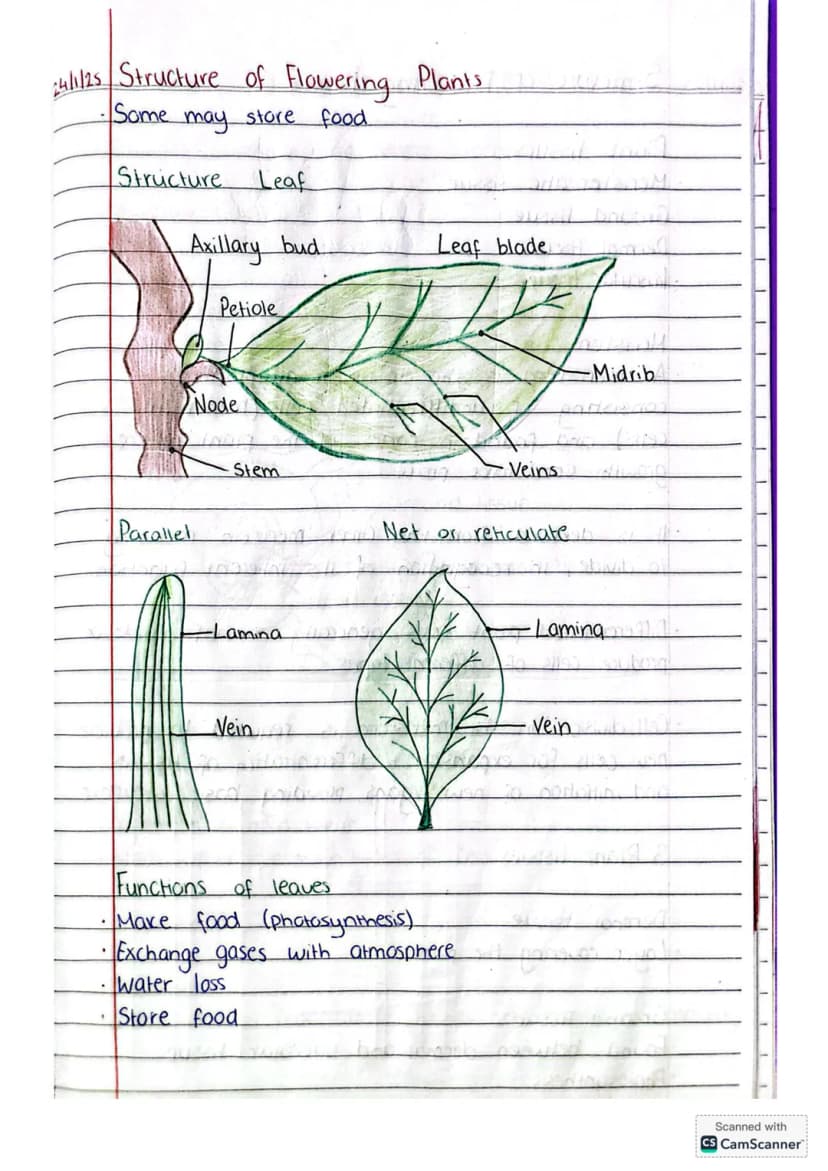
Leaves might look simple, but they're actually sophisticated food factories with some brilliant design features. The leaf blade (lamina) contains all the photosynthetic machinery, whilst the petiole connects it to the stem. The midrib and veins form the leaf's transport network.
You'll notice veins can be arranged in two patterns - parallel veins that run alongside each other, or net/reticulate veins that branch out like a spider's web. This difference actually tells you what type of plant you're looking at!
Leaves are absolute multitaskers: they make food through photosynthesis, exchange gases with the atmosphere, control water loss, and can even store food. Without leaves, plants would be properly stuffed - they're essential for survival.
Did You Know: The pattern of veins in leaves is one of the easiest ways to identify different types of flowering plants!
4
of 7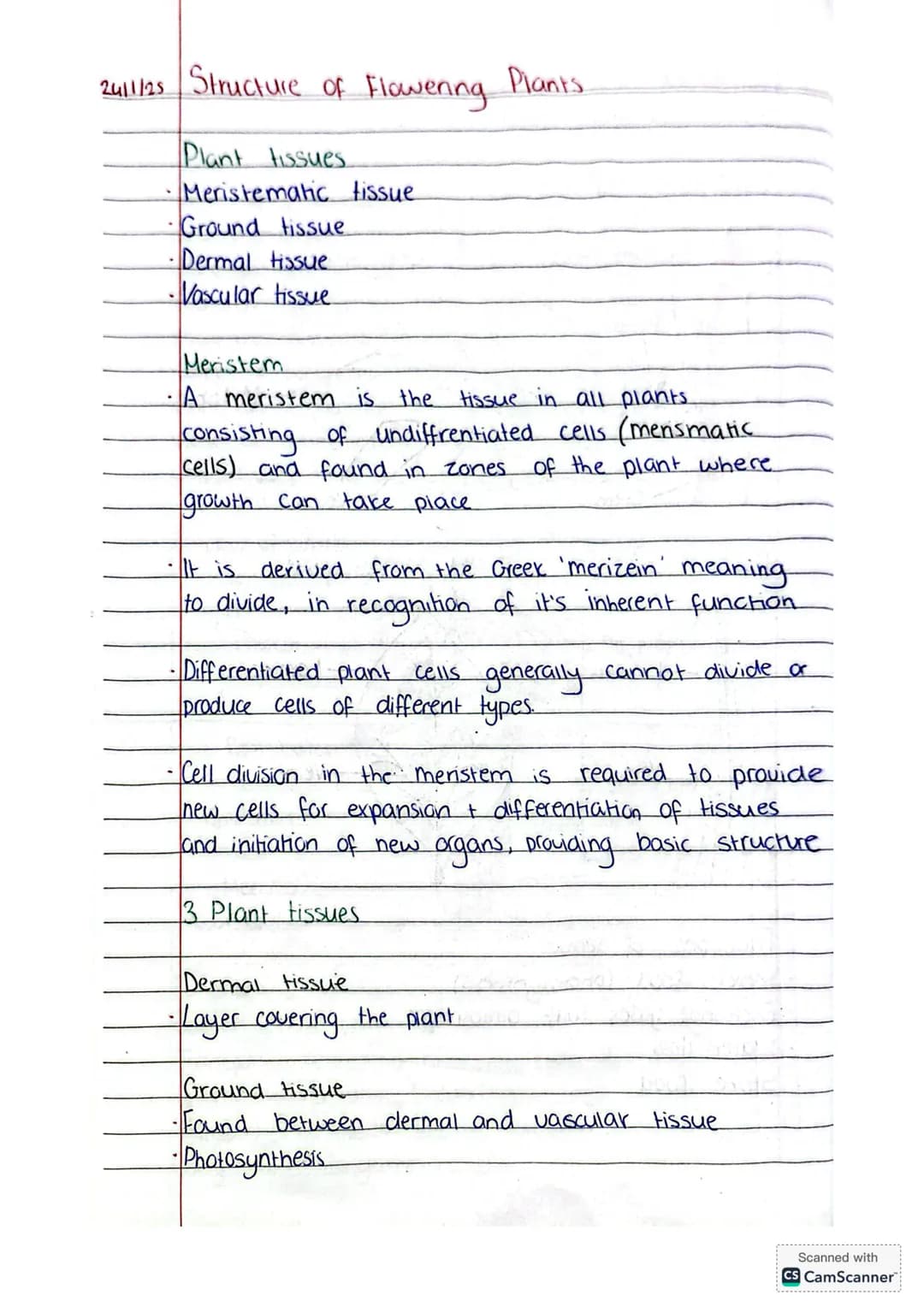
Plant Tissues - The Building Blocks
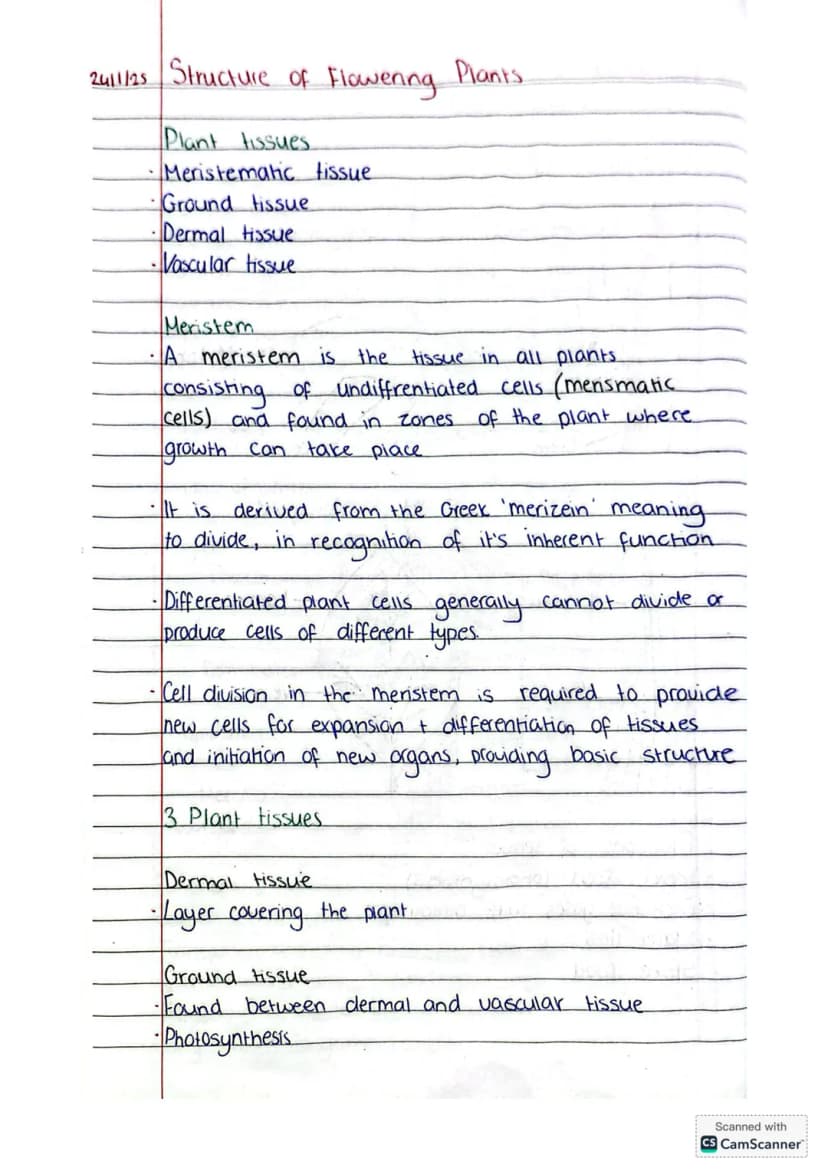
Plants are made up of four main tissue types that work together like a well-organised team. Meristematic tissue is the star player - these undifferentiated cells can divide and create new growth wherever the plant needs it most.
The word "meristem" comes from Greek meaning "to divide," which perfectly describes what these tissues do. Unlike other plant cells that are stuck in their roles, meristematic cells can become any type of tissue the plant needs.
Dermal tissue forms the plant's outer covering, ground tissue fills the space between dermal and vascular tissues (handling photosynthesis and storage), whilst vascular tissue contains the transport bundles. Each tissue type has evolved to handle specific jobs brilliantly.
Key Point: Only meristematic cells can divide to produce different cell types - they're like plant stem cells!
5
of 7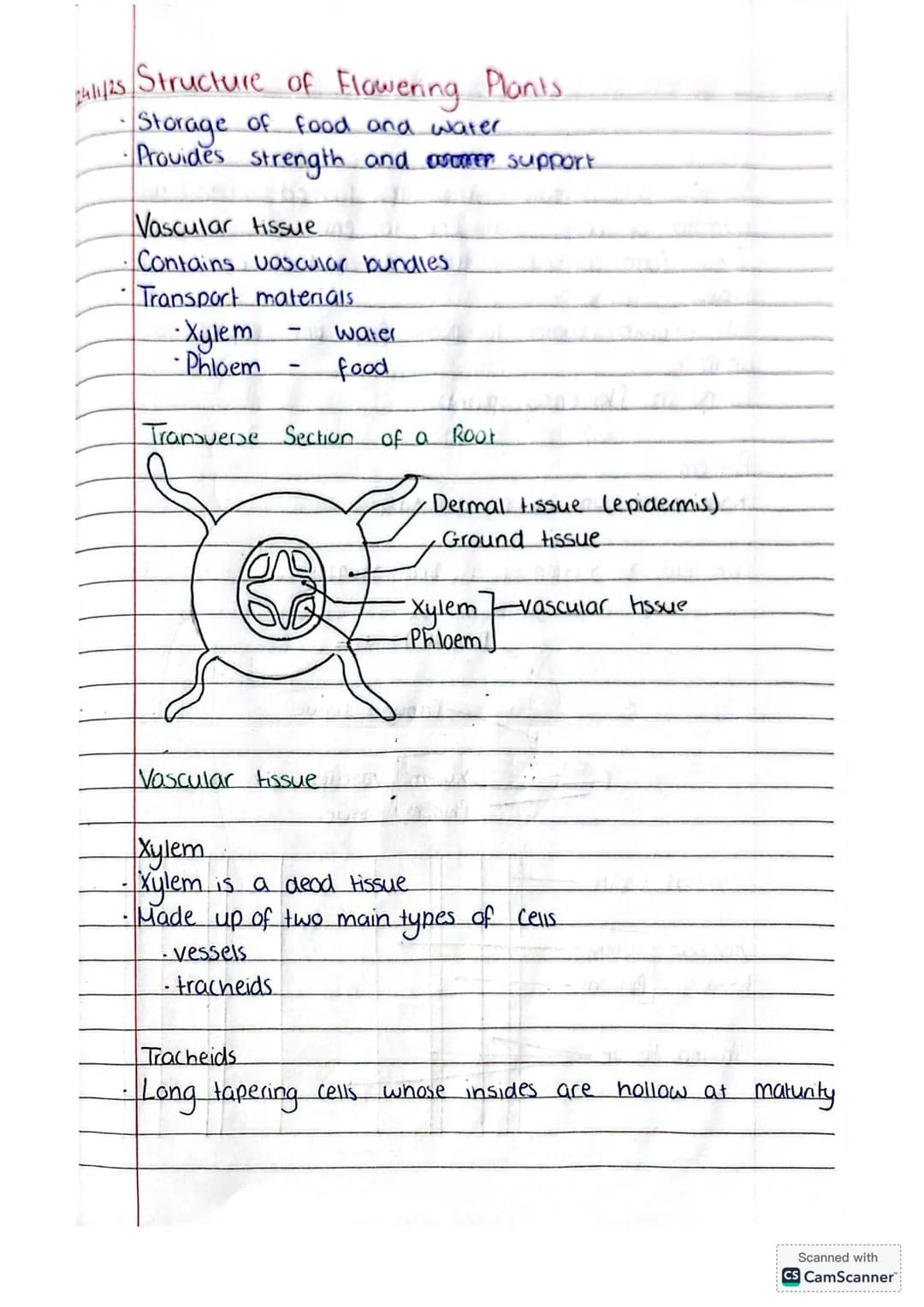
Vascular Tissues - The Plant's Transport System
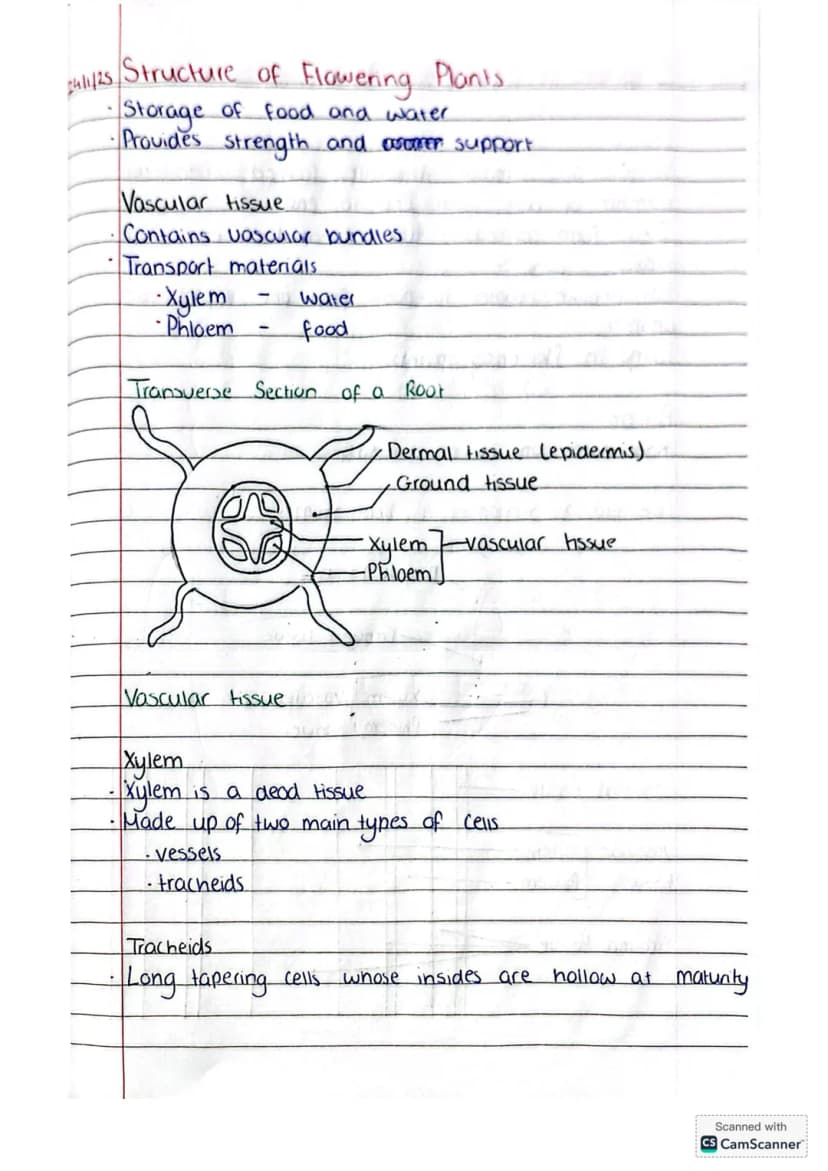
Vascular tissue contains the plant's plumbing system in neat little bundles. Xylem handles water transport whilst phloem moves food around - think of them as separate pipelines for different jobs.
Xylem is actually dead tissue made up of vessels and tracheids. Tracheids are long, tapering cells that are hollow inside when mature, whilst vessels are formed when cells join end-to-end and their walls break down to create continuous tubes.
These vessels have pits that allow water to move sideways between different transport tubes. It's a brilliant system that ensures water can always find alternative routes if one pathway gets blocked.
Ground tissue does the heavy lifting for storage of food and water whilst providing structural support to keep everything in place.
Cool Fact: Xylem vessels can be incredibly long - some stretch the entire height of massive trees!
6
of 7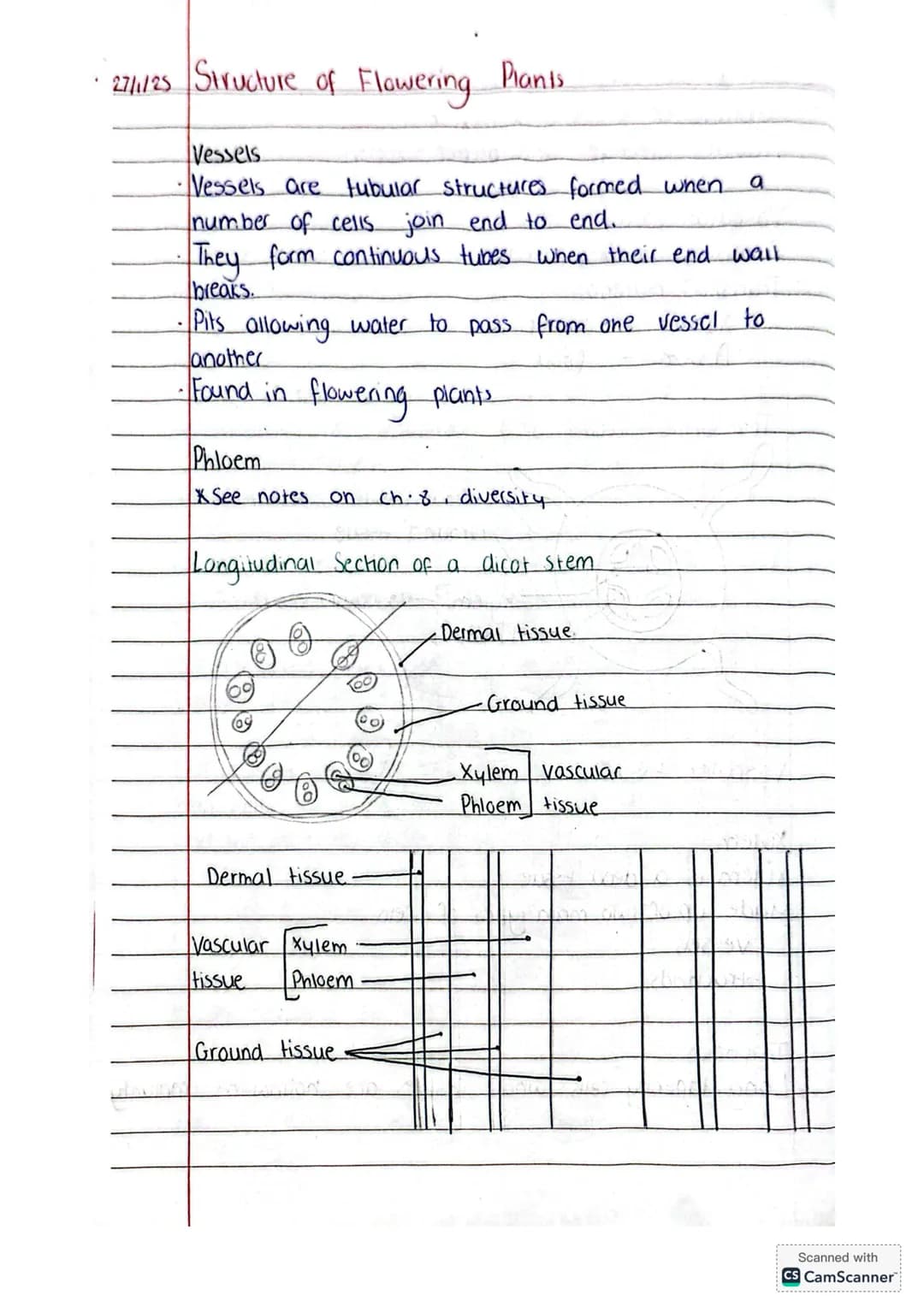
More on Vascular Structure
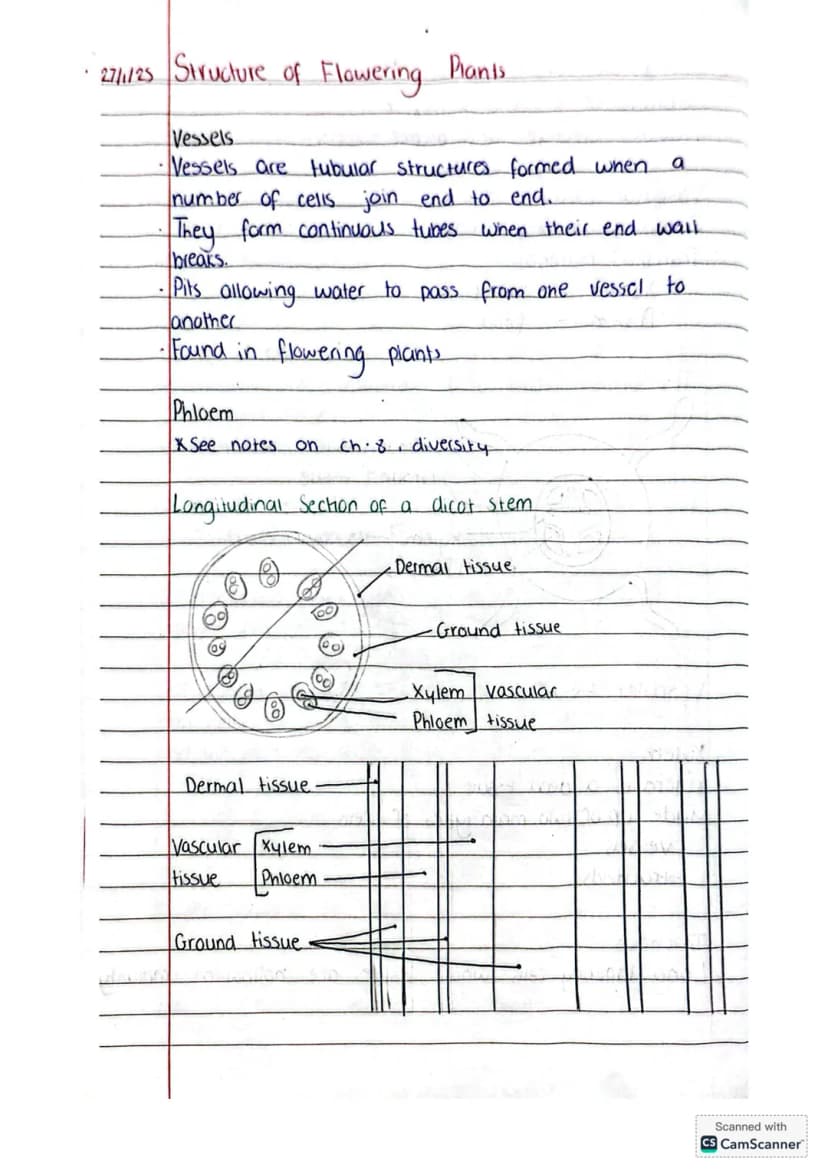
Vessels are particularly clever structures found in flowering plants. When multiple cells join end-to-end and their walls break down, they create these brilliant continuous tubes that can transport water efficiently over long distances.
The pits in vessel walls aren't just random holes - they're strategically placed to allow water to move between adjacent vessels. This creates a backup system so if one vessel gets damaged, water can still flow through alternative routes.
When you look at a transverse section of a root or stem, you can clearly see how the different tissues are organised. Dermal tissue (epidermis) forms the outer layer, ground tissue fills most of the middle space, and vascular tissue (xylem and phloem) is arranged in specific patterns.
Study Tip: Drawing cross-sections of roots and stems really helps you visualise how these tissues are arranged!
7
of 7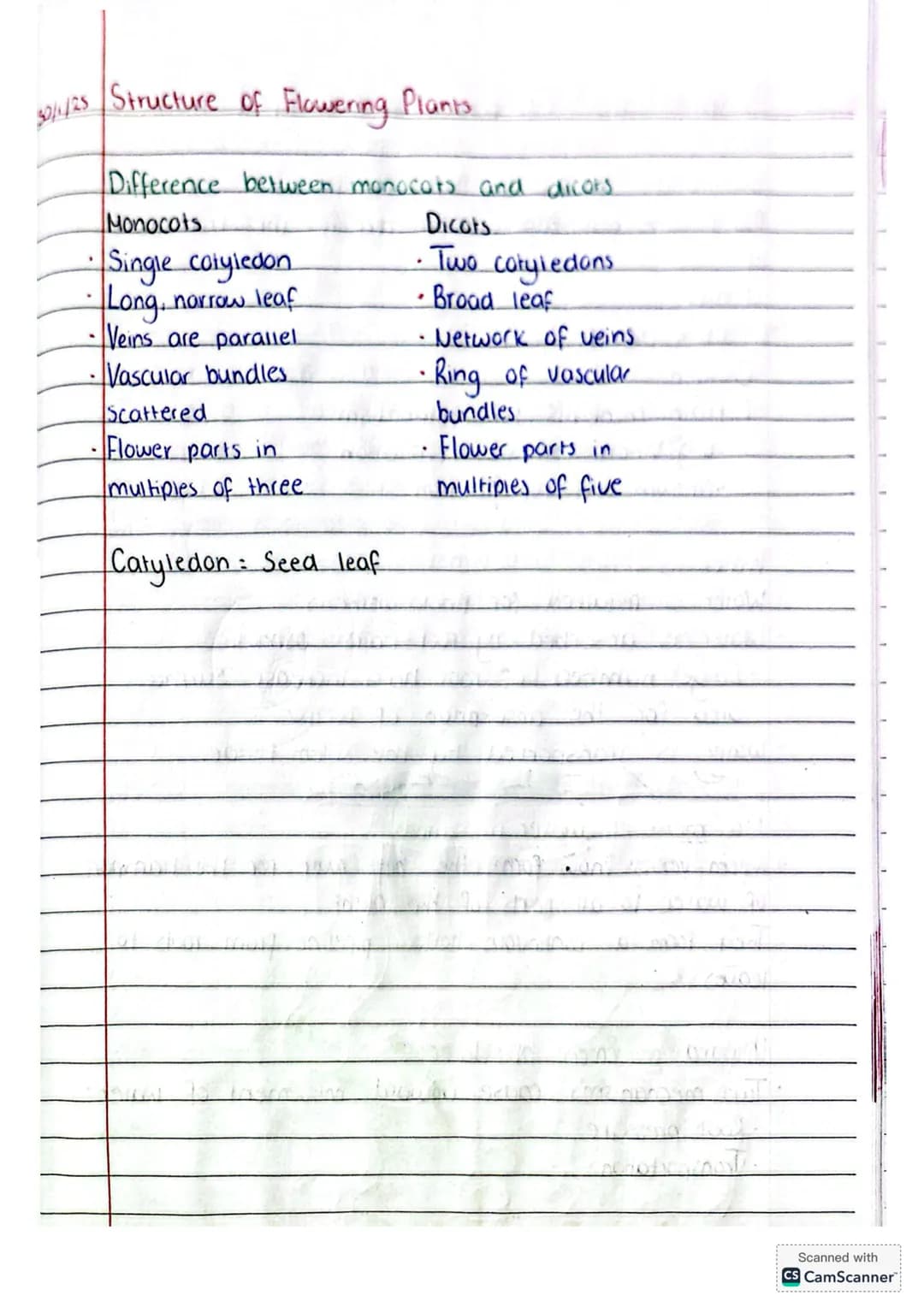
Monocots vs Dicots - Spot the Difference
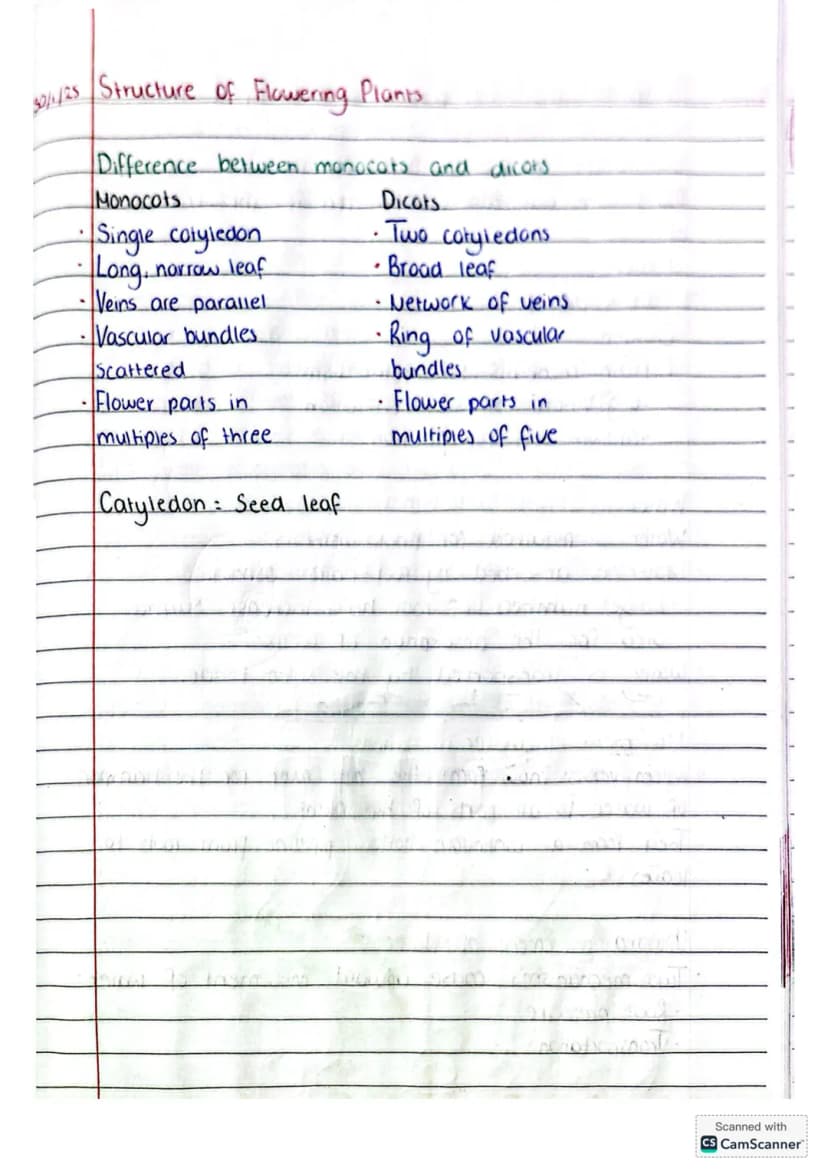
Flowering plants fall into two main groups that you can easily tell apart once you know what to look for. Monocots have a single cotyledon (seed leaf), long narrow leaves with parallel veins, scattered vascular bundles, and flower parts in multiples of three.
Dicots are quite different - they have two cotyledons, broad leaves with a network of veins, vascular bundles arranged in a ring, and flower parts in multiples of five. These differences aren't just random - they reflect completely different evolutionary strategies.
Cotyledons are basically seed leaves that provide energy for the germinating plant. Whether a plant has one or two cotyledons affects how its entire body plan develops, from leaf shape right through to flower structure.
Once you learn these patterns, you'll be able to classify most flowering plants just by looking at their leaves and flowers!
Memory Trick: Monocots = "mono" (one) cotyledon, "mono-rail" parallel veins, and "three" flower parts. Everything else is dicots!
We thought you’d never ask...
What is the Knowunity AI companion?
Our AI companion is specifically built for the needs of students. Based on the millions of content pieces we have on the platform we can provide truly meaningful and relevant answers to students. But its not only about answers, the companion is even more about guiding students through their daily learning challenges, with personalised study plans, quizzes or content pieces in the chat and 100% personalisation based on the students skills and developments.
Where can I download the Knowunity app?
You can download the app in the Google Play Store and in the Apple App Store.
Is Knowunity really free of charge?
That's right! Enjoy free access to study content, connect with fellow students, and get instant help – all at your fingertips.
Most popular content in Biology
8BiologyEcology introduction notes!
Start of the leaving cert ecology chapter
6th Year131
BiologyDNA & RNA
All notes on DNA & RNA including protein synthesis which is a HL topic
5th Year250
BiologyVertebrates and Invertebrates
Students will distinguish between animals that have a backbone (vertebrates) and those that do not (invertebrates), identifying examples of each.
2nd Year240
BiologyBiomolecules: chapter 8
Summary and easily understandable notes to revise chapter 8 biomolecules. Includes good labelled diagrams for visual learners
5th Year210
BiologyCirculatory System
Students will learn about the heart, blood, and blood vessels, and how this system transports oxygen, nutrients, and waste products around the body.
3rd Year140
BiologyRespiration
All respiration notes including simple diagrams and glycolysis and the Krebs cycle
5th Year120
BiologyPhotosynthesis : Biology
Photosynthesis
6th Year371
BiologyPlant Cells
Learning about the unique structures found in plant cells, such as the cell wall, chloroplasts, and large vacuole, and how they differ from animal cells.
1st Year80
Most popular content
9 Irish
IrishIrish oral questions and answers
Questions and answers for the leaving cert oral
5th Year4264
 English
Key Quotes : Sive
Key Quotes and explanations: Sive
6th Year2842
IrishIrish oral questions
Outline of oral questions
5th Year2055
IrishIníon- le hÁine Durkin
Aine Durkin’s poem, Iníon: Themes & summary
5th Year890
IrishIrish poetry 2027
Iníon + Dínit an Bhróin
5th Year1153
IrishLC HL notes- Iníon (poem)
Includes poem in English and Irish, theme, key words & phrases
5th Year2304
EnglishCultural Context : Shawshank Redemption : Sive : Small Things Like These
Comparative Study : Cultural Context : Shawshank Redemption, Sive and Small Things Like These
6th Year1430
IrishMo Ghrá-sa (Idir Lúibíní)
Notes on mo ghrá-sa
5th Year380
IrishAn Gaeilge Aiste
Irish Language essay
6th Year1320
Can't find what you're looking for? Explore other subjects.
Students love us — and so will you.
4.6/5App Store
4.7/5Google Play
The app is very easy to use and well designed. I have found everything I was looking for so far and have been able to learn a lot from the presentations! I will definitely use the app for a class assignment! And of course it also helps a lot as an inspiration.
Stefan SiOS user
This app is really great. There are so many study notes and help [...]. My problem subject is French, for example, and the app has so many options for help. Thanks to this app, I have improved my French. I would recommend it to anyone.
Samantha KlichAndroid user
Wow, I am really amazed. I just tried the app because I've seen it advertised many times and was absolutely stunned. This app is THE HELP you want for school and above all, it offers so many things, such as workouts and fact sheets, which have been VERY helpful to me personally.
AnnaiOS user
Biology3 views·Updated Jun 18, 2026·7 pagesUnderstanding the Structure of Flowering Plants
C
Cayla Martin@caylamartin
Ever wondered how flowering plants are built and how they actually work? From the roots anchoring them in soil to the leaves making their own food, flowering plants have an amazing structure that keeps them alive and thriving.
1
of 7
Sign up to see the content. It's free!
- Access to all documents
- Improve your grades
- Join milions of students
Basic Plant Structure and Root Functions
Your typical flowering plant is basically split into two main systems that work together perfectly. The shoot system includes everything above ground - stems, leaves, flowers, and buds - while the root system handles all the underground business.
Roots are proper workhorses that do way more than just sit there in the dirt. They anchor the plant so it doesn't topple over, absorb water and minerals through tiny root hairs, and transport all these materials up to the shoots above ground.
Some roots even act as storage units for food - think carrots and turnips. These clever plants pack away carbohydrates in their roots for later use, which is why we find them so tasty!
Quick Tip: Root hairs massively increase the surface area for absorption - it's like having millions of tiny straws sucking up nutrients!
2
of 7Sign up to see the content. It's free!
- Access to all documents
- Improve your grades
- Join milions of students
Root Zones and Stem Functions
Roots are organised into four distinct zones, each with its own job. At the tip, the zone of protection (root cap) shields delicate cells as they push through soil. Just behind that, the zone of cell production contains meristems - special tissues that can divide through mitosis to help plants grow.
The zone of elongation is where plant growth regulators make cells stretch longer, while the zone of differentiation is where cells specialise into different tissue types like xylem and phloem.
Stems are the plant's highway system, supporting all the aerial parts whilst transporting water and minerals upward from roots and food downward from leaves. Many stems can even carry out photosynthesis and store food - they're more versatile than you might think!
Remember: Meristems are the only plant tissues that can keep dividing - they're like the plant's growth centres!
3
of 7Sign up to see the content. It's free!
- Access to all documents
- Improve your grades
- Join milions of students
Leaf Structure and Functions
Leaves might look simple, but they're actually sophisticated food factories with some brilliant design features. The leaf blade (lamina) contains all the photosynthetic machinery, whilst the petiole connects it to the stem. The midrib and veins form the leaf's transport network.
You'll notice veins can be arranged in two patterns - parallel veins that run alongside each other, or net/reticulate veins that branch out like a spider's web. This difference actually tells you what type of plant you're looking at!
Leaves are absolute multitaskers: they make food through photosynthesis, exchange gases with the atmosphere, control water loss, and can even store food. Without leaves, plants would be properly stuffed - they're essential for survival.
Did You Know: The pattern of veins in leaves is one of the easiest ways to identify different types of flowering plants!
4
of 7Sign up to see the content. It's free!
- Access to all documents
- Improve your grades
- Join milions of students
Plant Tissues - The Building Blocks
Plants are made up of four main tissue types that work together like a well-organised team. Meristematic tissue is the star player - these undifferentiated cells can divide and create new growth wherever the plant needs it most.
The word "meristem" comes from Greek meaning "to divide," which perfectly describes what these tissues do. Unlike other plant cells that are stuck in their roles, meristematic cells can become any type of tissue the plant needs.
Dermal tissue forms the plant's outer covering, ground tissue fills the space between dermal and vascular tissues (handling photosynthesis and storage), whilst vascular tissue contains the transport bundles. Each tissue type has evolved to handle specific jobs brilliantly.
Key Point: Only meristematic cells can divide to produce different cell types - they're like plant stem cells!
5
of 7Sign up to see the content. It's free!
- Access to all documents
- Improve your grades
- Join milions of students
Vascular Tissues - The Plant's Transport System
Vascular tissue contains the plant's plumbing system in neat little bundles. Xylem handles water transport whilst phloem moves food around - think of them as separate pipelines for different jobs.
Xylem is actually dead tissue made up of vessels and tracheids. Tracheids are long, tapering cells that are hollow inside when mature, whilst vessels are formed when cells join end-to-end and their walls break down to create continuous tubes.
These vessels have pits that allow water to move sideways between different transport tubes. It's a brilliant system that ensures water can always find alternative routes if one pathway gets blocked.
Ground tissue does the heavy lifting for storage of food and water whilst providing structural support to keep everything in place.
Cool Fact: Xylem vessels can be incredibly long - some stretch the entire height of massive trees!
6
of 7Sign up to see the content. It's free!
- Access to all documents
- Improve your grades
- Join milions of students
More on Vascular Structure
Vessels are particularly clever structures found in flowering plants. When multiple cells join end-to-end and their walls break down, they create these brilliant continuous tubes that can transport water efficiently over long distances.
The pits in vessel walls aren't just random holes - they're strategically placed to allow water to move between adjacent vessels. This creates a backup system so if one vessel gets damaged, water can still flow through alternative routes.
When you look at a transverse section of a root or stem, you can clearly see how the different tissues are organised. Dermal tissue (epidermis) forms the outer layer, ground tissue fills most of the middle space, and vascular tissue (xylem and phloem) is arranged in specific patterns.
Study Tip: Drawing cross-sections of roots and stems really helps you visualise how these tissues are arranged!
7
of 7Sign up to see the content. It's free!
- Access to all documents
- Improve your grades
- Join milions of students
Monocots vs Dicots - Spot the Difference
Flowering plants fall into two main groups that you can easily tell apart once you know what to look for. Monocots have a single cotyledon (seed leaf), long narrow leaves with parallel veins, scattered vascular bundles, and flower parts in multiples of three.
Dicots are quite different - they have two cotyledons, broad leaves with a network of veins, vascular bundles arranged in a ring, and flower parts in multiples of five. These differences aren't just random - they reflect completely different evolutionary strategies.
Cotyledons are basically seed leaves that provide energy for the germinating plant. Whether a plant has one or two cotyledons affects how its entire body plan develops, from leaf shape right through to flower structure.
Once you learn these patterns, you'll be able to classify most flowering plants just by looking at their leaves and flowers!
Memory Trick: Monocots = "mono" (one) cotyledon, "mono-rail" parallel veins, and "three" flower parts. Everything else is dicots!
We thought you’d never ask...
What is the Knowunity AI companion?
Our AI companion is specifically built for the needs of students. Based on the millions of content pieces we have on the platform we can provide truly meaningful and relevant answers to students. But its not only about answers, the companion is even more about guiding students through their daily learning challenges, with personalised study plans, quizzes or content pieces in the chat and 100% personalisation based on the students skills and developments.
Where can I download the Knowunity app?
You can download the app in the Google Play Store and in the Apple App Store.
Is Knowunity really free of charge?
That's right! Enjoy free access to study content, connect with fellow students, and get instant help – all at your fingertips.
Most popular content in Biology
8BiologyEcology introduction notes!
Start of the leaving cert ecology chapter
6th Year131
BiologyDNA & RNA
All notes on DNA & RNA including protein synthesis which is a HL topic
5th Year250
BiologyVertebrates and Invertebrates
Students will distinguish between animals that have a backbone (vertebrates) and those that do not (invertebrates), identifying examples of each.
2nd Year240
BiologyBiomolecules: chapter 8
Summary and easily understandable notes to revise chapter 8 biomolecules. Includes good labelled diagrams for visual learners
5th Year210
BiologyCirculatory System
Students will learn about the heart, blood, and blood vessels, and how this system transports oxygen, nutrients, and waste products around the body.
3rd Year140
BiologyRespiration
All respiration notes including simple diagrams and glycolysis and the Krebs cycle
5th Year120
BiologyPhotosynthesis : Biology
Photosynthesis
6th Year371
BiologyPlant Cells
Learning about the unique structures found in plant cells, such as the cell wall, chloroplasts, and large vacuole, and how they differ from animal cells.
1st Year80
Most popular content
9IrishIrish oral questions and answers
Questions and answers for the leaving cert oral
5th Year4264
EnglishKey Quotes : Sive
Key Quotes and explanations: Sive
6th Year2842
IrishIrish oral questions
Outline of oral questions
5th Year2055
IrishIníon- le hÁine Durkin
Aine Durkin’s poem, Iníon: Themes & summary
5th Year890
IrishIrish poetry 2027
Iníon + Dínit an Bhróin
5th Year1153
IrishLC HL notes- Iníon (poem)
Includes poem in English and Irish, theme, key words & phrases
5th Year2304
EnglishCultural Context : Shawshank Redemption : Sive : Small Things Like These
Comparative Study : Cultural Context : Shawshank Redemption, Sive and Small Things Like These
6th Year1430
IrishMo Ghrá-sa (Idir Lúibíní)
Notes on mo ghrá-sa
5th Year380
IrishAn Gaeilge Aiste
Irish Language essay
6th Year1320
Can't find what you're looking for? Explore other subjects.
Students love us — and so will you.
4.6/5App Store
4.7/5Google Play
The app is very easy to use and well designed. I have found everything I was looking for so far and have been able to learn a lot from the presentations! I will definitely use the app for a class assignment! And of course it also helps a lot as an inspiration.
Stefan SiOS user
This app is really great. There are so many study notes and help [...]. My problem subject is French, for example, and the app has so many options for help. Thanks to this app, I have improved my French. I would recommend it to anyone.
Samantha KlichAndroid user
Wow, I am really amazed. I just tried the app because I've seen it advertised many times and was absolutely stunned. This app is THE HELP you want for school and above all, it offers so many things, such as workouts and fact sheets, which have been VERY helpful to me personally.
AnnaiOS user