
Genetic engineering is basically like being able to edit the...
 Biology2 views·Updated Jun 12, 2026·11 pages
Understanding Genetic Engineering in Biology
S
Sofia Allaiouti@sofiaallaiouti
1 / 10
1
of 10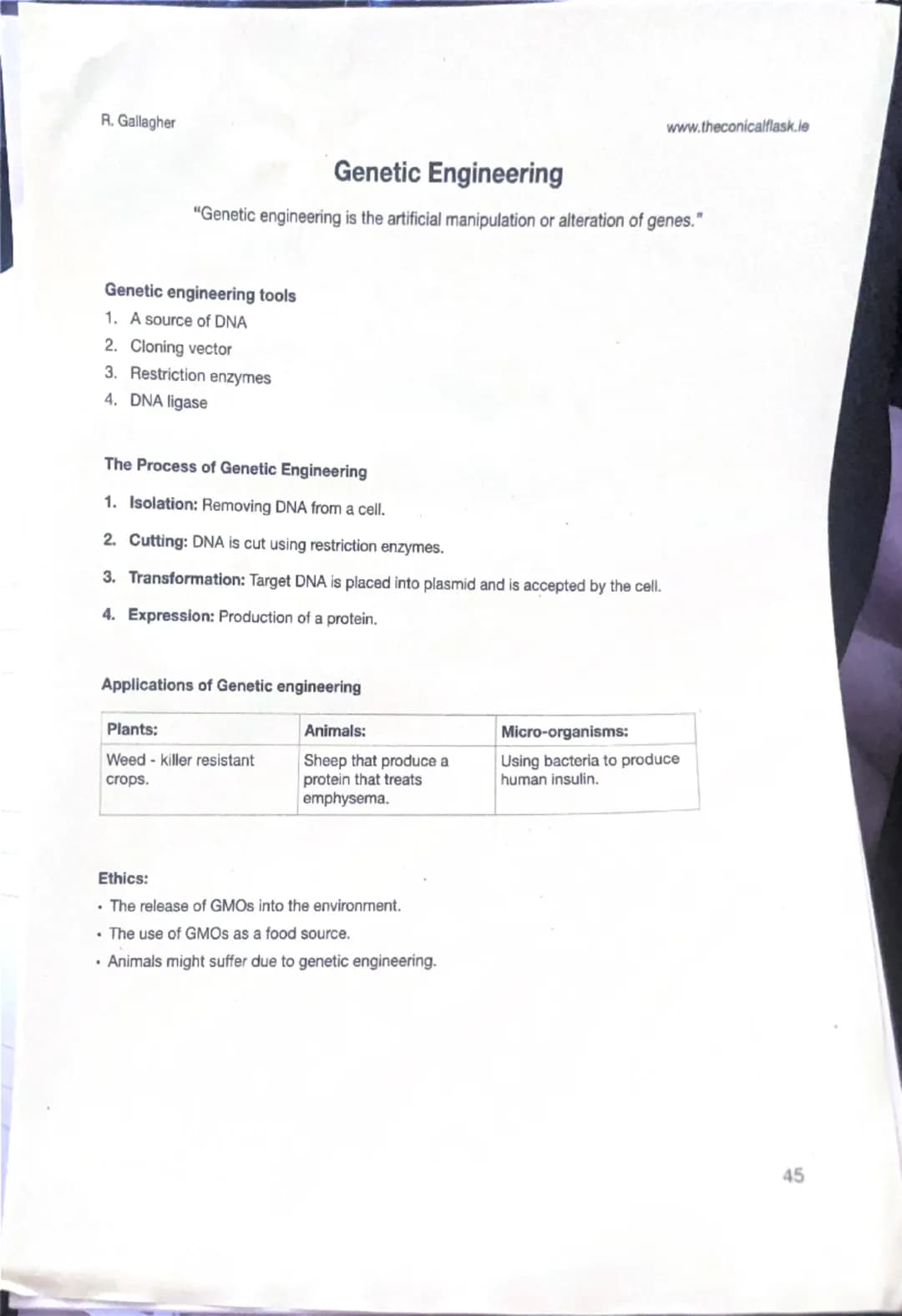
What is Genetic Engineering?
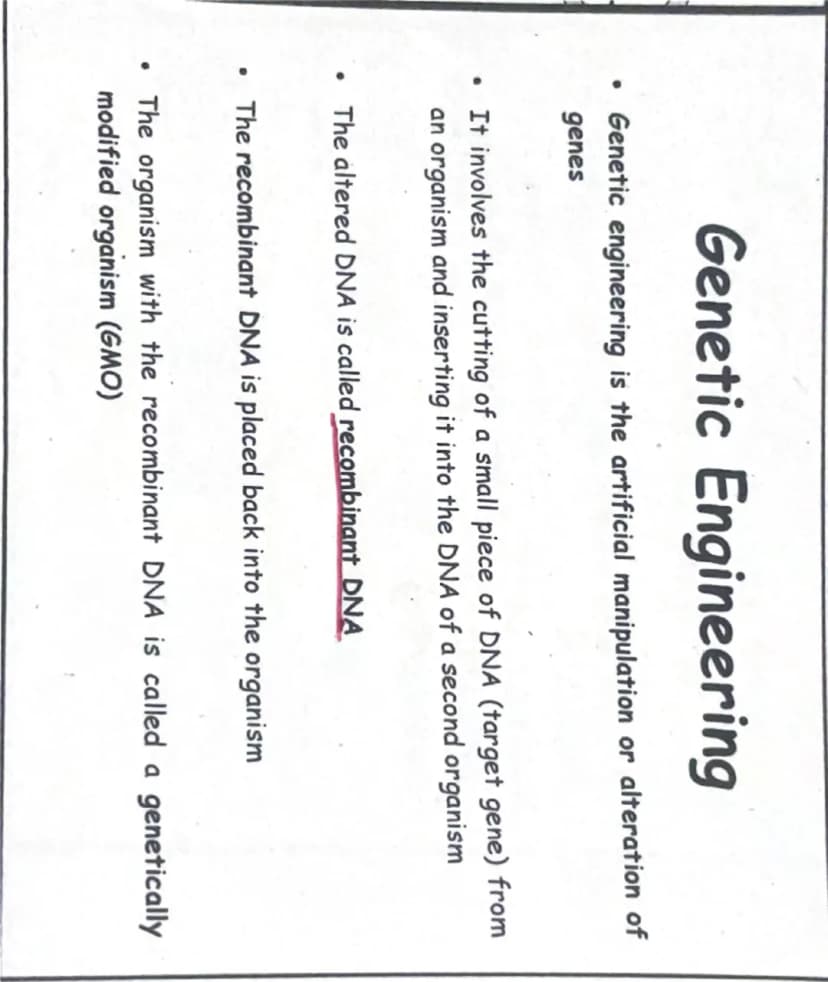
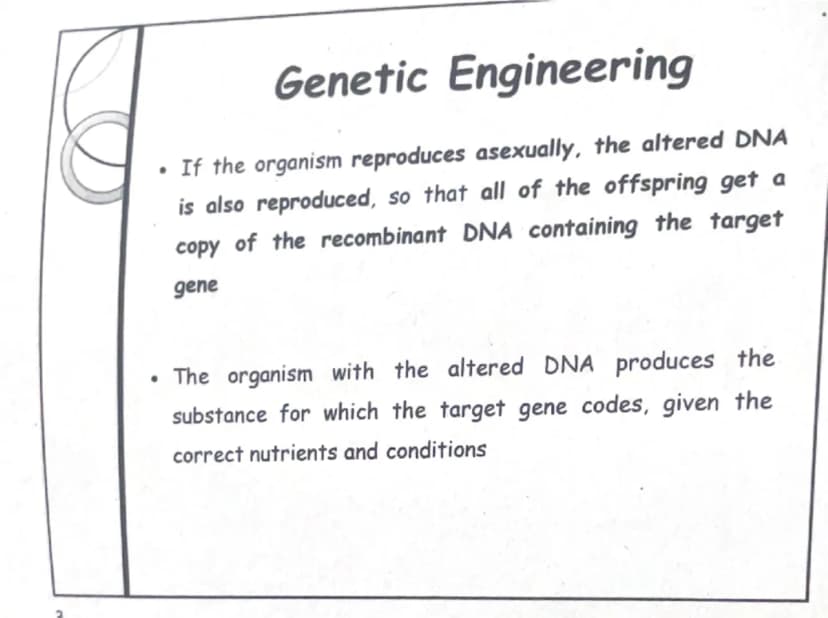
Think of genetic engineering as the ultimate copy-and-paste tool for biology. Scientists take a specific piece of DNA (called a target gene) from one organism and insert it into another organism's DNA. The result is recombinant DNA - basically DNA that's been mixed and matched from different sources.
When this altered DNA gets put back into an organism, that organism becomes a genetically modified organism (GMO). It's like giving an organism new instructions that it never had before.
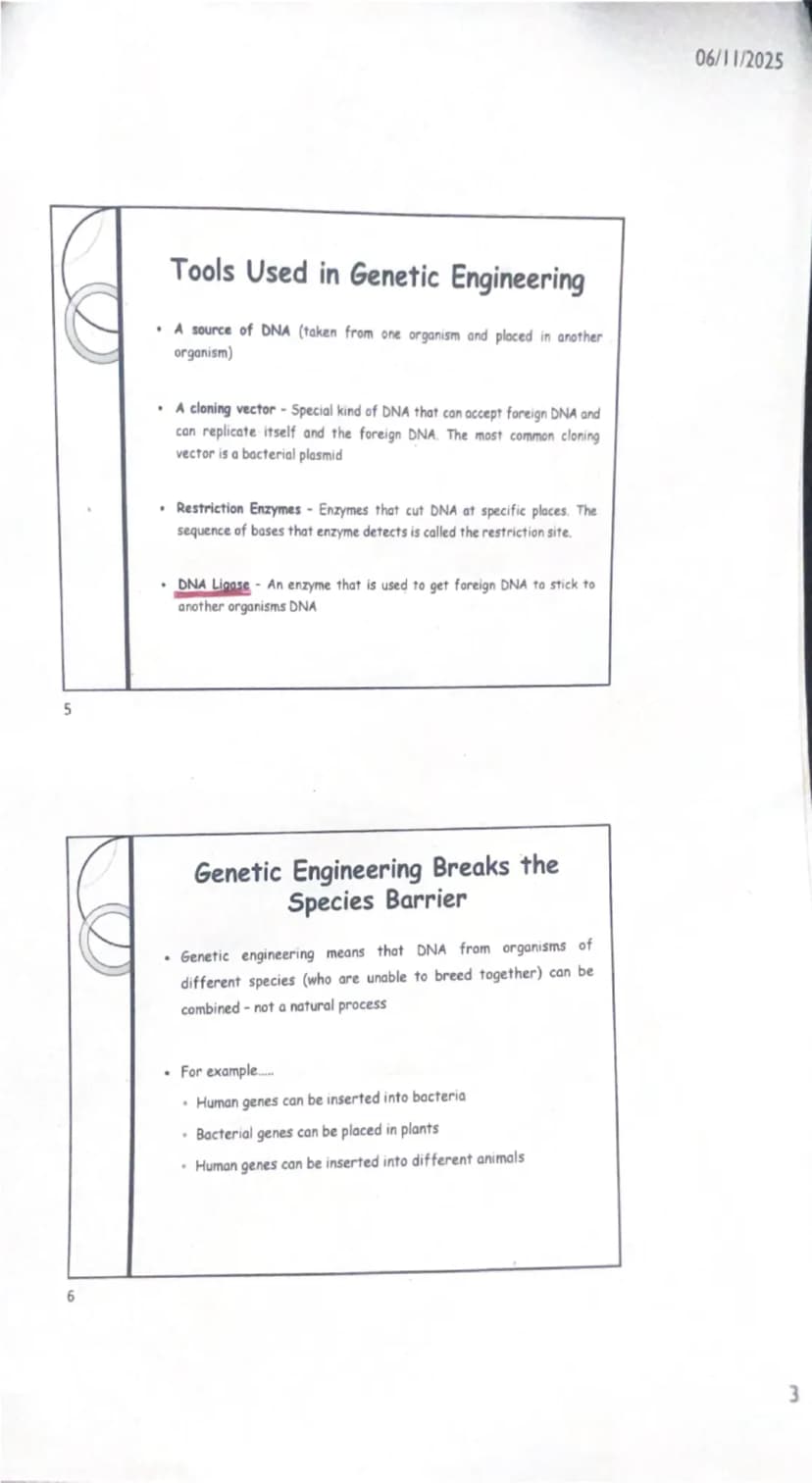
Key Point: Genetic engineering breaks the species barrier - you can put human genes into bacteria, or plant genes into animals!
2
of 10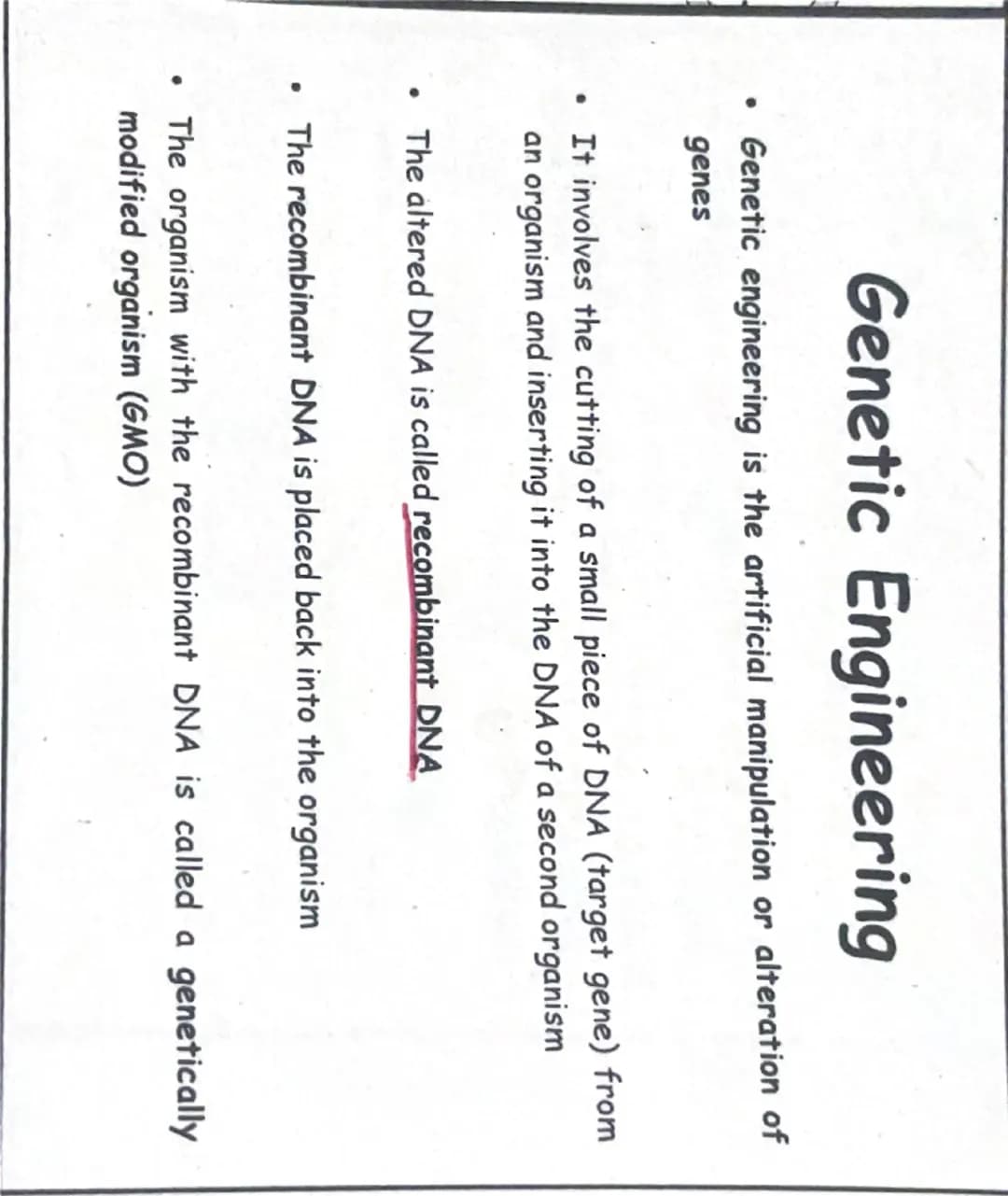
Essential Tools for Genetic Engineering
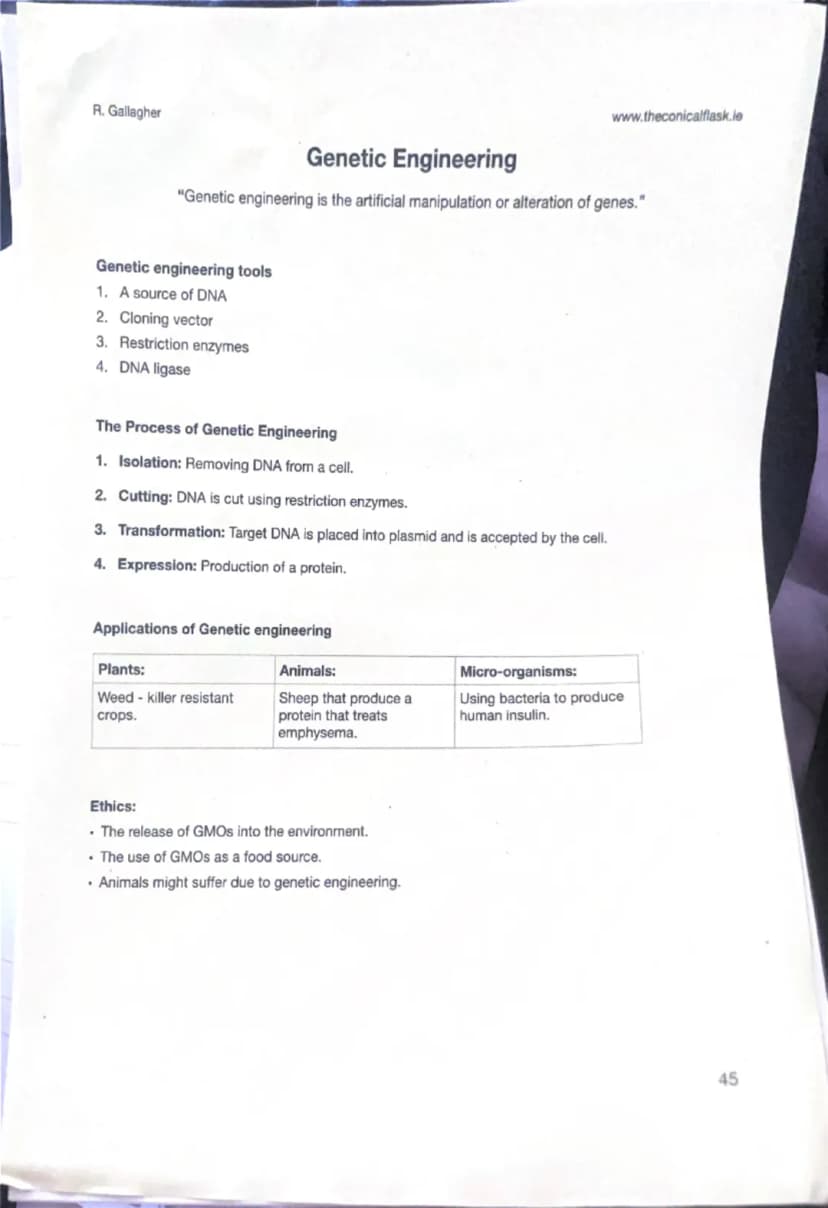
You need four main tools to successfully engineer genes, and each one has a specific job. First, you need a source of DNA - this is where your target gene comes from. Second, you need a cloning vector (usually a bacterial plasmid), which acts like a delivery truck for your new gene.
Restriction enzymes are your molecular scissors - they cut DNA at very specific spots called restriction sites. Finally, DNA ligase is your molecular glue that sticks the foreign DNA to the host organism's DNA.
Remember: These tools work together like a biological toolkit - you need all four to get the job done properly.
3
of 10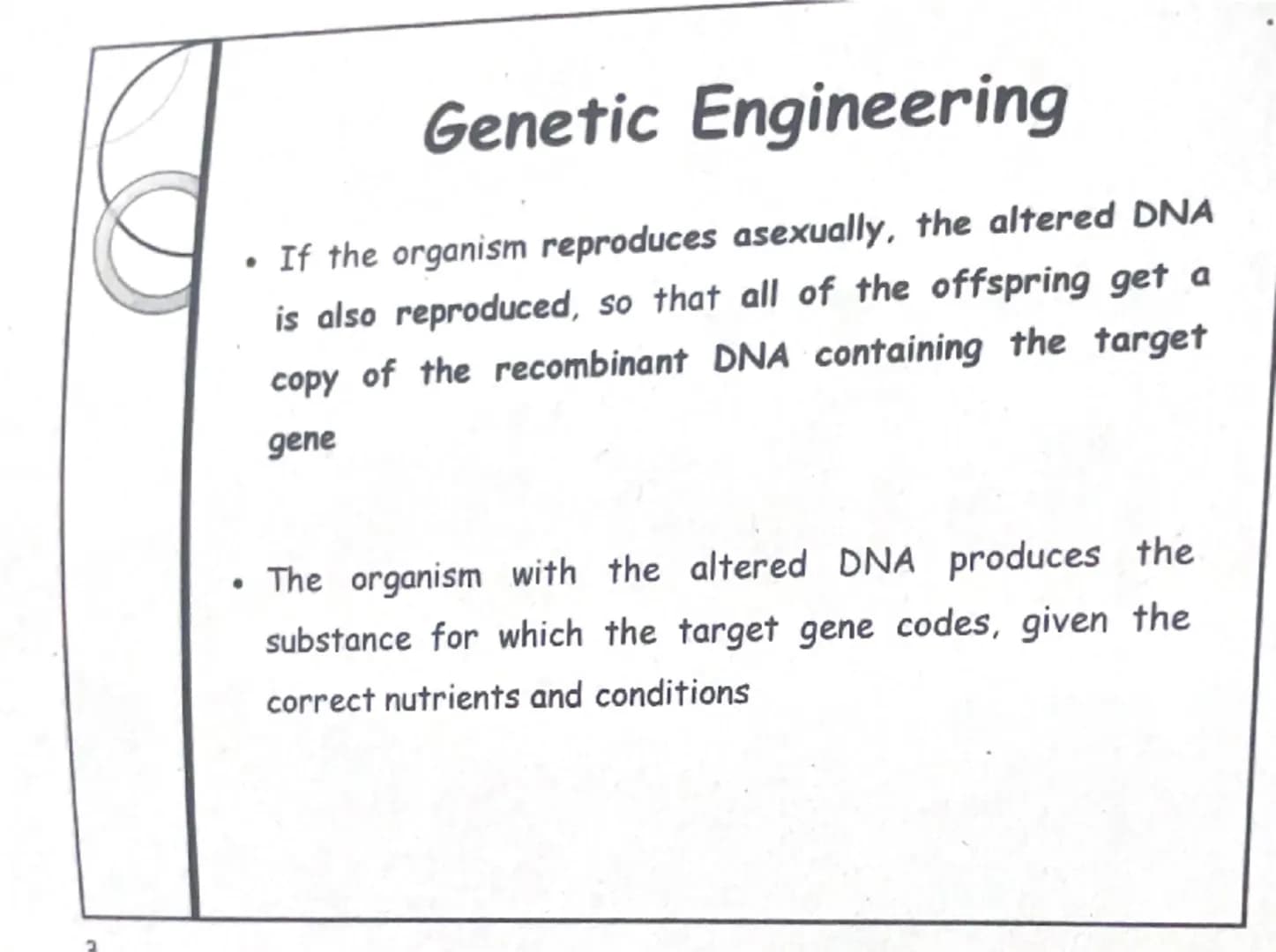
The Six-Step Process
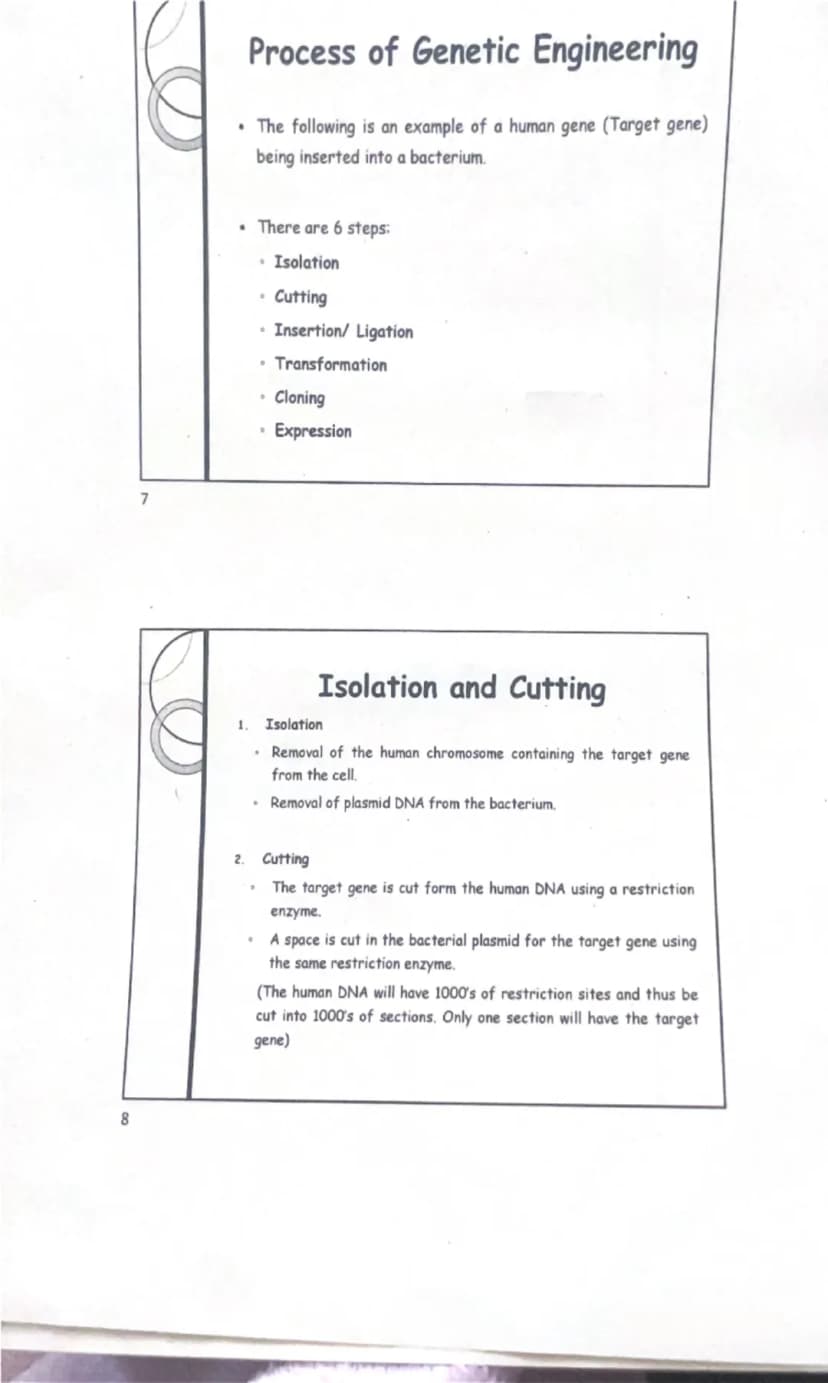
The genetic engineering process follows six crucial steps that transform ordinary organisms into biological factories. Isolation comes first - scientists remove both the target gene and the plasmid from their respective cells. Then comes cutting, where restriction enzymes slice both the target gene and create space in the plasmid.
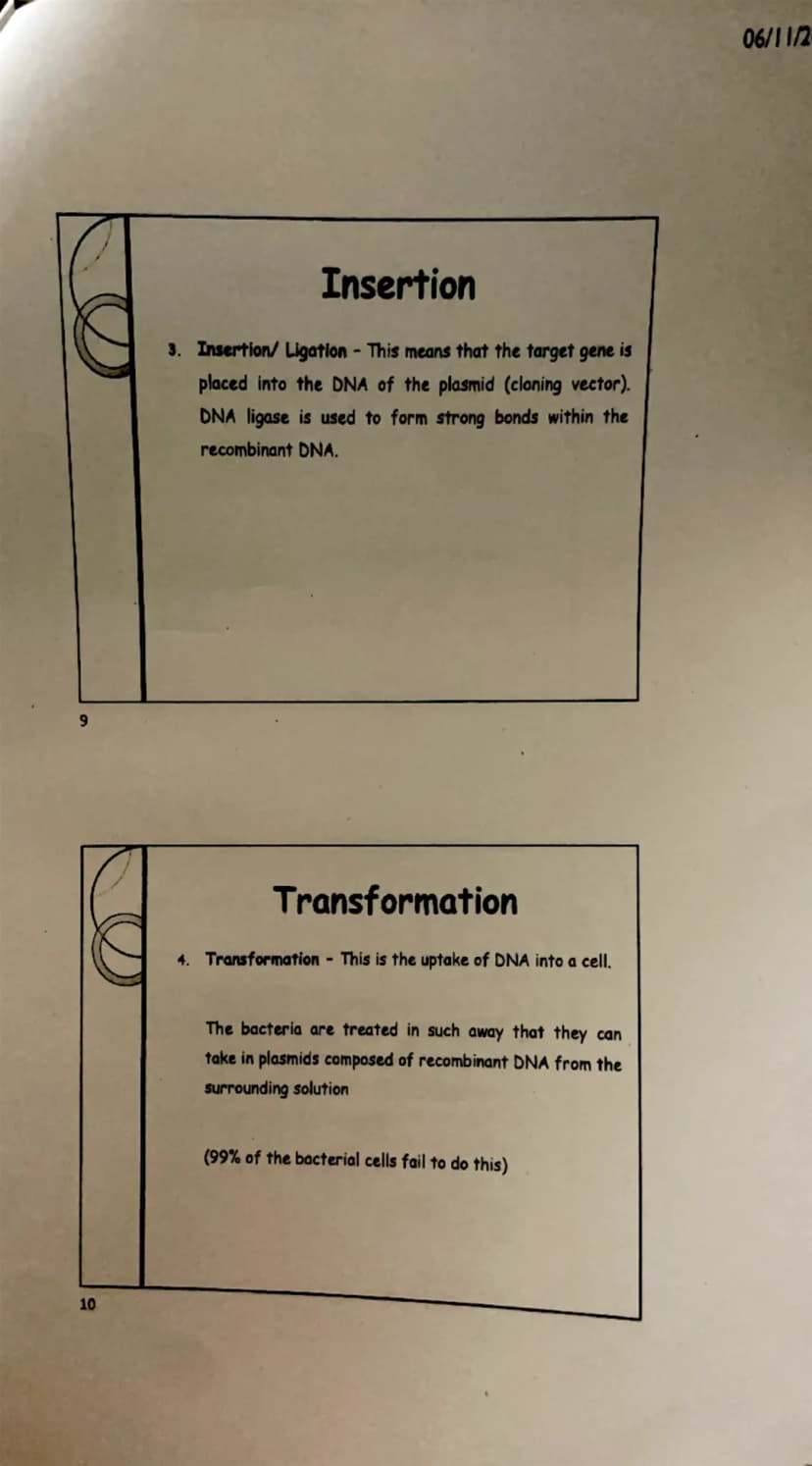
Insertion (or ligation) involves placing the target gene into the plasmid using DNA ligase to form strong bonds. Transformation is when bacteria actually take up this recombinant DNA - though 99% of bacterial cells fail at this step!
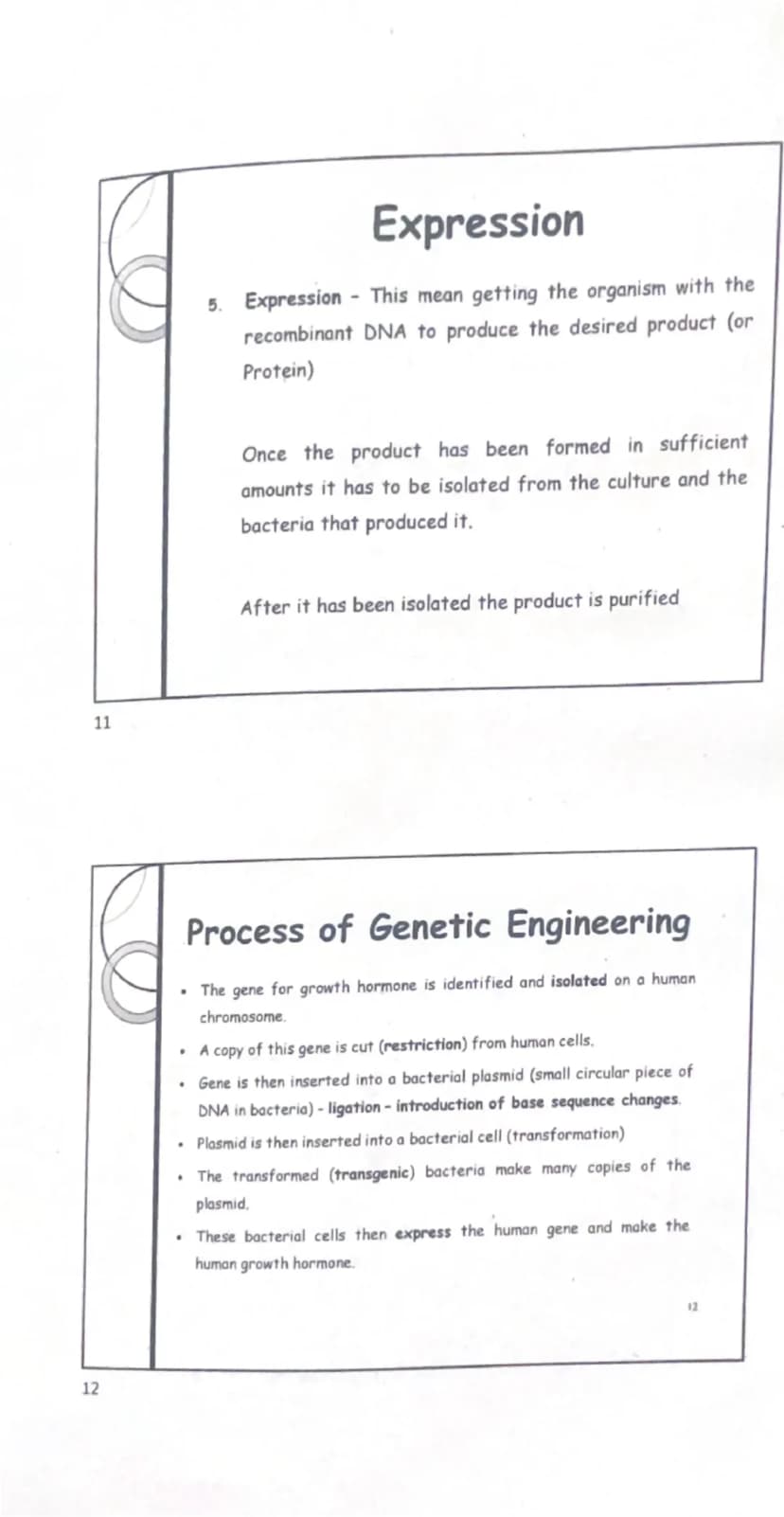
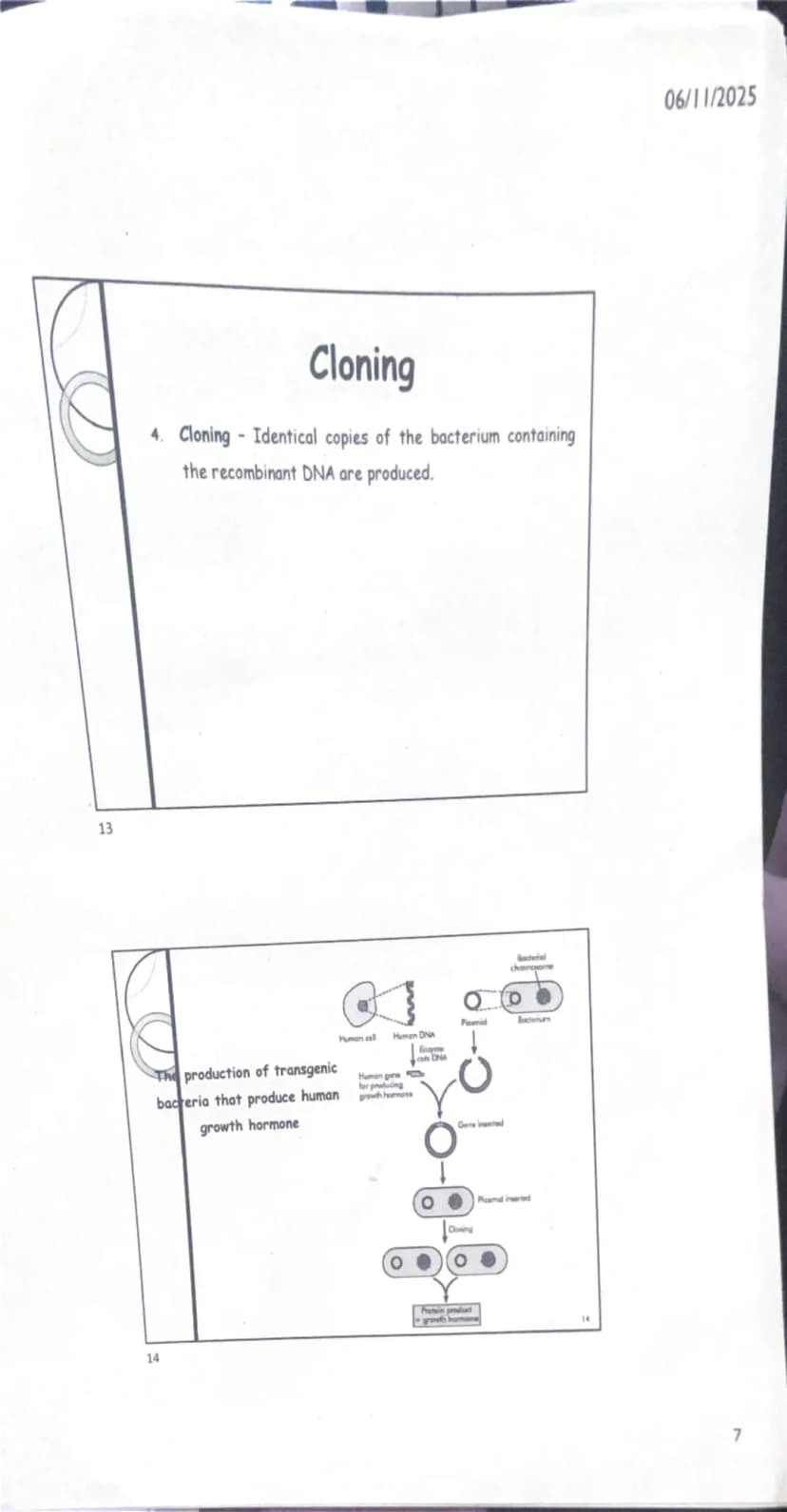
Cloning creates identical copies of the successfully transformed bacteria. Finally, expression means getting these modified organisms to actually produce the desired protein, which then needs to be isolated and purified.
Success Tip: Remember the process as "I Cut In To Create Expression" - it'll help you recall all six steps in order.
4
of 10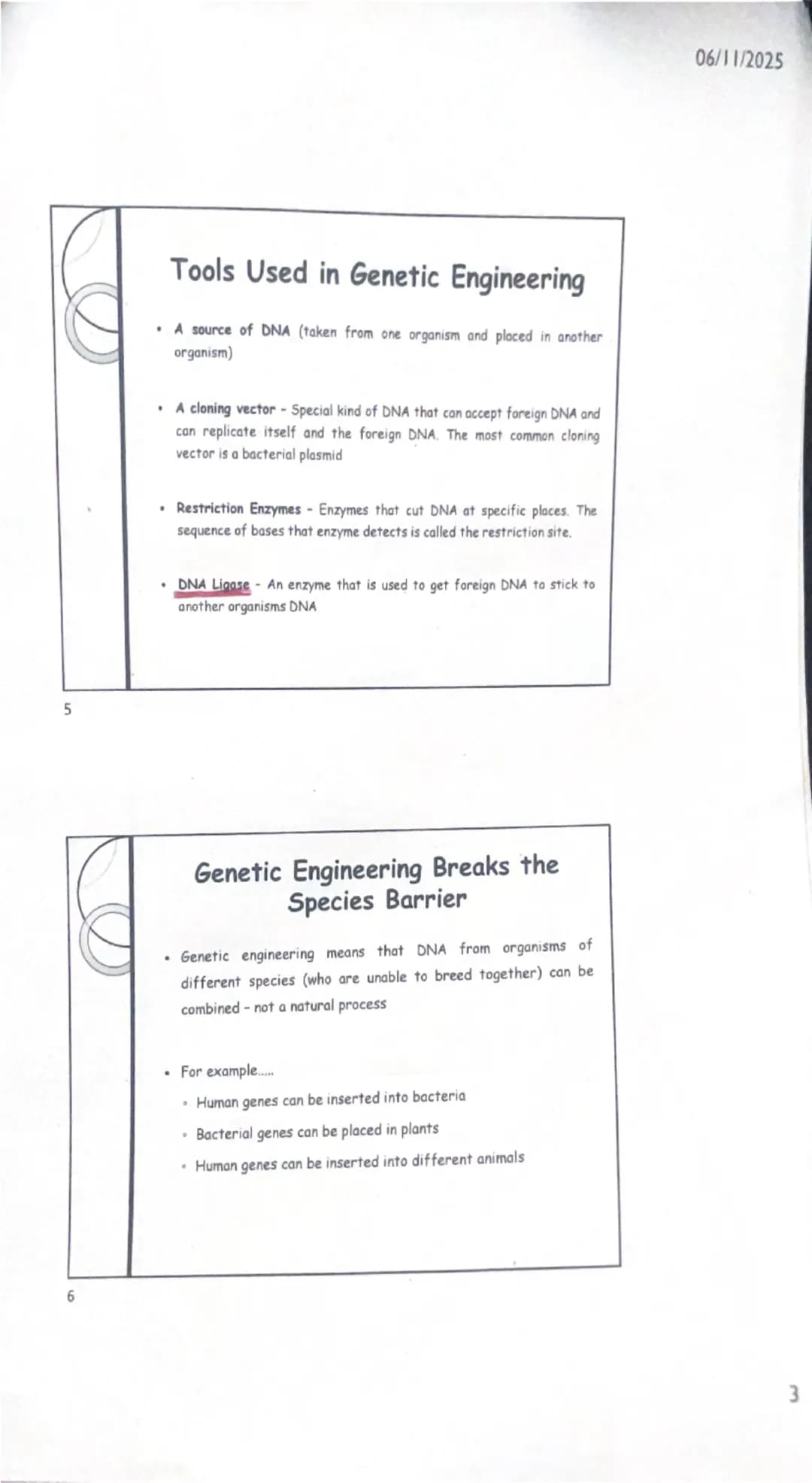
Real-World Applications in Plants and Animals
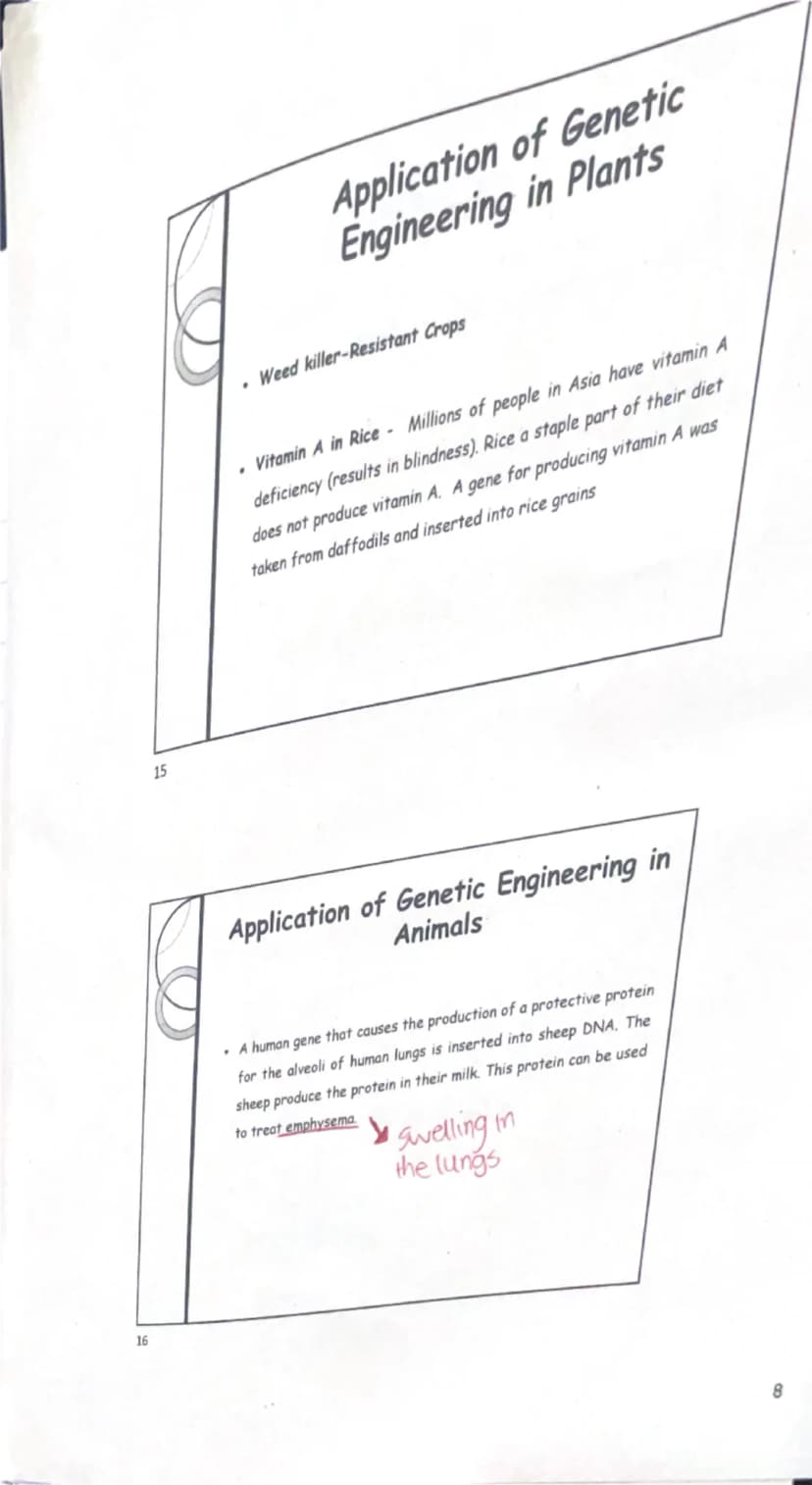
Genetic engineering isn't just theory - it's already changing the world around us. Weed-killer resistant crops help farmers manage their fields more effectively, whilst golden rice contains vitamin A genes from daffodils to prevent blindness in Asia.
In animals, scientists have created sheep that produce human lung proteins in their milk. These proteins can treat emphysema, a serious lung condition. It's like turning animals into living pharmaceutical factories.
The range of possibilities keeps expanding as scientists discover new ways to use this technology for medical and agricultural benefits.
Real Impact: Millions of people in Asia now have access to vitamin A through genetically modified rice.
5
of 10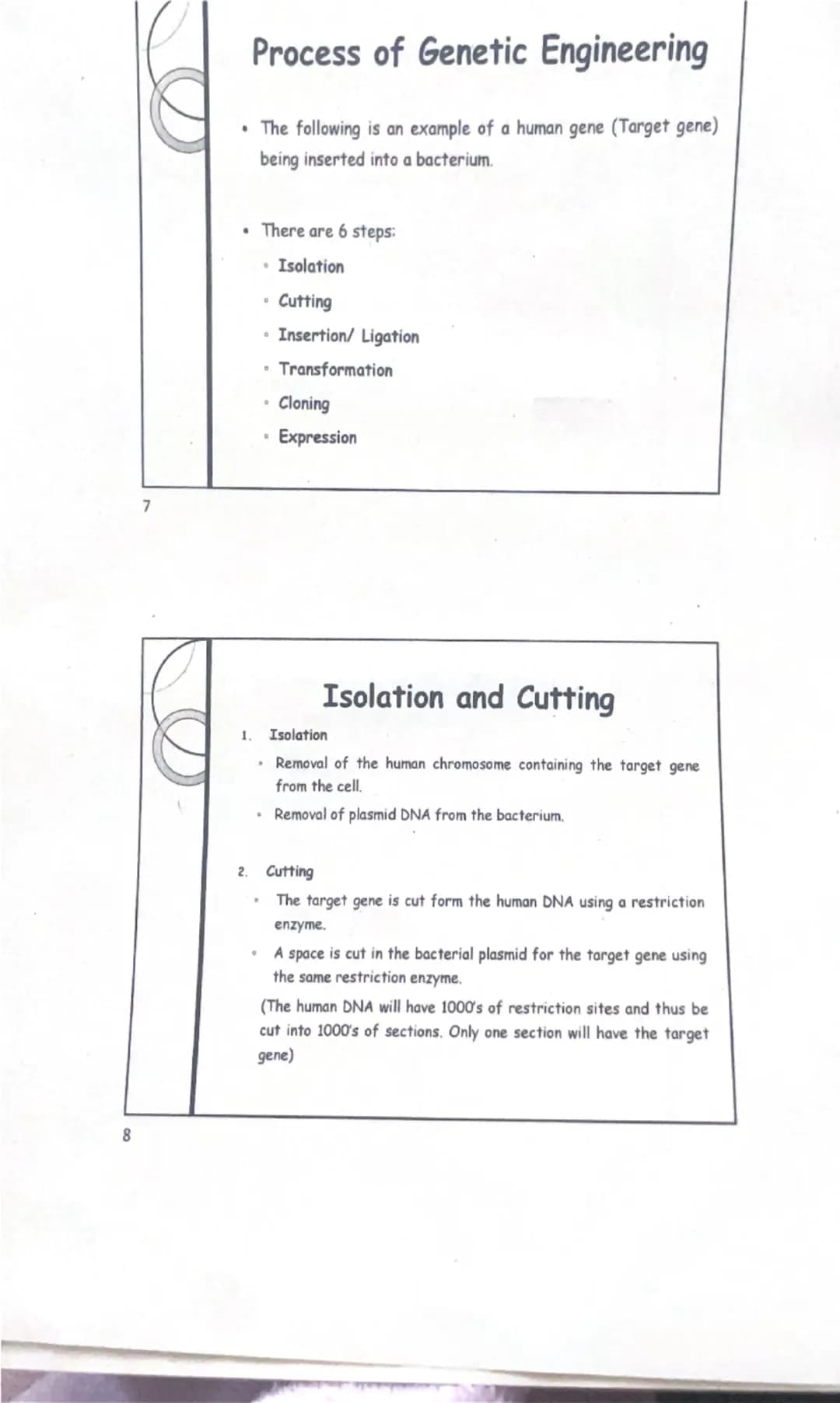
Microorganisms as Biological Factories
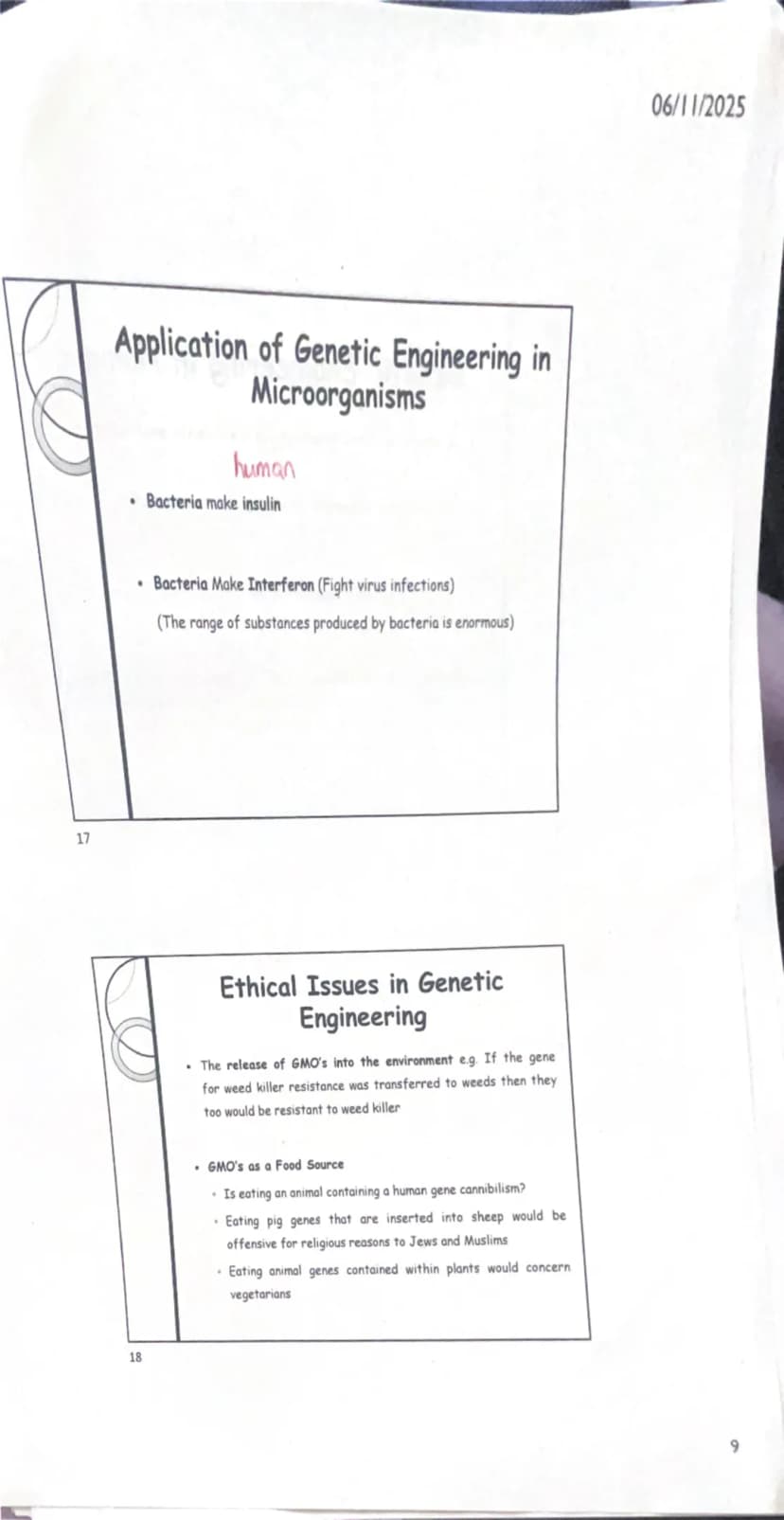
Bacteria are the workhorses of genetic engineering because they reproduce quickly and are easy to modify. Human insulin production using bacteria revolutionised diabetes treatment - before this, insulin had to be extracted from pig pancreases.
Bacteria can also produce interferon to fight viral infections, and the list of substances they can make keeps growing. These tiny organisms essentially become miniature pharmaceutical companies, churning out human proteins.
The beauty of using microorganisms is their speed - bacteria can multiply rapidly, meaning you can produce large quantities of medicine relatively quickly.
Amazing Fact: Diabetics worldwide now rely on insulin produced by genetically modified bacteria rather than animal sources.
6
of 10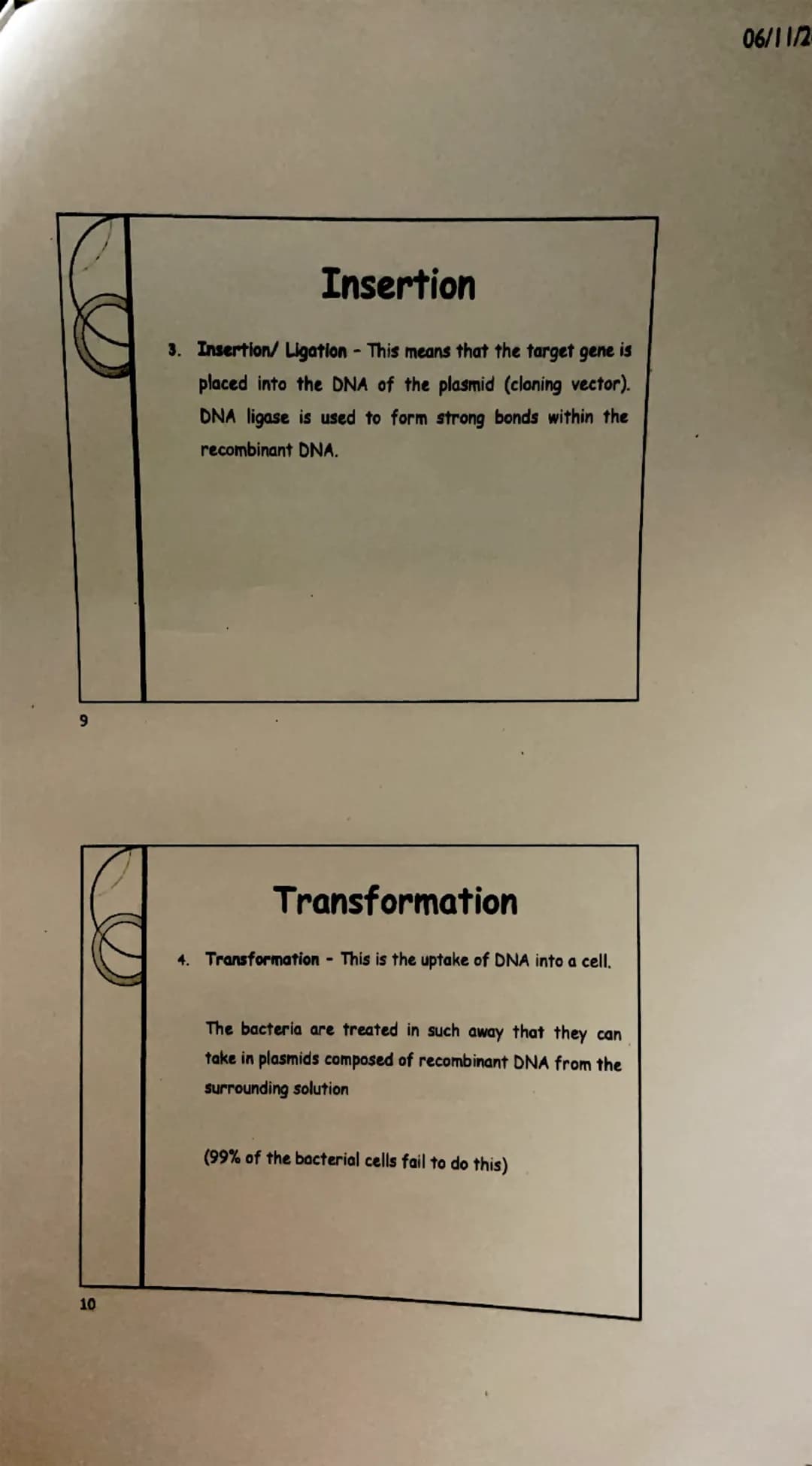
Ethical Considerations and Concerns
Genetic engineering raises serious ethical questions that society must address carefully. Environmental concerns focus on what happens if GMOs escape into the wild - imagine if weed-killer resistance accidentally transferred to actual weeds.
Food-related ethics get complicated quickly. Is eating an animal with human genes a form of cannibalism? Would Muslims and Jews be comfortable eating sheep containing pig genes? These questions matter to real people making daily food choices.
Animal welfare is another major concern, as genetic modifications might cause suffering or unexpected health problems in modified animals.
Think About It: As genetic engineering advances, we need to balance scientific progress with respect for different cultural and religious values.
7
of 10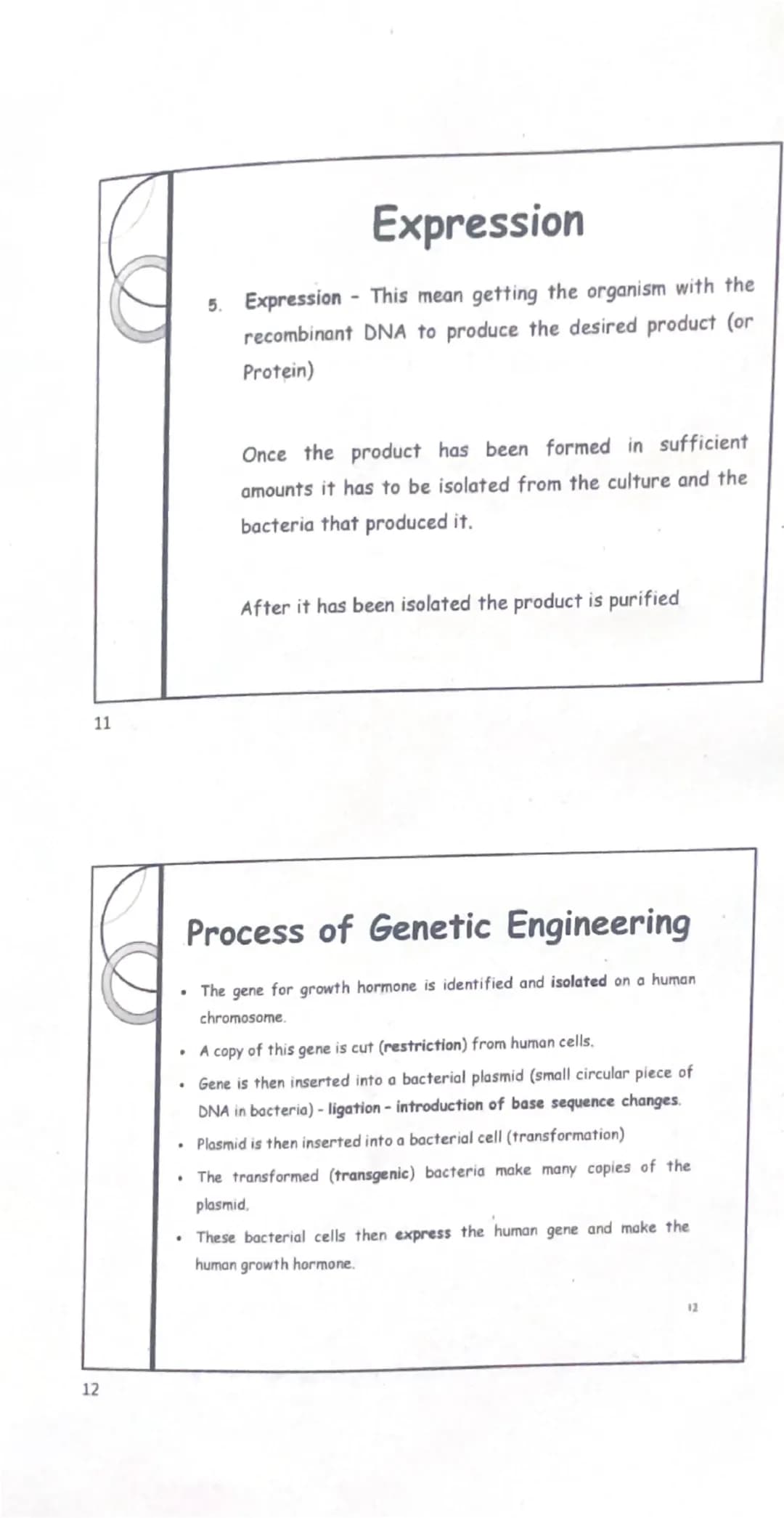
8
of 10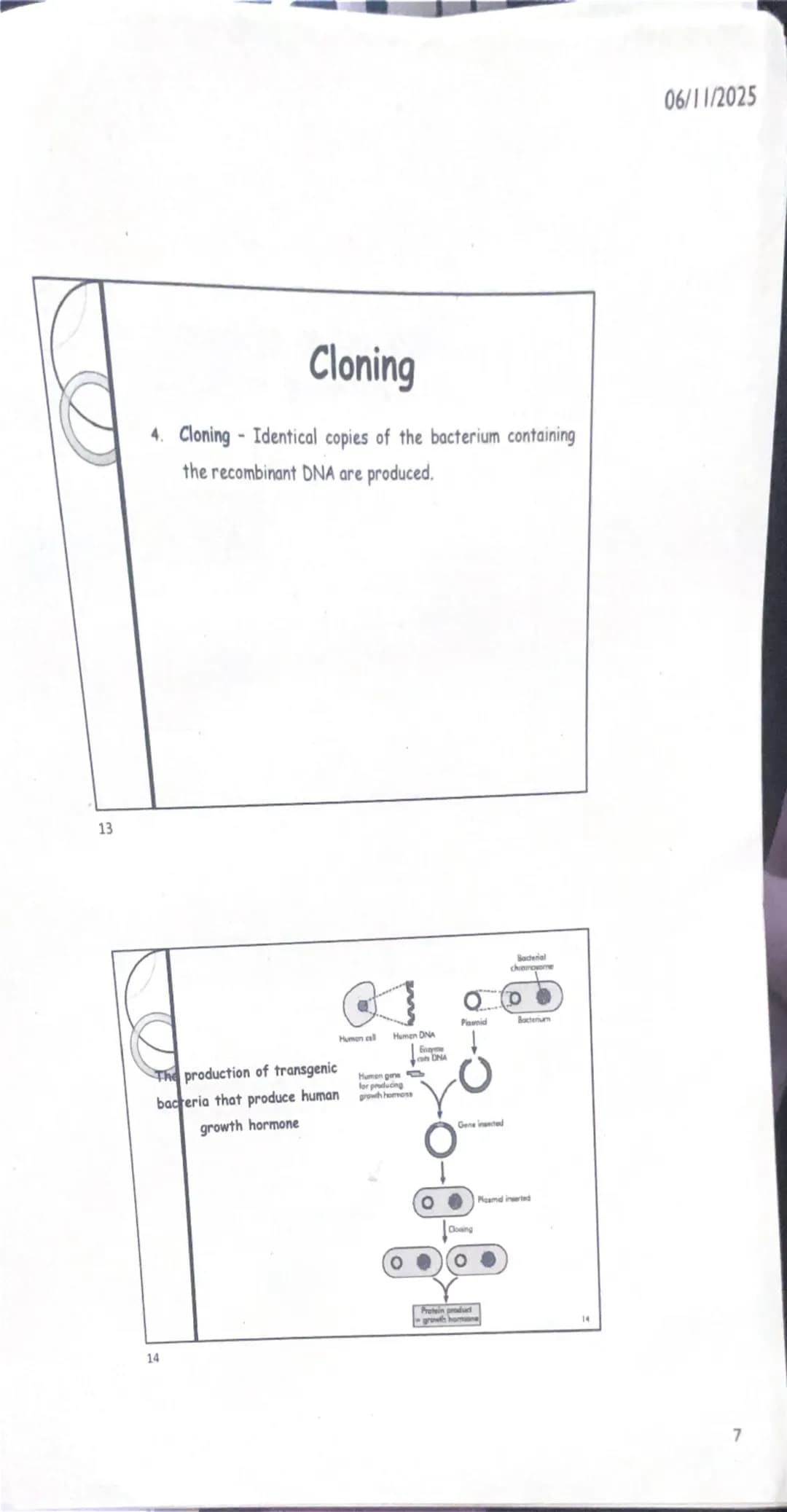
9
of 10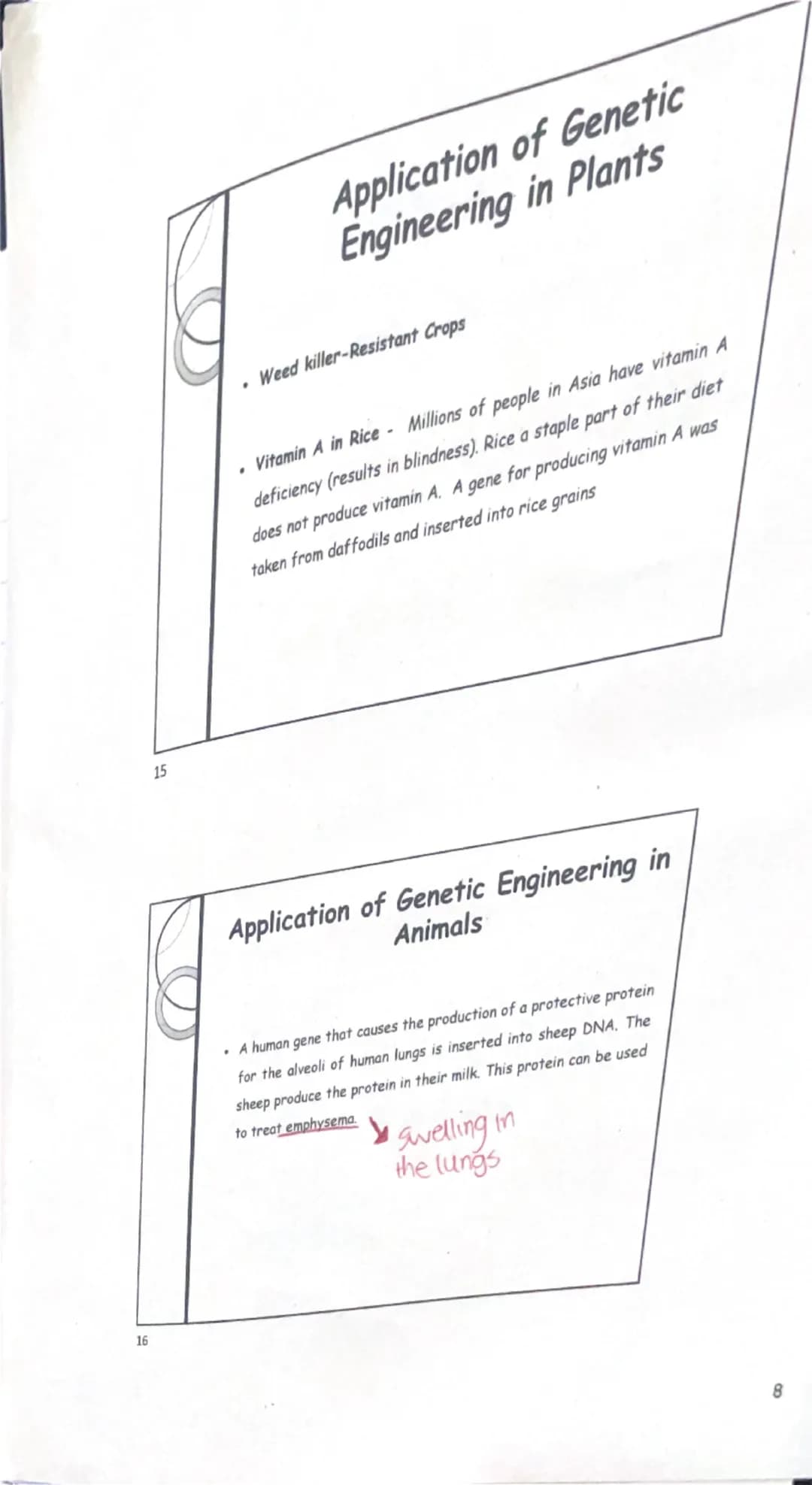
10
of 10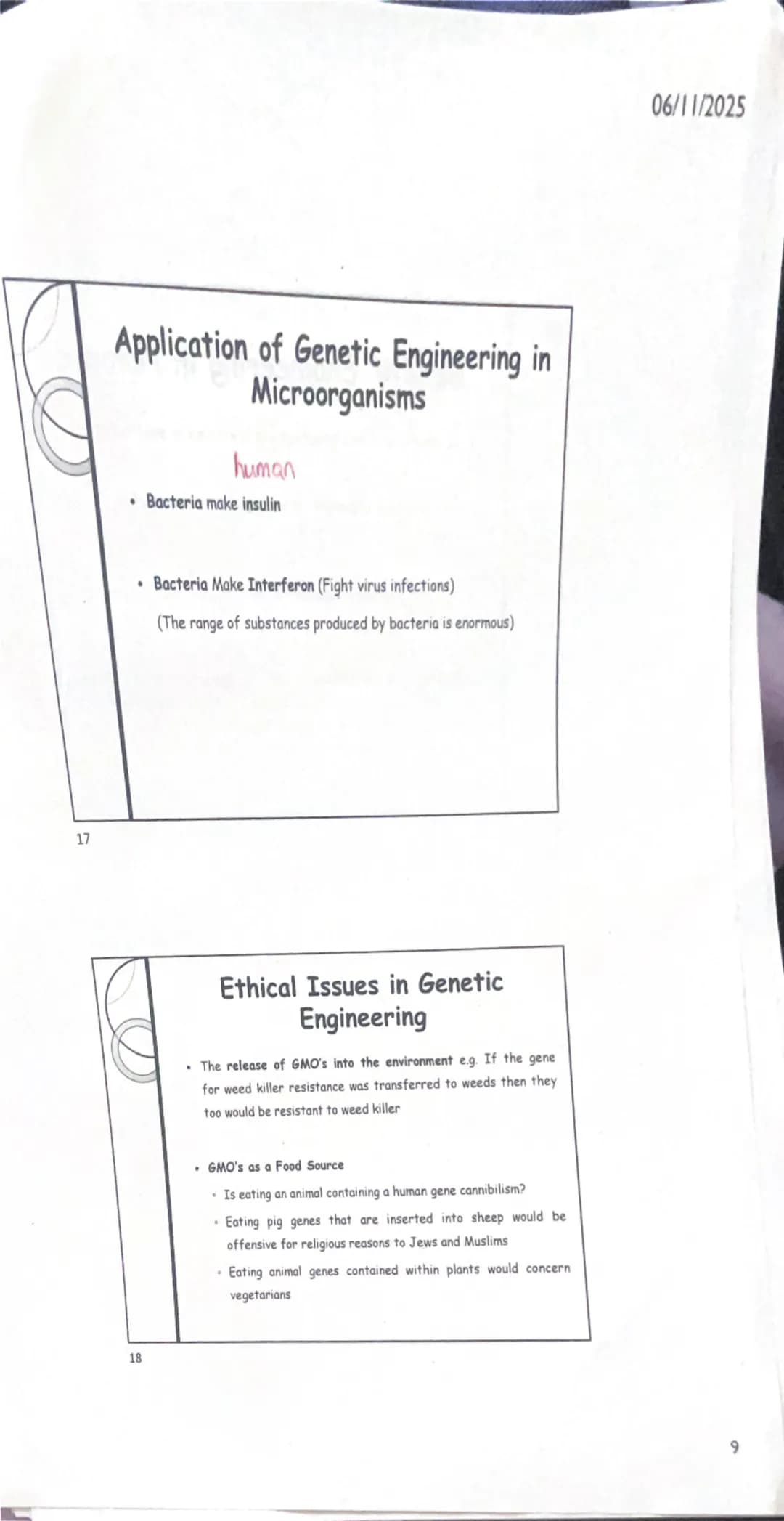
We thought you’d never ask...
What is the Knowunity AI companion?
Our AI companion is specifically built for the needs of students. Based on the millions of content pieces we have on the platform we can provide truly meaningful and relevant answers to students. But its not only about answers, the companion is even more about guiding students through their daily learning challenges, with personalised study plans, quizzes or content pieces in the chat and 100% personalisation based on the students skills and developments.
Where can I download the Knowunity app?
You can download the app in the Google Play Store and in the Apple App Store.
Is Knowunity really free of charge?
That's right! Enjoy free access to study content, connect with fellow students, and get instant help – all at your fingertips.
Most popular content in Biology
8BiologyEcology introduction notes!
Start of the leaving cert ecology chapter
6th Year131
BiologyDNA & RNA
All notes on DNA & RNA including protein synthesis which is a HL topic
5th Year250
BiologyVertebrates and Invertebrates
Students will distinguish between animals that have a backbone (vertebrates) and those that do not (invertebrates), identifying examples of each.
2nd Year240
BiologyBiomolecules: chapter 8
Summary and easily understandable notes to revise chapter 8 biomolecules. Includes good labelled diagrams for visual learners
5th Year210
BiologyCirculatory System
Students will learn about the heart, blood, and blood vessels, and how this system transports oxygen, nutrients, and waste products around the body.
3rd Year140
BiologyRespiration
All respiration notes including simple diagrams and glycolysis and the Krebs cycle
5th Year120
BiologyPhotosynthesis : Biology
Photosynthesis
6th Year371
BiologyPlant Cells
Learning about the unique structures found in plant cells, such as the cell wall, chloroplasts, and large vacuole, and how they differ from animal cells.
1st Year80
Most popular content
9 Irish
IrishIrish oral questions and answers
Questions and answers for the leaving cert oral
5th Year4264
 English
Key Quotes : Sive
Key Quotes and explanations: Sive
6th Year2842
IrishIrish oral questions
Outline of oral questions
5th Year2055
IrishIníon- le hÁine Durkin
Aine Durkin’s poem, Iníon: Themes & summary
5th Year850
IrishIrish poetry 2027
Iníon + Dínit an Bhróin
5th Year1133
IrishLC HL notes- Iníon (poem)
Includes poem in English and Irish, theme, key words & phrases
5th Year2284
EnglishCultural Context : Shawshank Redemption : Sive : Small Things Like These
Comparative Study : Cultural Context : Shawshank Redemption, Sive and Small Things Like These
6th Year1430
IrishMo Ghrá-sa (Idir Lúibíní)
Notes on mo ghrá-sa
5th Year380
IrishAn Gaeilge Aiste
Irish Language essay
6th Year1320
Can't find what you're looking for? Explore other subjects.
Students love us — and so will you.
4.6/5App Store
4.7/5Google Play
The app is very easy to use and well designed. I have found everything I was looking for so far and have been able to learn a lot from the presentations! I will definitely use the app for a class assignment! And of course it also helps a lot as an inspiration.
Stefan SiOS user
This app is really great. There are so many study notes and help [...]. My problem subject is French, for example, and the app has so many options for help. Thanks to this app, I have improved my French. I would recommend it to anyone.
Samantha KlichAndroid user
Wow, I am really amazed. I just tried the app because I've seen it advertised many times and was absolutely stunned. This app is THE HELP you want for school and above all, it offers so many things, such as workouts and fact sheets, which have been VERY helpful to me personally.
AnnaiOS user
Biology2 views·Updated Jun 12, 2026·11 pagesUnderstanding Genetic Engineering in Biology
S
Sofia Allaiouti@sofiaallaiouti
Genetic engineering is basically like being able to edit the code of life itself - scientists can take genes from one organism and insert them into another, creating entirely new possibilities. This revolutionary technology allows us to produce life-saving medicines...
1
of 10
Sign up to see the content. It's free!
- Access to all documents
- Improve your grades
- Join milions of students
What is Genetic Engineering?
Think of genetic engineering as the ultimate copy-and-paste tool for biology. Scientists take a specific piece of DNA (called a target gene) from one organism and insert it into another organism's DNA. The result is recombinant DNA - basically DNA that's been mixed and matched from different sources.
When this altered DNA gets put back into an organism, that organism becomes a genetically modified organism (GMO). It's like giving an organism new instructions that it never had before.
Key Point: Genetic engineering breaks the species barrier - you can put human genes into bacteria, or plant genes into animals!
2
of 10Sign up to see the content. It's free!
- Access to all documents
- Improve your grades
- Join milions of students
Essential Tools for Genetic Engineering
You need four main tools to successfully engineer genes, and each one has a specific job. First, you need a source of DNA - this is where your target gene comes from. Second, you need a cloning vector (usually a bacterial plasmid), which acts like a delivery truck for your new gene.
Restriction enzymes are your molecular scissors - they cut DNA at very specific spots called restriction sites. Finally, DNA ligase is your molecular glue that sticks the foreign DNA to the host organism's DNA.
Remember: These tools work together like a biological toolkit - you need all four to get the job done properly.
3
of 10Sign up to see the content. It's free!
- Access to all documents
- Improve your grades
- Join milions of students
The Six-Step Process
The genetic engineering process follows six crucial steps that transform ordinary organisms into biological factories. Isolation comes first - scientists remove both the target gene and the plasmid from their respective cells. Then comes cutting, where restriction enzymes slice both the target gene and create space in the plasmid.
Insertion (or ligation) involves placing the target gene into the plasmid using DNA ligase to form strong bonds. Transformation is when bacteria actually take up this recombinant DNA - though 99% of bacterial cells fail at this step!
Cloning creates identical copies of the successfully transformed bacteria. Finally, expression means getting these modified organisms to actually produce the desired protein, which then needs to be isolated and purified.
Success Tip: Remember the process as "I Cut In To Create Expression" - it'll help you recall all six steps in order.
4
of 10Sign up to see the content. It's free!
- Access to all documents
- Improve your grades
- Join milions of students
Real-World Applications in Plants and Animals
Genetic engineering isn't just theory - it's already changing the world around us. Weed-killer resistant crops help farmers manage their fields more effectively, whilst golden rice contains vitamin A genes from daffodils to prevent blindness in Asia.
In animals, scientists have created sheep that produce human lung proteins in their milk. These proteins can treat emphysema, a serious lung condition. It's like turning animals into living pharmaceutical factories.
The range of possibilities keeps expanding as scientists discover new ways to use this technology for medical and agricultural benefits.
Real Impact: Millions of people in Asia now have access to vitamin A through genetically modified rice.
5
of 10Sign up to see the content. It's free!
- Access to all documents
- Improve your grades
- Join milions of students
Microorganisms as Biological Factories
Bacteria are the workhorses of genetic engineering because they reproduce quickly and are easy to modify. Human insulin production using bacteria revolutionised diabetes treatment - before this, insulin had to be extracted from pig pancreases.
Bacteria can also produce interferon to fight viral infections, and the list of substances they can make keeps growing. These tiny organisms essentially become miniature pharmaceutical companies, churning out human proteins.
The beauty of using microorganisms is their speed - bacteria can multiply rapidly, meaning you can produce large quantities of medicine relatively quickly.
Amazing Fact: Diabetics worldwide now rely on insulin produced by genetically modified bacteria rather than animal sources.
6
of 10Sign up to see the content. It's free!
- Access to all documents
- Improve your grades
- Join milions of students
Ethical Considerations and Concerns
Genetic engineering raises serious ethical questions that society must address carefully. Environmental concerns focus on what happens if GMOs escape into the wild - imagine if weed-killer resistance accidentally transferred to actual weeds.
Food-related ethics get complicated quickly. Is eating an animal with human genes a form of cannibalism? Would Muslims and Jews be comfortable eating sheep containing pig genes? These questions matter to real people making daily food choices.
Animal welfare is another major concern, as genetic modifications might cause suffering or unexpected health problems in modified animals.
Think About It: As genetic engineering advances, we need to balance scientific progress with respect for different cultural and religious values.
7
of 10Sign up to see the content. It's free!
- Access to all documents
- Improve your grades
- Join milions of students
8
of 10Sign up to see the content. It's free!
- Access to all documents
- Improve your grades
- Join milions of students
9
of 10Sign up to see the content. It's free!
- Access to all documents
- Improve your grades
- Join milions of students
10
of 10Sign up to see the content. It's free!
- Access to all documents
- Improve your grades
- Join milions of students
We thought you’d never ask...
What is the Knowunity AI companion?
Our AI companion is specifically built for the needs of students. Based on the millions of content pieces we have on the platform we can provide truly meaningful and relevant answers to students. But its not only about answers, the companion is even more about guiding students through their daily learning challenges, with personalised study plans, quizzes or content pieces in the chat and 100% personalisation based on the students skills and developments.
Where can I download the Knowunity app?
You can download the app in the Google Play Store and in the Apple App Store.
Is Knowunity really free of charge?
That's right! Enjoy free access to study content, connect with fellow students, and get instant help – all at your fingertips.
Most popular content in Biology
8BiologyEcology introduction notes!
Start of the leaving cert ecology chapter
6th Year131
BiologyDNA & RNA
All notes on DNA & RNA including protein synthesis which is a HL topic
5th Year250
BiologyVertebrates and Invertebrates
Students will distinguish between animals that have a backbone (vertebrates) and those that do not (invertebrates), identifying examples of each.
2nd Year240
BiologyBiomolecules: chapter 8
Summary and easily understandable notes to revise chapter 8 biomolecules. Includes good labelled diagrams for visual learners
5th Year210
BiologyCirculatory System
Students will learn about the heart, blood, and blood vessels, and how this system transports oxygen, nutrients, and waste products around the body.
3rd Year140
BiologyRespiration
All respiration notes including simple diagrams and glycolysis and the Krebs cycle
5th Year120
BiologyPhotosynthesis : Biology
Photosynthesis
6th Year371
BiologyPlant Cells
Learning about the unique structures found in plant cells, such as the cell wall, chloroplasts, and large vacuole, and how they differ from animal cells.
1st Year80
Most popular content
9IrishIrish oral questions and answers
Questions and answers for the leaving cert oral
5th Year4264
EnglishKey Quotes : Sive
Key Quotes and explanations: Sive
6th Year2842
IrishIrish oral questions
Outline of oral questions
5th Year2055
IrishIníon- le hÁine Durkin
Aine Durkin’s poem, Iníon: Themes & summary
5th Year850
IrishIrish poetry 2027
Iníon + Dínit an Bhróin
5th Year1133
IrishLC HL notes- Iníon (poem)
Includes poem in English and Irish, theme, key words & phrases
5th Year2284
EnglishCultural Context : Shawshank Redemption : Sive : Small Things Like These
Comparative Study : Cultural Context : Shawshank Redemption, Sive and Small Things Like These
6th Year1430
IrishMo Ghrá-sa (Idir Lúibíní)
Notes on mo ghrá-sa
5th Year380
IrishAn Gaeilge Aiste
Irish Language essay
6th Year1320
Can't find what you're looking for? Explore other subjects.
Students love us — and so will you.
4.6/5App Store
4.7/5Google Play
The app is very easy to use and well designed. I have found everything I was looking for so far and have been able to learn a lot from the presentations! I will definitely use the app for a class assignment! And of course it also helps a lot as an inspiration.
Stefan SiOS user
This app is really great. There are so many study notes and help [...]. My problem subject is French, for example, and the app has so many options for help. Thanks to this app, I have improved my French. I would recommend it to anyone.
Samantha KlichAndroid user
Wow, I am really amazed. I just tried the app because I've seen it advertised many times and was absolutely stunned. This app is THE HELP you want for school and above all, it offers so many things, such as workouts and fact sheets, which have been VERY helpful to me personally.
AnnaiOS user