
Your cells are like tiny factories that need constant energy...
 Biology3 views·Updated Jun 18, 2026·2 pages
Understanding Energy Carriers
K
Keira Kennedy McGrath@keirakennedymcg
1
of 2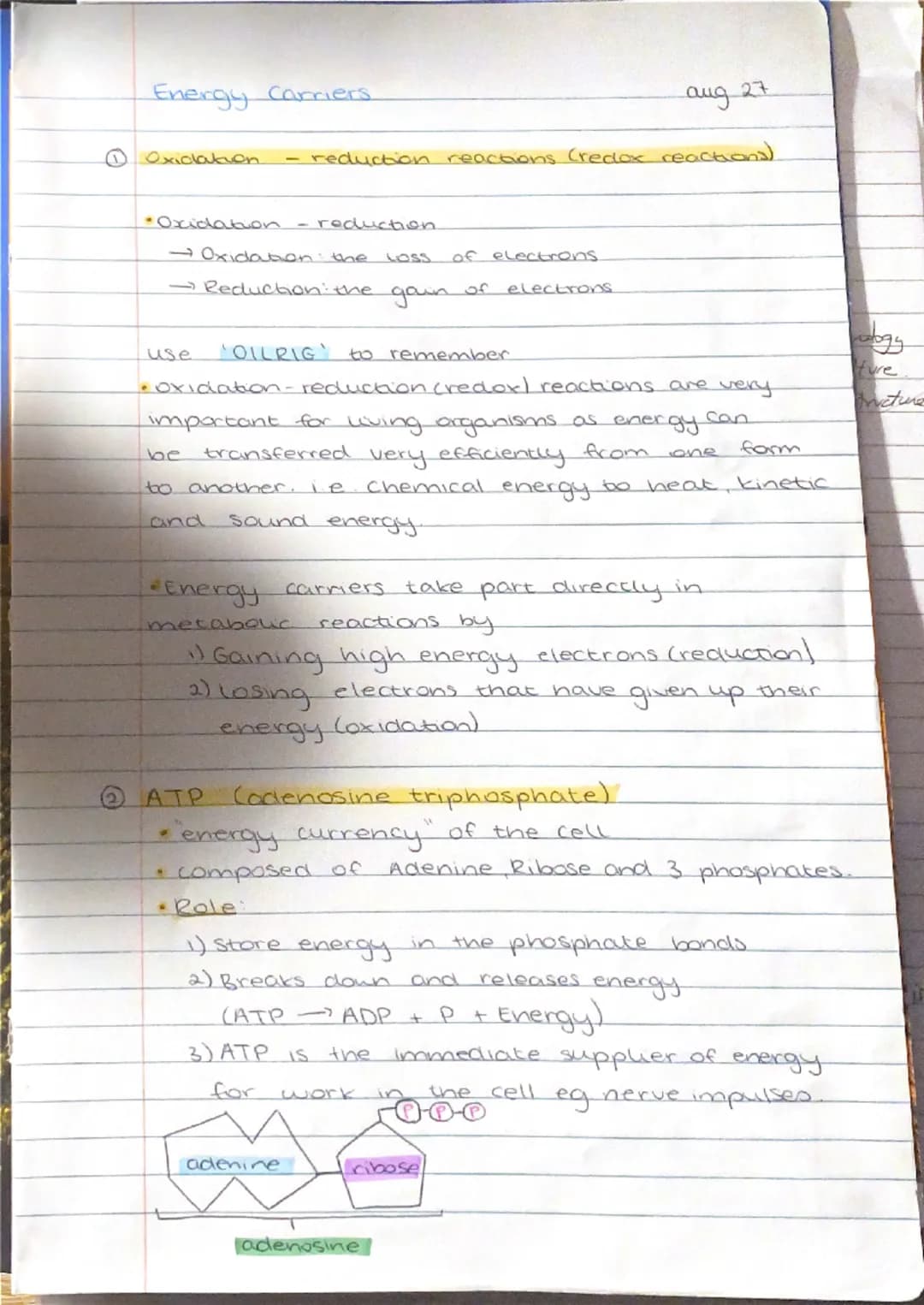
Understanding Energy Carriers and Redox Reactions
Ever wonder how your body actually uses the energy from food? It all comes down to oxidation-reduction reactions (or redox reactions for short). These are chemical processes where electrons get passed around between molecules.
Oxidation means losing electrons, whilst reduction means gaining electrons. Remember this with the acronym OILRIG: Oxidation Is Loss, Reduction Is Gain. Your body uses these reactions constantly because they're brilliant at transferring energy efficiently - converting chemical energy from food into heat, movement, and even sound.
Energy carriers are the key players here. They directly participate in your body's metabolic reactions by either gaining high-energy electrons (reduction) or losing electrons after they've given up their energy (oxidation). Think of them as the delivery trucks moving energy around your cells.
Quick Tip: Redox reactions happen millions of times per second in your body right now - they're what keep your heart beating and your brain thinking!
2
of 2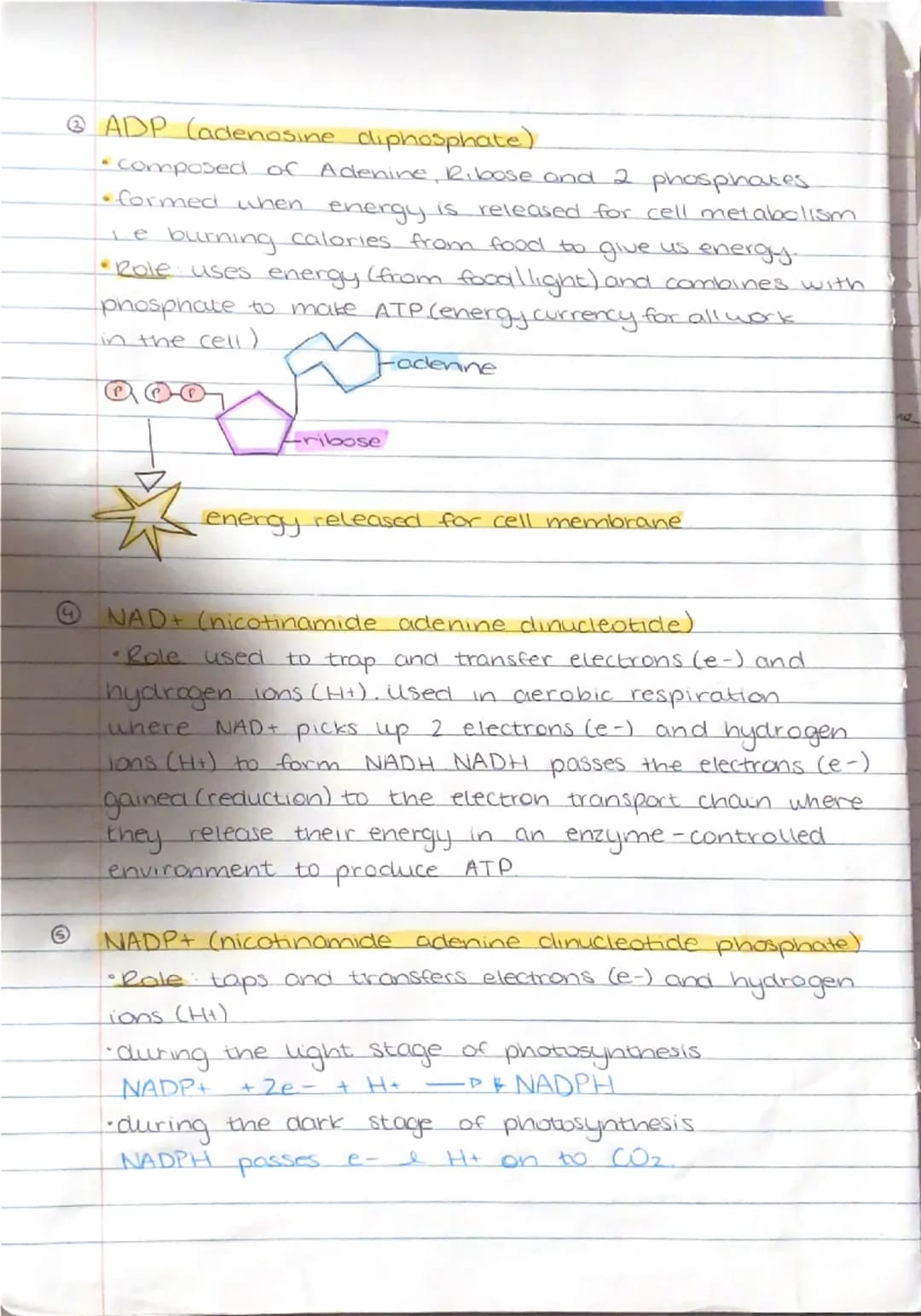
The Main Energy Carriers: ATP, ADP, NAD+, and NADP+
ATP (adenosine triphosphate) is literally the energy currency of every cell in your body. It's made up of adenine, ribose, and three phosphate groups. When ATP breaks down into ADP + phosphate + energy, it releases the power needed for everything from nerve impulses to muscle contractions.
ADP (adenosine diphosphate) has just two phosphate groups instead of three. When your cells burn calories from food, they use that energy to stick another phosphate onto ADP, rebuilding it back into ATP. It's like recharging a battery.
NAD+ and NADP+ are electron carriers that work like shuttles. NAD+ is crucial during aerobic respiration - it picks up electrons and hydrogen ions to become NADH, then delivers them to the electron transport chain where they release energy to make more ATP. NADP+ does similar work during photosynthesis in plants.
Memory Trick: Think of ATP as your cell's rechargeable battery and NAD+/NADP+ as the charging cables that help move energy around!
We thought you’d never ask...
What is the Knowunity AI companion?
Our AI companion is specifically built for the needs of students. Based on the millions of content pieces we have on the platform we can provide truly meaningful and relevant answers to students. But its not only about answers, the companion is even more about guiding students through their daily learning challenges, with personalised study plans, quizzes or content pieces in the chat and 100% personalisation based on the students skills and developments.
Where can I download the Knowunity app?
You can download the app in the Google Play Store and in the Apple App Store.
Is Knowunity really free of charge?
That's right! Enjoy free access to study content, connect with fellow students, and get instant help – all at your fingertips.
Most popular content in Biology
8BiologyEcology introduction notes!
Start of the leaving cert ecology chapter
6th Year131
BiologyDNA & RNA
All notes on DNA & RNA including protein synthesis which is a HL topic
5th Year250
BiologyVertebrates and Invertebrates
Students will distinguish between animals that have a backbone (vertebrates) and those that do not (invertebrates), identifying examples of each.
2nd Year240
BiologyBiomolecules: chapter 8
Summary and easily understandable notes to revise chapter 8 biomolecules. Includes good labelled diagrams for visual learners
5th Year210
BiologyCirculatory System
Students will learn about the heart, blood, and blood vessels, and how this system transports oxygen, nutrients, and waste products around the body.
3rd Year140
BiologyRespiration
All respiration notes including simple diagrams and glycolysis and the Krebs cycle
5th Year120
BiologyPhotosynthesis : Biology
Photosynthesis
6th Year371
BiologyPlant Cells
Learning about the unique structures found in plant cells, such as the cell wall, chloroplasts, and large vacuole, and how they differ from animal cells.
1st Year80
Most popular content
9 Irish
IrishIrish oral questions and answers
Questions and answers for the leaving cert oral
5th Year4264
 English
Key Quotes : Sive
Key Quotes and explanations: Sive
6th Year2842
IrishIrish oral questions
Outline of oral questions
5th Year2055
IrishIníon- le hÁine Durkin
Aine Durkin’s poem, Iníon: Themes & summary
5th Year890
IrishIrish poetry 2027
Iníon + Dínit an Bhróin
5th Year1153
IrishLC HL notes- Iníon (poem)
Includes poem in English and Irish, theme, key words & phrases
5th Year2304
EnglishCultural Context : Shawshank Redemption : Sive : Small Things Like These
Comparative Study : Cultural Context : Shawshank Redemption, Sive and Small Things Like These
6th Year1430
IrishMo Ghrá-sa (Idir Lúibíní)
Notes on mo ghrá-sa
5th Year380
IrishAn Gaeilge Aiste
Irish Language essay
6th Year1320
Can't find what you're looking for? Explore other subjects.
Students love us — and so will you.
4.6/5App Store
4.7/5Google Play
The app is very easy to use and well designed. I have found everything I was looking for so far and have been able to learn a lot from the presentations! I will definitely use the app for a class assignment! And of course it also helps a lot as an inspiration.
Stefan SiOS user
This app is really great. There are so many study notes and help [...]. My problem subject is French, for example, and the app has so many options for help. Thanks to this app, I have improved my French. I would recommend it to anyone.
Samantha KlichAndroid user
Wow, I am really amazed. I just tried the app because I've seen it advertised many times and was absolutely stunned. This app is THE HELP you want for school and above all, it offers so many things, such as workouts and fact sheets, which have been VERY helpful to me personally.
AnnaiOS user
Biology3 views·Updated Jun 18, 2026·2 pagesUnderstanding Energy Carriers
K
Keira Kennedy McGrath@keirakennedymcg
Your cells are like tiny factories that need constant energy to keep you alive, and they use special molecules called energy carriers to move this energy around efficiently. These carriers work through oxidation-reduction reactions, which are basically fancy ways of...
1
of 2
Sign up to see the content. It's free!
- Access to all documents
- Improve your grades
- Join milions of students
Understanding Energy Carriers and Redox Reactions
Ever wonder how your body actually uses the energy from food? It all comes down to oxidation-reduction reactions (or redox reactions for short). These are chemical processes where electrons get passed around between molecules.
Oxidation means losing electrons, whilst reduction means gaining electrons. Remember this with the acronym OILRIG: Oxidation Is Loss, Reduction Is Gain. Your body uses these reactions constantly because they're brilliant at transferring energy efficiently - converting chemical energy from food into heat, movement, and even sound.
Energy carriers are the key players here. They directly participate in your body's metabolic reactions by either gaining high-energy electrons (reduction) or losing electrons after they've given up their energy (oxidation). Think of them as the delivery trucks moving energy around your cells.
Quick Tip: Redox reactions happen millions of times per second in your body right now - they're what keep your heart beating and your brain thinking!
2
of 2Sign up to see the content. It's free!
- Access to all documents
- Improve your grades
- Join milions of students
The Main Energy Carriers: ATP, ADP, NAD+, and NADP+
ATP (adenosine triphosphate) is literally the energy currency of every cell in your body. It's made up of adenine, ribose, and three phosphate groups. When ATP breaks down into ADP + phosphate + energy, it releases the power needed for everything from nerve impulses to muscle contractions.
ADP (adenosine diphosphate) has just two phosphate groups instead of three. When your cells burn calories from food, they use that energy to stick another phosphate onto ADP, rebuilding it back into ATP. It's like recharging a battery.
NAD+ and NADP+ are electron carriers that work like shuttles. NAD+ is crucial during aerobic respiration - it picks up electrons and hydrogen ions to become NADH, then delivers them to the electron transport chain where they release energy to make more ATP. NADP+ does similar work during photosynthesis in plants.
Memory Trick: Think of ATP as your cell's rechargeable battery and NAD+/NADP+ as the charging cables that help move energy around!
We thought you’d never ask...
What is the Knowunity AI companion?
Our AI companion is specifically built for the needs of students. Based on the millions of content pieces we have on the platform we can provide truly meaningful and relevant answers to students. But its not only about answers, the companion is even more about guiding students through their daily learning challenges, with personalised study plans, quizzes or content pieces in the chat and 100% personalisation based on the students skills and developments.
Where can I download the Knowunity app?
You can download the app in the Google Play Store and in the Apple App Store.
Is Knowunity really free of charge?
That's right! Enjoy free access to study content, connect with fellow students, and get instant help – all at your fingertips.
Most popular content in Biology
8BiologyEcology introduction notes!
Start of the leaving cert ecology chapter
6th Year131
BiologyDNA & RNA
All notes on DNA & RNA including protein synthesis which is a HL topic
5th Year250
BiologyVertebrates and Invertebrates
Students will distinguish between animals that have a backbone (vertebrates) and those that do not (invertebrates), identifying examples of each.
2nd Year240
BiologyBiomolecules: chapter 8
Summary and easily understandable notes to revise chapter 8 biomolecules. Includes good labelled diagrams for visual learners
5th Year210
BiologyCirculatory System
Students will learn about the heart, blood, and blood vessels, and how this system transports oxygen, nutrients, and waste products around the body.
3rd Year140
BiologyRespiration
All respiration notes including simple diagrams and glycolysis and the Krebs cycle
5th Year120
BiologyPhotosynthesis : Biology
Photosynthesis
6th Year371
BiologyPlant Cells
Learning about the unique structures found in plant cells, such as the cell wall, chloroplasts, and large vacuole, and how they differ from animal cells.
1st Year80
Most popular content
9IrishIrish oral questions and answers
Questions and answers for the leaving cert oral
5th Year4264
EnglishKey Quotes : Sive
Key Quotes and explanations: Sive
6th Year2842
IrishIrish oral questions
Outline of oral questions
5th Year2055
IrishIníon- le hÁine Durkin
Aine Durkin’s poem, Iníon: Themes & summary
5th Year890
IrishIrish poetry 2027
Iníon + Dínit an Bhróin
5th Year1153
IrishLC HL notes- Iníon (poem)
Includes poem in English and Irish, theme, key words & phrases
5th Year2304
EnglishCultural Context : Shawshank Redemption : Sive : Small Things Like These
Comparative Study : Cultural Context : Shawshank Redemption, Sive and Small Things Like These
6th Year1430
IrishMo Ghrá-sa (Idir Lúibíní)
Notes on mo ghrá-sa
5th Year380
IrishAn Gaeilge Aiste
Irish Language essay
6th Year1320
Can't find what you're looking for? Explore other subjects.
Students love us — and so will you.
4.6/5App Store
4.7/5Google Play
The app is very easy to use and well designed. I have found everything I was looking for so far and have been able to learn a lot from the presentations! I will definitely use the app for a class assignment! And of course it also helps a lot as an inspiration.
Stefan SiOS user
This app is really great. There are so many study notes and help [...]. My problem subject is French, for example, and the app has so many options for help. Thanks to this app, I have improved my French. I would recommend it to anyone.
Samantha KlichAndroid user
Wow, I am really amazed. I just tried the app because I've seen it advertised many times and was absolutely stunned. This app is THE HELP you want for school and above all, it offers so many things, such as workouts and fact sheets, which have been VERY helpful to me personally.
AnnaiOS user