
Ever wonder what happens to your food after you swallow...
 Biology10 views·Updated Jun 13, 2026·7 pages
How the Digestive System Works: A Student's Guide
1 / 7
1
of 7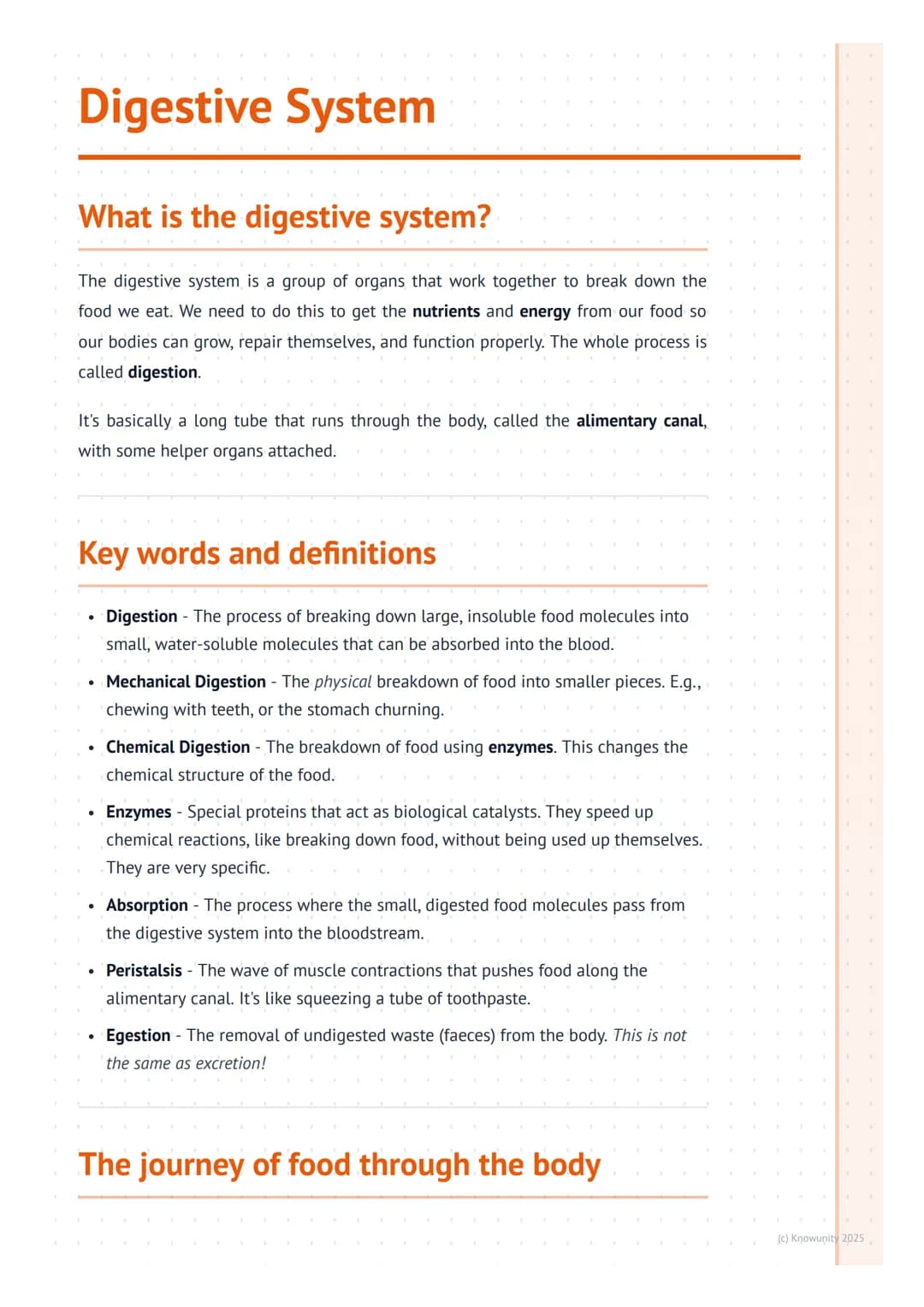
What is the Digestive System?
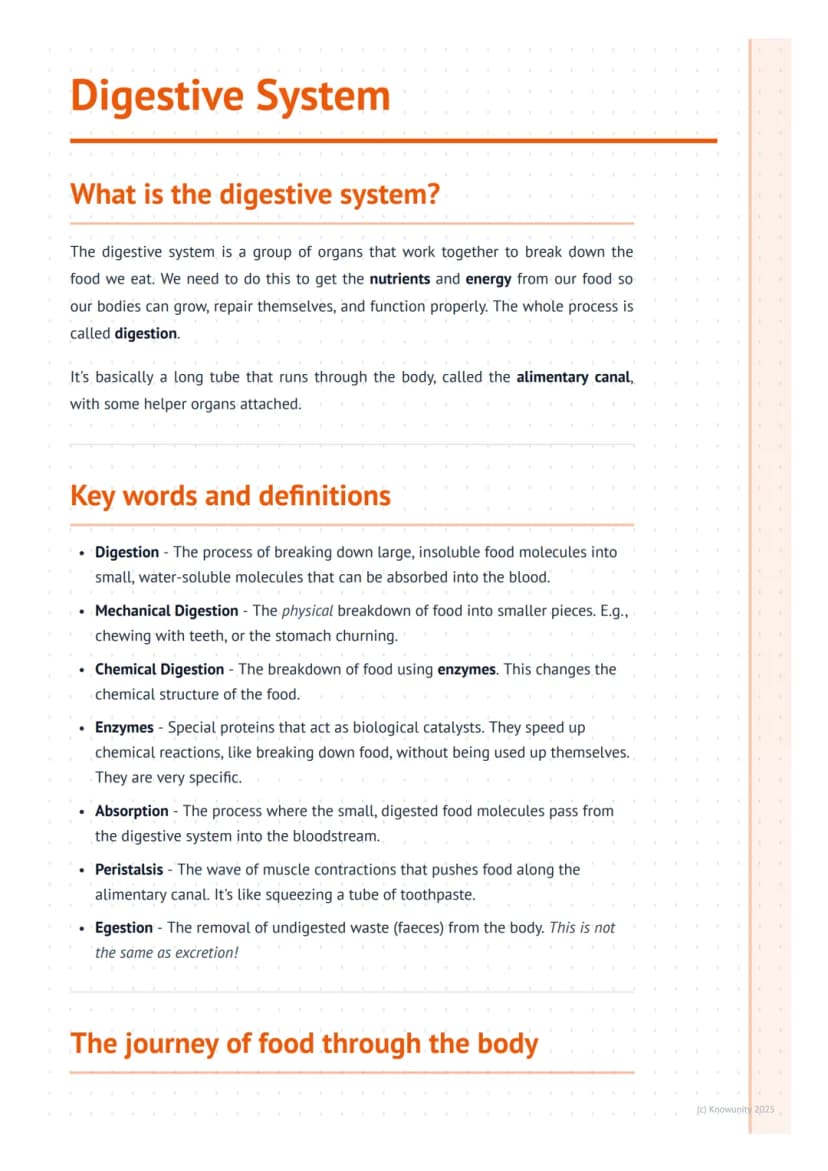
Your digestive system is essentially a long tube (called the alimentary canal) with some helper organs that work together to break down food. Think of it as your body's way of turning a chicken roll into fuel for your muscles and brain.
The whole process is called digestion, and it has two main types. Mechanical digestion is the physical stuff - like your teeth chomping food or your stomach churning it around. Chemical digestion uses special proteins called enzymes that act like molecular scissors, cutting food into smaller pieces.
Enzymes are absolutely crucial - they're biological catalysts that speed up reactions without getting used up themselves. Each enzyme is super picky and only works on one type of food. Absorption happens when these tiny food particles finally pass into your bloodstream, whilst egestion is just a fancy word for getting rid of waste.
Key Point: Peristalsis is like squeezing a tube of toothpaste - waves of muscle contractions push food along your digestive tract without you even thinking about it!
2
of 7
The Mouth and Oesophagus
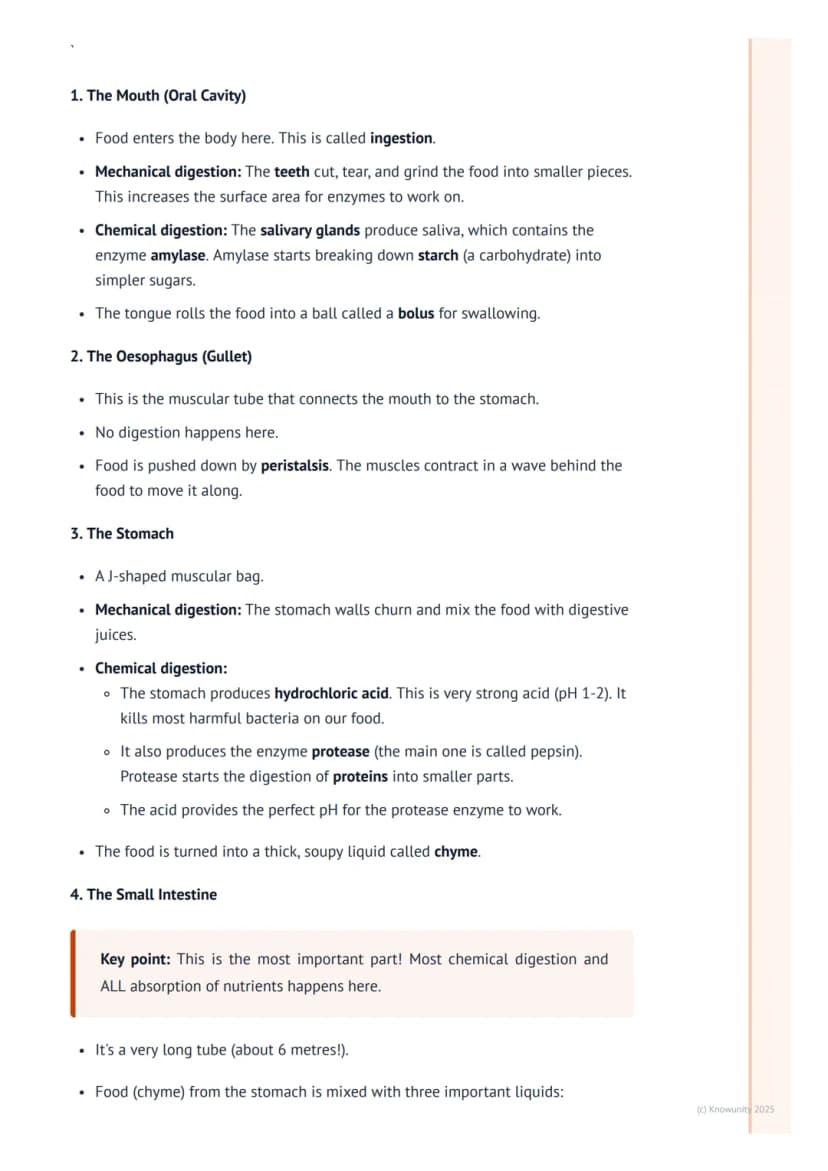
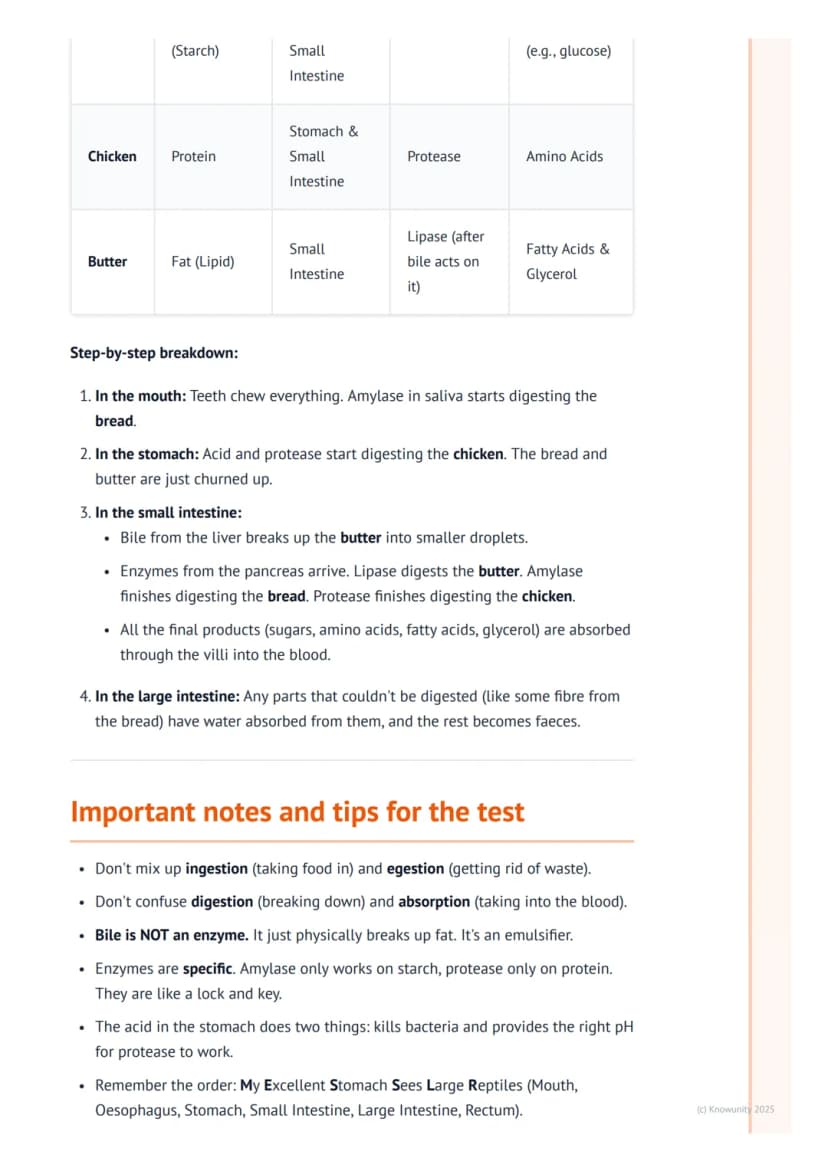
Your mouth is where the magic begins with ingestion (taking food in). Your teeth do the heavy lifting with mechanical digestion - cutting, tearing, and grinding food into smaller bits. This isn't just for easier swallowing; it massively increases the surface area for enzymes to work on.
Meanwhile, your salivary glands produce saliva containing amylase, an enzyme that starts breaking down starchy foods like bread and potatoes into simpler sugars. Your tongue then rolls everything into a neat ball called a bolus for swallowing.
The oesophagus (or gullet) is basically just a muscular tube connecting your mouth to your stomach. No digestion happens here - it's purely a transport system using peristalsis to push food downward.
Remember: Amylase only works on starch - it's completely useless against proteins or fats!
3
of 7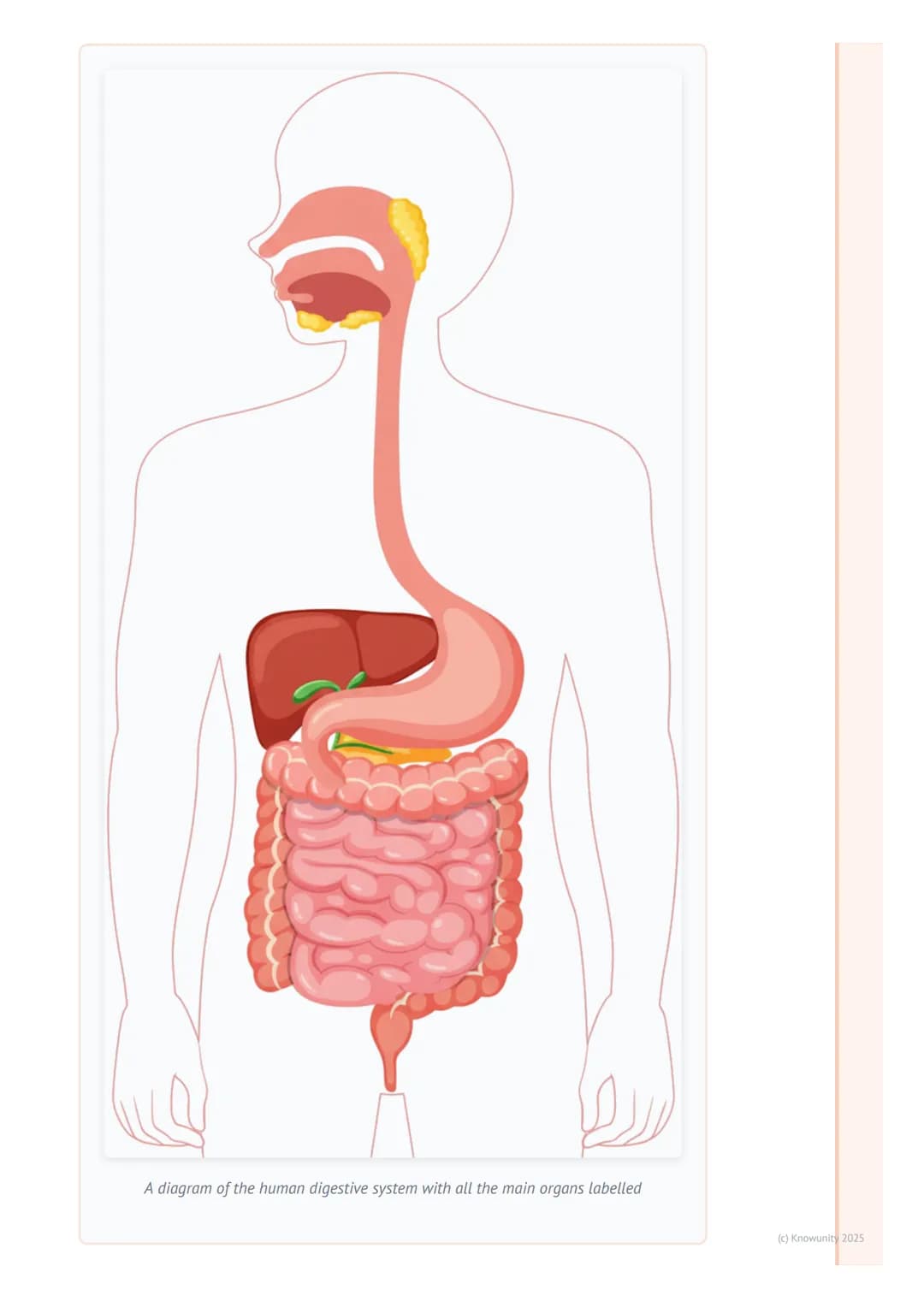
The Stomach - Your Body's Acid Bath
Your stomach is a J-shaped muscular bag that's basically a combination washing machine and acid bath. The walls churn and mix food with digestive juices through mechanical digestion, whilst some serious chemical digestion happens too.
Your stomach produces incredibly strong hydrochloric acid that kills most harmful bacteria on your food. It also creates the perfect acidic environment for protease enzymes (especially pepsin) to start breaking down proteins from meat, eggs, and dairy.
The acid and churning action transform your food into a thick, soupy liquid called chyme. This mixture then gets slowly released into the small intestine where the real action happens.
Fun Fact: Your stomach acid is so strong it could dissolve a nail, but a special mucus lining protects your stomach walls from being digested!
4
of 7
The Small Intestine - Digestion Central
The small intestine is where most chemical digestion happens and ALL absorption occurs. Despite being called 'small', it's actually about 6 metres long - longer than a giraffe is tall!
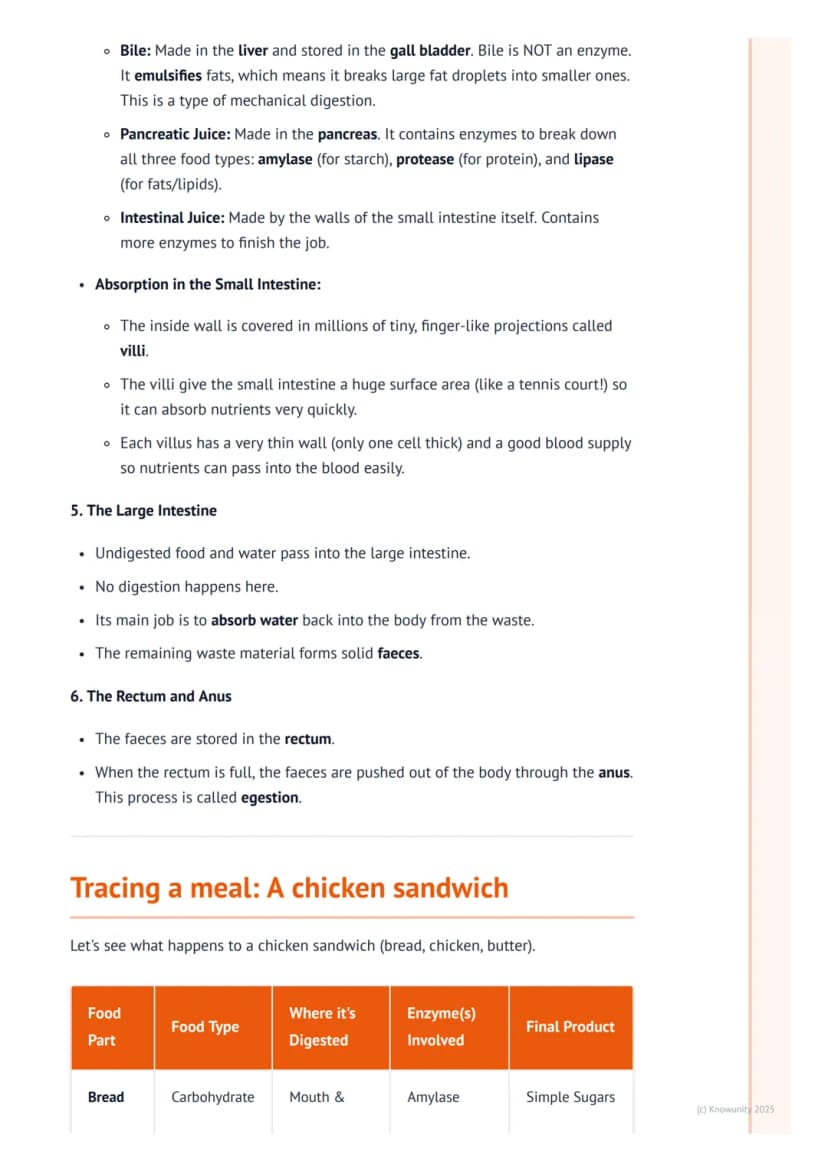
When chyme arrives from your stomach, it gets mixed with three crucial liquids. Bile from your liver (stored in the gall bladder) isn't an enzyme but acts like washing-up liquid, breaking large fat droplets into smaller ones through emulsification.
Pancreatic juice from your pancreas contains the full enzyme toolkit: amylase for remaining starch, protease for proteins, and lipase for fats. The small intestine itself produces intestinal juice with even more enzymes to finish the job completely.
Test Tip: Remember that bile is NOT an enzyme - it's an emulsifier that does mechanical digestion on fats!
5
of 7
Absorption and the Amazing Villi
The inside of your small intestine is covered with millions of tiny, finger-like projections called villi. These give your intestine a massive surface area - roughly the size of a tennis court - for super-efficient absorption.
Each villus has an incredibly thin wall (just one cell thick) and an excellent blood supply. This means digested nutrients can easily pass from your intestine into your bloodstream. Simple sugars, amino acids, fatty acids, and glycerol all get absorbed here and transported around your body.
By the time food leaves your small intestine, all the useful nutrients have been extracted. What's left is mainly water, undigested fibre, and waste products that your body can't use.
Quick Check: If someone asks where absorption happens, the answer is always the small intestine - nowhere else!
6
of 7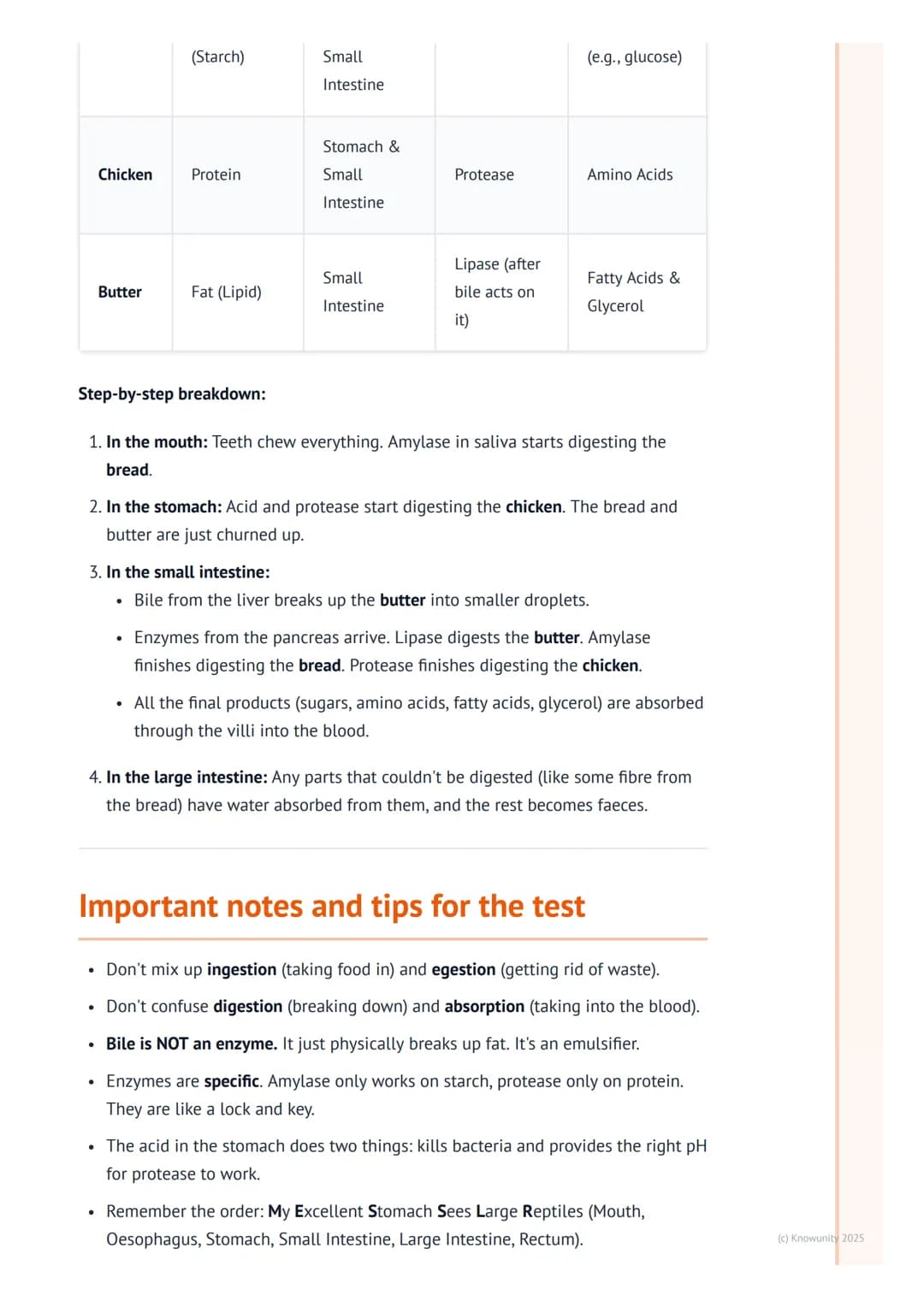
The Large Intestine and Waste Removal
The large intestine has one main job: absorbing water back into your body from the leftover waste. No digestion happens here at all - that job's already finished.
As water gets absorbed, the waste material gradually forms solid faeces. This waste then gets stored in the rectum until you're ready to get rid of it through the anus - a process called egestion.
Don't confuse egestion with excretion! Egestion is removing undigested food waste, whilst excretion is removing metabolic waste products like urea from your kidneys.
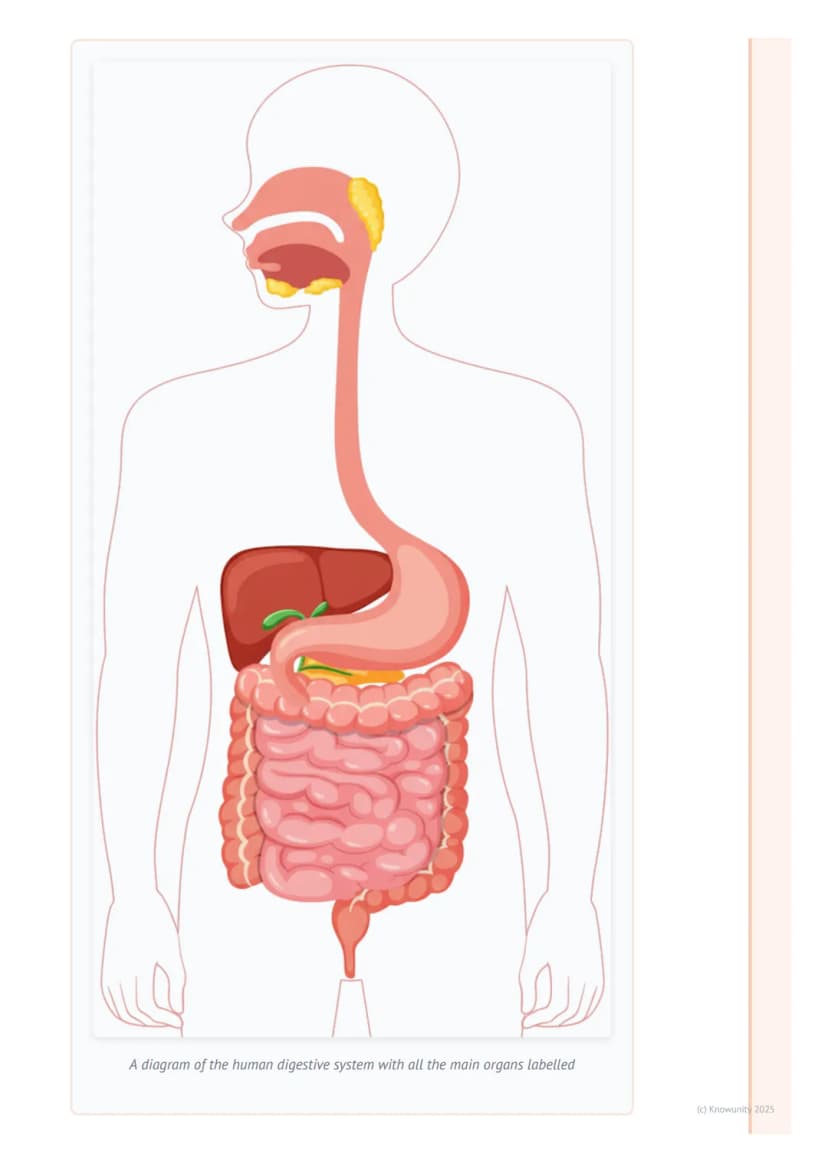
Memory Trick: Remember the path with "My Excellent Stomach Sees Large Reptiles" - Mouth, oEsophagus, Stomach, Small intestine, Large intestine, Rectum!
7
of 7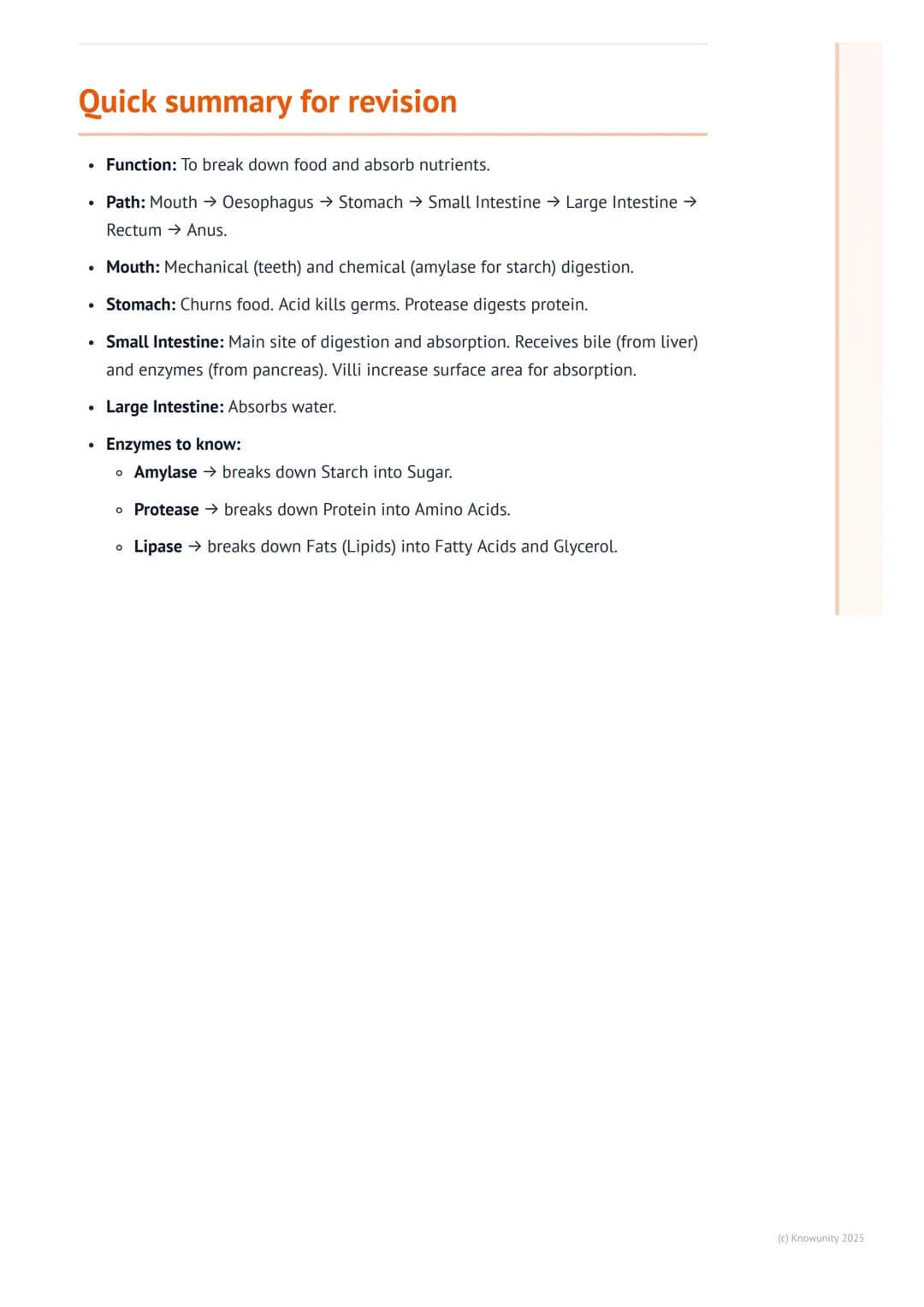
Quick Revision Summary
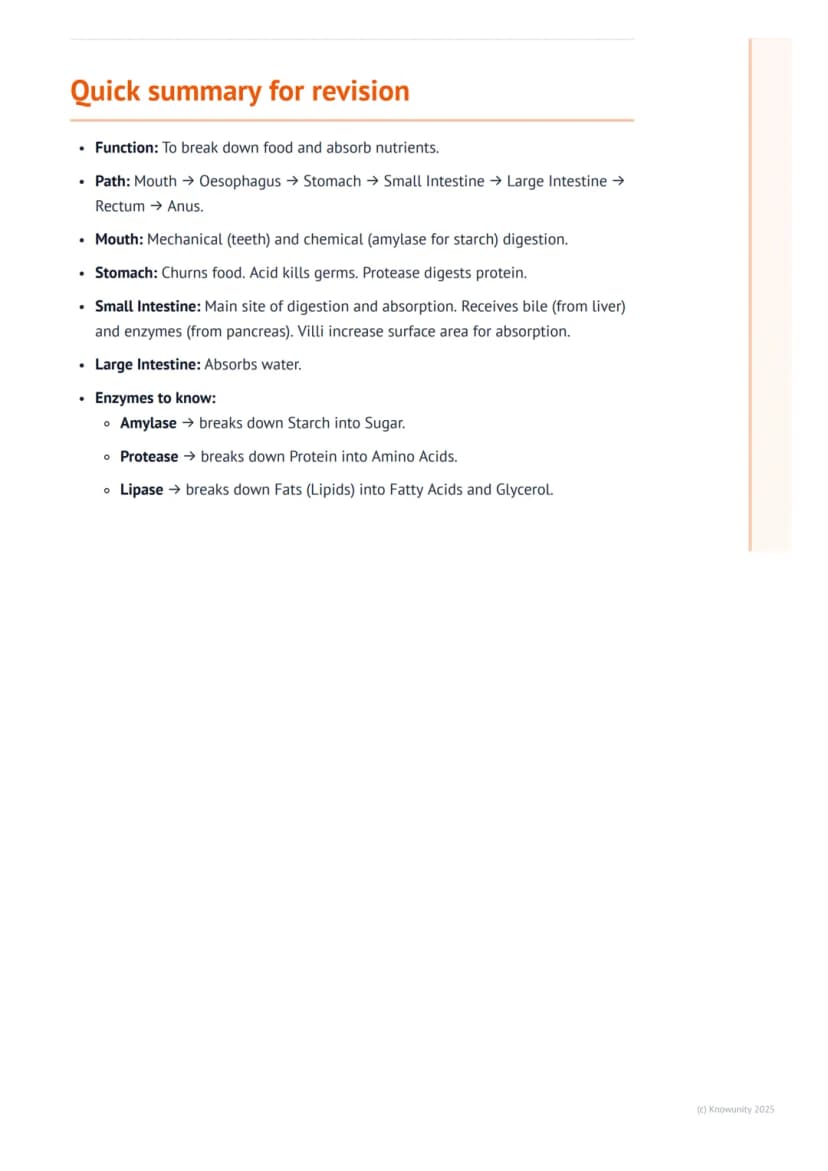
Here's everything you need to remember for your test. The digestive system breaks down food and absorbs nutrients through a specific pathway: Mouth → Oesophagus → Stomach → Small Intestine → Large Intestine → Rectum → Anus.
Key enzymes are amylase (starch → sugars), protease (proteins → amino acids), and lipase (fats → fatty acids and glycerol). Each enzyme is super specific - like a lock and key system.
The small intestine is your absorption superhero with its villi providing massive surface area. Your stomach kills bacteria with acid and starts protein digestion. Your large intestine just absorbs water from waste.
Final Tip: Focus on understanding the journey of a meal rather than memorising isolated facts - it all connects together beautifully!
We thought you’d never ask...
What is the Knowunity AI companion?
Our AI companion is specifically built for the needs of students. Based on the millions of content pieces we have on the platform we can provide truly meaningful and relevant answers to students. But its not only about answers, the companion is even more about guiding students through their daily learning challenges, with personalised study plans, quizzes or content pieces in the chat and 100% personalisation based on the students skills and developments.
Where can I download the Knowunity app?
You can download the app in the Google Play Store and in the Apple App Store.
Is Knowunity really free of charge?
That's right! Enjoy free access to study content, connect with fellow students, and get instant help – all at your fingertips.
Most popular content in Biology
8BiologyEcology introduction notes!
Start of the leaving cert ecology chapter
6th Year131
BiologyDNA & RNA
All notes on DNA & RNA including protein synthesis which is a HL topic
5th Year250
BiologyVertebrates and Invertebrates
Students will distinguish between animals that have a backbone (vertebrates) and those that do not (invertebrates), identifying examples of each.
2nd Year240
BiologyBiomolecules: chapter 8
Summary and easily understandable notes to revise chapter 8 biomolecules. Includes good labelled diagrams for visual learners
5th Year210
BiologyCirculatory System
Students will learn about the heart, blood, and blood vessels, and how this system transports oxygen, nutrients, and waste products around the body.
3rd Year140
BiologyRespiration
All respiration notes including simple diagrams and glycolysis and the Krebs cycle
5th Year120
BiologyPhotosynthesis : Biology
Photosynthesis
6th Year371
BiologyPlant Cells
Learning about the unique structures found in plant cells, such as the cell wall, chloroplasts, and large vacuole, and how they differ from animal cells.
1st Year80
Most popular content
9 Irish
IrishIrish oral questions and answers
Questions and answers for the leaving cert oral
5th Year4264
 English
Key Quotes : Sive
Key Quotes and explanations: Sive
6th Year2842
IrishIrish oral questions
Outline of oral questions
5th Year2055
IrishIníon- le hÁine Durkin
Aine Durkin’s poem, Iníon: Themes & summary
5th Year890
IrishIrish poetry 2027
Iníon + Dínit an Bhróin
5th Year1153
IrishLC HL notes- Iníon (poem)
Includes poem in English and Irish, theme, key words & phrases
5th Year2304
EnglishCultural Context : Shawshank Redemption : Sive : Small Things Like These
Comparative Study : Cultural Context : Shawshank Redemption, Sive and Small Things Like These
6th Year1430
IrishMo Ghrá-sa (Idir Lúibíní)
Notes on mo ghrá-sa
5th Year380
IrishAn Gaeilge Aiste
Irish Language essay
6th Year1320
Can't find what you're looking for? Explore other subjects.
Students love us — and so will you.
4.6/5App Store
4.7/5Google Play
The app is very easy to use and well designed. I have found everything I was looking for so far and have been able to learn a lot from the presentations! I will definitely use the app for a class assignment! And of course it also helps a lot as an inspiration.
Stefan SiOS user
This app is really great. There are so many study notes and help [...]. My problem subject is French, for example, and the app has so many options for help. Thanks to this app, I have improved my French. I would recommend it to anyone.
Samantha KlichAndroid user
Wow, I am really amazed. I just tried the app because I've seen it advertised many times and was absolutely stunned. This app is THE HELP you want for school and above all, it offers so many things, such as workouts and fact sheets, which have been VERY helpful to me personally.
AnnaiOS user
Biology10 views·Updated Jun 13, 2026·7 pagesHow the Digestive System Works: A Student's Guide
Ever wonder what happens to your food after you swallow it? Your digestive system is basically a brilliant food-processing factory that breaks down everything you eat into tiny nutrients your body can actually use. It's like having a super-efficient assembly...
1
of 7
Sign up to see the content. It's free!
- Access to all documents
- Improve your grades
- Join milions of students
What is the Digestive System?
Your digestive system is essentially a long tube (called the alimentary canal) with some helper organs that work together to break down food. Think of it as your body's way of turning a chicken roll into fuel for your muscles and brain.
The whole process is called digestion, and it has two main types. Mechanical digestion is the physical stuff - like your teeth chomping food or your stomach churning it around. Chemical digestion uses special proteins called enzymes that act like molecular scissors, cutting food into smaller pieces.
Enzymes are absolutely crucial - they're biological catalysts that speed up reactions without getting used up themselves. Each enzyme is super picky and only works on one type of food. Absorption happens when these tiny food particles finally pass into your bloodstream, whilst egestion is just a fancy word for getting rid of waste.
Key Point: Peristalsis is like squeezing a tube of toothpaste - waves of muscle contractions push food along your digestive tract without you even thinking about it!
2
of 7Sign up to see the content. It's free!
- Access to all documents
- Improve your grades
- Join milions of students
The Mouth and Oesophagus
Your mouth is where the magic begins with ingestion (taking food in). Your teeth do the heavy lifting with mechanical digestion - cutting, tearing, and grinding food into smaller bits. This isn't just for easier swallowing; it massively increases the surface area for enzymes to work on.
Meanwhile, your salivary glands produce saliva containing amylase, an enzyme that starts breaking down starchy foods like bread and potatoes into simpler sugars. Your tongue then rolls everything into a neat ball called a bolus for swallowing.
The oesophagus (or gullet) is basically just a muscular tube connecting your mouth to your stomach. No digestion happens here - it's purely a transport system using peristalsis to push food downward.
Remember: Amylase only works on starch - it's completely useless against proteins or fats!
3
of 7Sign up to see the content. It's free!
- Access to all documents
- Improve your grades
- Join milions of students
The Stomach - Your Body's Acid Bath
Your stomach is a J-shaped muscular bag that's basically a combination washing machine and acid bath. The walls churn and mix food with digestive juices through mechanical digestion, whilst some serious chemical digestion happens too.
Your stomach produces incredibly strong hydrochloric acid that kills most harmful bacteria on your food. It also creates the perfect acidic environment for protease enzymes (especially pepsin) to start breaking down proteins from meat, eggs, and dairy.
The acid and churning action transform your food into a thick, soupy liquid called chyme. This mixture then gets slowly released into the small intestine where the real action happens.
Fun Fact: Your stomach acid is so strong it could dissolve a nail, but a special mucus lining protects your stomach walls from being digested!
4
of 7Sign up to see the content. It's free!
- Access to all documents
- Improve your grades
- Join milions of students
The Small Intestine - Digestion Central
The small intestine is where most chemical digestion happens and ALL absorption occurs. Despite being called 'small', it's actually about 6 metres long - longer than a giraffe is tall!
When chyme arrives from your stomach, it gets mixed with three crucial liquids. Bile from your liver (stored in the gall bladder) isn't an enzyme but acts like washing-up liquid, breaking large fat droplets into smaller ones through emulsification.
Pancreatic juice from your pancreas contains the full enzyme toolkit: amylase for remaining starch, protease for proteins, and lipase for fats. The small intestine itself produces intestinal juice with even more enzymes to finish the job completely.
Test Tip: Remember that bile is NOT an enzyme - it's an emulsifier that does mechanical digestion on fats!
5
of 7Sign up to see the content. It's free!
- Access to all documents
- Improve your grades
- Join milions of students
Absorption and the Amazing Villi
The inside of your small intestine is covered with millions of tiny, finger-like projections called villi. These give your intestine a massive surface area - roughly the size of a tennis court - for super-efficient absorption.
Each villus has an incredibly thin wall (just one cell thick) and an excellent blood supply. This means digested nutrients can easily pass from your intestine into your bloodstream. Simple sugars, amino acids, fatty acids, and glycerol all get absorbed here and transported around your body.
By the time food leaves your small intestine, all the useful nutrients have been extracted. What's left is mainly water, undigested fibre, and waste products that your body can't use.
Quick Check: If someone asks where absorption happens, the answer is always the small intestine - nowhere else!
6
of 7Sign up to see the content. It's free!
- Access to all documents
- Improve your grades
- Join milions of students
The Large Intestine and Waste Removal
The large intestine has one main job: absorbing water back into your body from the leftover waste. No digestion happens here at all - that job's already finished.
As water gets absorbed, the waste material gradually forms solid faeces. This waste then gets stored in the rectum until you're ready to get rid of it through the anus - a process called egestion.
Don't confuse egestion with excretion! Egestion is removing undigested food waste, whilst excretion is removing metabolic waste products like urea from your kidneys.
Memory Trick: Remember the path with "My Excellent Stomach Sees Large Reptiles" - Mouth, oEsophagus, Stomach, Small intestine, Large intestine, Rectum!
7
of 7Sign up to see the content. It's free!
- Access to all documents
- Improve your grades
- Join milions of students
Quick Revision Summary
Here's everything you need to remember for your test. The digestive system breaks down food and absorbs nutrients through a specific pathway: Mouth → Oesophagus → Stomach → Small Intestine → Large Intestine → Rectum → Anus.
Key enzymes are amylase (starch → sugars), protease (proteins → amino acids), and lipase (fats → fatty acids and glycerol). Each enzyme is super specific - like a lock and key system.
The small intestine is your absorption superhero with its villi providing massive surface area. Your stomach kills bacteria with acid and starts protein digestion. Your large intestine just absorbs water from waste.
Final Tip: Focus on understanding the journey of a meal rather than memorising isolated facts - it all connects together beautifully!
We thought you’d never ask...
What is the Knowunity AI companion?
Our AI companion is specifically built for the needs of students. Based on the millions of content pieces we have on the platform we can provide truly meaningful and relevant answers to students. But its not only about answers, the companion is even more about guiding students through their daily learning challenges, with personalised study plans, quizzes or content pieces in the chat and 100% personalisation based on the students skills and developments.
Where can I download the Knowunity app?
You can download the app in the Google Play Store and in the Apple App Store.
Is Knowunity really free of charge?
That's right! Enjoy free access to study content, connect with fellow students, and get instant help – all at your fingertips.
Most popular content in Biology
8BiologyEcology introduction notes!
Start of the leaving cert ecology chapter
6th Year131
BiologyDNA & RNA
All notes on DNA & RNA including protein synthesis which is a HL topic
5th Year250
BiologyVertebrates and Invertebrates
Students will distinguish between animals that have a backbone (vertebrates) and those that do not (invertebrates), identifying examples of each.
2nd Year240
BiologyBiomolecules: chapter 8
Summary and easily understandable notes to revise chapter 8 biomolecules. Includes good labelled diagrams for visual learners
5th Year210
BiologyCirculatory System
Students will learn about the heart, blood, and blood vessels, and how this system transports oxygen, nutrients, and waste products around the body.
3rd Year140
BiologyRespiration
All respiration notes including simple diagrams and glycolysis and the Krebs cycle
5th Year120
BiologyPhotosynthesis : Biology
Photosynthesis
6th Year371
BiologyPlant Cells
Learning about the unique structures found in plant cells, such as the cell wall, chloroplasts, and large vacuole, and how they differ from animal cells.
1st Year80
Most popular content
9IrishIrish oral questions and answers
Questions and answers for the leaving cert oral
5th Year4264
EnglishKey Quotes : Sive
Key Quotes and explanations: Sive
6th Year2842
IrishIrish oral questions
Outline of oral questions
5th Year2055
IrishIníon- le hÁine Durkin
Aine Durkin’s poem, Iníon: Themes & summary
5th Year890
IrishIrish poetry 2027
Iníon + Dínit an Bhróin
5th Year1153
IrishLC HL notes- Iníon (poem)
Includes poem in English and Irish, theme, key words & phrases
5th Year2304
EnglishCultural Context : Shawshank Redemption : Sive : Small Things Like These
Comparative Study : Cultural Context : Shawshank Redemption, Sive and Small Things Like These
6th Year1430
IrishMo Ghrá-sa (Idir Lúibíní)
Notes on mo ghrá-sa
5th Year380
IrishAn Gaeilge Aiste
Irish Language essay
6th Year1320
Can't find what you're looking for? Explore other subjects.
Students love us — and so will you.
4.6/5App Store
4.7/5Google Play
The app is very easy to use and well designed. I have found everything I was looking for so far and have been able to learn a lot from the presentations! I will definitely use the app for a class assignment! And of course it also helps a lot as an inspiration.
Stefan SiOS user
This app is really great. There are so many study notes and help [...]. My problem subject is French, for example, and the app has so many options for help. Thanks to this app, I have improved my French. I would recommend it to anyone.
Samantha KlichAndroid user
Wow, I am really amazed. I just tried the app because I've seen it advertised many times and was absolutely stunned. This app is THE HELP you want for school and above all, it offers so many things, such as workouts and fact sheets, which have been VERY helpful to me personally.
AnnaiOS user