
Your cells are like tiny factories with specialised parts working...
 Biology7 views·Updated Jun 9, 2026·4 pages
Comprehensive Notes on Cell Structure
E
emma preston@emmapreston
1 / 4
1
of 4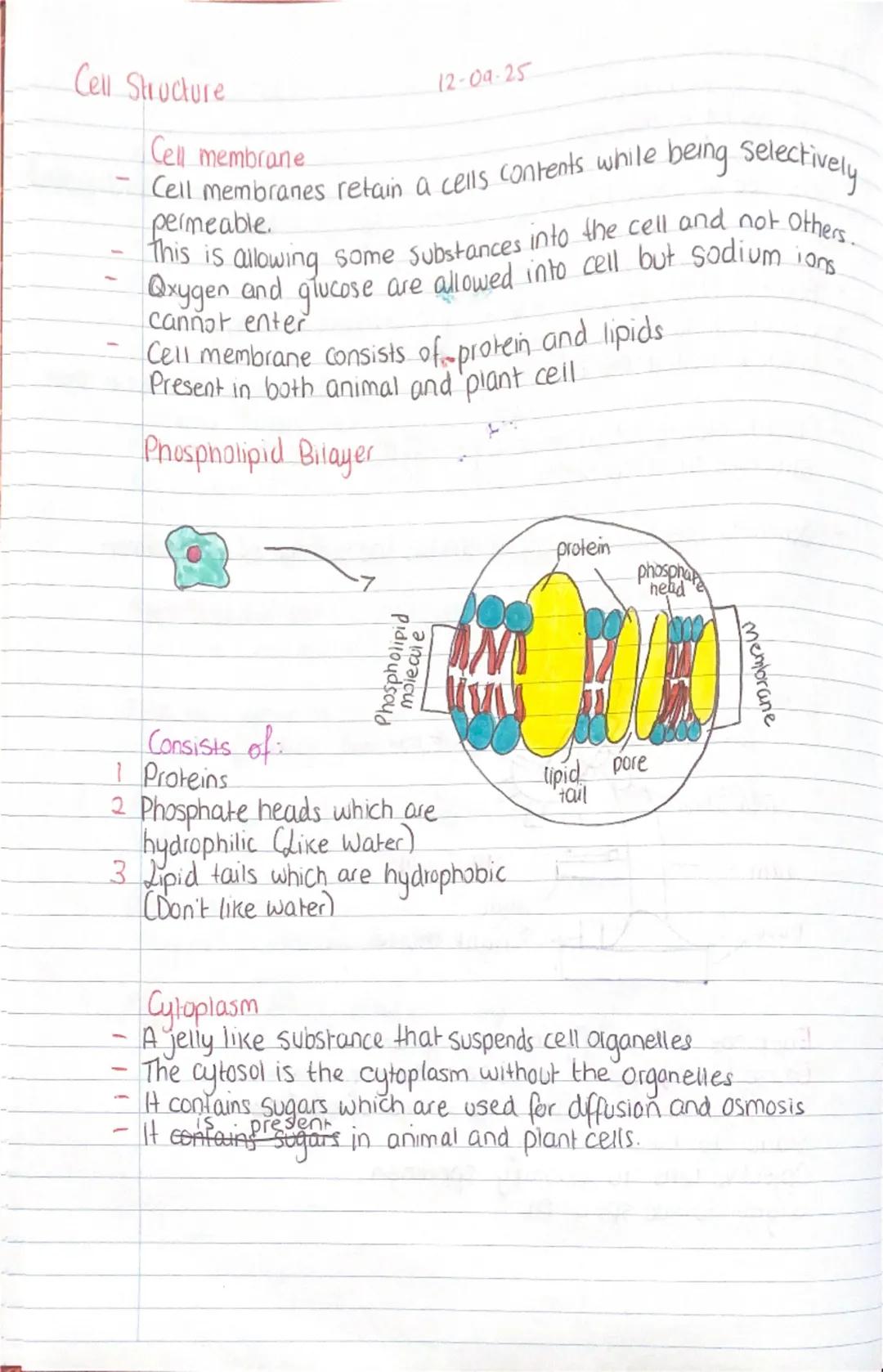
Cell Membranes and Basic Structure
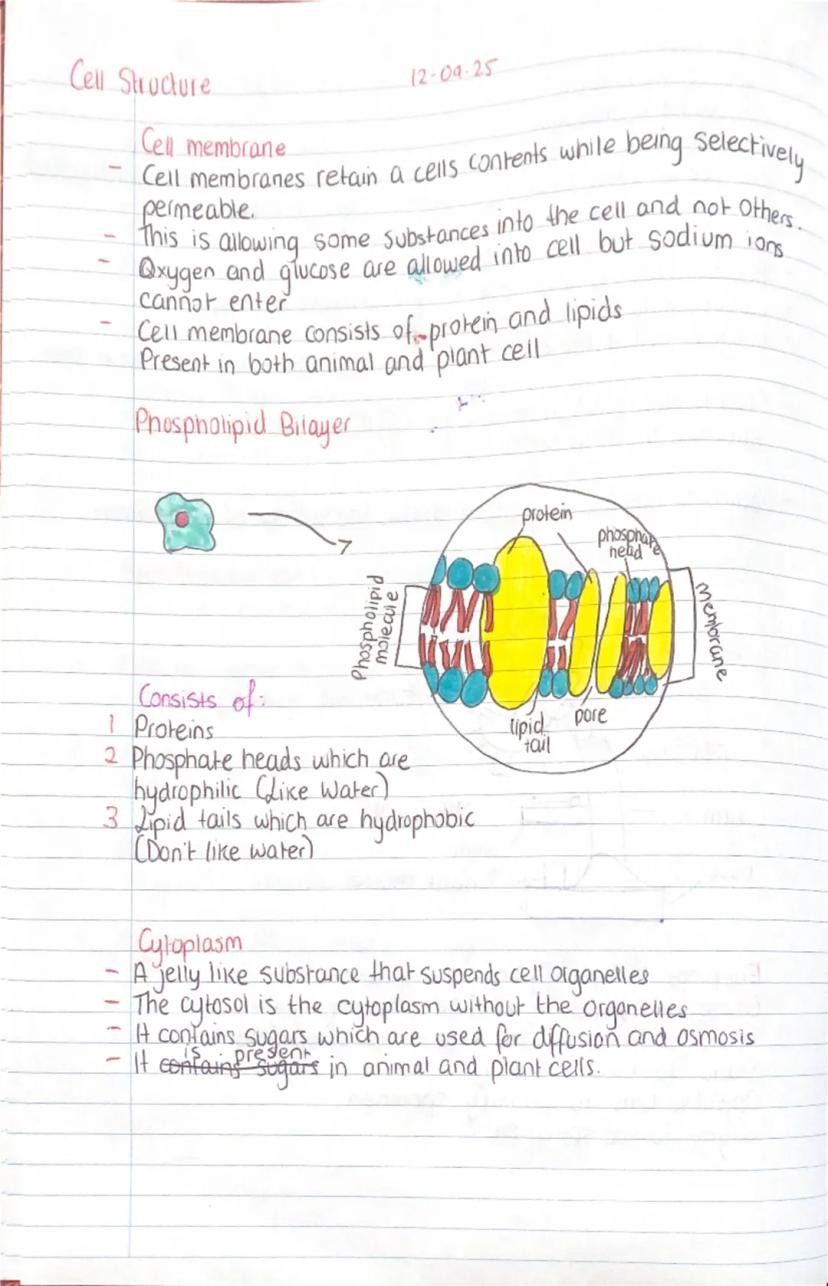
Think of the cell membrane as a bouncer at a club - it decides what gets in and what stays out. This selective permeability means oxygen and glucose can enter your cells, but harmful substances like excess sodium ions are blocked.
The membrane isn't just a simple barrier though. It's made of a phospholipid bilayer - imagine a sandwich where the bread slices are water-loving (hydrophilic) phosphate heads and the filling is water-hating (hydrophobic) lipid tails. Proteins scattered throughout act like doorways and sensors.
Inside the membrane, cytoplasm acts like jelly that holds all the cell's parts in place. The liquid part without organelles is called cytosol, and it's packed with sugars that help with important processes like diffusion and osmosis. Every cell - whether animal or plant - has this essential setup.
Quick Tip: Remember that hydrophilic = water-loving and hydrophobic = water-fearing. The membrane structure keeps the cell's insides separate from the watery environment outside.
2
of 4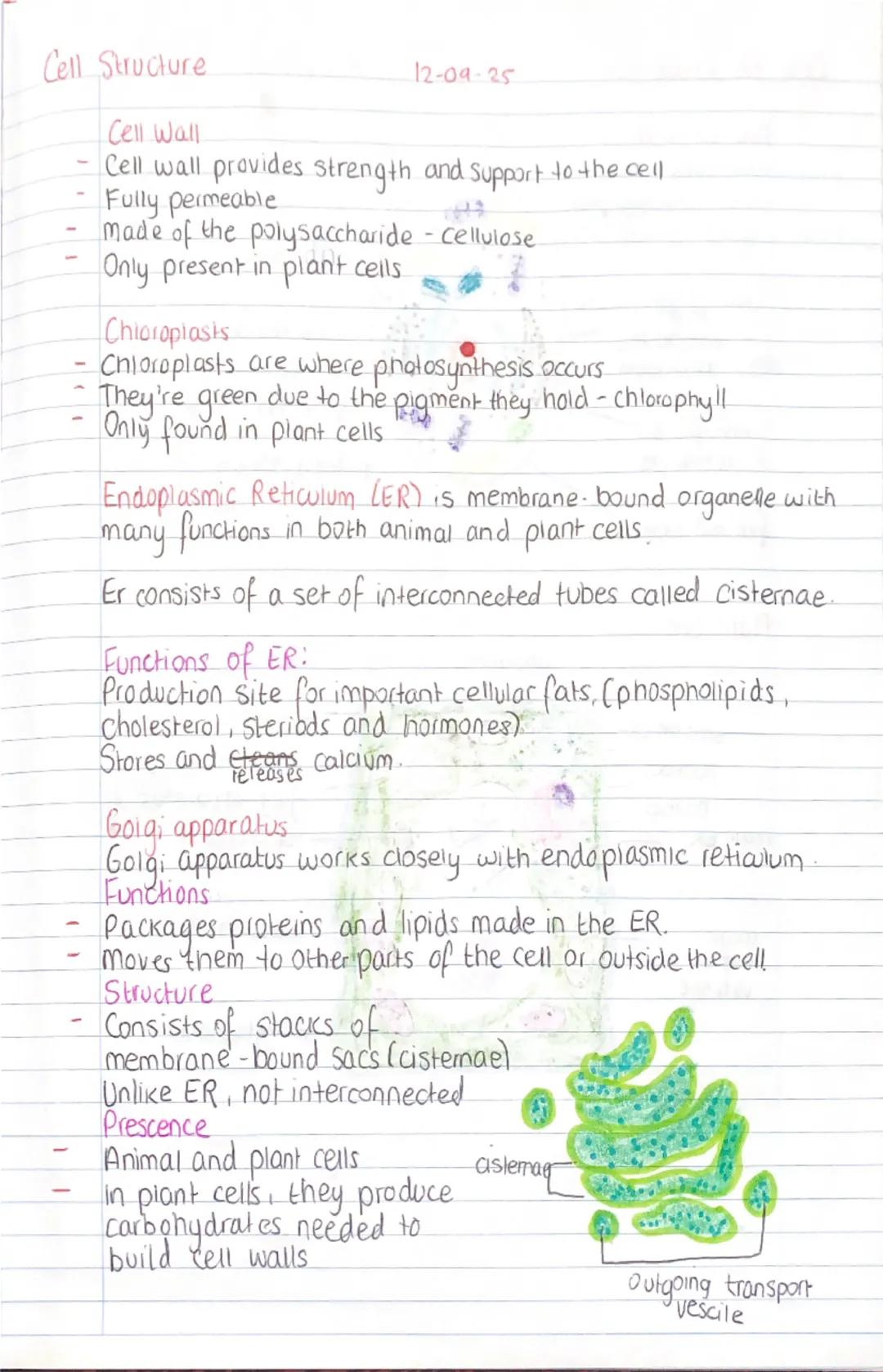
Plant-Specific Structures and Cellular Factories
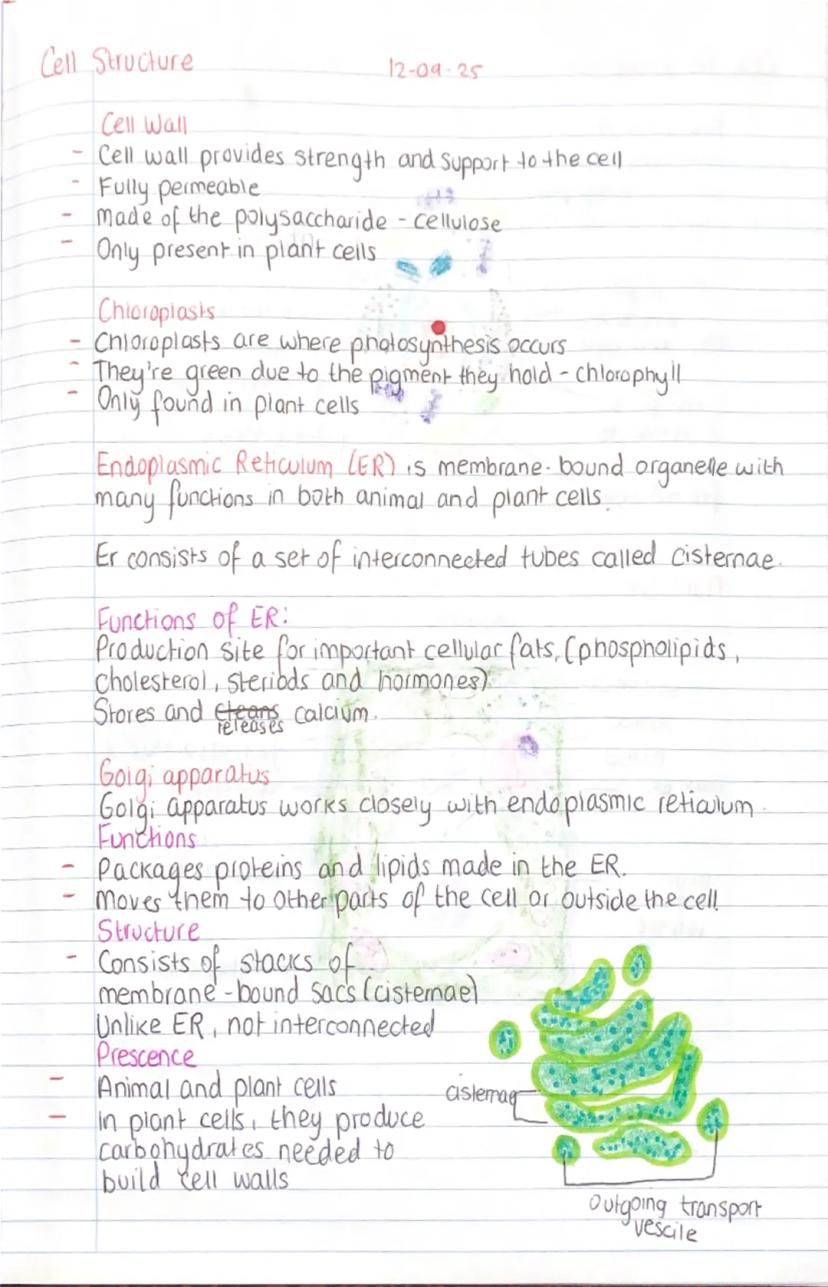
Plant cells have some extra features that animal cells don't need. The cell wall made of cellulose acts like armour, giving plants strength and support since they can't run away from danger like animals can. Unlike the selective cell membrane, the cell wall is fully permeable.
Chloroplasts are where the magic of photosynthesis happens - they're green because of chlorophyll, the pigment that captures sunlight. These are exclusive to plant cells and basically turn your garden into a solar power station.
Both plant and animal cells have the endoplasmic reticulum (ER), which is like the cell's production line. It's a network of interconnected tubes that makes important fats, stores calcium, and produces hormones. The Golgi apparatus works as the packaging and shipping department, taking proteins and lipids from the ER and sending them where they need to go.
Remember: Only plant cells have chloroplasts and cell walls - these features help plants make their own food and stand upright without bones!
3
of 4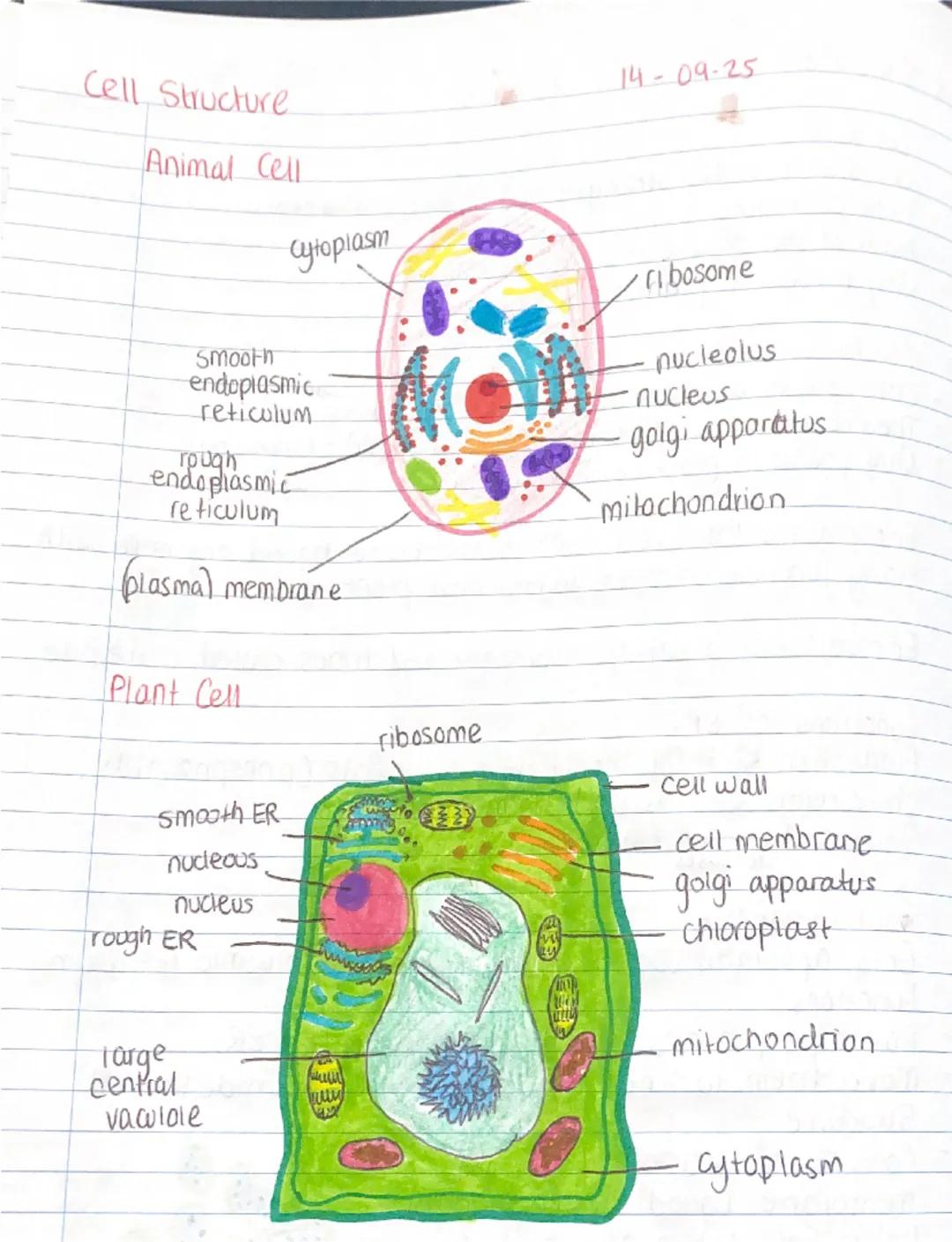
Comparing Animal and Plant Cells
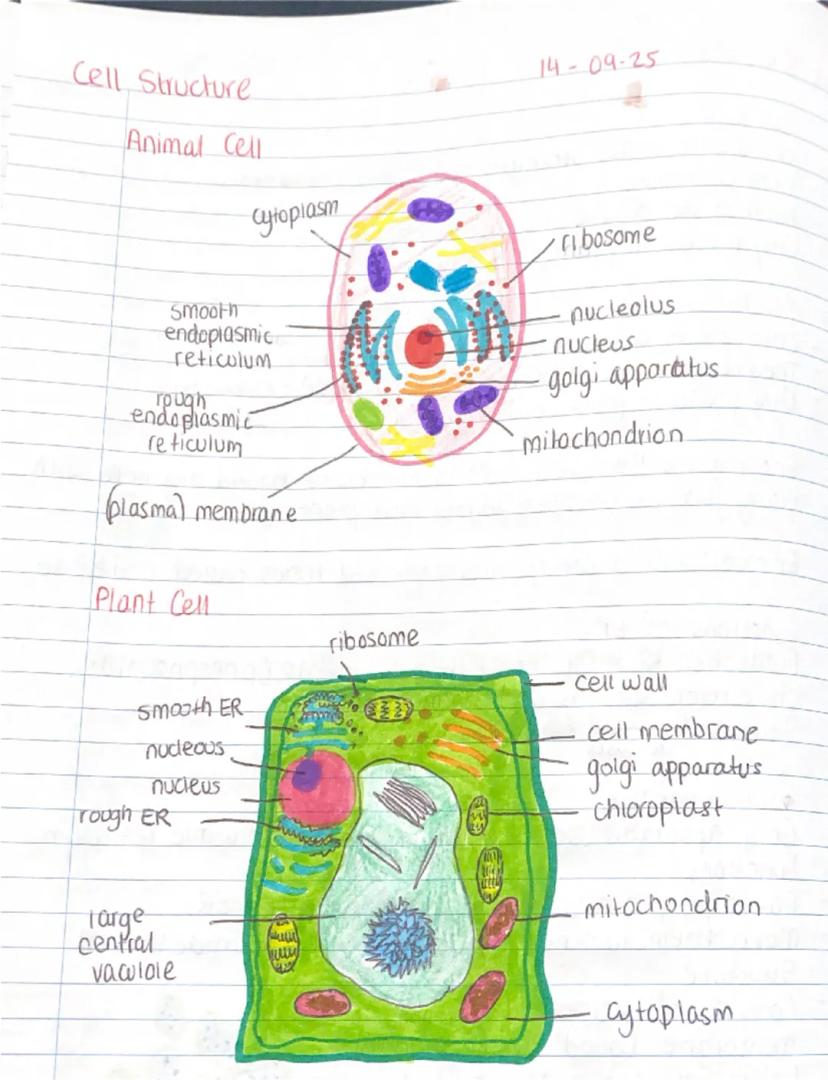
Now you can see the key differences side by side. Animal cells are more compact and flexible, with organelles like the nucleus, mitochondria, ribosomes, and both rough and smooth endoplasmic reticulum floating in the cytoplasm.
Plant cells have all the same organelles as animal cells, but they're supersized in some ways. They have a massive central vacuole that helps maintain the plant's shape and stores water. The cell wall provides the rigid structure that lets trees grow hundreds of feet tall.
Both cell types share the essential organelles - the nucleus (control centre), mitochondria (powerhouses), ribosomes (protein makers), and the Golgi apparatus (packaging centre). The main difference is that plant cells have extra equipment for making food and staying upright.
Study Hack: When drawing cell diagrams, start with the basic animal cell structure, then add the cell wall, chloroplasts, and large vacuole to create a plant cell.
4
of 4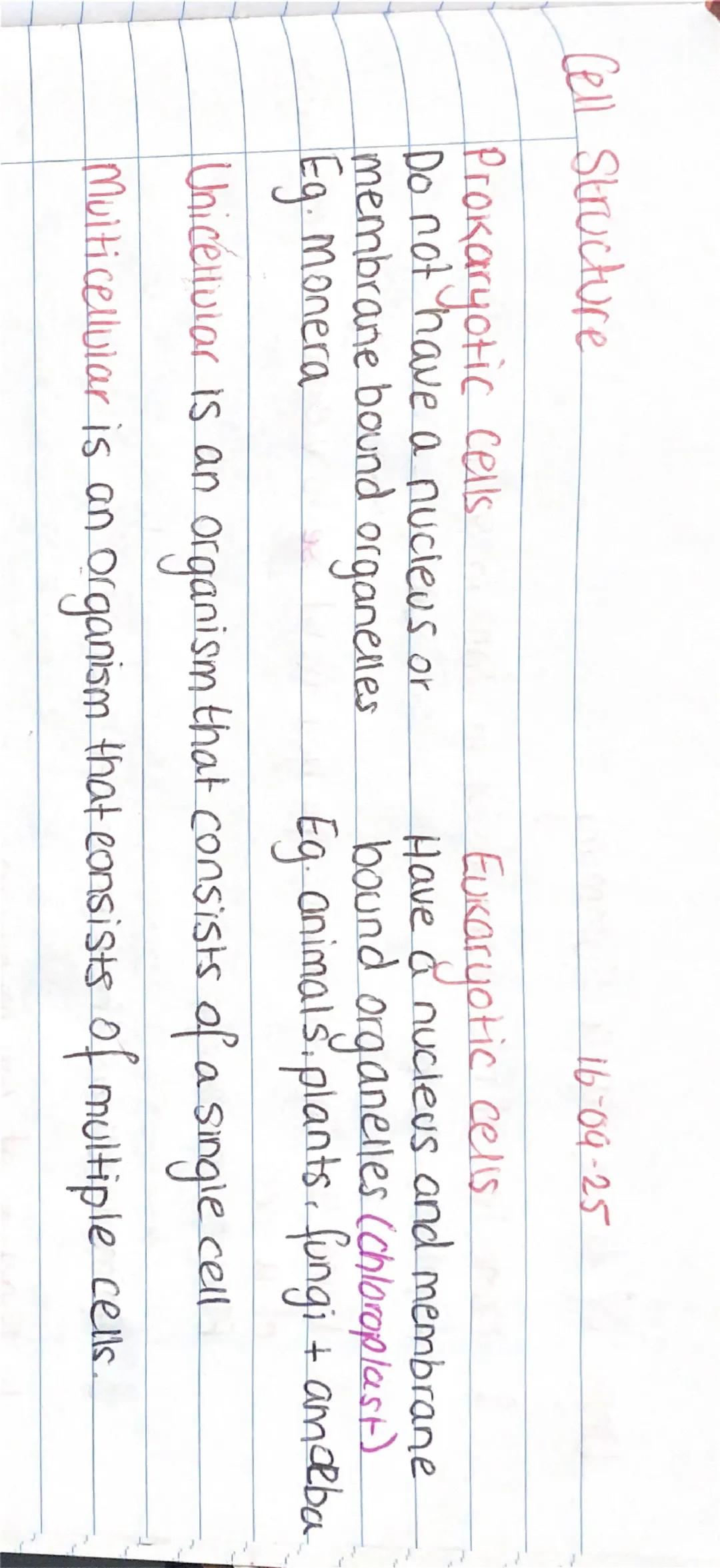
Prokaryotic vs Eukaryotic Cells
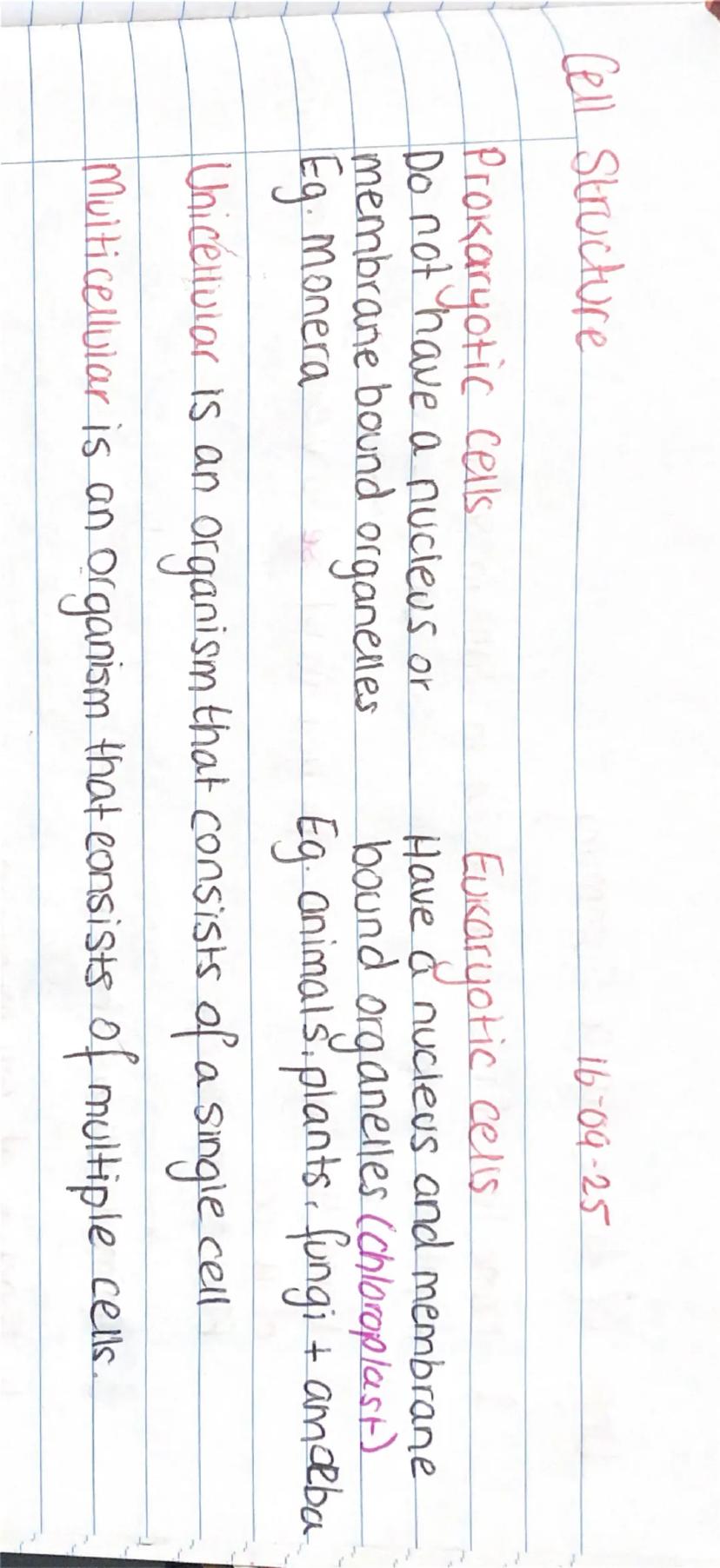
Here's a major divide in the living world: prokaryotic cells are the simpler, older type without a nucleus or membrane-bound organelles. Think bacteria - they're like studio apartments where everything happens in one room.
Eukaryotic cells are the complex type you've been studying, with a nucleus and specialised organelles. These include animals, plants, fungi, and single-celled organisms like amoeba. They're like mansions with different rooms for different functions.
Don't confuse cell complexity with organism complexity though. Unicellular organisms (like bacteria or amoeba) are made of just one cell, while multicellular organisms (like you!) are made of billions of cells working together.
Key Point: All the cell structures you've learned about (nucleus, mitochondria, ER) only exist in eukaryotic cells - prokaryotes keep things much simpler.
We thought you’d never ask...
What is the Knowunity AI companion?
Our AI companion is specifically built for the needs of students. Based on the millions of content pieces we have on the platform we can provide truly meaningful and relevant answers to students. But its not only about answers, the companion is even more about guiding students through their daily learning challenges, with personalised study plans, quizzes or content pieces in the chat and 100% personalisation based on the students skills and developments.
Where can I download the Knowunity app?
You can download the app in the Google Play Store and in the Apple App Store.
Is Knowunity really free of charge?
That's right! Enjoy free access to study content, connect with fellow students, and get instant help – all at your fingertips.
Most popular content in Biology
8BiologyEcology introduction notes!
Start of the leaving cert ecology chapter
6th Year131
BiologyDNA & RNA
All notes on DNA & RNA including protein synthesis which is a HL topic
5th Year250
BiologyVertebrates and Invertebrates
Students will distinguish between animals that have a backbone (vertebrates) and those that do not (invertebrates), identifying examples of each.
2nd Year240
BiologyBiomolecules: chapter 8
Summary and easily understandable notes to revise chapter 8 biomolecules. Includes good labelled diagrams for visual learners
5th Year210
BiologyCirculatory System
Students will learn about the heart, blood, and blood vessels, and how this system transports oxygen, nutrients, and waste products around the body.
3rd Year140
BiologyRespiration
All respiration notes including simple diagrams and glycolysis and the Krebs cycle
5th Year120
BiologyPhotosynthesis : Biology
Photosynthesis
6th Year371
BiologyPlant Cells
Learning about the unique structures found in plant cells, such as the cell wall, chloroplasts, and large vacuole, and how they differ from animal cells.
1st Year80
Most popular content
9 Irish
IrishIrish oral questions and answers
Questions and answers for the leaving cert oral
5th Year4264
 English
Key Quotes : Sive
Key Quotes and explanations: Sive
6th Year2842
IrishIrish oral questions
Outline of oral questions
5th Year2055
IrishIníon- le hÁine Durkin
Aine Durkin’s poem, Iníon: Themes & summary
5th Year890
IrishIrish poetry 2027
Iníon + Dínit an Bhróin
5th Year1153
IrishLC HL notes- Iníon (poem)
Includes poem in English and Irish, theme, key words & phrases
5th Year2304
EnglishCultural Context : Shawshank Redemption : Sive : Small Things Like These
Comparative Study : Cultural Context : Shawshank Redemption, Sive and Small Things Like These
6th Year1430
IrishMo Ghrá-sa (Idir Lúibíní)
Notes on mo ghrá-sa
5th Year380
IrishAn Gaeilge Aiste
Irish Language essay
6th Year1320
Can't find what you're looking for? Explore other subjects.
Students love us — and so will you.
4.6/5App Store
4.7/5Google Play
The app is very easy to use and well designed. I have found everything I was looking for so far and have been able to learn a lot from the presentations! I will definitely use the app for a class assignment! And of course it also helps a lot as an inspiration.
Stefan SiOS user
This app is really great. There are so many study notes and help [...]. My problem subject is French, for example, and the app has so many options for help. Thanks to this app, I have improved my French. I would recommend it to anyone.
Samantha KlichAndroid user
Wow, I am really amazed. I just tried the app because I've seen it advertised many times and was absolutely stunned. This app is THE HELP you want for school and above all, it offers so many things, such as workouts and fact sheets, which have been VERY helpful to me personally.
AnnaiOS user
Biology7 views·Updated Jun 9, 2026·4 pagesComprehensive Notes on Cell Structure
E
emma preston@emmapreston
Your cells are like tiny factories with specialised parts working together to keep you alive. Understanding cell structure is crucial for biology - it explains how life works at its most basic level and sets the foundation for everything from...
1
of 4
Sign up to see the content. It's free!
- Access to all documents
- Improve your grades
- Join milions of students
Cell Membranes and Basic Structure
Think of the cell membrane as a bouncer at a club - it decides what gets in and what stays out. This selective permeability means oxygen and glucose can enter your cells, but harmful substances like excess sodium ions are blocked.
The membrane isn't just a simple barrier though. It's made of a phospholipid bilayer - imagine a sandwich where the bread slices are water-loving (hydrophilic) phosphate heads and the filling is water-hating (hydrophobic) lipid tails. Proteins scattered throughout act like doorways and sensors.
Inside the membrane, cytoplasm acts like jelly that holds all the cell's parts in place. The liquid part without organelles is called cytosol, and it's packed with sugars that help with important processes like diffusion and osmosis. Every cell - whether animal or plant - has this essential setup.
Quick Tip: Remember that hydrophilic = water-loving and hydrophobic = water-fearing. The membrane structure keeps the cell's insides separate from the watery environment outside.
2
of 4Sign up to see the content. It's free!
- Access to all documents
- Improve your grades
- Join milions of students
Plant-Specific Structures and Cellular Factories
Plant cells have some extra features that animal cells don't need. The cell wall made of cellulose acts like armour, giving plants strength and support since they can't run away from danger like animals can. Unlike the selective cell membrane, the cell wall is fully permeable.
Chloroplasts are where the magic of photosynthesis happens - they're green because of chlorophyll, the pigment that captures sunlight. These are exclusive to plant cells and basically turn your garden into a solar power station.
Both plant and animal cells have the endoplasmic reticulum (ER), which is like the cell's production line. It's a network of interconnected tubes that makes important fats, stores calcium, and produces hormones. The Golgi apparatus works as the packaging and shipping department, taking proteins and lipids from the ER and sending them where they need to go.
Remember: Only plant cells have chloroplasts and cell walls - these features help plants make their own food and stand upright without bones!
3
of 4Sign up to see the content. It's free!
- Access to all documents
- Improve your grades
- Join milions of students
Comparing Animal and Plant Cells
Now you can see the key differences side by side. Animal cells are more compact and flexible, with organelles like the nucleus, mitochondria, ribosomes, and both rough and smooth endoplasmic reticulum floating in the cytoplasm.
Plant cells have all the same organelles as animal cells, but they're supersized in some ways. They have a massive central vacuole that helps maintain the plant's shape and stores water. The cell wall provides the rigid structure that lets trees grow hundreds of feet tall.
Both cell types share the essential organelles - the nucleus (control centre), mitochondria (powerhouses), ribosomes (protein makers), and the Golgi apparatus (packaging centre). The main difference is that plant cells have extra equipment for making food and staying upright.
Study Hack: When drawing cell diagrams, start with the basic animal cell structure, then add the cell wall, chloroplasts, and large vacuole to create a plant cell.
4
of 4Sign up to see the content. It's free!
- Access to all documents
- Improve your grades
- Join milions of students
Prokaryotic vs Eukaryotic Cells
Here's a major divide in the living world: prokaryotic cells are the simpler, older type without a nucleus or membrane-bound organelles. Think bacteria - they're like studio apartments where everything happens in one room.
Eukaryotic cells are the complex type you've been studying, with a nucleus and specialised organelles. These include animals, plants, fungi, and single-celled organisms like amoeba. They're like mansions with different rooms for different functions.
Don't confuse cell complexity with organism complexity though. Unicellular organisms (like bacteria or amoeba) are made of just one cell, while multicellular organisms (like you!) are made of billions of cells working together.
Key Point: All the cell structures you've learned about (nucleus, mitochondria, ER) only exist in eukaryotic cells - prokaryotes keep things much simpler.
We thought you’d never ask...
What is the Knowunity AI companion?
Our AI companion is specifically built for the needs of students. Based on the millions of content pieces we have on the platform we can provide truly meaningful and relevant answers to students. But its not only about answers, the companion is even more about guiding students through their daily learning challenges, with personalised study plans, quizzes or content pieces in the chat and 100% personalisation based on the students skills and developments.
Where can I download the Knowunity app?
You can download the app in the Google Play Store and in the Apple App Store.
Is Knowunity really free of charge?
That's right! Enjoy free access to study content, connect with fellow students, and get instant help – all at your fingertips.
Most popular content in Biology
8BiologyEcology introduction notes!
Start of the leaving cert ecology chapter
6th Year131
BiologyDNA & RNA
All notes on DNA & RNA including protein synthesis which is a HL topic
5th Year250
BiologyVertebrates and Invertebrates
Students will distinguish between animals that have a backbone (vertebrates) and those that do not (invertebrates), identifying examples of each.
2nd Year240
BiologyBiomolecules: chapter 8
Summary and easily understandable notes to revise chapter 8 biomolecules. Includes good labelled diagrams for visual learners
5th Year210
BiologyCirculatory System
Students will learn about the heart, blood, and blood vessels, and how this system transports oxygen, nutrients, and waste products around the body.
3rd Year140
BiologyRespiration
All respiration notes including simple diagrams and glycolysis and the Krebs cycle
5th Year120
BiologyPhotosynthesis : Biology
Photosynthesis
6th Year371
BiologyPlant Cells
Learning about the unique structures found in plant cells, such as the cell wall, chloroplasts, and large vacuole, and how they differ from animal cells.
1st Year80
Most popular content
9IrishIrish oral questions and answers
Questions and answers for the leaving cert oral
5th Year4264
EnglishKey Quotes : Sive
Key Quotes and explanations: Sive
6th Year2842
IrishIrish oral questions
Outline of oral questions
5th Year2055
IrishIníon- le hÁine Durkin
Aine Durkin’s poem, Iníon: Themes & summary
5th Year890
IrishIrish poetry 2027
Iníon + Dínit an Bhróin
5th Year1153
IrishLC HL notes- Iníon (poem)
Includes poem in English and Irish, theme, key words & phrases
5th Year2304
EnglishCultural Context : Shawshank Redemption : Sive : Small Things Like These
Comparative Study : Cultural Context : Shawshank Redemption, Sive and Small Things Like These
6th Year1430
IrishMo Ghrá-sa (Idir Lúibíní)
Notes on mo ghrá-sa
5th Year380
IrishAn Gaeilge Aiste
Irish Language essay
6th Year1320
Can't find what you're looking for? Explore other subjects.
Students love us — and so will you.
4.6/5App Store
4.7/5Google Play
The app is very easy to use and well designed. I have found everything I was looking for so far and have been able to learn a lot from the presentations! I will definitely use the app for a class assignment! And of course it also helps a lot as an inspiration.
Stefan SiOS user
This app is really great. There are so many study notes and help [...]. My problem subject is French, for example, and the app has so many options for help. Thanks to this app, I have improved my French. I would recommend it to anyone.
Samantha KlichAndroid user
Wow, I am really amazed. I just tried the app because I've seen it advertised many times and was absolutely stunned. This app is THE HELP you want for school and above all, it offers so many things, such as workouts and fact sheets, which have been VERY helpful to me personally.
AnnaiOS user