
Power tools like drills, sanders, and scroll saws can make... Show more
 Irish
Irish English
Sign up to see the contentIt's free!
Access to all documents
Improve your grades
Join milions of students
Knowunity AI
Subjects
Triangle Congruence and Similarity Theorems
Triangle Properties and Classification
Linear Equations and Graphs
Geometric Angle Relationships
Trigonometric Functions and Identities
Equation Solving Techniques
Circle Geometry Fundamentals
Division Operations and Methods
Basic Differentiation Rules
Exponent and Logarithm Properties
Show all topics
Human Organ Systems
Reproductive Cell Cycles
Biological Sciences Subdisciplines
Cellular Energy Metabolism
Autotrophic Energy Processes
Inheritance Patterns and Principles
Biomolecular Structure and Organization
Cell Cycle and Division Mechanics
Cellular Organization and Development
Biological Structural Organization
Show all topics
Chemical Sciences and Applications
Atomic Structure and Composition
Molecular Electron Structure Representation
Atomic Electron Behavior
Matter Properties and Water
Mole Concept and Calculations
Gas Laws and Behavior
Periodic Table Organization
Chemical Thermodynamics Fundamentals
Chemical Bond Types and Properties
Show all topics
European Renaissance and Enlightenment
European Cultural Movements 800-1920
American Revolution Era 1763-1797
American Civil War 1861-1865
Global Imperial Systems
Mongol and Chinese Dynasties
U.S. Presidents and World Leaders
Historical Sources and Documentation
World Wars Era and Impact
World Religious Systems
Show all topics
Classic and Contemporary Novels
Literary Character Analysis
Rhetorical Theory and Practice
Classic Literary Narratives
Reading Analysis and Interpretation
Narrative Structure and Techniques
English Language Components
Influential English-Language Authors
Basic Sentence Structure
Narrative Voice and Perspective
Show all topics
1
•
Updated May 11, 2026
•
Power tools like drills, sanders, and scroll saws can make... Show more
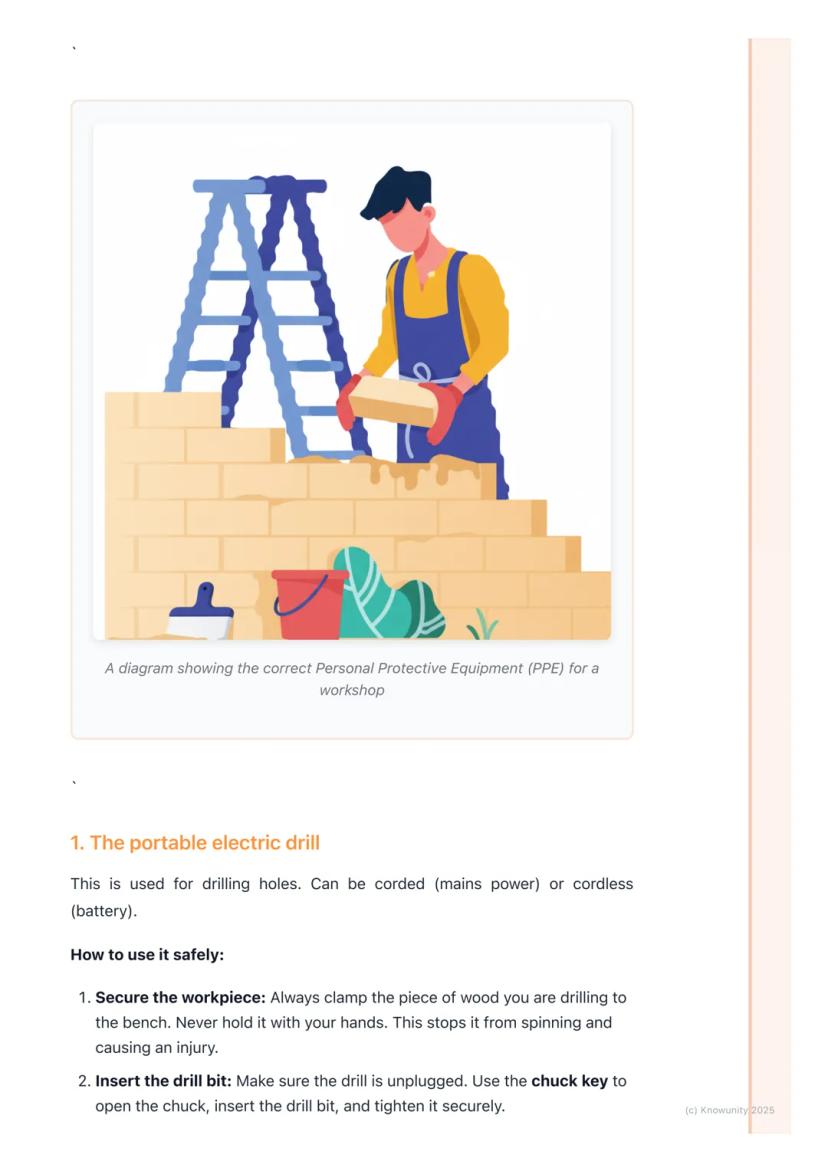
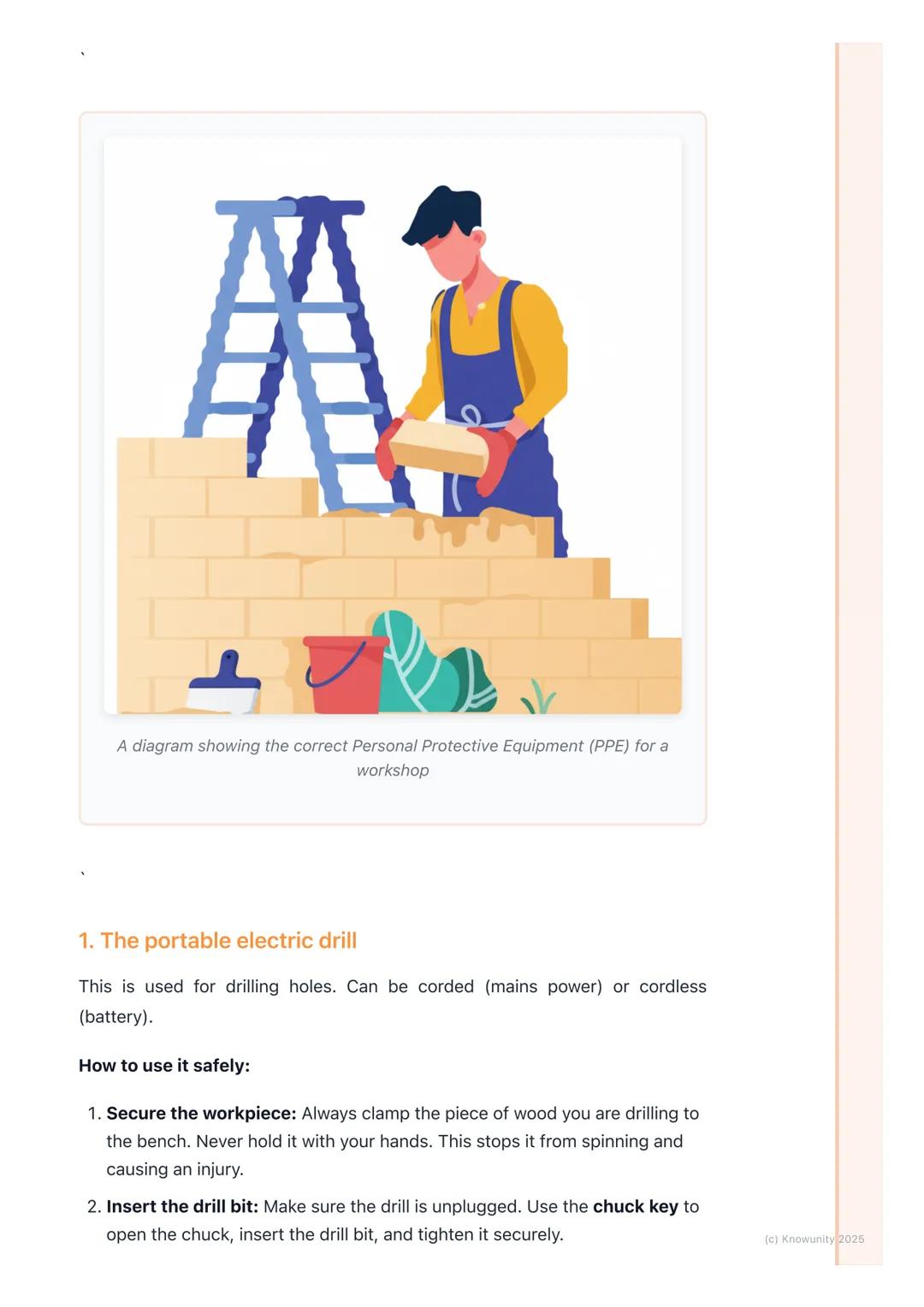
Workshop accidents happen in seconds, but following basic safety rules can prevent most of them. Personal Protective Equipment (PPE) is your first line of defence - safety glasses are absolutely essential, and you'll often need dust masks and ear defenders too.
Before touching any power tool, you need to understand what you're looking at. The guard is the protective cover over dangerous parts like blades - never remove or mess with it. Mains power tools are much more powerful than battery ones, so they need extra respect.
Kickback is when a tool suddenly jerks back towards you - this can break bones or worse. It usually happens when the tool gets jammed, so knowing how to prevent it could save you from a trip to A&E.
Remember: Every power tool accident could have been prevented by following basic safety rules. Taking shortcuts isn't worth the risk.
Drills might look simple, but they cause loads of workshop injuries when people get careless. The golden rule is simple: always clamp your workpiece to the bench. Holding wood with your hands whilst drilling is asking for a broken wrist when the drill catches.
The chuck key is your biggest safety concern with drills. After tightening your drill bit, you must remove the chuck key completely. If you forget and start the drill, that key becomes a high-speed projectile that could seriously hurt someone.
When you're actually drilling, start slowly to create a pilot hole, then increase speed gradually. Apply steady pressure but don't force it - let the drill do the work. As you're about to break through the other side, ease off to prevent splintering.
Top tip: Get into the habit of looking for the chuck key every time before you start drilling. It only takes one mistake to cause a serious accident.
Orbital sanders create clouds of fine dust that can damage your lungs, so always wear a dust mask. Like with drilling, clamp your work securely and keep the sander flat on the surface before switching on. Move slowly with the grain - rushing just creates scratches and uneven surfaces.
The scroll saw looks innocent but that fine blade moves incredibly fast. The safety guard and hold-down foot aren't suggestions - they're essential for keeping your fingers attached. Always check the blade is properly tensioned and pointing downwards before starting.
When using the scroll saw, guide the wood with both hands and keep your fingers well away from the blade path. Don't force tight turns or you'll snap the blade. If it does break, switch off immediately and get your teacher - never try to fix it yourself.
Safety check: If you can't see exactly where your fingers are at all times, you're working too close to danger zones.
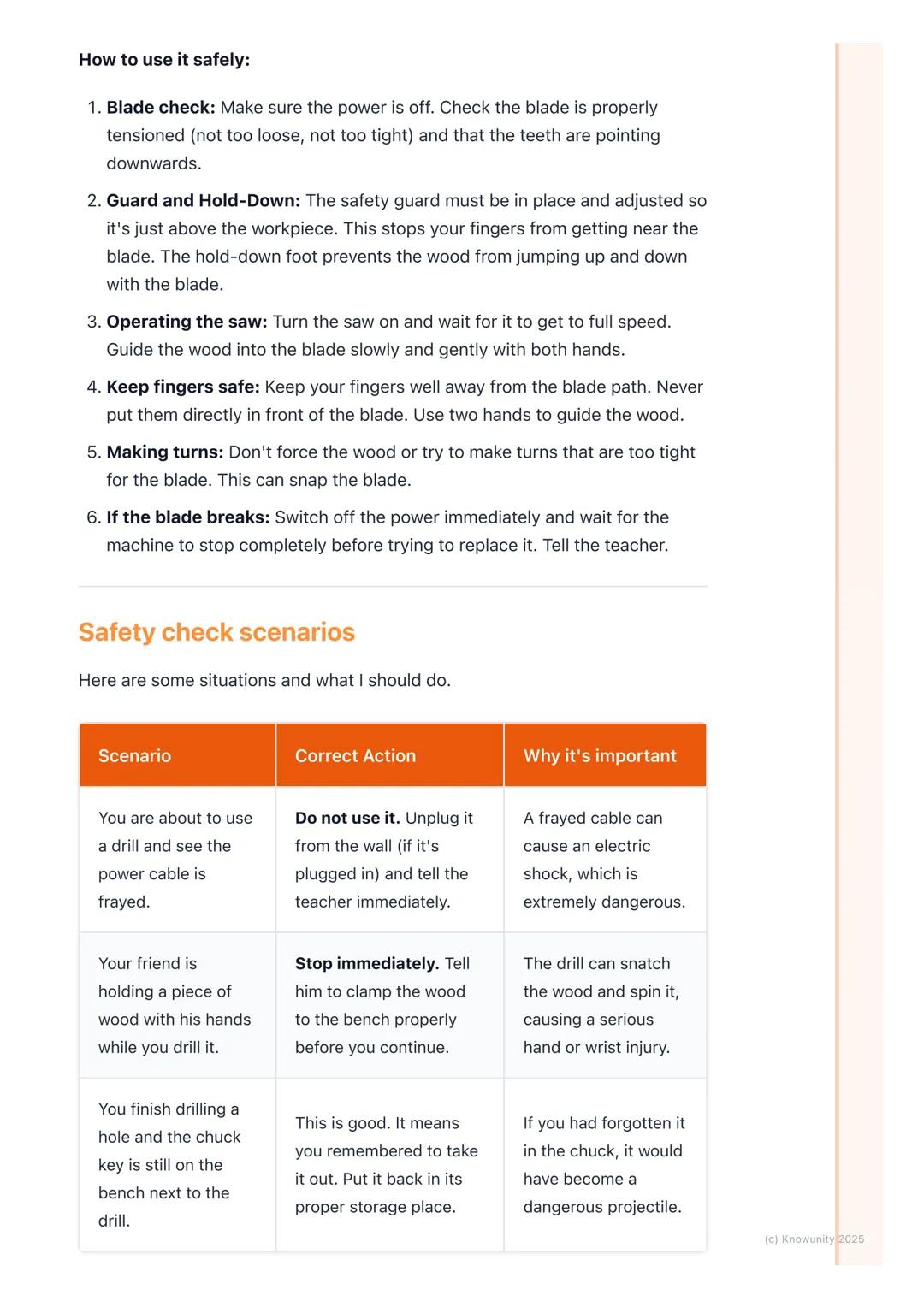
Recognising dangerous situations before accidents happen separates safe workers from accident statistics. If you spot a frayed power cable, don't even think about using that tool - unplug it and tell your teacher immediately. Electric shock can kill, and damaged cables are how it happens.
Your mates might try to rush jobs by holding wood instead of clamping it, but don't be tempted to join in. When a drill catches and spins the workpiece, hand injuries are brutal and often permanent. Taking 30 seconds to set up clamps properly isn't worth arguing about.
Concentration is just as important as protective equipment. Chat with friends before or after using power tools, not during. One moment of distraction whilst operating machinery can lead to injuries that change your life forever.
Real talk: Workshop accidents often happen to people who think they're too experienced to get hurt. Overconfidence kills - stay alert every single time.
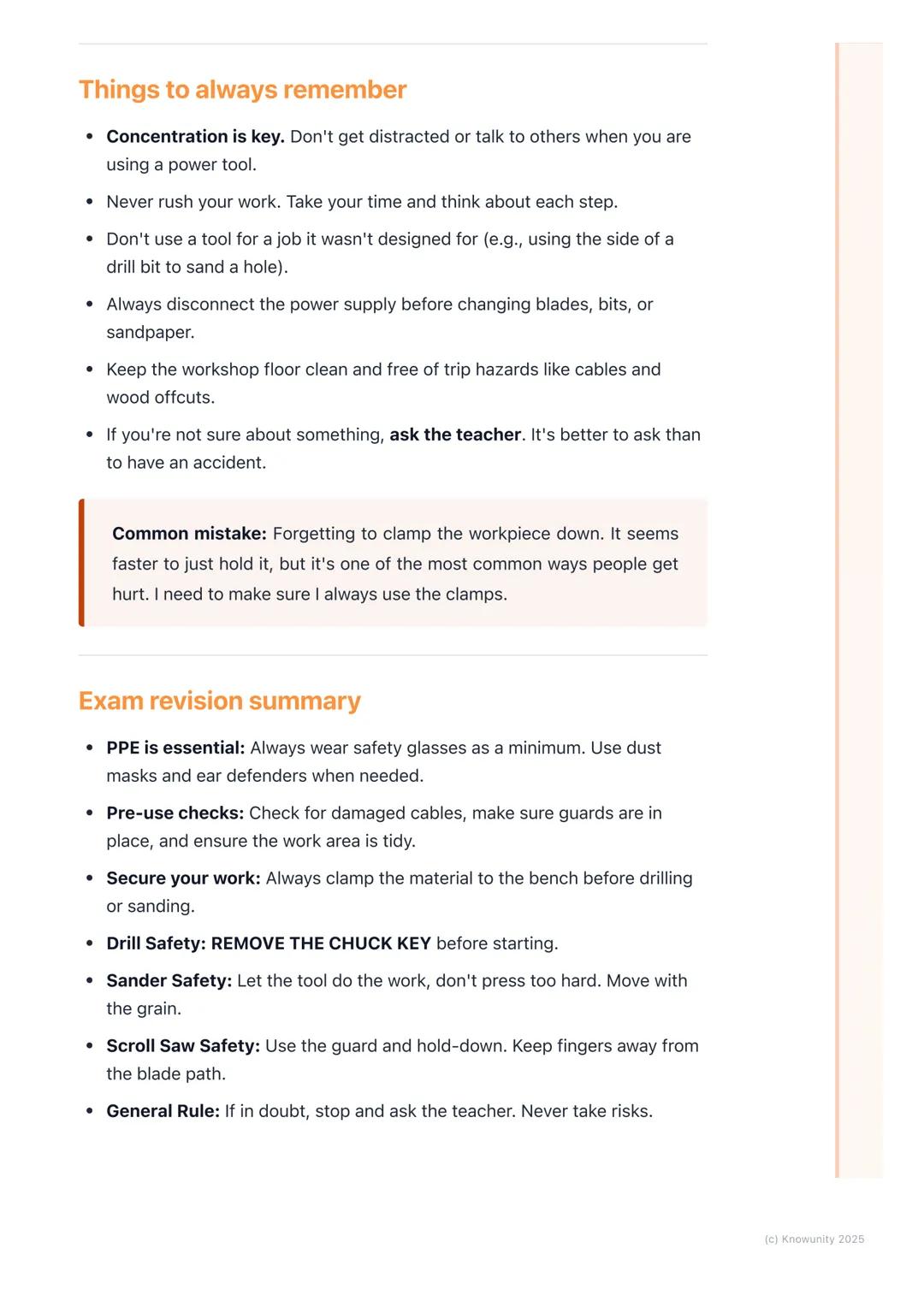
Never use any power tool for jobs it wasn't designed for - creativity in the workshop often leads to accidents. Always disconnect the mains power before changing bits, blades, or sandpaper. This simple step prevents tools from accidentally starting whilst your hands are near moving parts.
Keep your workspace clean and organised. Trailing cables and wood offcuts on the floor aren't just messy - they're trip hazards that can send you stumbling into machinery. Take two minutes to tidy up; it could prevent a lifetime of regret.
When in doubt, ask questions. Your teacher would much rather explain something twice than deal with an injured student. There's no such thing as a stupid safety question, but there are definitely stupid risks that aren't worth taking.
Exam focus: Remember the big three - clamp your work, remove chuck keys, and wear proper PPE. These simple rules prevent most workshop accidents.
Our AI companion is specifically built for the needs of students. Based on the millions of content pieces we have on the platform we can provide truly meaningful and relevant answers to students. But its not only about answers, the companion is even more about guiding students through their daily learning challenges, with personalised study plans, quizzes or content pieces in the chat and 100% personalisation based on the students skills and developments.
You can download the app in the Google Play Store and in the Apple App Store.
That's right! Enjoy free access to study content, connect with fellow students, and get instant help – all at your fingertips.
App Store
Google Play
The app is very easy to use and well designed. I have found everything I was looking for so far and have been able to learn a lot from the presentations! I will definitely use the app for a class assignment! And of course it also helps a lot as an inspiration.
Stefan S
iOS user
This app is really great. There are so many study notes and help [...]. My problem subject is French, for example, and the app has so many options for help. Thanks to this app, I have improved my French. I would recommend it to anyone.
Samantha Klich
Android user
Wow, I am really amazed. I just tried the app because I've seen it advertised many times and was absolutely stunned. This app is THE HELP you want for school and above all, it offers so many things, such as workouts and fact sheets, which have been VERY helpful to me personally.
Anna
iOS user
I think it’s very much worth it and you’ll end up using it a lot once you get the hang of it and even after looking at others notes you can still ask your Artificial intelligence buddy the question and ask to simplify it if you still don’t get it!!! In the end I think it’s worth it 😊👍 ⚠️Also DID I MENTION ITS FREEE YOU DON’T HAVE TO PAY FOR ANYTHING AND STILL GET YOUR GRADES IN PERFECTLY❗️❗️⚠️
Thomas R
iOS user
Knowunity is the BEST app I’ve used in a minute. This is not an ai review or anything this is genuinely coming from a 7th grade student (I know 2011 im young) but dude this app is a 10/10 i have maintained a 3.8 gpa and have plenty of time for gaming. I love it and my mom is just happy I got good grades
Brad T
Android user
Not only did it help me find the answer but it also showed me alternative ways to solve it. I was horrible in math and science but now I have an a in both subjects. Thanks for the help🤍🤍
David K
iOS user
The app's just great! All I have to do is enter the topic in the search bar and I get the response real fast. I don't have to watch 10 YouTube videos to understand something, so I'm saving my time. Highly recommended!
Sudenaz Ocak
Android user
In school I was really bad at maths but thanks to the app, I am doing better now. I am so grateful that you made the app.
Greenlight Bonnie
Android user
I found this app a couple years ago and it has only gotten better since then. I really love it because it can help with written questions and photo questions. Also, it can find study guides that other people have made as well as flashcard sets and practice tests. The free version is also amazing for students who might not be able to afford it. Would 100% recommend
Aubrey
iOS user
Best app if you're in Highschool or Junior high. I have been using this app for 2 school years and it's the best, it's good if you don't have anyone to help you with school work.😋🩷🎀
Marco B
iOS user
THE QUIZES AND FLASHCARDS ARE SO USEFUL AND I LOVE Knowunity AI. IT ALSO IS LITREALLY LIKE CHATGPT BUT SMARTER!! HELPED ME WITH MY MASCARA PROBLEMS TOO!! AS WELL AS MY REAL SUBJECTS ! DUHHH 😍😁😲🤑💗✨🎀😮
Elisha
iOS user
This app is phenomenal down to the correct info and the various topics you can study! I greatly recommend it for people who struggle with procrastination and those who need homework help. It has been perfectly accurate for world 1 history as far as I’ve seen! Geometry too!
Paul T
iOS user
The app is very easy to use and well designed. I have found everything I was looking for so far and have been able to learn a lot from the presentations! I will definitely use the app for a class assignment! And of course it also helps a lot as an inspiration.
Stefan S
iOS user
This app is really great. There are so many study notes and help [...]. My problem subject is French, for example, and the app has so many options for help. Thanks to this app, I have improved my French. I would recommend it to anyone.
Samantha Klich
Android user
Wow, I am really amazed. I just tried the app because I've seen it advertised many times and was absolutely stunned. This app is THE HELP you want for school and above all, it offers so many things, such as workouts and fact sheets, which have been VERY helpful to me personally.
Anna
iOS user
I think it’s very much worth it and you’ll end up using it a lot once you get the hang of it and even after looking at others notes you can still ask your Artificial intelligence buddy the question and ask to simplify it if you still don’t get it!!! In the end I think it’s worth it 😊👍 ⚠️Also DID I MENTION ITS FREEE YOU DON’T HAVE TO PAY FOR ANYTHING AND STILL GET YOUR GRADES IN PERFECTLY❗️❗️⚠️
Thomas R
iOS user
Knowunity is the BEST app I’ve used in a minute. This is not an ai review or anything this is genuinely coming from a 7th grade student (I know 2011 im young) but dude this app is a 10/10 i have maintained a 3.8 gpa and have plenty of time for gaming. I love it and my mom is just happy I got good grades
Brad T
Android user
Not only did it help me find the answer but it also showed me alternative ways to solve it. I was horrible in math and science but now I have an a in both subjects. Thanks for the help🤍🤍
David K
iOS user
The app's just great! All I have to do is enter the topic in the search bar and I get the response real fast. I don't have to watch 10 YouTube videos to understand something, so I'm saving my time. Highly recommended!
Sudenaz Ocak
Android user
In school I was really bad at maths but thanks to the app, I am doing better now. I am so grateful that you made the app.
Greenlight Bonnie
Android user
I found this app a couple years ago and it has only gotten better since then. I really love it because it can help with written questions and photo questions. Also, it can find study guides that other people have made as well as flashcard sets and practice tests. The free version is also amazing for students who might not be able to afford it. Would 100% recommend
Aubrey
iOS user
Best app if you're in Highschool or Junior high. I have been using this app for 2 school years and it's the best, it's good if you don't have anyone to help you with school work.😋🩷🎀
Marco B
iOS user
THE QUIZES AND FLASHCARDS ARE SO USEFUL AND I LOVE Knowunity AI. IT ALSO IS LITREALLY LIKE CHATGPT BUT SMARTER!! HELPED ME WITH MY MASCARA PROBLEMS TOO!! AS WELL AS MY REAL SUBJECTS ! DUHHH 😍😁😲🤑💗✨🎀😮
Elisha
iOS user
This app is phenomenal down to the correct info and the various topics you can study! I greatly recommend it for people who struggle with procrastination and those who need homework help. It has been perfectly accurate for world 1 history as far as I’ve seen! Geometry too!
Paul T
iOS user
Power tools like drills, sanders, and scroll saws can make workshop projects much easier - but they can also be seriously dangerous if you don't use them properly. Learning the safety rules isn't just about passing your woodwork class; it's... Show more
Access to all documents
Improve your grades
Join milions of students
Workshop accidents happen in seconds, but following basic safety rules can prevent most of them. Personal Protective Equipment (PPE) is your first line of defence - safety glasses are absolutely essential, and you'll often need dust masks and ear defenders too.
Before touching any power tool, you need to understand what you're looking at. The guard is the protective cover over dangerous parts like blades - never remove or mess with it. Mains power tools are much more powerful than battery ones, so they need extra respect.
Kickback is when a tool suddenly jerks back towards you - this can break bones or worse. It usually happens when the tool gets jammed, so knowing how to prevent it could save you from a trip to A&E.
Remember: Every power tool accident could have been prevented by following basic safety rules. Taking shortcuts isn't worth the risk.
Access to all documents
Improve your grades
Join milions of students
Drills might look simple, but they cause loads of workshop injuries when people get careless. The golden rule is simple: always clamp your workpiece to the bench. Holding wood with your hands whilst drilling is asking for a broken wrist when the drill catches.
The chuck key is your biggest safety concern with drills. After tightening your drill bit, you must remove the chuck key completely. If you forget and start the drill, that key becomes a high-speed projectile that could seriously hurt someone.
When you're actually drilling, start slowly to create a pilot hole, then increase speed gradually. Apply steady pressure but don't force it - let the drill do the work. As you're about to break through the other side, ease off to prevent splintering.
Top tip: Get into the habit of looking for the chuck key every time before you start drilling. It only takes one mistake to cause a serious accident.
Access to all documents
Improve your grades
Join milions of students
Orbital sanders create clouds of fine dust that can damage your lungs, so always wear a dust mask. Like with drilling, clamp your work securely and keep the sander flat on the surface before switching on. Move slowly with the grain - rushing just creates scratches and uneven surfaces.
The scroll saw looks innocent but that fine blade moves incredibly fast. The safety guard and hold-down foot aren't suggestions - they're essential for keeping your fingers attached. Always check the blade is properly tensioned and pointing downwards before starting.
When using the scroll saw, guide the wood with both hands and keep your fingers well away from the blade path. Don't force tight turns or you'll snap the blade. If it does break, switch off immediately and get your teacher - never try to fix it yourself.
Safety check: If you can't see exactly where your fingers are at all times, you're working too close to danger zones.
Access to all documents
Improve your grades
Join milions of students
Recognising dangerous situations before accidents happen separates safe workers from accident statistics. If you spot a frayed power cable, don't even think about using that tool - unplug it and tell your teacher immediately. Electric shock can kill, and damaged cables are how it happens.
Your mates might try to rush jobs by holding wood instead of clamping it, but don't be tempted to join in. When a drill catches and spins the workpiece, hand injuries are brutal and often permanent. Taking 30 seconds to set up clamps properly isn't worth arguing about.
Concentration is just as important as protective equipment. Chat with friends before or after using power tools, not during. One moment of distraction whilst operating machinery can lead to injuries that change your life forever.
Real talk: Workshop accidents often happen to people who think they're too experienced to get hurt. Overconfidence kills - stay alert every single time.
Access to all documents
Improve your grades
Join milions of students
Never use any power tool for jobs it wasn't designed for - creativity in the workshop often leads to accidents. Always disconnect the mains power before changing bits, blades, or sandpaper. This simple step prevents tools from accidentally starting whilst your hands are near moving parts.
Keep your workspace clean and organised. Trailing cables and wood offcuts on the floor aren't just messy - they're trip hazards that can send you stumbling into machinery. Take two minutes to tidy up; it could prevent a lifetime of regret.
When in doubt, ask questions. Your teacher would much rather explain something twice than deal with an injured student. There's no such thing as a stupid safety question, but there are definitely stupid risks that aren't worth taking.
Exam focus: Remember the big three - clamp your work, remove chuck keys, and wear proper PPE. These simple rules prevent most workshop accidents.
Our AI companion is specifically built for the needs of students. Based on the millions of content pieces we have on the platform we can provide truly meaningful and relevant answers to students. But its not only about answers, the companion is even more about guiding students through their daily learning challenges, with personalised study plans, quizzes or content pieces in the chat and 100% personalisation based on the students skills and developments.
You can download the app in the Google Play Store and in the Apple App Store.
That's right! Enjoy free access to study content, connect with fellow students, and get instant help – all at your fingertips.
0
Smart Tools NEW
Transform this note into: ✓ 50+ Practice Questions ✓ Interactive Flashcards ✓ Full Practice Test ✓ Essay Outlines
App Store
Google Play
The app is very easy to use and well designed. I have found everything I was looking for so far and have been able to learn a lot from the presentations! I will definitely use the app for a class assignment! And of course it also helps a lot as an inspiration.
Stefan S
iOS user
This app is really great. There are so many study notes and help [...]. My problem subject is French, for example, and the app has so many options for help. Thanks to this app, I have improved my French. I would recommend it to anyone.
Samantha Klich
Android user
Wow, I am really amazed. I just tried the app because I've seen it advertised many times and was absolutely stunned. This app is THE HELP you want for school and above all, it offers so many things, such as workouts and fact sheets, which have been VERY helpful to me personally.
Anna
iOS user
I think it’s very much worth it and you’ll end up using it a lot once you get the hang of it and even after looking at others notes you can still ask your Artificial intelligence buddy the question and ask to simplify it if you still don’t get it!!! In the end I think it’s worth it 😊👍 ⚠️Also DID I MENTION ITS FREEE YOU DON’T HAVE TO PAY FOR ANYTHING AND STILL GET YOUR GRADES IN PERFECTLY❗️❗️⚠️
Thomas R
iOS user
Knowunity is the BEST app I’ve used in a minute. This is not an ai review or anything this is genuinely coming from a 7th grade student (I know 2011 im young) but dude this app is a 10/10 i have maintained a 3.8 gpa and have plenty of time for gaming. I love it and my mom is just happy I got good grades
Brad T
Android user
Not only did it help me find the answer but it also showed me alternative ways to solve it. I was horrible in math and science but now I have an a in both subjects. Thanks for the help🤍🤍
David K
iOS user
The app's just great! All I have to do is enter the topic in the search bar and I get the response real fast. I don't have to watch 10 YouTube videos to understand something, so I'm saving my time. Highly recommended!
Sudenaz Ocak
Android user
In school I was really bad at maths but thanks to the app, I am doing better now. I am so grateful that you made the app.
Greenlight Bonnie
Android user
I found this app a couple years ago and it has only gotten better since then. I really love it because it can help with written questions and photo questions. Also, it can find study guides that other people have made as well as flashcard sets and practice tests. The free version is also amazing for students who might not be able to afford it. Would 100% recommend
Aubrey
iOS user
Best app if you're in Highschool or Junior high. I have been using this app for 2 school years and it's the best, it's good if you don't have anyone to help you with school work.😋🩷🎀
Marco B
iOS user
THE QUIZES AND FLASHCARDS ARE SO USEFUL AND I LOVE Knowunity AI. IT ALSO IS LITREALLY LIKE CHATGPT BUT SMARTER!! HELPED ME WITH MY MASCARA PROBLEMS TOO!! AS WELL AS MY REAL SUBJECTS ! DUHHH 😍😁😲🤑💗✨🎀😮
Elisha
iOS user
This app is phenomenal down to the correct info and the various topics you can study! I greatly recommend it for people who struggle with procrastination and those who need homework help. It has been perfectly accurate for world 1 history as far as I’ve seen! Geometry too!
Paul T
iOS user
The app is very easy to use and well designed. I have found everything I was looking for so far and have been able to learn a lot from the presentations! I will definitely use the app for a class assignment! And of course it also helps a lot as an inspiration.
Stefan S
iOS user
This app is really great. There are so many study notes and help [...]. My problem subject is French, for example, and the app has so many options for help. Thanks to this app, I have improved my French. I would recommend it to anyone.
Samantha Klich
Android user
Wow, I am really amazed. I just tried the app because I've seen it advertised many times and was absolutely stunned. This app is THE HELP you want for school and above all, it offers so many things, such as workouts and fact sheets, which have been VERY helpful to me personally.
Anna
iOS user
I think it’s very much worth it and you’ll end up using it a lot once you get the hang of it and even after looking at others notes you can still ask your Artificial intelligence buddy the question and ask to simplify it if you still don’t get it!!! In the end I think it’s worth it 😊👍 ⚠️Also DID I MENTION ITS FREEE YOU DON’T HAVE TO PAY FOR ANYTHING AND STILL GET YOUR GRADES IN PERFECTLY❗️❗️⚠️
Thomas R
iOS user
Knowunity is the BEST app I’ve used in a minute. This is not an ai review or anything this is genuinely coming from a 7th grade student (I know 2011 im young) but dude this app is a 10/10 i have maintained a 3.8 gpa and have plenty of time for gaming. I love it and my mom is just happy I got good grades
Brad T
Android user
Not only did it help me find the answer but it also showed me alternative ways to solve it. I was horrible in math and science but now I have an a in both subjects. Thanks for the help🤍🤍
David K
iOS user
The app's just great! All I have to do is enter the topic in the search bar and I get the response real fast. I don't have to watch 10 YouTube videos to understand something, so I'm saving my time. Highly recommended!
Sudenaz Ocak
Android user
In school I was really bad at maths but thanks to the app, I am doing better now. I am so grateful that you made the app.
Greenlight Bonnie
Android user
I found this app a couple years ago and it has only gotten better since then. I really love it because it can help with written questions and photo questions. Also, it can find study guides that other people have made as well as flashcard sets and practice tests. The free version is also amazing for students who might not be able to afford it. Would 100% recommend
Aubrey
iOS user
Best app if you're in Highschool or Junior high. I have been using this app for 2 school years and it's the best, it's good if you don't have anyone to help you with school work.😋🩷🎀
Marco B
iOS user
THE QUIZES AND FLASHCARDS ARE SO USEFUL AND I LOVE Knowunity AI. IT ALSO IS LITREALLY LIKE CHATGPT BUT SMARTER!! HELPED ME WITH MY MASCARA PROBLEMS TOO!! AS WELL AS MY REAL SUBJECTS ! DUHHH 😍😁😲🤑💗✨🎀😮
Elisha
iOS user
This app is phenomenal down to the correct info and the various topics you can study! I greatly recommend it for people who struggle with procrastination and those who need homework help. It has been perfectly accurate for world 1 history as far as I’ve seen! Geometry too!
Paul T
iOS user