
Science is the study of our world that helps us... Show more
 Science
 Irish
Irish English
 Geography
Sign up to see the contentIt's free!
Access to all documents
Improve your grades
Join milions of students
Knowunity AI
Subjects
Triangle Congruence and Similarity Theorems
Triangle Properties and Classification
Linear Equations and Graphs
Geometric Angle Relationships
Trigonometric Functions and Identities
Equation Solving Techniques
Circle Geometry Fundamentals
Division Operations and Methods
Basic Differentiation Rules
Exponent and Logarithm Properties
Show all topics
Human Organ Systems
Reproductive Cell Cycles
Biological Sciences Subdisciplines
Cellular Energy Metabolism
Autotrophic Energy Processes
Inheritance Patterns and Principles
Biomolecular Structure and Organization
Cell Cycle and Division Mechanics
Cellular Organization and Development
Biological Structural Organization
Show all topics
Chemical Sciences and Applications
Atomic Structure and Composition
Molecular Electron Structure Representation
Atomic Electron Behavior
Matter Properties and Water
Mole Concept and Calculations
Gas Laws and Behavior
Periodic Table Organization
Chemical Thermodynamics Fundamentals
Chemical Bond Types and Properties
Show all topics
European Renaissance and Enlightenment
European Cultural Movements 800-1920
American Revolution Era 1763-1797
American Civil War 1861-1865
Global Imperial Systems
Mongol and Chinese Dynasties
U.S. Presidents and World Leaders
Historical Sources and Documentation
World Wars Era and Impact
World Religious Systems
Show all topics
Classic and Contemporary Novels
Literary Character Analysis
Rhetorical Theory and Practice
Classic Literary Narratives
Reading Analysis and Interpretation
Narrative Structure and Techniques
English Language Components
Influential English-Language Authors
Basic Sentence Structure
Narrative Voice and Perspective
Show all topics
2
•
Updated May 14, 2026
•
Science is the study of our world that helps us... Show more
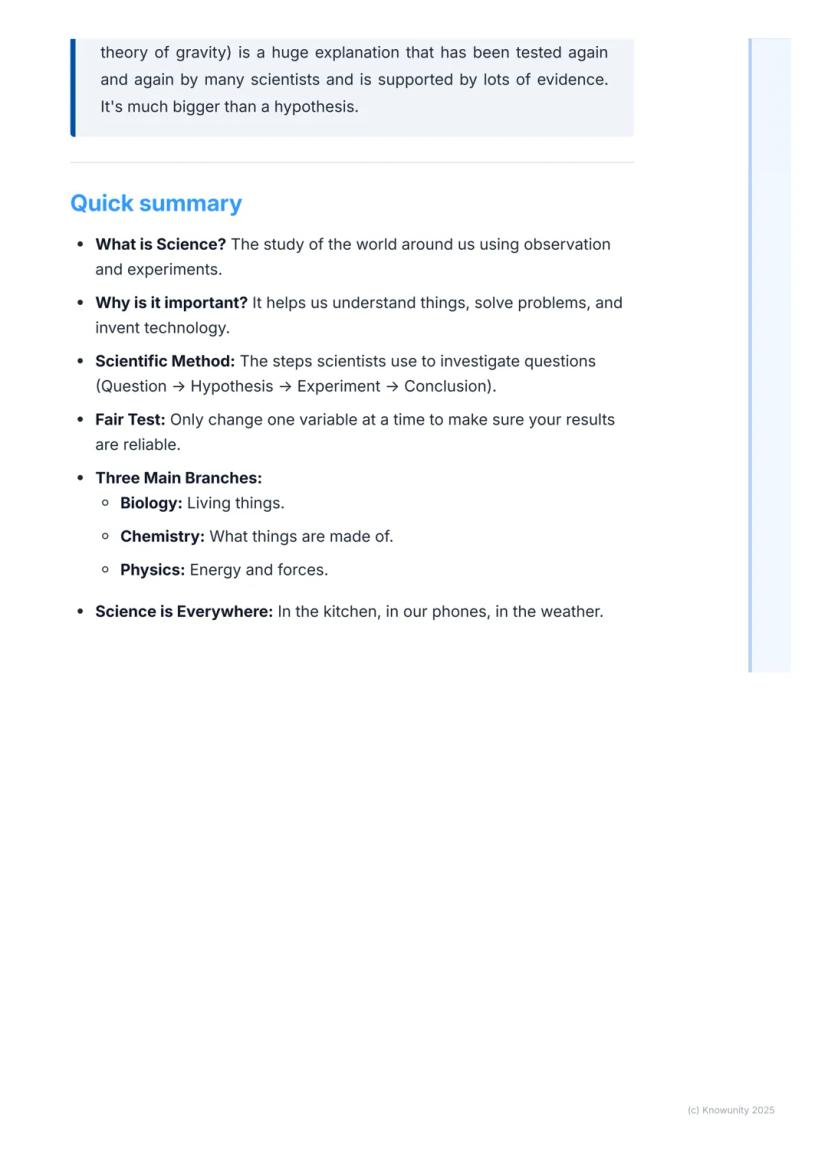
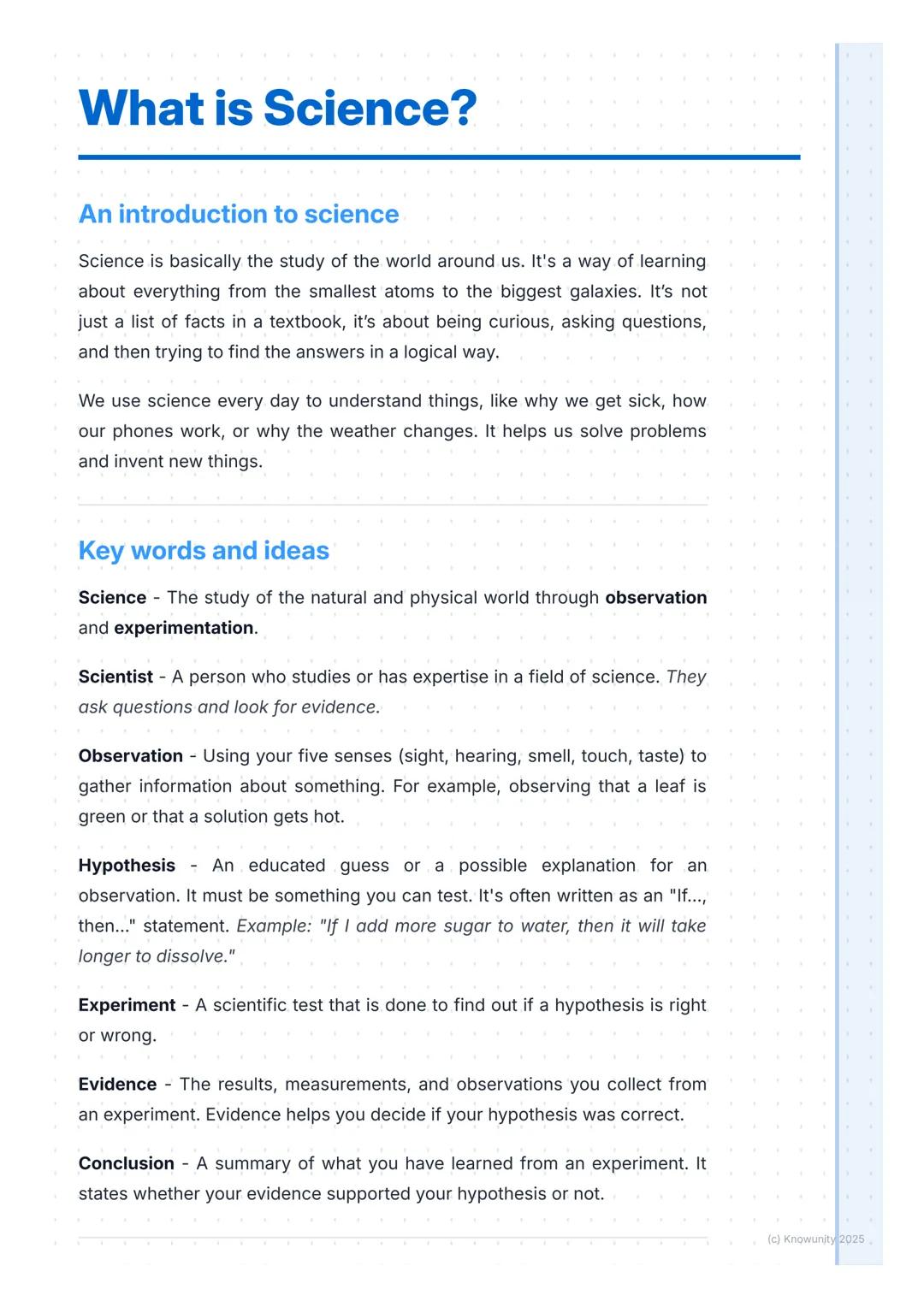
Science is all about exploring the world around us by asking questions and finding answers. When you wonder why your ice lolly melts or how birds fly, you're thinking like a scientist! It's a way of understanding everything through careful observation and testing.
Scientists are curious people who look for evidence before reaching conclusions. They use observations (information gathered using their five senses) to understand what's happening around them. For instance, noticing that leaves change colour in autumn is an observation.
When scientists have an idea about why something happens, they create a hypothesis - an educated guess that can be tested. For example: "If I water this plant more often, then it will grow taller." They then conduct an experiment to test this idea, collect evidence, and form a conclusion about whether their guess was right.
Did you know? Making mistakes is actually an important part of science! When an experiment doesn't work as expected, scientists often make their best discoveries.
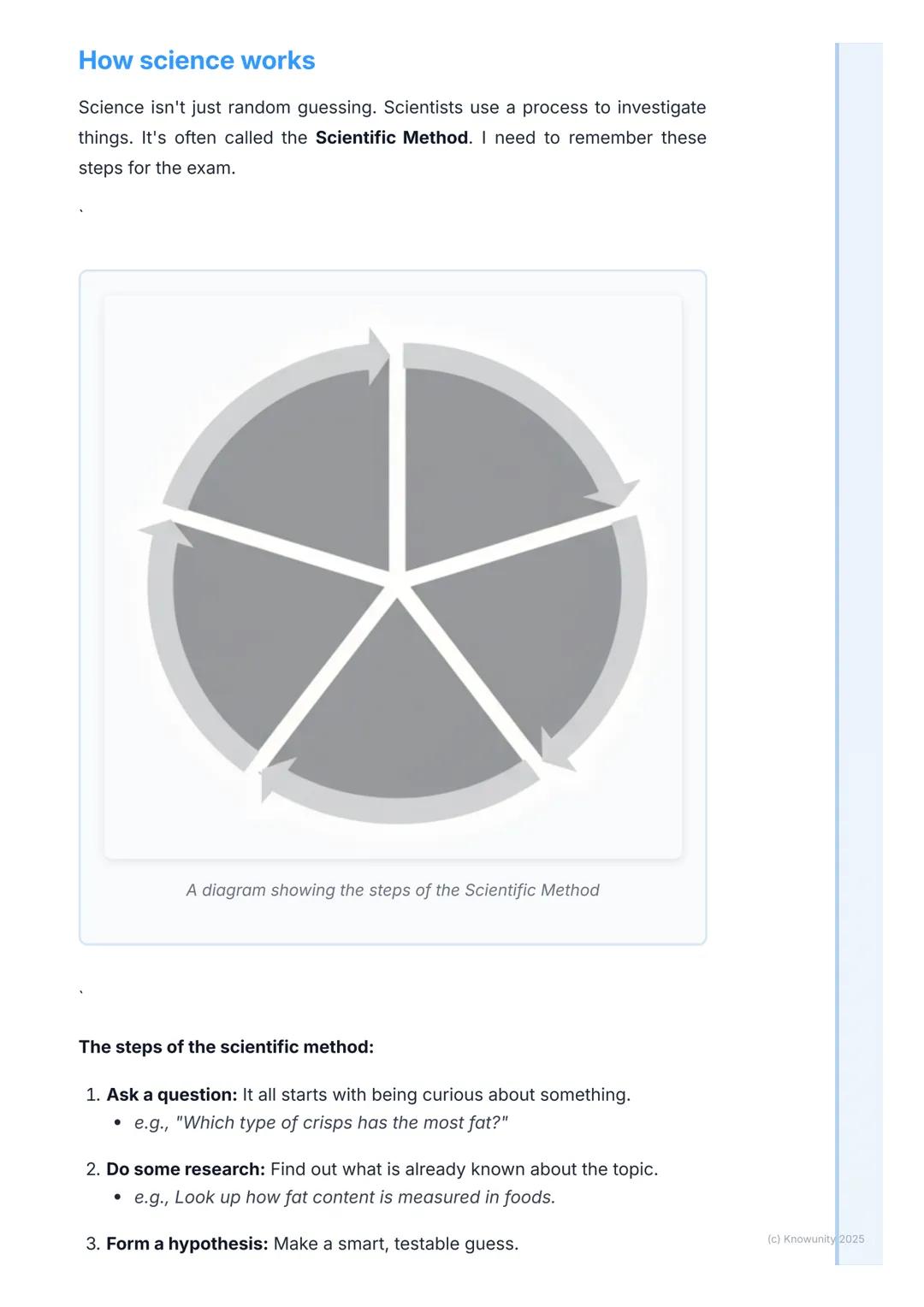
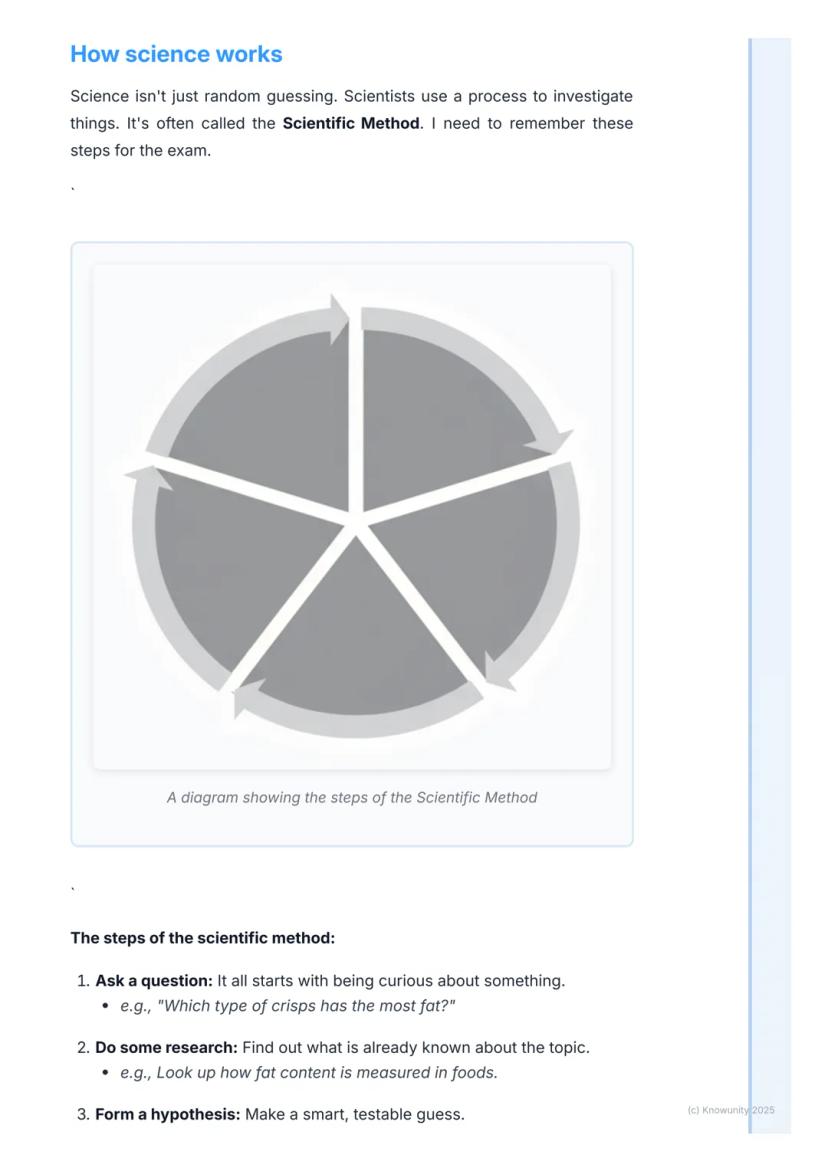
The Scientific Method is like a recipe that scientists follow to investigate questions properly. You'll need to know these steps for your exams, but don't worry - they actually make a lot of sense!
First, you ask a question about something you're curious about - like "Which type of crisps has the most fat?" Then you do some research to find out what's already known about your topic. This helps you form a hypothesis, which is your best guess at the answer - perhaps "I think cheese and onion crisps will have the most fat."
Next comes the fun part - you do an experiment to test your hypothesis. This might involve crushing different crisp types and measuring the grease spots they leave on paper. After collecting your data, you analyse your results and draw a conclusion about whether your hypothesis was correct.
Important! A fair test is crucial in science. This means only changing one thing (the variable) while keeping everything else exactly the same. Without a fair test, your results won't be reliable!
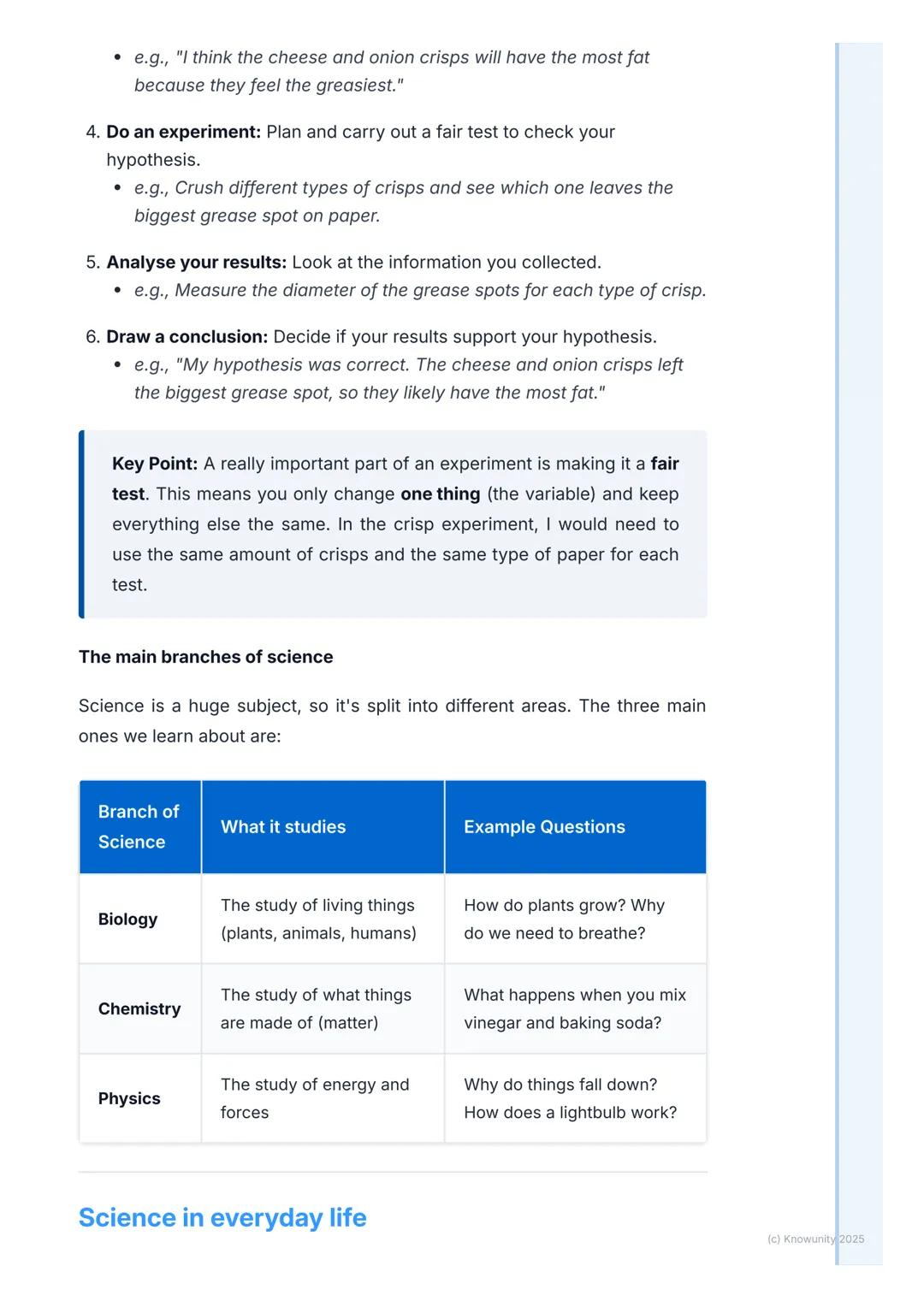
Science is so big that we divide it into three main branches to make it easier to study. Each branch focuses on different questions about our world.
Biology is all about living things. When you learn how your body works, why plants need sunlight, or how animals adapt to their environments - that's biology! Questions like "How do plants grow?" and "Why do we need to breathe?" fall under this branch.
Chemistry explores what things are made of (matter) and how substances interact. When you mix vinegar and baking soda to make a volcano eruption, you're doing chemistry! It helps explain questions like "What happens when you mix different substances?" or "How do things change state?"
Physics investigates energy and forces. It helps us understand why things fall down, how light travels, or what makes a roller coaster work. If you've ever wondered how a lightbulb works or why magnets stick together, you're thinking about physics questions.
Try this: Next time you're at home, see if you can identify which branch of science explains everyday activities like cooking, playing sports, or using technology!
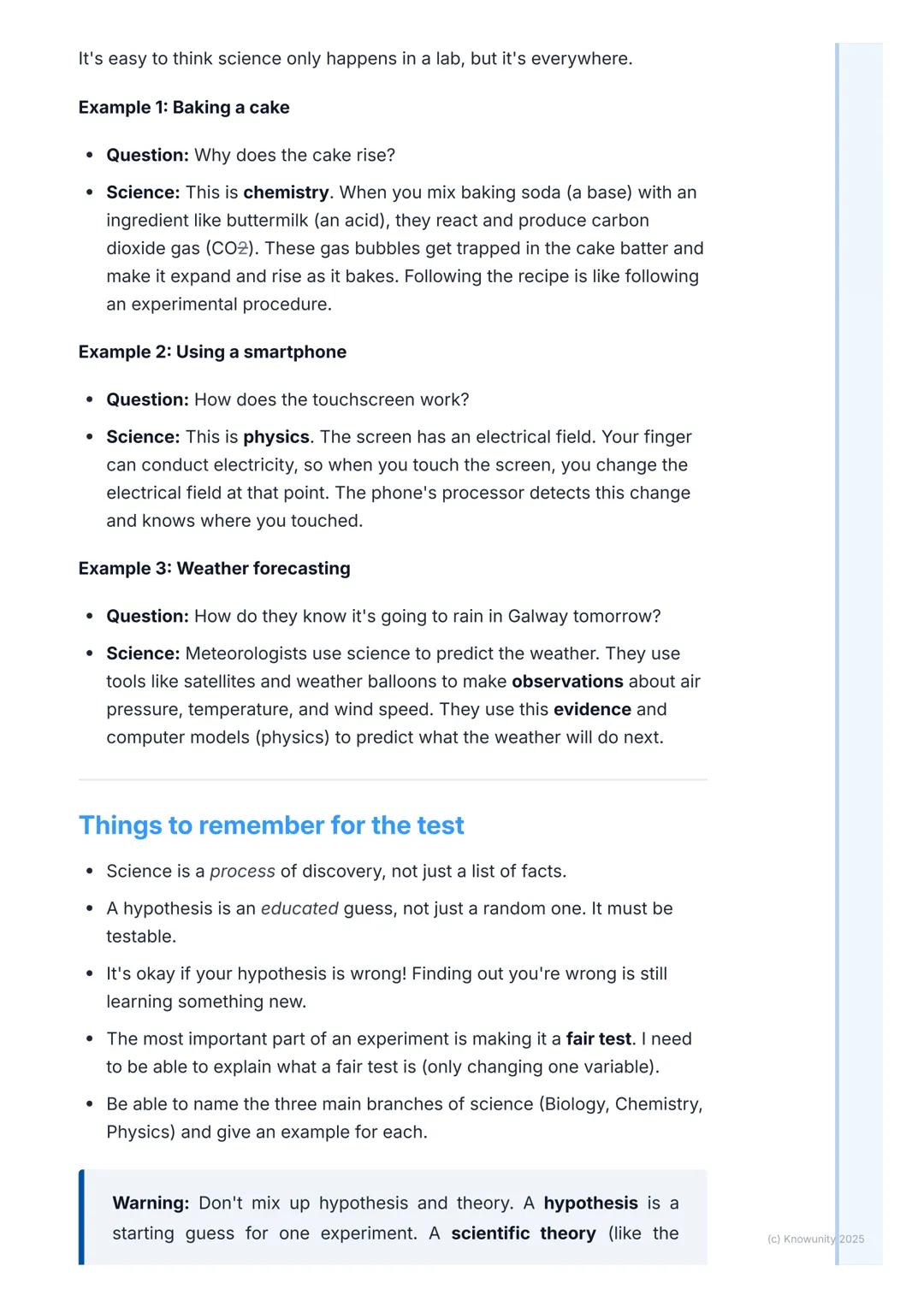
Science isn't just something that happens in laboratories with people in white coats - it's happening all around you every day!
When you're baking a cake, you're actually doing chemistry. The rising of your cake involves a chemical reaction between baking soda and acidic ingredients that produces carbon dioxide gas. These bubbles get trapped in the batter, causing it to expand as it bakes. Following your recipe is like following an experimental procedure!
Your smartphone works because of physics principles. When you touch the screen, your finger (which can conduct electricity) changes the electrical field at that point. The phone's processor detects this change and knows exactly where you touched - clever, right?
Even weather forecasting relies heavily on science. Meteorologists collect data about air pressure, temperature, and wind speed using satellites and weather balloons. They then use this evidence along with computer models to predict whether you'll need an umbrella tomorrow!
Remember: For tests, know that a hypothesis is just an educated guess for one experiment, while a scientific theory (like gravity) is a major explanation supported by loads of evidence from many scientists over time.
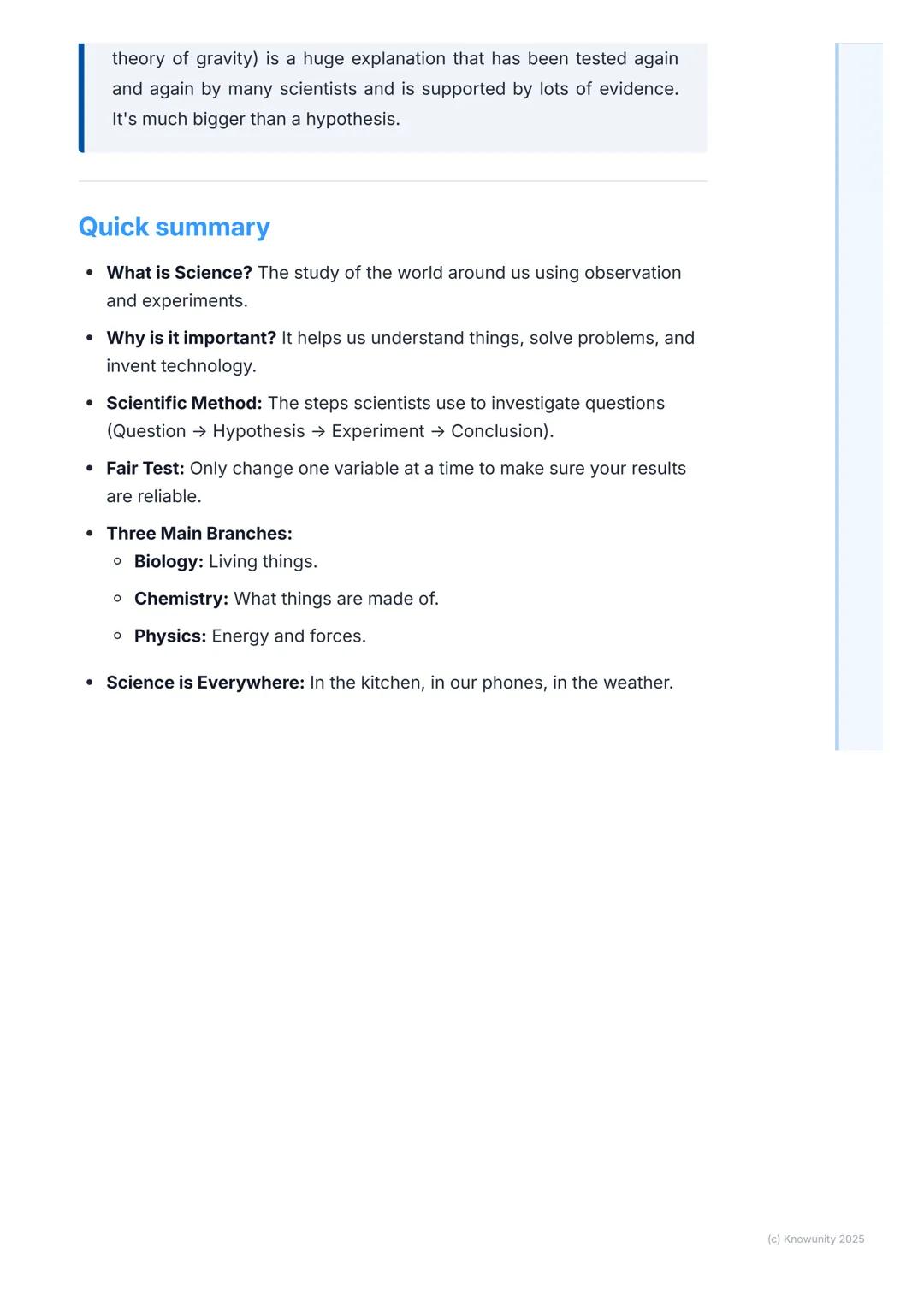
Science helps you make sense of the world through careful observation and testing. It's not just memorising facts but learning how to think critically and solve problems - skills you'll use throughout your life!
The Scientific Method gives us a reliable way to investigate questions by following logical steps: asking questions, forming hypotheses, conducting experiments, and drawing conclusions. Remember that a fair test (changing only one variable) is essential for reliable results.
Science connects to everything in your daily life - from understanding why your toast burns to how your video games work. The three main branches (Biology, Chemistry, and Physics) help us organise this vast field, but they often overlap in fascinating ways. For example, the study of how medicines work in your body combines biology and chemistry!
You've got this! Science might seem complicated at times, but remember - it started with people just being curious about the world, just like you are. Every scientist began as a student asking "why?" and "how?"
Our AI companion is specifically built for the needs of students. Based on the millions of content pieces we have on the platform we can provide truly meaningful and relevant answers to students. But its not only about answers, the companion is even more about guiding students through their daily learning challenges, with personalised study plans, quizzes or content pieces in the chat and 100% personalisation based on the students skills and developments.
You can download the app in the Google Play Store and in the Apple App Store.
That's right! Enjoy free access to study content, connect with fellow students, and get instant help – all at your fingertips.
App Store
Google Play
The app is very easy to use and well designed. I have found everything I was looking for so far and have been able to learn a lot from the presentations! I will definitely use the app for a class assignment! And of course it also helps a lot as an inspiration.
Stefan S
iOS user
This app is really great. There are so many study notes and help [...]. My problem subject is French, for example, and the app has so many options for help. Thanks to this app, I have improved my French. I would recommend it to anyone.
Samantha Klich
Android user
Wow, I am really amazed. I just tried the app because I've seen it advertised many times and was absolutely stunned. This app is THE HELP you want for school and above all, it offers so many things, such as workouts and fact sheets, which have been VERY helpful to me personally.
Anna
iOS user
I think it’s very much worth it and you’ll end up using it a lot once you get the hang of it and even after looking at others notes you can still ask your Artificial intelligence buddy the question and ask to simplify it if you still don’t get it!!! In the end I think it’s worth it 😊👍 ⚠️Also DID I MENTION ITS FREEE YOU DON’T HAVE TO PAY FOR ANYTHING AND STILL GET YOUR GRADES IN PERFECTLY❗️❗️⚠️
Thomas R
iOS user
Knowunity is the BEST app I’ve used in a minute. This is not an ai review or anything this is genuinely coming from a 7th grade student (I know 2011 im young) but dude this app is a 10/10 i have maintained a 3.8 gpa and have plenty of time for gaming. I love it and my mom is just happy I got good grades
Brad T
Android user
Not only did it help me find the answer but it also showed me alternative ways to solve it. I was horrible in math and science but now I have an a in both subjects. Thanks for the help🤍🤍
David K
iOS user
The app's just great! All I have to do is enter the topic in the search bar and I get the response real fast. I don't have to watch 10 YouTube videos to understand something, so I'm saving my time. Highly recommended!
Sudenaz Ocak
Android user
In school I was really bad at maths but thanks to the app, I am doing better now. I am so grateful that you made the app.
Greenlight Bonnie
Android user
I found this app a couple years ago and it has only gotten better since then. I really love it because it can help with written questions and photo questions. Also, it can find study guides that other people have made as well as flashcard sets and practice tests. The free version is also amazing for students who might not be able to afford it. Would 100% recommend
Aubrey
iOS user
Best app if you're in Highschool or Junior high. I have been using this app for 2 school years and it's the best, it's good if you don't have anyone to help you with school work.😋🩷🎀
Marco B
iOS user
THE QUIZES AND FLASHCARDS ARE SO USEFUL AND I LOVE Knowunity AI. IT ALSO IS LITREALLY LIKE CHATGPT BUT SMARTER!! HELPED ME WITH MY MASCARA PROBLEMS TOO!! AS WELL AS MY REAL SUBJECTS ! DUHHH 😍😁😲🤑💗✨🎀😮
Elisha
iOS user
This app is phenomenal down to the correct info and the various topics you can study! I greatly recommend it for people who struggle with procrastination and those who need homework help. It has been perfectly accurate for world 1 history as far as I’ve seen! Geometry too!
Paul T
iOS user
The app is very easy to use and well designed. I have found everything I was looking for so far and have been able to learn a lot from the presentations! I will definitely use the app for a class assignment! And of course it also helps a lot as an inspiration.
Stefan S
iOS user
This app is really great. There are so many study notes and help [...]. My problem subject is French, for example, and the app has so many options for help. Thanks to this app, I have improved my French. I would recommend it to anyone.
Samantha Klich
Android user
Wow, I am really amazed. I just tried the app because I've seen it advertised many times and was absolutely stunned. This app is THE HELP you want for school and above all, it offers so many things, such as workouts and fact sheets, which have been VERY helpful to me personally.
Anna
iOS user
I think it’s very much worth it and you’ll end up using it a lot once you get the hang of it and even after looking at others notes you can still ask your Artificial intelligence buddy the question and ask to simplify it if you still don’t get it!!! In the end I think it’s worth it 😊👍 ⚠️Also DID I MENTION ITS FREEE YOU DON’T HAVE TO PAY FOR ANYTHING AND STILL GET YOUR GRADES IN PERFECTLY❗️❗️⚠️
Thomas R
iOS user
Knowunity is the BEST app I’ve used in a minute. This is not an ai review or anything this is genuinely coming from a 7th grade student (I know 2011 im young) but dude this app is a 10/10 i have maintained a 3.8 gpa and have plenty of time for gaming. I love it and my mom is just happy I got good grades
Brad T
Android user
Not only did it help me find the answer but it also showed me alternative ways to solve it. I was horrible in math and science but now I have an a in both subjects. Thanks for the help🤍🤍
David K
iOS user
The app's just great! All I have to do is enter the topic in the search bar and I get the response real fast. I don't have to watch 10 YouTube videos to understand something, so I'm saving my time. Highly recommended!
Sudenaz Ocak
Android user
In school I was really bad at maths but thanks to the app, I am doing better now. I am so grateful that you made the app.
Greenlight Bonnie
Android user
I found this app a couple years ago and it has only gotten better since then. I really love it because it can help with written questions and photo questions. Also, it can find study guides that other people have made as well as flashcard sets and practice tests. The free version is also amazing for students who might not be able to afford it. Would 100% recommend
Aubrey
iOS user
Best app if you're in Highschool or Junior high. I have been using this app for 2 school years and it's the best, it's good if you don't have anyone to help you with school work.😋🩷🎀
Marco B
iOS user
THE QUIZES AND FLASHCARDS ARE SO USEFUL AND I LOVE Knowunity AI. IT ALSO IS LITREALLY LIKE CHATGPT BUT SMARTER!! HELPED ME WITH MY MASCARA PROBLEMS TOO!! AS WELL AS MY REAL SUBJECTS ! DUHHH 😍😁😲🤑💗✨🎀😮
Elisha
iOS user
This app is phenomenal down to the correct info and the various topics you can study! I greatly recommend it for people who struggle with procrastination and those who need homework help. It has been perfectly accurate for world 1 history as far as I’ve seen! Geometry too!
Paul T
iOS user
Science is the study of our world that helps us understand everything from atoms to galaxies. It's not just facts in a textbook but a process of being curious and finding answers through logical investigation. You use science every day,... Show more
Access to all documents
Improve your grades
Join milions of students
Science is all about exploring the world around us by asking questions and finding answers. When you wonder why your ice lolly melts or how birds fly, you're thinking like a scientist! It's a way of understanding everything through careful observation and testing.
Scientists are curious people who look for evidence before reaching conclusions. They use observations (information gathered using their five senses) to understand what's happening around them. For instance, noticing that leaves change colour in autumn is an observation.
When scientists have an idea about why something happens, they create a hypothesis - an educated guess that can be tested. For example: "If I water this plant more often, then it will grow taller." They then conduct an experiment to test this idea, collect evidence, and form a conclusion about whether their guess was right.
Did you know? Making mistakes is actually an important part of science! When an experiment doesn't work as expected, scientists often make their best discoveries.
Access to all documents
Improve your grades
Join milions of students
The Scientific Method is like a recipe that scientists follow to investigate questions properly. You'll need to know these steps for your exams, but don't worry - they actually make a lot of sense!
First, you ask a question about something you're curious about - like "Which type of crisps has the most fat?" Then you do some research to find out what's already known about your topic. This helps you form a hypothesis, which is your best guess at the answer - perhaps "I think cheese and onion crisps will have the most fat."
Next comes the fun part - you do an experiment to test your hypothesis. This might involve crushing different crisp types and measuring the grease spots they leave on paper. After collecting your data, you analyse your results and draw a conclusion about whether your hypothesis was correct.
Important! A fair test is crucial in science. This means only changing one thing (the variable) while keeping everything else exactly the same. Without a fair test, your results won't be reliable!
Access to all documents
Improve your grades
Join milions of students
Science is so big that we divide it into three main branches to make it easier to study. Each branch focuses on different questions about our world.
Biology is all about living things. When you learn how your body works, why plants need sunlight, or how animals adapt to their environments - that's biology! Questions like "How do plants grow?" and "Why do we need to breathe?" fall under this branch.
Chemistry explores what things are made of (matter) and how substances interact. When you mix vinegar and baking soda to make a volcano eruption, you're doing chemistry! It helps explain questions like "What happens when you mix different substances?" or "How do things change state?"
Physics investigates energy and forces. It helps us understand why things fall down, how light travels, or what makes a roller coaster work. If you've ever wondered how a lightbulb works or why magnets stick together, you're thinking about physics questions.
Try this: Next time you're at home, see if you can identify which branch of science explains everyday activities like cooking, playing sports, or using technology!
Access to all documents
Improve your grades
Join milions of students
Science isn't just something that happens in laboratories with people in white coats - it's happening all around you every day!
When you're baking a cake, you're actually doing chemistry. The rising of your cake involves a chemical reaction between baking soda and acidic ingredients that produces carbon dioxide gas. These bubbles get trapped in the batter, causing it to expand as it bakes. Following your recipe is like following an experimental procedure!
Your smartphone works because of physics principles. When you touch the screen, your finger (which can conduct electricity) changes the electrical field at that point. The phone's processor detects this change and knows exactly where you touched - clever, right?
Even weather forecasting relies heavily on science. Meteorologists collect data about air pressure, temperature, and wind speed using satellites and weather balloons. They then use this evidence along with computer models to predict whether you'll need an umbrella tomorrow!
Remember: For tests, know that a hypothesis is just an educated guess for one experiment, while a scientific theory (like gravity) is a major explanation supported by loads of evidence from many scientists over time.
Access to all documents
Improve your grades
Join milions of students
Science helps you make sense of the world through careful observation and testing. It's not just memorising facts but learning how to think critically and solve problems - skills you'll use throughout your life!
The Scientific Method gives us a reliable way to investigate questions by following logical steps: asking questions, forming hypotheses, conducting experiments, and drawing conclusions. Remember that a fair test (changing only one variable) is essential for reliable results.
Science connects to everything in your daily life - from understanding why your toast burns to how your video games work. The three main branches (Biology, Chemistry, and Physics) help us organise this vast field, but they often overlap in fascinating ways. For example, the study of how medicines work in your body combines biology and chemistry!
You've got this! Science might seem complicated at times, but remember - it started with people just being curious about the world, just like you are. Every scientist began as a student asking "why?" and "how?"
Our AI companion is specifically built for the needs of students. Based on the millions of content pieces we have on the platform we can provide truly meaningful and relevant answers to students. But its not only about answers, the companion is even more about guiding students through their daily learning challenges, with personalised study plans, quizzes or content pieces in the chat and 100% personalisation based on the students skills and developments.
You can download the app in the Google Play Store and in the Apple App Store.
That's right! Enjoy free access to study content, connect with fellow students, and get instant help – all at your fingertips.
0
Smart Tools NEW
Transform this note into: ✓ 50+ Practice Questions ✓ Interactive Flashcards ✓ Full Practice Test ✓ Essay Outlines
App Store
Google Play
The app is very easy to use and well designed. I have found everything I was looking for so far and have been able to learn a lot from the presentations! I will definitely use the app for a class assignment! And of course it also helps a lot as an inspiration.
Stefan S
iOS user
This app is really great. There are so many study notes and help [...]. My problem subject is French, for example, and the app has so many options for help. Thanks to this app, I have improved my French. I would recommend it to anyone.
Samantha Klich
Android user
Wow, I am really amazed. I just tried the app because I've seen it advertised many times and was absolutely stunned. This app is THE HELP you want for school and above all, it offers so many things, such as workouts and fact sheets, which have been VERY helpful to me personally.
Anna
iOS user
I think it’s very much worth it and you’ll end up using it a lot once you get the hang of it and even after looking at others notes you can still ask your Artificial intelligence buddy the question and ask to simplify it if you still don’t get it!!! In the end I think it’s worth it 😊👍 ⚠️Also DID I MENTION ITS FREEE YOU DON’T HAVE TO PAY FOR ANYTHING AND STILL GET YOUR GRADES IN PERFECTLY❗️❗️⚠️
Thomas R
iOS user
Knowunity is the BEST app I’ve used in a minute. This is not an ai review or anything this is genuinely coming from a 7th grade student (I know 2011 im young) but dude this app is a 10/10 i have maintained a 3.8 gpa and have plenty of time for gaming. I love it and my mom is just happy I got good grades
Brad T
Android user
Not only did it help me find the answer but it also showed me alternative ways to solve it. I was horrible in math and science but now I have an a in both subjects. Thanks for the help🤍🤍
David K
iOS user
The app's just great! All I have to do is enter the topic in the search bar and I get the response real fast. I don't have to watch 10 YouTube videos to understand something, so I'm saving my time. Highly recommended!
Sudenaz Ocak
Android user
In school I was really bad at maths but thanks to the app, I am doing better now. I am so grateful that you made the app.
Greenlight Bonnie
Android user
I found this app a couple years ago and it has only gotten better since then. I really love it because it can help with written questions and photo questions. Also, it can find study guides that other people have made as well as flashcard sets and practice tests. The free version is also amazing for students who might not be able to afford it. Would 100% recommend
Aubrey
iOS user
Best app if you're in Highschool or Junior high. I have been using this app for 2 school years and it's the best, it's good if you don't have anyone to help you with school work.😋🩷🎀
Marco B
iOS user
THE QUIZES AND FLASHCARDS ARE SO USEFUL AND I LOVE Knowunity AI. IT ALSO IS LITREALLY LIKE CHATGPT BUT SMARTER!! HELPED ME WITH MY MASCARA PROBLEMS TOO!! AS WELL AS MY REAL SUBJECTS ! DUHHH 😍😁😲🤑💗✨🎀😮
Elisha
iOS user
This app is phenomenal down to the correct info and the various topics you can study! I greatly recommend it for people who struggle with procrastination and those who need homework help. It has been perfectly accurate for world 1 history as far as I’ve seen! Geometry too!
Paul T
iOS user
The app is very easy to use and well designed. I have found everything I was looking for so far and have been able to learn a lot from the presentations! I will definitely use the app for a class assignment! And of course it also helps a lot as an inspiration.
Stefan S
iOS user
This app is really great. There are so many study notes and help [...]. My problem subject is French, for example, and the app has so many options for help. Thanks to this app, I have improved my French. I would recommend it to anyone.
Samantha Klich
Android user
Wow, I am really amazed. I just tried the app because I've seen it advertised many times and was absolutely stunned. This app is THE HELP you want for school and above all, it offers so many things, such as workouts and fact sheets, which have been VERY helpful to me personally.
Anna
iOS user
I think it’s very much worth it and you’ll end up using it a lot once you get the hang of it and even after looking at others notes you can still ask your Artificial intelligence buddy the question and ask to simplify it if you still don’t get it!!! In the end I think it’s worth it 😊👍 ⚠️Also DID I MENTION ITS FREEE YOU DON’T HAVE TO PAY FOR ANYTHING AND STILL GET YOUR GRADES IN PERFECTLY❗️❗️⚠️
Thomas R
iOS user
Knowunity is the BEST app I’ve used in a minute. This is not an ai review or anything this is genuinely coming from a 7th grade student (I know 2011 im young) but dude this app is a 10/10 i have maintained a 3.8 gpa and have plenty of time for gaming. I love it and my mom is just happy I got good grades
Brad T
Android user
Not only did it help me find the answer but it also showed me alternative ways to solve it. I was horrible in math and science but now I have an a in both subjects. Thanks for the help🤍🤍
David K
iOS user
The app's just great! All I have to do is enter the topic in the search bar and I get the response real fast. I don't have to watch 10 YouTube videos to understand something, so I'm saving my time. Highly recommended!
Sudenaz Ocak
Android user
In school I was really bad at maths but thanks to the app, I am doing better now. I am so grateful that you made the app.
Greenlight Bonnie
Android user
I found this app a couple years ago and it has only gotten better since then. I really love it because it can help with written questions and photo questions. Also, it can find study guides that other people have made as well as flashcard sets and practice tests. The free version is also amazing for students who might not be able to afford it. Would 100% recommend
Aubrey
iOS user
Best app if you're in Highschool or Junior high. I have been using this app for 2 school years and it's the best, it's good if you don't have anyone to help you with school work.😋🩷🎀
Marco B
iOS user
THE QUIZES AND FLASHCARDS ARE SO USEFUL AND I LOVE Knowunity AI. IT ALSO IS LITREALLY LIKE CHATGPT BUT SMARTER!! HELPED ME WITH MY MASCARA PROBLEMS TOO!! AS WELL AS MY REAL SUBJECTS ! DUHHH 😍😁😲🤑💗✨🎀😮
Elisha
iOS user
This app is phenomenal down to the correct info and the various topics you can study! I greatly recommend it for people who struggle with procrastination and those who need homework help. It has been perfectly accurate for world 1 history as far as I’ve seen! Geometry too!
Paul T
iOS user