
Ever wondered why things fall down instead of floating away? ...
 Physics4 views·Updated Jun 9, 2026·5 pages
The Science of Gravity: How It Shapes Our World
1 / 5
1
of 5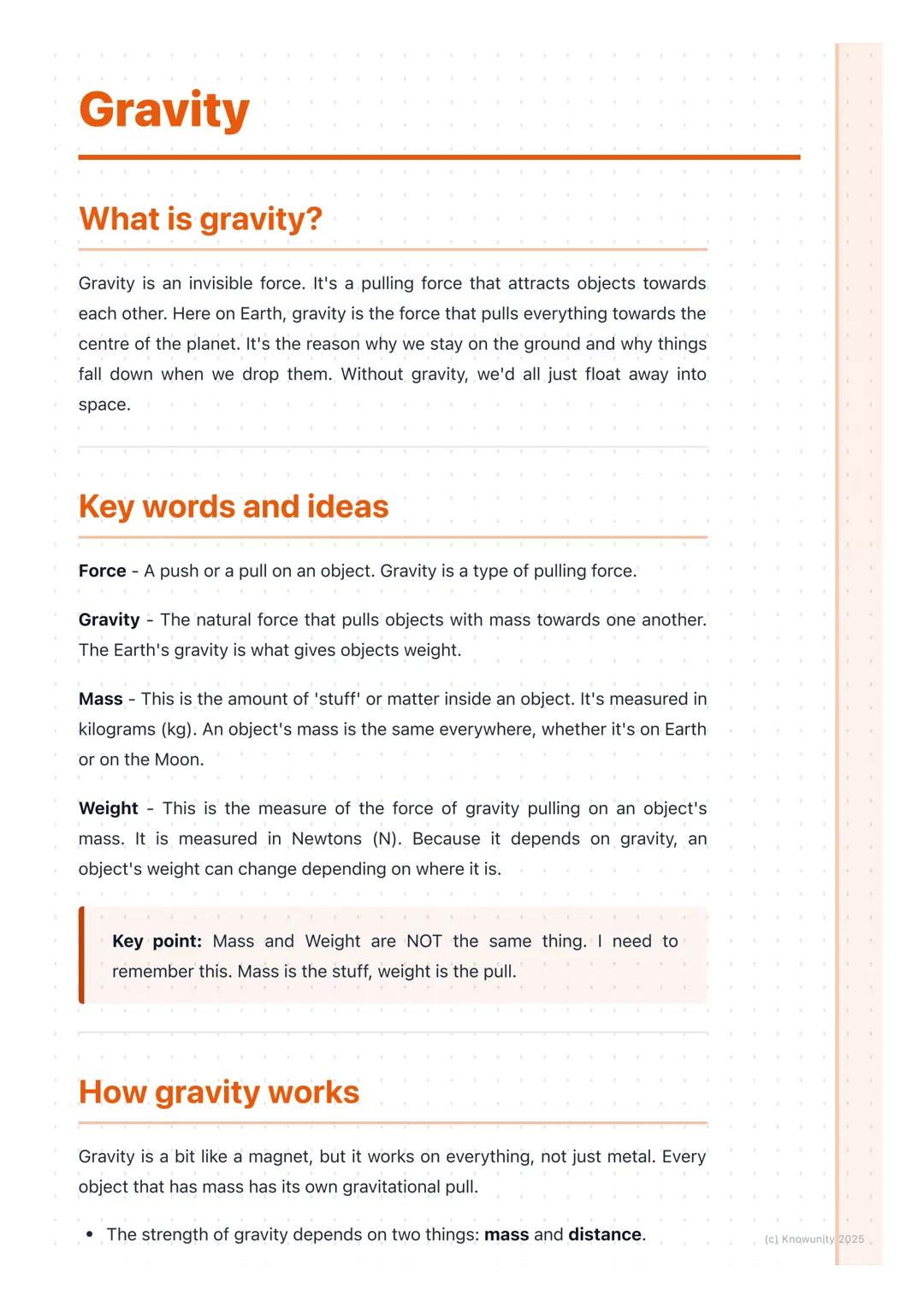
What is Gravity?
Think of gravity as nature's invisible magnet that works on everything, not just metal. It's a pulling force that attracts objects towards each other, and here on Earth, it pulls everything towards the planet's centre.
Without gravity, you'd literally float away into space! Every time you drop your phone or kick a football, you're seeing gravity in action.
Mass and weight might sound like the same thing, but they're completely different. Mass is the amount of stuff inside an object (measured in kilograms), and it never changes whether you're on Earth or the Moon. Weight is how hard gravity pulls on that mass (measured in Newtons), and this can change depending on where you are.
Quick Tip: Remember it this way - mass is the stuff, weight is the pull!
2
of 5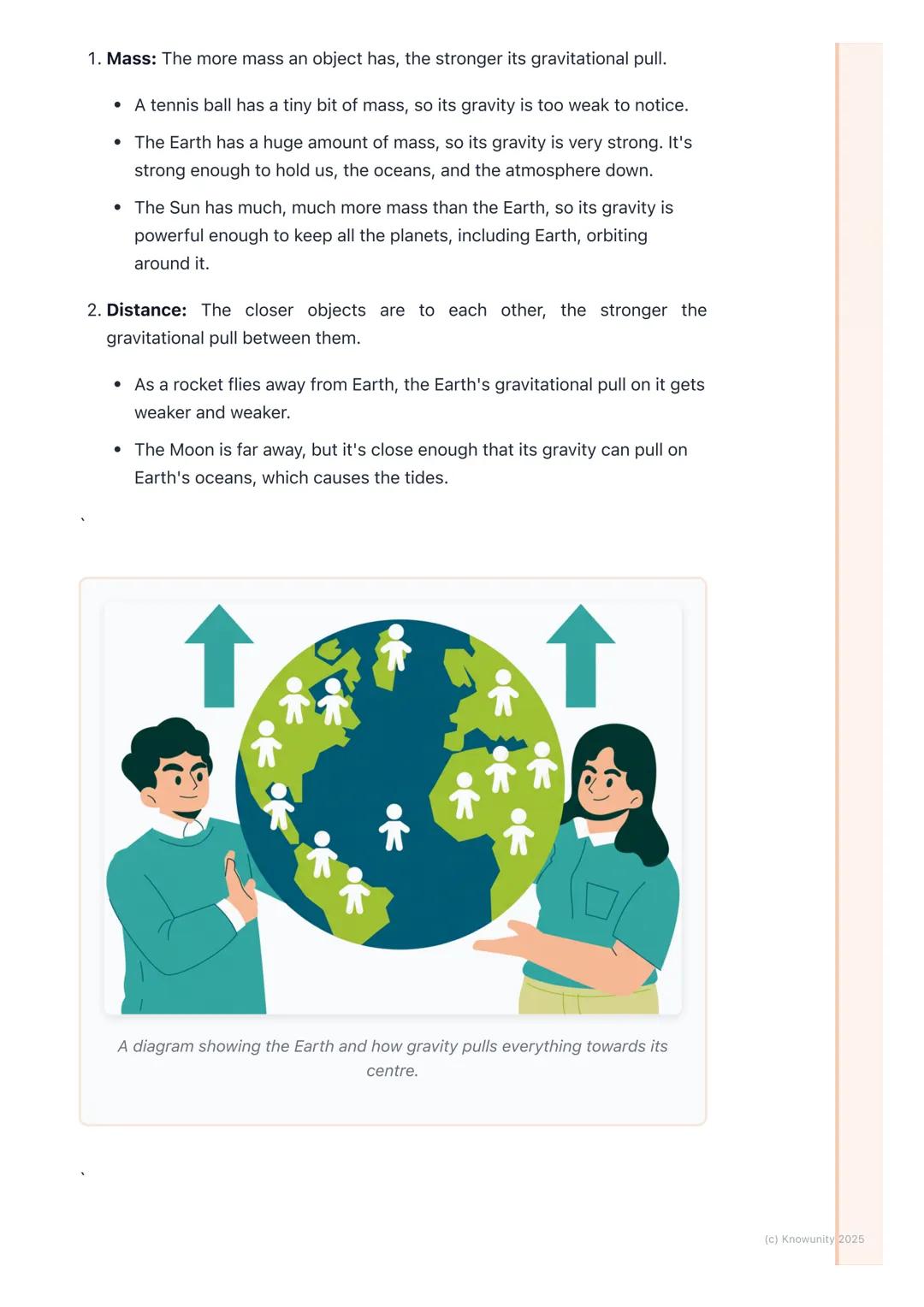
How Gravity Works
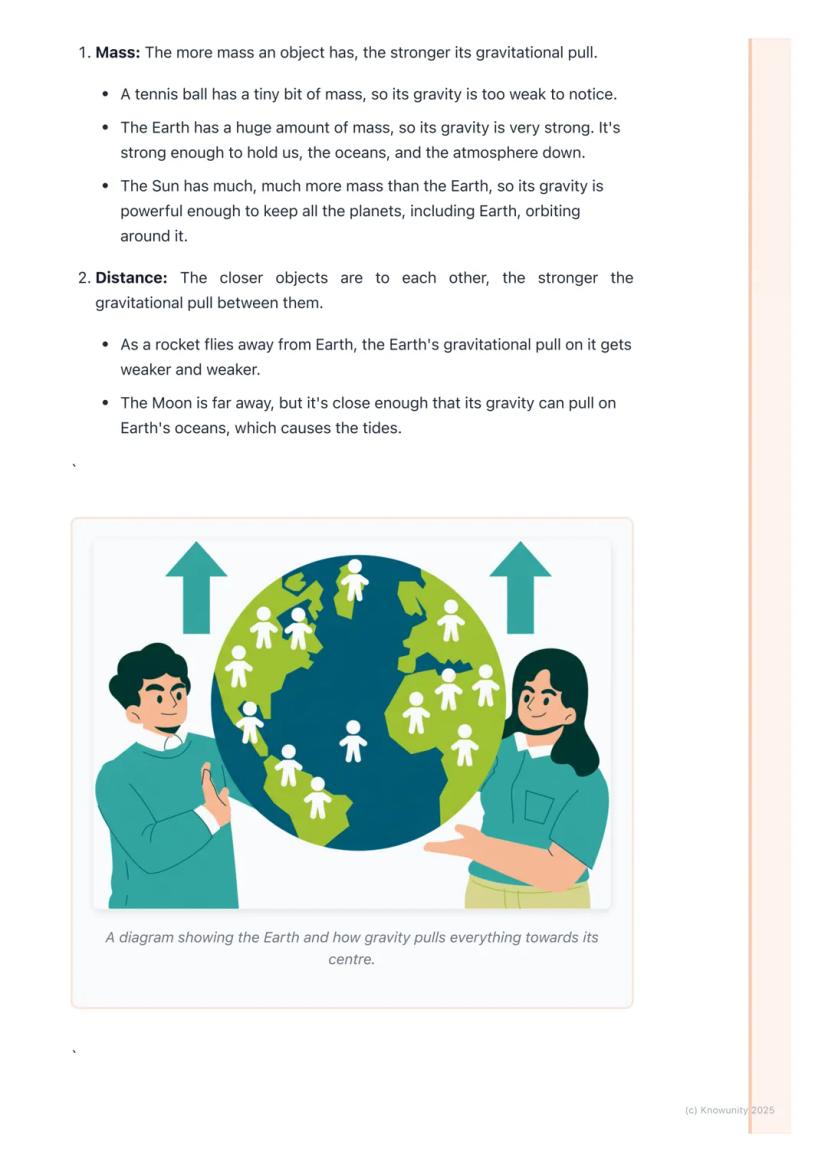
Gravity's strength depends on two main things: mass and distance. The more massive something is, the stronger its gravitational pull becomes.
A tennis ball has such tiny mass that its gravity is too weak to notice. Earth has enormous mass, so its gravity easily holds down oceans, the atmosphere, and us! The Sun's gravity is so powerful it keeps all the planets orbiting around it.
Distance matters too - the closer objects are, the stronger gravity pulls them together. As rockets fly away from Earth, they feel less and less gravitational pull. The Moon is far away, but close enough that its gravity still tugs on our oceans, creating the tides.
Fun Fact: When you drop an apple, both the apple and Earth are actually pulling on each other - Earth's pull is just massively stronger!
3
of 5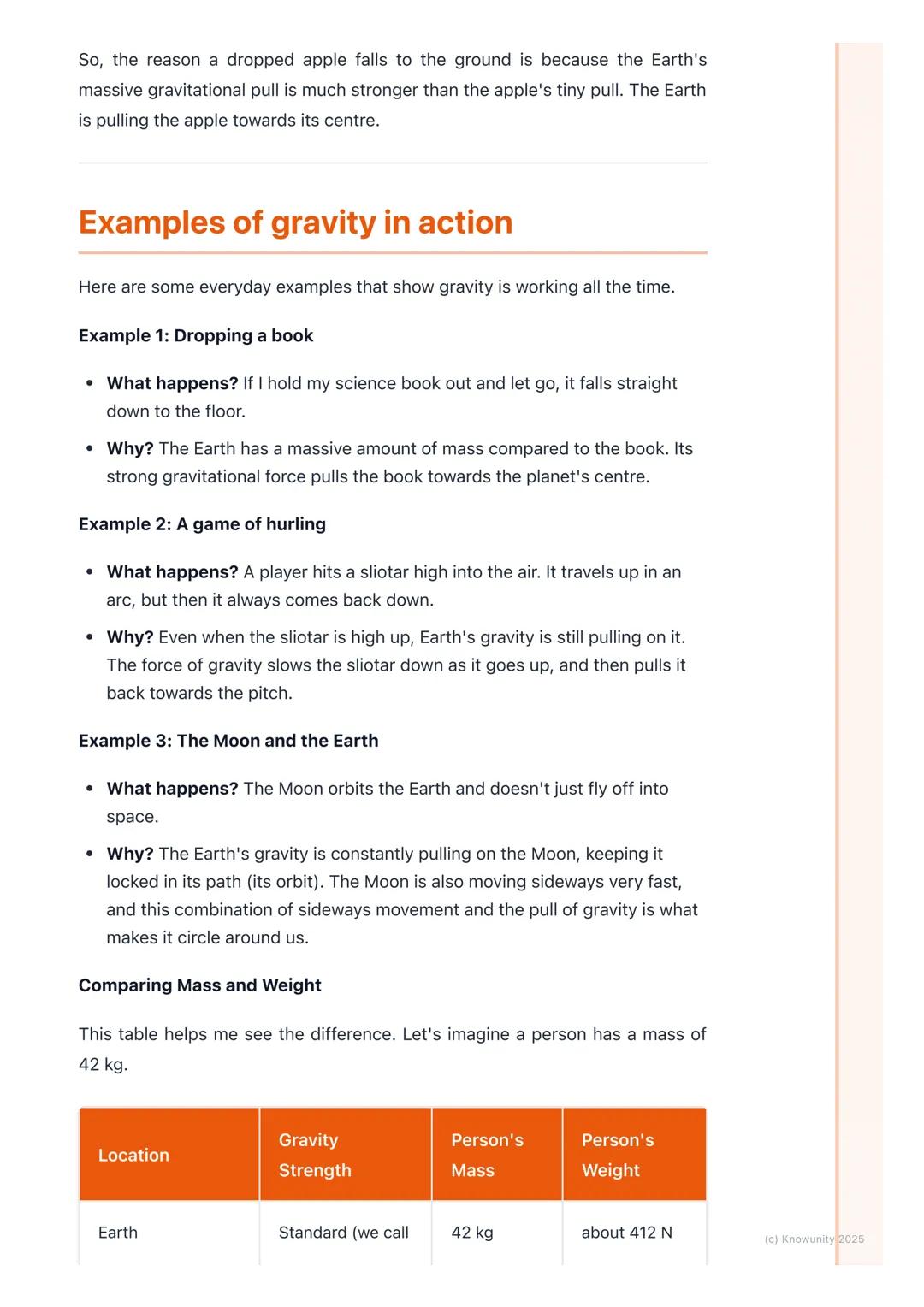
Gravity in Everyday Life
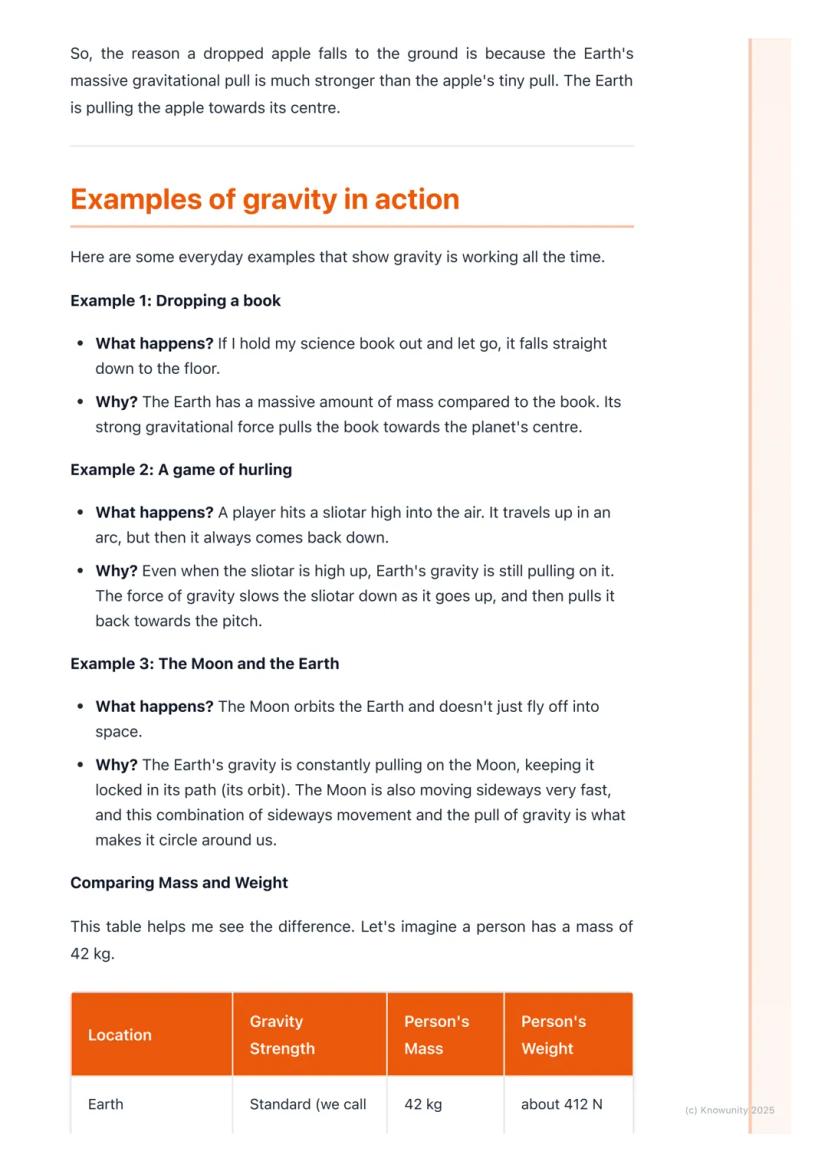
You can spot gravity working everywhere once you know what to look for. Drop a book and it falls straight down because Earth's massive gravitational force overpowers the book's tiny pull.
Watch a hurling match and you'll see gravity in action every time someone strikes the sliotar. The ball flies up in an arc, but gravity constantly pulls it back down to the pitch. Even when the ball is high in the air, Earth's gravity is still working on it.
The Moon orbiting Earth is another brilliant example. Earth's gravity constantly pulls on the Moon, stopping it from flying off into space. The Moon moves sideways very fast, and this combination of sideways movement plus gravity's pull creates the circular orbit we see.
Remember: Gravity is always a pulling force, never a pushing one!
4
of 5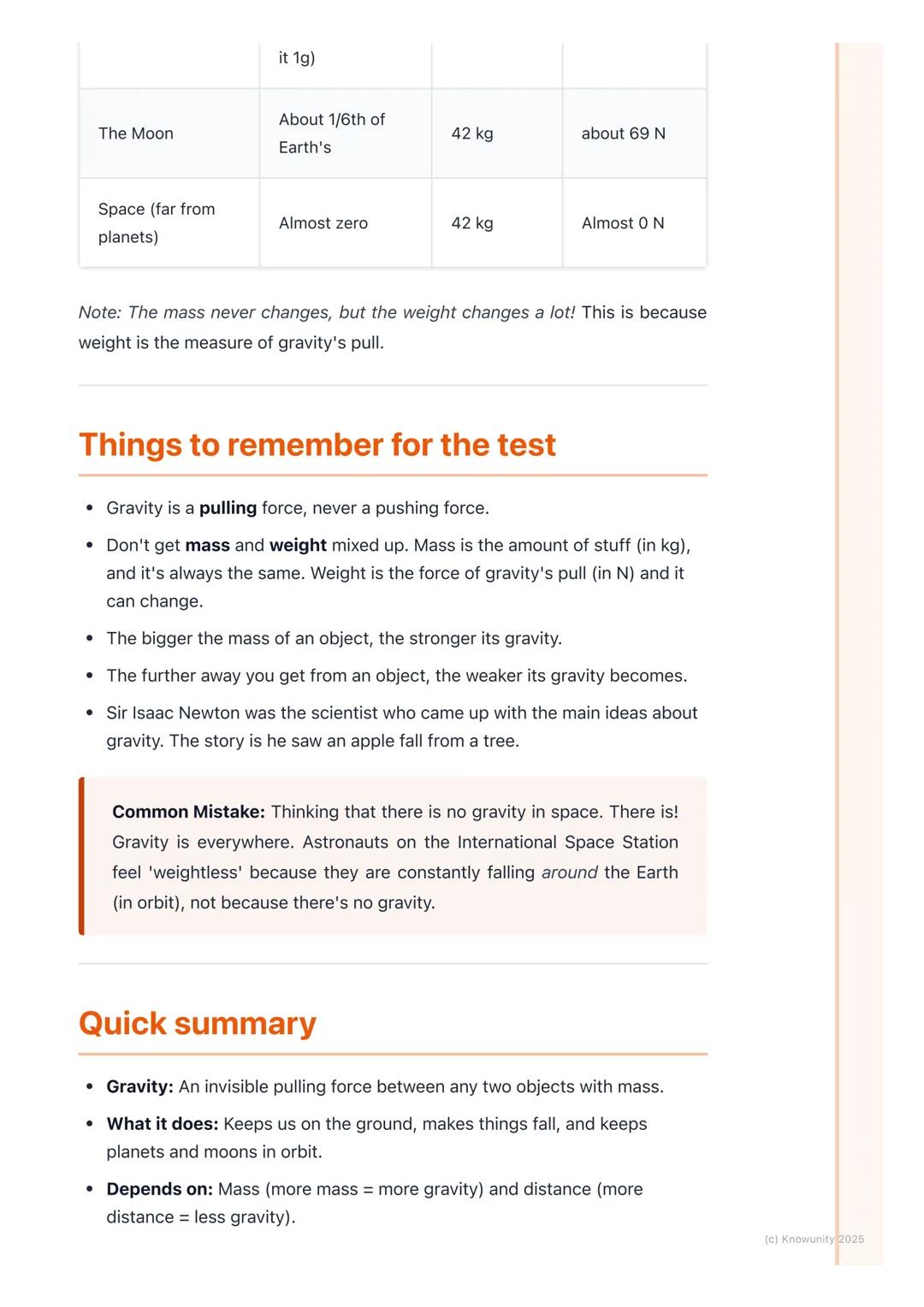
Mass vs Weight Comparison
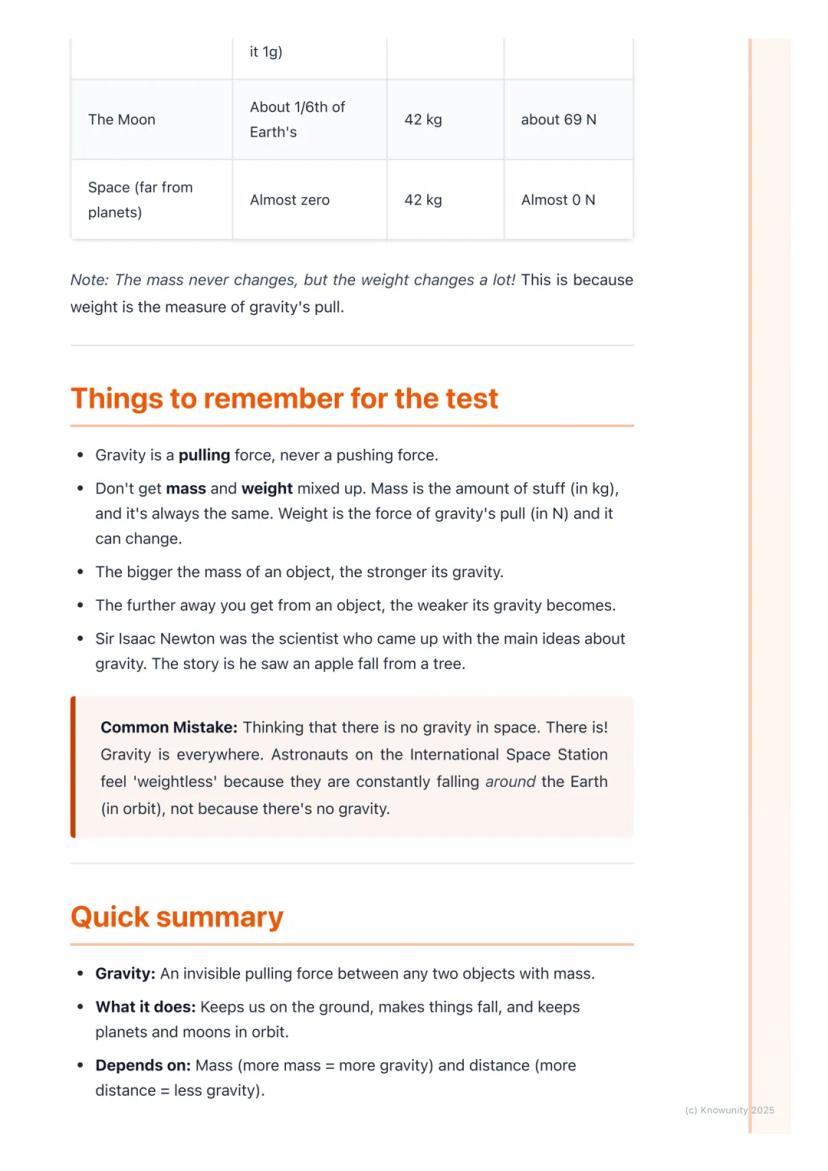
Here's where things get interesting! Imagine a person with a mass of 42 kg travelling to different places. Their mass stays exactly the same everywhere, but their weight changes dramatically.
On Earth, they'd weigh about 412 Newtons. On the Moon, where gravity is about one-sixth as strong, they'd only weigh about 69 Newtons - but their mass is still 42 kg! In deep space, far from any planets, they'd be almost weightless but still have the same 42 kg of mass.
This is why astronauts on the International Space Station float around. They're not escaping gravity - they're constantly falling around Earth in orbit! The feeling of weightlessness comes from being in free fall, not from a lack of gravity.
Test Tip: Don't confuse mass (always the same, measured in kg) with weight (changes with gravity, measured in Newtons)!
5
of 5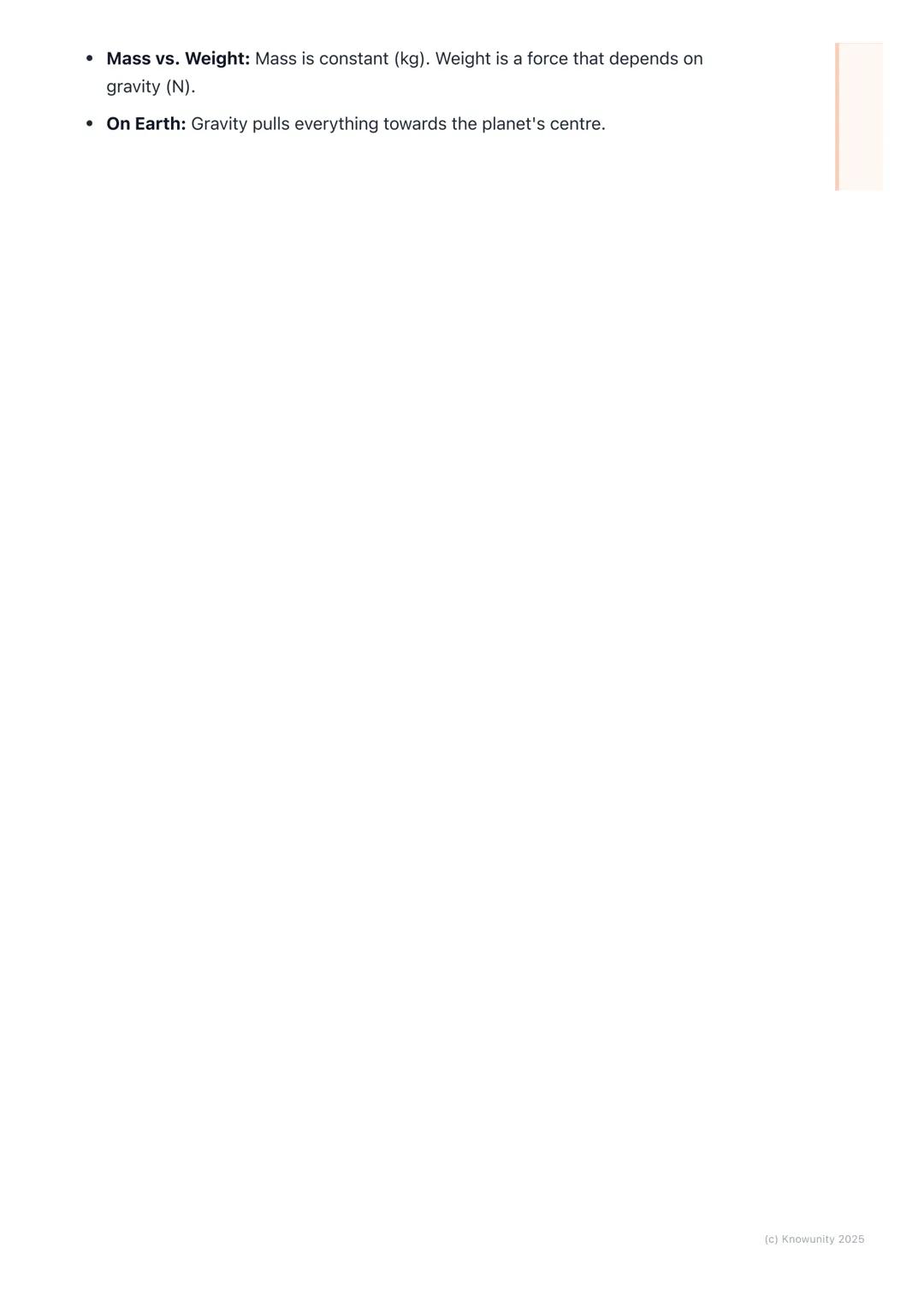
Key Points for Success
Gravity affects everything with mass, and its strength depends on how much mass objects have and how far apart they are. More mass means stronger gravity, whilst greater distance means weaker gravity.
Remember that gravity exists everywhere in space - it's not just an Earth thing! Planets, stars, and even you have gravitational pull, though yours is too weak to notice.
The story goes that Sir Isaac Newton figured out gravity's laws after watching an apple fall from a tree. Whether that's true or not, he definitely gave us the scientific understanding we use today.
Common Mistake Alert: There's still gravity in space! Astronauts feel weightless because they're orbiting (constantly falling around Earth), not because gravity disappears.
We thought you’d never ask...
What is the Knowunity AI companion?
Our AI companion is specifically built for the needs of students. Based on the millions of content pieces we have on the platform we can provide truly meaningful and relevant answers to students. But its not only about answers, the companion is even more about guiding students through their daily learning challenges, with personalised study plans, quizzes or content pieces in the chat and 100% personalisation based on the students skills and developments.
Where can I download the Knowunity app?
You can download the app in the Google Play Store and in the Apple App Store.
Is Knowunity really free of charge?
That's right! Enjoy free access to study content, connect with fellow students, and get instant help – all at your fingertips.
Most popular content in Physics
3PhysicsBalanced and Unbalanced Forces
Students will explore how balanced forces result in no change in motion, while unbalanced forces cause an object to accelerate or change direction.
2nd Year522
PhysicsTypes of Forces
Students will identify common forces such as gravity (pulling objects down), friction (opposing motion), and air resistance (slowing objects in the air).
2nd Year550
 Science
Science/Physics notes - Speed, density, work
Speed density work formulas
3rd Year81
Most popular content
9 Irish
IrishIrish oral questions and answers
Questions and answers for the leaving cert oral
5th Year4264
 English
Key Quotes : Sive
Key Quotes and explanations: Sive
6th Year2842
IrishIrish oral questions
Outline of oral questions
5th Year2055
IrishIníon- le hÁine Durkin
Aine Durkin’s poem, Iníon: Themes & summary
5th Year850
IrishIrish poetry 2027
Iníon + Dínit an Bhróin
5th Year1133
IrishLC HL notes- Iníon (poem)
Includes poem in English and Irish, theme, key words & phrases
5th Year2284
EnglishCultural Context : Shawshank Redemption : Sive : Small Things Like These
Comparative Study : Cultural Context : Shawshank Redemption, Sive and Small Things Like These
6th Year1430
IrishMo Ghrá-sa (Idir Lúibíní)
Notes on mo ghrá-sa
5th Year380
IrishAn Gaeilge Aiste
Irish Language essay
6th Year1320
Can't find what you're looking for? Explore other subjects.
Students love us — and so will you.
4.6/5App Store
4.7/5Google Play
The app is very easy to use and well designed. I have found everything I was looking for so far and have been able to learn a lot from the presentations! I will definitely use the app for a class assignment! And of course it also helps a lot as an inspiration.
Stefan SiOS user
This app is really great. There are so many study notes and help [...]. My problem subject is French, for example, and the app has so many options for help. Thanks to this app, I have improved my French. I would recommend it to anyone.
Samantha KlichAndroid user
Wow, I am really amazed. I just tried the app because I've seen it advertised many times and was absolutely stunned. This app is THE HELP you want for school and above all, it offers so many things, such as workouts and fact sheets, which have been VERY helpful to me personally.
AnnaiOS user
Physics4 views·Updated Jun 9, 2026·5 pagesThe Science of Gravity: How It Shapes Our World
Ever wondered why things fall down instead of floating away? Gravityis the invisible force that keeps your feet on the ground and makes dropped objects fall. It's working all around us every single day, from keeping the Moon in...
1
of 5
Sign up to see the content. It's free!
- Access to all documents
- Improve your grades
- Join milions of students
What is Gravity?
Think of gravity as nature's invisible magnet that works on everything, not just metal. It's a pulling force that attracts objects towards each other, and here on Earth, it pulls everything towards the planet's centre.
Without gravity, you'd literally float away into space! Every time you drop your phone or kick a football, you're seeing gravity in action.
Mass and weight might sound like the same thing, but they're completely different. Mass is the amount of stuff inside an object (measured in kilograms), and it never changes whether you're on Earth or the Moon. Weight is how hard gravity pulls on that mass (measured in Newtons), and this can change depending on where you are.
Quick Tip: Remember it this way - mass is the stuff, weight is the pull!
2
of 5Sign up to see the content. It's free!
- Access to all documents
- Improve your grades
- Join milions of students
How Gravity Works
Gravity's strength depends on two main things: mass and distance. The more massive something is, the stronger its gravitational pull becomes.
A tennis ball has such tiny mass that its gravity is too weak to notice. Earth has enormous mass, so its gravity easily holds down oceans, the atmosphere, and us! The Sun's gravity is so powerful it keeps all the planets orbiting around it.
Distance matters too - the closer objects are, the stronger gravity pulls them together. As rockets fly away from Earth, they feel less and less gravitational pull. The Moon is far away, but close enough that its gravity still tugs on our oceans, creating the tides.
Fun Fact: When you drop an apple, both the apple and Earth are actually pulling on each other - Earth's pull is just massively stronger!
3
of 5Sign up to see the content. It's free!
- Access to all documents
- Improve your grades
- Join milions of students
Gravity in Everyday Life
You can spot gravity working everywhere once you know what to look for. Drop a book and it falls straight down because Earth's massive gravitational force overpowers the book's tiny pull.
Watch a hurling match and you'll see gravity in action every time someone strikes the sliotar. The ball flies up in an arc, but gravity constantly pulls it back down to the pitch. Even when the ball is high in the air, Earth's gravity is still working on it.
The Moon orbiting Earth is another brilliant example. Earth's gravity constantly pulls on the Moon, stopping it from flying off into space. The Moon moves sideways very fast, and this combination of sideways movement plus gravity's pull creates the circular orbit we see.
Remember: Gravity is always a pulling force, never a pushing one!
4
of 5Sign up to see the content. It's free!
- Access to all documents
- Improve your grades
- Join milions of students
Mass vs Weight Comparison
Here's where things get interesting! Imagine a person with a mass of 42 kg travelling to different places. Their mass stays exactly the same everywhere, but their weight changes dramatically.
On Earth, they'd weigh about 412 Newtons. On the Moon, where gravity is about one-sixth as strong, they'd only weigh about 69 Newtons - but their mass is still 42 kg! In deep space, far from any planets, they'd be almost weightless but still have the same 42 kg of mass.
This is why astronauts on the International Space Station float around. They're not escaping gravity - they're constantly falling around Earth in orbit! The feeling of weightlessness comes from being in free fall, not from a lack of gravity.
Test Tip: Don't confuse mass (always the same, measured in kg) with weight (changes with gravity, measured in Newtons)!
5
of 5Sign up to see the content. It's free!
- Access to all documents
- Improve your grades
- Join milions of students
Key Points for Success
Gravity affects everything with mass, and its strength depends on how much mass objects have and how far apart they are. More mass means stronger gravity, whilst greater distance means weaker gravity.
Remember that gravity exists everywhere in space - it's not just an Earth thing! Planets, stars, and even you have gravitational pull, though yours is too weak to notice.
The story goes that Sir Isaac Newton figured out gravity's laws after watching an apple fall from a tree. Whether that's true or not, he definitely gave us the scientific understanding we use today.
Common Mistake Alert: There's still gravity in space! Astronauts feel weightless because they're orbiting (constantly falling around Earth), not because gravity disappears.
We thought you’d never ask...
What is the Knowunity AI companion?
Our AI companion is specifically built for the needs of students. Based on the millions of content pieces we have on the platform we can provide truly meaningful and relevant answers to students. But its not only about answers, the companion is even more about guiding students through their daily learning challenges, with personalised study plans, quizzes or content pieces in the chat and 100% personalisation based on the students skills and developments.
Where can I download the Knowunity app?
You can download the app in the Google Play Store and in the Apple App Store.
Is Knowunity really free of charge?
That's right! Enjoy free access to study content, connect with fellow students, and get instant help – all at your fingertips.
Most popular content in Physics
3PhysicsBalanced and Unbalanced Forces
Students will explore how balanced forces result in no change in motion, while unbalanced forces cause an object to accelerate or change direction.
2nd Year522
PhysicsTypes of Forces
Students will identify common forces such as gravity (pulling objects down), friction (opposing motion), and air resistance (slowing objects in the air).
2nd Year550
ScienceScience/Physics notes - Speed, density, work
Speed density work formulas
3rd Year81
Most popular content
9IrishIrish oral questions and answers
Questions and answers for the leaving cert oral
5th Year4264
EnglishKey Quotes : Sive
Key Quotes and explanations: Sive
6th Year2842
IrishIrish oral questions
Outline of oral questions
5th Year2055
IrishIníon- le hÁine Durkin
Aine Durkin’s poem, Iníon: Themes & summary
5th Year850
IrishIrish poetry 2027
Iníon + Dínit an Bhróin
5th Year1133
IrishLC HL notes- Iníon (poem)
Includes poem in English and Irish, theme, key words & phrases
5th Year2284
EnglishCultural Context : Shawshank Redemption : Sive : Small Things Like These
Comparative Study : Cultural Context : Shawshank Redemption, Sive and Small Things Like These
6th Year1430
IrishMo Ghrá-sa (Idir Lúibíní)
Notes on mo ghrá-sa
5th Year380
IrishAn Gaeilge Aiste
Irish Language essay
6th Year1320
Can't find what you're looking for? Explore other subjects.
Students love us — and so will you.
4.6/5App Store
4.7/5Google Play
The app is very easy to use and well designed. I have found everything I was looking for so far and have been able to learn a lot from the presentations! I will definitely use the app for a class assignment! And of course it also helps a lot as an inspiration.
Stefan SiOS user
This app is really great. There are so many study notes and help [...]. My problem subject is French, for example, and the app has so many options for help. Thanks to this app, I have improved my French. I would recommend it to anyone.
Samantha KlichAndroid user
Wow, I am really amazed. I just tried the app because I've seen it advertised many times and was absolutely stunned. This app is THE HELP you want for school and above all, it offers so many things, such as workouts and fact sheets, which have been VERY helpful to me personally.
AnnaiOS user