
Irish traditional music, or "trad" music, is the heartbeat of... Show more
 Music2 views·Updated May 20, 2026·5 pages
Exploring Irish Traditional Music: Instruments, Forms, and Culture
1 / 5
1
of 5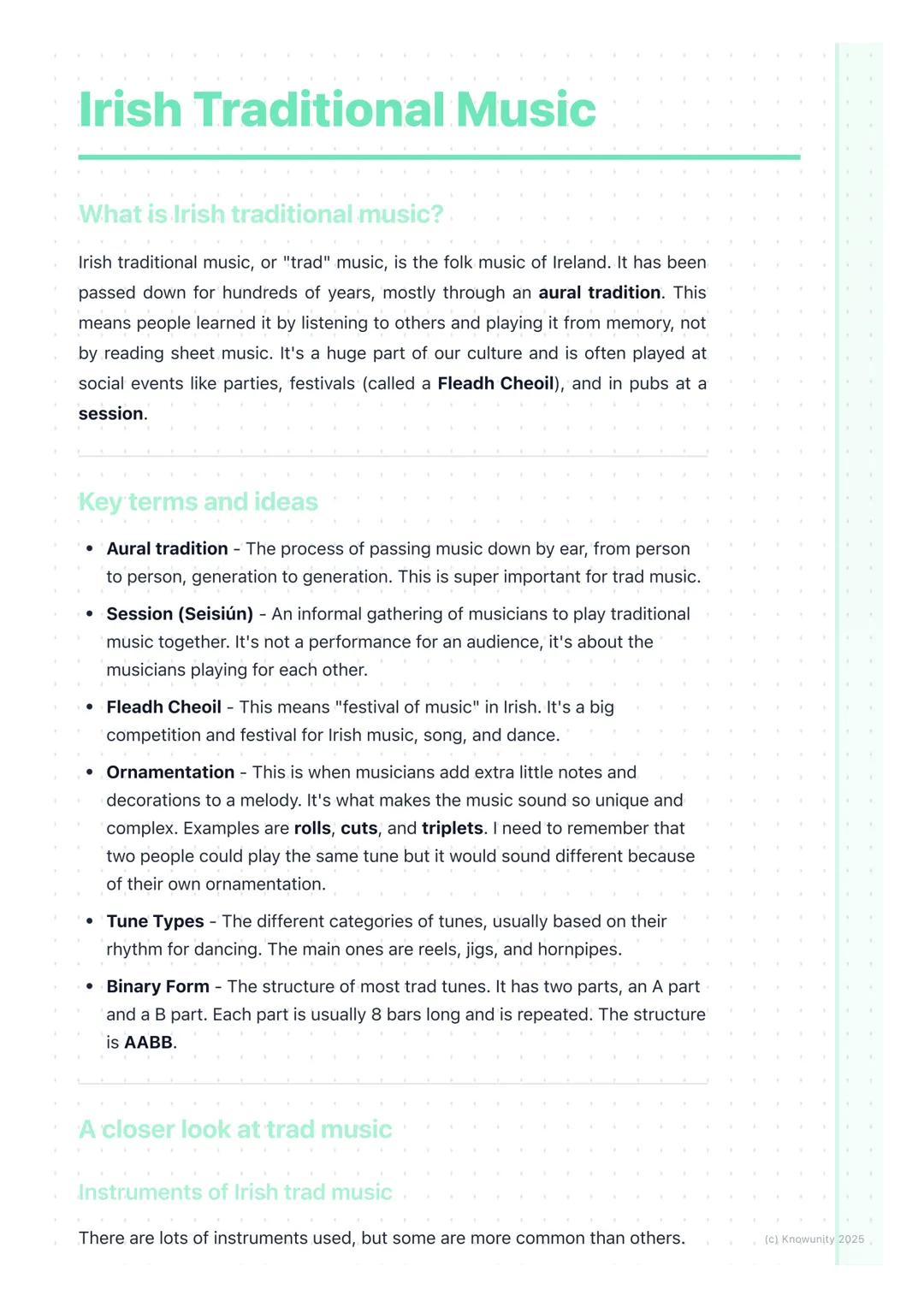
What is Irish Traditional Music?
Ever wondered why Irish music sounds so distinctive and alive? Irish traditional music has survived for centuries through something called aural tradition - meaning people learned tunes by listening and playing from memory rather than reading sheet music. This creates a personal connection between musicians that you can actually hear in the music.
You'll encounter this music everywhere in Ireland, from informal sessions in pubs where musicians gather to play together, to massive Fleadh Cheoil festivals that celebrate Irish culture. These aren't performances for audiences - they're musicians playing for the pure joy of it.
The magic happens through ornamentation - those little decorative notes like rolls, cuts, and triplets that make each musician's version unique. Two people can play the same tune, but it'll sound completely different because of their personal ornamental style.
💡 Remember: Most Irish tunes follow binary form (AABB structure) - an A section and B section, each 8 bars long and repeated.
2
of 5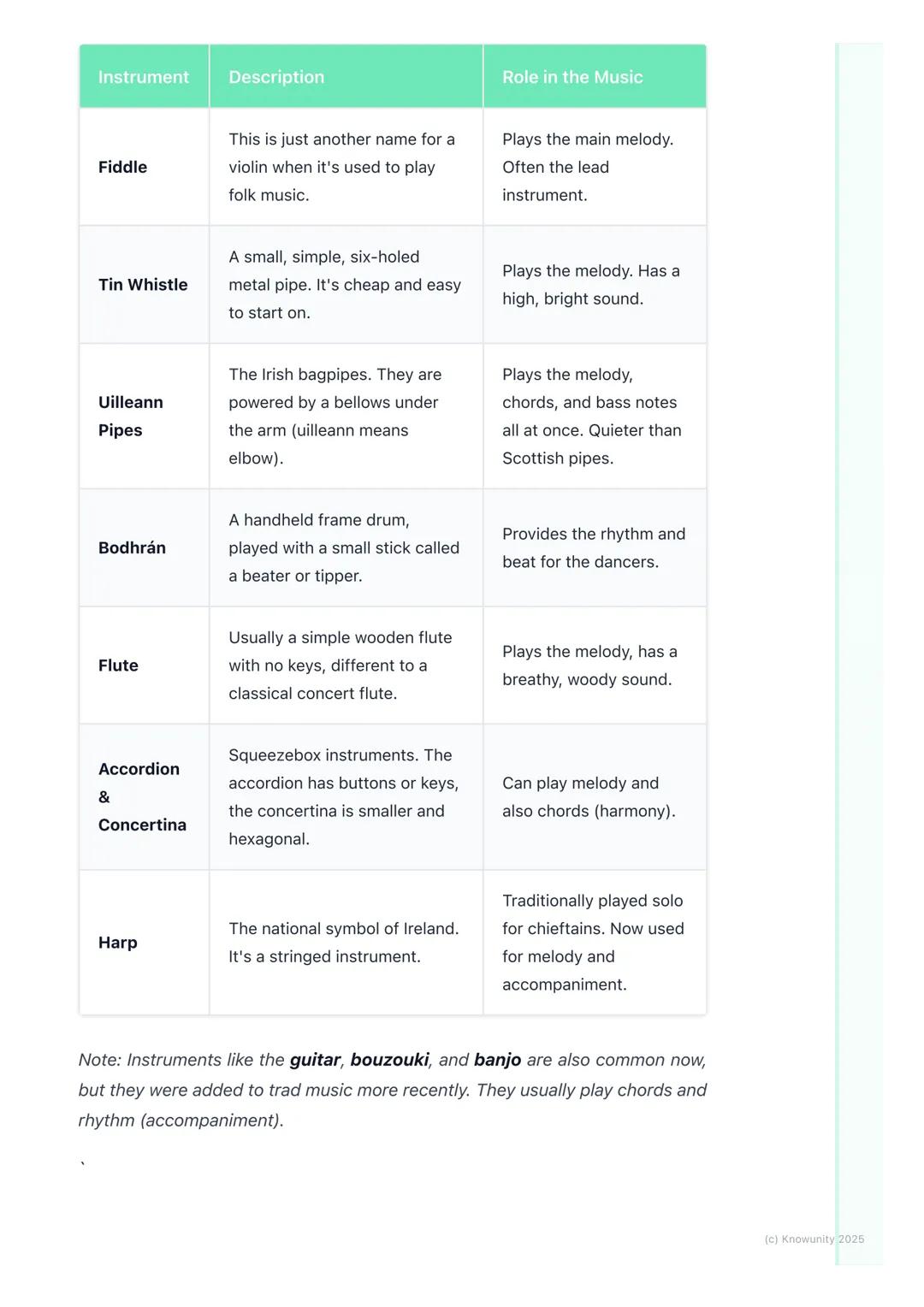
Traditional Irish Instruments
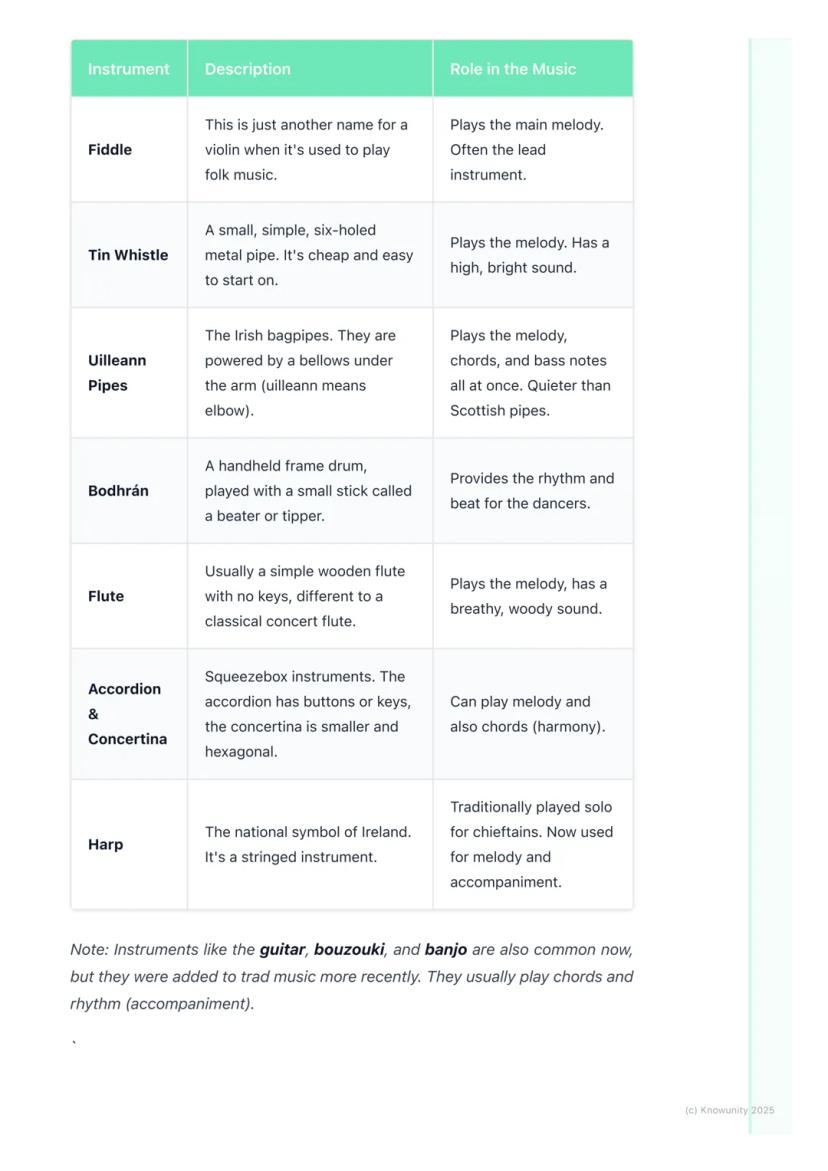
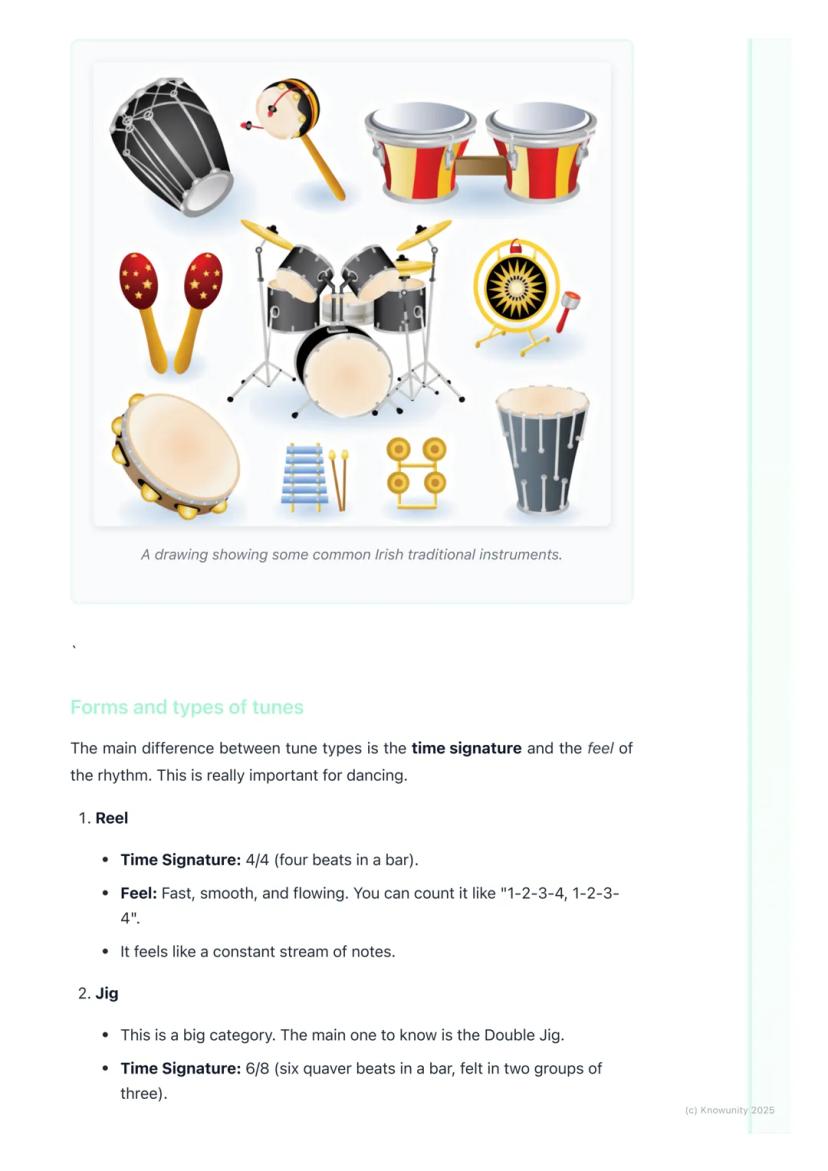
The fiddle (which is just a violin playing folk music) often leads the melody with its expressive, singing tone. For beginners, the tin whistle is brilliant - it's cheap, portable, and produces that bright, piercing sound you hear in Irish music.
Uilleann pipes are Ireland's answer to bagpipes, but they're powered by bellows under your arm (uilleann means "elbow") rather than breath. They're much quieter than Scottish pipes and can play melody, harmony, and bass all at once. The bodhrán provides the driving rhythm that gets dancers moving.
Traditional melody instruments also include wooden flutes and accordions or concertinas. The harp, Ireland's national symbol, was historically played for chieftains but now fits into modern sessions too.
💡 Quick tip: Instruments like guitar and banjo were added later for accompaniment - they're common now but aren't originally Irish.
3
of 5
Understanding Tune Types
Learning to recognise different tune types is crucial because they determine how people dance. The rhythm and time signature completely change the feel of the music.
Reels are in 4/4 time and feel fast, smooth, and flowing like a constant stream of notes. Count "1-2-3-4" and tap your foot - that's a reel's steady pulse. They're probably the most common type you'll hear.
Jigs are the bouncy ones in 6/8 time that make you want to skip. The classic double jig has that "diddly-diddly" or "ONE-two-three, FOUR-five-six" feel. There are also slip jigs in 9/8 time that feel more graceful and flowing.
💡 Listen for: "The Cooley's Reel" and "The Kesh Jig" online to hear the difference - your ears will pick up the rhythmic patterns quickly.
4
of 5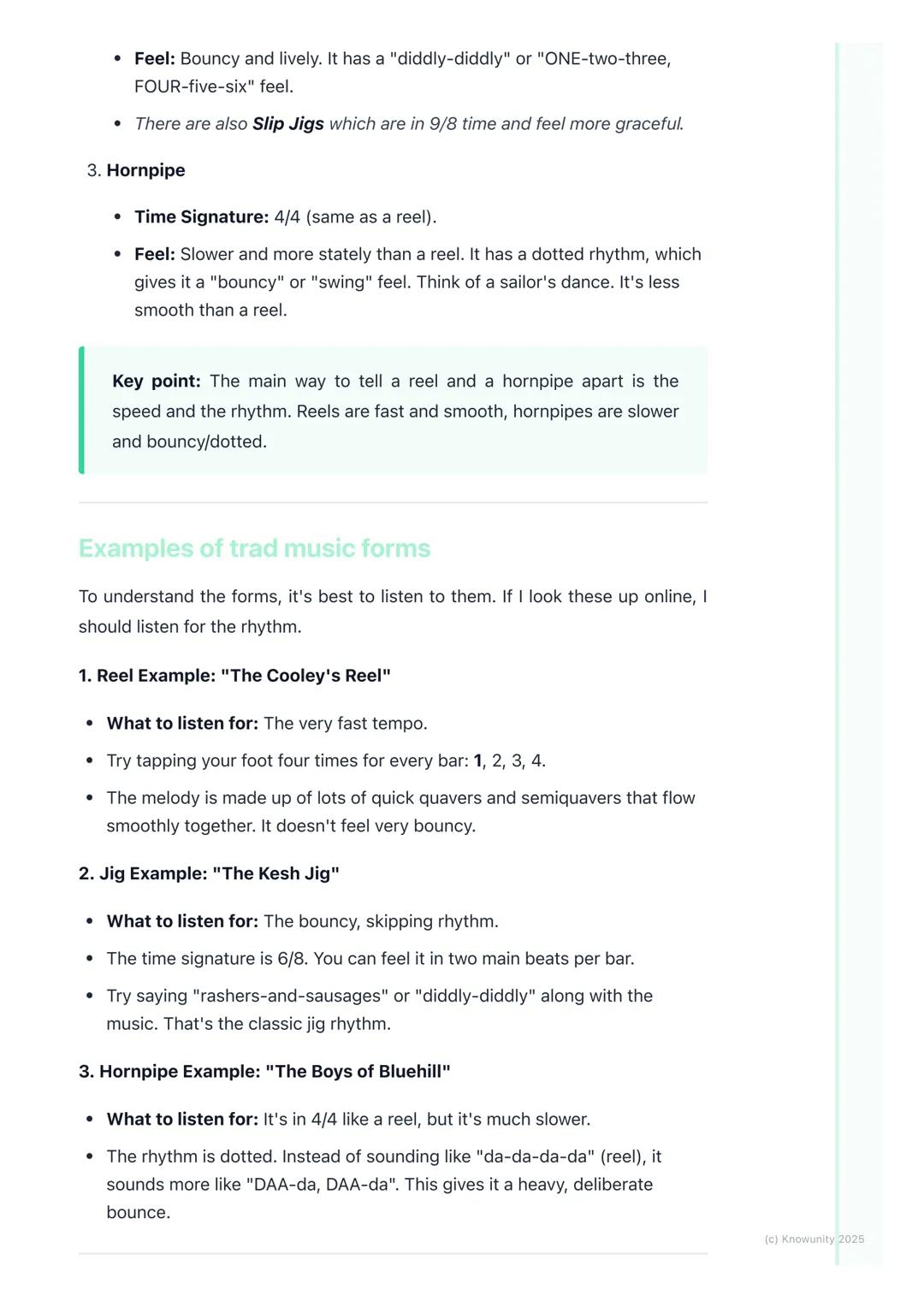
Hornpipes and Musical Examples
Hornpipes often confuse students because they're also in 4/4 like reels, but they're completely different in character. They're slower and have a dotted, bouncy rhythm that sounds like "DAA-da, DAA-da" instead of a reel's smooth "da-da-da-da". Think of a sailor's dance - deliberate and stately.
"The Boys of Bluehill" is a perfect hornpipe example. When you listen, notice how much heavier and more deliberate it sounds compared to a flowing reel. The dotted rhythms give it that characteristic swing feel.
The key difference between reels and hornpipes isn't just tempo - it's the entire rhythmic character. Reels flow like water, whilst hornpipes bounce with purpose.
💡 Exam tip: If you can distinguish between smooth flowing (reel) and bouncy dotted (hornpipe), you'll nail this topic in tests.
5
of 5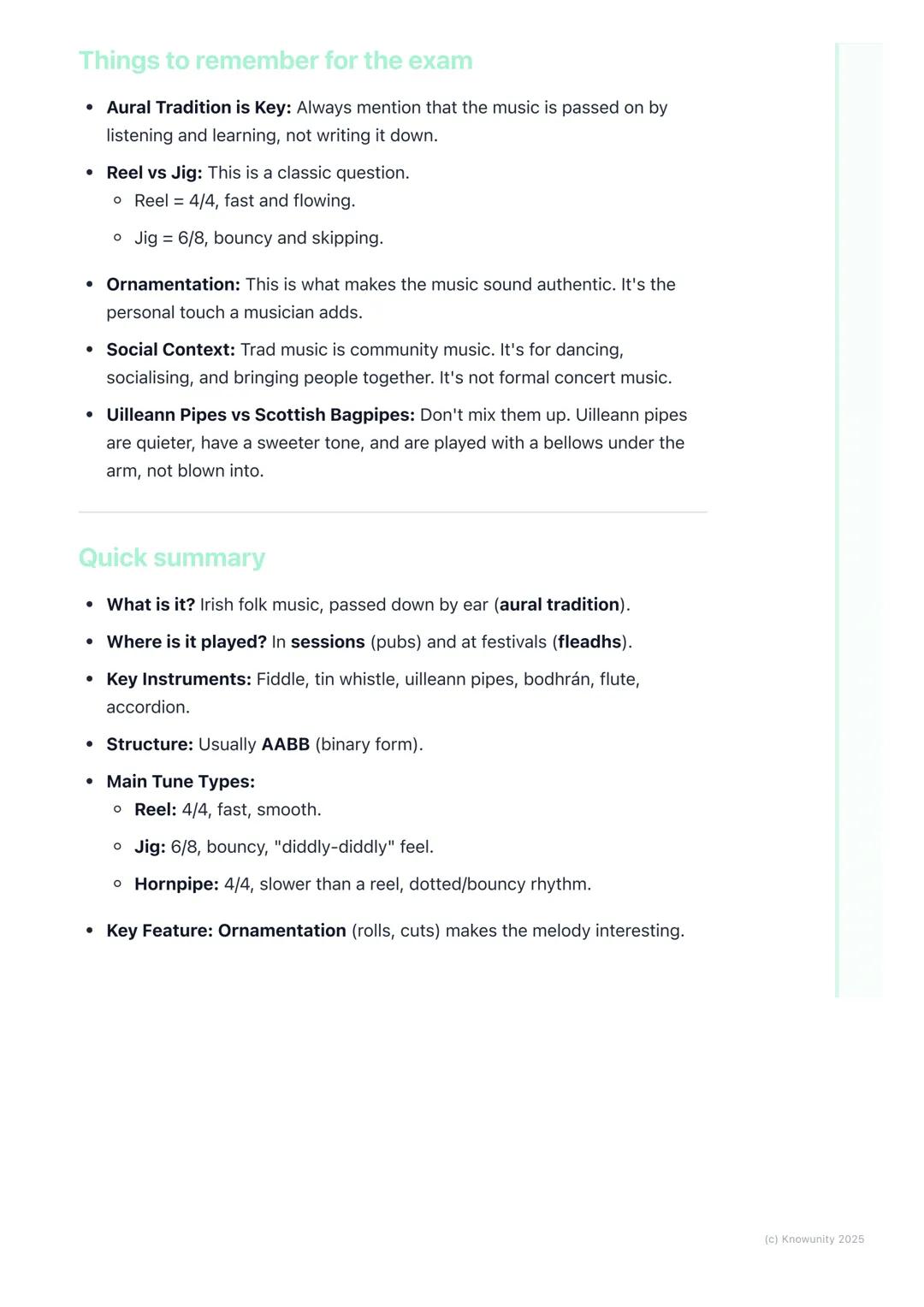
Key Points for Success
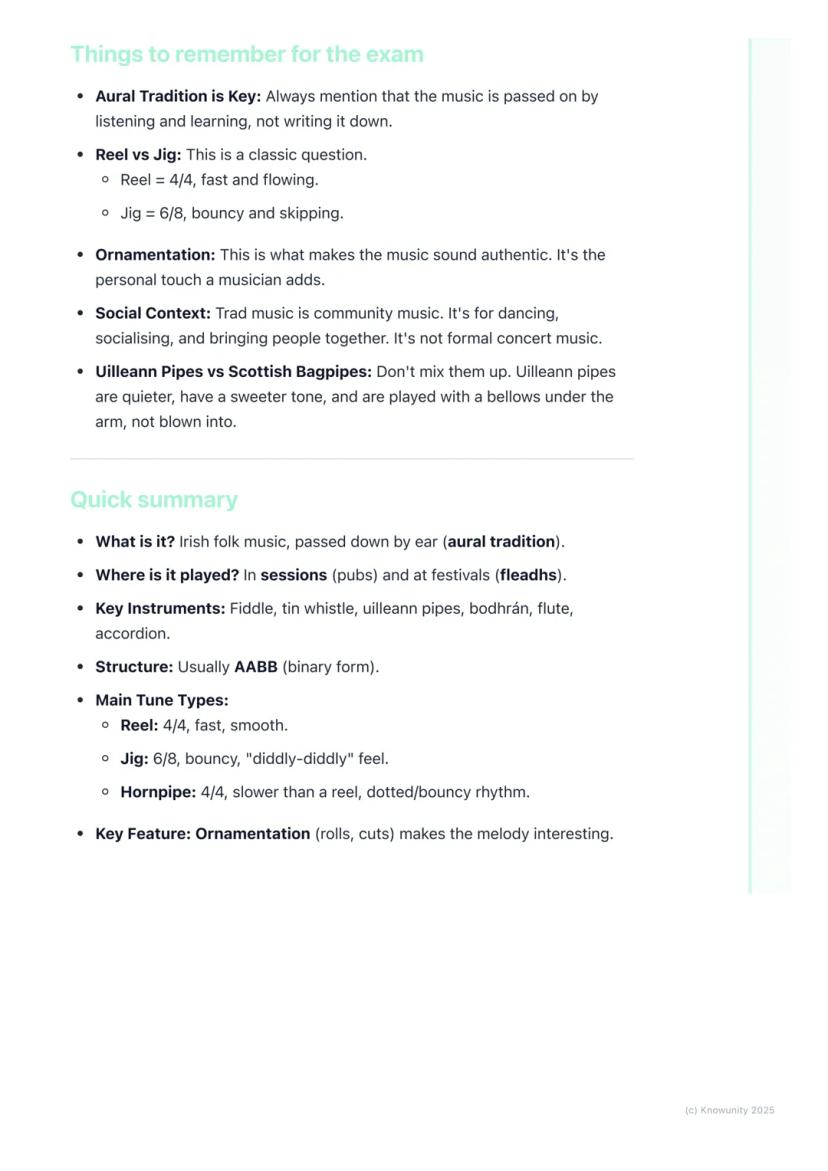
Aural tradition is the foundation of everything - always mention that this music lives through listening and learning by ear, not written notation. This creates the personal, intimate quality that makes Irish music so special.
Social context matters hugely. This isn't formal concert music - it's community music for dancing, socialising, and bringing people together. Sessions and fleadhs are where the tradition stays alive.
Ornamentation is what makes the music authentic and personal. It's how musicians add their own voice to ancient tunes, making each performance unique even when playing the same melody.
💡 Quick reference: Reel = 4/4 fast and smooth; Jig = 6/8 bouncy "diddly-diddly"; Hornpipe = 4/4 slower with dotted rhythm.
Remember that uilleann pipes are distinctly Irish - don't confuse them with Scottish bagpipes. They're quieter, sweeter, and use bellows instead of breath. Master these distinctions and you'll understand the heart of Irish traditional music.
We thought you’d never ask...
What is the Knowunity AI companion?
Our AI companion is specifically built for the needs of students. Based on the millions of content pieces we have on the platform we can provide truly meaningful and relevant answers to students. But its not only about answers, the companion is even more about guiding students through their daily learning challenges, with personalised study plans, quizzes or content pieces in the chat and 100% personalisation based on the students skills and developments.
Where can I download the Knowunity app?
You can download the app in the Google Play Store and in the Apple App Store.
Is Knowunity really free of charge?
That's right! Enjoy free access to study content, connect with fellow students, and get instant help – all at your fingertips.
Most popular content
9 Irish
IrishIrish oral questions and answers
Questions and answers for the leaving cert oral
5th Year4254
IrishIrish oral questions
Outline of oral questions
5th Year2055
IrishGaeilge Grammar Office
All the basics you need to know on Irish grammar.
6th Year883
 English
Key Quotes : Sive
Key Quotes and explanations: Sive
6th Year2191
IrishAn Gaeilge Aiste
Irish Language essay
6th Year1250
IrishIrish poetry 2027
Iníon + Dínit an Bhróin
5th Year1133
IrishMé Féin & Mo Chlann (Myself & My Family)
Students will learn vocabulary to describe themselves, their family members, and daily routines. This helps in personal introductions and discussions.
TY291
IrishLC HL notes- Iníon (poem)
Includes poem in English and Irish, theme, key words & phrases
5th Year2284
 Geography
Territory, economic activities in Paris basin
essay
6th Year80
Can't find what you're looking for? Explore other subjects.
Students love us — and so will you.
4.6/5App Store
4.7/5Google Play
The app is very easy to use and well designed. I have found everything I was looking for so far and have been able to learn a lot from the presentations! I will definitely use the app for a class assignment! And of course it also helps a lot as an inspiration.
Stefan SiOS user
This app is really great. There are so many study notes and help [...]. My problem subject is French, for example, and the app has so many options for help. Thanks to this app, I have improved my French. I would recommend it to anyone.
Samantha KlichAndroid user
Wow, I am really amazed. I just tried the app because I've seen it advertised many times and was absolutely stunned. This app is THE HELP you want for school and above all, it offers so many things, such as workouts and fact sheets, which have been VERY helpful to me personally.
AnnaiOS user
Music2 views·Updated May 20, 2026·5 pagesExploring Irish Traditional Music: Instruments, Forms, and Culture
Irish traditional music, or "trad" music, is the heartbeat of Irish culture that's been passed down through generations by ear. This folk music isn't just entertainment - it's a living tradition that brings communities together in pubs, festivals, and social... Show more
1
of 5Sign up to see the content. It's free!
- Access to all documents
- Improve your grades
- Join milions of students
What is Irish Traditional Music?
Ever wondered why Irish music sounds so distinctive and alive? Irish traditional music has survived for centuries through something called aural tradition - meaning people learned tunes by listening and playing from memory rather than reading sheet music. This creates a personal connection between musicians that you can actually hear in the music.
You'll encounter this music everywhere in Ireland, from informal sessions in pubs where musicians gather to play together, to massive Fleadh Cheoil festivals that celebrate Irish culture. These aren't performances for audiences - they're musicians playing for the pure joy of it.
The magic happens through ornamentation - those little decorative notes like rolls, cuts, and triplets that make each musician's version unique. Two people can play the same tune, but it'll sound completely different because of their personal ornamental style.
💡 Remember: Most Irish tunes follow binary form (AABB structure) - an A section and B section, each 8 bars long and repeated.
2
of 5Sign up to see the content. It's free!
- Access to all documents
- Improve your grades
- Join milions of students
Traditional Irish Instruments
The fiddle (which is just a violin playing folk music) often leads the melody with its expressive, singing tone. For beginners, the tin whistle is brilliant - it's cheap, portable, and produces that bright, piercing sound you hear in Irish music.
Uilleann pipes are Ireland's answer to bagpipes, but they're powered by bellows under your arm (uilleann means "elbow") rather than breath. They're much quieter than Scottish pipes and can play melody, harmony, and bass all at once. The bodhrán provides the driving rhythm that gets dancers moving.
Traditional melody instruments also include wooden flutes and accordions or concertinas. The harp, Ireland's national symbol, was historically played for chieftains but now fits into modern sessions too.
💡 Quick tip: Instruments like guitar and banjo were added later for accompaniment - they're common now but aren't originally Irish.
3
of 5Sign up to see the content. It's free!
- Access to all documents
- Improve your grades
- Join milions of students
Understanding Tune Types
Learning to recognise different tune types is crucial because they determine how people dance. The rhythm and time signature completely change the feel of the music.
Reels are in 4/4 time and feel fast, smooth, and flowing like a constant stream of notes. Count "1-2-3-4" and tap your foot - that's a reel's steady pulse. They're probably the most common type you'll hear.
Jigs are the bouncy ones in 6/8 time that make you want to skip. The classic double jig has that "diddly-diddly" or "ONE-two-three, FOUR-five-six" feel. There are also slip jigs in 9/8 time that feel more graceful and flowing.
💡 Listen for: "The Cooley's Reel" and "The Kesh Jig" online to hear the difference - your ears will pick up the rhythmic patterns quickly.
4
of 5Sign up to see the content. It's free!
- Access to all documents
- Improve your grades
- Join milions of students
Hornpipes and Musical Examples
Hornpipes often confuse students because they're also in 4/4 like reels, but they're completely different in character. They're slower and have a dotted, bouncy rhythm that sounds like "DAA-da, DAA-da" instead of a reel's smooth "da-da-da-da". Think of a sailor's dance - deliberate and stately.
"The Boys of Bluehill" is a perfect hornpipe example. When you listen, notice how much heavier and more deliberate it sounds compared to a flowing reel. The dotted rhythms give it that characteristic swing feel.
The key difference between reels and hornpipes isn't just tempo - it's the entire rhythmic character. Reels flow like water, whilst hornpipes bounce with purpose.
💡 Exam tip: If you can distinguish between smooth flowing (reel) and bouncy dotted (hornpipe), you'll nail this topic in tests.
5
of 5Sign up to see the content. It's free!
- Access to all documents
- Improve your grades
- Join milions of students
Key Points for Success
Aural tradition is the foundation of everything - always mention that this music lives through listening and learning by ear, not written notation. This creates the personal, intimate quality that makes Irish music so special.
Social context matters hugely. This isn't formal concert music - it's community music for dancing, socialising, and bringing people together. Sessions and fleadhs are where the tradition stays alive.
Ornamentation is what makes the music authentic and personal. It's how musicians add their own voice to ancient tunes, making each performance unique even when playing the same melody.
💡 Quick reference: Reel = 4/4 fast and smooth; Jig = 6/8 bouncy "diddly-diddly"; Hornpipe = 4/4 slower with dotted rhythm.
Remember that uilleann pipes are distinctly Irish - don't confuse them with Scottish bagpipes. They're quieter, sweeter, and use bellows instead of breath. Master these distinctions and you'll understand the heart of Irish traditional music.
We thought you’d never ask...
What is the Knowunity AI companion?
Our AI companion is specifically built for the needs of students. Based on the millions of content pieces we have on the platform we can provide truly meaningful and relevant answers to students. But its not only about answers, the companion is even more about guiding students through their daily learning challenges, with personalised study plans, quizzes or content pieces in the chat and 100% personalisation based on the students skills and developments.
Where can I download the Knowunity app?
You can download the app in the Google Play Store and in the Apple App Store.
Is Knowunity really free of charge?
That's right! Enjoy free access to study content, connect with fellow students, and get instant help – all at your fingertips.
Most popular content
9IrishIrish oral questions and answers
Questions and answers for the leaving cert oral
5th Year4254
IrishIrish oral questions
Outline of oral questions
5th Year2055
IrishGaeilge Grammar Office
All the basics you need to know on Irish grammar.
6th Year883
EnglishKey Quotes : Sive
Key Quotes and explanations: Sive
6th Year2191
IrishAn Gaeilge Aiste
Irish Language essay
6th Year1250
IrishIrish poetry 2027
Iníon + Dínit an Bhróin
5th Year1133
IrishMé Féin & Mo Chlann (Myself & My Family)
Students will learn vocabulary to describe themselves, their family members, and daily routines. This helps in personal introductions and discussions.
TY291
IrishLC HL notes- Iníon (poem)
Includes poem in English and Irish, theme, key words & phrases
5th Year2284
GeographyTerritory, economic activities in Paris basin
essay
6th Year80
Can't find what you're looking for? Explore other subjects.
Students love us — and so will you.
4.6/5App Store
4.7/5Google Play
The app is very easy to use and well designed. I have found everything I was looking for so far and have been able to learn a lot from the presentations! I will definitely use the app for a class assignment! And of course it also helps a lot as an inspiration.
Stefan SiOS user
This app is really great. There are so many study notes and help [...]. My problem subject is French, for example, and the app has so many options for help. Thanks to this app, I have improved my French. I would recommend it to anyone.
Samantha KlichAndroid user
Wow, I am really amazed. I just tried the app because I've seen it advertised many times and was absolutely stunned. This app is THE HELP you want for school and above all, it offers so many things, such as workouts and fact sheets, which have been VERY helpful to me personally.
AnnaiOS user