
Ever wondered why footballers curve their shots or why basketball... Show more
 LCPE3 views·Updated Jun 9, 2026·5 pages
Understanding the Basics of Projectile Motion

1 / 5
1
of 5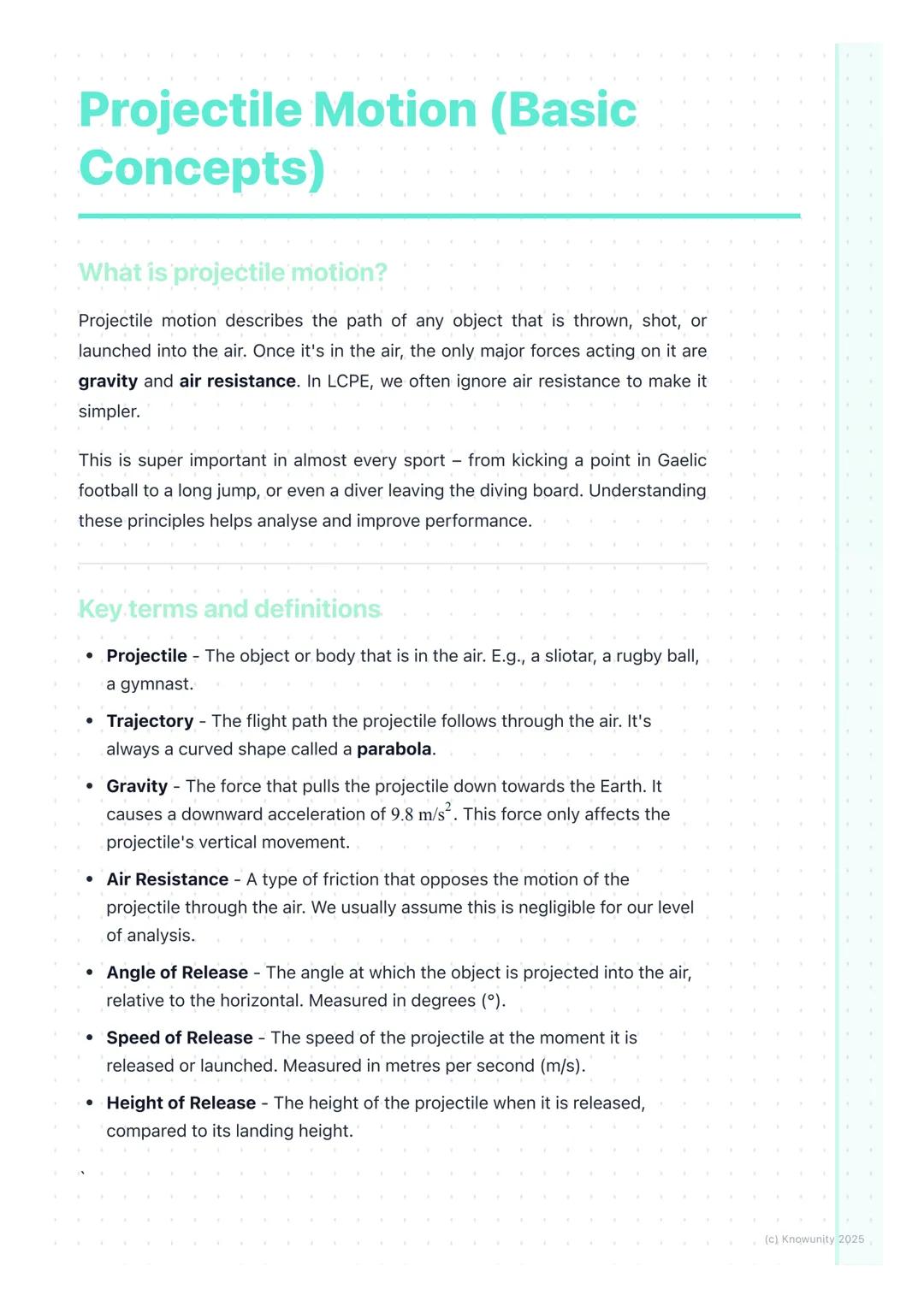
What is Projectile Motion?
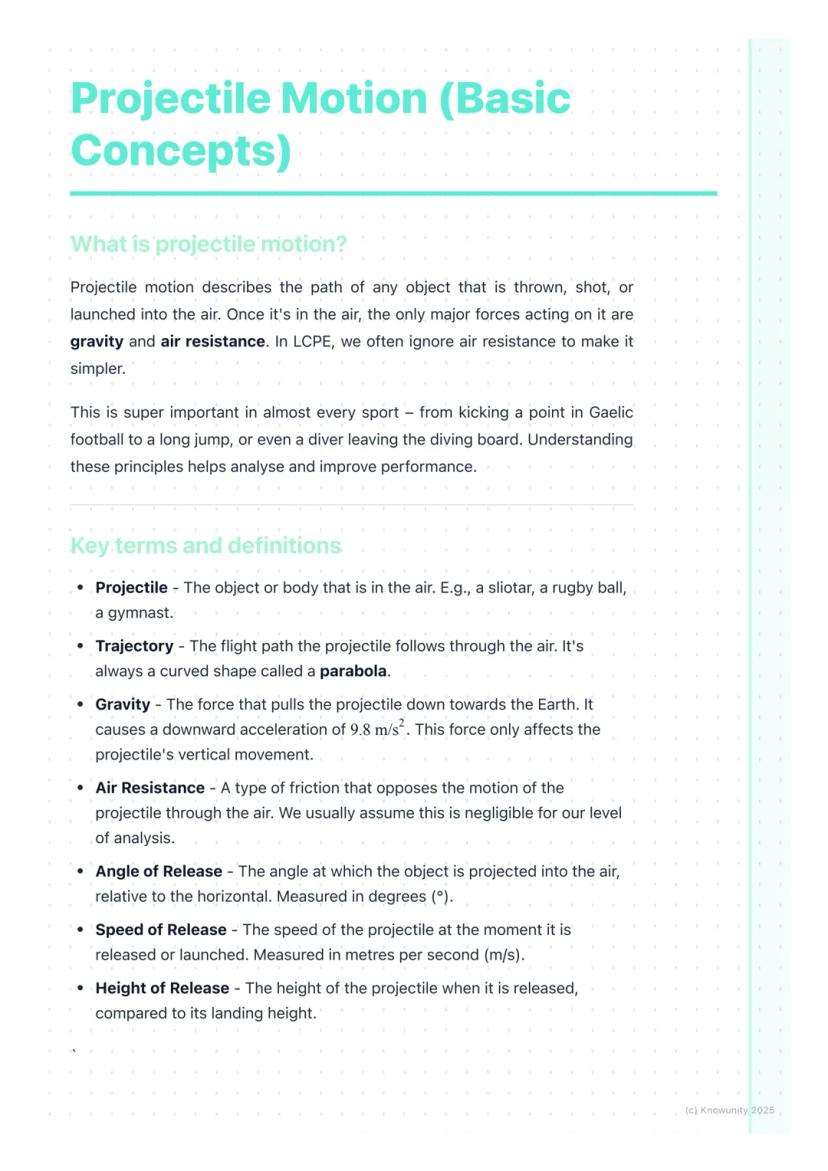
Think about every time you've kicked a football or thrown something - you've created projectile motion. This describes how objects move through the air once they've been launched, with only gravity pulling them down.
The most important thing to remember? Once an object is airborne, gravity is the main force affecting it (we'll ignore air resistance to keep things simple). This creates that curved path you always see when balls fly through the air.
Key terms you absolutely need to know:
- Projectile - the object in the air (could be a ball, or even a person jumping)
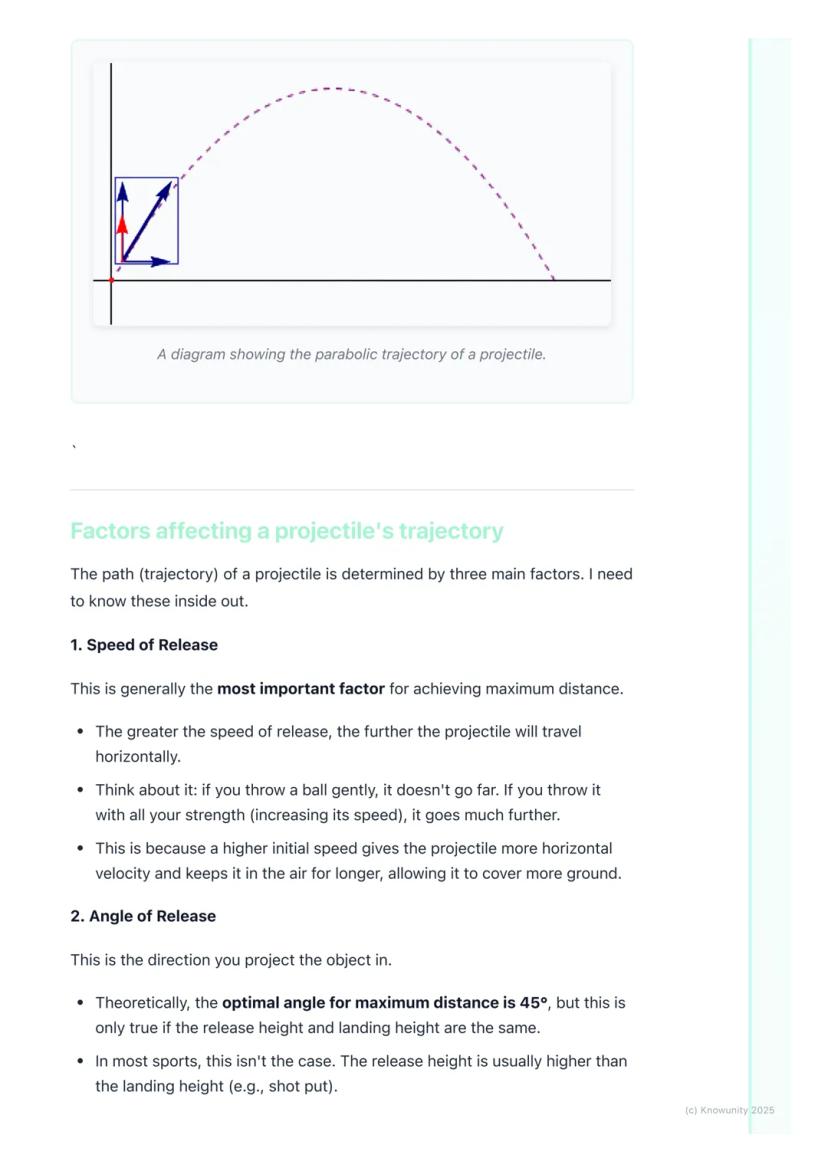
- Trajectory - the curved flight path, always shaped like a parabola
- Gravity - pulls everything down at 9.8 m/s², but only affects vertical movement
- Angle of release - the direction you launch the object (measured in degrees from horizontal)
Remember: Air resistance exists in real life, but we usually ignore it in physics problems to make calculations easier!
2
of 5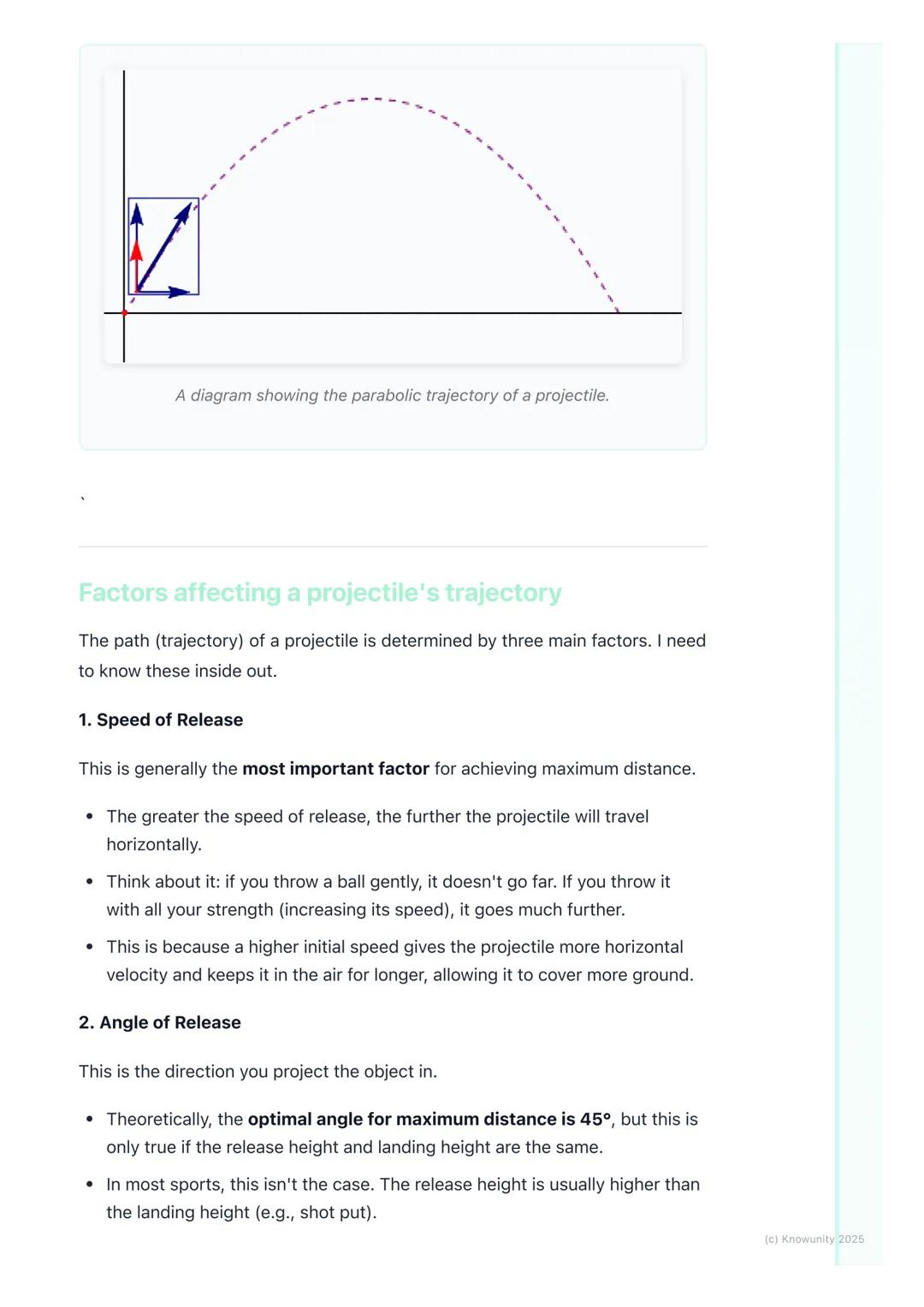
The Three Key Factors
Your projectile's path depends on three main factors that you need to master. Get these right and you'll ace any exam question about projectile motion.
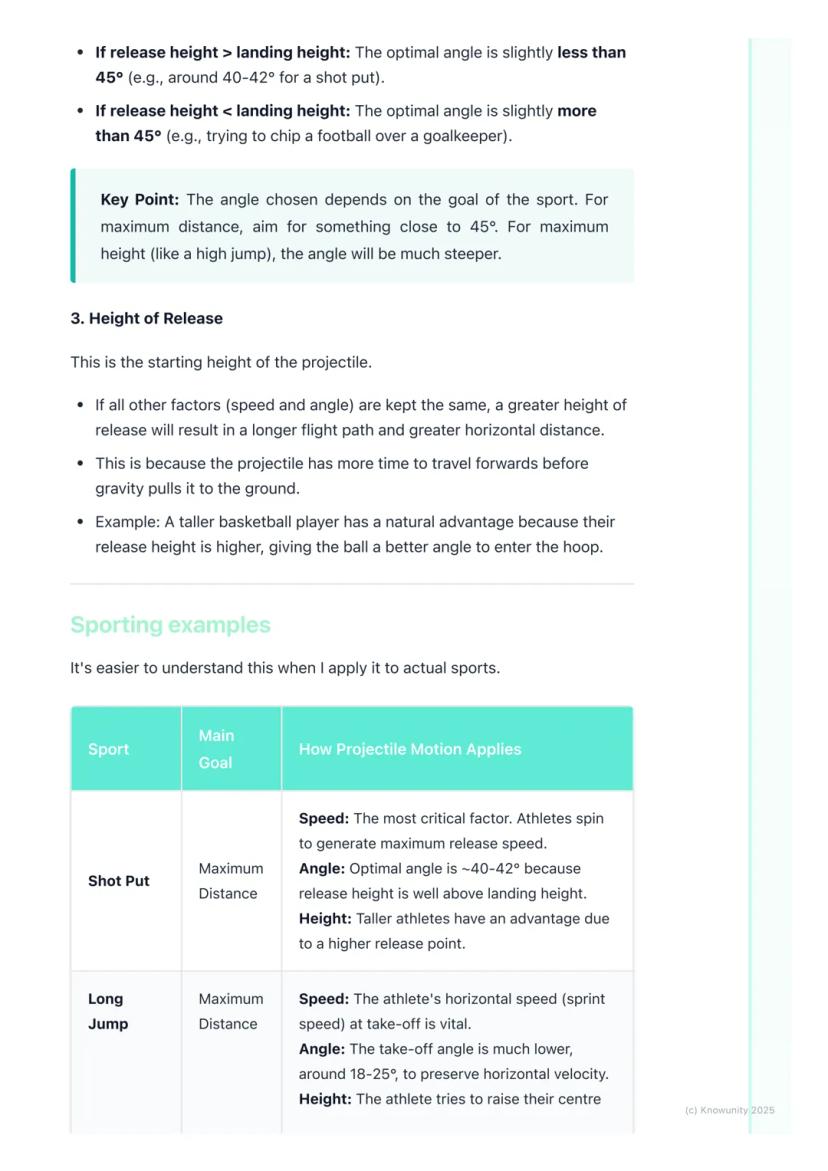
Speed of release is usually the most important factor. Launch something faster and it travels further horizontally - simple as that. It's like the difference between gently tossing a ball versus hurling it with all your strength.
Angle of release determines the direction. Here's the crucial bit: whilst 45° gives maximum distance in theory, this only works when you're launching and landing at the same height. In most sports, you're releasing from a different height than where it lands.
If you're releasing higher than the landing point (like shot put), aim slightly lower than 45°. If you're aiming upwards (like chipping a football over a goalkeeper), go slightly higher than 45°.
Top tip: Don't just memorise "45° is optimal" - explain why it changes in real sports situations!
3
of 5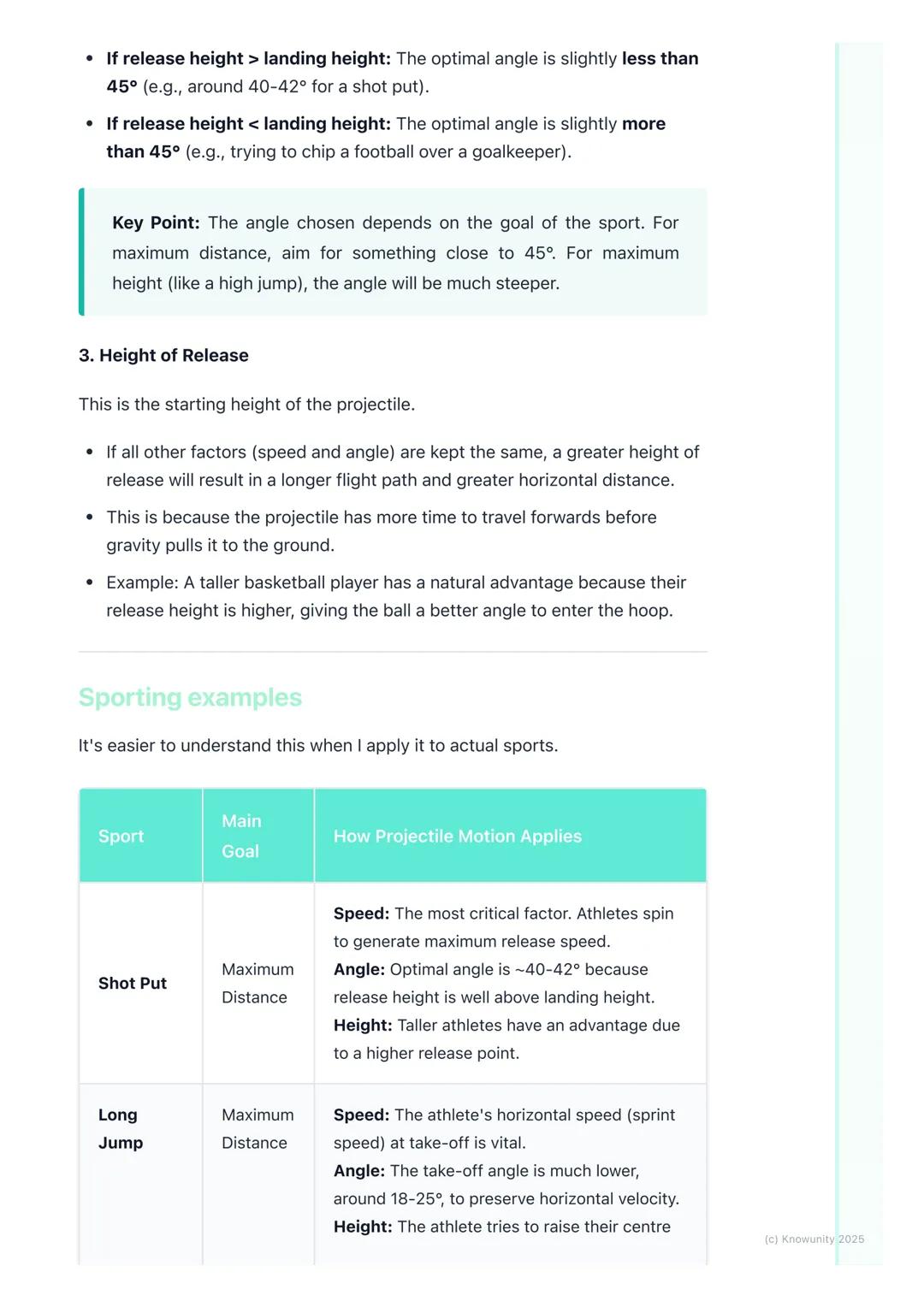
Height of Release Matters
Height of release gives you a massive advantage in many sports. Release something from higher up, and it has more time to travel forward before gravity brings it down to earth.
This explains why taller basketball players have natural advantages - their higher release point gives the ball a better angle into the hoop. It's also why shot putters try to release the shot as high as possible during their throw.
Real sporting examples make this clearer:
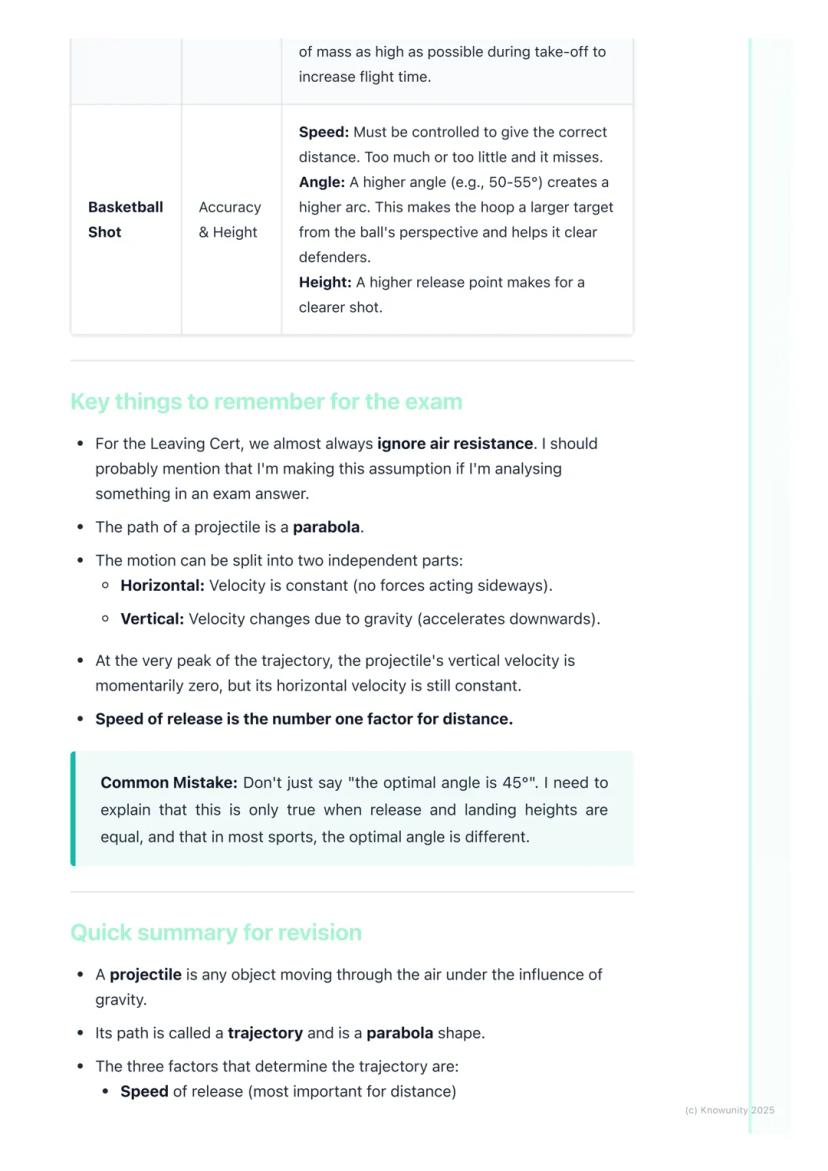
- Basketball shots need controlled speed, high angles (50-55°), and maximum release height
- Shot put requires maximum speed, optimal angles around 40-42°, and releasing as high as possible
- Long jump focuses on speed and getting your centre of mass as high as possible at take-off
The beauty of projectile motion is that you can split it into two parts: horizontal movement (constant speed) and vertical movement (constantly changing due to gravity).
Exam gold: Always mention that you're ignoring air resistance - it shows you understand the assumptions we make!
4
of 5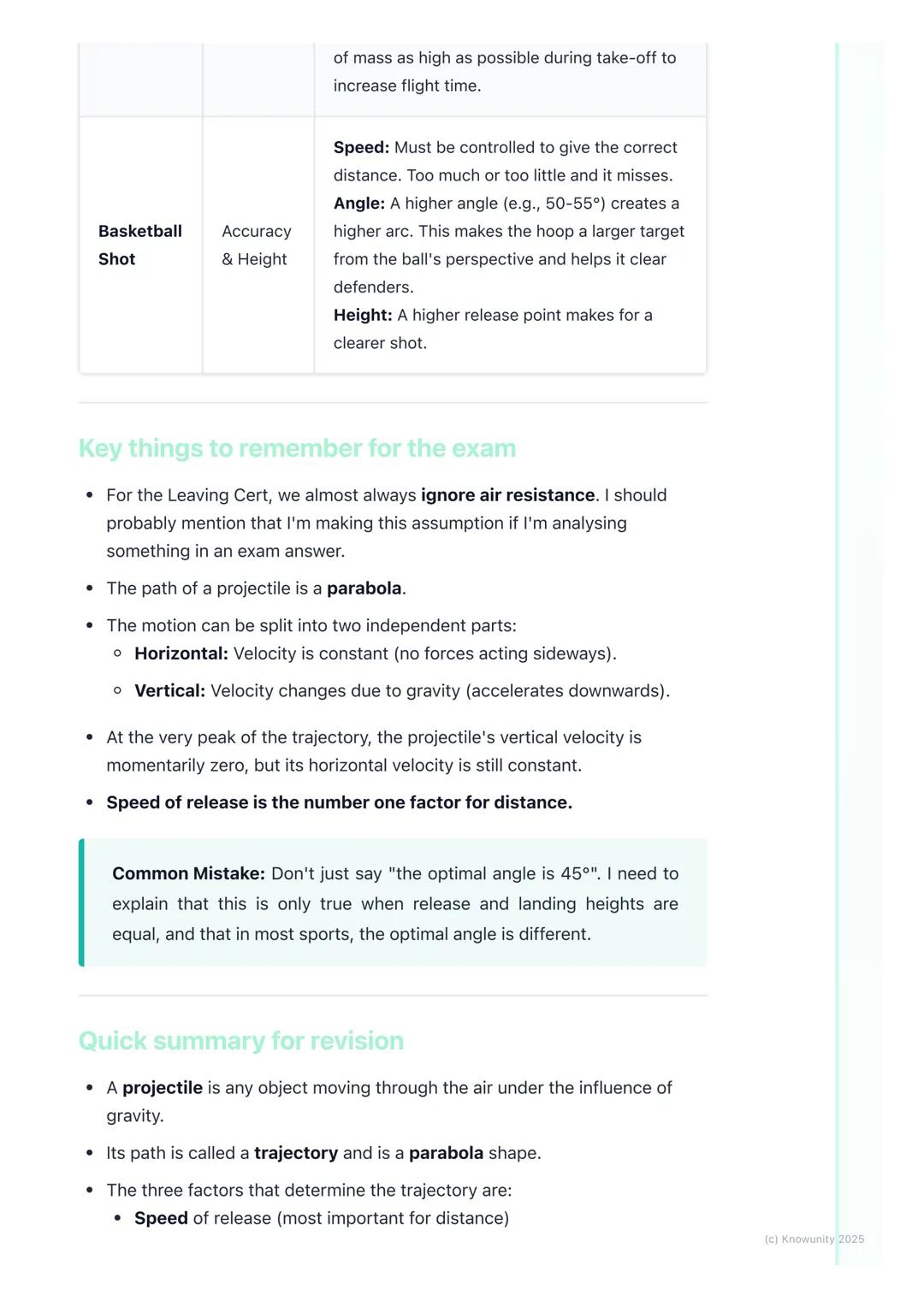
Essential Points for Success
At the peak of any trajectory, something interesting happens - the vertical speed becomes zero for a split second, but horizontal speed stays constant throughout the entire flight.
Gravity only affects the up-and-down motion, never the side-to-side movement. This is why projectiles follow that characteristic parabola shape every single time.
For your exams, remember that speed of release trumps everything else when you want maximum distance. Angle and height matter, but getting that initial speed right is crucial.
Don't fall into the common trap of saying "45° is always optimal" without explaining the conditions. Show you understand that real sports rarely have equal release and landing heights.
Quick revision checklist:
- Projectile = object in air under gravity's influence
- Trajectory = parabola-shaped flight path
- Three factors: speed (most important), angle, and height of release
- Horizontal motion = constant velocity
- Vertical motion = changes due to gravity
Confidence booster: You've got this! These concepts appear everywhere in sport, so you already have intuitive understanding from watching games.
5
of 5
We thought you’d never ask...
What is the Knowunity AI companion?
Our AI companion is specifically built for the needs of students. Based on the millions of content pieces we have on the platform we can provide truly meaningful and relevant answers to students. But its not only about answers, the companion is even more about guiding students through their daily learning challenges, with personalised study plans, quizzes or content pieces in the chat and 100% personalisation based on the students skills and developments.
Where can I download the Knowunity app?
You can download the app in the Google Play Store and in the Apple App Store.
Is Knowunity really free of charge?
That's right! Enjoy free access to study content, connect with fellow students, and get instant help – all at your fingertips.
Most popular content in LCPE
4Most popular content
9Can't find what you're looking for? Explore other subjects.
Students love us — and so will you.
4.6/5App Store
4.7/5Google Play
The app is very easy to use and well designed. I have found everything I was looking for so far and have been able to learn a lot from the presentations! I will definitely use the app for a class assignment! And of course it also helps a lot as an inspiration.
Stefan SiOS user
This app is really great. There are so many study notes and help [...]. My problem subject is French, for example, and the app has so many options for help. Thanks to this app, I have improved my French. I would recommend it to anyone.
Samantha KlichAndroid user
Wow, I am really amazed. I just tried the app because I've seen it advertised many times and was absolutely stunned. This app is THE HELP you want for school and above all, it offers so many things, such as workouts and fact sheets, which have been VERY helpful to me personally.
AnnaiOS user
LCPE3 views·Updated Jun 9, 2026·5 pagesUnderstanding the Basics of Projectile Motion
Ever wondered why footballers curve their shots or why basketball players aim high? Projectile motionexplains the path of any object flying through the air - from a sliotar in hurling to a long jumper soaring through the air. Once... Show more
1
of 5Sign up to see the content. It's free!
- Access to all documents
- Improve your grades
- Join milions of students
What is Projectile Motion?
Think about every time you've kicked a football or thrown something - you've created projectile motion. This describes how objects move through the air once they've been launched, with only gravity pulling them down.
The most important thing to remember? Once an object is airborne, gravity is the main force affecting it (we'll ignore air resistance to keep things simple). This creates that curved path you always see when balls fly through the air.
Key terms you absolutely need to know:
- Projectile - the object in the air (could be a ball, or even a person jumping)
- Trajectory - the curved flight path, always shaped like a parabola
- Gravity - pulls everything down at 9.8 m/s², but only affects vertical movement
- Angle of release - the direction you launch the object (measured in degrees from horizontal)
Remember: Air resistance exists in real life, but we usually ignore it in physics problems to make calculations easier!
2
of 5Sign up to see the content. It's free!
- Access to all documents
- Improve your grades
- Join milions of students
The Three Key Factors
Your projectile's path depends on three main factors that you need to master. Get these right and you'll ace any exam question about projectile motion.
Speed of release is usually the most important factor. Launch something faster and it travels further horizontally - simple as that. It's like the difference between gently tossing a ball versus hurling it with all your strength.
Angle of release determines the direction. Here's the crucial bit: whilst 45° gives maximum distance in theory, this only works when you're launching and landing at the same height. In most sports, you're releasing from a different height than where it lands.
If you're releasing higher than the landing point (like shot put), aim slightly lower than 45°. If you're aiming upwards (like chipping a football over a goalkeeper), go slightly higher than 45°.
Top tip: Don't just memorise "45° is optimal" - explain why it changes in real sports situations!
3
of 5Sign up to see the content. It's free!
- Access to all documents
- Improve your grades
- Join milions of students
Height of Release Matters
Height of release gives you a massive advantage in many sports. Release something from higher up, and it has more time to travel forward before gravity brings it down to earth.
This explains why taller basketball players have natural advantages - their higher release point gives the ball a better angle into the hoop. It's also why shot putters try to release the shot as high as possible during their throw.
Real sporting examples make this clearer:
- Basketball shots need controlled speed, high angles (50-55°), and maximum release height
- Shot put requires maximum speed, optimal angles around 40-42°, and releasing as high as possible
- Long jump focuses on speed and getting your centre of mass as high as possible at take-off
The beauty of projectile motion is that you can split it into two parts: horizontal movement (constant speed) and vertical movement (constantly changing due to gravity).
Exam gold: Always mention that you're ignoring air resistance - it shows you understand the assumptions we make!
4
of 5Sign up to see the content. It's free!
- Access to all documents
- Improve your grades
- Join milions of students
Essential Points for Success
At the peak of any trajectory, something interesting happens - the vertical speed becomes zero for a split second, but horizontal speed stays constant throughout the entire flight.
Gravity only affects the up-and-down motion, never the side-to-side movement. This is why projectiles follow that characteristic parabola shape every single time.
For your exams, remember that speed of release trumps everything else when you want maximum distance. Angle and height matter, but getting that initial speed right is crucial.
Don't fall into the common trap of saying "45° is always optimal" without explaining the conditions. Show you understand that real sports rarely have equal release and landing heights.
Quick revision checklist:
- Projectile = object in air under gravity's influence
- Trajectory = parabola-shaped flight path
- Three factors: speed (most important), angle, and height of release
- Horizontal motion = constant velocity
- Vertical motion = changes due to gravity
Confidence booster: You've got this! These concepts appear everywhere in sport, so you already have intuitive understanding from watching games.
5
of 5Sign up to see the content. It's free!
- Access to all documents
- Improve your grades
- Join milions of students
We thought you’d never ask...
What is the Knowunity AI companion?
Our AI companion is specifically built for the needs of students. Based on the millions of content pieces we have on the platform we can provide truly meaningful and relevant answers to students. But its not only about answers, the companion is even more about guiding students through their daily learning challenges, with personalised study plans, quizzes or content pieces in the chat and 100% personalisation based on the students skills and developments.
Where can I download the Knowunity app?
You can download the app in the Google Play Store and in the Apple App Store.
Is Knowunity really free of charge?
That's right! Enjoy free access to study content, connect with fellow students, and get instant help – all at your fingertips.
Most popular content in LCPE
4Most popular content
9Can't find what you're looking for? Explore other subjects.
Students love us — and so will you.
4.6/5App Store
4.7/5Google Play
The app is very easy to use and well designed. I have found everything I was looking for so far and have been able to learn a lot from the presentations! I will definitely use the app for a class assignment! And of course it also helps a lot as an inspiration.
Stefan SiOS user
This app is really great. There are so many study notes and help [...]. My problem subject is French, for example, and the app has so many options for help. Thanks to this app, I have improved my French. I would recommend it to anyone.
Samantha KlichAndroid user
Wow, I am really amazed. I just tried the app because I've seen it advertised many times and was absolutely stunned. This app is THE HELP you want for school and above all, it offers so many things, such as workouts and fact sheets, which have been VERY helpful to me personally.
AnnaiOS user