
Ever wondered what separates true champions from mere winners? It's...
 LCPE2 views·Updated Jun 17, 2026·6 pages
Integrity in Sports: Ethics and Fair Play

1 / 6
1
of 6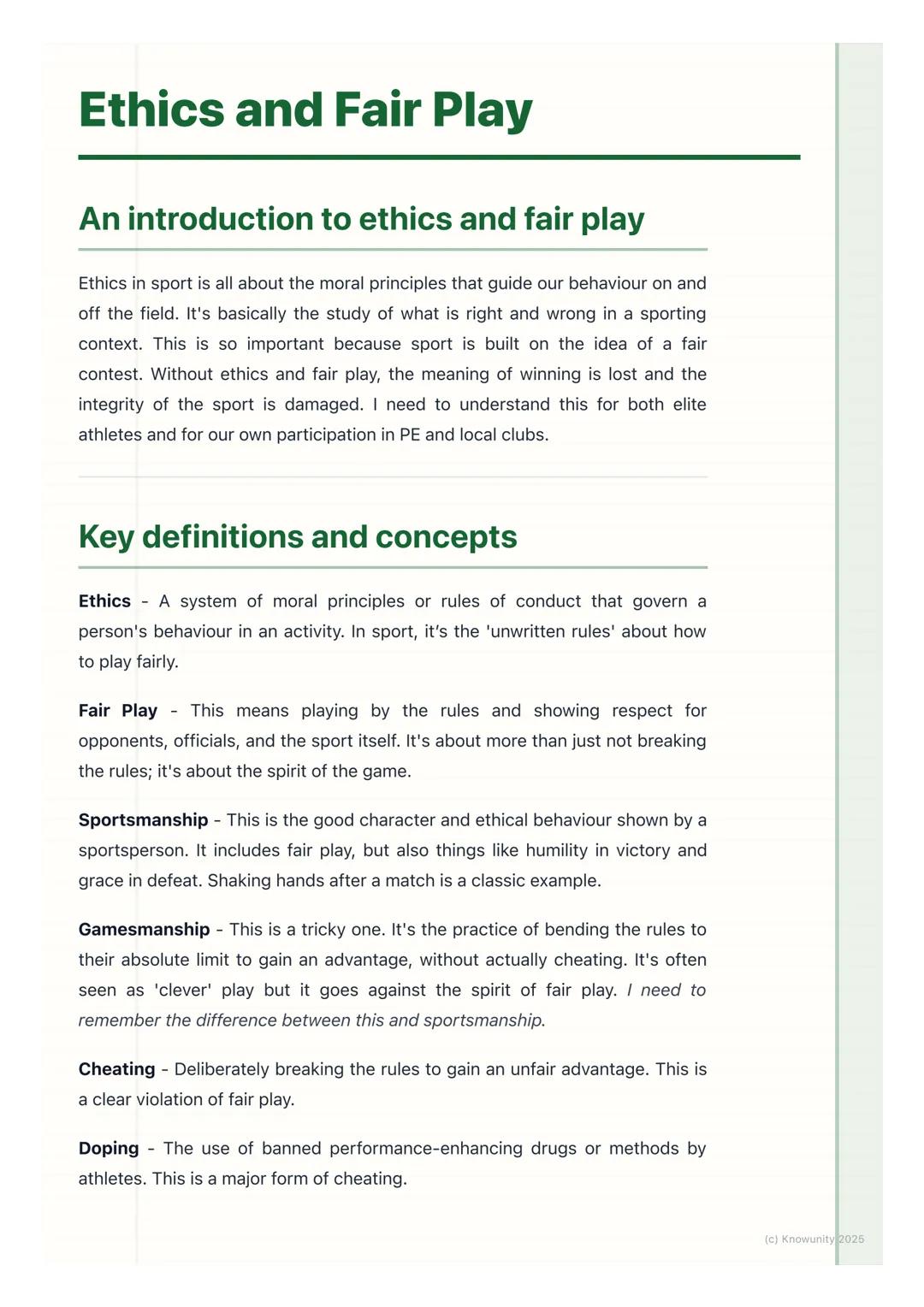
An Introduction to Ethics and Fair Play
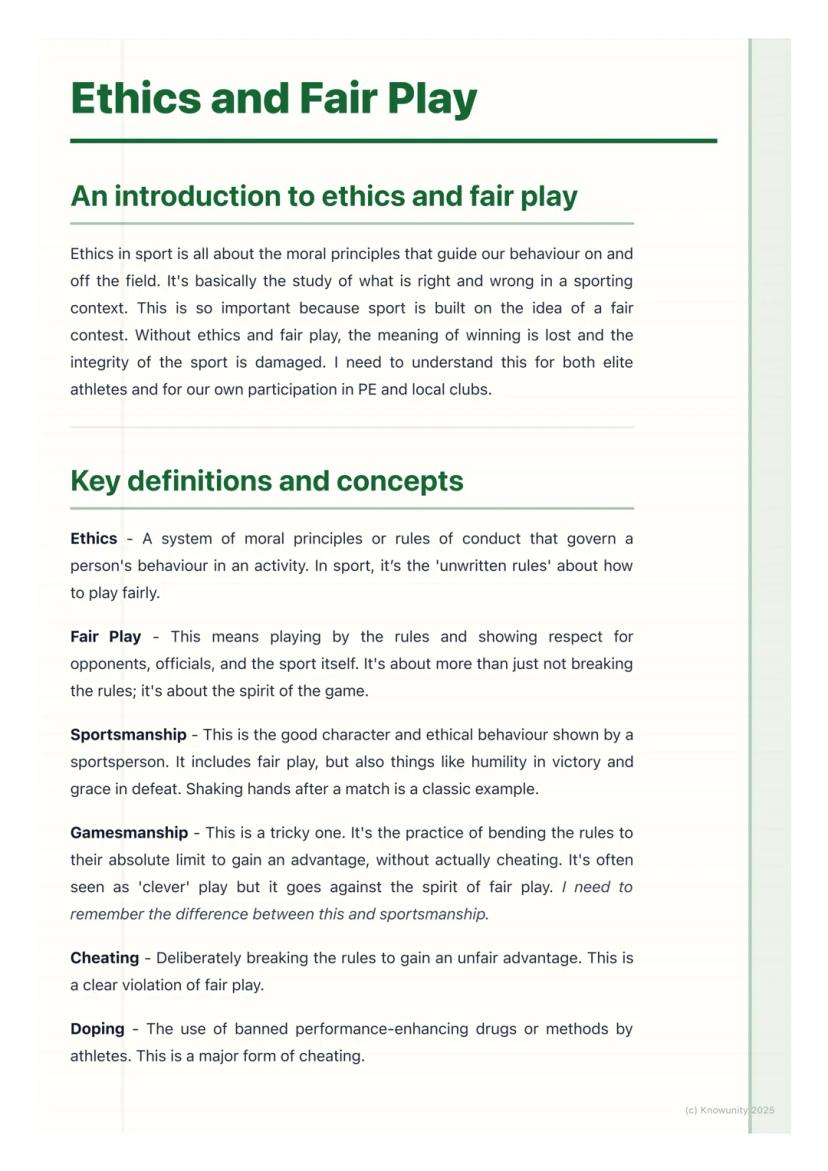
Think about your favourite sporting moment - chances are it wasn't just about the winning, but how it was won. Ethics in sport refers to the moral principles that guide behaviour both on and off the field. It's essentially the study of right versus wrong in sporting contexts.
Fair play forms the foundation of all meaningful competition. It goes beyond simply following the written rules - it's about respecting your opponents, officials, and the sport itself. Without it, winning loses all significance and the sport's integrity crumbles.
Understanding these concepts isn't just for elite athletes. Whether you're playing in PE class or for your local GAA club, these principles shape every sporting experience you'll have.
Remember: Fair play isn't about being soft - it's about being strong enough to win the right way.
Key terms you need to master include sportsmanship (showing good character and ethical behaviour), gamesmanship (bending rules to their limit without technically cheating), and doping . The difference between these concepts often determines whether an athlete becomes a hero or a villain.
2
of 6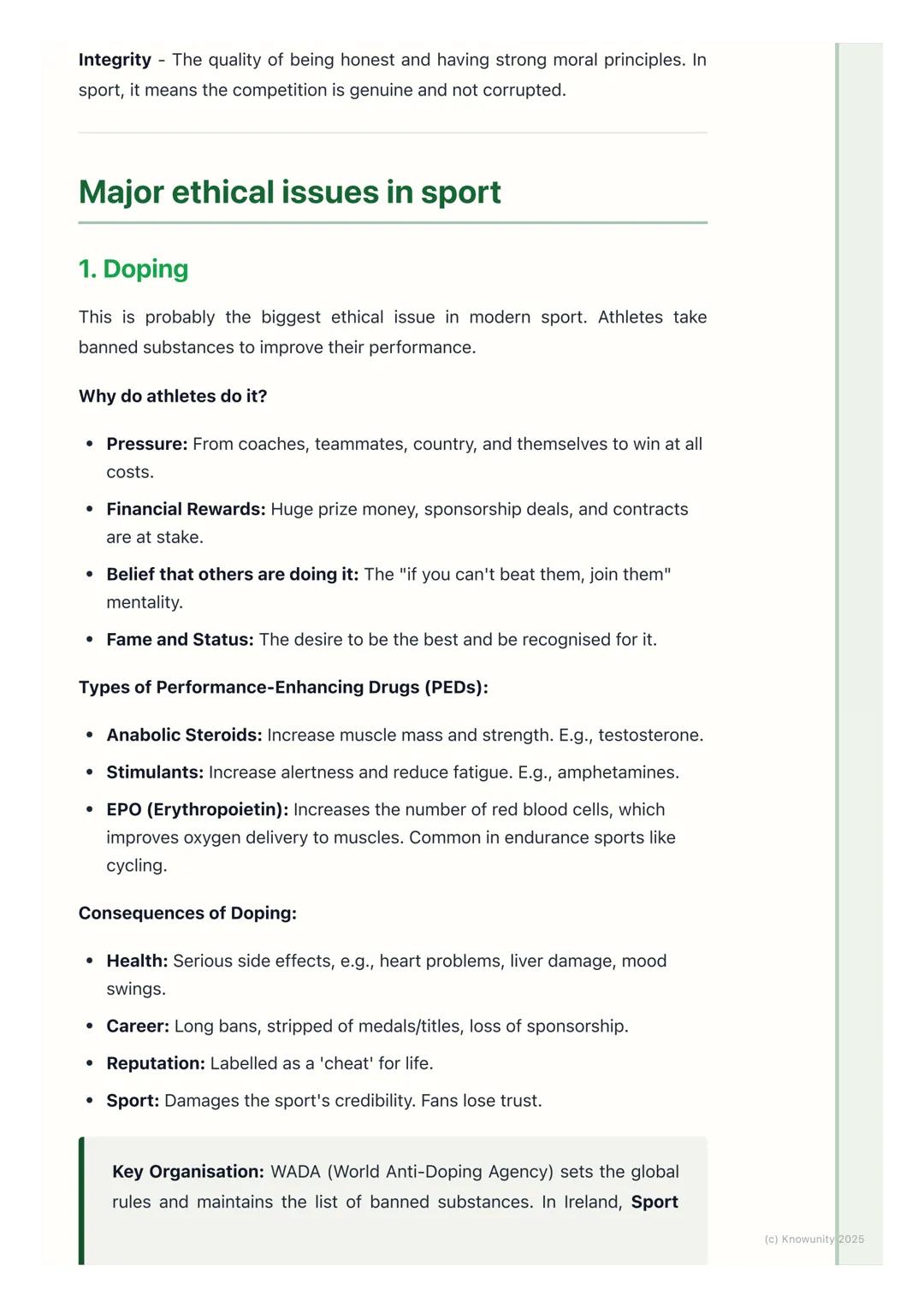
Major Ethical Issues in Sport
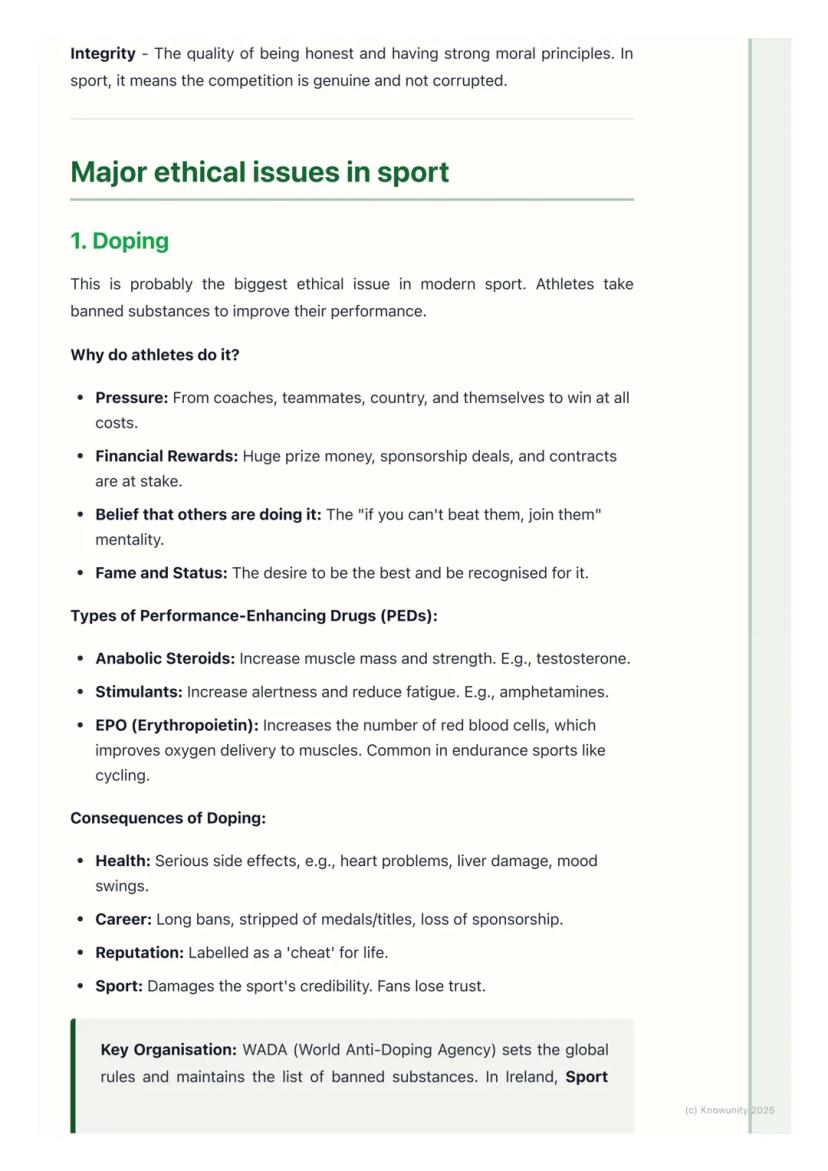
Doping represents the biggest ethical crisis in modern sport. Athletes use banned substances to artificially boost their performance, completely undermining fair competition.
Why do athletes risk everything for drugs? The pressure is immense - from coaches demanding results, massive financial rewards at stake, and the fear that competitors are already doing it. Fame and status drive some to make terrible decisions that haunt them forever.
Performance-enhancing drugs come in different forms. Anabolic steroids build muscle mass and strength, stimulants increase alertness whilst reducing fatigue, and EPO boosts red blood cell count for better endurance. Each carries serious health risks alongside the obvious ethical violations.
Did you know? WADA sets global anti-doping rules, whilst Sport Ireland implements testing programmes locally.
The consequences are devastating. Athletes face serious health problems, career-ending bans, stripped titles, and permanent damage to their reputation. More importantly, entire sports lose credibility when fans discover their heroes have been cheating.
Cheating extends beyond drugs though. Match-fixing, simulation (diving), illegal equipment, and cynical fouling all represent different ways athletes compromise their integrity for short-term gain.
3
of 6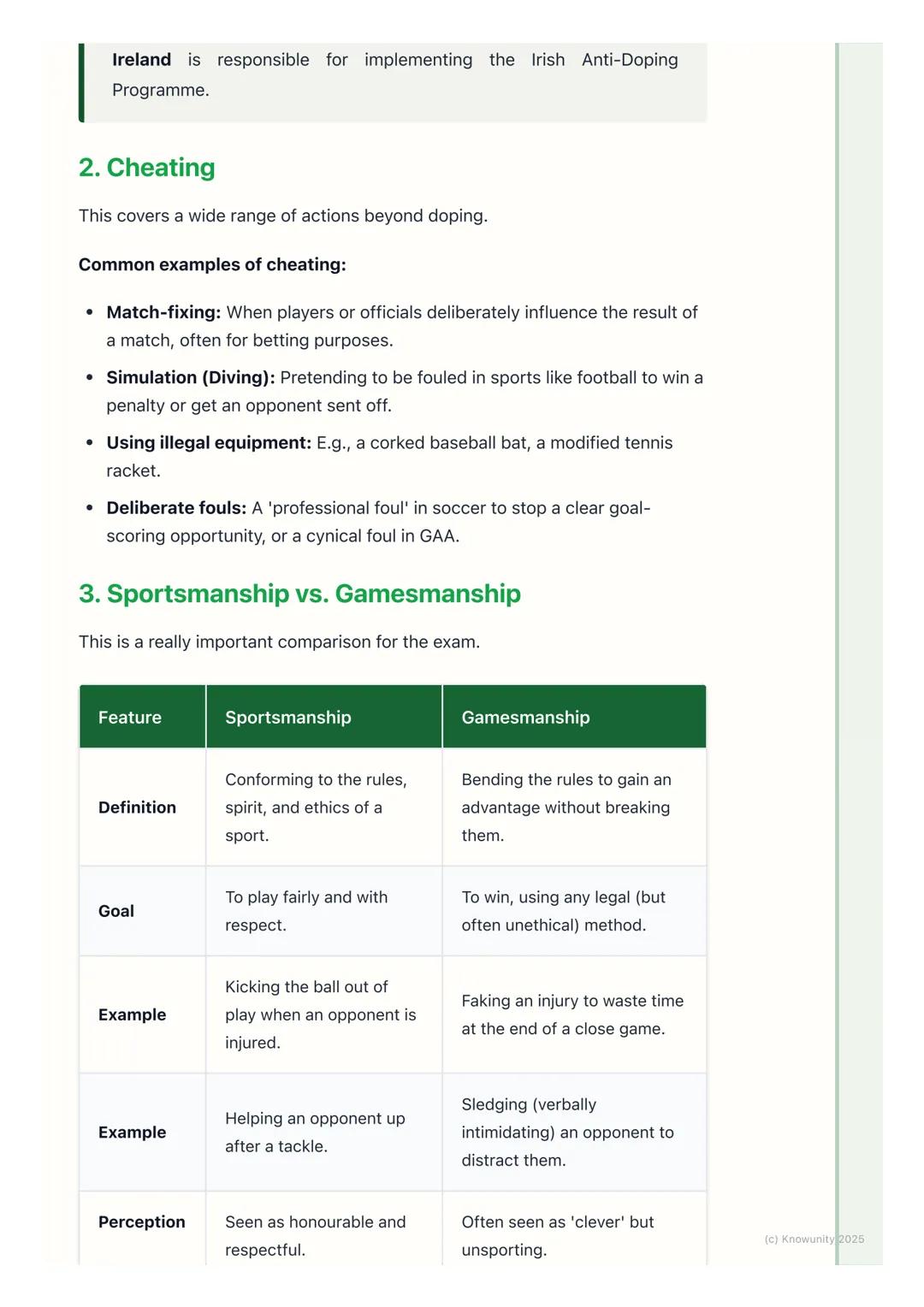
Sportsmanship vs Gamesmanship
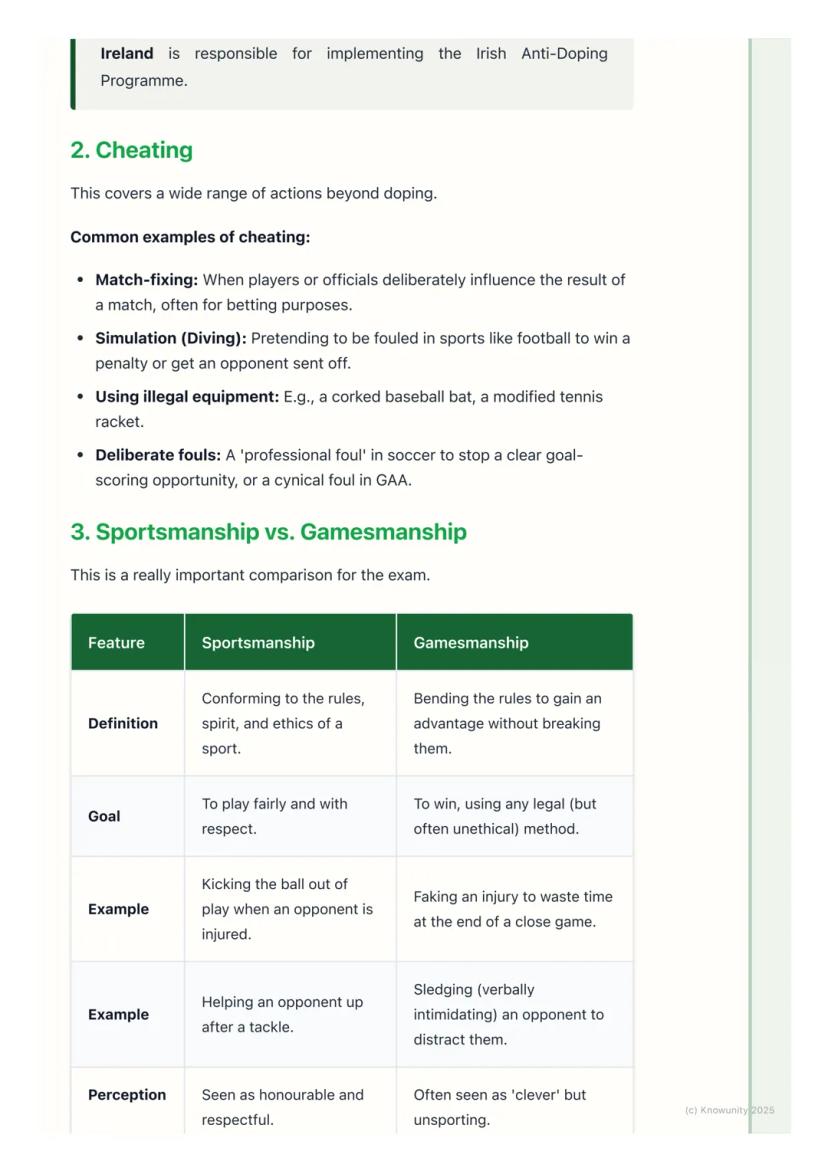
Here's a comparison that's absolutely crucial for your exams. Sportsmanship embodies everything sport should represent - playing with honour, respecting opponents, and accepting results gracefully. Think shaking hands after matches or helping an injured opponent.
Gamesmanship operates in sport's grey area. It's technically legal but goes against the spirit of fair play. Players push rules to their absolute limit without actually breaking them. It's often seen as "clever" play, but it damages what makes sport beautiful.
The key difference lies in intention and respect. Sportsmanship prioritises the game's integrity over personal gain, whilst gamesmanship exploits loopholes for advantage. Both are legal, but only one preserves sport's true meaning.
Modern technology like VAR and Hawk-Eye helps reduce some forms of cheating, but creates new ethical debates. Should technology make every decision, or does human judgement remain important?
Think about it: Every time you play sport, you choose between sportsmanship and gamesmanship. Which person do you want to be?
Remember that ethics apply at every level. Whether you're calling your own lines in tennis or admitting you touched the ball last in volleyball, these principles matter just as much in school sport as they do at the Olympics.
4
of 6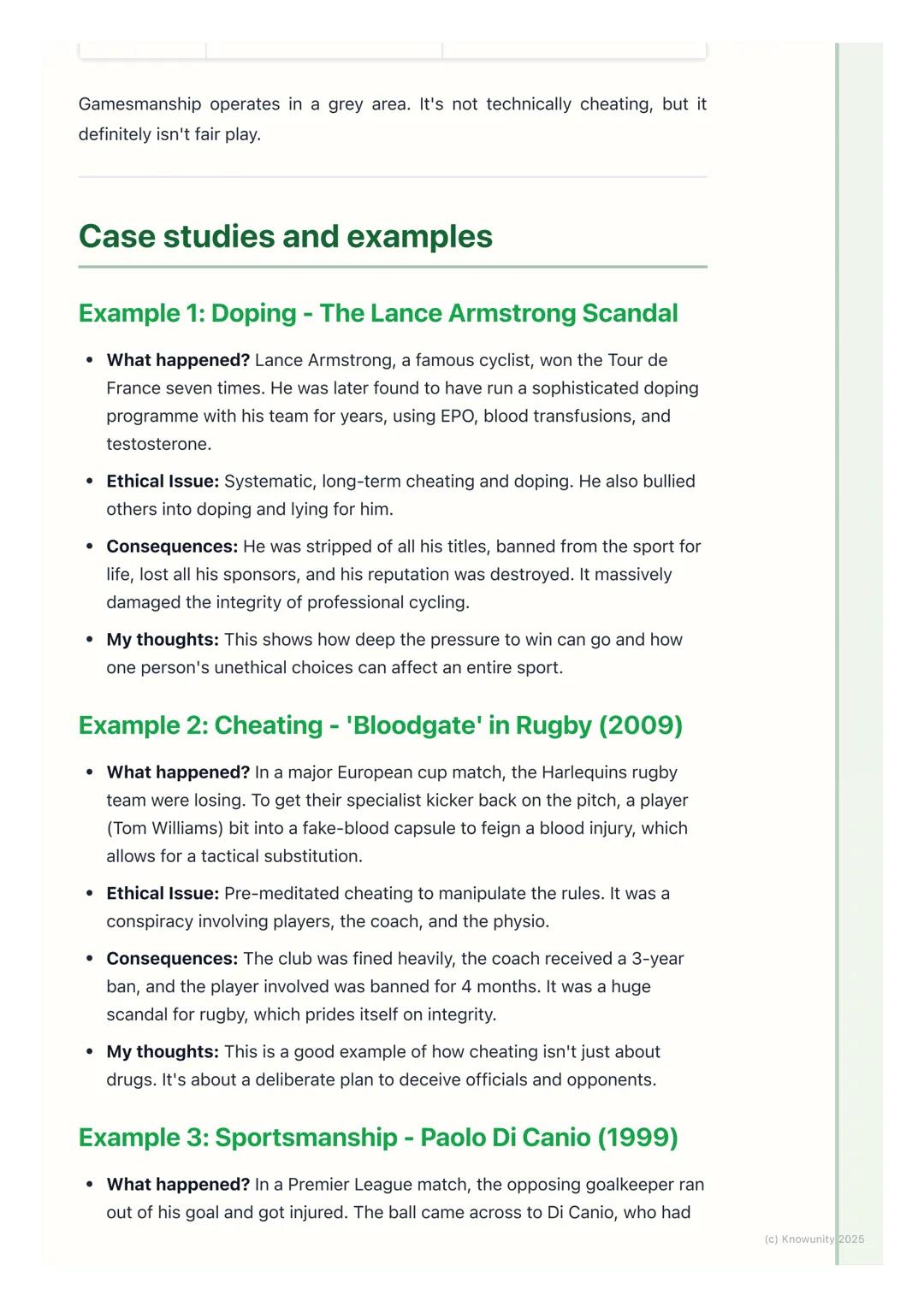
Case Studies and Examples
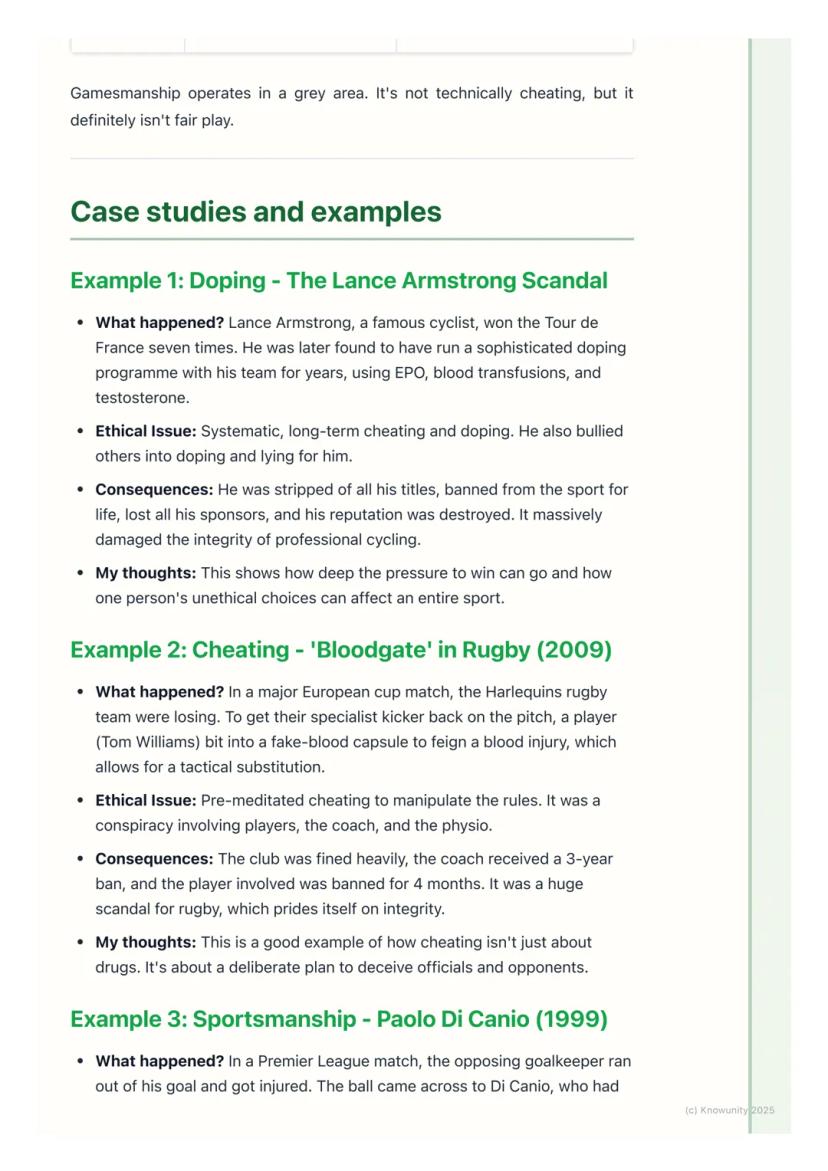
Lance Armstrong's doping scandal perfectly illustrates how deep unethical behaviour can go. The cyclist won seven Tour de France titles through systematic cheating, using EPO, blood transfusions, and testosterone whilst bullying teammates into joining his programme.
The consequences were brutal - stripped of all titles, lifetime ban, lost sponsorships, and a destroyed reputation. More damaging was the impact on professional cycling's credibility, which still suffers today.
'Bloodgate' in rugby shows that cheating isn't always about drugs. In 2009, Harlequins player Tom Williams bit a fake-blood capsule to feign injury, allowing a tactical substitution. This pre-meditated deception involved players, coaches, and medical staff.
The scandal rocked rugby, a sport that prides itself on integrity. Heavy fines, lengthy bans, and massive embarrassment followed. It proved that any sport can be corrupted when winning becomes more important than honour.
Inspiration: Not all sporting stories end badly though!
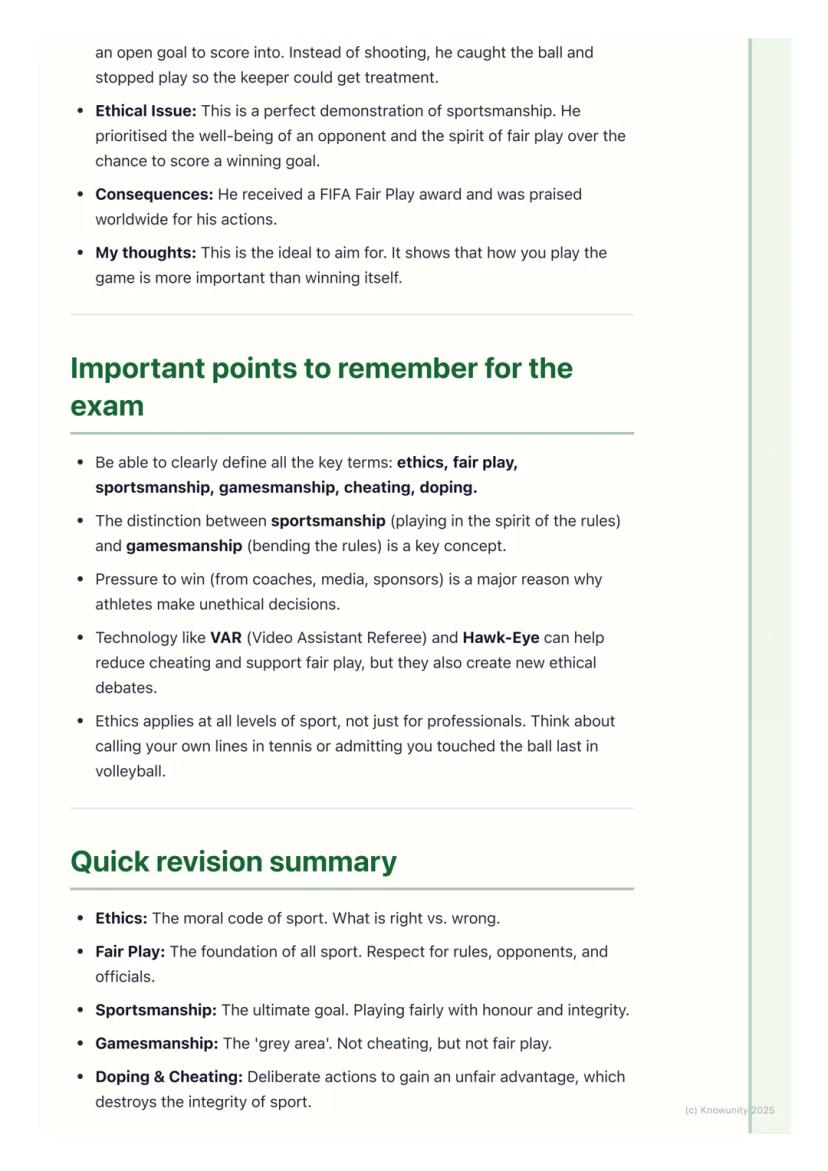
Paolo Di Canio's sportsmanship in 1999 provides the perfect counter-example. Facing an open goal after the opposing goalkeeper got injured, he caught the ball instead of scoring, stopping play so the keeper could receive treatment. His FIFA Fair Play award and worldwide praise showed that doing the right thing creates lasting respect that no goal ever could.
5
of 6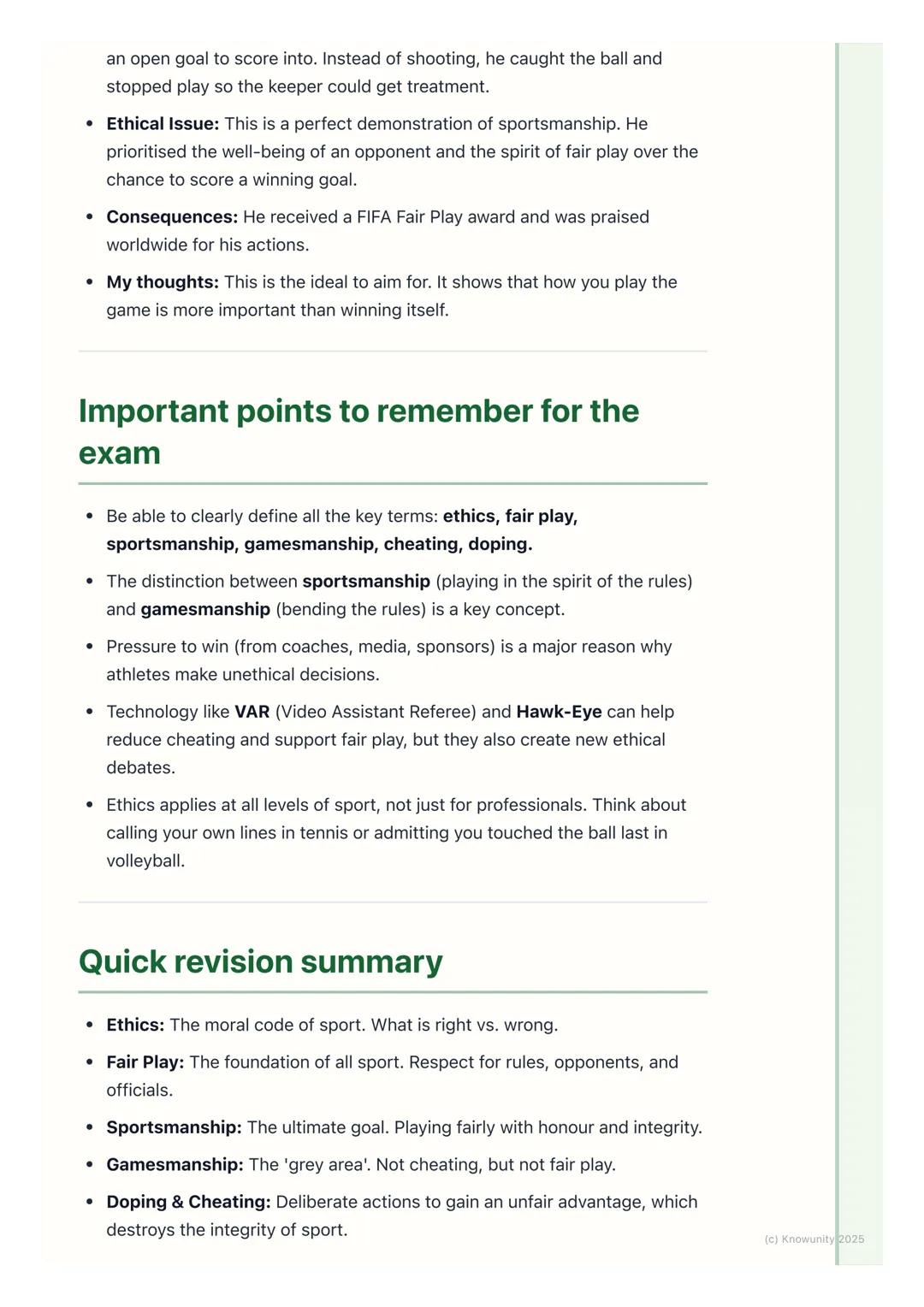
Key Points for Your Exam
You absolutely must be able to clearly define all major terms: ethics, fair play, sportsmanship, gamesmanship, cheating, and doping. The distinction between sportsmanship and gamesmanship appears frequently in exam questions.
Understanding why athletes make unethical choices is equally important. Pressure from coaches, media, and sponsors creates environments where some athletes prioritise winning over integrity. Financial rewards and fame can corrupt even well-intentioned competitors.
Technology's role in modern sport creates fascinating ethical debates. VAR helps referees make better decisions but also slows games down. Drug testing catches cheats but raises privacy concerns. These dilemmas show that ethical issues continue evolving.
Case studies bring these concepts to life. You should be able to describe Armstrong's systematic doping, rugby's Bloodgate scandal, and Di Canio's inspiring sportsmanship. Each illustrates different aspects of sporting ethics.
Exam tip: Always explain both what happened AND why it matters for sport's integrity.
Remember that consequences of unethical behaviour extend far beyond individual athletes. Entire sports suffer when fans lose trust, young people lose role models, and the fundamental meaning of competition gets undermined. That's why ethics matter so much in sport.
6
of 6
Quick Revision Summary
Ethics represents sport's moral code - the difference between right and wrong. Fair play provides the foundation that makes competition meaningful, whilst sportsmanship represents the ultimate goal of playing with honour and integrity.
Gamesmanship occupies sport's grey area - not technically cheating but definitely not fair play. Doping and cheating involve deliberate actions to gain unfair advantages, destroying sport's integrity completely.
Consequences of unethical behaviour include bans, reputation damage, health problems, and harm to entire sports. Your key examples remain Lance Armstrong (systematic doping), Bloodgate (premeditated cheating), and Paolo Di Canio (inspiring sportsmanship).
Final thought: In sport, as in life, how you achieve success matters as much as the success itself.
These principles apply whether you're competing at school level or dreaming of Olympic glory. Every time you step onto a pitch, court, or track, you choose what kind of athlete - and person - you want to be. Choose wisely, because your integrity is worth more than any trophy.
We thought you’d never ask...
What is the Knowunity AI companion?
Our AI companion is specifically built for the needs of students. Based on the millions of content pieces we have on the platform we can provide truly meaningful and relevant answers to students. But its not only about answers, the companion is even more about guiding students through their daily learning challenges, with personalised study plans, quizzes or content pieces in the chat and 100% personalisation based on the students skills and developments.
Where can I download the Knowunity app?
You can download the app in the Google Play Store and in the Apple App Store.
Is Knowunity really free of charge?
That's right! Enjoy free access to study content, connect with fellow students, and get instant help – all at your fingertips.
Most popular content in LCPE
4LCPEHealthy Eating Guidelines
This section explores national healthy eating guidelines, such as the food pyramid or healthy eating plate, to promote balanced dietary choices.
5th Year50
LCPEBiomechanics of Movement
Applying fundamental biomechanical principles such as force, motion, levers, and stability to analyse and improve human movement efficiency and performance in sport.
6th Year200
LCPEFactors effecting sports psychology ( confidence and self efficacy)
Higher Level LCPE psychological preprration notes
5th Year230
LCPETechnology in Sport
Investigating how technology is used in areas such as performance analysis, equipment design, officiating, and athlete monitoring to enhance training and competition.
6th Year50
Most popular content
9 Irish
IrishIrish oral questions and answers
Questions and answers for the leaving cert oral
5th Year4264
 English
Key Quotes : Sive
Key Quotes and explanations: Sive
6th Year2842
IrishIrish oral questions
Outline of oral questions
5th Year2055
IrishIníon- le hÁine Durkin
Aine Durkin’s poem, Iníon: Themes & summary
5th Year890
IrishIrish poetry 2027
Iníon + Dínit an Bhróin
5th Year1153
IrishLC HL notes- Iníon (poem)
Includes poem in English and Irish, theme, key words & phrases
5th Year2304
EnglishCultural Context : Shawshank Redemption : Sive : Small Things Like These
Comparative Study : Cultural Context : Shawshank Redemption, Sive and Small Things Like These
6th Year1430
IrishMo Ghrá-sa (Idir Lúibíní)
Notes on mo ghrá-sa
5th Year380
IrishAn Gaeilge Aiste
Irish Language essay
6th Year1320
Can't find what you're looking for? Explore other subjects.
Students love us — and so will you.
4.6/5App Store
4.7/5Google Play
The app is very easy to use and well designed. I have found everything I was looking for so far and have been able to learn a lot from the presentations! I will definitely use the app for a class assignment! And of course it also helps a lot as an inspiration.
Stefan SiOS user
This app is really great. There are so many study notes and help [...]. My problem subject is French, for example, and the app has so many options for help. Thanks to this app, I have improved my French. I would recommend it to anyone.
Samantha KlichAndroid user
Wow, I am really amazed. I just tried the app because I've seen it advertised many times and was absolutely stunned. This app is THE HELP you want for school and above all, it offers so many things, such as workouts and fact sheets, which have been VERY helpful to me personally.
AnnaiOS user
LCPE2 views·Updated Jun 17, 2026·6 pagesIntegrity in Sports: Ethics and Fair Play
Ever wondered what separates true champions from mere winners? It's all about ethics and fair play - the moral backbone that keeps sport meaningful and exciting. Without these principles, victories become hollow and the whole point of competition gets lost.
1
of 6
Sign up to see the content. It's free!
- Access to all documents
- Improve your grades
- Join milions of students
An Introduction to Ethics and Fair Play
Think about your favourite sporting moment - chances are it wasn't just about the winning, but how it was won. Ethics in sport refers to the moral principles that guide behaviour both on and off the field. It's essentially the study of right versus wrong in sporting contexts.
Fair play forms the foundation of all meaningful competition. It goes beyond simply following the written rules - it's about respecting your opponents, officials, and the sport itself. Without it, winning loses all significance and the sport's integrity crumbles.
Understanding these concepts isn't just for elite athletes. Whether you're playing in PE class or for your local GAA club, these principles shape every sporting experience you'll have.
Remember: Fair play isn't about being soft - it's about being strong enough to win the right way.
Key terms you need to master include sportsmanship (showing good character and ethical behaviour), gamesmanship (bending rules to their limit without technically cheating), and doping . The difference between these concepts often determines whether an athlete becomes a hero or a villain.
2
of 6Sign up to see the content. It's free!
- Access to all documents
- Improve your grades
- Join milions of students
Major Ethical Issues in Sport
Doping represents the biggest ethical crisis in modern sport. Athletes use banned substances to artificially boost their performance, completely undermining fair competition.
Why do athletes risk everything for drugs? The pressure is immense - from coaches demanding results, massive financial rewards at stake, and the fear that competitors are already doing it. Fame and status drive some to make terrible decisions that haunt them forever.
Performance-enhancing drugs come in different forms. Anabolic steroids build muscle mass and strength, stimulants increase alertness whilst reducing fatigue, and EPO boosts red blood cell count for better endurance. Each carries serious health risks alongside the obvious ethical violations.
Did you know? WADA sets global anti-doping rules, whilst Sport Ireland implements testing programmes locally.
The consequences are devastating. Athletes face serious health problems, career-ending bans, stripped titles, and permanent damage to their reputation. More importantly, entire sports lose credibility when fans discover their heroes have been cheating.
Cheating extends beyond drugs though. Match-fixing, simulation (diving), illegal equipment, and cynical fouling all represent different ways athletes compromise their integrity for short-term gain.
3
of 6Sign up to see the content. It's free!
- Access to all documents
- Improve your grades
- Join milions of students
Sportsmanship vs Gamesmanship
Here's a comparison that's absolutely crucial for your exams. Sportsmanship embodies everything sport should represent - playing with honour, respecting opponents, and accepting results gracefully. Think shaking hands after matches or helping an injured opponent.
Gamesmanship operates in sport's grey area. It's technically legal but goes against the spirit of fair play. Players push rules to their absolute limit without actually breaking them. It's often seen as "clever" play, but it damages what makes sport beautiful.
The key difference lies in intention and respect. Sportsmanship prioritises the game's integrity over personal gain, whilst gamesmanship exploits loopholes for advantage. Both are legal, but only one preserves sport's true meaning.
Modern technology like VAR and Hawk-Eye helps reduce some forms of cheating, but creates new ethical debates. Should technology make every decision, or does human judgement remain important?
Think about it: Every time you play sport, you choose between sportsmanship and gamesmanship. Which person do you want to be?
Remember that ethics apply at every level. Whether you're calling your own lines in tennis or admitting you touched the ball last in volleyball, these principles matter just as much in school sport as they do at the Olympics.
4
of 6Sign up to see the content. It's free!
- Access to all documents
- Improve your grades
- Join milions of students
Case Studies and Examples
Lance Armstrong's doping scandal perfectly illustrates how deep unethical behaviour can go. The cyclist won seven Tour de France titles through systematic cheating, using EPO, blood transfusions, and testosterone whilst bullying teammates into joining his programme.
The consequences were brutal - stripped of all titles, lifetime ban, lost sponsorships, and a destroyed reputation. More damaging was the impact on professional cycling's credibility, which still suffers today.
'Bloodgate' in rugby shows that cheating isn't always about drugs. In 2009, Harlequins player Tom Williams bit a fake-blood capsule to feign injury, allowing a tactical substitution. This pre-meditated deception involved players, coaches, and medical staff.
The scandal rocked rugby, a sport that prides itself on integrity. Heavy fines, lengthy bans, and massive embarrassment followed. It proved that any sport can be corrupted when winning becomes more important than honour.
Inspiration: Not all sporting stories end badly though!
Paolo Di Canio's sportsmanship in 1999 provides the perfect counter-example. Facing an open goal after the opposing goalkeeper got injured, he caught the ball instead of scoring, stopping play so the keeper could receive treatment. His FIFA Fair Play award and worldwide praise showed that doing the right thing creates lasting respect that no goal ever could.
5
of 6Sign up to see the content. It's free!
- Access to all documents
- Improve your grades
- Join milions of students
Key Points for Your Exam
You absolutely must be able to clearly define all major terms: ethics, fair play, sportsmanship, gamesmanship, cheating, and doping. The distinction between sportsmanship and gamesmanship appears frequently in exam questions.
Understanding why athletes make unethical choices is equally important. Pressure from coaches, media, and sponsors creates environments where some athletes prioritise winning over integrity. Financial rewards and fame can corrupt even well-intentioned competitors.
Technology's role in modern sport creates fascinating ethical debates. VAR helps referees make better decisions but also slows games down. Drug testing catches cheats but raises privacy concerns. These dilemmas show that ethical issues continue evolving.
Case studies bring these concepts to life. You should be able to describe Armstrong's systematic doping, rugby's Bloodgate scandal, and Di Canio's inspiring sportsmanship. Each illustrates different aspects of sporting ethics.
Exam tip: Always explain both what happened AND why it matters for sport's integrity.
Remember that consequences of unethical behaviour extend far beyond individual athletes. Entire sports suffer when fans lose trust, young people lose role models, and the fundamental meaning of competition gets undermined. That's why ethics matter so much in sport.
6
of 6Sign up to see the content. It's free!
- Access to all documents
- Improve your grades
- Join milions of students
Quick Revision Summary
Ethics represents sport's moral code - the difference between right and wrong. Fair play provides the foundation that makes competition meaningful, whilst sportsmanship represents the ultimate goal of playing with honour and integrity.
Gamesmanship occupies sport's grey area - not technically cheating but definitely not fair play. Doping and cheating involve deliberate actions to gain unfair advantages, destroying sport's integrity completely.
Consequences of unethical behaviour include bans, reputation damage, health problems, and harm to entire sports. Your key examples remain Lance Armstrong (systematic doping), Bloodgate (premeditated cheating), and Paolo Di Canio (inspiring sportsmanship).
Final thought: In sport, as in life, how you achieve success matters as much as the success itself.
These principles apply whether you're competing at school level or dreaming of Olympic glory. Every time you step onto a pitch, court, or track, you choose what kind of athlete - and person - you want to be. Choose wisely, because your integrity is worth more than any trophy.
We thought you’d never ask...
What is the Knowunity AI companion?
Our AI companion is specifically built for the needs of students. Based on the millions of content pieces we have on the platform we can provide truly meaningful and relevant answers to students. But its not only about answers, the companion is even more about guiding students through their daily learning challenges, with personalised study plans, quizzes or content pieces in the chat and 100% personalisation based on the students skills and developments.
Where can I download the Knowunity app?
You can download the app in the Google Play Store and in the Apple App Store.
Is Knowunity really free of charge?
That's right! Enjoy free access to study content, connect with fellow students, and get instant help – all at your fingertips.
Most popular content in LCPE
4LCPEHealthy Eating Guidelines
This section explores national healthy eating guidelines, such as the food pyramid or healthy eating plate, to promote balanced dietary choices.
5th Year50
LCPEBiomechanics of Movement
Applying fundamental biomechanical principles such as force, motion, levers, and stability to analyse and improve human movement efficiency and performance in sport.
6th Year200
LCPEFactors effecting sports psychology ( confidence and self efficacy)
Higher Level LCPE psychological preprration notes
5th Year230
LCPETechnology in Sport
Investigating how technology is used in areas such as performance analysis, equipment design, officiating, and athlete monitoring to enhance training and competition.
6th Year50
Most popular content
9IrishIrish oral questions and answers
Questions and answers for the leaving cert oral
5th Year4264
EnglishKey Quotes : Sive
Key Quotes and explanations: Sive
6th Year2842
IrishIrish oral questions
Outline of oral questions
5th Year2055
IrishIníon- le hÁine Durkin
Aine Durkin’s poem, Iníon: Themes & summary
5th Year890
IrishIrish poetry 2027
Iníon + Dínit an Bhróin
5th Year1153
IrishLC HL notes- Iníon (poem)
Includes poem in English and Irish, theme, key words & phrases
5th Year2304
EnglishCultural Context : Shawshank Redemption : Sive : Small Things Like These
Comparative Study : Cultural Context : Shawshank Redemption, Sive and Small Things Like These
6th Year1430
IrishMo Ghrá-sa (Idir Lúibíní)
Notes on mo ghrá-sa
5th Year380
IrishAn Gaeilge Aiste
Irish Language essay
6th Year1320
Can't find what you're looking for? Explore other subjects.
Students love us — and so will you.
4.6/5App Store
4.7/5Google Play
The app is very easy to use and well designed. I have found everything I was looking for so far and have been able to learn a lot from the presentations! I will definitely use the app for a class assignment! And of course it also helps a lot as an inspiration.
Stefan SiOS user
This app is really great. There are so many study notes and help [...]. My problem subject is French, for example, and the app has so many options for help. Thanks to this app, I have improved my French. I would recommend it to anyone.
Samantha KlichAndroid user
Wow, I am really amazed. I just tried the app because I've seen it advertised many times and was absolutely stunned. This app is THE HELP you want for school and above all, it offers so many things, such as workouts and fact sheets, which have been VERY helpful to me personally.
AnnaiOS user