
Ever wondered how someone could transform from a minor party... Show more
 History
 Irish
Irish English
Sign up to see the contentIt's free!
Access to all documents
Improve your grades
Join milions of students
Knowunity AI
Subjects
Triangle Congruence and Similarity Theorems
Triangle Properties and Classification
Linear Equations and Graphs
Geometric Angle Relationships
Trigonometric Functions and Identities
Equation Solving Techniques
Circle Geometry Fundamentals
Division Operations and Methods
Basic Differentiation Rules
Exponent and Logarithm Properties
Show all topics
Human Organ Systems
Reproductive Cell Cycles
Biological Sciences Subdisciplines
Cellular Energy Metabolism
Autotrophic Energy Processes
Inheritance Patterns and Principles
Biomolecular Structure and Organization
Cell Cycle and Division Mechanics
Cellular Organization and Development
Biological Structural Organization
Show all topics
Chemical Sciences and Applications
Atomic Structure and Composition
Molecular Electron Structure Representation
Atomic Electron Behavior
Matter Properties and Water
Mole Concept and Calculations
Gas Laws and Behavior
Periodic Table Organization
Chemical Thermodynamics Fundamentals
Chemical Bond Types and Properties
Show all topics
European Renaissance and Enlightenment
European Cultural Movements 800-1920
American Revolution Era 1763-1797
American Civil War 1861-1865
Global Imperial Systems
Mongol and Chinese Dynasties
U.S. Presidents and World Leaders
Historical Sources and Documentation
World Wars Era and Impact
World Religious Systems
Show all topics
Classic and Contemporary Novels
Literary Character Analysis
Rhetorical Theory and Practice
Classic Literary Narratives
Reading Analysis and Interpretation
Narrative Structure and Techniques
English Language Components
Influential English-Language Authors
Basic Sentence Structure
Narrative Voice and Perspective
Show all topics
10
•
Updated Mar 21, 2026
•
Ever wondered how someone could transform from a minor party... Show more
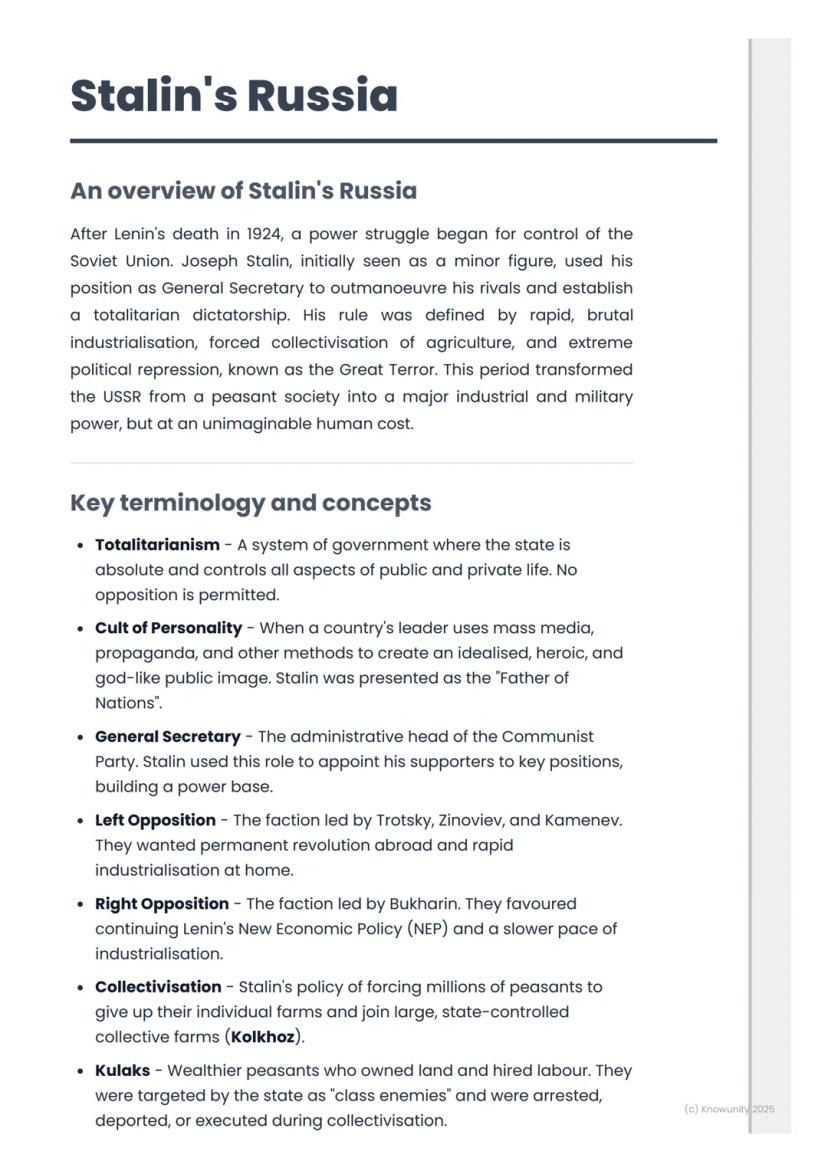


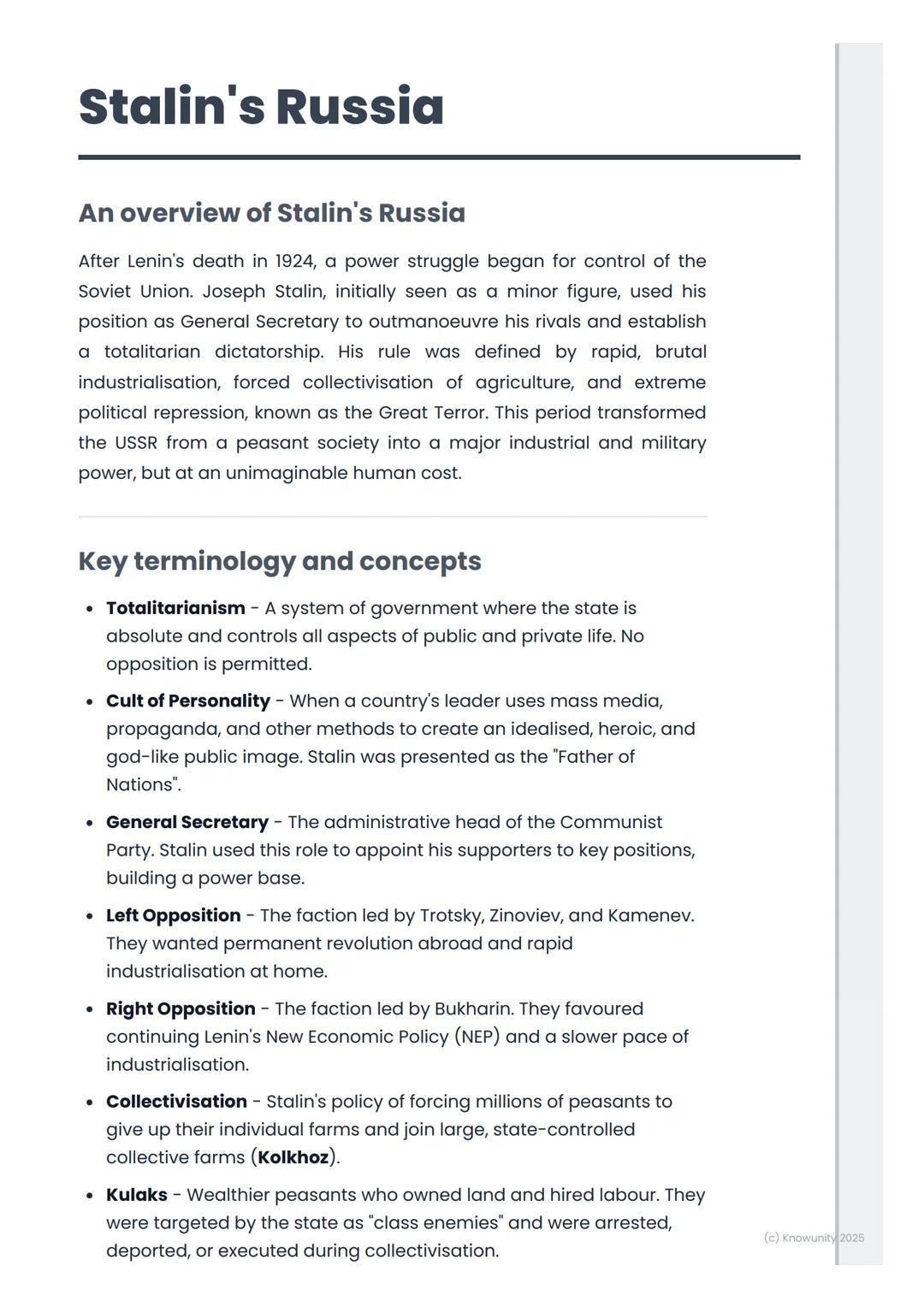
Getting to grips with Stalin's Russia means understanding how totalitarianism actually works in practice. Think of it as a system where the government controls literally everything - your job, your thoughts, even your private conversations.
Stalin's journey to absolute power began with his role as General Secretary of the Communist Party. Whilst his rivals saw this as boring paperwork, Stalin cleverly used it to place his supporters in key positions across the Soviet Union. He was building a loyal network whilst everyone else was arguing about ideology.
The cult of personality became Stalin's masterpiece of manipulation. Through massive propaganda campaigns, he transformed himself from "the grey blur" into the god-like "Father of Nations." Every success belonged to Stalin; every failure was someone else's fault.
Key insight: Stalin succeeded because he understood that controlling people was more important than winning debates about communist theory.
When Lenin died, the party split into the Left Opposition (wanting rapid change) and Right Opposition (preferring gradual progress). Stalin brilliantly played them against each other, supporting whoever helped him eliminate his current biggest threat. By 1929, he'd outmanoeuvred them all.

Stalin's economic revolution wasn't just about numbers - it was about completely reshaping Soviet society through fear and force. His collectivisation policy meant ripping millions of peasants away from their individual farms and forcing them onto massive state-controlled collective farms.
The kulaks (wealthier peasants) became convenient scapegoats. Stalin branded them "class enemies" and had them arrested, deported, or executed. This wasn't really about economics - it was about showing everyone what happened when you resisted the state.
Five-Year Plans sound boring until you realise they represented the most ambitious industrial transformation in history. Stalin demanded impossible targets for steel, coal, and oil production. Miss your quota? You're sabotaging the revolution. The NKVD (secret police) made sure everyone understood the consequences.
Reality check: The human cost was staggering - millions died from starvation during collectivisation, especially in Ukraine's Holodomor famine of 1932-33.
These policies were deliberately linked. Collectivisation was supposed to feed the growing industrial workforce and provide grain exports to buy foreign machinery. In reality, both policies created suffering on an unimaginable scale whilst giving Stalin total control over the economy.

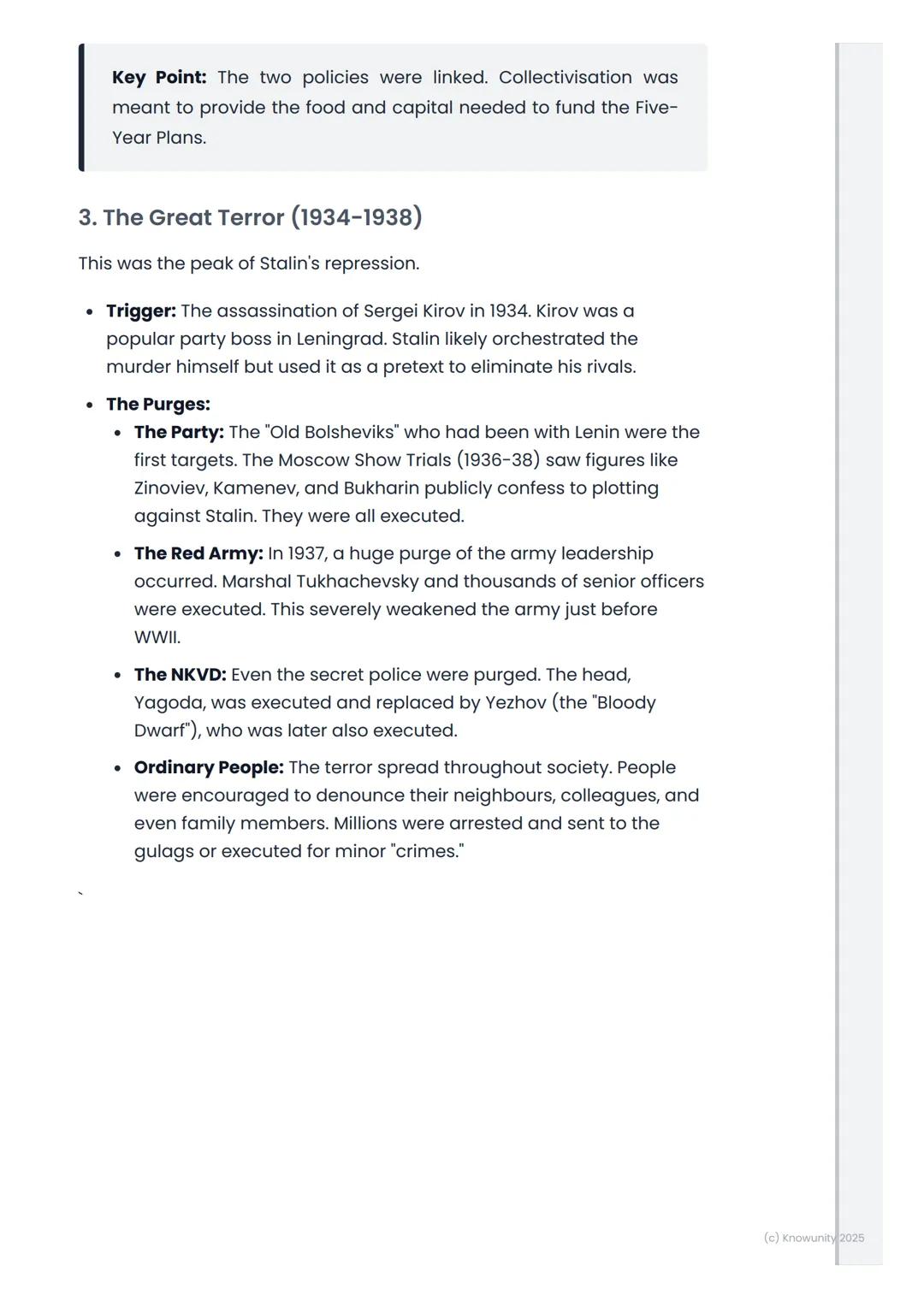
Nothing shows Stalin's ruthlessness quite like the Great Terror of 1936-1938. The assassination of Sergei Kirov in 1934 gave Stalin the perfect excuse to unleash a wave of paranoia and violence that would consume the entire Soviet Union.
The famous show trials were pure theatre designed to terrify the population. Old Bolsheviks like Zinoviev, Kamenev, and Bukharin - heroes of the 1917 Revolution - were forced to confess to ridiculous crimes against Stalin. After their public humiliation, they were all executed.
Stalin's paranoia knew no bounds. He even purged the Red Army leadership in 1937, executing Marshal Tukhachevsky and thousands of experienced officers just as Nazi Germany was becoming threatening. The NKVD itself wasn't safe - even the secret police chiefs were regularly executed and replaced.
Terrifying fact: The terror became self-perpetuating - people denounced neighbours, colleagues, and family members to prove their loyalty and avoid suspicion.
The Gulag system of labour camps became a crucial part of Soviet economics. Political prisoners provided slave labour for impossible construction projects in horrific conditions. Millions died from overwork, starvation, and disease, but the camps kept expanding.

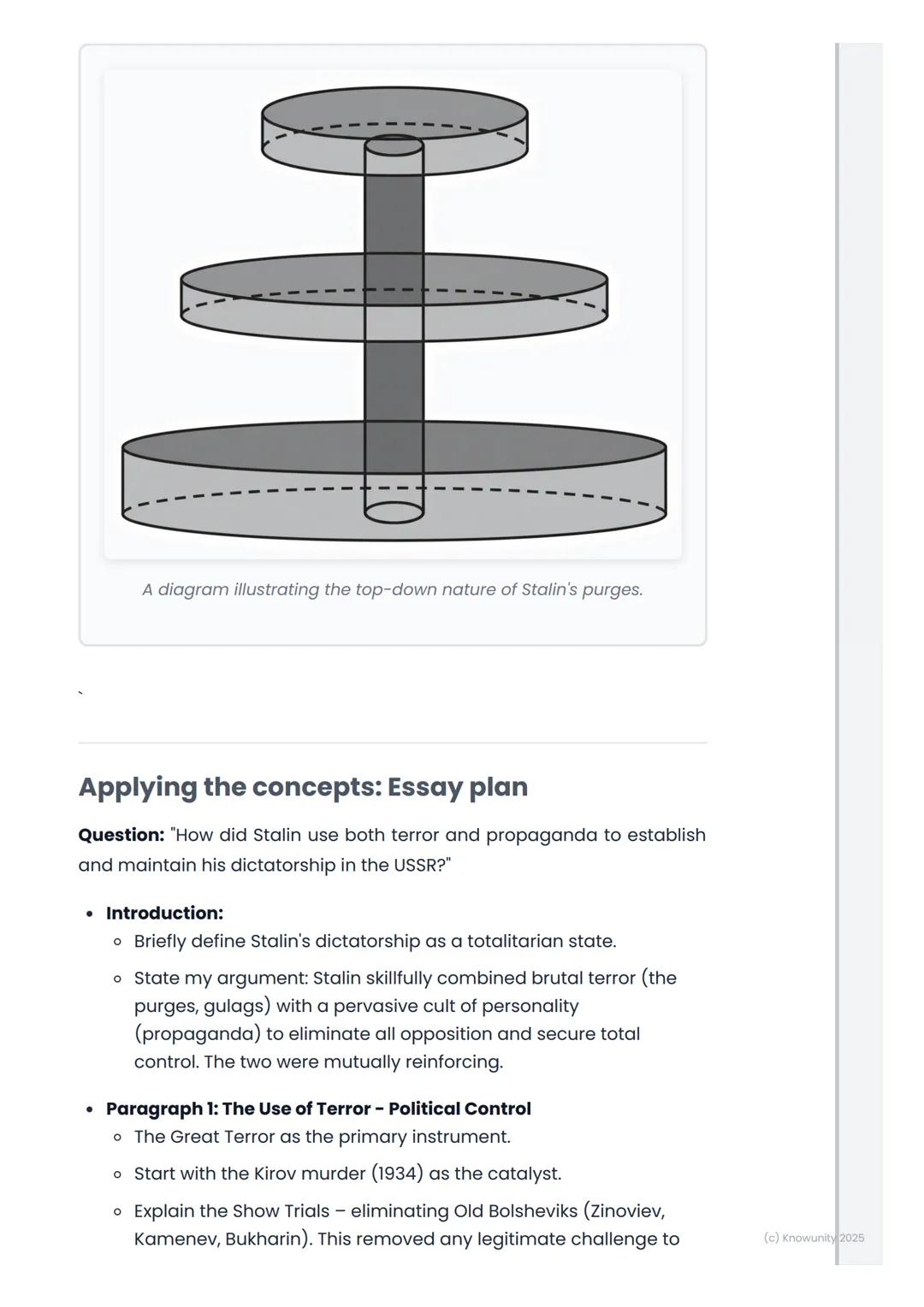
Stalin understood that terror alone wasn't enough - he needed people to actually believe in his leadership. The cult of personality became a sophisticated propaganda machine that touched every aspect of Soviet life.
Socialist Realism in art and literature meant everything had to glorify Stalin and Soviet achievements. History was literally rewritten - rivals like Trotsky were airbrushed out of photographs and erased from textbooks. Stalin became the hero of every story.
The regime targeted young people especially hard through organisations like the Komsomol (Communist Youth League). Children were taught to see Stalin as a wise father figure who cared personally about their future. Many genuinely believed this propaganda.
Powerful combination: Stalin's genius was combining brutal terror with seductive propaganda - stick and carrot, fear and hope, punishment and reward.
Mass rallies, parades, and celebrations created a sense of unity and purpose with Stalin at the centre. For many Soviets, especially those born after 1917, this was the only reality they knew. The propaganda was often genuinely effective, making Stalin's dictatorship seem legitimate and even inspiring.

Our AI companion is specifically built for the needs of students. Based on the millions of content pieces we have on the platform we can provide truly meaningful and relevant answers to students. But its not only about answers, the companion is even more about guiding students through their daily learning challenges, with personalised study plans, quizzes or content pieces in the chat and 100% personalisation based on the students skills and developments.
You can download the app in the Google Play Store and in the Apple App Store.
That's right! Enjoy free access to study content, connect with fellow students, and get instant help – all at your fingertips.
App Store
Google Play
The app is very easy to use and well designed. I have found everything I was looking for so far and have been able to learn a lot from the presentations! I will definitely use the app for a class assignment! And of course it also helps a lot as an inspiration.
Stefan S
iOS user
This app is really great. There are so many study notes and help [...]. My problem subject is French, for example, and the app has so many options for help. Thanks to this app, I have improved my French. I would recommend it to anyone.
Samantha Klich
Android user
Wow, I am really amazed. I just tried the app because I've seen it advertised many times and was absolutely stunned. This app is THE HELP you want for school and above all, it offers so many things, such as workouts and fact sheets, which have been VERY helpful to me personally.
Anna
iOS user
I think it’s very much worth it and you’ll end up using it a lot once you get the hang of it and even after looking at others notes you can still ask your Artificial intelligence buddy the question and ask to simplify it if you still don’t get it!!! In the end I think it’s worth it 😊👍 ⚠️Also DID I MENTION ITS FREEE YOU DON’T HAVE TO PAY FOR ANYTHING AND STILL GET YOUR GRADES IN PERFECTLY❗️❗️⚠️
Thomas R
iOS user
Knowunity is the BEST app I’ve used in a minute. This is not an ai review or anything this is genuinely coming from a 7th grade student (I know 2011 im young) but dude this app is a 10/10 i have maintained a 3.8 gpa and have plenty of time for gaming. I love it and my mom is just happy I got good grades
Brad T
Android user
Not only did it help me find the answer but it also showed me alternative ways to solve it. I was horrible in math and science but now I have an a in both subjects. Thanks for the help🤍🤍
David K
iOS user
The app's just great! All I have to do is enter the topic in the search bar and I get the response real fast. I don't have to watch 10 YouTube videos to understand something, so I'm saving my time. Highly recommended!
Sudenaz Ocak
Android user
In school I was really bad at maths but thanks to the app, I am doing better now. I am so grateful that you made the app.
Greenlight Bonnie
Android user
I found this app a couple years ago and it has only gotten better since then. I really love it because it can help with written questions and photo questions. Also, it can find study guides that other people have made as well as flashcard sets and practice tests. The free version is also amazing for students who might not be able to afford it. Would 100% recommend
Aubrey
iOS user
Best app if you're in Highschool or Junior high. I have been using this app for 2 school years and it's the best, it's good if you don't have anyone to help you with school work.😋🩷🎀
Marco B
iOS user
THE QUIZES AND FLASHCARDS ARE SO USEFUL AND I LOVE Knowunity AI. IT ALSO IS LITREALLY LIKE CHATGPT BUT SMARTER!! HELPED ME WITH MY MASCARA PROBLEMS TOO!! AS WELL AS MY REAL SUBJECTS ! DUHHH 😍😁😲🤑💗✨🎀😮
Elisha
iOS user
This app is phenomenal down to the correct info and the various topics you can study! I greatly recommend it for people who struggle with procrastination and those who need homework help. It has been perfectly accurate for world 1 history as far as I’ve seen! Geometry too!
Paul T
iOS user
The app is very easy to use and well designed. I have found everything I was looking for so far and have been able to learn a lot from the presentations! I will definitely use the app for a class assignment! And of course it also helps a lot as an inspiration.
Stefan S
iOS user
This app is really great. There are so many study notes and help [...]. My problem subject is French, for example, and the app has so many options for help. Thanks to this app, I have improved my French. I would recommend it to anyone.
Samantha Klich
Android user
Wow, I am really amazed. I just tried the app because I've seen it advertised many times and was absolutely stunned. This app is THE HELP you want for school and above all, it offers so many things, such as workouts and fact sheets, which have been VERY helpful to me personally.
Anna
iOS user
I think it’s very much worth it and you’ll end up using it a lot once you get the hang of it and even after looking at others notes you can still ask your Artificial intelligence buddy the question and ask to simplify it if you still don’t get it!!! In the end I think it’s worth it 😊👍 ⚠️Also DID I MENTION ITS FREEE YOU DON’T HAVE TO PAY FOR ANYTHING AND STILL GET YOUR GRADES IN PERFECTLY❗️❗️⚠️
Thomas R
iOS user
Knowunity is the BEST app I’ve used in a minute. This is not an ai review or anything this is genuinely coming from a 7th grade student (I know 2011 im young) but dude this app is a 10/10 i have maintained a 3.8 gpa and have plenty of time for gaming. I love it and my mom is just happy I got good grades
Brad T
Android user
Not only did it help me find the answer but it also showed me alternative ways to solve it. I was horrible in math and science but now I have an a in both subjects. Thanks for the help🤍🤍
David K
iOS user
The app's just great! All I have to do is enter the topic in the search bar and I get the response real fast. I don't have to watch 10 YouTube videos to understand something, so I'm saving my time. Highly recommended!
Sudenaz Ocak
Android user
In school I was really bad at maths but thanks to the app, I am doing better now. I am so grateful that you made the app.
Greenlight Bonnie
Android user
I found this app a couple years ago and it has only gotten better since then. I really love it because it can help with written questions and photo questions. Also, it can find study guides that other people have made as well as flashcard sets and practice tests. The free version is also amazing for students who might not be able to afford it. Would 100% recommend
Aubrey
iOS user
Best app if you're in Highschool or Junior high. I have been using this app for 2 school years and it's the best, it's good if you don't have anyone to help you with school work.😋🩷🎀
Marco B
iOS user
THE QUIZES AND FLASHCARDS ARE SO USEFUL AND I LOVE Knowunity AI. IT ALSO IS LITREALLY LIKE CHATGPT BUT SMARTER!! HELPED ME WITH MY MASCARA PROBLEMS TOO!! AS WELL AS MY REAL SUBJECTS ! DUHHH 😍😁😲🤑💗✨🎀😮
Elisha
iOS user
This app is phenomenal down to the correct info and the various topics you can study! I greatly recommend it for people who struggle with procrastination and those who need homework help. It has been perfectly accurate for world 1 history as far as I’ve seen! Geometry too!
Paul T
iOS user
Ever wondered how someone could transform from a minor party official into one of history's most feared dictators? After Lenin's death in 1924, Joseph Stalin pulled off exactly that - using cunning political moves, brutal economic policies, and absolute terror... Show more
Access to all documents
Improve your grades
Join milions of students
Getting to grips with Stalin's Russia means understanding how totalitarianism actually works in practice. Think of it as a system where the government controls literally everything - your job, your thoughts, even your private conversations.
Stalin's journey to absolute power began with his role as General Secretary of the Communist Party. Whilst his rivals saw this as boring paperwork, Stalin cleverly used it to place his supporters in key positions across the Soviet Union. He was building a loyal network whilst everyone else was arguing about ideology.
The cult of personality became Stalin's masterpiece of manipulation. Through massive propaganda campaigns, he transformed himself from "the grey blur" into the god-like "Father of Nations." Every success belonged to Stalin; every failure was someone else's fault.
Key insight: Stalin succeeded because he understood that controlling people was more important than winning debates about communist theory.
When Lenin died, the party split into the Left Opposition (wanting rapid change) and Right Opposition (preferring gradual progress). Stalin brilliantly played them against each other, supporting whoever helped him eliminate his current biggest threat. By 1929, he'd outmanoeuvred them all.
Access to all documents
Improve your grades
Join milions of students
Stalin's economic revolution wasn't just about numbers - it was about completely reshaping Soviet society through fear and force. His collectivisation policy meant ripping millions of peasants away from their individual farms and forcing them onto massive state-controlled collective farms.
The kulaks (wealthier peasants) became convenient scapegoats. Stalin branded them "class enemies" and had them arrested, deported, or executed. This wasn't really about economics - it was about showing everyone what happened when you resisted the state.
Five-Year Plans sound boring until you realise they represented the most ambitious industrial transformation in history. Stalin demanded impossible targets for steel, coal, and oil production. Miss your quota? You're sabotaging the revolution. The NKVD (secret police) made sure everyone understood the consequences.
Reality check: The human cost was staggering - millions died from starvation during collectivisation, especially in Ukraine's Holodomor famine of 1932-33.
These policies were deliberately linked. Collectivisation was supposed to feed the growing industrial workforce and provide grain exports to buy foreign machinery. In reality, both policies created suffering on an unimaginable scale whilst giving Stalin total control over the economy.
Access to all documents
Improve your grades
Join milions of students
Nothing shows Stalin's ruthlessness quite like the Great Terror of 1936-1938. The assassination of Sergei Kirov in 1934 gave Stalin the perfect excuse to unleash a wave of paranoia and violence that would consume the entire Soviet Union.
The famous show trials were pure theatre designed to terrify the population. Old Bolsheviks like Zinoviev, Kamenev, and Bukharin - heroes of the 1917 Revolution - were forced to confess to ridiculous crimes against Stalin. After their public humiliation, they were all executed.
Stalin's paranoia knew no bounds. He even purged the Red Army leadership in 1937, executing Marshal Tukhachevsky and thousands of experienced officers just as Nazi Germany was becoming threatening. The NKVD itself wasn't safe - even the secret police chiefs were regularly executed and replaced.
Terrifying fact: The terror became self-perpetuating - people denounced neighbours, colleagues, and family members to prove their loyalty and avoid suspicion.
The Gulag system of labour camps became a crucial part of Soviet economics. Political prisoners provided slave labour for impossible construction projects in horrific conditions. Millions died from overwork, starvation, and disease, but the camps kept expanding.
Access to all documents
Improve your grades
Join milions of students
Stalin understood that terror alone wasn't enough - he needed people to actually believe in his leadership. The cult of personality became a sophisticated propaganda machine that touched every aspect of Soviet life.
Socialist Realism in art and literature meant everything had to glorify Stalin and Soviet achievements. History was literally rewritten - rivals like Trotsky were airbrushed out of photographs and erased from textbooks. Stalin became the hero of every story.
The regime targeted young people especially hard through organisations like the Komsomol (Communist Youth League). Children were taught to see Stalin as a wise father figure who cared personally about their future. Many genuinely believed this propaganda.
Powerful combination: Stalin's genius was combining brutal terror with seductive propaganda - stick and carrot, fear and hope, punishment and reward.
Mass rallies, parades, and celebrations created a sense of unity and purpose with Stalin at the centre. For many Soviets, especially those born after 1917, this was the only reality they knew. The propaganda was often genuinely effective, making Stalin's dictatorship seem legitimate and even inspiring.
Access to all documents
Improve your grades
Join milions of students
Access to all documents
Improve your grades
Join milions of students
Access to all documents
Improve your grades
Join milions of students
Access to all documents
Improve your grades
Join milions of students
Our AI companion is specifically built for the needs of students. Based on the millions of content pieces we have on the platform we can provide truly meaningful and relevant answers to students. But its not only about answers, the companion is even more about guiding students through their daily learning challenges, with personalised study plans, quizzes or content pieces in the chat and 100% personalisation based on the students skills and developments.
You can download the app in the Google Play Store and in the Apple App Store.
That's right! Enjoy free access to study content, connect with fellow students, and get instant help – all at your fingertips.
0
Smart Tools NEW
Transform this note into: ✓ 50+ Practice Questions ✓ Interactive Flashcards ✓ Full Practice Test ✓ Essay Outlines
App Store
Google Play
The app is very easy to use and well designed. I have found everything I was looking for so far and have been able to learn a lot from the presentations! I will definitely use the app for a class assignment! And of course it also helps a lot as an inspiration.
Stefan S
iOS user
This app is really great. There are so many study notes and help [...]. My problem subject is French, for example, and the app has so many options for help. Thanks to this app, I have improved my French. I would recommend it to anyone.
Samantha Klich
Android user
Wow, I am really amazed. I just tried the app because I've seen it advertised many times and was absolutely stunned. This app is THE HELP you want for school and above all, it offers so many things, such as workouts and fact sheets, which have been VERY helpful to me personally.
Anna
iOS user
I think it’s very much worth it and you’ll end up using it a lot once you get the hang of it and even after looking at others notes you can still ask your Artificial intelligence buddy the question and ask to simplify it if you still don’t get it!!! In the end I think it’s worth it 😊👍 ⚠️Also DID I MENTION ITS FREEE YOU DON’T HAVE TO PAY FOR ANYTHING AND STILL GET YOUR GRADES IN PERFECTLY❗️❗️⚠️
Thomas R
iOS user
Knowunity is the BEST app I’ve used in a minute. This is not an ai review or anything this is genuinely coming from a 7th grade student (I know 2011 im young) but dude this app is a 10/10 i have maintained a 3.8 gpa and have plenty of time for gaming. I love it and my mom is just happy I got good grades
Brad T
Android user
Not only did it help me find the answer but it also showed me alternative ways to solve it. I was horrible in math and science but now I have an a in both subjects. Thanks for the help🤍🤍
David K
iOS user
The app's just great! All I have to do is enter the topic in the search bar and I get the response real fast. I don't have to watch 10 YouTube videos to understand something, so I'm saving my time. Highly recommended!
Sudenaz Ocak
Android user
In school I was really bad at maths but thanks to the app, I am doing better now. I am so grateful that you made the app.
Greenlight Bonnie
Android user
I found this app a couple years ago and it has only gotten better since then. I really love it because it can help with written questions and photo questions. Also, it can find study guides that other people have made as well as flashcard sets and practice tests. The free version is also amazing for students who might not be able to afford it. Would 100% recommend
Aubrey
iOS user
Best app if you're in Highschool or Junior high. I have been using this app for 2 school years and it's the best, it's good if you don't have anyone to help you with school work.😋🩷🎀
Marco B
iOS user
THE QUIZES AND FLASHCARDS ARE SO USEFUL AND I LOVE Knowunity AI. IT ALSO IS LITREALLY LIKE CHATGPT BUT SMARTER!! HELPED ME WITH MY MASCARA PROBLEMS TOO!! AS WELL AS MY REAL SUBJECTS ! DUHHH 😍😁😲🤑💗✨🎀😮
Elisha
iOS user
This app is phenomenal down to the correct info and the various topics you can study! I greatly recommend it for people who struggle with procrastination and those who need homework help. It has been perfectly accurate for world 1 history as far as I’ve seen! Geometry too!
Paul T
iOS user
The app is very easy to use and well designed. I have found everything I was looking for so far and have been able to learn a lot from the presentations! I will definitely use the app for a class assignment! And of course it also helps a lot as an inspiration.
Stefan S
iOS user
This app is really great. There are so many study notes and help [...]. My problem subject is French, for example, and the app has so many options for help. Thanks to this app, I have improved my French. I would recommend it to anyone.
Samantha Klich
Android user
Wow, I am really amazed. I just tried the app because I've seen it advertised many times and was absolutely stunned. This app is THE HELP you want for school and above all, it offers so many things, such as workouts and fact sheets, which have been VERY helpful to me personally.
Anna
iOS user
I think it’s very much worth it and you’ll end up using it a lot once you get the hang of it and even after looking at others notes you can still ask your Artificial intelligence buddy the question and ask to simplify it if you still don’t get it!!! In the end I think it’s worth it 😊👍 ⚠️Also DID I MENTION ITS FREEE YOU DON’T HAVE TO PAY FOR ANYTHING AND STILL GET YOUR GRADES IN PERFECTLY❗️❗️⚠️
Thomas R
iOS user
Knowunity is the BEST app I’ve used in a minute. This is not an ai review or anything this is genuinely coming from a 7th grade student (I know 2011 im young) but dude this app is a 10/10 i have maintained a 3.8 gpa and have plenty of time for gaming. I love it and my mom is just happy I got good grades
Brad T
Android user
Not only did it help me find the answer but it also showed me alternative ways to solve it. I was horrible in math and science but now I have an a in both subjects. Thanks for the help🤍🤍
David K
iOS user
The app's just great! All I have to do is enter the topic in the search bar and I get the response real fast. I don't have to watch 10 YouTube videos to understand something, so I'm saving my time. Highly recommended!
Sudenaz Ocak
Android user
In school I was really bad at maths but thanks to the app, I am doing better now. I am so grateful that you made the app.
Greenlight Bonnie
Android user
I found this app a couple years ago and it has only gotten better since then. I really love it because it can help with written questions and photo questions. Also, it can find study guides that other people have made as well as flashcard sets and practice tests. The free version is also amazing for students who might not be able to afford it. Would 100% recommend
Aubrey
iOS user
Best app if you're in Highschool or Junior high. I have been using this app for 2 school years and it's the best, it's good if you don't have anyone to help you with school work.😋🩷🎀
Marco B
iOS user
THE QUIZES AND FLASHCARDS ARE SO USEFUL AND I LOVE Knowunity AI. IT ALSO IS LITREALLY LIKE CHATGPT BUT SMARTER!! HELPED ME WITH MY MASCARA PROBLEMS TOO!! AS WELL AS MY REAL SUBJECTS ! DUHHH 😍😁😲🤑💗✨🎀😮
Elisha
iOS user
This app is phenomenal down to the correct info and the various topics you can study! I greatly recommend it for people who struggle with procrastination and those who need homework help. It has been perfectly accurate for world 1 history as far as I’ve seen! Geometry too!
Paul T
iOS user