
German cases might seem intimidating at first, but they're actually...
 German6 views·Updated Jun 16, 2026·1 page
Die deutschen Fälle erklärt
C
Cayla Martin@caylamartin
1
of 1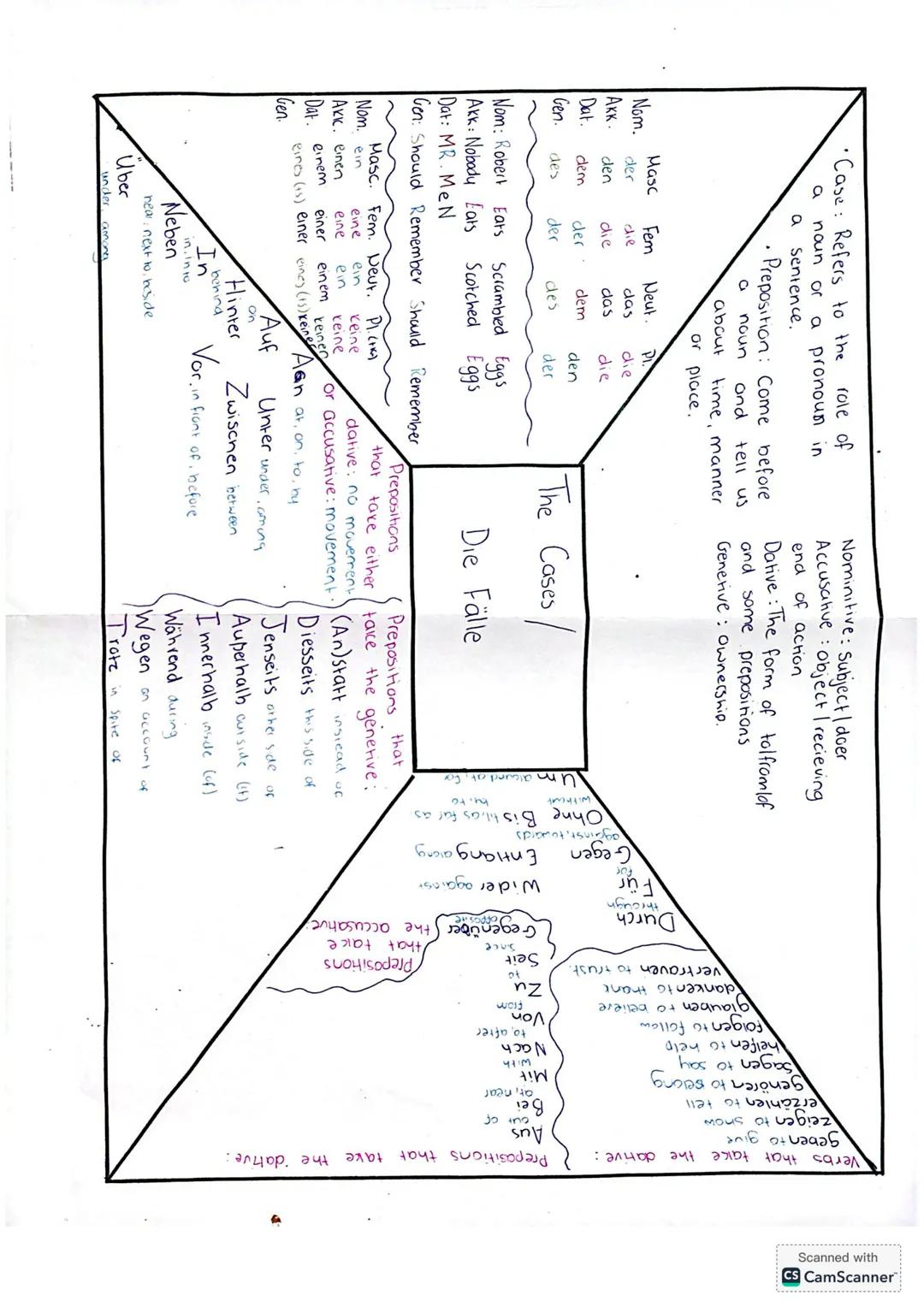
German Cases and Articles
Cases are simply the different roles a noun can play in a sentence. There are four main cases in German, and each one changes how the articles (der, die, das) look.
The nominative case is for the subject - the person or thing doing the action. The accusative case is for the direct object - what's receiving the action. The dative case shows the indirect object , and the genitive case shows possession or ownership.
Here's a handy memory trick: "Robert Eats Scrambled Eggs" for nominative (der, die, das, die), and "Nobody Eats Scorched Eggs" for accusative (den, die, das, die). For dative, remember "MR. MeN" (dem, der, dem, den).
Quick Tip: The indefinite articles (ein, eine) follow similar patterns - learn the definite articles first, and the indefinite ones will be much easier to pick up!
Prepositions and Movement
Prepositions are those little words that tell you about time, place, and manner - like "on", "under", or "between". Some prepositions are tricky because they can take either dative or accusative, depending on whether there's movement involved.
If there's movement (going somewhere), use accusative. If there's no movement (staying in one place), use dative. Words like "an" , "auf" (on), "in" , and "zwischen" (between) work this way.
Some prepositions always take the same case. Genitive prepositions include "anstatt" (instead of) and "während" (during). Dative prepositions include "aus" (out of), "mit" (with), and "nach" . Accusative prepositions include "durch" (through), "für" (for), and "ohne" (without).
Certain German verbs always take the dative case, like "helfen" (to help), "danken" (to thank), and "folgen" (to follow). These are worth memorising as they don't always match their English equivalents.
We thought you’d never ask...
What is the Knowunity AI companion?
Our AI companion is specifically built for the needs of students. Based on the millions of content pieces we have on the platform we can provide truly meaningful and relevant answers to students. But its not only about answers, the companion is even more about guiding students through their daily learning challenges, with personalised study plans, quizzes or content pieces in the chat and 100% personalisation based on the students skills and developments.
Where can I download the Knowunity app?
You can download the app in the Google Play Store and in the Apple App Store.
Is Knowunity really free of charge?
That's right! Enjoy free access to study content, connect with fellow students, and get instant help – all at your fingertips.
Most popular content in German
2Most popular content
9 Irish
IrishIrish oral questions and answers
Questions and answers for the leaving cert oral
5th Year4264
 English
Key Quotes : Sive
Key Quotes and explanations: Sive
6th Year2842
IrishIrish oral questions
Outline of oral questions
5th Year2055
IrishIníon- le hÁine Durkin
Aine Durkin’s poem, Iníon: Themes & summary
5th Year890
IrishIrish poetry 2027
Iníon + Dínit an Bhróin
5th Year1153
IrishLC HL notes- Iníon (poem)
Includes poem in English and Irish, theme, key words & phrases
5th Year2304
EnglishCultural Context : Shawshank Redemption : Sive : Small Things Like These
Comparative Study : Cultural Context : Shawshank Redemption, Sive and Small Things Like These
6th Year1430
IrishMo Ghrá-sa (Idir Lúibíní)
Notes on mo ghrá-sa
5th Year380
IrishAn Gaeilge Aiste
Irish Language essay
6th Year1320
Can't find what you're looking for? Explore other subjects.
Students love us — and so will you.
4.6/5App Store
4.7/5Google Play
The app is very easy to use and well designed. I have found everything I was looking for so far and have been able to learn a lot from the presentations! I will definitely use the app for a class assignment! And of course it also helps a lot as an inspiration.
Stefan SiOS user
This app is really great. There are so many study notes and help [...]. My problem subject is French, for example, and the app has so many options for help. Thanks to this app, I have improved my French. I would recommend it to anyone.
Samantha KlichAndroid user
Wow, I am really amazed. I just tried the app because I've seen it advertised many times and was absolutely stunned. This app is THE HELP you want for school and above all, it offers so many things, such as workouts and fact sheets, which have been VERY helpful to me personally.
AnnaiOS user
German6 views·Updated Jun 16, 2026·1 pageDie deutschen Fälle erklärt
C
Cayla Martin@caylamartin
German cases might seem intimidating at first, but they're actually just a way of showing what job each noun is doing in a sentence. Think of cases as different hats that nouns wear depending on whether they're the subject, object,...
1
of 1
Sign up to see the content. It's free!
- Access to all documents
- Improve your grades
- Join milions of students
German Cases and Articles
Cases are simply the different roles a noun can play in a sentence. There are four main cases in German, and each one changes how the articles (der, die, das) look.
The nominative case is for the subject - the person or thing doing the action. The accusative case is for the direct object - what's receiving the action. The dative case shows the indirect object , and the genitive case shows possession or ownership.
Here's a handy memory trick: "Robert Eats Scrambled Eggs" for nominative (der, die, das, die), and "Nobody Eats Scorched Eggs" for accusative (den, die, das, die). For dative, remember "MR. MeN" (dem, der, dem, den).
Quick Tip: The indefinite articles (ein, eine) follow similar patterns - learn the definite articles first, and the indefinite ones will be much easier to pick up!
Prepositions and Movement
Prepositions are those little words that tell you about time, place, and manner - like "on", "under", or "between". Some prepositions are tricky because they can take either dative or accusative, depending on whether there's movement involved.
If there's movement (going somewhere), use accusative. If there's no movement (staying in one place), use dative. Words like "an" , "auf" (on), "in" , and "zwischen" (between) work this way.
Some prepositions always take the same case. Genitive prepositions include "anstatt" (instead of) and "während" (during). Dative prepositions include "aus" (out of), "mit" (with), and "nach" . Accusative prepositions include "durch" (through), "für" (for), and "ohne" (without).
Certain German verbs always take the dative case, like "helfen" (to help), "danken" (to thank), and "folgen" (to follow). These are worth memorising as they don't always match their English equivalents.
We thought you’d never ask...
What is the Knowunity AI companion?
Our AI companion is specifically built for the needs of students. Based on the millions of content pieces we have on the platform we can provide truly meaningful and relevant answers to students. But its not only about answers, the companion is even more about guiding students through their daily learning challenges, with personalised study plans, quizzes or content pieces in the chat and 100% personalisation based on the students skills and developments.
Where can I download the Knowunity app?
You can download the app in the Google Play Store and in the Apple App Store.
Is Knowunity really free of charge?
That's right! Enjoy free access to study content, connect with fellow students, and get instant help – all at your fingertips.
Most popular content in German
2Most popular content
9IrishIrish oral questions and answers
Questions and answers for the leaving cert oral
5th Year4264
EnglishKey Quotes : Sive
Key Quotes and explanations: Sive
6th Year2842
IrishIrish oral questions
Outline of oral questions
5th Year2055
IrishIníon- le hÁine Durkin
Aine Durkin’s poem, Iníon: Themes & summary
5th Year890
IrishIrish poetry 2027
Iníon + Dínit an Bhróin
5th Year1153
IrishLC HL notes- Iníon (poem)
Includes poem in English and Irish, theme, key words & phrases
5th Year2304
EnglishCultural Context : Shawshank Redemption : Sive : Small Things Like These
Comparative Study : Cultural Context : Shawshank Redemption, Sive and Small Things Like These
6th Year1430
IrishMo Ghrá-sa (Idir Lúibíní)
Notes on mo ghrá-sa
5th Year380
IrishAn Gaeilge Aiste
Irish Language essay
6th Year1320
Can't find what you're looking for? Explore other subjects.
Students love us — and so will you.
4.6/5App Store
4.7/5Google Play
The app is very easy to use and well designed. I have found everything I was looking for so far and have been able to learn a lot from the presentations! I will definitely use the app for a class assignment! And of course it also helps a lot as an inspiration.
Stefan SiOS user
This app is really great. There are so many study notes and help [...]. My problem subject is French, for example, and the app has so many options for help. Thanks to this app, I have improved my French. I would recommend it to anyone.
Samantha KlichAndroid user
Wow, I am really amazed. I just tried the app because I've seen it advertised many times and was absolutely stunned. This app is THE HELP you want for school and above all, it offers so many things, such as workouts and fact sheets, which have been VERY helpful to me personally.
AnnaiOS user