
Ever wondered why earthquakes happen or how mountains form? It's...
 Geography6 views·Updated Jun 11, 2026·3 pages
Understanding Earth's Structure and Plate Tectonics
C
Cayla Martin@caylamartin
1 / 3
1
of 3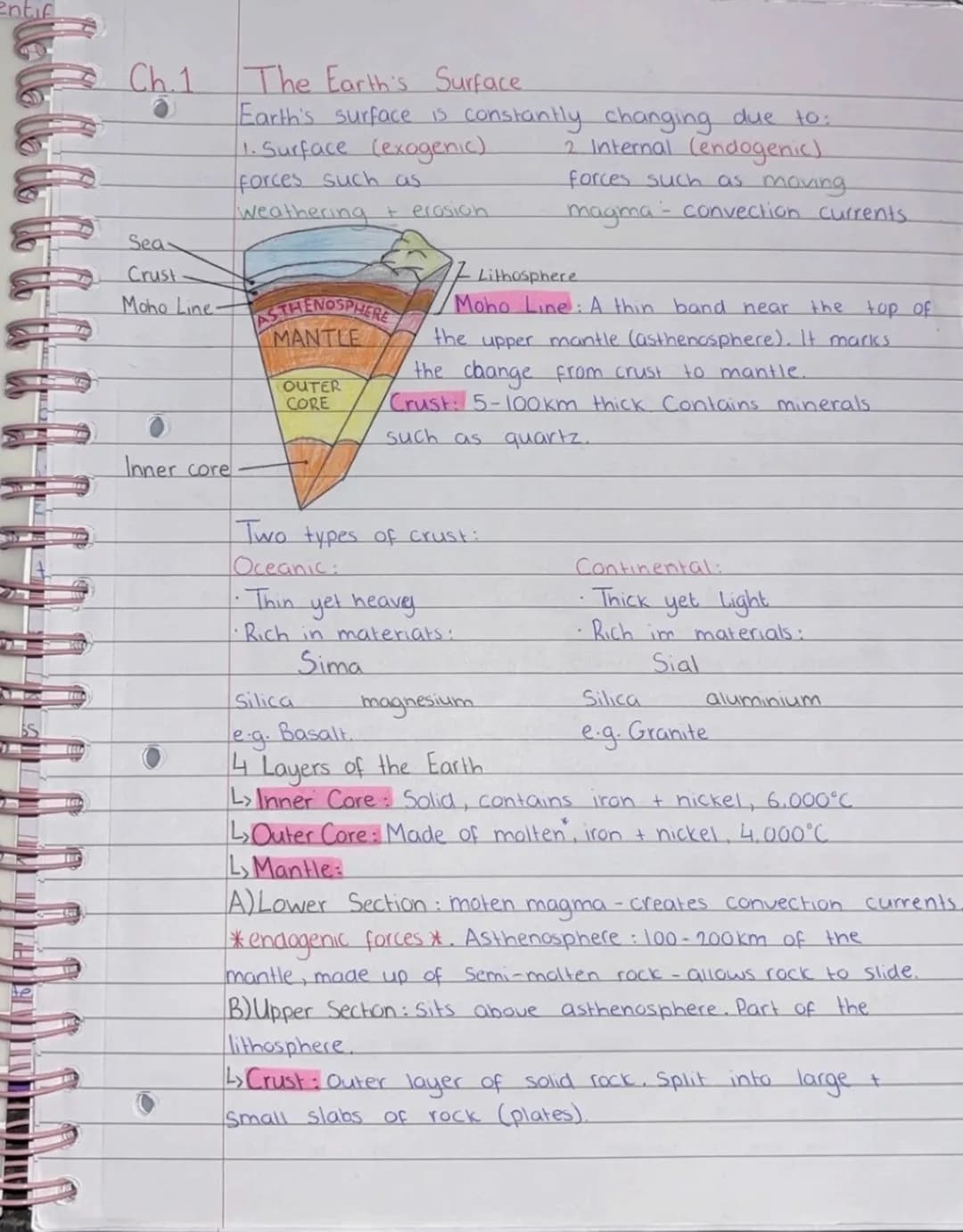
Earth's Structure and Surface Changes
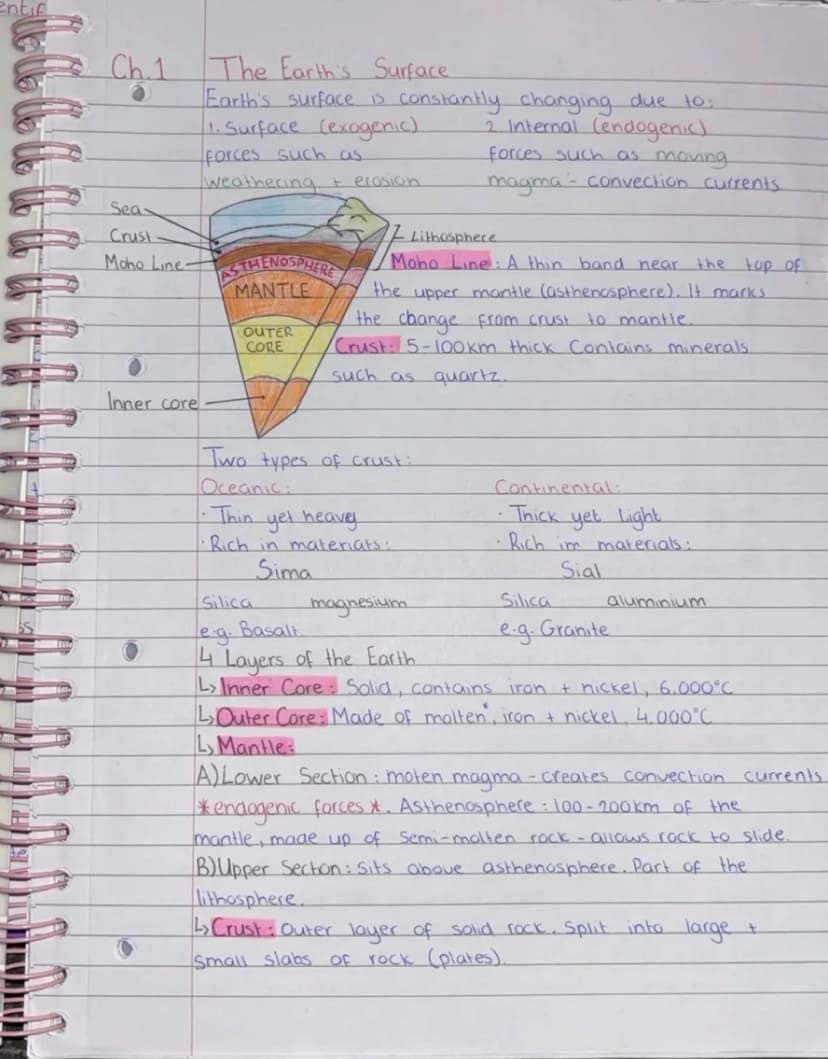
Your planet is like a giant onion with four main layers, each playing a crucial role in shaping the world around you. The inner core is a solid ball of iron and nickel at a scorching 6,000°C, whilst the outer core contains molten metal at 4,000°C.
The mantle is where the real action happens for surface changes. Its lower section contains molten magma that creates convection currents - these are the driving force behind most surface activity. The upper mantle includes the asthenosphere, a layer of semi-molten rock that acts like a slippery surface for plates to slide on.
Earth's crust sits on top like a cracked eggshell, made up of large slabs called plates. There are two types: thin but heavy oceanic crust (rich in silica and magnesium) and thick but light continental crust (rich in silica and aluminium). The Moho Line marks where the crust meets the mantle.
Quick Tip: Remember that endogenic forces (from inside Earth) like moving magma work alongside exogenic forces (surface processes) like weathering to constantly change our planet's appearance.
2
of 3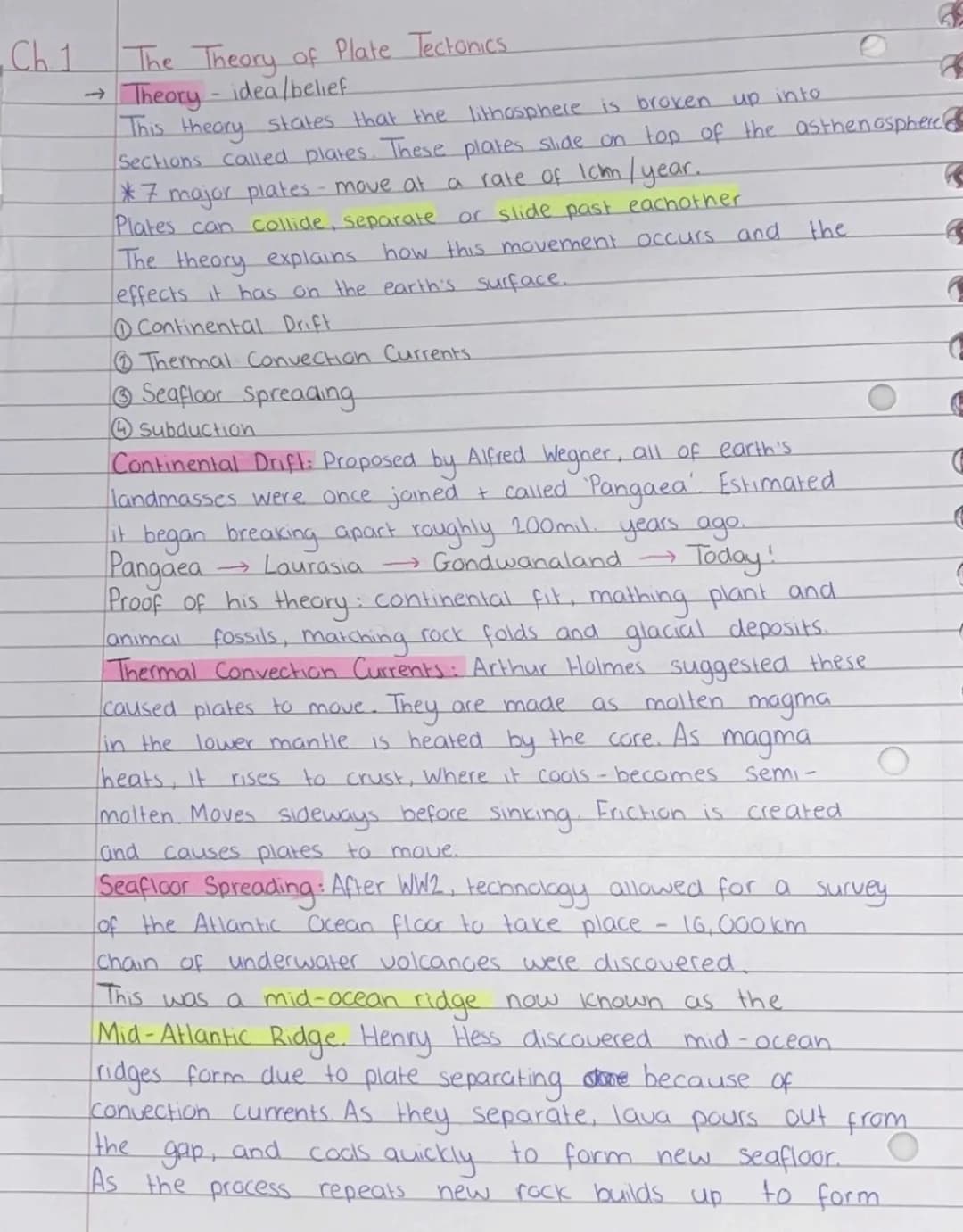
Continental Drift and Thermal Convection
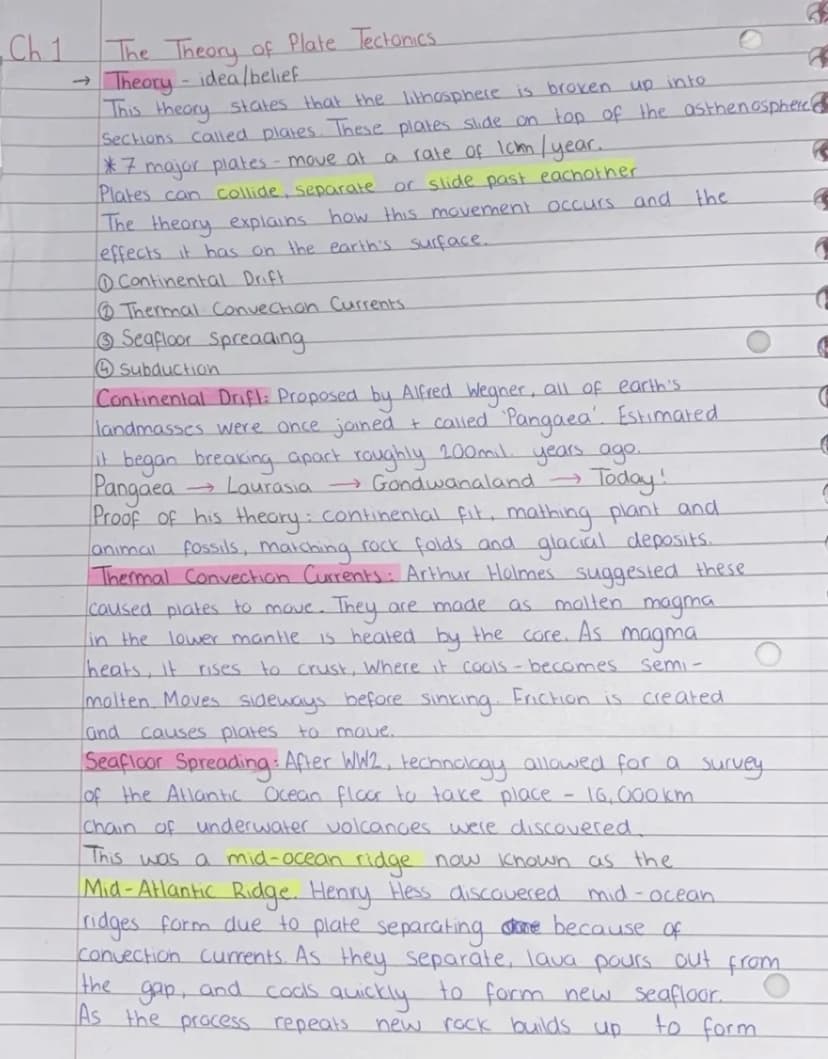
Back in the day, all Earth's landmasses were squashed together in one supercontinent called Pangaea. Alfred Wegener figured this out by noticing how continents fit together like puzzle pieces and finding matching fossils and rock formations across oceans.
Thermal convection currents are the engine behind plate movement. Here's how they work: hot magma in the lower mantle rises toward the crust, cools down, moves sideways, then sinks back down. This creates a circular motion that drags the plates along through friction.
Arthur Holmes was the genius who connected convection currents to plate movement. Think of it like a very slow conveyor belt system deep inside Earth that never stops moving.
Remember: These processes happen incredibly slowly - plates move at about 1cm per year, which is roughly the speed your fingernails grow!
3
of 3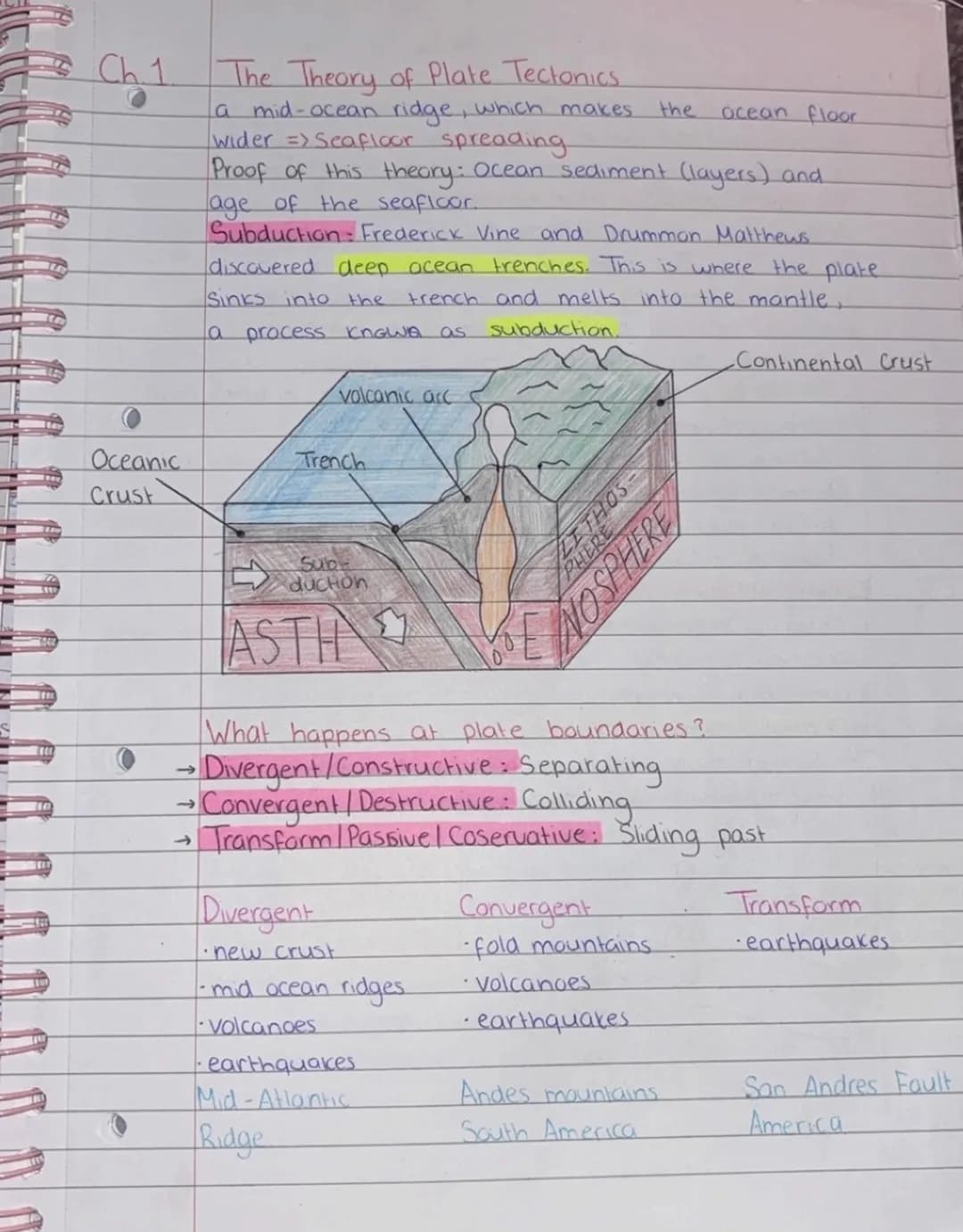
Seafloor Spreading and Plate Boundaries
After World War II, scientists discovered something amazing on the ocean floor - a massive chain of underwater volcanoes called the Mid-Atlantic Ridge. Henry Hess worked out that seafloor spreading happens when plates separate and lava fills the gap, creating new ocean floor.
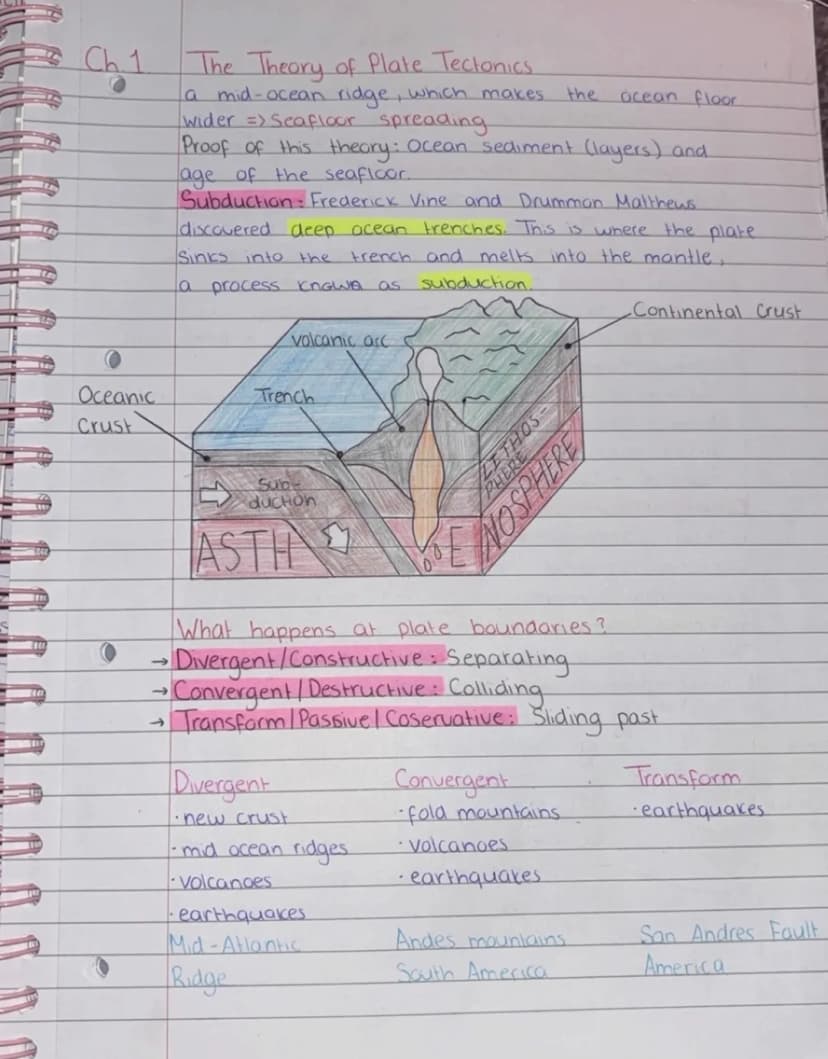
Subduction is the opposite process where oceanic plates sink into deep ocean trenches and melt back into the mantle. This recycling system keeps Earth's surface constantly renewed.
Plates interact in three main ways at their boundaries. Divergent boundaries pull apart creating new crust and volcanoes. Convergent boundaries smash together forming fold mountains and causing earthquakes. Transform boundaries slide past each other, creating major earthquake zones like California's San Andreas Fault.
Exam Tip: Each boundary type has specific features - divergent creates mid-ocean ridges, convergent builds mountain ranges like the Andes, and transform boundaries are famous for powerful earthquakes.
We thought you’d never ask...
What is the Knowunity AI companion?
Our AI companion is specifically built for the needs of students. Based on the millions of content pieces we have on the platform we can provide truly meaningful and relevant answers to students. But its not only about answers, the companion is even more about guiding students through their daily learning challenges, with personalised study plans, quizzes or content pieces in the chat and 100% personalisation based on the students skills and developments.
Where can I download the Knowunity app?
You can download the app in the Google Play Store and in the Apple App Store.
Is Knowunity really free of charge?
That's right! Enjoy free access to study content, connect with fellow students, and get instant help – all at your fingertips.
Most popular content in Geography
9GeographyGeography notes on rocks
Includes types of rocks,uses of rocks, case studies
1st Year341
GeographyEarthquakes revision notes
Notes on earthquakes with diagrams
1st Year110
GeographyPopulation Change and Migration
This covers factors that cause populations to grow or shrink, including birth rates, death rates, and the reasons people migrate.
2nd Year90
GeographyRock notes geography
Geography
5th Year250
GeographyThe sea
Jc Geography
1st Year230
GeographyGeography notes On the sea
Includes costal erosion, sea cliffs, longshore drift etc.
1st Year160
GeographyInside the Earth
Students will learn about the basic layers of the Earth: the crust, mantle, and core, understanding that our planet is made up of different parts.
1st Year51
GeographyGeography notes on glaciation
Includes diagrams, erosion, deposition, transportation
1st Year210
GeographyGeography notes on weather
Includes instruments, diagrams, how to read weather
1st Year120
Most popular content
9 Irish
IrishIrish oral questions and answers
Questions and answers for the leaving cert oral
5th Year4264
 English
Key Quotes : Sive
Key Quotes and explanations: Sive
6th Year2842
IrishIrish oral questions
Outline of oral questions
5th Year2055
IrishIníon- le hÁine Durkin
Aine Durkin’s poem, Iníon: Themes & summary
5th Year890
IrishIrish poetry 2027
Iníon + Dínit an Bhróin
5th Year1153
IrishLC HL notes- Iníon (poem)
Includes poem in English and Irish, theme, key words & phrases
5th Year2304
EnglishCultural Context : Shawshank Redemption : Sive : Small Things Like These
Comparative Study : Cultural Context : Shawshank Redemption, Sive and Small Things Like These
6th Year1430
IrishMo Ghrá-sa (Idir Lúibíní)
Notes on mo ghrá-sa
5th Year380
IrishAn Gaeilge Aiste
Irish Language essay
6th Year1320
Can't find what you're looking for? Explore other subjects.
Students love us — and so will you.
4.6/5App Store
4.7/5Google Play
The app is very easy to use and well designed. I have found everything I was looking for so far and have been able to learn a lot from the presentations! I will definitely use the app for a class assignment! And of course it also helps a lot as an inspiration.
Stefan SiOS user
This app is really great. There are so many study notes and help [...]. My problem subject is French, for example, and the app has so many options for help. Thanks to this app, I have improved my French. I would recommend it to anyone.
Samantha KlichAndroid user
Wow, I am really amazed. I just tried the app because I've seen it advertised many times and was absolutely stunned. This app is THE HELP you want for school and above all, it offers so many things, such as workouts and fact sheets, which have been VERY helpful to me personally.
AnnaiOS user
Geography6 views·Updated Jun 11, 2026·3 pagesUnderstanding Earth's Structure and Plate Tectonics
C
Cayla Martin@caylamartin
Ever wondered why earthquakes happen or how mountains form? It's all down to the massive puzzle pieces that make up Earth's surface - tectonic plates that are constantly moving and reshaping our planet. Understanding how Earth's layers work together gives...
1
of 3
Sign up to see the content. It's free!
- Access to all documents
- Improve your grades
- Join milions of students
Earth's Structure and Surface Changes
Your planet is like a giant onion with four main layers, each playing a crucial role in shaping the world around you. The inner core is a solid ball of iron and nickel at a scorching 6,000°C, whilst the outer core contains molten metal at 4,000°C.
The mantle is where the real action happens for surface changes. Its lower section contains molten magma that creates convection currents - these are the driving force behind most surface activity. The upper mantle includes the asthenosphere, a layer of semi-molten rock that acts like a slippery surface for plates to slide on.
Earth's crust sits on top like a cracked eggshell, made up of large slabs called plates. There are two types: thin but heavy oceanic crust (rich in silica and magnesium) and thick but light continental crust (rich in silica and aluminium). The Moho Line marks where the crust meets the mantle.
Quick Tip: Remember that endogenic forces (from inside Earth) like moving magma work alongside exogenic forces (surface processes) like weathering to constantly change our planet's appearance.
2
of 3Sign up to see the content. It's free!
- Access to all documents
- Improve your grades
- Join milions of students
Continental Drift and Thermal Convection
Back in the day, all Earth's landmasses were squashed together in one supercontinent called Pangaea. Alfred Wegener figured this out by noticing how continents fit together like puzzle pieces and finding matching fossils and rock formations across oceans.
Thermal convection currents are the engine behind plate movement. Here's how they work: hot magma in the lower mantle rises toward the crust, cools down, moves sideways, then sinks back down. This creates a circular motion that drags the plates along through friction.
Arthur Holmes was the genius who connected convection currents to plate movement. Think of it like a very slow conveyor belt system deep inside Earth that never stops moving.
Remember: These processes happen incredibly slowly - plates move at about 1cm per year, which is roughly the speed your fingernails grow!
3
of 3Sign up to see the content. It's free!
- Access to all documents
- Improve your grades
- Join milions of students
Seafloor Spreading and Plate Boundaries
After World War II, scientists discovered something amazing on the ocean floor - a massive chain of underwater volcanoes called the Mid-Atlantic Ridge. Henry Hess worked out that seafloor spreading happens when plates separate and lava fills the gap, creating new ocean floor.
Subduction is the opposite process where oceanic plates sink into deep ocean trenches and melt back into the mantle. This recycling system keeps Earth's surface constantly renewed.
Plates interact in three main ways at their boundaries. Divergent boundaries pull apart creating new crust and volcanoes. Convergent boundaries smash together forming fold mountains and causing earthquakes. Transform boundaries slide past each other, creating major earthquake zones like California's San Andreas Fault.
Exam Tip: Each boundary type has specific features - divergent creates mid-ocean ridges, convergent builds mountain ranges like the Andes, and transform boundaries are famous for powerful earthquakes.
We thought you’d never ask...
What is the Knowunity AI companion?
Our AI companion is specifically built for the needs of students. Based on the millions of content pieces we have on the platform we can provide truly meaningful and relevant answers to students. But its not only about answers, the companion is even more about guiding students through their daily learning challenges, with personalised study plans, quizzes or content pieces in the chat and 100% personalisation based on the students skills and developments.
Where can I download the Knowunity app?
You can download the app in the Google Play Store and in the Apple App Store.
Is Knowunity really free of charge?
That's right! Enjoy free access to study content, connect with fellow students, and get instant help – all at your fingertips.
Most popular content in Geography
9GeographyGeography notes on rocks
Includes types of rocks,uses of rocks, case studies
1st Year341
GeographyEarthquakes revision notes
Notes on earthquakes with diagrams
1st Year110
GeographyPopulation Change and Migration
This covers factors that cause populations to grow or shrink, including birth rates, death rates, and the reasons people migrate.
2nd Year90
GeographyRock notes geography
Geography
5th Year250
GeographyThe sea
Jc Geography
1st Year230
GeographyGeography notes On the sea
Includes costal erosion, sea cliffs, longshore drift etc.
1st Year160
GeographyInside the Earth
Students will learn about the basic layers of the Earth: the crust, mantle, and core, understanding that our planet is made up of different parts.
1st Year51
GeographyGeography notes on glaciation
Includes diagrams, erosion, deposition, transportation
1st Year210
GeographyGeography notes on weather
Includes instruments, diagrams, how to read weather
1st Year120
Most popular content
9IrishIrish oral questions and answers
Questions and answers for the leaving cert oral
5th Year4264
EnglishKey Quotes : Sive
Key Quotes and explanations: Sive
6th Year2842
IrishIrish oral questions
Outline of oral questions
5th Year2055
IrishIníon- le hÁine Durkin
Aine Durkin’s poem, Iníon: Themes & summary
5th Year890
IrishIrish poetry 2027
Iníon + Dínit an Bhróin
5th Year1153
IrishLC HL notes- Iníon (poem)
Includes poem in English and Irish, theme, key words & phrases
5th Year2304
EnglishCultural Context : Shawshank Redemption : Sive : Small Things Like These
Comparative Study : Cultural Context : Shawshank Redemption, Sive and Small Things Like These
6th Year1430
IrishMo Ghrá-sa (Idir Lúibíní)
Notes on mo ghrá-sa
5th Year380
IrishAn Gaeilge Aiste
Irish Language essay
6th Year1320
Can't find what you're looking for? Explore other subjects.
Students love us — and so will you.
4.6/5App Store
4.7/5Google Play
The app is very easy to use and well designed. I have found everything I was looking for so far and have been able to learn a lot from the presentations! I will definitely use the app for a class assignment! And of course it also helps a lot as an inspiration.
Stefan SiOS user
This app is really great. There are so many study notes and help [...]. My problem subject is French, for example, and the app has so many options for help. Thanks to this app, I have improved my French. I would recommend it to anyone.
Samantha KlichAndroid user
Wow, I am really amazed. I just tried the app because I've seen it advertised many times and was absolutely stunned. This app is THE HELP you want for school and above all, it offers so many things, such as workouts and fact sheets, which have been VERY helpful to me personally.
AnnaiOS user