
Ever wondered what's beneath your feet when you walk across... Show more
 Geography
 Irish
Irish English
Sign up to see the contentIt's free!
Access to all documents
Improve your grades
Join milions of students
Knowunity AI
Subjects
Triangle Congruence and Similarity Theorems
Triangle Properties and Classification
Linear Equations and Graphs
Geometric Angle Relationships
Trigonometric Functions and Identities
Equation Solving Techniques
Circle Geometry Fundamentals
Division Operations and Methods
Basic Differentiation Rules
Exponent and Logarithm Properties
Show all topics
Human Organ Systems
Reproductive Cell Cycles
Biological Sciences Subdisciplines
Cellular Energy Metabolism
Autotrophic Energy Processes
Inheritance Patterns and Principles
Biomolecular Structure and Organization
Cell Cycle and Division Mechanics
Cellular Organization and Development
Biological Structural Organization
Show all topics
Chemical Sciences and Applications
Atomic Structure and Composition
Molecular Electron Structure Representation
Atomic Electron Behavior
Matter Properties and Water
Mole Concept and Calculations
Gas Laws and Behavior
Periodic Table Organization
Chemical Thermodynamics Fundamentals
Chemical Bond Types and Properties
Show all topics
European Renaissance and Enlightenment
European Cultural Movements 800-1920
American Revolution Era 1763-1797
American Civil War 1861-1865
Global Imperial Systems
Mongol and Chinese Dynasties
U.S. Presidents and World Leaders
Historical Sources and Documentation
World Wars Era and Impact
World Religious Systems
Show all topics
Classic and Contemporary Novels
Literary Character Analysis
Rhetorical Theory and Practice
Classic Literary Narratives
Reading Analysis and Interpretation
Narrative Structure and Techniques
English Language Components
Influential English-Language Authors
Basic Sentence Structure
Narrative Voice and Perspective
Show all topics
3
•
Updated May 3, 2026
•
Ever wondered what's beneath your feet when you walk across... Show more

Think of soil as nature's ultimate recycling project. It's a living mixture of weathered rock, organic matter (called humus), air, and water that creates the foundation for almost everything we do - from growing food to building homes.
The magic happens through weathering - rocks slowly breaking down through physical forces like freeze-thaw cycles, chemical reactions from acid rain, and biological activity from plant roots. This process is incredibly slow; it can take hundreds of years to create just a few centimetres of soil.
Several key components make soil work. Parent material is the original rock that determines many soil characteristics. Humus forms when dead plants and animals decompose, creating a dark, nutrient-rich material that's essential for plant growth.
Key Insight: Soil formation is so slow that it's considered a non-renewable resource - once it's gone through erosion, it's essentially gone forever.
Soil formation depends on five crucial factors, easily remembered by the acronym CLORPT: Climate, Living organisms, Relief, Parent material, and Time.
Climate is usually the most important factor. Heavy rainfall causes more leaching - where water dissolves nutrients and carries them deeper underground, potentially making topsoil less fertile. Warmer temperatures speed up chemical reactions and help organic matter decompose faster into humus.
Living organisms are soil's workforce. Plants provide leaf litter and roots that become humus, whilst earthworms are absolute heroes - they mix soil layers, create air pockets, and add nutrients through their waste. Bacteria and fungi break down dead material into usable nutrients.
Relief (the shape of the land) dramatically affects soil development. Steep slopes often have thin soils because rainfall washes material downhill, whilst flat areas typically develop deeper, sometimes waterlogged soils. The original parent material determines the soil's basic mineral content and texture - limestone creates alkaline soils whilst sandstone produces more acidic, gritty ones.
Remember This: Climate is king! More rain equals more leaching, which is why Ireland's wet, mountainous areas often have less fertile soils.
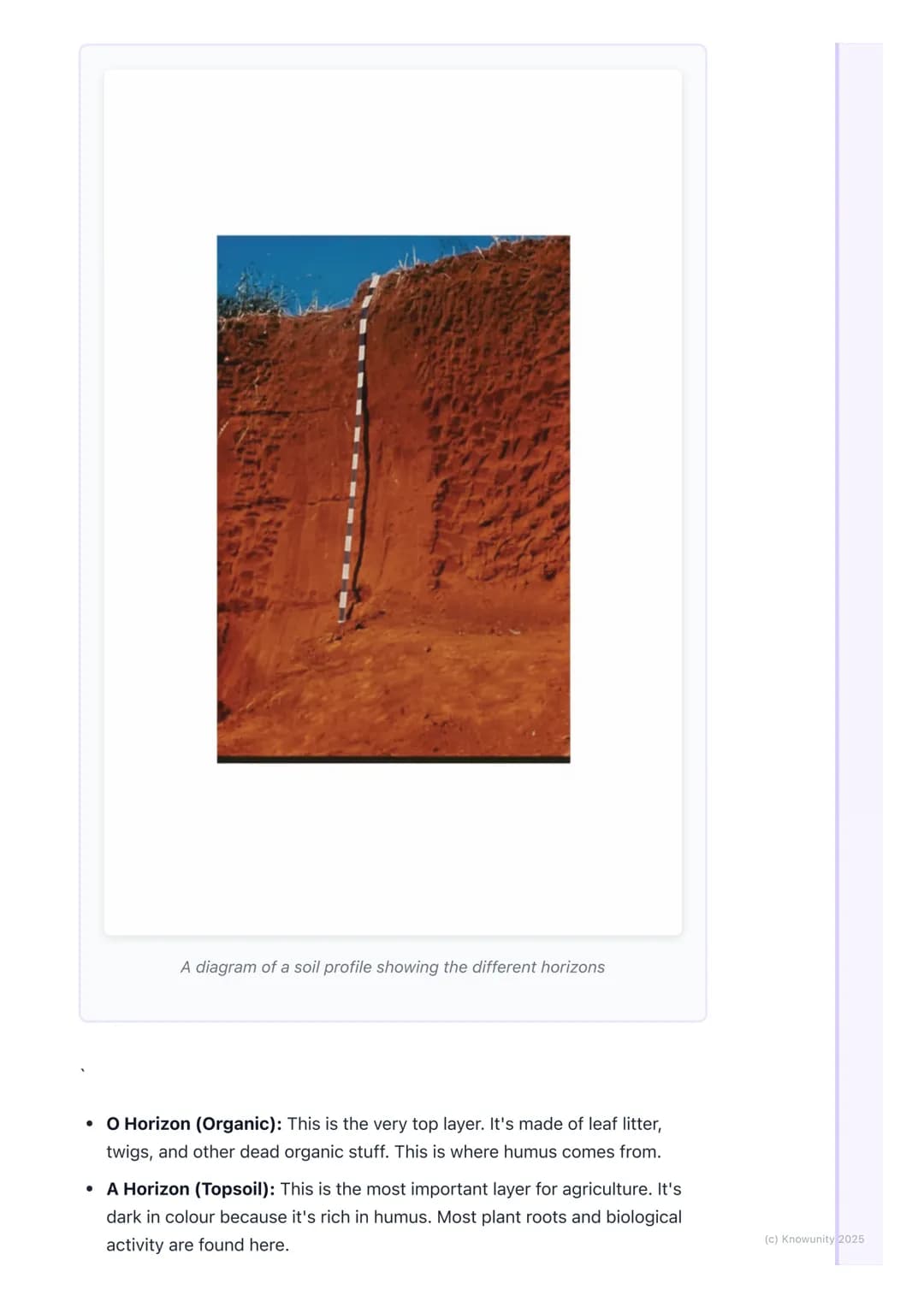
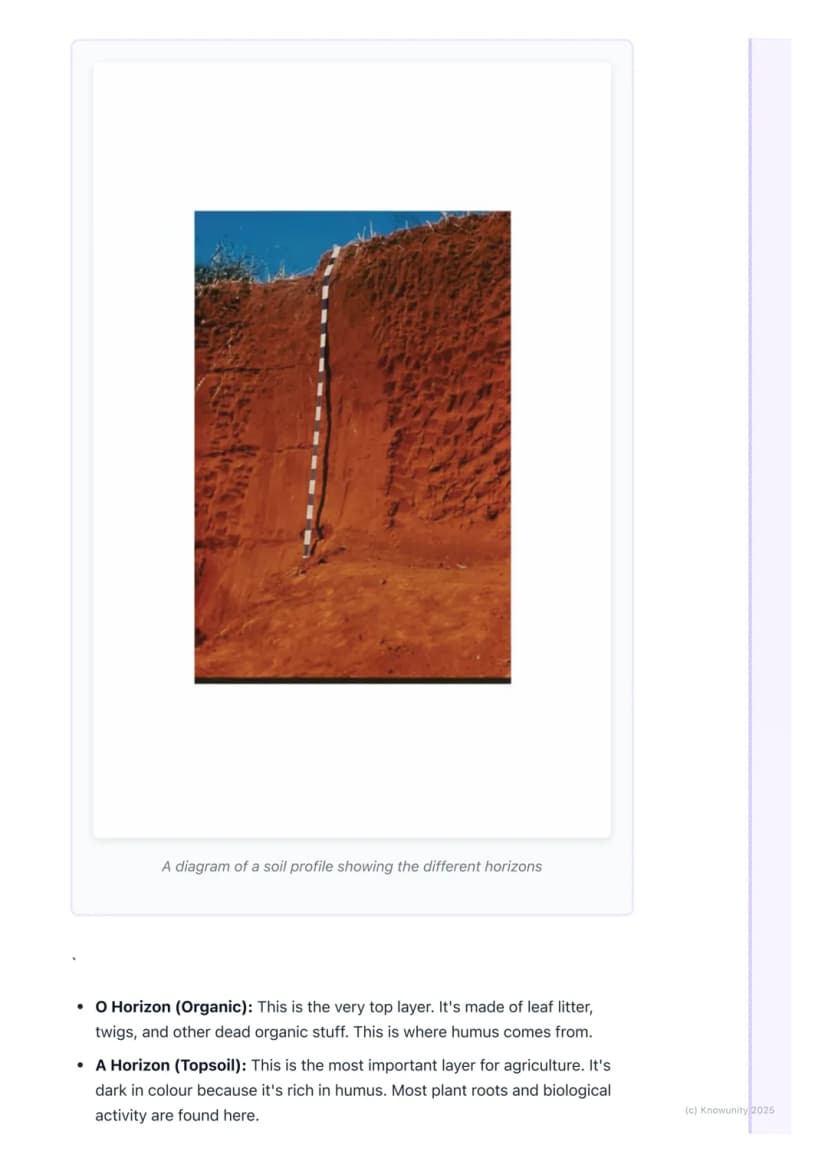
When you dig deep into soil, you'll discover distinct layers called horizons that reveal the soil's history and health.
The O Horizon sits at the very top - it's pure organic material like fallen leaves and twigs that haven't fully decomposed yet. Just below, the A Horizon (topsoil) is where the action happens. This dark, humus-rich layer supports most plant roots and biological activity, making it absolutely crucial for agriculture.
The B Horizon (subsoil) appears lighter because it contains less humus. However, it often accumulates minerals that have been leached down from above. Sometimes this creates a hardpan - a solid layer that blocks water movement and root growth.
Deeper still, the C Horizon contains weathered rock fragments representing the early stages of soil formation. At the bottom, the R Horizon is solid bedrock that hasn't weathered yet.
Exam Tip: Understanding soil horizons helps explain why different layers have different colours, textures, and uses - it's like reading the soil's biography!
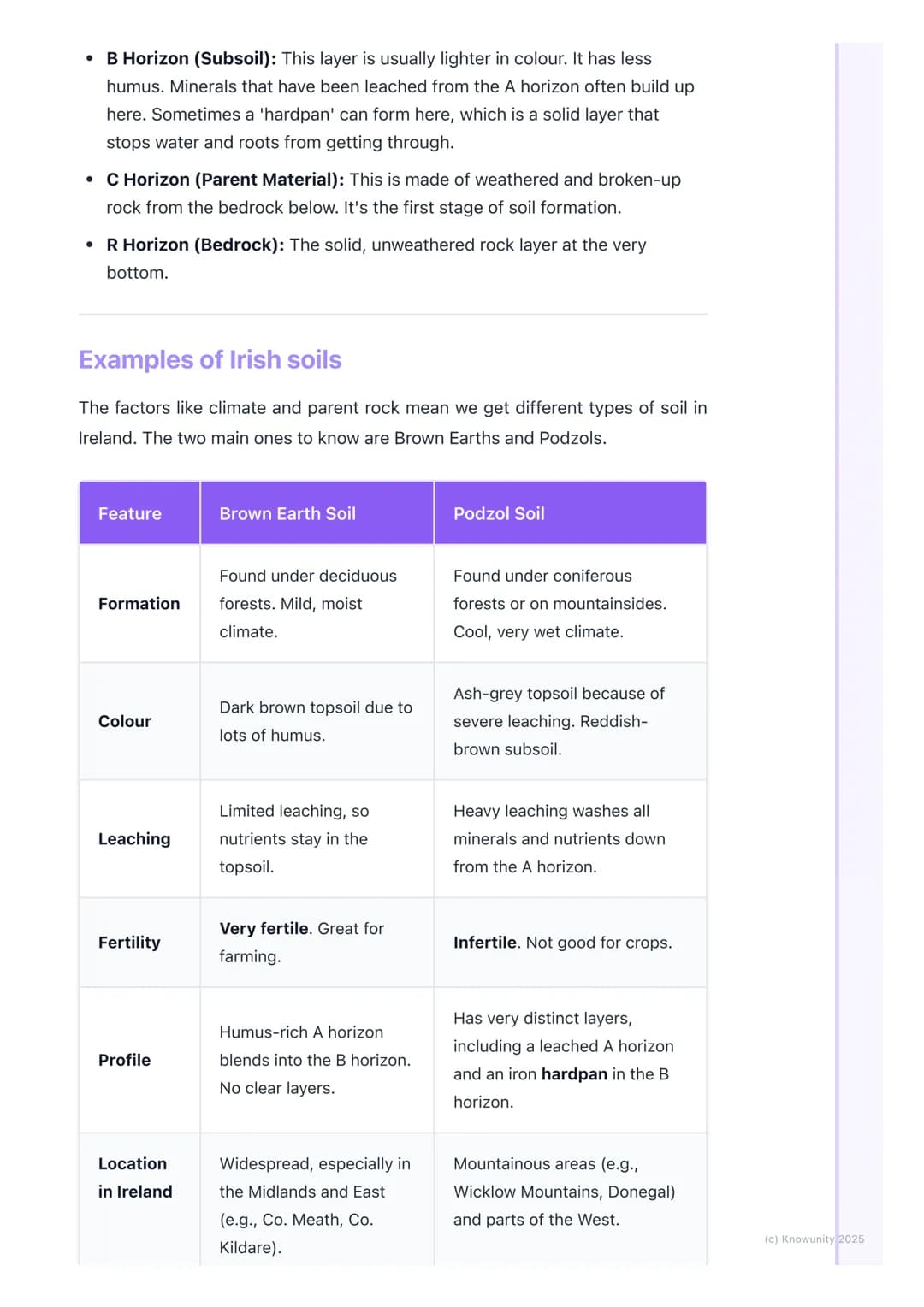
Ireland's varied climate and geology create distinctly different soil types, with Brown Earths and Podzols being the most important to understand.
Brown Earths are Ireland's agricultural superstars. Found mainly in the midlands and eastern counties like Meath and Kildare, these soils developed under deciduous forests in relatively mild, moist conditions. Their dark brown colour comes from abundant humus, and limited leaching means nutrients stay in the topsoil where plants need them.
Podzols tell a completely different story. Found in mountainous areas like Wicklow and Donegal, these soils form under coniferous forests in cool, very wet conditions. Heavy rainfall causes severe leaching, creating distinctive ash-grey topsoil and reddish-brown subsoil with an iron hardpan that blocks drainage.
The contrast is stark: Brown Earths are perfect for crops and pasture, whilst Podzols are mainly suitable for forestry. This explains why Ireland's best farmland is in the east and midlands, whilst upland areas remain forested or used for grazing.
Geographic Connection: Soil types directly explain Ireland's land use patterns - you can predict what grows where just by understanding the soil beneath!
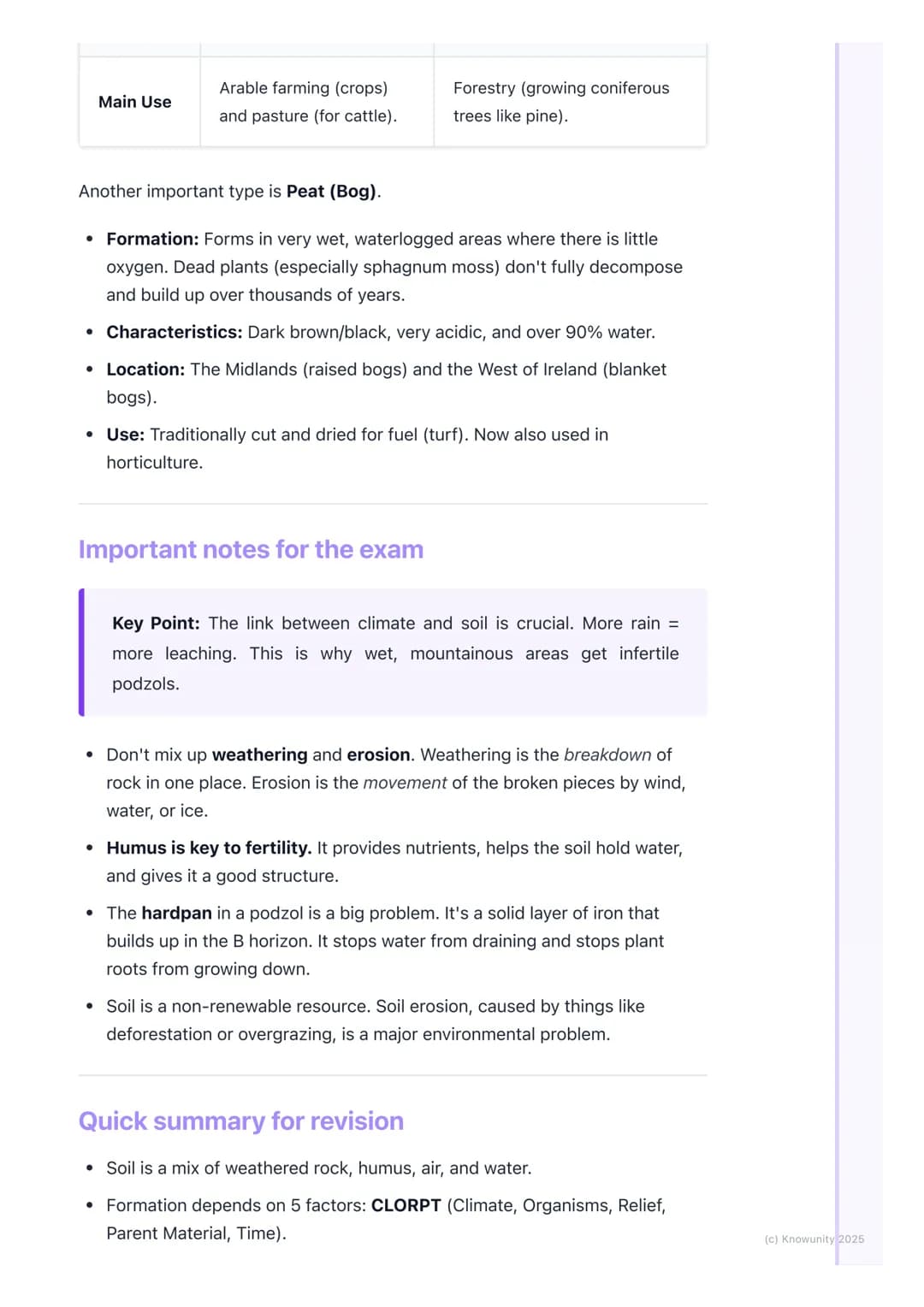
Peat represents a special case in Irish soils, forming in waterlogged conditions where dead plants (especially sphagnum moss) can't fully decompose due to lack of oxygen.
Over thousands of years, this organic matter builds up into dark brown or black deposits that are over 90% water and highly acidic. Ireland's peat forms in two main environments: raised bogs in the midlands and blanket bogs covering western uplands.
Traditionally, peat was cut and dried as turf for fuel, and it's still used in horticulture today. However, peat bogs are now recognised as important ecosystems and carbon stores, making their conservation increasingly important.
The formation process is fascinating - what starts as living sphagnum moss in waterlogged conditions slowly transforms into layers of peat that can be several metres thick. This creates unique landscapes that are distinctly Irish.
Environmental Note: Peat bogs are crucial for climate regulation as they store massive amounts of carbon - protecting them helps fight climate change!

Understanding soil formation helps explain so much about Ireland's geography, agriculture, and environmental challenges.
Remember that weathering breaks down rocks in place, whilst erosion moves the broken material elsewhere - don't mix these up! Humus is absolutely vital for soil fertility because it provides nutrients, helps retain water, and creates good soil structure.
The hardpan in podzols creates serious problems by blocking drainage and root growth, explaining why these soils aren't suitable for agriculture. Meanwhile, leaching is the key process that makes some soils fertile (when limited) or infertile (when excessive).
Soil connects to bigger environmental issues too. Because soil formation is so slow, soil erosion from deforestation or overgrazing represents a major environmental threat that affects food security and ecosystem health.
Exam Success: Focus on the connections - link soil types to climate, parent material to soil characteristics, and soil quality to land use patterns across Ireland.
Our AI companion is specifically built for the needs of students. Based on the millions of content pieces we have on the platform we can provide truly meaningful and relevant answers to students. But its not only about answers, the companion is even more about guiding students through their daily learning challenges, with personalised study plans, quizzes or content pieces in the chat and 100% personalisation based on the students skills and developments.
You can download the app in the Google Play Store and in the Apple App Store.
That's right! Enjoy free access to study content, connect with fellow students, and get instant help – all at your fingertips.
App Store
Google Play
The app is very easy to use and well designed. I have found everything I was looking for so far and have been able to learn a lot from the presentations! I will definitely use the app for a class assignment! And of course it also helps a lot as an inspiration.
Stefan S
iOS user
This app is really great. There are so many study notes and help [...]. My problem subject is French, for example, and the app has so many options for help. Thanks to this app, I have improved my French. I would recommend it to anyone.
Samantha Klich
Android user
Wow, I am really amazed. I just tried the app because I've seen it advertised many times and was absolutely stunned. This app is THE HELP you want for school and above all, it offers so many things, such as workouts and fact sheets, which have been VERY helpful to me personally.
Anna
iOS user
I think it’s very much worth it and you’ll end up using it a lot once you get the hang of it and even after looking at others notes you can still ask your Artificial intelligence buddy the question and ask to simplify it if you still don’t get it!!! In the end I think it’s worth it 😊👍 ⚠️Also DID I MENTION ITS FREEE YOU DON’T HAVE TO PAY FOR ANYTHING AND STILL GET YOUR GRADES IN PERFECTLY❗️❗️⚠️
Thomas R
iOS user
Knowunity is the BEST app I’ve used in a minute. This is not an ai review or anything this is genuinely coming from a 7th grade student (I know 2011 im young) but dude this app is a 10/10 i have maintained a 3.8 gpa and have plenty of time for gaming. I love it and my mom is just happy I got good grades
Brad T
Android user
Not only did it help me find the answer but it also showed me alternative ways to solve it. I was horrible in math and science but now I have an a in both subjects. Thanks for the help🤍🤍
David K
iOS user
The app's just great! All I have to do is enter the topic in the search bar and I get the response real fast. I don't have to watch 10 YouTube videos to understand something, so I'm saving my time. Highly recommended!
Sudenaz Ocak
Android user
In school I was really bad at maths but thanks to the app, I am doing better now. I am so grateful that you made the app.
Greenlight Bonnie
Android user
I found this app a couple years ago and it has only gotten better since then. I really love it because it can help with written questions and photo questions. Also, it can find study guides that other people have made as well as flashcard sets and practice tests. The free version is also amazing for students who might not be able to afford it. Would 100% recommend
Aubrey
iOS user
Best app if you're in Highschool or Junior high. I have been using this app for 2 school years and it's the best, it's good if you don't have anyone to help you with school work.😋🩷🎀
Marco B
iOS user
THE QUIZES AND FLASHCARDS ARE SO USEFUL AND I LOVE Knowunity AI. IT ALSO IS LITREALLY LIKE CHATGPT BUT SMARTER!! HELPED ME WITH MY MASCARA PROBLEMS TOO!! AS WELL AS MY REAL SUBJECTS ! DUHHH 😍😁😲🤑💗✨🎀😮
Elisha
iOS user
This app is phenomenal down to the correct info and the various topics you can study! I greatly recommend it for people who struggle with procrastination and those who need homework help. It has been perfectly accurate for world 1 history as far as I’ve seen! Geometry too!
Paul T
iOS user
The app is very easy to use and well designed. I have found everything I was looking for so far and have been able to learn a lot from the presentations! I will definitely use the app for a class assignment! And of course it also helps a lot as an inspiration.
Stefan S
iOS user
This app is really great. There are so many study notes and help [...]. My problem subject is French, for example, and the app has so many options for help. Thanks to this app, I have improved my French. I would recommend it to anyone.
Samantha Klich
Android user
Wow, I am really amazed. I just tried the app because I've seen it advertised many times and was absolutely stunned. This app is THE HELP you want for school and above all, it offers so many things, such as workouts and fact sheets, which have been VERY helpful to me personally.
Anna
iOS user
I think it’s very much worth it and you’ll end up using it a lot once you get the hang of it and even after looking at others notes you can still ask your Artificial intelligence buddy the question and ask to simplify it if you still don’t get it!!! In the end I think it’s worth it 😊👍 ⚠️Also DID I MENTION ITS FREEE YOU DON’T HAVE TO PAY FOR ANYTHING AND STILL GET YOUR GRADES IN PERFECTLY❗️❗️⚠️
Thomas R
iOS user
Knowunity is the BEST app I’ve used in a minute. This is not an ai review or anything this is genuinely coming from a 7th grade student (I know 2011 im young) but dude this app is a 10/10 i have maintained a 3.8 gpa and have plenty of time for gaming. I love it and my mom is just happy I got good grades
Brad T
Android user
Not only did it help me find the answer but it also showed me alternative ways to solve it. I was horrible in math and science but now I have an a in both subjects. Thanks for the help🤍🤍
David K
iOS user
The app's just great! All I have to do is enter the topic in the search bar and I get the response real fast. I don't have to watch 10 YouTube videos to understand something, so I'm saving my time. Highly recommended!
Sudenaz Ocak
Android user
In school I was really bad at maths but thanks to the app, I am doing better now. I am so grateful that you made the app.
Greenlight Bonnie
Android user
I found this app a couple years ago and it has only gotten better since then. I really love it because it can help with written questions and photo questions. Also, it can find study guides that other people have made as well as flashcard sets and practice tests. The free version is also amazing for students who might not be able to afford it. Would 100% recommend
Aubrey
iOS user
Best app if you're in Highschool or Junior high. I have been using this app for 2 school years and it's the best, it's good if you don't have anyone to help you with school work.😋🩷🎀
Marco B
iOS user
THE QUIZES AND FLASHCARDS ARE SO USEFUL AND I LOVE Knowunity AI. IT ALSO IS LITREALLY LIKE CHATGPT BUT SMARTER!! HELPED ME WITH MY MASCARA PROBLEMS TOO!! AS WELL AS MY REAL SUBJECTS ! DUHHH 😍😁😲🤑💗✨🎀😮
Elisha
iOS user
This app is phenomenal down to the correct info and the various topics you can study! I greatly recommend it for people who struggle with procrastination and those who need homework help. It has been perfectly accurate for world 1 history as far as I’ve seen! Geometry too!
Paul T
iOS user
Ever wondered what's beneath your feet when you walk across a field or dig in your garden? Soil might look like simple dirt, but it's actually an incredibly complex system that took thousands of years to form. Understanding how different... Show more
Access to all documents
Improve your grades
Join milions of students
Think of soil as nature's ultimate recycling project. It's a living mixture of weathered rock, organic matter (called humus), air, and water that creates the foundation for almost everything we do - from growing food to building homes.
The magic happens through weathering - rocks slowly breaking down through physical forces like freeze-thaw cycles, chemical reactions from acid rain, and biological activity from plant roots. This process is incredibly slow; it can take hundreds of years to create just a few centimetres of soil.
Several key components make soil work. Parent material is the original rock that determines many soil characteristics. Humus forms when dead plants and animals decompose, creating a dark, nutrient-rich material that's essential for plant growth.
Key Insight: Soil formation is so slow that it's considered a non-renewable resource - once it's gone through erosion, it's essentially gone forever.
Access to all documents
Improve your grades
Join milions of students
Soil formation depends on five crucial factors, easily remembered by the acronym CLORPT: Climate, Living organisms, Relief, Parent material, and Time.
Climate is usually the most important factor. Heavy rainfall causes more leaching - where water dissolves nutrients and carries them deeper underground, potentially making topsoil less fertile. Warmer temperatures speed up chemical reactions and help organic matter decompose faster into humus.
Living organisms are soil's workforce. Plants provide leaf litter and roots that become humus, whilst earthworms are absolute heroes - they mix soil layers, create air pockets, and add nutrients through their waste. Bacteria and fungi break down dead material into usable nutrients.
Relief (the shape of the land) dramatically affects soil development. Steep slopes often have thin soils because rainfall washes material downhill, whilst flat areas typically develop deeper, sometimes waterlogged soils. The original parent material determines the soil's basic mineral content and texture - limestone creates alkaline soils whilst sandstone produces more acidic, gritty ones.
Remember This: Climate is king! More rain equals more leaching, which is why Ireland's wet, mountainous areas often have less fertile soils.
Access to all documents
Improve your grades
Join milions of students
When you dig deep into soil, you'll discover distinct layers called horizons that reveal the soil's history and health.
The O Horizon sits at the very top - it's pure organic material like fallen leaves and twigs that haven't fully decomposed yet. Just below, the A Horizon (topsoil) is where the action happens. This dark, humus-rich layer supports most plant roots and biological activity, making it absolutely crucial for agriculture.
The B Horizon (subsoil) appears lighter because it contains less humus. However, it often accumulates minerals that have been leached down from above. Sometimes this creates a hardpan - a solid layer that blocks water movement and root growth.
Deeper still, the C Horizon contains weathered rock fragments representing the early stages of soil formation. At the bottom, the R Horizon is solid bedrock that hasn't weathered yet.
Exam Tip: Understanding soil horizons helps explain why different layers have different colours, textures, and uses - it's like reading the soil's biography!
Access to all documents
Improve your grades
Join milions of students
Ireland's varied climate and geology create distinctly different soil types, with Brown Earths and Podzols being the most important to understand.
Brown Earths are Ireland's agricultural superstars. Found mainly in the midlands and eastern counties like Meath and Kildare, these soils developed under deciduous forests in relatively mild, moist conditions. Their dark brown colour comes from abundant humus, and limited leaching means nutrients stay in the topsoil where plants need them.
Podzols tell a completely different story. Found in mountainous areas like Wicklow and Donegal, these soils form under coniferous forests in cool, very wet conditions. Heavy rainfall causes severe leaching, creating distinctive ash-grey topsoil and reddish-brown subsoil with an iron hardpan that blocks drainage.
The contrast is stark: Brown Earths are perfect for crops and pasture, whilst Podzols are mainly suitable for forestry. This explains why Ireland's best farmland is in the east and midlands, whilst upland areas remain forested or used for grazing.
Geographic Connection: Soil types directly explain Ireland's land use patterns - you can predict what grows where just by understanding the soil beneath!
Access to all documents
Improve your grades
Join milions of students
Peat represents a special case in Irish soils, forming in waterlogged conditions where dead plants (especially sphagnum moss) can't fully decompose due to lack of oxygen.
Over thousands of years, this organic matter builds up into dark brown or black deposits that are over 90% water and highly acidic. Ireland's peat forms in two main environments: raised bogs in the midlands and blanket bogs covering western uplands.
Traditionally, peat was cut and dried as turf for fuel, and it's still used in horticulture today. However, peat bogs are now recognised as important ecosystems and carbon stores, making their conservation increasingly important.
The formation process is fascinating - what starts as living sphagnum moss in waterlogged conditions slowly transforms into layers of peat that can be several metres thick. This creates unique landscapes that are distinctly Irish.
Environmental Note: Peat bogs are crucial for climate regulation as they store massive amounts of carbon - protecting them helps fight climate change!
Access to all documents
Improve your grades
Join milions of students
Understanding soil formation helps explain so much about Ireland's geography, agriculture, and environmental challenges.
Remember that weathering breaks down rocks in place, whilst erosion moves the broken material elsewhere - don't mix these up! Humus is absolutely vital for soil fertility because it provides nutrients, helps retain water, and creates good soil structure.
The hardpan in podzols creates serious problems by blocking drainage and root growth, explaining why these soils aren't suitable for agriculture. Meanwhile, leaching is the key process that makes some soils fertile (when limited) or infertile (when excessive).
Soil connects to bigger environmental issues too. Because soil formation is so slow, soil erosion from deforestation or overgrazing represents a major environmental threat that affects food security and ecosystem health.
Exam Success: Focus on the connections - link soil types to climate, parent material to soil characteristics, and soil quality to land use patterns across Ireland.
Our AI companion is specifically built for the needs of students. Based on the millions of content pieces we have on the platform we can provide truly meaningful and relevant answers to students. But its not only about answers, the companion is even more about guiding students through their daily learning challenges, with personalised study plans, quizzes or content pieces in the chat and 100% personalisation based on the students skills and developments.
You can download the app in the Google Play Store and in the Apple App Store.
That's right! Enjoy free access to study content, connect with fellow students, and get instant help – all at your fingertips.
0
Smart Tools NEW
Transform this note into: ✓ 50+ Practice Questions ✓ Interactive Flashcards ✓ Full Practice Test ✓ Essay Outlines
App Store
Google Play
The app is very easy to use and well designed. I have found everything I was looking for so far and have been able to learn a lot from the presentations! I will definitely use the app for a class assignment! And of course it also helps a lot as an inspiration.
Stefan S
iOS user
This app is really great. There are so many study notes and help [...]. My problem subject is French, for example, and the app has so many options for help. Thanks to this app, I have improved my French. I would recommend it to anyone.
Samantha Klich
Android user
Wow, I am really amazed. I just tried the app because I've seen it advertised many times and was absolutely stunned. This app is THE HELP you want for school and above all, it offers so many things, such as workouts and fact sheets, which have been VERY helpful to me personally.
Anna
iOS user
I think it’s very much worth it and you’ll end up using it a lot once you get the hang of it and even after looking at others notes you can still ask your Artificial intelligence buddy the question and ask to simplify it if you still don’t get it!!! In the end I think it’s worth it 😊👍 ⚠️Also DID I MENTION ITS FREEE YOU DON’T HAVE TO PAY FOR ANYTHING AND STILL GET YOUR GRADES IN PERFECTLY❗️❗️⚠️
Thomas R
iOS user
Knowunity is the BEST app I’ve used in a minute. This is not an ai review or anything this is genuinely coming from a 7th grade student (I know 2011 im young) but dude this app is a 10/10 i have maintained a 3.8 gpa and have plenty of time for gaming. I love it and my mom is just happy I got good grades
Brad T
Android user
Not only did it help me find the answer but it also showed me alternative ways to solve it. I was horrible in math and science but now I have an a in both subjects. Thanks for the help🤍🤍
David K
iOS user
The app's just great! All I have to do is enter the topic in the search bar and I get the response real fast. I don't have to watch 10 YouTube videos to understand something, so I'm saving my time. Highly recommended!
Sudenaz Ocak
Android user
In school I was really bad at maths but thanks to the app, I am doing better now. I am so grateful that you made the app.
Greenlight Bonnie
Android user
I found this app a couple years ago and it has only gotten better since then. I really love it because it can help with written questions and photo questions. Also, it can find study guides that other people have made as well as flashcard sets and practice tests. The free version is also amazing for students who might not be able to afford it. Would 100% recommend
Aubrey
iOS user
Best app if you're in Highschool or Junior high. I have been using this app for 2 school years and it's the best, it's good if you don't have anyone to help you with school work.😋🩷🎀
Marco B
iOS user
THE QUIZES AND FLASHCARDS ARE SO USEFUL AND I LOVE Knowunity AI. IT ALSO IS LITREALLY LIKE CHATGPT BUT SMARTER!! HELPED ME WITH MY MASCARA PROBLEMS TOO!! AS WELL AS MY REAL SUBJECTS ! DUHHH 😍😁😲🤑💗✨🎀😮
Elisha
iOS user
This app is phenomenal down to the correct info and the various topics you can study! I greatly recommend it for people who struggle with procrastination and those who need homework help. It has been perfectly accurate for world 1 history as far as I’ve seen! Geometry too!
Paul T
iOS user
The app is very easy to use and well designed. I have found everything I was looking for so far and have been able to learn a lot from the presentations! I will definitely use the app for a class assignment! And of course it also helps a lot as an inspiration.
Stefan S
iOS user
This app is really great. There are so many study notes and help [...]. My problem subject is French, for example, and the app has so many options for help. Thanks to this app, I have improved my French. I would recommend it to anyone.
Samantha Klich
Android user
Wow, I am really amazed. I just tried the app because I've seen it advertised many times and was absolutely stunned. This app is THE HELP you want for school and above all, it offers so many things, such as workouts and fact sheets, which have been VERY helpful to me personally.
Anna
iOS user
I think it’s very much worth it and you’ll end up using it a lot once you get the hang of it and even after looking at others notes you can still ask your Artificial intelligence buddy the question and ask to simplify it if you still don’t get it!!! In the end I think it’s worth it 😊👍 ⚠️Also DID I MENTION ITS FREEE YOU DON’T HAVE TO PAY FOR ANYTHING AND STILL GET YOUR GRADES IN PERFECTLY❗️❗️⚠️
Thomas R
iOS user
Knowunity is the BEST app I’ve used in a minute. This is not an ai review or anything this is genuinely coming from a 7th grade student (I know 2011 im young) but dude this app is a 10/10 i have maintained a 3.8 gpa and have plenty of time for gaming. I love it and my mom is just happy I got good grades
Brad T
Android user
Not only did it help me find the answer but it also showed me alternative ways to solve it. I was horrible in math and science but now I have an a in both subjects. Thanks for the help🤍🤍
David K
iOS user
The app's just great! All I have to do is enter the topic in the search bar and I get the response real fast. I don't have to watch 10 YouTube videos to understand something, so I'm saving my time. Highly recommended!
Sudenaz Ocak
Android user
In school I was really bad at maths but thanks to the app, I am doing better now. I am so grateful that you made the app.
Greenlight Bonnie
Android user
I found this app a couple years ago and it has only gotten better since then. I really love it because it can help with written questions and photo questions. Also, it can find study guides that other people have made as well as flashcard sets and practice tests. The free version is also amazing for students who might not be able to afford it. Would 100% recommend
Aubrey
iOS user
Best app if you're in Highschool or Junior high. I have been using this app for 2 school years and it's the best, it's good if you don't have anyone to help you with school work.😋🩷🎀
Marco B
iOS user
THE QUIZES AND FLASHCARDS ARE SO USEFUL AND I LOVE Knowunity AI. IT ALSO IS LITREALLY LIKE CHATGPT BUT SMARTER!! HELPED ME WITH MY MASCARA PROBLEMS TOO!! AS WELL AS MY REAL SUBJECTS ! DUHHH 😍😁😲🤑💗✨🎀😮
Elisha
iOS user
This app is phenomenal down to the correct info and the various topics you can study! I greatly recommend it for people who struggle with procrastination and those who need homework help. It has been perfectly accurate for world 1 history as far as I’ve seen! Geometry too!
Paul T
iOS user