
Think of rocks as constantly recycling - they're always changing...
 Geography24 views·Updated Jun 4, 2026·12 pages
Understanding Rock Formations in Geography
C
Ciara Hanratty@ciarahanratty
1 / 10
1
of 10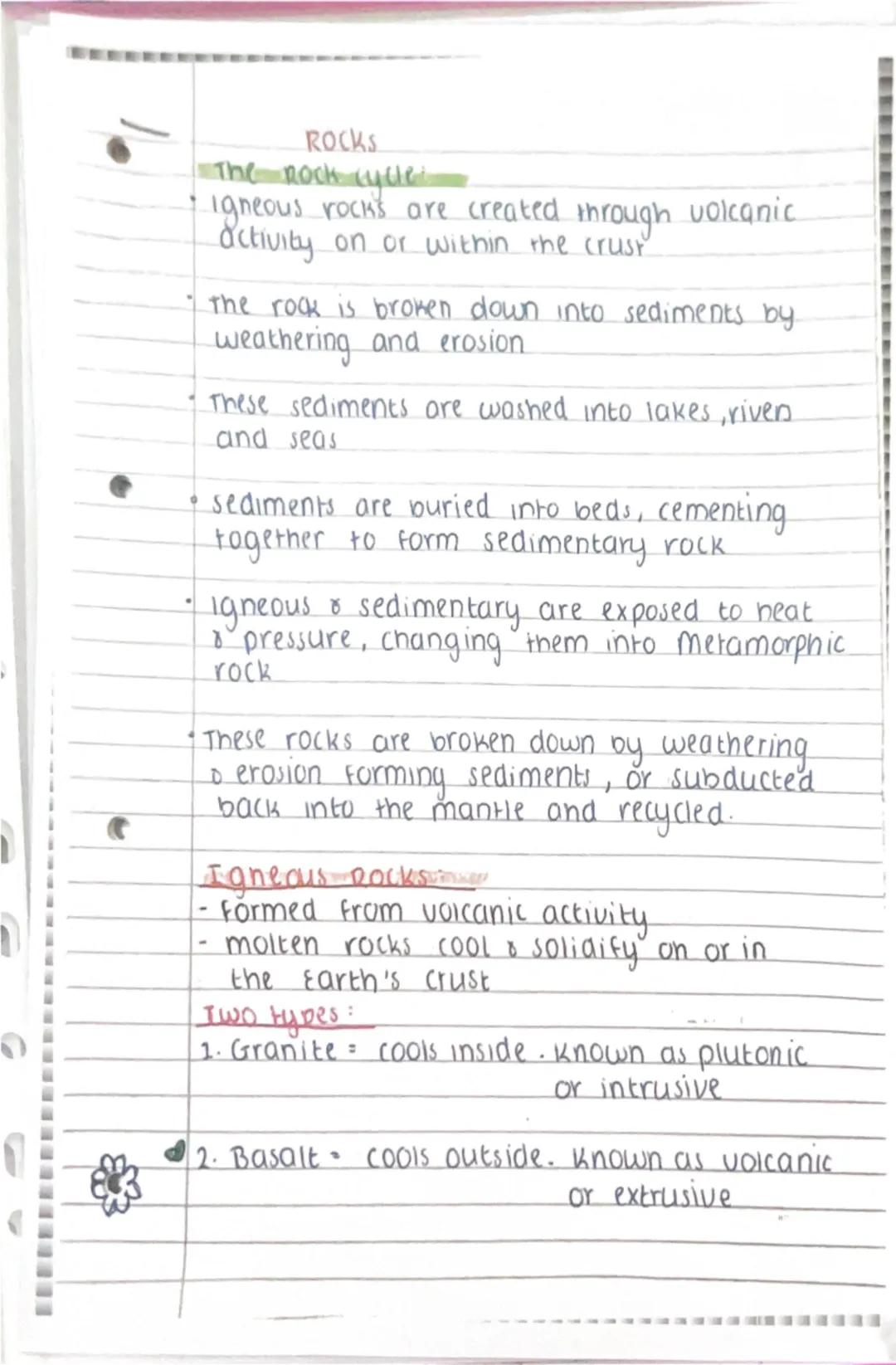
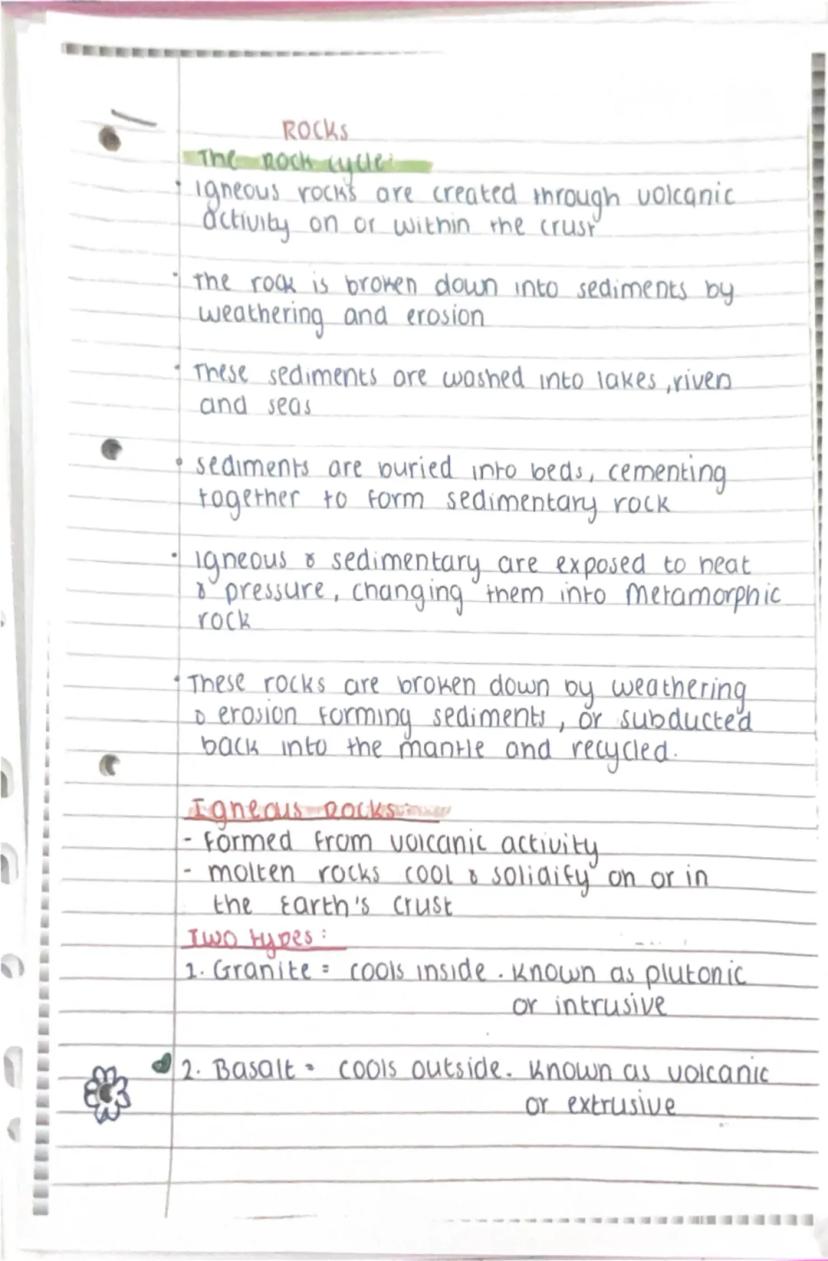
The Rock Cycle & Igneous Rocks
The rock cycle shows how rocks constantly transform from one type to another. Igneous rocks start the cycle when volcanic activity creates molten rock that cools and solidifies. These rocks then weather and erode into sediments that wash into water bodies.
Sediments get buried and cement together to form sedimentary rock. When igneous and sedimentary rocks face intense heat and pressure, they transform into metamorphic rock. The cycle continues as these rocks either weather into sediments again or get recycled back into the Earth's mantle.
There are two main types of igneous rocks. Granite forms when molten rock cools slowly inside the Earth (plutonic or intrusive). Basalt forms when lava cools quickly on the surface (volcanic or extrusive).
Key Tip: Remember that cooling speed determines crystal size - slow cooling creates large crystals, fast cooling creates small crystals.
2
of 10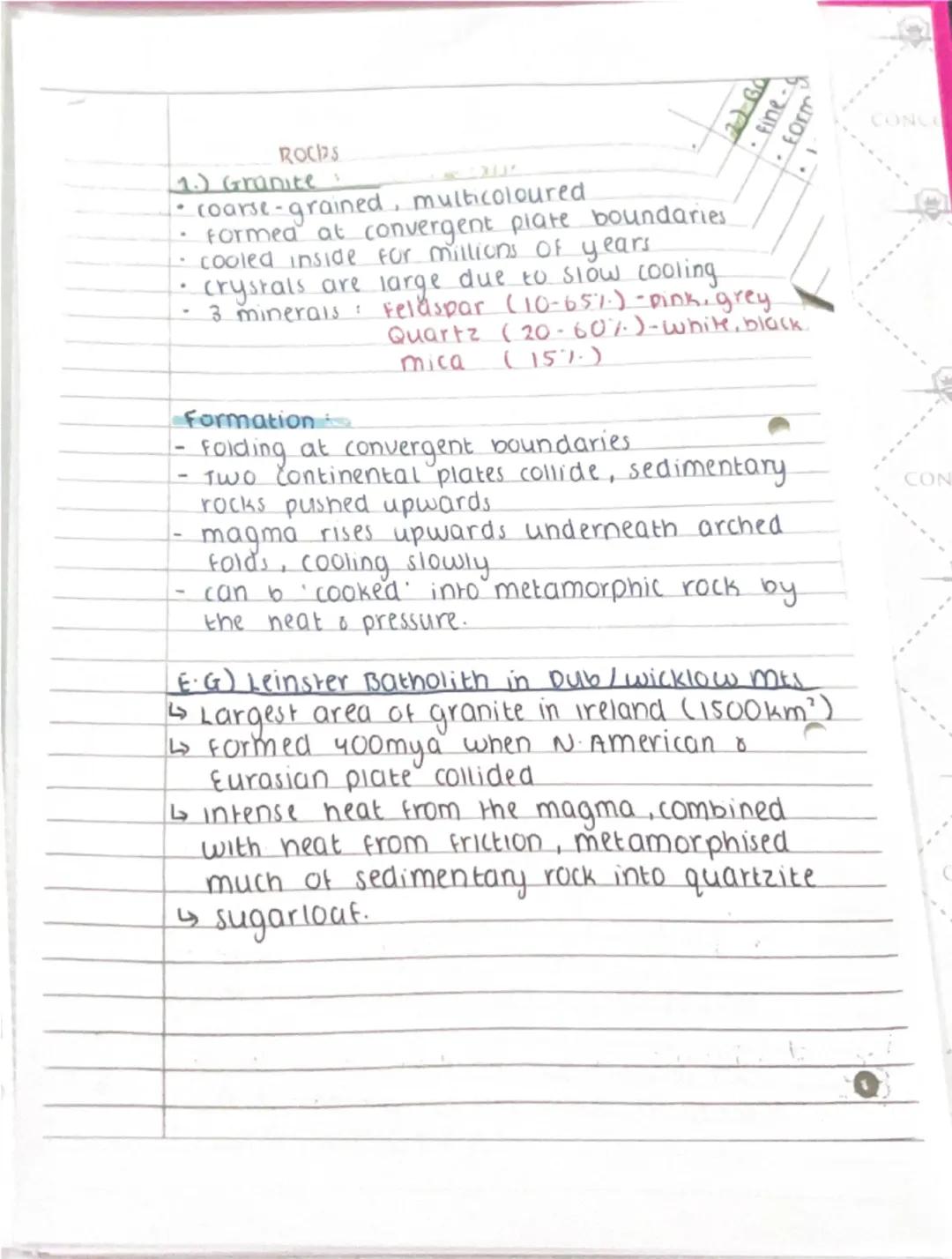
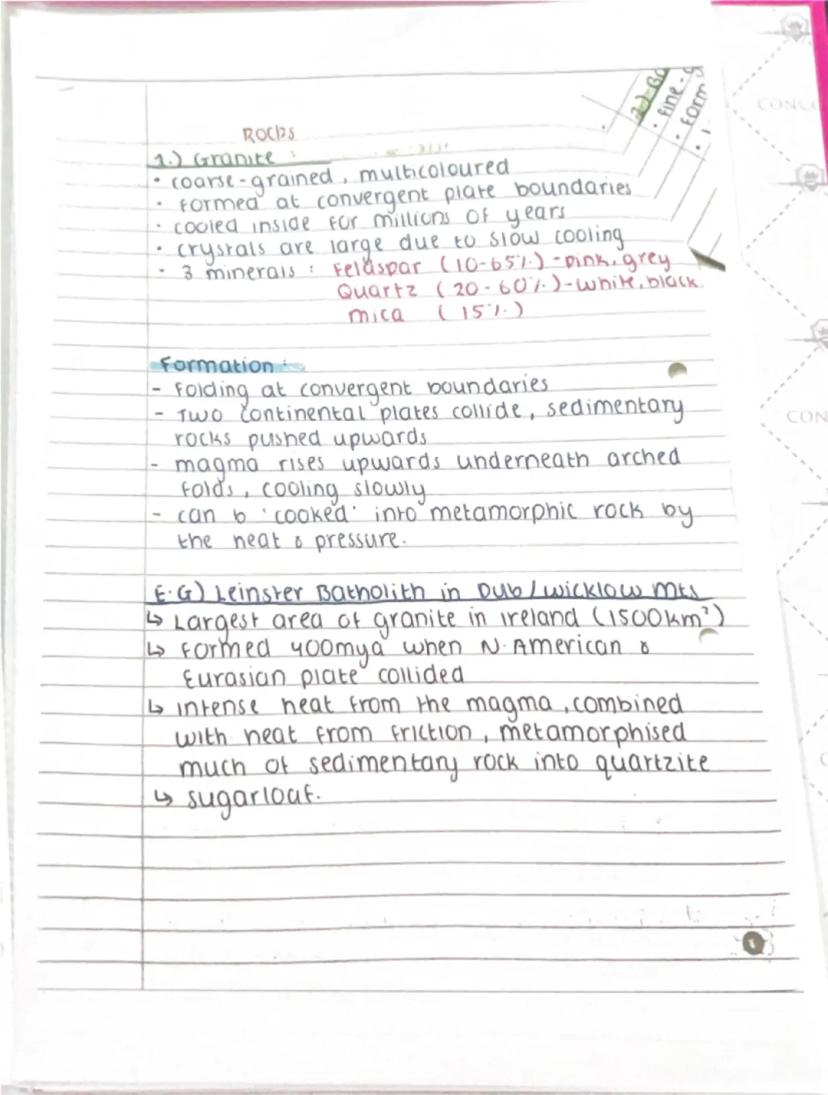
Granite Formation
Granite is that coarse-grained, multicoloured rock you see throughout Ireland's mountains. It forms at convergent plate boundaries where continental plates smash together, pushing sedimentary rocks upward and forcing magma to rise underneath.
The magic happens during slow cooling over millions of years. This creates large, visible crystals made of three main minerals: feldspar , quartz , and mica (about 15%).
Ireland's best example is the Leinster Batholith in Dublin and Wicklow - covering 1,500km². This massive granite formation developed 400 million years ago when the North American and Eurasian plates collided. The intense heat didn't just create granite; it also transformed surrounding sedimentary rock into quartzite, which you can see at Sugarloaf Mountain.
Did You Know? The Leinster Batholith is Ireland's largest granite area - that's bigger than County Dublin!
3
of 10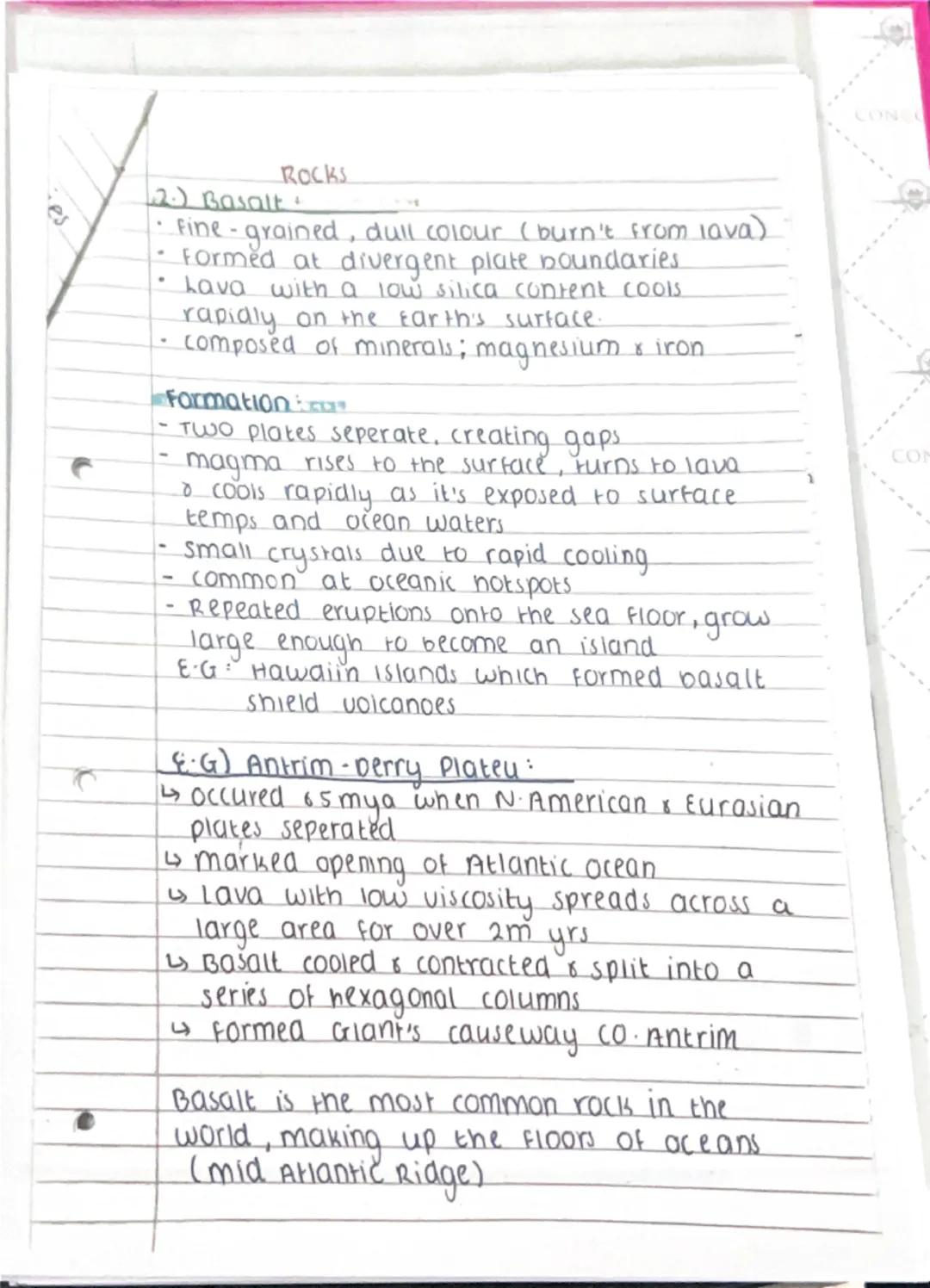
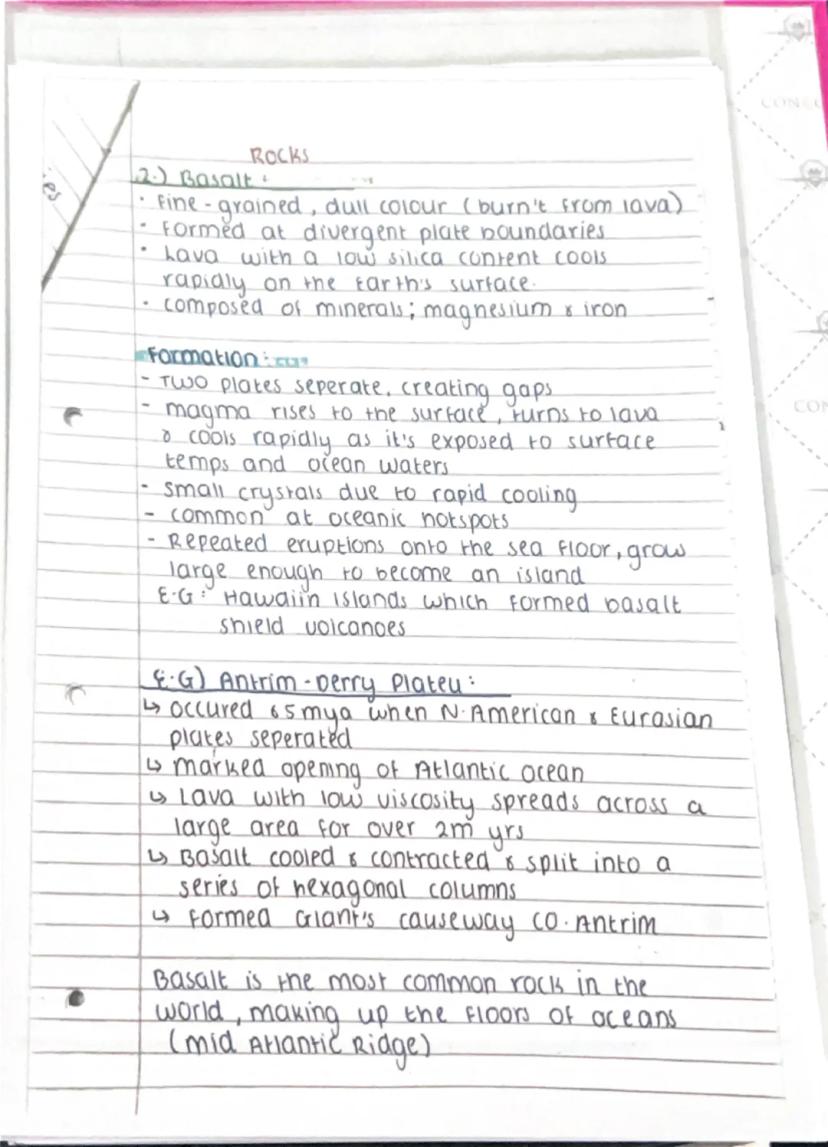
Basalt Formation
Basalt looks completely different from granite - it's fine-grained with a dull, burnt appearance from rapid lava cooling. This rock forms at divergent plate boundaries where plates separate, creating gaps for magma to escape.
The formation process is dramatic but quick. Magma rises through the gaps, becomes lava on the surface, then cools rapidly due to surface temperatures and ocean water. This rapid cooling creates tiny crystals, and the rock contains lots of magnesium and iron.
Ireland's most famous basalt formation is the Antrim-Derry Plateau, created 65 million years ago when North America and Eurasia separated. Low-viscosity lava spread across huge areas for over 2 million years. When this basalt cooled and contracted, it split into hexagonal columns - forming the iconic Giant's Causeway.
Basalt is actually the world's most common rock, making up all ocean floors including the Mid-Atlantic Ridge.
Fun Fact: The Giant's Causeway's hexagonal columns formed naturally when cooling basalt contracted - no human engineering required!
4
of 10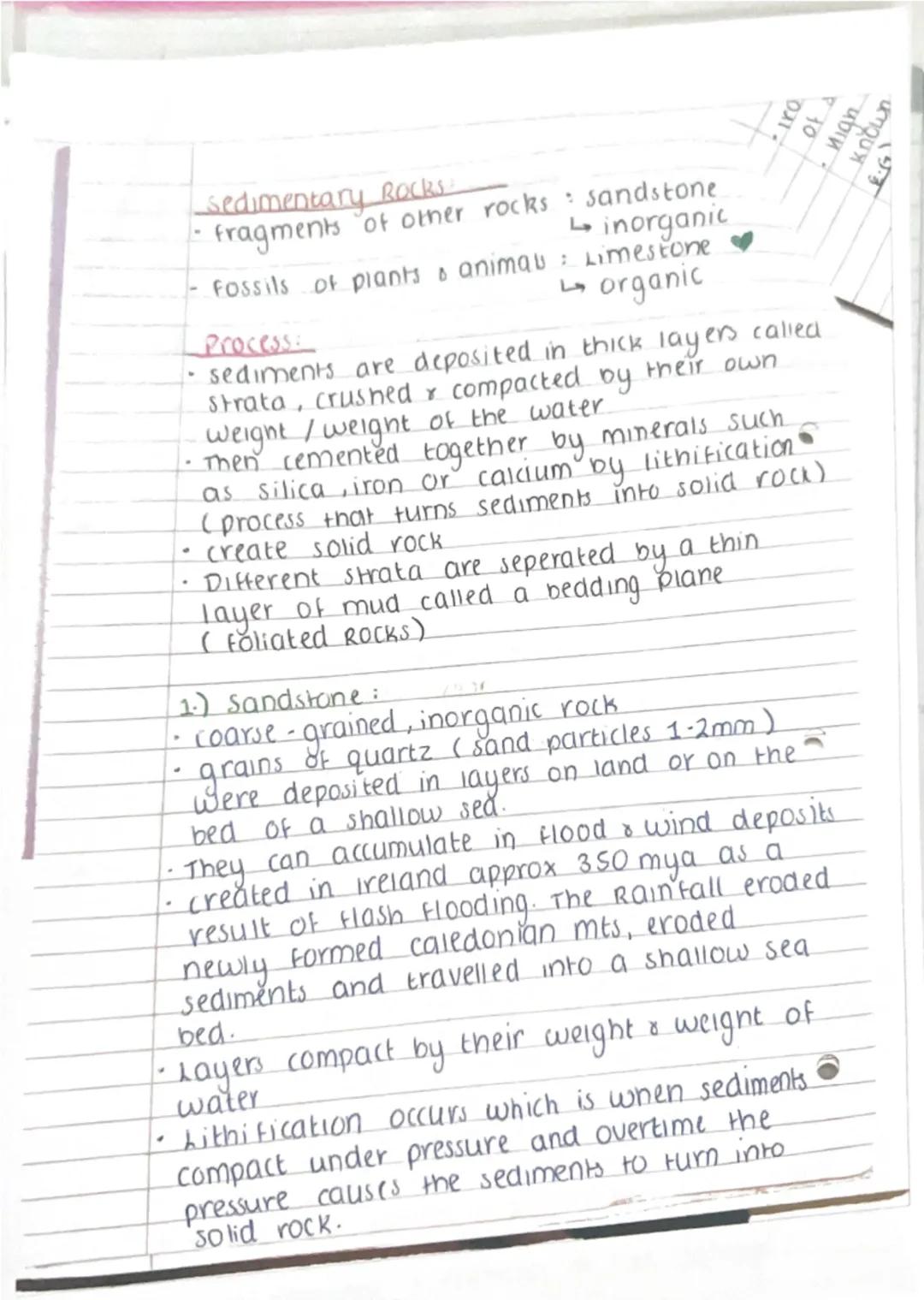
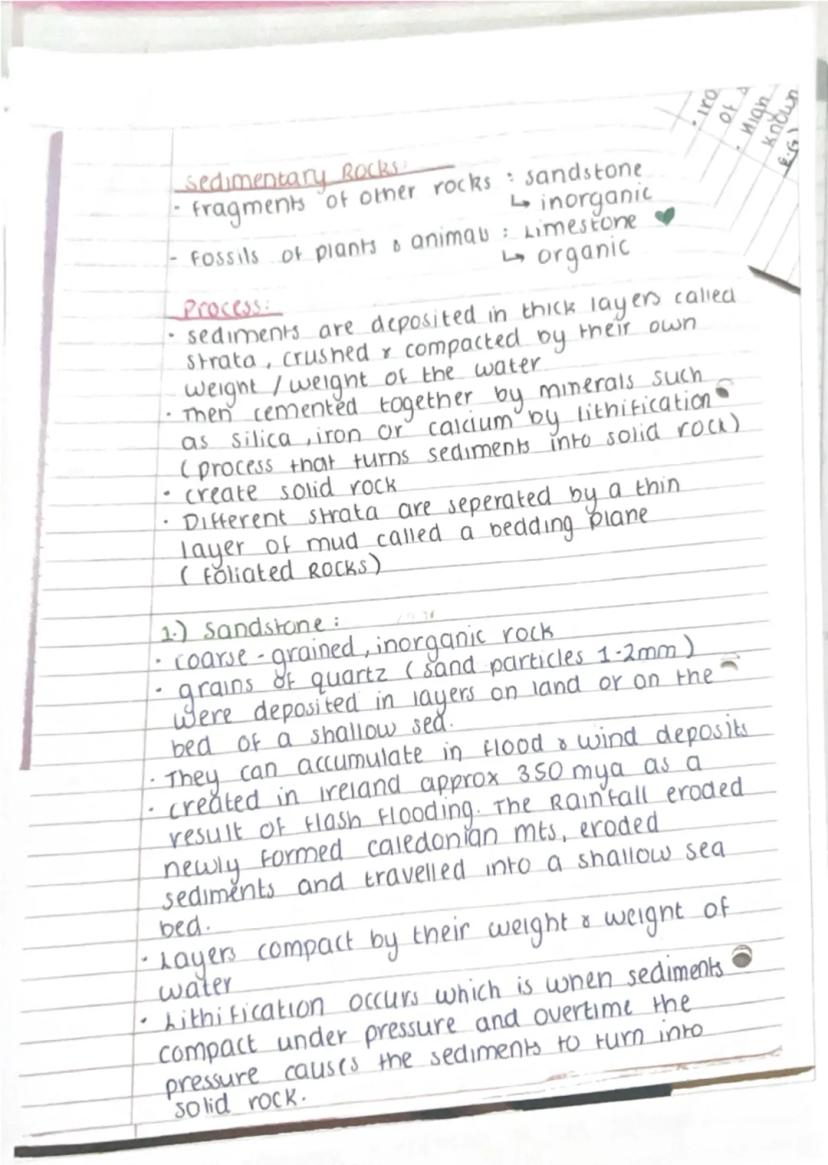
Sedimentary Rocks - Sandstone
Sedimentary rocks form from fragments of other rocks (like sandstone) or fossils of plants and animals (like limestone). The process involves lithification - where sediments get deposited in thick layers called strata, then crushed and compacted by weight.
Sandstone is a coarse-grained, inorganic rock made from quartz grains . These sediments can accumulate from flood deposits, wind deposits, or shallow sea beds. In Ireland, sandstone formed about 350 million years ago from massive flooding that eroded the newly formed Caledonian Mountains.
The formation process involves layers compacting under their own weight plus water weight. Lithification occurs when pressure turns loose sediments into solid rock over time. Iron and silica act as cement, binding everything together into distinct strata separated by thin mud layers called bedding planes.
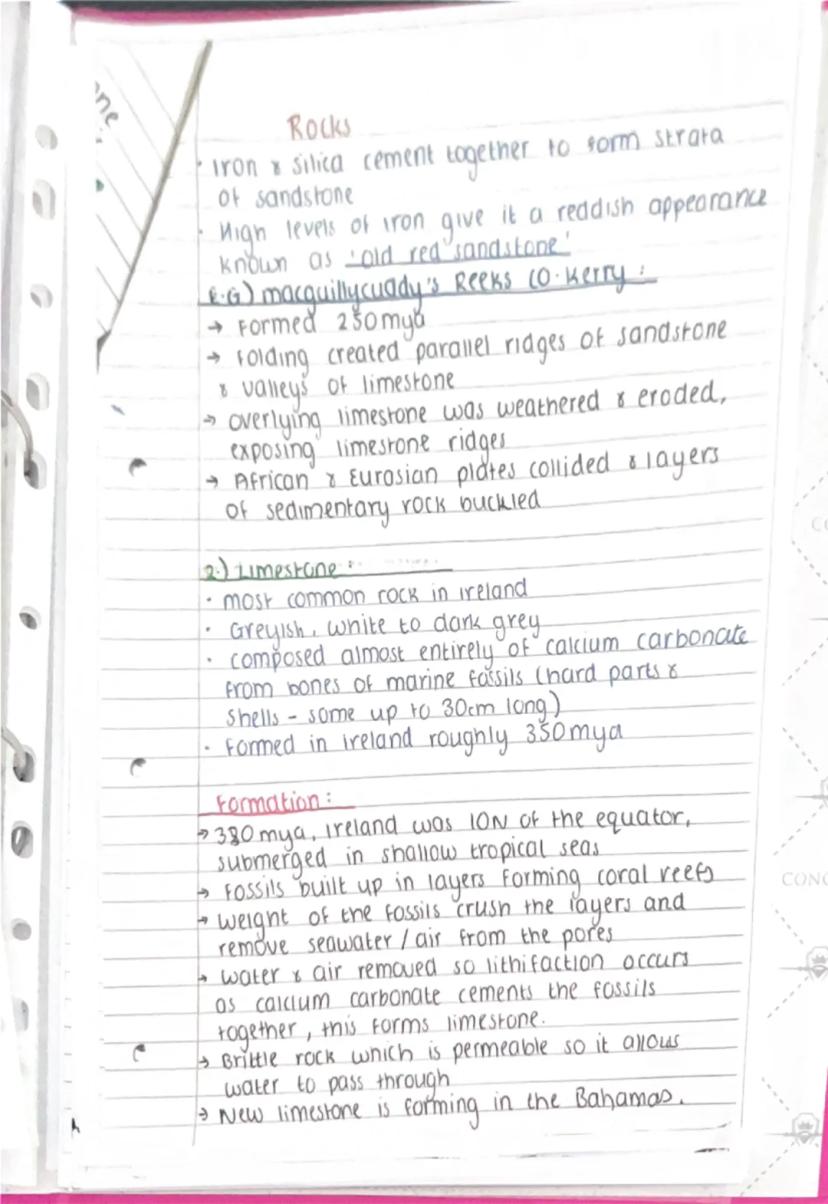
High iron content gives sandstone its reddish appearance - that's why we call it "Old Red Sandstone."
Local Example: MacGillycuddy's Reeks in Kerry formed 250 million years ago when plate collisions created parallel sandstone ridges.
5
of 10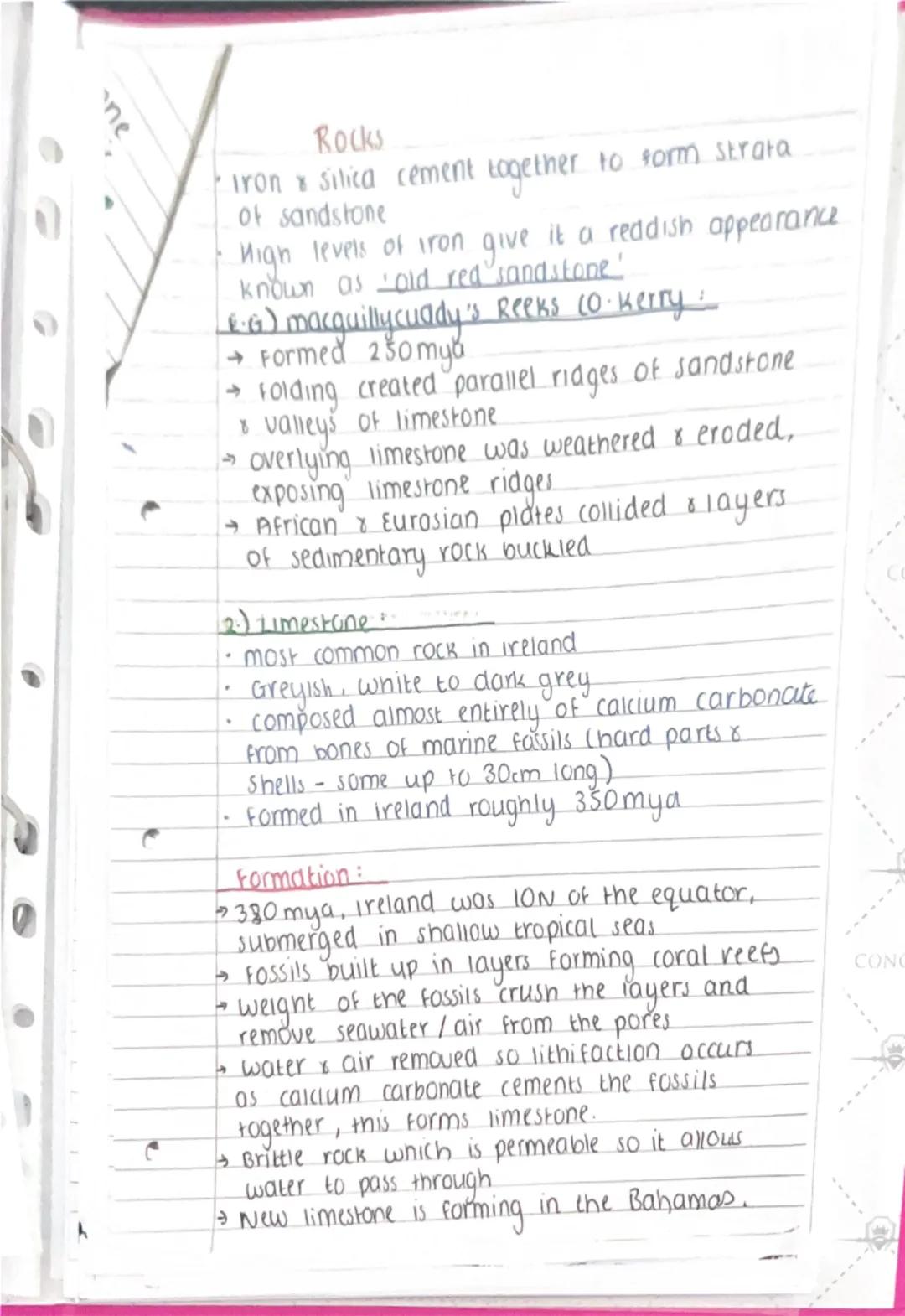
Limestone Formation
Limestone is Ireland's most common rock - that greyish-white to dark grey rock you see everywhere. It's composed almost entirely of calcium carbonate from marine fossils, including shells and bones up to 30cm long.
Ireland's limestone story begins 380 million years ago when our island sat 10° south of the equator, submerged in shallow tropical seas. Fossils built up in layers, forming coral reefs over time. The weight of accumulating fossils crushed lower layers, removing seawater and air from pores.
Lithification occurred when calcium carbonate cemented the fossils together. This created a brittle, permeable rock that allows water to pass through - a crucial characteristic for understanding Irish landscapes.
The process continues today in places like the Bahamas, where new limestone forms under similar tropical conditions. Ireland's limestone foundation explains why our soil is often alkaline and why we have such distinctive karst landscapes.
Ireland Fact: About 60% of Ireland sits on limestone - it's literally our bedrock foundation!
6
of 10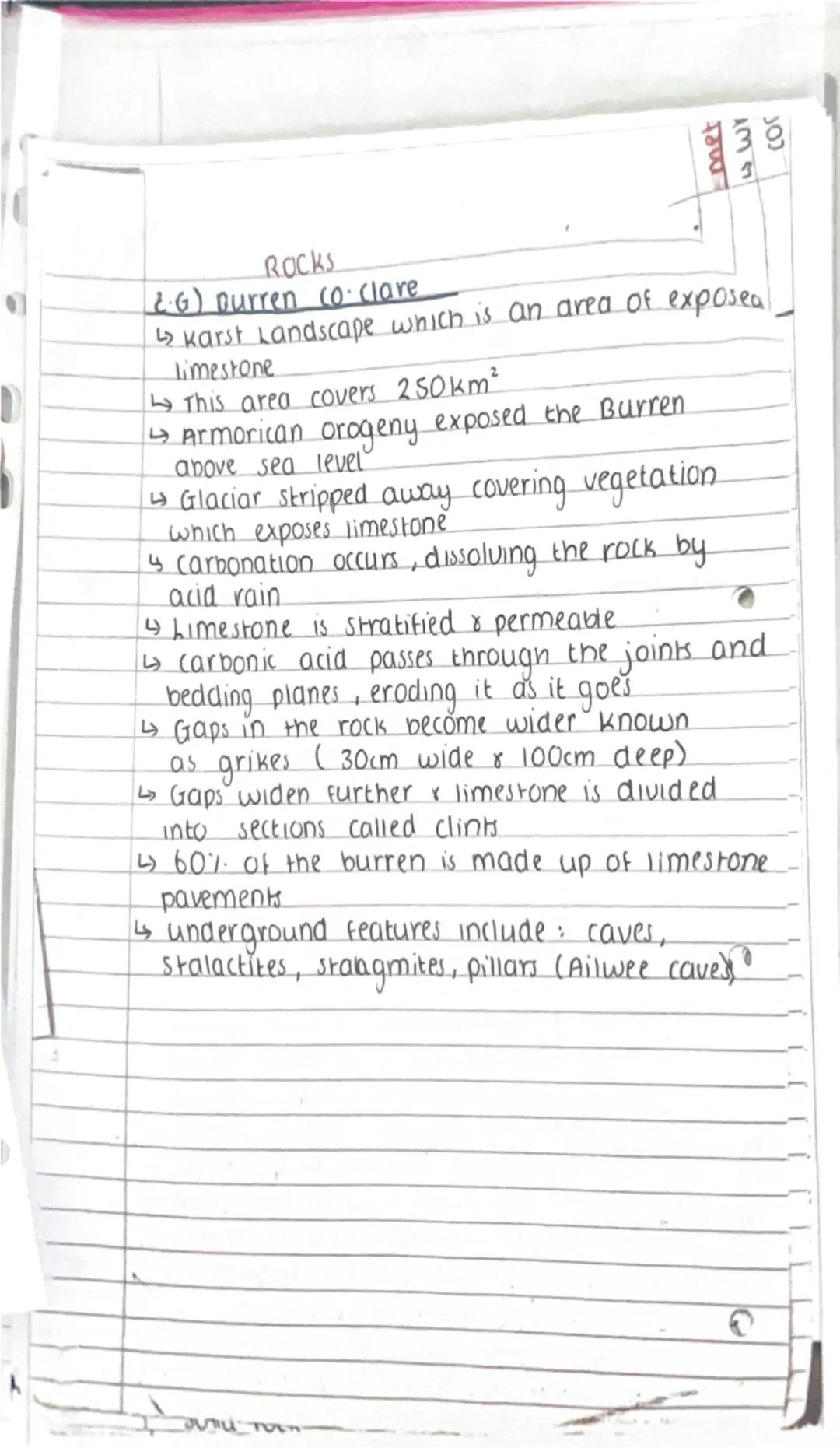
The Burren - Karst Landscape
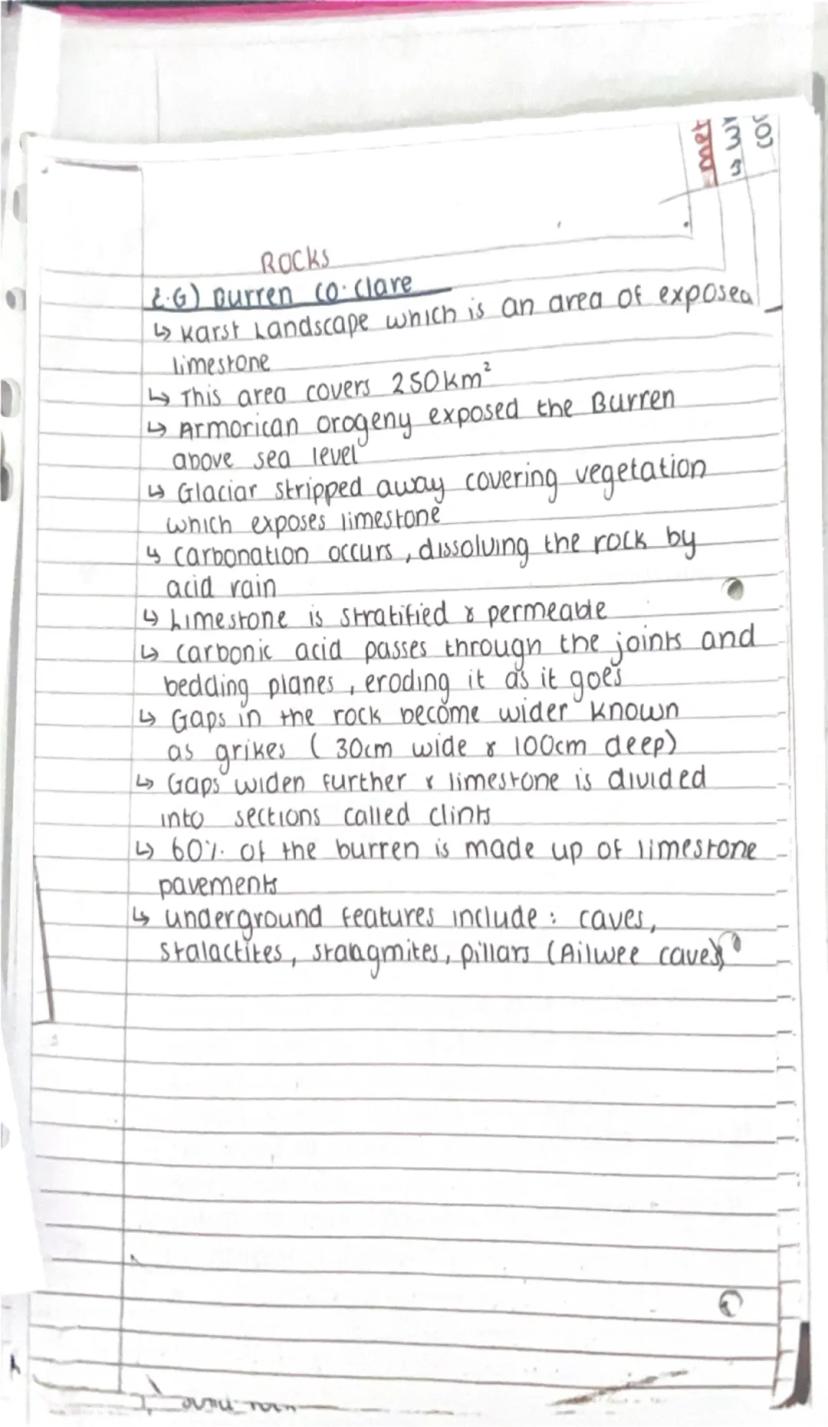
The Burren in Clare showcases what happens when limestone gets exposed and weathered. This karst landscape covers 250km² of exposed limestone pavement - one of Europe's most unique geological features.
The Armorican orogeny exposed the Burren above sea level. Later, glaciers stripped away covering vegetation, leaving bare limestone vulnerable to carbonation - where acid rain dissolves the rock chemically.
Because limestone is stratified and permeable, carbonic acid passes through joints and bedding planes, eroding as it flows. This creates grikes (gaps 30cm wide and 100cm deep) that gradually widen, dividing limestone into sections called clints.
About 60% of the Burren consists of these limestone pavements. Underground, the same process creates caves, stalactites, stalagmites, and pillars - like those you can explore at Ailwee Cave.
Nature's Art: The Burren's limestone pavement looks like giant stone tiles - created entirely by natural weathering over thousands of years.
7
of 10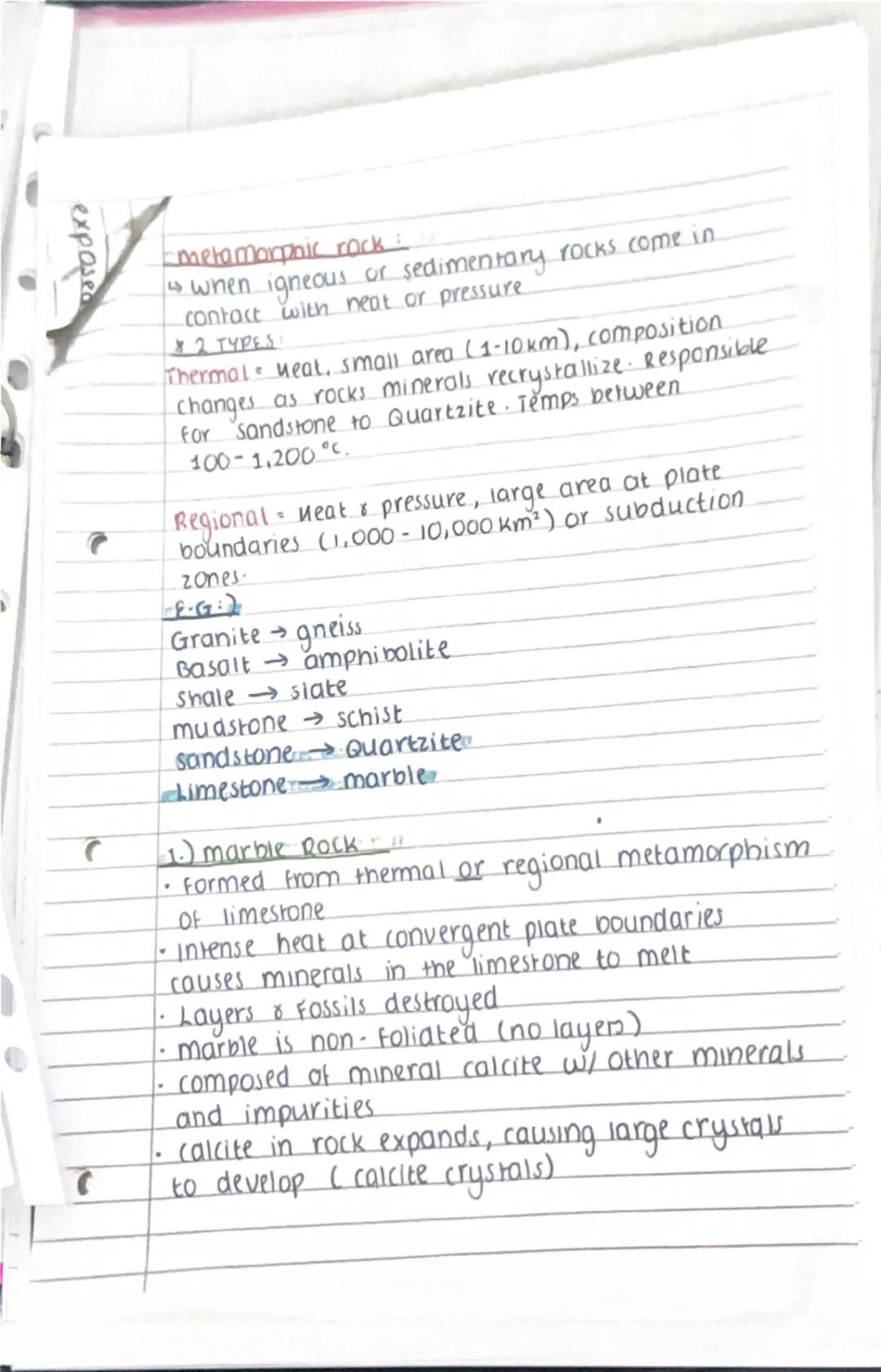
Metamorphic Rocks
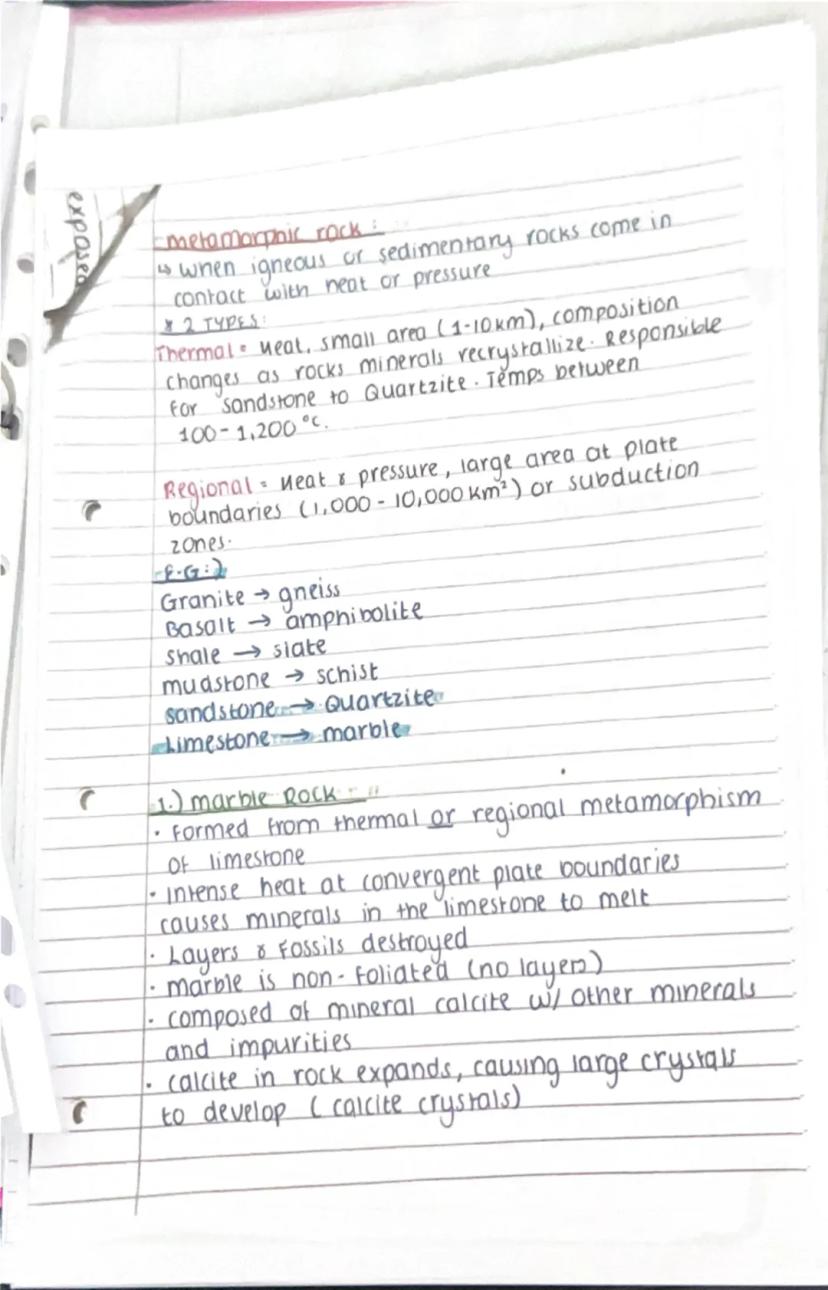
Metamorphic rocks form when existing igneous or sedimentary rocks encounter intense heat or pressure. There are two main types: thermal metamorphism and regional metamorphism (heat and pressure, large areas at plate boundaries).
Thermal metamorphism operates between 100-1,200°C, changing rock composition as minerals recrystallize. Regional metamorphism occurs at convergent boundaries and subduction zones, affecting areas of 1,000-10,000km².
Common transformations include granite becoming gneiss, basalt becoming amphibolite, and limestone becoming marble. These changes completely alter the original rock's appearance and properties.
Marble forms from limestone through thermal or regional metamorphism. Intense heat at convergent plate boundaries melts limestone minerals, destroying original layers and fossils. The result is a non-foliated rock (no layers) composed mainly of calcite crystals that expand during formation, creating large, visible crystals.
Remember: Metamorphic rocks are "changed" rocks - the original rock transforms but doesn't melt completely.
8
of 10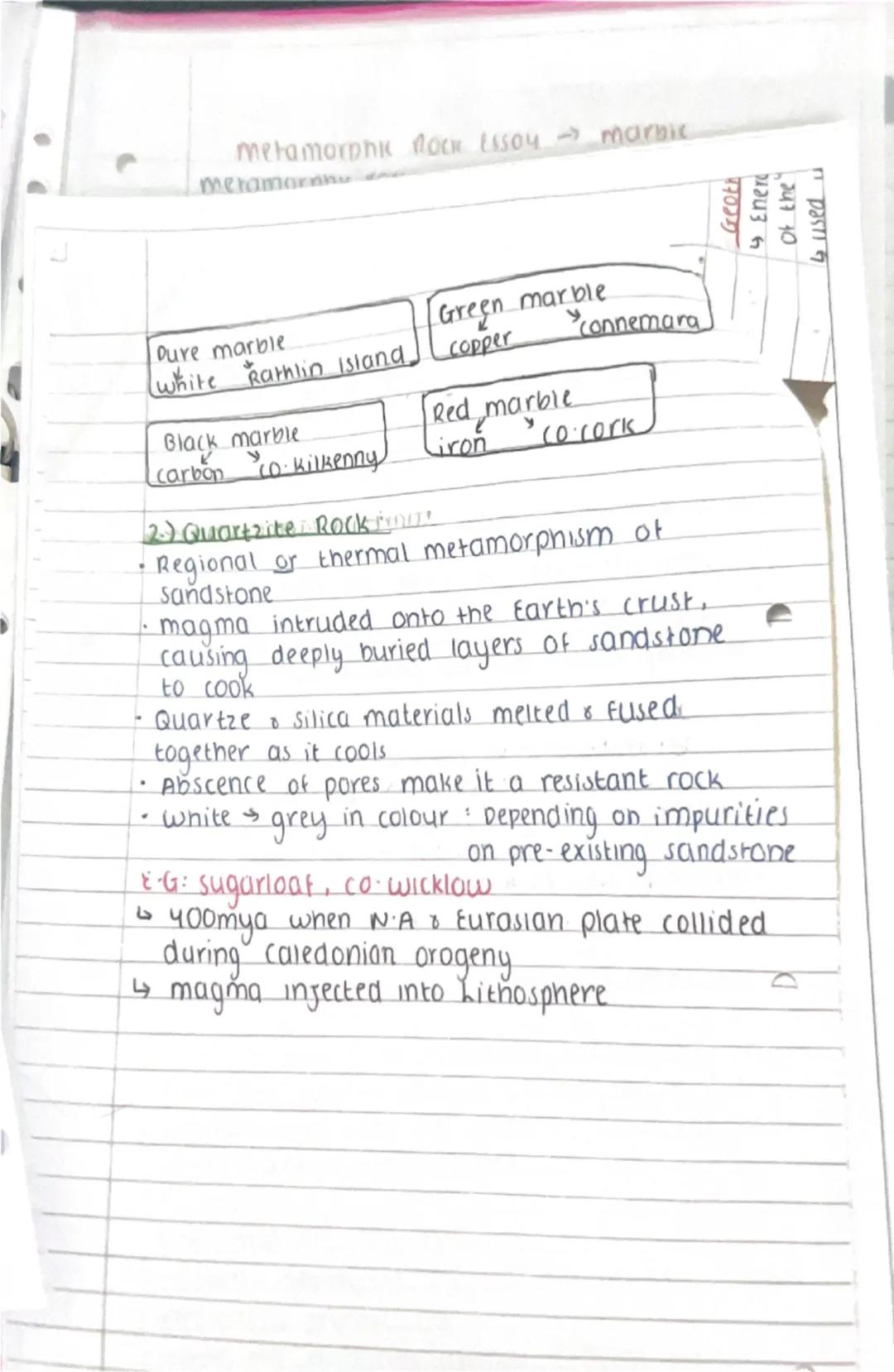
Irish Marble and Quartzite
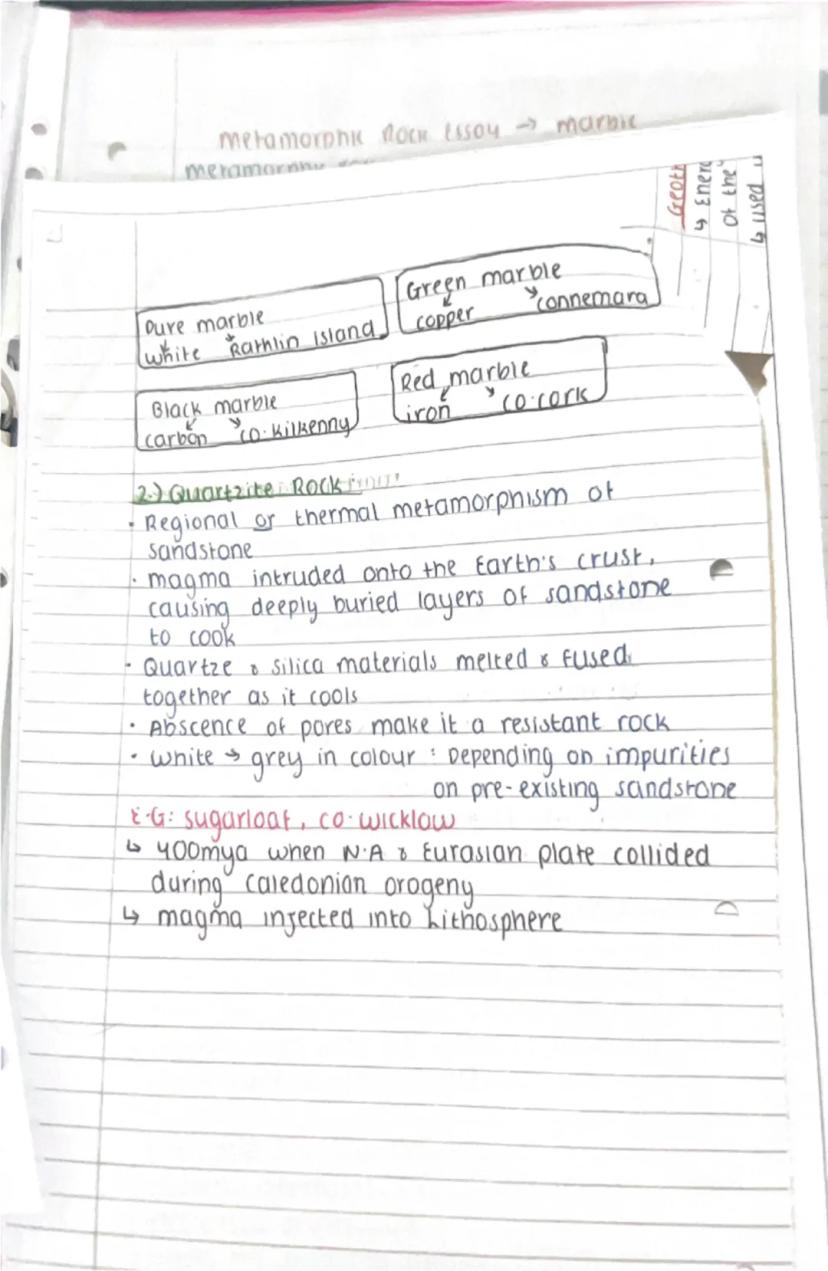
Ireland produces beautiful marble in different colours depending on mineral impurities. White marble comes from Rathlin Island, green marble (containing copper) from Connemara, black marble (with carbon) from Kilkenny, and red marble (with iron) from Cork.
Quartzite forms from sandstone through regional or thermal metamorphism. When magma intrudes into Earth's crust, deeply buried sandstone layers get "cooked." The quartz and silica materials melt and fuse together as they cool, creating an incredibly resistant rock with no pores.
Quartzite appears white to grey depending on impurities in the original sandstone. The absence of pores makes it extremely resistant to weathering - that's why quartzite mountains often form dramatic peaks.
Sugarloaf Mountain in Wicklow is Ireland's most famous quartzite formation. It formed 400 million years ago during the Caledonian orogeny when North American and Eurasian plates collided, injecting magma into the lithosphere and metamorphosing surrounding sandstone.
Mountain Fact: Quartzite's resistance to erosion explains why Sugarloaf stands out so dramatically in the Wicklow landscape.
9
of 10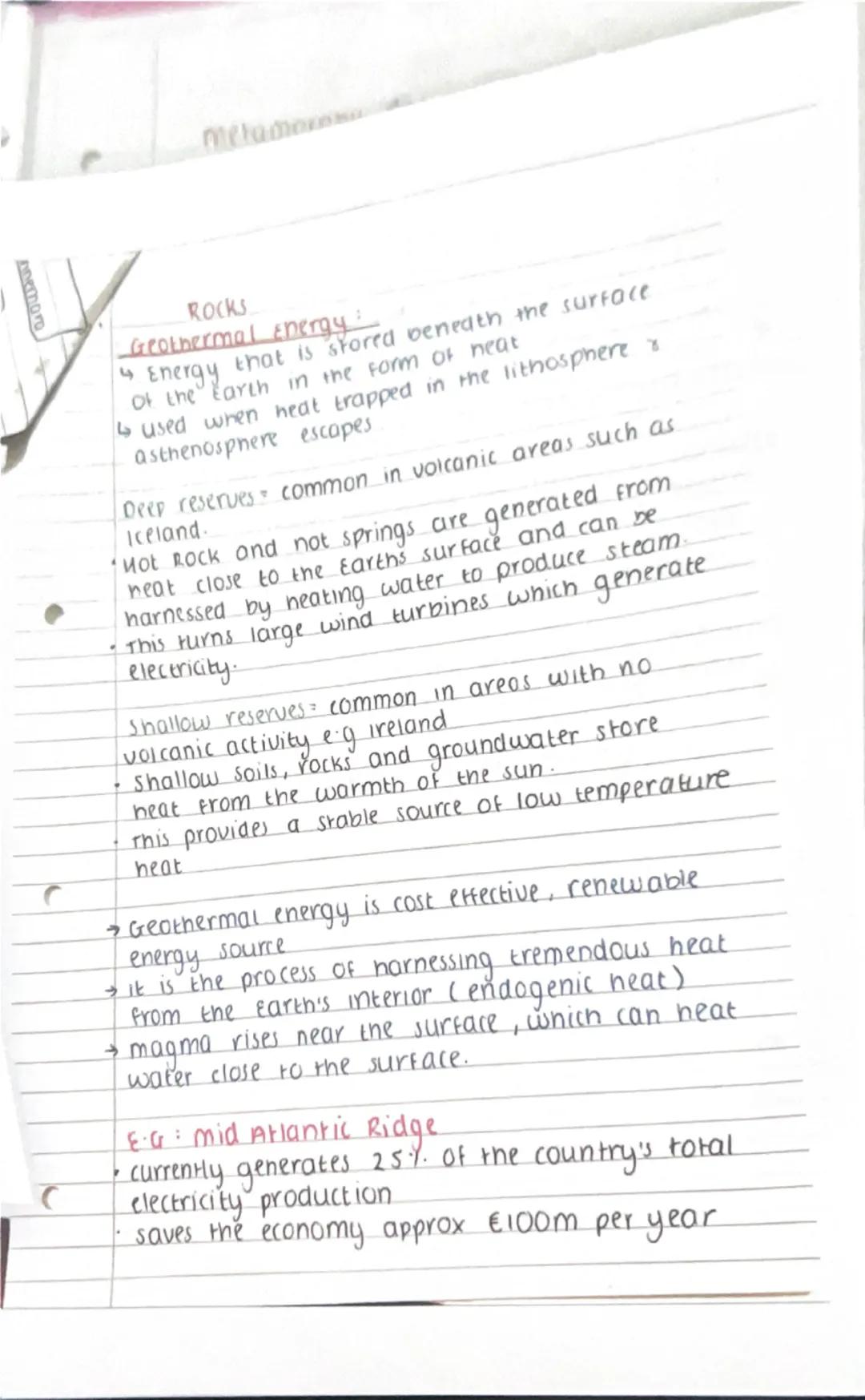
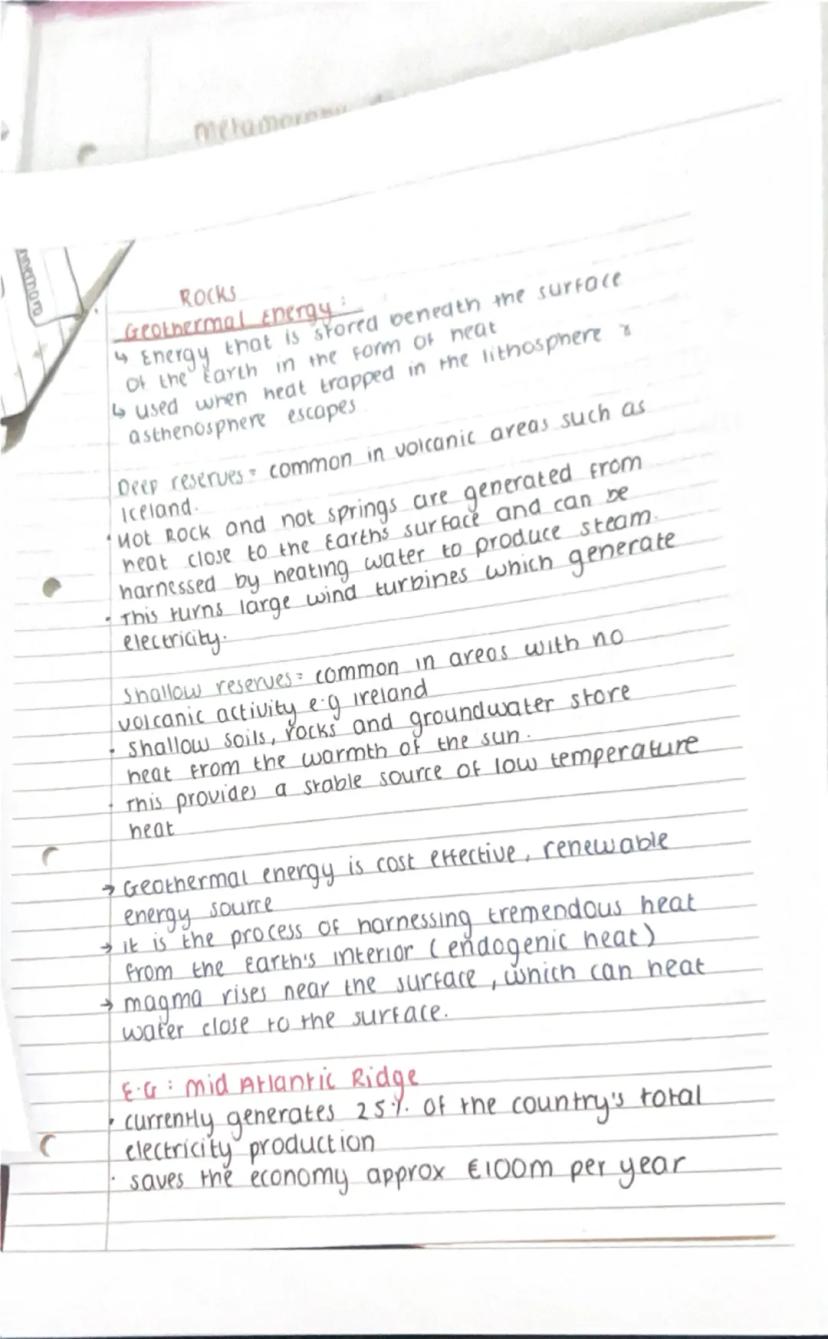
Geothermal Energy Basics
Geothermal energy harnesses heat stored beneath Earth's surface - it's renewable energy that comes from our planet's interior. This endogenic heat becomes accessible when heat from the lithosphere and asthenosphere escapes upward.
Deep reserves occur in volcanic areas like Iceland, where hot rocks and hot springs generate steam close to Earth's surface. This steam powers turbines that generate electricity - it's the same principle as wind turbines but powered by underground heat.
Shallow reserves exist in non-volcanic areas like Ireland, where soils, rocks, and groundwater store heat from solar warmth. This provides stable, low-temperature heat that's perfect for heating buildings.
Iceland demonstrates geothermal energy's potential perfectly. The Mid-Atlantic Ridge running through Iceland currently generates 25% of the country's total electricity production, saving their economy approximately €100 million per year.
Green Energy: Geothermal is cost-effective and renewable - it's literally powered by Earth's internal heat that will last millions of years.
10
of 10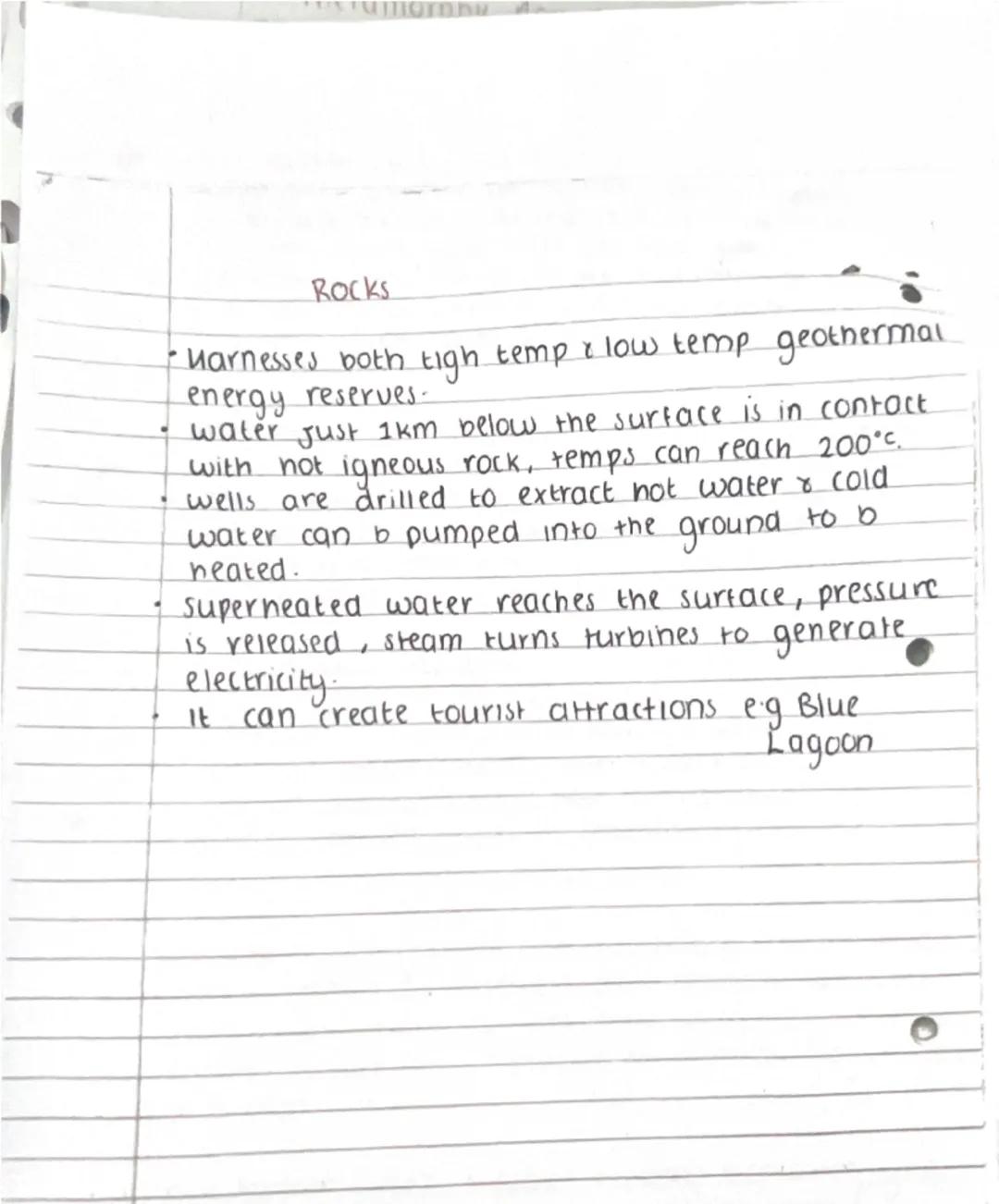
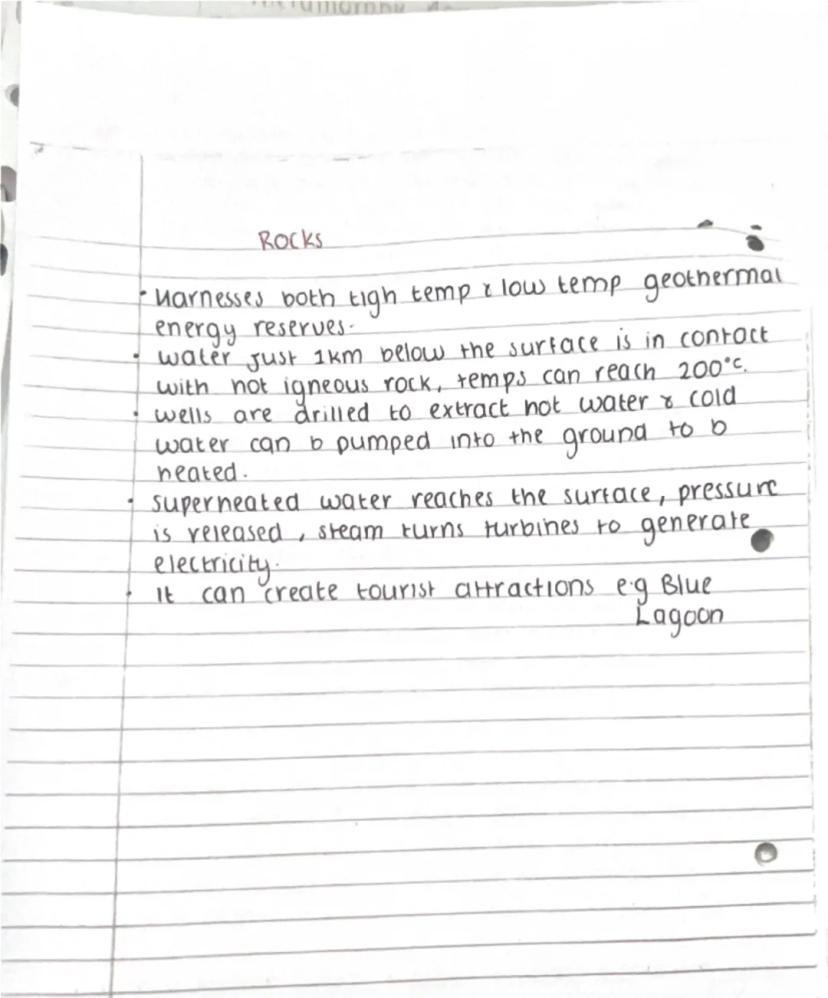
Geothermal Energy in Action
Iceland harnesses both high-temperature and low-temperature geothermal reserves with impressive efficiency. Water just 1km below the surface contacts hot igneous rock, reaching temperatures of 200°C - that's nearly boiling point at high pressure.
The extraction process involves drilling wells to reach superheated water. Cold water can also be pumped underground to be heated by contact with hot rocks. When this superheated water reaches the surface, pressure release creates steam that turns turbines to generate electricity.
The technology isn't just about electricity generation. Iceland's geothermal systems heat homes, businesses, and even create tourist attractions. The famous Blue Lagoon is actually a byproduct of geothermal power production - the warm, mineral-rich water attracts visitors from around the world.
This demonstrates how geological processes we study in class have real-world applications for sustainable energy production.
Cool Application: Iceland's Blue Lagoon shows how understanding rock formation and heat transfer can create both clean energy and economic opportunities.
We thought you’d never ask...
What is the Knowunity AI companion?
Our AI companion is specifically built for the needs of students. Based on the millions of content pieces we have on the platform we can provide truly meaningful and relevant answers to students. But its not only about answers, the companion is even more about guiding students through their daily learning challenges, with personalised study plans, quizzes or content pieces in the chat and 100% personalisation based on the students skills and developments.
Where can I download the Knowunity app?
You can download the app in the Google Play Store and in the Apple App Store.
Is Knowunity really free of charge?
That's right! Enjoy free access to study content, connect with fellow students, and get instant help – all at your fingertips.
Most popular content in Geography
9Most popular content
9Can't find what you're looking for? Explore other subjects.
Students love us — and so will you.
4.6/5App Store
4.7/5Google Play
The app is very easy to use and well designed. I have found everything I was looking for so far and have been able to learn a lot from the presentations! I will definitely use the app for a class assignment! And of course it also helps a lot as an inspiration.
Stefan SiOS user
This app is really great. There are so many study notes and help [...]. My problem subject is French, for example, and the app has so many options for help. Thanks to this app, I have improved my French. I would recommend it to anyone.
Samantha KlichAndroid user
Wow, I am really amazed. I just tried the app because I've seen it advertised many times and was absolutely stunned. This app is THE HELP you want for school and above all, it offers so many things, such as workouts and fact sheets, which have been VERY helpful to me personally.
AnnaiOS user
Geography24 views·Updated Jun 4, 2026·12 pagesUnderstanding Rock Formations in Geography
C
Ciara Hanratty@ciarahanratty
Think of rocks as constantly recycling - they're always changing from one type to another through the rock cycle. Understanding igneous, sedimentary, and metamorphic rocks isn't just geology theory - it's the story of how our landscape formed and...
1
of 10
Sign up to see the content. It's free!
- Access to all documents
- Improve your grades
- Join milions of students
The Rock Cycle & Igneous Rocks
The rock cycle shows how rocks constantly transform from one type to another. Igneous rocks start the cycle when volcanic activity creates molten rock that cools and solidifies. These rocks then weather and erode into sediments that wash into water bodies.
Sediments get buried and cement together to form sedimentary rock. When igneous and sedimentary rocks face intense heat and pressure, they transform into metamorphic rock. The cycle continues as these rocks either weather into sediments again or get recycled back into the Earth's mantle.
There are two main types of igneous rocks. Granite forms when molten rock cools slowly inside the Earth (plutonic or intrusive). Basalt forms when lava cools quickly on the surface (volcanic or extrusive).
Key Tip: Remember that cooling speed determines crystal size - slow cooling creates large crystals, fast cooling creates small crystals.
2
of 10Sign up to see the content. It's free!
- Access to all documents
- Improve your grades
- Join milions of students
Granite Formation
Granite is that coarse-grained, multicoloured rock you see throughout Ireland's mountains. It forms at convergent plate boundaries where continental plates smash together, pushing sedimentary rocks upward and forcing magma to rise underneath.
The magic happens during slow cooling over millions of years. This creates large, visible crystals made of three main minerals: feldspar , quartz , and mica (about 15%).
Ireland's best example is the Leinster Batholith in Dublin and Wicklow - covering 1,500km². This massive granite formation developed 400 million years ago when the North American and Eurasian plates collided. The intense heat didn't just create granite; it also transformed surrounding sedimentary rock into quartzite, which you can see at Sugarloaf Mountain.
Did You Know? The Leinster Batholith is Ireland's largest granite area - that's bigger than County Dublin!
3
of 10Sign up to see the content. It's free!
- Access to all documents
- Improve your grades
- Join milions of students
Basalt Formation
Basalt looks completely different from granite - it's fine-grained with a dull, burnt appearance from rapid lava cooling. This rock forms at divergent plate boundaries where plates separate, creating gaps for magma to escape.
The formation process is dramatic but quick. Magma rises through the gaps, becomes lava on the surface, then cools rapidly due to surface temperatures and ocean water. This rapid cooling creates tiny crystals, and the rock contains lots of magnesium and iron.
Ireland's most famous basalt formation is the Antrim-Derry Plateau, created 65 million years ago when North America and Eurasia separated. Low-viscosity lava spread across huge areas for over 2 million years. When this basalt cooled and contracted, it split into hexagonal columns - forming the iconic Giant's Causeway.
Basalt is actually the world's most common rock, making up all ocean floors including the Mid-Atlantic Ridge.
Fun Fact: The Giant's Causeway's hexagonal columns formed naturally when cooling basalt contracted - no human engineering required!
4
of 10Sign up to see the content. It's free!
- Access to all documents
- Improve your grades
- Join milions of students
Sedimentary Rocks - Sandstone
Sedimentary rocks form from fragments of other rocks (like sandstone) or fossils of plants and animals (like limestone). The process involves lithification - where sediments get deposited in thick layers called strata, then crushed and compacted by weight.
Sandstone is a coarse-grained, inorganic rock made from quartz grains . These sediments can accumulate from flood deposits, wind deposits, or shallow sea beds. In Ireland, sandstone formed about 350 million years ago from massive flooding that eroded the newly formed Caledonian Mountains.
The formation process involves layers compacting under their own weight plus water weight. Lithification occurs when pressure turns loose sediments into solid rock over time. Iron and silica act as cement, binding everything together into distinct strata separated by thin mud layers called bedding planes.
High iron content gives sandstone its reddish appearance - that's why we call it "Old Red Sandstone."
Local Example: MacGillycuddy's Reeks in Kerry formed 250 million years ago when plate collisions created parallel sandstone ridges.
5
of 10Sign up to see the content. It's free!
- Access to all documents
- Improve your grades
- Join milions of students
Limestone Formation
Limestone is Ireland's most common rock - that greyish-white to dark grey rock you see everywhere. It's composed almost entirely of calcium carbonate from marine fossils, including shells and bones up to 30cm long.
Ireland's limestone story begins 380 million years ago when our island sat 10° south of the equator, submerged in shallow tropical seas. Fossils built up in layers, forming coral reefs over time. The weight of accumulating fossils crushed lower layers, removing seawater and air from pores.
Lithification occurred when calcium carbonate cemented the fossils together. This created a brittle, permeable rock that allows water to pass through - a crucial characteristic for understanding Irish landscapes.
The process continues today in places like the Bahamas, where new limestone forms under similar tropical conditions. Ireland's limestone foundation explains why our soil is often alkaline and why we have such distinctive karst landscapes.
Ireland Fact: About 60% of Ireland sits on limestone - it's literally our bedrock foundation!
6
of 10Sign up to see the content. It's free!
- Access to all documents
- Improve your grades
- Join milions of students
The Burren - Karst Landscape
The Burren in Clare showcases what happens when limestone gets exposed and weathered. This karst landscape covers 250km² of exposed limestone pavement - one of Europe's most unique geological features.
The Armorican orogeny exposed the Burren above sea level. Later, glaciers stripped away covering vegetation, leaving bare limestone vulnerable to carbonation - where acid rain dissolves the rock chemically.
Because limestone is stratified and permeable, carbonic acid passes through joints and bedding planes, eroding as it flows. This creates grikes (gaps 30cm wide and 100cm deep) that gradually widen, dividing limestone into sections called clints.
About 60% of the Burren consists of these limestone pavements. Underground, the same process creates caves, stalactites, stalagmites, and pillars - like those you can explore at Ailwee Cave.
Nature's Art: The Burren's limestone pavement looks like giant stone tiles - created entirely by natural weathering over thousands of years.
7
of 10Sign up to see the content. It's free!
- Access to all documents
- Improve your grades
- Join milions of students
Metamorphic Rocks
Metamorphic rocks form when existing igneous or sedimentary rocks encounter intense heat or pressure. There are two main types: thermal metamorphism and regional metamorphism (heat and pressure, large areas at plate boundaries).
Thermal metamorphism operates between 100-1,200°C, changing rock composition as minerals recrystallize. Regional metamorphism occurs at convergent boundaries and subduction zones, affecting areas of 1,000-10,000km².
Common transformations include granite becoming gneiss, basalt becoming amphibolite, and limestone becoming marble. These changes completely alter the original rock's appearance and properties.
Marble forms from limestone through thermal or regional metamorphism. Intense heat at convergent plate boundaries melts limestone minerals, destroying original layers and fossils. The result is a non-foliated rock (no layers) composed mainly of calcite crystals that expand during formation, creating large, visible crystals.
Remember: Metamorphic rocks are "changed" rocks - the original rock transforms but doesn't melt completely.
8
of 10Sign up to see the content. It's free!
- Access to all documents
- Improve your grades
- Join milions of students
Irish Marble and Quartzite
Ireland produces beautiful marble in different colours depending on mineral impurities. White marble comes from Rathlin Island, green marble (containing copper) from Connemara, black marble (with carbon) from Kilkenny, and red marble (with iron) from Cork.
Quartzite forms from sandstone through regional or thermal metamorphism. When magma intrudes into Earth's crust, deeply buried sandstone layers get "cooked." The quartz and silica materials melt and fuse together as they cool, creating an incredibly resistant rock with no pores.
Quartzite appears white to grey depending on impurities in the original sandstone. The absence of pores makes it extremely resistant to weathering - that's why quartzite mountains often form dramatic peaks.
Sugarloaf Mountain in Wicklow is Ireland's most famous quartzite formation. It formed 400 million years ago during the Caledonian orogeny when North American and Eurasian plates collided, injecting magma into the lithosphere and metamorphosing surrounding sandstone.
Mountain Fact: Quartzite's resistance to erosion explains why Sugarloaf stands out so dramatically in the Wicklow landscape.
9
of 10Sign up to see the content. It's free!
- Access to all documents
- Improve your grades
- Join milions of students
Geothermal Energy Basics
Geothermal energy harnesses heat stored beneath Earth's surface - it's renewable energy that comes from our planet's interior. This endogenic heat becomes accessible when heat from the lithosphere and asthenosphere escapes upward.
Deep reserves occur in volcanic areas like Iceland, where hot rocks and hot springs generate steam close to Earth's surface. This steam powers turbines that generate electricity - it's the same principle as wind turbines but powered by underground heat.
Shallow reserves exist in non-volcanic areas like Ireland, where soils, rocks, and groundwater store heat from solar warmth. This provides stable, low-temperature heat that's perfect for heating buildings.
Iceland demonstrates geothermal energy's potential perfectly. The Mid-Atlantic Ridge running through Iceland currently generates 25% of the country's total electricity production, saving their economy approximately €100 million per year.
Green Energy: Geothermal is cost-effective and renewable - it's literally powered by Earth's internal heat that will last millions of years.
10
of 10Sign up to see the content. It's free!
- Access to all documents
- Improve your grades
- Join milions of students
Geothermal Energy in Action
Iceland harnesses both high-temperature and low-temperature geothermal reserves with impressive efficiency. Water just 1km below the surface contacts hot igneous rock, reaching temperatures of 200°C - that's nearly boiling point at high pressure.
The extraction process involves drilling wells to reach superheated water. Cold water can also be pumped underground to be heated by contact with hot rocks. When this superheated water reaches the surface, pressure release creates steam that turns turbines to generate electricity.
The technology isn't just about electricity generation. Iceland's geothermal systems heat homes, businesses, and even create tourist attractions. The famous Blue Lagoon is actually a byproduct of geothermal power production - the warm, mineral-rich water attracts visitors from around the world.
This demonstrates how geological processes we study in class have real-world applications for sustainable energy production.
Cool Application: Iceland's Blue Lagoon shows how understanding rock formation and heat transfer can create both clean energy and economic opportunities.
We thought you’d never ask...
What is the Knowunity AI companion?
Our AI companion is specifically built for the needs of students. Based on the millions of content pieces we have on the platform we can provide truly meaningful and relevant answers to students. But its not only about answers, the companion is even more about guiding students through their daily learning challenges, with personalised study plans, quizzes or content pieces in the chat and 100% personalisation based on the students skills and developments.
Where can I download the Knowunity app?
You can download the app in the Google Play Store and in the Apple App Store.
Is Knowunity really free of charge?
That's right! Enjoy free access to study content, connect with fellow students, and get instant help – all at your fingertips.
Most popular content in Geography
9Most popular content
9Can't find what you're looking for? Explore other subjects.
Students love us — and so will you.
4.6/5App Store
4.7/5Google Play
The app is very easy to use and well designed. I have found everything I was looking for so far and have been able to learn a lot from the presentations! I will definitely use the app for a class assignment! And of course it also helps a lot as an inspiration.
Stefan SiOS user
This app is really great. There are so many study notes and help [...]. My problem subject is French, for example, and the app has so many options for help. Thanks to this app, I have improved my French. I would recommend it to anyone.
Samantha KlichAndroid user
Wow, I am really amazed. I just tried the app because I've seen it advertised many times and was absolutely stunned. This app is THE HELP you want for school and above all, it offers so many things, such as workouts and fact sheets, which have been VERY helpful to me personally.
AnnaiOS user