
Ever wondered what's happening beneath your feet? The Earth isn't... Show more
 Geography
 Irish
Irish English
Sign up to see the contentIt's free!
Access to all documents
Improve your grades
Join milions of students
Knowunity AI
Subjects
Triangle Congruence and Similarity Theorems
Triangle Properties and Classification
Linear Equations and Graphs
Geometric Angle Relationships
Trigonometric Functions and Identities
Equation Solving Techniques
Circle Geometry Fundamentals
Division Operations and Methods
Basic Differentiation Rules
Exponent and Logarithm Properties
Show all topics
Human Organ Systems
Reproductive Cell Cycles
Biological Sciences Subdisciplines
Cellular Energy Metabolism
Autotrophic Energy Processes
Inheritance Patterns and Principles
Biomolecular Structure and Organization
Cell Cycle and Division Mechanics
Cellular Organization and Development
Biological Structural Organization
Show all topics
Chemical Sciences and Applications
Atomic Structure and Composition
Molecular Electron Structure Representation
Atomic Electron Behavior
Matter Properties and Water
Mole Concept and Calculations
Gas Laws and Behavior
Periodic Table Organization
Chemical Thermodynamics Fundamentals
Chemical Bond Types and Properties
Show all topics
European Renaissance and Enlightenment
European Cultural Movements 800-1920
American Revolution Era 1763-1797
American Civil War 1861-1865
Global Imperial Systems
Mongol and Chinese Dynasties
U.S. Presidents and World Leaders
Historical Sources and Documentation
World Wars Era and Impact
World Religious Systems
Show all topics
Classic and Contemporary Novels
Literary Character Analysis
Rhetorical Theory and Practice
Classic Literary Narratives
Reading Analysis and Interpretation
Narrative Structure and Techniques
English Language Components
Influential English-Language Authors
Basic Sentence Structure
Narrative Voice and Perspective
Show all topics
16
•
Updated Apr 28, 2026
•
Kyla McInerney
@kylamcinerney
Ever wondered what's happening beneath your feet? The Earth isn't... Show more
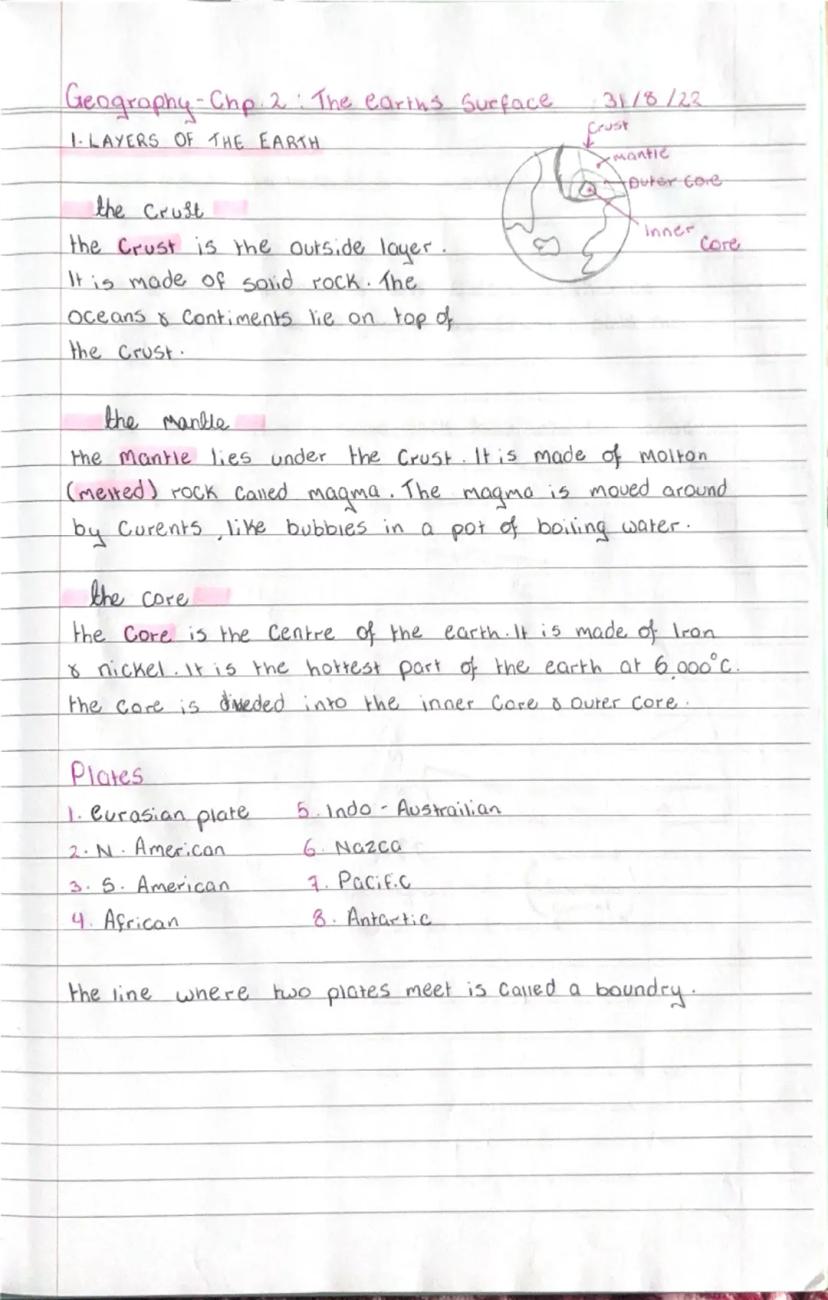
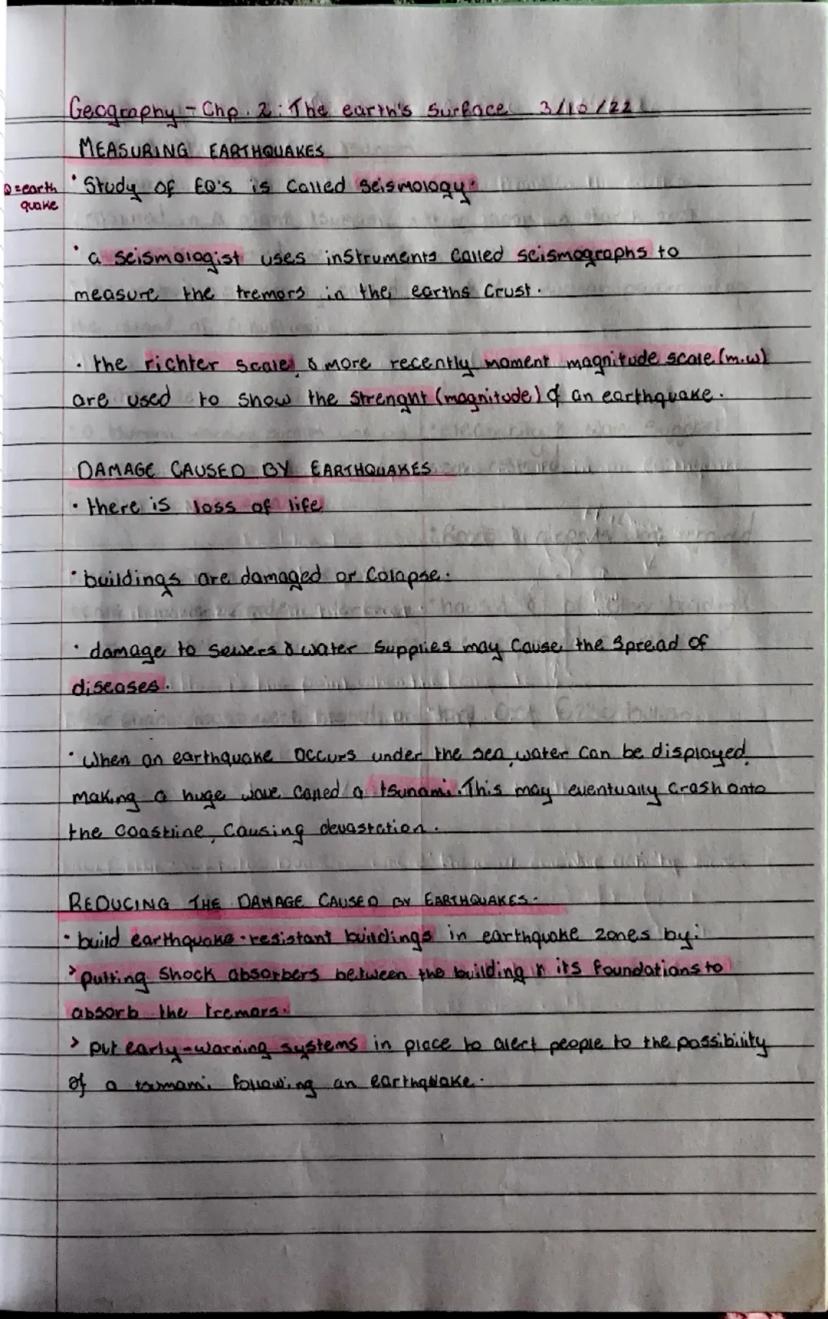
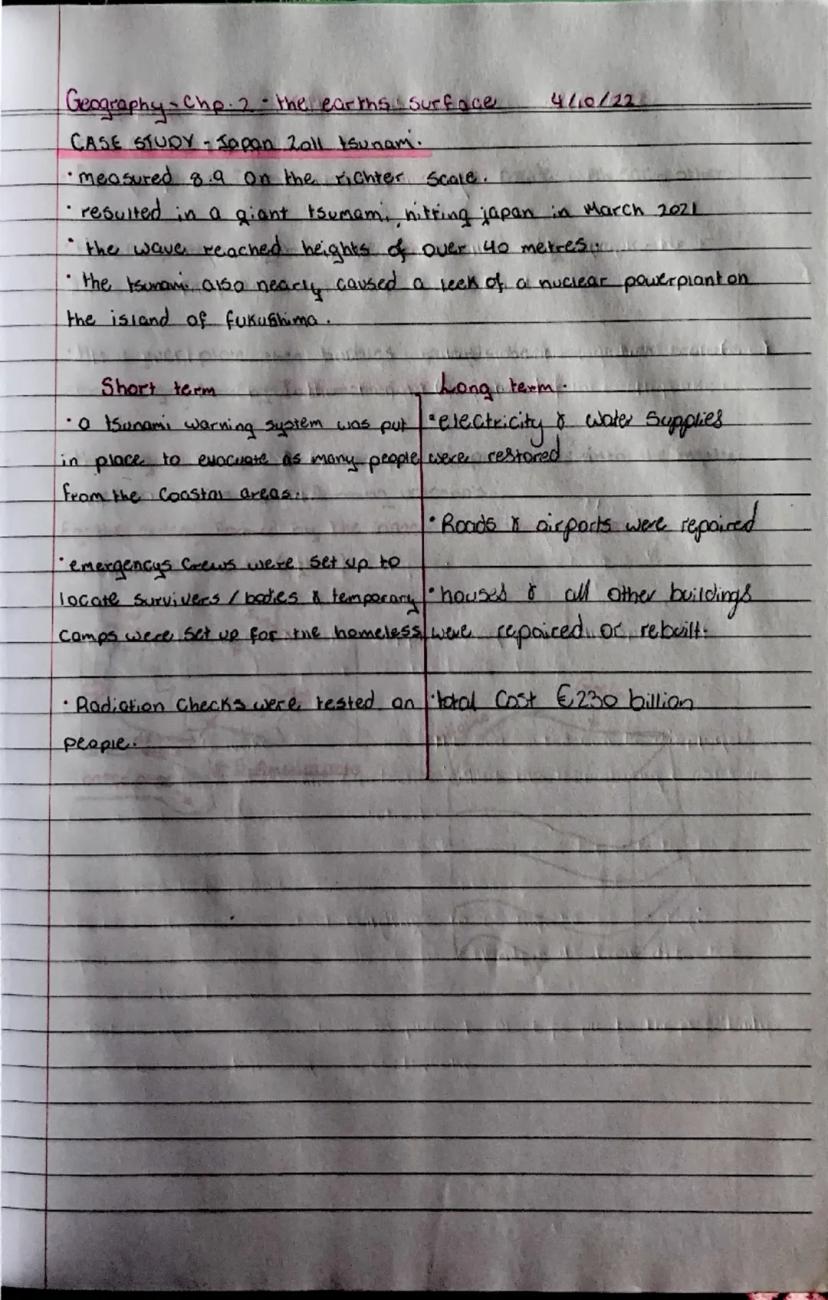
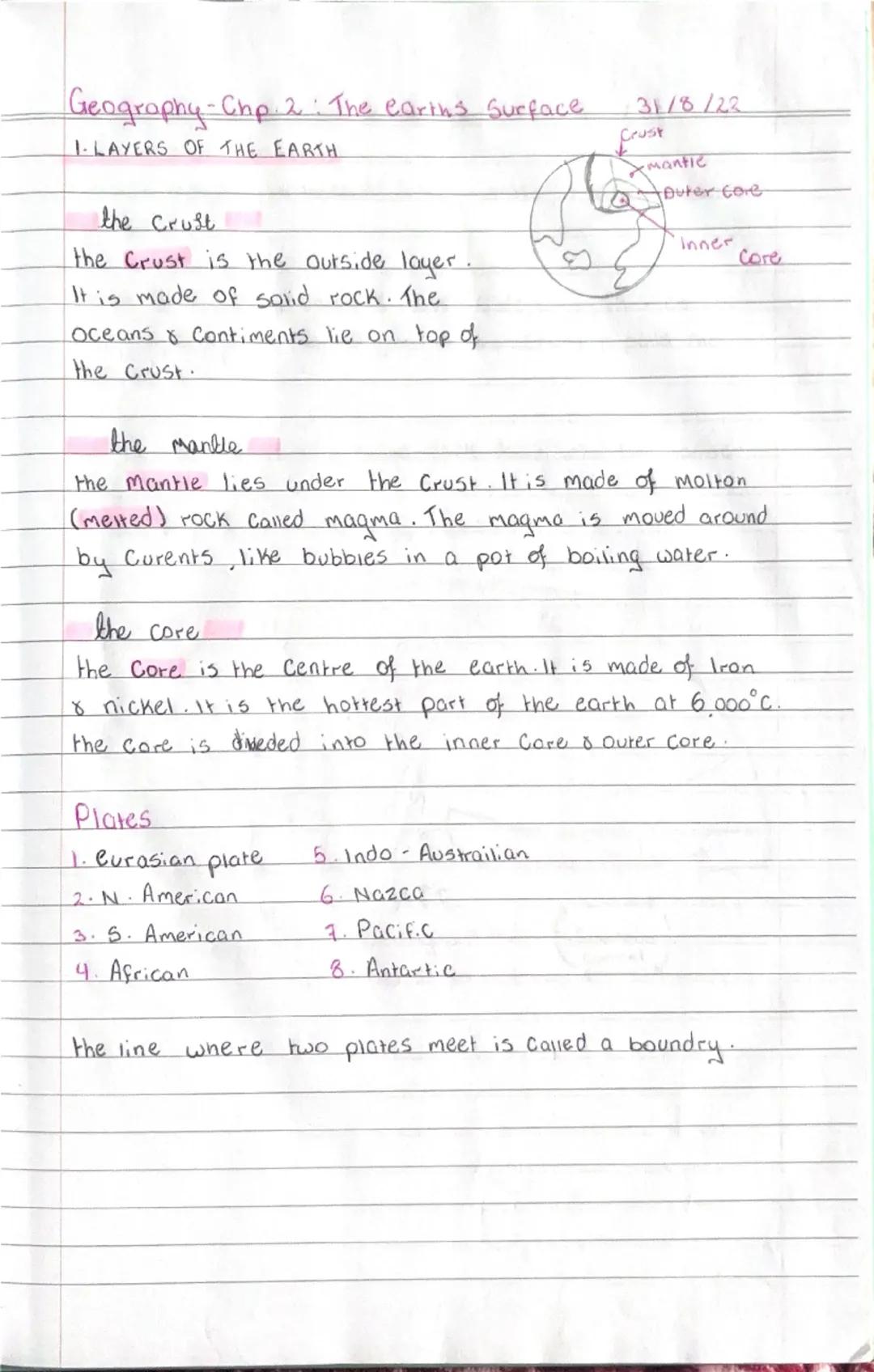
Think of the Earth like a giant layered cake, except this one's made of rock and molten metal! The crust is the thin outer layer we live on - it's solid rock that holds all our oceans and continents.
Beneath that lies the mantle, which is basically a massive ocean of magma (melted rock). This magma moves around in currents, just like bubbles in a pot of boiling water. It's this movement that causes all the action on Earth's surface.
At the very centre sits the core, made of iron and nickel. This is the hottest part of our planet at a scorching 6,000°C! The crust is actually broken up into eight huge pieces called plates that float on top of the mantle like puzzle pieces.
Remember: Where two plates meet is called a boundary - this is where most of the exciting geological action happens!
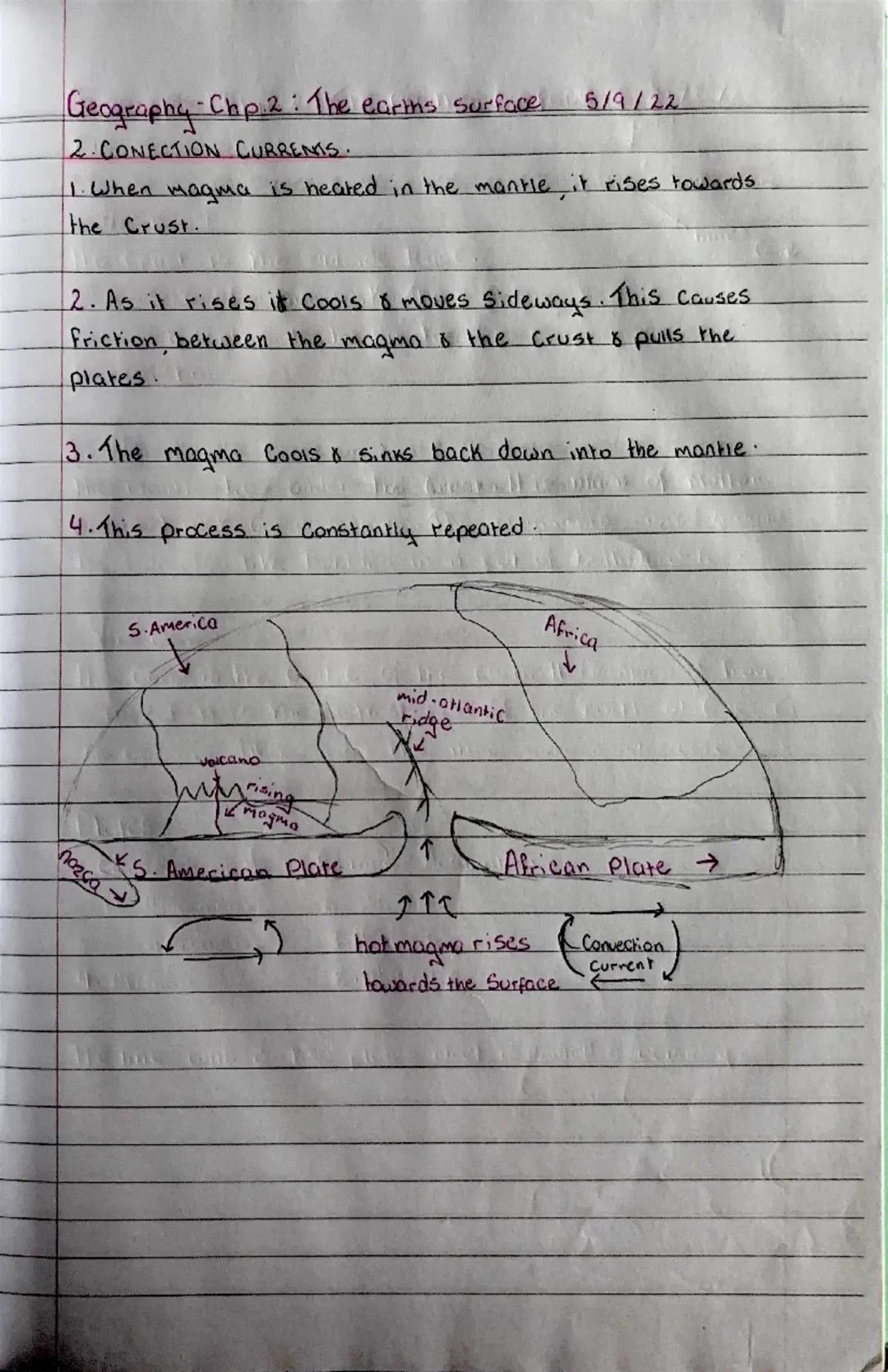
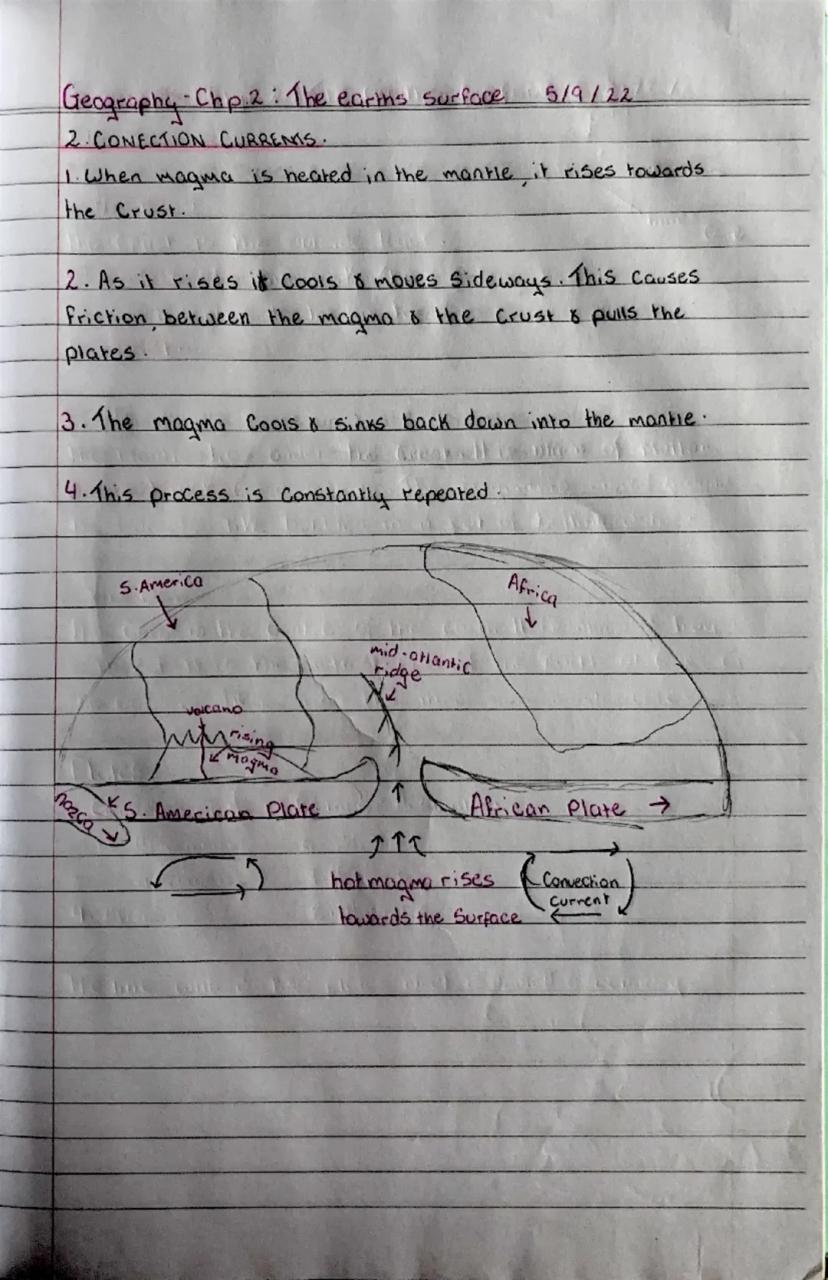
Here's where things get really interesting - the Earth is like a giant heating system! Convection currents in the mantle are what make the plates move around.
The process is actually quite simple. Hot magma rises towards the crust, then cools down and moves sideways. This creates friction that literally pulls the crustal plates along for the ride!
Once the magma cools, it sinks back down into the mantle, and the whole process starts again. This is happening constantly beneath your feet right now - pretty mental when you think about it!
Fun fact: This process is so powerful it can move entire continents over millions of years!
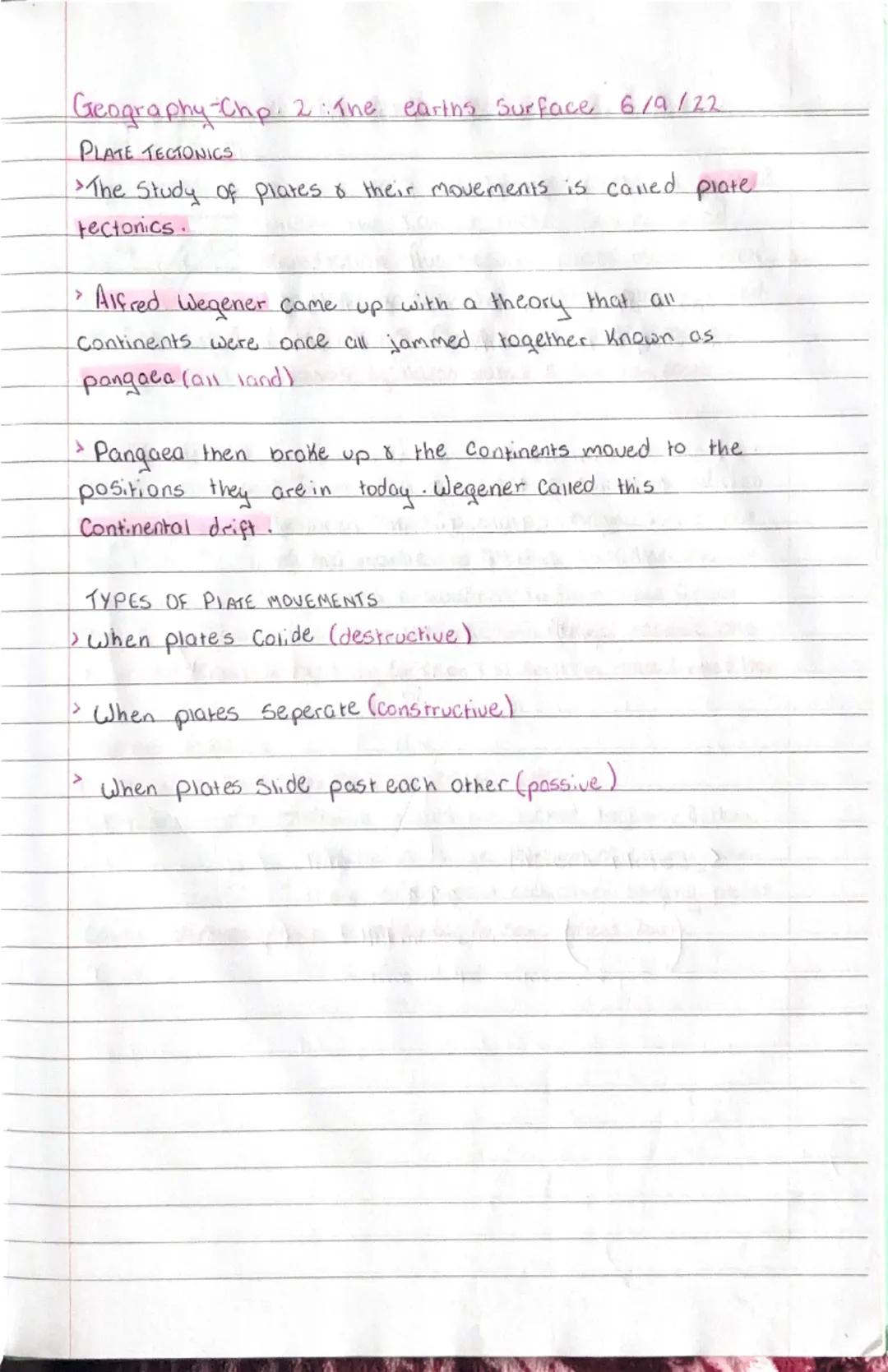
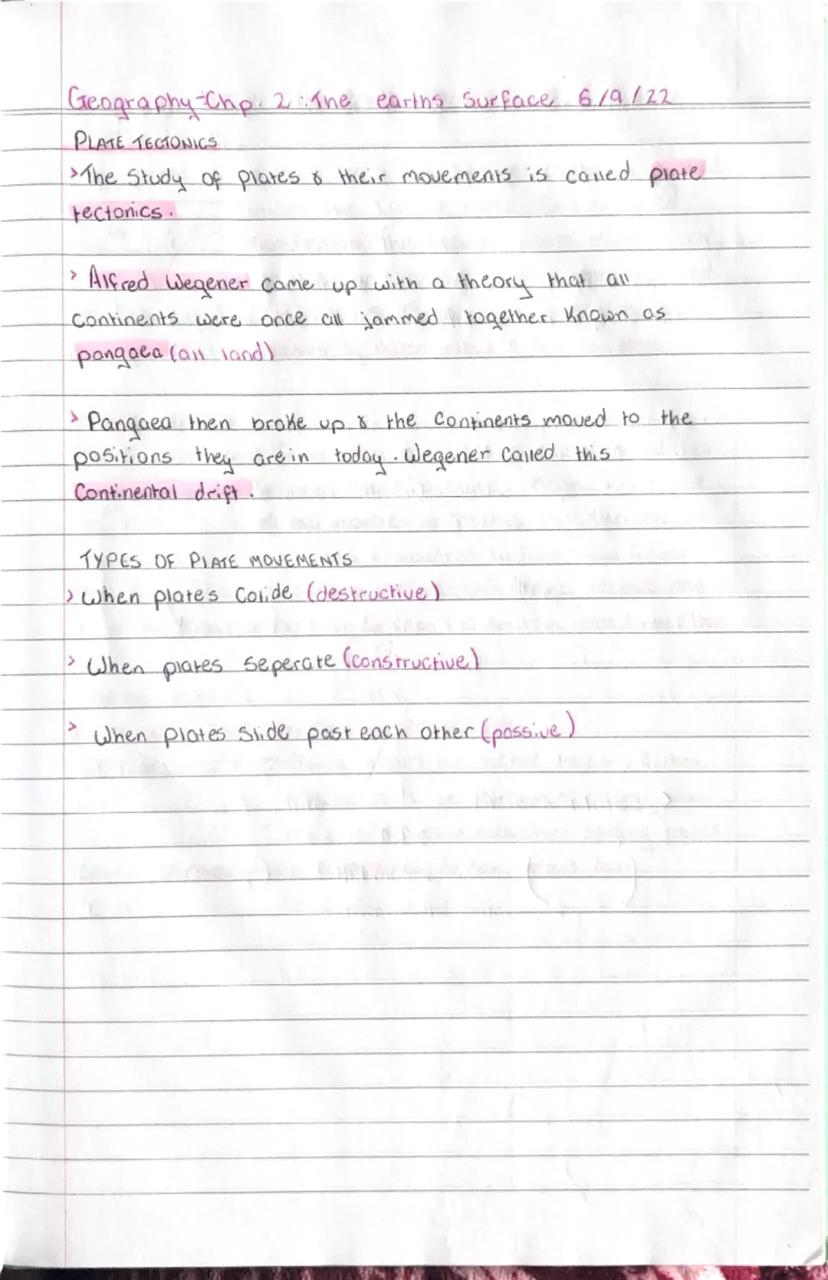
Plate tectonics is the fancy name for studying how plates move. A scientist called Alfred Wegener figured out that all continents were once stuck together in one massive supercontinent called Pangaea (meaning "all land").
Over millions of years, Pangaea broke apart and the continents drifted to where they are today. Wegener called this process continental drift - basically, continents on the move!
There are three main ways plates can move. They can collide with each other (destructive), separate from each other (constructive), or slide past each other (passive). Each type creates different geological features and events.
Test tip: Remember the three types - collide, separate, slide. Each one has different effects!
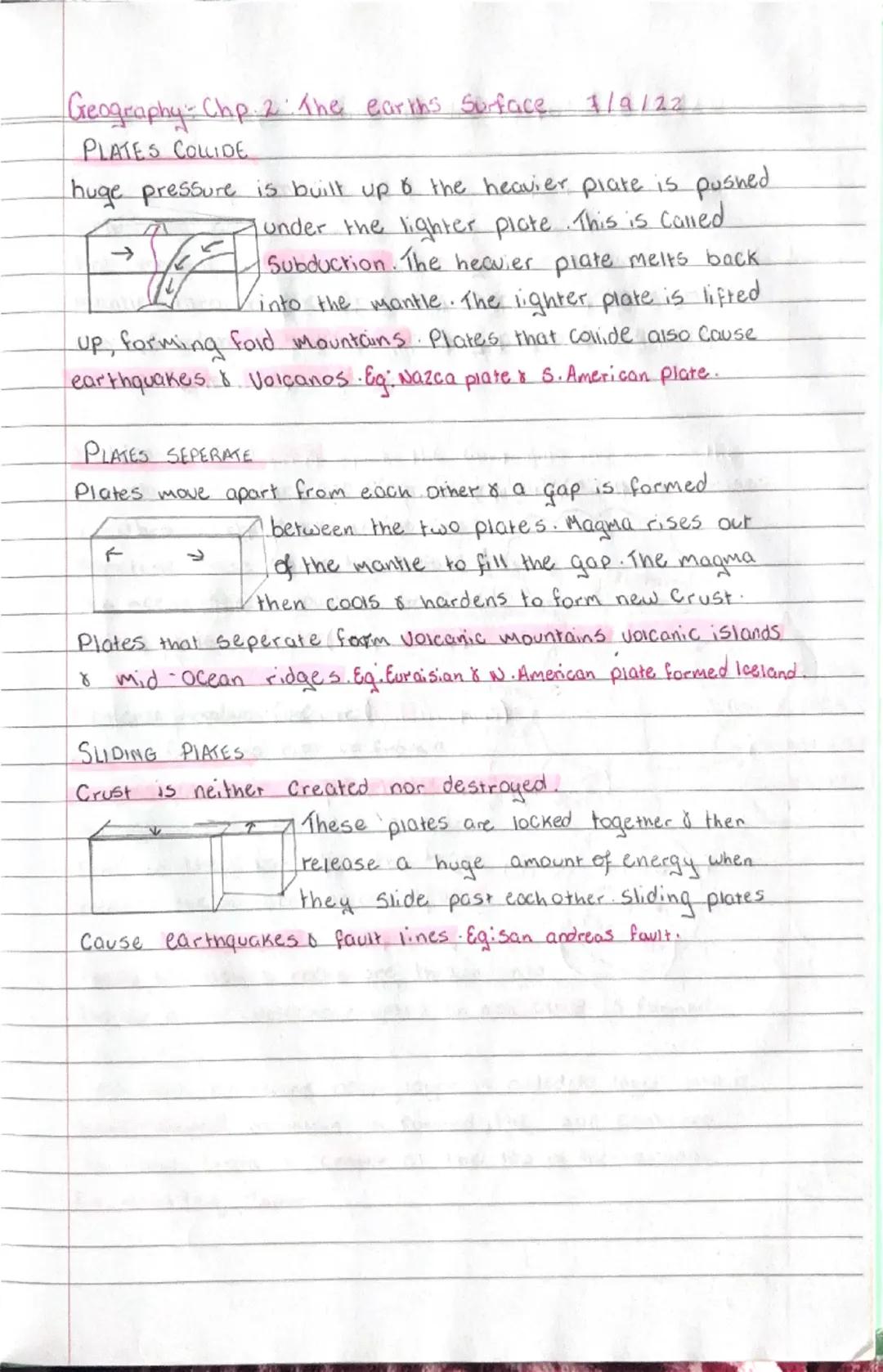
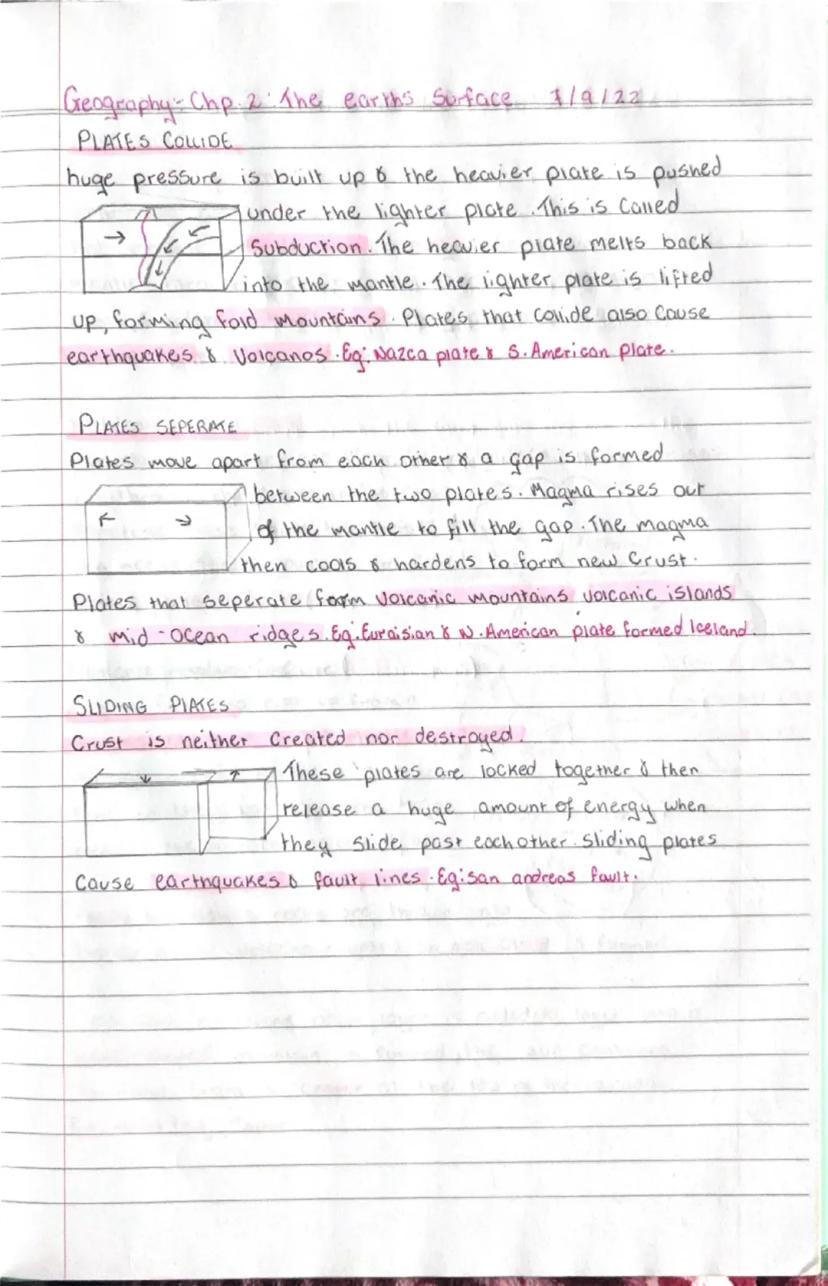
When plates collide, it's like a slow-motion car crash that lasts millions of years! The heavier plate gets pushed under the lighter one in a process called subduction. The lighter plate gets lifted up to form fold mountains, whilst the heavier one melts back into the mantle.
When plates separate, they create gaps that get filled with rising magma. This magma cools and hardens to form new crust, creating volcanic mountains, volcanic islands, and mid-ocean ridges. Iceland was formed this way!
Sliding plates are probably the most dramatic in the short term. They get locked together, then suddenly release huge amounts of energy, causing earthquakes and creating fault lines like the famous San Andreas Fault.
Real-world example: The Nazca and South American plates colliding created the Andes Mountains!
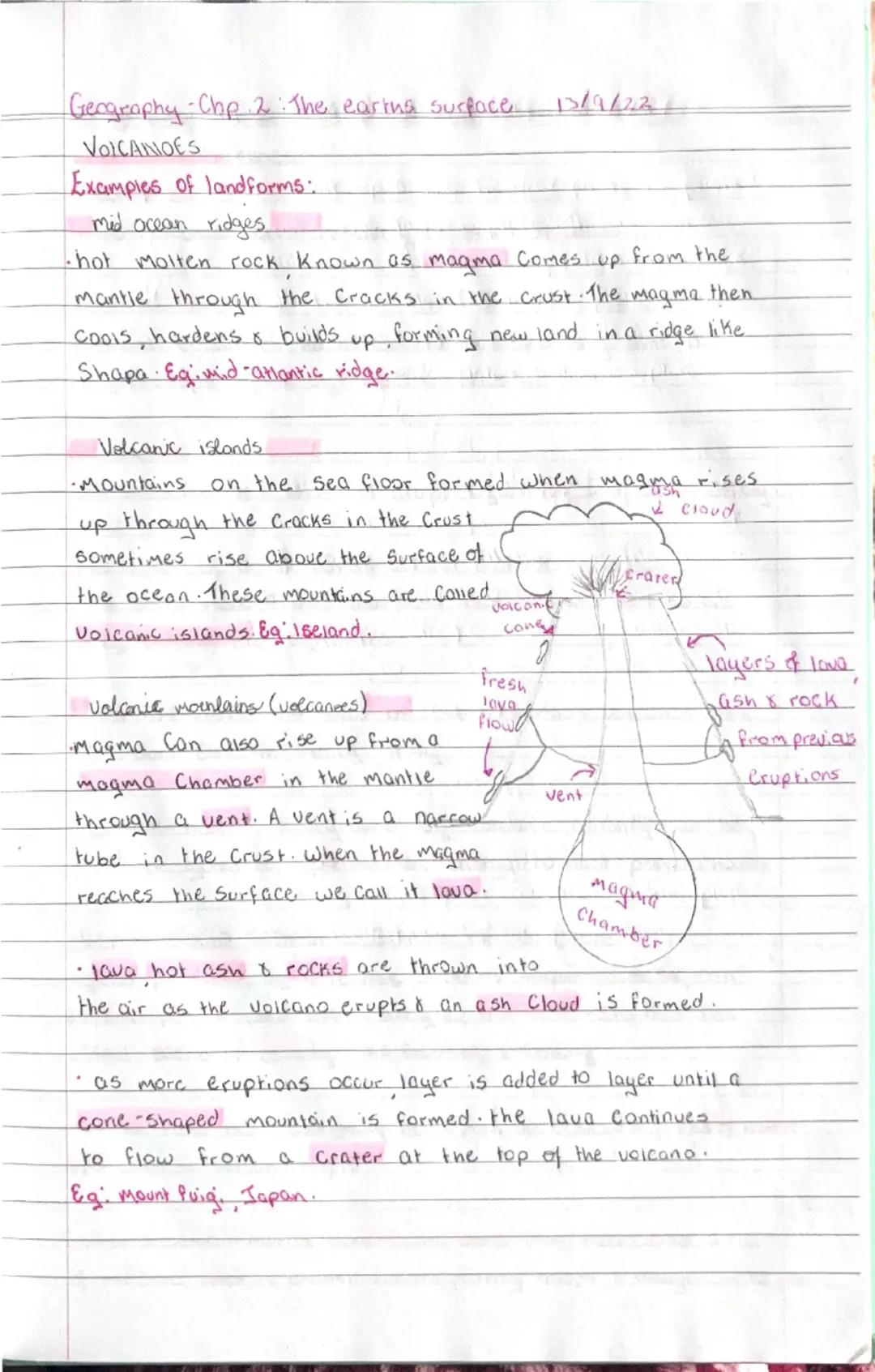
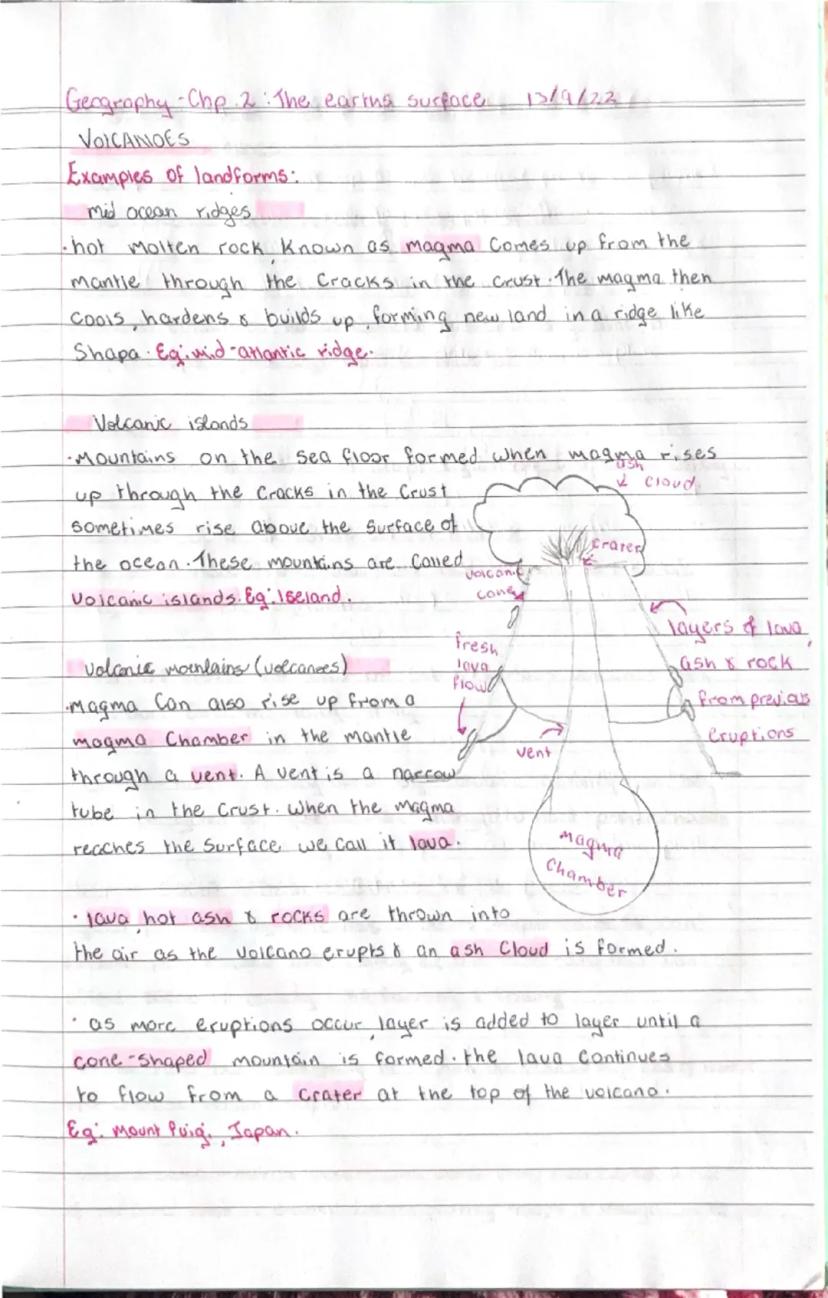
Volcanoes are basically the Earth's way of letting off steam! Mid-ocean ridges form when magma rises through cracks in the crust underwater, cooling and building up into ridge-like shapes - the Mid-Atlantic Ridge is a perfect example.
Volcanic islands are mountains on the sea floor that sometimes poke above the ocean surface. Iceland is one of these! Volcanic mountains form when magma rises from a magma chamber through a narrow tube called a vent.
When magma reaches the surface, we call it lava. During eruptions, lava, hot ash, and rocks get thrown into the air, creating an ash cloud. Over time, layers build up to form a cone-shaped mountain with a crater at the top.
Key point: It's only called lava once it reaches the surface - before that, it's magma!
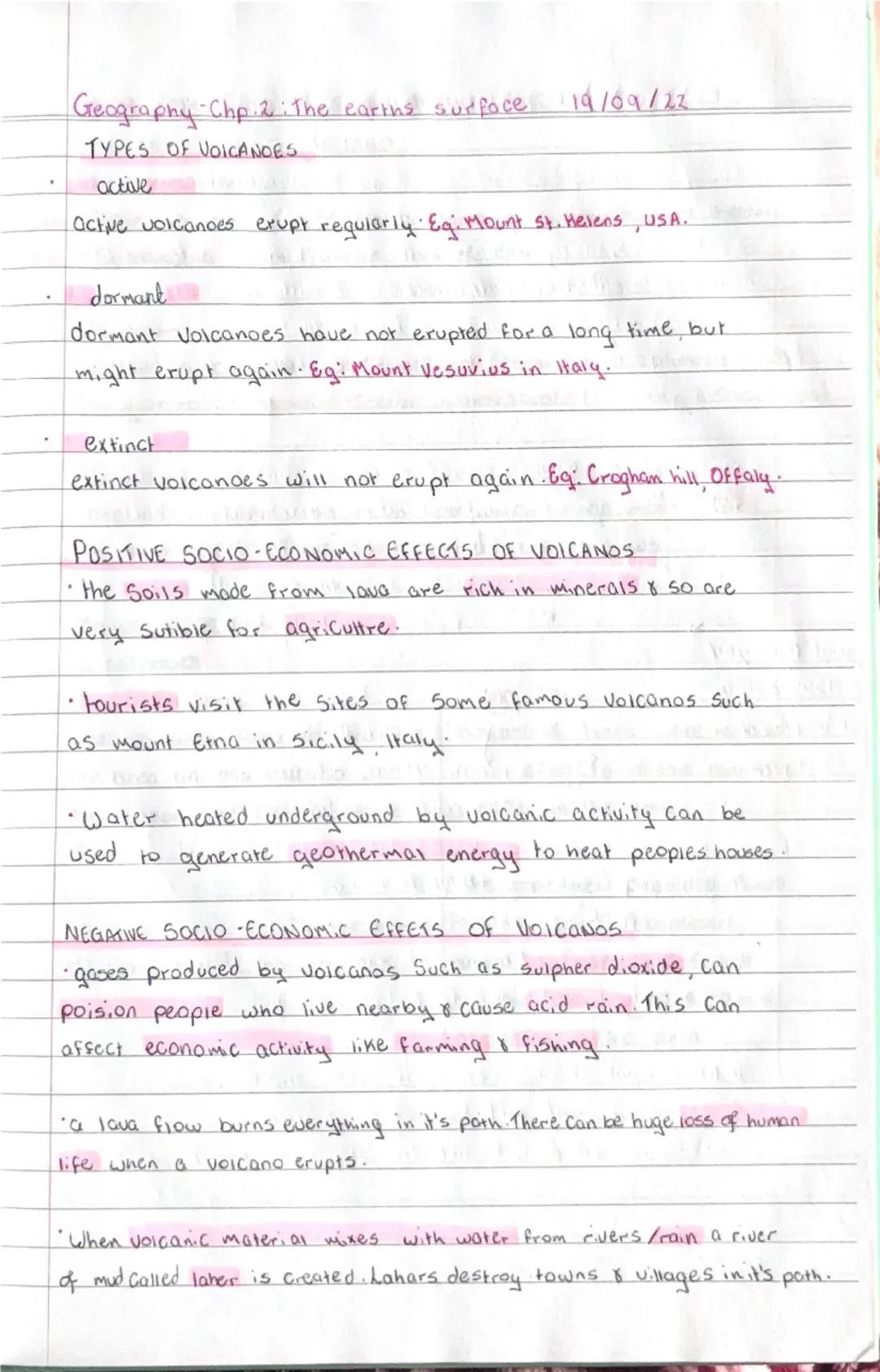
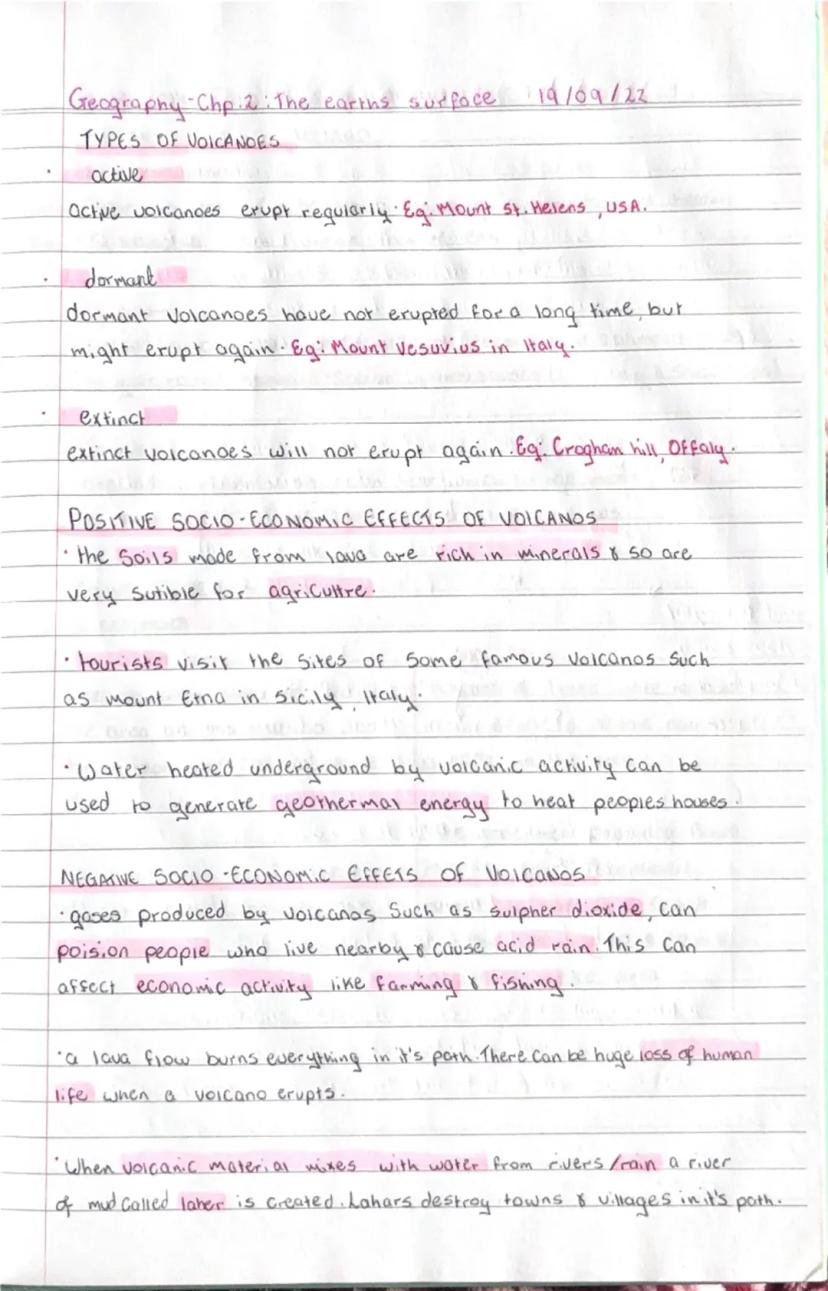
Volcanoes come in three types: active (erupt regularly), dormant (haven't erupted recently but might again), and extinct (will never erupt again). Mount St. Helens is active, whilst Croghan Hill in Offaly is extinct.
Volcanoes aren't all bad news! They create incredibly fertile soil perfect for farming, attract millions of tourists, and provide geothermal energy for heating homes. Countries like Iceland make brilliant use of these benefits.
However, the downsides can be devastating. Volcanic gases can poison people and cause acid rain, lava flows destroy everything in their path, and lahars (mudflows created when volcanic material mixes with water) can wipe out entire towns.
Balance: While volcanoes can be dangerous, many communities have learned to live with and benefit from them!
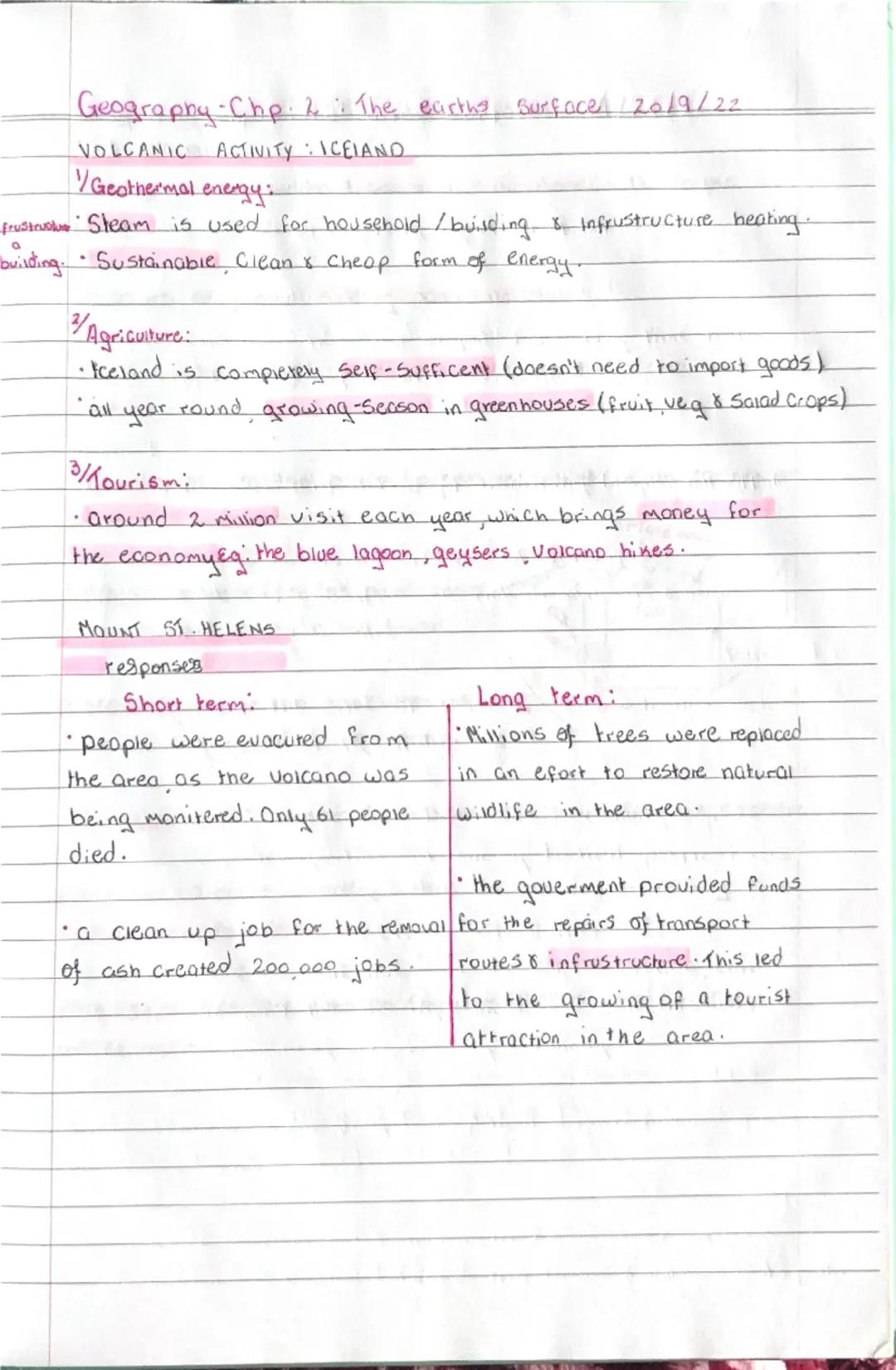
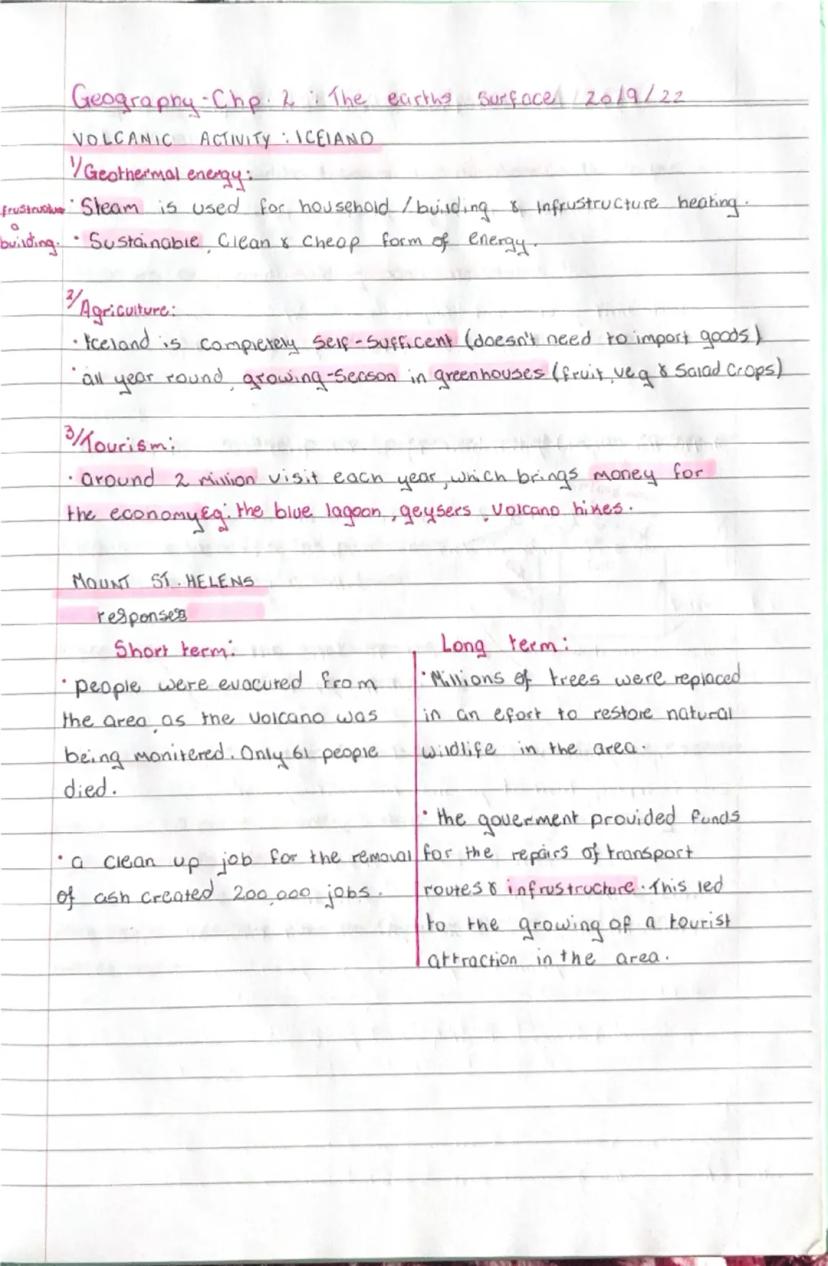
Iceland is a fantastic example of living with volcanoes successfully. They use geothermal energy to heat buildings cheaply and sustainably, grow food year-round in heated greenhouses, and attract 2 million tourists annually to see geysers and volcanic landscapes.
Mount St. Helens in the USA shows how proper preparation saves lives. When it erupted, people were evacuated based on monitoring data, so only 61 people died. The government funded massive clean-up operations that created 200,000 jobs!
Long-term responses included replanting millions of trees and repairing transport routes. The area has now become a major tourist attraction, showing how communities can recover and even benefit from volcanic activity.
Success story: Good monitoring and planning can turn a potential disaster into an opportunity!
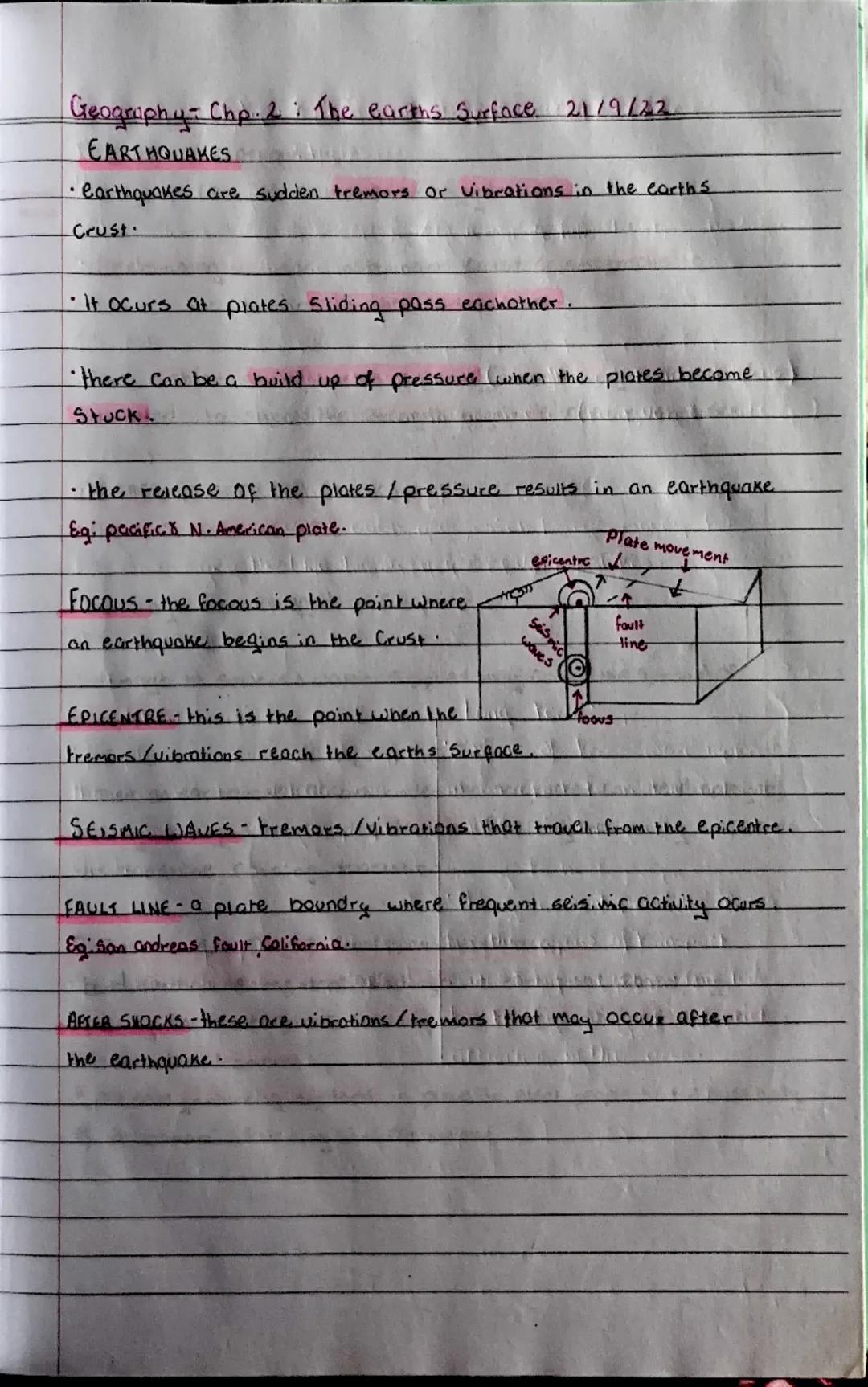
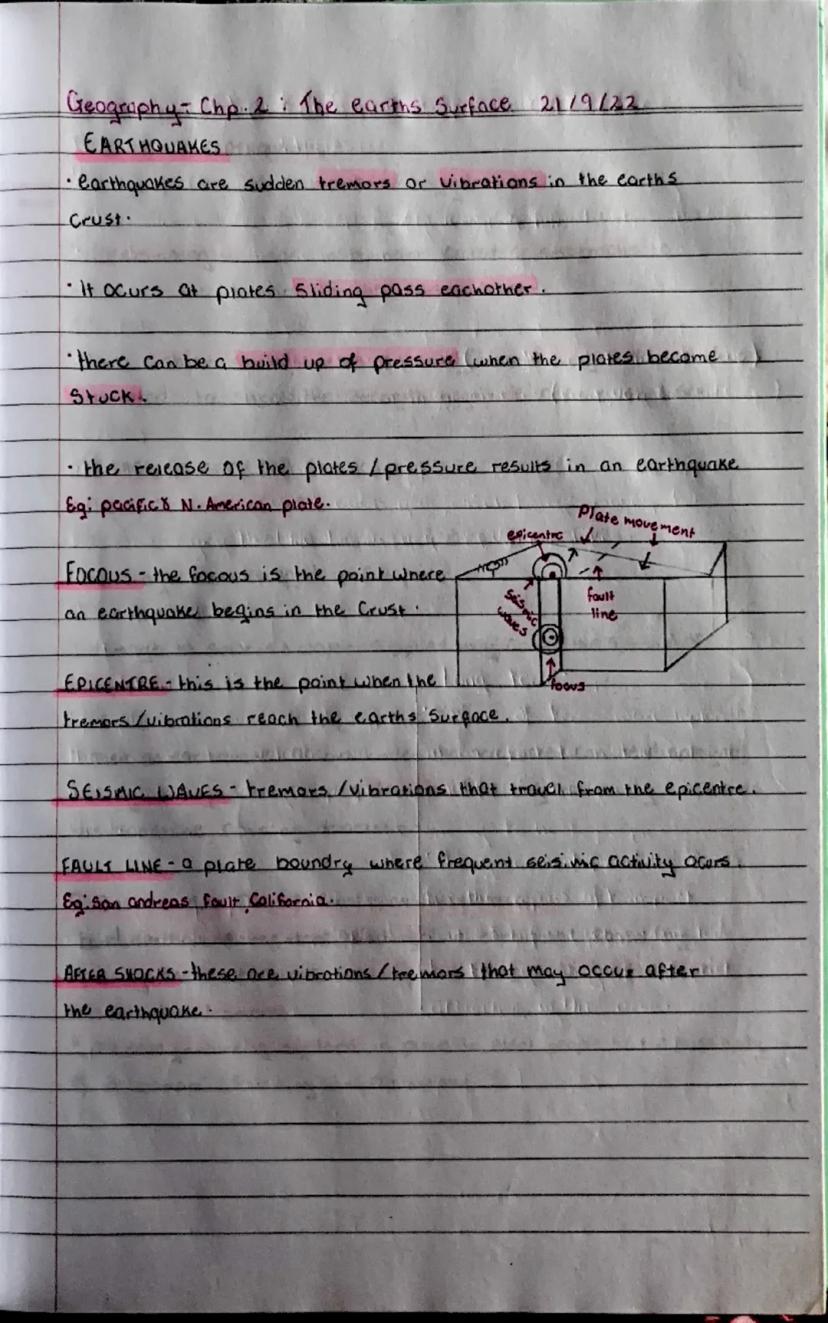
Earthquakes are sudden vibrations in the Earth's crust that happen when sliding plates get stuck, build up pressure, then suddenly release it. Think of it like snapping a rubber band after stretching it too far!
The focus is where the earthquake starts underground, whilst the epicentre is where the vibrations first reach the surface. Seismic waves spread out from the epicentre, and aftershocks can continue for days or weeks afterwards.
Fault lines are plate boundaries where earthquakes happen frequently - the San Andreas Fault in California is probably the most famous. These areas experience regular seismic activity as the plates constantly try to move past each other.
Remember: The focus is underground, the epicentre is on the surface directly above it!
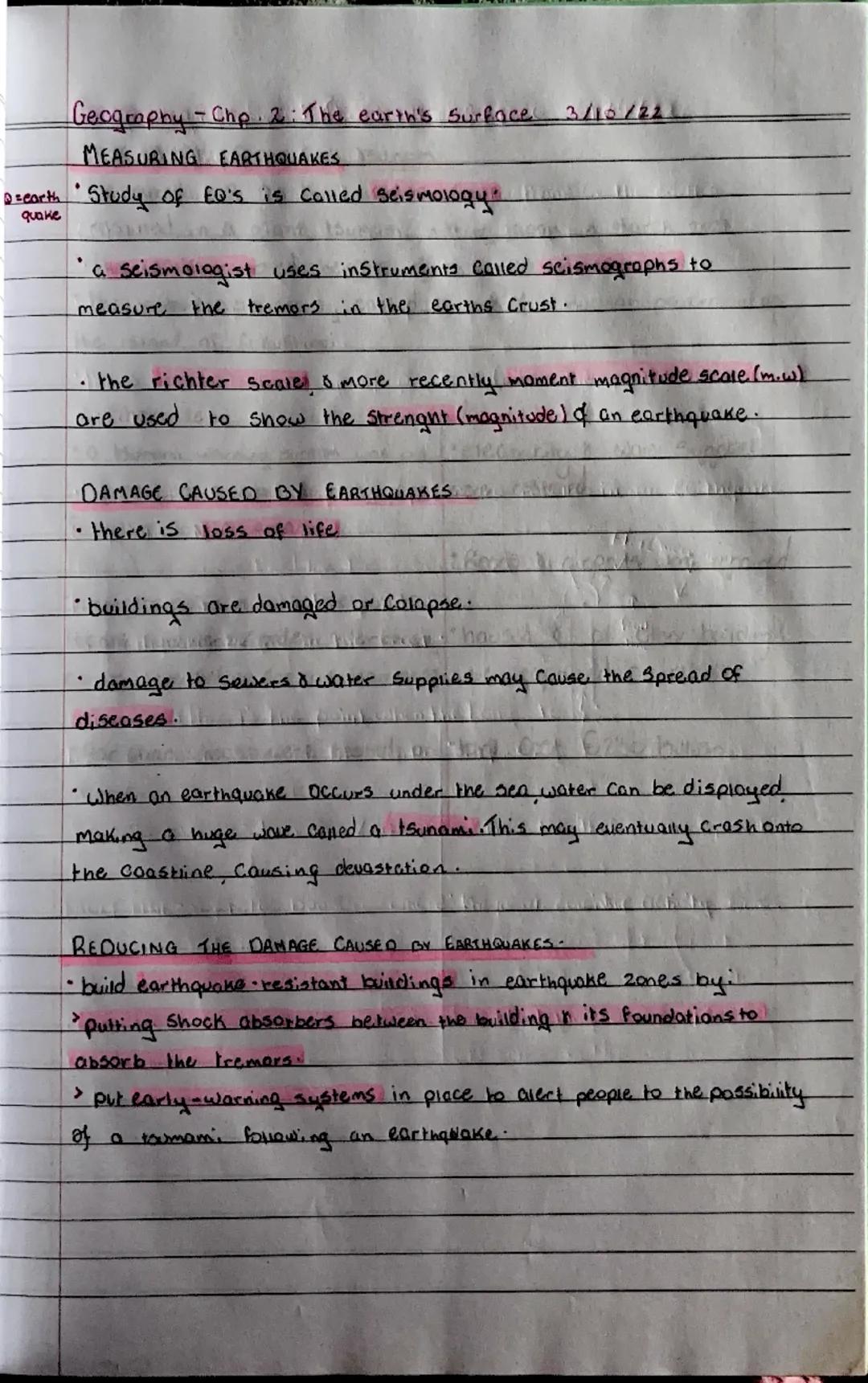
Seismologists study earthquakes using instruments called seismographs that detect ground movements. They measure earthquake strength using the Richter scale or the newer moment magnitude scale.
Earthquakes cause massive damage: buildings collapse, people die, water supplies get contaminated leading to disease outbreaks, and underwater earthquakes can create tsunamis - giant waves that devastate coastlines.
Smart engineering can reduce damage though! Earthquake-resistant buildings use shock absorbers in their foundations to absorb tremors. Early warning systems can alert coastal areas about incoming tsunamis, giving people time to evacuate to higher ground.
Engineering solution: Modern buildings in earthquake zones are designed to sway rather than break!
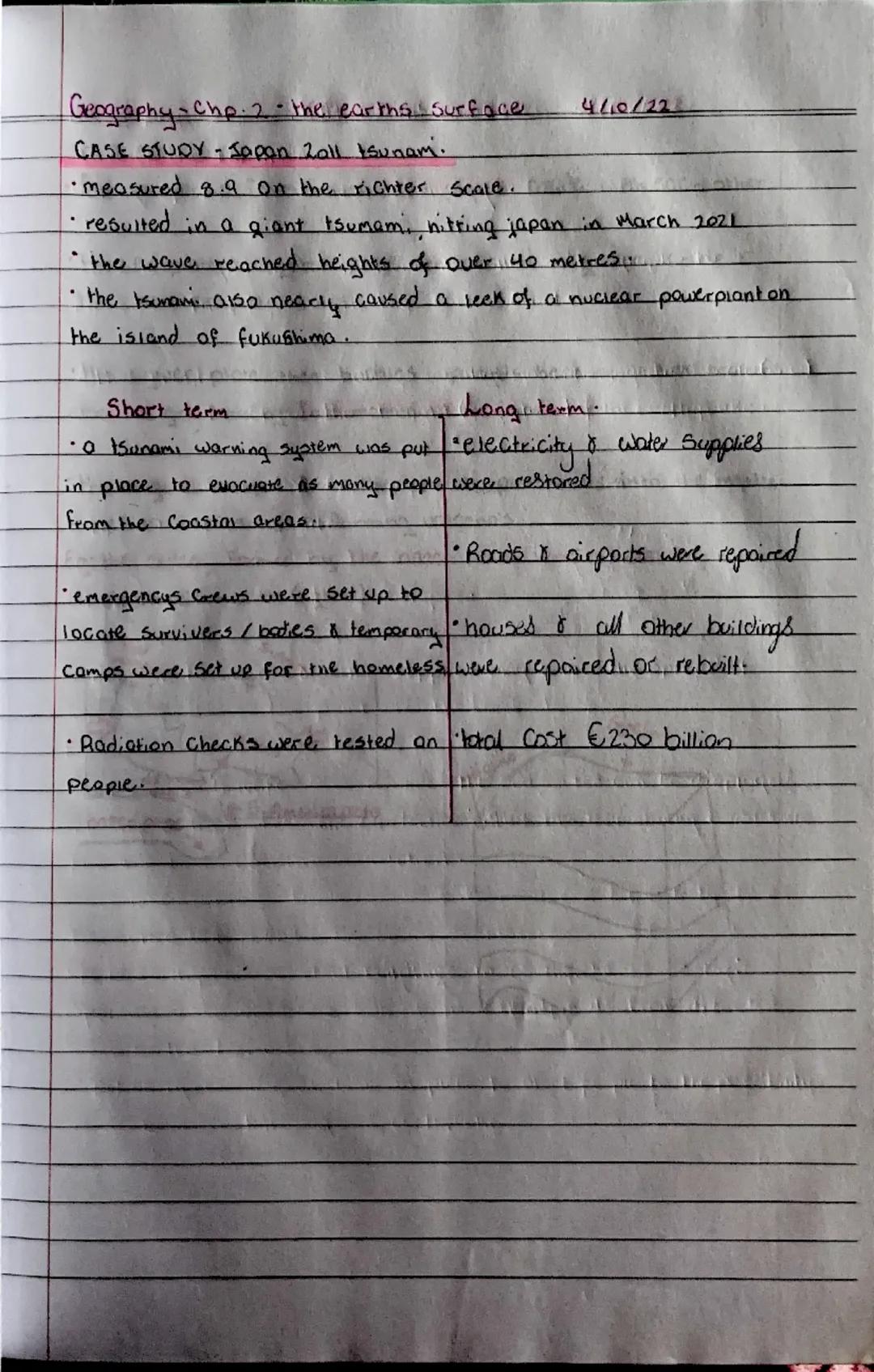
The 2011 Japanese earthquake measured 8.9 on the Richter scale and created a devastating tsunami with waves over 40 metres high. It nearly caused a nuclear disaster at the Fukushima power plant, showing how natural disasters can trigger other emergencies.
Short-term responses included tsunami warning systems to evacuate coastal areas, emergency crews searching for survivors, temporary camps for homeless people, and radiation checks to ensure public safety.
Long-term responses took years and cost €230 billion! This included restoring electricity and water supplies, repairing roads and airports, and rebuilding thousands of houses and other buildings. Japan's recovery shows how preparation and investment can help communities bounce back.
Scale: The total cost was €230 billion - that's more than Ireland's entire annual budget!
Our AI companion is specifically built for the needs of students. Based on the millions of content pieces we have on the platform we can provide truly meaningful and relevant answers to students. But its not only about answers, the companion is even more about guiding students through their daily learning challenges, with personalised study plans, quizzes or content pieces in the chat and 100% personalisation based on the students skills and developments.
You can download the app in the Google Play Store and in the Apple App Store.
That's right! Enjoy free access to study content, connect with fellow students, and get instant help – all at your fingertips.
App Store
Google Play
The app is very easy to use and well designed. I have found everything I was looking for so far and have been able to learn a lot from the presentations! I will definitely use the app for a class assignment! And of course it also helps a lot as an inspiration.
Stefan S
iOS user
This app is really great. There are so many study notes and help [...]. My problem subject is French, for example, and the app has so many options for help. Thanks to this app, I have improved my French. I would recommend it to anyone.
Samantha Klich
Android user
Wow, I am really amazed. I just tried the app because I've seen it advertised many times and was absolutely stunned. This app is THE HELP you want for school and above all, it offers so many things, such as workouts and fact sheets, which have been VERY helpful to me personally.
Anna
iOS user
I think it’s very much worth it and you’ll end up using it a lot once you get the hang of it and even after looking at others notes you can still ask your Artificial intelligence buddy the question and ask to simplify it if you still don’t get it!!! In the end I think it’s worth it 😊👍 ⚠️Also DID I MENTION ITS FREEE YOU DON’T HAVE TO PAY FOR ANYTHING AND STILL GET YOUR GRADES IN PERFECTLY❗️❗️⚠️
Thomas R
iOS user
Knowunity is the BEST app I’ve used in a minute. This is not an ai review or anything this is genuinely coming from a 7th grade student (I know 2011 im young) but dude this app is a 10/10 i have maintained a 3.8 gpa and have plenty of time for gaming. I love it and my mom is just happy I got good grades
Brad T
Android user
Not only did it help me find the answer but it also showed me alternative ways to solve it. I was horrible in math and science but now I have an a in both subjects. Thanks for the help🤍🤍
David K
iOS user
The app's just great! All I have to do is enter the topic in the search bar and I get the response real fast. I don't have to watch 10 YouTube videos to understand something, so I'm saving my time. Highly recommended!
Sudenaz Ocak
Android user
In school I was really bad at maths but thanks to the app, I am doing better now. I am so grateful that you made the app.
Greenlight Bonnie
Android user
I found this app a couple years ago and it has only gotten better since then. I really love it because it can help with written questions and photo questions. Also, it can find study guides that other people have made as well as flashcard sets and practice tests. The free version is also amazing for students who might not be able to afford it. Would 100% recommend
Aubrey
iOS user
Best app if you're in Highschool or Junior high. I have been using this app for 2 school years and it's the best, it's good if you don't have anyone to help you with school work.😋🩷🎀
Marco B
iOS user
THE QUIZES AND FLASHCARDS ARE SO USEFUL AND I LOVE Knowunity AI. IT ALSO IS LITREALLY LIKE CHATGPT BUT SMARTER!! HELPED ME WITH MY MASCARA PROBLEMS TOO!! AS WELL AS MY REAL SUBJECTS ! DUHHH 😍😁😲🤑💗✨🎀😮
Elisha
iOS user
This app is phenomenal down to the correct info and the various topics you can study! I greatly recommend it for people who struggle with procrastination and those who need homework help. It has been perfectly accurate for world 1 history as far as I’ve seen! Geometry too!
Paul T
iOS user
The app is very easy to use and well designed. I have found everything I was looking for so far and have been able to learn a lot from the presentations! I will definitely use the app for a class assignment! And of course it also helps a lot as an inspiration.
Stefan S
iOS user
This app is really great. There are so many study notes and help [...]. My problem subject is French, for example, and the app has so many options for help. Thanks to this app, I have improved my French. I would recommend it to anyone.
Samantha Klich
Android user
Wow, I am really amazed. I just tried the app because I've seen it advertised many times and was absolutely stunned. This app is THE HELP you want for school and above all, it offers so many things, such as workouts and fact sheets, which have been VERY helpful to me personally.
Anna
iOS user
I think it’s very much worth it and you’ll end up using it a lot once you get the hang of it and even after looking at others notes you can still ask your Artificial intelligence buddy the question and ask to simplify it if you still don’t get it!!! In the end I think it’s worth it 😊👍 ⚠️Also DID I MENTION ITS FREEE YOU DON’T HAVE TO PAY FOR ANYTHING AND STILL GET YOUR GRADES IN PERFECTLY❗️❗️⚠️
Thomas R
iOS user
Knowunity is the BEST app I’ve used in a minute. This is not an ai review or anything this is genuinely coming from a 7th grade student (I know 2011 im young) but dude this app is a 10/10 i have maintained a 3.8 gpa and have plenty of time for gaming. I love it and my mom is just happy I got good grades
Brad T
Android user
Not only did it help me find the answer but it also showed me alternative ways to solve it. I was horrible in math and science but now I have an a in both subjects. Thanks for the help🤍🤍
David K
iOS user
The app's just great! All I have to do is enter the topic in the search bar and I get the response real fast. I don't have to watch 10 YouTube videos to understand something, so I'm saving my time. Highly recommended!
Sudenaz Ocak
Android user
In school I was really bad at maths but thanks to the app, I am doing better now. I am so grateful that you made the app.
Greenlight Bonnie
Android user
I found this app a couple years ago and it has only gotten better since then. I really love it because it can help with written questions and photo questions. Also, it can find study guides that other people have made as well as flashcard sets and practice tests. The free version is also amazing for students who might not be able to afford it. Would 100% recommend
Aubrey
iOS user
Best app if you're in Highschool or Junior high. I have been using this app for 2 school years and it's the best, it's good if you don't have anyone to help you with school work.😋🩷🎀
Marco B
iOS user
THE QUIZES AND FLASHCARDS ARE SO USEFUL AND I LOVE Knowunity AI. IT ALSO IS LITREALLY LIKE CHATGPT BUT SMARTER!! HELPED ME WITH MY MASCARA PROBLEMS TOO!! AS WELL AS MY REAL SUBJECTS ! DUHHH 😍😁😲🤑💗✨🎀😮
Elisha
iOS user
This app is phenomenal down to the correct info and the various topics you can study! I greatly recommend it for people who struggle with procrastination and those who need homework help. It has been perfectly accurate for world 1 history as far as I’ve seen! Geometry too!
Paul T
iOS user
Kyla McInerney
@kylamcinerney
Ever wondered what's happening beneath your feet? The Earth isn't just a solid ball of rock - it's actually made up of different layers that are constantly moving and creating the world around us. This movement causes some pretty dramatic... Show more
Access to all documents
Improve your grades
Join milions of students
Think of the Earth like a giant layered cake, except this one's made of rock and molten metal! The crust is the thin outer layer we live on - it's solid rock that holds all our oceans and continents.
Beneath that lies the mantle, which is basically a massive ocean of magma (melted rock). This magma moves around in currents, just like bubbles in a pot of boiling water. It's this movement that causes all the action on Earth's surface.
At the very centre sits the core, made of iron and nickel. This is the hottest part of our planet at a scorching 6,000°C! The crust is actually broken up into eight huge pieces called plates that float on top of the mantle like puzzle pieces.
Remember: Where two plates meet is called a boundary - this is where most of the exciting geological action happens!
Access to all documents
Improve your grades
Join milions of students
Here's where things get really interesting - the Earth is like a giant heating system! Convection currents in the mantle are what make the plates move around.
The process is actually quite simple. Hot magma rises towards the crust, then cools down and moves sideways. This creates friction that literally pulls the crustal plates along for the ride!
Once the magma cools, it sinks back down into the mantle, and the whole process starts again. This is happening constantly beneath your feet right now - pretty mental when you think about it!
Fun fact: This process is so powerful it can move entire continents over millions of years!
Access to all documents
Improve your grades
Join milions of students
Plate tectonics is the fancy name for studying how plates move. A scientist called Alfred Wegener figured out that all continents were once stuck together in one massive supercontinent called Pangaea (meaning "all land").
Over millions of years, Pangaea broke apart and the continents drifted to where they are today. Wegener called this process continental drift - basically, continents on the move!
There are three main ways plates can move. They can collide with each other (destructive), separate from each other (constructive), or slide past each other (passive). Each type creates different geological features and events.
Test tip: Remember the three types - collide, separate, slide. Each one has different effects!
Access to all documents
Improve your grades
Join milions of students
When plates collide, it's like a slow-motion car crash that lasts millions of years! The heavier plate gets pushed under the lighter one in a process called subduction. The lighter plate gets lifted up to form fold mountains, whilst the heavier one melts back into the mantle.
When plates separate, they create gaps that get filled with rising magma. This magma cools and hardens to form new crust, creating volcanic mountains, volcanic islands, and mid-ocean ridges. Iceland was formed this way!
Sliding plates are probably the most dramatic in the short term. They get locked together, then suddenly release huge amounts of energy, causing earthquakes and creating fault lines like the famous San Andreas Fault.
Real-world example: The Nazca and South American plates colliding created the Andes Mountains!
Access to all documents
Improve your grades
Join milions of students
Volcanoes are basically the Earth's way of letting off steam! Mid-ocean ridges form when magma rises through cracks in the crust underwater, cooling and building up into ridge-like shapes - the Mid-Atlantic Ridge is a perfect example.
Volcanic islands are mountains on the sea floor that sometimes poke above the ocean surface. Iceland is one of these! Volcanic mountains form when magma rises from a magma chamber through a narrow tube called a vent.
When magma reaches the surface, we call it lava. During eruptions, lava, hot ash, and rocks get thrown into the air, creating an ash cloud. Over time, layers build up to form a cone-shaped mountain with a crater at the top.
Key point: It's only called lava once it reaches the surface - before that, it's magma!
Access to all documents
Improve your grades
Join milions of students
Volcanoes come in three types: active (erupt regularly), dormant (haven't erupted recently but might again), and extinct (will never erupt again). Mount St. Helens is active, whilst Croghan Hill in Offaly is extinct.
Volcanoes aren't all bad news! They create incredibly fertile soil perfect for farming, attract millions of tourists, and provide geothermal energy for heating homes. Countries like Iceland make brilliant use of these benefits.
However, the downsides can be devastating. Volcanic gases can poison people and cause acid rain, lava flows destroy everything in their path, and lahars (mudflows created when volcanic material mixes with water) can wipe out entire towns.
Balance: While volcanoes can be dangerous, many communities have learned to live with and benefit from them!
Access to all documents
Improve your grades
Join milions of students
Iceland is a fantastic example of living with volcanoes successfully. They use geothermal energy to heat buildings cheaply and sustainably, grow food year-round in heated greenhouses, and attract 2 million tourists annually to see geysers and volcanic landscapes.
Mount St. Helens in the USA shows how proper preparation saves lives. When it erupted, people were evacuated based on monitoring data, so only 61 people died. The government funded massive clean-up operations that created 200,000 jobs!
Long-term responses included replanting millions of trees and repairing transport routes. The area has now become a major tourist attraction, showing how communities can recover and even benefit from volcanic activity.
Success story: Good monitoring and planning can turn a potential disaster into an opportunity!
Access to all documents
Improve your grades
Join milions of students
Earthquakes are sudden vibrations in the Earth's crust that happen when sliding plates get stuck, build up pressure, then suddenly release it. Think of it like snapping a rubber band after stretching it too far!
The focus is where the earthquake starts underground, whilst the epicentre is where the vibrations first reach the surface. Seismic waves spread out from the epicentre, and aftershocks can continue for days or weeks afterwards.
Fault lines are plate boundaries where earthquakes happen frequently - the San Andreas Fault in California is probably the most famous. These areas experience regular seismic activity as the plates constantly try to move past each other.
Remember: The focus is underground, the epicentre is on the surface directly above it!
Access to all documents
Improve your grades
Join milions of students
Seismologists study earthquakes using instruments called seismographs that detect ground movements. They measure earthquake strength using the Richter scale or the newer moment magnitude scale.
Earthquakes cause massive damage: buildings collapse, people die, water supplies get contaminated leading to disease outbreaks, and underwater earthquakes can create tsunamis - giant waves that devastate coastlines.
Smart engineering can reduce damage though! Earthquake-resistant buildings use shock absorbers in their foundations to absorb tremors. Early warning systems can alert coastal areas about incoming tsunamis, giving people time to evacuate to higher ground.
Engineering solution: Modern buildings in earthquake zones are designed to sway rather than break!
Access to all documents
Improve your grades
Join milions of students
The 2011 Japanese earthquake measured 8.9 on the Richter scale and created a devastating tsunami with waves over 40 metres high. It nearly caused a nuclear disaster at the Fukushima power plant, showing how natural disasters can trigger other emergencies.
Short-term responses included tsunami warning systems to evacuate coastal areas, emergency crews searching for survivors, temporary camps for homeless people, and radiation checks to ensure public safety.
Long-term responses took years and cost €230 billion! This included restoring electricity and water supplies, repairing roads and airports, and rebuilding thousands of houses and other buildings. Japan's recovery shows how preparation and investment can help communities bounce back.
Scale: The total cost was €230 billion - that's more than Ireland's entire annual budget!
Our AI companion is specifically built for the needs of students. Based on the millions of content pieces we have on the platform we can provide truly meaningful and relevant answers to students. But its not only about answers, the companion is even more about guiding students through their daily learning challenges, with personalised study plans, quizzes or content pieces in the chat and 100% personalisation based on the students skills and developments.
You can download the app in the Google Play Store and in the Apple App Store.
That's right! Enjoy free access to study content, connect with fellow students, and get instant help – all at your fingertips.
0
Smart Tools NEW
Transform this note into: ✓ 50+ Practice Questions ✓ Interactive Flashcards ✓ Full Practice Test ✓ Essay Outlines
App Store
Google Play
The app is very easy to use and well designed. I have found everything I was looking for so far and have been able to learn a lot from the presentations! I will definitely use the app for a class assignment! And of course it also helps a lot as an inspiration.
Stefan S
iOS user
This app is really great. There are so many study notes and help [...]. My problem subject is French, for example, and the app has so many options for help. Thanks to this app, I have improved my French. I would recommend it to anyone.
Samantha Klich
Android user
Wow, I am really amazed. I just tried the app because I've seen it advertised many times and was absolutely stunned. This app is THE HELP you want for school and above all, it offers so many things, such as workouts and fact sheets, which have been VERY helpful to me personally.
Anna
iOS user
I think it’s very much worth it and you’ll end up using it a lot once you get the hang of it and even after looking at others notes you can still ask your Artificial intelligence buddy the question and ask to simplify it if you still don’t get it!!! In the end I think it’s worth it 😊👍 ⚠️Also DID I MENTION ITS FREEE YOU DON’T HAVE TO PAY FOR ANYTHING AND STILL GET YOUR GRADES IN PERFECTLY❗️❗️⚠️
Thomas R
iOS user
Knowunity is the BEST app I’ve used in a minute. This is not an ai review or anything this is genuinely coming from a 7th grade student (I know 2011 im young) but dude this app is a 10/10 i have maintained a 3.8 gpa and have plenty of time for gaming. I love it and my mom is just happy I got good grades
Brad T
Android user
Not only did it help me find the answer but it also showed me alternative ways to solve it. I was horrible in math and science but now I have an a in both subjects. Thanks for the help🤍🤍
David K
iOS user
The app's just great! All I have to do is enter the topic in the search bar and I get the response real fast. I don't have to watch 10 YouTube videos to understand something, so I'm saving my time. Highly recommended!
Sudenaz Ocak
Android user
In school I was really bad at maths but thanks to the app, I am doing better now. I am so grateful that you made the app.
Greenlight Bonnie
Android user
I found this app a couple years ago and it has only gotten better since then. I really love it because it can help with written questions and photo questions. Also, it can find study guides that other people have made as well as flashcard sets and practice tests. The free version is also amazing for students who might not be able to afford it. Would 100% recommend
Aubrey
iOS user
Best app if you're in Highschool or Junior high. I have been using this app for 2 school years and it's the best, it's good if you don't have anyone to help you with school work.😋🩷🎀
Marco B
iOS user
THE QUIZES AND FLASHCARDS ARE SO USEFUL AND I LOVE Knowunity AI. IT ALSO IS LITREALLY LIKE CHATGPT BUT SMARTER!! HELPED ME WITH MY MASCARA PROBLEMS TOO!! AS WELL AS MY REAL SUBJECTS ! DUHHH 😍😁😲🤑💗✨🎀😮
Elisha
iOS user
This app is phenomenal down to the correct info and the various topics you can study! I greatly recommend it for people who struggle with procrastination and those who need homework help. It has been perfectly accurate for world 1 history as far as I’ve seen! Geometry too!
Paul T
iOS user
The app is very easy to use and well designed. I have found everything I was looking for so far and have been able to learn a lot from the presentations! I will definitely use the app for a class assignment! And of course it also helps a lot as an inspiration.
Stefan S
iOS user
This app is really great. There are so many study notes and help [...]. My problem subject is French, for example, and the app has so many options for help. Thanks to this app, I have improved my French. I would recommend it to anyone.
Samantha Klich
Android user
Wow, I am really amazed. I just tried the app because I've seen it advertised many times and was absolutely stunned. This app is THE HELP you want for school and above all, it offers so many things, such as workouts and fact sheets, which have been VERY helpful to me personally.
Anna
iOS user
I think it’s very much worth it and you’ll end up using it a lot once you get the hang of it and even after looking at others notes you can still ask your Artificial intelligence buddy the question and ask to simplify it if you still don’t get it!!! In the end I think it’s worth it 😊👍 ⚠️Also DID I MENTION ITS FREEE YOU DON’T HAVE TO PAY FOR ANYTHING AND STILL GET YOUR GRADES IN PERFECTLY❗️❗️⚠️
Thomas R
iOS user
Knowunity is the BEST app I’ve used in a minute. This is not an ai review or anything this is genuinely coming from a 7th grade student (I know 2011 im young) but dude this app is a 10/10 i have maintained a 3.8 gpa and have plenty of time for gaming. I love it and my mom is just happy I got good grades
Brad T
Android user
Not only did it help me find the answer but it also showed me alternative ways to solve it. I was horrible in math and science but now I have an a in both subjects. Thanks for the help🤍🤍
David K
iOS user
The app's just great! All I have to do is enter the topic in the search bar and I get the response real fast. I don't have to watch 10 YouTube videos to understand something, so I'm saving my time. Highly recommended!
Sudenaz Ocak
Android user
In school I was really bad at maths but thanks to the app, I am doing better now. I am so grateful that you made the app.
Greenlight Bonnie
Android user
I found this app a couple years ago and it has only gotten better since then. I really love it because it can help with written questions and photo questions. Also, it can find study guides that other people have made as well as flashcard sets and practice tests. The free version is also amazing for students who might not be able to afford it. Would 100% recommend
Aubrey
iOS user
Best app if you're in Highschool or Junior high. I have been using this app for 2 school years and it's the best, it's good if you don't have anyone to help you with school work.😋🩷🎀
Marco B
iOS user
THE QUIZES AND FLASHCARDS ARE SO USEFUL AND I LOVE Knowunity AI. IT ALSO IS LITREALLY LIKE CHATGPT BUT SMARTER!! HELPED ME WITH MY MASCARA PROBLEMS TOO!! AS WELL AS MY REAL SUBJECTS ! DUHHH 😍😁😲🤑💗✨🎀😮
Elisha
iOS user
This app is phenomenal down to the correct info and the various topics you can study! I greatly recommend it for people who struggle with procrastination and those who need homework help. It has been perfectly accurate for world 1 history as far as I’ve seen! Geometry too!
Paul T
iOS user