
Ever wondered why mountains change shape or how caves form?... Show more
 Geography
 Irish
Irish English
 Biology
Sign up to see the contentIt's free!
Access to all documents
Improve your grades
Join milions of students
Knowunity AI
Subjects
Triangle Congruence and Similarity Theorems
Triangle Properties and Classification
Linear Equations and Graphs
Geometric Angle Relationships
Trigonometric Functions and Identities
Equation Solving Techniques
Circle Geometry Fundamentals
Division Operations and Methods
Basic Differentiation Rules
Exponent and Logarithm Properties
Show all topics
Human Organ Systems
Reproductive Cell Cycles
Biological Sciences Subdisciplines
Cellular Energy Metabolism
Autotrophic Energy Processes
Inheritance Patterns and Principles
Biomolecular Structure and Organization
Cell Cycle and Division Mechanics
Cellular Organization and Development
Biological Structural Organization
Show all topics
Chemical Sciences and Applications
Atomic Structure and Composition
Molecular Electron Structure Representation
Atomic Electron Behavior
Matter Properties and Water
Mole Concept and Calculations
Gas Laws and Behavior
Periodic Table Organization
Chemical Thermodynamics Fundamentals
Chemical Bond Types and Properties
Show all topics
European Renaissance and Enlightenment
European Cultural Movements 800-1920
American Revolution Era 1763-1797
American Civil War 1861-1865
Global Imperial Systems
Mongol and Chinese Dynasties
U.S. Presidents and World Leaders
Historical Sources and Documentation
World Wars Era and Impact
World Religious Systems
Show all topics
Classic and Contemporary Novels
Literary Character Analysis
Rhetorical Theory and Practice
Classic Literary Narratives
Reading Analysis and Interpretation
Narrative Structure and Techniques
English Language Components
Influential English-Language Authors
Basic Sentence Structure
Narrative Voice and Perspective
Show all topics
8
•
Updated Apr 6, 2026
•
Kyla McInerney
@kylamcinerney
Ever wondered why mountains change shape or how caves form?... Show more
Rocks don't stay the same forever! Weathering breaks down rocks and soil that are exposed to the weather, but the broken material stays put. It's like when a biscuit crumbles but remains on your plate.
Erosion goes a step further - it not only breaks down rocks and soil but also moves the material away. This happens through moving water (rivers and seas), moving ice (glaciers), and moving air (wind).
Mechanical weathering (also called physical weathering) puts pressure on rocks to break them into smaller pieces. One important type is freeze-thaw action, which happens in mountainous areas where temperatures regularly go above and below freezing point.
Did you know? During freeze-thaw action, water expands by 9% when it freezes! This powerful expansion is enough to crack even the toughest rocks over time.
The process works like this: water seeps into cracks during the day, freezes and expands at night, and eventually breaks the rock. The broken pieces (called scree) often pile up at the base of mountains, like at Croagh Patrick in County Mayo.
While mechanical weathering physically breaks rocks, chemical weathering changes their actual composition through chemical reactions. It's like how vinegar can dissolve an eggshell!
Carbonation is a fascinating example of chemical weathering that happens when:
This process is particularly powerful on limestone because it's a permeable rock, meaning water can pass through it easily.
Quick Tip: You can remember carbonation by thinking of fizzy drinks - they contain carbonic acid too, which gives them their fizz!
The Burren in County Clare is a perfect example of carbonation in action, where the landscape has been dramatically shaped by this chemical process over thousands of years.
Karst landscapes are areas where bare limestone is exposed to weather, creating some truly unusual features. The Burren in County Clare is a brilliant example that you might have visited on a school trip.
On the surface, limestone pavements develop when rainwater falls onto exposed limestone and dissolves it along cracks and joints. The gaps that form are called grikes, while the blocks of limestone left between them are called clints. It ends up looking a bit like a giant's paving stones!
Another fascinating feature is the swallow hole - a place where a river disappears underground! Imagine watching a river suddenly vanish into the ground. You can see this happen at Pollnagollum in the Burren.
Fascinating fact: The word "karst" comes from a region called Kras in Slovenia where these landscapes were first studied. Ireland has some of the best karst landscapes in Europe!
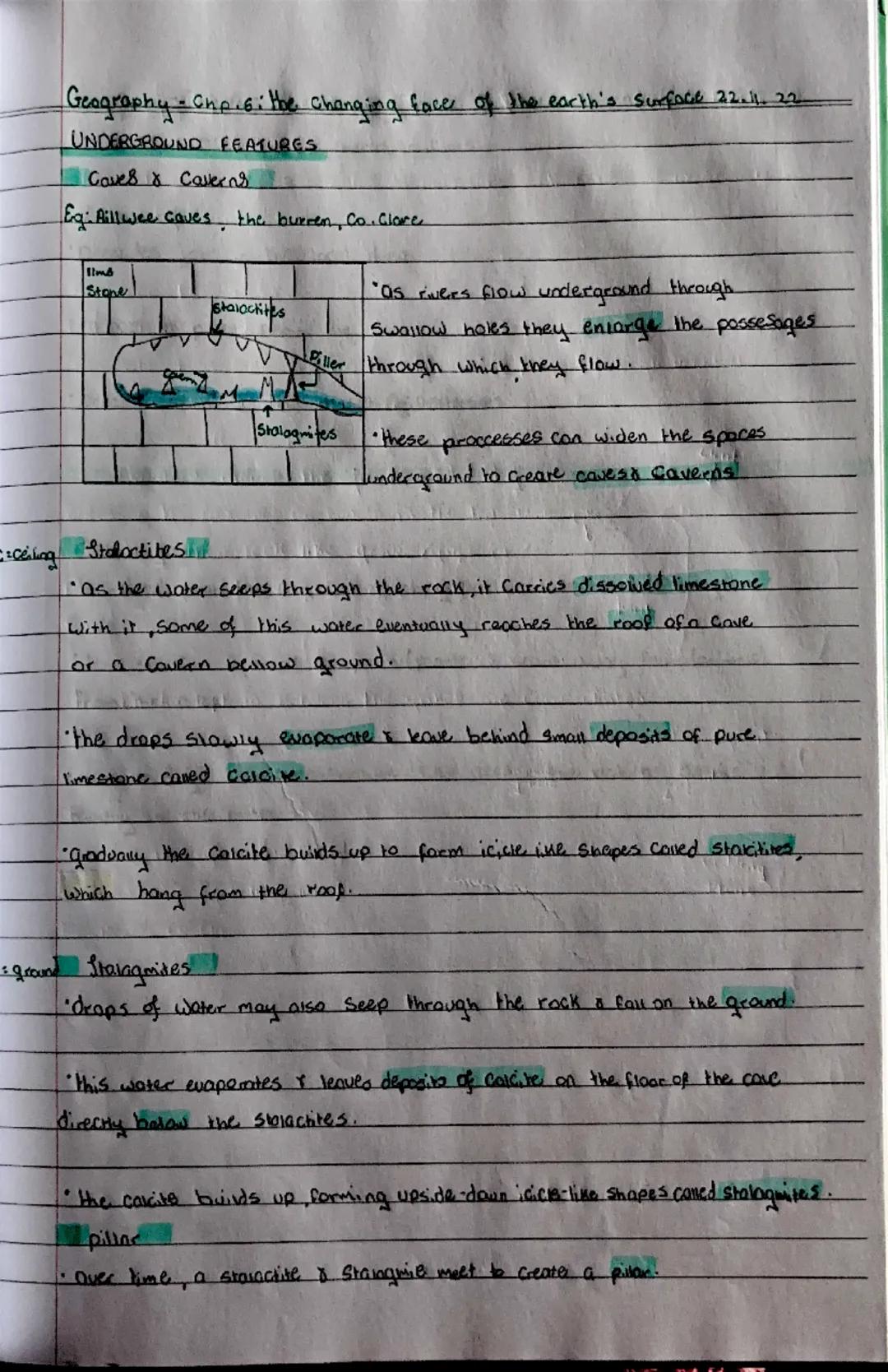
Beneath the surface of karst landscapes, magical things happen! As rivers flow underground through swallow holes, they carve out passages that can widen into caves and caverns like the famous Aillwee Caves in the Burren.
Water seeping through the limestone carries dissolved calcium carbonate with it. When this water reaches the roof of a cave, it slowly evaporates and leaves behind deposits of pure limestone called calcite. Over time, these deposits build up to form icicle-like shapes called stalactites that hang from the ceiling.
Similarly, when drops fall to the floor, they form upside-down icicle shapes called stalagmites. An easy way to remember which is which: stalactites hold "tight" to the ceiling, while stalagmites "might" reach the ceiling one day.
Amazing fact: When a stalactite and stalagmite eventually meet after thousands of years, they form a pillar. Some of these in Irish caves are over 200,000 years old!
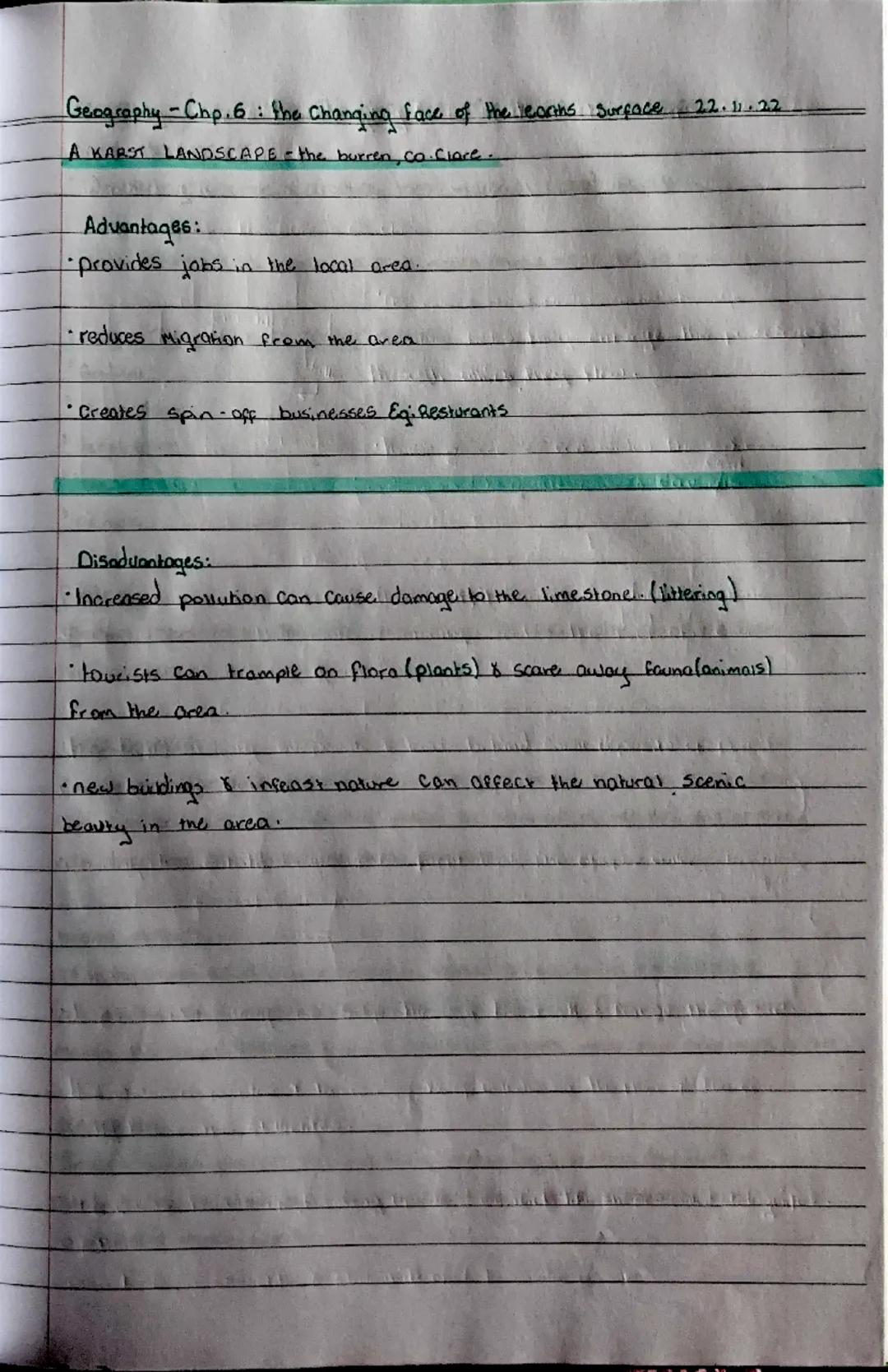
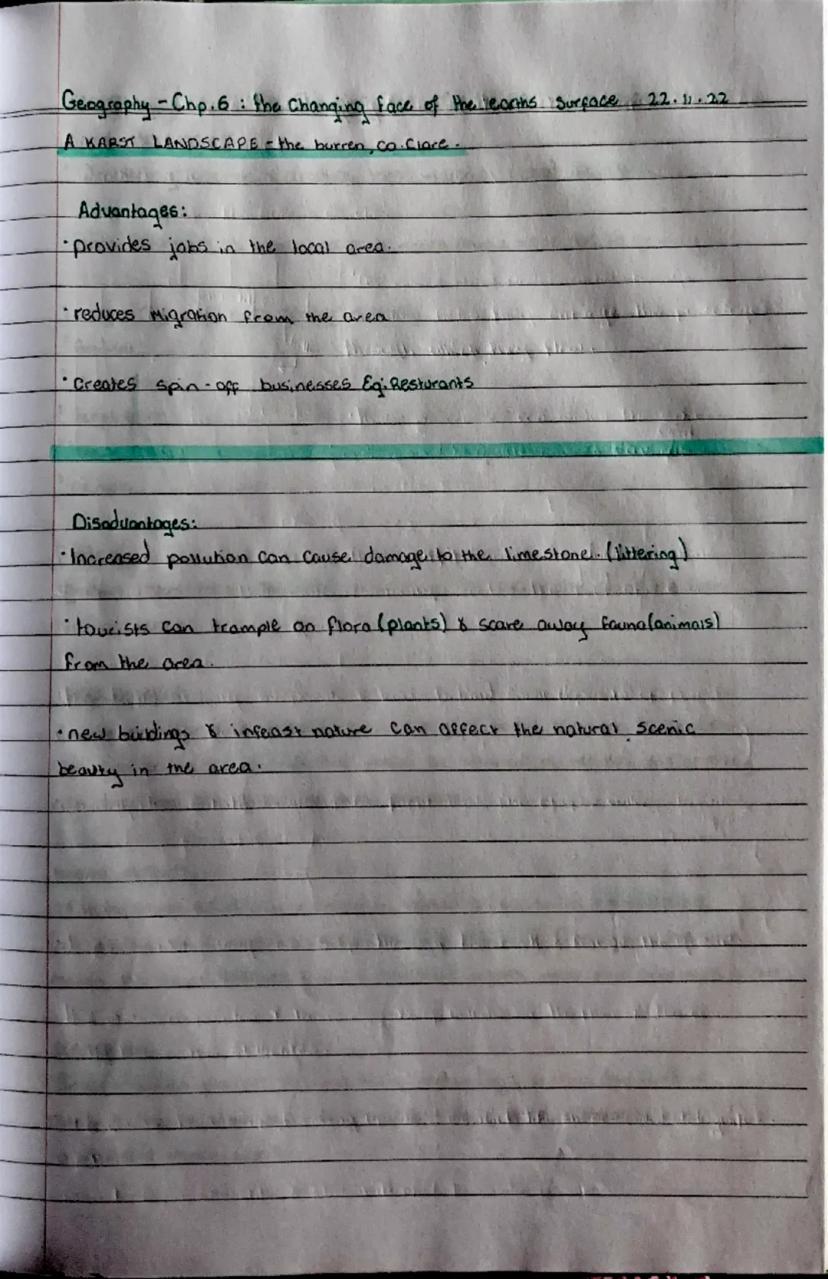
The Burren's unique karst landscape attracts thousands of visitors each year, bringing both benefits and challenges to the local area.
Advantages of tourism in the Burren include creating jobs for local people, reducing migration away from the area as young people can find work, and supporting spin-off businesses like restaurants and shops that serve visitors.
However, there are disadvantages too. Increased pollution from litter can damage the delicate limestone. Tourists might accidentally trample rare plants that grow in the area or disturb wildlife. New buildings and infrastructure needed for tourism can also affect the natural beauty that attracted visitors in the first place.
Think about it: If you visited the Burren, what could you do to be a responsible tourist who enjoys the landscape without damaging it?
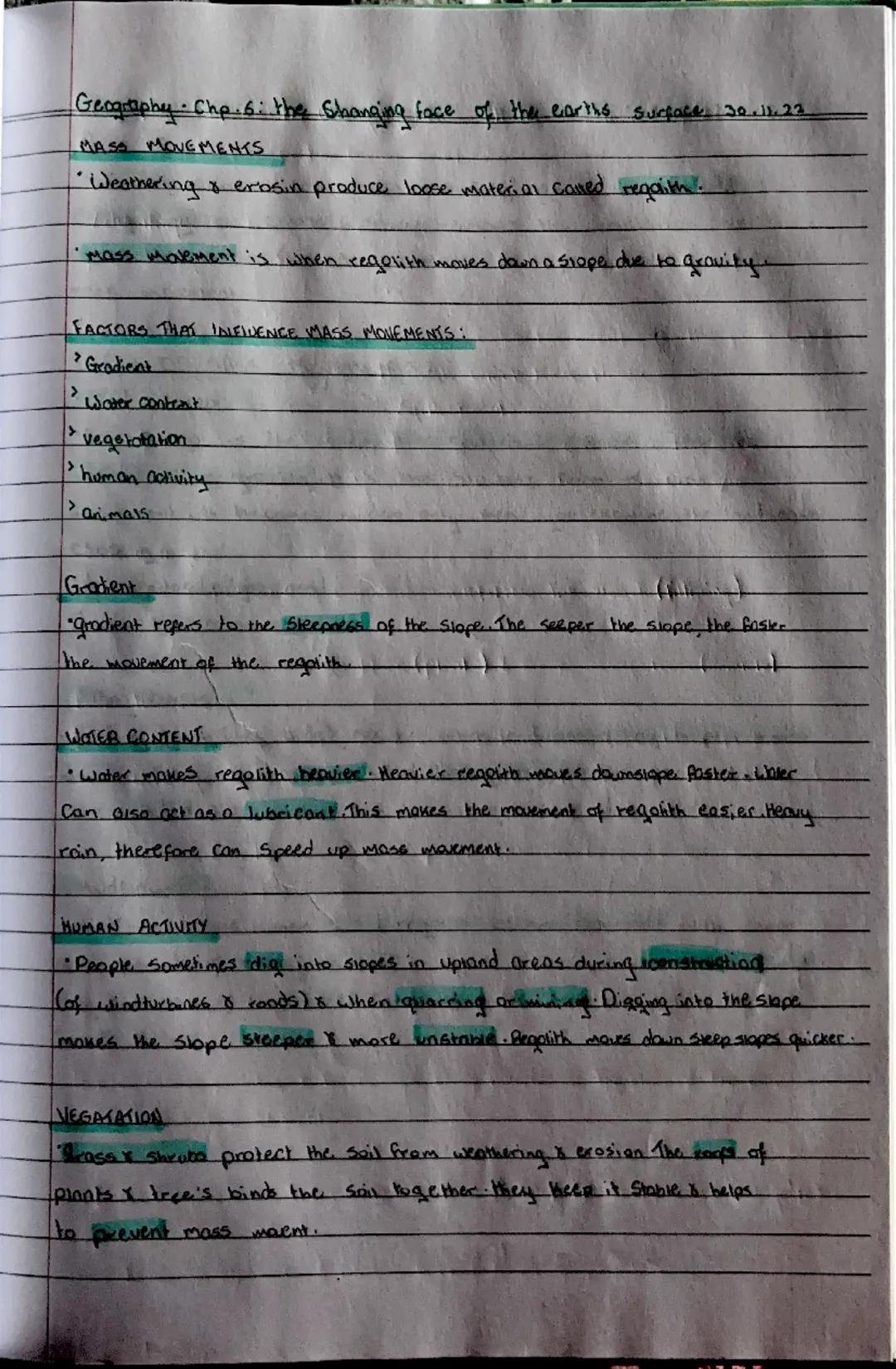
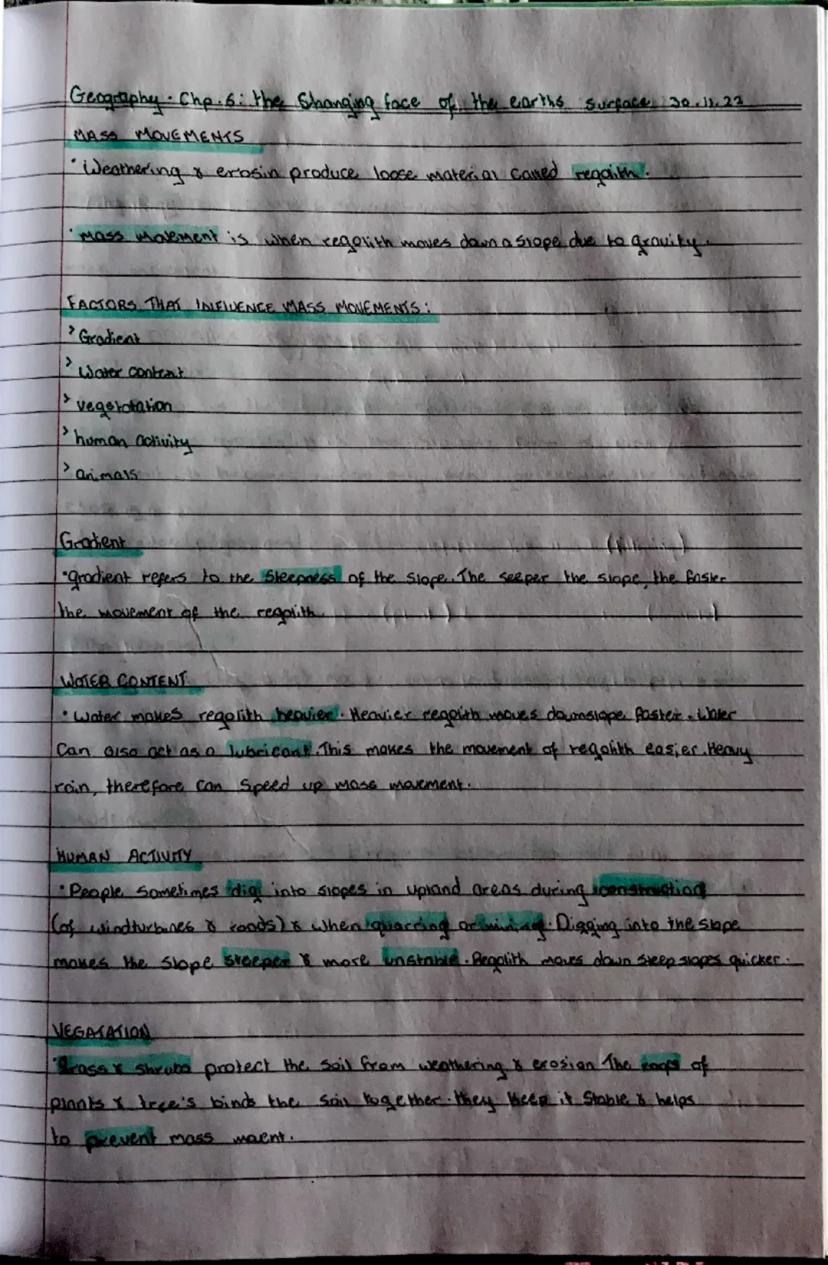
When weathered rock and soil (called regolith) move downhill due to gravity, we call it mass movement. It's a bit like how your schoolbooks slide off your desk - except on a much bigger scale!
Several factors influence how quickly and dramatically mass movement occurs. The gradient (steepness) of a slope is crucial - the steeper it is, the faster material moves downhill. Water content also matters because water makes regolith heavier and acts as a lubricant, speeding up movement especially during heavy rainfall.
Human activities like digging into slopes for roads, wind turbines, quarrying, or mining can make slopes steeper and more unstable. Vegetation plays an important protective role - grass, shrubs and trees bind the soil together with their roots, helping to prevent mass movement.
Safety tip: After very heavy rainfall, be extra careful near steep slopes as this is when mass movements are most likely to occur!
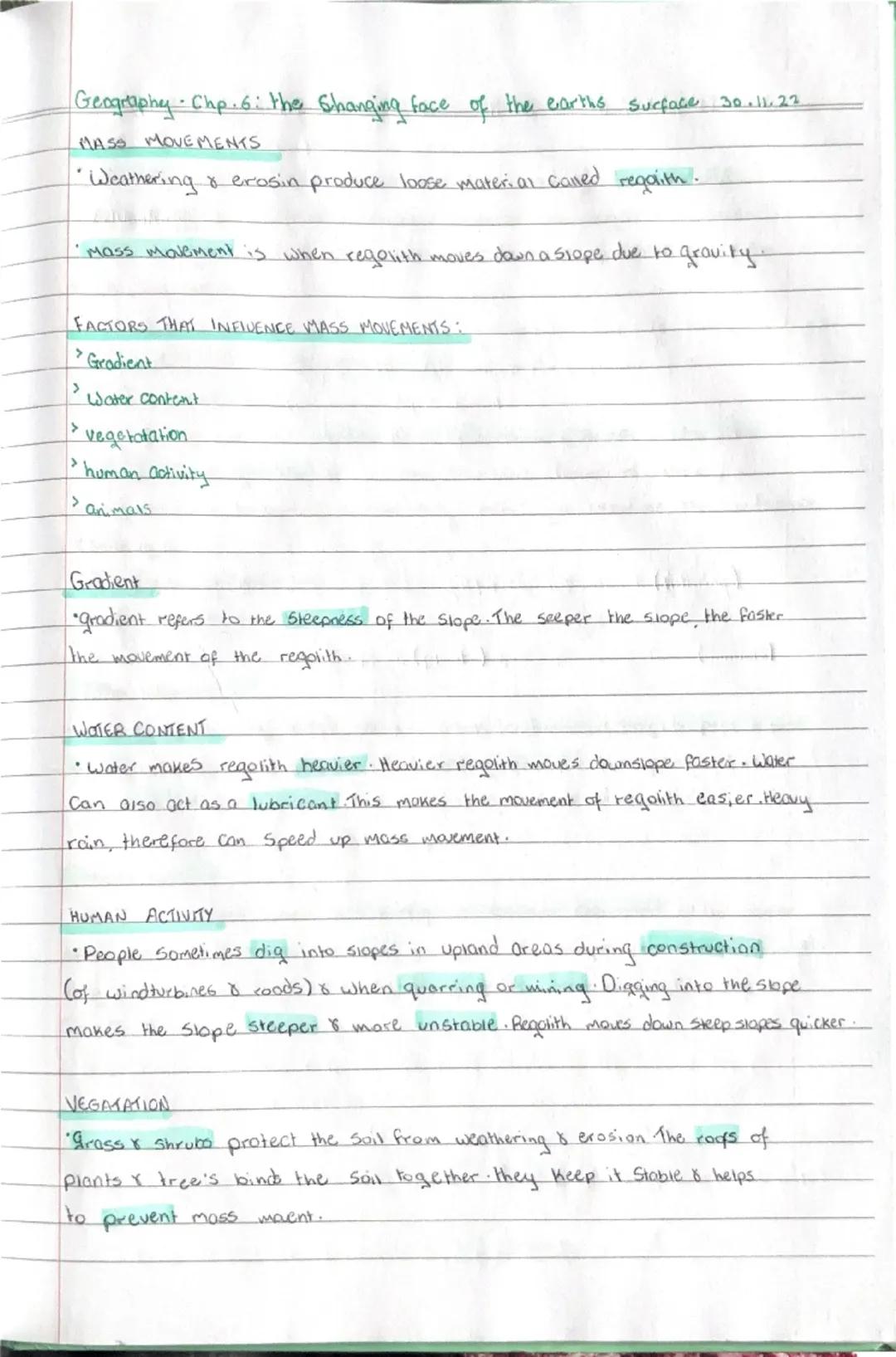
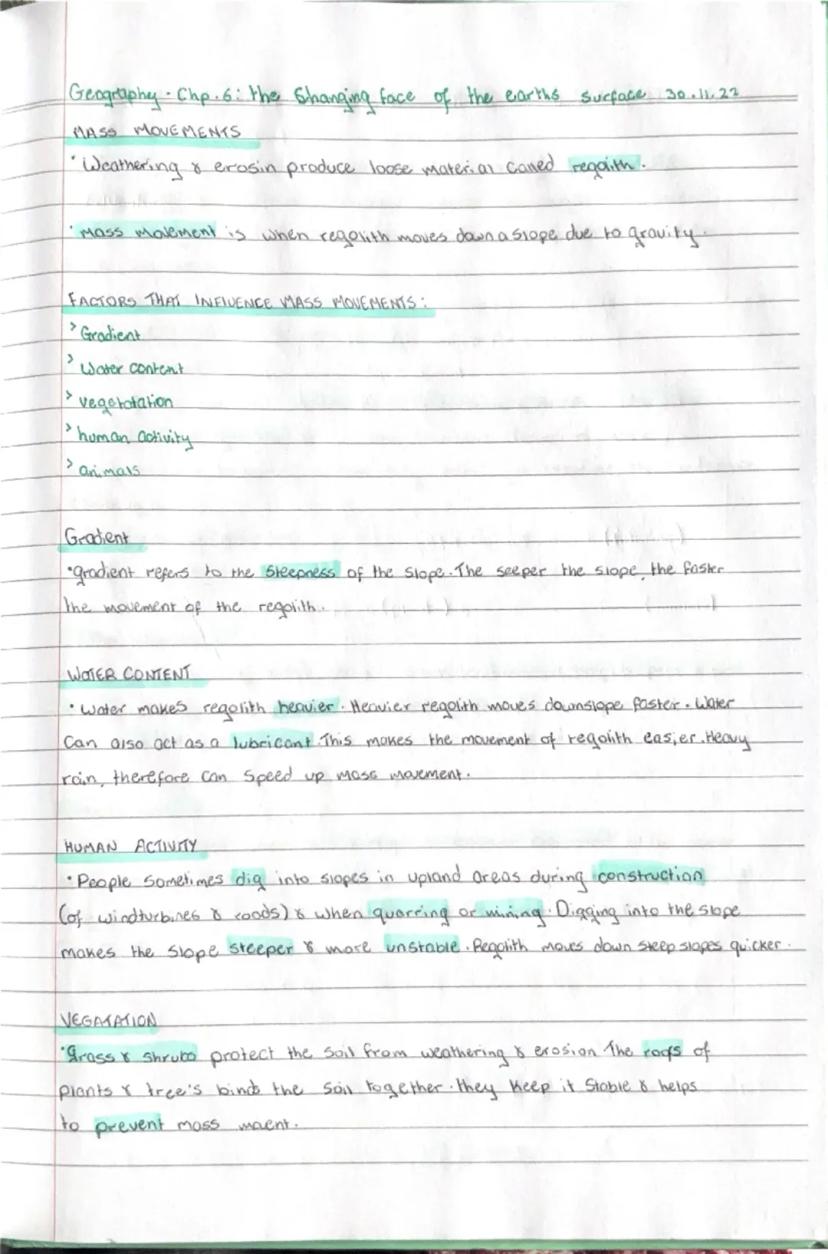
Mass movement happens when loose weathered material (regolith) slides downhill because of gravity, but several factors control how quickly this happens.
The gradient of a slope is crucial - steeper slopes mean faster movement, just like how a marble rolls faster down a steep ramp than a gentle one. Water content also plays a major role because water makes regolith heavier and acts as a lubricant, helping it slide more easily. Heavy rain can therefore speed up mass movements considerably.
Human activities like construction, mining and quarrying often involve digging into slopes, making them steeper and less stable. This is why you sometimes see special reinforcements on hillsides near new roads.
Vegetation acts as nature's safety net - plant roots bind soil together and keep it stable. When plants are removed through deforestation or overgrazing, the soil becomes much more likely to move downhill.
Local connection: Have you noticed how road cuttings through hills in Ireland often have special netting or concrete supports? These help prevent dangerous mass movements!
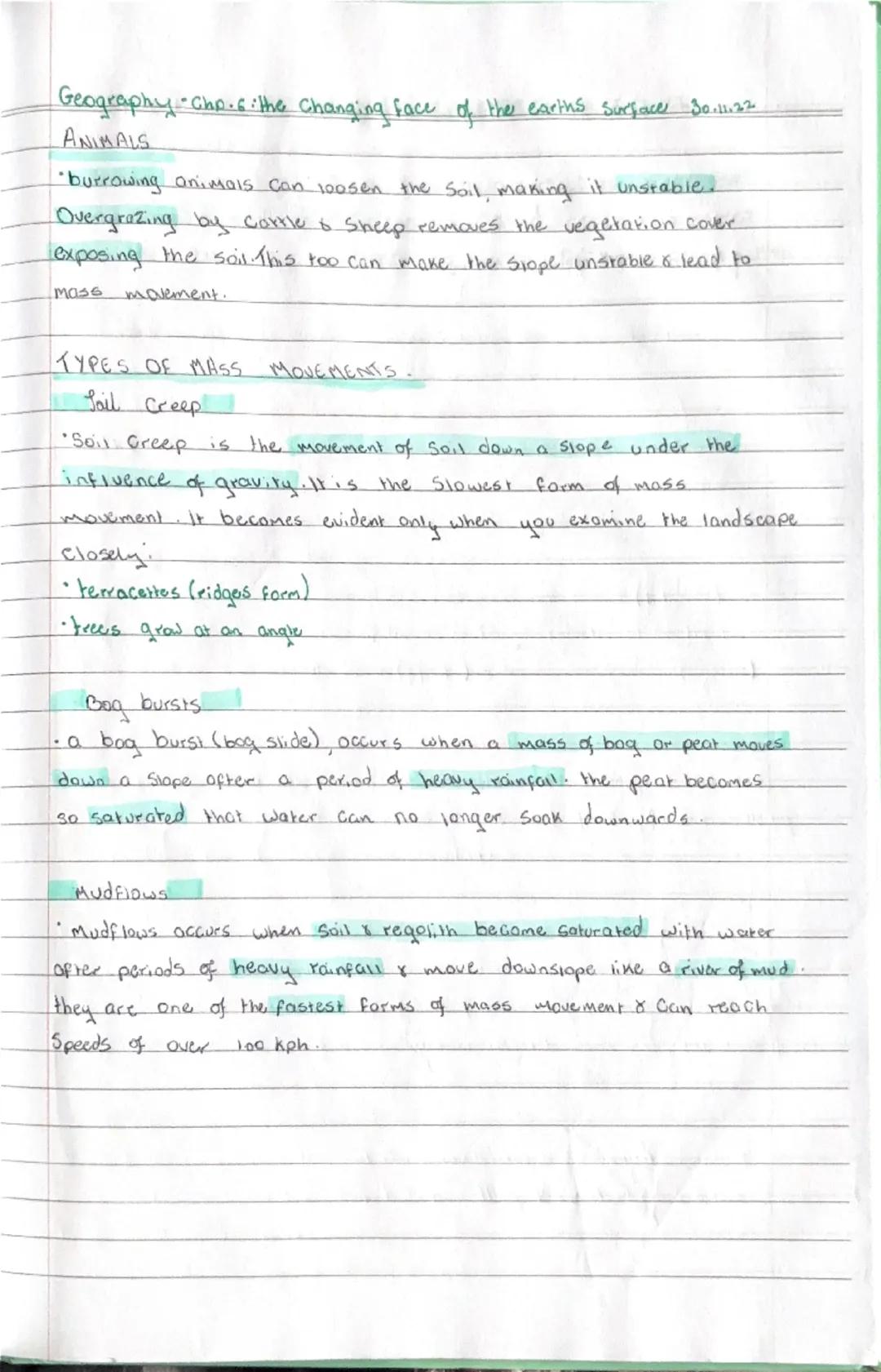
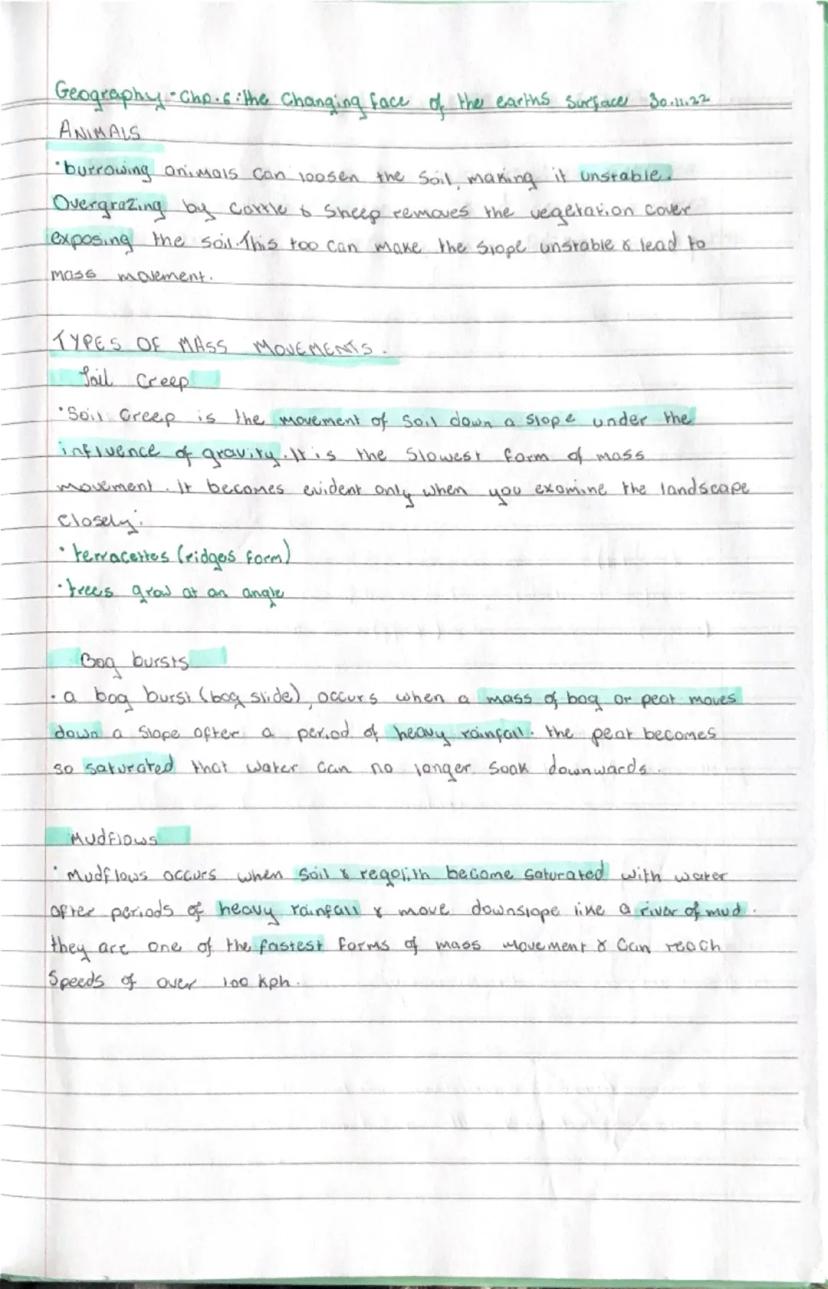
Animals can also trigger mass movements. Burrowing animals loosen soil, while overgrazing by cattle and sheep removes protective vegetation, leaving soil exposed and unstable.
There are several types of mass movements that you might spot if you know what to look for. Soil creep is the slowest type - a gradual downhill movement that's hard to see happening but leaves clues like ridges called terracettes and trees growing at strange angles.
Bog bursts (or bog slides) occur when peat becomes so saturated with water after heavy rainfall that it can't soak up any more. The waterlogged peat then moves downslope in a sudden, dramatic event.
Mudflows are among the fastest and most dangerous mass movements. They happen when soil becomes completely saturated with water and flows downhill like a river of mud. These can reach speeds over 100 km/h - faster than you're allowed to drive on most Irish roads!
Shocking fact: Mudflows can move entire houses and have been known to bury whole villages. They're one of nature's most destructive forces!
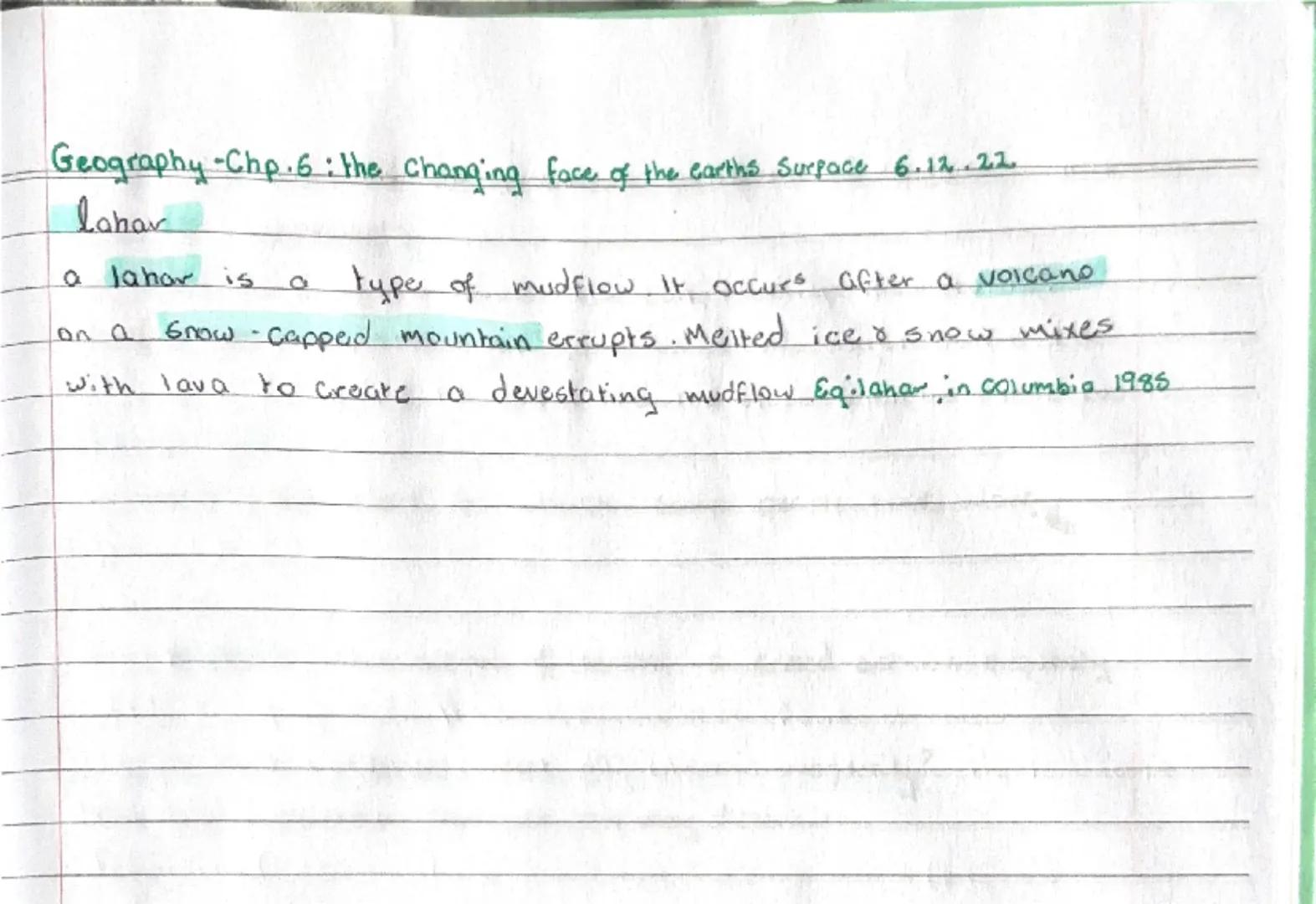
A lahar is a special and particularly dangerous type of mudflow that occurs after a volcanic eruption on a snow-capped mountain. When the hot volcanic material melts the snow and ice, it mixes with volcanic ash and debris to create a fast-moving river of mud.
The Colombia lahar of 1985 is a tragic example that shows the devastating power of these events. When the Nevado del Ruiz volcano erupted, it melted snow and ice on the mountain, creating lahars that buried the town of Armero and killed about 23,000 people.
Important to know: Lahars can travel at speeds up to 100 km/h and can be as thick as wet concrete, making them nearly impossible to escape once they're moving toward populated areas.
Our AI companion is specifically built for the needs of students. Based on the millions of content pieces we have on the platform we can provide truly meaningful and relevant answers to students. But its not only about answers, the companion is even more about guiding students through their daily learning challenges, with personalised study plans, quizzes or content pieces in the chat and 100% personalisation based on the students skills and developments.
You can download the app in the Google Play Store and in the Apple App Store.
That's right! Enjoy free access to study content, connect with fellow students, and get instant help – all at your fingertips.
App Store
Google Play
The app is very easy to use and well designed. I have found everything I was looking for so far and have been able to learn a lot from the presentations! I will definitely use the app for a class assignment! And of course it also helps a lot as an inspiration.
Stefan S
iOS user
This app is really great. There are so many study notes and help [...]. My problem subject is French, for example, and the app has so many options for help. Thanks to this app, I have improved my French. I would recommend it to anyone.
Samantha Klich
Android user
Wow, I am really amazed. I just tried the app because I've seen it advertised many times and was absolutely stunned. This app is THE HELP you want for school and above all, it offers so many things, such as workouts and fact sheets, which have been VERY helpful to me personally.
Anna
iOS user
I think it’s very much worth it and you’ll end up using it a lot once you get the hang of it and even after looking at others notes you can still ask your Artificial intelligence buddy the question and ask to simplify it if you still don’t get it!!! In the end I think it’s worth it 😊👍 ⚠️Also DID I MENTION ITS FREEE YOU DON’T HAVE TO PAY FOR ANYTHING AND STILL GET YOUR GRADES IN PERFECTLY❗️❗️⚠️
Thomas R
iOS user
Knowunity is the BEST app I’ve used in a minute. This is not an ai review or anything this is genuinely coming from a 7th grade student (I know 2011 im young) but dude this app is a 10/10 i have maintained a 3.8 gpa and have plenty of time for gaming. I love it and my mom is just happy I got good grades
Brad T
Android user
Not only did it help me find the answer but it also showed me alternative ways to solve it. I was horrible in math and science but now I have an a in both subjects. Thanks for the help🤍🤍
David K
iOS user
The app's just great! All I have to do is enter the topic in the search bar and I get the response real fast. I don't have to watch 10 YouTube videos to understand something, so I'm saving my time. Highly recommended!
Sudenaz Ocak
Android user
In school I was really bad at maths but thanks to the app, I am doing better now. I am so grateful that you made the app.
Greenlight Bonnie
Android user
I found this app a couple years ago and it has only gotten better since then. I really love it because it can help with written questions and photo questions. Also, it can find study guides that other people have made as well as flashcard sets and practice tests. The free version is also amazing for students who might not be able to afford it. Would 100% recommend
Aubrey
iOS user
Best app if you're in Highschool or Junior high. I have been using this app for 2 school years and it's the best, it's good if you don't have anyone to help you with school work.😋🩷🎀
Marco B
iOS user
THE QUIZES AND FLASHCARDS ARE SO USEFUL AND I LOVE Knowunity AI. IT ALSO IS LITREALLY LIKE CHATGPT BUT SMARTER!! HELPED ME WITH MY MASCARA PROBLEMS TOO!! AS WELL AS MY REAL SUBJECTS ! DUHHH 😍😁😲🤑💗✨🎀😮
Elisha
iOS user
This app is phenomenal down to the correct info and the various topics you can study! I greatly recommend it for people who struggle with procrastination and those who need homework help. It has been perfectly accurate for world 1 history as far as I’ve seen! Geometry too!
Paul T
iOS user
The app is very easy to use and well designed. I have found everything I was looking for so far and have been able to learn a lot from the presentations! I will definitely use the app for a class assignment! And of course it also helps a lot as an inspiration.
Stefan S
iOS user
This app is really great. There are so many study notes and help [...]. My problem subject is French, for example, and the app has so many options for help. Thanks to this app, I have improved my French. I would recommend it to anyone.
Samantha Klich
Android user
Wow, I am really amazed. I just tried the app because I've seen it advertised many times and was absolutely stunned. This app is THE HELP you want for school and above all, it offers so many things, such as workouts and fact sheets, which have been VERY helpful to me personally.
Anna
iOS user
I think it’s very much worth it and you’ll end up using it a lot once you get the hang of it and even after looking at others notes you can still ask your Artificial intelligence buddy the question and ask to simplify it if you still don’t get it!!! In the end I think it’s worth it 😊👍 ⚠️Also DID I MENTION ITS FREEE YOU DON’T HAVE TO PAY FOR ANYTHING AND STILL GET YOUR GRADES IN PERFECTLY❗️❗️⚠️
Thomas R
iOS user
Knowunity is the BEST app I’ve used in a minute. This is not an ai review or anything this is genuinely coming from a 7th grade student (I know 2011 im young) but dude this app is a 10/10 i have maintained a 3.8 gpa and have plenty of time for gaming. I love it and my mom is just happy I got good grades
Brad T
Android user
Not only did it help me find the answer but it also showed me alternative ways to solve it. I was horrible in math and science but now I have an a in both subjects. Thanks for the help🤍🤍
David K
iOS user
The app's just great! All I have to do is enter the topic in the search bar and I get the response real fast. I don't have to watch 10 YouTube videos to understand something, so I'm saving my time. Highly recommended!
Sudenaz Ocak
Android user
In school I was really bad at maths but thanks to the app, I am doing better now. I am so grateful that you made the app.
Greenlight Bonnie
Android user
I found this app a couple years ago and it has only gotten better since then. I really love it because it can help with written questions and photo questions. Also, it can find study guides that other people have made as well as flashcard sets and practice tests. The free version is also amazing for students who might not be able to afford it. Would 100% recommend
Aubrey
iOS user
Best app if you're in Highschool or Junior high. I have been using this app for 2 school years and it's the best, it's good if you don't have anyone to help you with school work.😋🩷🎀
Marco B
iOS user
THE QUIZES AND FLASHCARDS ARE SO USEFUL AND I LOVE Knowunity AI. IT ALSO IS LITREALLY LIKE CHATGPT BUT SMARTER!! HELPED ME WITH MY MASCARA PROBLEMS TOO!! AS WELL AS MY REAL SUBJECTS ! DUHHH 😍😁😲🤑💗✨🎀😮
Elisha
iOS user
This app is phenomenal down to the correct info and the various topics you can study! I greatly recommend it for people who struggle with procrastination and those who need homework help. It has been perfectly accurate for world 1 history as far as I’ve seen! Geometry too!
Paul T
iOS user
Kyla McInerney
@kylamcinerney
Ever wondered why mountains change shape or how caves form? Geography of Earth's changing surface is all about the natural processes that shape our landscapes. From crumbling rocks to flowing mud, you're about to discover how our planet constantly transforms... Show more
Access to all documents
Improve your grades
Join milions of students
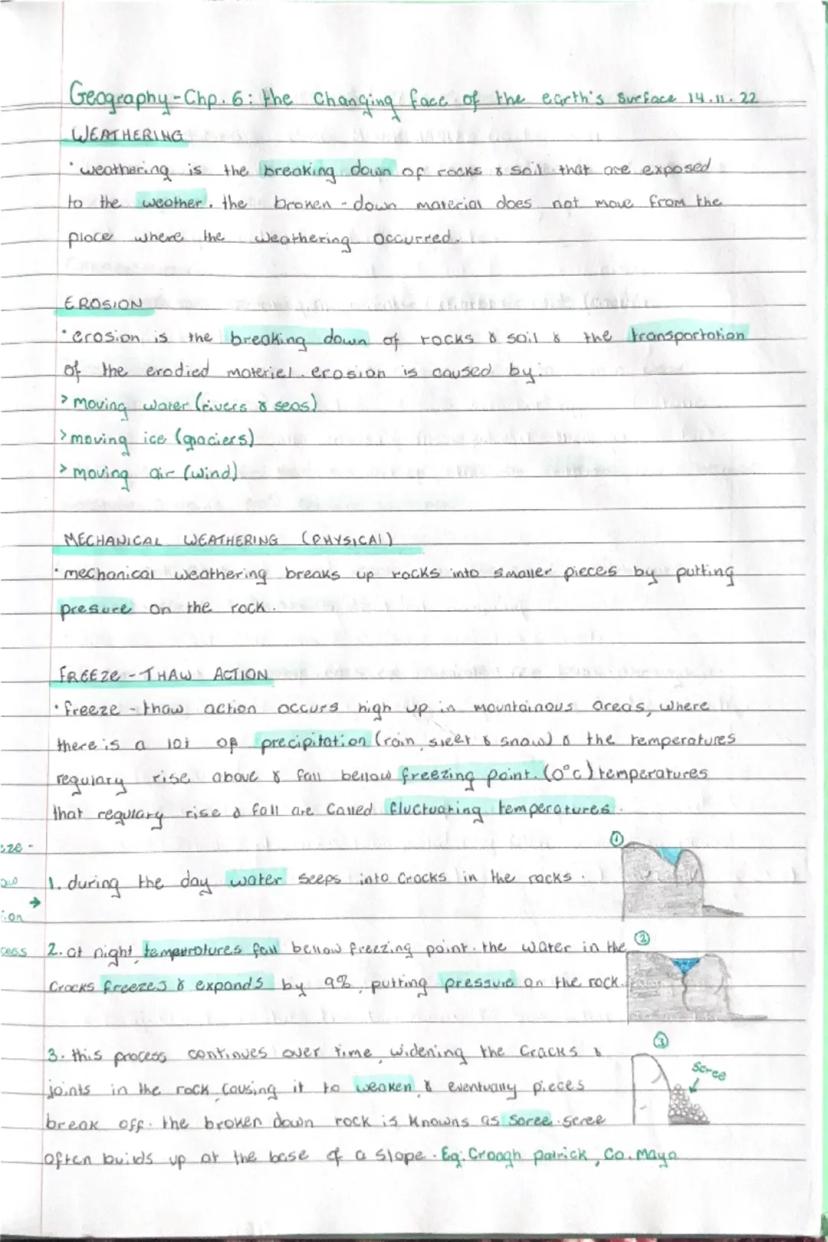
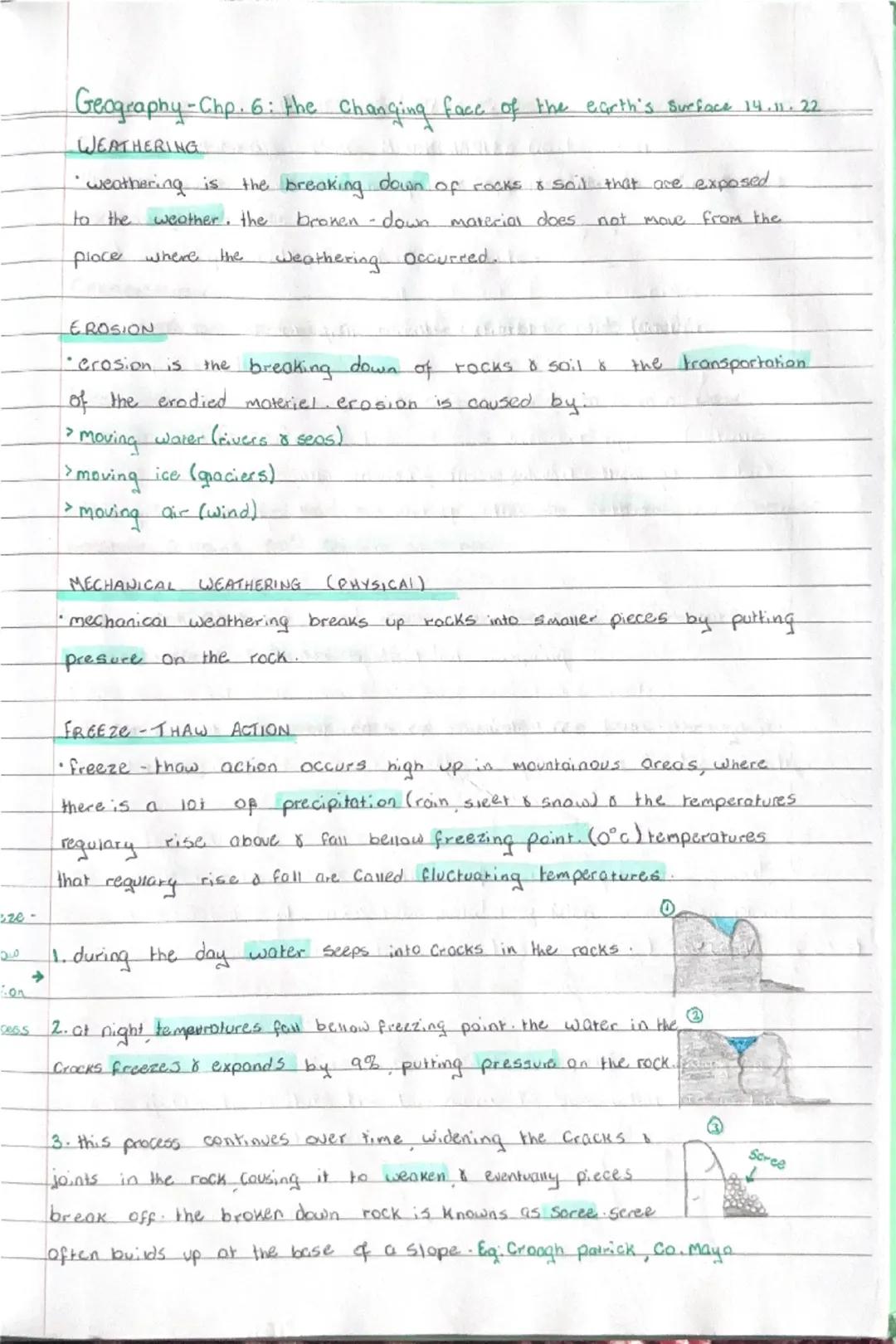
Rocks don't stay the same forever! Weathering breaks down rocks and soil that are exposed to the weather, but the broken material stays put. It's like when a biscuit crumbles but remains on your plate.
Erosion goes a step further - it not only breaks down rocks and soil but also moves the material away. This happens through moving water (rivers and seas), moving ice (glaciers), and moving air (wind).
Mechanical weathering (also called physical weathering) puts pressure on rocks to break them into smaller pieces. One important type is freeze-thaw action, which happens in mountainous areas where temperatures regularly go above and below freezing point.
Did you know? During freeze-thaw action, water expands by 9% when it freezes! This powerful expansion is enough to crack even the toughest rocks over time.
The process works like this: water seeps into cracks during the day, freezes and expands at night, and eventually breaks the rock. The broken pieces (called scree) often pile up at the base of mountains, like at Croagh Patrick in County Mayo.
Access to all documents
Improve your grades
Join milions of students
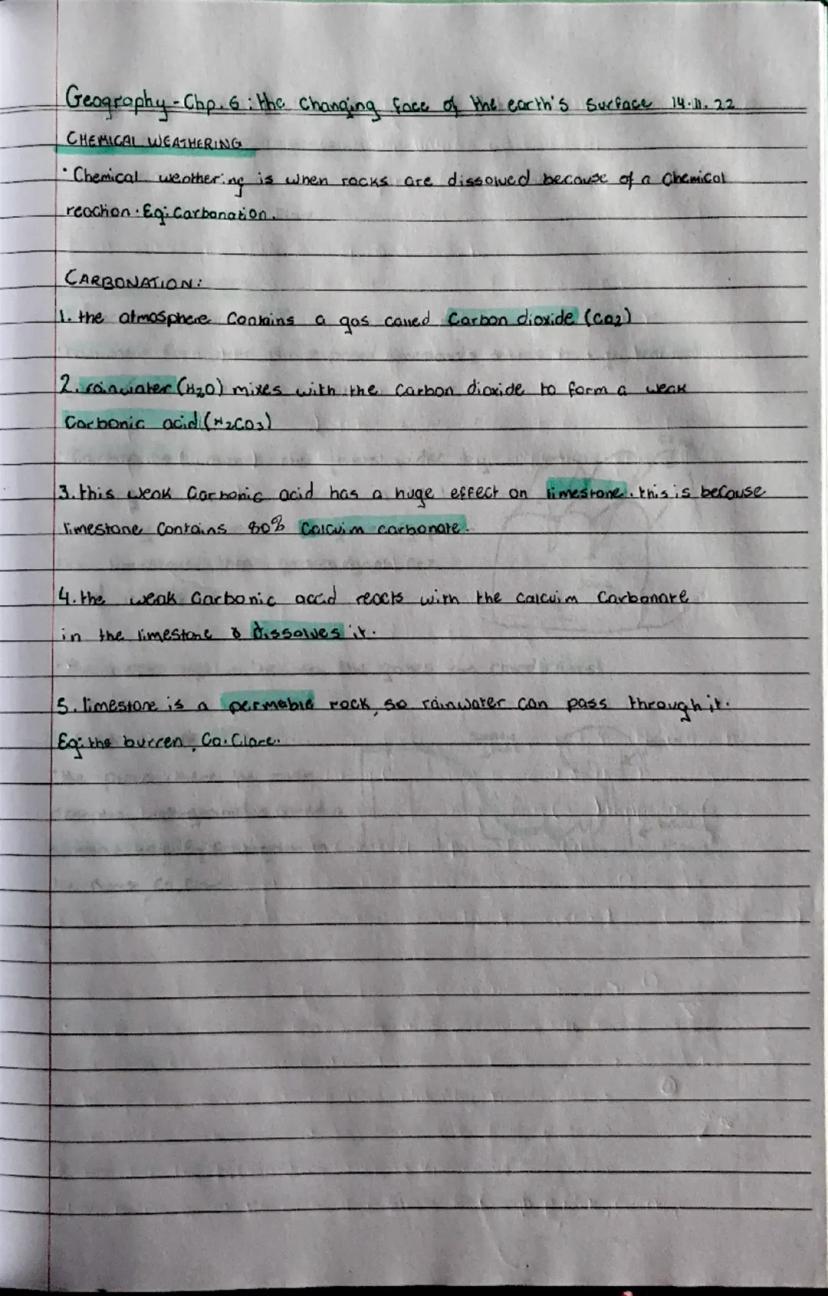
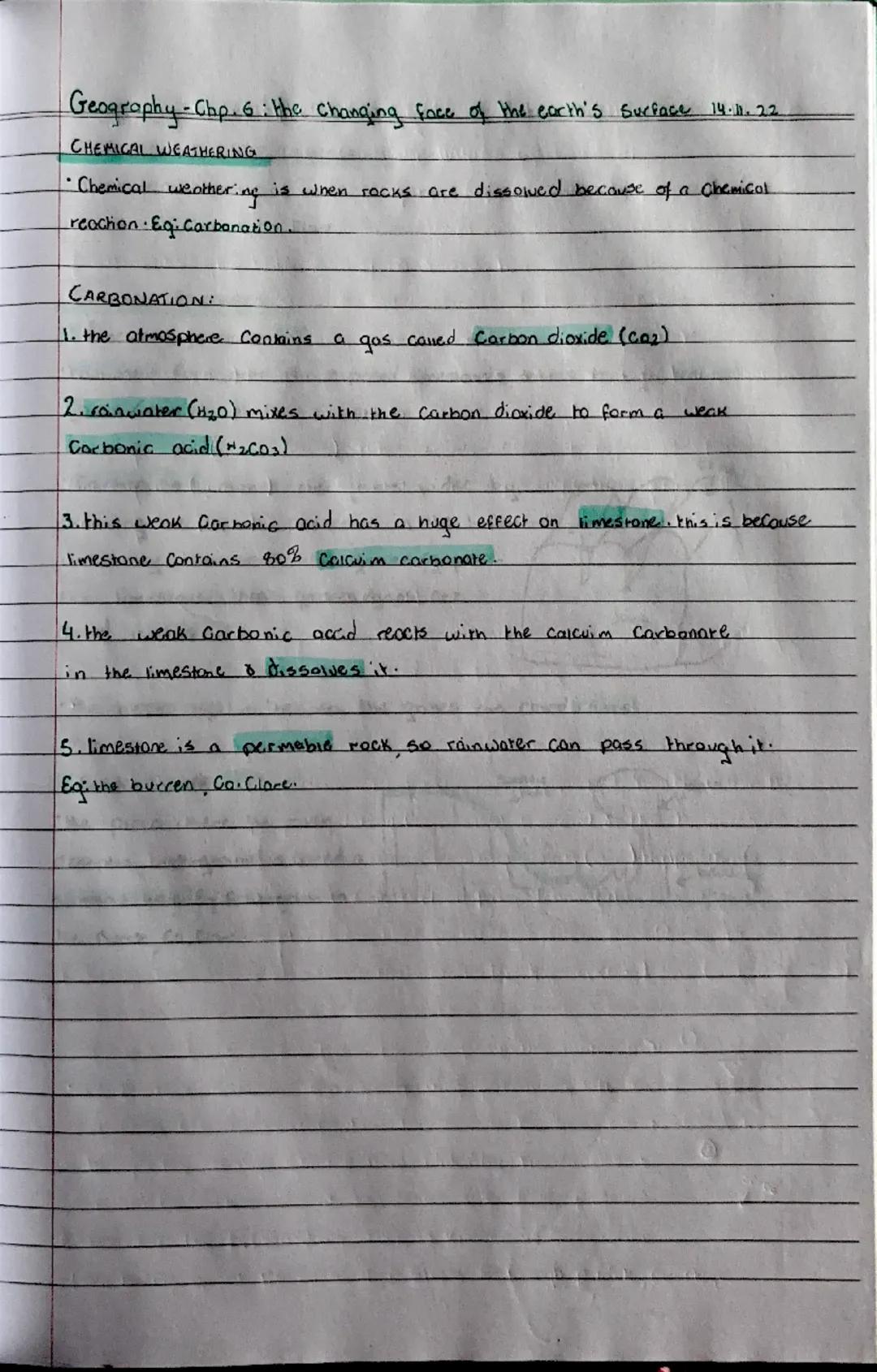
While mechanical weathering physically breaks rocks, chemical weathering changes their actual composition through chemical reactions. It's like how vinegar can dissolve an eggshell!
Carbonation is a fascinating example of chemical weathering that happens when:
This process is particularly powerful on limestone because it's a permeable rock, meaning water can pass through it easily.
Quick Tip: You can remember carbonation by thinking of fizzy drinks - they contain carbonic acid too, which gives them their fizz!
The Burren in County Clare is a perfect example of carbonation in action, where the landscape has been dramatically shaped by this chemical process over thousands of years.
Access to all documents
Improve your grades
Join milions of students
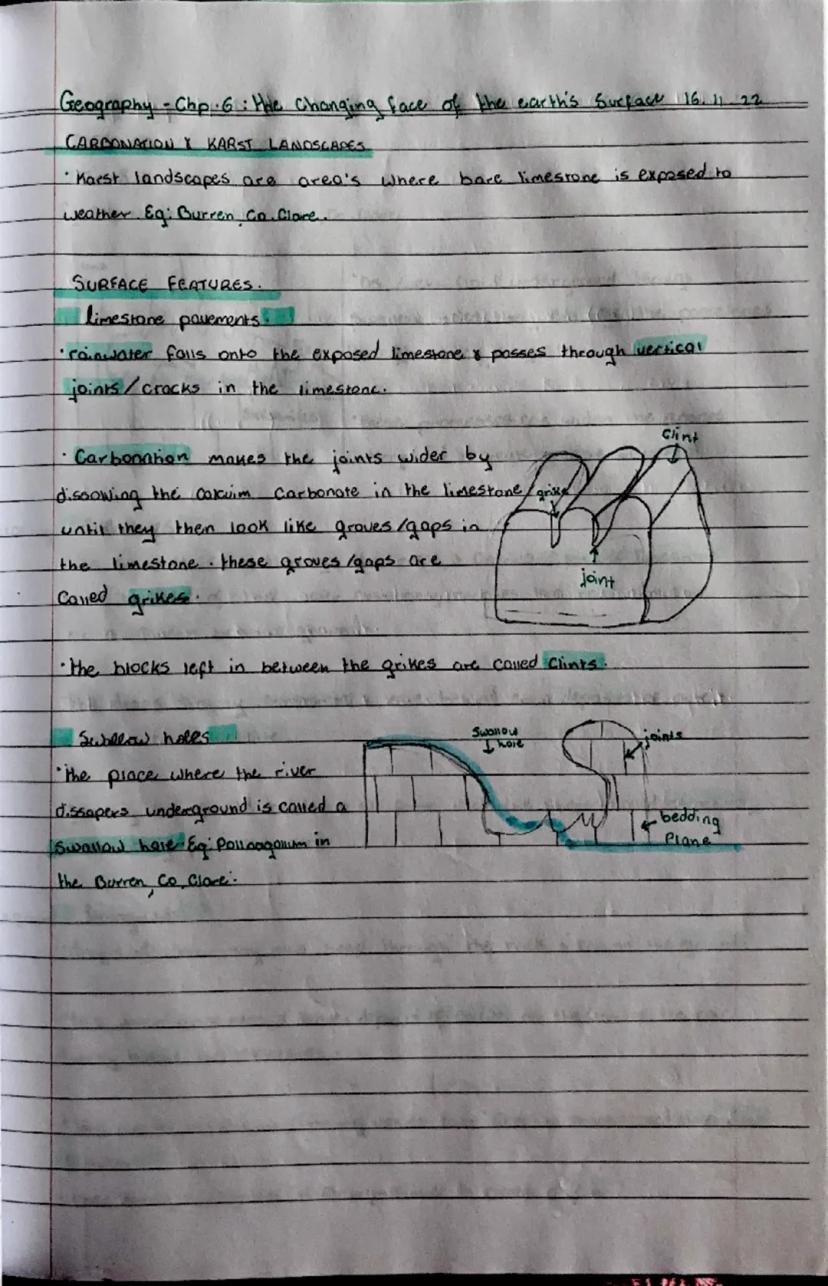
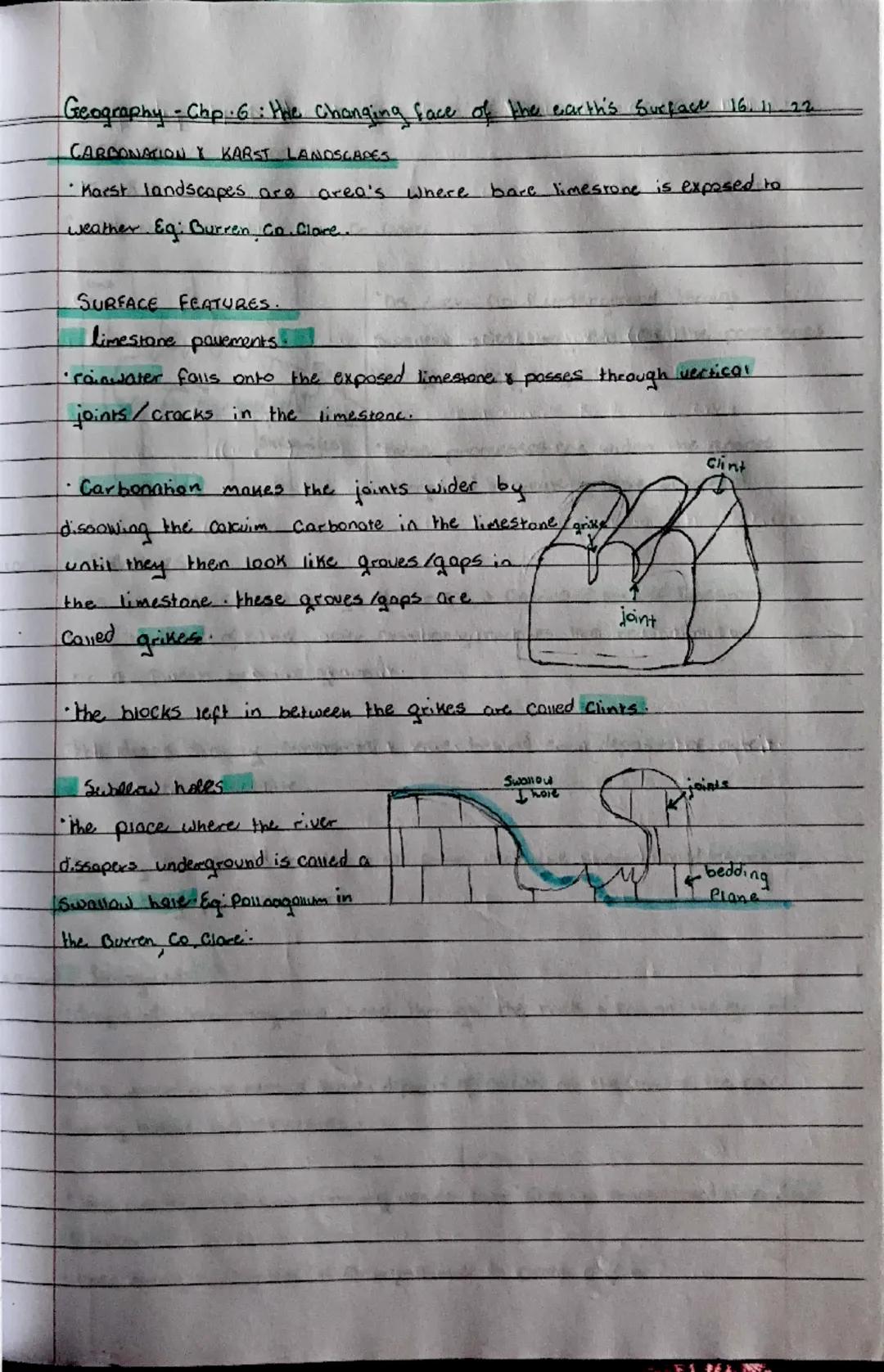
Karst landscapes are areas where bare limestone is exposed to weather, creating some truly unusual features. The Burren in County Clare is a brilliant example that you might have visited on a school trip.
On the surface, limestone pavements develop when rainwater falls onto exposed limestone and dissolves it along cracks and joints. The gaps that form are called grikes, while the blocks of limestone left between them are called clints. It ends up looking a bit like a giant's paving stones!
Another fascinating feature is the swallow hole - a place where a river disappears underground! Imagine watching a river suddenly vanish into the ground. You can see this happen at Pollnagollum in the Burren.
Fascinating fact: The word "karst" comes from a region called Kras in Slovenia where these landscapes were first studied. Ireland has some of the best karst landscapes in Europe!
Access to all documents
Improve your grades
Join milions of students
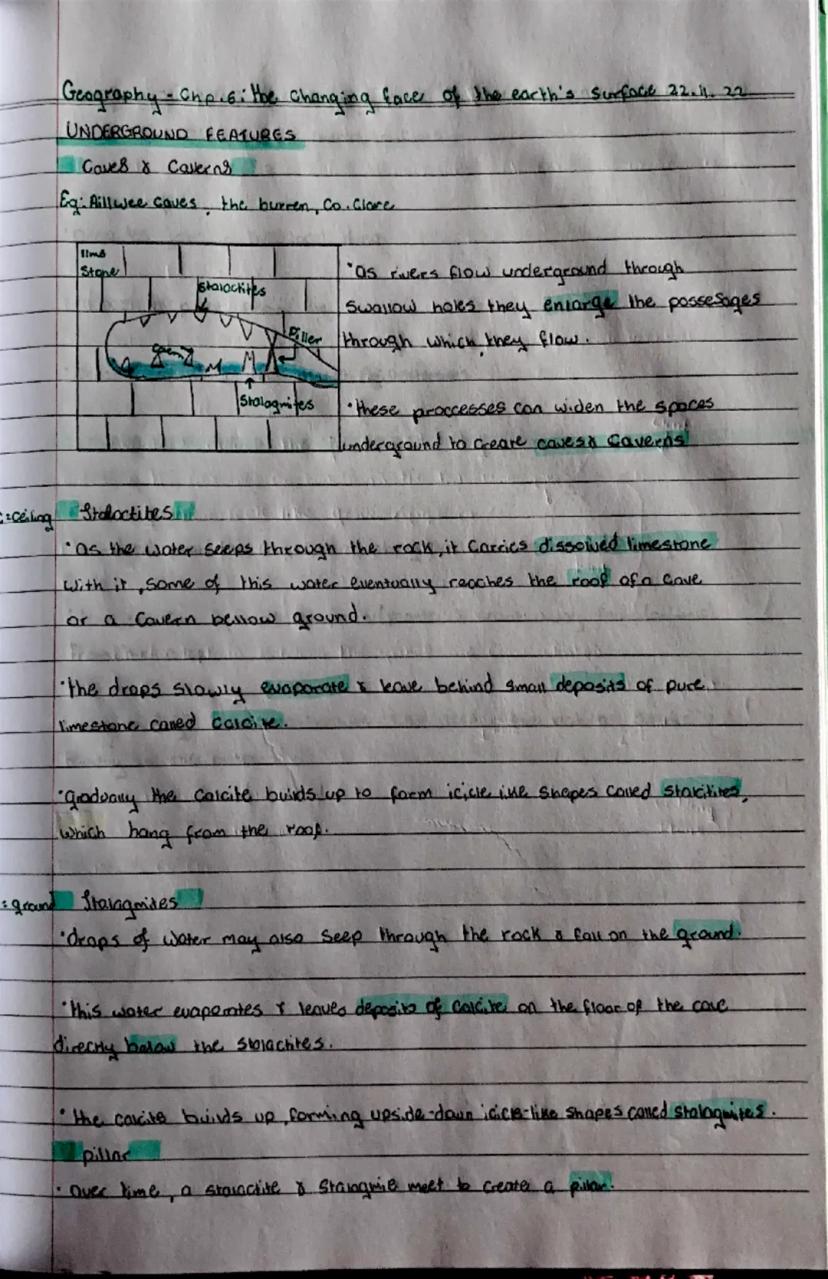
Beneath the surface of karst landscapes, magical things happen! As rivers flow underground through swallow holes, they carve out passages that can widen into caves and caverns like the famous Aillwee Caves in the Burren.
Water seeping through the limestone carries dissolved calcium carbonate with it. When this water reaches the roof of a cave, it slowly evaporates and leaves behind deposits of pure limestone called calcite. Over time, these deposits build up to form icicle-like shapes called stalactites that hang from the ceiling.
Similarly, when drops fall to the floor, they form upside-down icicle shapes called stalagmites. An easy way to remember which is which: stalactites hold "tight" to the ceiling, while stalagmites "might" reach the ceiling one day.
Amazing fact: When a stalactite and stalagmite eventually meet after thousands of years, they form a pillar. Some of these in Irish caves are over 200,000 years old!
Access to all documents
Improve your grades
Join milions of students
The Burren's unique karst landscape attracts thousands of visitors each year, bringing both benefits and challenges to the local area.
Advantages of tourism in the Burren include creating jobs for local people, reducing migration away from the area as young people can find work, and supporting spin-off businesses like restaurants and shops that serve visitors.
However, there are disadvantages too. Increased pollution from litter can damage the delicate limestone. Tourists might accidentally trample rare plants that grow in the area or disturb wildlife. New buildings and infrastructure needed for tourism can also affect the natural beauty that attracted visitors in the first place.
Think about it: If you visited the Burren, what could you do to be a responsible tourist who enjoys the landscape without damaging it?
Access to all documents
Improve your grades
Join milions of students
When weathered rock and soil (called regolith) move downhill due to gravity, we call it mass movement. It's a bit like how your schoolbooks slide off your desk - except on a much bigger scale!
Several factors influence how quickly and dramatically mass movement occurs. The gradient (steepness) of a slope is crucial - the steeper it is, the faster material moves downhill. Water content also matters because water makes regolith heavier and acts as a lubricant, speeding up movement especially during heavy rainfall.
Human activities like digging into slopes for roads, wind turbines, quarrying, or mining can make slopes steeper and more unstable. Vegetation plays an important protective role - grass, shrubs and trees bind the soil together with their roots, helping to prevent mass movement.
Safety tip: After very heavy rainfall, be extra careful near steep slopes as this is when mass movements are most likely to occur!
Access to all documents
Improve your grades
Join milions of students
Mass movement happens when loose weathered material (regolith) slides downhill because of gravity, but several factors control how quickly this happens.
The gradient of a slope is crucial - steeper slopes mean faster movement, just like how a marble rolls faster down a steep ramp than a gentle one. Water content also plays a major role because water makes regolith heavier and acts as a lubricant, helping it slide more easily. Heavy rain can therefore speed up mass movements considerably.
Human activities like construction, mining and quarrying often involve digging into slopes, making them steeper and less stable. This is why you sometimes see special reinforcements on hillsides near new roads.
Vegetation acts as nature's safety net - plant roots bind soil together and keep it stable. When plants are removed through deforestation or overgrazing, the soil becomes much more likely to move downhill.
Local connection: Have you noticed how road cuttings through hills in Ireland often have special netting or concrete supports? These help prevent dangerous mass movements!
Access to all documents
Improve your grades
Join milions of students
Animals can also trigger mass movements. Burrowing animals loosen soil, while overgrazing by cattle and sheep removes protective vegetation, leaving soil exposed and unstable.
There are several types of mass movements that you might spot if you know what to look for. Soil creep is the slowest type - a gradual downhill movement that's hard to see happening but leaves clues like ridges called terracettes and trees growing at strange angles.
Bog bursts (or bog slides) occur when peat becomes so saturated with water after heavy rainfall that it can't soak up any more. The waterlogged peat then moves downslope in a sudden, dramatic event.
Mudflows are among the fastest and most dangerous mass movements. They happen when soil becomes completely saturated with water and flows downhill like a river of mud. These can reach speeds over 100 km/h - faster than you're allowed to drive on most Irish roads!
Shocking fact: Mudflows can move entire houses and have been known to bury whole villages. They're one of nature's most destructive forces!
Access to all documents
Improve your grades
Join milions of students
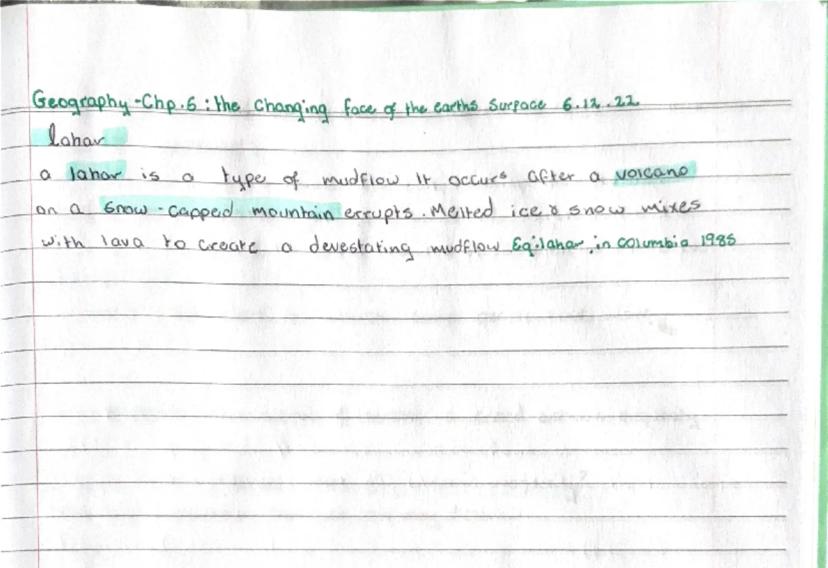
A lahar is a special and particularly dangerous type of mudflow that occurs after a volcanic eruption on a snow-capped mountain. When the hot volcanic material melts the snow and ice, it mixes with volcanic ash and debris to create a fast-moving river of mud.
The Colombia lahar of 1985 is a tragic example that shows the devastating power of these events. When the Nevado del Ruiz volcano erupted, it melted snow and ice on the mountain, creating lahars that buried the town of Armero and killed about 23,000 people.
Important to know: Lahars can travel at speeds up to 100 km/h and can be as thick as wet concrete, making them nearly impossible to escape once they're moving toward populated areas.
Our AI companion is specifically built for the needs of students. Based on the millions of content pieces we have on the platform we can provide truly meaningful and relevant answers to students. But its not only about answers, the companion is even more about guiding students through their daily learning challenges, with personalised study plans, quizzes or content pieces in the chat and 100% personalisation based on the students skills and developments.
You can download the app in the Google Play Store and in the Apple App Store.
That's right! Enjoy free access to study content, connect with fellow students, and get instant help – all at your fingertips.
1
Smart Tools NEW
Transform this note into: ✓ 50+ Practice Questions ✓ Interactive Flashcards ✓ Full Practice Test ✓ Essay Outlines
App Store
Google Play
The app is very easy to use and well designed. I have found everything I was looking for so far and have been able to learn a lot from the presentations! I will definitely use the app for a class assignment! And of course it also helps a lot as an inspiration.
Stefan S
iOS user
This app is really great. There are so many study notes and help [...]. My problem subject is French, for example, and the app has so many options for help. Thanks to this app, I have improved my French. I would recommend it to anyone.
Samantha Klich
Android user
Wow, I am really amazed. I just tried the app because I've seen it advertised many times and was absolutely stunned. This app is THE HELP you want for school and above all, it offers so many things, such as workouts and fact sheets, which have been VERY helpful to me personally.
Anna
iOS user
I think it’s very much worth it and you’ll end up using it a lot once you get the hang of it and even after looking at others notes you can still ask your Artificial intelligence buddy the question and ask to simplify it if you still don’t get it!!! In the end I think it’s worth it 😊👍 ⚠️Also DID I MENTION ITS FREEE YOU DON’T HAVE TO PAY FOR ANYTHING AND STILL GET YOUR GRADES IN PERFECTLY❗️❗️⚠️
Thomas R
iOS user
Knowunity is the BEST app I’ve used in a minute. This is not an ai review or anything this is genuinely coming from a 7th grade student (I know 2011 im young) but dude this app is a 10/10 i have maintained a 3.8 gpa and have plenty of time for gaming. I love it and my mom is just happy I got good grades
Brad T
Android user
Not only did it help me find the answer but it also showed me alternative ways to solve it. I was horrible in math and science but now I have an a in both subjects. Thanks for the help🤍🤍
David K
iOS user
The app's just great! All I have to do is enter the topic in the search bar and I get the response real fast. I don't have to watch 10 YouTube videos to understand something, so I'm saving my time. Highly recommended!
Sudenaz Ocak
Android user
In school I was really bad at maths but thanks to the app, I am doing better now. I am so grateful that you made the app.
Greenlight Bonnie
Android user
I found this app a couple years ago and it has only gotten better since then. I really love it because it can help with written questions and photo questions. Also, it can find study guides that other people have made as well as flashcard sets and practice tests. The free version is also amazing for students who might not be able to afford it. Would 100% recommend
Aubrey
iOS user
Best app if you're in Highschool or Junior high. I have been using this app for 2 school years and it's the best, it's good if you don't have anyone to help you with school work.😋🩷🎀
Marco B
iOS user
THE QUIZES AND FLASHCARDS ARE SO USEFUL AND I LOVE Knowunity AI. IT ALSO IS LITREALLY LIKE CHATGPT BUT SMARTER!! HELPED ME WITH MY MASCARA PROBLEMS TOO!! AS WELL AS MY REAL SUBJECTS ! DUHHH 😍😁😲🤑💗✨🎀😮
Elisha
iOS user
This app is phenomenal down to the correct info and the various topics you can study! I greatly recommend it for people who struggle with procrastination and those who need homework help. It has been perfectly accurate for world 1 history as far as I’ve seen! Geometry too!
Paul T
iOS user
The app is very easy to use and well designed. I have found everything I was looking for so far and have been able to learn a lot from the presentations! I will definitely use the app for a class assignment! And of course it also helps a lot as an inspiration.
Stefan S
iOS user
This app is really great. There are so many study notes and help [...]. My problem subject is French, for example, and the app has so many options for help. Thanks to this app, I have improved my French. I would recommend it to anyone.
Samantha Klich
Android user
Wow, I am really amazed. I just tried the app because I've seen it advertised many times and was absolutely stunned. This app is THE HELP you want for school and above all, it offers so many things, such as workouts and fact sheets, which have been VERY helpful to me personally.
Anna
iOS user
I think it’s very much worth it and you’ll end up using it a lot once you get the hang of it and even after looking at others notes you can still ask your Artificial intelligence buddy the question and ask to simplify it if you still don’t get it!!! In the end I think it’s worth it 😊👍 ⚠️Also DID I MENTION ITS FREEE YOU DON’T HAVE TO PAY FOR ANYTHING AND STILL GET YOUR GRADES IN PERFECTLY❗️❗️⚠️
Thomas R
iOS user
Knowunity is the BEST app I’ve used in a minute. This is not an ai review or anything this is genuinely coming from a 7th grade student (I know 2011 im young) but dude this app is a 10/10 i have maintained a 3.8 gpa and have plenty of time for gaming. I love it and my mom is just happy I got good grades
Brad T
Android user
Not only did it help me find the answer but it also showed me alternative ways to solve it. I was horrible in math and science but now I have an a in both subjects. Thanks for the help🤍🤍
David K
iOS user
The app's just great! All I have to do is enter the topic in the search bar and I get the response real fast. I don't have to watch 10 YouTube videos to understand something, so I'm saving my time. Highly recommended!
Sudenaz Ocak
Android user
In school I was really bad at maths but thanks to the app, I am doing better now. I am so grateful that you made the app.
Greenlight Bonnie
Android user
I found this app a couple years ago and it has only gotten better since then. I really love it because it can help with written questions and photo questions. Also, it can find study guides that other people have made as well as flashcard sets and practice tests. The free version is also amazing for students who might not be able to afford it. Would 100% recommend
Aubrey
iOS user
Best app if you're in Highschool or Junior high. I have been using this app for 2 school years and it's the best, it's good if you don't have anyone to help you with school work.😋🩷🎀
Marco B
iOS user
THE QUIZES AND FLASHCARDS ARE SO USEFUL AND I LOVE Knowunity AI. IT ALSO IS LITREALLY LIKE CHATGPT BUT SMARTER!! HELPED ME WITH MY MASCARA PROBLEMS TOO!! AS WELL AS MY REAL SUBJECTS ! DUHHH 😍😁😲🤑💗✨🎀😮
Elisha
iOS user
This app is phenomenal down to the correct info and the various topics you can study! I greatly recommend it for people who struggle with procrastination and those who need homework help. It has been perfectly accurate for world 1 history as far as I’ve seen! Geometry too!
Paul T
iOS user