
Ever wondered how massive mountain ranges like the Himalayas and... Show more
 Geography10 views·Updated May 25, 2026·3 pages
Fold Mountains: Exploring Their Global Distribution in Geography
C
Cayla Martin@caylamartin
1 / 3
1
of 3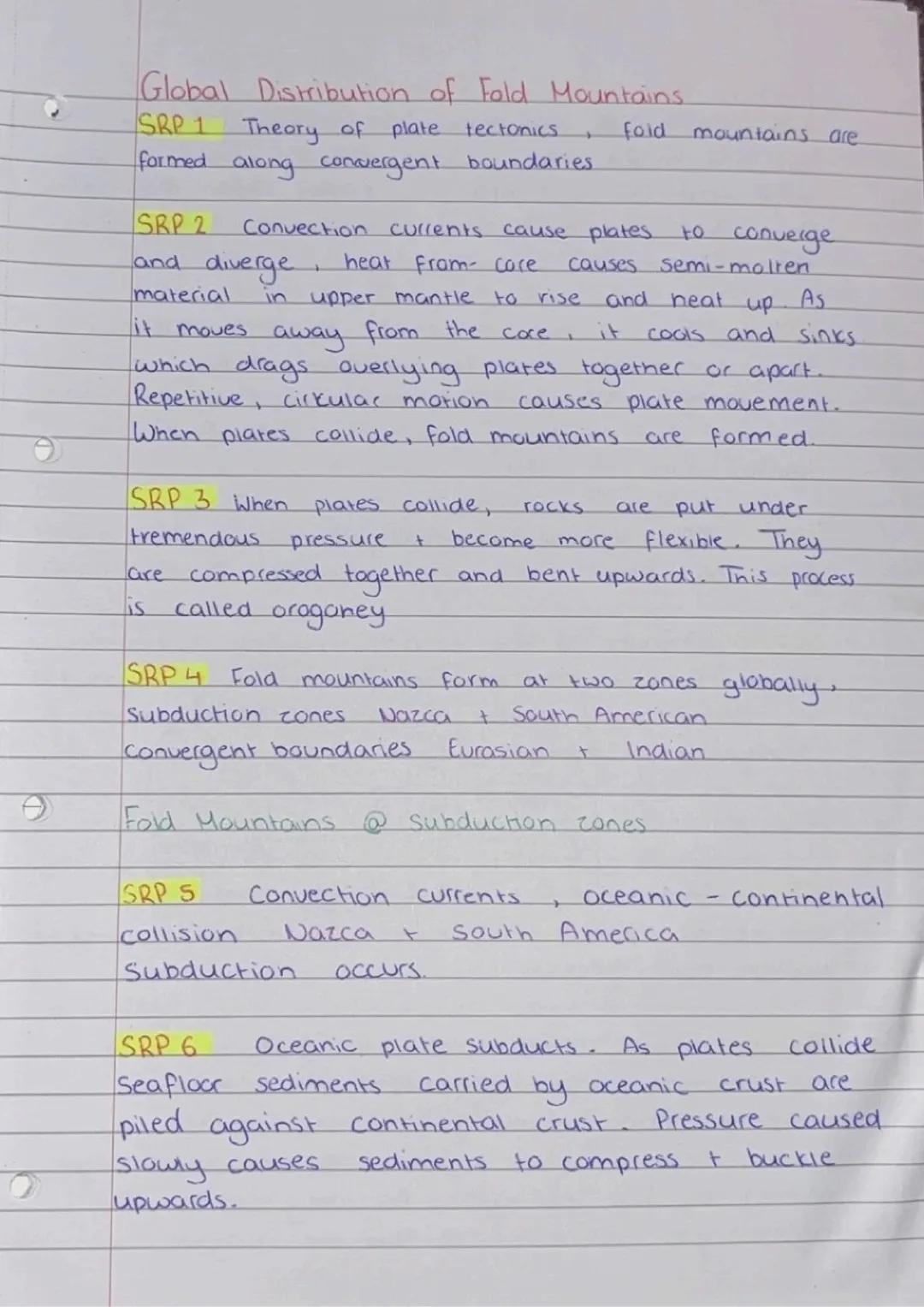
How Fold Mountains Form
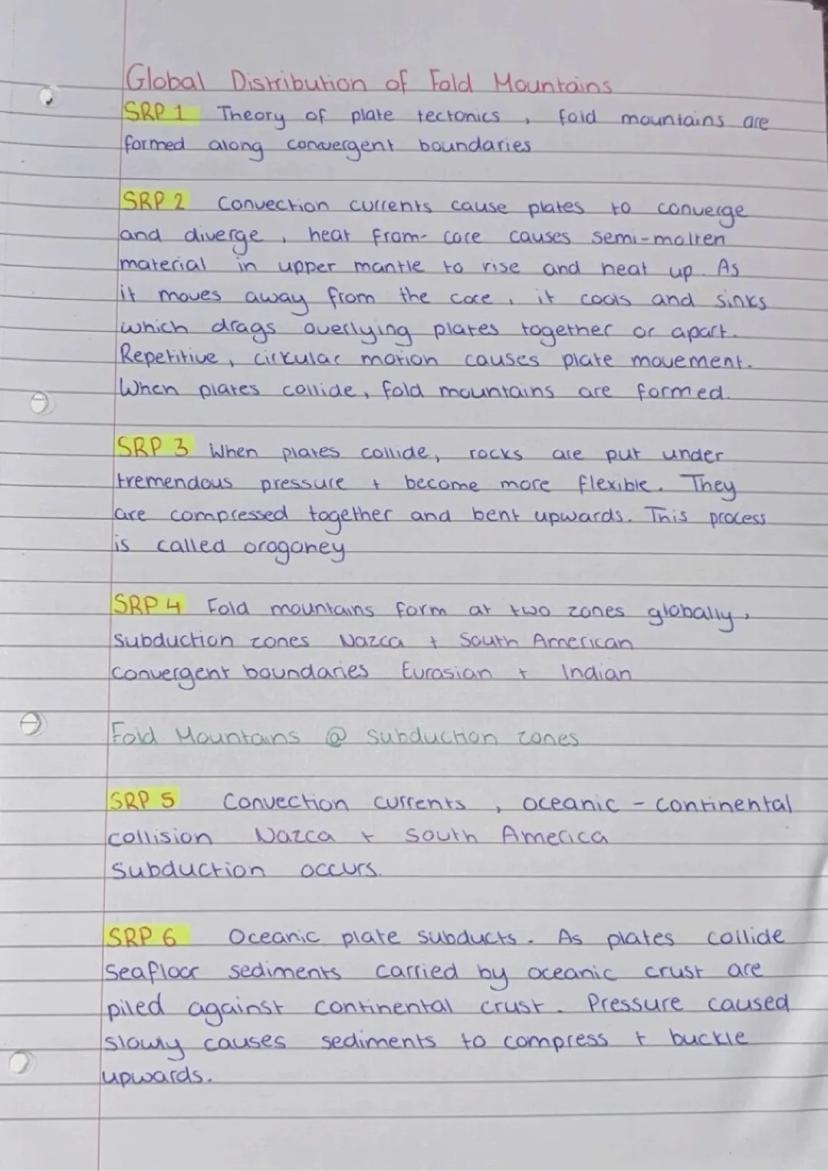
Think of fold mountains as nature's ultimate collision damage - they form when tectonic plates smash together at convergent boundaries. The theory of plate tectonics explains this perfectly.
Convection currents deep in Earth's mantle are the driving force behind everything. Heat from the core causes semi-molten material to rise, cool, and sink in a repetitive circular motion. This drags the overlying plates together or apart like a massive underground conveyor belt.
When plates collide, the rocks get squeezed under tremendous pressure and become surprisingly flexible. They compress and bend upwards through a process called orogenesis - basically Earth's way of creating mountains through folding.
Quick Tip: Remember that fold mountains form in two main zones globally - at subduction zones (like the Andes) and at convergent boundaries where continents crash together (like the Himalayas).
2
of 3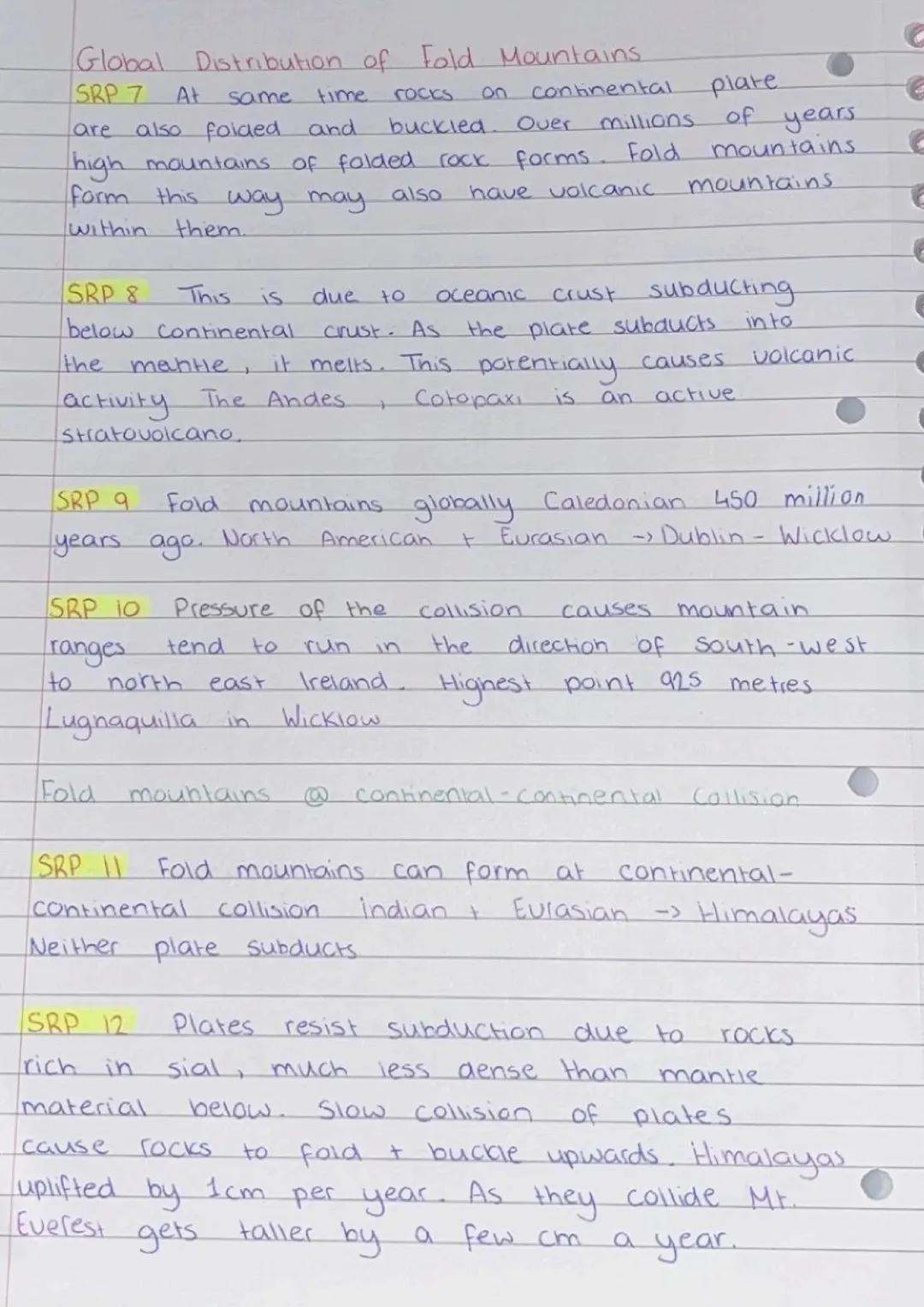
Oceanic-Continental Collisions
The Andes mountains show exactly what happens when oceanic and continental plates collide. The Nazca plate crashes into the South American plate, and because oceanic crust is denser, it gets forced underneath in a process called subduction.
As the oceanic plate dives down, it carries seafloor sediments that pile up against the continental crust. Over millions of years, this pressure compresses and buckles these sediments upwards into mountains.
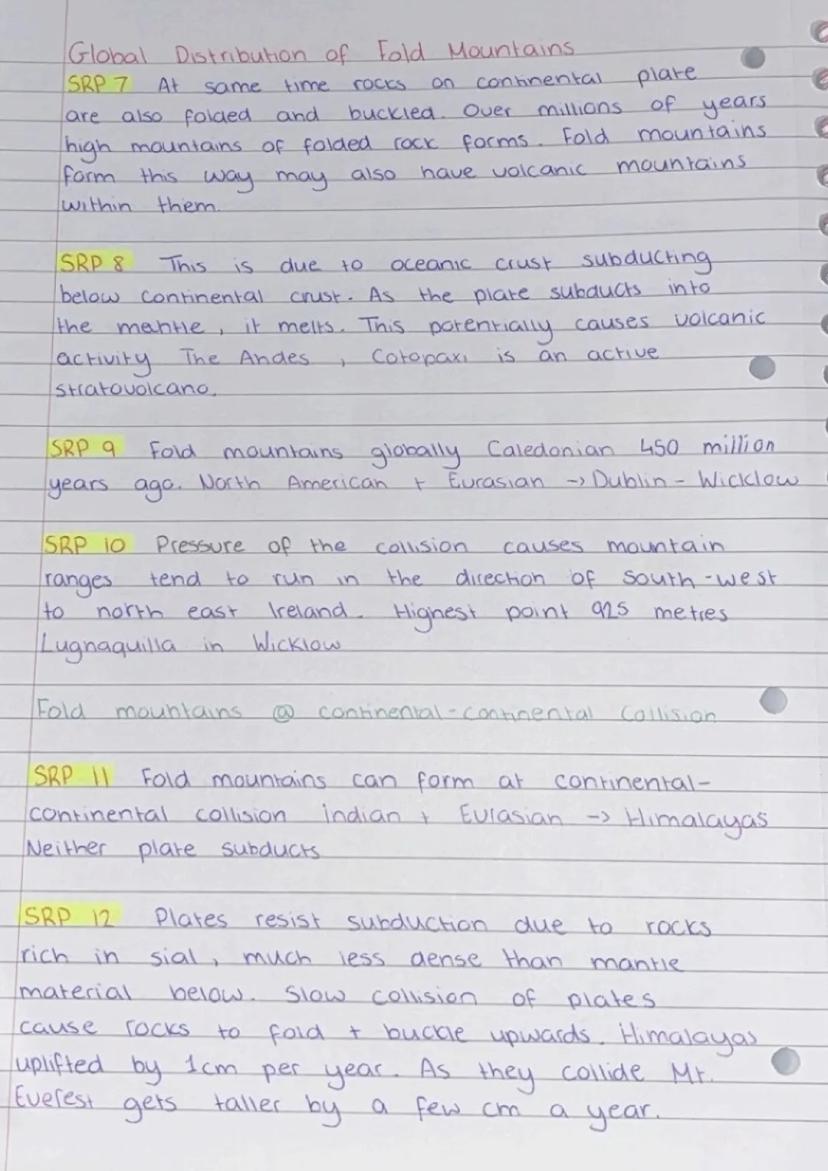
Here's where it gets interesting - the rocks on the continental plate also get folded and buckled at the same time. Plus, as the oceanic crust melts in the mantle, it can create volcanic activity within the fold mountains. That's why you'll find active volcanoes like Cotopaxi in the Andes.
Ireland has its own fold mountain story too. The Dublin-Wicklow mountains formed 450 million years ago when North American and Eurasian plates collided during the Caledonian orogeny. These mountains run southwest to northeast, with Lugnaquilla being the highest point at 925 metres.
Did You Know? The pressure from ancient plate collisions still influences Ireland's landscape today - that's why our mountain ranges follow specific directional patterns.
3
of 3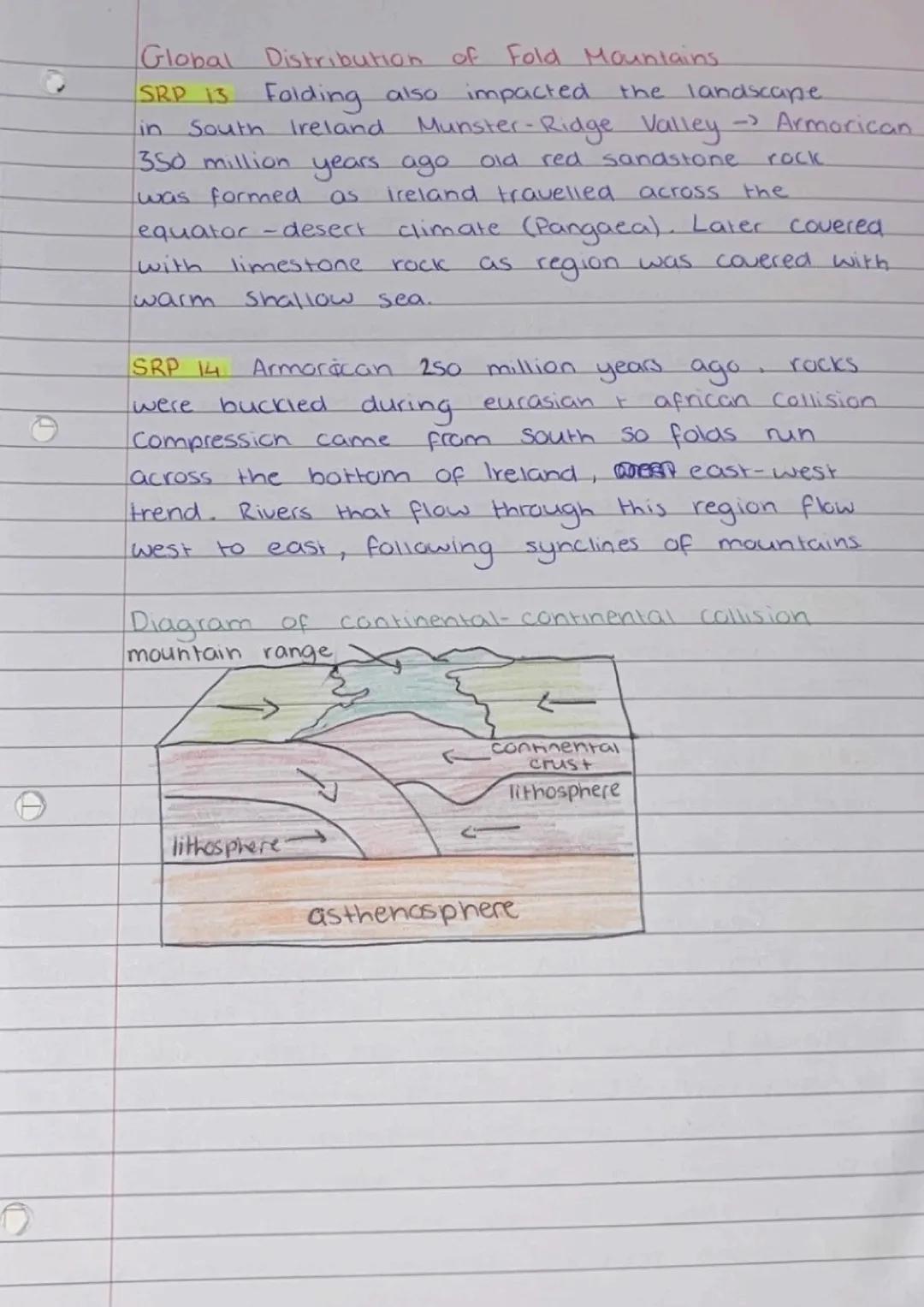
Continental-Continental Collisions
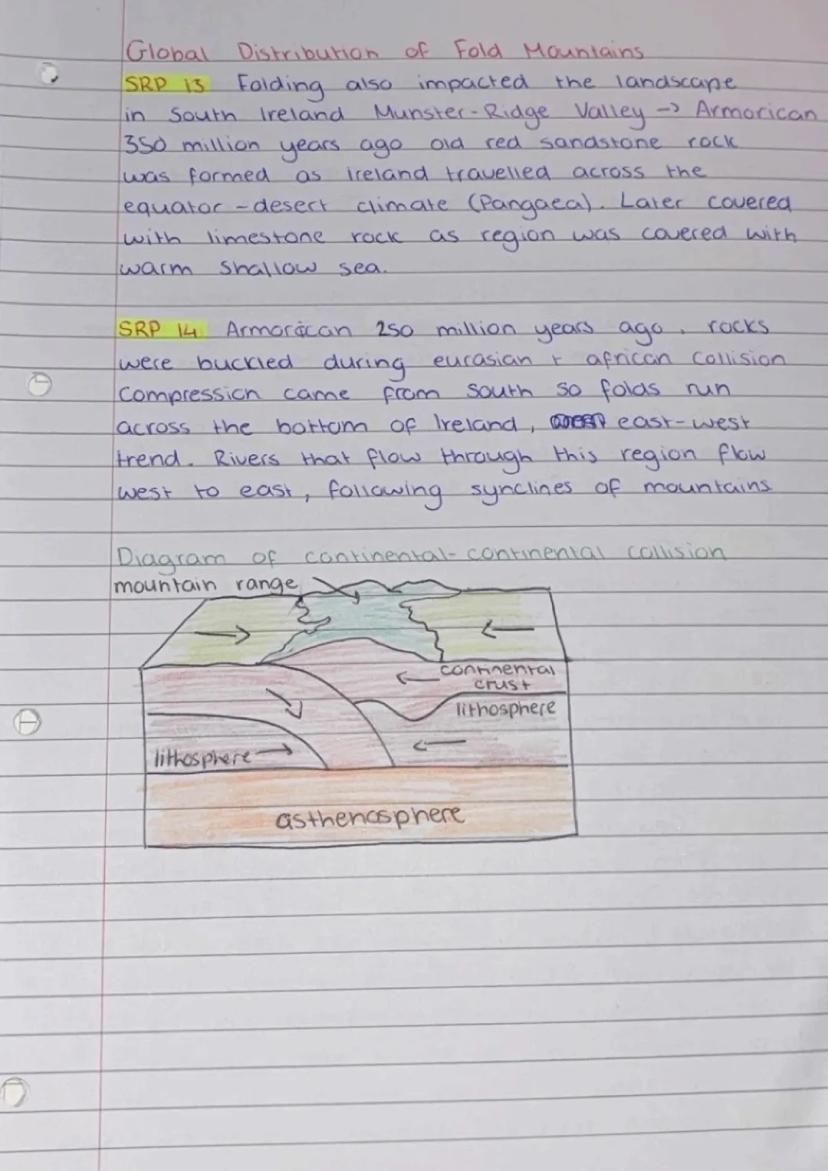
The Himalayas represent the ultimate mountain-building showdown - what happens when two continental plates refuse to back down. When the Indian and Eurasian plates collided, neither would subduct because continental rocks are much less dense than mantle material.
Instead of one plate diving under the other, both plates resist and create a slow-motion collision that forces rocks to fold and buckle upwards dramatically. The Himalayas are still growing about 1cm per year, making Mount Everest a few centimetres taller annually.
Ireland experienced this type of collision too during the Armorican orogeny 250 million years ago. When the Eurasian and African plates collided, compression from the south created the Munster Ridge-Valley landscape in southern Ireland. These folds run east-west, and rivers in the region follow the synclines (valley folds) between mountains.
The story gets even more fascinating when you consider that the rocks involved were originally old red sandstone formed when Ireland was crossing the equator in a desert climate, later covered with limestone from warm shallow seas.
Geography Hack: Notice how different collision directions create different mountain orientations - Caledonian folds run southwest-northeast, while Armorican folds run east-west across southern Ireland.
We thought you’d never ask...
What is the Knowunity AI companion?
Our AI companion is specifically built for the needs of students. Based on the millions of content pieces we have on the platform we can provide truly meaningful and relevant answers to students. But its not only about answers, the companion is even more about guiding students through their daily learning challenges, with personalised study plans, quizzes or content pieces in the chat and 100% personalisation based on the students skills and developments.
Where can I download the Knowunity app?
You can download the app in the Google Play Store and in the Apple App Store.
Is Knowunity really free of charge?
That's right! Enjoy free access to study content, connect with fellow students, and get instant help – all at your fingertips.
Most popular content in Geography
9Most popular content
9Can't find what you're looking for? Explore other subjects.
Students love us — and so will you.
4.6/5App Store
4.7/5Google Play
The app is very easy to use and well designed. I have found everything I was looking for so far and have been able to learn a lot from the presentations! I will definitely use the app for a class assignment! And of course it also helps a lot as an inspiration.
Stefan SiOS user
This app is really great. There are so many study notes and help [...]. My problem subject is French, for example, and the app has so many options for help. Thanks to this app, I have improved my French. I would recommend it to anyone.
Samantha KlichAndroid user
Wow, I am really amazed. I just tried the app because I've seen it advertised many times and was absolutely stunned. This app is THE HELP you want for school and above all, it offers so many things, such as workouts and fact sheets, which have been VERY helpful to me personally.
AnnaiOS user
Geography10 views·Updated May 25, 2026·3 pagesFold Mountains: Exploring Their Global Distribution in Geography
C
Cayla Martin@caylamartin
Ever wondered how massive mountain ranges like the Himalayas and the Andes formed? Fold mountainsare created when Earth's tectonic plates crash into each other with incredible force, buckling and folding rock layers upwards over millions of years. Understanding plate... Show more
1
of 3Sign up to see the content. It's free!
- Access to all documents
- Improve your grades
- Join milions of students
How Fold Mountains Form
Think of fold mountains as nature's ultimate collision damage - they form when tectonic plates smash together at convergent boundaries. The theory of plate tectonics explains this perfectly.
Convection currents deep in Earth's mantle are the driving force behind everything. Heat from the core causes semi-molten material to rise, cool, and sink in a repetitive circular motion. This drags the overlying plates together or apart like a massive underground conveyor belt.
When plates collide, the rocks get squeezed under tremendous pressure and become surprisingly flexible. They compress and bend upwards through a process called orogenesis - basically Earth's way of creating mountains through folding.
Quick Tip: Remember that fold mountains form in two main zones globally - at subduction zones (like the Andes) and at convergent boundaries where continents crash together (like the Himalayas).
2
of 3Sign up to see the content. It's free!
- Access to all documents
- Improve your grades
- Join milions of students
Oceanic-Continental Collisions
The Andes mountains show exactly what happens when oceanic and continental plates collide. The Nazca plate crashes into the South American plate, and because oceanic crust is denser, it gets forced underneath in a process called subduction.
As the oceanic plate dives down, it carries seafloor sediments that pile up against the continental crust. Over millions of years, this pressure compresses and buckles these sediments upwards into mountains.
Here's where it gets interesting - the rocks on the continental plate also get folded and buckled at the same time. Plus, as the oceanic crust melts in the mantle, it can create volcanic activity within the fold mountains. That's why you'll find active volcanoes like Cotopaxi in the Andes.
Ireland has its own fold mountain story too. The Dublin-Wicklow mountains formed 450 million years ago when North American and Eurasian plates collided during the Caledonian orogeny. These mountains run southwest to northeast, with Lugnaquilla being the highest point at 925 metres.
Did You Know? The pressure from ancient plate collisions still influences Ireland's landscape today - that's why our mountain ranges follow specific directional patterns.
3
of 3Sign up to see the content. It's free!
- Access to all documents
- Improve your grades
- Join milions of students
Continental-Continental Collisions
The Himalayas represent the ultimate mountain-building showdown - what happens when two continental plates refuse to back down. When the Indian and Eurasian plates collided, neither would subduct because continental rocks are much less dense than mantle material.
Instead of one plate diving under the other, both plates resist and create a slow-motion collision that forces rocks to fold and buckle upwards dramatically. The Himalayas are still growing about 1cm per year, making Mount Everest a few centimetres taller annually.
Ireland experienced this type of collision too during the Armorican orogeny 250 million years ago. When the Eurasian and African plates collided, compression from the south created the Munster Ridge-Valley landscape in southern Ireland. These folds run east-west, and rivers in the region follow the synclines (valley folds) between mountains.
The story gets even more fascinating when you consider that the rocks involved were originally old red sandstone formed when Ireland was crossing the equator in a desert climate, later covered with limestone from warm shallow seas.
Geography Hack: Notice how different collision directions create different mountain orientations - Caledonian folds run southwest-northeast, while Armorican folds run east-west across southern Ireland.
We thought you’d never ask...
What is the Knowunity AI companion?
Our AI companion is specifically built for the needs of students. Based on the millions of content pieces we have on the platform we can provide truly meaningful and relevant answers to students. But its not only about answers, the companion is even more about guiding students through their daily learning challenges, with personalised study plans, quizzes or content pieces in the chat and 100% personalisation based on the students skills and developments.
Where can I download the Knowunity app?
You can download the app in the Google Play Store and in the Apple App Store.
Is Knowunity really free of charge?
That's right! Enjoy free access to study content, connect with fellow students, and get instant help – all at your fingertips.
Most popular content in Geography
9Most popular content
9Can't find what you're looking for? Explore other subjects.
Students love us — and so will you.
4.6/5App Store
4.7/5Google Play
The app is very easy to use and well designed. I have found everything I was looking for so far and have been able to learn a lot from the presentations! I will definitely use the app for a class assignment! And of course it also helps a lot as an inspiration.
Stefan SiOS user
This app is really great. There are so many study notes and help [...]. My problem subject is French, for example, and the app has so many options for help. Thanks to this app, I have improved my French. I would recommend it to anyone.
Samantha KlichAndroid user
Wow, I am really amazed. I just tried the app because I've seen it advertised many times and was absolutely stunned. This app is THE HELP you want for school and above all, it offers so many things, such as workouts and fact sheets, which have been VERY helpful to me personally.
AnnaiOS user