
Earthquakes are one of nature's most powerful forces, capable of... Show more
 Geography
 Irish
Irish English
 Biology
Sign up to see the contentIt's free!
Access to all documents
Improve your grades
Join milions of students
Knowunity AI
Subjects
Triangle Congruence and Similarity Theorems
Triangle Properties and Classification
Linear Equations and Graphs
Geometric Angle Relationships
Trigonometric Functions and Identities
Equation Solving Techniques
Circle Geometry Fundamentals
Division Operations and Methods
Basic Differentiation Rules
Exponent and Logarithm Properties
Show all topics
Human Organ Systems
Reproductive Cell Cycles
Biological Sciences Subdisciplines
Cellular Energy Metabolism
Autotrophic Energy Processes
Inheritance Patterns and Principles
Biomolecular Structure and Organization
Cell Cycle and Division Mechanics
Cellular Organization and Development
Biological Structural Organization
Show all topics
Chemical Sciences and Applications
Atomic Structure and Composition
Molecular Electron Structure Representation
Atomic Electron Behavior
Matter Properties and Water
Mole Concept and Calculations
Gas Laws and Behavior
Periodic Table Organization
Chemical Thermodynamics Fundamentals
Chemical Bond Types and Properties
Show all topics
European Renaissance and Enlightenment
European Cultural Movements 800-1920
American Revolution Era 1763-1797
American Civil War 1861-1865
Global Imperial Systems
Mongol and Chinese Dynasties
U.S. Presidents and World Leaders
Historical Sources and Documentation
World Wars Era and Impact
World Religious Systems
Show all topics
Classic and Contemporary Novels
Literary Character Analysis
Rhetorical Theory and Practice
Classic Literary Narratives
Reading Analysis and Interpretation
Narrative Structure and Techniques
English Language Components
Influential English-Language Authors
Basic Sentence Structure
Narrative Voice and Perspective
Show all topics
8
•
Updated Apr 10, 2026
•
Earthquakes are one of nature's most powerful forces, capable of... Show more

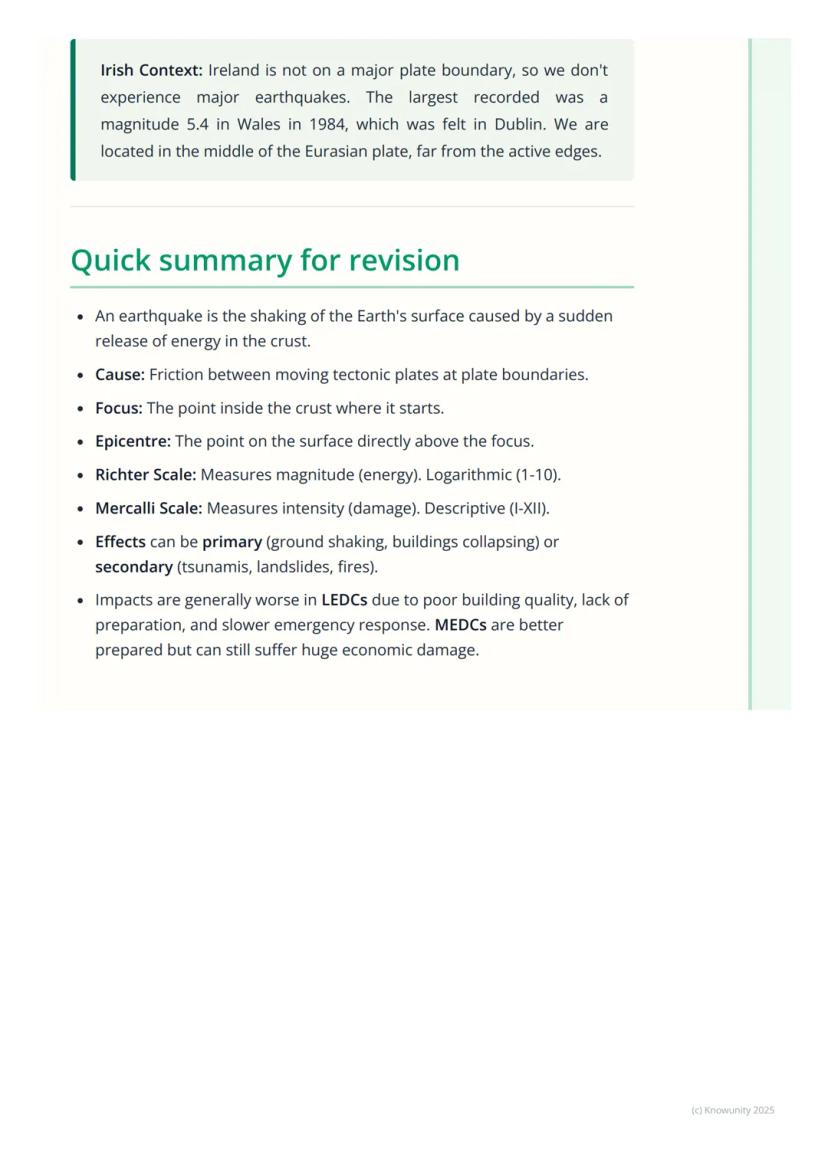
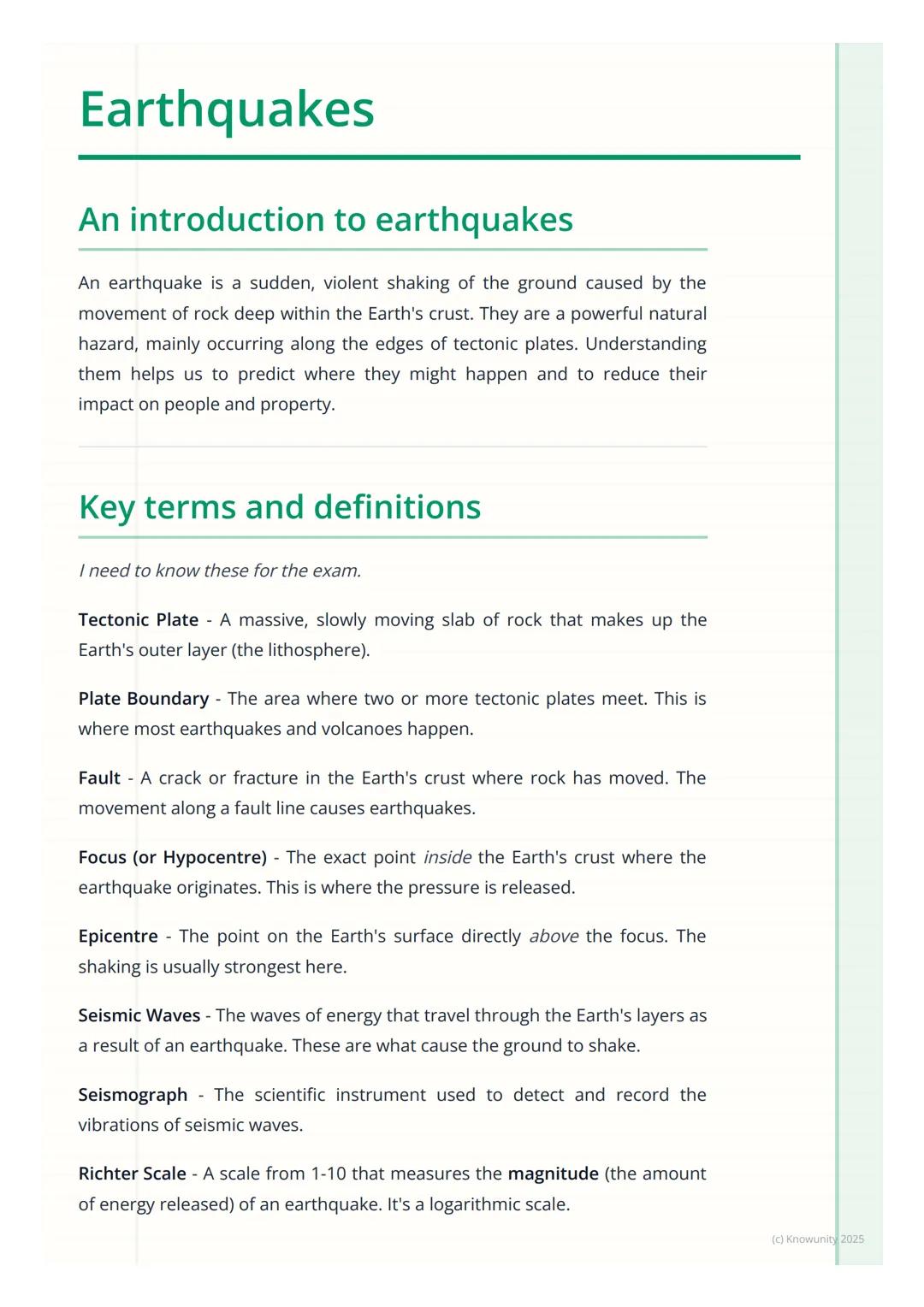
When the ground suddenly starts shaking beneath your feet, you're experiencing an earthquake - a violent tremor caused by rock movements deep within Earth's crust. These natural disasters mainly happen along tectonic plate boundaries, where massive slabs of rock are constantly shifting and grinding against each other.
Getting the key terms straight is absolutely essential for your exams. The focus (or hypocentre) is where the earthquake actually starts underground, whilst the epicentre sits directly above it on Earth's surface. Think of it like dropping a stone in water - the focus is the stone hitting the bottom, and the epicentre is where the ripples start on the surface.
Seismic waves carry the earthquake's energy outward from the focus, creating the shaking we feel. Scientists detect these using a seismograph, which records the vibrations and helps measure the earthquake's strength. The Richter Scale measures magnitude (energy released) from 1-10, whilst the Mercalli Scale uses Roman numerals to describe intensity based on damage caused.
Key Point: Don't mix up focus and epicentre - focus is underground where it starts, epicentre is on the surface directly above!
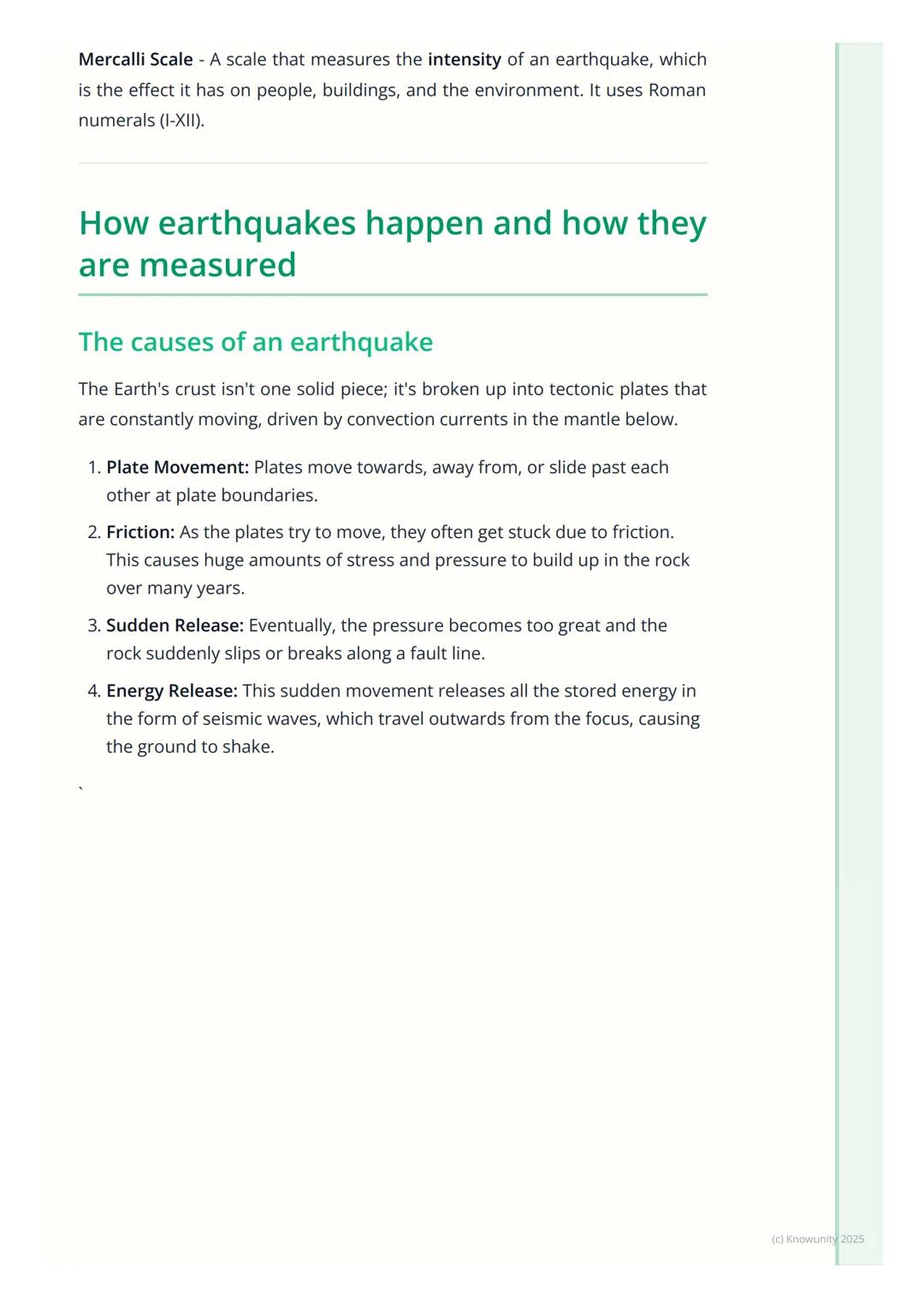
Picture Earth's surface like a massive jigsaw puzzle where the pieces are constantly moving. These tectonic plates float on the molten rock below, driven by heat currents called convection currents in the mantle.
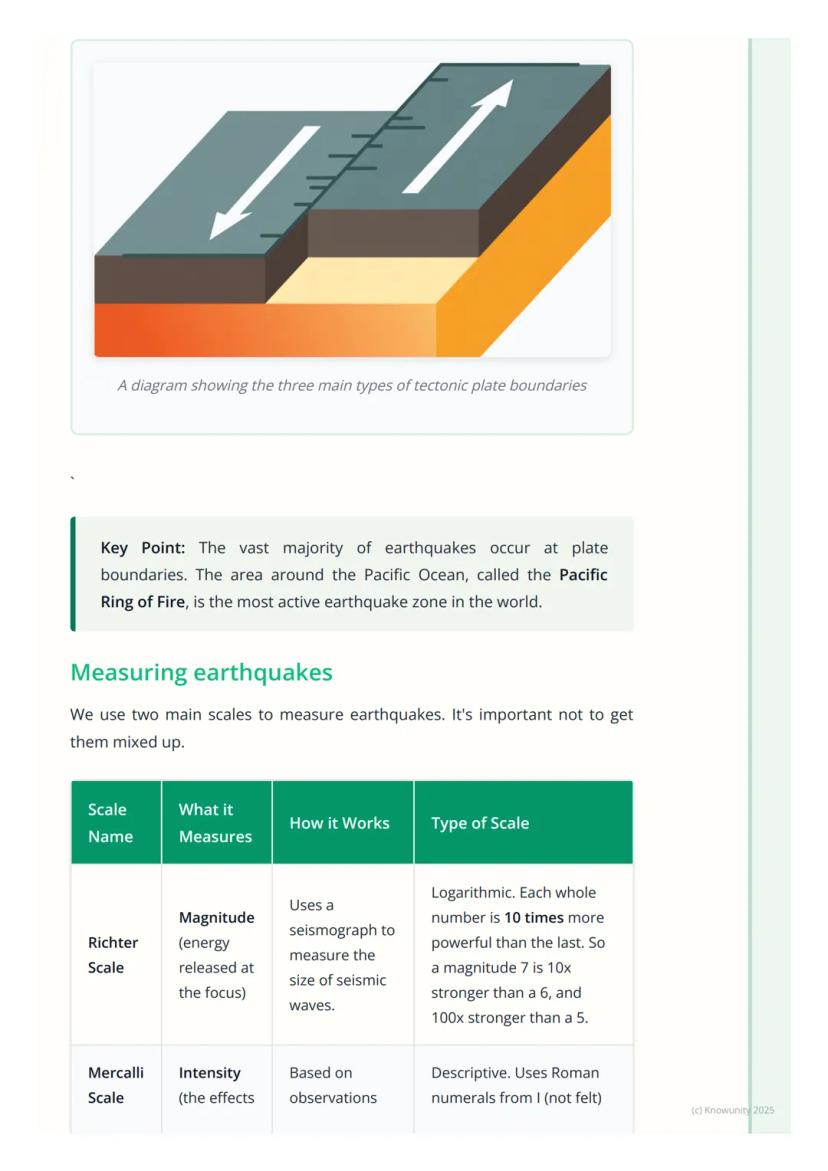
The drama starts when plates try to move past, towards, or away from each other at plate boundaries. However, they often get stuck due to friction, like trying to slide two rough pieces of sandpaper against each other. This creates enormous pressure that builds up over years or even decades.
Eventually, the stress becomes too much and the rock suddenly snaps or slips along a fault line. All that stored energy explodes outward as seismic waves, causing the ground to shake violently. It's like stretching an elastic band until it snaps - the sudden release creates the earthquake.
Remember: Most earthquakes happen at plate boundaries, especially around the Pacific Ring of Fire, which is the world's most active earthquake zone.
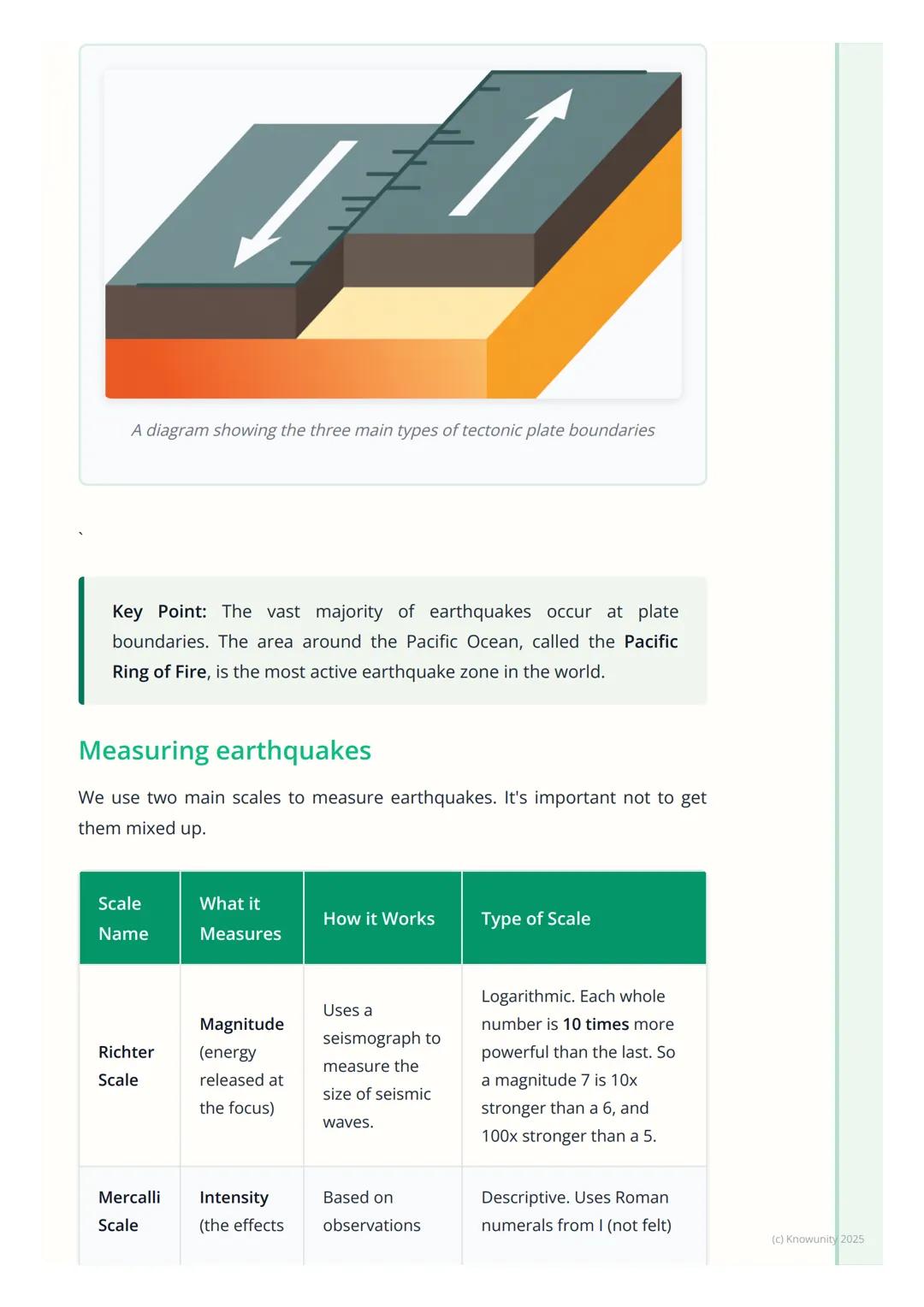
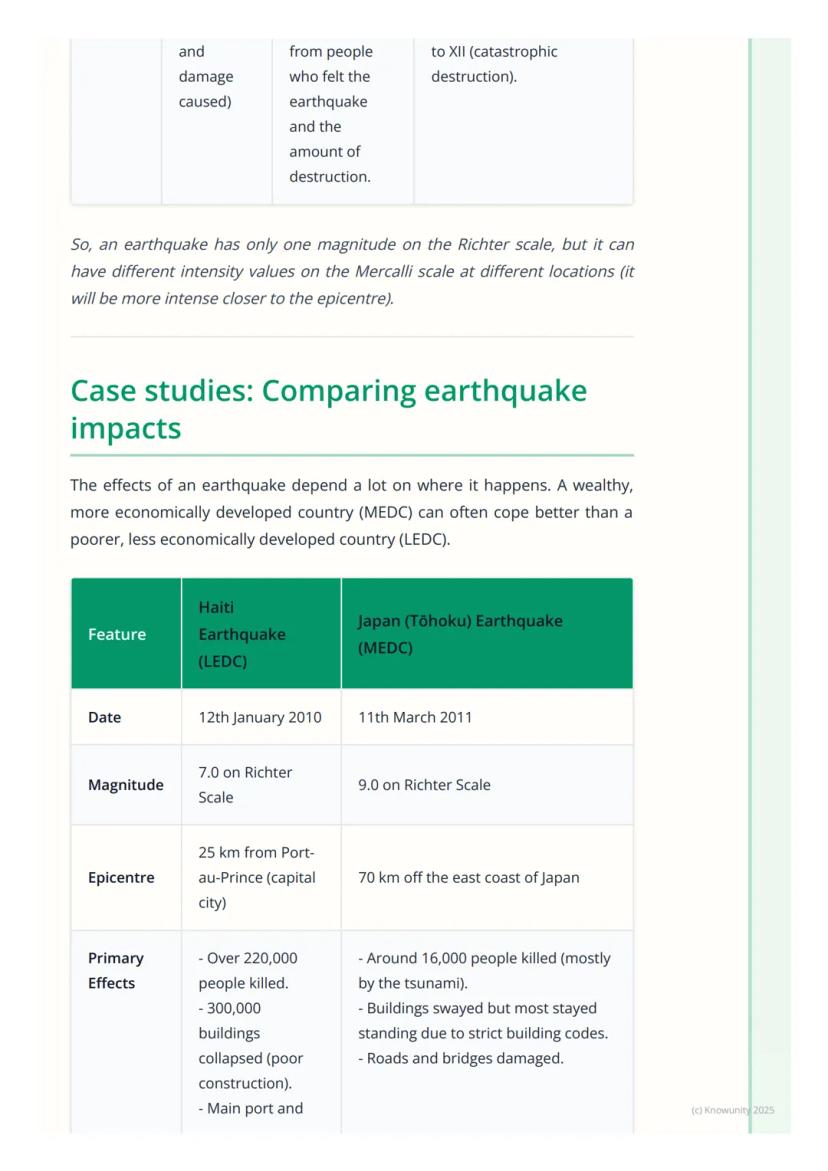
Scientists use two completely different scales to measure earthquakes, and mixing them up is a classic exam mistake. The Richter Scale measures magnitude - essentially how much energy the earthquake releases. It runs from 1-10 and is logarithmic, meaning each number represents 10 times more energy than the previous one.
The Mercalli Scale measures intensity - the actual damage and effects people experience. It uses Roman numerals from I (barely felt) to XII (total destruction). Here's the crucial difference: an earthquake has only one magnitude on the Richter Scale, but can have different intensities at various locations.
Think of it this way: Richter measures the "release of energy," whilst Mercalli measures the "mess it makes." The intensity will be strongest near the epicentre and weaker further away, but the magnitude stays the same everywhere.
Exam Tip: Remember "Richter = Release, Mercalli = Mess" to avoid confusion between the two scales.
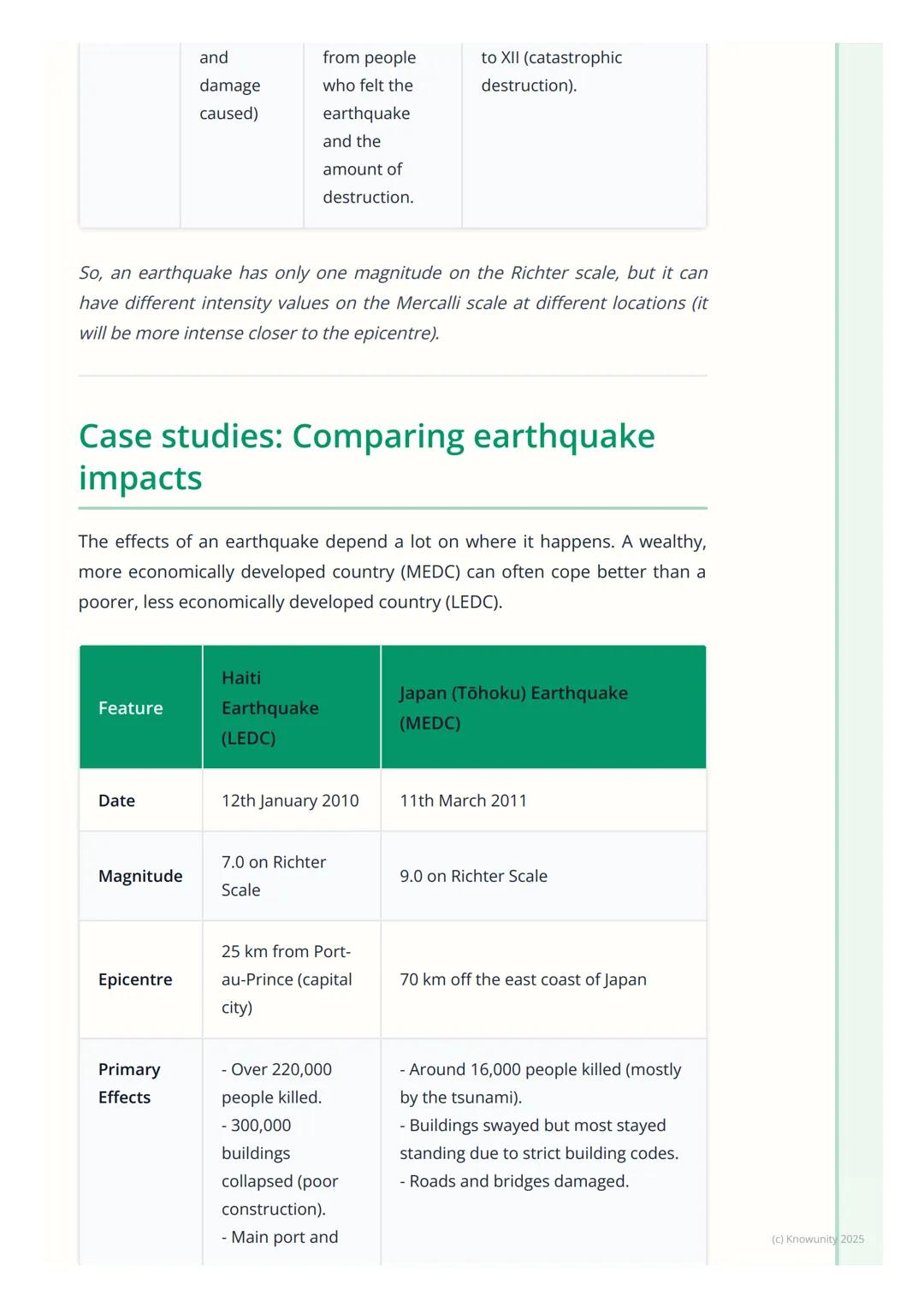
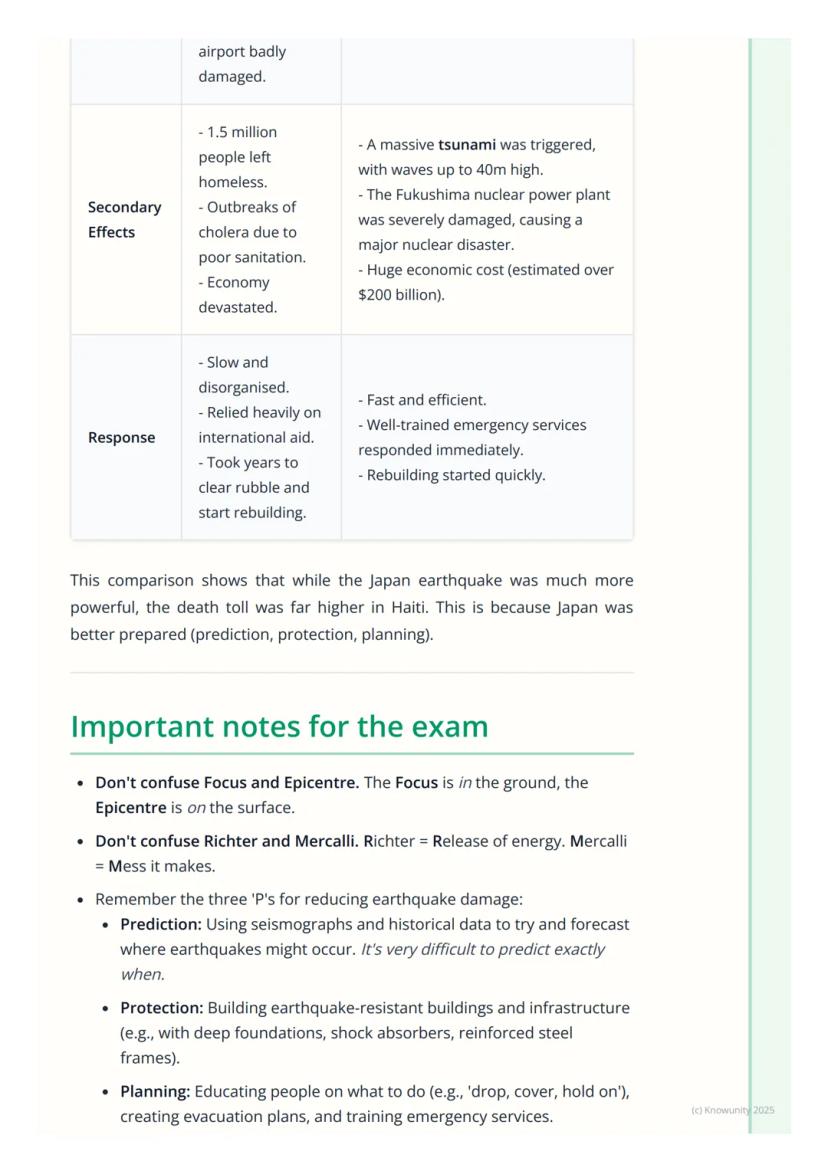
Comparing the 2010 Haiti earthquake with the 2011 Japan earthquake perfectly shows how location and preparation matter more than raw power. Haiti's magnitude 7.0 quake killed over 220,000 people, whilst Japan's massive 9.0 earthquake (much more powerful) killed around 16,000.
The difference comes down to wealth and preparation. Haiti, as a less economically developed country (LEDC), had poorly constructed buildings that collapsed like dominoes. The main port and airport were destroyed, leaving 1.5 million people homeless and triggering cholera outbreaks due to poor sanitation.
Japan, being a more economically developed country (MEDC), had strict building codes that kept most structures standing. Their emergency services responded immediately, and rebuilding started quickly. However, the earthquake triggered a devastating tsunami and the Fukushima nuclear disaster, showing that even wealthy countries face serious challenges.
Key Point: The Haiti earthquake was far less powerful but much deadlier, proving that preparation and building quality matter more than earthquake strength.
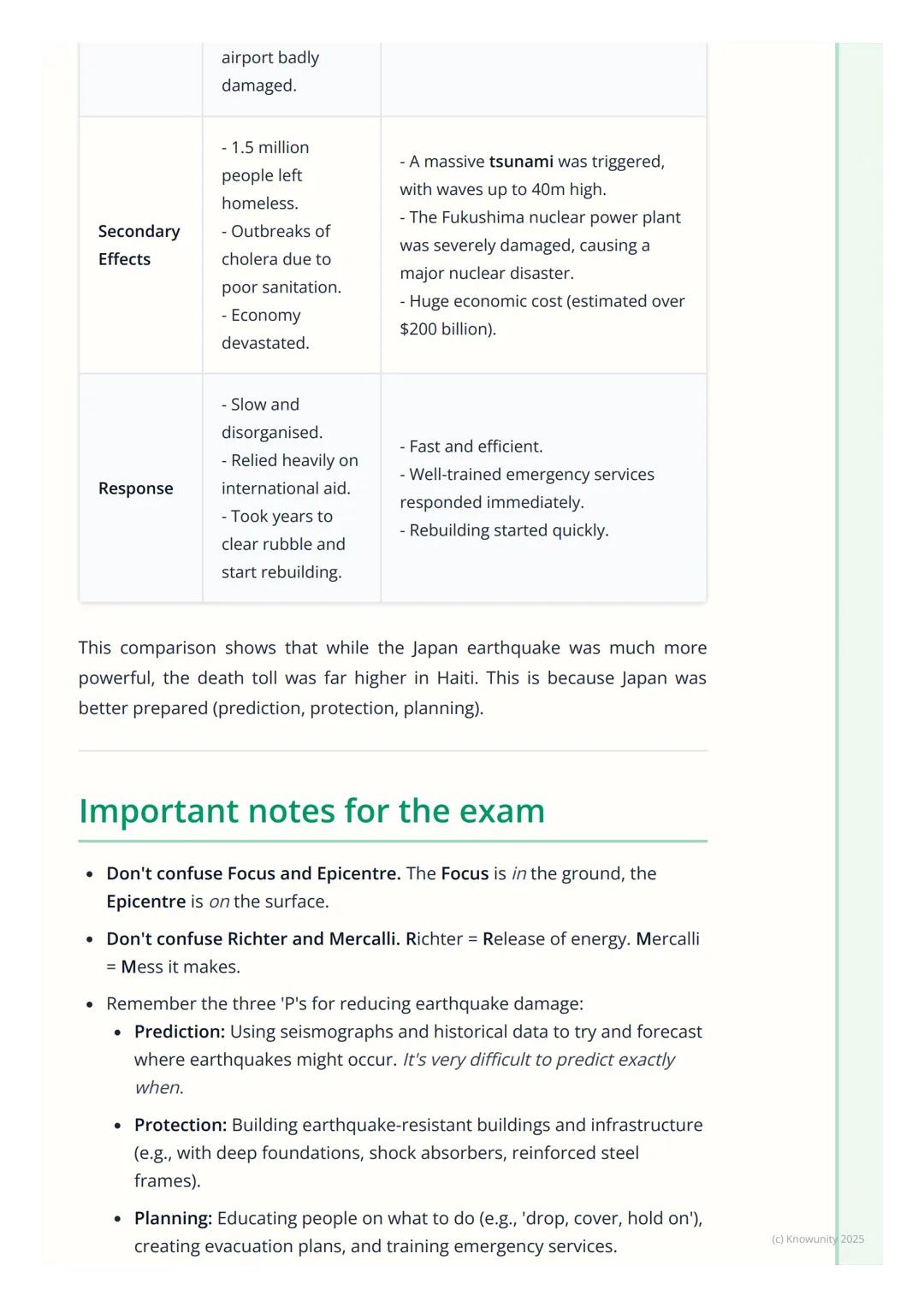
Countries protect themselves from earthquake damage using the three P's: Prediction, Protection, and Planning. Understanding these could be crucial for your exams and real-life safety.
Prediction involves using seismographs and historical data to forecast where earthquakes might strike. However, predicting exactly when remains nearly impossible - scientists can identify high-risk areas but can't give precise timing.
Protection focuses on building earthquake-resistant structures with deep foundations, shock absorbers, and reinforced steel frames. Modern buildings in earthquake-prone areas are designed to sway rather than collapse, potentially saving thousands of lives.
Planning means educating people about safety procedures like "drop, cover, hold on," creating evacuation routes, and training emergency services. Well-prepared communities can respond quickly and effectively when disaster strikes.
Life-Saving Tip: During an earthquake, drop to hands and knees, take cover under a sturdy desk or table, and hold on until the shaking stops.
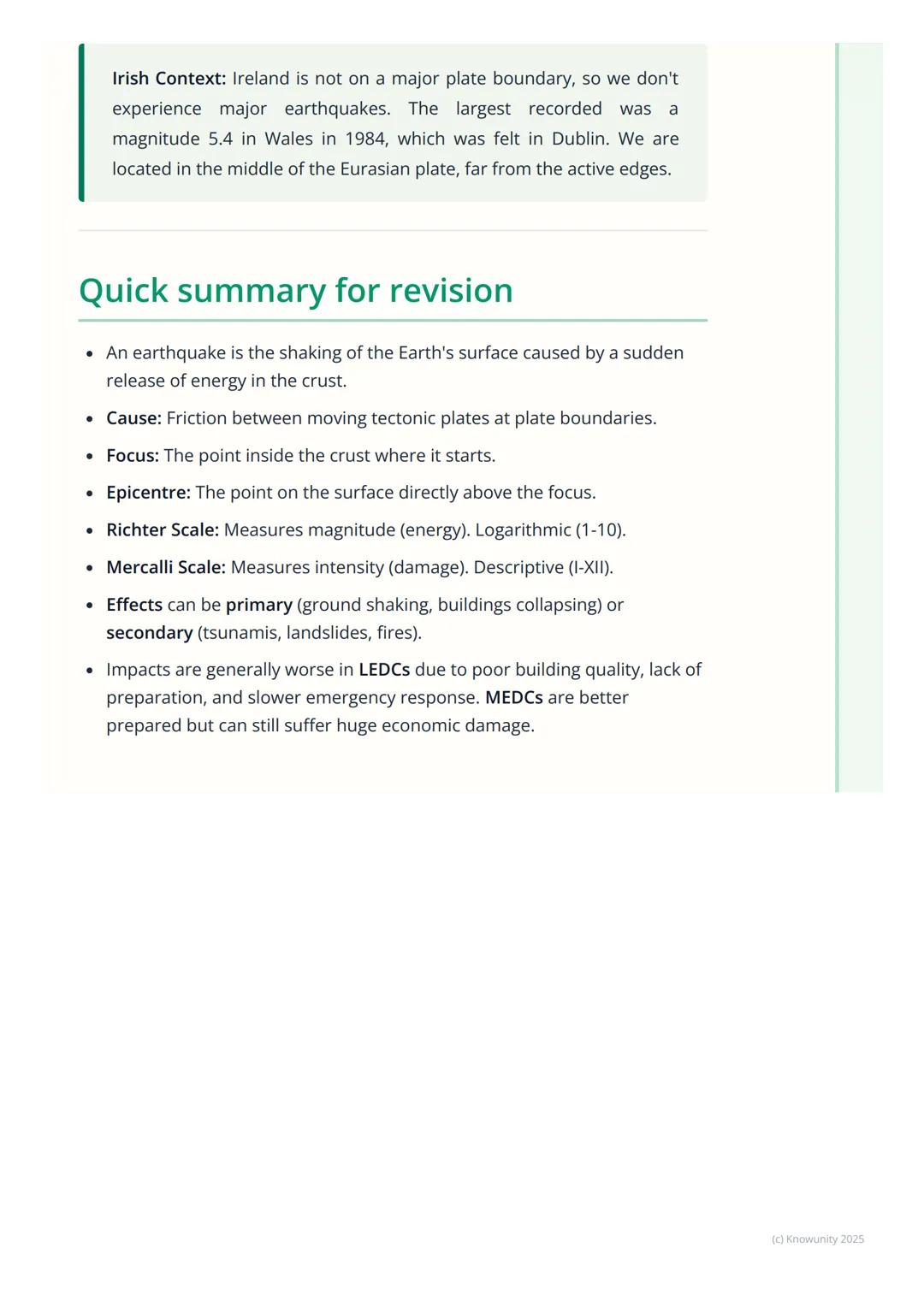
Here's your complete earthquake knowledge in bite-sized chunks, perfect for last-minute revision. An earthquake is ground shaking caused by sudden energy release in Earth's crust, typically occurring when tectonic plates get stuck and then suddenly slip at plate boundaries.
Remember that the focus is underground where it starts, whilst the epicentre sits on the surface directly above. The Richter Scale measures magnitude , and the Mercalli Scale measures intensity .
Effects split into primary (immediate ground shaking, building collapse) and secondary (tsunamis, landslides, fires). Generally, LEDCs suffer worse casualties due to poor building quality and slow emergency response, whilst MEDCs face huge economic costs but fewer deaths.
Ireland sits safely in the middle of the Eurasian plate, far from active boundaries, so we rarely experience significant earthquakes. The strongest we've felt was magnitude 5.4 from Wales in 1984.
Exam Success: Focus on the three P's (Prediction, Protection, Planning) and always compare LEDC vs MEDC responses in your answers.
Our AI companion is specifically built for the needs of students. Based on the millions of content pieces we have on the platform we can provide truly meaningful and relevant answers to students. But its not only about answers, the companion is even more about guiding students through their daily learning challenges, with personalised study plans, quizzes or content pieces in the chat and 100% personalisation based on the students skills and developments.
You can download the app in the Google Play Store and in the Apple App Store.
That's right! Enjoy free access to study content, connect with fellow students, and get instant help – all at your fingertips.
App Store
Google Play
The app is very easy to use and well designed. I have found everything I was looking for so far and have been able to learn a lot from the presentations! I will definitely use the app for a class assignment! And of course it also helps a lot as an inspiration.
Stefan S
iOS user
This app is really great. There are so many study notes and help [...]. My problem subject is French, for example, and the app has so many options for help. Thanks to this app, I have improved my French. I would recommend it to anyone.
Samantha Klich
Android user
Wow, I am really amazed. I just tried the app because I've seen it advertised many times and was absolutely stunned. This app is THE HELP you want for school and above all, it offers so many things, such as workouts and fact sheets, which have been VERY helpful to me personally.
Anna
iOS user
I think it’s very much worth it and you’ll end up using it a lot once you get the hang of it and even after looking at others notes you can still ask your Artificial intelligence buddy the question and ask to simplify it if you still don’t get it!!! In the end I think it’s worth it 😊👍 ⚠️Also DID I MENTION ITS FREEE YOU DON’T HAVE TO PAY FOR ANYTHING AND STILL GET YOUR GRADES IN PERFECTLY❗️❗️⚠️
Thomas R
iOS user
Knowunity is the BEST app I’ve used in a minute. This is not an ai review or anything this is genuinely coming from a 7th grade student (I know 2011 im young) but dude this app is a 10/10 i have maintained a 3.8 gpa and have plenty of time for gaming. I love it and my mom is just happy I got good grades
Brad T
Android user
Not only did it help me find the answer but it also showed me alternative ways to solve it. I was horrible in math and science but now I have an a in both subjects. Thanks for the help🤍🤍
David K
iOS user
The app's just great! All I have to do is enter the topic in the search bar and I get the response real fast. I don't have to watch 10 YouTube videos to understand something, so I'm saving my time. Highly recommended!
Sudenaz Ocak
Android user
In school I was really bad at maths but thanks to the app, I am doing better now. I am so grateful that you made the app.
Greenlight Bonnie
Android user
I found this app a couple years ago and it has only gotten better since then. I really love it because it can help with written questions and photo questions. Also, it can find study guides that other people have made as well as flashcard sets and practice tests. The free version is also amazing for students who might not be able to afford it. Would 100% recommend
Aubrey
iOS user
Best app if you're in Highschool or Junior high. I have been using this app for 2 school years and it's the best, it's good if you don't have anyone to help you with school work.😋🩷🎀
Marco B
iOS user
THE QUIZES AND FLASHCARDS ARE SO USEFUL AND I LOVE Knowunity AI. IT ALSO IS LITREALLY LIKE CHATGPT BUT SMARTER!! HELPED ME WITH MY MASCARA PROBLEMS TOO!! AS WELL AS MY REAL SUBJECTS ! DUHHH 😍😁😲🤑💗✨🎀😮
Elisha
iOS user
This app is phenomenal down to the correct info and the various topics you can study! I greatly recommend it for people who struggle with procrastination and those who need homework help. It has been perfectly accurate for world 1 history as far as I’ve seen! Geometry too!
Paul T
iOS user
The app is very easy to use and well designed. I have found everything I was looking for so far and have been able to learn a lot from the presentations! I will definitely use the app for a class assignment! And of course it also helps a lot as an inspiration.
Stefan S
iOS user
This app is really great. There are so many study notes and help [...]. My problem subject is French, for example, and the app has so many options for help. Thanks to this app, I have improved my French. I would recommend it to anyone.
Samantha Klich
Android user
Wow, I am really amazed. I just tried the app because I've seen it advertised many times and was absolutely stunned. This app is THE HELP you want for school and above all, it offers so many things, such as workouts and fact sheets, which have been VERY helpful to me personally.
Anna
iOS user
I think it’s very much worth it and you’ll end up using it a lot once you get the hang of it and even after looking at others notes you can still ask your Artificial intelligence buddy the question and ask to simplify it if you still don’t get it!!! In the end I think it’s worth it 😊👍 ⚠️Also DID I MENTION ITS FREEE YOU DON’T HAVE TO PAY FOR ANYTHING AND STILL GET YOUR GRADES IN PERFECTLY❗️❗️⚠️
Thomas R
iOS user
Knowunity is the BEST app I’ve used in a minute. This is not an ai review or anything this is genuinely coming from a 7th grade student (I know 2011 im young) but dude this app is a 10/10 i have maintained a 3.8 gpa and have plenty of time for gaming. I love it and my mom is just happy I got good grades
Brad T
Android user
Not only did it help me find the answer but it also showed me alternative ways to solve it. I was horrible in math and science but now I have an a in both subjects. Thanks for the help🤍🤍
David K
iOS user
The app's just great! All I have to do is enter the topic in the search bar and I get the response real fast. I don't have to watch 10 YouTube videos to understand something, so I'm saving my time. Highly recommended!
Sudenaz Ocak
Android user
In school I was really bad at maths but thanks to the app, I am doing better now. I am so grateful that you made the app.
Greenlight Bonnie
Android user
I found this app a couple years ago and it has only gotten better since then. I really love it because it can help with written questions and photo questions. Also, it can find study guides that other people have made as well as flashcard sets and practice tests. The free version is also amazing for students who might not be able to afford it. Would 100% recommend
Aubrey
iOS user
Best app if you're in Highschool or Junior high. I have been using this app for 2 school years and it's the best, it's good if you don't have anyone to help you with school work.😋🩷🎀
Marco B
iOS user
THE QUIZES AND FLASHCARDS ARE SO USEFUL AND I LOVE Knowunity AI. IT ALSO IS LITREALLY LIKE CHATGPT BUT SMARTER!! HELPED ME WITH MY MASCARA PROBLEMS TOO!! AS WELL AS MY REAL SUBJECTS ! DUHHH 😍😁😲🤑💗✨🎀😮
Elisha
iOS user
This app is phenomenal down to the correct info and the various topics you can study! I greatly recommend it for people who struggle with procrastination and those who need homework help. It has been perfectly accurate for world 1 history as far as I’ve seen! Geometry too!
Paul T
iOS user
Earthquakes are one of nature's most powerful forces, capable of devastating entire cities in minutes. Understanding how they work and why some places handle them better than others is crucial for geography students - and might just save your life... Show more
Access to all documents
Improve your grades
Join milions of students
When the ground suddenly starts shaking beneath your feet, you're experiencing an earthquake - a violent tremor caused by rock movements deep within Earth's crust. These natural disasters mainly happen along tectonic plate boundaries, where massive slabs of rock are constantly shifting and grinding against each other.
Getting the key terms straight is absolutely essential for your exams. The focus (or hypocentre) is where the earthquake actually starts underground, whilst the epicentre sits directly above it on Earth's surface. Think of it like dropping a stone in water - the focus is the stone hitting the bottom, and the epicentre is where the ripples start on the surface.
Seismic waves carry the earthquake's energy outward from the focus, creating the shaking we feel. Scientists detect these using a seismograph, which records the vibrations and helps measure the earthquake's strength. The Richter Scale measures magnitude (energy released) from 1-10, whilst the Mercalli Scale uses Roman numerals to describe intensity based on damage caused.
Key Point: Don't mix up focus and epicentre - focus is underground where it starts, epicentre is on the surface directly above!
Access to all documents
Improve your grades
Join milions of students
Picture Earth's surface like a massive jigsaw puzzle where the pieces are constantly moving. These tectonic plates float on the molten rock below, driven by heat currents called convection currents in the mantle.
The drama starts when plates try to move past, towards, or away from each other at plate boundaries. However, they often get stuck due to friction, like trying to slide two rough pieces of sandpaper against each other. This creates enormous pressure that builds up over years or even decades.
Eventually, the stress becomes too much and the rock suddenly snaps or slips along a fault line. All that stored energy explodes outward as seismic waves, causing the ground to shake violently. It's like stretching an elastic band until it snaps - the sudden release creates the earthquake.
Remember: Most earthquakes happen at plate boundaries, especially around the Pacific Ring of Fire, which is the world's most active earthquake zone.
Access to all documents
Improve your grades
Join milions of students
Scientists use two completely different scales to measure earthquakes, and mixing them up is a classic exam mistake. The Richter Scale measures magnitude - essentially how much energy the earthquake releases. It runs from 1-10 and is logarithmic, meaning each number represents 10 times more energy than the previous one.
The Mercalli Scale measures intensity - the actual damage and effects people experience. It uses Roman numerals from I (barely felt) to XII (total destruction). Here's the crucial difference: an earthquake has only one magnitude on the Richter Scale, but can have different intensities at various locations.
Think of it this way: Richter measures the "release of energy," whilst Mercalli measures the "mess it makes." The intensity will be strongest near the epicentre and weaker further away, but the magnitude stays the same everywhere.
Exam Tip: Remember "Richter = Release, Mercalli = Mess" to avoid confusion between the two scales.
Access to all documents
Improve your grades
Join milions of students
Comparing the 2010 Haiti earthquake with the 2011 Japan earthquake perfectly shows how location and preparation matter more than raw power. Haiti's magnitude 7.0 quake killed over 220,000 people, whilst Japan's massive 9.0 earthquake (much more powerful) killed around 16,000.
The difference comes down to wealth and preparation. Haiti, as a less economically developed country (LEDC), had poorly constructed buildings that collapsed like dominoes. The main port and airport were destroyed, leaving 1.5 million people homeless and triggering cholera outbreaks due to poor sanitation.
Japan, being a more economically developed country (MEDC), had strict building codes that kept most structures standing. Their emergency services responded immediately, and rebuilding started quickly. However, the earthquake triggered a devastating tsunami and the Fukushima nuclear disaster, showing that even wealthy countries face serious challenges.
Key Point: The Haiti earthquake was far less powerful but much deadlier, proving that preparation and building quality matter more than earthquake strength.
Access to all documents
Improve your grades
Join milions of students
Countries protect themselves from earthquake damage using the three P's: Prediction, Protection, and Planning. Understanding these could be crucial for your exams and real-life safety.
Prediction involves using seismographs and historical data to forecast where earthquakes might strike. However, predicting exactly when remains nearly impossible - scientists can identify high-risk areas but can't give precise timing.
Protection focuses on building earthquake-resistant structures with deep foundations, shock absorbers, and reinforced steel frames. Modern buildings in earthquake-prone areas are designed to sway rather than collapse, potentially saving thousands of lives.
Planning means educating people about safety procedures like "drop, cover, hold on," creating evacuation routes, and training emergency services. Well-prepared communities can respond quickly and effectively when disaster strikes.
Life-Saving Tip: During an earthquake, drop to hands and knees, take cover under a sturdy desk or table, and hold on until the shaking stops.
Access to all documents
Improve your grades
Join milions of students
Here's your complete earthquake knowledge in bite-sized chunks, perfect for last-minute revision. An earthquake is ground shaking caused by sudden energy release in Earth's crust, typically occurring when tectonic plates get stuck and then suddenly slip at plate boundaries.
Remember that the focus is underground where it starts, whilst the epicentre sits on the surface directly above. The Richter Scale measures magnitude , and the Mercalli Scale measures intensity .
Effects split into primary (immediate ground shaking, building collapse) and secondary (tsunamis, landslides, fires). Generally, LEDCs suffer worse casualties due to poor building quality and slow emergency response, whilst MEDCs face huge economic costs but fewer deaths.
Ireland sits safely in the middle of the Eurasian plate, far from active boundaries, so we rarely experience significant earthquakes. The strongest we've felt was magnitude 5.4 from Wales in 1984.
Exam Success: Focus on the three P's (Prediction, Protection, Planning) and always compare LEDC vs MEDC responses in your answers.
Our AI companion is specifically built for the needs of students. Based on the millions of content pieces we have on the platform we can provide truly meaningful and relevant answers to students. But its not only about answers, the companion is even more about guiding students through their daily learning challenges, with personalised study plans, quizzes or content pieces in the chat and 100% personalisation based on the students skills and developments.
You can download the app in the Google Play Store and in the Apple App Store.
That's right! Enjoy free access to study content, connect with fellow students, and get instant help – all at your fingertips.
0
Smart Tools NEW
Transform this note into: ✓ 50+ Practice Questions ✓ Interactive Flashcards ✓ Full Practice Test ✓ Essay Outlines
App Store
Google Play
The app is very easy to use and well designed. I have found everything I was looking for so far and have been able to learn a lot from the presentations! I will definitely use the app for a class assignment! And of course it also helps a lot as an inspiration.
Stefan S
iOS user
This app is really great. There are so many study notes and help [...]. My problem subject is French, for example, and the app has so many options for help. Thanks to this app, I have improved my French. I would recommend it to anyone.
Samantha Klich
Android user
Wow, I am really amazed. I just tried the app because I've seen it advertised many times and was absolutely stunned. This app is THE HELP you want for school and above all, it offers so many things, such as workouts and fact sheets, which have been VERY helpful to me personally.
Anna
iOS user
I think it’s very much worth it and you’ll end up using it a lot once you get the hang of it and even after looking at others notes you can still ask your Artificial intelligence buddy the question and ask to simplify it if you still don’t get it!!! In the end I think it’s worth it 😊👍 ⚠️Also DID I MENTION ITS FREEE YOU DON’T HAVE TO PAY FOR ANYTHING AND STILL GET YOUR GRADES IN PERFECTLY❗️❗️⚠️
Thomas R
iOS user
Knowunity is the BEST app I’ve used in a minute. This is not an ai review or anything this is genuinely coming from a 7th grade student (I know 2011 im young) but dude this app is a 10/10 i have maintained a 3.8 gpa and have plenty of time for gaming. I love it and my mom is just happy I got good grades
Brad T
Android user
Not only did it help me find the answer but it also showed me alternative ways to solve it. I was horrible in math and science but now I have an a in both subjects. Thanks for the help🤍🤍
David K
iOS user
The app's just great! All I have to do is enter the topic in the search bar and I get the response real fast. I don't have to watch 10 YouTube videos to understand something, so I'm saving my time. Highly recommended!
Sudenaz Ocak
Android user
In school I was really bad at maths but thanks to the app, I am doing better now. I am so grateful that you made the app.
Greenlight Bonnie
Android user
I found this app a couple years ago and it has only gotten better since then. I really love it because it can help with written questions and photo questions. Also, it can find study guides that other people have made as well as flashcard sets and practice tests. The free version is also amazing for students who might not be able to afford it. Would 100% recommend
Aubrey
iOS user
Best app if you're in Highschool or Junior high. I have been using this app for 2 school years and it's the best, it's good if you don't have anyone to help you with school work.😋🩷🎀
Marco B
iOS user
THE QUIZES AND FLASHCARDS ARE SO USEFUL AND I LOVE Knowunity AI. IT ALSO IS LITREALLY LIKE CHATGPT BUT SMARTER!! HELPED ME WITH MY MASCARA PROBLEMS TOO!! AS WELL AS MY REAL SUBJECTS ! DUHHH 😍😁😲🤑💗✨🎀😮
Elisha
iOS user
This app is phenomenal down to the correct info and the various topics you can study! I greatly recommend it for people who struggle with procrastination and those who need homework help. It has been perfectly accurate for world 1 history as far as I’ve seen! Geometry too!
Paul T
iOS user
The app is very easy to use and well designed. I have found everything I was looking for so far and have been able to learn a lot from the presentations! I will definitely use the app for a class assignment! And of course it also helps a lot as an inspiration.
Stefan S
iOS user
This app is really great. There are so many study notes and help [...]. My problem subject is French, for example, and the app has so many options for help. Thanks to this app, I have improved my French. I would recommend it to anyone.
Samantha Klich
Android user
Wow, I am really amazed. I just tried the app because I've seen it advertised many times and was absolutely stunned. This app is THE HELP you want for school and above all, it offers so many things, such as workouts and fact sheets, which have been VERY helpful to me personally.
Anna
iOS user
I think it’s very much worth it and you’ll end up using it a lot once you get the hang of it and even after looking at others notes you can still ask your Artificial intelligence buddy the question and ask to simplify it if you still don’t get it!!! In the end I think it’s worth it 😊👍 ⚠️Also DID I MENTION ITS FREEE YOU DON’T HAVE TO PAY FOR ANYTHING AND STILL GET YOUR GRADES IN PERFECTLY❗️❗️⚠️
Thomas R
iOS user
Knowunity is the BEST app I’ve used in a minute. This is not an ai review or anything this is genuinely coming from a 7th grade student (I know 2011 im young) but dude this app is a 10/10 i have maintained a 3.8 gpa and have plenty of time for gaming. I love it and my mom is just happy I got good grades
Brad T
Android user
Not only did it help me find the answer but it also showed me alternative ways to solve it. I was horrible in math and science but now I have an a in both subjects. Thanks for the help🤍🤍
David K
iOS user
The app's just great! All I have to do is enter the topic in the search bar and I get the response real fast. I don't have to watch 10 YouTube videos to understand something, so I'm saving my time. Highly recommended!
Sudenaz Ocak
Android user
In school I was really bad at maths but thanks to the app, I am doing better now. I am so grateful that you made the app.
Greenlight Bonnie
Android user
I found this app a couple years ago and it has only gotten better since then. I really love it because it can help with written questions and photo questions. Also, it can find study guides that other people have made as well as flashcard sets and practice tests. The free version is also amazing for students who might not be able to afford it. Would 100% recommend
Aubrey
iOS user
Best app if you're in Highschool or Junior high. I have been using this app for 2 school years and it's the best, it's good if you don't have anyone to help you with school work.😋🩷🎀
Marco B
iOS user
THE QUIZES AND FLASHCARDS ARE SO USEFUL AND I LOVE Knowunity AI. IT ALSO IS LITREALLY LIKE CHATGPT BUT SMARTER!! HELPED ME WITH MY MASCARA PROBLEMS TOO!! AS WELL AS MY REAL SUBJECTS ! DUHHH 😍😁😲🤑💗✨🎀😮
Elisha
iOS user
This app is phenomenal down to the correct info and the various topics you can study! I greatly recommend it for people who struggle with procrastination and those who need homework help. It has been perfectly accurate for world 1 history as far as I’ve seen! Geometry too!
Paul T
iOS user