
Learning the months of the year in French is essential...
 French3 views·Updated Jun 14, 2026·4 pages
Les Mois de l'Année en Français
1 / 4
1
of 4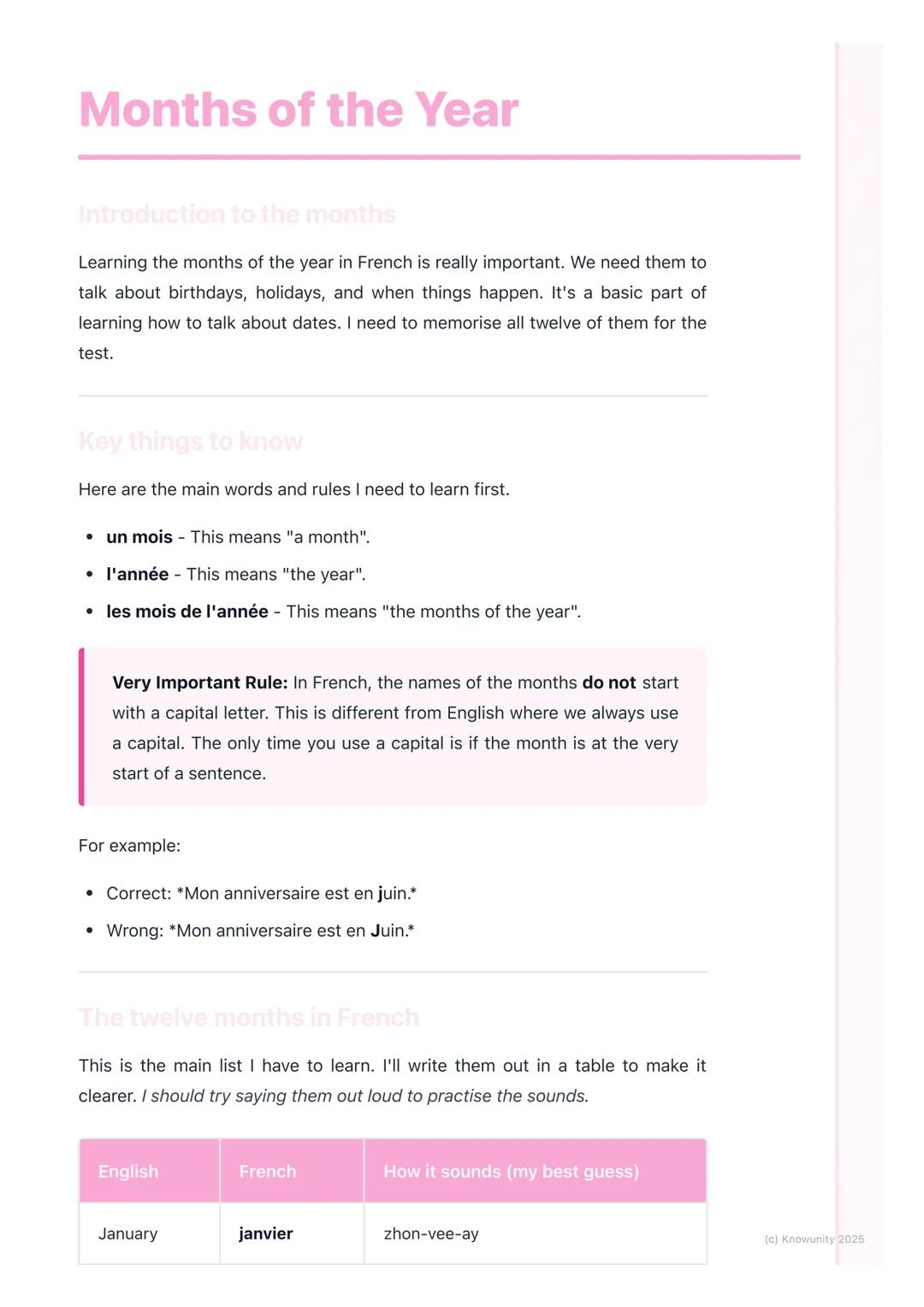
Getting Started with French Months
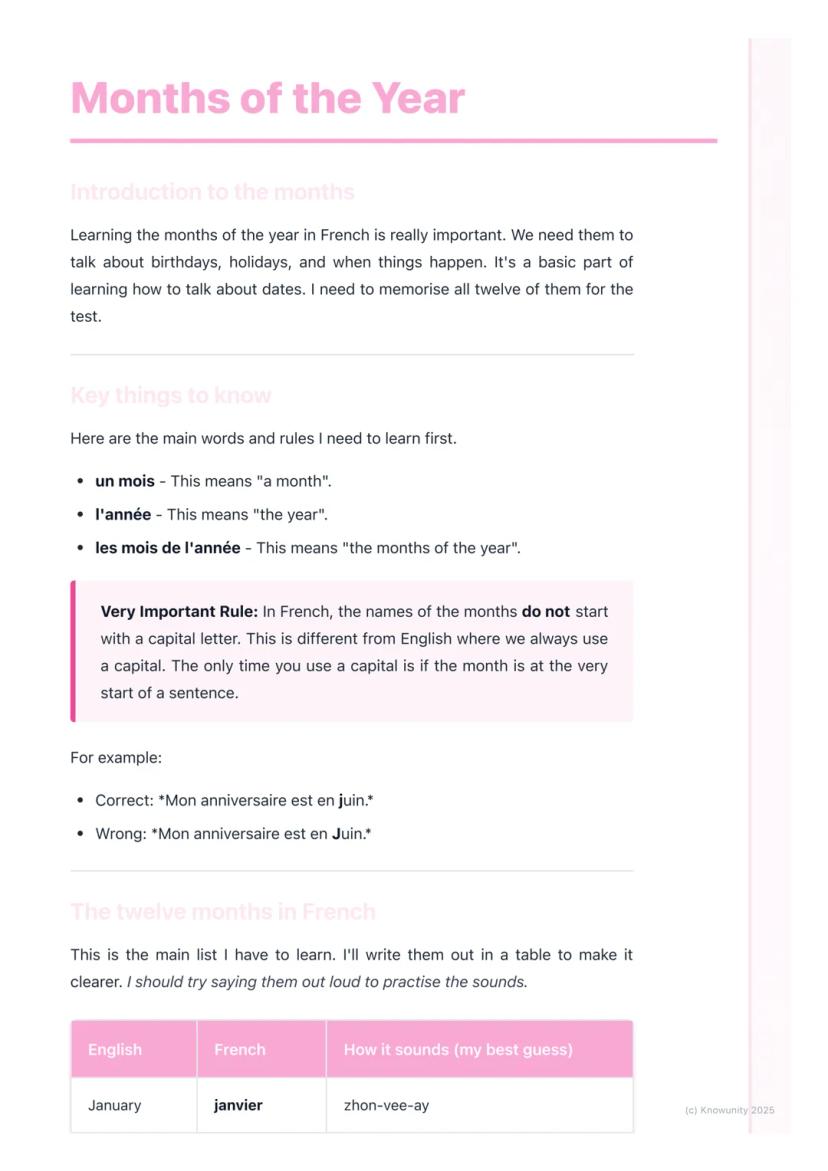
You'll use French months constantly - from talking about your birthday to planning holidays. The good news is that many of them look quite similar to English, so you're already halfway there!
There are three key terms to master first: un mois (a month), l'année (the year), and les mois de l'année (the months of the year). These will pop up everywhere when discussing dates.
Here's the game-changer that trips up loads of students: French months never start with capital letters unless they're at the beginning of a sentence. So it's "Mon anniversaire est en juin" (My birthday is in June), not "Mon anniversaire est en Juin."
Quick Tip: Practice saying the months out loud - hearing yourself say them helps with spelling and pronunciation!
2
of 4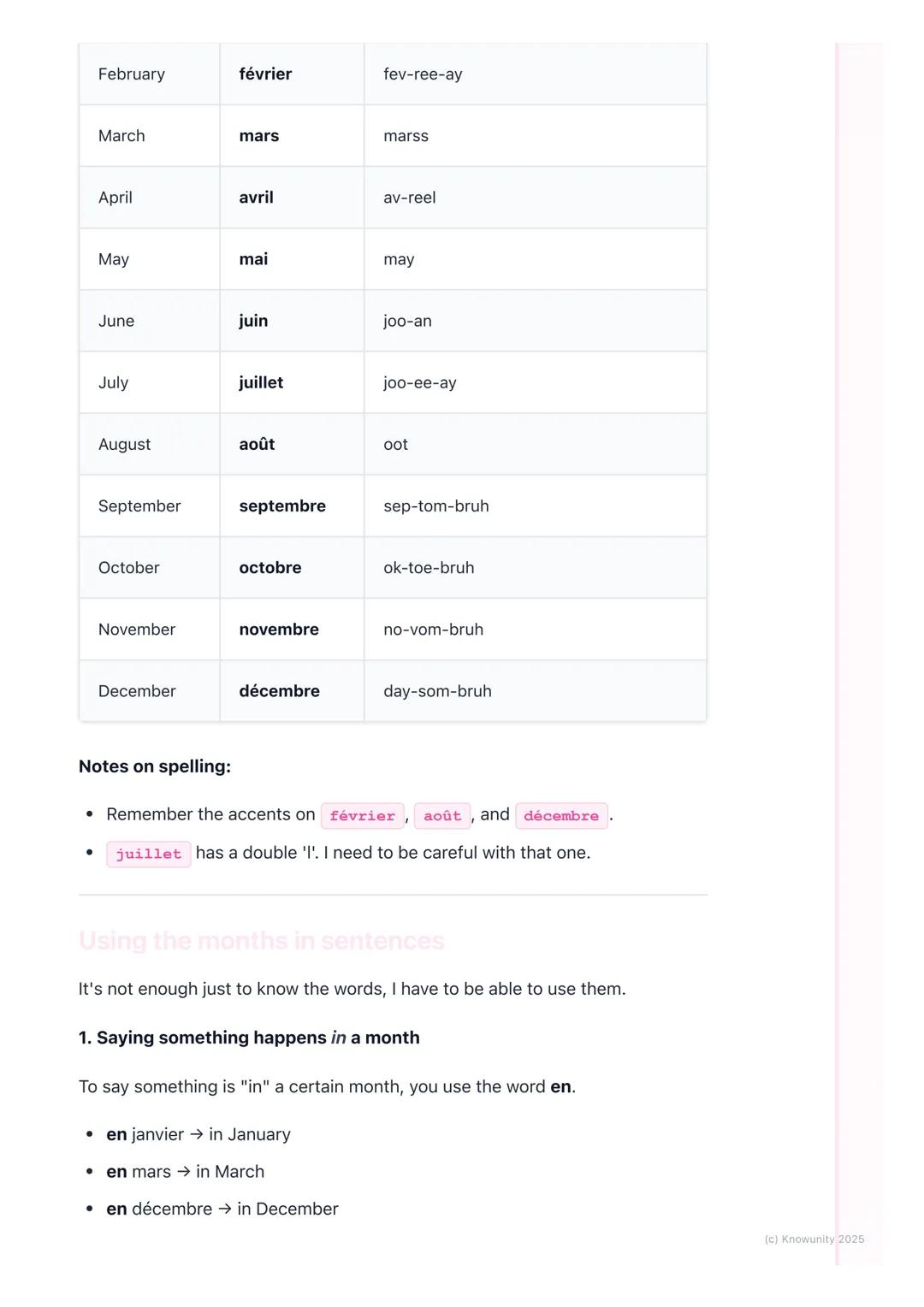
The Twelve Months You Need to Know
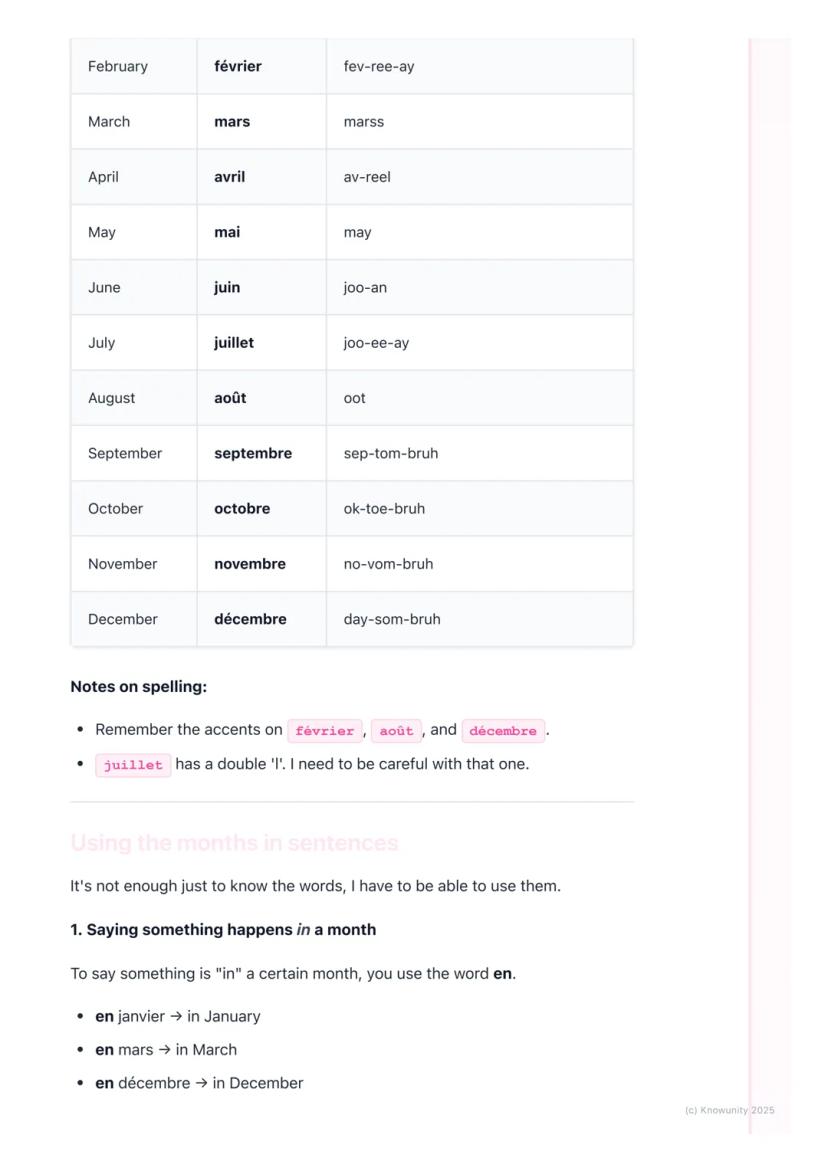
Here are all twelve months with their pronunciation guides. Don't worry about getting the pronunciation perfect straight away - just have a go and you'll improve with practice.
janvier , février , mars (marss), avril , mai (may), juin - these first six are quite different from English.
The summer and autumn months are more familiar: juillet , août (oot), septembre , octobre , novembre , décembre .
Watch out for the tricky spellings: février, août, and décembre all have accents, whilst juillet has a sneaky double 'l' that's easy to forget.
Memory Hack: The last four months (septembre, octobre, novembre, décembre) are dead similar to English - use these as your confidence boosters!
3
of 4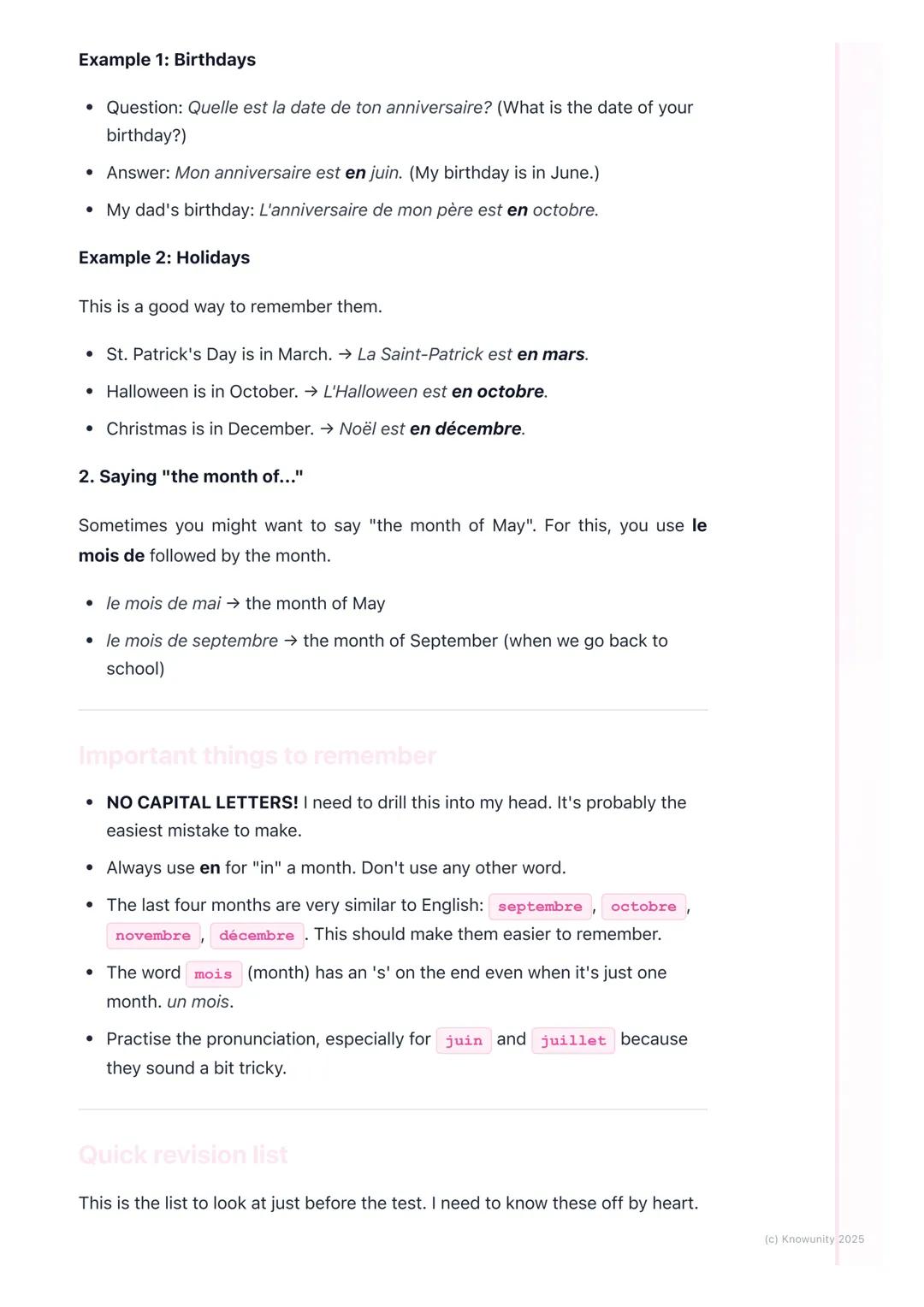
Using Months in Real Conversations
Now for the practical bit - actually using these months in sentences. This is where French gets really useful for everyday chat.
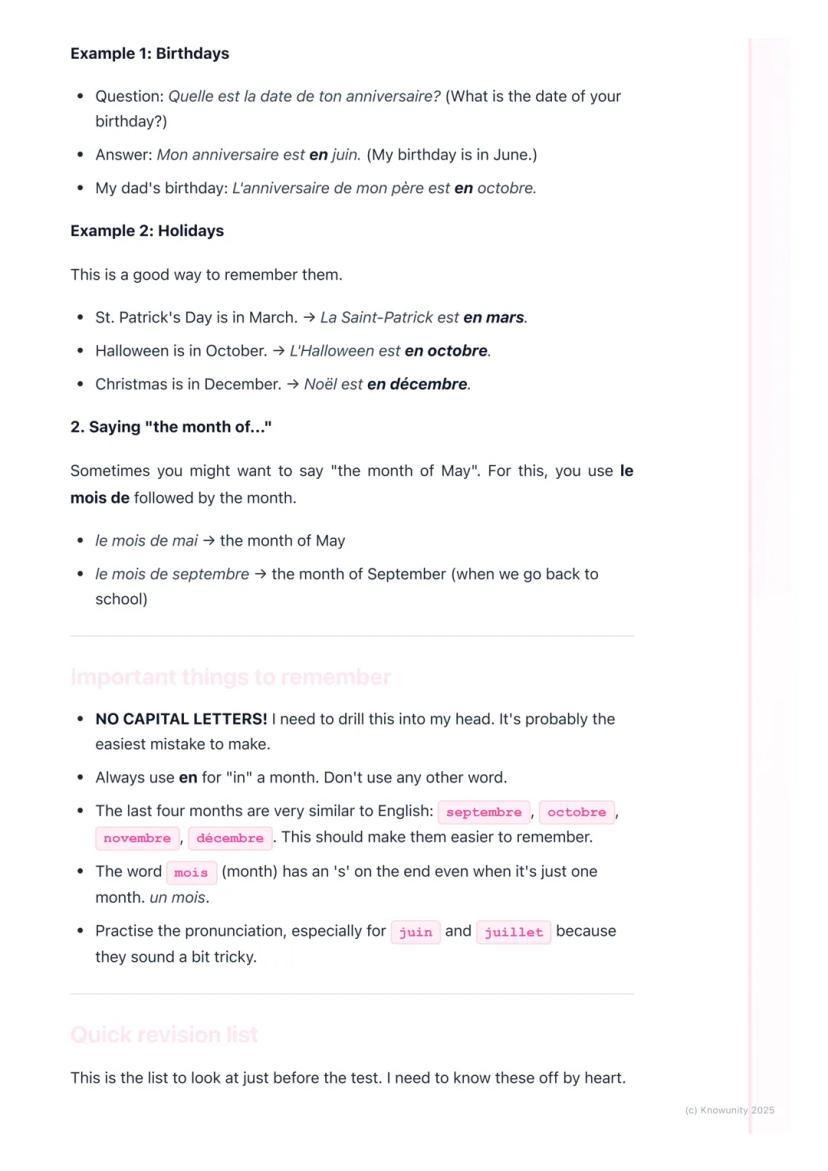
To say something happens "in" a month, you always use en. So "en janvier" means "in January", "en mars" means "in March", and so on. This works for absolutely everything - birthdays, holidays, school terms.
For birthdays, you'll often hear "Mon anniversaire est en juin" (My birthday is in June). For holidays, try "Noël est en décembre" (Christmas is in December) or "La Saint-Patrick est en mars" (St. Patrick's Day is in March).
Sometimes you might need to say "the month of..." - that's when you use le mois de followed by the month name, like "le mois de septembre" (the month of September).
Test Prep: Remember - always use 'en' for 'in' with months, never any other word. This is a common exam question!
4
of 4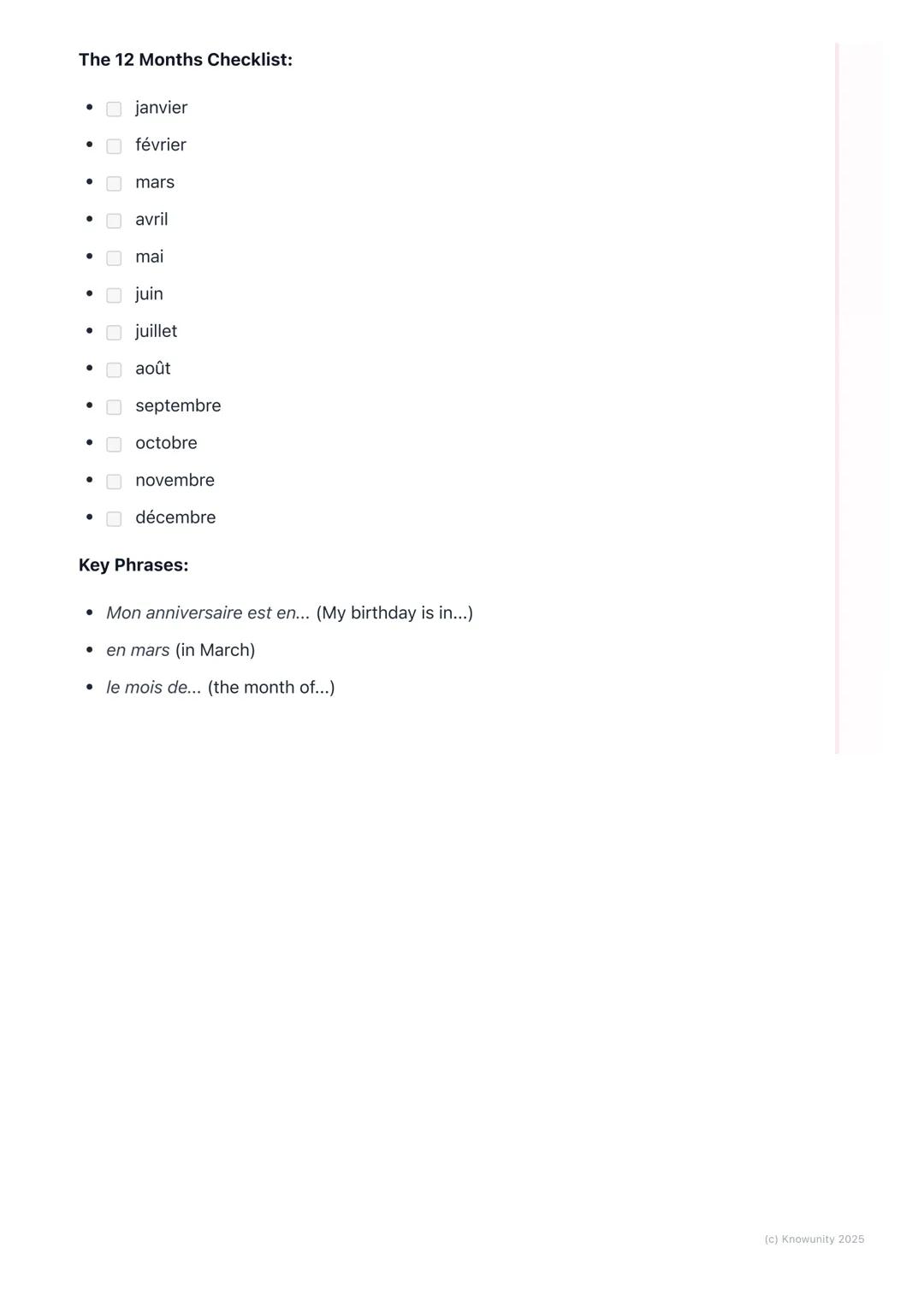
Your Final Revision Checklist
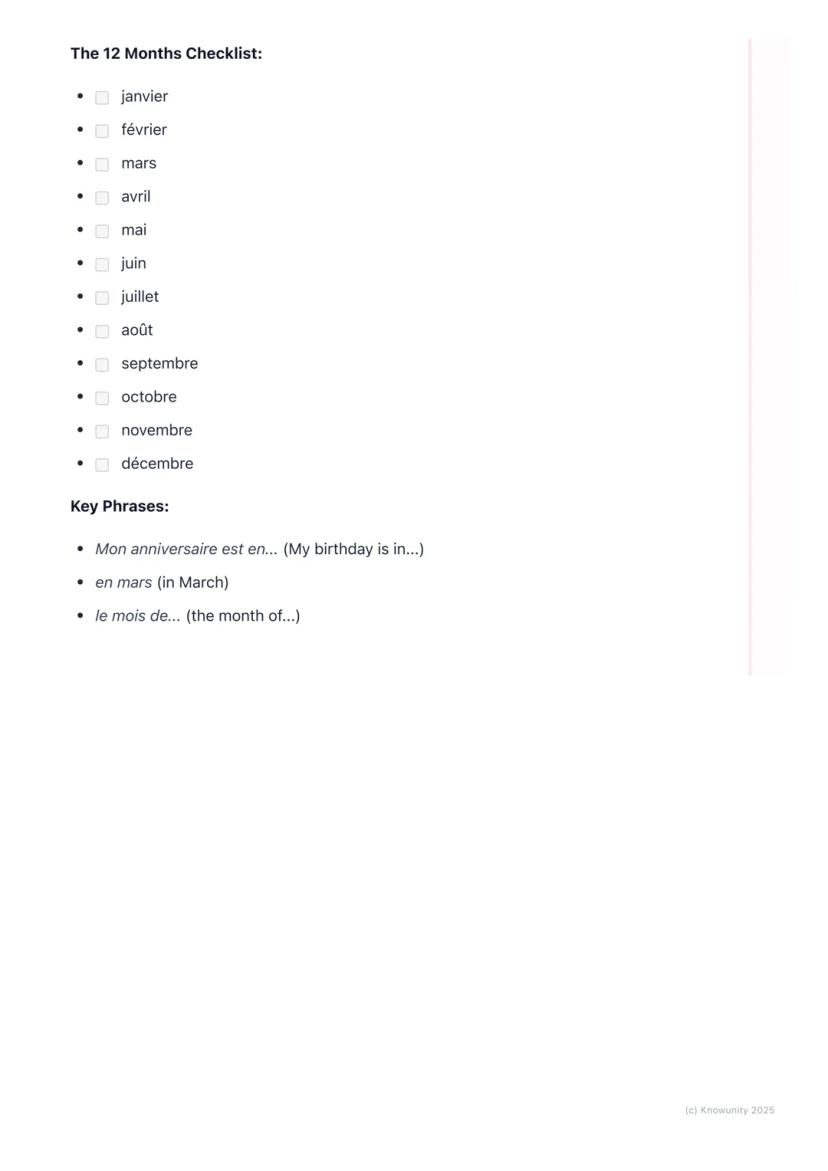
Right, here's your quick-fire revision list for before any test or when you need a speedy reminder.
The twelve months in order: janvier, février, mars, avril, mai, juin, juillet, août, septembre, octobre, novembre, décembre. Run through these a few times until they flow naturally.
Your essential phrases are "Mon anniversaire est en..." (My birthday is in...), "en mars" (in March), and "le mois de..." (the month of...). These three patterns will cover most situations you'll encounter.
Remember the golden rules: no capitals unless it's the start of a sentence, always use 'en' for 'in', and don't panic about pronunciation - you'll get better with practice.
Confidence Booster: You've already got this! Many French months are similar to English, and with a bit of practice, you'll be using them naturally in conversations.
We thought you’d never ask...
What is the Knowunity AI companion?
Our AI companion is specifically built for the needs of students. Based on the millions of content pieces we have on the platform we can provide truly meaningful and relevant answers to students. But its not only about answers, the companion is even more about guiding students through their daily learning challenges, with personalised study plans, quizzes or content pieces in the chat and 100% personalisation based on the students skills and developments.
Where can I download the Knowunity app?
You can download the app in the Google Play Store and in the Apple App Store.
Is Knowunity really free of charge?
That's right! Enjoy free access to study content, connect with fellow students, and get instant help – all at your fingertips.
Most popular content in French
2Most popular content
9 Irish
IrishIrish oral questions and answers
Questions and answers for the leaving cert oral
5th Year4264
 English
Key Quotes : Sive
Key Quotes and explanations: Sive
6th Year2842
IrishIrish oral questions
Outline of oral questions
5th Year2055
IrishIníon- le hÁine Durkin
Aine Durkin’s poem, Iníon: Themes & summary
5th Year890
IrishIrish poetry 2027
Iníon + Dínit an Bhróin
5th Year1153
IrishLC HL notes- Iníon (poem)
Includes poem in English and Irish, theme, key words & phrases
5th Year2304
EnglishCultural Context : Shawshank Redemption : Sive : Small Things Like These
Comparative Study : Cultural Context : Shawshank Redemption, Sive and Small Things Like These
6th Year1430
IrishMo Ghrá-sa (Idir Lúibíní)
Notes on mo ghrá-sa
5th Year380
IrishAn Gaeilge Aiste
Irish Language essay
6th Year1320
Can't find what you're looking for? Explore other subjects.
Students love us — and so will you.
4.6/5App Store
4.7/5Google Play
The app is very easy to use and well designed. I have found everything I was looking for so far and have been able to learn a lot from the presentations! I will definitely use the app for a class assignment! And of course it also helps a lot as an inspiration.
Stefan SiOS user
This app is really great. There are so many study notes and help [...]. My problem subject is French, for example, and the app has so many options for help. Thanks to this app, I have improved my French. I would recommend it to anyone.
Samantha KlichAndroid user
Wow, I am really amazed. I just tried the app because I've seen it advertised many times and was absolutely stunned. This app is THE HELP you want for school and above all, it offers so many things, such as workouts and fact sheets, which have been VERY helpful to me personally.
AnnaiOS user
French3 views·Updated Jun 14, 2026·4 pagesLes Mois de l'Année en Français
Learning the months of the year in French is essential for talking about birthdays, holidays, and when events happen. It's one of the most practical things you'll use when speaking French, and once you get the hang of it, you'll...
1
of 4
Sign up to see the content. It's free!
- Access to all documents
- Improve your grades
- Join milions of students
Getting Started with French Months
You'll use French months constantly - from talking about your birthday to planning holidays. The good news is that many of them look quite similar to English, so you're already halfway there!
There are three key terms to master first: un mois (a month), l'année (the year), and les mois de l'année (the months of the year). These will pop up everywhere when discussing dates.
Here's the game-changer that trips up loads of students: French months never start with capital letters unless they're at the beginning of a sentence. So it's "Mon anniversaire est en juin" (My birthday is in June), not "Mon anniversaire est en Juin."
Quick Tip: Practice saying the months out loud - hearing yourself say them helps with spelling and pronunciation!
2
of 4Sign up to see the content. It's free!
- Access to all documents
- Improve your grades
- Join milions of students
The Twelve Months You Need to Know
Here are all twelve months with their pronunciation guides. Don't worry about getting the pronunciation perfect straight away - just have a go and you'll improve with practice.
janvier , février , mars (marss), avril , mai (may), juin - these first six are quite different from English.
The summer and autumn months are more familiar: juillet , août (oot), septembre , octobre , novembre , décembre .
Watch out for the tricky spellings: février, août, and décembre all have accents, whilst juillet has a sneaky double 'l' that's easy to forget.
Memory Hack: The last four months (septembre, octobre, novembre, décembre) are dead similar to English - use these as your confidence boosters!
3
of 4Sign up to see the content. It's free!
- Access to all documents
- Improve your grades
- Join milions of students
Using Months in Real Conversations
Now for the practical bit - actually using these months in sentences. This is where French gets really useful for everyday chat.
To say something happens "in" a month, you always use en. So "en janvier" means "in January", "en mars" means "in March", and so on. This works for absolutely everything - birthdays, holidays, school terms.
For birthdays, you'll often hear "Mon anniversaire est en juin" (My birthday is in June). For holidays, try "Noël est en décembre" (Christmas is in December) or "La Saint-Patrick est en mars" (St. Patrick's Day is in March).
Sometimes you might need to say "the month of..." - that's when you use le mois de followed by the month name, like "le mois de septembre" (the month of September).
Test Prep: Remember - always use 'en' for 'in' with months, never any other word. This is a common exam question!
4
of 4Sign up to see the content. It's free!
- Access to all documents
- Improve your grades
- Join milions of students
Your Final Revision Checklist
Right, here's your quick-fire revision list for before any test or when you need a speedy reminder.
The twelve months in order: janvier, février, mars, avril, mai, juin, juillet, août, septembre, octobre, novembre, décembre. Run through these a few times until they flow naturally.
Your essential phrases are "Mon anniversaire est en..." (My birthday is in...), "en mars" (in March), and "le mois de..." (the month of...). These three patterns will cover most situations you'll encounter.
Remember the golden rules: no capitals unless it's the start of a sentence, always use 'en' for 'in', and don't panic about pronunciation - you'll get better with practice.
Confidence Booster: You've already got this! Many French months are similar to English, and with a bit of practice, you'll be using them naturally in conversations.
We thought you’d never ask...
What is the Knowunity AI companion?
Our AI companion is specifically built for the needs of students. Based on the millions of content pieces we have on the platform we can provide truly meaningful and relevant answers to students. But its not only about answers, the companion is even more about guiding students through their daily learning challenges, with personalised study plans, quizzes or content pieces in the chat and 100% personalisation based on the students skills and developments.
Where can I download the Knowunity app?
You can download the app in the Google Play Store and in the Apple App Store.
Is Knowunity really free of charge?
That's right! Enjoy free access to study content, connect with fellow students, and get instant help – all at your fingertips.
Most popular content in French
2Most popular content
9IrishIrish oral questions and answers
Questions and answers for the leaving cert oral
5th Year4264
EnglishKey Quotes : Sive
Key Quotes and explanations: Sive
6th Year2842
IrishIrish oral questions
Outline of oral questions
5th Year2055
IrishIníon- le hÁine Durkin
Aine Durkin’s poem, Iníon: Themes & summary
5th Year890
IrishIrish poetry 2027
Iníon + Dínit an Bhróin
5th Year1153
IrishLC HL notes- Iníon (poem)
Includes poem in English and Irish, theme, key words & phrases
5th Year2304
EnglishCultural Context : Shawshank Redemption : Sive : Small Things Like These
Comparative Study : Cultural Context : Shawshank Redemption, Sive and Small Things Like These
6th Year1430
IrishMo Ghrá-sa (Idir Lúibíní)
Notes on mo ghrá-sa
5th Year380
IrishAn Gaeilge Aiste
Irish Language essay
6th Year1320
Can't find what you're looking for? Explore other subjects.
Students love us — and so will you.
4.6/5App Store
4.7/5Google Play
The app is very easy to use and well designed. I have found everything I was looking for so far and have been able to learn a lot from the presentations! I will definitely use the app for a class assignment! And of course it also helps a lot as an inspiration.
Stefan SiOS user
This app is really great. There are so many study notes and help [...]. My problem subject is French, for example, and the app has so many options for help. Thanks to this app, I have improved my French. I would recommend it to anyone.
Samantha KlichAndroid user
Wow, I am really amazed. I just tried the app because I've seen it advertised many times and was absolutely stunned. This app is THE HELP you want for school and above all, it offers so many things, such as workouts and fact sheets, which have been VERY helpful to me personally.
AnnaiOS user