
The French imperfect tense(imparfait) is your go-to for talking...
 French5 views·Updated Jun 19, 2026·2 pages
L’imparfait : Guide de révision pour le passé simple
K
Keira Kennedy McGrath@keirakennedymcg
1
of 2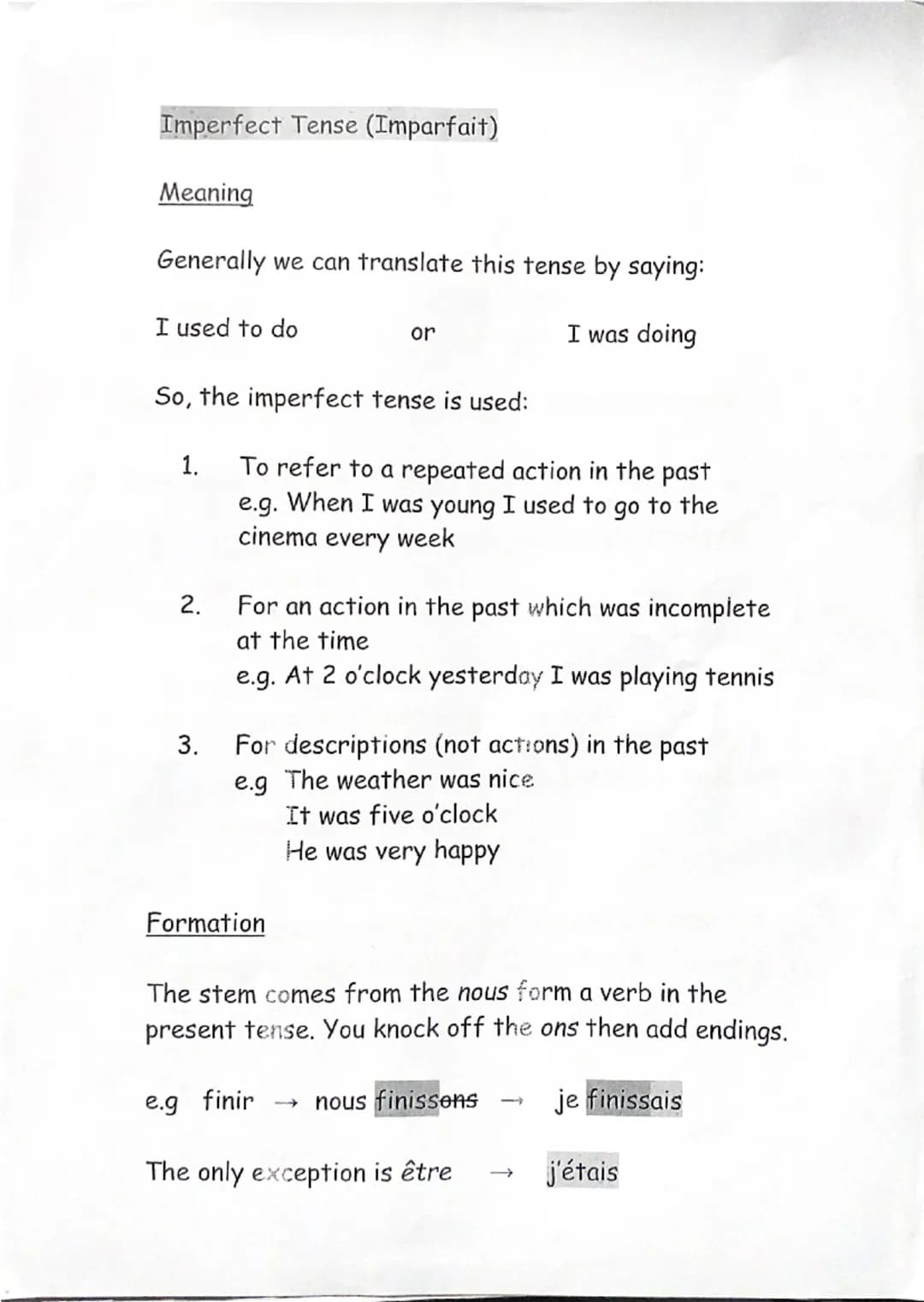
Understanding the Imperfect Tense
The imperfect tense is actually dead handy once you get the hang of it. You'll use it whenever you want to say "I used to do" or "I was doing" something in French.
There are three main situations where you'll reach for the imperfect. First, when describing repeated actions in the past - like "When I was young, I used to go to the cinema every week." Second, for incomplete actions that were happening at a specific time - "At 2 o'clock yesterday I was playing tennis." Finally, for descriptions rather than actions - "The weather was nice" or "He was very happy."
Forming the imperfect is straightforward. Take any verb's nous form in the present tense, chop off the -ons, and add the imperfect endings. For example: finir → nous finissons → je finissais. The only rebel here is être, which becomes j'étais.
Quick Tip: Remember that the imperfect is all about setting the scene or describing ongoing situations, not completed actions!
2
of 2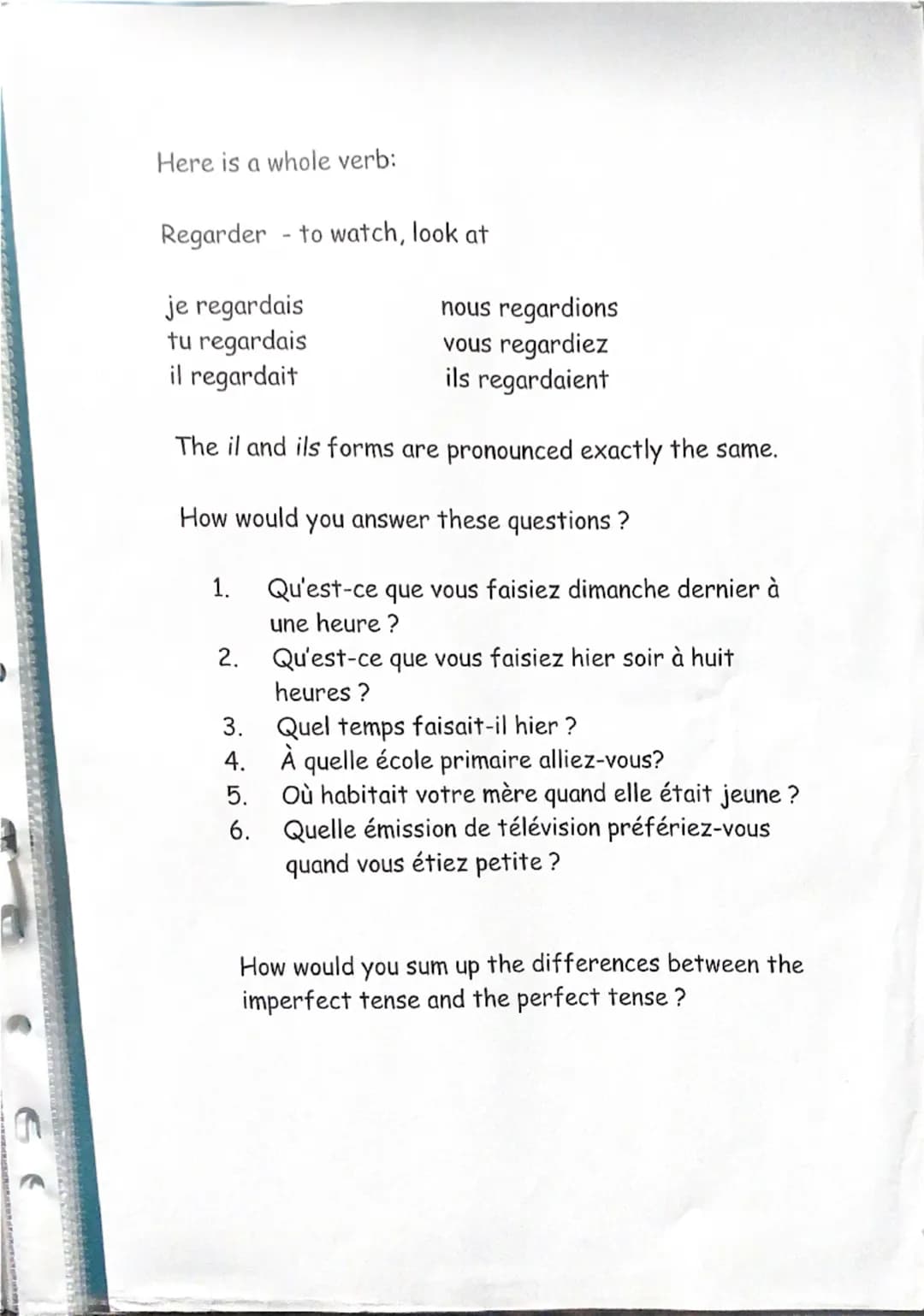
Conjugation Pattern and Practice
Let's look at a complete verb conjugation using regarder (to watch). The pattern is: je regardais, tu regardais, il regardait, nous regardions, vous regardiez, ils regardaient. Notice that il and ils sound exactly the same when spoken!
Those practice questions are brilliant for getting comfortable with the tense. You'd answer "Qu'est-ce que vous faisiez dimanche dernier?" (What were you doing last Sunday?) with something like "Je regardais la télé" or "Je faisais mes devoirs." The key is thinking about what you were doing at that specific moment.
The big difference between perfect and imperfect tense? Perfect tense is for completed actions ("I went"), whilst imperfect is for ongoing situations or habits ("I was going" or "I used to go"). Perfect tense moves the story forward; imperfect sets the background scene.
Remember: If you can translate it with "used to" or "was doing" in English, you probably need the imperfect in French!
We thought you’d never ask...
What is the Knowunity AI companion?
Our AI companion is specifically built for the needs of students. Based on the millions of content pieces we have on the platform we can provide truly meaningful and relevant answers to students. But its not only about answers, the companion is even more about guiding students through their daily learning challenges, with personalised study plans, quizzes or content pieces in the chat and 100% personalisation based on the students skills and developments.
Where can I download the Knowunity app?
You can download the app in the Google Play Store and in the Apple App Store.
Is Knowunity really free of charge?
That's right! Enjoy free access to study content, connect with fellow students, and get instant help – all at your fingertips.
Most popular content in French
2Most popular content
9 Irish
IrishIrish oral questions and answers
Questions and answers for the leaving cert oral
5th Year4264
 English
Key Quotes : Sive
Key Quotes and explanations: Sive
6th Year2842
IrishIrish oral questions
Outline of oral questions
5th Year2055
IrishIníon- le hÁine Durkin
Aine Durkin’s poem, Iníon: Themes & summary
5th Year890
IrishIrish poetry 2027
Iníon + Dínit an Bhróin
5th Year1153
IrishLC HL notes- Iníon (poem)
Includes poem in English and Irish, theme, key words & phrases
5th Year2304
EnglishCultural Context : Shawshank Redemption : Sive : Small Things Like These
Comparative Study : Cultural Context : Shawshank Redemption, Sive and Small Things Like These
6th Year1430
IrishMo Ghrá-sa (Idir Lúibíní)
Notes on mo ghrá-sa
5th Year380
IrishAn Gaeilge Aiste
Irish Language essay
6th Year1320
Can't find what you're looking for? Explore other subjects.
Students love us — and so will you.
4.6/5App Store
4.7/5Google Play
The app is very easy to use and well designed. I have found everything I was looking for so far and have been able to learn a lot from the presentations! I will definitely use the app for a class assignment! And of course it also helps a lot as an inspiration.
Stefan SiOS user
This app is really great. There are so many study notes and help [...]. My problem subject is French, for example, and the app has so many options for help. Thanks to this app, I have improved my French. I would recommend it to anyone.
Samantha KlichAndroid user
Wow, I am really amazed. I just tried the app because I've seen it advertised many times and was absolutely stunned. This app is THE HELP you want for school and above all, it offers so many things, such as workouts and fact sheets, which have been VERY helpful to me personally.
AnnaiOS user
French5 views·Updated Jun 19, 2026·2 pagesL’imparfait : Guide de révision pour le passé simple
K
Keira Kennedy McGrath@keirakennedymcg
The French imperfect tense (imparfait) is your go-to for talking about ongoing actions, habits, and descriptions in the past. Think of it as the "used to" or "was doing" tense that brings past stories to life.
1
of 2
Sign up to see the content. It's free!
- Access to all documents
- Improve your grades
- Join milions of students
Understanding the Imperfect Tense
The imperfect tense is actually dead handy once you get the hang of it. You'll use it whenever you want to say "I used to do" or "I was doing" something in French.
There are three main situations where you'll reach for the imperfect. First, when describing repeated actions in the past - like "When I was young, I used to go to the cinema every week." Second, for incomplete actions that were happening at a specific time - "At 2 o'clock yesterday I was playing tennis." Finally, for descriptions rather than actions - "The weather was nice" or "He was very happy."
Forming the imperfect is straightforward. Take any verb's nous form in the present tense, chop off the -ons, and add the imperfect endings. For example: finir → nous finissons → je finissais. The only rebel here is être, which becomes j'étais.
Quick Tip: Remember that the imperfect is all about setting the scene or describing ongoing situations, not completed actions!
2
of 2Sign up to see the content. It's free!
- Access to all documents
- Improve your grades
- Join milions of students
Conjugation Pattern and Practice
Let's look at a complete verb conjugation using regarder (to watch). The pattern is: je regardais, tu regardais, il regardait, nous regardions, vous regardiez, ils regardaient. Notice that il and ils sound exactly the same when spoken!
Those practice questions are brilliant for getting comfortable with the tense. You'd answer "Qu'est-ce que vous faisiez dimanche dernier?" (What were you doing last Sunday?) with something like "Je regardais la télé" or "Je faisais mes devoirs." The key is thinking about what you were doing at that specific moment.
The big difference between perfect and imperfect tense? Perfect tense is for completed actions ("I went"), whilst imperfect is for ongoing situations or habits ("I was going" or "I used to go"). Perfect tense moves the story forward; imperfect sets the background scene.
Remember: If you can translate it with "used to" or "was doing" in English, you probably need the imperfect in French!
We thought you’d never ask...
What is the Knowunity AI companion?
Our AI companion is specifically built for the needs of students. Based on the millions of content pieces we have on the platform we can provide truly meaningful and relevant answers to students. But its not only about answers, the companion is even more about guiding students through their daily learning challenges, with personalised study plans, quizzes or content pieces in the chat and 100% personalisation based on the students skills and developments.
Where can I download the Knowunity app?
You can download the app in the Google Play Store and in the Apple App Store.
Is Knowunity really free of charge?
That's right! Enjoy free access to study content, connect with fellow students, and get instant help – all at your fingertips.
Most popular content in French
2Most popular content
9IrishIrish oral questions and answers
Questions and answers for the leaving cert oral
5th Year4264
EnglishKey Quotes : Sive
Key Quotes and explanations: Sive
6th Year2842
IrishIrish oral questions
Outline of oral questions
5th Year2055
IrishIníon- le hÁine Durkin
Aine Durkin’s poem, Iníon: Themes & summary
5th Year890
IrishIrish poetry 2027
Iníon + Dínit an Bhróin
5th Year1153
IrishLC HL notes- Iníon (poem)
Includes poem in English and Irish, theme, key words & phrases
5th Year2304
EnglishCultural Context : Shawshank Redemption : Sive : Small Things Like These
Comparative Study : Cultural Context : Shawshank Redemption, Sive and Small Things Like These
6th Year1430
IrishMo Ghrá-sa (Idir Lúibíní)
Notes on mo ghrá-sa
5th Year380
IrishAn Gaeilge Aiste
Irish Language essay
6th Year1320
Can't find what you're looking for? Explore other subjects.
Students love us — and so will you.
4.6/5App Store
4.7/5Google Play
The app is very easy to use and well designed. I have found everything I was looking for so far and have been able to learn a lot from the presentations! I will definitely use the app for a class assignment! And of course it also helps a lot as an inspiration.
Stefan SiOS user
This app is really great. There are so many study notes and help [...]. My problem subject is French, for example, and the app has so many options for help. Thanks to this app, I have improved my French. I would recommend it to anyone.
Samantha KlichAndroid user
Wow, I am really amazed. I just tried the app because I've seen it advertised many times and was absolutely stunned. This app is THE HELP you want for school and above all, it offers so many things, such as workouts and fact sheets, which have been VERY helpful to me personally.
AnnaiOS user