
Learning French numbers might seem tricky at first, but it's... Show more
 French10 views·Updated May 19, 2026·5 pages
Master French Numbers: Count from 1 to 50

1 / 5
1
of 5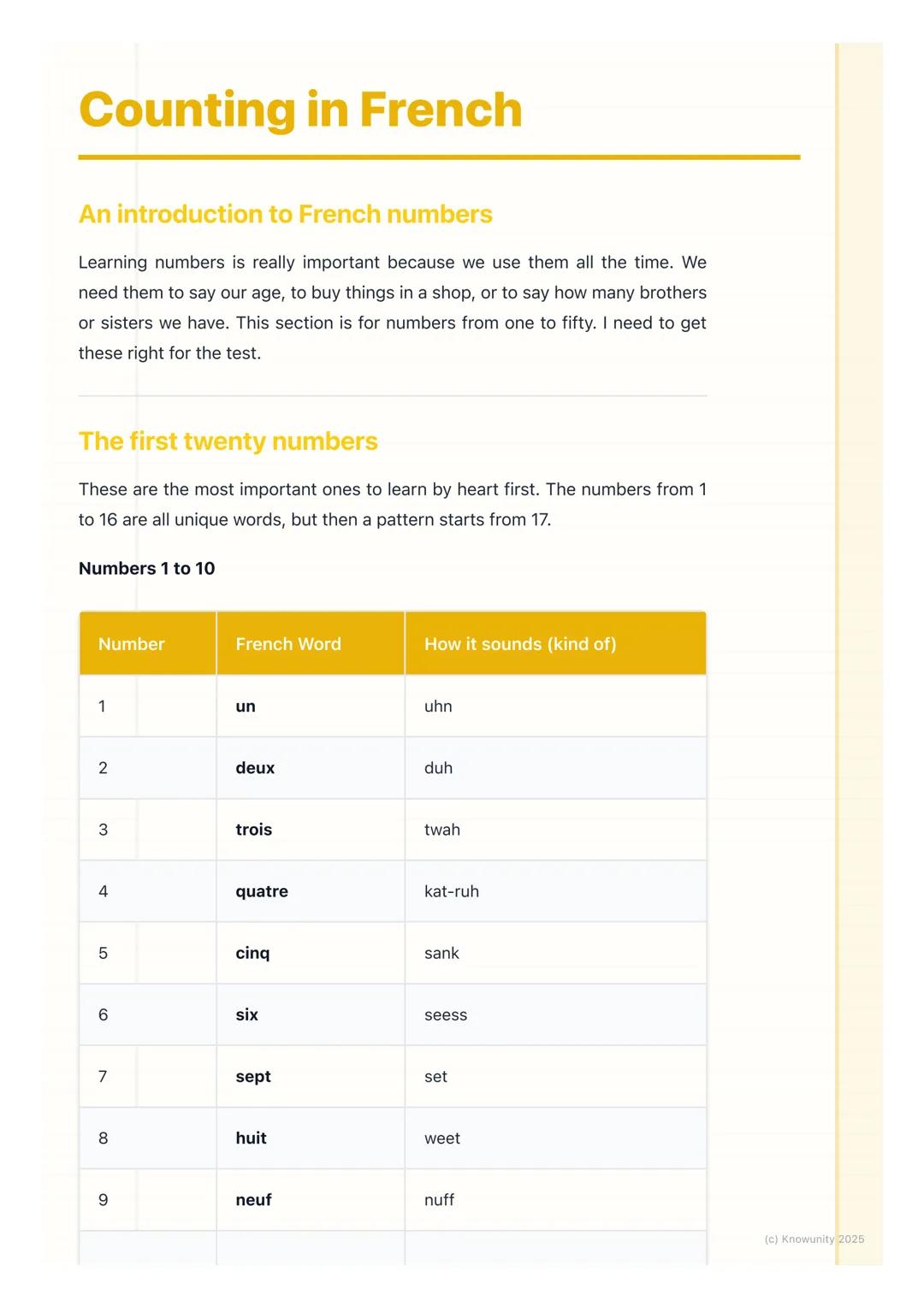
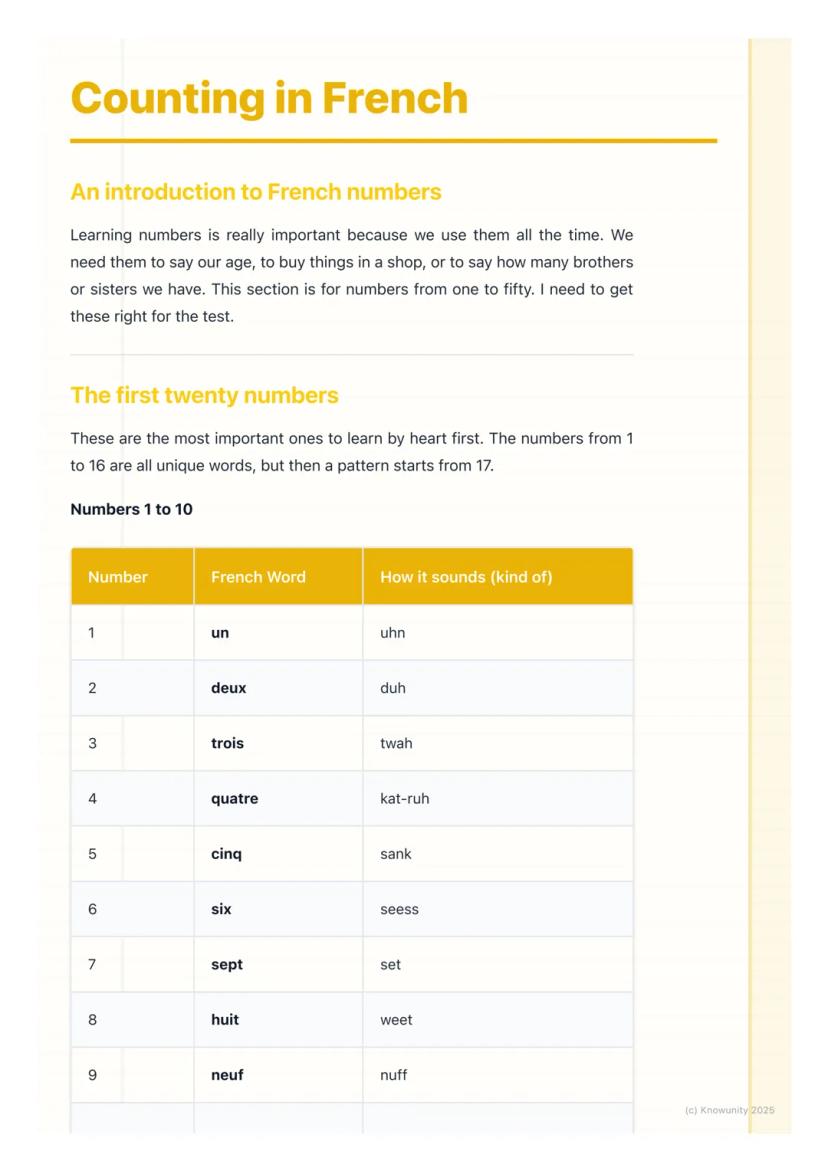
Getting Started with French Numbers 1-20
French numbers from 1-10 are completely unique words that you'll need to memorise properly. Think of them as your building blocks - once you've got these down, everything else becomes much easier!
The key ones to nail first are: un (1), deux (2), trois (3), quatre (4), cinq (5), six (6), sept (7), huit (8), neuf (9), and dix (10). Don't worry about perfect pronunciation yet - just get familiar with how they look.
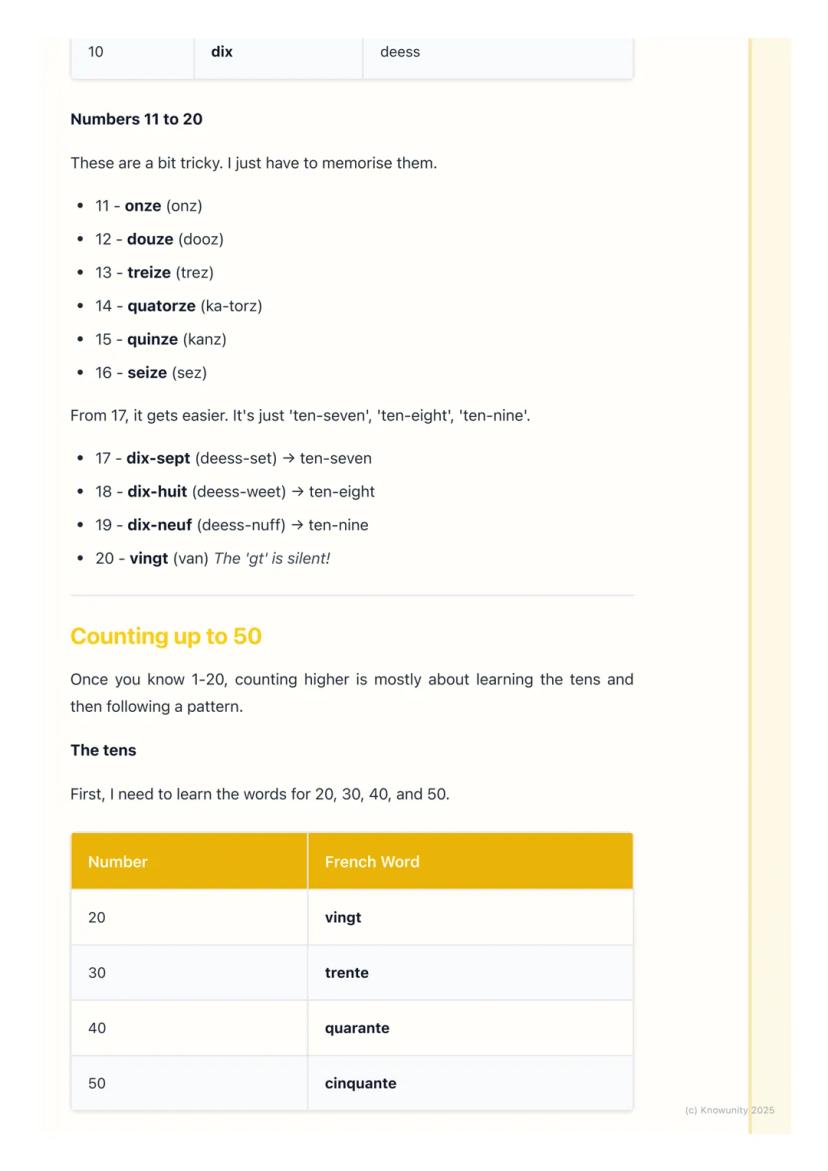
Numbers 11-16 are special cases that you'll have to learn separately: onze, douze, treize, quatorze, quinze, seize. There's no pattern here, so it's just memorisation time!
Quick Tip: Practice writing out numbers 1-16 from memory. Once you can do this without looking, you're ready for the clever bit that comes next!
2
of 5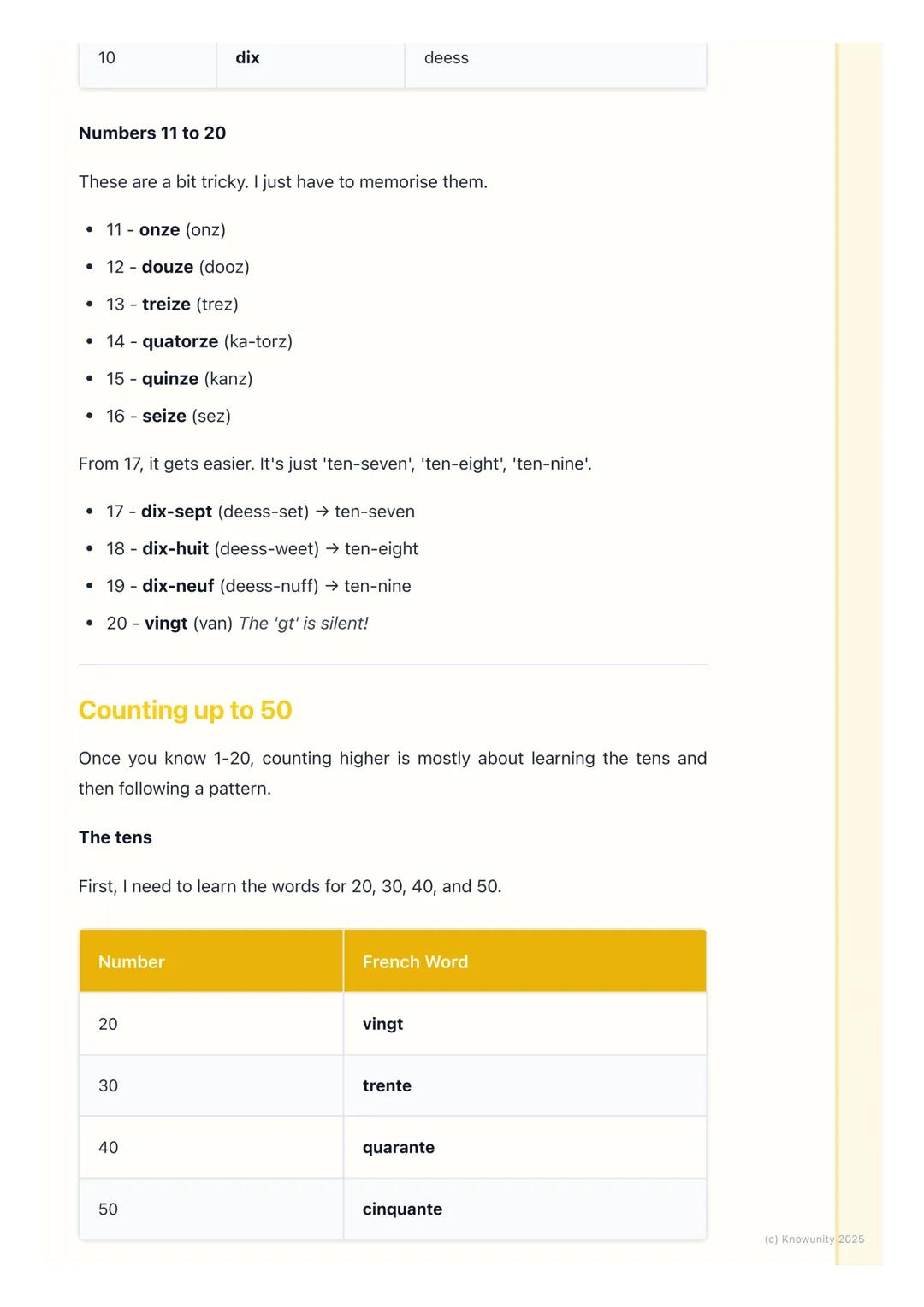
The Clever Pattern from 17-20 and Beyond
Here's where French gets really smart! Numbers 17-19 follow a simple pattern: they're literally "ten-seven", "ten-eight", "ten-nine". So you get dix-sept (17), dix-huit (18), and dix-neuf (19). Brilliant, right?
Twenty is "vingt" - and watch out because the 'gt' at the end is silent! This trips up loads of people, so remember it sounds like "van", not "vingt".
Now you need to learn the tens: vingt (20), trente (30), quarante (40), and cinquante (50). These are your next building blocks for making bigger numbers.
Remember: The teens from 11-16 are weird, but 17-19 follow the "dix-" pattern. After that, it's all about combining tens with units!
3
of 5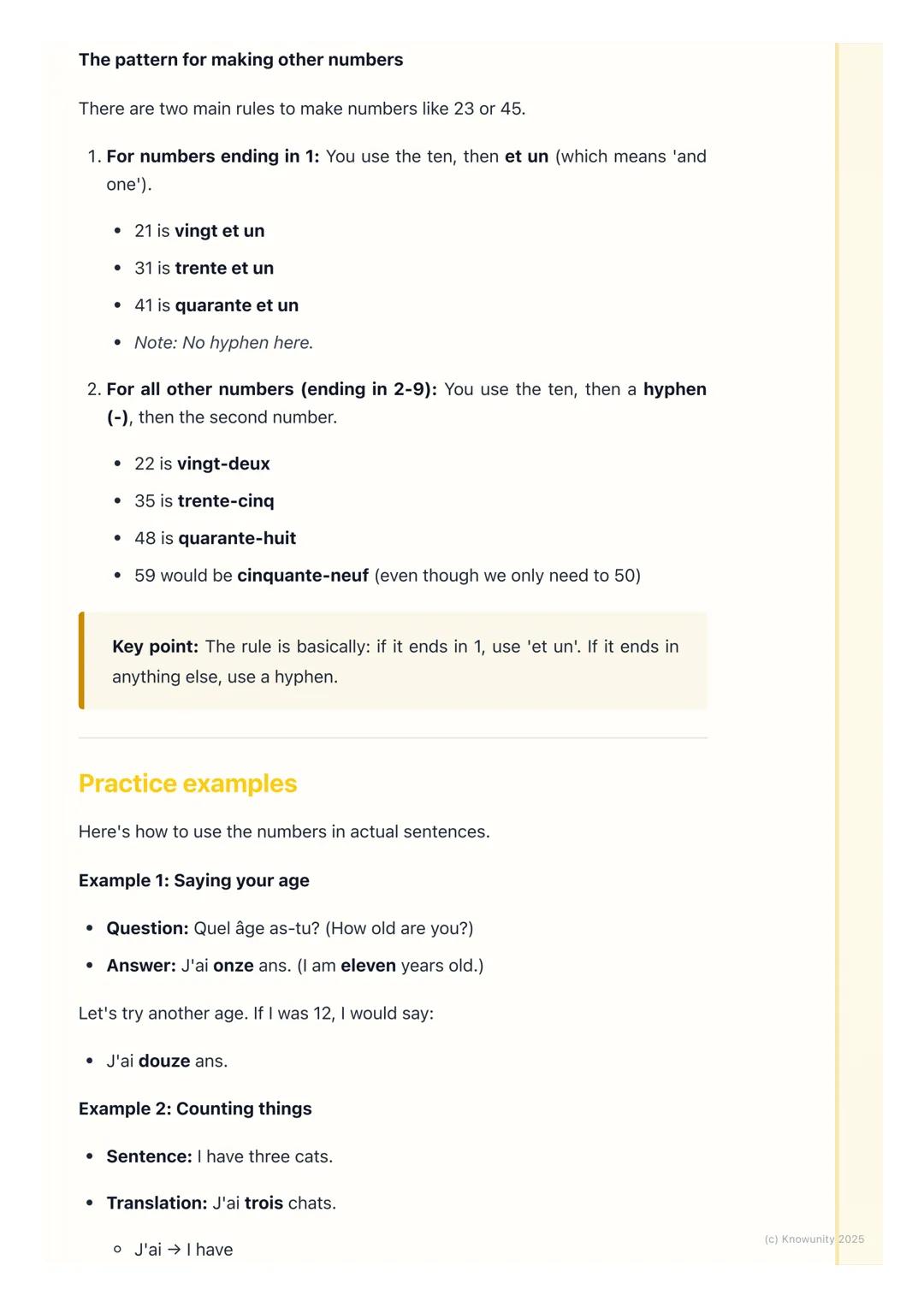
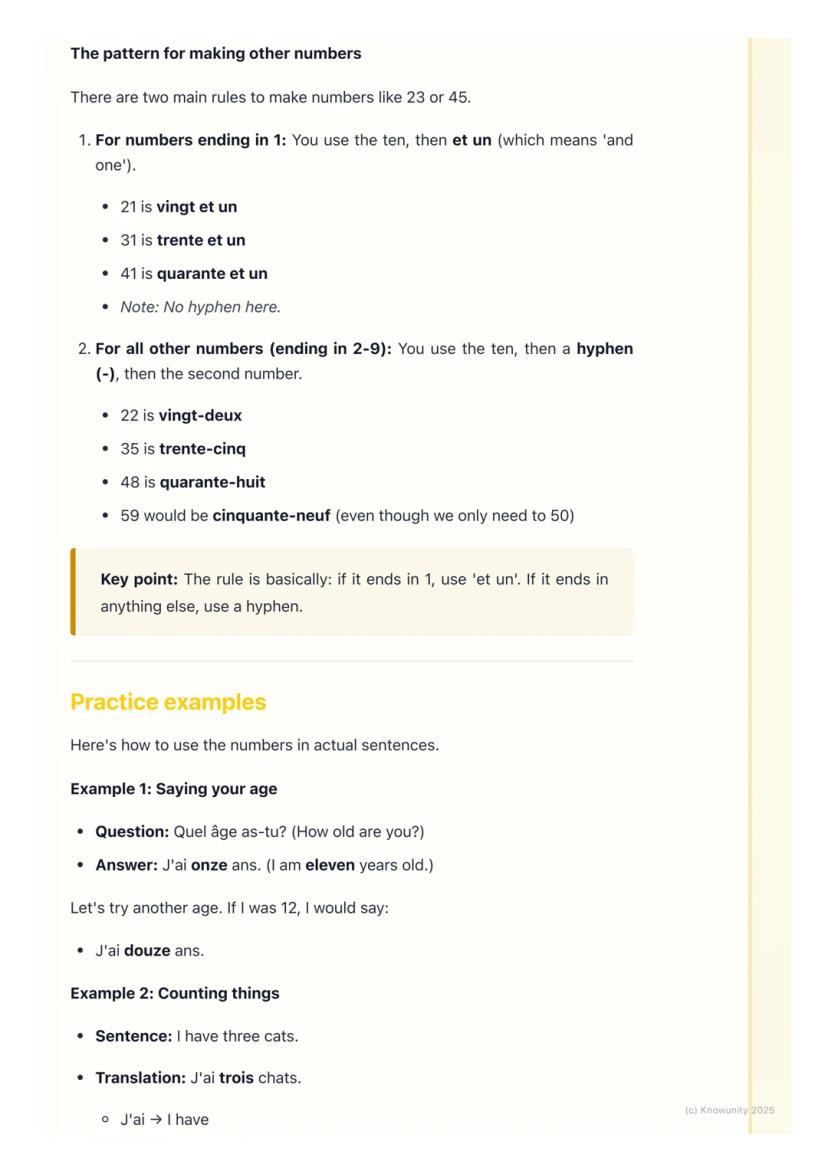
The Two Golden Rules for Making Numbers
Right, this is the game-changer! There are only two rules you need to make any number up to 50, and they're dead simple once you get them.
Rule 1: Numbers ending in 1 use "et un" (meaning "and one"). So 21 becomes vingt et un, 31 becomes trente et un, and 41 becomes quarante et un. Notice there's no hyphen here - just the words flowing together.
Rule 2: All other numbers use a hyphen between the ten and the unit. So 22 is vingt-deux, 35 is trente-cinq, and 48 is quarante-huit. The hyphen keeps everything tidy!
Memory Trick: If it ends in 1, think "and one" (et un). If it ends in anything else, think "hyphen time"!
4
of 5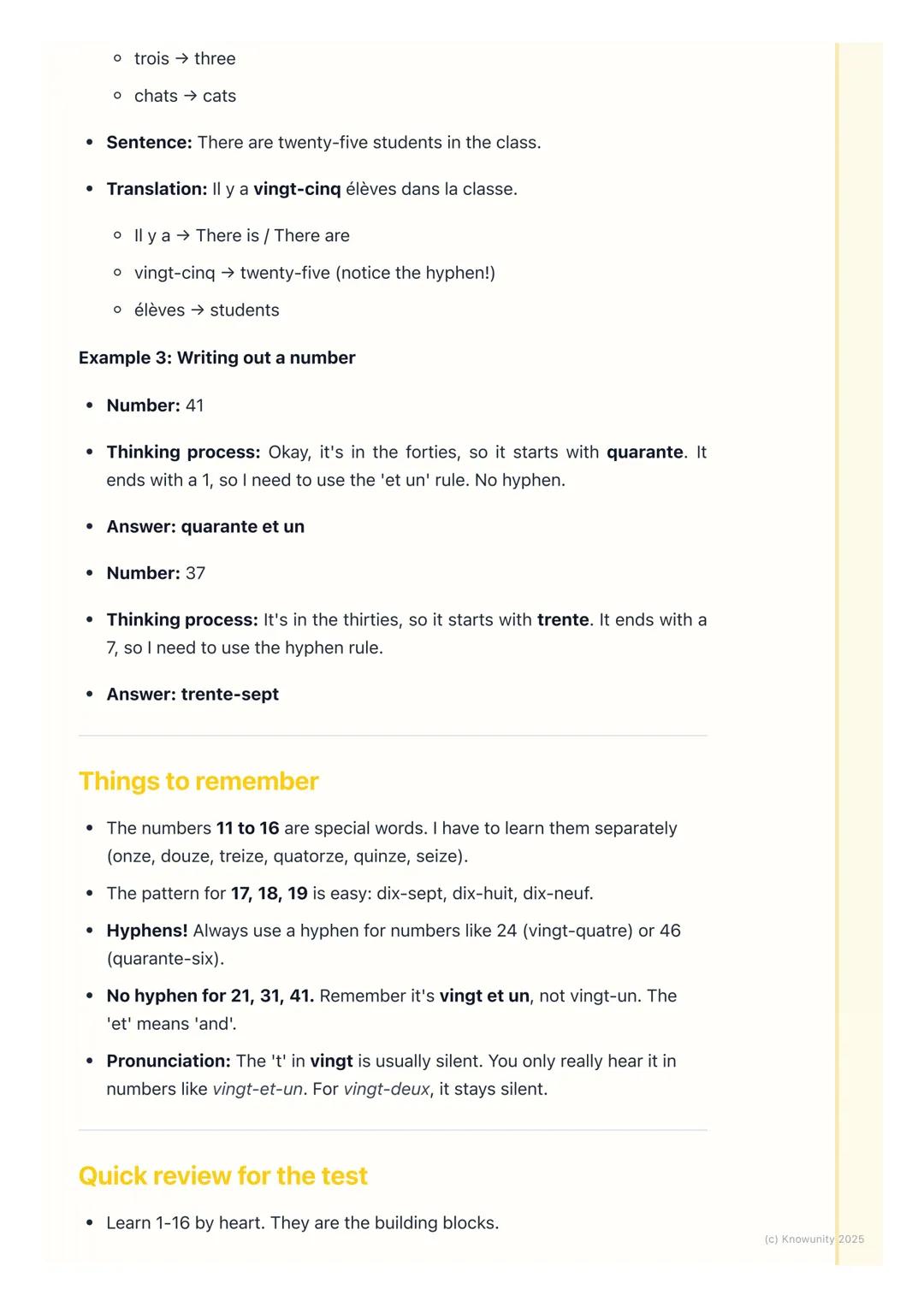
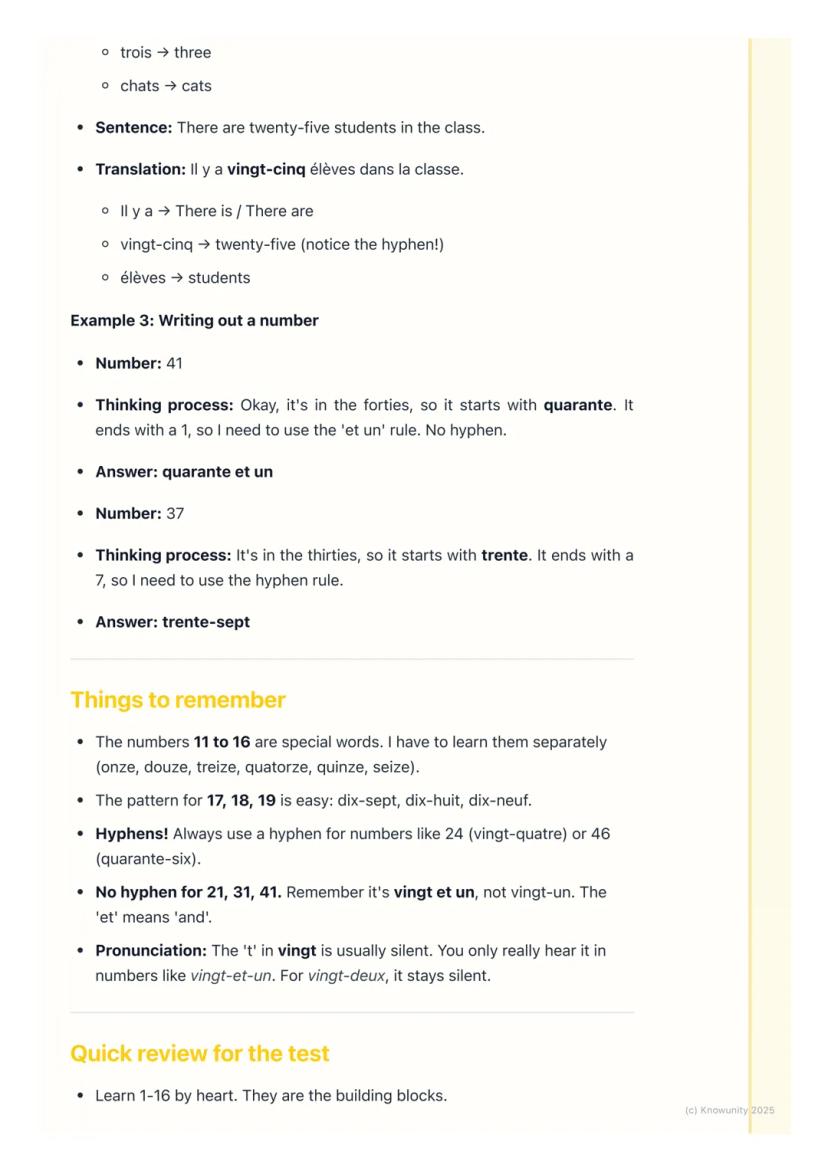
Using Numbers in Real French Sentences
Time to put these numbers to work! Saying your age is probably the most useful thing you'll do with French numbers. The question "Quel âge as-tu?" means "How old are you?"
Your answer always starts with "J'ai" (I have) followed by the number and "ans" (years). So if you're 12, you'd say "J'ai douze ans." Easy!
Counting objects works similarly. "J'ai trois chats" means "I have three cats." For bigger groups, like "There are twenty-five students in the class," you'd say "Il y a vingt-cinq élèves dans la classe." Notice that hyphen in vingt-cinq!
When you're writing out numbers, just think through the process: Is it in the twenties, thirties, or forties? Does it end in 1 (use et un) or something else (use a hyphen)?
Practice Tip: Try saying your real age, your family members' ages, and count objects around your room. The more you use these numbers, the more automatic they become!
5
of 5
Quick Review and Test Prep
Master the foundation first: numbers 1-16 are your absolute essentials. If you know these cold, you can build everything else. The pattern for 17-19 is your bridge to the bigger numbers.
Don't forget the silent letters! The 't' in vingt is usually silent - it sounds like "van", not "vingt". This catches out loads of students in speaking tests.
Practice the two rules until they're automatic: "et un" for numbers ending in 1 (no hyphen), and hyphens for everything else. Try making random numbers like 23, 37, or 44 and see if you can write them out correctly.
The brilliant thing about French numbers is that once you've cracked this system up to 50, you've basically got the pattern for counting much higher too!
Final Check: Can you write your age in French? Can you count to 20 without looking? If yes, you're absolutely ready for that test!
We thought you’d never ask...
What is the Knowunity AI companion?
Our AI companion is specifically built for the needs of students. Based on the millions of content pieces we have on the platform we can provide truly meaningful and relevant answers to students. But its not only about answers, the companion is even more about guiding students through their daily learning challenges, with personalised study plans, quizzes or content pieces in the chat and 100% personalisation based on the students skills and developments.
Where can I download the Knowunity app?
You can download the app in the Google Play Store and in the Apple App Store.
Is Knowunity really free of charge?
That's right! Enjoy free access to study content, connect with fellow students, and get instant help – all at your fingertips.
Most popular content in French
1Most popular content
9 Irish
IrishIrish oral questions and answers
Questions and answers for the leaving cert oral
5th Year4254
IrishIrish oral questions
Outline of oral questions
5th Year2055
IrishIníon- le hÁine Durkin
Aine Durkin’s poem, Iníon: Themes & summary
5th Year850
 English
Key Quotes : Sive
Key Quotes and explanations: Sive
6th Year2402
IrishIrish poetry 2027
Iníon + Dínit an Bhróin
5th Year1133
IrishLC HL notes- Iníon (poem)
Includes poem in English and Irish, theme, key words & phrases
5th Year2284
IrishGaeilge Grammar Office
All the basics you need to know on Irish grammar.
6th Year913
IrishMo Ghrá-sa (Idir Lúibíní)
Notes on mo ghrá-sa
5th Year350
IrishAn Gaeilge Aiste
Irish Language essay
6th Year1250
Can't find what you're looking for? Explore other subjects.
Students love us — and so will you.
4.6/5App Store
4.7/5Google Play
The app is very easy to use and well designed. I have found everything I was looking for so far and have been able to learn a lot from the presentations! I will definitely use the app for a class assignment! And of course it also helps a lot as an inspiration.
Stefan SiOS user
This app is really great. There are so many study notes and help [...]. My problem subject is French, for example, and the app has so many options for help. Thanks to this app, I have improved my French. I would recommend it to anyone.
Samantha KlichAndroid user
Wow, I am really amazed. I just tried the app because I've seen it advertised many times and was absolutely stunned. This app is THE HELP you want for school and above all, it offers so many things, such as workouts and fact sheets, which have been VERY helpful to me personally.
AnnaiOS user
French10 views·Updated May 19, 2026·5 pagesMaster French Numbers: Count from 1 to 50
Learning French numbers might seem tricky at first, but it's actually quite brilliant once you spot the patterns! You'll use these numbers constantly - for your age, buying things, or talking about your family - so getting them right is... Show more
1
of 5Sign up to see the content. It's free!
- Access to all documents
- Improve your grades
- Join milions of students
Getting Started with French Numbers 1-20
French numbers from 1-10 are completely unique words that you'll need to memorise properly. Think of them as your building blocks - once you've got these down, everything else becomes much easier!
The key ones to nail first are: un (1), deux (2), trois (3), quatre (4), cinq (5), six (6), sept (7), huit (8), neuf (9), and dix (10). Don't worry about perfect pronunciation yet - just get familiar with how they look.
Numbers 11-16 are special cases that you'll have to learn separately: onze, douze, treize, quatorze, quinze, seize. There's no pattern here, so it's just memorisation time!
Quick Tip: Practice writing out numbers 1-16 from memory. Once you can do this without looking, you're ready for the clever bit that comes next!
2
of 5Sign up to see the content. It's free!
- Access to all documents
- Improve your grades
- Join milions of students
The Clever Pattern from 17-20 and Beyond
Here's where French gets really smart! Numbers 17-19 follow a simple pattern: they're literally "ten-seven", "ten-eight", "ten-nine". So you get dix-sept (17), dix-huit (18), and dix-neuf (19). Brilliant, right?
Twenty is "vingt" - and watch out because the 'gt' at the end is silent! This trips up loads of people, so remember it sounds like "van", not "vingt".
Now you need to learn the tens: vingt (20), trente (30), quarante (40), and cinquante (50). These are your next building blocks for making bigger numbers.
Remember: The teens from 11-16 are weird, but 17-19 follow the "dix-" pattern. After that, it's all about combining tens with units!
3
of 5Sign up to see the content. It's free!
- Access to all documents
- Improve your grades
- Join milions of students
The Two Golden Rules for Making Numbers
Right, this is the game-changer! There are only two rules you need to make any number up to 50, and they're dead simple once you get them.
Rule 1: Numbers ending in 1 use "et un" (meaning "and one"). So 21 becomes vingt et un, 31 becomes trente et un, and 41 becomes quarante et un. Notice there's no hyphen here - just the words flowing together.
Rule 2: All other numbers use a hyphen between the ten and the unit. So 22 is vingt-deux, 35 is trente-cinq, and 48 is quarante-huit. The hyphen keeps everything tidy!
Memory Trick: If it ends in 1, think "and one" (et un). If it ends in anything else, think "hyphen time"!
4
of 5Sign up to see the content. It's free!
- Access to all documents
- Improve your grades
- Join milions of students
Using Numbers in Real French Sentences
Time to put these numbers to work! Saying your age is probably the most useful thing you'll do with French numbers. The question "Quel âge as-tu?" means "How old are you?"
Your answer always starts with "J'ai" (I have) followed by the number and "ans" (years). So if you're 12, you'd say "J'ai douze ans." Easy!
Counting objects works similarly. "J'ai trois chats" means "I have three cats." For bigger groups, like "There are twenty-five students in the class," you'd say "Il y a vingt-cinq élèves dans la classe." Notice that hyphen in vingt-cinq!
When you're writing out numbers, just think through the process: Is it in the twenties, thirties, or forties? Does it end in 1 (use et un) or something else (use a hyphen)?
Practice Tip: Try saying your real age, your family members' ages, and count objects around your room. The more you use these numbers, the more automatic they become!
5
of 5Sign up to see the content. It's free!
- Access to all documents
- Improve your grades
- Join milions of students
Quick Review and Test Prep
Master the foundation first: numbers 1-16 are your absolute essentials. If you know these cold, you can build everything else. The pattern for 17-19 is your bridge to the bigger numbers.
Don't forget the silent letters! The 't' in vingt is usually silent - it sounds like "van", not "vingt". This catches out loads of students in speaking tests.
Practice the two rules until they're automatic: "et un" for numbers ending in 1 (no hyphen), and hyphens for everything else. Try making random numbers like 23, 37, or 44 and see if you can write them out correctly.
The brilliant thing about French numbers is that once you've cracked this system up to 50, you've basically got the pattern for counting much higher too!
Final Check: Can you write your age in French? Can you count to 20 without looking? If yes, you're absolutely ready for that test!
We thought you’d never ask...
What is the Knowunity AI companion?
Our AI companion is specifically built for the needs of students. Based on the millions of content pieces we have on the platform we can provide truly meaningful and relevant answers to students. But its not only about answers, the companion is even more about guiding students through their daily learning challenges, with personalised study plans, quizzes or content pieces in the chat and 100% personalisation based on the students skills and developments.
Where can I download the Knowunity app?
You can download the app in the Google Play Store and in the Apple App Store.
Is Knowunity really free of charge?
That's right! Enjoy free access to study content, connect with fellow students, and get instant help – all at your fingertips.
Most popular content in French
1Most popular content
9IrishIrish oral questions and answers
Questions and answers for the leaving cert oral
5th Year4254
IrishIrish oral questions
Outline of oral questions
5th Year2055
IrishIníon- le hÁine Durkin
Aine Durkin’s poem, Iníon: Themes & summary
5th Year850
EnglishKey Quotes : Sive
Key Quotes and explanations: Sive
6th Year2402
IrishIrish poetry 2027
Iníon + Dínit an Bhróin
5th Year1133
IrishLC HL notes- Iníon (poem)
Includes poem in English and Irish, theme, key words & phrases
5th Year2284
IrishGaeilge Grammar Office
All the basics you need to know on Irish grammar.
6th Year913
IrishMo Ghrá-sa (Idir Lúibíní)
Notes on mo ghrá-sa
5th Year350
IrishAn Gaeilge Aiste
Irish Language essay
6th Year1250
Can't find what you're looking for? Explore other subjects.
Students love us — and so will you.
4.6/5App Store
4.7/5Google Play
The app is very easy to use and well designed. I have found everything I was looking for so far and have been able to learn a lot from the presentations! I will definitely use the app for a class assignment! And of course it also helps a lot as an inspiration.
Stefan SiOS user
This app is really great. There are so many study notes and help [...]. My problem subject is French, for example, and the app has so many options for help. Thanks to this app, I have improved my French. I would recommend it to anyone.
Samantha KlichAndroid user
Wow, I am really amazed. I just tried the app because I've seen it advertised many times and was absolutely stunned. This app is THE HELP you want for school and above all, it offers so many things, such as workouts and fact sheets, which have been VERY helpful to me personally.
AnnaiOS user