
Wenn du eine Englisch-Klausur schreibst und dabei Texte analysieren oder... Show more
 Englisch3,595 views·Updated May 26, 2026·6 pages
Top-Phrasen für das Englisch-Abitur
1 / 6
1
of 6
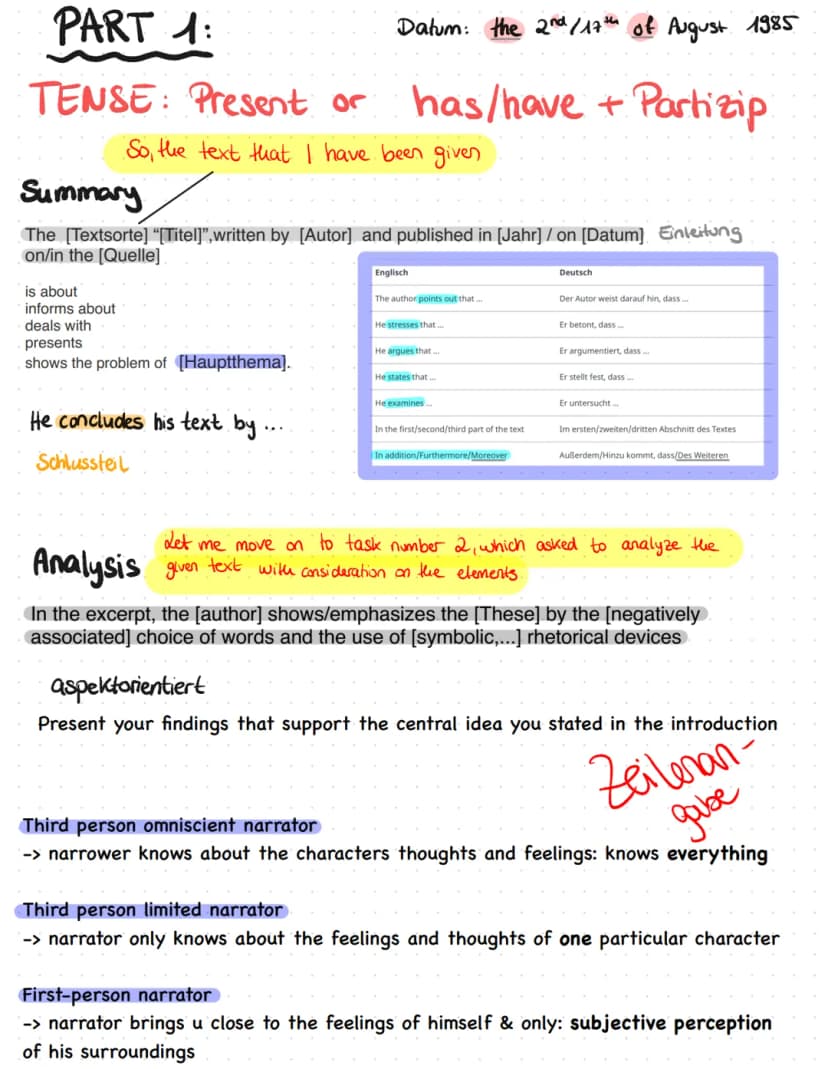
Nützliche Phrasen für den Einstieg
Der erste Eindruck zählt - und das gilt besonders für deine Einleitung in Englisch-Klausuren! Mit den richtigen Standardphrasen wirkst du sofort professioneller.
Für die Texteinleitung merkst du dir am besten diese Formel: "The [Textsorte] '[Titel]', written by [Autor] and published in [Jahr]/on [Datum] on/in the [Quelle]". Beim Datum verwendest du übrigens "the 2nd/17th of August 1985" und achtest darauf, dass du im Present Tense oder mit "has/have + Partizip" schreibst.
Tipp: Lerne diese Einleitungsformel auswendig - sie funktioniert bei fast jedem Text und spart dir wertvolle Zeit in der Klausur!
2
of 6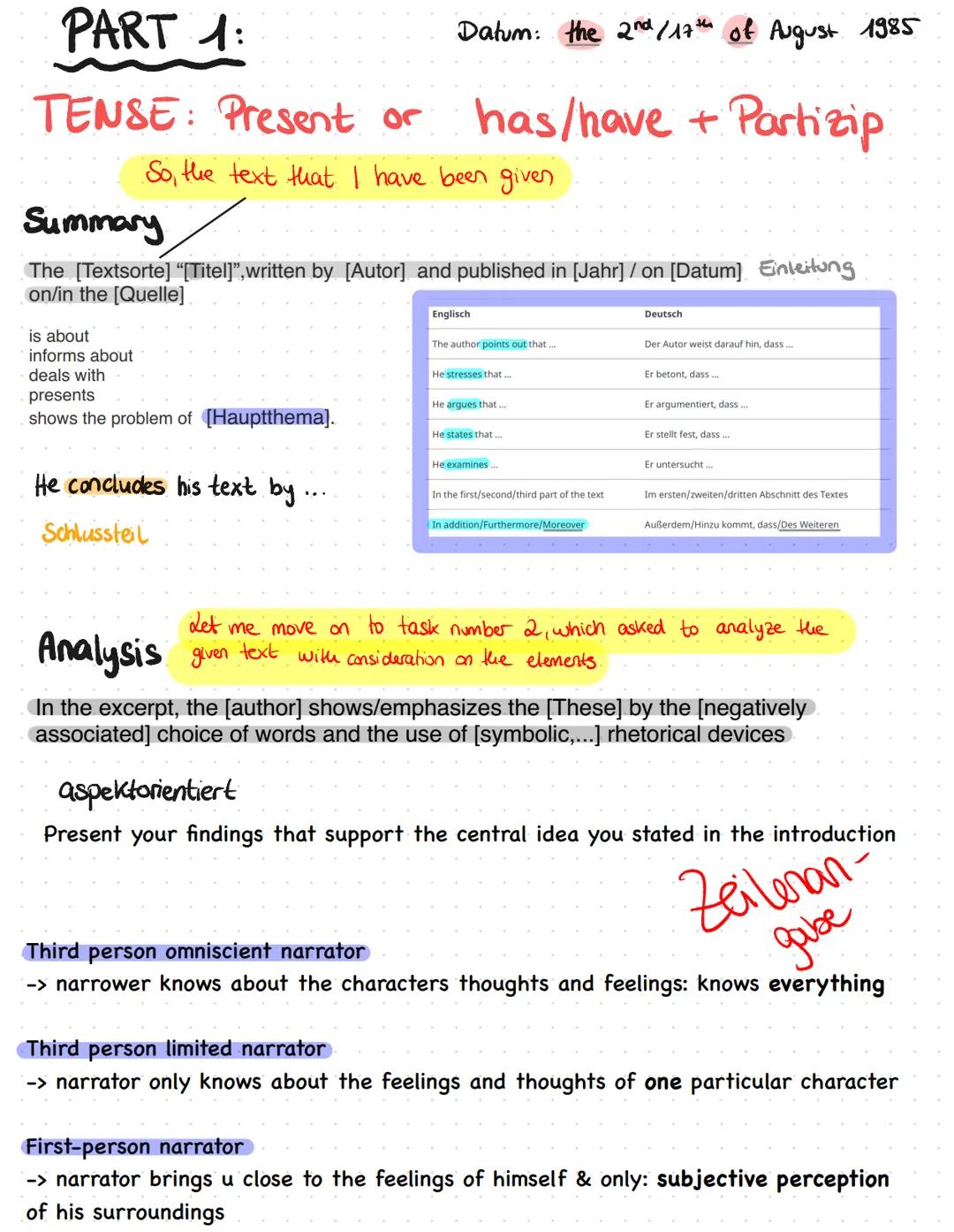
Analysephrasen und Erzählperspektiven
Für eine gute Textanalyse brauchst du Phrasen, die zeigen, was der Autor macht. "The author points out that..." (Der Autor weist darauf hin), "He stresses that..." (Er betont) oder "He argues that..." (Er argumentiert) sind deine Grundausstattung.
Bei der Erzählperspektive unterscheidest du drei wichtige Typen: Der Third person omniscient narrator weiß alles über alle Charaktere. Der Third person limited narrator kennt nur die Gedanken einer Person. Der First-person narrator erzählt subjektiv aus seiner eigenen Sicht.
Vergiss nicht die aspektorientierte Analyse: "In the excerpt, the author shows the [These] by the negatively associated choice of words and the use of rhetorical devices." So verbindest du Textinhalt mit sprachlichen Mitteln.
Merkhilfe: Omniscient = allwissend, Limited = begrenzt, First-person = ich-bezogen!
3
of 6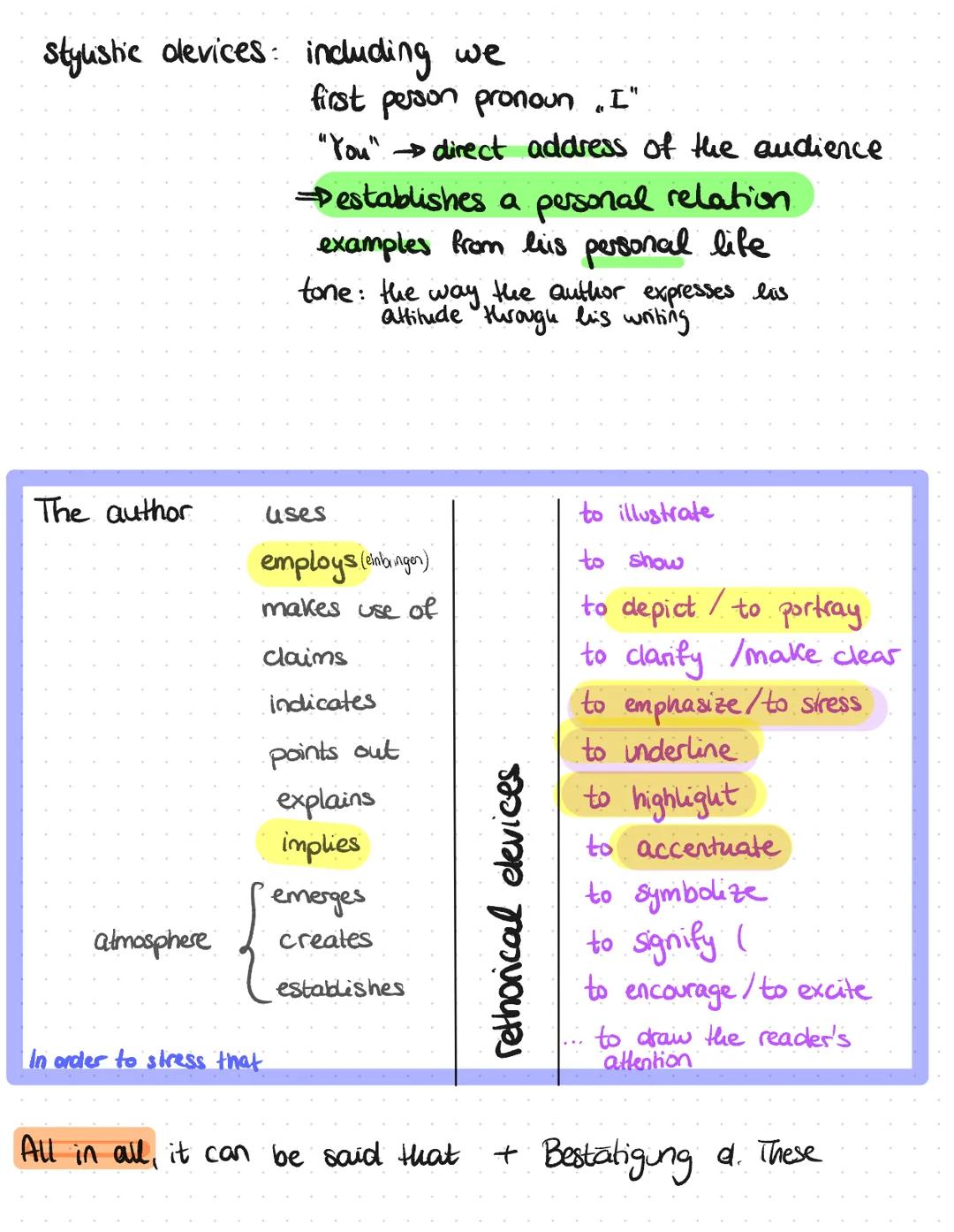
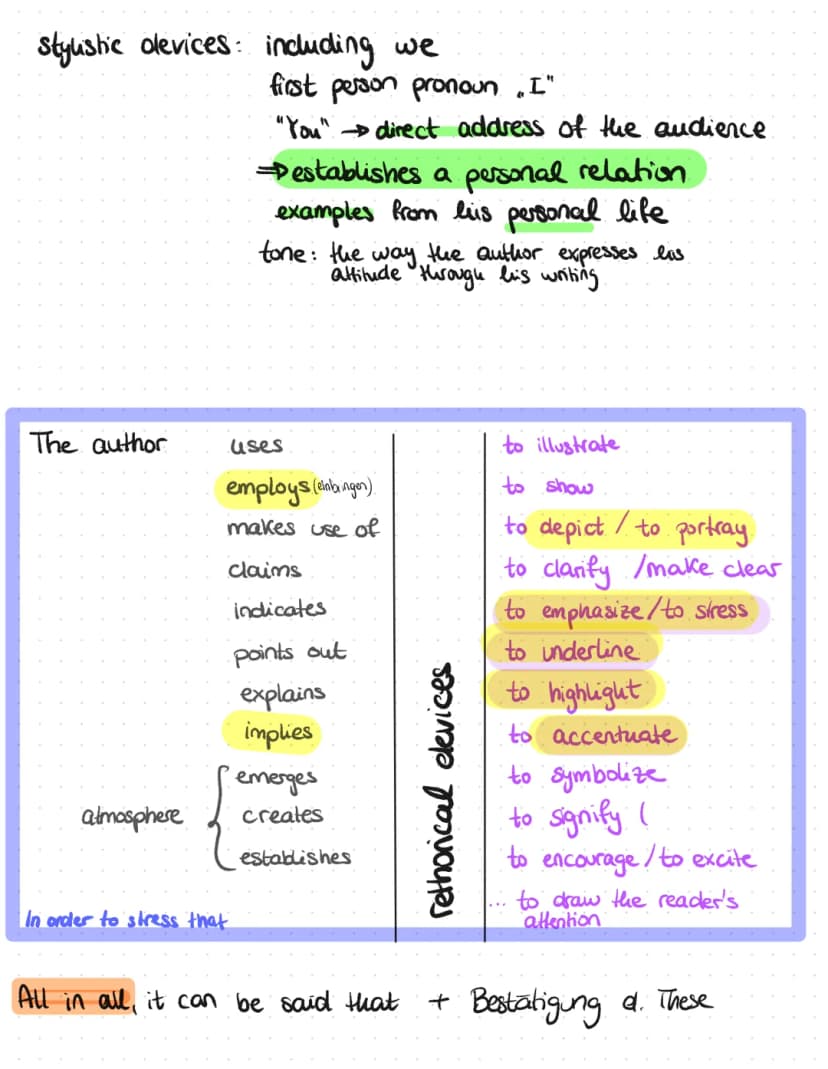
Stilmittel und Wirkung beschreiben
Stilmittel erkennen ist nur die halbe Miete - du musst auch ihre Wirkung erklären können! Der Autor "uses", "employs" oder "makes use of" verschiedene Techniken, um bestimmte Effekte zu erzielen.
Wichtige Wirkungsverben sind: "to emphasize/to stress" (betonen), "to highlight" (hervorheben), "to symbolize" (symbolisieren) und "to draw the reader's attention" (Aufmerksamkeit lenken). Diese Verben zeigen, warum der Autor bestimmte Mittel einsetzt.
Persönliche Elemente wie "I", "you" oder "we" schaffen eine direkte Verbindung zum Leser. Der Tone (Tonfall) verrät die Haltung des Autors zum Thema.
Profi-Tipp: Verknüpfe Stilmittel immer mit ihrer Wirkung - nie nur auflisten!
4
of 6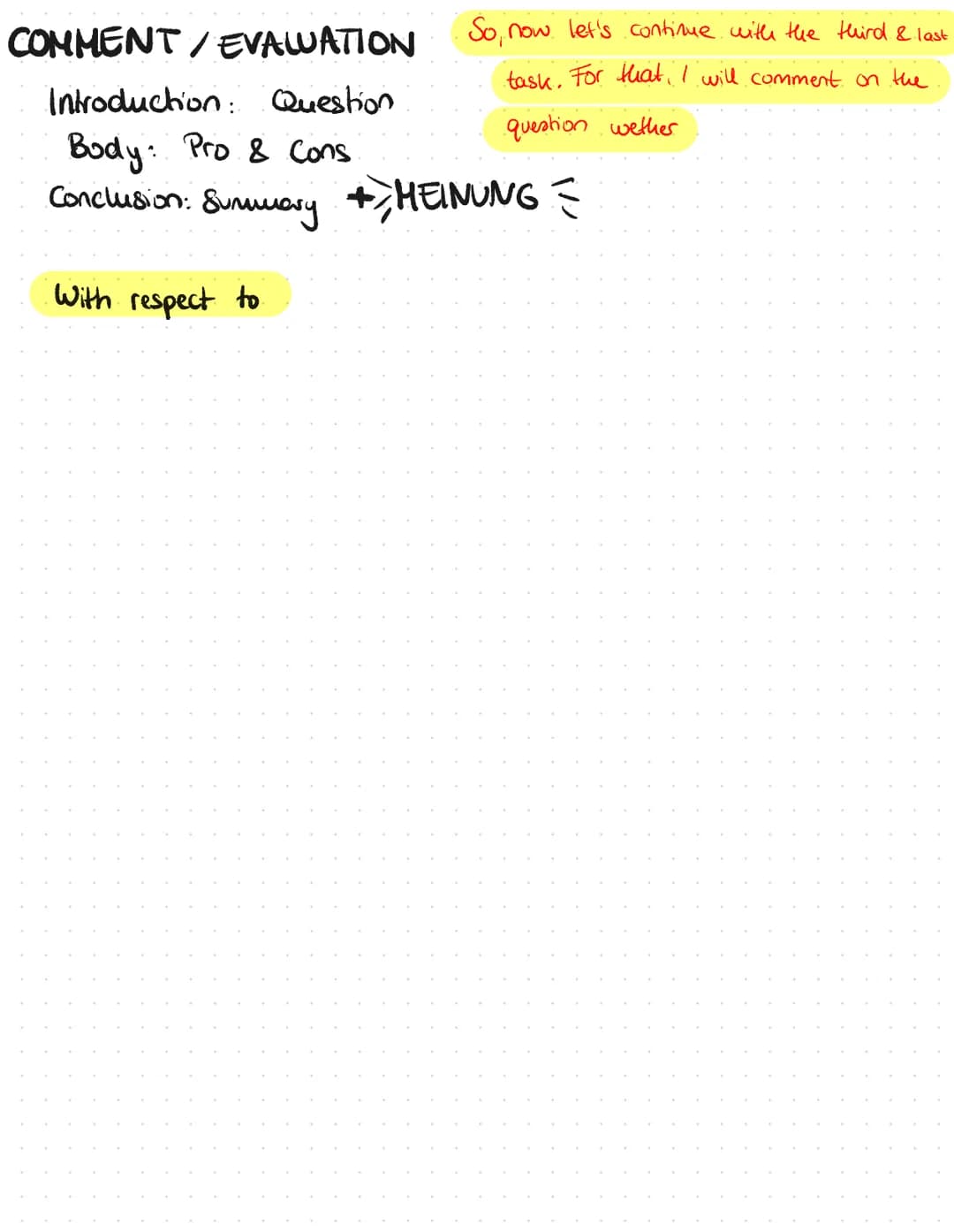
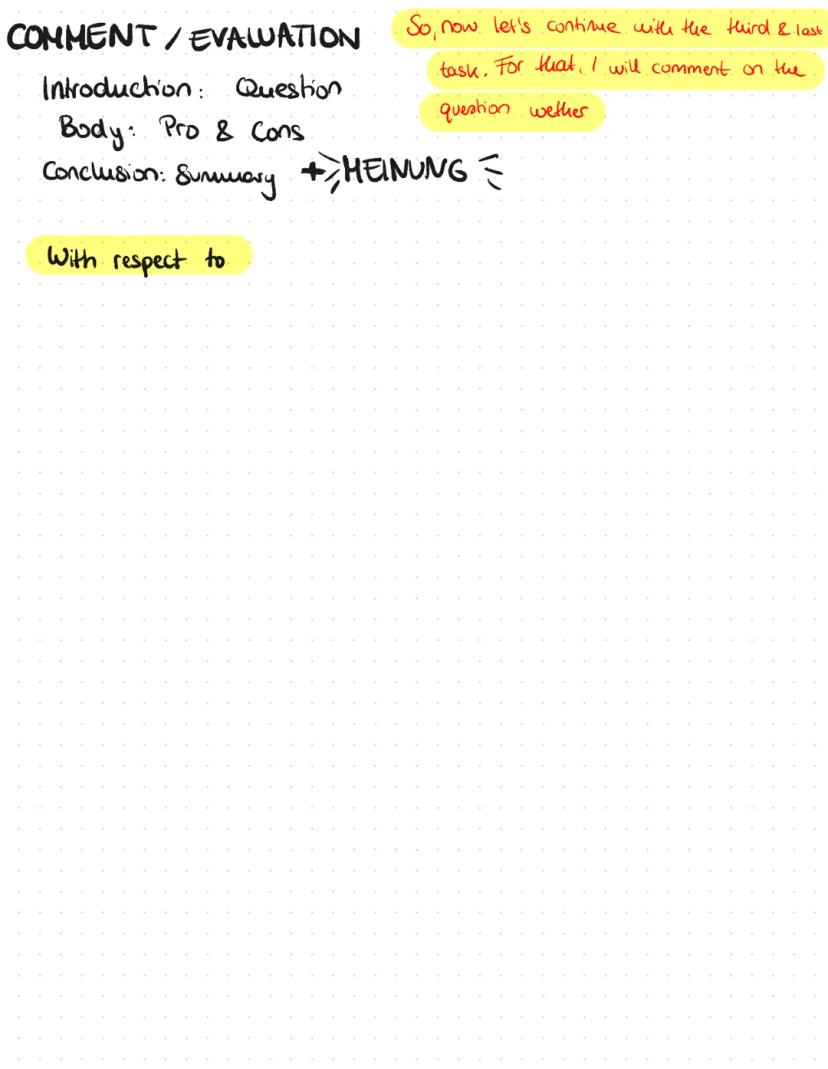
Comment und Evaluation strukturieren
Beim Comment zeigst du deine eigene Meinung zu einer Frage. Die Struktur ist klar: Introduction mit der Fragestellung, Body mit Pro- und Contra-Argumenten, Conclusion mit deiner persönlichen Meinung.
"With respect to" (In Bezug auf) ist ein eleganter Einstieg für deine Stellungnahme. Du bewertest dabei nicht nur den Text, sondern entwickelst eine eigene argumentative Position.
Der Schlüssel liegt darin, beide Seiten zu beleuchten, bevor du dich festlegst. So wirkst du reflektiert und durchdacht.
Wichtig: Deine Meinung gehört in den Schluss - vorher bleibst du neutral und wägst ab!
5
of 6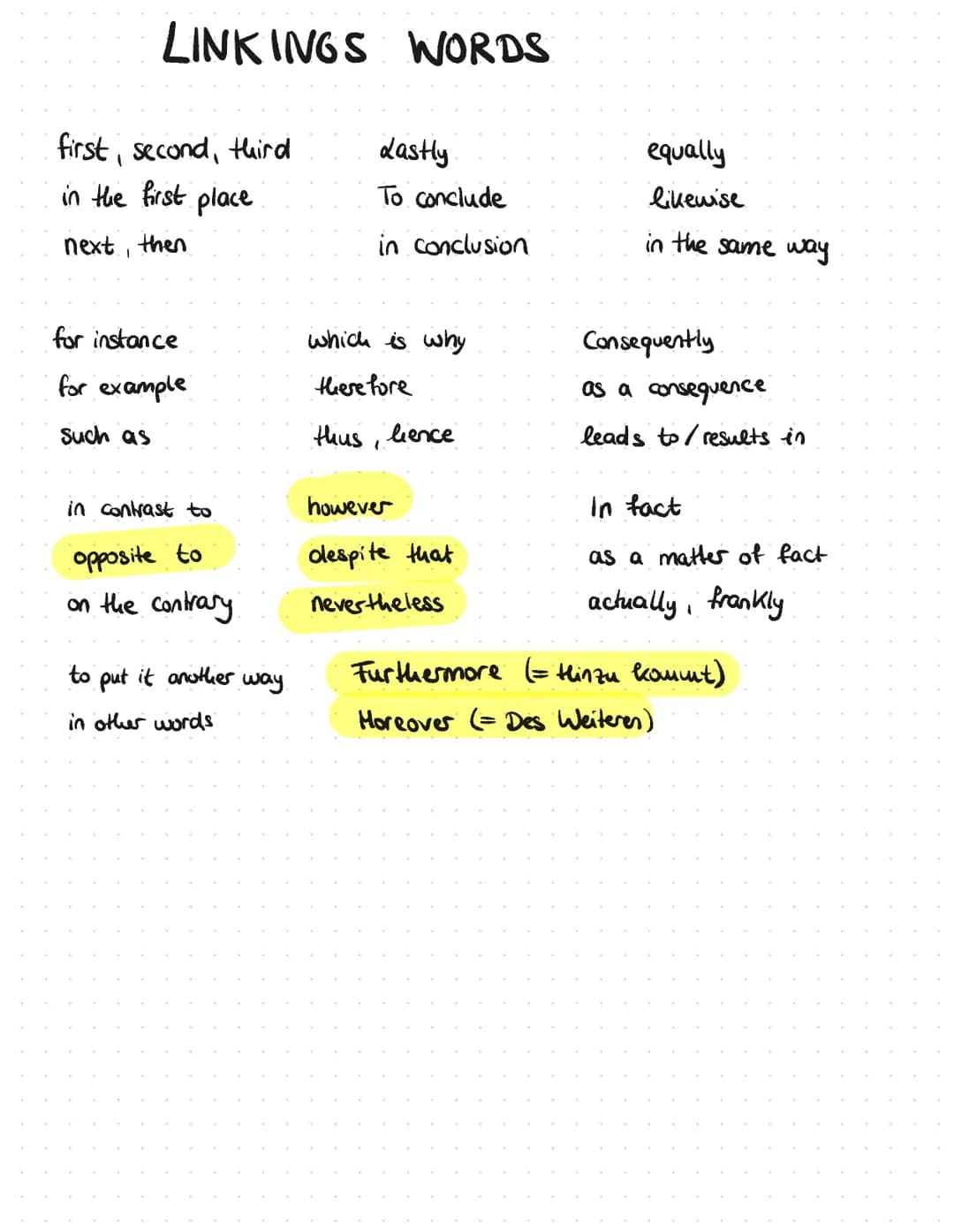
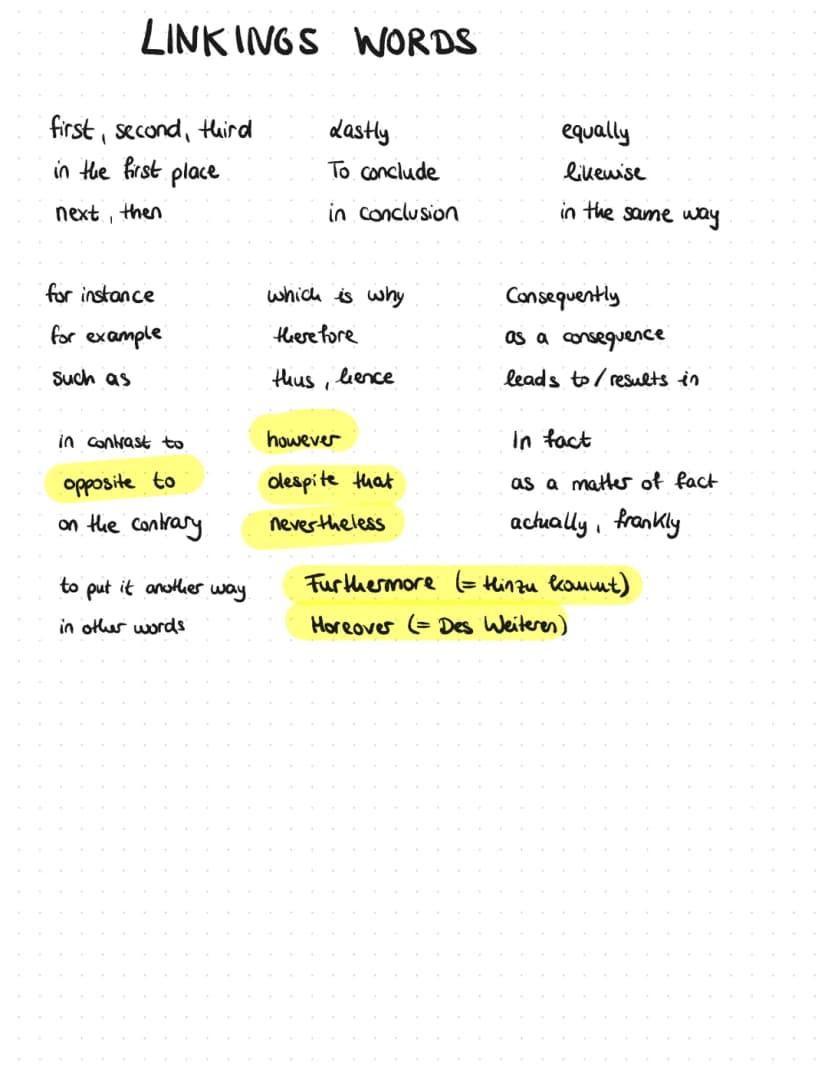
Linking Words für bessere Struktur
Linking Words sind das Geheimnis für flüssige Texte! Sie verbinden deine Gedanken logisch und machen deine Argumentation nachvollziehbar.
Für Aufzählungen verwendest du "first, second, third" oder "in the first place, next, then". Beispiele leitest du mit "for instance" oder "such as" ein. Gegensätze zeigst du mit "in contrast to", "however" oder "nevertheless".
Schlussfolgerungen markierst du mit "therefore", "thus" oder "consequently". Für Zusatzinformationen nutzt du "furthermore" oder "moreover". Am Ende fasst du mit "to conclude" oder "in conclusion" zusammen.
Übung macht den Meister: Verwende in jedem Absatz mindestens ein Linking Word!
6
of 6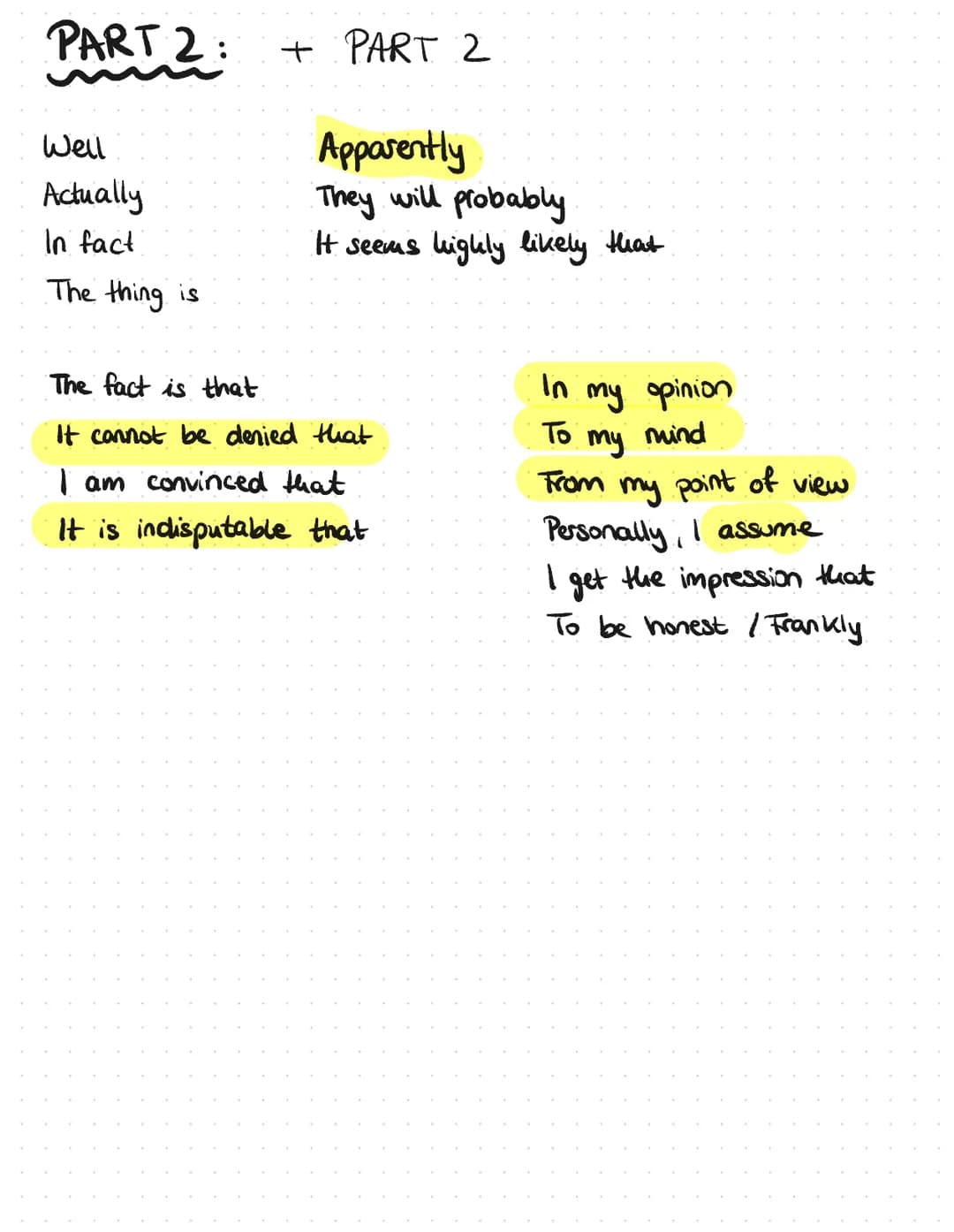
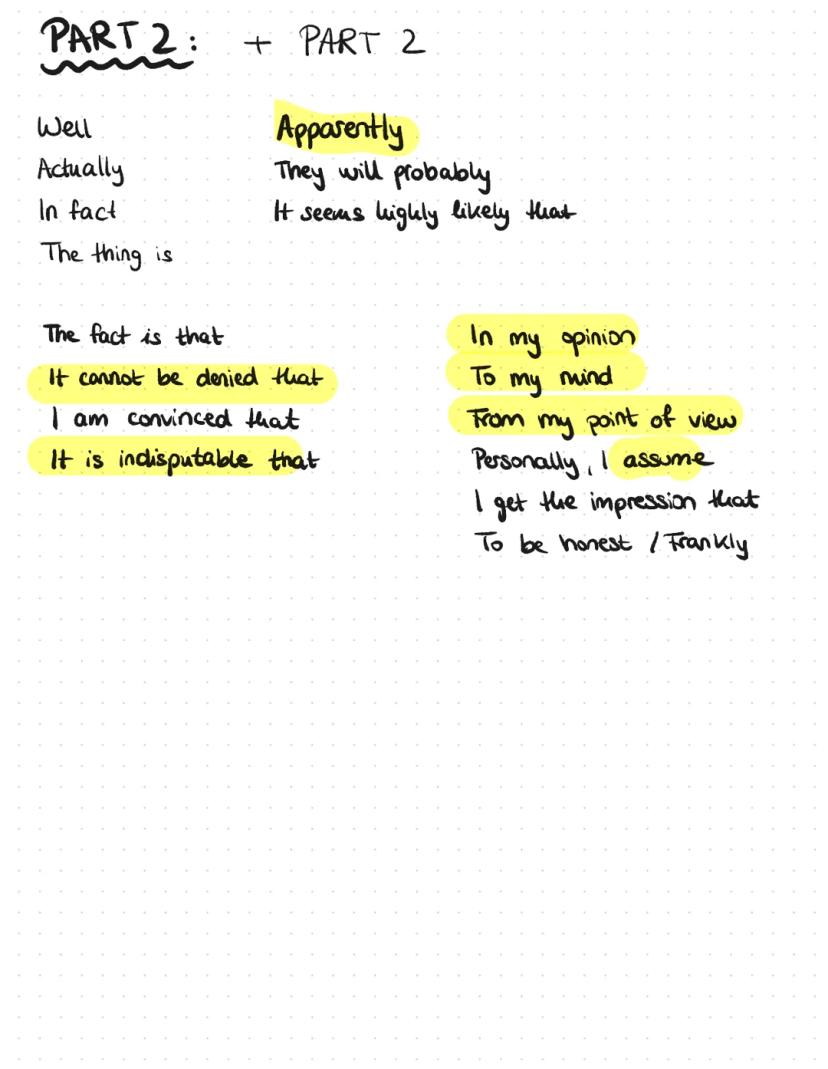
Meinungsäußerung und Wahrscheinlichkeit
Deine persönliche Meinung drückst du höflich aber bestimmt aus. "In my opinion", "from my point of view" oder "personally, I assume" zeigen, dass du eine durchdachte Position hast.
Für Wahrscheinlichkeiten und Vermutungen verwendest du "apparently", "it seems highly likely that" oder "they will probably". So wirkst du nicht zu absolut in deinen Aussagen.
Bekräftigungen wie "I am convinced that", "it cannot be denied that" oder "it is indisputable that" unterstützen starke Argumente. "To be honest" oder "frankly" verleihen deinen Aussagen Authentizität.
Balance finden: Sei selbstbewusst in deiner Meinung, aber respektiere andere Sichtweisen!
We thought you’d never ask...
What is the Knowunity AI companion?
Our AI companion is specifically built for the needs of students. Based on the millions of content pieces we have on the platform we can provide truly meaningful and relevant answers to students. But its not only about answers, the companion is even more about guiding students through their daily learning challenges, with personalised study plans, quizzes or content pieces in the chat and 100% personalisation based on the students skills and developments.
Where can I download the Knowunity app?
You can download the app in the Google Play Store and in the Apple App Store.
Is Knowunity really free of charge?
That's right! Enjoy free access to study content, connect with fellow students, and get instant help – all at your fingertips.
Similar Content
Most popular content: linking words
9Most popular content in Englisch
9Most popular content
9Can't find what you're looking for? Explore other subjects.
Students love us — and so will you.
4.6/5App Store
4.7/5Google Play
The app is very easy to use and well designed. I have found everything I was looking for so far and have been able to learn a lot from the presentations! I will definitely use the app for a class assignment! And of course it also helps a lot as an inspiration.
Stefan SiOS user
This app is really great. There are so many study notes and help [...]. My problem subject is French, for example, and the app has so many options for help. Thanks to this app, I have improved my French. I would recommend it to anyone.
Samantha KlichAndroid user
Wow, I am really amazed. I just tried the app because I've seen it advertised many times and was absolutely stunned. This app is THE HELP you want for school and above all, it offers so many things, such as workouts and fact sheets, which have been VERY helpful to me personally.
AnnaiOS user
Englisch3,595 views·Updated May 26, 2026·6 pagesTop-Phrasen für das Englisch-Abitur
Wenn du eine Englisch-Klausur schreibst und dabei Texte analysieren oder kommentieren musst, brauchst du die richtigen sprachlichen Werkzeuge. Diese nützlichen Phrasen und Linking Words helfen dir dabei, deine Gedanken strukturiert und überzeugend zu formulieren.
1
of 6Sign up to see the content. It's free!
- Access to all documents
- Improve your grades
- Join milions of students
Nützliche Phrasen für den Einstieg
Der erste Eindruck zählt - und das gilt besonders für deine Einleitung in Englisch-Klausuren! Mit den richtigen Standardphrasen wirkst du sofort professioneller.
Für die Texteinleitung merkst du dir am besten diese Formel: "The [Textsorte] '[Titel]', written by [Autor] and published in [Jahr]/on [Datum] on/in the [Quelle]". Beim Datum verwendest du übrigens "the 2nd/17th of August 1985" und achtest darauf, dass du im Present Tense oder mit "has/have + Partizip" schreibst.
Tipp: Lerne diese Einleitungsformel auswendig - sie funktioniert bei fast jedem Text und spart dir wertvolle Zeit in der Klausur!
2
of 6Sign up to see the content. It's free!
- Access to all documents
- Improve your grades
- Join milions of students
Analysephrasen und Erzählperspektiven
Für eine gute Textanalyse brauchst du Phrasen, die zeigen, was der Autor macht. "The author points out that..." (Der Autor weist darauf hin), "He stresses that..." (Er betont) oder "He argues that..." (Er argumentiert) sind deine Grundausstattung.
Bei der Erzählperspektive unterscheidest du drei wichtige Typen: Der Third person omniscient narrator weiß alles über alle Charaktere. Der Third person limited narrator kennt nur die Gedanken einer Person. Der First-person narrator erzählt subjektiv aus seiner eigenen Sicht.
Vergiss nicht die aspektorientierte Analyse: "In the excerpt, the author shows the [These] by the negatively associated choice of words and the use of rhetorical devices." So verbindest du Textinhalt mit sprachlichen Mitteln.
Merkhilfe: Omniscient = allwissend, Limited = begrenzt, First-person = ich-bezogen!
3
of 6Sign up to see the content. It's free!
- Access to all documents
- Improve your grades
- Join milions of students
Stilmittel und Wirkung beschreiben
Stilmittel erkennen ist nur die halbe Miete - du musst auch ihre Wirkung erklären können! Der Autor "uses", "employs" oder "makes use of" verschiedene Techniken, um bestimmte Effekte zu erzielen.
Wichtige Wirkungsverben sind: "to emphasize/to stress" (betonen), "to highlight" (hervorheben), "to symbolize" (symbolisieren) und "to draw the reader's attention" (Aufmerksamkeit lenken). Diese Verben zeigen, warum der Autor bestimmte Mittel einsetzt.
Persönliche Elemente wie "I", "you" oder "we" schaffen eine direkte Verbindung zum Leser. Der Tone (Tonfall) verrät die Haltung des Autors zum Thema.
Profi-Tipp: Verknüpfe Stilmittel immer mit ihrer Wirkung - nie nur auflisten!
4
of 6Sign up to see the content. It's free!
- Access to all documents
- Improve your grades
- Join milions of students
Comment und Evaluation strukturieren
Beim Comment zeigst du deine eigene Meinung zu einer Frage. Die Struktur ist klar: Introduction mit der Fragestellung, Body mit Pro- und Contra-Argumenten, Conclusion mit deiner persönlichen Meinung.
"With respect to" (In Bezug auf) ist ein eleganter Einstieg für deine Stellungnahme. Du bewertest dabei nicht nur den Text, sondern entwickelst eine eigene argumentative Position.
Der Schlüssel liegt darin, beide Seiten zu beleuchten, bevor du dich festlegst. So wirkst du reflektiert und durchdacht.
Wichtig: Deine Meinung gehört in den Schluss - vorher bleibst du neutral und wägst ab!
5
of 6Sign up to see the content. It's free!
- Access to all documents
- Improve your grades
- Join milions of students
Linking Words für bessere Struktur
Linking Words sind das Geheimnis für flüssige Texte! Sie verbinden deine Gedanken logisch und machen deine Argumentation nachvollziehbar.
Für Aufzählungen verwendest du "first, second, third" oder "in the first place, next, then". Beispiele leitest du mit "for instance" oder "such as" ein. Gegensätze zeigst du mit "in contrast to", "however" oder "nevertheless".
Schlussfolgerungen markierst du mit "therefore", "thus" oder "consequently". Für Zusatzinformationen nutzt du "furthermore" oder "moreover". Am Ende fasst du mit "to conclude" oder "in conclusion" zusammen.
Übung macht den Meister: Verwende in jedem Absatz mindestens ein Linking Word!
6
of 6Sign up to see the content. It's free!
- Access to all documents
- Improve your grades
- Join milions of students
Meinungsäußerung und Wahrscheinlichkeit
Deine persönliche Meinung drückst du höflich aber bestimmt aus. "In my opinion", "from my point of view" oder "personally, I assume" zeigen, dass du eine durchdachte Position hast.
Für Wahrscheinlichkeiten und Vermutungen verwendest du "apparently", "it seems highly likely that" oder "they will probably". So wirkst du nicht zu absolut in deinen Aussagen.
Bekräftigungen wie "I am convinced that", "it cannot be denied that" oder "it is indisputable that" unterstützen starke Argumente. "To be honest" oder "frankly" verleihen deinen Aussagen Authentizität.
Balance finden: Sei selbstbewusst in deiner Meinung, aber respektiere andere Sichtweisen!
We thought you’d never ask...
What is the Knowunity AI companion?
Our AI companion is specifically built for the needs of students. Based on the millions of content pieces we have on the platform we can provide truly meaningful and relevant answers to students. But its not only about answers, the companion is even more about guiding students through their daily learning challenges, with personalised study plans, quizzes or content pieces in the chat and 100% personalisation based on the students skills and developments.
Where can I download the Knowunity app?
You can download the app in the Google Play Store and in the Apple App Store.
Is Knowunity really free of charge?
That's right! Enjoy free access to study content, connect with fellow students, and get instant help – all at your fingertips.
Similar Content
Most popular content: linking words
9Most popular content in Englisch
9Most popular content
9Can't find what you're looking for? Explore other subjects.
Students love us — and so will you.
4.6/5App Store
4.7/5Google Play
The app is very easy to use and well designed. I have found everything I was looking for so far and have been able to learn a lot from the presentations! I will definitely use the app for a class assignment! And of course it also helps a lot as an inspiration.
Stefan SiOS user
This app is really great. There are so many study notes and help [...]. My problem subject is French, for example, and the app has so many options for help. Thanks to this app, I have improved my French. I would recommend it to anyone.
Samantha KlichAndroid user
Wow, I am really amazed. I just tried the app because I've seen it advertised many times and was absolutely stunned. This app is THE HELP you want for school and above all, it offers so many things, such as workouts and fact sheets, which have been VERY helpful to me personally.
AnnaiOS user