
Engineering materials are at the heart of everything we build... Show more
 Engineering
 Irish
Irish English
Sign up to see the contentIt's free!
Access to all documents
Improve your grades
Join milions of students
Knowunity AI
Subjects
Triangle Congruence and Similarity Theorems
Triangle Properties and Classification
Linear Equations and Graphs
Geometric Angle Relationships
Trigonometric Functions and Identities
Equation Solving Techniques
Circle Geometry Fundamentals
Division Operations and Methods
Basic Differentiation Rules
Exponent and Logarithm Properties
Show all topics
Human Organ Systems
Reproductive Cell Cycles
Biological Sciences Subdisciplines
Cellular Energy Metabolism
Autotrophic Energy Processes
Inheritance Patterns and Principles
Biomolecular Structure and Organization
Cell Cycle and Division Mechanics
Cellular Organization and Development
Biological Structural Organization
Show all topics
Chemical Sciences and Applications
Atomic Structure and Composition
Molecular Electron Structure Representation
Atomic Electron Behavior
Matter Properties and Water
Mole Concept and Calculations
Gas Laws and Behavior
Periodic Table Organization
Chemical Thermodynamics Fundamentals
Chemical Bond Types and Properties
Show all topics
European Renaissance and Enlightenment
European Cultural Movements 800-1920
American Revolution Era 1763-1797
American Civil War 1861-1865
Global Imperial Systems
Mongol and Chinese Dynasties
U.S. Presidents and World Leaders
Historical Sources and Documentation
World Wars Era and Impact
World Religious Systems
Show all topics
Classic and Contemporary Novels
Literary Character Analysis
Rhetorical Theory and Practice
Classic Literary Narratives
Reading Analysis and Interpretation
Narrative Structure and Techniques
English Language Components
Influential English-Language Authors
Basic Sentence Structure
Narrative Voice and Perspective
Show all topics
2
•
Updated Apr 30, 2026
•
Engineering materials are at the heart of everything we build... Show more
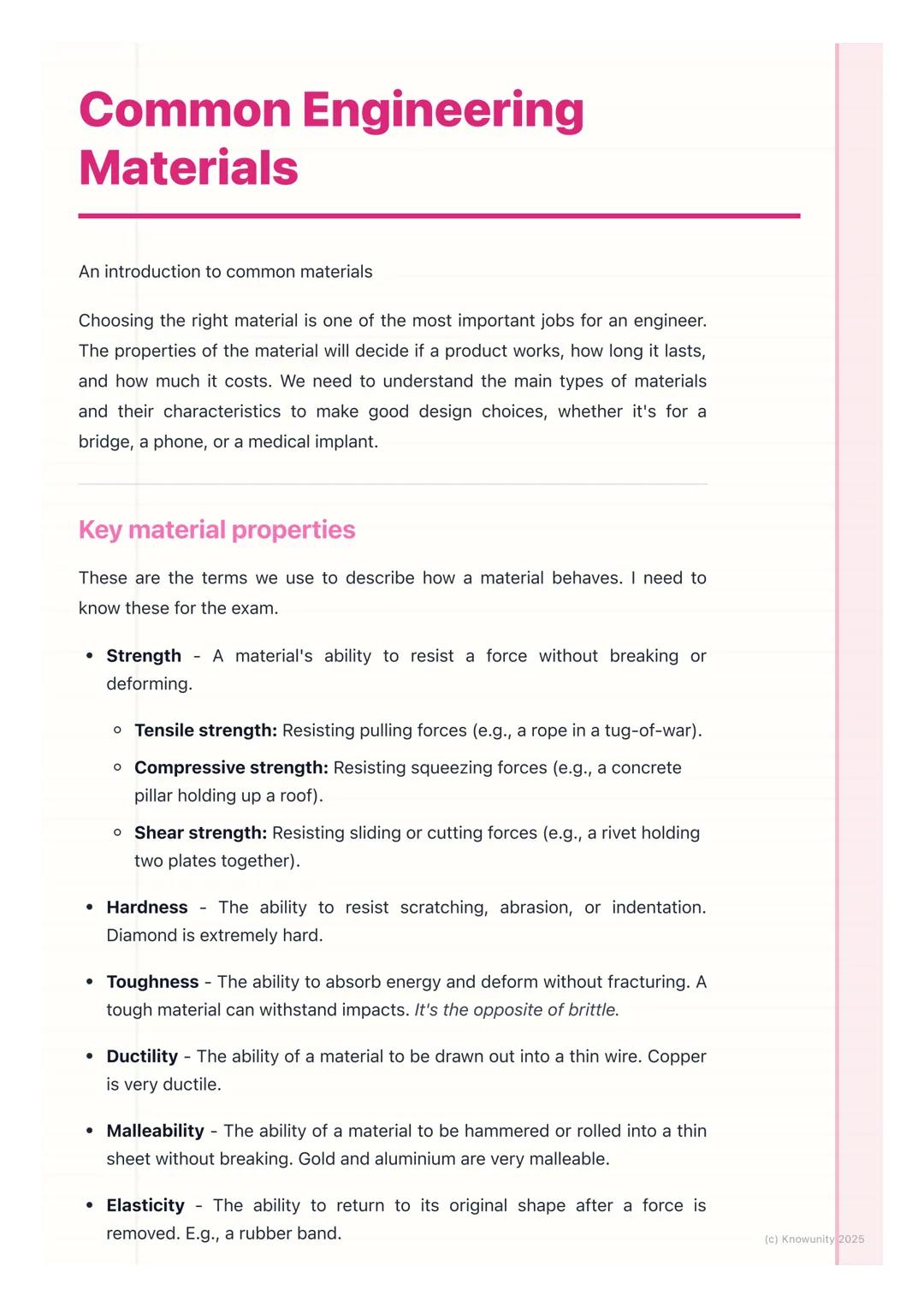
When designing products, engineers must understand how materials behave under different conditions. These properties determine which materials are suitable for specific applications.
Materials have different types of strength: tensile strength helps resist pulling forces , compressive strength resists squeezing forces (like concrete pillars supporting a roof), and shear strength resists sliding forces (like rivets holding plates together). Hardness measures resistance to scratching or indentation, while toughness is about absorbing energy without breaking.
Ductility and malleability are related but different properties. Ductile materials like copper can be drawn into wires, while malleable materials like gold can be hammered into sheets without breaking. Elasticity describes how well materials return to their original shape after a force is removed, like a rubber band. When materials permanently change shape, they've undergone plastic deformation.
Remember: Don't confuse hardness with toughness! A ceramic tile is hard but not tough (it shatters easily), while a car bumper is tough (absorbs impact) but not very hard.
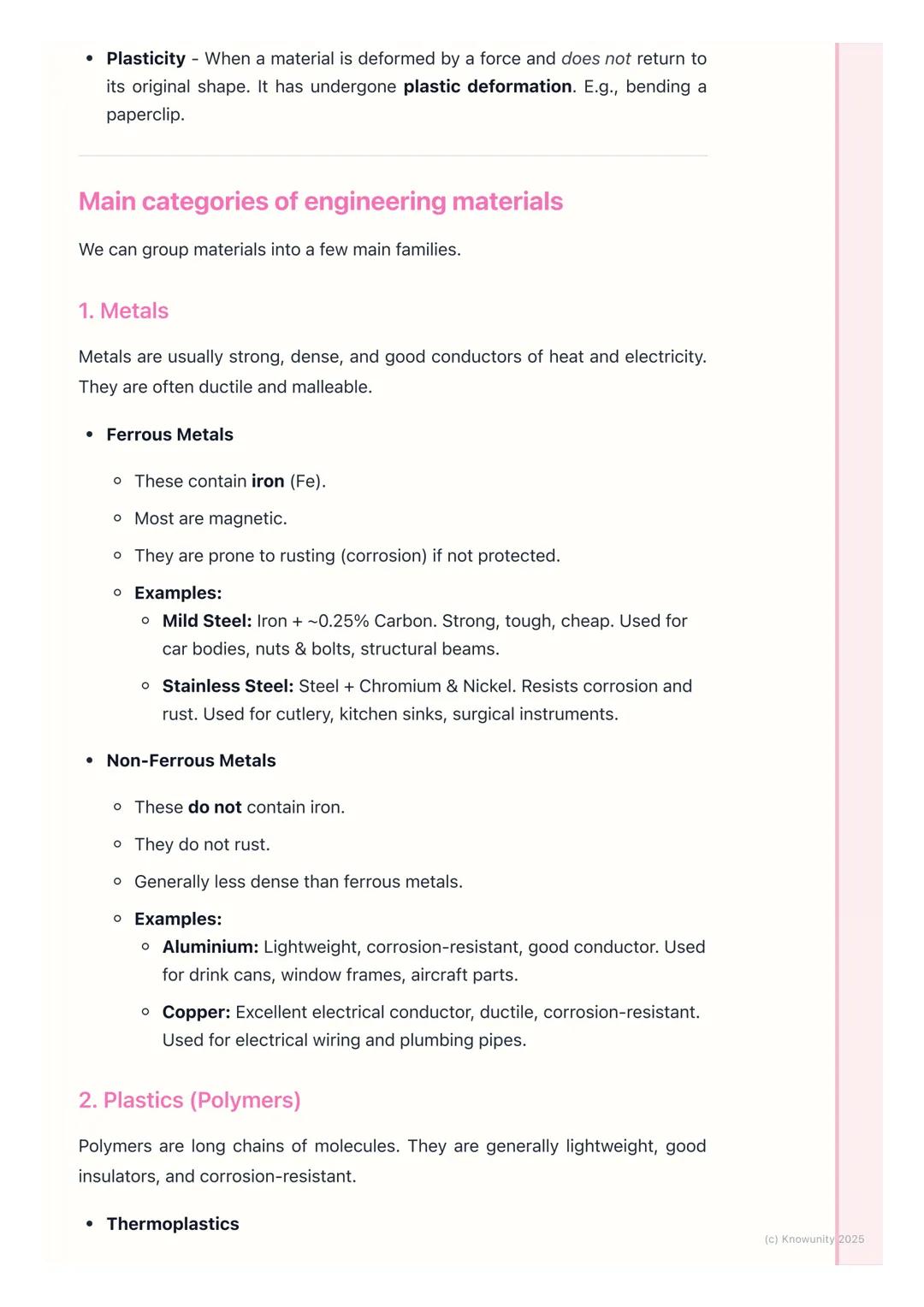
Metals are the workhorses of engineering materials, known for their strength and conductivity. You'll find them in everything from your smartphone to massive bridges.
Ferrous metals contain iron and include mild steel (iron with about 0.25% carbon) which is strong, tough, and affordable, making it perfect for car bodies and structural beams. Stainless steel adds chromium and nickel to create a rust-resistant metal ideal for cutlery and surgical instruments. Most ferrous metals are magnetic and prone to rusting if not protected.
Non-ferrous metals don't contain iron and don't rust, which makes them valuable for specific applications. Aluminium is lightweight and corrosion-resistant, making it perfect for aircraft parts and window frames. Copper is an excellent electrical conductor that's also ductile and corrosion-resistant, which is why it's used for electrical wiring and plumbing.
When choosing between ferrous and non-ferrous metals, consider the environment where they'll be used. For outdoor applications exposed to moisture, non-ferrous metals or specially treated ferrous metals are often better choices.
Pro tip: When preparing for exams, remember ferrous metals with the phrase "Fe-rrous" – Fe is the chemical symbol for iron!
Plastics are everywhere in our modern world, from your water bottle to parts in your computer. Their versatility comes from their molecular structure.
Thermoplastics can be melted and reshaped repeatedly, making them ideal for recycling. Their long polymer chains tangle but don't link together, allowing them to soften when heated. PVC (polyvinyl chloride) is a rigid, tough thermoplastic used for pipes and window frames, while acrylic (Perspex) offers clarity for signs and car light covers.
Thermosetting plastics undergo a permanent chemical change when first heated, creating strong cross-links between polymer chains. Once set, they can't be remelted or reshaped. Epoxy resin is a strong adhesive and electrical insulator used in circuit boards, while urea formaldehyde provides hard, stiff material for electrical plugs and sockets.
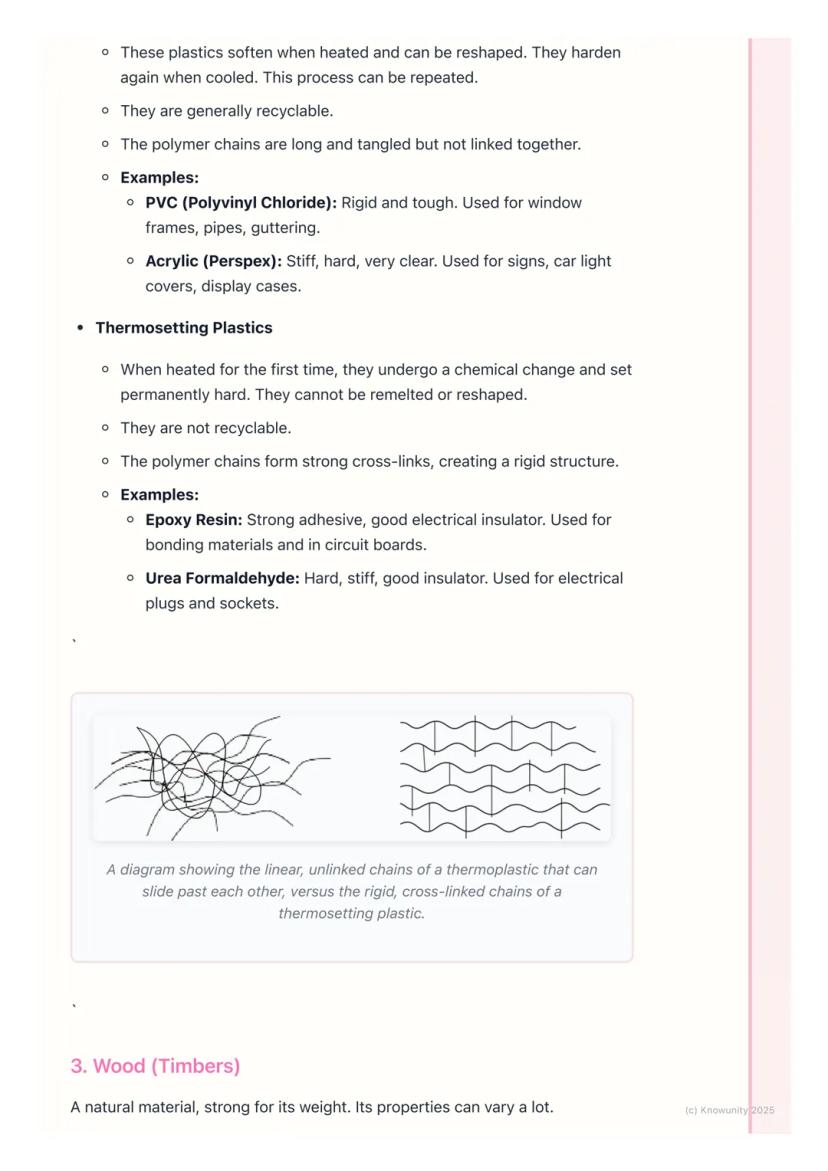
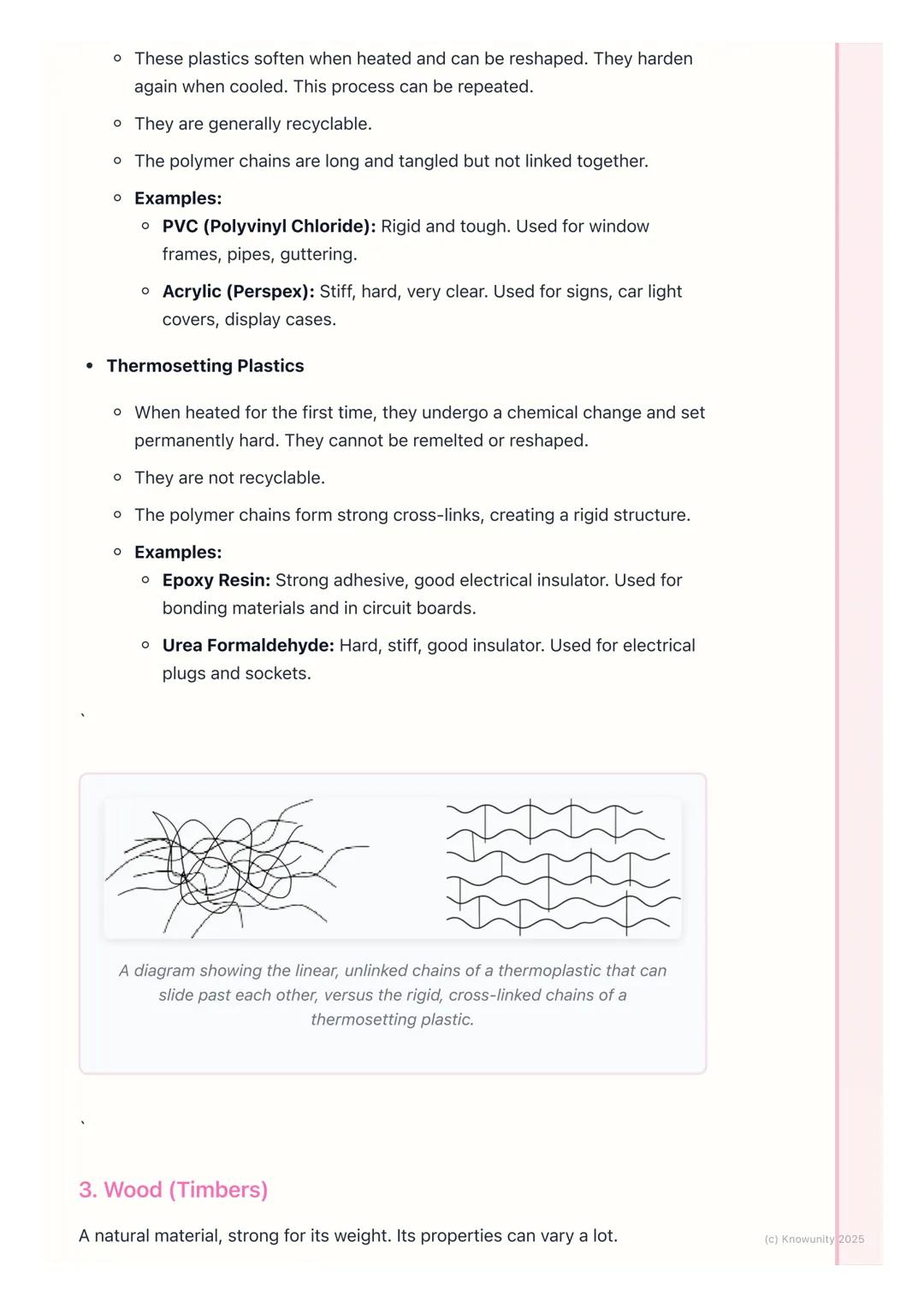
The key difference between these plastic types is in their molecular structure – thermoplastics have linear chains that can slide past each other when heated, while thermosets have rigid cross-linked structures that cannot be broken down by reheating.
Visual comparison: Think of thermoplastics as a bowl of spaghetti (strands can move) and thermosetting plastics as a fishing net (permanently connected at junction points).
Natural and traditional materials still play crucial roles in modern engineering despite advancements in synthetic options.
Wood offers excellent strength-to-weight properties and comes in two main categories. Hardwoods come from broad-leafed deciduous trees, grow slowly, and are generally denser and more expensive. Oak provides durability for high-quality furniture, while ash's flexibility makes it perfect for hurley sticks and tool handles. Softwoods from coniferous trees grow faster and are less dense and cheaper. Pine is lightweight and easy to work with, making it ideal for construction timber and affordable furniture.
Ceramics are non-metallic solids known for extreme hardness, brittleness, and excellent insulation properties. They have incredibly high melting points and maintain strength at high temperatures. Glass provides transparency for windows and bottles, while concrete creates the foundation for buildings and bridges. Bricks have been used in construction for centuries, and porcelain serves as both an electrical insulator and durable bathroom fixture material.
Wood and ceramics represent opposite ends of the materials spectrum – wood is flexible and organic, while ceramics are rigid and processed. Each has properties that make them irreplaceable in certain applications.
Interesting fact: Despite advances in synthetic materials, wood still has one of the best strength-to-weight ratios of any engineering material, which is why it remains popular for many applications.
Composites represent the cutting edge of engineering materials, combining the best properties of different materials to create something superior to the individual components.
Composites typically consist of a matrix (binder) and reinforcement (strong fibres). Carbon Fibre Reinforced Polymer (CFRP) uses carbon fibres in a polymer resin to create an incredibly strong yet lightweight material used in Formula 1 cars and high-end bicycles. Glass Reinforced Plastic combines glass fibres with polymer resin for strong, lightweight boat hulls and car body panels.
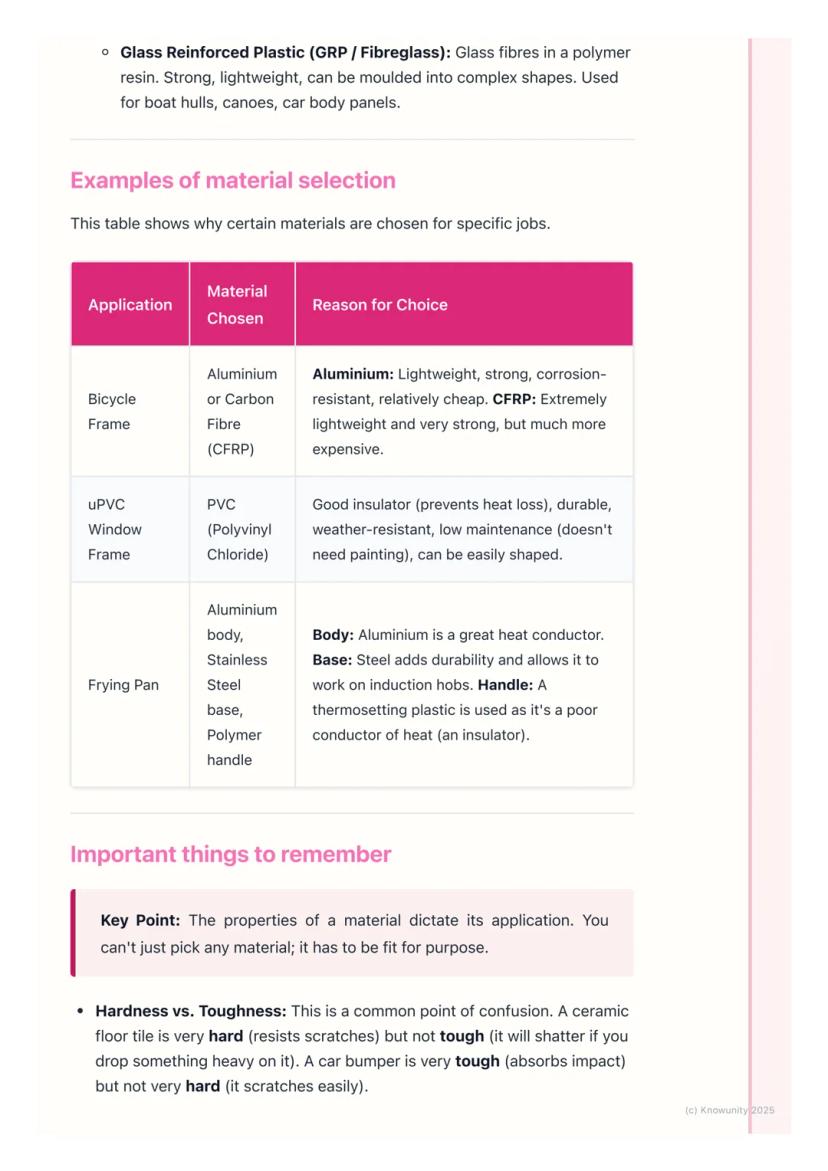
Engineers select materials based on specific requirements. Bicycle frames use aluminium or carbon fibre for their strength-to-weight ratio and corrosion resistance. uPVC window frames offer insulation, weather resistance, and low maintenance. Frying pans combine aluminium bodies (good heat conductors) with stainless steel bases (durability) and polymer handles (heat insulation).
The key principle in material selection is fitness for purpose – you must consider all requirements, constraints, and environmental factors when choosing materials for a specific application.
Exam tip: When answering questions about material selection, always explain both the property AND why it matters for that specific application (e.g., "Aluminium is lightweight, which reduces the energy needed to propel a bicycle").
As you prepare for your exams, focus on understanding the relationships between material properties and their applications in real-world engineering.
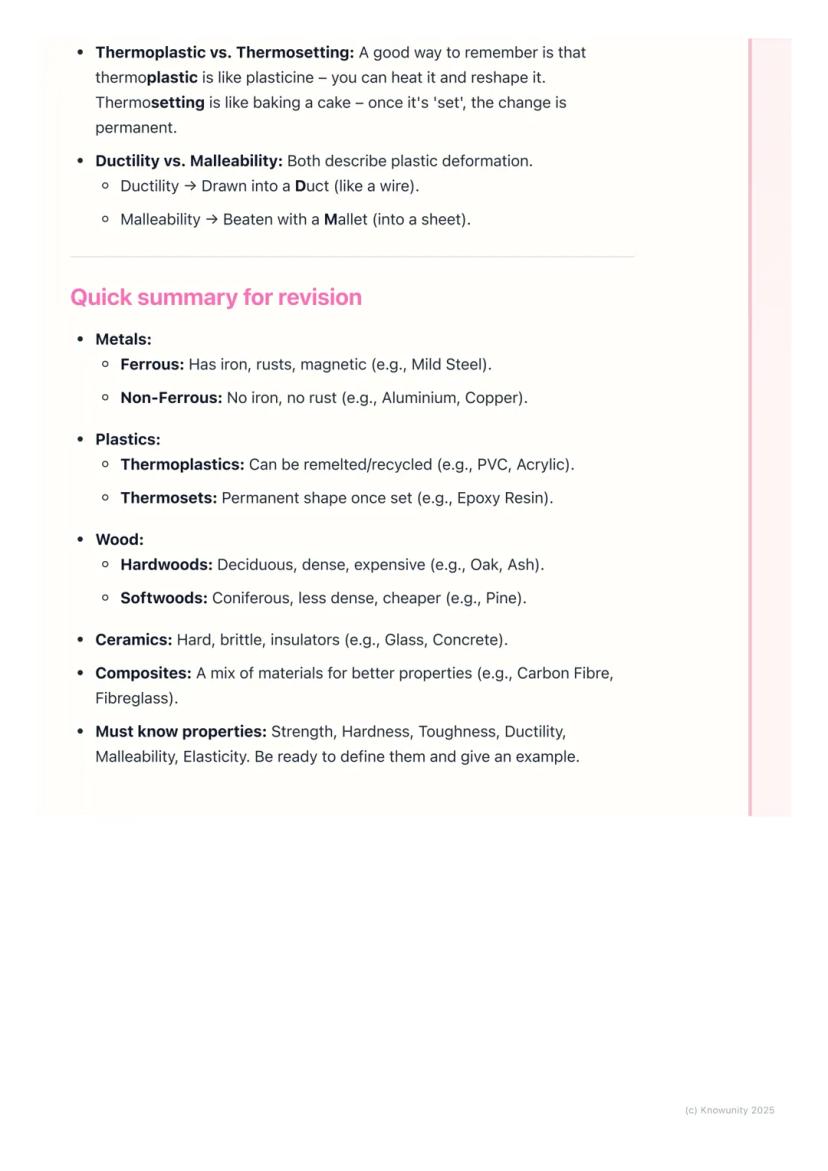
To distinguish between similar-sounding properties, use memory aids: think of ductility as drawing into a "duct" (wire), and malleability as beating with a "mallet" (sheet). For plastics, remember that thermoplastics are like plasticine (reheat to reshape), while thermosetting plastics are like a baked cake (once set, the change is permanent).
For quick revision, group materials by family: Metals , Plastics (thermoplastics can be remelted; thermosets cannot), Wood (hardwoods are dense and expensive; softwoods are less dense and cheaper), Ceramics (hard, brittle insulators), and Composites (material combinations with enhanced properties).
The essential properties to know include strength (tensile, compressive, shear), hardness, toughness, ductility, malleability, and elasticity. Be prepared to define each and provide relevant examples. Understanding these fundamentals will help you analyse and solve engineering material problems in your exams.
Final tip: When studying materials, try to physically handle examples of each type. The tactile experience of feeling the weight of metals, the flexibility of thermoplastics, or the grain of different woods will help cement your understanding better than text alone.
Our AI companion is specifically built for the needs of students. Based on the millions of content pieces we have on the platform we can provide truly meaningful and relevant answers to students. But its not only about answers, the companion is even more about guiding students through their daily learning challenges, with personalised study plans, quizzes or content pieces in the chat and 100% personalisation based on the students skills and developments.
You can download the app in the Google Play Store and in the Apple App Store.
That's right! Enjoy free access to study content, connect with fellow students, and get instant help – all at your fingertips.
App Store
Google Play
The app is very easy to use and well designed. I have found everything I was looking for so far and have been able to learn a lot from the presentations! I will definitely use the app for a class assignment! And of course it also helps a lot as an inspiration.
Stefan S
iOS user
This app is really great. There are so many study notes and help [...]. My problem subject is French, for example, and the app has so many options for help. Thanks to this app, I have improved my French. I would recommend it to anyone.
Samantha Klich
Android user
Wow, I am really amazed. I just tried the app because I've seen it advertised many times and was absolutely stunned. This app is THE HELP you want for school and above all, it offers so many things, such as workouts and fact sheets, which have been VERY helpful to me personally.
Anna
iOS user
I think it’s very much worth it and you’ll end up using it a lot once you get the hang of it and even after looking at others notes you can still ask your Artificial intelligence buddy the question and ask to simplify it if you still don’t get it!!! In the end I think it’s worth it 😊👍 ⚠️Also DID I MENTION ITS FREEE YOU DON’T HAVE TO PAY FOR ANYTHING AND STILL GET YOUR GRADES IN PERFECTLY❗️❗️⚠️
Thomas R
iOS user
Knowunity is the BEST app I’ve used in a minute. This is not an ai review or anything this is genuinely coming from a 7th grade student (I know 2011 im young) but dude this app is a 10/10 i have maintained a 3.8 gpa and have plenty of time for gaming. I love it and my mom is just happy I got good grades
Brad T
Android user
Not only did it help me find the answer but it also showed me alternative ways to solve it. I was horrible in math and science but now I have an a in both subjects. Thanks for the help🤍🤍
David K
iOS user
The app's just great! All I have to do is enter the topic in the search bar and I get the response real fast. I don't have to watch 10 YouTube videos to understand something, so I'm saving my time. Highly recommended!
Sudenaz Ocak
Android user
In school I was really bad at maths but thanks to the app, I am doing better now. I am so grateful that you made the app.
Greenlight Bonnie
Android user
I found this app a couple years ago and it has only gotten better since then. I really love it because it can help with written questions and photo questions. Also, it can find study guides that other people have made as well as flashcard sets and practice tests. The free version is also amazing for students who might not be able to afford it. Would 100% recommend
Aubrey
iOS user
Best app if you're in Highschool or Junior high. I have been using this app for 2 school years and it's the best, it's good if you don't have anyone to help you with school work.😋🩷🎀
Marco B
iOS user
THE QUIZES AND FLASHCARDS ARE SO USEFUL AND I LOVE Knowunity AI. IT ALSO IS LITREALLY LIKE CHATGPT BUT SMARTER!! HELPED ME WITH MY MASCARA PROBLEMS TOO!! AS WELL AS MY REAL SUBJECTS ! DUHHH 😍😁😲🤑💗✨🎀😮
Elisha
iOS user
This app is phenomenal down to the correct info and the various topics you can study! I greatly recommend it for people who struggle with procrastination and those who need homework help. It has been perfectly accurate for world 1 history as far as I’ve seen! Geometry too!
Paul T
iOS user
The app is very easy to use and well designed. I have found everything I was looking for so far and have been able to learn a lot from the presentations! I will definitely use the app for a class assignment! And of course it also helps a lot as an inspiration.
Stefan S
iOS user
This app is really great. There are so many study notes and help [...]. My problem subject is French, for example, and the app has so many options for help. Thanks to this app, I have improved my French. I would recommend it to anyone.
Samantha Klich
Android user
Wow, I am really amazed. I just tried the app because I've seen it advertised many times and was absolutely stunned. This app is THE HELP you want for school and above all, it offers so many things, such as workouts and fact sheets, which have been VERY helpful to me personally.
Anna
iOS user
I think it’s very much worth it and you’ll end up using it a lot once you get the hang of it and even after looking at others notes you can still ask your Artificial intelligence buddy the question and ask to simplify it if you still don’t get it!!! In the end I think it’s worth it 😊👍 ⚠️Also DID I MENTION ITS FREEE YOU DON’T HAVE TO PAY FOR ANYTHING AND STILL GET YOUR GRADES IN PERFECTLY❗️❗️⚠️
Thomas R
iOS user
Knowunity is the BEST app I’ve used in a minute. This is not an ai review or anything this is genuinely coming from a 7th grade student (I know 2011 im young) but dude this app is a 10/10 i have maintained a 3.8 gpa and have plenty of time for gaming. I love it and my mom is just happy I got good grades
Brad T
Android user
Not only did it help me find the answer but it also showed me alternative ways to solve it. I was horrible in math and science but now I have an a in both subjects. Thanks for the help🤍🤍
David K
iOS user
The app's just great! All I have to do is enter the topic in the search bar and I get the response real fast. I don't have to watch 10 YouTube videos to understand something, so I'm saving my time. Highly recommended!
Sudenaz Ocak
Android user
In school I was really bad at maths but thanks to the app, I am doing better now. I am so grateful that you made the app.
Greenlight Bonnie
Android user
I found this app a couple years ago and it has only gotten better since then. I really love it because it can help with written questions and photo questions. Also, it can find study guides that other people have made as well as flashcard sets and practice tests. The free version is also amazing for students who might not be able to afford it. Would 100% recommend
Aubrey
iOS user
Best app if you're in Highschool or Junior high. I have been using this app for 2 school years and it's the best, it's good if you don't have anyone to help you with school work.😋🩷🎀
Marco B
iOS user
THE QUIZES AND FLASHCARDS ARE SO USEFUL AND I LOVE Knowunity AI. IT ALSO IS LITREALLY LIKE CHATGPT BUT SMARTER!! HELPED ME WITH MY MASCARA PROBLEMS TOO!! AS WELL AS MY REAL SUBJECTS ! DUHHH 😍😁😲🤑💗✨🎀😮
Elisha
iOS user
This app is phenomenal down to the correct info and the various topics you can study! I greatly recommend it for people who struggle with procrastination and those who need homework help. It has been perfectly accurate for world 1 history as far as I’ve seen! Geometry too!
Paul T
iOS user
Engineering materials are at the heart of everything we build and use daily. Selecting the right material can make the difference between a product that excels and one that fails. This guide explores the key properties of materials and the... Show more
Access to all documents
Improve your grades
Join milions of students
When designing products, engineers must understand how materials behave under different conditions. These properties determine which materials are suitable for specific applications.
Materials have different types of strength: tensile strength helps resist pulling forces , compressive strength resists squeezing forces (like concrete pillars supporting a roof), and shear strength resists sliding forces (like rivets holding plates together). Hardness measures resistance to scratching or indentation, while toughness is about absorbing energy without breaking.
Ductility and malleability are related but different properties. Ductile materials like copper can be drawn into wires, while malleable materials like gold can be hammered into sheets without breaking. Elasticity describes how well materials return to their original shape after a force is removed, like a rubber band. When materials permanently change shape, they've undergone plastic deformation.
Remember: Don't confuse hardness with toughness! A ceramic tile is hard but not tough (it shatters easily), while a car bumper is tough (absorbs impact) but not very hard.
Access to all documents
Improve your grades
Join milions of students
Metals are the workhorses of engineering materials, known for their strength and conductivity. You'll find them in everything from your smartphone to massive bridges.
Ferrous metals contain iron and include mild steel (iron with about 0.25% carbon) which is strong, tough, and affordable, making it perfect for car bodies and structural beams. Stainless steel adds chromium and nickel to create a rust-resistant metal ideal for cutlery and surgical instruments. Most ferrous metals are magnetic and prone to rusting if not protected.
Non-ferrous metals don't contain iron and don't rust, which makes them valuable for specific applications. Aluminium is lightweight and corrosion-resistant, making it perfect for aircraft parts and window frames. Copper is an excellent electrical conductor that's also ductile and corrosion-resistant, which is why it's used for electrical wiring and plumbing.
When choosing between ferrous and non-ferrous metals, consider the environment where they'll be used. For outdoor applications exposed to moisture, non-ferrous metals or specially treated ferrous metals are often better choices.
Pro tip: When preparing for exams, remember ferrous metals with the phrase "Fe-rrous" – Fe is the chemical symbol for iron!
Access to all documents
Improve your grades
Join milions of students
Plastics are everywhere in our modern world, from your water bottle to parts in your computer. Their versatility comes from their molecular structure.
Thermoplastics can be melted and reshaped repeatedly, making them ideal for recycling. Their long polymer chains tangle but don't link together, allowing them to soften when heated. PVC (polyvinyl chloride) is a rigid, tough thermoplastic used for pipes and window frames, while acrylic (Perspex) offers clarity for signs and car light covers.
Thermosetting plastics undergo a permanent chemical change when first heated, creating strong cross-links between polymer chains. Once set, they can't be remelted or reshaped. Epoxy resin is a strong adhesive and electrical insulator used in circuit boards, while urea formaldehyde provides hard, stiff material for electrical plugs and sockets.
The key difference between these plastic types is in their molecular structure – thermoplastics have linear chains that can slide past each other when heated, while thermosets have rigid cross-linked structures that cannot be broken down by reheating.
Visual comparison: Think of thermoplastics as a bowl of spaghetti (strands can move) and thermosetting plastics as a fishing net (permanently connected at junction points).
Access to all documents
Improve your grades
Join milions of students
Natural and traditional materials still play crucial roles in modern engineering despite advancements in synthetic options.
Wood offers excellent strength-to-weight properties and comes in two main categories. Hardwoods come from broad-leafed deciduous trees, grow slowly, and are generally denser and more expensive. Oak provides durability for high-quality furniture, while ash's flexibility makes it perfect for hurley sticks and tool handles. Softwoods from coniferous trees grow faster and are less dense and cheaper. Pine is lightweight and easy to work with, making it ideal for construction timber and affordable furniture.
Ceramics are non-metallic solids known for extreme hardness, brittleness, and excellent insulation properties. They have incredibly high melting points and maintain strength at high temperatures. Glass provides transparency for windows and bottles, while concrete creates the foundation for buildings and bridges. Bricks have been used in construction for centuries, and porcelain serves as both an electrical insulator and durable bathroom fixture material.
Wood and ceramics represent opposite ends of the materials spectrum – wood is flexible and organic, while ceramics are rigid and processed. Each has properties that make them irreplaceable in certain applications.
Interesting fact: Despite advances in synthetic materials, wood still has one of the best strength-to-weight ratios of any engineering material, which is why it remains popular for many applications.
Access to all documents
Improve your grades
Join milions of students
Composites represent the cutting edge of engineering materials, combining the best properties of different materials to create something superior to the individual components.
Composites typically consist of a matrix (binder) and reinforcement (strong fibres). Carbon Fibre Reinforced Polymer (CFRP) uses carbon fibres in a polymer resin to create an incredibly strong yet lightweight material used in Formula 1 cars and high-end bicycles. Glass Reinforced Plastic combines glass fibres with polymer resin for strong, lightweight boat hulls and car body panels.
Engineers select materials based on specific requirements. Bicycle frames use aluminium or carbon fibre for their strength-to-weight ratio and corrosion resistance. uPVC window frames offer insulation, weather resistance, and low maintenance. Frying pans combine aluminium bodies (good heat conductors) with stainless steel bases (durability) and polymer handles (heat insulation).
The key principle in material selection is fitness for purpose – you must consider all requirements, constraints, and environmental factors when choosing materials for a specific application.
Exam tip: When answering questions about material selection, always explain both the property AND why it matters for that specific application (e.g., "Aluminium is lightweight, which reduces the energy needed to propel a bicycle").
Access to all documents
Improve your grades
Join milions of students
As you prepare for your exams, focus on understanding the relationships between material properties and their applications in real-world engineering.
To distinguish between similar-sounding properties, use memory aids: think of ductility as drawing into a "duct" (wire), and malleability as beating with a "mallet" (sheet). For plastics, remember that thermoplastics are like plasticine (reheat to reshape), while thermosetting plastics are like a baked cake (once set, the change is permanent).
For quick revision, group materials by family: Metals , Plastics (thermoplastics can be remelted; thermosets cannot), Wood (hardwoods are dense and expensive; softwoods are less dense and cheaper), Ceramics (hard, brittle insulators), and Composites (material combinations with enhanced properties).
The essential properties to know include strength (tensile, compressive, shear), hardness, toughness, ductility, malleability, and elasticity. Be prepared to define each and provide relevant examples. Understanding these fundamentals will help you analyse and solve engineering material problems in your exams.
Final tip: When studying materials, try to physically handle examples of each type. The tactile experience of feeling the weight of metals, the flexibility of thermoplastics, or the grain of different woods will help cement your understanding better than text alone.
Our AI companion is specifically built for the needs of students. Based on the millions of content pieces we have on the platform we can provide truly meaningful and relevant answers to students. But its not only about answers, the companion is even more about guiding students through their daily learning challenges, with personalised study plans, quizzes or content pieces in the chat and 100% personalisation based on the students skills and developments.
You can download the app in the Google Play Store and in the Apple App Store.
That's right! Enjoy free access to study content, connect with fellow students, and get instant help – all at your fingertips.
0
Smart Tools NEW
Transform this note into: ✓ 50+ Practice Questions ✓ Interactive Flashcards ✓ Full Practice Test ✓ Essay Outlines
App Store
Google Play
The app is very easy to use and well designed. I have found everything I was looking for so far and have been able to learn a lot from the presentations! I will definitely use the app for a class assignment! And of course it also helps a lot as an inspiration.
Stefan S
iOS user
This app is really great. There are so many study notes and help [...]. My problem subject is French, for example, and the app has so many options for help. Thanks to this app, I have improved my French. I would recommend it to anyone.
Samantha Klich
Android user
Wow, I am really amazed. I just tried the app because I've seen it advertised many times and was absolutely stunned. This app is THE HELP you want for school and above all, it offers so many things, such as workouts and fact sheets, which have been VERY helpful to me personally.
Anna
iOS user
I think it’s very much worth it and you’ll end up using it a lot once you get the hang of it and even after looking at others notes you can still ask your Artificial intelligence buddy the question and ask to simplify it if you still don’t get it!!! In the end I think it’s worth it 😊👍 ⚠️Also DID I MENTION ITS FREEE YOU DON’T HAVE TO PAY FOR ANYTHING AND STILL GET YOUR GRADES IN PERFECTLY❗️❗️⚠️
Thomas R
iOS user
Knowunity is the BEST app I’ve used in a minute. This is not an ai review or anything this is genuinely coming from a 7th grade student (I know 2011 im young) but dude this app is a 10/10 i have maintained a 3.8 gpa and have plenty of time for gaming. I love it and my mom is just happy I got good grades
Brad T
Android user
Not only did it help me find the answer but it also showed me alternative ways to solve it. I was horrible in math and science but now I have an a in both subjects. Thanks for the help🤍🤍
David K
iOS user
The app's just great! All I have to do is enter the topic in the search bar and I get the response real fast. I don't have to watch 10 YouTube videos to understand something, so I'm saving my time. Highly recommended!
Sudenaz Ocak
Android user
In school I was really bad at maths but thanks to the app, I am doing better now. I am so grateful that you made the app.
Greenlight Bonnie
Android user
I found this app a couple years ago and it has only gotten better since then. I really love it because it can help with written questions and photo questions. Also, it can find study guides that other people have made as well as flashcard sets and practice tests. The free version is also amazing for students who might not be able to afford it. Would 100% recommend
Aubrey
iOS user
Best app if you're in Highschool or Junior high. I have been using this app for 2 school years and it's the best, it's good if you don't have anyone to help you with school work.😋🩷🎀
Marco B
iOS user
THE QUIZES AND FLASHCARDS ARE SO USEFUL AND I LOVE Knowunity AI. IT ALSO IS LITREALLY LIKE CHATGPT BUT SMARTER!! HELPED ME WITH MY MASCARA PROBLEMS TOO!! AS WELL AS MY REAL SUBJECTS ! DUHHH 😍😁😲🤑💗✨🎀😮
Elisha
iOS user
This app is phenomenal down to the correct info and the various topics you can study! I greatly recommend it for people who struggle with procrastination and those who need homework help. It has been perfectly accurate for world 1 history as far as I’ve seen! Geometry too!
Paul T
iOS user
The app is very easy to use and well designed. I have found everything I was looking for so far and have been able to learn a lot from the presentations! I will definitely use the app for a class assignment! And of course it also helps a lot as an inspiration.
Stefan S
iOS user
This app is really great. There are so many study notes and help [...]. My problem subject is French, for example, and the app has so many options for help. Thanks to this app, I have improved my French. I would recommend it to anyone.
Samantha Klich
Android user
Wow, I am really amazed. I just tried the app because I've seen it advertised many times and was absolutely stunned. This app is THE HELP you want for school and above all, it offers so many things, such as workouts and fact sheets, which have been VERY helpful to me personally.
Anna
iOS user
I think it’s very much worth it and you’ll end up using it a lot once you get the hang of it and even after looking at others notes you can still ask your Artificial intelligence buddy the question and ask to simplify it if you still don’t get it!!! In the end I think it’s worth it 😊👍 ⚠️Also DID I MENTION ITS FREEE YOU DON’T HAVE TO PAY FOR ANYTHING AND STILL GET YOUR GRADES IN PERFECTLY❗️❗️⚠️
Thomas R
iOS user
Knowunity is the BEST app I’ve used in a minute. This is not an ai review or anything this is genuinely coming from a 7th grade student (I know 2011 im young) but dude this app is a 10/10 i have maintained a 3.8 gpa and have plenty of time for gaming. I love it and my mom is just happy I got good grades
Brad T
Android user
Not only did it help me find the answer but it also showed me alternative ways to solve it. I was horrible in math and science but now I have an a in both subjects. Thanks for the help🤍🤍
David K
iOS user
The app's just great! All I have to do is enter the topic in the search bar and I get the response real fast. I don't have to watch 10 YouTube videos to understand something, so I'm saving my time. Highly recommended!
Sudenaz Ocak
Android user
In school I was really bad at maths but thanks to the app, I am doing better now. I am so grateful that you made the app.
Greenlight Bonnie
Android user
I found this app a couple years ago and it has only gotten better since then. I really love it because it can help with written questions and photo questions. Also, it can find study guides that other people have made as well as flashcard sets and practice tests. The free version is also amazing for students who might not be able to afford it. Would 100% recommend
Aubrey
iOS user
Best app if you're in Highschool or Junior high. I have been using this app for 2 school years and it's the best, it's good if you don't have anyone to help you with school work.😋🩷🎀
Marco B
iOS user
THE QUIZES AND FLASHCARDS ARE SO USEFUL AND I LOVE Knowunity AI. IT ALSO IS LITREALLY LIKE CHATGPT BUT SMARTER!! HELPED ME WITH MY MASCARA PROBLEMS TOO!! AS WELL AS MY REAL SUBJECTS ! DUHHH 😍😁😲🤑💗✨🎀😮
Elisha
iOS user
This app is phenomenal down to the correct info and the various topics you can study! I greatly recommend it for people who struggle with procrastination and those who need homework help. It has been perfectly accurate for world 1 history as far as I’ve seen! Geometry too!
Paul T
iOS user