
Ever wondered what atoms actually look like inside? Ernest Rutherford's...
 Chemistry4 views·Updated Jun 18, 2026·3 pages
Understanding Rutherford's Nuclear Model of the Atom
S
Shakerah@shakerah
1 / 3
1
of 3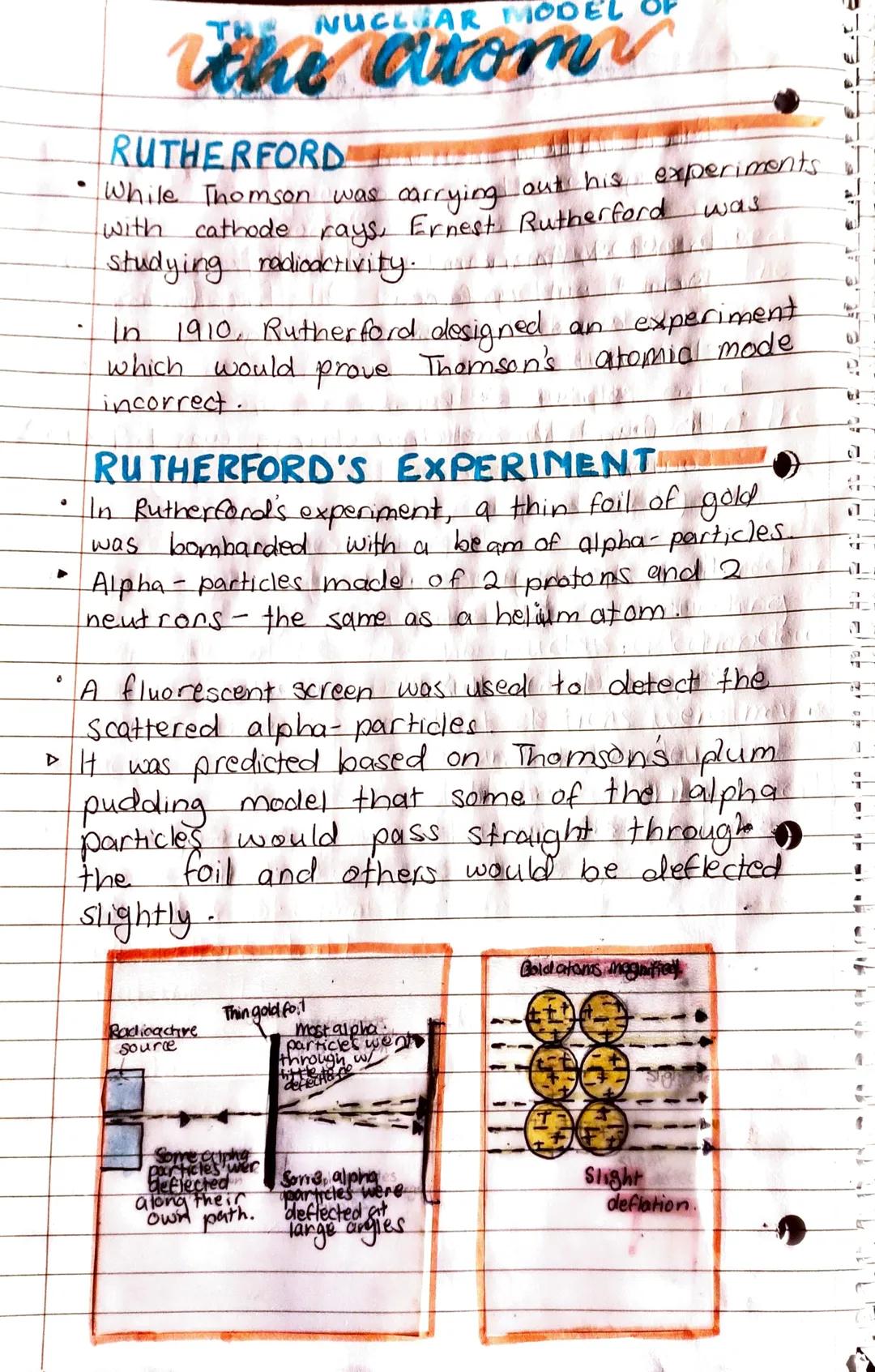
Rutherford's Gold Foil Experiment
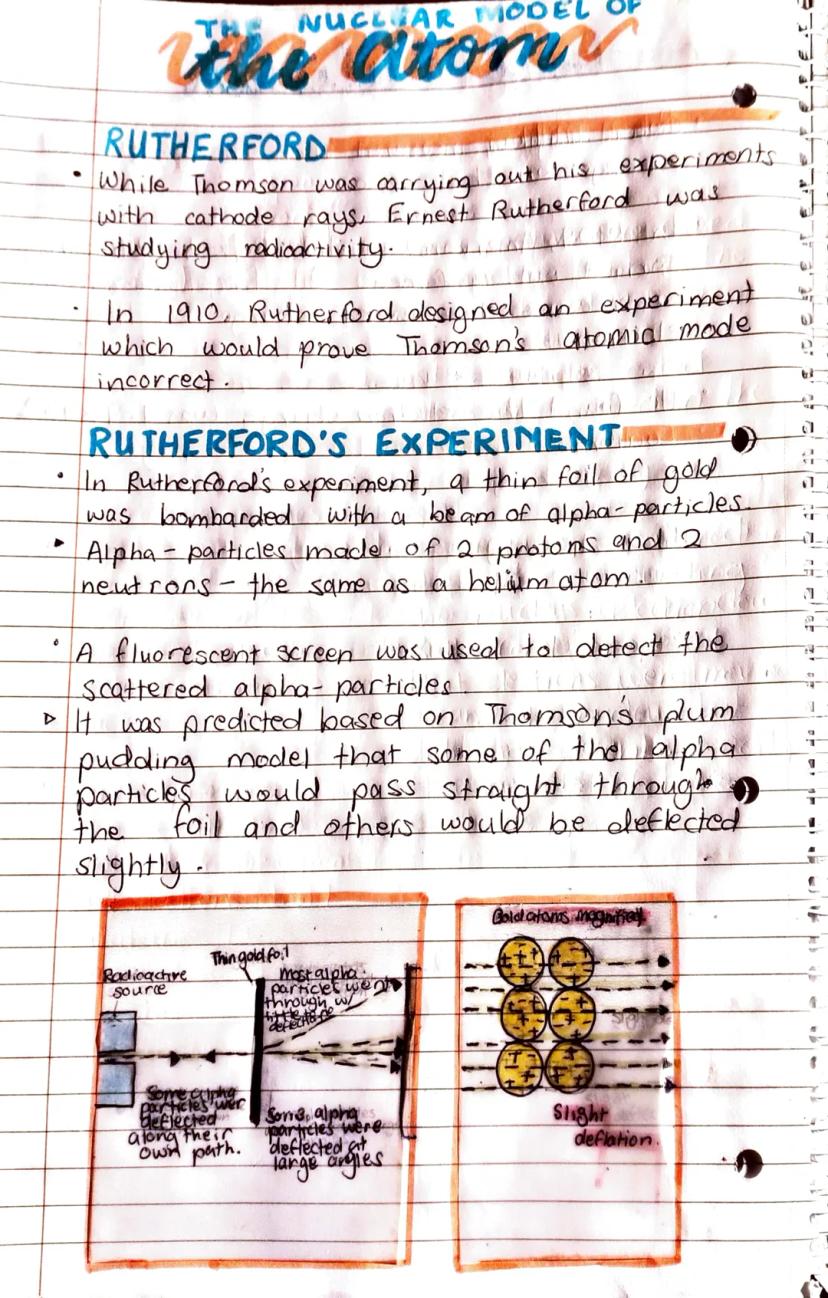
Picture this: you're firing tiny bullets at a piece of paper and expecting them all to go straight through. That's basically what Rutherford did in 1910, except he used alpha particles (made of 2 protons and 2 neutrons) as bullets and a thin sheet of gold as his target.
The setup was brilliant in its simplicity. Rutherford shot a beam of alpha particles at the gold foil and used a fluorescent screen to see where they ended up. Based on Thomson's "plum pudding model" of the atom, he expected most particles to pass straight through with maybe some slight deflection.
Key Point: Alpha particles are positively charged particles that are much smaller than atoms, making them perfect "probes" for exploring atomic structure.
But the results were absolutely shocking and would revolutionise our understanding of atoms forever.
2
of 3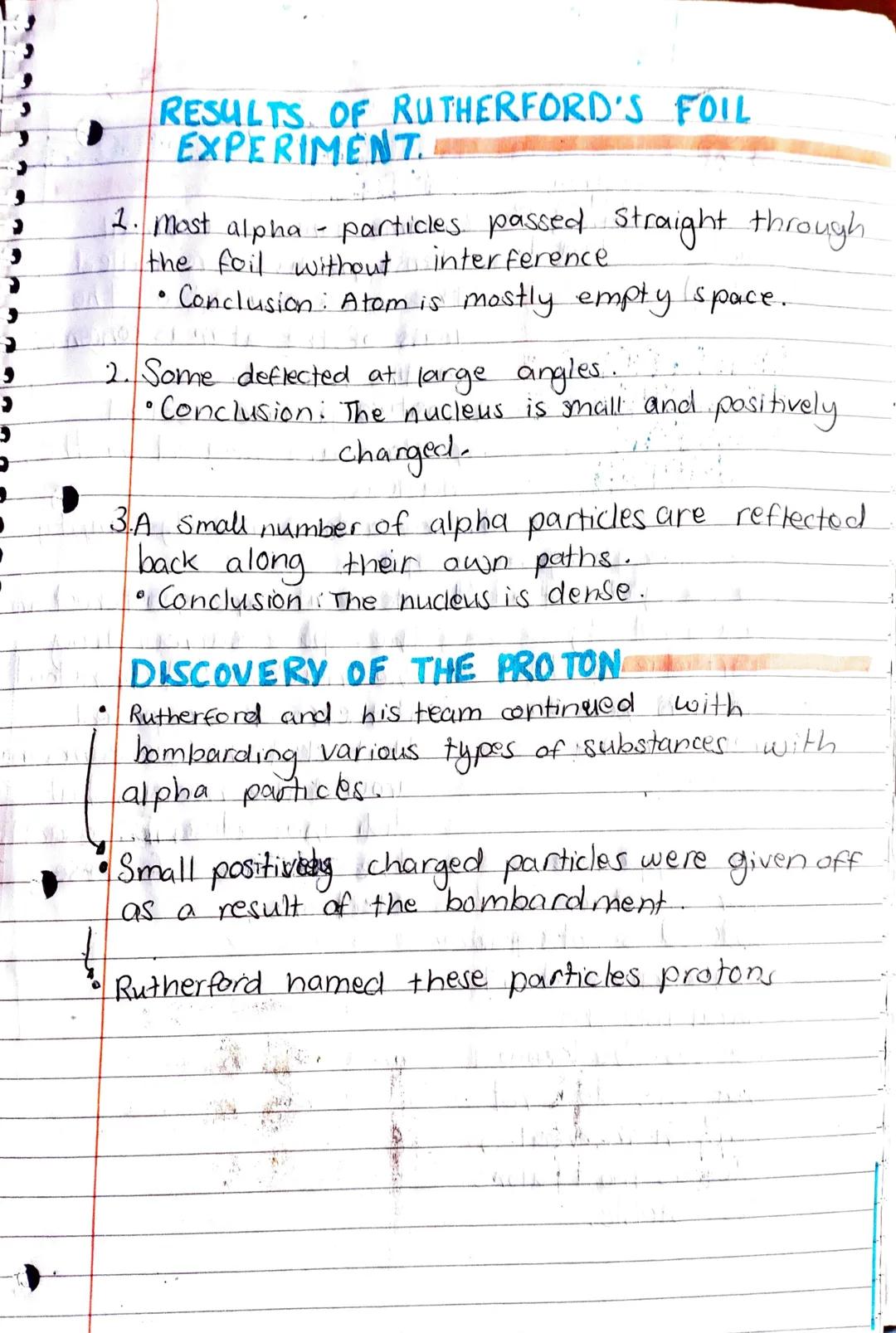
Shocking Results and Game-Changing Conclusions
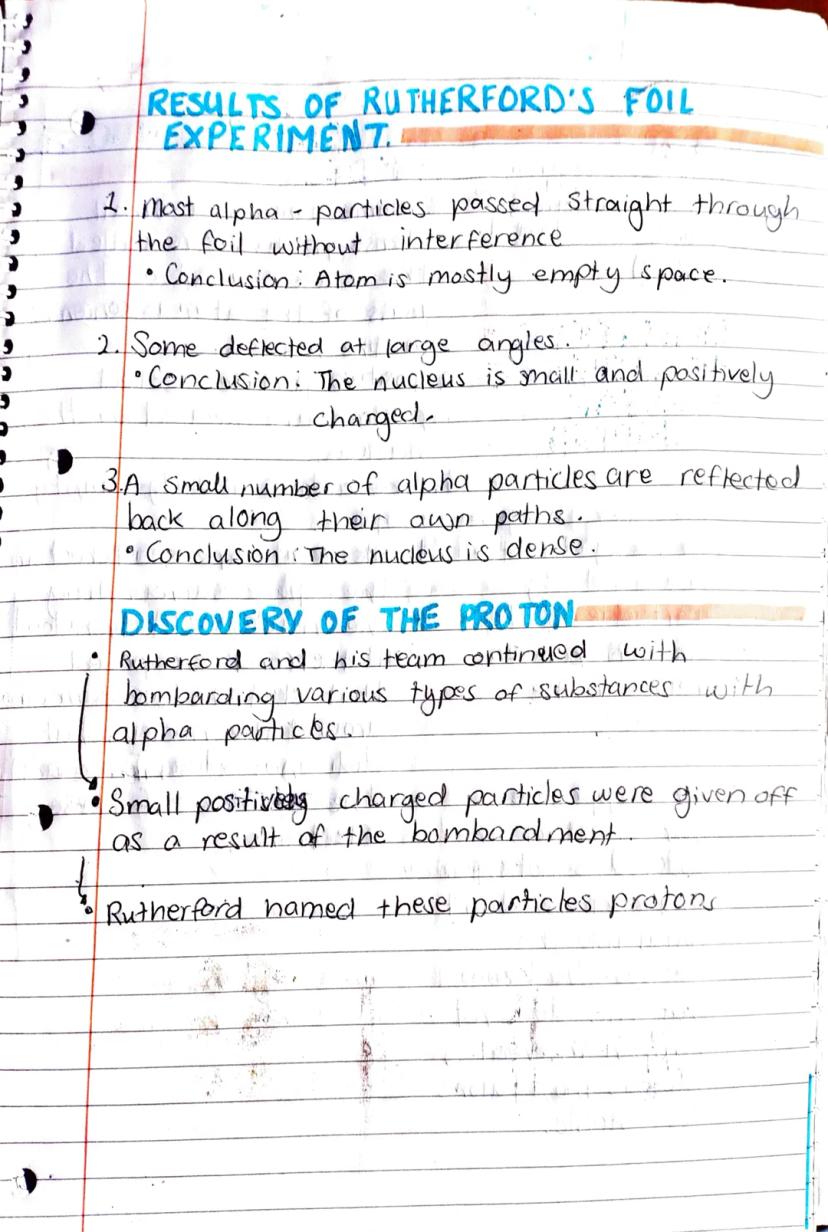
The experimental results completely defied expectations and gave Rutherford three crucial clues about atomic structure. Most alpha particles sailed straight through the gold foil without any interference - this told him that atoms are mostly empty space.
Some particles were deflected at large angles, which seemed impossible unless there was a small, positively charged nucleus repelling them. Even more surprising, a tiny number of alpha particles bounced straight back along their original paths.
This last observation led to perhaps the most important conclusion: the nucleus must be incredibly dense. Think about it - for a tiny alpha particle to completely reverse direction, it must have hit something much more massive and concentrated than anyone had imagined.
Fun Fact: Rutherford famously said it was "as if you fired a 15-inch shell at a piece of tissue paper and it came back and hit you!"
Through continued experiments, Rutherford's team discovered protons - those small, positively charged particles that make up the nucleus.
3
of 3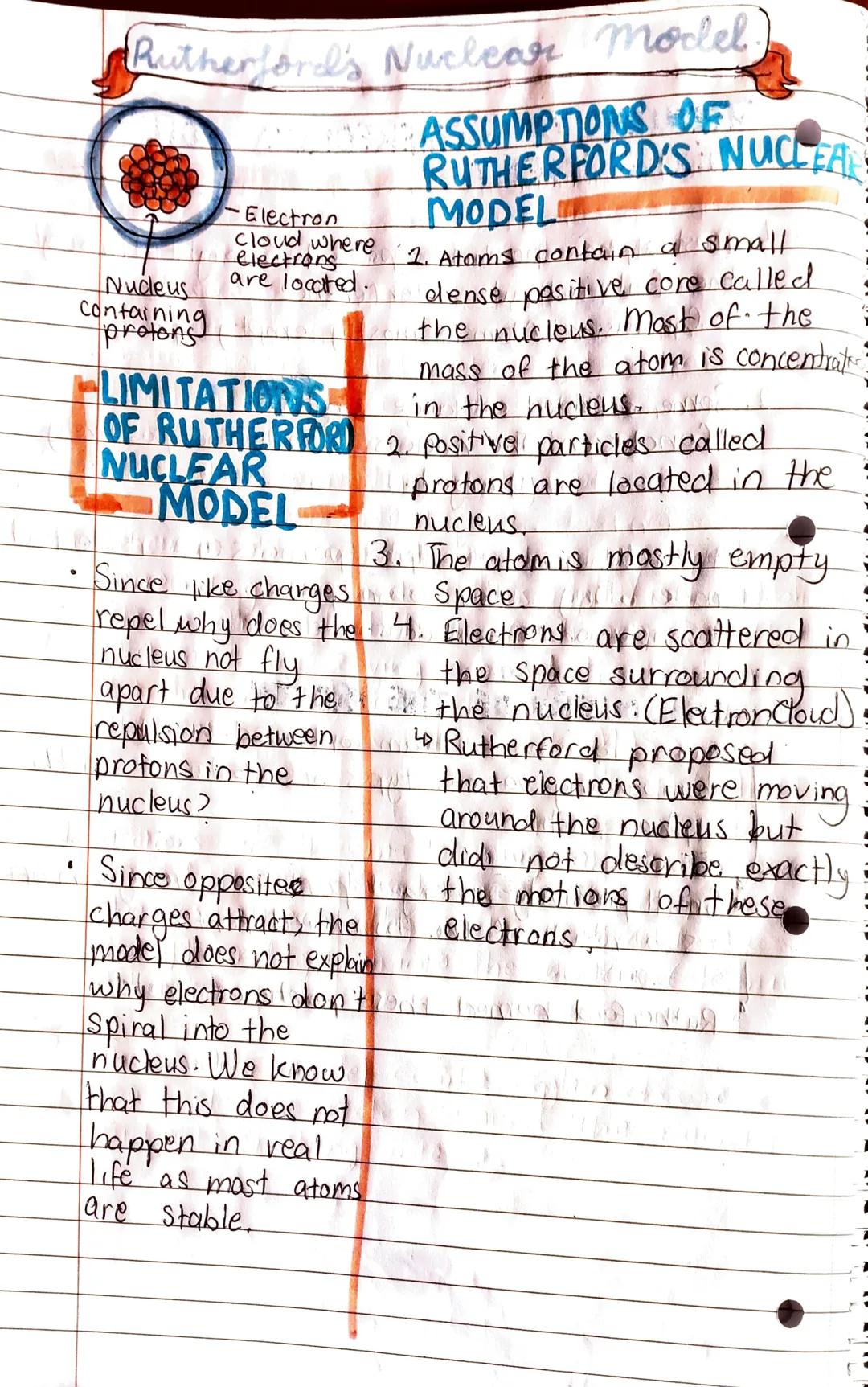
Rutherford's Nuclear Model and Its Problems
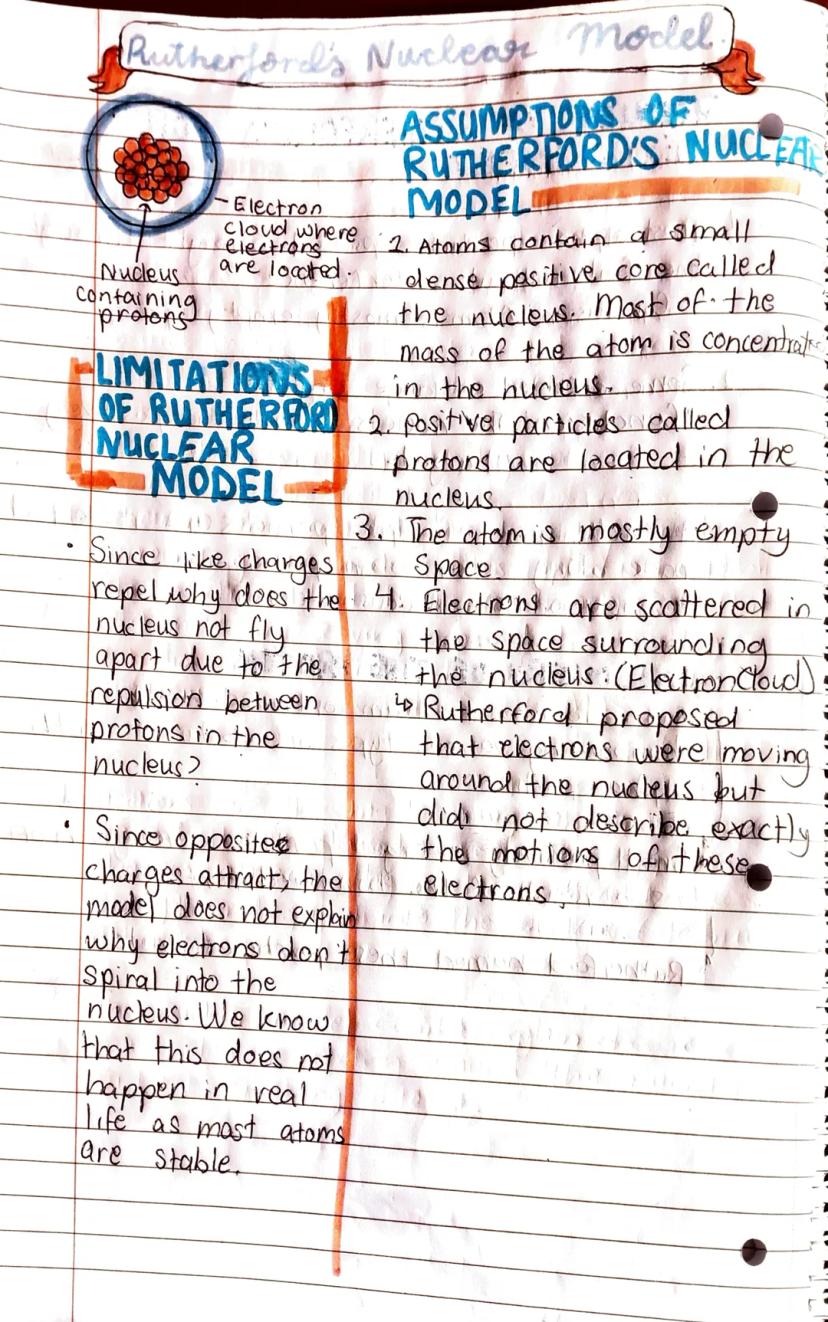
Rutherford's nuclear model painted a completely new picture of the atom. He proposed that atoms have a tiny, dense, positively charged nucleus containing protons, with electrons scattered in the empty space around it like planets orbiting the sun.
This model explained his experimental results perfectly: the nucleus contains most of the atom's mass, positive charges (protons) are concentrated in the centre, and electrons float around in the surrounding space. However, the model had some serious flaws that kept scientists scratching their heads.
The biggest problem? Like charges repel, so why doesn't the nucleus explode from all those protons pushing against each other? Additionally, since opposite charges attract, what stops the negatively charged electrons from spiralling into the positive nucleus?
Think About It: Rutherford knew electrons were moving around the nucleus but couldn't explain exactly how - this mystery would lead to the development of quantum mechanics!
Despite these limitations, Rutherford's nuclear model was a massive leap forward and laid the foundation for our modern understanding of atomic structure.
We thought you’d never ask...
What is the Knowunity AI companion?
Our AI companion is specifically built for the needs of students. Based on the millions of content pieces we have on the platform we can provide truly meaningful and relevant answers to students. But its not only about answers, the companion is even more about guiding students through their daily learning challenges, with personalised study plans, quizzes or content pieces in the chat and 100% personalisation based on the students skills and developments.
Where can I download the Knowunity app?
You can download the app in the Google Play Store and in the Apple App Store.
Is Knowunity really free of charge?
That's right! Enjoy free access to study content, connect with fellow students, and get instant help – all at your fingertips.
Most popular content
9 Irish
IrishIrish oral questions and answers
Questions and answers for the leaving cert oral
5th Year4264
 English
Key Quotes : Sive
Key Quotes and explanations: Sive
6th Year2842
IrishIrish oral questions
Outline of oral questions
5th Year2055
IrishIníon- le hÁine Durkin
Aine Durkin’s poem, Iníon: Themes & summary
5th Year890
IrishIrish poetry 2027
Iníon + Dínit an Bhróin
5th Year1153
IrishLC HL notes- Iníon (poem)
Includes poem in English and Irish, theme, key words & phrases
5th Year2304
EnglishCultural Context : Shawshank Redemption : Sive : Small Things Like These
Comparative Study : Cultural Context : Shawshank Redemption, Sive and Small Things Like These
6th Year1430
IrishMo Ghrá-sa (Idir Lúibíní)
Notes on mo ghrá-sa
5th Year380
IrishAn Gaeilge Aiste
Irish Language essay
6th Year1320
Can't find what you're looking for? Explore other subjects.
Students love us — and so will you.
4.6/5App Store
4.7/5Google Play
The app is very easy to use and well designed. I have found everything I was looking for so far and have been able to learn a lot from the presentations! I will definitely use the app for a class assignment! And of course it also helps a lot as an inspiration.
Stefan SiOS user
This app is really great. There are so many study notes and help [...]. My problem subject is French, for example, and the app has so many options for help. Thanks to this app, I have improved my French. I would recommend it to anyone.
Samantha KlichAndroid user
Wow, I am really amazed. I just tried the app because I've seen it advertised many times and was absolutely stunned. This app is THE HELP you want for school and above all, it offers so many things, such as workouts and fact sheets, which have been VERY helpful to me personally.
AnnaiOS user
Chemistry4 views·Updated Jun 18, 2026·3 pagesUnderstanding Rutherford's Nuclear Model of the Atom
S
Shakerah@shakerah
Ever wondered what atoms actually look like inside? Ernest Rutherford's famous gold foil experiment completely changed how scientists understood atomic structure, proving that atoms aren't just blobs of positive charge with electrons scattered throughout like raisins in a pudding.
1
of 3
Sign up to see the content. It's free!
- Access to all documents
- Improve your grades
- Join milions of students
Rutherford's Gold Foil Experiment
Picture this: you're firing tiny bullets at a piece of paper and expecting them all to go straight through. That's basically what Rutherford did in 1910, except he used alpha particles (made of 2 protons and 2 neutrons) as bullets and a thin sheet of gold as his target.
The setup was brilliant in its simplicity. Rutherford shot a beam of alpha particles at the gold foil and used a fluorescent screen to see where they ended up. Based on Thomson's "plum pudding model" of the atom, he expected most particles to pass straight through with maybe some slight deflection.
Key Point: Alpha particles are positively charged particles that are much smaller than atoms, making them perfect "probes" for exploring atomic structure.
But the results were absolutely shocking and would revolutionise our understanding of atoms forever.
2
of 3Sign up to see the content. It's free!
- Access to all documents
- Improve your grades
- Join milions of students
Shocking Results and Game-Changing Conclusions
The experimental results completely defied expectations and gave Rutherford three crucial clues about atomic structure. Most alpha particles sailed straight through the gold foil without any interference - this told him that atoms are mostly empty space.
Some particles were deflected at large angles, which seemed impossible unless there was a small, positively charged nucleus repelling them. Even more surprising, a tiny number of alpha particles bounced straight back along their original paths.
This last observation led to perhaps the most important conclusion: the nucleus must be incredibly dense. Think about it - for a tiny alpha particle to completely reverse direction, it must have hit something much more massive and concentrated than anyone had imagined.
Fun Fact: Rutherford famously said it was "as if you fired a 15-inch shell at a piece of tissue paper and it came back and hit you!"
Through continued experiments, Rutherford's team discovered protons - those small, positively charged particles that make up the nucleus.
3
of 3Sign up to see the content. It's free!
- Access to all documents
- Improve your grades
- Join milions of students
Rutherford's Nuclear Model and Its Problems
Rutherford's nuclear model painted a completely new picture of the atom. He proposed that atoms have a tiny, dense, positively charged nucleus containing protons, with electrons scattered in the empty space around it like planets orbiting the sun.
This model explained his experimental results perfectly: the nucleus contains most of the atom's mass, positive charges (protons) are concentrated in the centre, and electrons float around in the surrounding space. However, the model had some serious flaws that kept scientists scratching their heads.
The biggest problem? Like charges repel, so why doesn't the nucleus explode from all those protons pushing against each other? Additionally, since opposite charges attract, what stops the negatively charged electrons from spiralling into the positive nucleus?
Think About It: Rutherford knew electrons were moving around the nucleus but couldn't explain exactly how - this mystery would lead to the development of quantum mechanics!
Despite these limitations, Rutherford's nuclear model was a massive leap forward and laid the foundation for our modern understanding of atomic structure.
We thought you’d never ask...
What is the Knowunity AI companion?
Our AI companion is specifically built for the needs of students. Based on the millions of content pieces we have on the platform we can provide truly meaningful and relevant answers to students. But its not only about answers, the companion is even more about guiding students through their daily learning challenges, with personalised study plans, quizzes or content pieces in the chat and 100% personalisation based on the students skills and developments.
Where can I download the Knowunity app?
You can download the app in the Google Play Store and in the Apple App Store.
Is Knowunity really free of charge?
That's right! Enjoy free access to study content, connect with fellow students, and get instant help – all at your fingertips.
Most popular content
9IrishIrish oral questions and answers
Questions and answers for the leaving cert oral
5th Year4264
EnglishKey Quotes : Sive
Key Quotes and explanations: Sive
6th Year2842
IrishIrish oral questions
Outline of oral questions
5th Year2055
IrishIníon- le hÁine Durkin
Aine Durkin’s poem, Iníon: Themes & summary
5th Year890
IrishIrish poetry 2027
Iníon + Dínit an Bhróin
5th Year1153
IrishLC HL notes- Iníon (poem)
Includes poem in English and Irish, theme, key words & phrases
5th Year2304
EnglishCultural Context : Shawshank Redemption : Sive : Small Things Like These
Comparative Study : Cultural Context : Shawshank Redemption, Sive and Small Things Like These
6th Year1430
IrishMo Ghrá-sa (Idir Lúibíní)
Notes on mo ghrá-sa
5th Year380
IrishAn Gaeilge Aiste
Irish Language essay
6th Year1320
Can't find what you're looking for? Explore other subjects.
Students love us — and so will you.
4.6/5App Store
4.7/5Google Play
The app is very easy to use and well designed. I have found everything I was looking for so far and have been able to learn a lot from the presentations! I will definitely use the app for a class assignment! And of course it also helps a lot as an inspiration.
Stefan SiOS user
This app is really great. There are so many study notes and help [...]. My problem subject is French, for example, and the app has so many options for help. Thanks to this app, I have improved my French. I would recommend it to anyone.
Samantha KlichAndroid user
Wow, I am really amazed. I just tried the app because I've seen it advertised many times and was absolutely stunned. This app is THE HELP you want for school and above all, it offers so many things, such as workouts and fact sheets, which have been VERY helpful to me personally.
AnnaiOS user