
Every business creates two crucial financial documents that tell the...
 Business2 views·Updated Jun 11, 2026·7 pages
Overview of Key Financial Statements: Income Statement and Balance Sheet

1 / 7
1
of 7
Basic Financial Documents
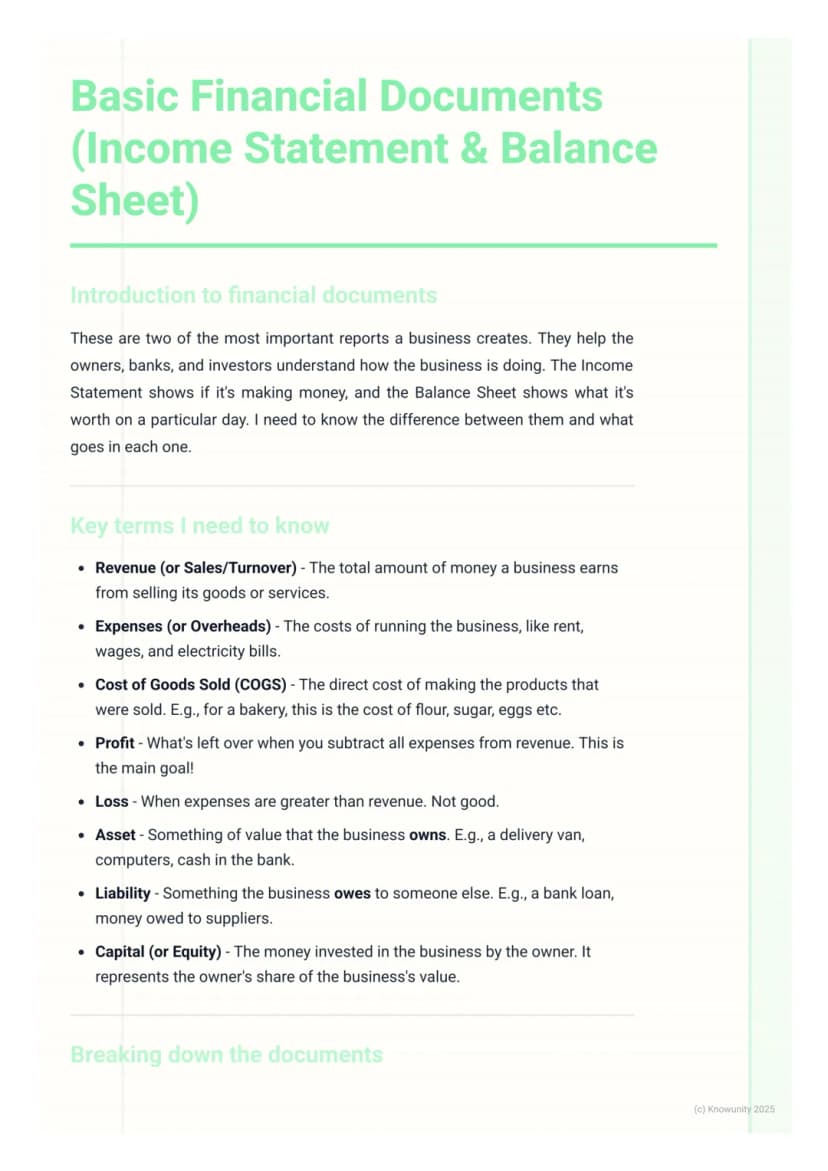
Understanding financial documents is like learning to read a business's health check. These reports help everyone from business owners to banks figure out if a company is worth investing in or lending money to.
Revenue (also called sales or turnover) is simply all the money a business earns from selling stuff. Expenses are all the costs of keeping the business running - things like rent, wages, and electricity bills. When you subtract expenses from revenue, you get profit (the good outcome) or loss (not so good).
On the flip side, assets are valuable things the business owns like delivery vans or cash in the bank. Liabilities are debts the business owes to others, whilst capital represents the owner's stake in the business.
Quick Tip: Think of assets as "what we have" and liabilities as "what we owe" - this makes the concepts much easier to remember!
2
of 7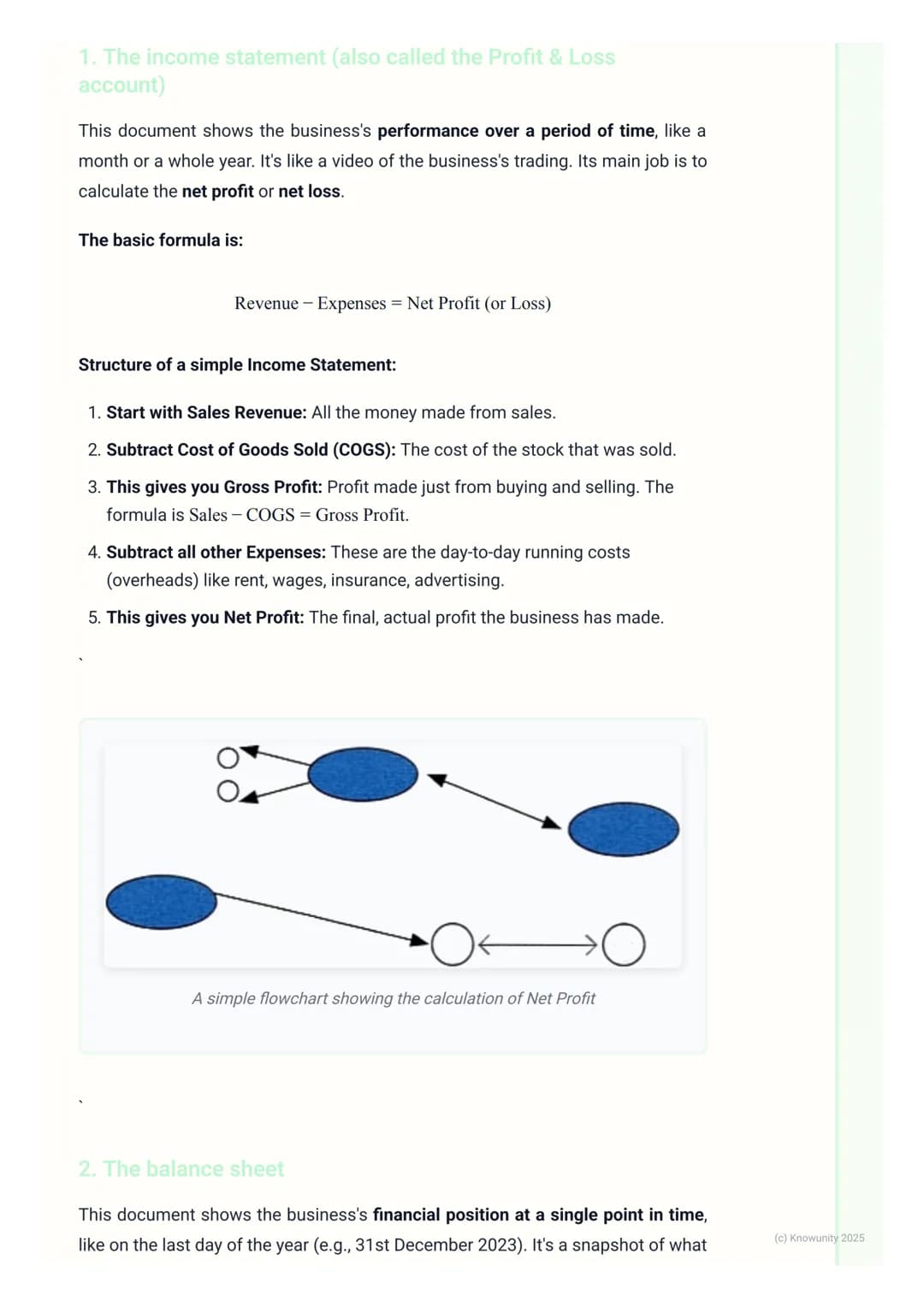
The Income Statement
This document works like a business video - it shows performance over a specific time period, whether that's a month or a full year. Its main job is dead simple: calculate whether the business made money or lost it.
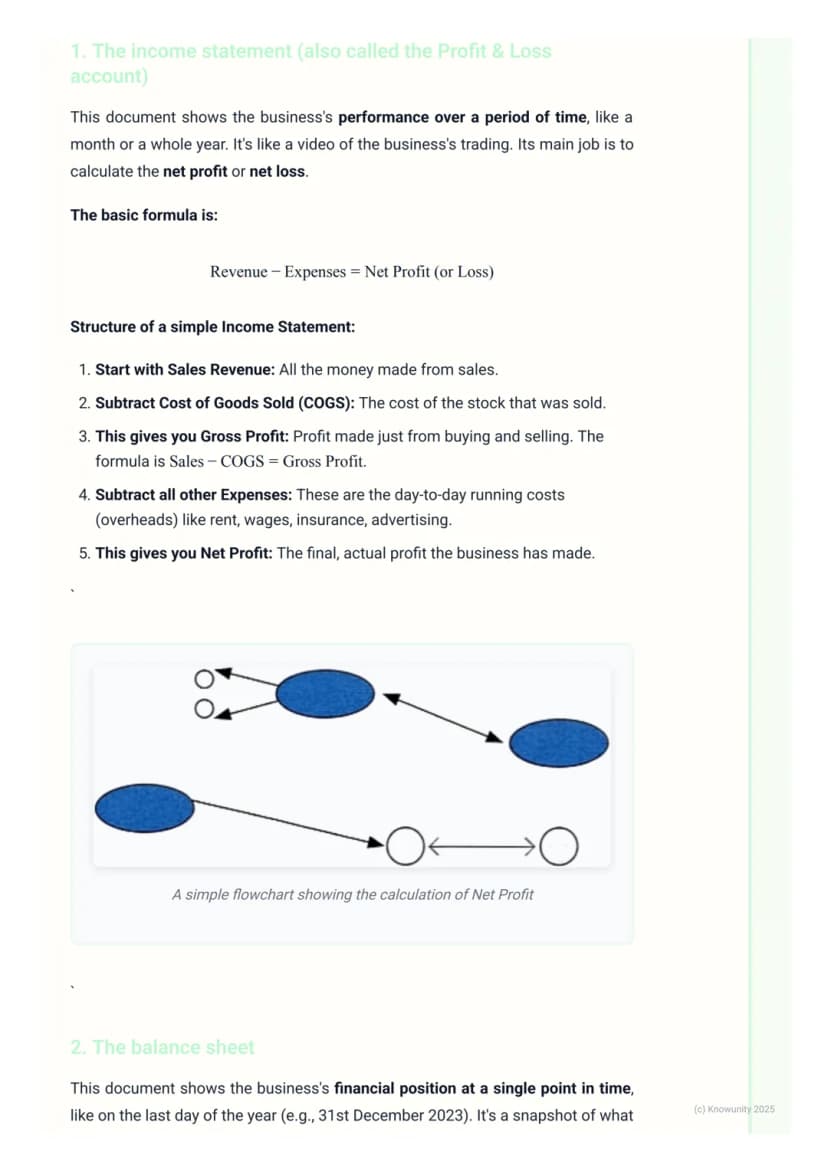
The income statement follows a straightforward formula: Revenue minus Expenses equals Net Profit (or Loss). You start with all the sales revenue, subtract the cost of goods sold (COGS), and this gives you gross profit. Then you subtract all other running costs to reach your final net profit.
Here's the flow: Sales → minus COGS → equals Gross Profit → minus other expenses → equals Net Profit. It's basically asking "did we make more than we spent?"
Remember: The income statement is all about performance over time - it's the "how did we do?" document.
3
of 7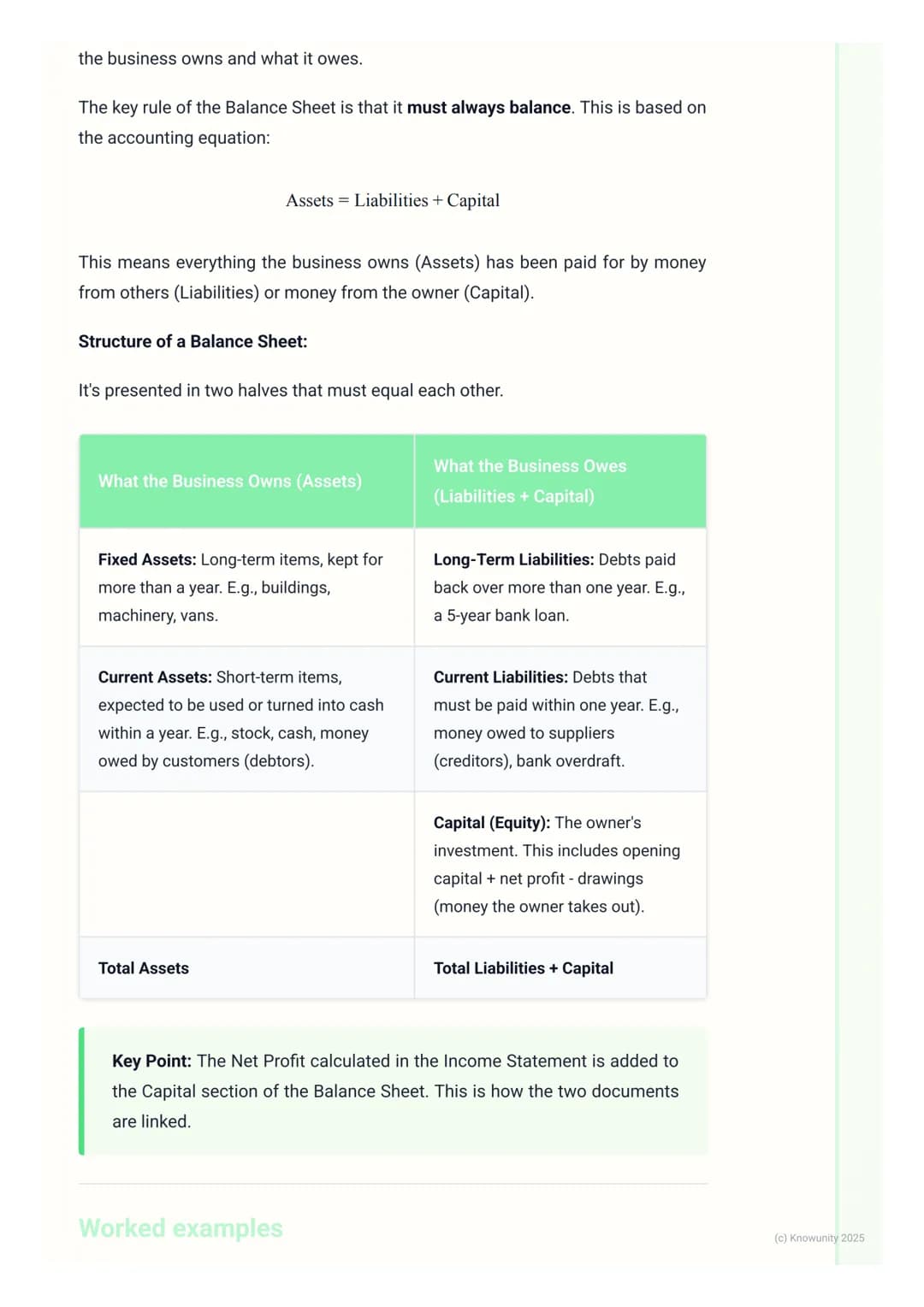
The Balance Sheet
Unlike the income statement's video approach, the balance sheet works like a photograph - it captures the business's financial position at one exact moment in time. Think of it as a snapshot taken on a specific date, like 31st December.
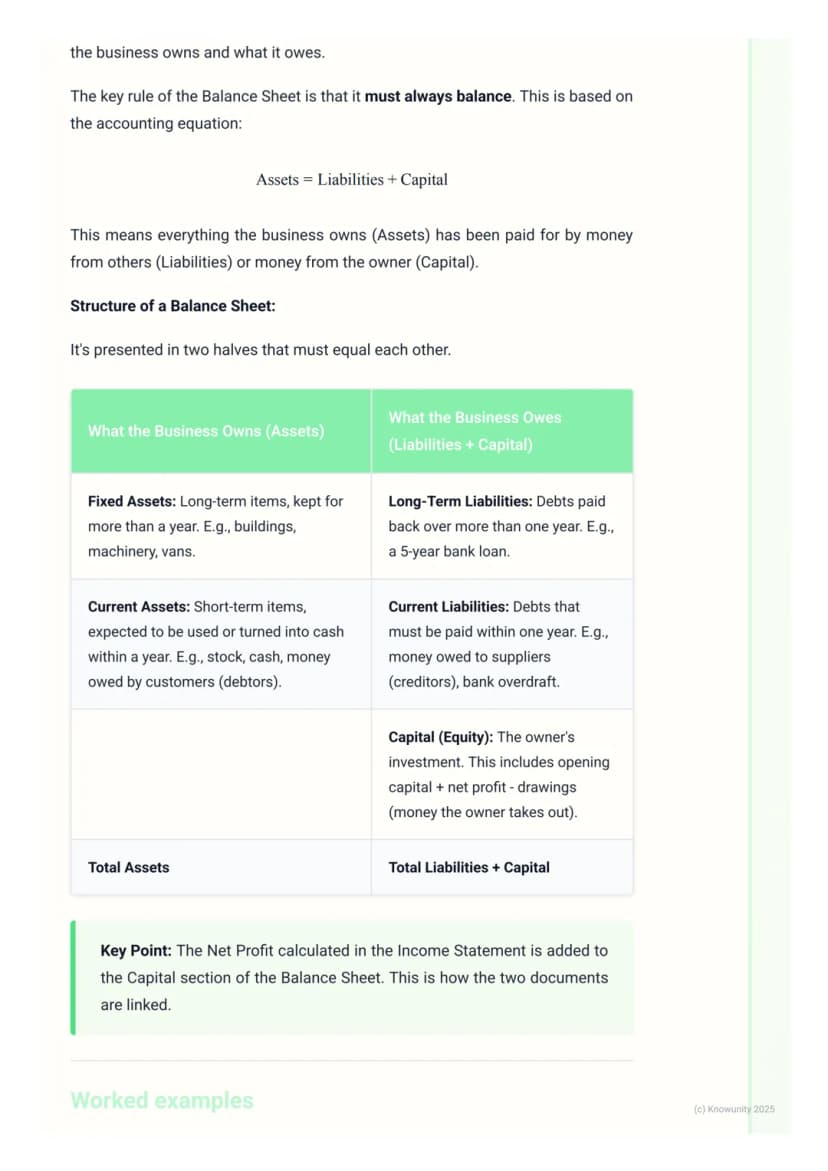
The magic rule of balance sheets is that they must always balance perfectly. This follows the accounting equation: Assets = Liabilities + Capital. Everything the business owns has been paid for either by borrowing money (liabilities) or using the owner's money (capital).
Fixed assets are long-term items kept for over a year (buildings, machinery), whilst current assets are short-term items like stock or cash. Similarly, liabilities split into long-term debts and current debts due within a year.
The clever bit is how the net profit from your income statement gets added to the capital section of your balance sheet - this is how the two documents connect together.
Key Point: If your balance sheet doesn't balance, you've definitely made a calculation error somewhere!
4
of 7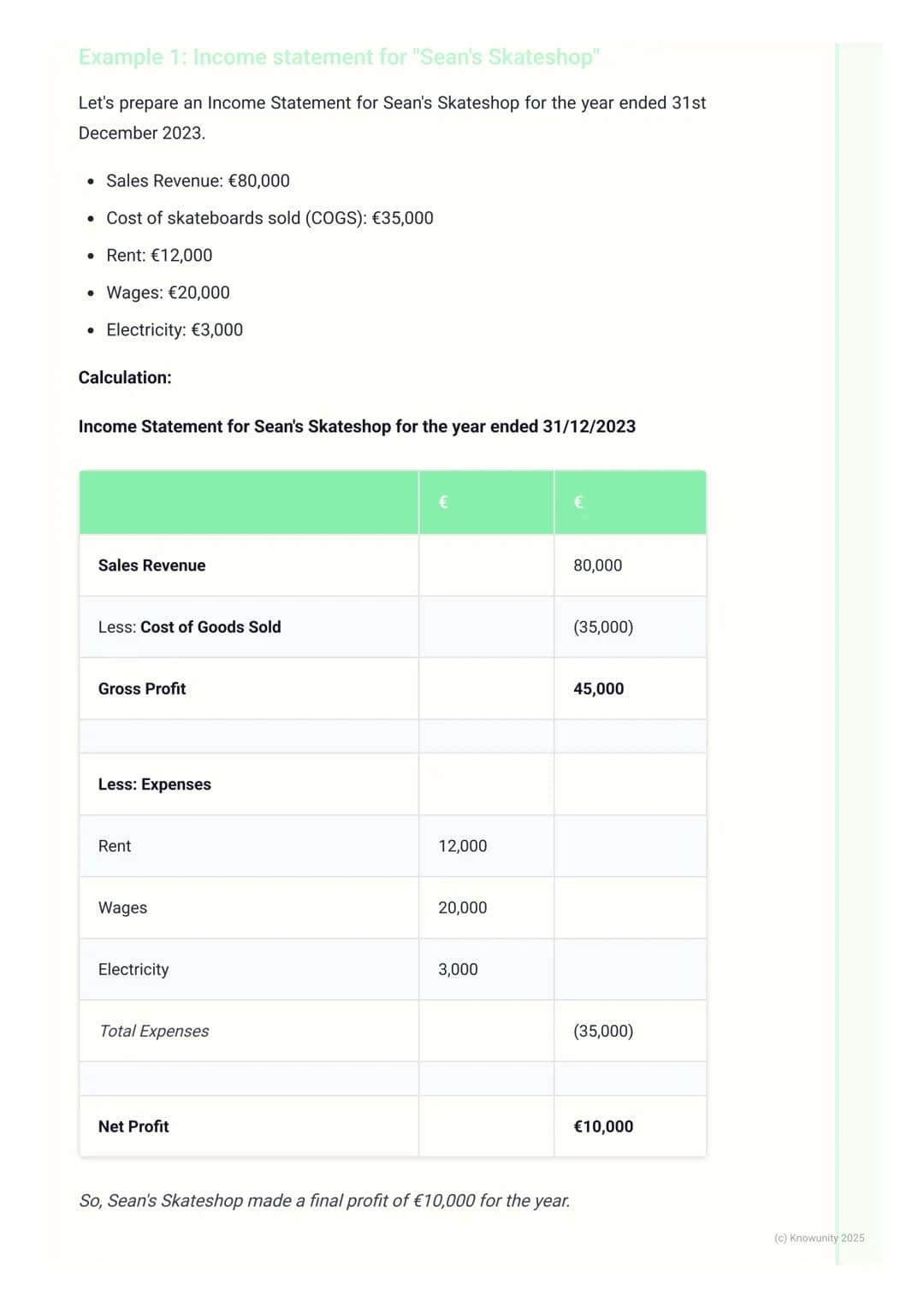
Worked Example - Sean's Skateshop Income Statement
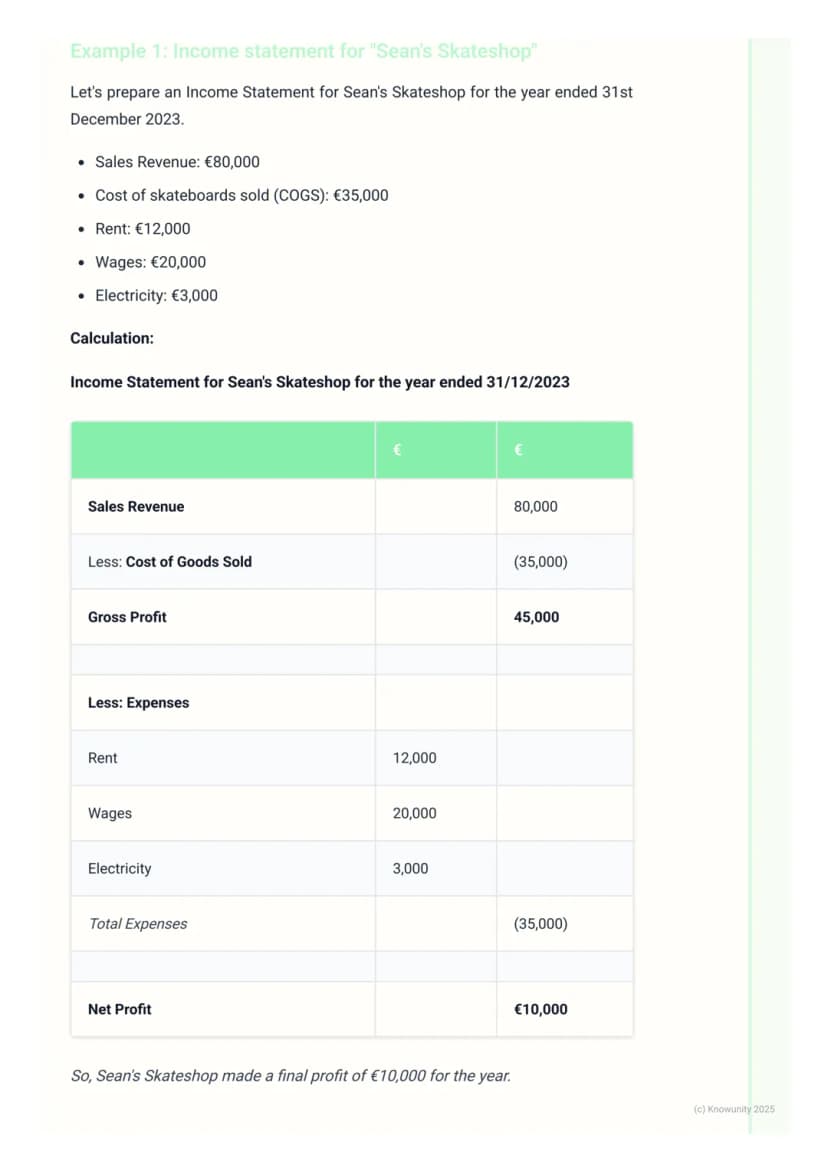
Let's see how this works in practice with Sean's Skateshop for the year ending 31st December 2023. Sean had sales of €80,000, but his skateboards cost him €35,000 to buy (his COGS).
After subtracting the €35,000 COGS from his €80,000 sales, Sean's gross profit was €45,000. Not bad! But he still had running costs: €12,000 rent, €20,000 wages, and €3,000 electricity bills.
When Sean subtracts his total expenses of €35,000 from his gross profit of €45,000, he ends up with a net profit of €10,000. This means after paying for everything, Sean actually made €10,000 for the year.
Pro Tip: Always double-check your arithmetic - small calculation errors can throw off your entire financial statement!
5
of 7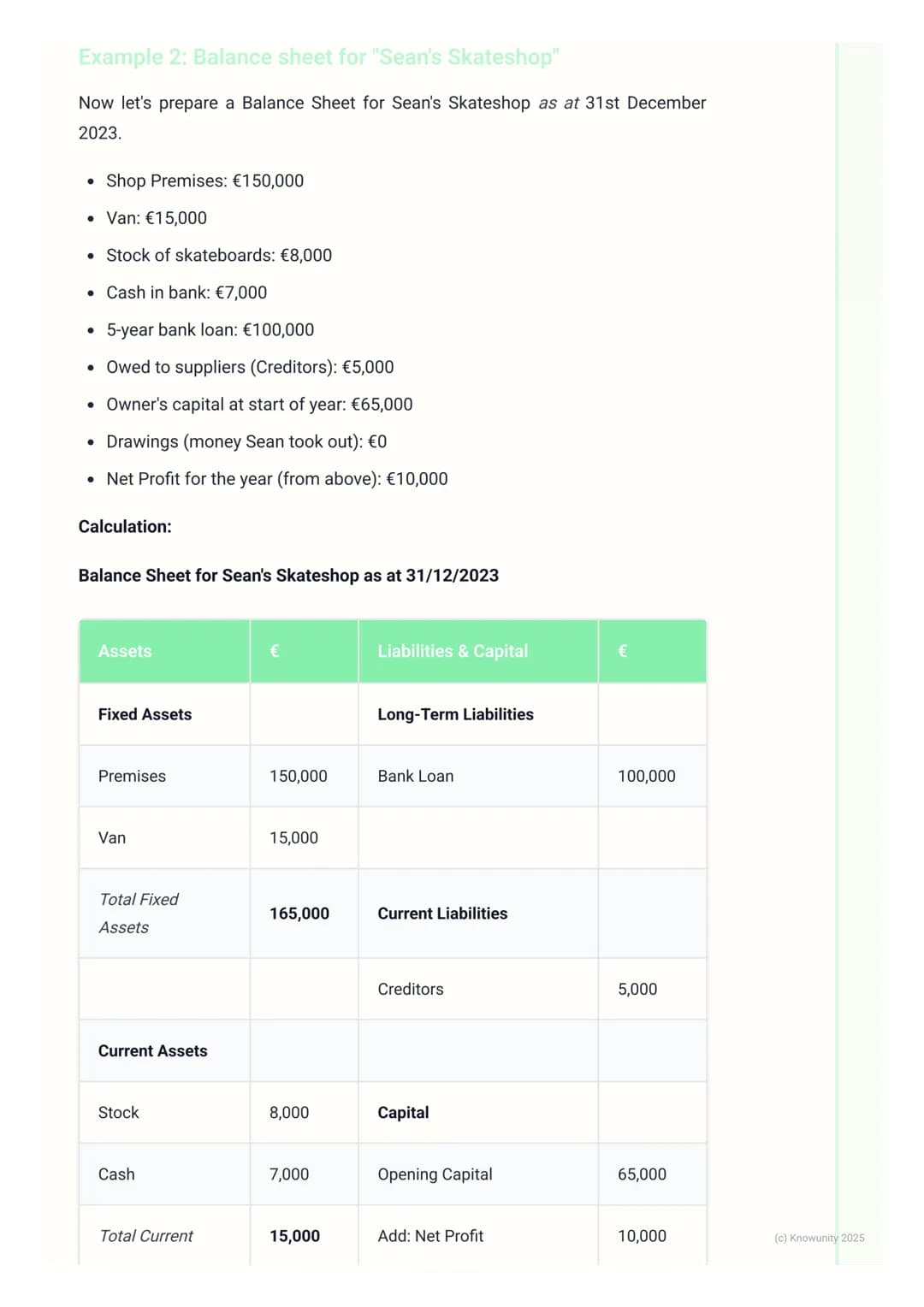
Worked Example - Sean's Skateshop Balance Sheet
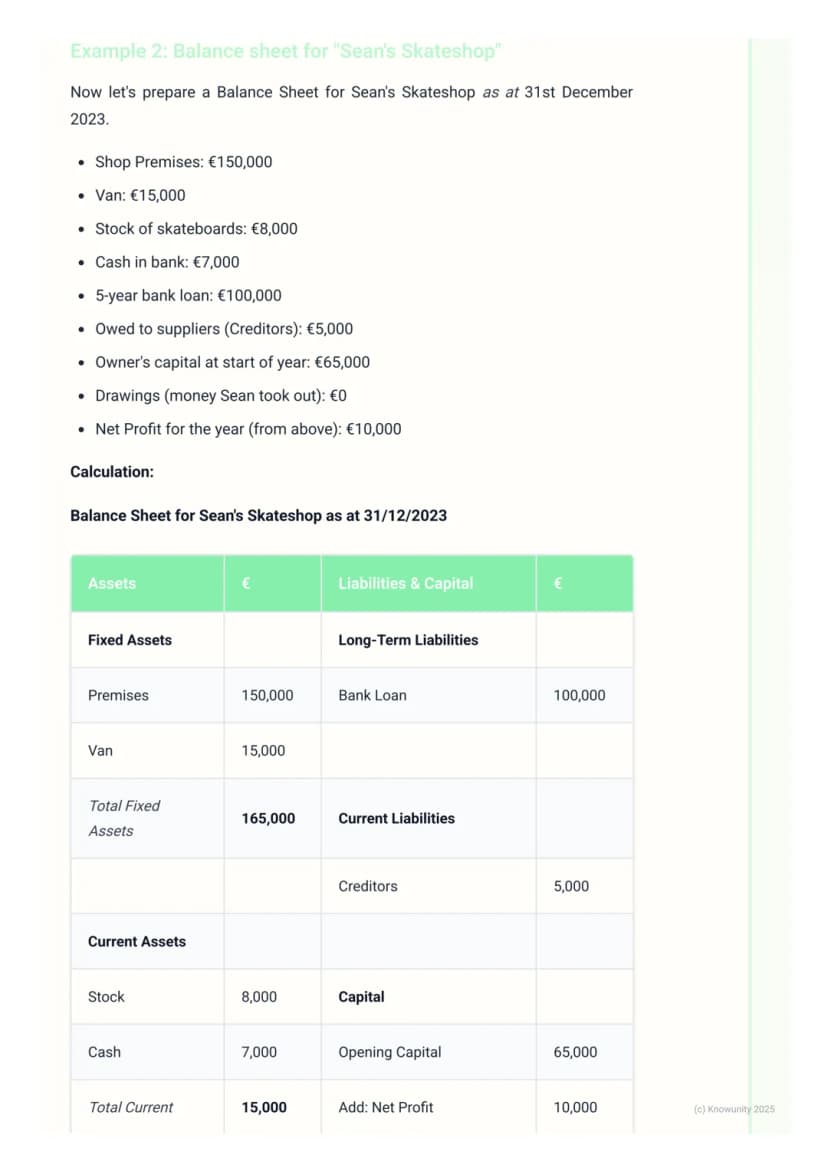
Now let's create Sean's balance sheet as at 31st December 2023. On the assets side, Sean owns shop premises worth €150,000, a van worth €15,000, stock worth €8,000, and has €7,000 cash in the bank.
His liabilities include a €100,000 five-year bank loan and €5,000 owed to suppliers. Sean started the year with €65,000 capital, didn't take any money out (drawings), and made that €10,000 profit we calculated earlier.
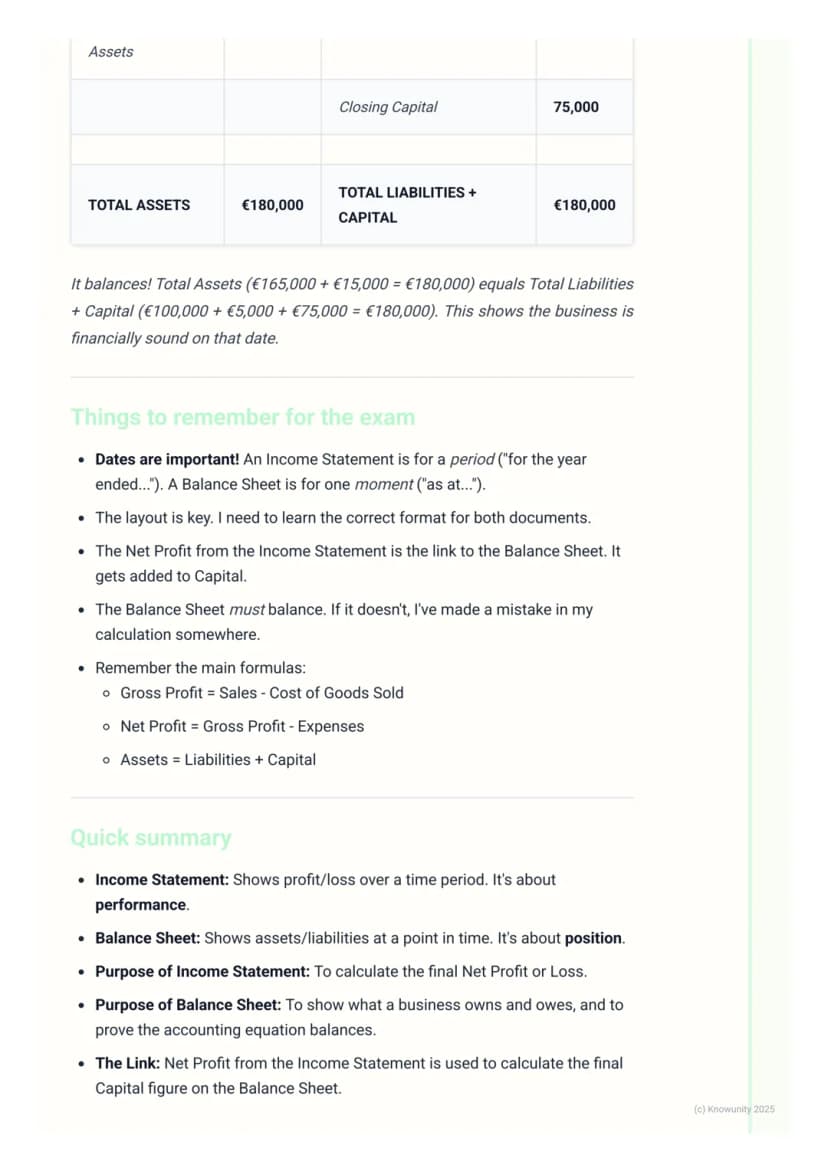
Adding the €10,000 net profit to his original €65,000 capital gives Sean €75,000 total capital. When we check the balance: total assets (€180,000) equals total liabilities plus capital (€180,000). Perfect!
Success Check: When your balance sheet balances perfectly, you know you've got all the numbers right!
6
of 7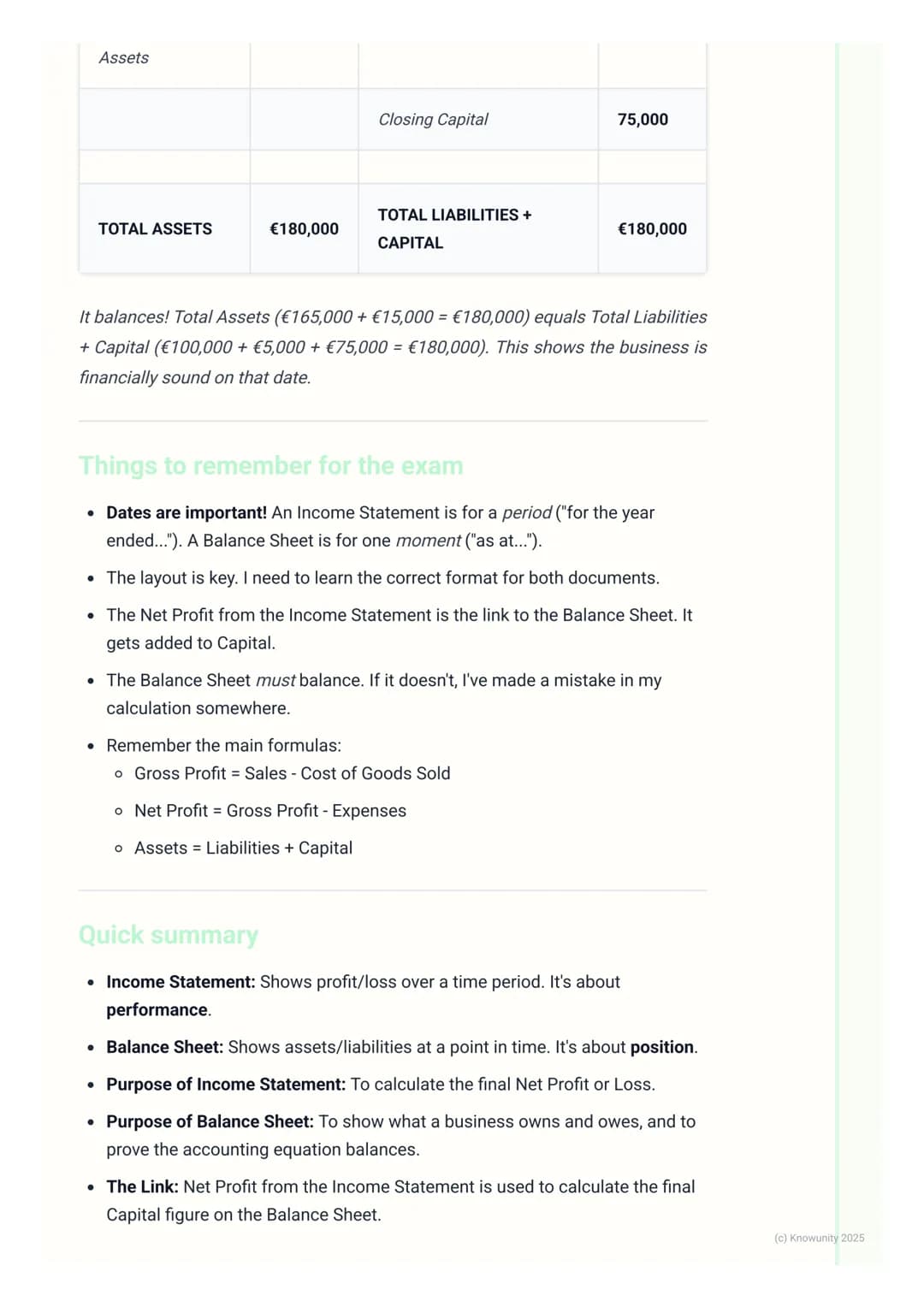
Exam Tips and Key Formulas
Getting the dates right is absolutely crucial for exams. Income statements cover a time period ("for the year ended...") whilst balance sheets capture a single moment ("as at..."). Mix these up and you'll lose marks instantly.
The layout matters just as much as the numbers. Learn the correct format for both documents and practise writing them out properly. Remember that net profit from your income statement must appear in the capital section of your balance sheet - this connection often comes up in exam questions.
Master these essential formulas: Gross Profit = Sales minus Cost of Goods Sold, Net Profit = Gross Profit minus Expenses, and Assets = Liabilities + Capital. If your balance sheet doesn't balance, work backwards through your calculations to find the mistake.
Exam Success: Think of the income statement as showing performance (how did we do?) and the balance sheet as showing position (what do we have?).
7
of 7
We thought you’d never ask...
What is the Knowunity AI companion?
Our AI companion is specifically built for the needs of students. Based on the millions of content pieces we have on the platform we can provide truly meaningful and relevant answers to students. But its not only about answers, the companion is even more about guiding students through their daily learning challenges, with personalised study plans, quizzes or content pieces in the chat and 100% personalisation based on the students skills and developments.
Where can I download the Knowunity app?
You can download the app in the Google Play Store and in the Apple App Store.
Is Knowunity really free of charge?
That's right! Enjoy free access to study content, connect with fellow students, and get instant help – all at your fingertips.
Most popular content in Business
3Most popular content
9 Irish
IrishIrish oral questions and answers
Questions and answers for the leaving cert oral
5th Year4264
 English
Key Quotes : Sive
Key Quotes and explanations: Sive
6th Year2842
IrishIrish oral questions
Outline of oral questions
5th Year2055
IrishIníon- le hÁine Durkin
Aine Durkin’s poem, Iníon: Themes & summary
5th Year890
IrishIrish poetry 2027
Iníon + Dínit an Bhróin
5th Year1153
IrishLC HL notes- Iníon (poem)
Includes poem in English and Irish, theme, key words & phrases
5th Year2304
EnglishCultural Context : Shawshank Redemption : Sive : Small Things Like These
Comparative Study : Cultural Context : Shawshank Redemption, Sive and Small Things Like These
6th Year1430
IrishMo Ghrá-sa (Idir Lúibíní)
Notes on mo ghrá-sa
5th Year380
IrishAn Gaeilge Aiste
Irish Language essay
6th Year1320
Can't find what you're looking for? Explore other subjects.
Students love us — and so will you.
4.6/5App Store
4.7/5Google Play
The app is very easy to use and well designed. I have found everything I was looking for so far and have been able to learn a lot from the presentations! I will definitely use the app for a class assignment! And of course it also helps a lot as an inspiration.
Stefan SiOS user
This app is really great. There are so many study notes and help [...]. My problem subject is French, for example, and the app has so many options for help. Thanks to this app, I have improved my French. I would recommend it to anyone.
Samantha KlichAndroid user
Wow, I am really amazed. I just tried the app because I've seen it advertised many times and was absolutely stunned. This app is THE HELP you want for school and above all, it offers so many things, such as workouts and fact sheets, which have been VERY helpful to me personally.
AnnaiOS user
Business2 views·Updated Jun 11, 2026·7 pagesOverview of Key Financial Statements: Income Statement and Balance Sheet
Every business creates two crucial financial documents that tell the story of how it's performing - think of them as the business's report card and bank statement rolled into one. The Income Statement shows whether a company is actually making...
1
of 7
Sign up to see the content. It's free!
- Access to all documents
- Improve your grades
- Join milions of students
Basic Financial Documents
Understanding financial documents is like learning to read a business's health check. These reports help everyone from business owners to banks figure out if a company is worth investing in or lending money to.
Revenue (also called sales or turnover) is simply all the money a business earns from selling stuff. Expenses are all the costs of keeping the business running - things like rent, wages, and electricity bills. When you subtract expenses from revenue, you get profit (the good outcome) or loss (not so good).
On the flip side, assets are valuable things the business owns like delivery vans or cash in the bank. Liabilities are debts the business owes to others, whilst capital represents the owner's stake in the business.
Quick Tip: Think of assets as "what we have" and liabilities as "what we owe" - this makes the concepts much easier to remember!
2
of 7Sign up to see the content. It's free!
- Access to all documents
- Improve your grades
- Join milions of students
The Income Statement
This document works like a business video - it shows performance over a specific time period, whether that's a month or a full year. Its main job is dead simple: calculate whether the business made money or lost it.
The income statement follows a straightforward formula: Revenue minus Expenses equals Net Profit (or Loss). You start with all the sales revenue, subtract the cost of goods sold (COGS), and this gives you gross profit. Then you subtract all other running costs to reach your final net profit.
Here's the flow: Sales → minus COGS → equals Gross Profit → minus other expenses → equals Net Profit. It's basically asking "did we make more than we spent?"
Remember: The income statement is all about performance over time - it's the "how did we do?" document.
3
of 7Sign up to see the content. It's free!
- Access to all documents
- Improve your grades
- Join milions of students
The Balance Sheet
Unlike the income statement's video approach, the balance sheet works like a photograph - it captures the business's financial position at one exact moment in time. Think of it as a snapshot taken on a specific date, like 31st December.
The magic rule of balance sheets is that they must always balance perfectly. This follows the accounting equation: Assets = Liabilities + Capital. Everything the business owns has been paid for either by borrowing money (liabilities) or using the owner's money (capital).
Fixed assets are long-term items kept for over a year (buildings, machinery), whilst current assets are short-term items like stock or cash. Similarly, liabilities split into long-term debts and current debts due within a year.
The clever bit is how the net profit from your income statement gets added to the capital section of your balance sheet - this is how the two documents connect together.
Key Point: If your balance sheet doesn't balance, you've definitely made a calculation error somewhere!
4
of 7Sign up to see the content. It's free!
- Access to all documents
- Improve your grades
- Join milions of students
Worked Example - Sean's Skateshop Income Statement
Let's see how this works in practice with Sean's Skateshop for the year ending 31st December 2023. Sean had sales of €80,000, but his skateboards cost him €35,000 to buy (his COGS).
After subtracting the €35,000 COGS from his €80,000 sales, Sean's gross profit was €45,000. Not bad! But he still had running costs: €12,000 rent, €20,000 wages, and €3,000 electricity bills.
When Sean subtracts his total expenses of €35,000 from his gross profit of €45,000, he ends up with a net profit of €10,000. This means after paying for everything, Sean actually made €10,000 for the year.
Pro Tip: Always double-check your arithmetic - small calculation errors can throw off your entire financial statement!
5
of 7Sign up to see the content. It's free!
- Access to all documents
- Improve your grades
- Join milions of students
Worked Example - Sean's Skateshop Balance Sheet
Now let's create Sean's balance sheet as at 31st December 2023. On the assets side, Sean owns shop premises worth €150,000, a van worth €15,000, stock worth €8,000, and has €7,000 cash in the bank.
His liabilities include a €100,000 five-year bank loan and €5,000 owed to suppliers. Sean started the year with €65,000 capital, didn't take any money out (drawings), and made that €10,000 profit we calculated earlier.
Adding the €10,000 net profit to his original €65,000 capital gives Sean €75,000 total capital. When we check the balance: total assets (€180,000) equals total liabilities plus capital (€180,000). Perfect!
Success Check: When your balance sheet balances perfectly, you know you've got all the numbers right!
6
of 7Sign up to see the content. It's free!
- Access to all documents
- Improve your grades
- Join milions of students
Exam Tips and Key Formulas
Getting the dates right is absolutely crucial for exams. Income statements cover a time period ("for the year ended...") whilst balance sheets capture a single moment ("as at..."). Mix these up and you'll lose marks instantly.
The layout matters just as much as the numbers. Learn the correct format for both documents and practise writing them out properly. Remember that net profit from your income statement must appear in the capital section of your balance sheet - this connection often comes up in exam questions.
Master these essential formulas: Gross Profit = Sales minus Cost of Goods Sold, Net Profit = Gross Profit minus Expenses, and Assets = Liabilities + Capital. If your balance sheet doesn't balance, work backwards through your calculations to find the mistake.
Exam Success: Think of the income statement as showing performance (how did we do?) and the balance sheet as showing position (what do we have?).
7
of 7Sign up to see the content. It's free!
- Access to all documents
- Improve your grades
- Join milions of students
We thought you’d never ask...
What is the Knowunity AI companion?
Our AI companion is specifically built for the needs of students. Based on the millions of content pieces we have on the platform we can provide truly meaningful and relevant answers to students. But its not only about answers, the companion is even more about guiding students through their daily learning challenges, with personalised study plans, quizzes or content pieces in the chat and 100% personalisation based on the students skills and developments.
Where can I download the Knowunity app?
You can download the app in the Google Play Store and in the Apple App Store.
Is Knowunity really free of charge?
That's right! Enjoy free access to study content, connect with fellow students, and get instant help – all at your fingertips.
Most popular content in Business
3Most popular content
9IrishIrish oral questions and answers
Questions and answers for the leaving cert oral
5th Year4264
EnglishKey Quotes : Sive
Key Quotes and explanations: Sive
6th Year2842
IrishIrish oral questions
Outline of oral questions
5th Year2055
IrishIníon- le hÁine Durkin
Aine Durkin’s poem, Iníon: Themes & summary
5th Year890
IrishIrish poetry 2027
Iníon + Dínit an Bhróin
5th Year1153
IrishLC HL notes- Iníon (poem)
Includes poem in English and Irish, theme, key words & phrases
5th Year2304
EnglishCultural Context : Shawshank Redemption : Sive : Small Things Like These
Comparative Study : Cultural Context : Shawshank Redemption, Sive and Small Things Like These
6th Year1430
IrishMo Ghrá-sa (Idir Lúibíní)
Notes on mo ghrá-sa
5th Year380
IrishAn Gaeilge Aiste
Irish Language essay
6th Year1320
Can't find what you're looking for? Explore other subjects.
Students love us — and so will you.
4.6/5App Store
4.7/5Google Play
The app is very easy to use and well designed. I have found everything I was looking for so far and have been able to learn a lot from the presentations! I will definitely use the app for a class assignment! And of course it also helps a lot as an inspiration.
Stefan SiOS user
This app is really great. There are so many study notes and help [...]. My problem subject is French, for example, and the app has so many options for help. Thanks to this app, I have improved my French. I would recommend it to anyone.
Samantha KlichAndroid user
Wow, I am really amazed. I just tried the app because I've seen it advertised many times and was absolutely stunned. This app is THE HELP you want for school and above all, it offers so many things, such as workouts and fact sheets, which have been VERY helpful to me personally.
AnnaiOS user