
Ever wondered why you have your mum's eyes or your...
 Biology49 views·Updated 11 Jul 2026·8 pages
Mendelian Inheritance and Genetic Crosses
1 / 8
1
of 8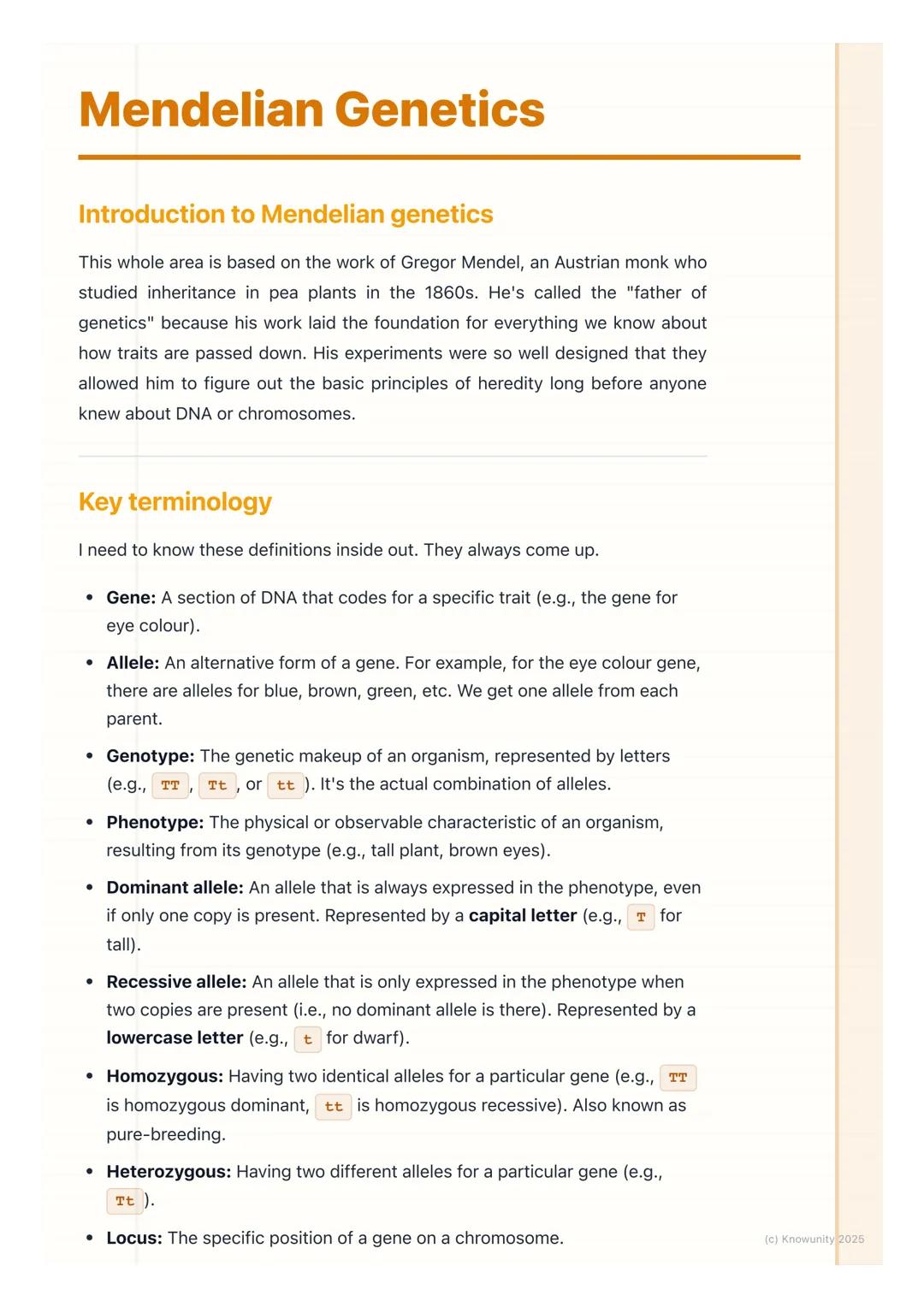
Mendelian Genetics Basics
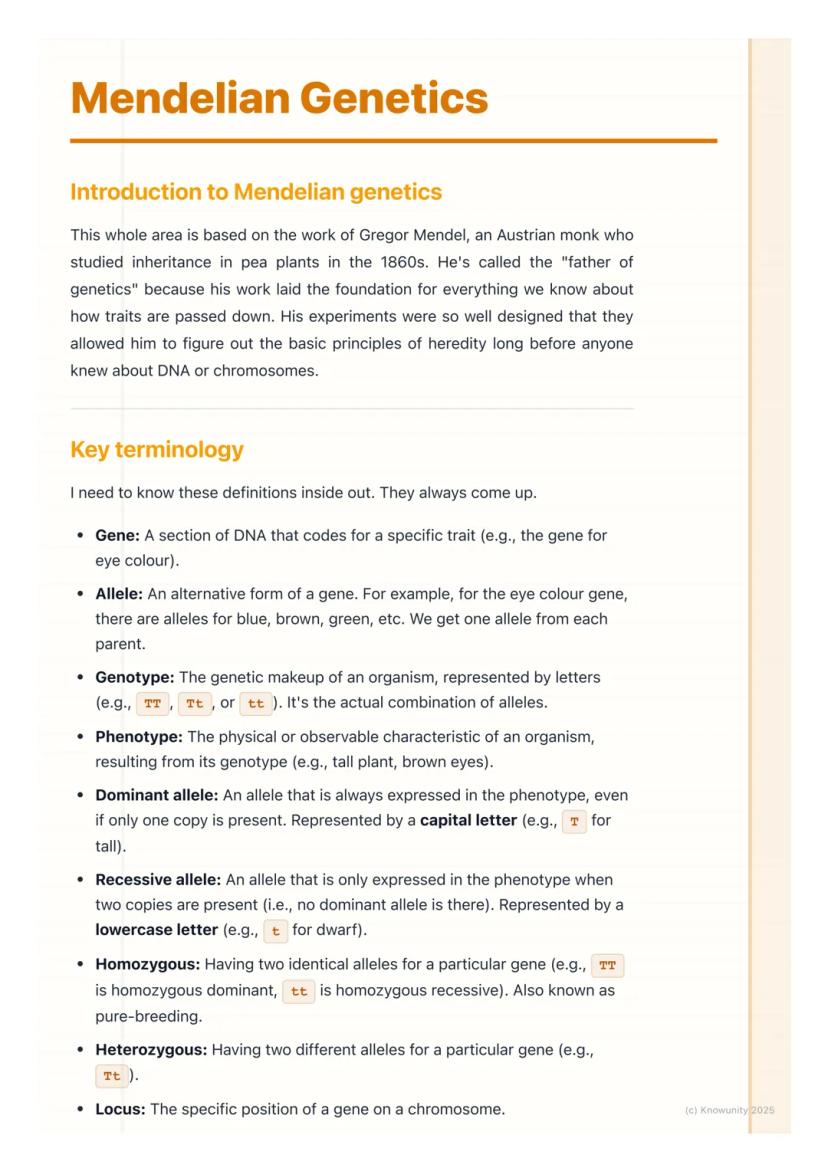
You'll need to nail the key terms first - they're the building blocks for everything else in genetics. A gene is basically a section of DNA that controls a specific trait, like eye colour. Alleles are different versions of the same gene (think blue eyes vs brown eyes).
Your genotype is the actual genetic code you carry (written as letters like TT or Tt), whilst your phenotype is what you actually look like. Dominant alleles (capital letters) always show up in your appearance, even if you only have one copy. Recessive alleles (lowercase letters) only appear when you have two copies.
Homozygous means having two identical alleles (like TT or tt), whilst heterozygous means having two different ones (like Tt). The generations have special names too: P generation (parents), F1 (first offspring), and F2 (second generation offspring).
Quick Tip: Think of alleles like different flavours of the same ice cream - same product, different varieties!
2
of 8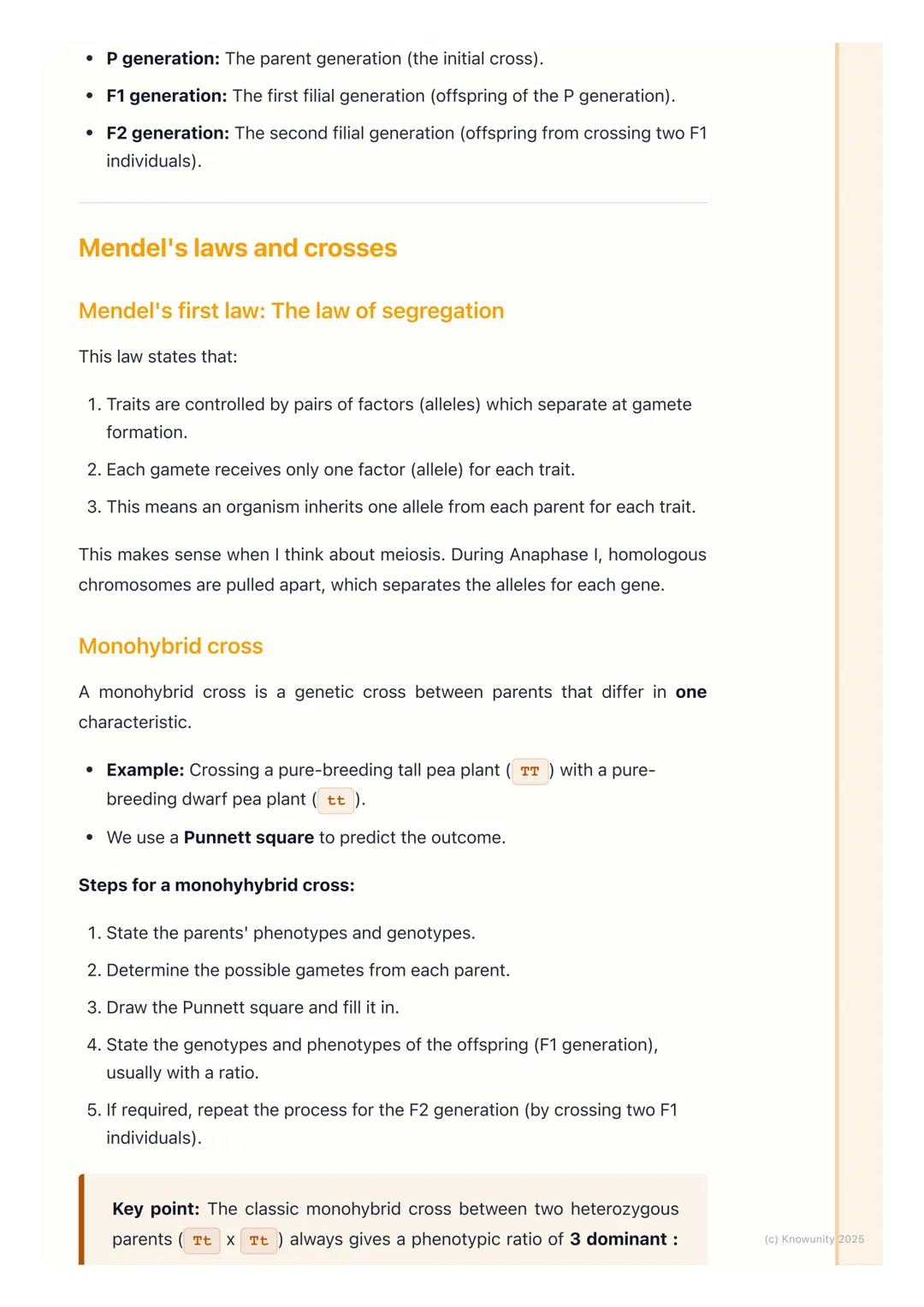
Mendel's Laws and Monohybrid Crosses
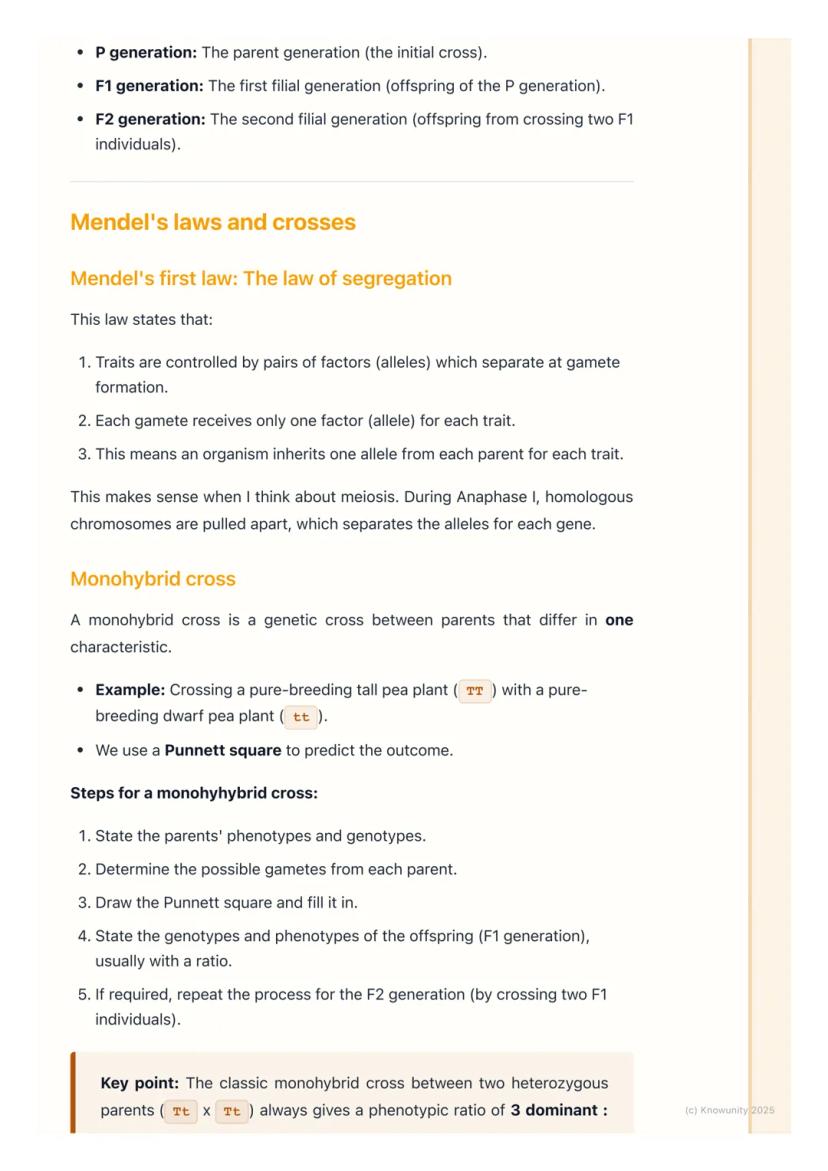
Mendel's first law (segregation) tells us that trait-controlling factors separate during gamete formation, so each parent only passes on one allele for each trait. This happens during meiosis when chromosomes get pulled apart.
A monohybrid cross tracks just one characteristic at a time. You'll use Punnett squares to predict outcomes - they're like genetic calculators! The classic example is crossing two heterozygous parents (Tt × Tt).
Here's your step-by-step process: state parent phenotypes and genotypes, work out possible gametes, draw your Punnett square, fill it in, then state the offspring ratios. The magic ratio you'll see constantly is 3:1 for phenotypes (3 dominant : 1 recessive) and 1:2:1 for genotypes.
Exam Gold: That 3:1 ratio from Tt × Tt crosses appears in loads of questions - memorise it!
3
of 8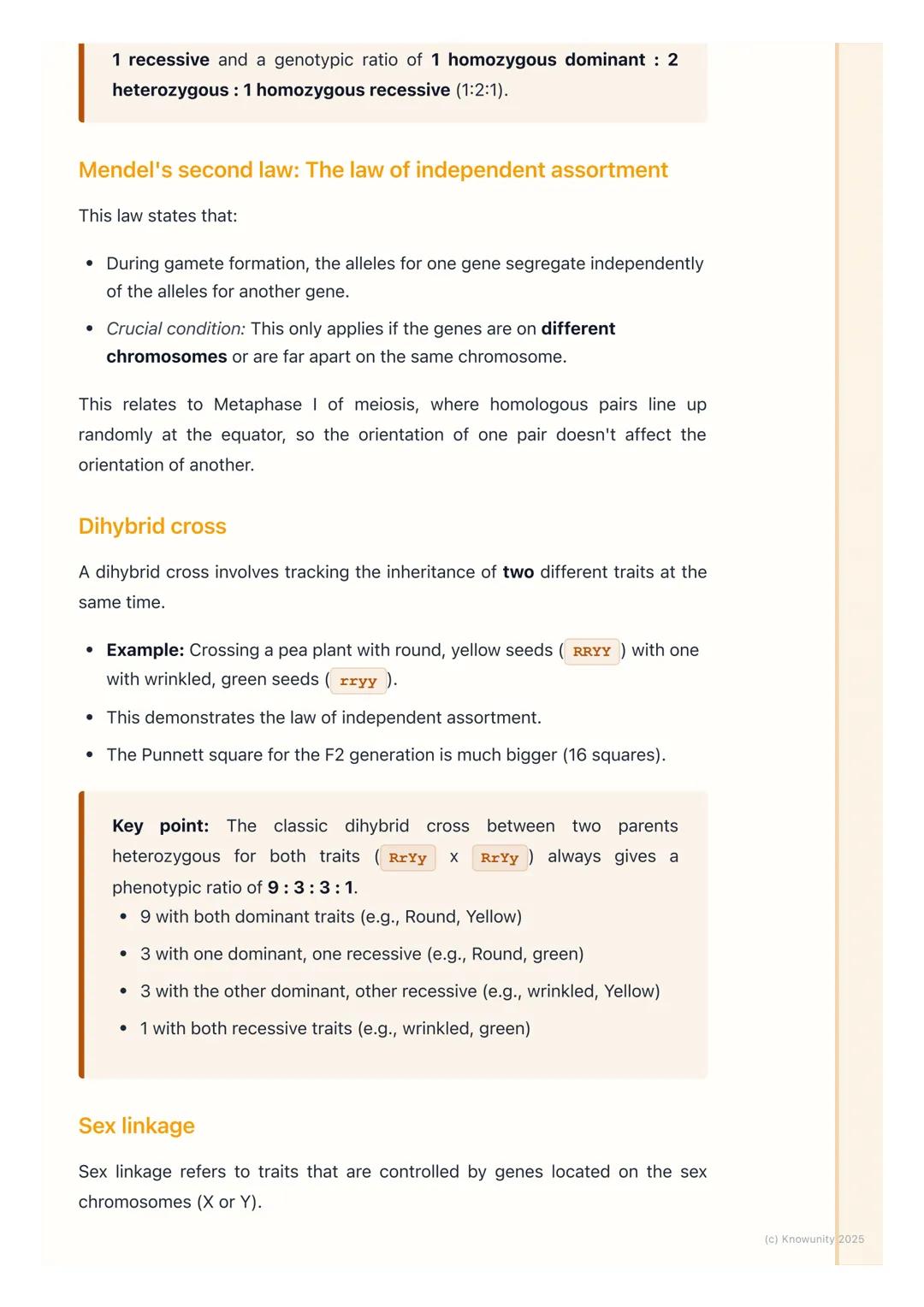
Independent Assortment and Dihybrid Crosses
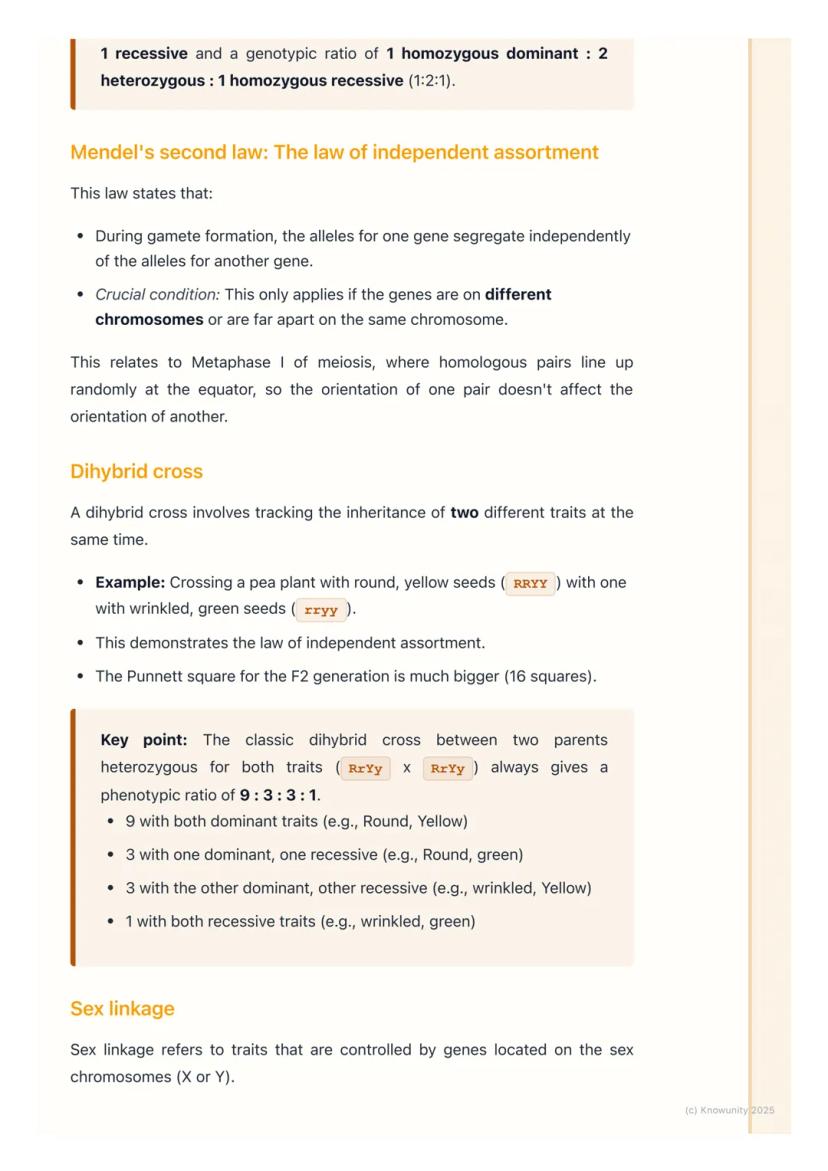
Mendel's second law (independent assortment) shows that different genes get inherited independently - but only if they're on different chromosomes or far apart on the same one. This relates to how chromosomes line up randomly during meiosis.
Dihybrid crosses track two traits simultaneously, like seed shape and colour. The Punnett square becomes much bigger (16 squares instead of 4), but don't panic - the process is the same.
When you cross two parents who are heterozygous for both traits (like RrYy × RrYy), you get the famous 9:3:3:1 ratio. That's 9 with both dominant traits, 3 with each mixed combination, and 1 with both recessive traits.
Sex linkage happens when genes sit on sex chromosomes. Most sex-linked traits are X-linked, which means males are more likely to show recessive traits since they only have one X chromosome.
Memory Trick: For dihybrid crosses, remember "9-3-3-1" - it's the genetic equivalent of a phone number!
4
of 8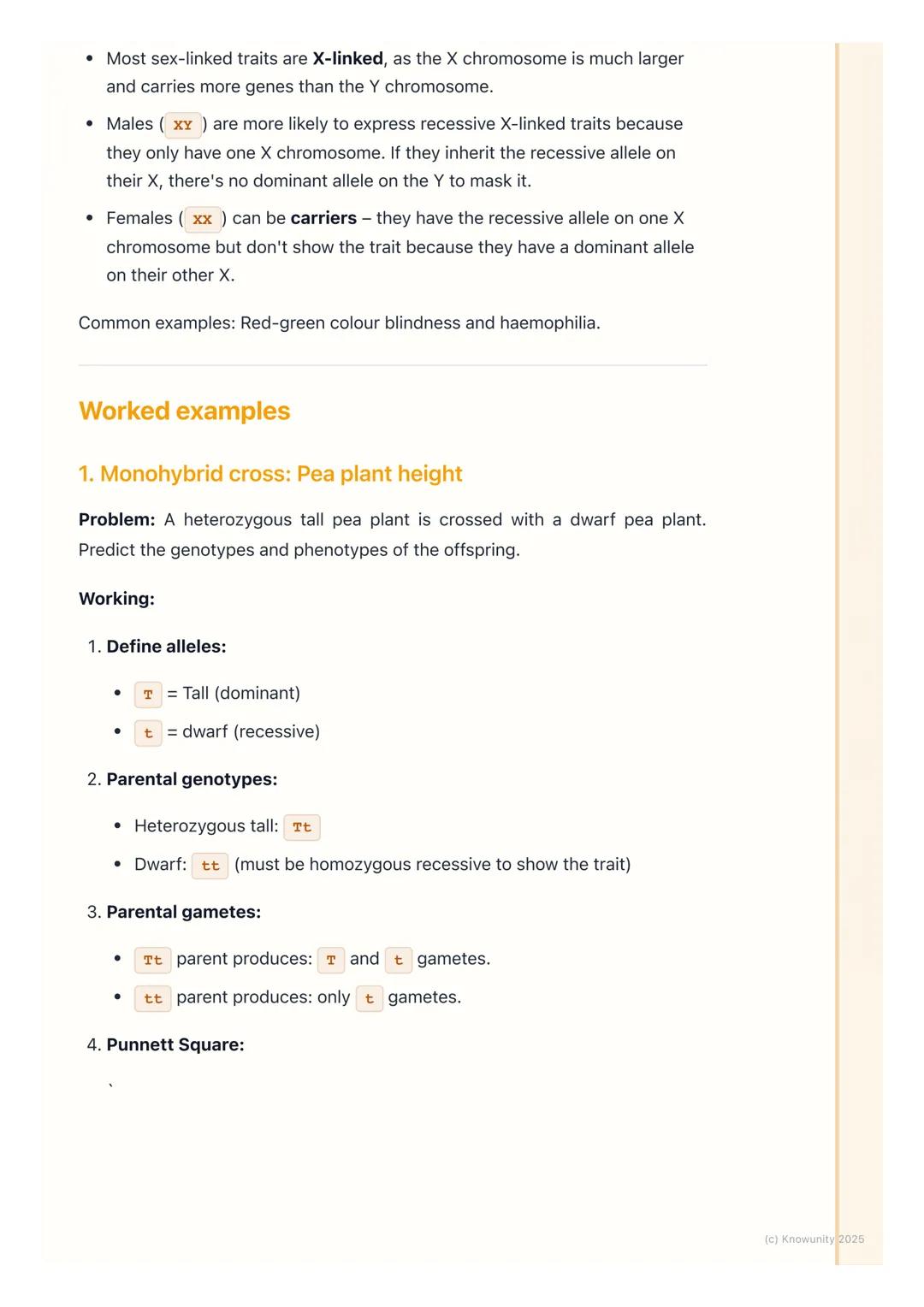
Working Through Genetic Problems
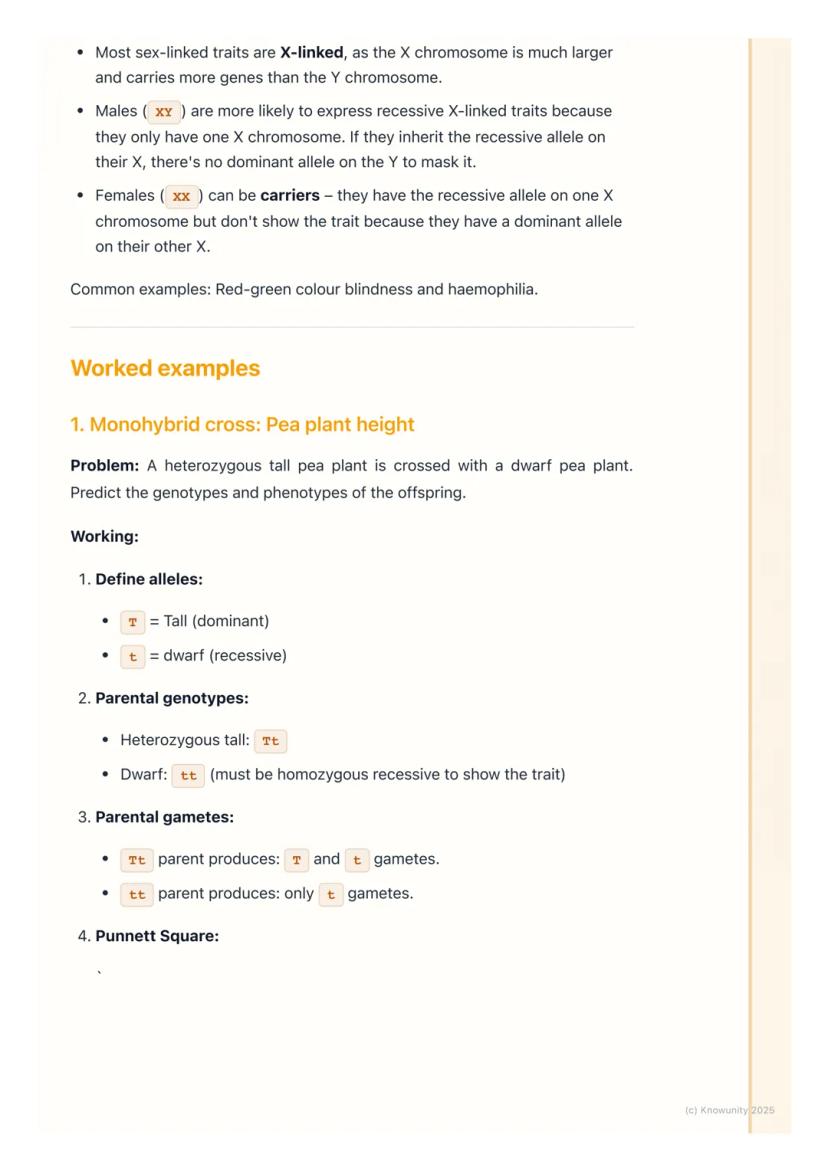
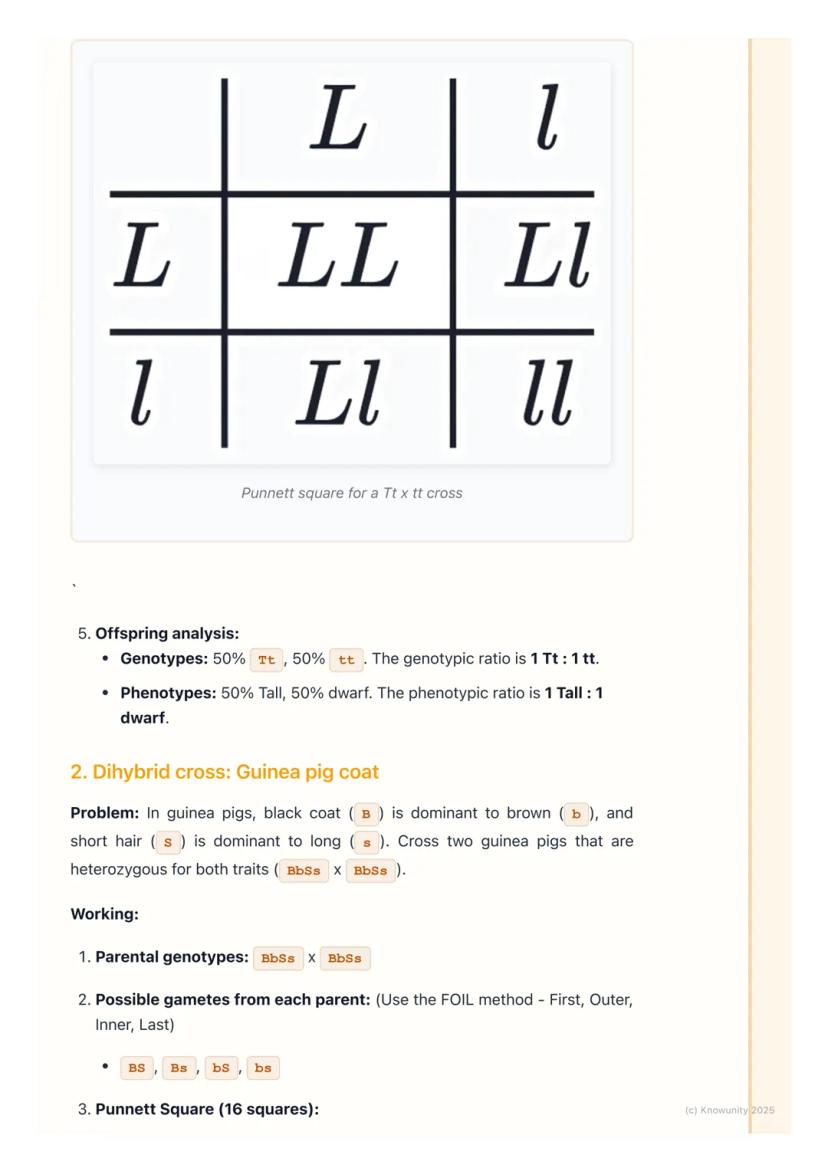
Let's tackle a monohybrid cross step by step. Say you're crossing a heterozygous tall plant (Tt) with a dwarf plant (tt). The tall plant produces T and t gametes, whilst the dwarf only produces t gametes.
Your Punnett square gives you 50% Tt (tall) and 50% tt (dwarf) offspring. Notice how this gives a 1:1 ratio instead of 3:1 - that's because one parent is homozygous recessive.
For sex-linked problems, always write alleles as superscripts on the X chromosome (like X^N for normal vision). Remember that the Y chromosome carries no allele for most X-linked traits.
The key is reading questions carefully - are they asking for the probability of any child having a trait, or specifically a son or daughter? Your answer format matters too (percentage, fraction, or ratio).
Pro Tip: Always show your working - even if you get the final answer wrong, you can still pick up marks for correct method!
5
of 8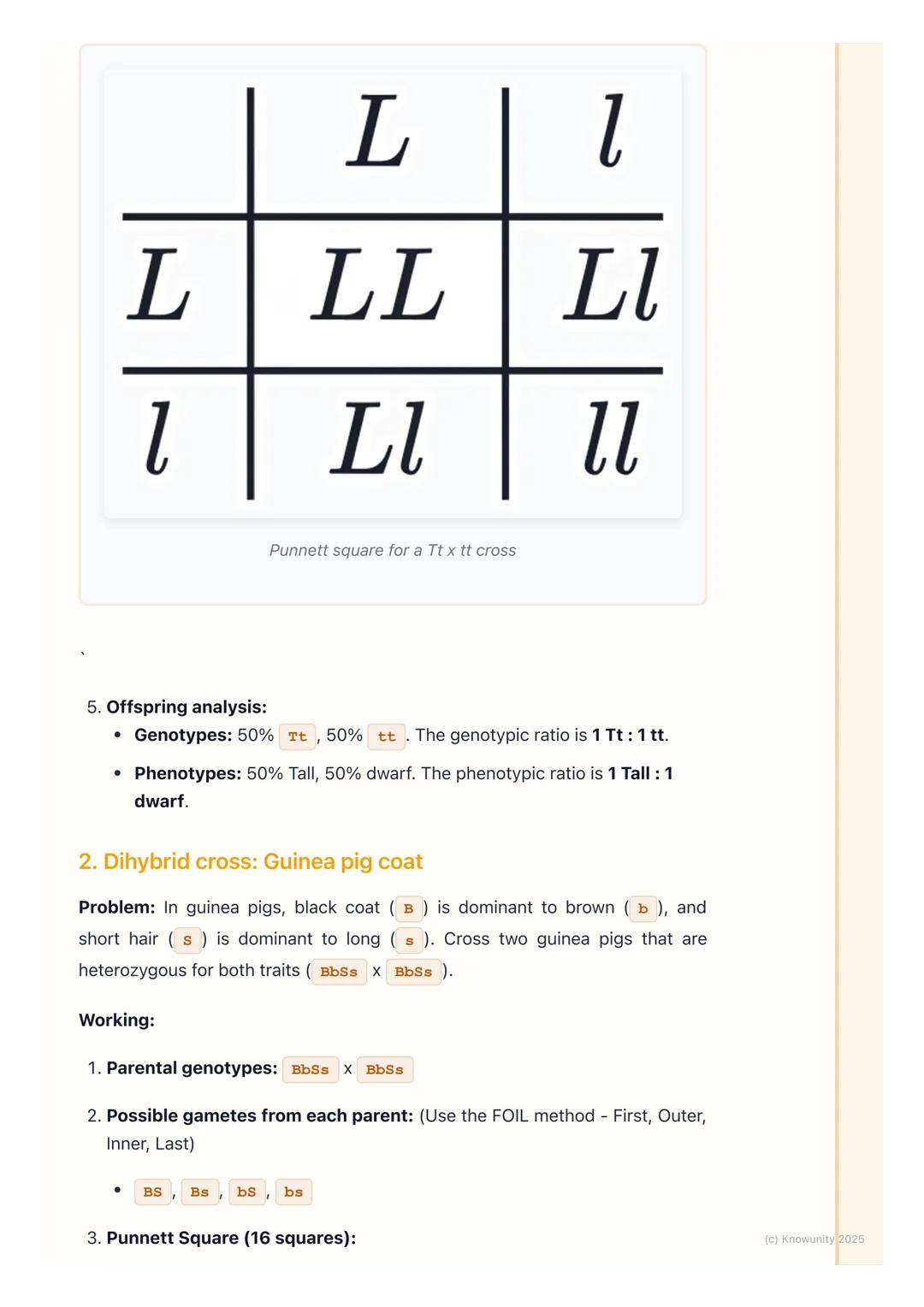
Dihybrid Cross Example
Guinea pig genetics makes a perfect dihybrid example! With black coat (B) dominant over brown , and short hair (S) dominant over long , let's cross two heterozygous parents (BbSs × BbSs).
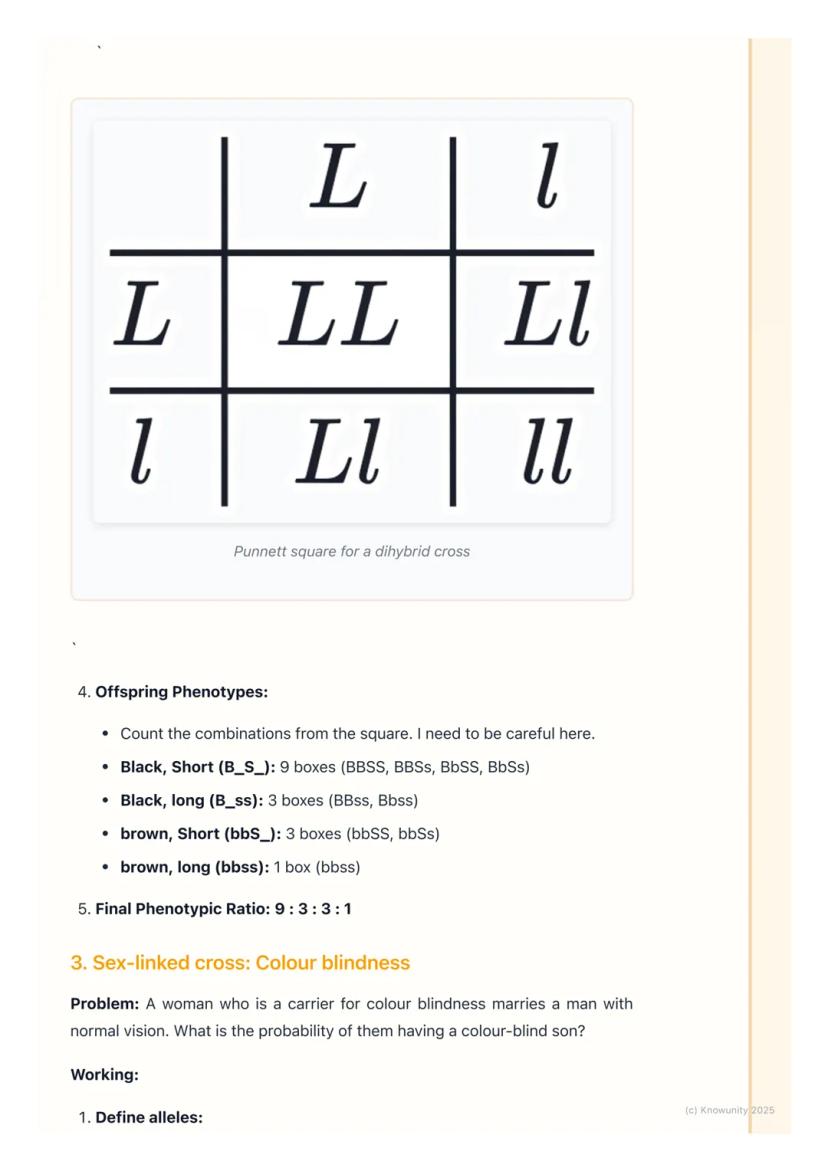
Each parent can produce four different gamete types: BS, Bs, bS, and bs. Use the FOIL method (First, Outer, Inner, Last) to work these out systematically.
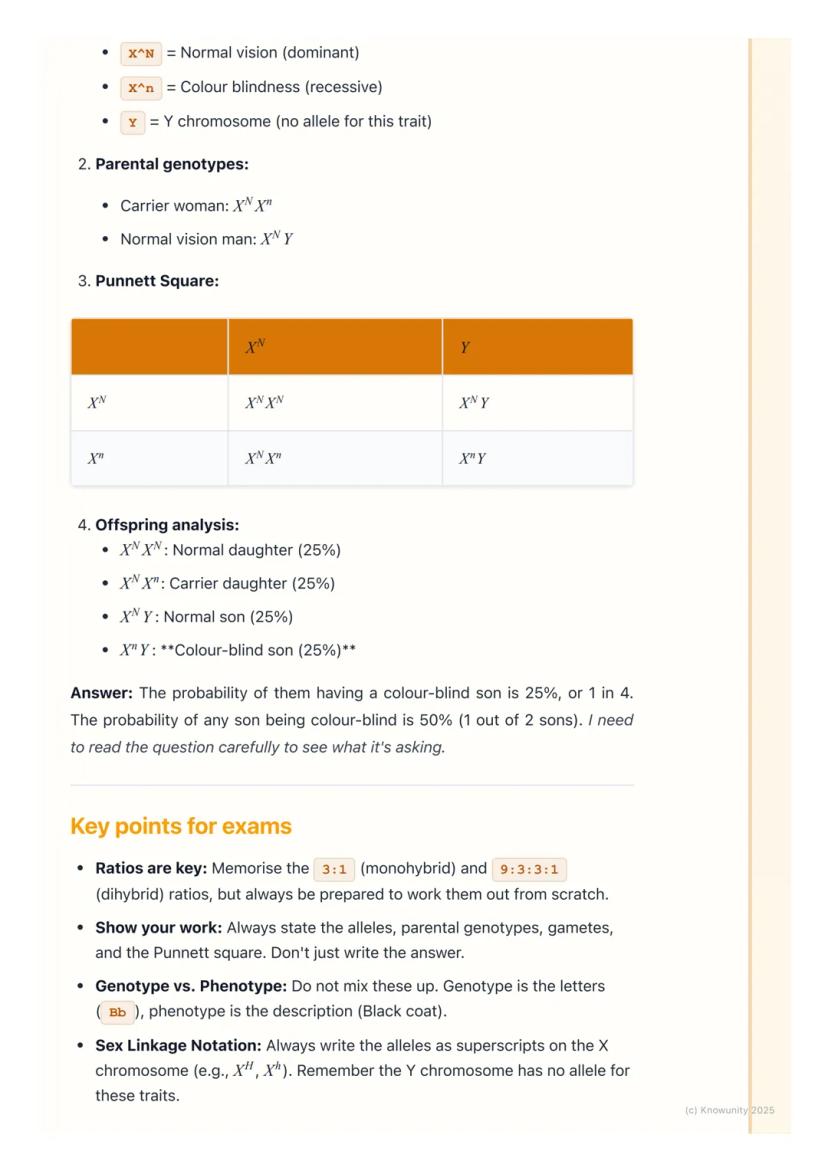
Your 16-square Punnett square will show the classic 9:3:3:1 phenotypic ratio. Count carefully: 9 black short-haired, 3 black long-haired, 3 brown short-haired, and 1 brown long-haired guinea pig.
This ratio appears whenever you cross two individuals who are heterozygous for both traits. It's one of the most important patterns in genetics, so make sure you can recognise and reproduce it.
Study Hack: Practice drawing 16-square Punnett squares until you can do them quickly - they're exam favourites!
6
of 8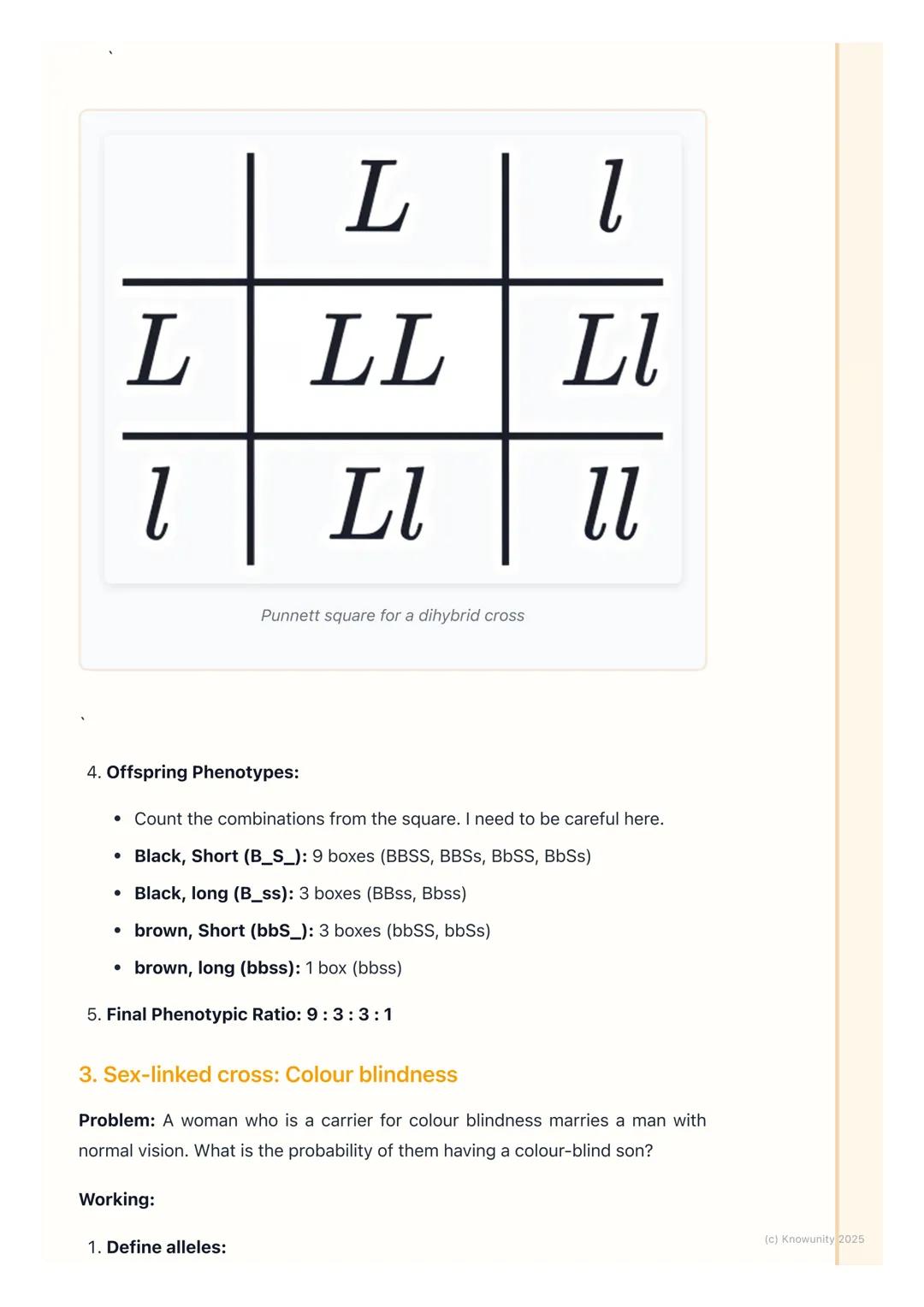
Sex-Linked Inheritance
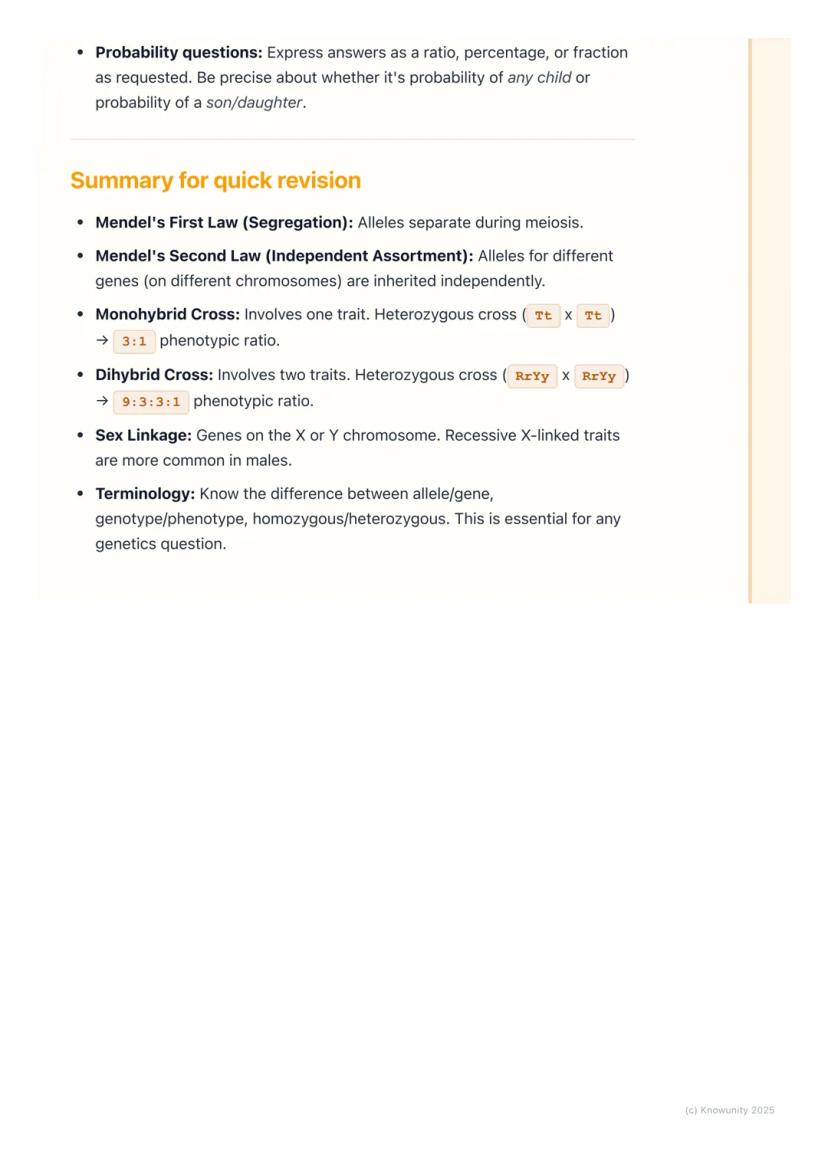
Sex-linked crosses work differently because the inheritance pattern depends on whether you're male or female. Let's look at colour blindness: a carrier woman married to a normal-vision man .
Their Punnett square shows four possible outcomes. Daughters can be normal or carriers , whilst sons can be normal or colour-blind .
The probability of having a colour-blind son is 25% of all children, but 50% of all sons. Always check what the question is actually asking for!
Males show X-linked recessive traits more often because they only need one copy of the recessive allele. Females need two copies, which is much less likely.
Remember: In sex-linkage, it's all about that X chromosome - males get their only copy from mum!
7
of 8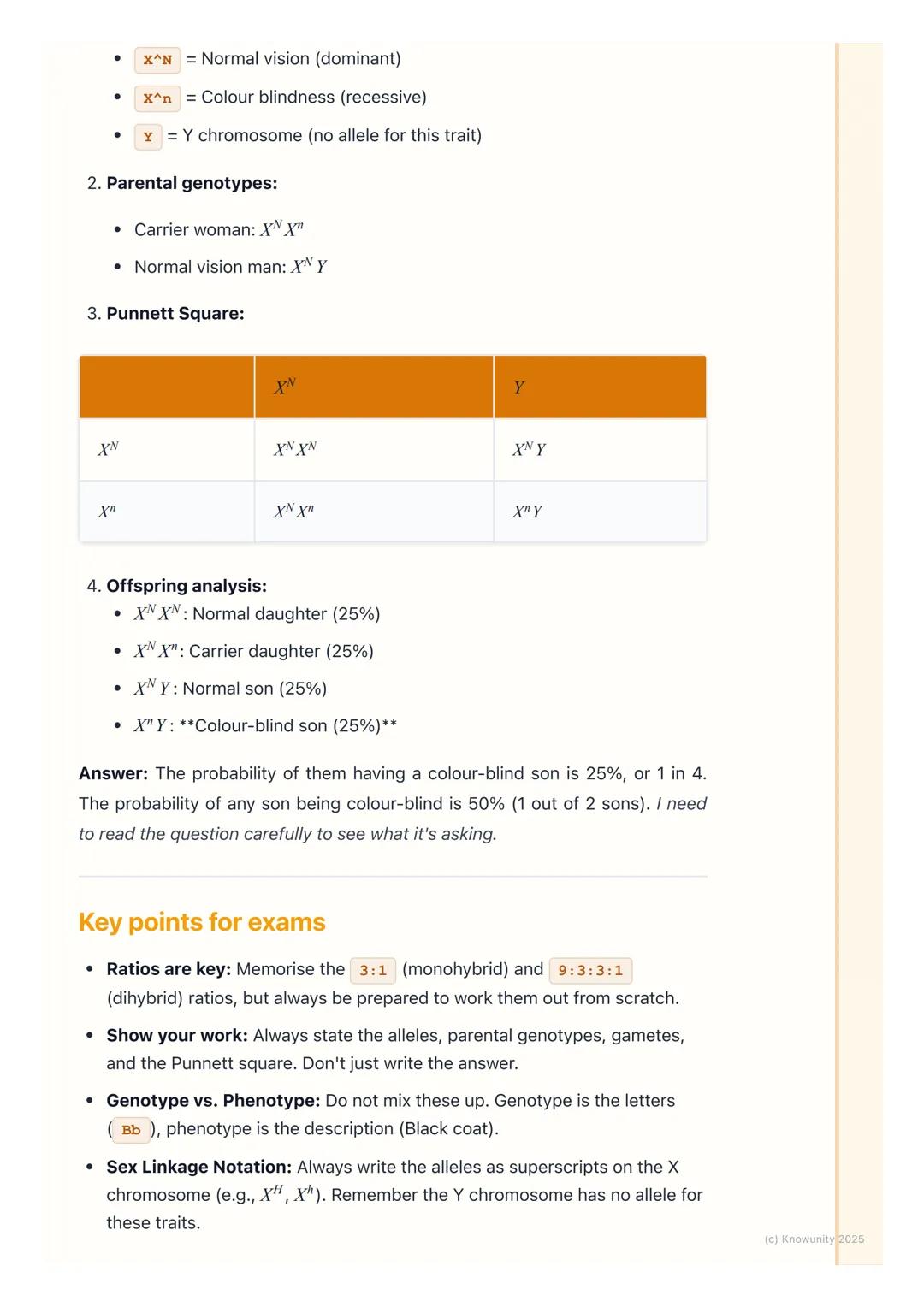
Exam Success Strategy
Your exam toolkit needs these essential ratios: 3:1 for monohybrid crosses and 9:3:3:1 for dihybrid crosses. But don't just memorise them - understand where they come from so you can work them out from scratch.
Always show your complete working: state your alleles, write parental genotypes, list possible gametes, draw your Punnett square, and calculate ratios. Even if you make an error early on, you can still earn marks for correct method.
Never mix up genotype (the letters like Bb) with phenotype (the description like "black coat"). This is a classic mistake that costs easy marks.
For probability questions, express answers exactly as requested - ratio, percentage, or fraction. Be precise about whether it's probability of any child or specifically a son or daughter having the trait.
Final Tip: Practice past paper questions until genetic crosses become second nature - repetition builds confidence!
8
of 8
Quick Revision Summary
Mendel's laws form the foundation: segregation (alleles separate during meiosis) and independent assortment (different genes inherit independently if on different chromosomes).
Cross types you must know: monohybrid (one trait, gives 3:1 ratio when both parents heterozygous) and dihybrid (two traits, gives 9:3:3:1 ratio when both parents heterozygous for both traits).
Sex-linkage means genes on sex chromosomes, with X-linked recessive traits more common in males since they only have one X chromosome.
Master your terminology: the difference between allele/gene, genotype/phenotype, and homozygous/heterozygous. These distinctions appear in every genetics question, so getting them right is non-negotiable for success.
Revision Gold: Create flashcards for all key terms - you'll need instant recall under exam pressure!
We thought you’d never ask...
Our AI companion is specifically built for the needs of students. Based on the millions of content pieces we have on the platform we can provide truly meaningful and relevant answers to students. But its not only about answers, the companion is even more about guiding students through their daily learning challenges, with personalised study plans, quizzes or content pieces in the chat and 100% personalisation based on the students skills and developments.
You can download the app in the Google Play Store and in the Apple App Store.
That's right! Enjoy free access to study content, connect with fellow students, and get instant help – all at your fingertips.
Most popular content in Biology
6BiologyBiomolecules: chapter 8
Summary and easily understandable notes to revise chapter 8 biomolecules. Includes good labelled diagrams for visual learners
5th Year210
BiologyDNA & RNA
All notes on DNA & RNA including protein synthesis which is a HL topic
5th Year250
BiologyPlant Cells
Learning about the unique structures found in plant cells, such as the cell wall, chloroplasts, and large vacuole, and how they differ from animal cells.
1st Year80
BiologyCirculatory System
Students will learn about the heart, blood, and blood vessels, and how this system transports oxygen, nutrients, and waste products around the body.
3rd Year140
BiologyEcology introduction notes!
Start of the leaving cert ecology chapter
6th Year141
BiologyVertebrates and Invertebrates
Students will distinguish between animals that have a backbone (vertebrates) and those that do not (invertebrates), identifying examples of each.
2nd Year240
Most popular content
9 English
Key Quotes : Sive
Key Quotes and explanations: Sive
6th Year2852
 Physics
Balanced and Unbalanced Forces
Students will explore how balanced forces result in no change in motion, while unbalanced forces cause an object to accelerate or change direction.
2nd Year592
 Irish
IrishIrish oral questions and answers
Questions and answers for the leaving cert oral
5th Year4274
IrishIníon- le hÁine Durkin
Aine Durkin’s poem, Iníon: Themes & summary
5th Year890
IrishMo Ghrá-sa (Idir Lúibíní)
Notes on mo ghrá-sa
5th Year380
IrishLC HL notes- Iníon (poem)
Includes poem in English and Irish, theme, key words & phrases
5th Year2324
EnglishCultural Context : Shawshank Redemption : Sive : Small Things Like These
Comparative Study : Cultural Context : Shawshank Redemption, Sive and Small Things Like These
6th Year1430
IrishAn Gaeilge Aiste
Irish Language essay
6th Year1320
EnglishElizabeth Bishop notes
Elizabeth Bishop notes
6th Year1271
Students love us — and so will you.
4.6/5App Store
4.7/5Google Play
The app is very easy to use and well designed. I have found everything I was looking for so far and have been able to learn a lot from the presentations! I will definitely use the app for a class assignment! And of course it also helps a lot as an inspiration.
Stefan SiOS user
This app is really great. There are so many study notes and help [...]. My problem subject is French, for example, and the app has so many options for help. Thanks to this app, I have improved my French. I would recommend it to anyone.
Samantha KlichAndroid user
Wow, I am really amazed. I just tried the app because I've seen it advertised many times and was absolutely stunned. This app is THE HELP you want for school and above all, it offers so many things, such as workouts and fact sheets, which have been VERY helpful to me personally.
AnnaiOS user
Biology49 views·Updated 11 Jul 2026·8 pagesMendelian Inheritance and Genetic Crosses
Ever wondered why you have your mum's eyes or your dad's height? It all comes down to genetics! Gregor Mendel, an Austrian monk from the 1860s, figured out the basic rules of inheritance by studying pea plants, and his discoveries...
1
of 8
Sign up to see the content. It's free!
- Access to all documents
- Improve your grades
- Join milions of students
By signing up you accept Terms of Service and Privacy Policy
Mendelian Genetics Basics
You'll need to nail the key terms first - they're the building blocks for everything else in genetics. A gene is basically a section of DNA that controls a specific trait, like eye colour. Alleles are different versions of the same gene (think blue eyes vs brown eyes).
Your genotype is the actual genetic code you carry (written as letters like TT or Tt), whilst your phenotype is what you actually look like. Dominant alleles (capital letters) always show up in your appearance, even if you only have one copy. Recessive alleles (lowercase letters) only appear when you have two copies.
Homozygous means having two identical alleles (like TT or tt), whilst heterozygous means having two different ones (like Tt). The generations have special names too: P generation (parents), F1 (first offspring), and F2 (second generation offspring).
Quick Tip: Think of alleles like different flavours of the same ice cream - same product, different varieties!
2
of 8Sign up to see the content. It's free!
- Access to all documents
- Improve your grades
- Join milions of students
By signing up you accept Terms of Service and Privacy Policy
Mendel's Laws and Monohybrid Crosses
Mendel's first law (segregation) tells us that trait-controlling factors separate during gamete formation, so each parent only passes on one allele for each trait. This happens during meiosis when chromosomes get pulled apart.
A monohybrid cross tracks just one characteristic at a time. You'll use Punnett squares to predict outcomes - they're like genetic calculators! The classic example is crossing two heterozygous parents (Tt × Tt).
Here's your step-by-step process: state parent phenotypes and genotypes, work out possible gametes, draw your Punnett square, fill it in, then state the offspring ratios. The magic ratio you'll see constantly is 3:1 for phenotypes (3 dominant : 1 recessive) and 1:2:1 for genotypes.
Exam Gold: That 3:1 ratio from Tt × Tt crosses appears in loads of questions - memorise it!
3
of 8Sign up to see the content. It's free!
- Access to all documents
- Improve your grades
- Join milions of students
By signing up you accept Terms of Service and Privacy Policy
Independent Assortment and Dihybrid Crosses
Mendel's second law (independent assortment) shows that different genes get inherited independently - but only if they're on different chromosomes or far apart on the same one. This relates to how chromosomes line up randomly during meiosis.
Dihybrid crosses track two traits simultaneously, like seed shape and colour. The Punnett square becomes much bigger (16 squares instead of 4), but don't panic - the process is the same.
When you cross two parents who are heterozygous for both traits (like RrYy × RrYy), you get the famous 9:3:3:1 ratio. That's 9 with both dominant traits, 3 with each mixed combination, and 1 with both recessive traits.
Sex linkage happens when genes sit on sex chromosomes. Most sex-linked traits are X-linked, which means males are more likely to show recessive traits since they only have one X chromosome.
Memory Trick: For dihybrid crosses, remember "9-3-3-1" - it's the genetic equivalent of a phone number!
4
of 8Sign up to see the content. It's free!
- Access to all documents
- Improve your grades
- Join milions of students
By signing up you accept Terms of Service and Privacy Policy
Working Through Genetic Problems
Let's tackle a monohybrid cross step by step. Say you're crossing a heterozygous tall plant (Tt) with a dwarf plant (tt). The tall plant produces T and t gametes, whilst the dwarf only produces t gametes.
Your Punnett square gives you 50% Tt (tall) and 50% tt (dwarf) offspring. Notice how this gives a 1:1 ratio instead of 3:1 - that's because one parent is homozygous recessive.
For sex-linked problems, always write alleles as superscripts on the X chromosome (like X^N for normal vision). Remember that the Y chromosome carries no allele for most X-linked traits.
The key is reading questions carefully - are they asking for the probability of any child having a trait, or specifically a son or daughter? Your answer format matters too (percentage, fraction, or ratio).
Pro Tip: Always show your working - even if you get the final answer wrong, you can still pick up marks for correct method!
5
of 8Sign up to see the content. It's free!
- Access to all documents
- Improve your grades
- Join milions of students
By signing up you accept Terms of Service and Privacy Policy
Dihybrid Cross Example
Guinea pig genetics makes a perfect dihybrid example! With black coat (B) dominant over brown , and short hair (S) dominant over long , let's cross two heterozygous parents (BbSs × BbSs).
Each parent can produce four different gamete types: BS, Bs, bS, and bs. Use the FOIL method (First, Outer, Inner, Last) to work these out systematically.
Your 16-square Punnett square will show the classic 9:3:3:1 phenotypic ratio. Count carefully: 9 black short-haired, 3 black long-haired, 3 brown short-haired, and 1 brown long-haired guinea pig.
This ratio appears whenever you cross two individuals who are heterozygous for both traits. It's one of the most important patterns in genetics, so make sure you can recognise and reproduce it.
Study Hack: Practice drawing 16-square Punnett squares until you can do them quickly - they're exam favourites!
6
of 8Sign up to see the content. It's free!
- Access to all documents
- Improve your grades
- Join milions of students
By signing up you accept Terms of Service and Privacy Policy
Sex-Linked Inheritance
Sex-linked crosses work differently because the inheritance pattern depends on whether you're male or female. Let's look at colour blindness: a carrier woman married to a normal-vision man .
Their Punnett square shows four possible outcomes. Daughters can be normal or carriers , whilst sons can be normal or colour-blind .
The probability of having a colour-blind son is 25% of all children, but 50% of all sons. Always check what the question is actually asking for!
Males show X-linked recessive traits more often because they only need one copy of the recessive allele. Females need two copies, which is much less likely.
Remember: In sex-linkage, it's all about that X chromosome - males get their only copy from mum!
7
of 8Sign up to see the content. It's free!
- Access to all documents
- Improve your grades
- Join milions of students
By signing up you accept Terms of Service and Privacy Policy
Exam Success Strategy
Your exam toolkit needs these essential ratios: 3:1 for monohybrid crosses and 9:3:3:1 for dihybrid crosses. But don't just memorise them - understand where they come from so you can work them out from scratch.
Always show your complete working: state your alleles, write parental genotypes, list possible gametes, draw your Punnett square, and calculate ratios. Even if you make an error early on, you can still earn marks for correct method.
Never mix up genotype (the letters like Bb) with phenotype (the description like "black coat"). This is a classic mistake that costs easy marks.
For probability questions, express answers exactly as requested - ratio, percentage, or fraction. Be precise about whether it's probability of any child or specifically a son or daughter having the trait.
Final Tip: Practice past paper questions until genetic crosses become second nature - repetition builds confidence!
8
of 8Sign up to see the content. It's free!
- Access to all documents
- Improve your grades
- Join milions of students
By signing up you accept Terms of Service and Privacy Policy
Quick Revision Summary
Mendel's laws form the foundation: segregation (alleles separate during meiosis) and independent assortment (different genes inherit independently if on different chromosomes).
Cross types you must know: monohybrid (one trait, gives 3:1 ratio when both parents heterozygous) and dihybrid (two traits, gives 9:3:3:1 ratio when both parents heterozygous for both traits).
Sex-linkage means genes on sex chromosomes, with X-linked recessive traits more common in males since they only have one X chromosome.
Master your terminology: the difference between allele/gene, genotype/phenotype, and homozygous/heterozygous. These distinctions appear in every genetics question, so getting them right is non-negotiable for success.
Revision Gold: Create flashcards for all key terms - you'll need instant recall under exam pressure!
We thought you’d never ask...
Our AI companion is specifically built for the needs of students. Based on the millions of content pieces we have on the platform we can provide truly meaningful and relevant answers to students. But its not only about answers, the companion is even more about guiding students through their daily learning challenges, with personalised study plans, quizzes or content pieces in the chat and 100% personalisation based on the students skills and developments.
You can download the app in the Google Play Store and in the Apple App Store.
That's right! Enjoy free access to study content, connect with fellow students, and get instant help – all at your fingertips.
Most popular content in Biology
6BiologyBiomolecules: chapter 8
Summary and easily understandable notes to revise chapter 8 biomolecules. Includes good labelled diagrams for visual learners
5th Year210
BiologyDNA & RNA
All notes on DNA & RNA including protein synthesis which is a HL topic
5th Year250
BiologyPlant Cells
Learning about the unique structures found in plant cells, such as the cell wall, chloroplasts, and large vacuole, and how they differ from animal cells.
1st Year80
BiologyCirculatory System
Students will learn about the heart, blood, and blood vessels, and how this system transports oxygen, nutrients, and waste products around the body.
3rd Year140
BiologyEcology introduction notes!
Start of the leaving cert ecology chapter
6th Year141
BiologyVertebrates and Invertebrates
Students will distinguish between animals that have a backbone (vertebrates) and those that do not (invertebrates), identifying examples of each.
2nd Year240
Most popular content
9EnglishKey Quotes : Sive
Key Quotes and explanations: Sive
6th Year2852
PhysicsBalanced and Unbalanced Forces
Students will explore how balanced forces result in no change in motion, while unbalanced forces cause an object to accelerate or change direction.
2nd Year592
IrishIrish oral questions and answers
Questions and answers for the leaving cert oral
5th Year4274
IrishIníon- le hÁine Durkin
Aine Durkin’s poem, Iníon: Themes & summary
5th Year890
IrishMo Ghrá-sa (Idir Lúibíní)
Notes on mo ghrá-sa
5th Year380
IrishLC HL notes- Iníon (poem)
Includes poem in English and Irish, theme, key words & phrases
5th Year2324
EnglishCultural Context : Shawshank Redemption : Sive : Small Things Like These
Comparative Study : Cultural Context : Shawshank Redemption, Sive and Small Things Like These
6th Year1430
IrishAn Gaeilge Aiste
Irish Language essay
6th Year1320
EnglishElizabeth Bishop notes
Elizabeth Bishop notes
6th Year1271
Students love us — and so will you.
4.6/5App Store
4.7/5Google Play
The app is very easy to use and well designed. I have found everything I was looking for so far and have been able to learn a lot from the presentations! I will definitely use the app for a class assignment! And of course it also helps a lot as an inspiration.
Stefan SiOS user
This app is really great. There are so many study notes and help [...]. My problem subject is French, for example, and the app has so many options for help. Thanks to this app, I have improved my French. I would recommend it to anyone.
Samantha KlichAndroid user
Wow, I am really amazed. I just tried the app because I've seen it advertised many times and was absolutely stunned. This app is THE HELP you want for school and above all, it offers so many things, such as workouts and fact sheets, which have been VERY helpful to me personally.
AnnaiOS user