
Genetics and heredity form the foundation of how traits are... Show more
 Biology
 Irish
Irish English
Sign up to see the contentIt's free!
Access to all documents
Improve your grades
Join milions of students
Knowunity AI
Subjects
Triangle Congruence and Similarity Theorems
Triangle Properties and Classification
Linear Equations and Graphs
Geometric Angle Relationships
Trigonometric Functions and Identities
Equation Solving Techniques
Circle Geometry Fundamentals
Division Operations and Methods
Basic Differentiation Rules
Exponent and Logarithm Properties
Show all topics
Human Organ Systems
Reproductive Cell Cycles
Biological Sciences Subdisciplines
Cellular Energy Metabolism
Autotrophic Energy Processes
Inheritance Patterns and Principles
Biomolecular Structure and Organization
Cell Cycle and Division Mechanics
Cellular Organization and Development
Biological Structural Organization
Show all topics
Chemical Sciences and Applications
Atomic Structure and Composition
Molecular Electron Structure Representation
Atomic Electron Behavior
Matter Properties and Water
Mole Concept and Calculations
Gas Laws and Behavior
Periodic Table Organization
Chemical Thermodynamics Fundamentals
Chemical Bond Types and Properties
Show all topics
European Renaissance and Enlightenment
European Cultural Movements 800-1920
American Revolution Era 1763-1797
American Civil War 1861-1865
Global Imperial Systems
Mongol and Chinese Dynasties
U.S. Presidents and World Leaders
Historical Sources and Documentation
World Wars Era and Impact
World Religious Systems
Show all topics
Classic and Contemporary Novels
Literary Character Analysis
Rhetorical Theory and Practice
Classic Literary Narratives
Reading Analysis and Interpretation
Narrative Structure and Techniques
English Language Components
Influential English-Language Authors
Basic Sentence Structure
Narrative Voice and Perspective
Show all topics
31
•
Updated Apr 3, 2026
•
emma f
@emlfty
Genetics and heredity form the foundation of how traits are... Show more
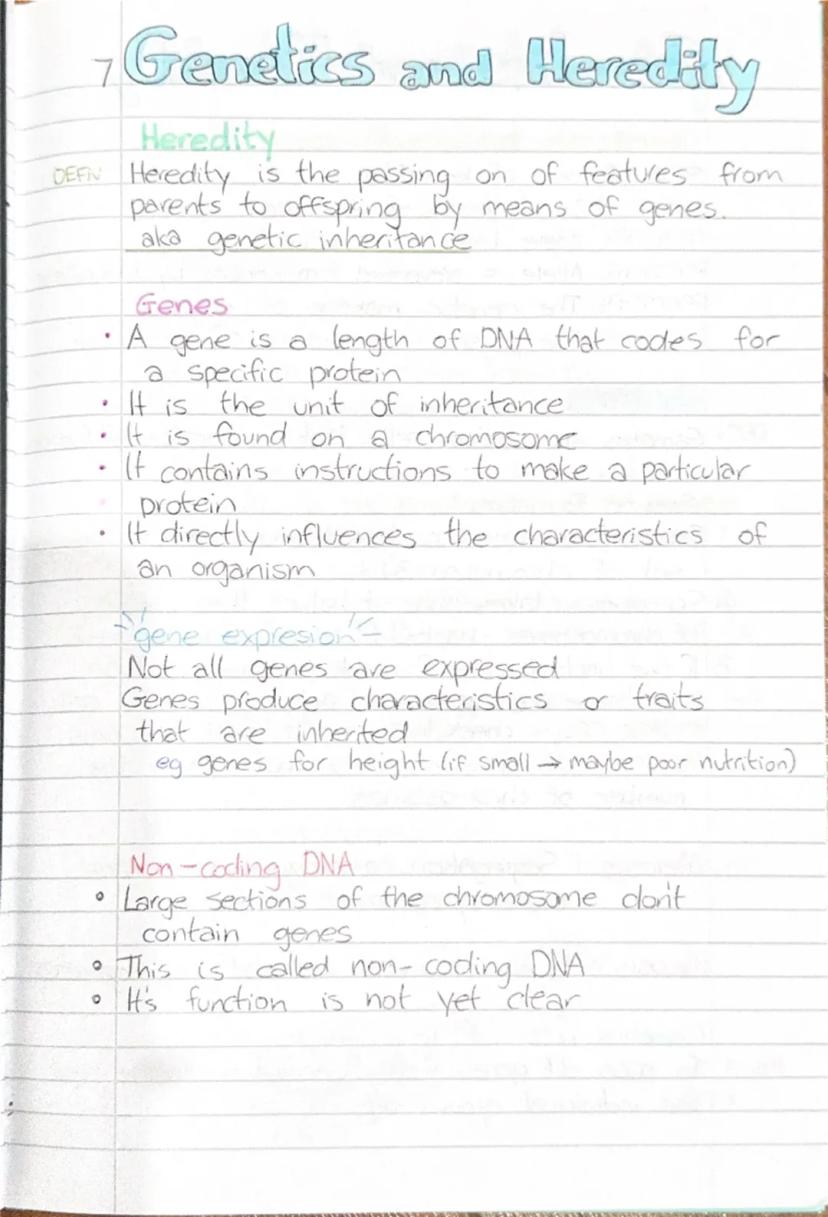
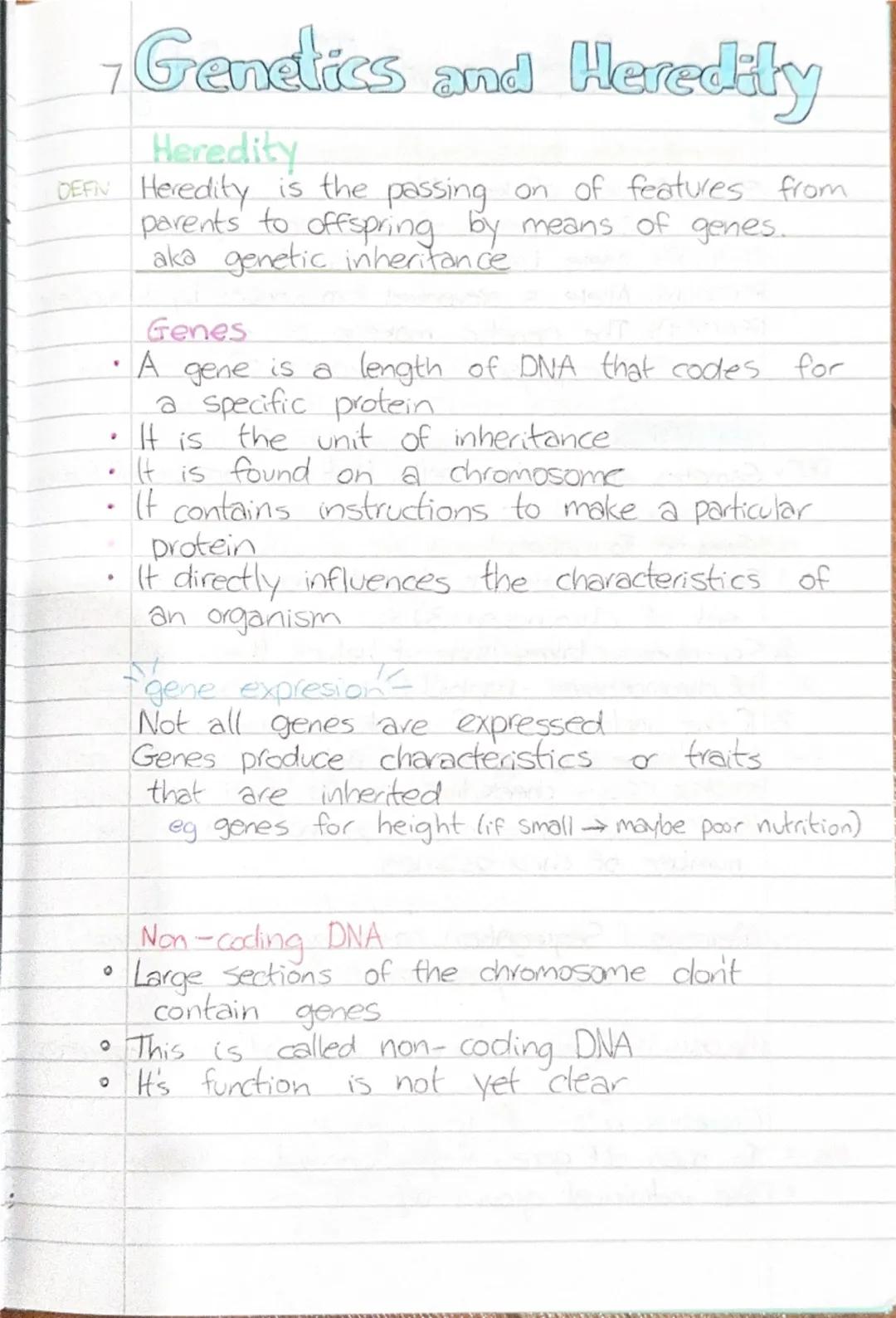
Ever wondered why you look like your parents? That's heredity in action—the passing of features from parents to offspring through genes. Think of it as nature's way of keeping family resemblances going!
A gene is essentially a segment of DNA that acts like a recipe for making specific proteins in your body. These proteins then influence your characteristics or traits. Genes are found on chromosomes and serve as the basic units of inheritance.
Not all genes are expressed though. Your environment and other factors can influence whether a gene is "switched on" or remains dormant. For example, you might have genes for tallness, but poor nutrition could prevent you from reaching your full height potential.
Did you know? Much of your DNA doesn't actually code for proteins! These non-coding sections make up a large portion of chromosomes, and scientists are still figuring out exactly what they do.
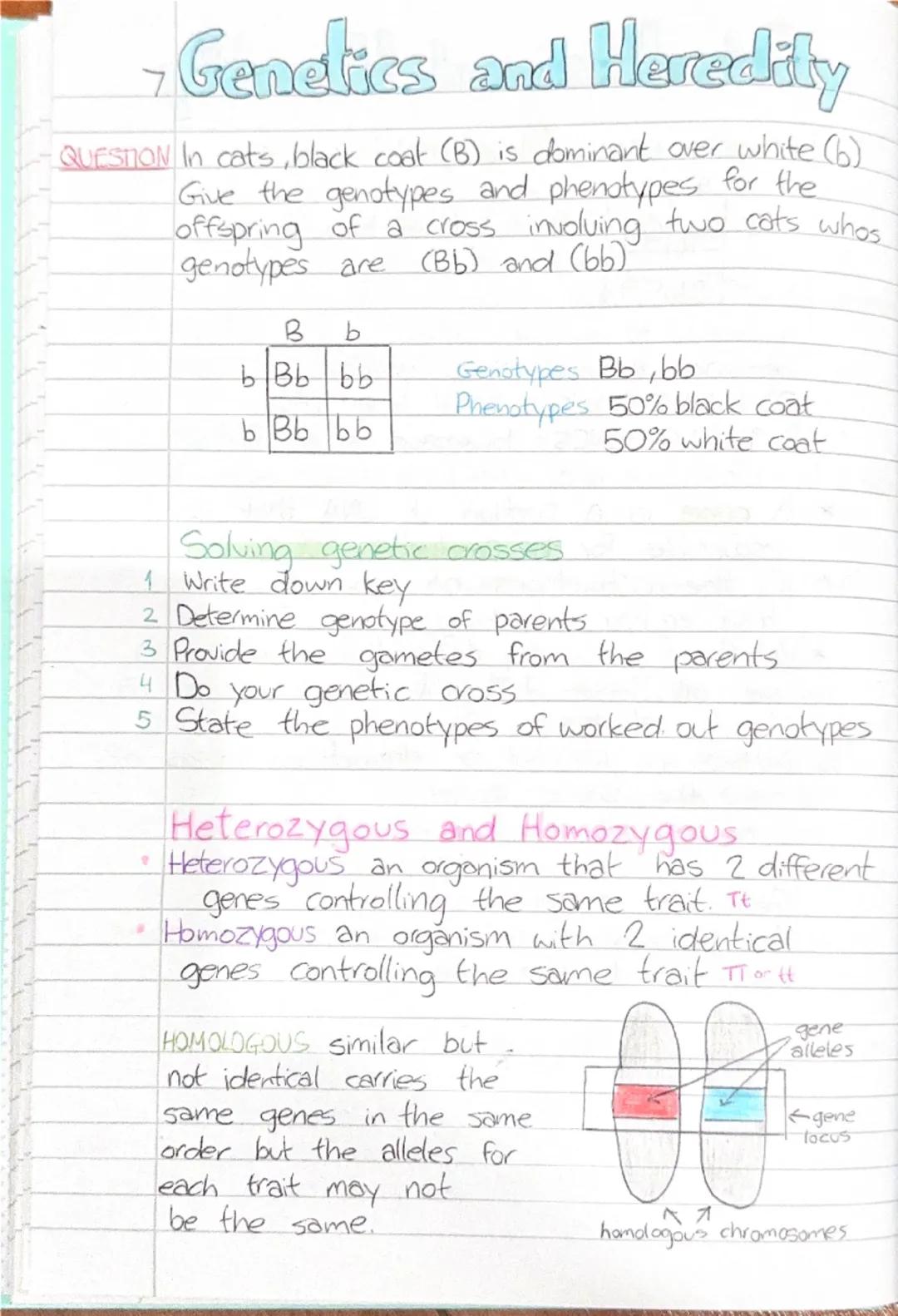
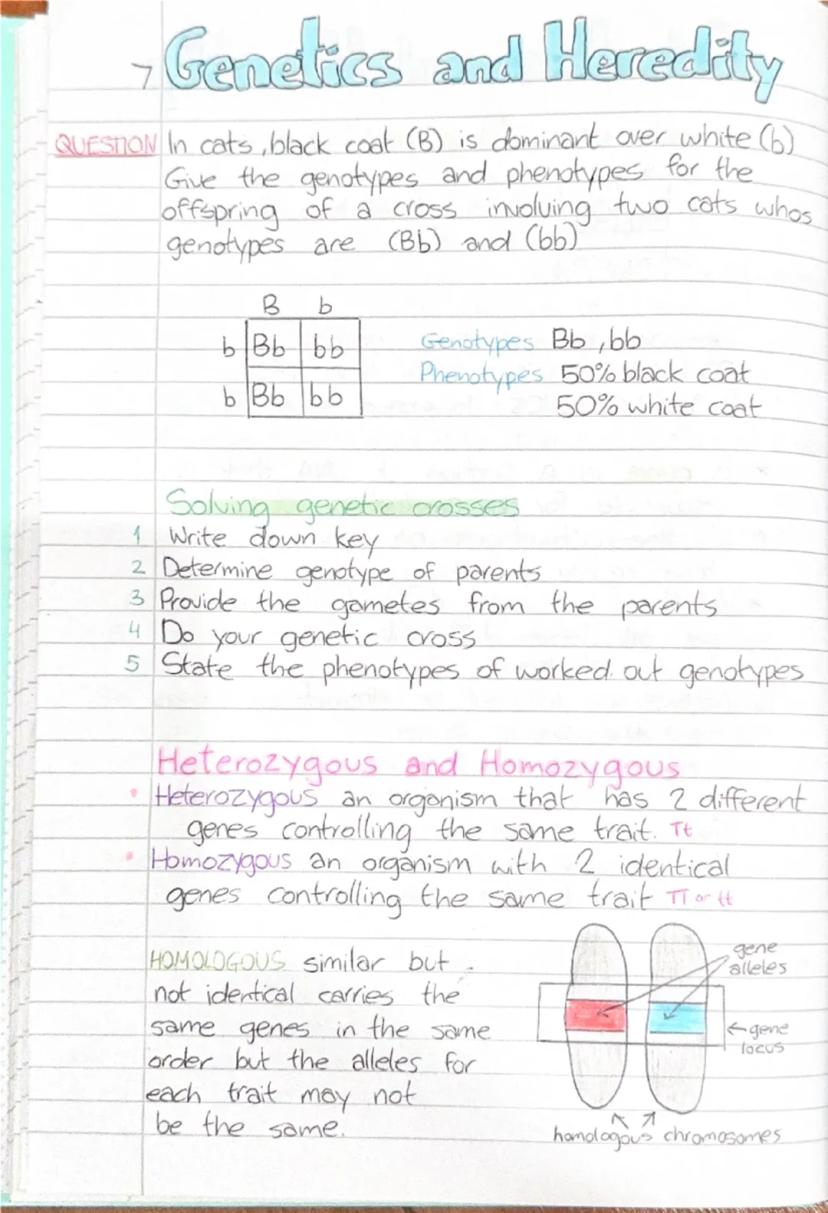
When studying genetics, we use simple crosses to predict the traits offspring might inherit. This is where those Punnett squares you've seen come into play!
To solve genetic crosses, follow these steps: write down the key (which letters represent which traits), determine the parents' genotypes, identify possible gametes, complete your cross, and finally state the phenotypes (physical appearance) of the offspring.
Homozygous organisms have identical genes for a trait (like BB or bb), while heterozygous organisms have different genes for the same trait (like Bb). Homologous chromosomes carry the same genes in the same order, though the specific alleles (versions of genes) may differ.
Study tip: When working with genetic crosses, always label your work clearly and use a consistent notation system. This makes it much easier to spot patterns and avoid mistakes on exams!
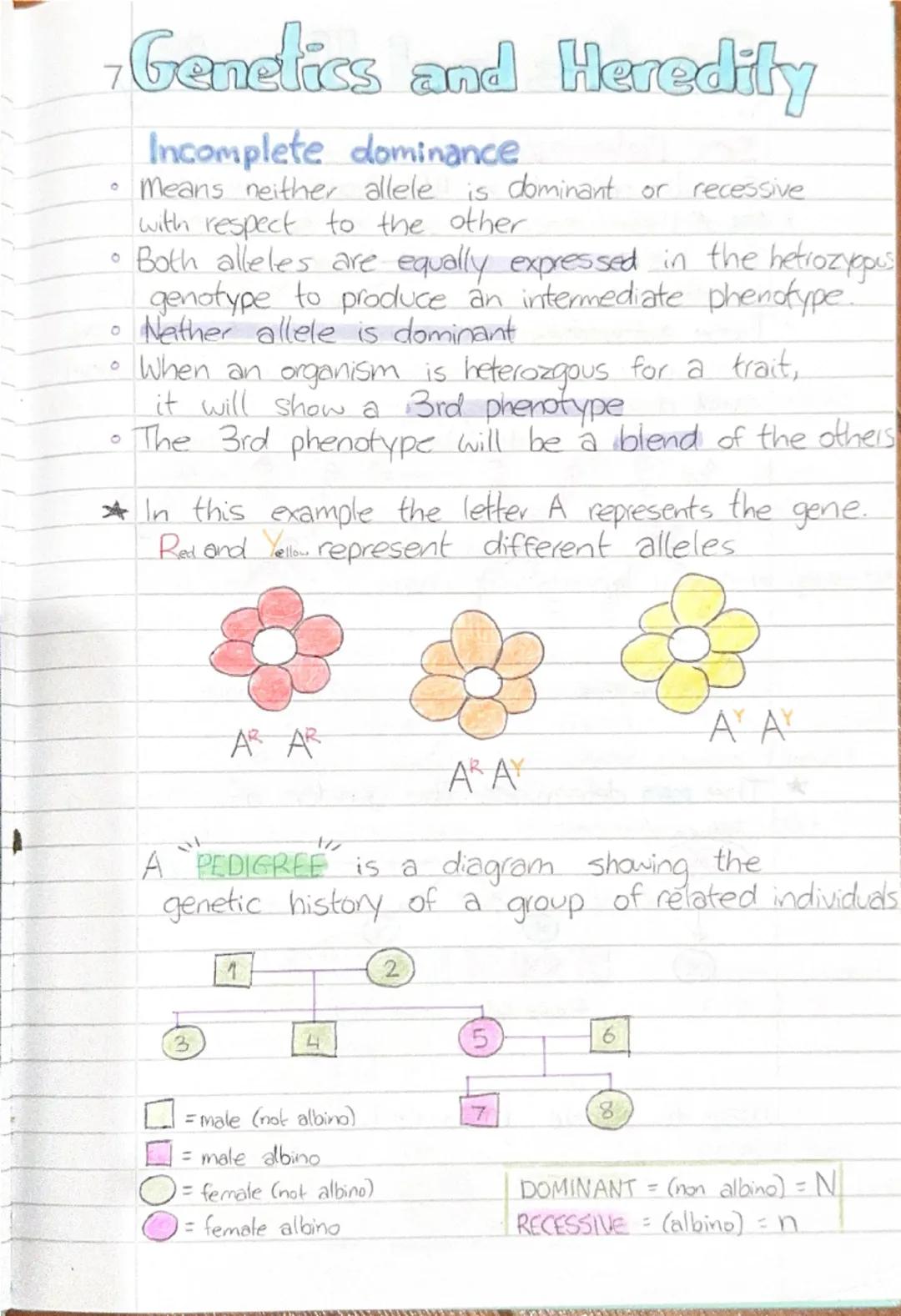
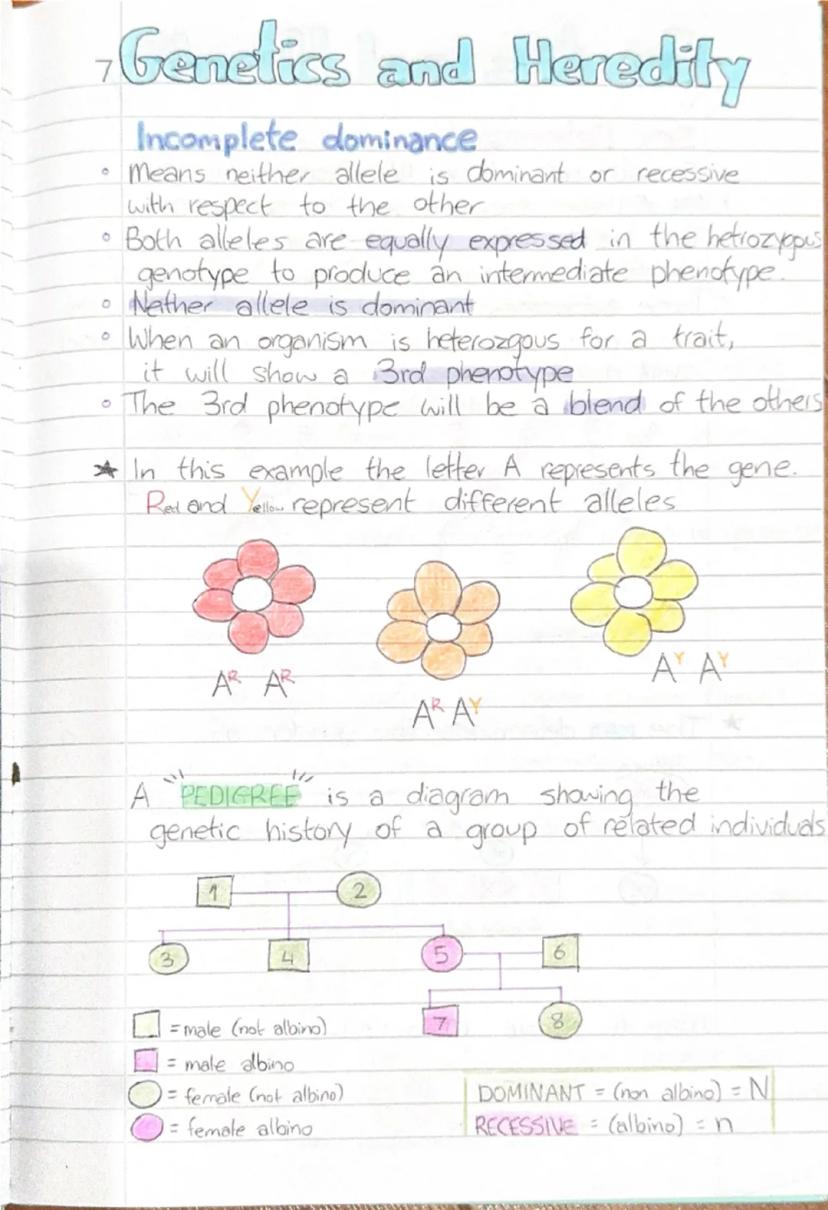
Not all traits follow simple dominant-recessive patterns. With incomplete dominance, neither allele dominates the other. Instead, heterozygous individuals show a blended or intermediate trait. Think of red flowers and white flowers producing pink offspring—neither parental trait completely dominates.
When neither allele is dominant, a third phenotype emerges that's typically a blend of the two original traits. This explains why we see such a spectrum of traits in the natural world rather than just either/or characteristics.
A pedigree is essentially a family tree showing genetic relationships. These diagrams track the inheritance of specific traits through generations, making them powerful tools for studying genetic disorders and predicting inheritance patterns.
Exam focus: Pedigree analysis questions often appear on exams! Practice identifying patterns of dominant, recessive, and sex-linked inheritance by studying example pedigrees.
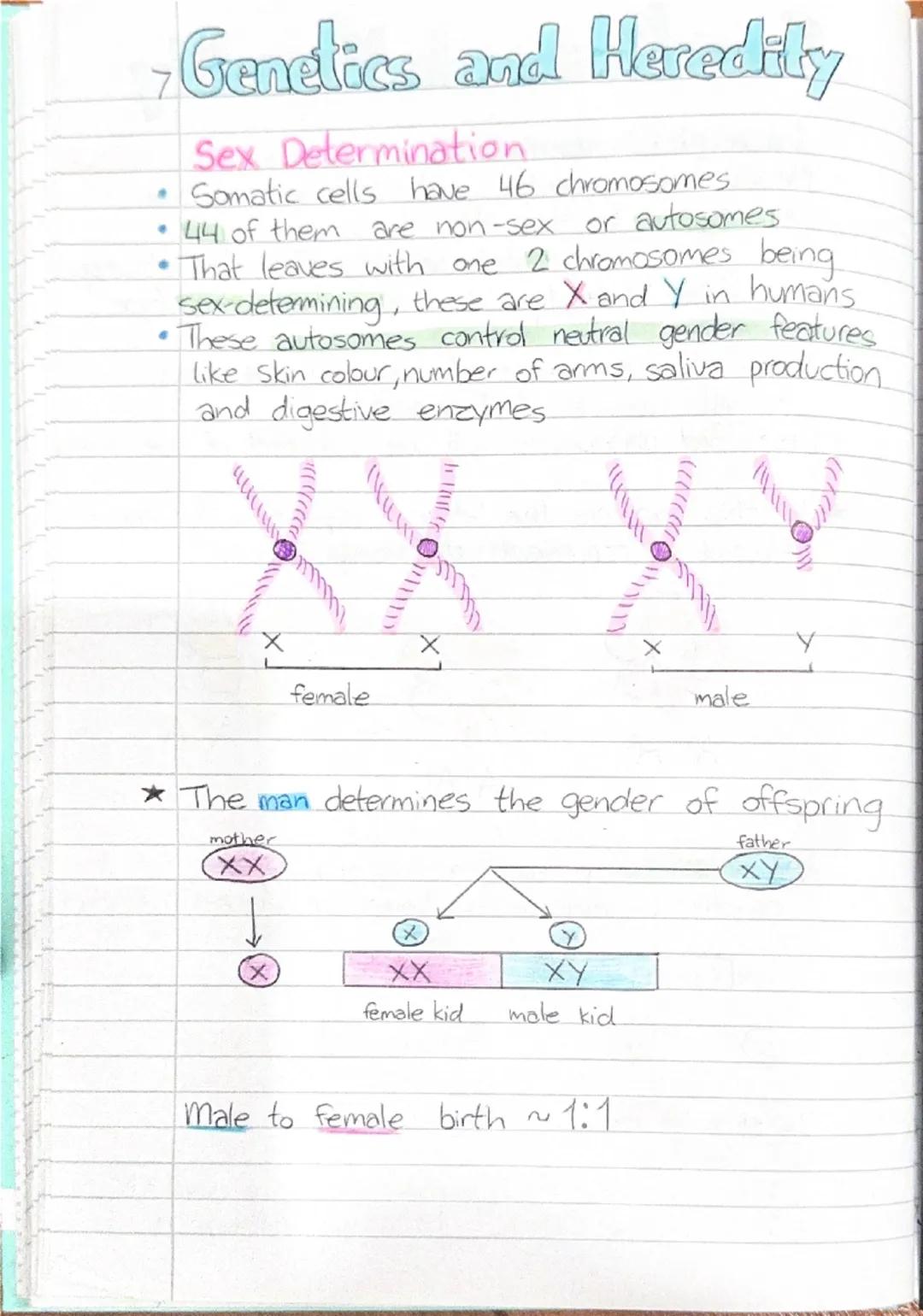
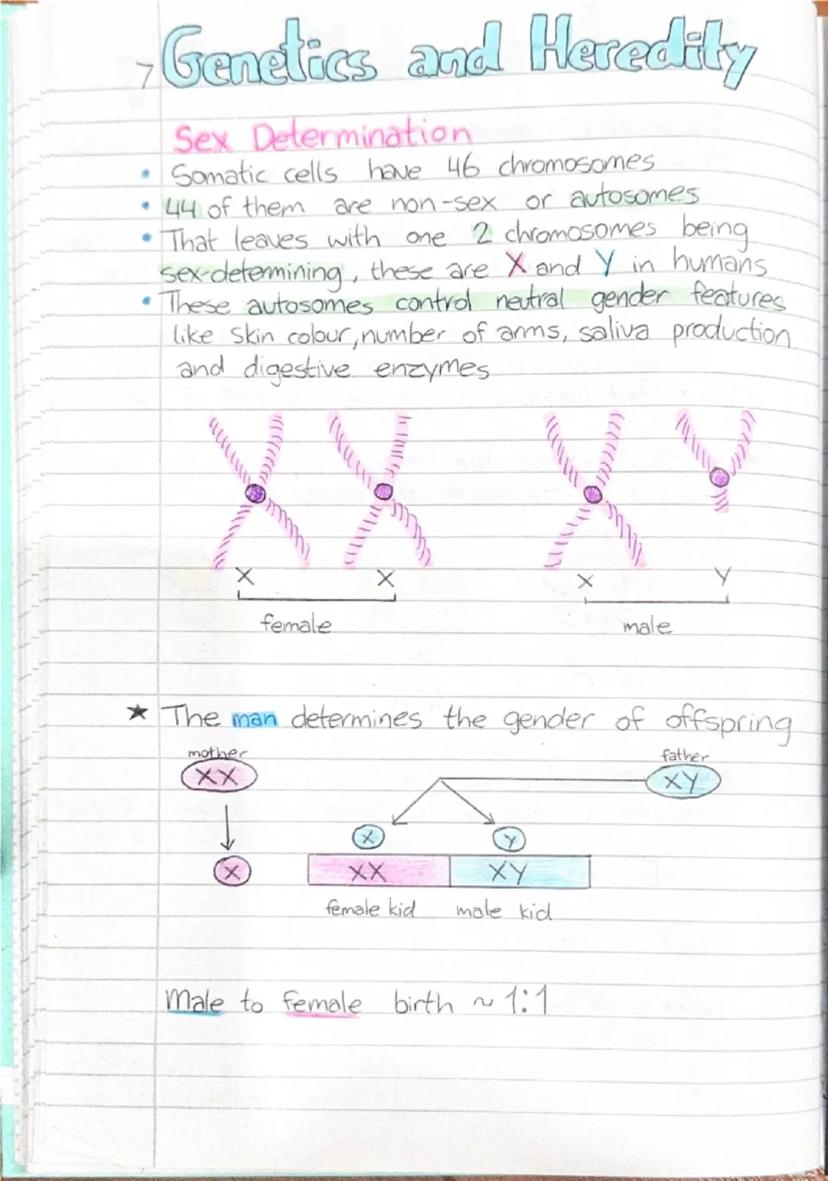
Your body contains 46 chromosomes in each cell, with 44 being regular chromosomes (autosomes) and 2 being sex chromosomes. These sex chromosomes—X and Y—determine biological sex in humans.
Females have two X chromosomes (XX), while males have one X and one Y chromosome (XY). The most fascinating part? The father's sperm determines a child's biological sex. If a sperm carrying an X chromosome fertilizes the egg, the child will be female (XX); if a Y-carrying sperm succeeds, the child will be male (XY).
The ratio of male to female births is approximately 1:1, though slight variations occur naturally. Meanwhile, those 44 autosomes control all your non-sex characteristics like skin colour, number of limbs, and digestive functions.
Think about it: Since males determine the sex of offspring, the old practice of blaming women for not producing male heirs (as happened historically in royal families) was completely unscientific!
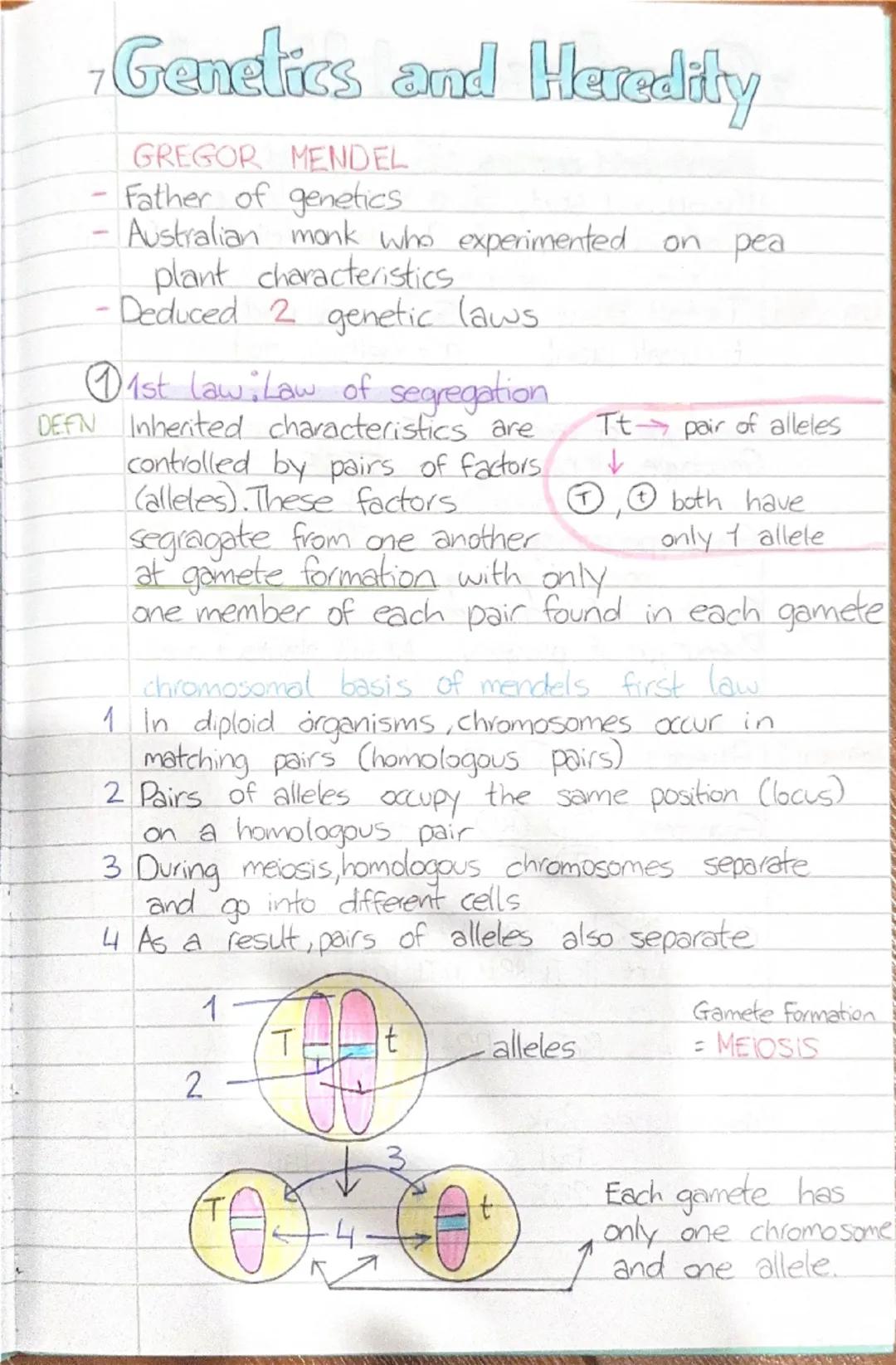
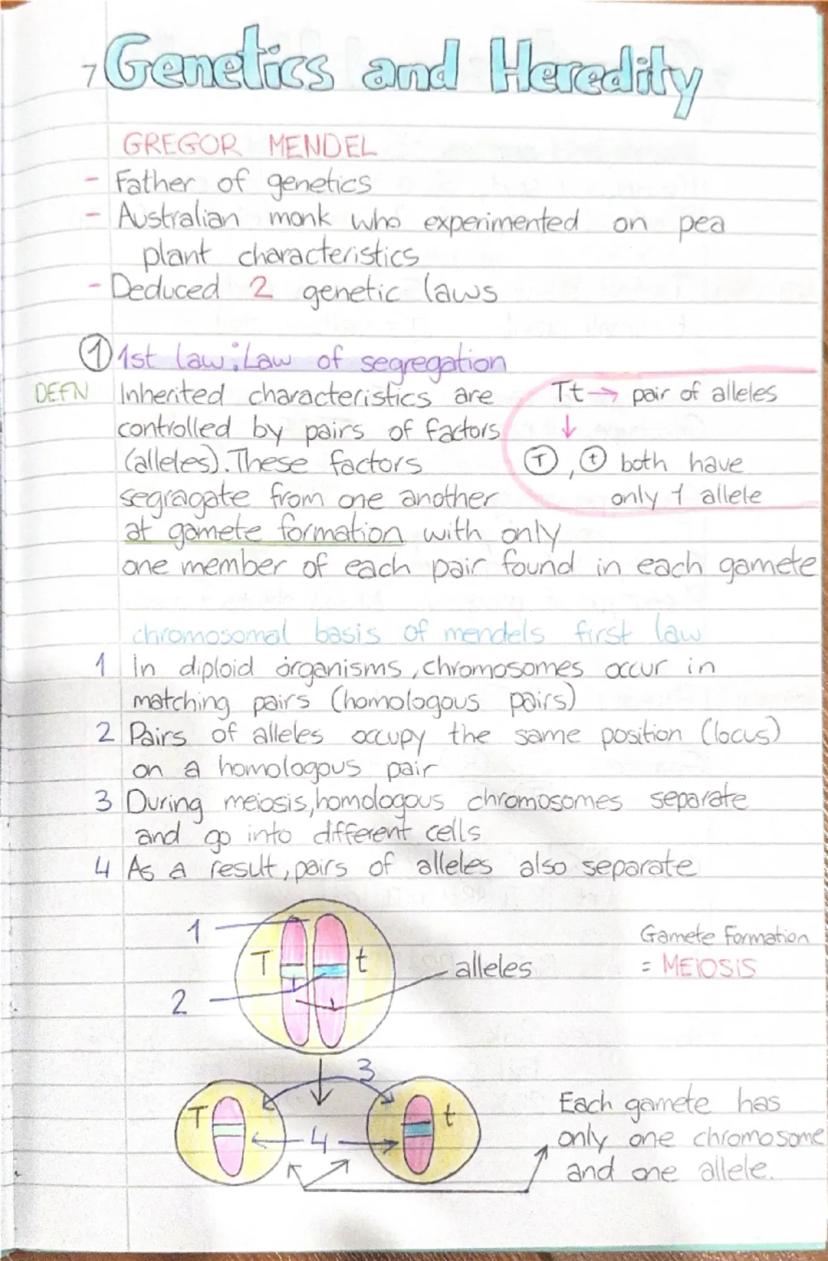
Gregor Mendel, an Austrian monk who experimented with pea plants, is considered the father of genetics. His meticulous work with pea plants helped establish the fundamental laws of inheritance that we still use today.
Mendel's First Law (Law of Segregation) states that inherited characteristics are controlled by pairs of factors (alleles) that separate during gamete formation. This means that each reproductive cell (egg or sperm) receives only one allele from each pair.
The chromosomal basis for this law is quite elegant. Our chromosomes exist in matching pairs (homologous pairs), and during meiosis (the cell division that produces gametes), these pairs separate. This separation ensures that each egg or sperm cell contains only one copy of each chromosome and therefore only one allele for each trait.
Visualization tip: Think of meiosis as dealing cards—each gamete gets dealt only one card (allele) from each pair, never both from the same pair!
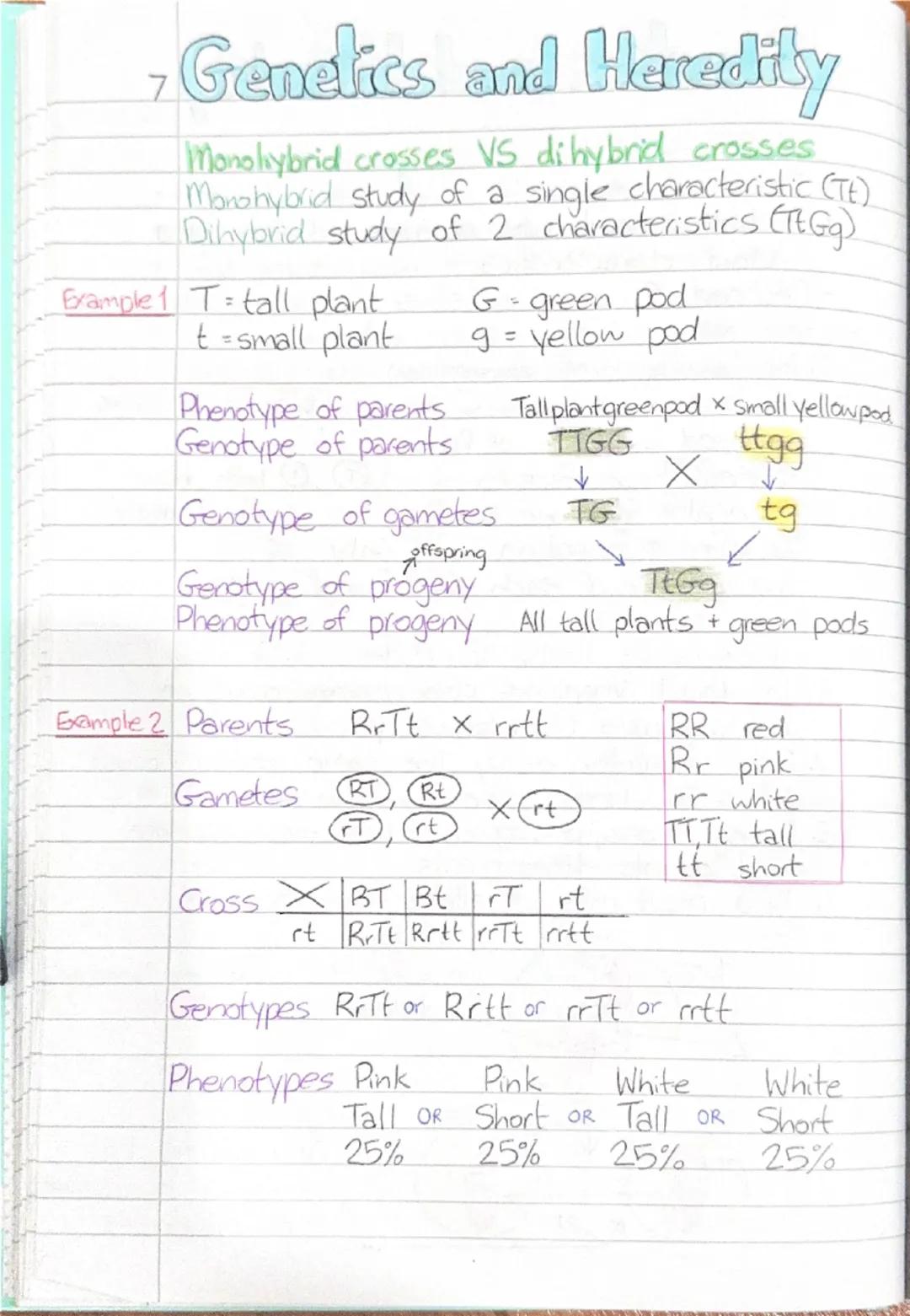
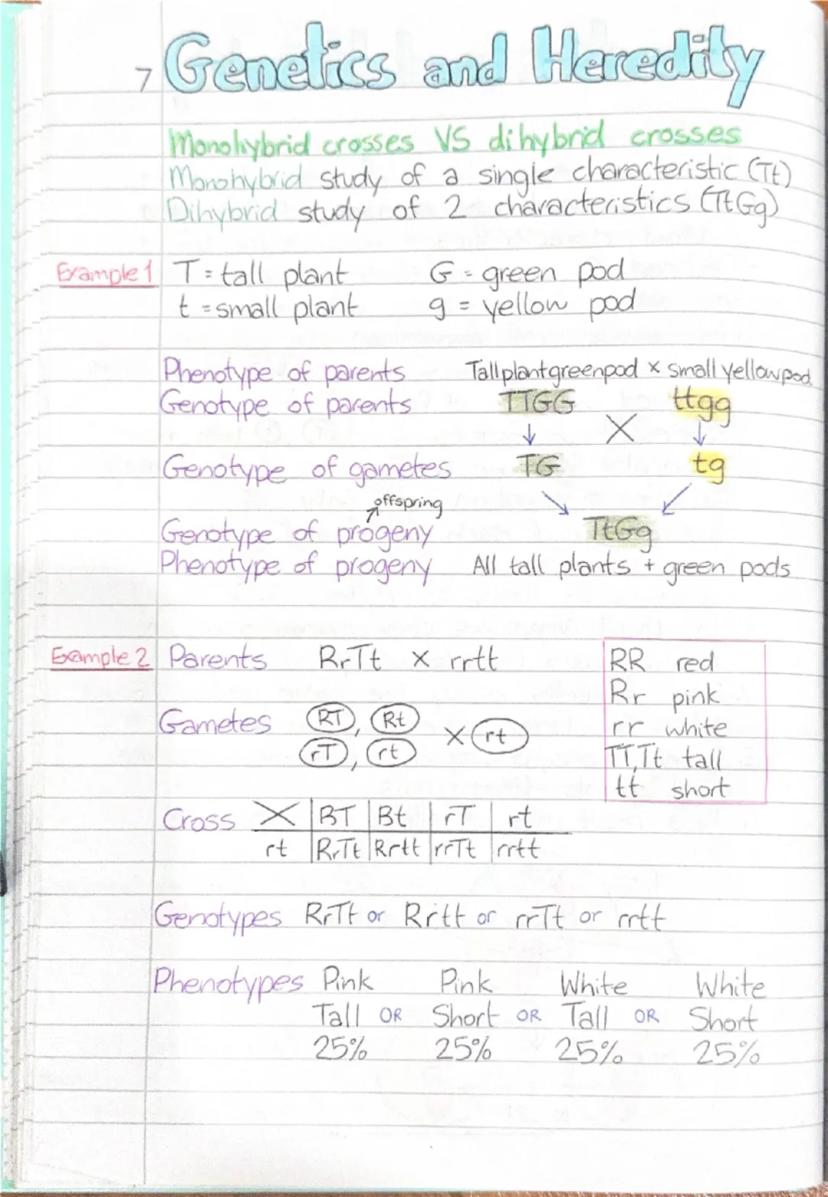
Genetic crosses come in different complexities depending on how many traits you're tracking. A monohybrid cross examines just one characteristic (like height), while a dihybrid cross tracks two characteristics simultaneously (like height and pod color).
When working with dihybrid crosses, you'll need to account for all possible combinations of alleles. For example, crossing plants with the genotypes TTGG (tall with green pods) and ttgg (short with yellow pods) will produce offspring with the genotype TtGg—all tall plants with green pods in the first generation.
The results get more interesting when crossing heterozygous individuals. A cross between RrTt and rrtt parents would produce four different phenotypes in equal proportions: pink tall plants, pink short plants, white tall plants, and white short plants—each making up about 25% of the offspring.
Pattern recognition: In complete dihybrid crosses with unlinked genes, you'll typically see a 9:3:3:1 ratio of phenotypes in the F2 generation. This is a classic pattern to watch for in exam questions!
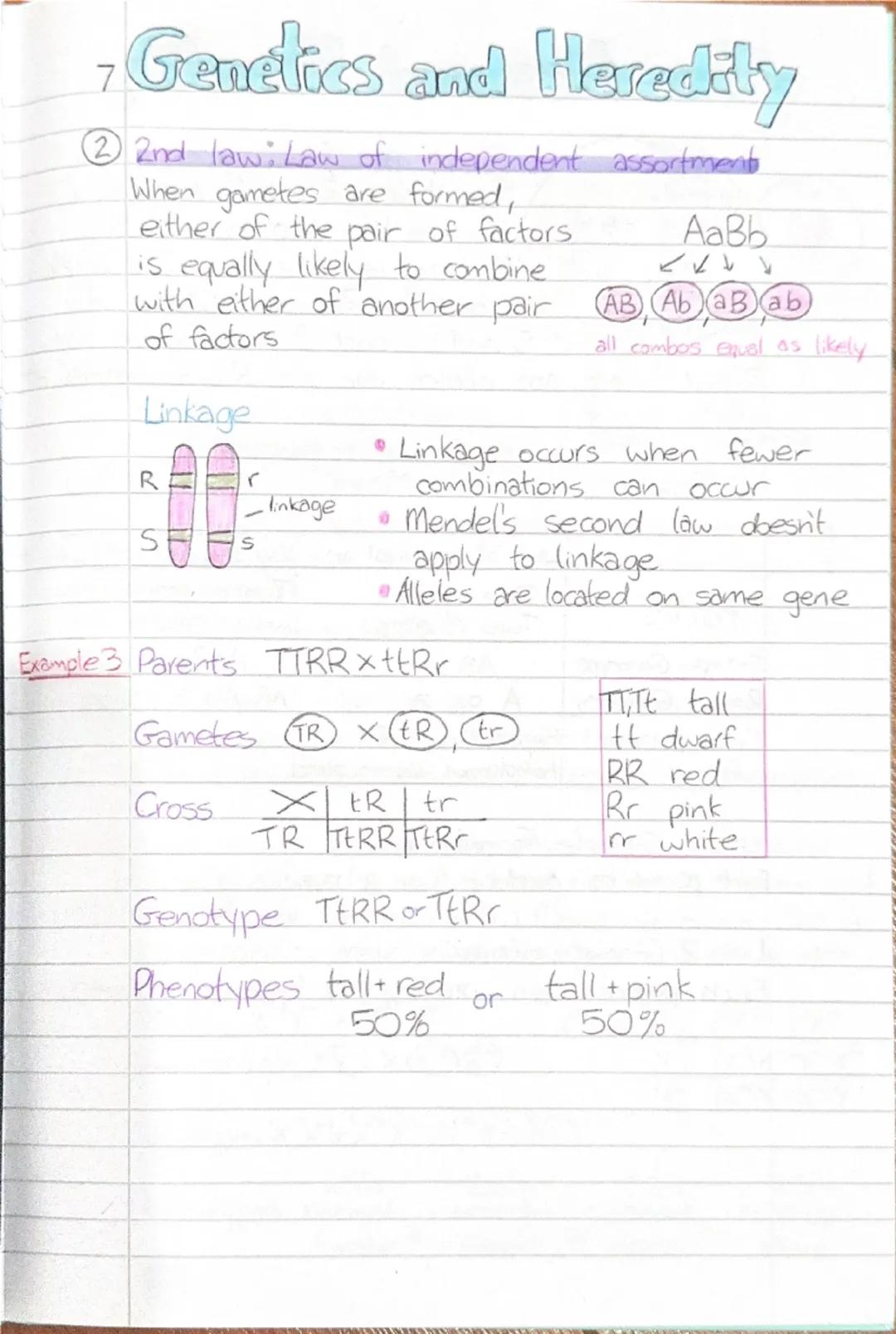
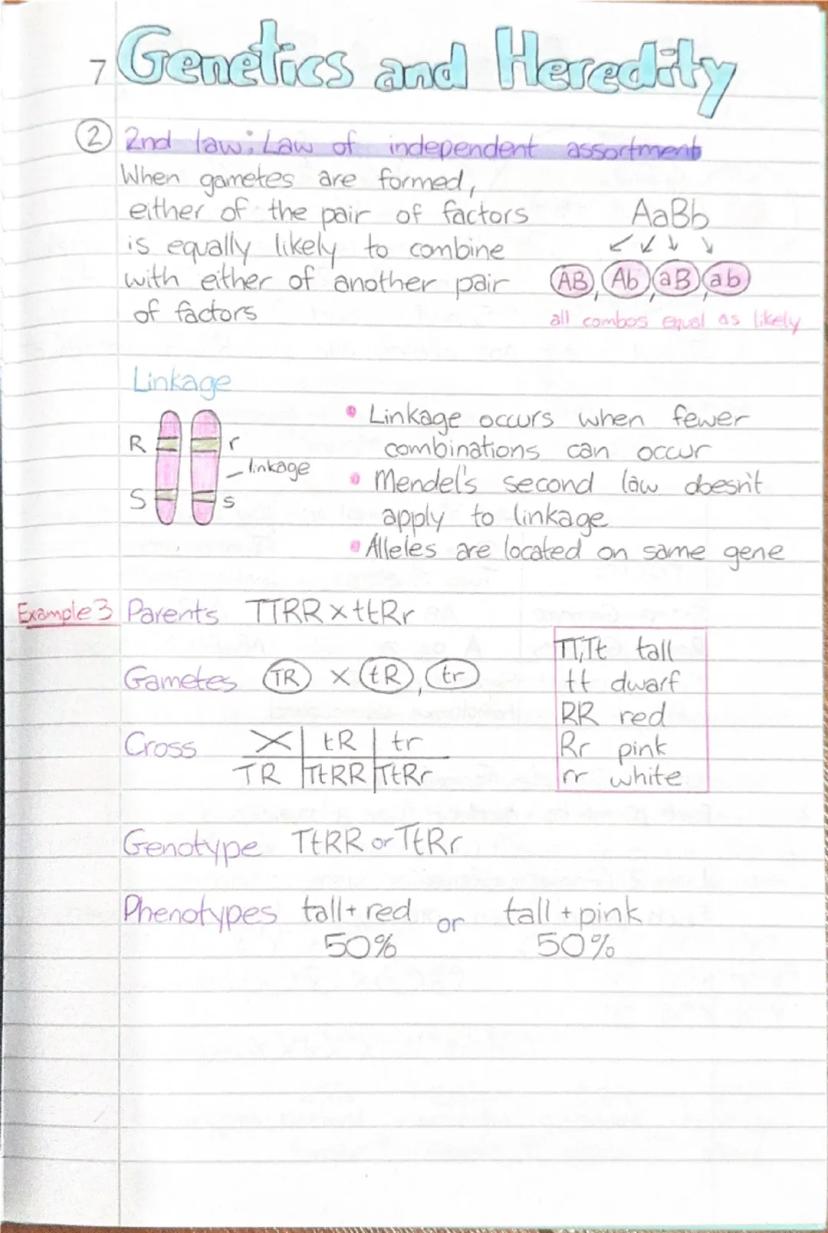
Mendel's Second Law, the Law of Independent Assortment, states that when gametes form, alleles for different traits combine randomly. This explains why you might have your mum's eye color but your dad's hair texture—traits assort independently.
When we represent this genetically, we can see that all possible combinations of alleles are equally likely. For example, a parent with genotype AaBb can produce gametes carrying AB, Ab, aB, or ab with equal probability.
However, Mendel's Second Law doesn't always apply. When genes are located close together on the same chromosome, they tend to be inherited together—a phenomenon called linkage. Linked genes don't assort independently because they're physically connected, leading to fewer possible combinations in the offspring.
Challenge concept: Linkage explains why certain traits seem to "travel together" in families. The closer two genes are on a chromosome, the less likely they are to be separated during genetic recombination!
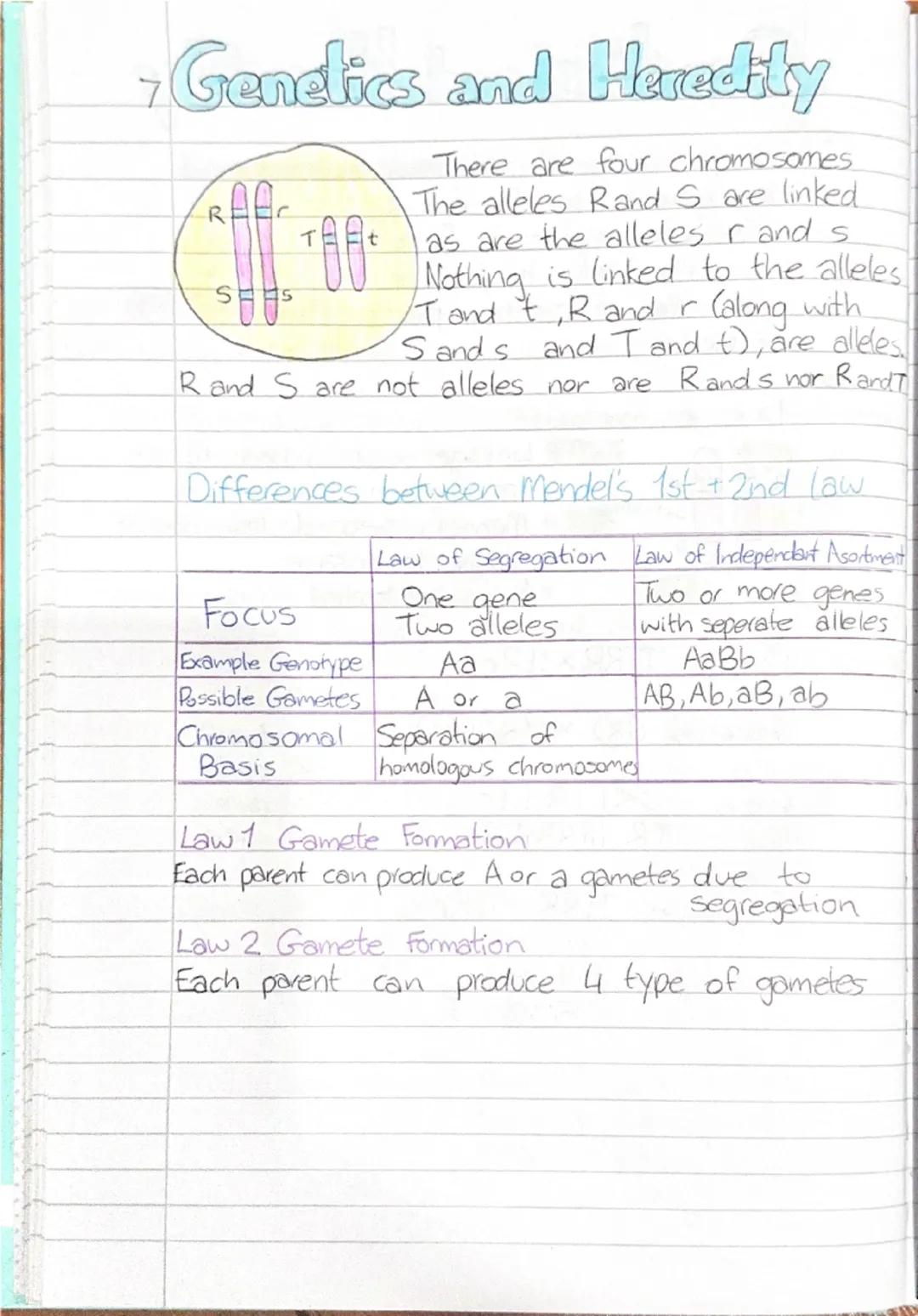
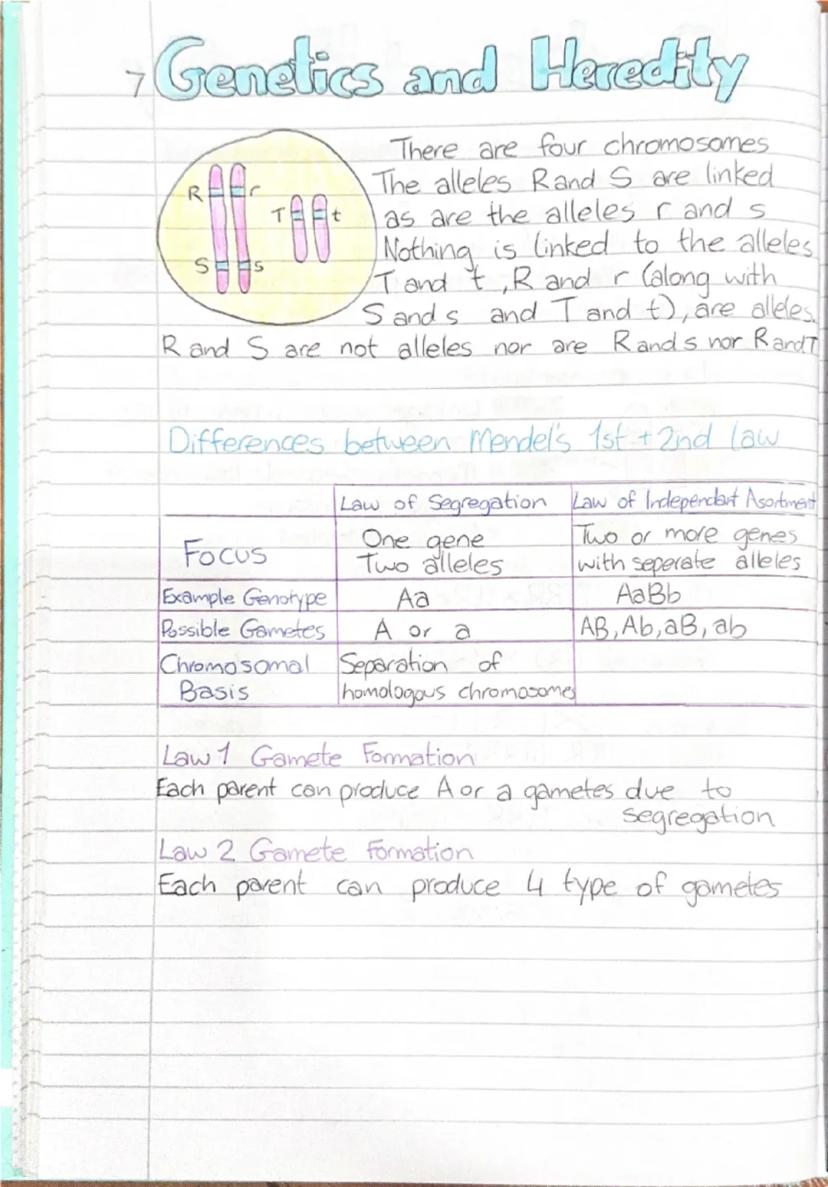
The difference between Mendel's laws lies in their scope and focus. The Law of Segregation deals with a single gene and its alleles, while the Law of Independent Assortment addresses how multiple genes interact during inheritance.
With the Law of Segregation, we're concerned with how alleles of a single gene separate during gamete formation. If a parent has genotype Aa, they can produce either A or a gametes. The chromosomal basis for this is the separation of homologous chromosomes during meiosis.
The Law of Independent Assortment goes further by explaining how different genes behave in relation to each other. A parent with genotype AaBb can produce four types of gametes: AB, Ab, aB, or ab. This happens because different gene pairs on different chromosomes segregate independently of each other.
Memory trick: Think of Law 1 as "one gene splitting up" and Law 2 as "multiple genes mixing up"—this distinction helps keep the two laws straight in your mind!
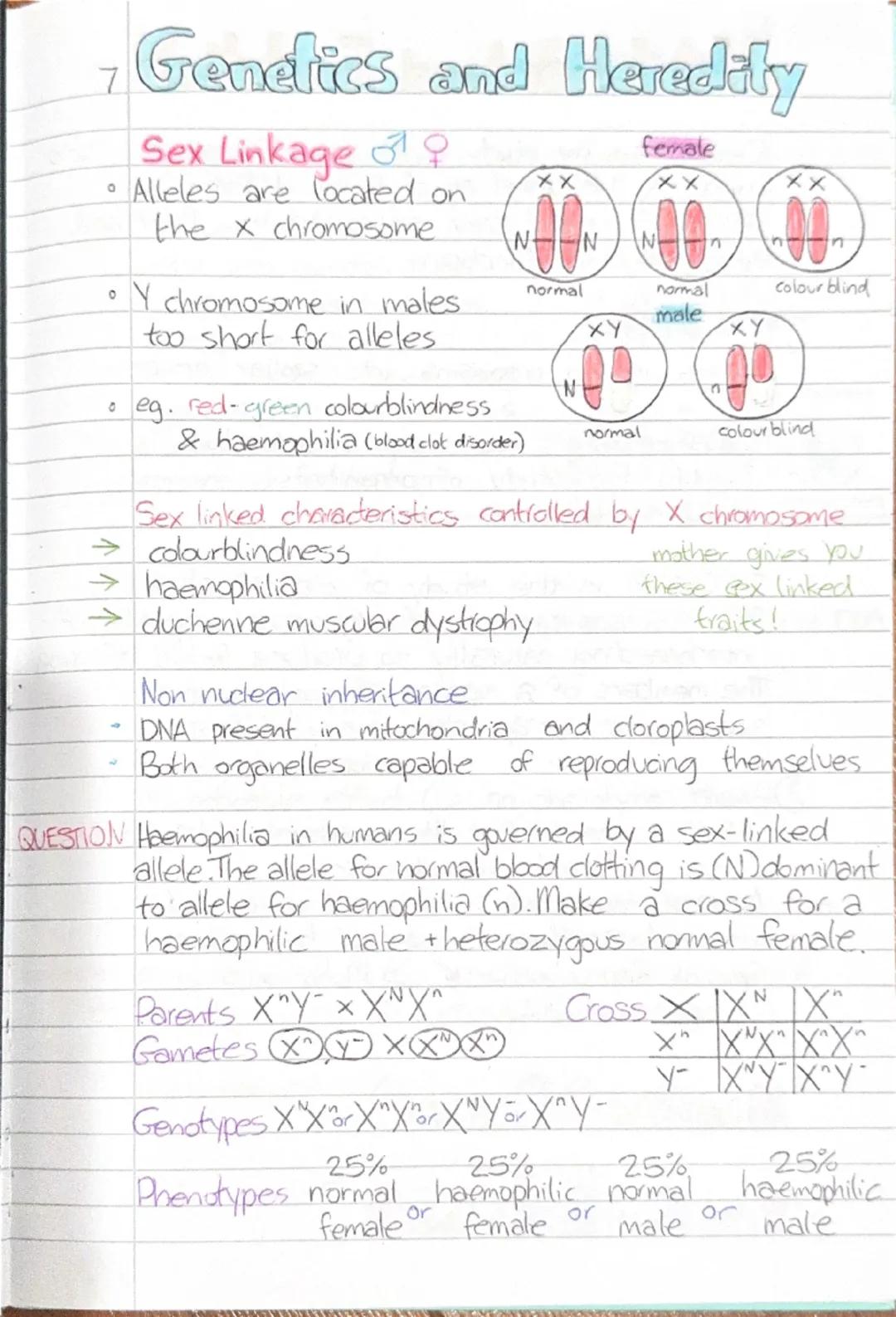
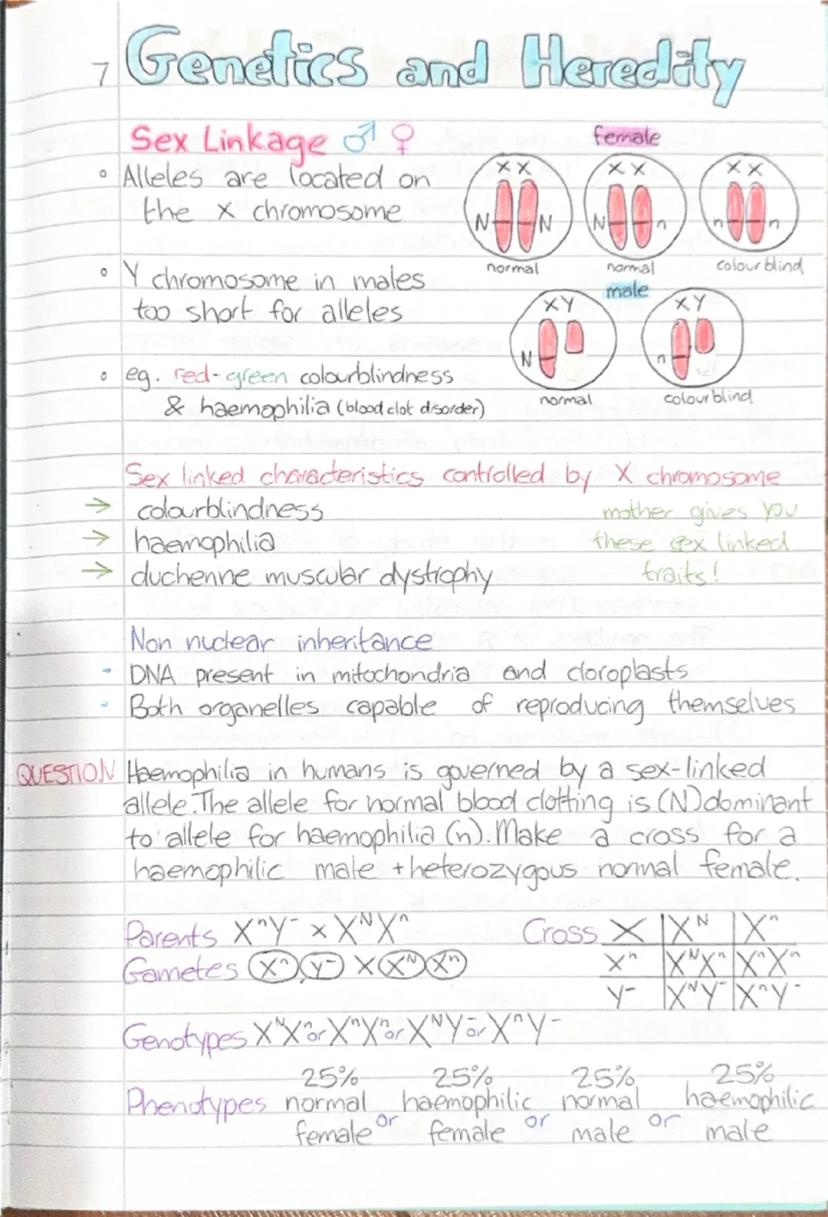
Sex-linked traits are those controlled by genes located on sex chromosomes, most commonly the X chromosome. Since males have only one X chromosome (paired with a Y chromosome that's too short to carry many genes), they express recessive X-linked traits more frequently than females.
Classic examples of sex-linked disorders include red-green colorblindness, haemophilia (a blood clotting disorder), and Duchenne muscular dystrophy. In these conditions, males are affected more often because they need only one recessive allele to show the trait, while females need two.
Not all inheritance follows nuclear DNA patterns. Mitochondria and chloroplasts contain their own DNA and can reproduce independently within cells. This non-nuclear inheritance typically follows maternal lines because egg cells contribute most of the cytoplasm (and thus the organelles) to the embryo.
Application insight: Understanding sex-linked inheritance is crucial in genetic counseling and helps explain why certain conditions like haemophilia historically appeared more frequently in royal families where intermarriage was common!
Our AI companion is specifically built for the needs of students. Based on the millions of content pieces we have on the platform we can provide truly meaningful and relevant answers to students. But its not only about answers, the companion is even more about guiding students through their daily learning challenges, with personalised study plans, quizzes or content pieces in the chat and 100% personalisation based on the students skills and developments.
You can download the app in the Google Play Store and in the Apple App Store.
That's right! Enjoy free access to study content, connect with fellow students, and get instant help – all at your fingertips.
App Store
Google Play
The app is very easy to use and well designed. I have found everything I was looking for so far and have been able to learn a lot from the presentations! I will definitely use the app for a class assignment! And of course it also helps a lot as an inspiration.
Stefan S
iOS user
This app is really great. There are so many study notes and help [...]. My problem subject is French, for example, and the app has so many options for help. Thanks to this app, I have improved my French. I would recommend it to anyone.
Samantha Klich
Android user
Wow, I am really amazed. I just tried the app because I've seen it advertised many times and was absolutely stunned. This app is THE HELP you want for school and above all, it offers so many things, such as workouts and fact sheets, which have been VERY helpful to me personally.
Anna
iOS user
I think it’s very much worth it and you’ll end up using it a lot once you get the hang of it and even after looking at others notes you can still ask your Artificial intelligence buddy the question and ask to simplify it if you still don’t get it!!! In the end I think it’s worth it 😊👍 ⚠️Also DID I MENTION ITS FREEE YOU DON’T HAVE TO PAY FOR ANYTHING AND STILL GET YOUR GRADES IN PERFECTLY❗️❗️⚠️
Thomas R
iOS user
Knowunity is the BEST app I’ve used in a minute. This is not an ai review or anything this is genuinely coming from a 7th grade student (I know 2011 im young) but dude this app is a 10/10 i have maintained a 3.8 gpa and have plenty of time for gaming. I love it and my mom is just happy I got good grades
Brad T
Android user
Not only did it help me find the answer but it also showed me alternative ways to solve it. I was horrible in math and science but now I have an a in both subjects. Thanks for the help🤍🤍
David K
iOS user
The app's just great! All I have to do is enter the topic in the search bar and I get the response real fast. I don't have to watch 10 YouTube videos to understand something, so I'm saving my time. Highly recommended!
Sudenaz Ocak
Android user
In school I was really bad at maths but thanks to the app, I am doing better now. I am so grateful that you made the app.
Greenlight Bonnie
Android user
I found this app a couple years ago and it has only gotten better since then. I really love it because it can help with written questions and photo questions. Also, it can find study guides that other people have made as well as flashcard sets and practice tests. The free version is also amazing for students who might not be able to afford it. Would 100% recommend
Aubrey
iOS user
Best app if you're in Highschool or Junior high. I have been using this app for 2 school years and it's the best, it's good if you don't have anyone to help you with school work.😋🩷🎀
Marco B
iOS user
THE QUIZES AND FLASHCARDS ARE SO USEFUL AND I LOVE Knowunity AI. IT ALSO IS LITREALLY LIKE CHATGPT BUT SMARTER!! HELPED ME WITH MY MASCARA PROBLEMS TOO!! AS WELL AS MY REAL SUBJECTS ! DUHHH 😍😁😲🤑💗✨🎀😮
Elisha
iOS user
This app is phenomenal down to the correct info and the various topics you can study! I greatly recommend it for people who struggle with procrastination and those who need homework help. It has been perfectly accurate for world 1 history as far as I’ve seen! Geometry too!
Paul T
iOS user
The app is very easy to use and well designed. I have found everything I was looking for so far and have been able to learn a lot from the presentations! I will definitely use the app for a class assignment! And of course it also helps a lot as an inspiration.
Stefan S
iOS user
This app is really great. There are so many study notes and help [...]. My problem subject is French, for example, and the app has so many options for help. Thanks to this app, I have improved my French. I would recommend it to anyone.
Samantha Klich
Android user
Wow, I am really amazed. I just tried the app because I've seen it advertised many times and was absolutely stunned. This app is THE HELP you want for school and above all, it offers so many things, such as workouts and fact sheets, which have been VERY helpful to me personally.
Anna
iOS user
I think it’s very much worth it and you’ll end up using it a lot once you get the hang of it and even after looking at others notes you can still ask your Artificial intelligence buddy the question and ask to simplify it if you still don’t get it!!! In the end I think it’s worth it 😊👍 ⚠️Also DID I MENTION ITS FREEE YOU DON’T HAVE TO PAY FOR ANYTHING AND STILL GET YOUR GRADES IN PERFECTLY❗️❗️⚠️
Thomas R
iOS user
Knowunity is the BEST app I’ve used in a minute. This is not an ai review or anything this is genuinely coming from a 7th grade student (I know 2011 im young) but dude this app is a 10/10 i have maintained a 3.8 gpa and have plenty of time for gaming. I love it and my mom is just happy I got good grades
Brad T
Android user
Not only did it help me find the answer but it also showed me alternative ways to solve it. I was horrible in math and science but now I have an a in both subjects. Thanks for the help🤍🤍
David K
iOS user
The app's just great! All I have to do is enter the topic in the search bar and I get the response real fast. I don't have to watch 10 YouTube videos to understand something, so I'm saving my time. Highly recommended!
Sudenaz Ocak
Android user
In school I was really bad at maths but thanks to the app, I am doing better now. I am so grateful that you made the app.
Greenlight Bonnie
Android user
I found this app a couple years ago and it has only gotten better since then. I really love it because it can help with written questions and photo questions. Also, it can find study guides that other people have made as well as flashcard sets and practice tests. The free version is also amazing for students who might not be able to afford it. Would 100% recommend
Aubrey
iOS user
Best app if you're in Highschool or Junior high. I have been using this app for 2 school years and it's the best, it's good if you don't have anyone to help you with school work.😋🩷🎀
Marco B
iOS user
THE QUIZES AND FLASHCARDS ARE SO USEFUL AND I LOVE Knowunity AI. IT ALSO IS LITREALLY LIKE CHATGPT BUT SMARTER!! HELPED ME WITH MY MASCARA PROBLEMS TOO!! AS WELL AS MY REAL SUBJECTS ! DUHHH 😍😁😲🤑💗✨🎀😮
Elisha
iOS user
This app is phenomenal down to the correct info and the various topics you can study! I greatly recommend it for people who struggle with procrastination and those who need homework help. It has been perfectly accurate for world 1 history as far as I’ve seen! Geometry too!
Paul T
iOS user
emma f
@emlfty
Genetics and heredity form the foundation of how traits are passed from parents to offspring. These processes explain why you might have your mum's eyes or your dad's height, and understanding them helps us make sense of the diversity of... Show more
Access to all documents
Improve your grades
Join milions of students
Ever wondered why you look like your parents? That's heredity in action—the passing of features from parents to offspring through genes. Think of it as nature's way of keeping family resemblances going!
A gene is essentially a segment of DNA that acts like a recipe for making specific proteins in your body. These proteins then influence your characteristics or traits. Genes are found on chromosomes and serve as the basic units of inheritance.
Not all genes are expressed though. Your environment and other factors can influence whether a gene is "switched on" or remains dormant. For example, you might have genes for tallness, but poor nutrition could prevent you from reaching your full height potential.
Did you know? Much of your DNA doesn't actually code for proteins! These non-coding sections make up a large portion of chromosomes, and scientists are still figuring out exactly what they do.
Access to all documents
Improve your grades
Join milions of students
When studying genetics, we use simple crosses to predict the traits offspring might inherit. This is where those Punnett squares you've seen come into play!
To solve genetic crosses, follow these steps: write down the key (which letters represent which traits), determine the parents' genotypes, identify possible gametes, complete your cross, and finally state the phenotypes (physical appearance) of the offspring.
Homozygous organisms have identical genes for a trait (like BB or bb), while heterozygous organisms have different genes for the same trait (like Bb). Homologous chromosomes carry the same genes in the same order, though the specific alleles (versions of genes) may differ.
Study tip: When working with genetic crosses, always label your work clearly and use a consistent notation system. This makes it much easier to spot patterns and avoid mistakes on exams!
Access to all documents
Improve your grades
Join milions of students
Not all traits follow simple dominant-recessive patterns. With incomplete dominance, neither allele dominates the other. Instead, heterozygous individuals show a blended or intermediate trait. Think of red flowers and white flowers producing pink offspring—neither parental trait completely dominates.
When neither allele is dominant, a third phenotype emerges that's typically a blend of the two original traits. This explains why we see such a spectrum of traits in the natural world rather than just either/or characteristics.
A pedigree is essentially a family tree showing genetic relationships. These diagrams track the inheritance of specific traits through generations, making them powerful tools for studying genetic disorders and predicting inheritance patterns.
Exam focus: Pedigree analysis questions often appear on exams! Practice identifying patterns of dominant, recessive, and sex-linked inheritance by studying example pedigrees.
Access to all documents
Improve your grades
Join milions of students
Your body contains 46 chromosomes in each cell, with 44 being regular chromosomes (autosomes) and 2 being sex chromosomes. These sex chromosomes—X and Y—determine biological sex in humans.
Females have two X chromosomes (XX), while males have one X and one Y chromosome (XY). The most fascinating part? The father's sperm determines a child's biological sex. If a sperm carrying an X chromosome fertilizes the egg, the child will be female (XX); if a Y-carrying sperm succeeds, the child will be male (XY).
The ratio of male to female births is approximately 1:1, though slight variations occur naturally. Meanwhile, those 44 autosomes control all your non-sex characteristics like skin colour, number of limbs, and digestive functions.
Think about it: Since males determine the sex of offspring, the old practice of blaming women for not producing male heirs (as happened historically in royal families) was completely unscientific!
Access to all documents
Improve your grades
Join milions of students
Gregor Mendel, an Austrian monk who experimented with pea plants, is considered the father of genetics. His meticulous work with pea plants helped establish the fundamental laws of inheritance that we still use today.
Mendel's First Law (Law of Segregation) states that inherited characteristics are controlled by pairs of factors (alleles) that separate during gamete formation. This means that each reproductive cell (egg or sperm) receives only one allele from each pair.
The chromosomal basis for this law is quite elegant. Our chromosomes exist in matching pairs (homologous pairs), and during meiosis (the cell division that produces gametes), these pairs separate. This separation ensures that each egg or sperm cell contains only one copy of each chromosome and therefore only one allele for each trait.
Visualization tip: Think of meiosis as dealing cards—each gamete gets dealt only one card (allele) from each pair, never both from the same pair!
Access to all documents
Improve your grades
Join milions of students
Genetic crosses come in different complexities depending on how many traits you're tracking. A monohybrid cross examines just one characteristic (like height), while a dihybrid cross tracks two characteristics simultaneously (like height and pod color).
When working with dihybrid crosses, you'll need to account for all possible combinations of alleles. For example, crossing plants with the genotypes TTGG (tall with green pods) and ttgg (short with yellow pods) will produce offspring with the genotype TtGg—all tall plants with green pods in the first generation.
The results get more interesting when crossing heterozygous individuals. A cross between RrTt and rrtt parents would produce four different phenotypes in equal proportions: pink tall plants, pink short plants, white tall plants, and white short plants—each making up about 25% of the offspring.
Pattern recognition: In complete dihybrid crosses with unlinked genes, you'll typically see a 9:3:3:1 ratio of phenotypes in the F2 generation. This is a classic pattern to watch for in exam questions!
Access to all documents
Improve your grades
Join milions of students
Mendel's Second Law, the Law of Independent Assortment, states that when gametes form, alleles for different traits combine randomly. This explains why you might have your mum's eye color but your dad's hair texture—traits assort independently.
When we represent this genetically, we can see that all possible combinations of alleles are equally likely. For example, a parent with genotype AaBb can produce gametes carrying AB, Ab, aB, or ab with equal probability.
However, Mendel's Second Law doesn't always apply. When genes are located close together on the same chromosome, they tend to be inherited together—a phenomenon called linkage. Linked genes don't assort independently because they're physically connected, leading to fewer possible combinations in the offspring.
Challenge concept: Linkage explains why certain traits seem to "travel together" in families. The closer two genes are on a chromosome, the less likely they are to be separated during genetic recombination!
Access to all documents
Improve your grades
Join milions of students
The difference between Mendel's laws lies in their scope and focus. The Law of Segregation deals with a single gene and its alleles, while the Law of Independent Assortment addresses how multiple genes interact during inheritance.
With the Law of Segregation, we're concerned with how alleles of a single gene separate during gamete formation. If a parent has genotype Aa, they can produce either A or a gametes. The chromosomal basis for this is the separation of homologous chromosomes during meiosis.
The Law of Independent Assortment goes further by explaining how different genes behave in relation to each other. A parent with genotype AaBb can produce four types of gametes: AB, Ab, aB, or ab. This happens because different gene pairs on different chromosomes segregate independently of each other.
Memory trick: Think of Law 1 as "one gene splitting up" and Law 2 as "multiple genes mixing up"—this distinction helps keep the two laws straight in your mind!
Access to all documents
Improve your grades
Join milions of students
Sex-linked traits are those controlled by genes located on sex chromosomes, most commonly the X chromosome. Since males have only one X chromosome (paired with a Y chromosome that's too short to carry many genes), they express recessive X-linked traits more frequently than females.
Classic examples of sex-linked disorders include red-green colorblindness, haemophilia (a blood clotting disorder), and Duchenne muscular dystrophy. In these conditions, males are affected more often because they need only one recessive allele to show the trait, while females need two.
Not all inheritance follows nuclear DNA patterns. Mitochondria and chloroplasts contain their own DNA and can reproduce independently within cells. This non-nuclear inheritance typically follows maternal lines because egg cells contribute most of the cytoplasm (and thus the organelles) to the embryo.
Application insight: Understanding sex-linked inheritance is crucial in genetic counseling and helps explain why certain conditions like haemophilia historically appeared more frequently in royal families where intermarriage was common!
Our AI companion is specifically built for the needs of students. Based on the millions of content pieces we have on the platform we can provide truly meaningful and relevant answers to students. But its not only about answers, the companion is even more about guiding students through their daily learning challenges, with personalised study plans, quizzes or content pieces in the chat and 100% personalisation based on the students skills and developments.
You can download the app in the Google Play Store and in the Apple App Store.
That's right! Enjoy free access to study content, connect with fellow students, and get instant help – all at your fingertips.
0
Smart Tools NEW
Transform this note into: ✓ 50+ Practice Questions ✓ Interactive Flashcards ✓ Full Practice Test ✓ Essay Outlines
App Store
Google Play
The app is very easy to use and well designed. I have found everything I was looking for so far and have been able to learn a lot from the presentations! I will definitely use the app for a class assignment! And of course it also helps a lot as an inspiration.
Stefan S
iOS user
This app is really great. There are so many study notes and help [...]. My problem subject is French, for example, and the app has so many options for help. Thanks to this app, I have improved my French. I would recommend it to anyone.
Samantha Klich
Android user
Wow, I am really amazed. I just tried the app because I've seen it advertised many times and was absolutely stunned. This app is THE HELP you want for school and above all, it offers so many things, such as workouts and fact sheets, which have been VERY helpful to me personally.
Anna
iOS user
I think it’s very much worth it and you’ll end up using it a lot once you get the hang of it and even after looking at others notes you can still ask your Artificial intelligence buddy the question and ask to simplify it if you still don’t get it!!! In the end I think it’s worth it 😊👍 ⚠️Also DID I MENTION ITS FREEE YOU DON’T HAVE TO PAY FOR ANYTHING AND STILL GET YOUR GRADES IN PERFECTLY❗️❗️⚠️
Thomas R
iOS user
Knowunity is the BEST app I’ve used in a minute. This is not an ai review or anything this is genuinely coming from a 7th grade student (I know 2011 im young) but dude this app is a 10/10 i have maintained a 3.8 gpa and have plenty of time for gaming. I love it and my mom is just happy I got good grades
Brad T
Android user
Not only did it help me find the answer but it also showed me alternative ways to solve it. I was horrible in math and science but now I have an a in both subjects. Thanks for the help🤍🤍
David K
iOS user
The app's just great! All I have to do is enter the topic in the search bar and I get the response real fast. I don't have to watch 10 YouTube videos to understand something, so I'm saving my time. Highly recommended!
Sudenaz Ocak
Android user
In school I was really bad at maths but thanks to the app, I am doing better now. I am so grateful that you made the app.
Greenlight Bonnie
Android user
I found this app a couple years ago and it has only gotten better since then. I really love it because it can help with written questions and photo questions. Also, it can find study guides that other people have made as well as flashcard sets and practice tests. The free version is also amazing for students who might not be able to afford it. Would 100% recommend
Aubrey
iOS user
Best app if you're in Highschool or Junior high. I have been using this app for 2 school years and it's the best, it's good if you don't have anyone to help you with school work.😋🩷🎀
Marco B
iOS user
THE QUIZES AND FLASHCARDS ARE SO USEFUL AND I LOVE Knowunity AI. IT ALSO IS LITREALLY LIKE CHATGPT BUT SMARTER!! HELPED ME WITH MY MASCARA PROBLEMS TOO!! AS WELL AS MY REAL SUBJECTS ! DUHHH 😍😁😲🤑💗✨🎀😮
Elisha
iOS user
This app is phenomenal down to the correct info and the various topics you can study! I greatly recommend it for people who struggle with procrastination and those who need homework help. It has been perfectly accurate for world 1 history as far as I’ve seen! Geometry too!
Paul T
iOS user
The app is very easy to use and well designed. I have found everything I was looking for so far and have been able to learn a lot from the presentations! I will definitely use the app for a class assignment! And of course it also helps a lot as an inspiration.
Stefan S
iOS user
This app is really great. There are so many study notes and help [...]. My problem subject is French, for example, and the app has so many options for help. Thanks to this app, I have improved my French. I would recommend it to anyone.
Samantha Klich
Android user
Wow, I am really amazed. I just tried the app because I've seen it advertised many times and was absolutely stunned. This app is THE HELP you want for school and above all, it offers so many things, such as workouts and fact sheets, which have been VERY helpful to me personally.
Anna
iOS user
I think it’s very much worth it and you’ll end up using it a lot once you get the hang of it and even after looking at others notes you can still ask your Artificial intelligence buddy the question and ask to simplify it if you still don’t get it!!! In the end I think it’s worth it 😊👍 ⚠️Also DID I MENTION ITS FREEE YOU DON’T HAVE TO PAY FOR ANYTHING AND STILL GET YOUR GRADES IN PERFECTLY❗️❗️⚠️
Thomas R
iOS user
Knowunity is the BEST app I’ve used in a minute. This is not an ai review or anything this is genuinely coming from a 7th grade student (I know 2011 im young) but dude this app is a 10/10 i have maintained a 3.8 gpa and have plenty of time for gaming. I love it and my mom is just happy I got good grades
Brad T
Android user
Not only did it help me find the answer but it also showed me alternative ways to solve it. I was horrible in math and science but now I have an a in both subjects. Thanks for the help🤍🤍
David K
iOS user
The app's just great! All I have to do is enter the topic in the search bar and I get the response real fast. I don't have to watch 10 YouTube videos to understand something, so I'm saving my time. Highly recommended!
Sudenaz Ocak
Android user
In school I was really bad at maths but thanks to the app, I am doing better now. I am so grateful that you made the app.
Greenlight Bonnie
Android user
I found this app a couple years ago and it has only gotten better since then. I really love it because it can help with written questions and photo questions. Also, it can find study guides that other people have made as well as flashcard sets and practice tests. The free version is also amazing for students who might not be able to afford it. Would 100% recommend
Aubrey
iOS user
Best app if you're in Highschool or Junior high. I have been using this app for 2 school years and it's the best, it's good if you don't have anyone to help you with school work.😋🩷🎀
Marco B
iOS user
THE QUIZES AND FLASHCARDS ARE SO USEFUL AND I LOVE Knowunity AI. IT ALSO IS LITREALLY LIKE CHATGPT BUT SMARTER!! HELPED ME WITH MY MASCARA PROBLEMS TOO!! AS WELL AS MY REAL SUBJECTS ! DUHHH 😍😁😲🤑💗✨🎀😮
Elisha
iOS user
This app is phenomenal down to the correct info and the various topics you can study! I greatly recommend it for people who struggle with procrastination and those who need homework help. It has been perfectly accurate for world 1 history as far as I’ve seen! Geometry too!
Paul T
iOS user