
We've all wondered about the big stuff - why we're... Show more
 Religious Education
 Irish
Irish English
 Biology
 Agricultural Science
Sign up to see the contentIt's free!
Access to all documents
Improve your grades
Join milions of students
By signing up you accept Terms of Service and Privacy Policy
Subjects
1
•
Updated 2 Mar 2026
•
We've all wondered about the big stuff - why we're... Show more
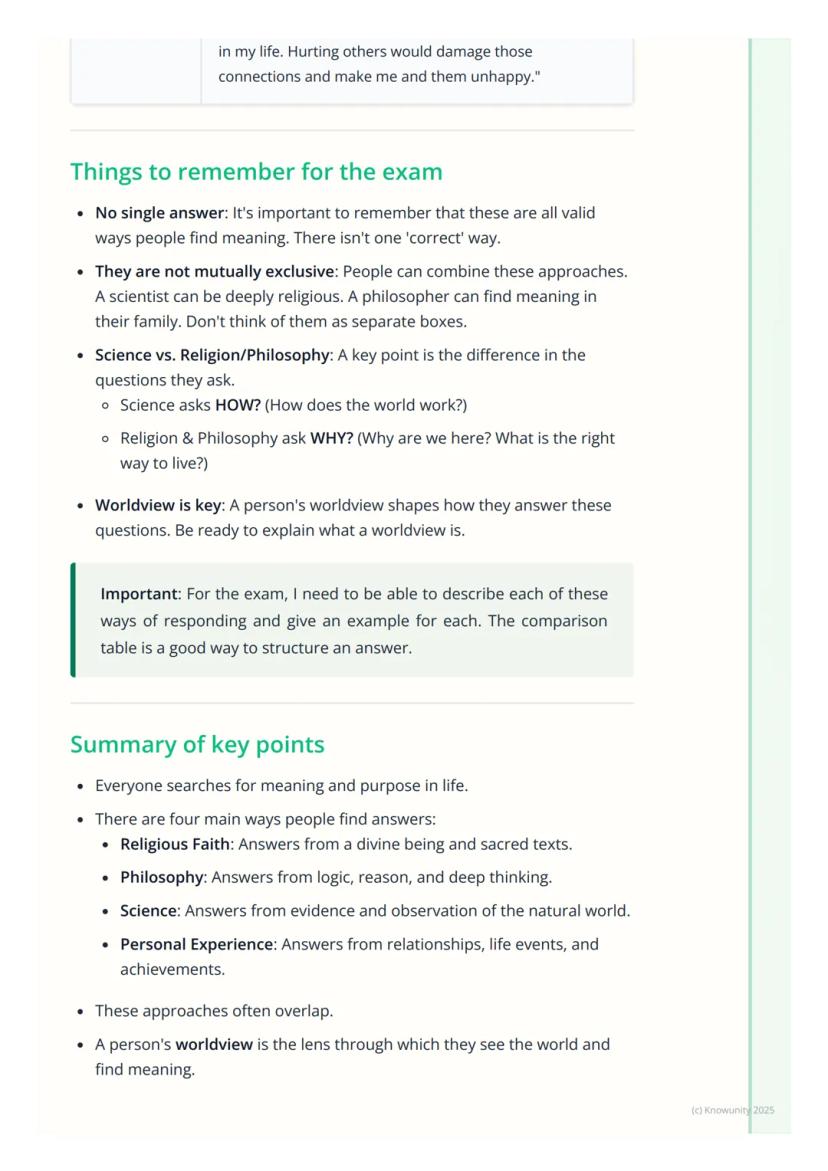

Ever found yourself staring at the ceiling at night wondering what the point of everything is? You're definitely not alone in asking these questions.
When we talk about meaning, we're looking for what makes life feel worthwhile - that sense of purpose that gets you out of bed in the morning. Your worldview is basically like a pair of glasses that colours how you see everything around you. It's your overall perspective on life, death, right, wrong, and everything in between.
Different people use different approaches to find answers. Some turn to religion - organised systems of beliefs about God or gods that come with rules and ceremonies. Others prefer philosophy, which uses pure reasoning and logic to work things out. Then there's science, which focuses on evidence and observation of the natural world.
Remember: There's no single "right" way to find meaning - most people actually mix and match these approaches throughout their lives.
You've also got humanism (focusing on human reason and shared values rather than God), agnosticism (admitting we can't know if God exists), and atheism (believing there's no God at all).
For millions of people worldwide, religious faith provides a complete roadmap for understanding life's mysteries.
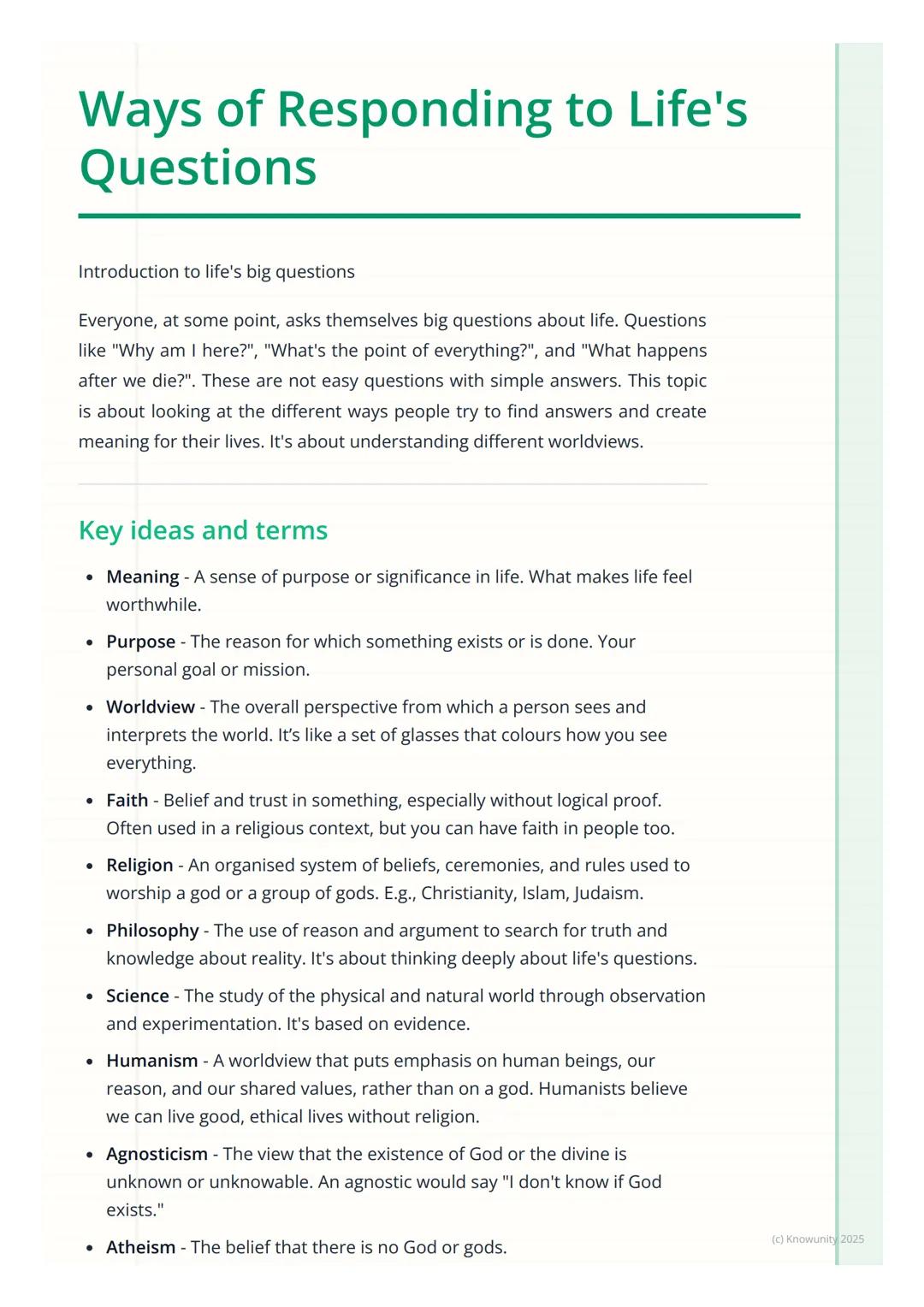
Religious believers find their answers in sacred texts like the Bible or Qur'an, guidance from religious leaders, and personal prayer or spiritual experiences. They typically believe in a higher power who created everything, that life has a divine purpose, and that there's some form of afterlife waiting. A Christian, for example, might find meaning in believing God loves them and has a specific plan for their life.
Philosophy takes a completely different approach - it's all about using your brain to think deeply about life's questions. Instead of accepting ready-made answers, philosophers prefer the process of questioning everything. They tackle big topics like what makes a good life, what's actually real, and how we can know anything for certain.
Think about it: A philosopher facing the question "What's my purpose?" might conclude that humans must create their own purpose rather than receive it from a divine source.
The key difference? Religious faith often starts with belief and builds from there, while philosophy starts with doubt and uses logic to work towards possible answers.
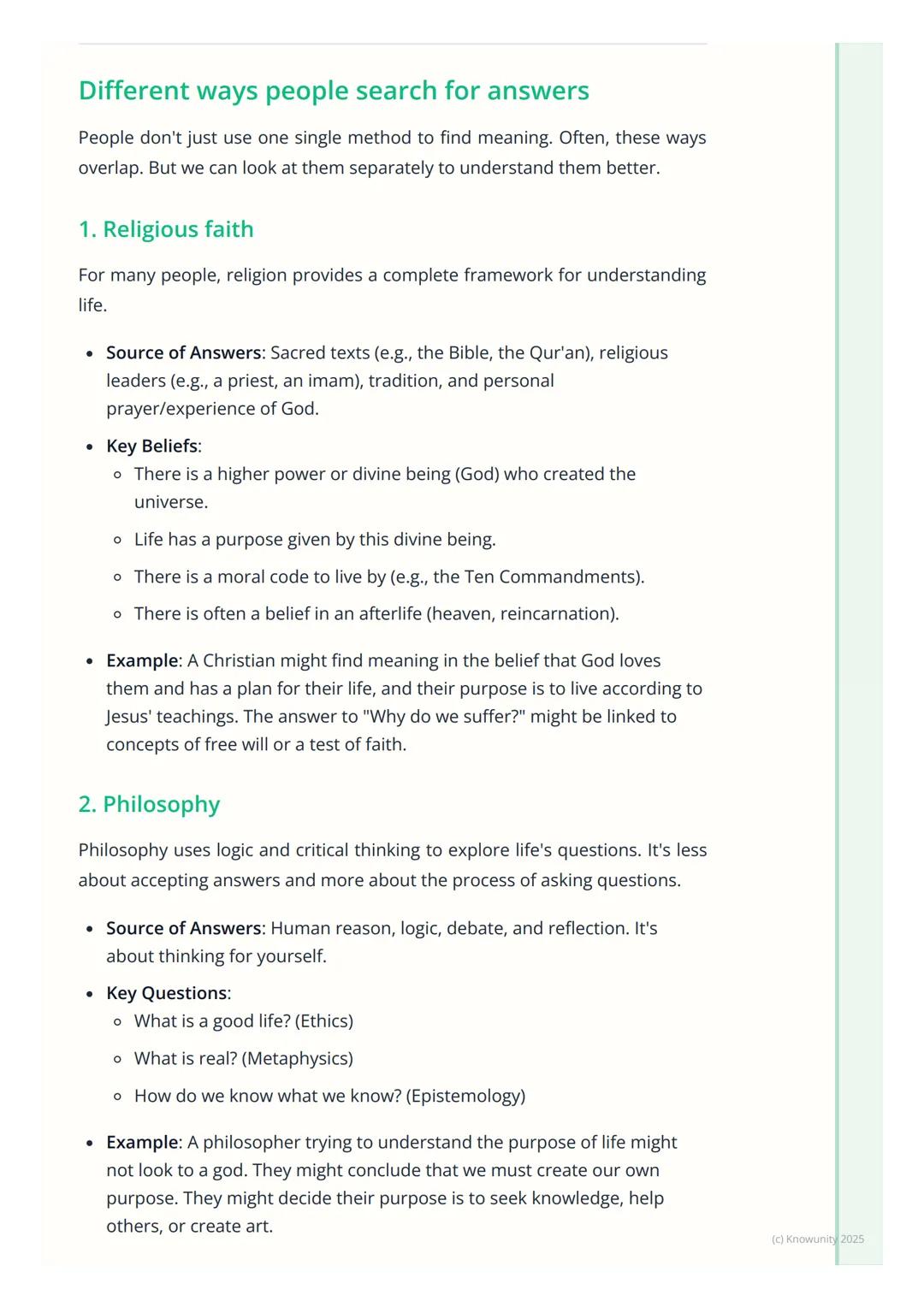
Science is brilliant at explaining the "how" but struggles with the "why" questions that keep us up at night.
Through observation and experimentation, science can tell us how the universe began with the Big Bang, how life evolved over millions of years, and how our brains work. But it can't really explain why the universe bothered to exist in the first place or why love feels so meaningful to us. A scientist answering "Where did we come from?" would point to evolution and our connection to all life on Earth - which some people find deeply meaningful.
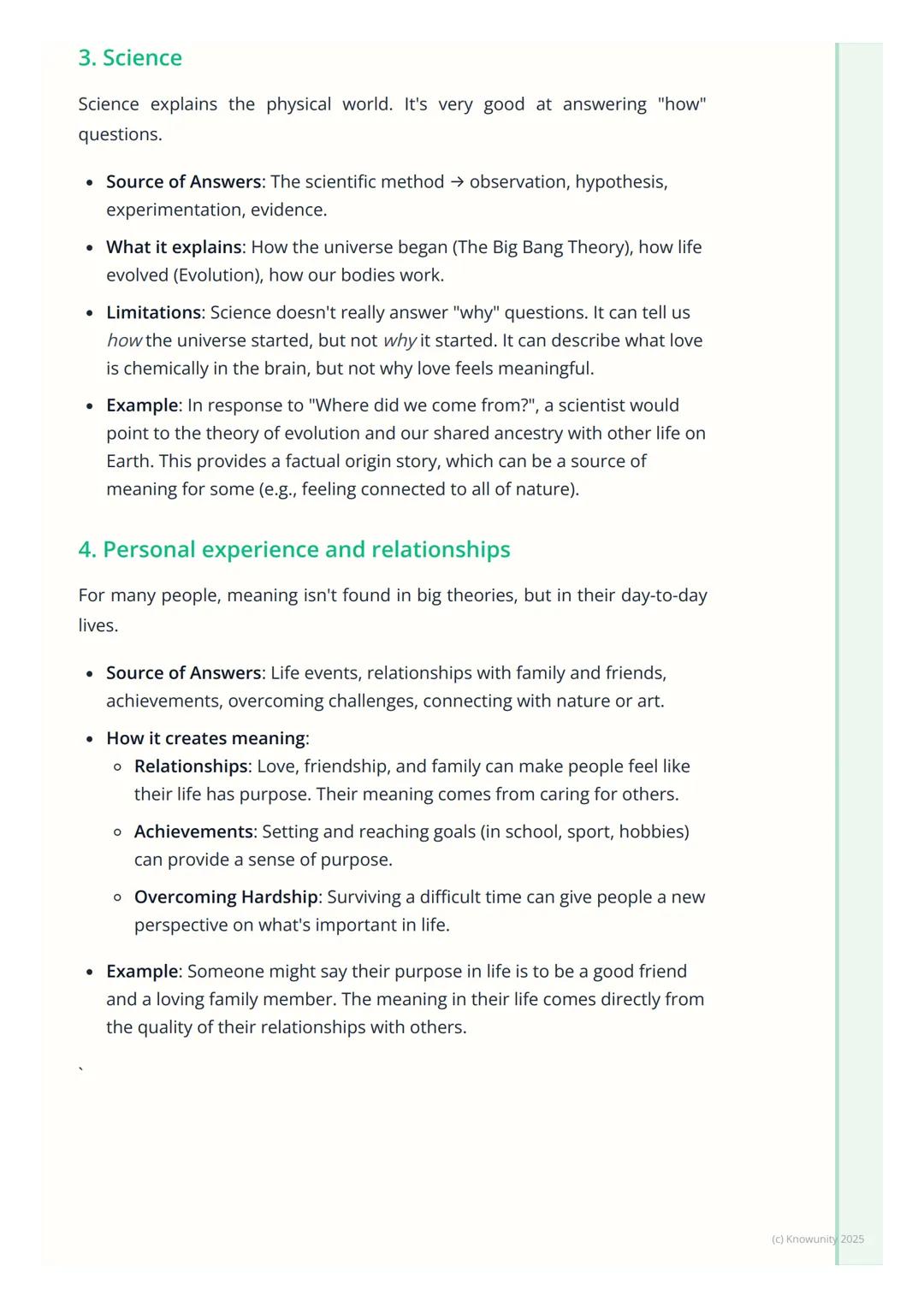
Many people find their answers not in grand theories but in their everyday experiences and relationships. Personal experience as a source of meaning comes from the people we love, the goals we achieve, and the challenges we overcome.
Your purpose might be as simple as being a good friend or family member. The meaning in your life could come from getting better at guitar, helping your little sister with homework, or just making people laugh. Sometimes surviving something really tough gives people a completely new perspective on what actually matters.
Real talk: This approach to meaning is probably the most relatable - it's about finding significance in the life you're actually living right now.
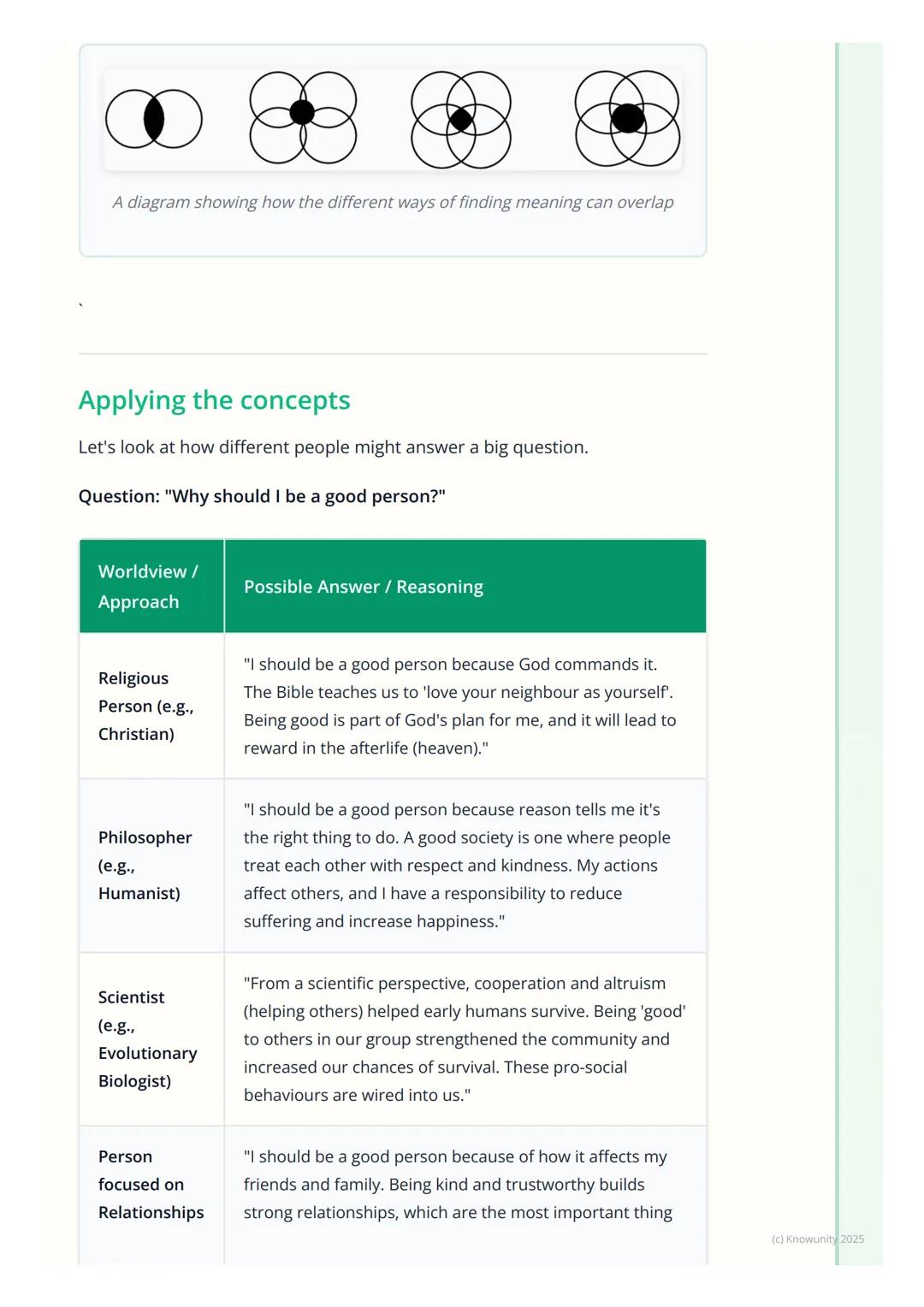
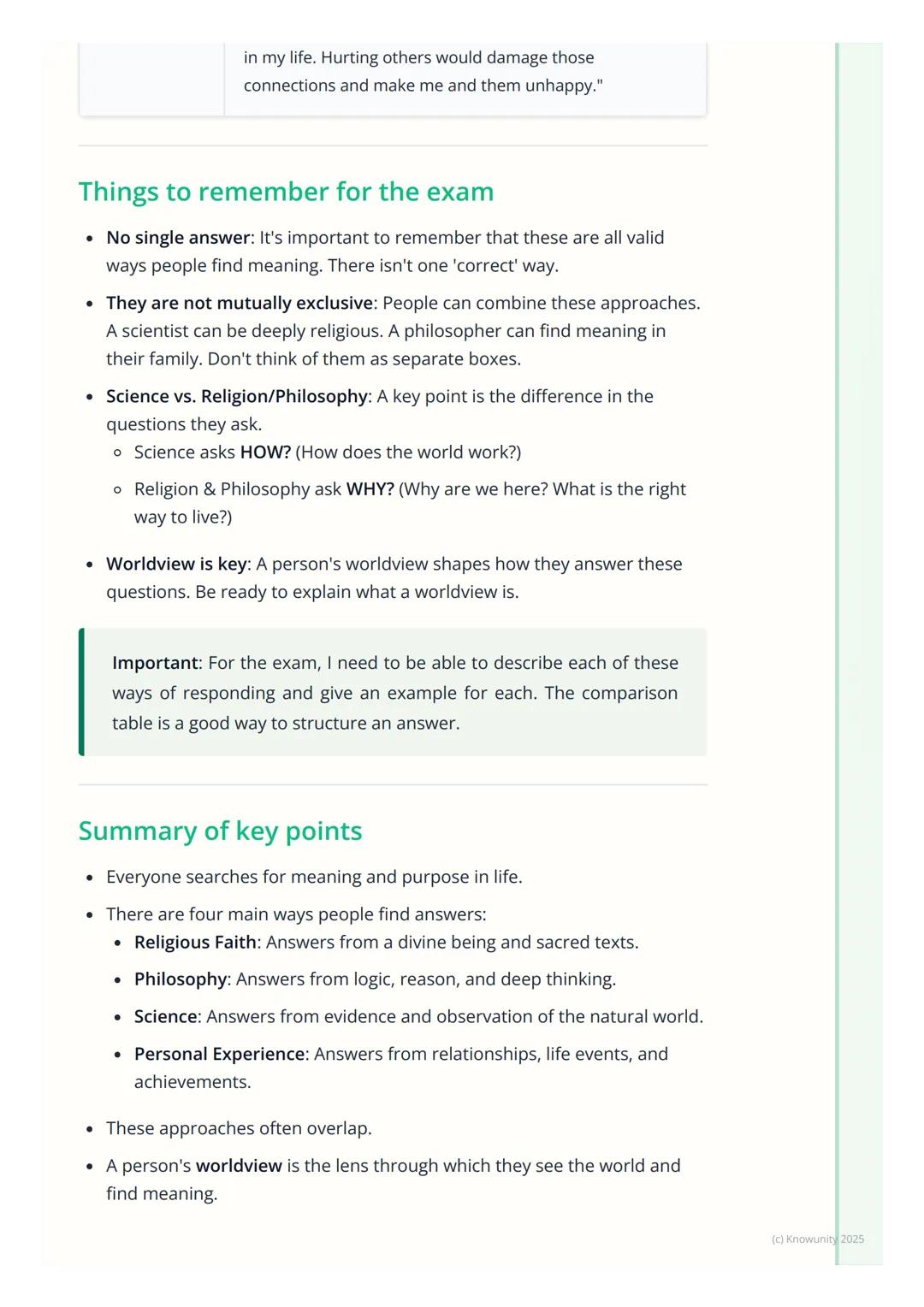
Let's see how these different worldviews would tackle a practical question: "Why should I be a good person?"
A religious person might say they should be good because God commands it - the Bible teaches "love your neighbour as yourself," and being good leads to rewards in the afterlife. It's part of following a divine plan that's bigger than themselves.
A philosopher with a humanist worldview would argue that reason tells us being good is right. They'd say we have a responsibility to reduce suffering and increase happiness because our actions affect others, and a good society needs people who treat each other with respect.
A scientist might explain that cooperation and helping others (altruism) helped early humans survive. Being good to people in our group made the whole community stronger, so these helpful behaviours got wired into our brains through evolution.
Someone focused on personal relationships would say being good matters because of how it affects their friends and family. Being kind and trustworthy builds strong relationships, which are what make life worth living.
Exam tip: Remember these approaches aren't mutually exclusive - a scientist can be deeply religious, and a philosopher can find meaning in family relationships.
Here's what you absolutely need to remember: there's no single "correct" way to find meaning and purpose in life.
The four main approaches are religious faith (answers from divine sources), philosophy (answers from reason and logic), science (answers from evidence and observation), and personal experience (answers from relationships and life events). People often combine these approaches rather than sticking to just one.
Understanding the difference between "how" and "why" questions is crucial. Science excels at explaining how things work - how the universe formed, how evolution happened, how our bodies function. But religion and philosophy focus more on why questions - why we're here, what the right way to live is, what our ultimate purpose should be.
Your worldview is the lens through which you interpret everything around you. It shapes how you answer life's big questions and what you consider meaningful. Someone with a religious worldview will approach the question "What happens after death?" very differently from someone with a scientific worldview.
Exam strategy: Practice explaining each approach with a clear example, and remember that comparing them in a table format often works well for structured answers.
Most importantly, recognise that everyone's search for meaning is valid, even if their conclusions are completely different from yours.

Our AI companion is specifically built for the needs of students. Based on the millions of content pieces we have on the platform we can provide truly meaningful and relevant answers to students. But its not only about answers, the companion is even more about guiding students through their daily learning challenges, with personalised study plans, quizzes or content pieces in the chat and 100% personalisation based on the students skills and developments.
You can download the app in the Google Play Store and in the Apple App Store.
That's right! Enjoy free access to study content, connect with fellow students, and get instant help – all at your fingertips.
App Store
Google Play
The app is very easy to use and well designed. I have found everything I was looking for so far and have been able to learn a lot from the presentations! I will definitely use the app for a class assignment! And of course it also helps a lot as an inspiration.
Stefan S
iOS user
This app is really great. There are so many study notes and help [...]. My problem subject is French, for example, and the app has so many options for help. Thanks to this app, I have improved my French. I would recommend it to anyone.
Samantha Klich
Android user
Wow, I am really amazed. I just tried the app because I've seen it advertised many times and was absolutely stunned. This app is THE HELP you want for school and above all, it offers so many things, such as workouts and fact sheets, which have been VERY helpful to me personally.
Anna
iOS user
I think it’s very much worth it and you’ll end up using it a lot once you get the hang of it and even after looking at others notes you can still ask your Artificial intelligence buddy the question and ask to simplify it if you still don’t get it!!! In the end I think it’s worth it 😊👍 ⚠️Also DID I MENTION ITS FREEE YOU DON’T HAVE TO PAY FOR ANYTHING AND STILL GET YOUR GRADES IN PERFECTLY❗️❗️⚠️
Thomas R
iOS user
Knowunity is the BEST app I’ve used in a minute. This is not an ai review or anything this is genuinely coming from a 7th grade student (I know 2011 im young) but dude this app is a 10/10 i have maintained a 3.8 gpa and have plenty of time for gaming. I love it and my mom is just happy I got good grades
Brad T
Android user
Not only did it help me find the answer but it also showed me alternative ways to solve it. I was horrible in math and science but now I have an a in both subjects. Thanks for the help🤍🤍
David K
iOS user
The app's just great! All I have to do is enter the topic in the search bar and I get the response real fast. I don't have to watch 10 YouTube videos to understand something, so I'm saving my time. Highly recommended!
Sudenaz Ocak
Android user
In school I was really bad at maths but thanks to the app, I am doing better now. I am so grateful that you made the app.
Greenlight Bonnie
Android user
I found this app a couple years ago and it has only gotten better since then. I really love it because it can help with written questions and photo questions. Also, it can find study guides that other people have made as well as flashcard sets and practice tests. The free version is also amazing for students who might not be able to afford it. Would 100% recommend
Aubrey
iOS user
Best app if you're in Highschool or Junior high. I have been using this app for 2 school years and it's the best, it's good if you don't have anyone to help you with school work.😋🩷🎀
Marco B
iOS user
THE QUIZES AND FLASHCARDS ARE SO USEFUL AND I LOVE Knowunity AI. IT ALSO IS LITREALLY LIKE CHATGPT BUT SMARTER!! HELPED ME WITH MY MASCARA PROBLEMS TOO!! AS WELL AS MY REAL SUBJECTS ! DUHHH 😍😁😲🤑💗✨🎀😮
Elisha
iOS user
This app is phenomenal down to the correct info and the various topics you can study! I greatly recommend it for people who struggle with procrastination and those who need homework help. It has been perfectly accurate for world 1 history as far as I’ve seen! Geometry too!
Paul T
iOS user
The app is very easy to use and well designed. I have found everything I was looking for so far and have been able to learn a lot from the presentations! I will definitely use the app for a class assignment! And of course it also helps a lot as an inspiration.
Stefan S
iOS user
This app is really great. There are so many study notes and help [...]. My problem subject is French, for example, and the app has so many options for help. Thanks to this app, I have improved my French. I would recommend it to anyone.
Samantha Klich
Android user
Wow, I am really amazed. I just tried the app because I've seen it advertised many times and was absolutely stunned. This app is THE HELP you want for school and above all, it offers so many things, such as workouts and fact sheets, which have been VERY helpful to me personally.
Anna
iOS user
I think it’s very much worth it and you’ll end up using it a lot once you get the hang of it and even after looking at others notes you can still ask your Artificial intelligence buddy the question and ask to simplify it if you still don’t get it!!! In the end I think it’s worth it 😊👍 ⚠️Also DID I MENTION ITS FREEE YOU DON’T HAVE TO PAY FOR ANYTHING AND STILL GET YOUR GRADES IN PERFECTLY❗️❗️⚠️
Thomas R
iOS user
Knowunity is the BEST app I’ve used in a minute. This is not an ai review or anything this is genuinely coming from a 7th grade student (I know 2011 im young) but dude this app is a 10/10 i have maintained a 3.8 gpa and have plenty of time for gaming. I love it and my mom is just happy I got good grades
Brad T
Android user
Not only did it help me find the answer but it also showed me alternative ways to solve it. I was horrible in math and science but now I have an a in both subjects. Thanks for the help🤍🤍
David K
iOS user
The app's just great! All I have to do is enter the topic in the search bar and I get the response real fast. I don't have to watch 10 YouTube videos to understand something, so I'm saving my time. Highly recommended!
Sudenaz Ocak
Android user
In school I was really bad at maths but thanks to the app, I am doing better now. I am so grateful that you made the app.
Greenlight Bonnie
Android user
I found this app a couple years ago and it has only gotten better since then. I really love it because it can help with written questions and photo questions. Also, it can find study guides that other people have made as well as flashcard sets and practice tests. The free version is also amazing for students who might not be able to afford it. Would 100% recommend
Aubrey
iOS user
Best app if you're in Highschool or Junior high. I have been using this app for 2 school years and it's the best, it's good if you don't have anyone to help you with school work.😋🩷🎀
Marco B
iOS user
THE QUIZES AND FLASHCARDS ARE SO USEFUL AND I LOVE Knowunity AI. IT ALSO IS LITREALLY LIKE CHATGPT BUT SMARTER!! HELPED ME WITH MY MASCARA PROBLEMS TOO!! AS WELL AS MY REAL SUBJECTS ! DUHHH 😍😁😲🤑💗✨🎀😮
Elisha
iOS user
This app is phenomenal down to the correct info and the various topics you can study! I greatly recommend it for people who struggle with procrastination and those who need homework help. It has been perfectly accurate for world 1 history as far as I’ve seen! Geometry too!
Paul T
iOS user
We've all wondered about the big stuff - why we're here, what's the point of it all, and what happens when we die. These massive questions don't have simple answers, but people have developed different ways to search for meaning... Show more
Access to all documents
Improve your grades
Join milions of students
By signing up you accept Terms of Service and Privacy Policy
Ever found yourself staring at the ceiling at night wondering what the point of everything is? You're definitely not alone in asking these questions.
When we talk about meaning, we're looking for what makes life feel worthwhile - that sense of purpose that gets you out of bed in the morning. Your worldview is basically like a pair of glasses that colours how you see everything around you. It's your overall perspective on life, death, right, wrong, and everything in between.
Different people use different approaches to find answers. Some turn to religion - organised systems of beliefs about God or gods that come with rules and ceremonies. Others prefer philosophy, which uses pure reasoning and logic to work things out. Then there's science, which focuses on evidence and observation of the natural world.
Remember: There's no single "right" way to find meaning - most people actually mix and match these approaches throughout their lives.
You've also got humanism (focusing on human reason and shared values rather than God), agnosticism (admitting we can't know if God exists), and atheism (believing there's no God at all).
Access to all documents
Improve your grades
Join milions of students
By signing up you accept Terms of Service and Privacy Policy
For millions of people worldwide, religious faith provides a complete roadmap for understanding life's mysteries.
Religious believers find their answers in sacred texts like the Bible or Qur'an, guidance from religious leaders, and personal prayer or spiritual experiences. They typically believe in a higher power who created everything, that life has a divine purpose, and that there's some form of afterlife waiting. A Christian, for example, might find meaning in believing God loves them and has a specific plan for their life.
Philosophy takes a completely different approach - it's all about using your brain to think deeply about life's questions. Instead of accepting ready-made answers, philosophers prefer the process of questioning everything. They tackle big topics like what makes a good life, what's actually real, and how we can know anything for certain.
Think about it: A philosopher facing the question "What's my purpose?" might conclude that humans must create their own purpose rather than receive it from a divine source.
The key difference? Religious faith often starts with belief and builds from there, while philosophy starts with doubt and uses logic to work towards possible answers.
Access to all documents
Improve your grades
Join milions of students
By signing up you accept Terms of Service and Privacy Policy
Science is brilliant at explaining the "how" but struggles with the "why" questions that keep us up at night.
Through observation and experimentation, science can tell us how the universe began with the Big Bang, how life evolved over millions of years, and how our brains work. But it can't really explain why the universe bothered to exist in the first place or why love feels so meaningful to us. A scientist answering "Where did we come from?" would point to evolution and our connection to all life on Earth - which some people find deeply meaningful.
Many people find their answers not in grand theories but in their everyday experiences and relationships. Personal experience as a source of meaning comes from the people we love, the goals we achieve, and the challenges we overcome.
Your purpose might be as simple as being a good friend or family member. The meaning in your life could come from getting better at guitar, helping your little sister with homework, or just making people laugh. Sometimes surviving something really tough gives people a completely new perspective on what actually matters.
Real talk: This approach to meaning is probably the most relatable - it's about finding significance in the life you're actually living right now.
Access to all documents
Improve your grades
Join milions of students
By signing up you accept Terms of Service and Privacy Policy
Let's see how these different worldviews would tackle a practical question: "Why should I be a good person?"
A religious person might say they should be good because God commands it - the Bible teaches "love your neighbour as yourself," and being good leads to rewards in the afterlife. It's part of following a divine plan that's bigger than themselves.
A philosopher with a humanist worldview would argue that reason tells us being good is right. They'd say we have a responsibility to reduce suffering and increase happiness because our actions affect others, and a good society needs people who treat each other with respect.
A scientist might explain that cooperation and helping others (altruism) helped early humans survive. Being good to people in our group made the whole community stronger, so these helpful behaviours got wired into our brains through evolution.
Someone focused on personal relationships would say being good matters because of how it affects their friends and family. Being kind and trustworthy builds strong relationships, which are what make life worth living.
Exam tip: Remember these approaches aren't mutually exclusive - a scientist can be deeply religious, and a philosopher can find meaning in family relationships.
Access to all documents
Improve your grades
Join milions of students
By signing up you accept Terms of Service and Privacy Policy
Here's what you absolutely need to remember: there's no single "correct" way to find meaning and purpose in life.
The four main approaches are religious faith (answers from divine sources), philosophy (answers from reason and logic), science (answers from evidence and observation), and personal experience (answers from relationships and life events). People often combine these approaches rather than sticking to just one.
Understanding the difference between "how" and "why" questions is crucial. Science excels at explaining how things work - how the universe formed, how evolution happened, how our bodies function. But religion and philosophy focus more on why questions - why we're here, what the right way to live is, what our ultimate purpose should be.
Your worldview is the lens through which you interpret everything around you. It shapes how you answer life's big questions and what you consider meaningful. Someone with a religious worldview will approach the question "What happens after death?" very differently from someone with a scientific worldview.
Exam strategy: Practice explaining each approach with a clear example, and remember that comparing them in a table format often works well for structured answers.
Most importantly, recognise that everyone's search for meaning is valid, even if their conclusions are completely different from yours.
Access to all documents
Improve your grades
Join milions of students
By signing up you accept Terms of Service and Privacy Policy
Our AI companion is specifically built for the needs of students. Based on the millions of content pieces we have on the platform we can provide truly meaningful and relevant answers to students. But its not only about answers, the companion is even more about guiding students through their daily learning challenges, with personalised study plans, quizzes or content pieces in the chat and 100% personalisation based on the students skills and developments.
You can download the app in the Google Play Store and in the Apple App Store.
That's right! Enjoy free access to study content, connect with fellow students, and get instant help – all at your fingertips.
0
Smart Tools NEW
Transform this note into: ✓ 50+ Practice Questions ✓ Interactive Flashcards ✓ Full Practice Test ✓ Essay Outlines
App Store
Google Play
The app is very easy to use and well designed. I have found everything I was looking for so far and have been able to learn a lot from the presentations! I will definitely use the app for a class assignment! And of course it also helps a lot as an inspiration.
Stefan S
iOS user
This app is really great. There are so many study notes and help [...]. My problem subject is French, for example, and the app has so many options for help. Thanks to this app, I have improved my French. I would recommend it to anyone.
Samantha Klich
Android user
Wow, I am really amazed. I just tried the app because I've seen it advertised many times and was absolutely stunned. This app is THE HELP you want for school and above all, it offers so many things, such as workouts and fact sheets, which have been VERY helpful to me personally.
Anna
iOS user
I think it’s very much worth it and you’ll end up using it a lot once you get the hang of it and even after looking at others notes you can still ask your Artificial intelligence buddy the question and ask to simplify it if you still don’t get it!!! In the end I think it’s worth it 😊👍 ⚠️Also DID I MENTION ITS FREEE YOU DON’T HAVE TO PAY FOR ANYTHING AND STILL GET YOUR GRADES IN PERFECTLY❗️❗️⚠️
Thomas R
iOS user
Knowunity is the BEST app I’ve used in a minute. This is not an ai review or anything this is genuinely coming from a 7th grade student (I know 2011 im young) but dude this app is a 10/10 i have maintained a 3.8 gpa and have plenty of time for gaming. I love it and my mom is just happy I got good grades
Brad T
Android user
Not only did it help me find the answer but it also showed me alternative ways to solve it. I was horrible in math and science but now I have an a in both subjects. Thanks for the help🤍🤍
David K
iOS user
The app's just great! All I have to do is enter the topic in the search bar and I get the response real fast. I don't have to watch 10 YouTube videos to understand something, so I'm saving my time. Highly recommended!
Sudenaz Ocak
Android user
In school I was really bad at maths but thanks to the app, I am doing better now. I am so grateful that you made the app.
Greenlight Bonnie
Android user
I found this app a couple years ago and it has only gotten better since then. I really love it because it can help with written questions and photo questions. Also, it can find study guides that other people have made as well as flashcard sets and practice tests. The free version is also amazing for students who might not be able to afford it. Would 100% recommend
Aubrey
iOS user
Best app if you're in Highschool or Junior high. I have been using this app for 2 school years and it's the best, it's good if you don't have anyone to help you with school work.😋🩷🎀
Marco B
iOS user
THE QUIZES AND FLASHCARDS ARE SO USEFUL AND I LOVE Knowunity AI. IT ALSO IS LITREALLY LIKE CHATGPT BUT SMARTER!! HELPED ME WITH MY MASCARA PROBLEMS TOO!! AS WELL AS MY REAL SUBJECTS ! DUHHH 😍😁😲🤑💗✨🎀😮
Elisha
iOS user
This app is phenomenal down to the correct info and the various topics you can study! I greatly recommend it for people who struggle with procrastination and those who need homework help. It has been perfectly accurate for world 1 history as far as I’ve seen! Geometry too!
Paul T
iOS user
The app is very easy to use and well designed. I have found everything I was looking for so far and have been able to learn a lot from the presentations! I will definitely use the app for a class assignment! And of course it also helps a lot as an inspiration.
Stefan S
iOS user
This app is really great. There are so many study notes and help [...]. My problem subject is French, for example, and the app has so many options for help. Thanks to this app, I have improved my French. I would recommend it to anyone.
Samantha Klich
Android user
Wow, I am really amazed. I just tried the app because I've seen it advertised many times and was absolutely stunned. This app is THE HELP you want for school and above all, it offers so many things, such as workouts and fact sheets, which have been VERY helpful to me personally.
Anna
iOS user
I think it’s very much worth it and you’ll end up using it a lot once you get the hang of it and even after looking at others notes you can still ask your Artificial intelligence buddy the question and ask to simplify it if you still don’t get it!!! In the end I think it’s worth it 😊👍 ⚠️Also DID I MENTION ITS FREEE YOU DON’T HAVE TO PAY FOR ANYTHING AND STILL GET YOUR GRADES IN PERFECTLY❗️❗️⚠️
Thomas R
iOS user
Knowunity is the BEST app I’ve used in a minute. This is not an ai review or anything this is genuinely coming from a 7th grade student (I know 2011 im young) but dude this app is a 10/10 i have maintained a 3.8 gpa and have plenty of time for gaming. I love it and my mom is just happy I got good grades
Brad T
Android user
Not only did it help me find the answer but it also showed me alternative ways to solve it. I was horrible in math and science but now I have an a in both subjects. Thanks for the help🤍🤍
David K
iOS user
The app's just great! All I have to do is enter the topic in the search bar and I get the response real fast. I don't have to watch 10 YouTube videos to understand something, so I'm saving my time. Highly recommended!
Sudenaz Ocak
Android user
In school I was really bad at maths but thanks to the app, I am doing better now. I am so grateful that you made the app.
Greenlight Bonnie
Android user
I found this app a couple years ago and it has only gotten better since then. I really love it because it can help with written questions and photo questions. Also, it can find study guides that other people have made as well as flashcard sets and practice tests. The free version is also amazing for students who might not be able to afford it. Would 100% recommend
Aubrey
iOS user
Best app if you're in Highschool or Junior high. I have been using this app for 2 school years and it's the best, it's good if you don't have anyone to help you with school work.😋🩷🎀
Marco B
iOS user
THE QUIZES AND FLASHCARDS ARE SO USEFUL AND I LOVE Knowunity AI. IT ALSO IS LITREALLY LIKE CHATGPT BUT SMARTER!! HELPED ME WITH MY MASCARA PROBLEMS TOO!! AS WELL AS MY REAL SUBJECTS ! DUHHH 😍😁😲🤑💗✨🎀😮
Elisha
iOS user
This app is phenomenal down to the correct info and the various topics you can study! I greatly recommend it for people who struggle with procrastination and those who need homework help. It has been perfectly accurate for world 1 history as far as I’ve seen! Geometry too!
Paul T
iOS user