
Ever wonder why that little voice in your head tells... Show more
 Religious Education
 Irish
Irish English
 Biology
 Agricultural Science
Sign up to see the contentIt's free!
Access to all documents
Improve your grades
Join milions of students
By signing up you accept Terms of Service and Privacy Policy
Subjects
4
•
Updated 28 Feb 2026
•
Ever wonder why that little voice in your head tells... Show more
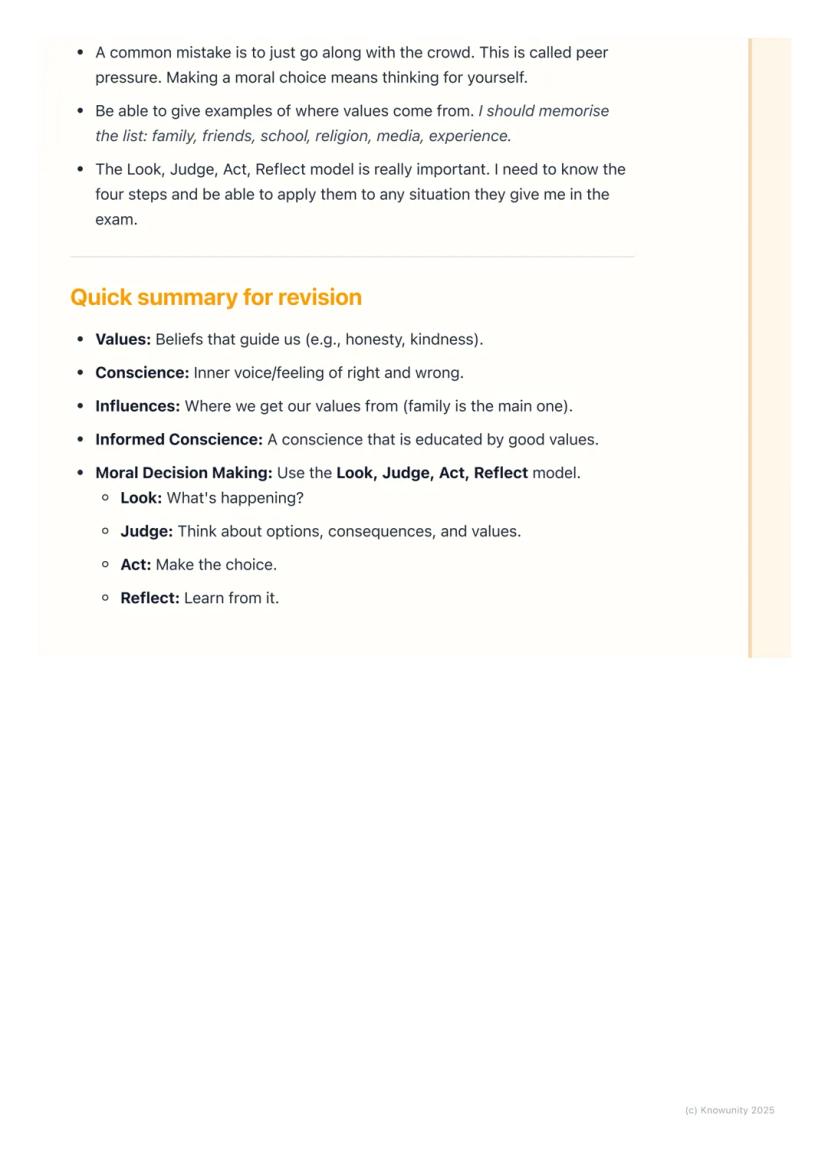
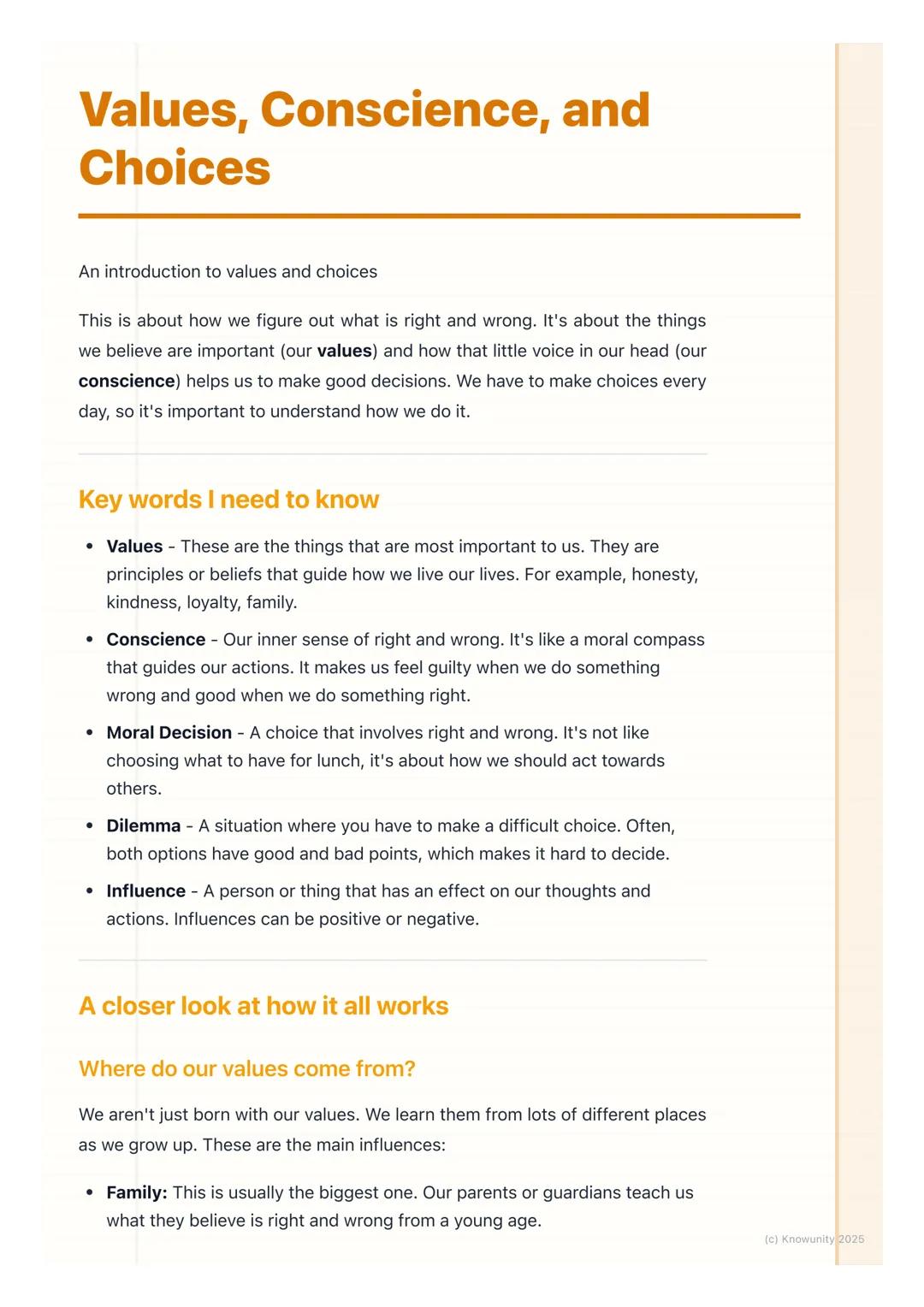
You're constantly making decisions, from small ones like what to wear to bigger ones about how to treat your mates. What guides these choices are your values - basically the principles that matter most to you, like honesty, kindness, or loyalty.
Your conscience is like your internal moral compass. It's that feeling that makes you squirm when you've done something dodgy, or gives you a warm feeling when you've helped someone out. Think of it as your brain's way of checking if your actions match up with your values.
When you face a moral decision - a choice about right and wrong - things can get tricky. Sometimes you'll face a dilemma where both options have pros and cons, making it dead hard to know what to do.
Remember: Your conscience isn't just a random feeling - it needs to be informed by learning about right and wrong from good sources like family, teachers, or your faith.
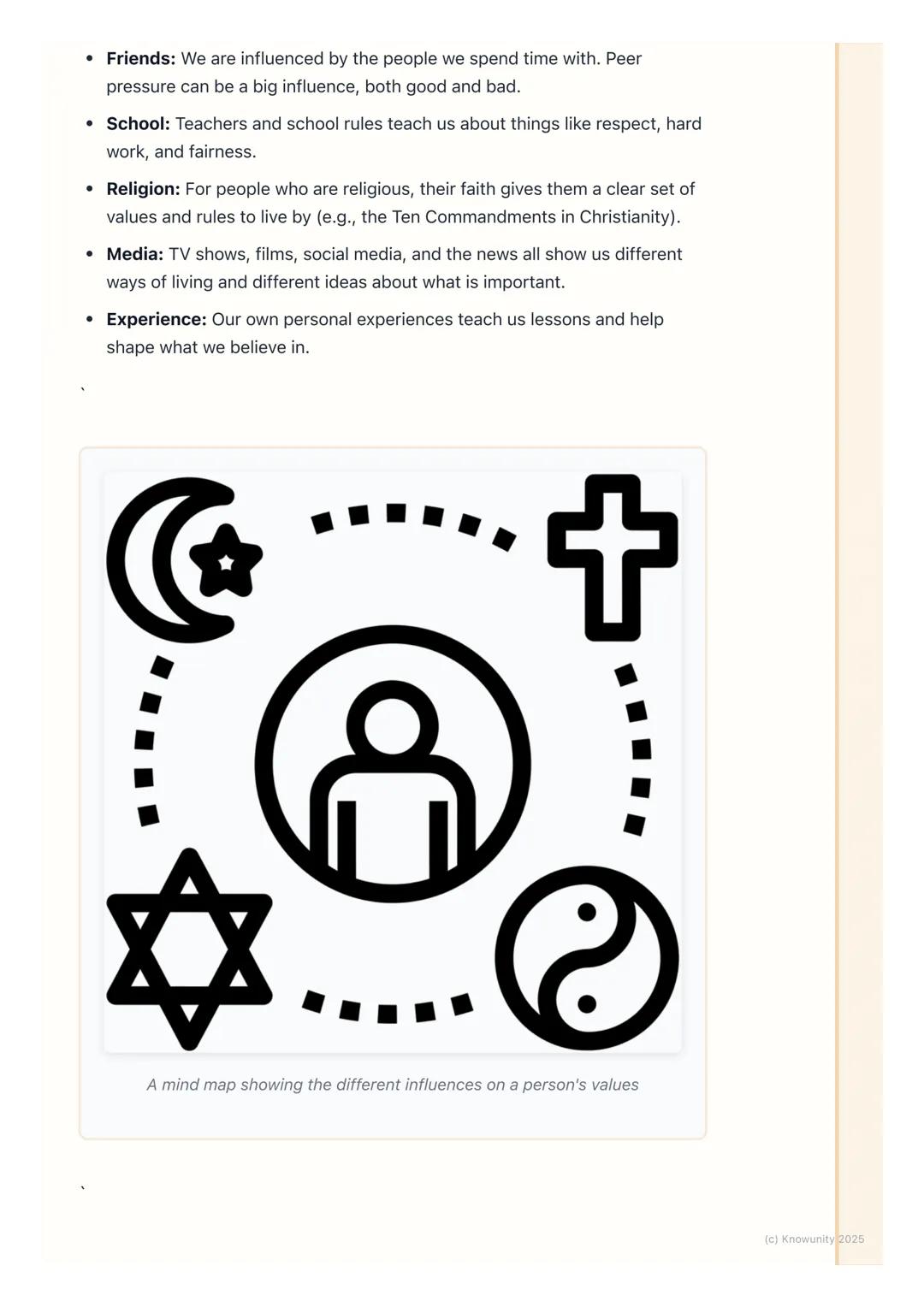
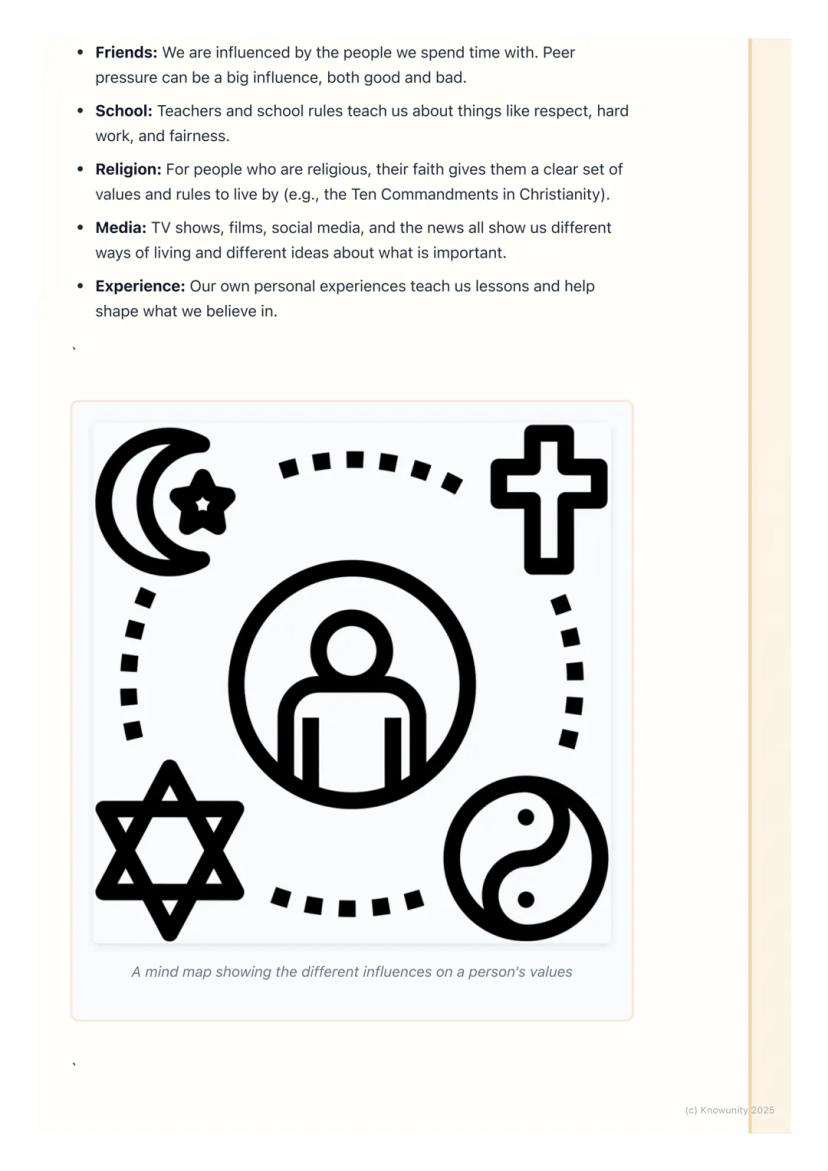
You weren't born knowing right from wrong - you picked it up along the way from loads of different influences. Your family is usually the biggest one, especially your parents or guardians who've been teaching you their beliefs since you were tiny.
Your friends have a massive impact too. Peer pressure can push you towards good or bad choices, depending on who you hang around with. School teaches you about respect, fairness, and working hard through rules and lessons.
For many people, religion provides clear guidelines about how to live. Media - everything from TikTok to Netflix - constantly shows you different ways of thinking about what's important. Plus, your own personal experiences teach you lessons that stick.
Top Tip: The strongest values usually come from multiple sources backing each other up - like when your family, school, and friends all value honesty.
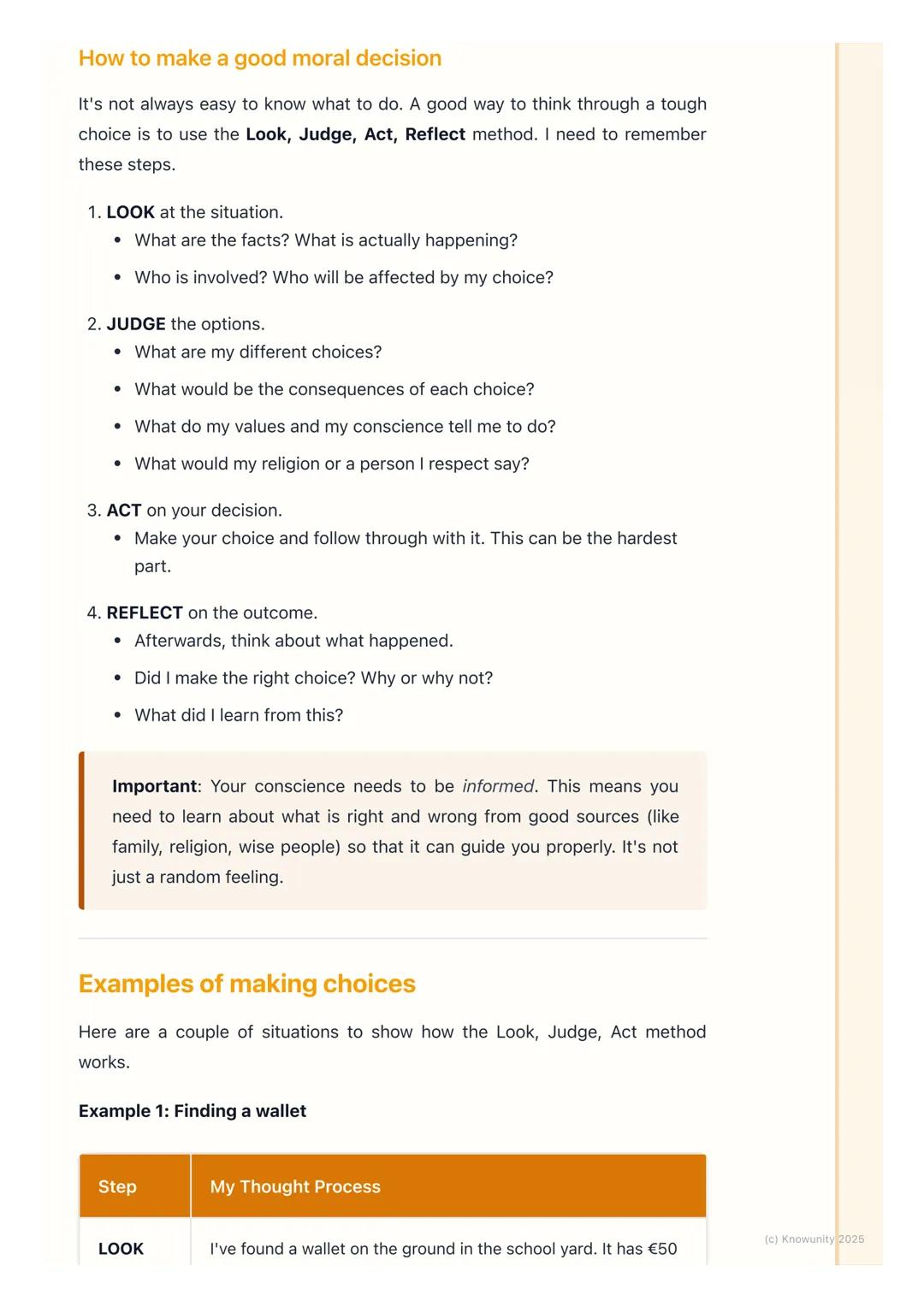
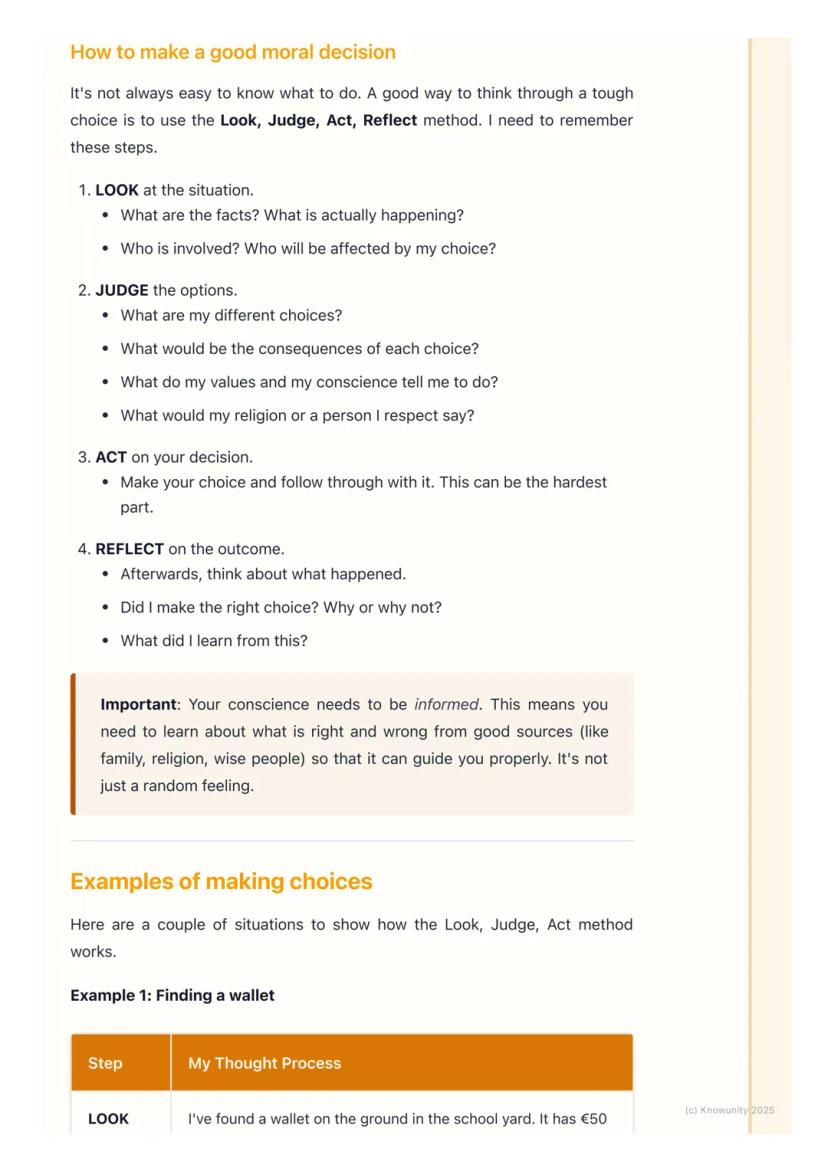
When you're facing a tough moral decision, don't just wing it. Use this four-step method that actually works:
LOOK at what's happening. Get the facts straight - who's involved, what's the actual situation, and who might be affected by your choice?
JUDGE your options. What could you do? What would happen with each choice? What do your values and conscience tell you? What would someone you respect advise?
ACT on your decision. This is often the hardest bit - actually following through with what you know is right, even when it's uncomfortable.
REFLECT afterwards. Did you make the right call? What did you learn? This helps your conscience get better at guiding you next time.
Key Point: Don't just say "my conscience told me" - explain WHY it told you that by linking it to your specific values.
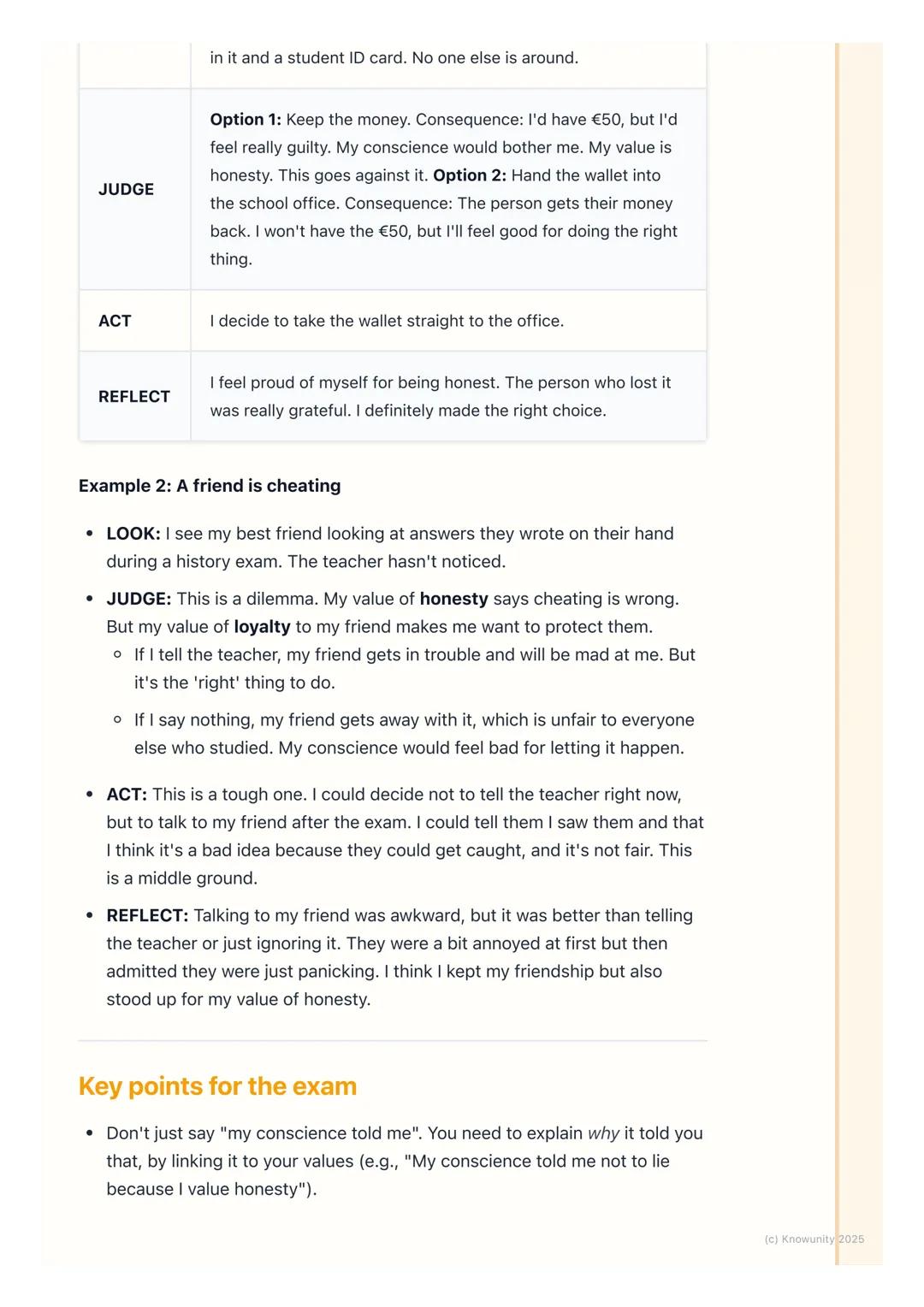
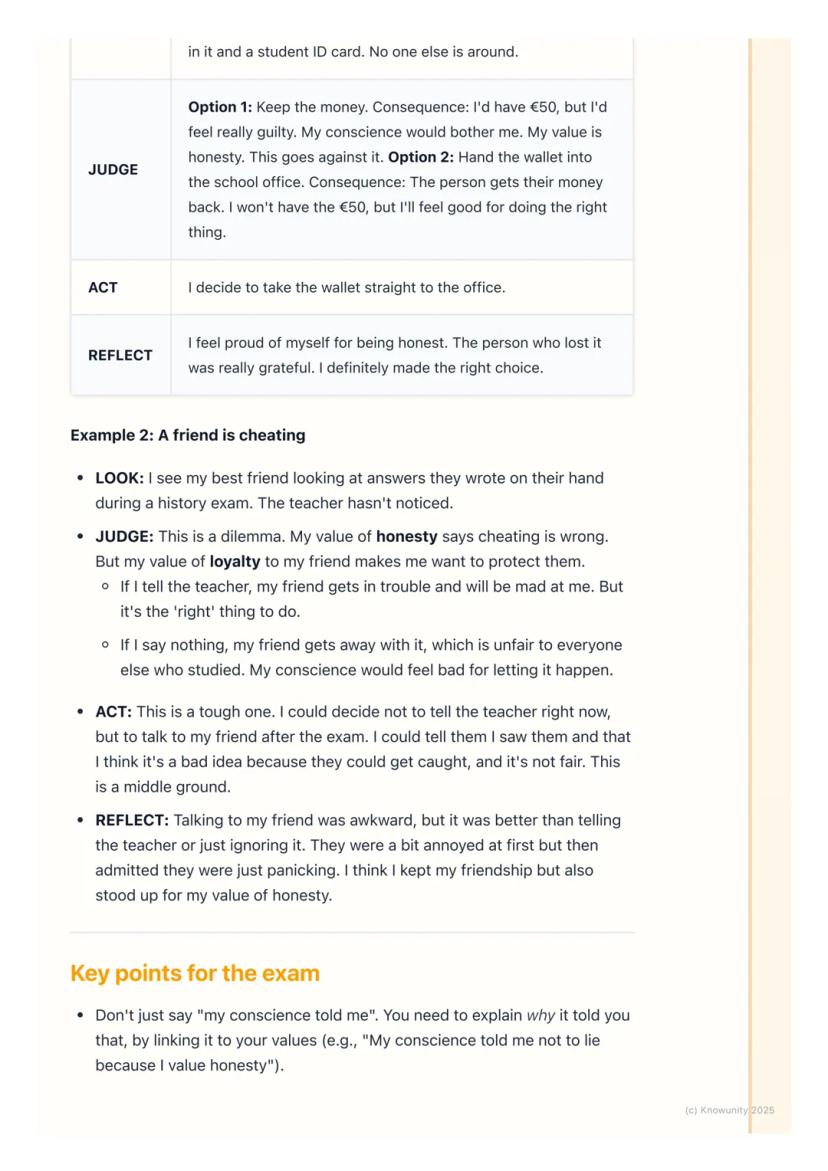
Let's say you find a wallet with €50 and someone's student ID. Using Look, Judge, Act, Reflect: You'd look at the facts (it's not yours), judge your options (keep it vs return it), think about your values (honesty), act (hand it in), then reflect (feel proud for doing right).
Here's a trickier one - spotting your mate cheating in an exam. This creates a dilemma between your values of honesty and loyalty. You might judge that telling the teacher would be harsh, but ignoring it feels wrong too. You could act by talking to your friend privately after the exam, then reflect on whether that balanced both values.
The key is thinking for yourself rather than just following the crowd. Peer pressure can be mental, but making a proper moral decision means using your own informed conscience.
Exam Success: Always explain your thinking process using the four steps, and link your choices back to specific values like honesty, fairness, or loyalty.
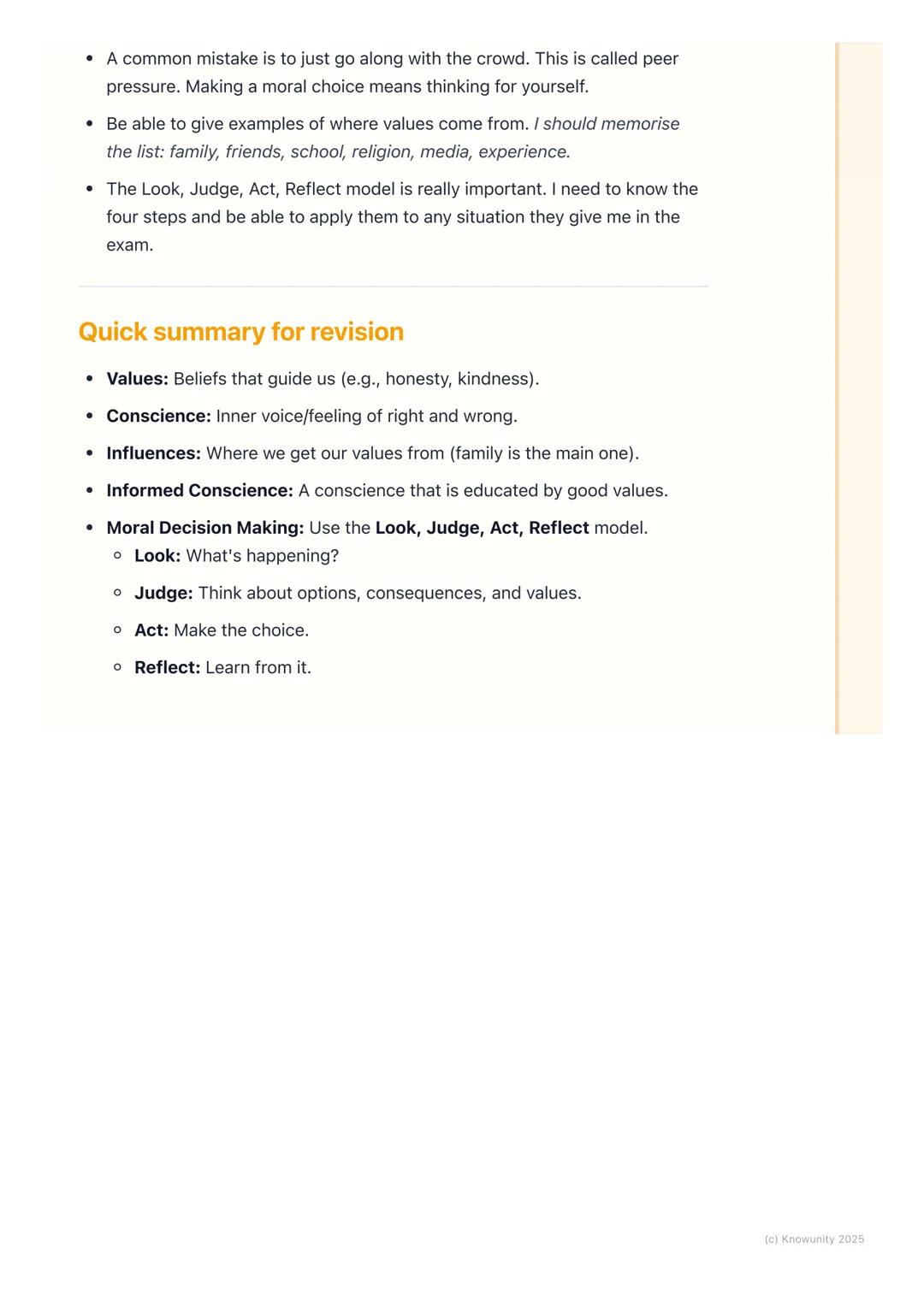
Your values are beliefs that guide you (like honesty or kindness), while your conscience is that inner voice of right and wrong. The main influences on your values are family, friends, school, religion, media, and personal experience - with family usually being the strongest.
An informed conscience means you've learned about right and wrong from reliable sources, not just random feelings. For any moral decision, use Look, Judge, Act, Reflect - know these four steps inside out.
Remember that dilemmas are normal when values clash, and peer pressure can push you away from what you know is right. The trick is learning to think for yourself whilst still listening to that inner voice.
Exam Strategy: Practice applying the Look, Judge, Act, Reflect model to different scenarios - it's guaranteed to come up and shows proper understanding of moral decision-making.
Our AI companion is specifically built for the needs of students. Based on the millions of content pieces we have on the platform we can provide truly meaningful and relevant answers to students. But its not only about answers, the companion is even more about guiding students through their daily learning challenges, with personalised study plans, quizzes or content pieces in the chat and 100% personalisation based on the students skills and developments.
You can download the app in the Google Play Store and in the Apple App Store.
That's right! Enjoy free access to study content, connect with fellow students, and get instant help – all at your fingertips.
App Store
Google Play
The app is very easy to use and well designed. I have found everything I was looking for so far and have been able to learn a lot from the presentations! I will definitely use the app for a class assignment! And of course it also helps a lot as an inspiration.
Stefan S
iOS user
This app is really great. There are so many study notes and help [...]. My problem subject is French, for example, and the app has so many options for help. Thanks to this app, I have improved my French. I would recommend it to anyone.
Samantha Klich
Android user
Wow, I am really amazed. I just tried the app because I've seen it advertised many times and was absolutely stunned. This app is THE HELP you want for school and above all, it offers so many things, such as workouts and fact sheets, which have been VERY helpful to me personally.
Anna
iOS user
I think it’s very much worth it and you’ll end up using it a lot once you get the hang of it and even after looking at others notes you can still ask your Artificial intelligence buddy the question and ask to simplify it if you still don’t get it!!! In the end I think it’s worth it 😊👍 ⚠️Also DID I MENTION ITS FREEE YOU DON’T HAVE TO PAY FOR ANYTHING AND STILL GET YOUR GRADES IN PERFECTLY❗️❗️⚠️
Thomas R
iOS user
Knowunity is the BEST app I’ve used in a minute. This is not an ai review or anything this is genuinely coming from a 7th grade student (I know 2011 im young) but dude this app is a 10/10 i have maintained a 3.8 gpa and have plenty of time for gaming. I love it and my mom is just happy I got good grades
Brad T
Android user
Not only did it help me find the answer but it also showed me alternative ways to solve it. I was horrible in math and science but now I have an a in both subjects. Thanks for the help🤍🤍
David K
iOS user
The app's just great! All I have to do is enter the topic in the search bar and I get the response real fast. I don't have to watch 10 YouTube videos to understand something, so I'm saving my time. Highly recommended!
Sudenaz Ocak
Android user
In school I was really bad at maths but thanks to the app, I am doing better now. I am so grateful that you made the app.
Greenlight Bonnie
Android user
I found this app a couple years ago and it has only gotten better since then. I really love it because it can help with written questions and photo questions. Also, it can find study guides that other people have made as well as flashcard sets and practice tests. The free version is also amazing for students who might not be able to afford it. Would 100% recommend
Aubrey
iOS user
Best app if you're in Highschool or Junior high. I have been using this app for 2 school years and it's the best, it's good if you don't have anyone to help you with school work.😋🩷🎀
Marco B
iOS user
THE QUIZES AND FLASHCARDS ARE SO USEFUL AND I LOVE Knowunity AI. IT ALSO IS LITREALLY LIKE CHATGPT BUT SMARTER!! HELPED ME WITH MY MASCARA PROBLEMS TOO!! AS WELL AS MY REAL SUBJECTS ! DUHHH 😍😁😲🤑💗✨🎀😮
Elisha
iOS user
This app is phenomenal down to the correct info and the various topics you can study! I greatly recommend it for people who struggle with procrastination and those who need homework help. It has been perfectly accurate for world 1 history as far as I’ve seen! Geometry too!
Paul T
iOS user
The app is very easy to use and well designed. I have found everything I was looking for so far and have been able to learn a lot from the presentations! I will definitely use the app for a class assignment! And of course it also helps a lot as an inspiration.
Stefan S
iOS user
This app is really great. There are so many study notes and help [...]. My problem subject is French, for example, and the app has so many options for help. Thanks to this app, I have improved my French. I would recommend it to anyone.
Samantha Klich
Android user
Wow, I am really amazed. I just tried the app because I've seen it advertised many times and was absolutely stunned. This app is THE HELP you want for school and above all, it offers so many things, such as workouts and fact sheets, which have been VERY helpful to me personally.
Anna
iOS user
I think it’s very much worth it and you’ll end up using it a lot once you get the hang of it and even after looking at others notes you can still ask your Artificial intelligence buddy the question and ask to simplify it if you still don’t get it!!! In the end I think it’s worth it 😊👍 ⚠️Also DID I MENTION ITS FREEE YOU DON’T HAVE TO PAY FOR ANYTHING AND STILL GET YOUR GRADES IN PERFECTLY❗️❗️⚠️
Thomas R
iOS user
Knowunity is the BEST app I’ve used in a minute. This is not an ai review or anything this is genuinely coming from a 7th grade student (I know 2011 im young) but dude this app is a 10/10 i have maintained a 3.8 gpa and have plenty of time for gaming. I love it and my mom is just happy I got good grades
Brad T
Android user
Not only did it help me find the answer but it also showed me alternative ways to solve it. I was horrible in math and science but now I have an a in both subjects. Thanks for the help🤍🤍
David K
iOS user
The app's just great! All I have to do is enter the topic in the search bar and I get the response real fast. I don't have to watch 10 YouTube videos to understand something, so I'm saving my time. Highly recommended!
Sudenaz Ocak
Android user
In school I was really bad at maths but thanks to the app, I am doing better now. I am so grateful that you made the app.
Greenlight Bonnie
Android user
I found this app a couple years ago and it has only gotten better since then. I really love it because it can help with written questions and photo questions. Also, it can find study guides that other people have made as well as flashcard sets and practice tests. The free version is also amazing for students who might not be able to afford it. Would 100% recommend
Aubrey
iOS user
Best app if you're in Highschool or Junior high. I have been using this app for 2 school years and it's the best, it's good if you don't have anyone to help you with school work.😋🩷🎀
Marco B
iOS user
THE QUIZES AND FLASHCARDS ARE SO USEFUL AND I LOVE Knowunity AI. IT ALSO IS LITREALLY LIKE CHATGPT BUT SMARTER!! HELPED ME WITH MY MASCARA PROBLEMS TOO!! AS WELL AS MY REAL SUBJECTS ! DUHHH 😍😁😲🤑💗✨🎀😮
Elisha
iOS user
This app is phenomenal down to the correct info and the various topics you can study! I greatly recommend it for people who struggle with procrastination and those who need homework help. It has been perfectly accurate for world 1 history as far as I’ve seen! Geometry too!
Paul T
iOS user
Ever wonder why that little voice in your head tells you what's right and wrong? This is all about understanding your values - the things that matter most to you - and how your consciencehelps you make good choices... Show more
Access to all documents
Improve your grades
Join milions of students
By signing up you accept Terms of Service and Privacy Policy
You're constantly making decisions, from small ones like what to wear to bigger ones about how to treat your mates. What guides these choices are your values - basically the principles that matter most to you, like honesty, kindness, or loyalty.
Your conscience is like your internal moral compass. It's that feeling that makes you squirm when you've done something dodgy, or gives you a warm feeling when you've helped someone out. Think of it as your brain's way of checking if your actions match up with your values.
When you face a moral decision - a choice about right and wrong - things can get tricky. Sometimes you'll face a dilemma where both options have pros and cons, making it dead hard to know what to do.
Remember: Your conscience isn't just a random feeling - it needs to be informed by learning about right and wrong from good sources like family, teachers, or your faith.
Access to all documents
Improve your grades
Join milions of students
By signing up you accept Terms of Service and Privacy Policy
You weren't born knowing right from wrong - you picked it up along the way from loads of different influences. Your family is usually the biggest one, especially your parents or guardians who've been teaching you their beliefs since you were tiny.
Your friends have a massive impact too. Peer pressure can push you towards good or bad choices, depending on who you hang around with. School teaches you about respect, fairness, and working hard through rules and lessons.
For many people, religion provides clear guidelines about how to live. Media - everything from TikTok to Netflix - constantly shows you different ways of thinking about what's important. Plus, your own personal experiences teach you lessons that stick.
Top Tip: The strongest values usually come from multiple sources backing each other up - like when your family, school, and friends all value honesty.
Access to all documents
Improve your grades
Join milions of students
By signing up you accept Terms of Service and Privacy Policy
When you're facing a tough moral decision, don't just wing it. Use this four-step method that actually works:
LOOK at what's happening. Get the facts straight - who's involved, what's the actual situation, and who might be affected by your choice?
JUDGE your options. What could you do? What would happen with each choice? What do your values and conscience tell you? What would someone you respect advise?
ACT on your decision. This is often the hardest bit - actually following through with what you know is right, even when it's uncomfortable.
REFLECT afterwards. Did you make the right call? What did you learn? This helps your conscience get better at guiding you next time.
Key Point: Don't just say "my conscience told me" - explain WHY it told you that by linking it to your specific values.
Access to all documents
Improve your grades
Join milions of students
By signing up you accept Terms of Service and Privacy Policy
Let's say you find a wallet with €50 and someone's student ID. Using Look, Judge, Act, Reflect: You'd look at the facts (it's not yours), judge your options (keep it vs return it), think about your values (honesty), act (hand it in), then reflect (feel proud for doing right).
Here's a trickier one - spotting your mate cheating in an exam. This creates a dilemma between your values of honesty and loyalty. You might judge that telling the teacher would be harsh, but ignoring it feels wrong too. You could act by talking to your friend privately after the exam, then reflect on whether that balanced both values.
The key is thinking for yourself rather than just following the crowd. Peer pressure can be mental, but making a proper moral decision means using your own informed conscience.
Exam Success: Always explain your thinking process using the four steps, and link your choices back to specific values like honesty, fairness, or loyalty.
Access to all documents
Improve your grades
Join milions of students
By signing up you accept Terms of Service and Privacy Policy
Your values are beliefs that guide you (like honesty or kindness), while your conscience is that inner voice of right and wrong. The main influences on your values are family, friends, school, religion, media, and personal experience - with family usually being the strongest.
An informed conscience means you've learned about right and wrong from reliable sources, not just random feelings. For any moral decision, use Look, Judge, Act, Reflect - know these four steps inside out.
Remember that dilemmas are normal when values clash, and peer pressure can push you away from what you know is right. The trick is learning to think for yourself whilst still listening to that inner voice.
Exam Strategy: Practice applying the Look, Judge, Act, Reflect model to different scenarios - it's guaranteed to come up and shows proper understanding of moral decision-making.
Our AI companion is specifically built for the needs of students. Based on the millions of content pieces we have on the platform we can provide truly meaningful and relevant answers to students. But its not only about answers, the companion is even more about guiding students through their daily learning challenges, with personalised study plans, quizzes or content pieces in the chat and 100% personalisation based on the students skills and developments.
You can download the app in the Google Play Store and in the Apple App Store.
That's right! Enjoy free access to study content, connect with fellow students, and get instant help – all at your fingertips.
0
Smart Tools NEW
Transform this note into: ✓ 50+ Practice Questions ✓ Interactive Flashcards ✓ Full Practice Test ✓ Essay Outlines
App Store
Google Play
The app is very easy to use and well designed. I have found everything I was looking for so far and have been able to learn a lot from the presentations! I will definitely use the app for a class assignment! And of course it also helps a lot as an inspiration.
Stefan S
iOS user
This app is really great. There are so many study notes and help [...]. My problem subject is French, for example, and the app has so many options for help. Thanks to this app, I have improved my French. I would recommend it to anyone.
Samantha Klich
Android user
Wow, I am really amazed. I just tried the app because I've seen it advertised many times and was absolutely stunned. This app is THE HELP you want for school and above all, it offers so many things, such as workouts and fact sheets, which have been VERY helpful to me personally.
Anna
iOS user
I think it’s very much worth it and you’ll end up using it a lot once you get the hang of it and even after looking at others notes you can still ask your Artificial intelligence buddy the question and ask to simplify it if you still don’t get it!!! In the end I think it’s worth it 😊👍 ⚠️Also DID I MENTION ITS FREEE YOU DON’T HAVE TO PAY FOR ANYTHING AND STILL GET YOUR GRADES IN PERFECTLY❗️❗️⚠️
Thomas R
iOS user
Knowunity is the BEST app I’ve used in a minute. This is not an ai review or anything this is genuinely coming from a 7th grade student (I know 2011 im young) but dude this app is a 10/10 i have maintained a 3.8 gpa and have plenty of time for gaming. I love it and my mom is just happy I got good grades
Brad T
Android user
Not only did it help me find the answer but it also showed me alternative ways to solve it. I was horrible in math and science but now I have an a in both subjects. Thanks for the help🤍🤍
David K
iOS user
The app's just great! All I have to do is enter the topic in the search bar and I get the response real fast. I don't have to watch 10 YouTube videos to understand something, so I'm saving my time. Highly recommended!
Sudenaz Ocak
Android user
In school I was really bad at maths but thanks to the app, I am doing better now. I am so grateful that you made the app.
Greenlight Bonnie
Android user
I found this app a couple years ago and it has only gotten better since then. I really love it because it can help with written questions and photo questions. Also, it can find study guides that other people have made as well as flashcard sets and practice tests. The free version is also amazing for students who might not be able to afford it. Would 100% recommend
Aubrey
iOS user
Best app if you're in Highschool or Junior high. I have been using this app for 2 school years and it's the best, it's good if you don't have anyone to help you with school work.😋🩷🎀
Marco B
iOS user
THE QUIZES AND FLASHCARDS ARE SO USEFUL AND I LOVE Knowunity AI. IT ALSO IS LITREALLY LIKE CHATGPT BUT SMARTER!! HELPED ME WITH MY MASCARA PROBLEMS TOO!! AS WELL AS MY REAL SUBJECTS ! DUHHH 😍😁😲🤑💗✨🎀😮
Elisha
iOS user
This app is phenomenal down to the correct info and the various topics you can study! I greatly recommend it for people who struggle with procrastination and those who need homework help. It has been perfectly accurate for world 1 history as far as I’ve seen! Geometry too!
Paul T
iOS user
The app is very easy to use and well designed. I have found everything I was looking for so far and have been able to learn a lot from the presentations! I will definitely use the app for a class assignment! And of course it also helps a lot as an inspiration.
Stefan S
iOS user
This app is really great. There are so many study notes and help [...]. My problem subject is French, for example, and the app has so many options for help. Thanks to this app, I have improved my French. I would recommend it to anyone.
Samantha Klich
Android user
Wow, I am really amazed. I just tried the app because I've seen it advertised many times and was absolutely stunned. This app is THE HELP you want for school and above all, it offers so many things, such as workouts and fact sheets, which have been VERY helpful to me personally.
Anna
iOS user
I think it’s very much worth it and you’ll end up using it a lot once you get the hang of it and even after looking at others notes you can still ask your Artificial intelligence buddy the question and ask to simplify it if you still don’t get it!!! In the end I think it’s worth it 😊👍 ⚠️Also DID I MENTION ITS FREEE YOU DON’T HAVE TO PAY FOR ANYTHING AND STILL GET YOUR GRADES IN PERFECTLY❗️❗️⚠️
Thomas R
iOS user
Knowunity is the BEST app I’ve used in a minute. This is not an ai review or anything this is genuinely coming from a 7th grade student (I know 2011 im young) but dude this app is a 10/10 i have maintained a 3.8 gpa and have plenty of time for gaming. I love it and my mom is just happy I got good grades
Brad T
Android user
Not only did it help me find the answer but it also showed me alternative ways to solve it. I was horrible in math and science but now I have an a in both subjects. Thanks for the help🤍🤍
David K
iOS user
The app's just great! All I have to do is enter the topic in the search bar and I get the response real fast. I don't have to watch 10 YouTube videos to understand something, so I'm saving my time. Highly recommended!
Sudenaz Ocak
Android user
In school I was really bad at maths but thanks to the app, I am doing better now. I am so grateful that you made the app.
Greenlight Bonnie
Android user
I found this app a couple years ago and it has only gotten better since then. I really love it because it can help with written questions and photo questions. Also, it can find study guides that other people have made as well as flashcard sets and practice tests. The free version is also amazing for students who might not be able to afford it. Would 100% recommend
Aubrey
iOS user
Best app if you're in Highschool or Junior high. I have been using this app for 2 school years and it's the best, it's good if you don't have anyone to help you with school work.😋🩷🎀
Marco B
iOS user
THE QUIZES AND FLASHCARDS ARE SO USEFUL AND I LOVE Knowunity AI. IT ALSO IS LITREALLY LIKE CHATGPT BUT SMARTER!! HELPED ME WITH MY MASCARA PROBLEMS TOO!! AS WELL AS MY REAL SUBJECTS ! DUHHH 😍😁😲🤑💗✨🎀😮
Elisha
iOS user
This app is phenomenal down to the correct info and the various topics you can study! I greatly recommend it for people who struggle with procrastination and those who need homework help. It has been perfectly accurate for world 1 history as far as I’ve seen! Geometry too!
Paul T
iOS user