
"Mo Ghrá-sa (Idir Lúibíní)" by Nuala Ní Dhomhnaill is a...
 Irish38 views·Updated 12 Jul 2026·5 pages
Tuiscint ar Mo Ghrá-sa (Idir Lúibíní)
C
Cayla Martin@caylamartin
1 / 5
1
of 5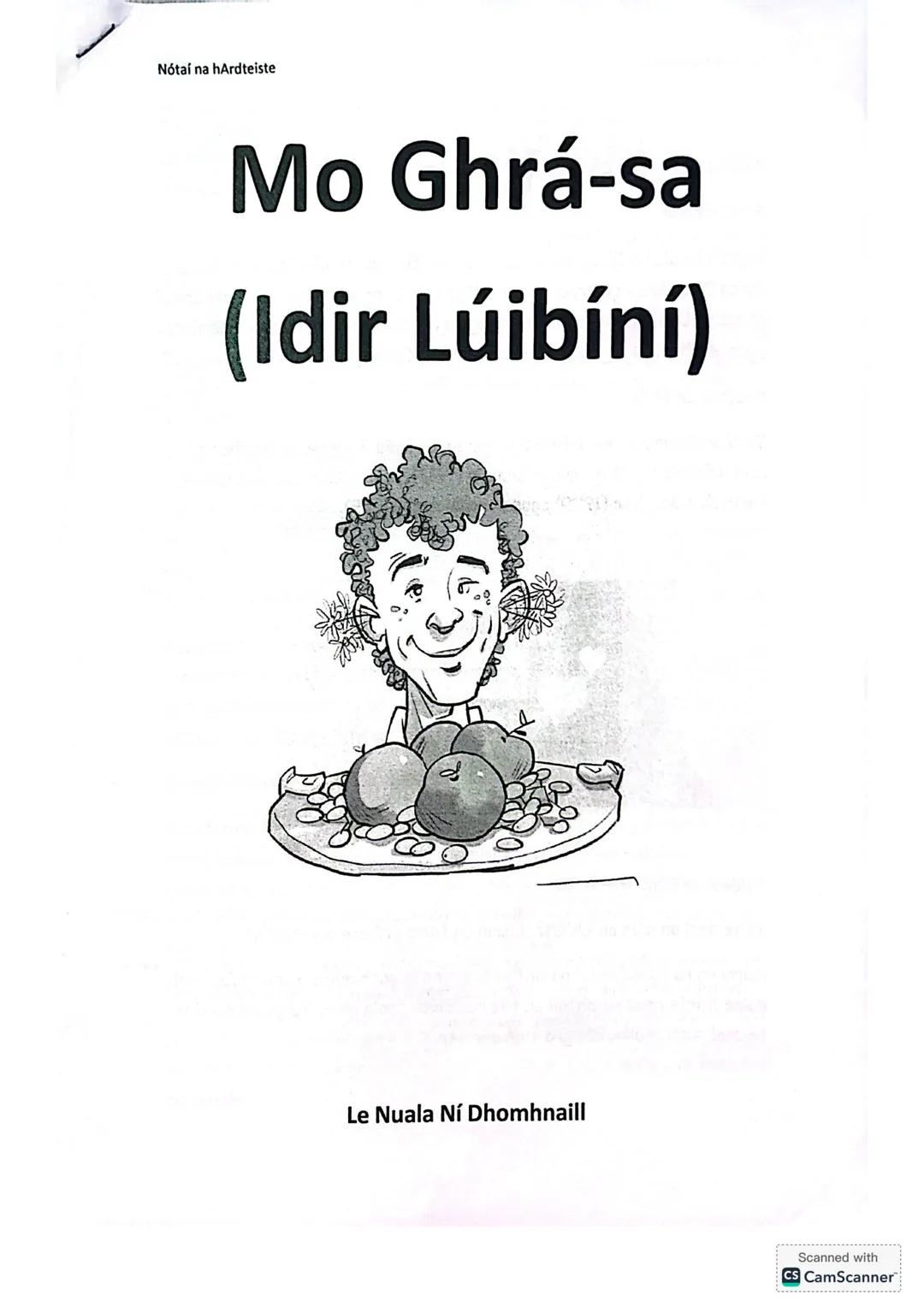
Introduction to "Mo Ghrá-sa (Idir Lúibíní)"
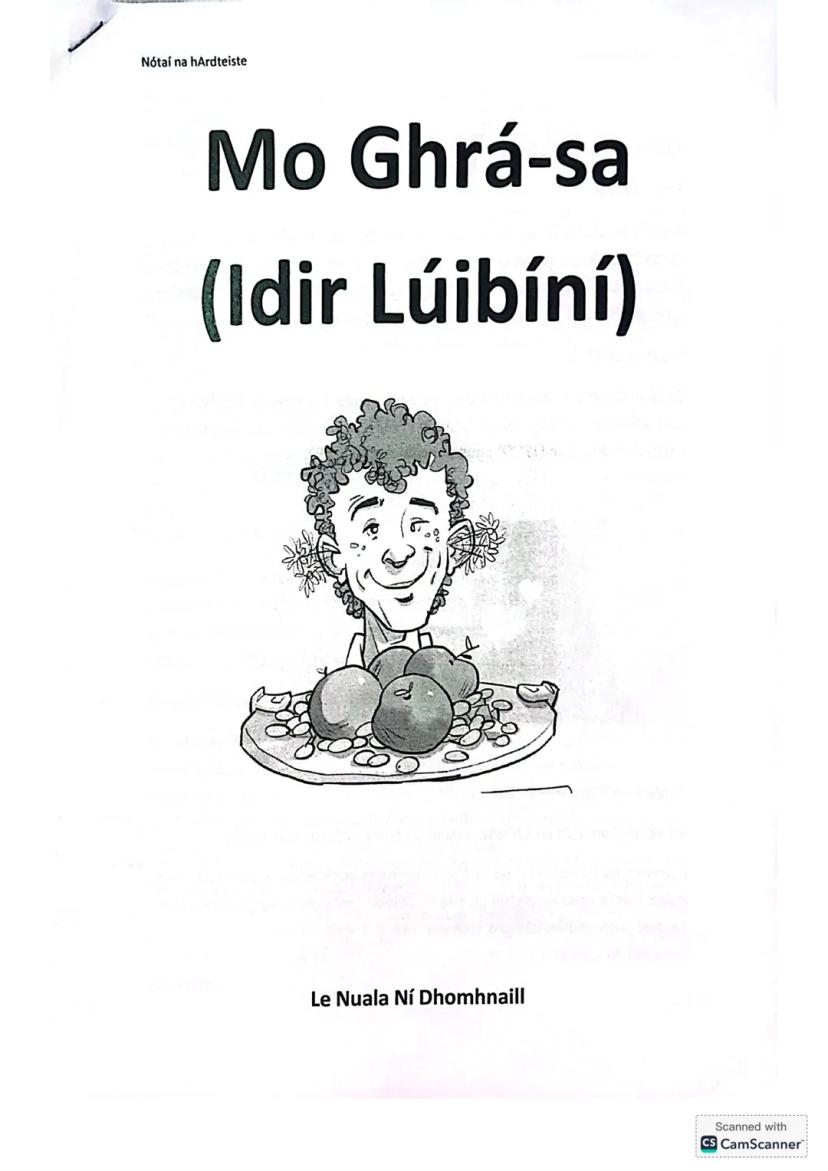
"Mo Ghrá-sa (Idir Lúibíní)" or "My Love (Between Brackets)" is a modern Irish poem by acclaimed poet Nuala Ní Dhomhnaill. The poem offers a unique take on traditional love poetry, with the title itself suggesting something unconventional about the love being described.
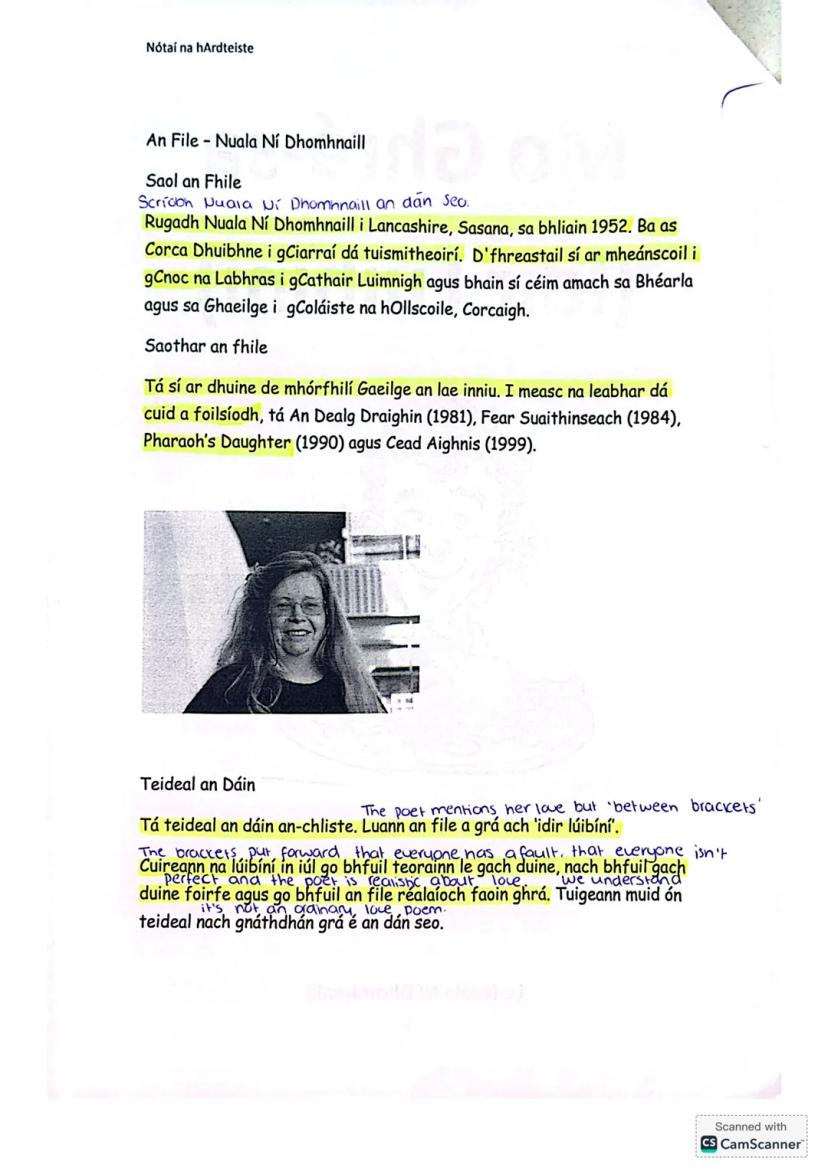
Born in Lancashire, England in 1952 to parents from Corca Dhuibhne in Kerry, Ní Dhomhnaill is considered one of today's most significant Irish-language poets. She was educated in Limerick and later studied English and Irish at University College Cork.
Key insight: The poem's title cleverly signals to readers that this isn't an ordinary love poem. The brackets suggest limitations and realism in love - acknowledging that nobody is perfect.
Her notable published works include "An Dealg Draighin" (1981), "Fear Suaithinseach" (1984), "Pharaoh's Daughter" (1990), and "Cead Aighnis" (1999).
2
of 5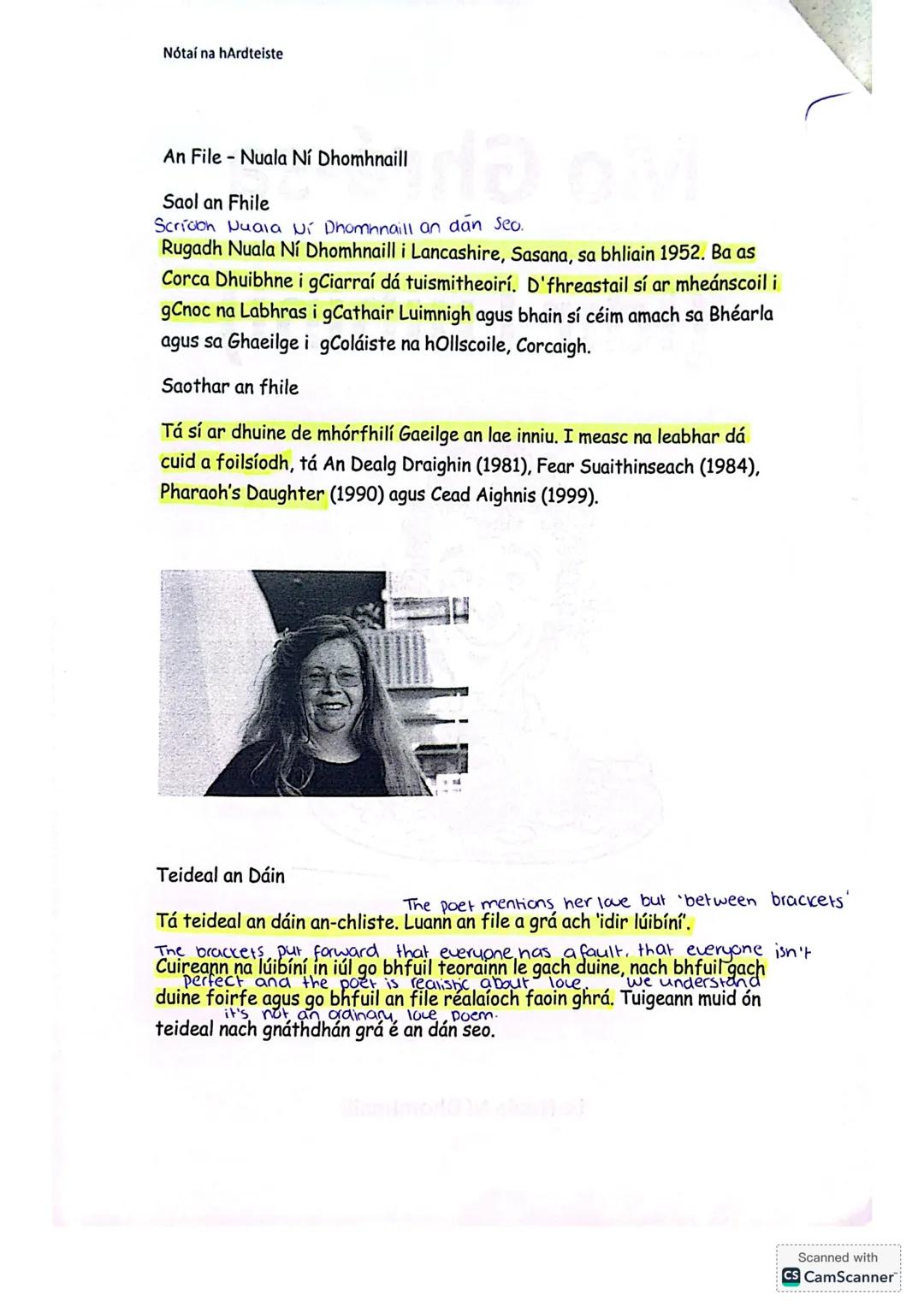
The Significance of Brackets
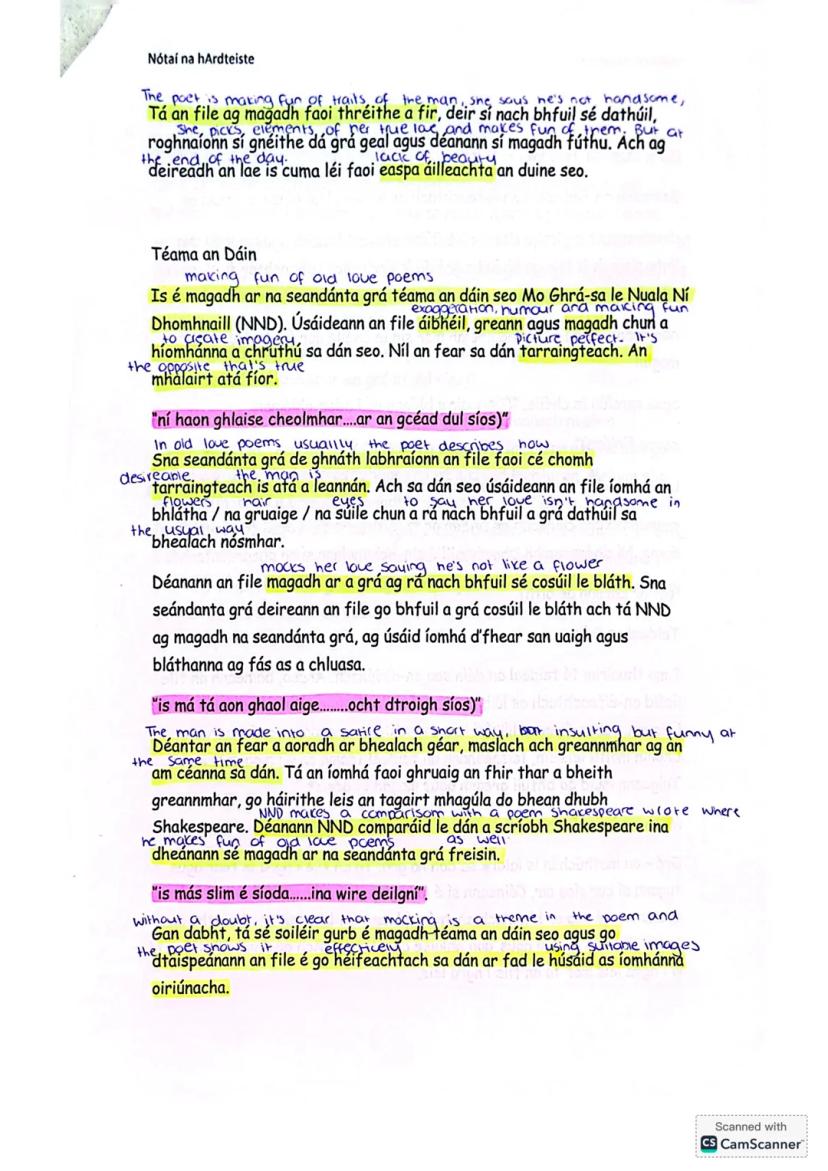
The brackets in the title serve multiple clever purposes that enhance the poem's meaning. They allow the poet to add depth to her expressions of love while maintaining a playful, sarcastic tone throughout the work.
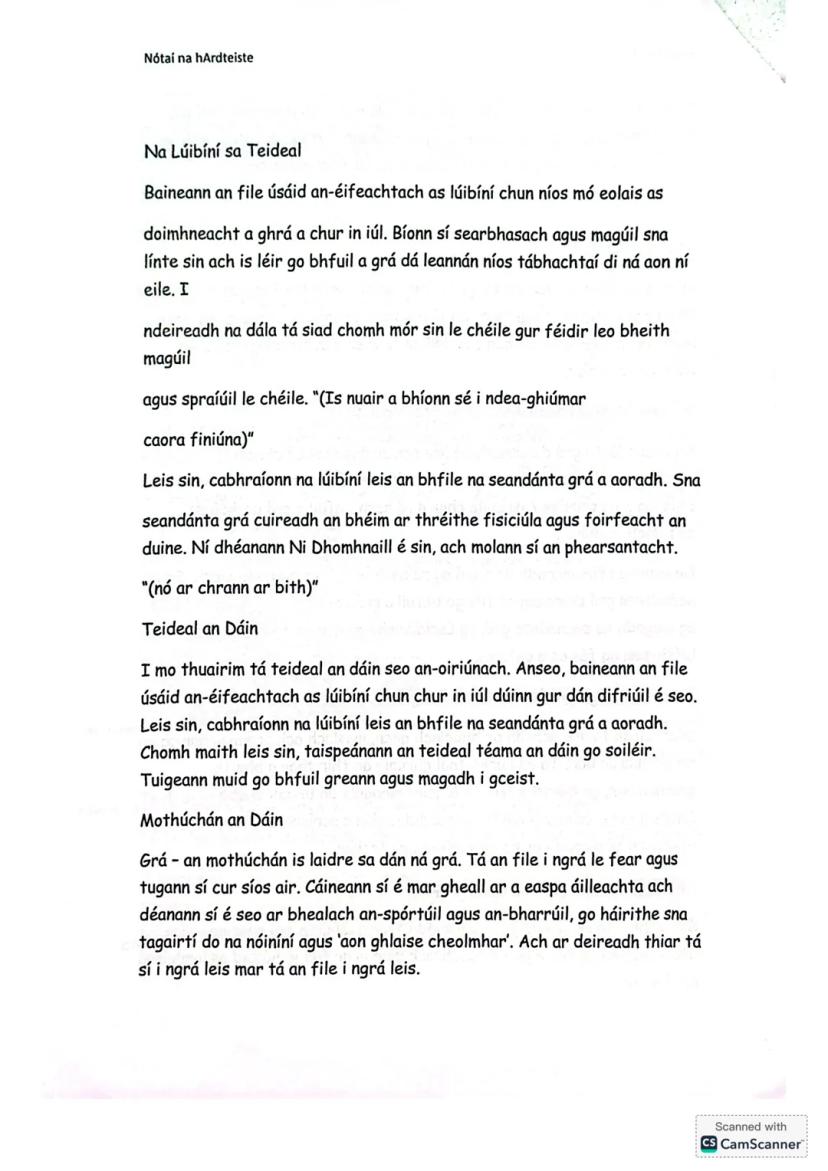
The bracketed sections reveal how comfortable the lovers are with each other. Lines like "(Is nuair a bhíonn sé i ndea-ghiúmar caora finiúna)" (And when he's in a good mood, grapes) show they can be teasing and playful together, indicating a deep connection beyond superficial attraction.
Significantly, the brackets help Ní Dhomhnaill parody traditional love poetry. While classic love poems often focused on physical traits and perfection, this poem celebrates personality instead. The line "(nó ar chrann ar bith)" (or on any tree) demonstrates this playful subversion.
Remember this: The brackets aren't just stylistic choices - they're critical to understanding how the poem challenges conventional love poetry traditions while creating a more authentic portrayal of modern relationships.
3
of 5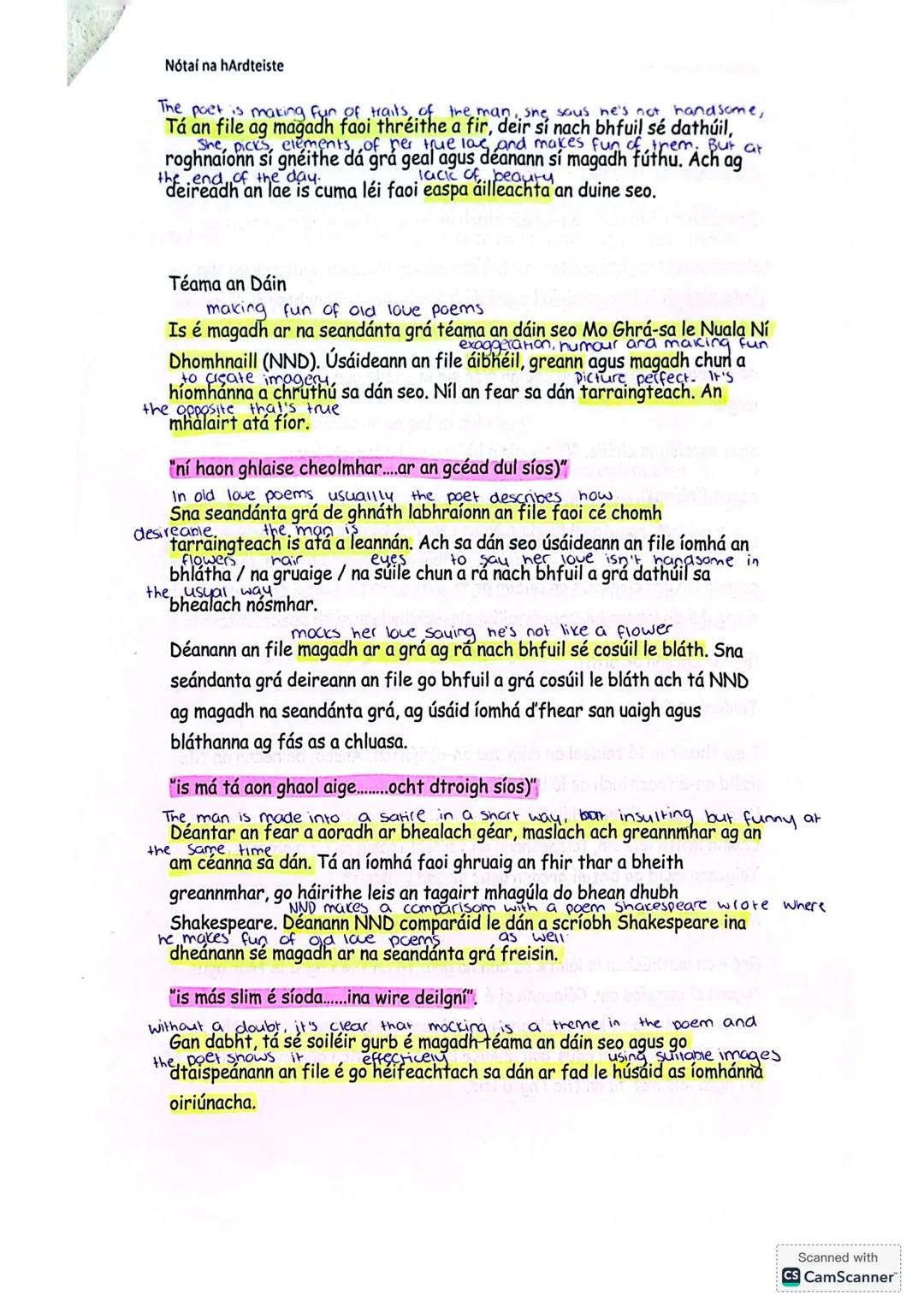
Emotional Depth and Humour
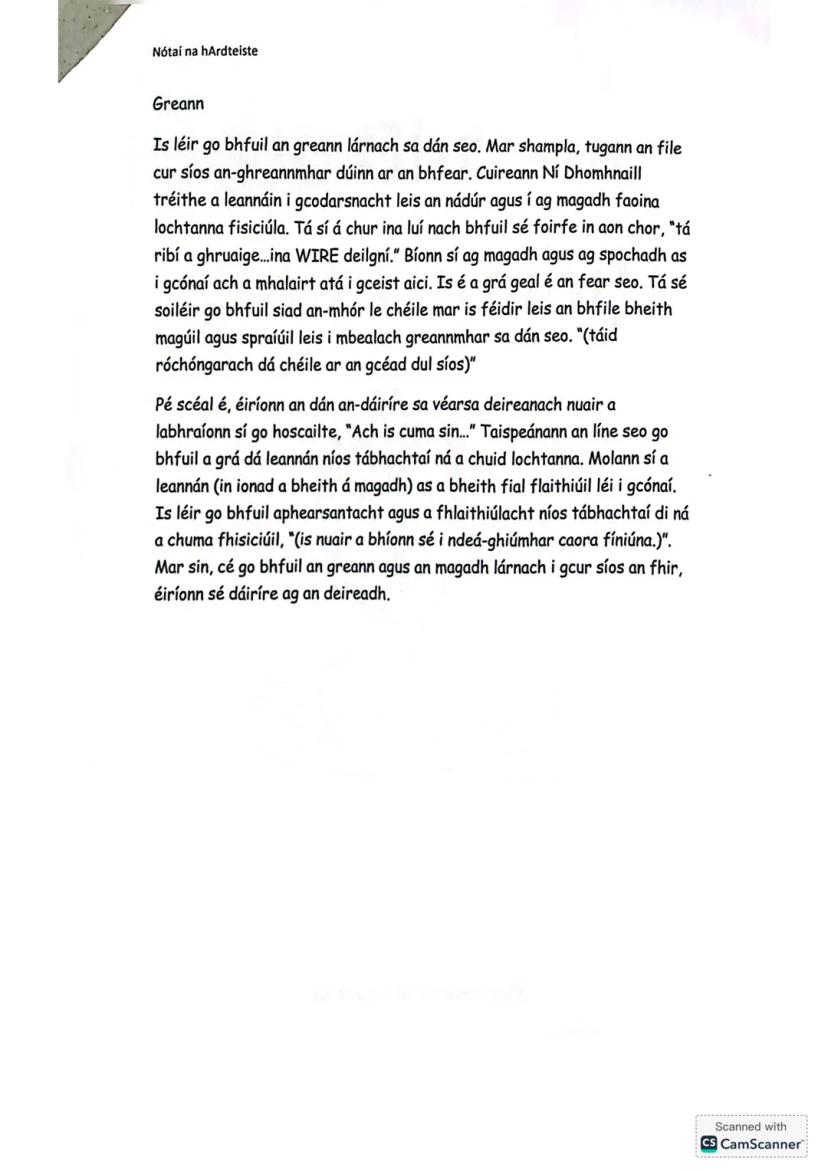
Love is clearly the strongest emotion in this poem. Ní Dhomhnaill describes a man she loves, yet she criticizes his lack of beauty in a playful, humorous manner. Her references to daisies and "any musical greenery" are particularly amusing and showcase her wit.
Humour functions as a central element throughout the poem. The poet provides entertaining descriptions of her lover by contrasting his features with nature, mocking his physical flaws. She emphasizes his imperfections with vivid imagery: "the strands of his hair...like a WIRE of thorns."
The brackets enhance this playfulness, allowing for asides that add depth to the poet's expressions. When she writes "(táid róchóngarach dá chéile ar an gcéad dul síos)" (they're too close together in the first place), we see the comfortable, teasing relationship they share.
Worth noting: Despite all the teasing, the poem ultimately reveals that the poet's love for her partner matters more than any physical imperfections - showing that Ní Dhomhnaill values personality and character over appearance.
4
of 5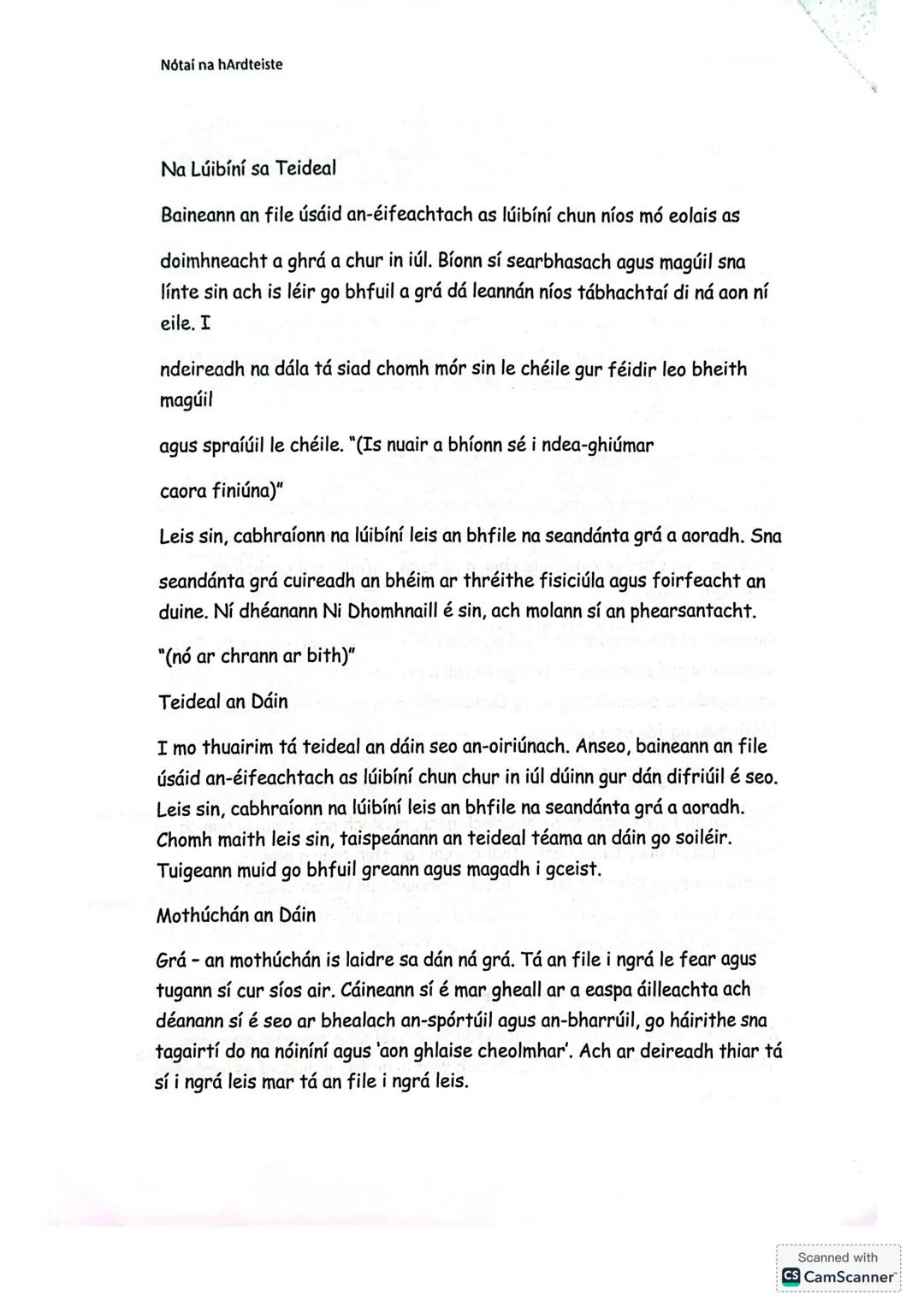
Balancing Humour and Sincerity
Humour serves as the backbone of this poem, particularly in the poet's descriptions of her beloved. Ní Dhomhnaill creates amusing contrasts between her partner and nature, poking fun at his physical flaws while actually expressing deep affection.
The poem takes a serious turn in the final verse with the line "Ach is cuma sin..." (But that doesn't matter...). This pivotal moment shows that her love transcends any imperfections she's previously described. She praises her partner for his generosity and kindness toward her, revealing that personality and generosity matter far more than physical appearance.
The line "(is nuair a bhíonn sé i ndeá-ghiúmhar caora fíniúna)" (and when he's in a good mood, grapes) demonstrates how she values his personality traits. Even while maintaining the humorous bracketed format, she communicates sincere appreciation.
Think about this: Notice how the poem moves from playful mockery to heartfelt sincerity - this structure mirrors real relationships where teasing and deep affection often exist side by side. The final message emphasizes that true love appreciates the whole person, imperfections and all.
5
of 5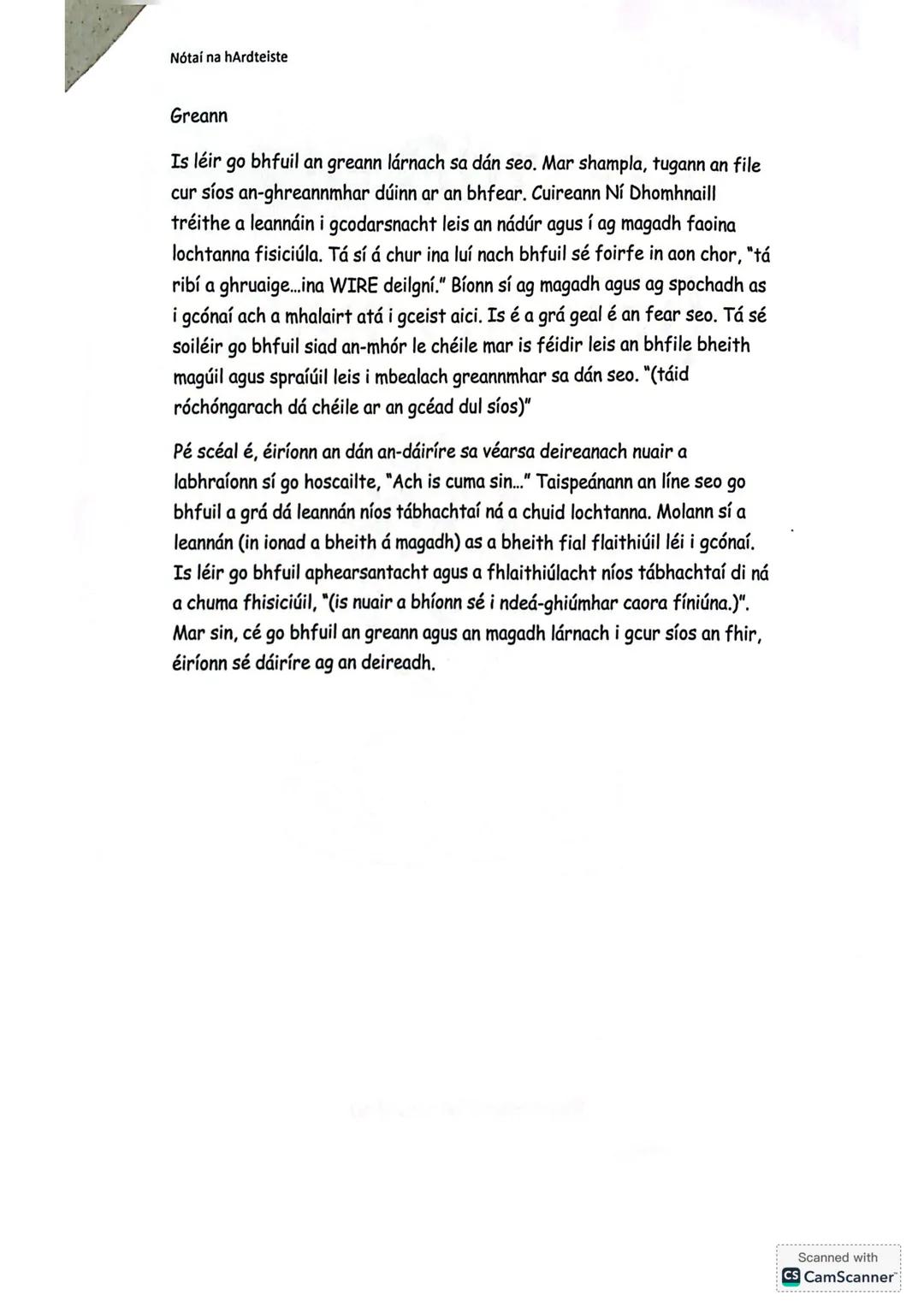
We thought you’d never ask...
Our AI companion is specifically built for the needs of students. Based on the millions of content pieces we have on the platform we can provide truly meaningful and relevant answers to students. But its not only about answers, the companion is even more about guiding students through their daily learning challenges, with personalised study plans, quizzes or content pieces in the chat and 100% personalisation based on the students skills and developments.
You can download the app in the Google Play Store and in the Apple App Store.
That's right! Enjoy free access to study content, connect with fellow students, and get instant help – all at your fingertips.
Most popular content in Irish
9IrishIníon- le hÁine Durkin
Aine Durkin’s poem, Iníon: Themes & summary
5th Year890
IrishIrish oral questions and answers
Questions and answers for the leaving cert oral
5th Year4274
IrishAn Gaeilge Aiste
Irish Language essay
6th Year1320
IrishLC HL notes- Iníon (poem)
Includes poem in English and Irish, theme, key words & phrases
5th Year2324
IrishIrish poetry 2027
Iníon + Dínit an Bhróin
5th Year1153
IrishMo Ghra-sa notes
Notes on the Irish poem Mo ghra sa includes notes on the poet, images, themes and many more
6th Year492
IrishIrish oral questions
Outline of oral questions
5th Year2055
IrishIrish notes- Jeaic ar scoil (poem)
Includes the poem in English & Irish, exam style answers
1st Year1174
IrishDialann (Diary Entries)
Students will practice writing about daily events, personal thoughts, and feelings in a diary format. This encourages reflective writing in Irish.
TY60
Most popular content
9 English
Key Quotes : Sive
Key Quotes and explanations: Sive
6th Year2852
 Physics
Balanced and Unbalanced Forces
Students will explore how balanced forces result in no change in motion, while unbalanced forces cause an object to accelerate or change direction.
2nd Year592
IrishIníon- le hÁine Durkin
Aine Durkin’s poem, Iníon: Themes & summary
5th Year890
IrishIrish oral questions and answers
Questions and answers for the leaving cert oral
5th Year4274
EnglishCultural Context : Shawshank Redemption : Sive : Small Things Like These
Comparative Study : Cultural Context : Shawshank Redemption, Sive and Small Things Like These
6th Year1430
EnglishElizabeth Bishop notes
Elizabeth Bishop notes
6th Year1271
PhysicsTypes of Forces
Students will identify common forces such as gravity (pulling objects down), friction (opposing motion), and air resistance (slowing objects in the air).
2nd Year580
IrishAn Gaeilge Aiste
Irish Language essay
6th Year1320
IrishLC HL notes- Iníon (poem)
Includes poem in English and Irish, theme, key words & phrases
5th Year2324
Students love us — and so will you.
4.6/5App Store
4.7/5Google Play
The app is very easy to use and well designed. I have found everything I was looking for so far and have been able to learn a lot from the presentations! I will definitely use the app for a class assignment! And of course it also helps a lot as an inspiration.
Stefan SiOS user
This app is really great. There are so many study notes and help [...]. My problem subject is French, for example, and the app has so many options for help. Thanks to this app, I have improved my French. I would recommend it to anyone.
Samantha KlichAndroid user
Wow, I am really amazed. I just tried the app because I've seen it advertised many times and was absolutely stunned. This app is THE HELP you want for school and above all, it offers so many things, such as workouts and fact sheets, which have been VERY helpful to me personally.
AnnaiOS user
Irish38 views·Updated 12 Jul 2026·5 pagesTuiscint ar Mo Ghrá-sa (Idir Lúibíní)
C
Cayla Martin@caylamartin
"Mo Ghrá-sa (Idir Lúibíní)" by Nuala Ní Dhomhnaill is a clever, unconventional love poem that plays with traditional romantic poetry conventions. Through humorous brackets and realistic descriptions, the poet creates a refreshingly honest portrayal of love that celebrates personality over...
1
of 5
Sign up to see the content. It's free!
- Access to all documents
- Improve your grades
- Join milions of students
By signing up you accept Terms of Service and Privacy Policy
Introduction to "Mo Ghrá-sa (Idir Lúibíní)"
"Mo Ghrá-sa (Idir Lúibíní)" or "My Love (Between Brackets)" is a modern Irish poem by acclaimed poet Nuala Ní Dhomhnaill. The poem offers a unique take on traditional love poetry, with the title itself suggesting something unconventional about the love being described.
Born in Lancashire, England in 1952 to parents from Corca Dhuibhne in Kerry, Ní Dhomhnaill is considered one of today's most significant Irish-language poets. She was educated in Limerick and later studied English and Irish at University College Cork.
Key insight: The poem's title cleverly signals to readers that this isn't an ordinary love poem. The brackets suggest limitations and realism in love - acknowledging that nobody is perfect.
Her notable published works include "An Dealg Draighin" (1981), "Fear Suaithinseach" (1984), "Pharaoh's Daughter" (1990), and "Cead Aighnis" (1999).
2
of 5Sign up to see the content. It's free!
- Access to all documents
- Improve your grades
- Join milions of students
By signing up you accept Terms of Service and Privacy Policy
The Significance of Brackets
The brackets in the title serve multiple clever purposes that enhance the poem's meaning. They allow the poet to add depth to her expressions of love while maintaining a playful, sarcastic tone throughout the work.
The bracketed sections reveal how comfortable the lovers are with each other. Lines like "(Is nuair a bhíonn sé i ndea-ghiúmar caora finiúna)" (And when he's in a good mood, grapes) show they can be teasing and playful together, indicating a deep connection beyond superficial attraction.
Significantly, the brackets help Ní Dhomhnaill parody traditional love poetry. While classic love poems often focused on physical traits and perfection, this poem celebrates personality instead. The line "(nó ar chrann ar bith)" (or on any tree) demonstrates this playful subversion.
Remember this: The brackets aren't just stylistic choices - they're critical to understanding how the poem challenges conventional love poetry traditions while creating a more authentic portrayal of modern relationships.
3
of 5Sign up to see the content. It's free!
- Access to all documents
- Improve your grades
- Join milions of students
By signing up you accept Terms of Service and Privacy Policy
Emotional Depth and Humour
Love is clearly the strongest emotion in this poem. Ní Dhomhnaill describes a man she loves, yet she criticizes his lack of beauty in a playful, humorous manner. Her references to daisies and "any musical greenery" are particularly amusing and showcase her wit.
Humour functions as a central element throughout the poem. The poet provides entertaining descriptions of her lover by contrasting his features with nature, mocking his physical flaws. She emphasizes his imperfections with vivid imagery: "the strands of his hair...like a WIRE of thorns."
The brackets enhance this playfulness, allowing for asides that add depth to the poet's expressions. When she writes "(táid róchóngarach dá chéile ar an gcéad dul síos)" (they're too close together in the first place), we see the comfortable, teasing relationship they share.
Worth noting: Despite all the teasing, the poem ultimately reveals that the poet's love for her partner matters more than any physical imperfections - showing that Ní Dhomhnaill values personality and character over appearance.
4
of 5Sign up to see the content. It's free!
- Access to all documents
- Improve your grades
- Join milions of students
By signing up you accept Terms of Service and Privacy Policy
Balancing Humour and Sincerity
Humour serves as the backbone of this poem, particularly in the poet's descriptions of her beloved. Ní Dhomhnaill creates amusing contrasts between her partner and nature, poking fun at his physical flaws while actually expressing deep affection.
The poem takes a serious turn in the final verse with the line "Ach is cuma sin..." (But that doesn't matter...). This pivotal moment shows that her love transcends any imperfections she's previously described. She praises her partner for his generosity and kindness toward her, revealing that personality and generosity matter far more than physical appearance.
The line "(is nuair a bhíonn sé i ndeá-ghiúmhar caora fíniúna)" (and when he's in a good mood, grapes) demonstrates how she values his personality traits. Even while maintaining the humorous bracketed format, she communicates sincere appreciation.
Think about this: Notice how the poem moves from playful mockery to heartfelt sincerity - this structure mirrors real relationships where teasing and deep affection often exist side by side. The final message emphasizes that true love appreciates the whole person, imperfections and all.
5
of 5Sign up to see the content. It's free!
- Access to all documents
- Improve your grades
- Join milions of students
By signing up you accept Terms of Service and Privacy Policy
We thought you’d never ask...
Our AI companion is specifically built for the needs of students. Based on the millions of content pieces we have on the platform we can provide truly meaningful and relevant answers to students. But its not only about answers, the companion is even more about guiding students through their daily learning challenges, with personalised study plans, quizzes or content pieces in the chat and 100% personalisation based on the students skills and developments.
You can download the app in the Google Play Store and in the Apple App Store.
That's right! Enjoy free access to study content, connect with fellow students, and get instant help – all at your fingertips.
Most popular content in Irish
9IrishIníon- le hÁine Durkin
Aine Durkin’s poem, Iníon: Themes & summary
5th Year890
IrishIrish oral questions and answers
Questions and answers for the leaving cert oral
5th Year4274
IrishAn Gaeilge Aiste
Irish Language essay
6th Year1320
IrishLC HL notes- Iníon (poem)
Includes poem in English and Irish, theme, key words & phrases
5th Year2324
IrishIrish poetry 2027
Iníon + Dínit an Bhróin
5th Year1153
IrishMo Ghra-sa notes
Notes on the Irish poem Mo ghra sa includes notes on the poet, images, themes and many more
6th Year492
IrishIrish oral questions
Outline of oral questions
5th Year2055
IrishIrish notes- Jeaic ar scoil (poem)
Includes the poem in English & Irish, exam style answers
1st Year1174
IrishDialann (Diary Entries)
Students will practice writing about daily events, personal thoughts, and feelings in a diary format. This encourages reflective writing in Irish.
TY60
Most popular content
9EnglishKey Quotes : Sive
Key Quotes and explanations: Sive
6th Year2852
PhysicsBalanced and Unbalanced Forces
Students will explore how balanced forces result in no change in motion, while unbalanced forces cause an object to accelerate or change direction.
2nd Year592
IrishIníon- le hÁine Durkin
Aine Durkin’s poem, Iníon: Themes & summary
5th Year890
IrishIrish oral questions and answers
Questions and answers for the leaving cert oral
5th Year4274
EnglishCultural Context : Shawshank Redemption : Sive : Small Things Like These
Comparative Study : Cultural Context : Shawshank Redemption, Sive and Small Things Like These
6th Year1430
EnglishElizabeth Bishop notes
Elizabeth Bishop notes
6th Year1271
PhysicsTypes of Forces
Students will identify common forces such as gravity (pulling objects down), friction (opposing motion), and air resistance (slowing objects in the air).
2nd Year580
IrishAn Gaeilge Aiste
Irish Language essay
6th Year1320
IrishLC HL notes- Iníon (poem)
Includes poem in English and Irish, theme, key words & phrases
5th Year2324
Students love us — and so will you.
4.6/5App Store
4.7/5Google Play
The app is very easy to use and well designed. I have found everything I was looking for so far and have been able to learn a lot from the presentations! I will definitely use the app for a class assignment! And of course it also helps a lot as an inspiration.
Stefan SiOS user
This app is really great. There are so many study notes and help [...]. My problem subject is French, for example, and the app has so many options for help. Thanks to this app, I have improved my French. I would recommend it to anyone.
Samantha KlichAndroid user
Wow, I am really amazed. I just tried the app because I've seen it advertised many times and was absolutely stunned. This app is THE HELP you want for school and above all, it offers so many things, such as workouts and fact sheets, which have been VERY helpful to me personally.
AnnaiOS user