
Weathering is the natural process that breaks down rocks through...
 Geography10 views·Updated 16 Jul 2026·8 pages
Understanding Weathering and Karst Landscape Geography
C
Ciara Hanratty@ciarahanratty
1 / 8
1
of 8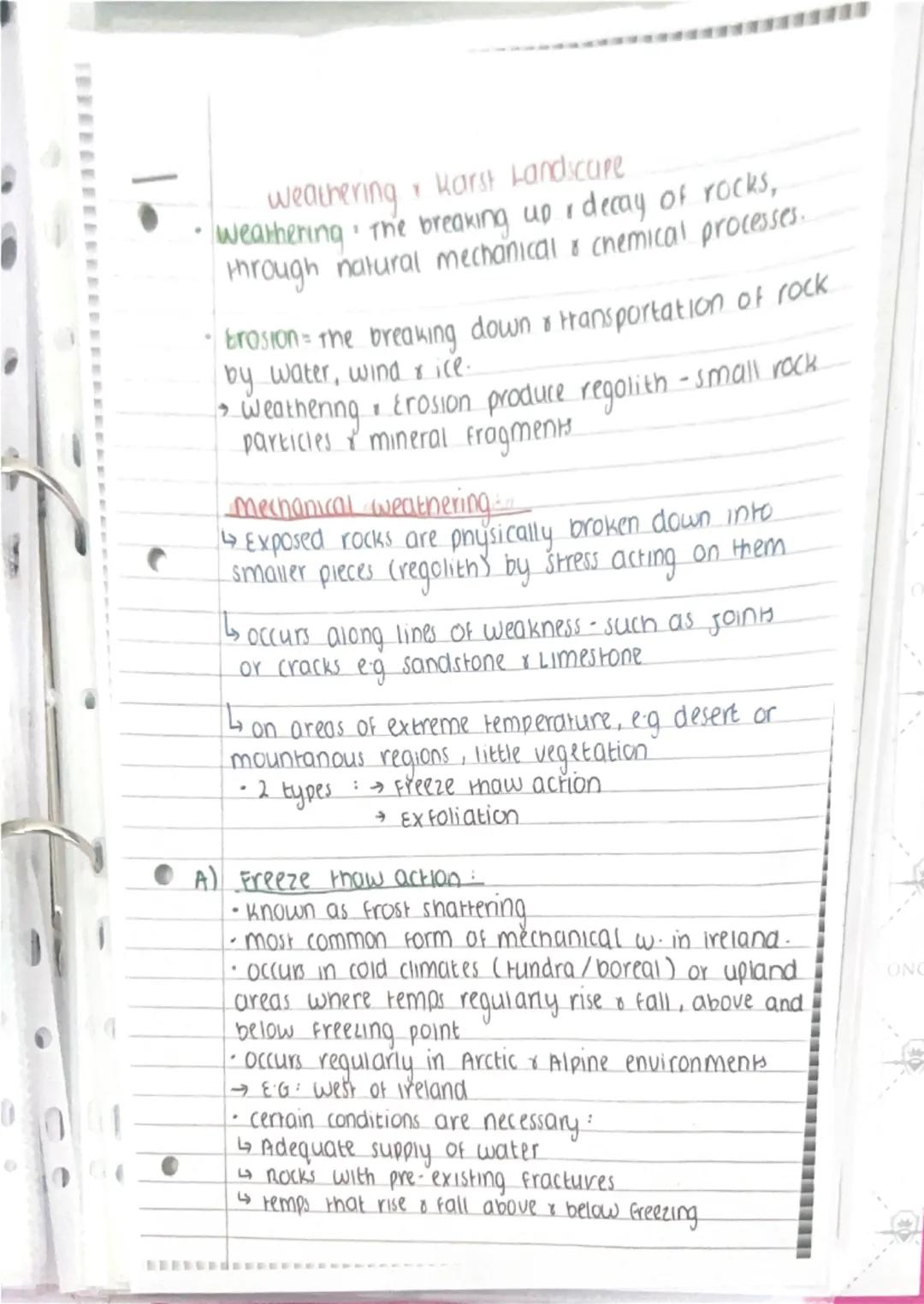
Understanding Weathering and Erosion
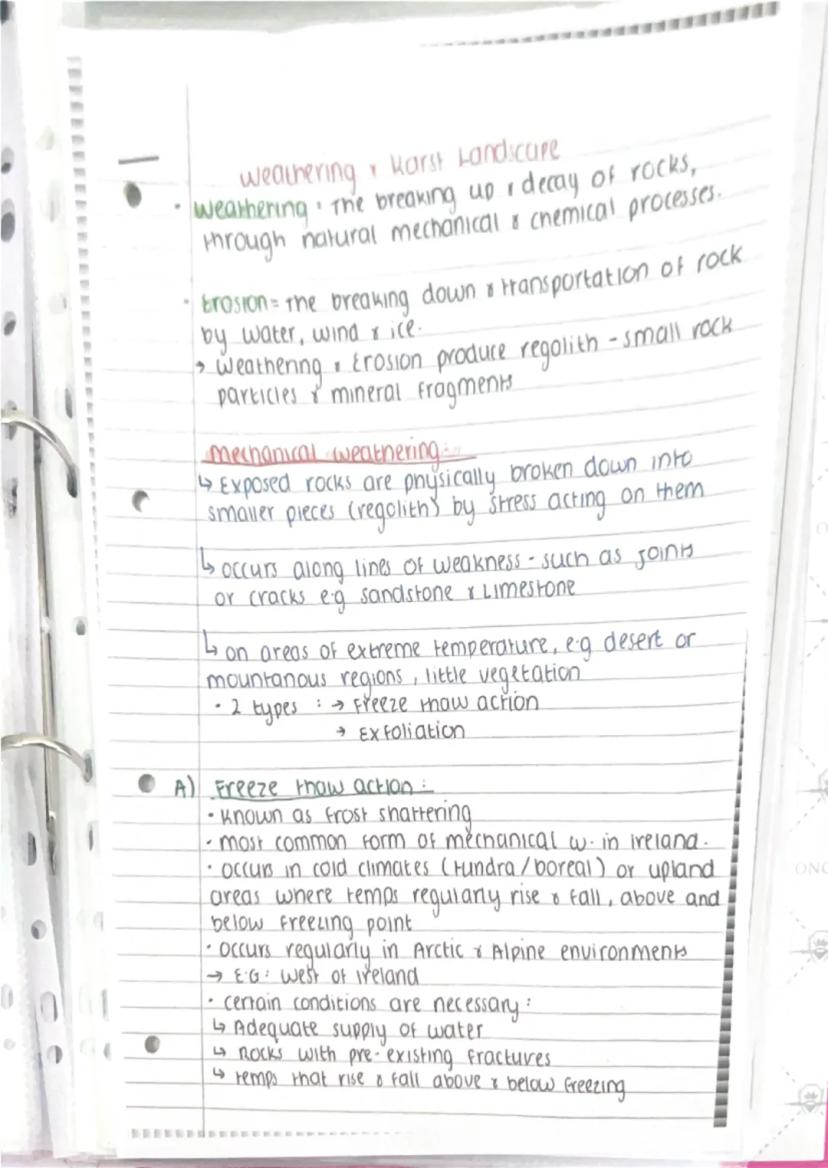
Weathering is basically nature's way of breaking up and decaying rocks through natural processes. Think of it as rocks getting worn down over time by the elements around them.
There's an important difference between weathering and erosion. Weathering breaks rocks down where they are, whilst erosion actually moves these broken pieces around using water, wind, or ice. Together, they create regolith - those small rock particles and mineral fragments you see scattered about.
Mechanical weathering physically breaks rocks into smaller pieces, especially along weak spots like cracks and joints. This happens most in places with extreme temperatures and little vegetation, like deserts or mountains.
Did you know? The most common type of mechanical weathering in Ireland is freeze-thaw action, also called frost shattering!
2
of 8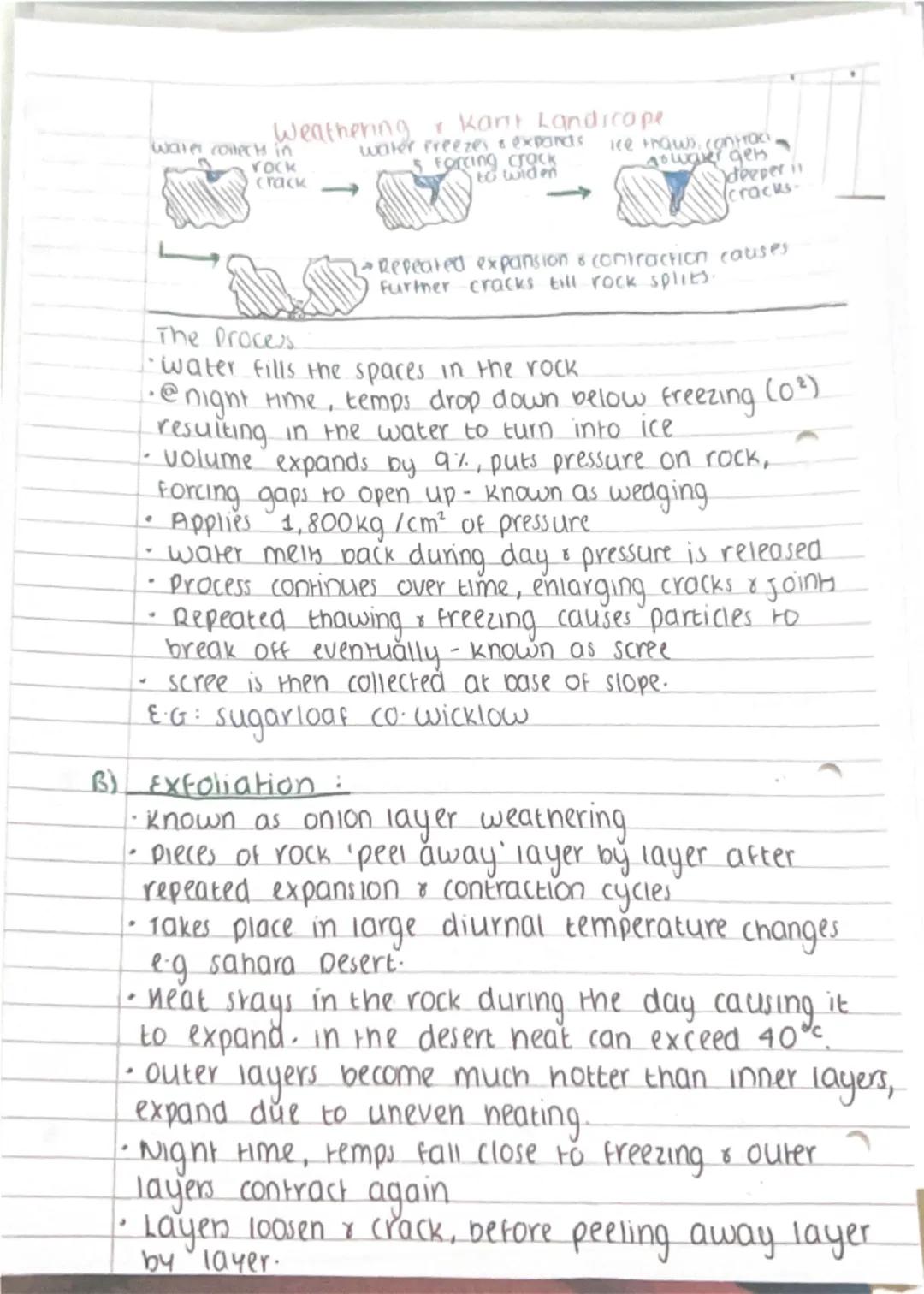
Freeze-Thaw Action
This process is constantly reshaping Ireland's landscape, especially in upland areas where temperatures regularly swing above and below freezing.
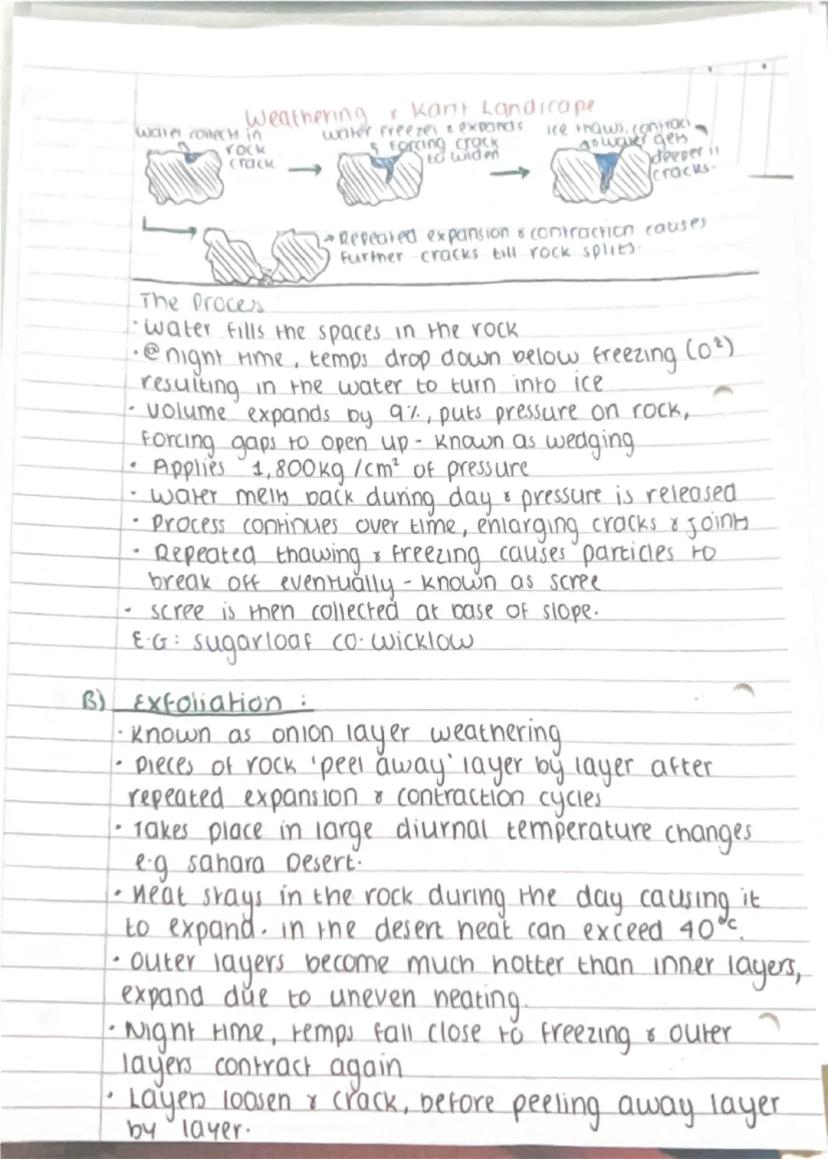
The process is surprisingly powerful. Water seeps into rock cracks, then freezes at night when temperatures drop below 0°C. When water turns to ice, it expands by 9%, putting massive pressure on the rock - about 1,800kg per square centimetre! This forces the cracks to widen.
During the day, the ice melts and pressure releases, but the damage is done. This cycle repeats over time, eventually breaking off rock particles called scree that collect at the bottom of slopes. You can see brilliant examples of this at Sugarloaf Mountain in County Wicklow.
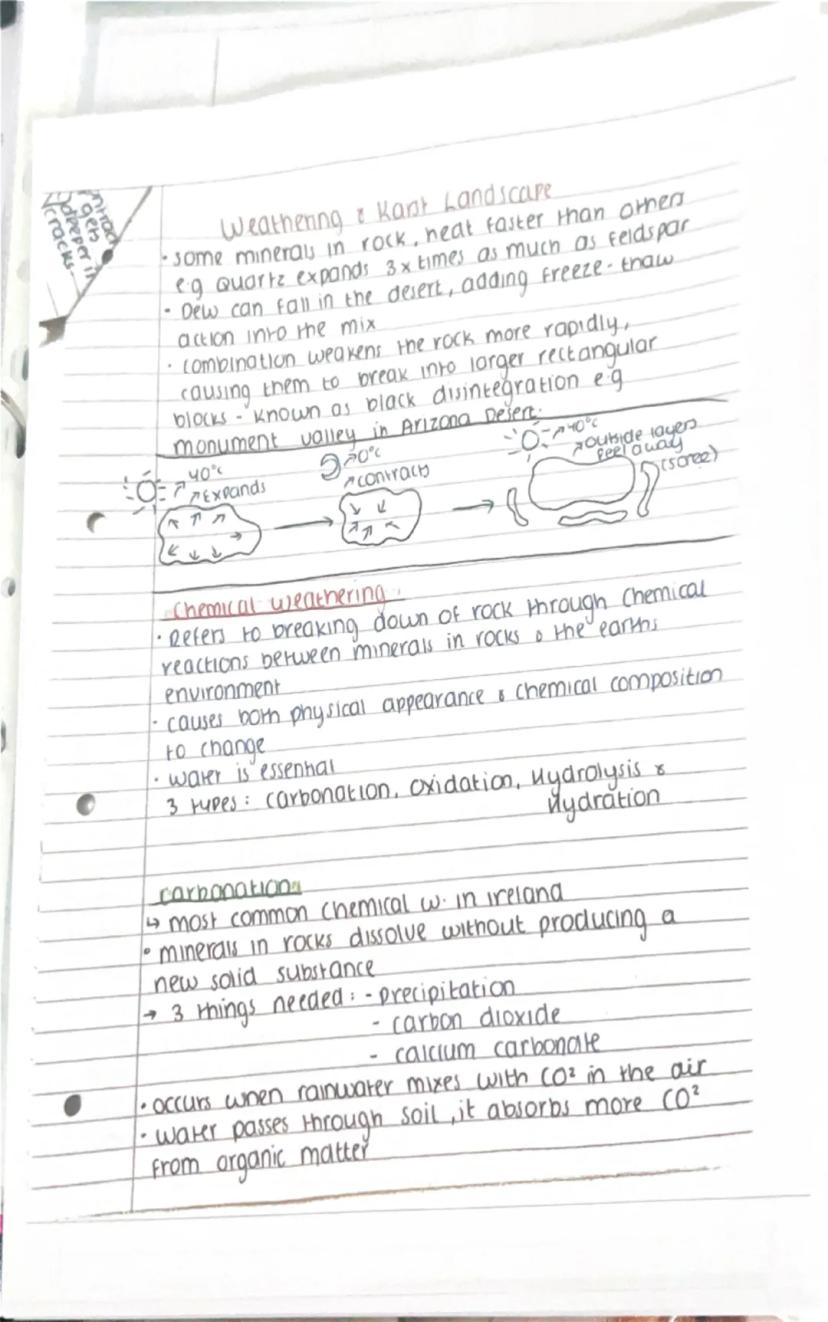
Exfoliation works differently - it's like an onion losing its layers. In places with huge daily temperature changes (like the Sahara Desert), rocks expand and contract so much that outer layers literally peel away, creating rectangular blocks.
Remember: Freeze-thaw needs three things: water supply, fractured rocks, and temperatures that swing above and below freezing.
3
of 8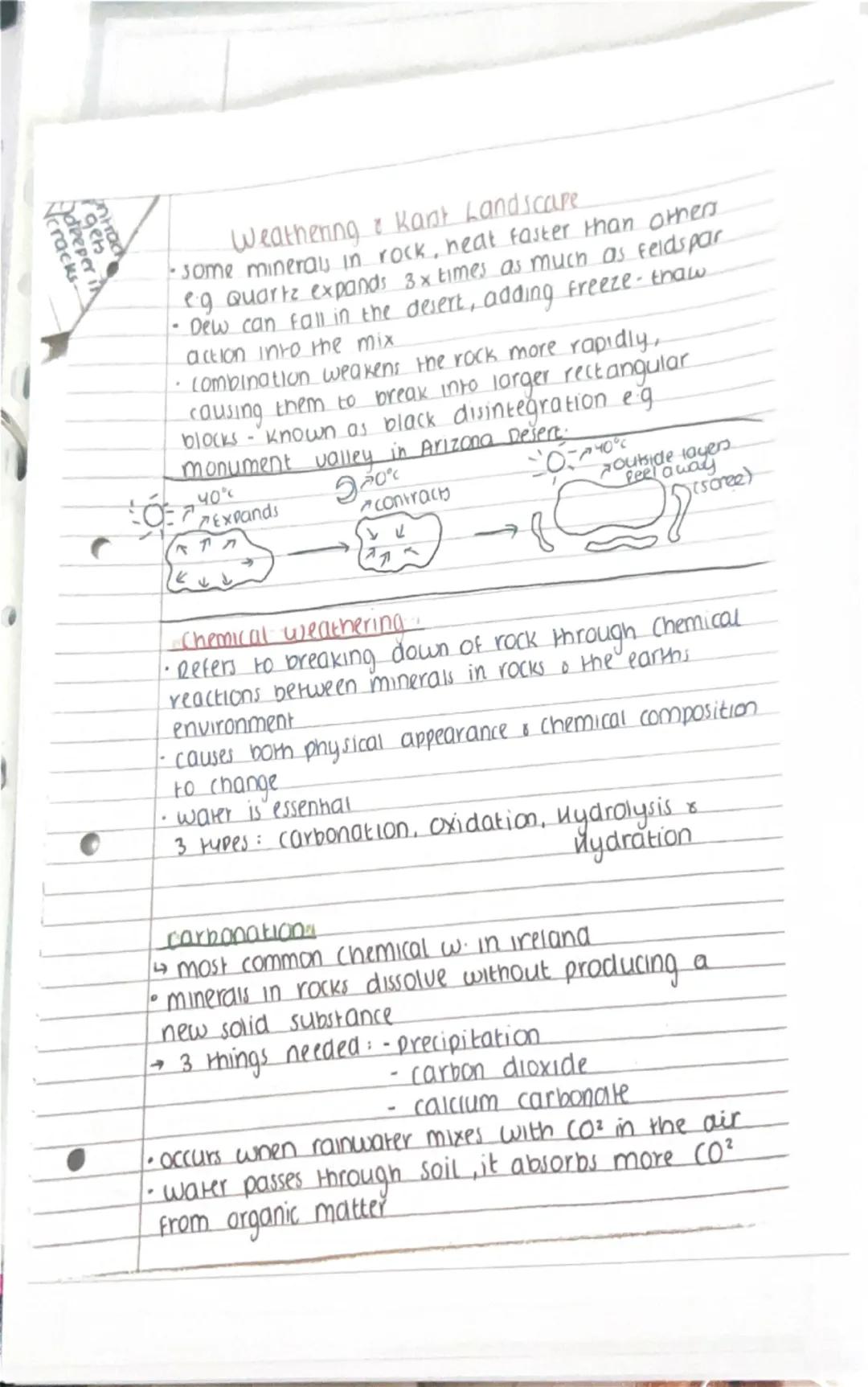
Chemical Weathering Processes
Chemical weathering changes both how rocks look and what they're made of through chemical reactions. Water is absolutely essential for this process to work.
The three main types you need to know are carbonation, oxidation, and hydrolysis. Each attacks rocks in different ways, breaking down their mineral structure from the inside out.
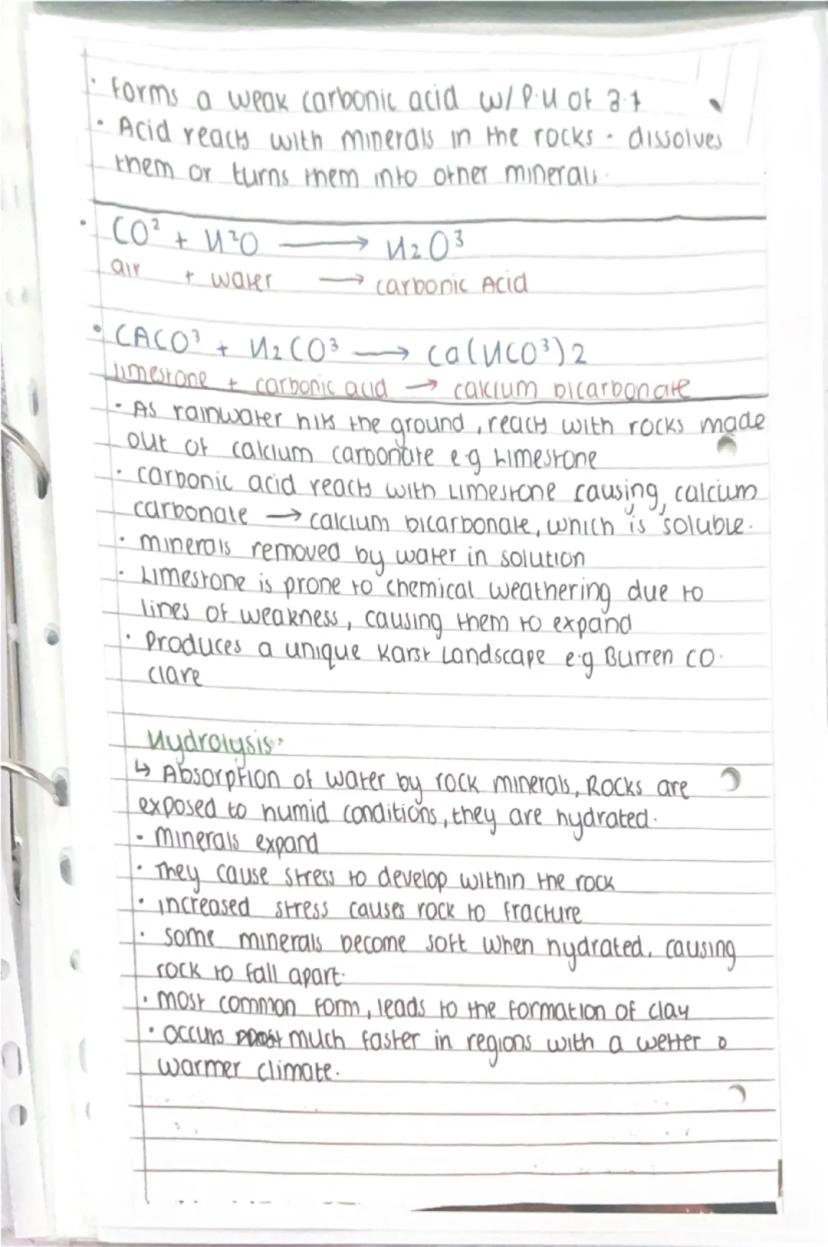
Carbonation is Ireland's most important chemical weathering process. It happens when rainwater mixes with carbon dioxide in the air, creating weak carbonic acid with a pH of 3.7. This acid becomes even stronger as it passes through soil and picks up more CO₂ from organic matter.
When this carbonic acid hits limestone (which is made of calcium carbonate), it dissolves it completely. The limestone turns into calcium bicarbonate, which water can easily wash away. This process creates Ireland's unique karst landscapes, like the spectacular Burren in County Clare.
Key reaction: Limestone + carbonic acid → calcium bicarbonate (which dissolves away)
4
of 8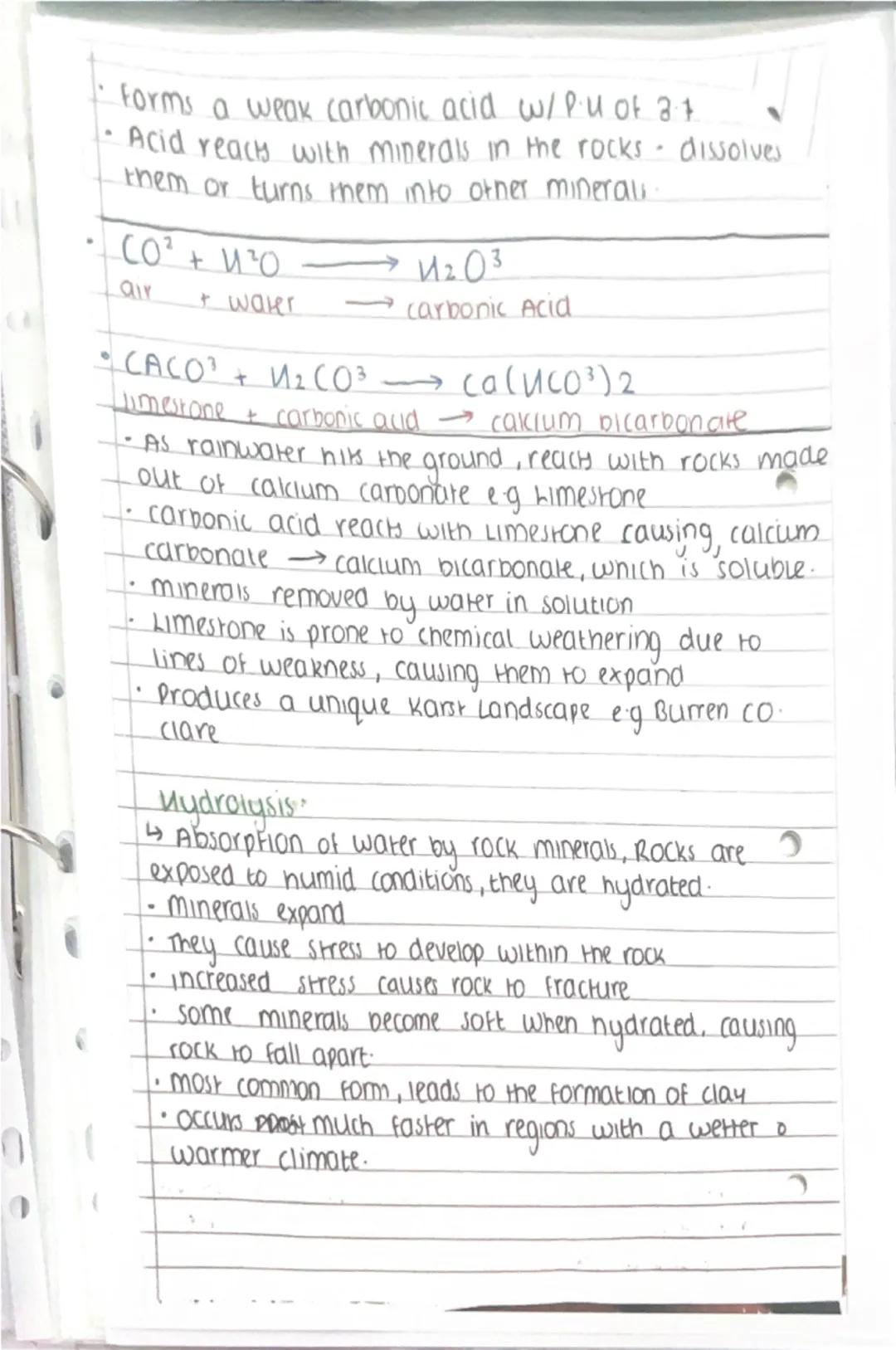
Hydrolysis and Limestone Landscapes
Hydrolysis happens when rock minerals absorb water and expand, creating stress that fractures the rock. Some minerals become soft when hydrated, causing rocks to fall apart completely. This process works much faster in warm, wet climates.
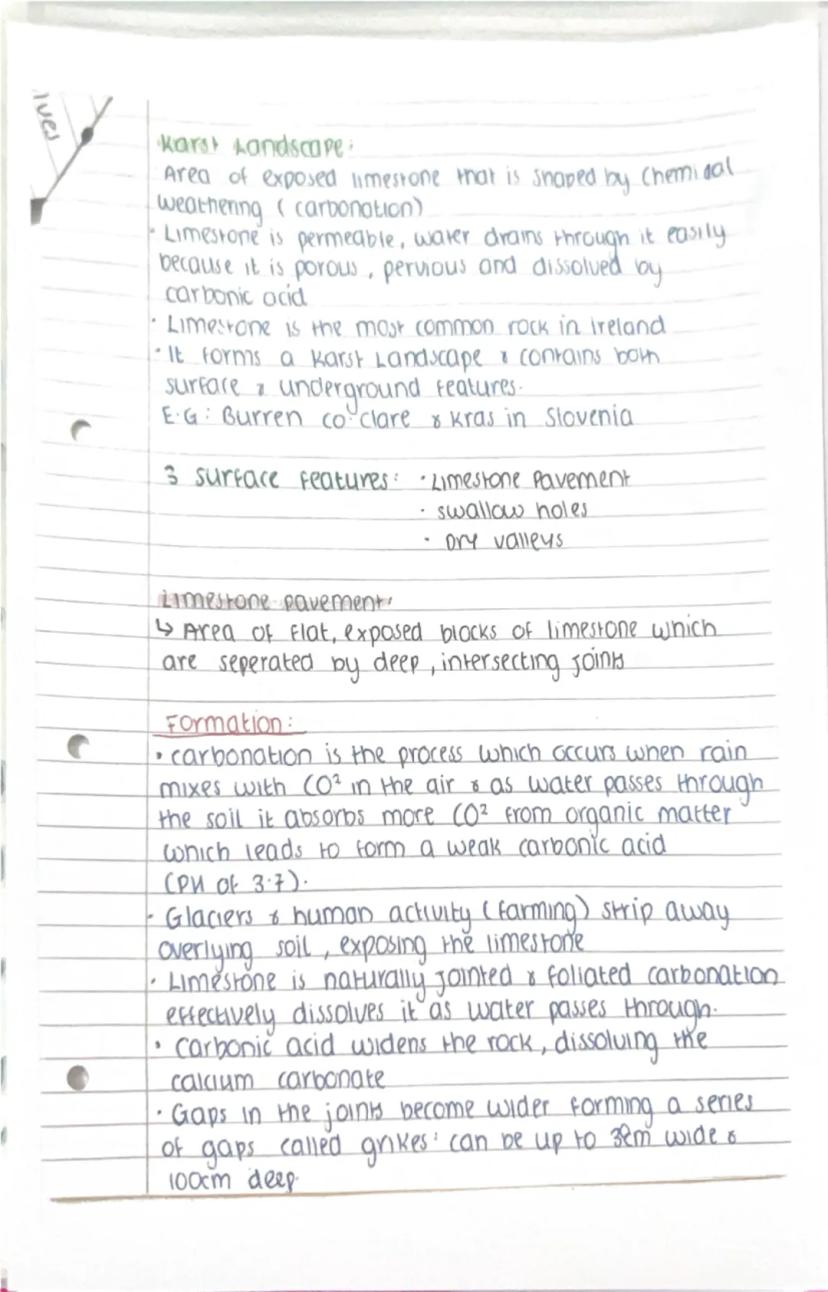
Karst landscapes are areas of exposed limestone shaped entirely by chemical weathering, particularly carbonation. Limestone is perfect for this because it's permeable - water drains through it easily since it's both porous and easily dissolved by carbonic acid.
These landscapes contain both surface and underground features that make them fascinating to study. Ireland has plenty of limestone - it's our most common rock type - which explains why karst features are so widespread here.
The three main surface features you'll encounter are limestone pavements, swallow holes, and dry valleys. Each tells a story about how chemical weathering has shaped our landscape over thousands of years.
Fun fact: The Burren covers 250 square kilometres and formed 350 million years ago when Ireland was 10° south of the equator in tropical waters!
5
of 8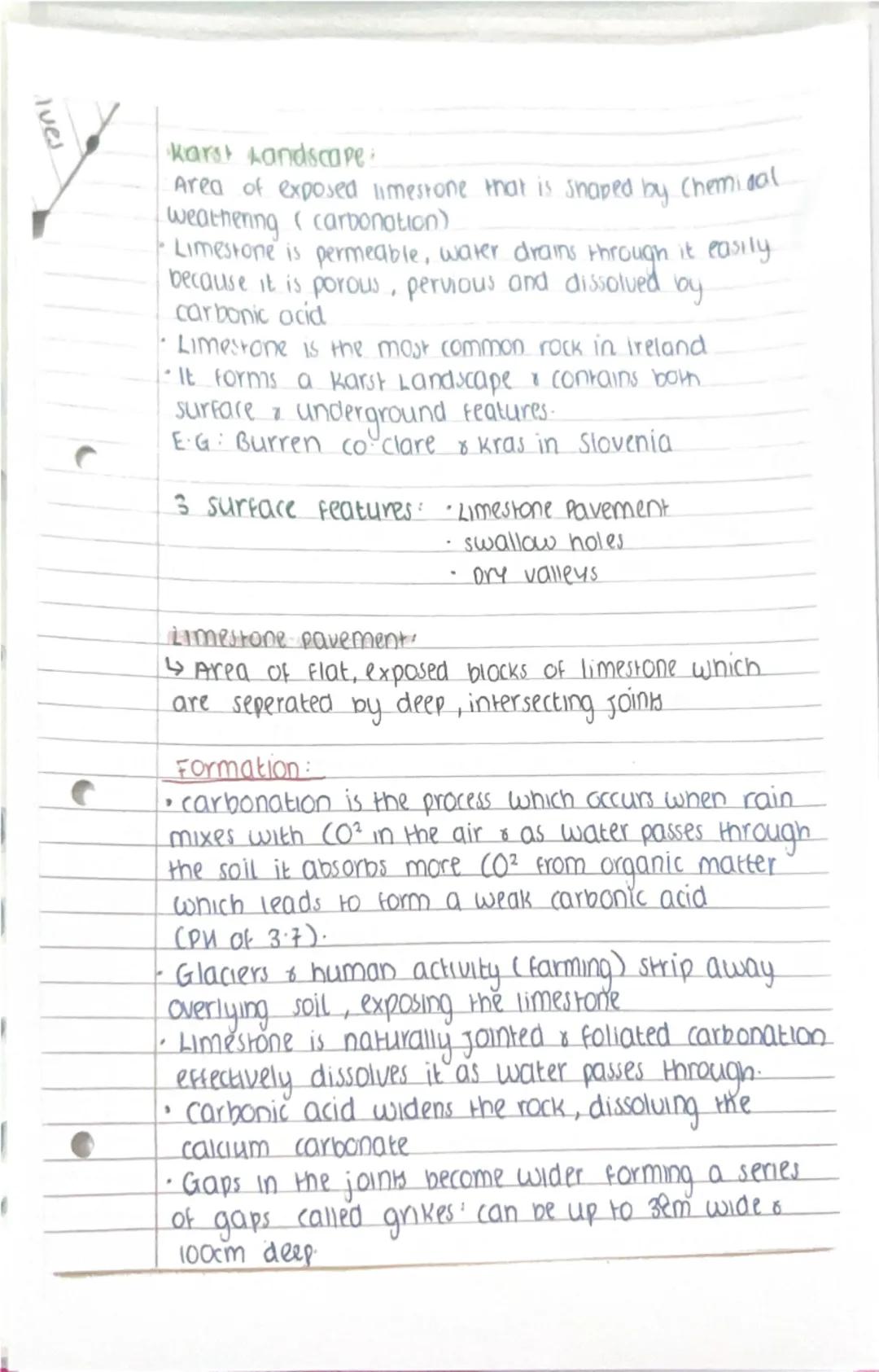
Limestone Pavements
Limestone pavements are those distinctive flat, exposed blocks of limestone separated by deep, intersecting cracks. They look almost like giant stone puzzles scattered across the landscape.
The formation process starts with carbonation creating weak carbonic acid from rainwater and CO₂. Then glaciers and human farming activities strip away the overlying soil, exposing the limestone underneath.
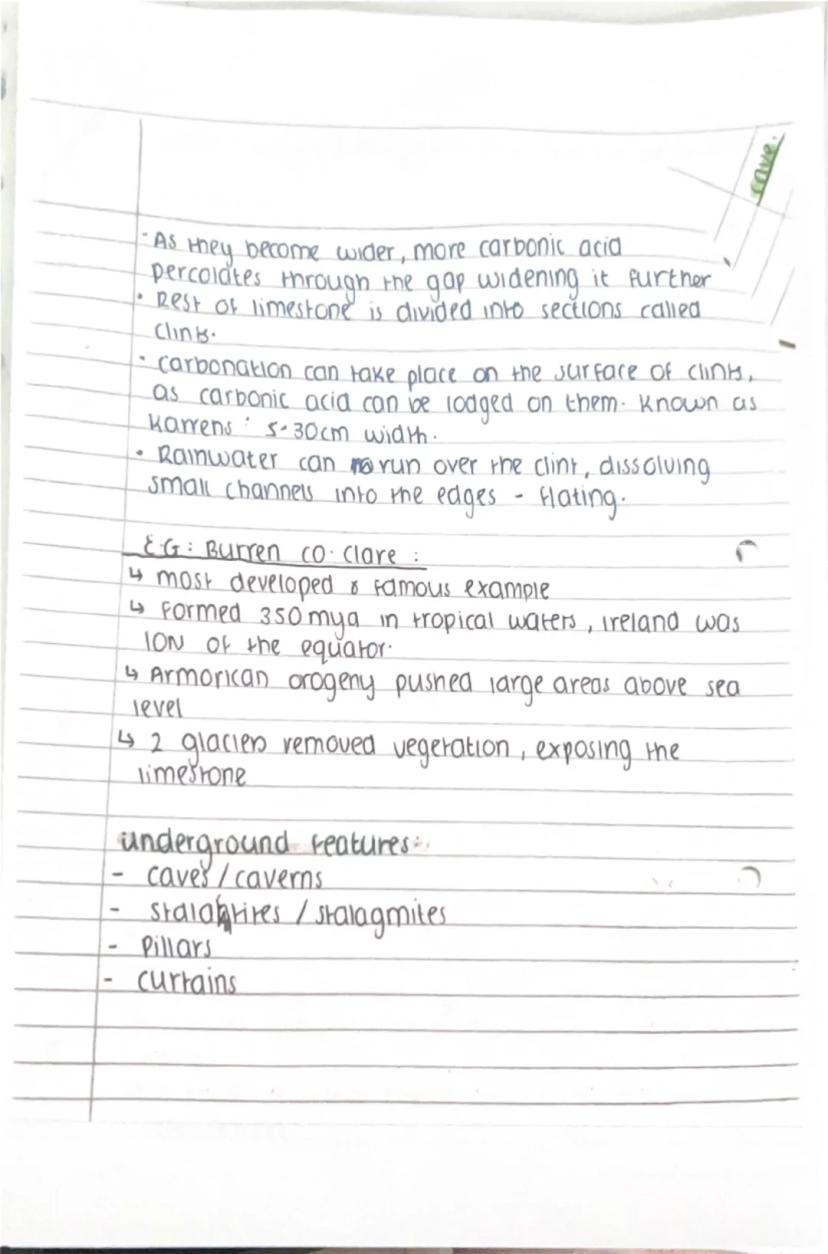
Since limestone is naturally jointed and fractured, the carbonic acid gets to work dissolving the calcium carbonate. As it passes through these natural weak points, the acid widens the gaps, creating deep cracks called grikes that can be up to 5cm wide and 100cm deep.
The remaining limestone sections between the grikes are called clints. Carbonation also works on the surface of clints, where carbonic acid creates small channels called karren (5-30cm wide) and fluting around the edges.
The Burren example: This is Ireland's most developed limestone pavement, exposed when Armorican mountain-building pushed it above sea level and glaciers removed all vegetation.
6
of 8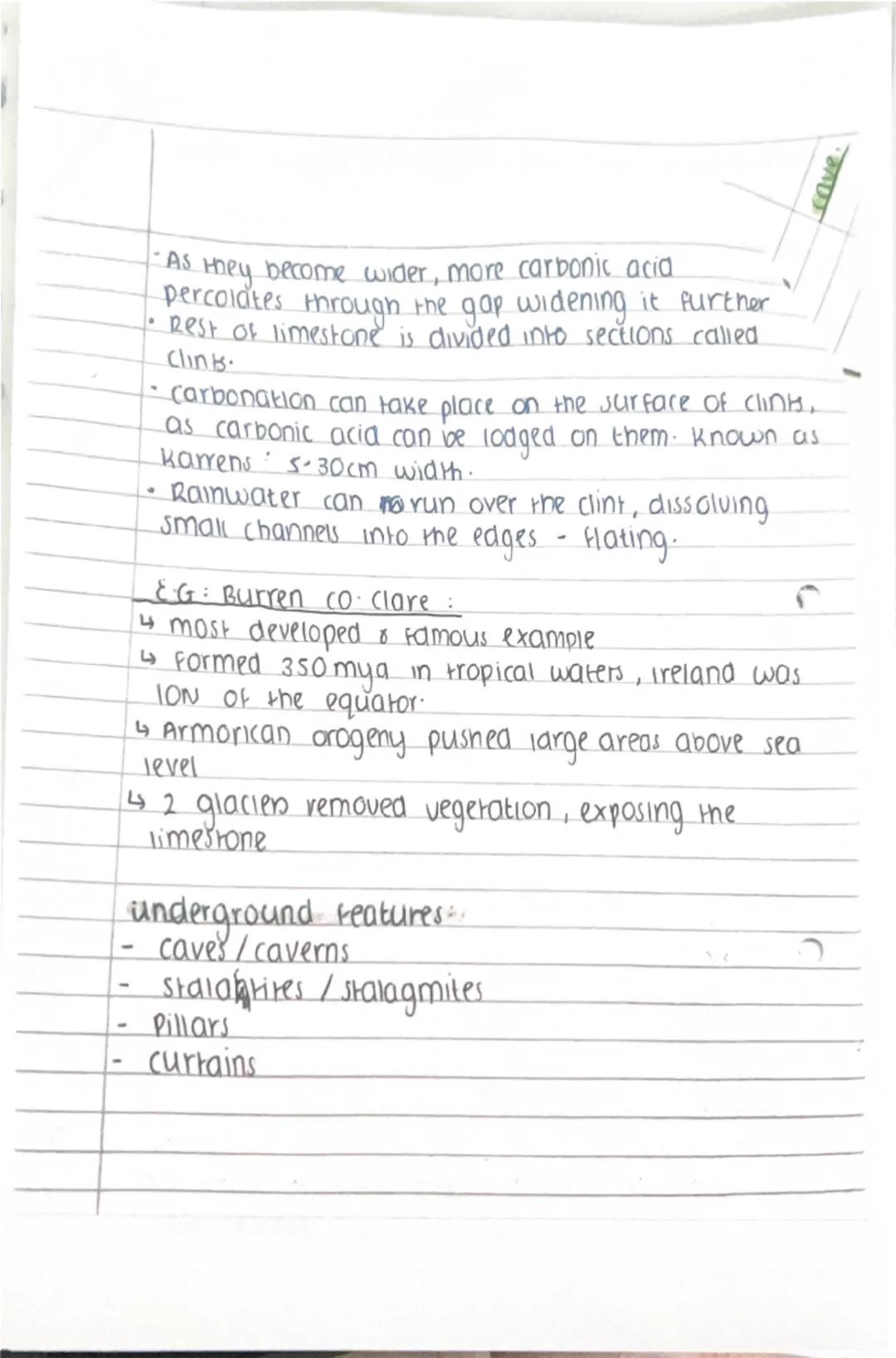
Underground Cave Systems
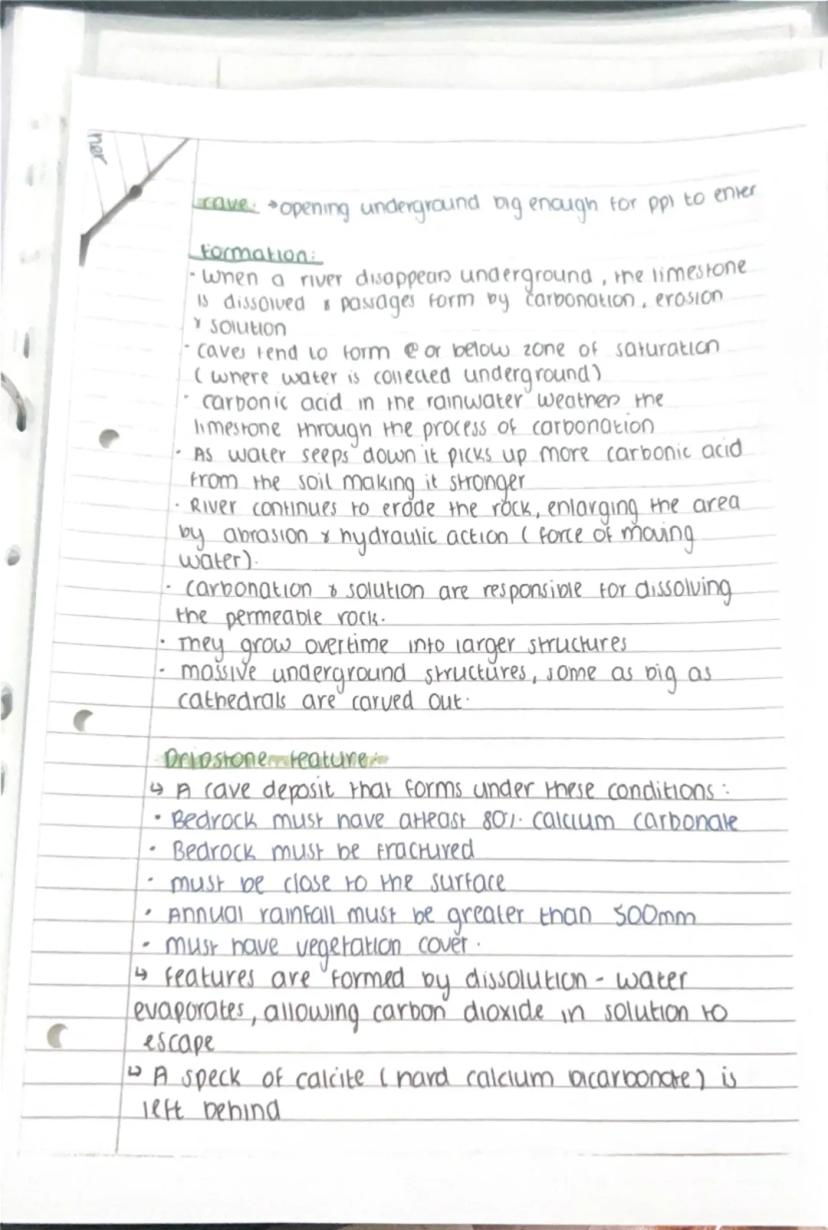
Caves are underground spaces big enough for people to enter, formed when rivers disappear underground and limestone gets dissolved away through carbonation, erosion, and solution.
Most caves form at or below the zone of saturation - that's where water collects underground. As carbonic acid seeps down through soil, it gets stronger and more effective at dissolving limestone.
Rivers continue eroding through abrasion and hydraulic action (the sheer force of moving water), while carbonation and solution dissolve the permeable rock. Over time, these processes carve out massive underground structures - some as big as cathedrals!
Dripstone features need specific conditions to form: bedrock with at least 80% calcium carbonate, fractured rock close to the surface, over 500mm annual rainfall, and vegetation cover. These features form through dissolution - when water evaporates, carbon dioxide escapes and leaves behind specks of calcite (hard calcium carbonate).
Amazing fact: Some Irish cave systems have been growing for thousands of years, with an average growth rate of just 127mm per 100 years!
7
of 8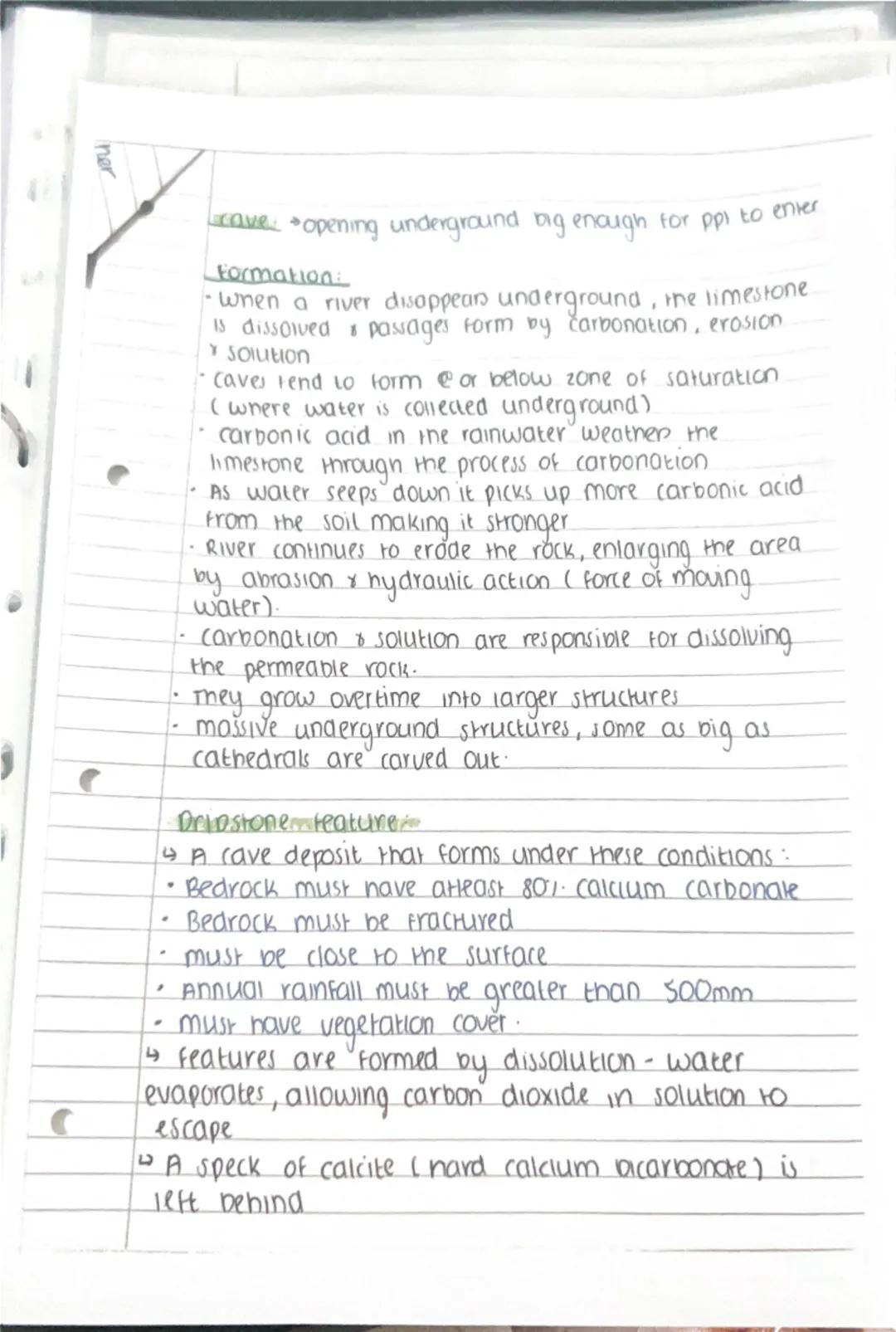
Stalactites and Stalagmites
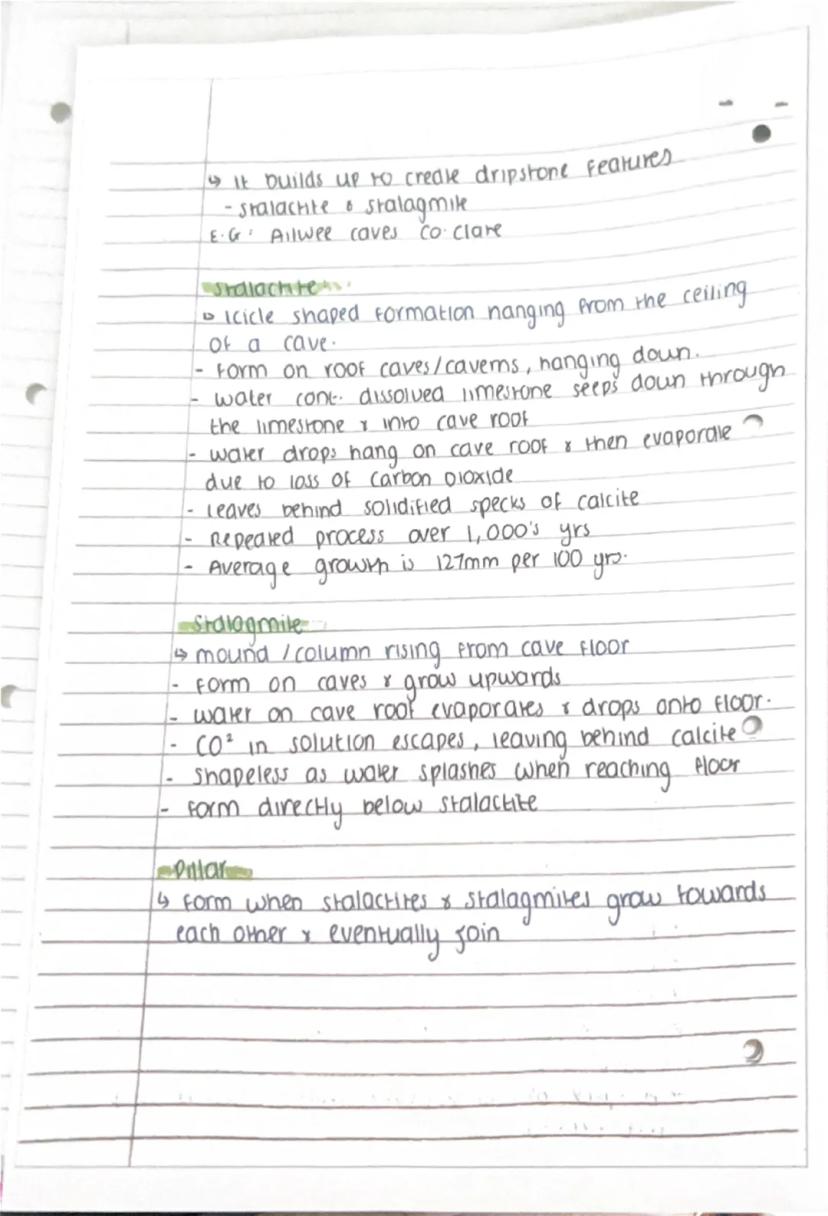
Stalactites are those icicle-shaped formations hanging from cave ceilings like rocky chandeliers. They form when water containing dissolved limestone seeps through the cave roof and hangs as drops.
When these water drops evaporate due to loss of carbon dioxide, they leave behind solidified specks of calcite. This process repeats over thousands of years, slowly building downward from the ceiling at an incredibly slow rate of about 127mm per 100 years.
Stalagmites work in reverse - they're mounds or columns rising from cave floors, growing upwards. They form when water drops from stalactites hit the floor, evaporate, and leave calcite deposits behind. They're usually more shapeless than stalactites because the water splashes when it hits the ground.
Pillars are the ultimate cave feature - they form when stalactites and stalagmites grow towards each other over thousands of years and eventually join together, creating stunning natural columns.
Visit Ailwee Caves: County Clare's Ailwee Caves showcase perfect examples of all these dripstone features in action!
8
of 8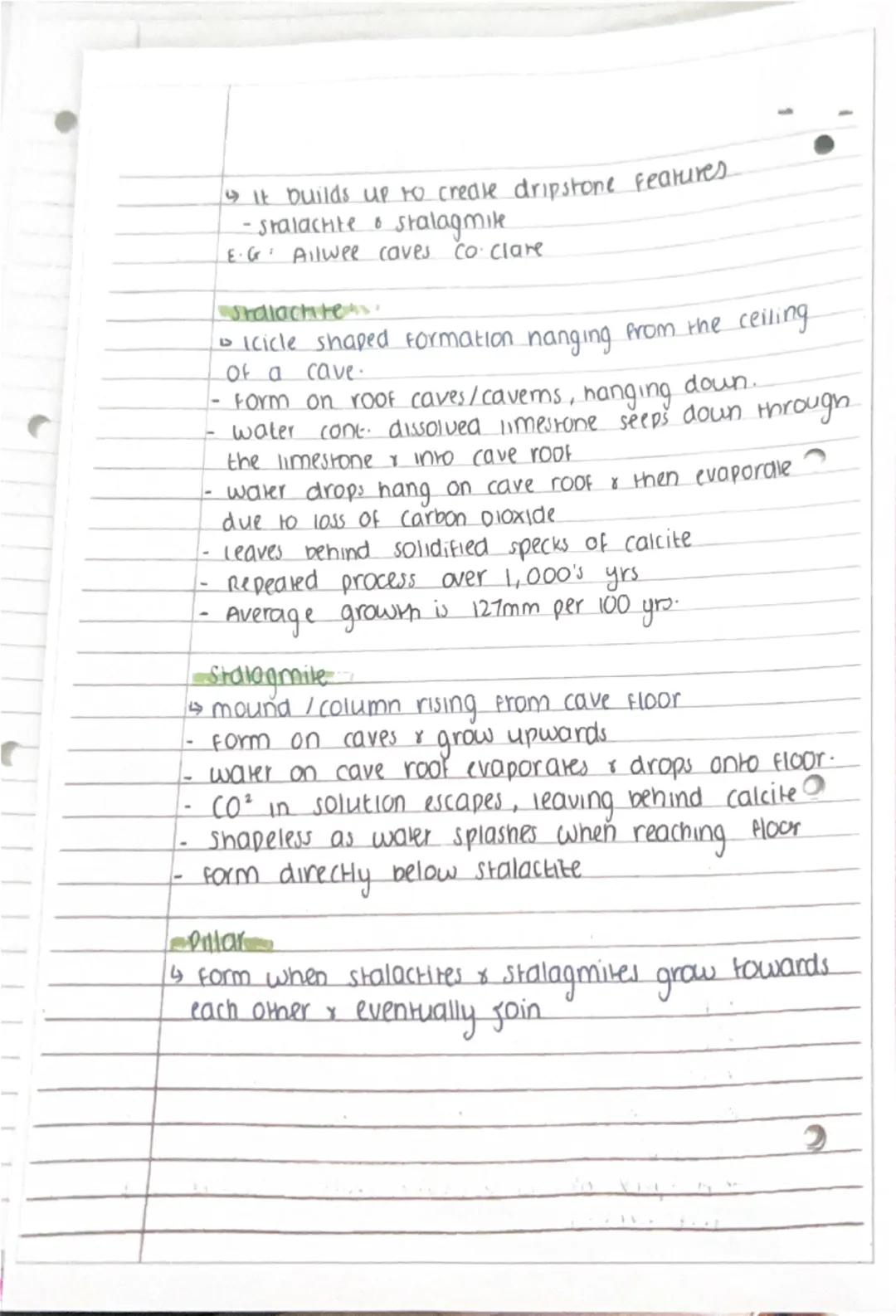
We thought you’d never ask...
Our AI companion is specifically built for the needs of students. Based on the millions of content pieces we have on the platform we can provide truly meaningful and relevant answers to students. But its not only about answers, the companion is even more about guiding students through their daily learning challenges, with personalised study plans, quizzes or content pieces in the chat and 100% personalisation based on the students skills and developments.
You can download the app in the Google Play Store and in the Apple App Store.
That's right! Enjoy free access to study content, connect with fellow students, and get instant help – all at your fingertips.
Most popular content in Geography
9GeographyRock notes geography
Geography
5th Year250
GeographyEarthquakes revision notes
Notes on earthquakes with diagrams
1st Year110
GeographyPlate Tectonics
This introduces the idea of tectonic plates, how they move, and how their movement causes major geological events.
2nd Year170
GeographyGeography notes on rocks
Includes types of rocks,uses of rocks, case studies
1st Year341
GeographyInside the Earth
Students will learn about the basic layers of the Earth: the crust, mantle, and core, understanding that our planet is made up of different parts.
1st Year51
GeographyGeography notes on weather
Includes instruments, diagrams, how to read weather
1st Year120
GeographyRocks Leaving Cert Geography
The Rock Diagram , including some notes on rocks
6th Year121
GeographyThe sea
Jc Geography
1st Year230
GeographyGeography notes On the sea
Includes costal erosion, sea cliffs, longshore drift etc.
1st Year160
Most popular content
9 English
Key Quotes : Sive
Key Quotes and explanations: Sive
6th Year2852
 Physics
Balanced and Unbalanced Forces
Students will explore how balanced forces result in no change in motion, while unbalanced forces cause an object to accelerate or change direction.
2nd Year592
 Irish
IrishIníon- le hÁine Durkin
Aine Durkin’s poem, Iníon: Themes & summary
5th Year890
IrishIrish oral questions and answers
Questions and answers for the leaving cert oral
5th Year4274
EnglishCultural Context : Shawshank Redemption : Sive : Small Things Like These
Comparative Study : Cultural Context : Shawshank Redemption, Sive and Small Things Like These
6th Year1430
IrishMo Ghrá-sa (Idir Lúibíní)
Notes on mo ghrá-sa
5th Year380
EnglishElizabeth Bishop notes
Elizabeth Bishop notes
6th Year1271
PhysicsTypes of Forces
Students will identify common forces such as gravity (pulling objects down), friction (opposing motion), and air resistance (slowing objects in the air).
2nd Year580
IrishAn Gaeilge Aiste
Irish Language essay
6th Year1320
Students love us — and so will you.
4.6/5App Store
4.7/5Google Play
The app is very easy to use and well designed. I have found everything I was looking for so far and have been able to learn a lot from the presentations! I will definitely use the app for a class assignment! And of course it also helps a lot as an inspiration.
Stefan SiOS user
This app is really great. There are so many study notes and help [...]. My problem subject is French, for example, and the app has so many options for help. Thanks to this app, I have improved my French. I would recommend it to anyone.
Samantha KlichAndroid user
Wow, I am really amazed. I just tried the app because I've seen it advertised many times and was absolutely stunned. This app is THE HELP you want for school and above all, it offers so many things, such as workouts and fact sheets, which have been VERY helpful to me personally.
AnnaiOS user
Geography10 views·Updated 16 Jul 2026·8 pagesUnderstanding Weathering and Karst Landscape Geography
C
Ciara Hanratty@ciarahanratty
Weathering is the natural process that breaks down rocks through mechanical and chemical forces, creating the landscape features we see around us. In Ireland, these processes are particularly important in shaping our limestone regions, like the famous Burren in County...
1
of 8
Sign up to see the content. It's free!
- Access to all documents
- Improve your grades
- Join milions of students
By signing up you accept Terms of Service and Privacy Policy
Understanding Weathering and Erosion
Weathering is basically nature's way of breaking up and decaying rocks through natural processes. Think of it as rocks getting worn down over time by the elements around them.
There's an important difference between weathering and erosion. Weathering breaks rocks down where they are, whilst erosion actually moves these broken pieces around using water, wind, or ice. Together, they create regolith - those small rock particles and mineral fragments you see scattered about.
Mechanical weathering physically breaks rocks into smaller pieces, especially along weak spots like cracks and joints. This happens most in places with extreme temperatures and little vegetation, like deserts or mountains.
Did you know? The most common type of mechanical weathering in Ireland is freeze-thaw action, also called frost shattering!
2
of 8Sign up to see the content. It's free!
- Access to all documents
- Improve your grades
- Join milions of students
By signing up you accept Terms of Service and Privacy Policy
Freeze-Thaw Action
This process is constantly reshaping Ireland's landscape, especially in upland areas where temperatures regularly swing above and below freezing.
The process is surprisingly powerful. Water seeps into rock cracks, then freezes at night when temperatures drop below 0°C. When water turns to ice, it expands by 9%, putting massive pressure on the rock - about 1,800kg per square centimetre! This forces the cracks to widen.
During the day, the ice melts and pressure releases, but the damage is done. This cycle repeats over time, eventually breaking off rock particles called scree that collect at the bottom of slopes. You can see brilliant examples of this at Sugarloaf Mountain in County Wicklow.
Exfoliation works differently - it's like an onion losing its layers. In places with huge daily temperature changes (like the Sahara Desert), rocks expand and contract so much that outer layers literally peel away, creating rectangular blocks.
Remember: Freeze-thaw needs three things: water supply, fractured rocks, and temperatures that swing above and below freezing.
3
of 8Sign up to see the content. It's free!
- Access to all documents
- Improve your grades
- Join milions of students
By signing up you accept Terms of Service and Privacy Policy
Chemical Weathering Processes
Chemical weathering changes both how rocks look and what they're made of through chemical reactions. Water is absolutely essential for this process to work.
The three main types you need to know are carbonation, oxidation, and hydrolysis. Each attacks rocks in different ways, breaking down their mineral structure from the inside out.
Carbonation is Ireland's most important chemical weathering process. It happens when rainwater mixes with carbon dioxide in the air, creating weak carbonic acid with a pH of 3.7. This acid becomes even stronger as it passes through soil and picks up more CO₂ from organic matter.
When this carbonic acid hits limestone (which is made of calcium carbonate), it dissolves it completely. The limestone turns into calcium bicarbonate, which water can easily wash away. This process creates Ireland's unique karst landscapes, like the spectacular Burren in County Clare.
Key reaction: Limestone + carbonic acid → calcium bicarbonate (which dissolves away)
4
of 8Sign up to see the content. It's free!
- Access to all documents
- Improve your grades
- Join milions of students
By signing up you accept Terms of Service and Privacy Policy
Hydrolysis and Limestone Landscapes
Hydrolysis happens when rock minerals absorb water and expand, creating stress that fractures the rock. Some minerals become soft when hydrated, causing rocks to fall apart completely. This process works much faster in warm, wet climates.
Karst landscapes are areas of exposed limestone shaped entirely by chemical weathering, particularly carbonation. Limestone is perfect for this because it's permeable - water drains through it easily since it's both porous and easily dissolved by carbonic acid.
These landscapes contain both surface and underground features that make them fascinating to study. Ireland has plenty of limestone - it's our most common rock type - which explains why karst features are so widespread here.
The three main surface features you'll encounter are limestone pavements, swallow holes, and dry valleys. Each tells a story about how chemical weathering has shaped our landscape over thousands of years.
Fun fact: The Burren covers 250 square kilometres and formed 350 million years ago when Ireland was 10° south of the equator in tropical waters!
5
of 8Sign up to see the content. It's free!
- Access to all documents
- Improve your grades
- Join milions of students
By signing up you accept Terms of Service and Privacy Policy
Limestone Pavements
Limestone pavements are those distinctive flat, exposed blocks of limestone separated by deep, intersecting cracks. They look almost like giant stone puzzles scattered across the landscape.
The formation process starts with carbonation creating weak carbonic acid from rainwater and CO₂. Then glaciers and human farming activities strip away the overlying soil, exposing the limestone underneath.
Since limestone is naturally jointed and fractured, the carbonic acid gets to work dissolving the calcium carbonate. As it passes through these natural weak points, the acid widens the gaps, creating deep cracks called grikes that can be up to 5cm wide and 100cm deep.
The remaining limestone sections between the grikes are called clints. Carbonation also works on the surface of clints, where carbonic acid creates small channels called karren (5-30cm wide) and fluting around the edges.
The Burren example: This is Ireland's most developed limestone pavement, exposed when Armorican mountain-building pushed it above sea level and glaciers removed all vegetation.
6
of 8Sign up to see the content. It's free!
- Access to all documents
- Improve your grades
- Join milions of students
By signing up you accept Terms of Service and Privacy Policy
Underground Cave Systems
Caves are underground spaces big enough for people to enter, formed when rivers disappear underground and limestone gets dissolved away through carbonation, erosion, and solution.
Most caves form at or below the zone of saturation - that's where water collects underground. As carbonic acid seeps down through soil, it gets stronger and more effective at dissolving limestone.
Rivers continue eroding through abrasion and hydraulic action (the sheer force of moving water), while carbonation and solution dissolve the permeable rock. Over time, these processes carve out massive underground structures - some as big as cathedrals!
Dripstone features need specific conditions to form: bedrock with at least 80% calcium carbonate, fractured rock close to the surface, over 500mm annual rainfall, and vegetation cover. These features form through dissolution - when water evaporates, carbon dioxide escapes and leaves behind specks of calcite (hard calcium carbonate).
Amazing fact: Some Irish cave systems have been growing for thousands of years, with an average growth rate of just 127mm per 100 years!
7
of 8Sign up to see the content. It's free!
- Access to all documents
- Improve your grades
- Join milions of students
By signing up you accept Terms of Service and Privacy Policy
Stalactites and Stalagmites
Stalactites are those icicle-shaped formations hanging from cave ceilings like rocky chandeliers. They form when water containing dissolved limestone seeps through the cave roof and hangs as drops.
When these water drops evaporate due to loss of carbon dioxide, they leave behind solidified specks of calcite. This process repeats over thousands of years, slowly building downward from the ceiling at an incredibly slow rate of about 127mm per 100 years.
Stalagmites work in reverse - they're mounds or columns rising from cave floors, growing upwards. They form when water drops from stalactites hit the floor, evaporate, and leave calcite deposits behind. They're usually more shapeless than stalactites because the water splashes when it hits the ground.
Pillars are the ultimate cave feature - they form when stalactites and stalagmites grow towards each other over thousands of years and eventually join together, creating stunning natural columns.
Visit Ailwee Caves: County Clare's Ailwee Caves showcase perfect examples of all these dripstone features in action!
8
of 8Sign up to see the content. It's free!
- Access to all documents
- Improve your grades
- Join milions of students
By signing up you accept Terms of Service and Privacy Policy
We thought you’d never ask...
Our AI companion is specifically built for the needs of students. Based on the millions of content pieces we have on the platform we can provide truly meaningful and relevant answers to students. But its not only about answers, the companion is even more about guiding students through their daily learning challenges, with personalised study plans, quizzes or content pieces in the chat and 100% personalisation based on the students skills and developments.
You can download the app in the Google Play Store and in the Apple App Store.
That's right! Enjoy free access to study content, connect with fellow students, and get instant help – all at your fingertips.
Most popular content in Geography
9GeographyRock notes geography
Geography
5th Year250
GeographyEarthquakes revision notes
Notes on earthquakes with diagrams
1st Year110
GeographyPlate Tectonics
This introduces the idea of tectonic plates, how they move, and how their movement causes major geological events.
2nd Year170
GeographyGeography notes on rocks
Includes types of rocks,uses of rocks, case studies
1st Year341
GeographyInside the Earth
Students will learn about the basic layers of the Earth: the crust, mantle, and core, understanding that our planet is made up of different parts.
1st Year51
GeographyGeography notes on weather
Includes instruments, diagrams, how to read weather
1st Year120
GeographyRocks Leaving Cert Geography
The Rock Diagram , including some notes on rocks
6th Year121
GeographyThe sea
Jc Geography
1st Year230
GeographyGeography notes On the sea
Includes costal erosion, sea cliffs, longshore drift etc.
1st Year160
Most popular content
9EnglishKey Quotes : Sive
Key Quotes and explanations: Sive
6th Year2852
PhysicsBalanced and Unbalanced Forces
Students will explore how balanced forces result in no change in motion, while unbalanced forces cause an object to accelerate or change direction.
2nd Year592
IrishIníon- le hÁine Durkin
Aine Durkin’s poem, Iníon: Themes & summary
5th Year890
IrishIrish oral questions and answers
Questions and answers for the leaving cert oral
5th Year4274
EnglishCultural Context : Shawshank Redemption : Sive : Small Things Like These
Comparative Study : Cultural Context : Shawshank Redemption, Sive and Small Things Like These
6th Year1430
IrishMo Ghrá-sa (Idir Lúibíní)
Notes on mo ghrá-sa
5th Year380
EnglishElizabeth Bishop notes
Elizabeth Bishop notes
6th Year1271
PhysicsTypes of Forces
Students will identify common forces such as gravity (pulling objects down), friction (opposing motion), and air resistance (slowing objects in the air).
2nd Year580
IrishAn Gaeilge Aiste
Irish Language essay
6th Year1320
Students love us — and so will you.
4.6/5App Store
4.7/5Google Play
The app is very easy to use and well designed. I have found everything I was looking for so far and have been able to learn a lot from the presentations! I will definitely use the app for a class assignment! And of course it also helps a lot as an inspiration.
Stefan SiOS user
This app is really great. There are so many study notes and help [...]. My problem subject is French, for example, and the app has so many options for help. Thanks to this app, I have improved my French. I would recommend it to anyone.
Samantha KlichAndroid user
Wow, I am really amazed. I just tried the app because I've seen it advertised many times and was absolutely stunned. This app is THE HELP you want for school and above all, it offers so many things, such as workouts and fact sheets, which have been VERY helpful to me personally.
AnnaiOS user