
Ever wondered how the sea shapes our coastlines? The constant...
 Geography23 views·Updated 6 Jul 2026·2 pages
Exploring the Wonders of the Sea
H
hannah @hannah_rwe32
1
of 2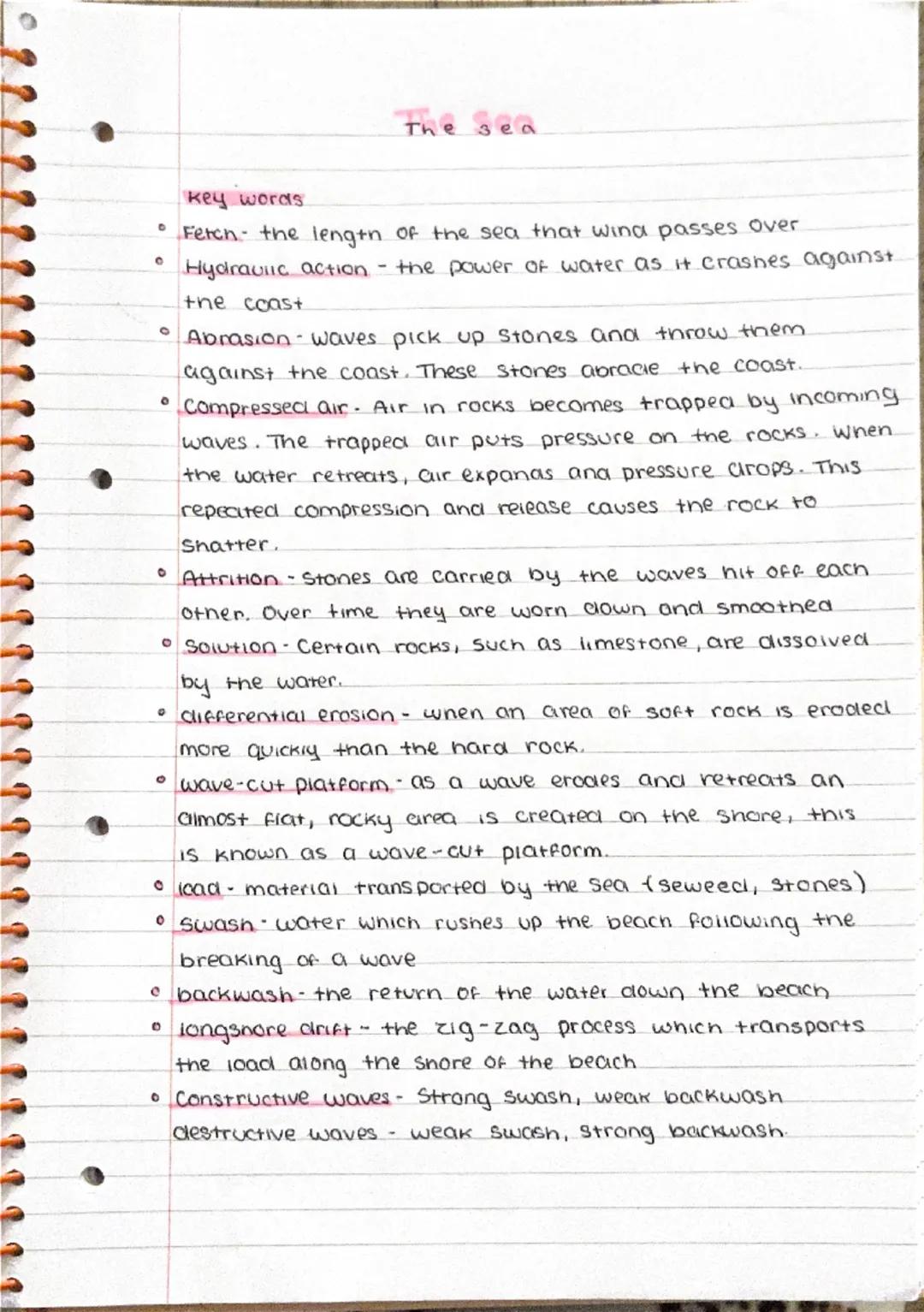
How the Sea Erodes Our Coastlines
You'll be amazed at how many different ways the sea can wear away rock! Hydraulic action is like nature's power washer - waves crash against cliffs with such force that they can smash solid rock. Think of it as the sea literally punching the coast.
Abrasion works differently - waves pick up stones and hurl them at the coastline like a never-ending rock fight. Meanwhile, compressed air gets trapped in cracks when waves hit, then expands when the water pulls back, causing rocks to shatter from the inside out.
The sea also carries materials through longshore drift, which moves stones and sand along beaches in a zig-zag pattern. Constructive waves build up beaches with strong swash (water rushing up), while destructive waves tear them down with powerful backwash (water flowing back).
Quick Tip: Remember that fetch (the distance wind travels over water) determines wave size - longer fetch means bigger, more powerful waves that cause more erosion!
2
of 2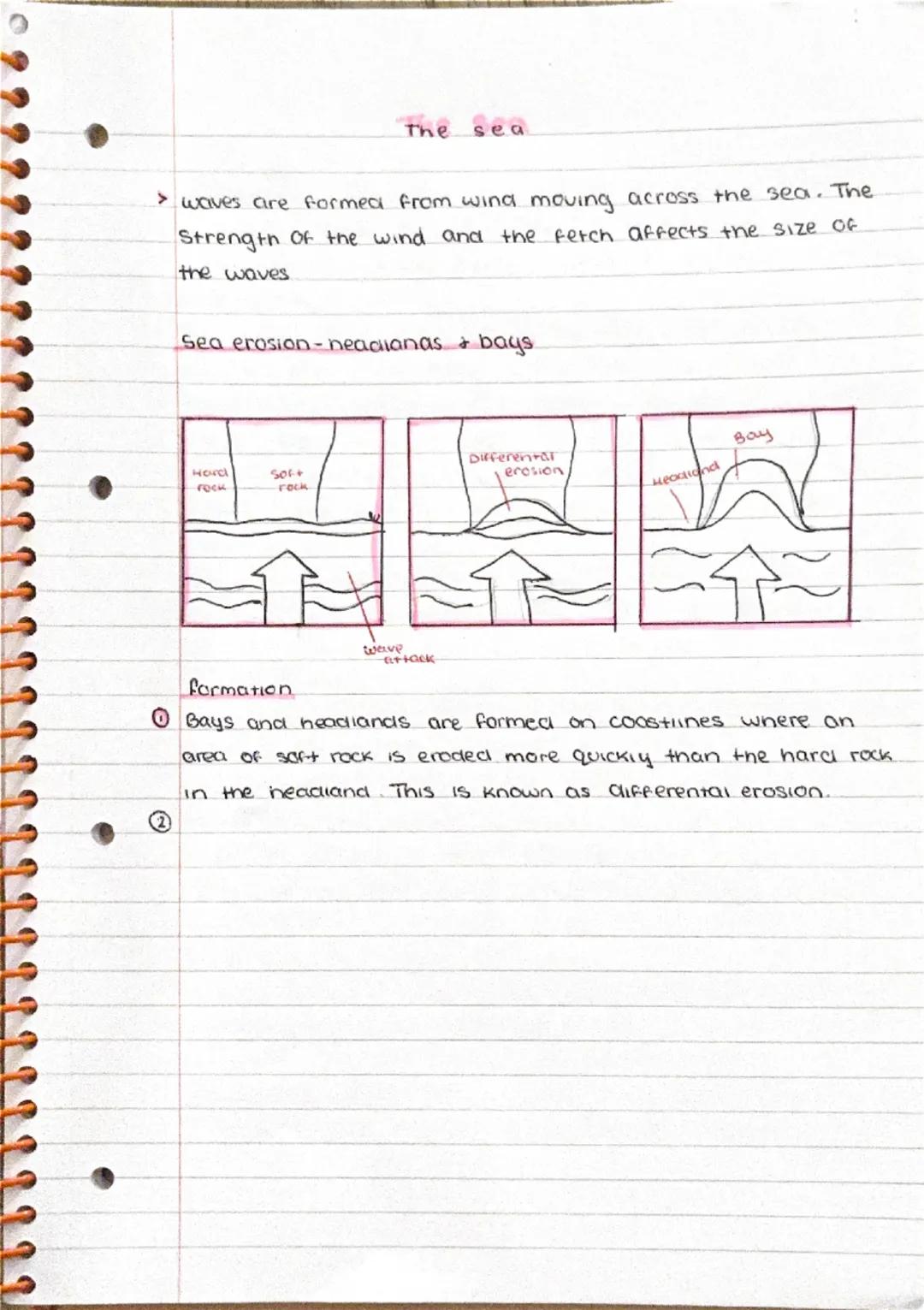
How Headlands and Bays Form
Here's where coastal erosion gets really interesting - it doesn't affect all rocks equally! Some rocks are tough cookies while others crumble easily when waves attack them.
Differential erosion is the key process here. When waves hit a coastline with mixed rock types, they erode soft rocks (like clay) much faster than hard rocks (like granite). Over thousands of years, this creates a stunning pattern of headlands and bays.
The soft rock gets carved out to form curved bays where the sea has eaten into the land. The hard rock stays put, sticking out into the sea as rocky headlands. As waves continue their relentless attack, they eventually cut back the cliff and leave behind a flat wave-cut platform at sea level.
Remember: This process takes ages to happen - we're talking thousands of years for major changes, but the sea never stops working!
We thought you’d never ask...
Our AI companion is specifically built for the needs of students. Based on the millions of content pieces we have on the platform we can provide truly meaningful and relevant answers to students. But its not only about answers, the companion is even more about guiding students through their daily learning challenges, with personalised study plans, quizzes or content pieces in the chat and 100% personalisation based on the students skills and developments.
You can download the app in the Google Play Store and in the Apple App Store.
That's right! Enjoy free access to study content, connect with fellow students, and get instant help – all at your fingertips.
Most popular content in Geography
7GeographyEarthquakes revision notes
Notes on earthquakes with diagrams
1st Year110
GeographyPlate Tectonics
This introduces the idea of tectonic plates, how they move, and how their movement causes major geological events.
2nd Year170
GeographyGeography notes On the sea
Includes costal erosion, sea cliffs, longshore drift etc.
1st Year160
GeographyGeography notes on rocks
Includes types of rocks,uses of rocks, case studies
1st Year341
GeographyGeography notes on weather
Includes instruments, diagrams, how to read weather
1st Year120
GeographyRocks Leaving Cert Geography
The Rock Diagram , including some notes on rocks
6th Year121
GeographyInside the Earth
Students will learn about the basic layers of the Earth: the crust, mantle, and core, understanding that our planet is made up of different parts.
1st Year51
Most popular content
9 English
Key Quotes : Sive
Key Quotes and explanations: Sive
6th Year2852
 Physics
Balanced and Unbalanced Forces
Students will explore how balanced forces result in no change in motion, while unbalanced forces cause an object to accelerate or change direction.
2nd Year592
 Irish
IrishIrish oral questions and answers
Questions and answers for the leaving cert oral
5th Year4274
IrishIníon- le hÁine Durkin
Aine Durkin’s poem, Iníon: Themes & summary
5th Year890
IrishMo Ghrá-sa (Idir Lúibíní)
Notes on mo ghrá-sa
5th Year380
IrishLC HL notes- Iníon (poem)
Includes poem in English and Irish, theme, key words & phrases
5th Year2324
EnglishCultural Context : Shawshank Redemption : Sive : Small Things Like These
Comparative Study : Cultural Context : Shawshank Redemption, Sive and Small Things Like These
6th Year1430
IrishAn Gaeilge Aiste
Irish Language essay
6th Year1320
EnglishElizabeth Bishop notes
Elizabeth Bishop notes
6th Year1271
Students love us — and so will you.
4.6/5App Store
4.7/5Google Play
The app is very easy to use and well designed. I have found everything I was looking for so far and have been able to learn a lot from the presentations! I will definitely use the app for a class assignment! And of course it also helps a lot as an inspiration.
Stefan SiOS user
This app is really great. There are so many study notes and help [...]. My problem subject is French, for example, and the app has so many options for help. Thanks to this app, I have improved my French. I would recommend it to anyone.
Samantha KlichAndroid user
Wow, I am really amazed. I just tried the app because I've seen it advertised many times and was absolutely stunned. This app is THE HELP you want for school and above all, it offers so many things, such as workouts and fact sheets, which have been VERY helpful to me personally.
AnnaiOS user
Geography23 views·Updated 6 Jul 2026·2 pagesExploring the Wonders of the Sea
H
hannah @hannah_rwe32
Ever wondered how the sea shapes our coastlines? The constant movement of waves creates some incredible landforms through powerful erosion processes that have been working for millions of years.
1
of 2
Sign up to see the content. It's free!
- Access to all documents
- Improve your grades
- Join milions of students
By signing up you accept Terms of Service and Privacy Policy
How the Sea Erodes Our Coastlines
You'll be amazed at how many different ways the sea can wear away rock! Hydraulic action is like nature's power washer - waves crash against cliffs with such force that they can smash solid rock. Think of it as the sea literally punching the coast.
Abrasion works differently - waves pick up stones and hurl them at the coastline like a never-ending rock fight. Meanwhile, compressed air gets trapped in cracks when waves hit, then expands when the water pulls back, causing rocks to shatter from the inside out.
The sea also carries materials through longshore drift, which moves stones and sand along beaches in a zig-zag pattern. Constructive waves build up beaches with strong swash (water rushing up), while destructive waves tear them down with powerful backwash (water flowing back).
Quick Tip: Remember that fetch (the distance wind travels over water) determines wave size - longer fetch means bigger, more powerful waves that cause more erosion!
2
of 2Sign up to see the content. It's free!
- Access to all documents
- Improve your grades
- Join milions of students
By signing up you accept Terms of Service and Privacy Policy
How Headlands and Bays Form
Here's where coastal erosion gets really interesting - it doesn't affect all rocks equally! Some rocks are tough cookies while others crumble easily when waves attack them.
Differential erosion is the key process here. When waves hit a coastline with mixed rock types, they erode soft rocks (like clay) much faster than hard rocks (like granite). Over thousands of years, this creates a stunning pattern of headlands and bays.
The soft rock gets carved out to form curved bays where the sea has eaten into the land. The hard rock stays put, sticking out into the sea as rocky headlands. As waves continue their relentless attack, they eventually cut back the cliff and leave behind a flat wave-cut platform at sea level.
Remember: This process takes ages to happen - we're talking thousands of years for major changes, but the sea never stops working!
We thought you’d never ask...
Our AI companion is specifically built for the needs of students. Based on the millions of content pieces we have on the platform we can provide truly meaningful and relevant answers to students. But its not only about answers, the companion is even more about guiding students through their daily learning challenges, with personalised study plans, quizzes or content pieces in the chat and 100% personalisation based on the students skills and developments.
You can download the app in the Google Play Store and in the Apple App Store.
That's right! Enjoy free access to study content, connect with fellow students, and get instant help – all at your fingertips.
Most popular content in Geography
7GeographyEarthquakes revision notes
Notes on earthquakes with diagrams
1st Year110
GeographyPlate Tectonics
This introduces the idea of tectonic plates, how they move, and how their movement causes major geological events.
2nd Year170
GeographyGeography notes On the sea
Includes costal erosion, sea cliffs, longshore drift etc.
1st Year160
GeographyGeography notes on rocks
Includes types of rocks,uses of rocks, case studies
1st Year341
GeographyGeography notes on weather
Includes instruments, diagrams, how to read weather
1st Year120
GeographyRocks Leaving Cert Geography
The Rock Diagram , including some notes on rocks
6th Year121
GeographyInside the Earth
Students will learn about the basic layers of the Earth: the crust, mantle, and core, understanding that our planet is made up of different parts.
1st Year51
Most popular content
9EnglishKey Quotes : Sive
Key Quotes and explanations: Sive
6th Year2852
PhysicsBalanced and Unbalanced Forces
Students will explore how balanced forces result in no change in motion, while unbalanced forces cause an object to accelerate or change direction.
2nd Year592
IrishIrish oral questions and answers
Questions and answers for the leaving cert oral
5th Year4274
IrishIníon- le hÁine Durkin
Aine Durkin’s poem, Iníon: Themes & summary
5th Year890
IrishMo Ghrá-sa (Idir Lúibíní)
Notes on mo ghrá-sa
5th Year380
IrishLC HL notes- Iníon (poem)
Includes poem in English and Irish, theme, key words & phrases
5th Year2324
EnglishCultural Context : Shawshank Redemption : Sive : Small Things Like These
Comparative Study : Cultural Context : Shawshank Redemption, Sive and Small Things Like These
6th Year1430
IrishAn Gaeilge Aiste
Irish Language essay
6th Year1320
EnglishElizabeth Bishop notes
Elizabeth Bishop notes
6th Year1271
Students love us — and so will you.
4.6/5App Store
4.7/5Google Play
The app is very easy to use and well designed. I have found everything I was looking for so far and have been able to learn a lot from the presentations! I will definitely use the app for a class assignment! And of course it also helps a lot as an inspiration.
Stefan SiOS user
This app is really great. There are so many study notes and help [...]. My problem subject is French, for example, and the app has so many options for help. Thanks to this app, I have improved my French. I would recommend it to anyone.
Samantha KlichAndroid user
Wow, I am really amazed. I just tried the app because I've seen it advertised many times and was absolutely stunned. This app is THE HELP you want for school and above all, it offers so many things, such as workouts and fact sheets, which have been VERY helpful to me personally.
AnnaiOS user